
San Clemente City Zoning Code
CHAPTER 17
56 - OVERLAY DISTRICTS AND STANDARDS
17.56.010 - Purpose and Intent.
The General Plan establishes a number of overlay designations for the City. These designations are to be used along with underlying land-use designations, such as residential, commercial, mixed-use, and open-space designations, also established in the General Plan. Overlay districts signify that an area or site has been identified to have distinct characteristics, requiring special development standards or guidelines beyond those for the underlying zoning designation. The General Plan details the goals, objectives and policies for areas with the overlay designations, which are meant to be used along with the goals, objectives and policies for the underlying zoning designation for an area. It is the purpose of this chapter to implement the General Plan's vision for the overlay districts through development regulations and guidelines specific to each overlay. The goals for each of the overlay districts is provided with a description of the district, in the following section.
(Ord. 1172 § 3 (part), 1996)
17.56.020 - Architectural (-A) Overlay District.
A.
Purpose and Intent. .....The purpose and intent of the Architectural ["-A"] Overlay designation is to signify a visually distinct district in San Clemente, containing structures characterized by two significant design orientations: 1) the City's traditional architectural style, Spanish Colonial Revival, and 2) a pedestrian orientation. The goals for areas with this designation are as follows to:
1.
Maintain and enhance the unique "Spanish-Village-by-the-Sea" character of specific areas of the City;
2.
Maintain a high quality of design consistent with the City's history, according to the General Plan Urban Design Element and City's Design Guidelines;
3.
Require new buildings and major remodels be designed to reflect the City's Spanish Colonial Revival, except for:
a.
Projects on properties along North El Camino Real between West Avenida Palizada and Calle Los Bolas, and on South El Camino Real between Avenida Rosa and Interstate-5 that may have Spanish Colonial Revival architecture or a true form of another Spanish architectural style, such as Mission, Monterey, or Mediterranean.
b.
Remodels of architecture of historically significant buildings with distinctive architecture other than Spanish Colonial Revival. These remodel projects are required to preserve and reinforce the character defining features and other aspects of the site and building's design that are architecturally significant and distinct.
4.
When Spanish Colonial Revival architecture is required, the goal of the [A] Overlay is to require site and structural development that exemplifies the Ole Hanson era, and, at the same time, allow creative interpretation of Spanish Colonial Revival architecture. If this section requires architecture other than Spanish Colonial Revival, the goal of the [A] Overlay is to require site and structural development ;that is consistent with the City's Design Guidelines and in character with the architectural style required by the [A] Overlay.
5.
Provide for the development of commercial and mixed-use (integrating commercial with residential) districts characterized by a high level of pedestrian activity;
6.
Require that structures be sited and designed to enhance pedestrian activity along sidewalks.
B.
Applicability. .....The provisions in this section apply to development within the - A Overlay.
C.
Permitted and Conditionally Permitted Uses. .....Permitted and conditional uses within the -AA Overlay are the same uses as those allowed within the underlying base zones. Please refer to the use tables in Chapters 17.32, Residential Zones and Standards, through 17.48, Public Zones and Standards, of this title.
D.
Development Review. .....Development within the Architectural Overlay may require approvals specified in Chapter 17.16, such as an Administrative Development Permit; Section 17.16.100, Development Permit; or Section 17.16.110, Cultural Heritage Permit for historic resources and landmarks on the City's designated historic resources and landmarks list.
E.
Architectural Review Criteria. .....The purpose of architectural review shall vary, according to the following criteria:
1.
Required Architecture.
a.
Spanish Colonial Revival. Ole Hanson-era Spanish Colonial Revival architecture is required except when subsections b and c apply, below. When Spanish Colonial Revival architecture is required, site and structural developments are to exemplify the Ole Hanson era, and, at the same time, allow creative interpretation of Spanish Colonial Revival architecture;
b.
Spanish Colonial Revival or Other Spanish Architecture. Spanish Colonial Revival architecture or other Spanish architectural styles shall be utilized, such as Monterey, Mediterranean, or Mission, etc., on properties along North El Camino Real between West Avenida Palizada and Calle Los Bolas, and on South El Camino Real between Avenida Rosa and Interstate-5. For properties in the West Pico Corridor Specific Plan, that take access from Los Obreros Lane, Spanish Architecture is required for any whole-site development proposal, and for major remodels of buildings and improvements fronting North El Camino Real. Otherwise, projects may use existing architecture.
c.
Distinctive Architecture of Historically Significant Buildings. Projects shall preserve and reinforce the original architectural design of structures that are designated historic resources, eligible for historic listing, or potential eligible for historic listing. This includes significant structures with distinctive architectural styles that include but is not limited to Spanish Colonial Revival, Art Deco, Post-Modern, and Mid-Century Modern. Project should reinforce the building's original architectural design.
d.
Pedestrian-Oriented Design in the [A] and [P] Overlays. Projects located in [A] and [P] Overlays shall have a pedestrian-orientation with design elements such as courtyards, paseos, outdoor eating areas, landscaping, interesting architectural details, etc.
2.
New Structures. The architectural character for all new buildings shall reflect a pedestrian orientation, and have Spanish Colonial Revival architecture unless other architecture is required by subsection E above. New and historic structures are required to comply with all relevant sections of the City's Design Guidelines, as well as the development standards for the underlying zoning designation.
3.
Historic Structures. Projects shall preserve and reinforce the original architectural design of significant structures that are designated historic, eligible for historic listing, or potential eligible for historic listing. This includes significant structures with distinctive architectural styles other than Spanish Colonial Revival, such as, Art Deco, Post-Modern, and Mid-Century Modern. Project should reinforce the building's original architectural design.
4.
Remodeled Structures. Although the ultimate goals for remodeled buildings in the Architectural Overlay are to have the required architectural style per subsection E above. It may not always be practical, with minor changes, to convert a contemporary building into a true form of the required architectural style, consistent with the City's Design Guidelines, or to provide pedestrian-oriented elements. It is not the intent of the Architectural Overlay District to prevent minor building improvements, additions, maintenance, etc., from occurring. The following should be considered when remodeling a building:
a.
In reviewing additions to existing buildings which do not have the required architectural style and/or not pedestrian-oriented, the review authority shall determine whether or not it is practical for the existing buildings to be converted to a true form of the architecture required by this section and/or to provide pedestrian-oriented elements.
b.
In cases where only minor modifications are proposed, the goals shall be the following:
i.
To improve the architectural quality of the building, consistent with the architectural style required by this section;
ii.
To include design elements that are in character with the required architectural style, where practical;
iii.
To include as many pedestrian-oriented elements, such as courtyards, paseos, outdoor eating areas, landscaping, interesting architectural details, etc., as is practical.
Minor modifications are changes that leave the existing building essentially intact and are primarily cosmetic (e.g., paint, re-stucco, enlarged windows, small additions).
Minor remodels are required to comply with the standards of the underlying zoning designation, and the general Design Guidelines in the City's Design Guidelines. If the building being remodeled is Spanish Colonial Revival, or if Spanish Colonial Revival elements would complement the building and are practical, then the section of the City's Design Guidelines pertaining to Spanish Colonial Revival architecture should be used to guide minor changes. When practical, the guidelines for pedestrian districts contained in the City's Design Guidelines should also be used.
c.
For all major remodels, projects shall have the required architectural style per subsection E and pedestrian-orientation unless it can be demonstrated that it is impractical to do so. Major remodels are changes that significantly alter a building's design (e.g., additions that significantly change the footprint of the building, the addition of new stories, new roof design, etc.).
Major remodels are required to comply with all relevant sections of the City's Design Guidelines, particularly the section for pedestrian districts, as well as the development standards for underlying zoning designation. If Spanish Colonial Revival architecture is required, major remodels are also required to comply with relevant sections of the City's Design Guidelines for Spanish Colonial Revival architecture.
(Ord. 1445 § 14, 2007; Ord. 1314 § 56, 2006; Ord. 1172 § 3 (part), 1996)
(Ord. No. 1652, § 4, 5-15-2018; Ord. No. 1759, § 3(Exh. A), 10-3-2023)
17.56.030 - Central Business (-CB) Overlay District.
A.
Purpose and Intent. .....The Central Business [CB] Overlay is also known as Pedestrian [P] Overlay in the General Plan and as the Visitor Serving Commercial District [VSCD] Overlay in the Coastal Land Use Plan. The purpose of the Central Business District (CB) Overlay designation is to signify core commercial and mixed-use districts in which the City will require pedestrian uses to be located in pedestrian spaces (on the street level of the project along the sidewalk/street), thereby facilitating visitor-serving uses and pedestrian activity along sidewalks and throughout the area. This overlay was created in order to protect existing coastal visitor-serving commercial, recreational, dining, and lodging uses and provide new areas for such uses. It sets aside certain commercial areas to ensure adequate sites to accommodate the provision of additional new visitor-serving commercial and lodging development in the Coastal Zone. This goal is to be achieved by reviewing all uses requiring discretionary review for their appropriateness in pedestrian spaces. The City recognizes that the market for pedestrian uses in the CB Overlay fluctuates and, as such, provides this discretionary review process for the approval of non-pedestrian uses in pedestrian spaces. As the market for pedestrian uses increases in the CB Overlay area, the approval of non-pedestrian uses in pedestrian spaces should diminish.
B.
Applicability. .....The provisions in this section apply to development within the - CBCB Overlay.
C.
Permitted and Conditionally Permitted Uses. .....Within the CB Overlay, the appropriateness of the location of nonpedestrian-oriented uses, as defined below, in pedestrian-oriented space, as defined below, shall be considered as part of the discretionary review process for the use, as indicated in the use table in Chapter 17.40, Mixed-Use Zones and Standards, of this title.
1.
Definitions.
a.
Pedestrian-oriented uses. Pedestrian-oriented uses facilitate a relatively high level of pedestrian activity. Examples of pedestrian-oriented uses include retail shops; restaurants; entertainment; commercial services such as banks, cleaners, electronic repair shops; offices such as optometrists with retail space and realtors; the common areas of lodging facilities such as lobbies, restaurants, and shops; public uses such as postal offices and parks; and other similar uses.
b.
Nonpedestrian-oriented uses. Nonpedestrian-oriented uses facilitate relatively little pedestrian activity. Examples of nonpedestrian-oriented uses include most professional offices, such as insurance agencies, secretarial services and telemarketing services; medical uses such as doctor's, dentist's and veterinary offices and optometrists without retail space; guest rooms in lodging facilities; and other similar uses.
c.
Pedestrian-oriented space shall be commercial space on the street level of a project which meets either of the following criteria:
i.
Individual commercial space with a wall which is contiguous with the front property line; or
ii.
Individual commercial space with an entrance located within 15 feet of the front property line.
2.
Required Findings. In addition to the general findings listed for the discretionary process required for the application, one of the following findings shall be made:
a.
The use sufficiently generates pedestrian activity to be appropriate in a pedestrian-oriented space; or
b.
Current market conditions make it reasonably necessary to allow a use that does not generate significant pedestrian activity in order for the subject space to remain occupied.
(Ord. 1314 § 57, 2006; Ord. 1252 § 13, 2001)
(Ord. No. 1652, § 4, 5-15-2018)
17.56.040 - Planned Residential District (-PRD) Overlay.
A.
Purpose and Intent. .....The purpose of the Planned Residential District (-PRD) Overlay is to provide flexible regulations in order to foster innovation, variety, amenities, and a sensitivity to the natural topography in residential development. The intent is to allow development to deviate from conventional residential standards to achieve higher quality rather than increased density.
B.
Applicability. .....The provisions in this section apply to all areas with the Planned Residential District (-PRD) designation.
C.
Adoption and Amendment of the Planned Residential Overlay District (-PRD).
1.
Adoption and amendment of the -PRD Overlay on any properties shall occur in accordance with the provisions described in Section 17.16.040, Zoning Amendments, of this title.
2.
Adoption of the -PRD Overlay shall require the concurrent approval of a Tentative Map, if property is being subdivided according to the City's Subdivision Ordinance and concurrent approval of a Development Permit (Section 17.16.100) or Cultural Heritage Permit (17.16.110).
3.
Prior to submitting an application for adoption of the -PRD Overlay, the applicant or prospective developer shall schedule a preapplication review conference with the City Planner. Please refer to Section 17.12.030, Preapplication Review, of this title for the general purpose and intent of preapplication review.
4.
Please refer to Sections 17.12.040, Filing an Application, 17.12.050, Application Completeness, and 17.12.060, Applications Requiring Additional Information, of this title for the application requirements for all discretionary applications.
5.
The adoption of the -PRD Overlay for a development shall result in the underlying zoning designation and the -PRD Overlay becoming the official zoning designation for the development (such as RL-PRD, for a PRD in the RL zone). In addition, -PRD designations shall be numbered, in sequence of adoption, and their specific zoning requirements added to the appendix to this title when the -PRD standards differ from those in Subsection (F), Development Standards, of this section.
D.
General Requirements. .....The -PRD Overlay may be requested for land complying with both the following provisions:
1.
The land is zoned RL, RML, RM and RH;
2.
The project has a minimum site area of five acres.
E.
Use Regulations. .....The uses allowed in a Planned Residential District shall be limited to those uses allowed in the underlying zoning designation.
F.
Development Standards.
1.
General Development Standards. Table 17.56.040, Planned Residential District Standards, lists the site development standards required for planned residential development projects. Additional common amenities such as, but not limited to, an increase in common open space, clustering of dwelling units and a general conservation in the amount of land utilized for development may be required through the Site Plan Permit process.
Table 17.56.040
Planned Residential District Standards
2.
Special Planned Residential Developments (Numbered PRD Overlays). An index listing the PRD's which deviate from the standards of Table 17.56.040, Planned Residential District Standards, is contained in Appendix B of this title.
G.
Required Findings. .....Prior to the approval of a zoning amendment to add the -PRD designation to a property, the following findings shall be made, along with the general findings required for a zoning amendment:
1.
The development's density is consistent with the existing zoning for the property;
2.
The uses and design of the development are compatible with adjacent uses and properties;
3.
The development minimizes impacts to existing topographical conditions.
(Ord. 1172 § 3 (part), 1996)
(Ord. No. 1759, § 3(Exh. A), 10-3-2023)
17.56.050 - Coastal Zone (-CZ) Overlay District.
A.
Purpose and Intent. .....The purpose of the Coastal Zone (-CZ) Overlay is to provide standards which preserve and protect the coastal resources within San Clemente, and implement the coastal policies in the City's Coastal Element and the California Coastal Act (Division 20 of the Public Resources Code). The Coastal Zone is an overlay which may be combined with any other zone that lies within the Coastal Zone of San Clemente.
B.
Applicability. .....The provisions in this section apply to development within the -CZ Overlay. For purposes of this section, bluff, canyon, beach front standards shall apply to those bluffs, canyons, and beach front lots identified on the Zoning Map.
C.
Permitted and Conditional Uses. .....Permitted and conditional uses within the -CZ Overlay are the same uses as those allowed within the underlying base zones. Please refer to the permitted and conditional use tables in Chapters 17.32, Residential Zones and Standards, through 17.48, Public Zones and Standards, of this title.
D.
Development Standards. .....In addition to the development standards for the base zone described in Chapters 17.32, Residential Zones and Standards, through 17.48, Public Zones and Standards, of this title, the following standards apply to all applicable projects, as indicated in the subsection below, within the -CZ Overlay. The purpose of the coastal standards is to protect coastal resources and reduce hazards to life and property. When there are two or more setback choices available in the standards below (e.g., stringline and bluff or canyon edge setback), the City Planner shall determine which of the setbacks shall be applied to a development based on the geology, soil, topography, existing vegetation, public views, adjacent development and other site characteristics, subject to the appeals provisions of Section 17.12.140, Appeals of an Action, of this title. The setbacks below are minimum setbacks that may be altered to require greater setbacks when required or recommended as a result of a geotechnical review. No development shall be permitted within the setbacks provided below except for as provided in Subsection (D)(7), Exceptions to the Standards, of this section.
1.
Coastal Bluff Setback. Proposed development on coastal bluff lots (refer to Zoning Map) shall be set back:
a.
At least 25 feet from the bluff edge (see Subsection (D)(5), Determination of Bluff, Canyon or Cliff Edge); or
b.
In accordance with a stringline drawn between the nearest corners of adjacent structures on either side of the development (see Subsection (D)(4), Infill Development).
c.
Ancillary improvements, such as at-grade decks, walls, fences, retaining walls, patio covers, and other accessory structures, as determined by the City Planner, may encroach into the 25-foot bluff edge setback to a minimum of 10 feet from the bluff edge.
New permanent structures shall not be permitted on a bluff face, except for engineered staircases or accessways to provide public beach access where no feasible alternative means of public access exists. Drainage devices extending over or down the bluff face will not be permitted if the property can be drained away from the bluff face. Drainpipes will be allowed only where no other less environmentally damaging drain system is feasible and the drainpipes are designed and placed to minimize impacts to the bluff face, toe, and beach.
2.
Coastal Canyon Setback. New development shall not encroach into coastal canyons and shall be set back:
a.
A minimum of 30 percent of the depth of the lot and not less than 15 feet from the canyon edge; or
b.
A minimum of 30 percent of the depth of the lot and set back from the primary vegetation line (not less than 15 feet from coastal sage scrub vegetation or not less than 50 feet from riparian vegetation); or
c.
In accordance with house and deck/patio stringlines drawn between the nearest corners of adjacent structures. Only like structures/development shall be utilized when determining a stringline setback for proposed development (see Subsection (D)(4), Infill Development (stringline) of this section).
d.
Ancillary improvements, such as at-grade decks, walls, fences, retaining walls, patio covers, and other accessory structures, as determined by the City Planner, may encroach into the 15-foot canyon edge setback to a minimum of five feet from the canyon edge.
Drainage devices extending into the canyon will be allowed only when 100 percent site drainage to the street is not practical, to be determined by the City Engineer. Drainpipes are to be designed and placed to minimize impacts to the canyon, including visual impacts. Where practical, when extensions are made to existing drainpipes, the entire length of pipe shall be brought into conformance with this section. Drainpipes must be reviewed and in-concept approved by the City Engineer and City Planner, or their designees, before being sent to the California Coastal Commission for approval.
Adequate visual impact mitigation may include color of original pipe, painting of pipe to blend with natural surroundings, screening of pipe using vegetation and other natural land features, or any other method deemed appropriate by the City Planner.
3.
Coastal Beach Front Setback. Proposed development on a beach front lot shall be set back:
a.
In accordance with a stringline (see Subsection (D)(4), Infill Development); or
b.
In accordance with the underlying zoning district setback.
4.
Infill Development (Stringline). When new construction along a coastal canyon, bluff or beach front is infill development and is consistent with the policies of the City of San Clemente Coastal Element Land Use Plan, the following setback standards shall be applied:
a.
No part of a proposed new deck/patio shall be built farther toward a bluff edge, canyon edge, or beach front than a line drawn between the nearest adjacent corners of the adjacent deck/patios (deck stringline); and
b.
No part of a proposed new structure's living space shall be built farther toward a bluff edge, canyon edge, or beach front than a line drawn between the nearest adjacent corners of the adjacent structures' living space (house stringline).
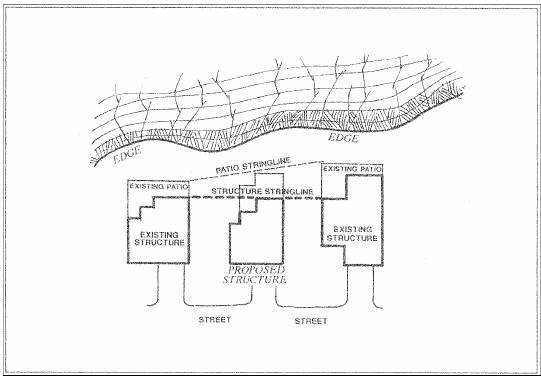
The illustration below depicts how the two different stringlines are used. If the adjacent lot is vacant, a stringline shall not be used.
Figure 17.56.050
5.
Determination of Bluff, Canyon or Cliff Edge. All development applications for projects adjacent to a bluff, cliff or canyon edge shall provide a topographic survey of the property which indicates the bluff, canyon or cliff edge. The topographic survey shall be prepared by a licensed surveyor or registered civil engineer. The edge location shall be drawn in accordance with the definition for "edge" as defined in Chapter 17.88, Definitions, of this title, under coastal zone definitions.
If after reviewing the topographic survey, the City Planner determines that the location of the bluff, canyon or cliff edge has not been drawn in accordance with the definition of "edge," the City may stake the bluff, canyon or cliff edge in the field. Once the edge is staked a licensed surveyor or registered civil engineer shall survey the location of the stakes and transfer the stakes coordinates onto the topographic survey. This information shall then be used to accurately establish the edge of bluff on the topographic survey and project site plan.
6.
Coastal Bluff and Canyon Preservation.
a.
Landscaping. Landscaping in coastal canyon setback areas or the coastal bluff setback areas, as defined in the subsections above, shall be primarily composed of native plant species. The removal of native plant species and the introduction of nonnative plant species in the canyons shall be discouraged. The use of native plant species in and adjacent to the canyons shall be encouraged.
b.
Landscape thinning and clearing within Coastal Canyons and Bluffs, including setback areas as defined in the subsections above, for areas located within 30 feet of any habitable structure or parking garage, shall be allowed when done in accordance with the following criteria:
i.
Dead and dying plants, leaves and similar debris shall be removed.
ii.
Non-native (also termed as ornamental or exotic) vegetation may be removed.
iii.
Vegetation located next to or under combustible structures shall be removed.
iv.
30 feet shall be provided between the building and native (also defined as non-ornamental or non-exotic), non-irrigated vegetation, unless the vegetation is on a slope, in which case the native, non-irrigated plants shall be trimmed and thinned while retaining root structures in place for slope and soil stability. Where root zone is not sufficiently established, to be determined by the City Engineer, alternative measures for slope and soil stability may be required, to the satisfaction of the City Engineer and Coastal Commission staff.
v.
Best Management Practices (BMPs) must be utilized to prevent any discharge of soil, vegetation or other material to the storm drain system (including natural canyons, area drains, streets, gutters, catch basins, pipes, channels or receiving waters) in compliance with the municipal storm water permit issued by the San Diego Regional Water Quality Control Board, the city's local implementation plan and the Orange County Drainage area management plan.
c.
Landscape thinning and clearing within Coastal Canyons and Bluffs, including setback areas as defined in the subsections above, for areas located within 100 feet of any habitable structure or parking garage, shall be allowed when done in accordance with the following criteria:
i.
Dead and dying plants, leaves and similar debris shall be removed.
ii.
Non-native (also termed as ornamental or exotic) vegetation may be removed.
iii.
Nominal trimming of native vegetation is allowed. In no case shall plants be trimmed down to the root stalk, unless in-concept approved by the City Planner and approved by the California Coastal Commission.
iv.
Best Management Practices (BMPs) must be utilized to prevent any discharge of soil, vegetation or other material to the storm drain system (including natural canyons, area drains, streets, gutters, catch basins, pipes, channels or receiving waters) in compliance with the municipal storm water permit issued by the San Diego Regional Water Quality Control Board, the city's local implementation plan and the Orange County Drainage area maintenance plan.
d.
New landscaping and landscape modification, other than as described above, must be in-concept approved by the City Planner and reviewed and approved by the California Coastal Commission.
e.
Subdivision. Any subdivision of property in or adjacent to coastal bluffs and/or coastal canyons shall be for consistency with the coastal bluff and canyon preservation policies. New parcels that do not have an adequate building site area to comply with the setback standards of these policies shall not be created.
f.
Review of Projects:
i.
Projects Requiring a Development Permit or Cultural Heritage Permit. Review of all projects within the Coastal Zone requiring Development Permit, Cultural Heritage Permit, or Conditional Use Permit review shall include an assessment of the potential impact on natural habitat areas. Site plan review of all development projects located adjacent to parks and recreation areas shall include an evaluation of potential impacts on coastal bluffs and coastal canyons.
ii.
Mitigation measures identified during site plan review stages to limit a project's effect on the coastal bluff or coastal canyon environment shall be incorporated into final project design plans.
iii.
Large-Scale Projects. The analysis and evaluation of large-scale development projects shall include a comprehensive inventory of biological resources. A determination should be made of the area's importance as a native habitat, including identification of rare or endangered species, or those species being considered to be listed as rare or endangered.
7.
Exceptions to the Standards of this Section. Exceptions to the standards in this section shall not require the approval of a variance and shall be permitted by the City of San Clemente, if all of the following occur:
a.
The exception is for an addition to an existing structure;
b.
The exception is approved by the Coastal Commission; and
c.
The City of San Clemente has no objections to the exception.
E.
Replacement of Affordable Housing Units.
1.
Purpose and Intent. This subsection is intended to provide standards to implement affordable housing requirements, related to the replacement of existing affordable units in the Coastal Zone, included in the City's Housing Element and the State Government Code Section 65590.
2.
Applicability.
a.
Applicable Projects. This subsection shall apply to the conversion to condominiums or demolition of three or more dwelling units within the Coastal Zone, where at least one of the units was occupied by an eligible household, as defined in the City's Housing Element.
b.
Exempt Projects. This subsection shall not apply to projects meeting any of the following criteria, unless the City determines that the replacement of all or any portion of the converted or demolished dwelling unit is feasible:
i.
The conversion or demolition of a residential structure which contains less than three dwelling units, or in the event that a proposed conversion or demolition involves more than one residential structure, the conversion or demolition of 10 or fewer dwelling units;
ii.
The conversion or demolition of a residential structure to a nonresidential use which is "coastal dependent" or "coastal related" as defined in Public Resources Code 30101 as amended, and consistent with the underlying zone;
iii.
The demolition of a residential structure which has been declared a public nuisance.
c.
Determination of Applicability. The Planning Division shall determine whether units to be converted or demolished are occupied by Eligible Households. This determination may be based upon an income survey of current residents. A dwelling unit need not be replaced if either of the following criteria apply:
i.
The dwelling unit is not occupied by an eligible household. For purposes of this subsection, a residential dwelling shall be deemed occupied by a person or family if the person or family was evicted from that dwelling unit within one year prior to the filing of an application to convert or demolish the unit and if the eviction was for the purpose of avoiding the requirements of this subsection.
ii.
A survey of the residents of the units is infeasible, based on the City Planner's determination.
The Planning Division shall make its determination, and inform the developer of the number of below market rate rental units to be provided, as required in Subdivision 3, Standards, of this section, within 60 days of receipt of a complete application.
3.
Standards.
a.
Requirement to Provide Affordable Housing. Dwelling units located in the Coastal Zone Overlay which are to be demolished or converted to condominiums, and which are occupied by "eligible households" shall be replaced. Requirements for affordability, eligibility and implementation shall be in accordance with the requirements of Section 17.24.120, Inclusionary Housing Requirements, and the standards and guidelines in the Inclusionary Housing Program in the City's Housing Element, except as otherwise stated in this section.
b.
Number of Affordable Units to be Provided. The developer shall provide one below market rate rental unit for each dwelling unit to be demolished or converted that was occupied by an eligible household, or 20 percent of the total number of residential units in the project, whichever is greater.
F.
Landform Alterations for Coastal Bluffs, Canyons and Cliffs.
1.
Prohibition of Landform Alterations. Grading, cutting or filling that will materially alter coastal bluffs, canyons, and cliffs shall be prohibited unless approved by the City and one of the following findings made:
a.
Alterations to a coastal bluff, canyon or cliff are required for compelling reasons of public safety (e.g., grading work necessary for stabilization of the coastal bluffs adjacent to the Pacific Coast Highway which without stabilization would threaten life and property); or
b.
The alterations are required to provide a significant overriding coastal public benefit (e.g., staircases or accessways to provide beach access to the public where none previously existed).
2.
Standards for Permitted Landform Alterations.
a.
Where permitted, alterations of bluffs, canyons and cliffs shall comply with all of the following standards:
i.
Any landform alteration proposed for reasons of public safety or public benefit shall minimize the extent of the grading to the maximum extent feasible. In the areas where the natural landform is impacted (e.g., bluffs, cliffs, ravines) the stabilization method used shall be visually compatible with the coastal landform (e.g., land-form or contour grading, artificial sculptured bluff face that matches the natural bluff, etc.).
ii.
Drought tolerant plants and efficient irrigation shall be required for landscaping to minimize water consumption, fertilization and chemical application, and to visually relate development to existing natural landscapes. Grading shall not alter the biological integrity of the sensitive habitat areas unless it is replaced with habitat of equal or greater value.
iii.
Development shall be conducted with provisions for the control of sediment transport, and debris originating at the construction site or upstream property as follows:
(A)
For necessary grading operations, the smallest practical area of land will be exposed at any one time during development, and the length of exposure will be kept to the minimum practical amount of time. The clearing of land shall be avoided during the winter rainy season with all measures for removing sediments and stabilizing slopes required in place before the beginning of the rainy season.
(B)
Sediment basins (including debris basins, desalting basins or silt traps) shall be installed in conjunction with the initial grading operations and maintained current to site development through the development process to remove sediment from runoff waters. All debris and sediments shall be retained on site unless removed to an appropriate dumping location approved by the City Engineer.
(C)
Temporary vegetation, seeding, mulching or other suitable stabilization method will be used to protect against soil erosion on slope during grading or development. All cut and fill slopes shall be stabilized immediately with planting of native grasses and shrubs, appropriate nonnative plants or with accepted landscaping practices.
(D)
Provisions shall be made to conduct surface water to storm drains or suitable watercourses to prevent erosion. Drainage devices shall be designed to accommodate increased runoff resulting from modified soil and surface conditions as a result of development.
(Ord. 1307 §§ 3—4, 2005; Ord. 1304 § 29, 2005; Ord. 1296 §§ 3—4, 2004; Ord. 1172 § 3 (part), 1996)
(Ord. No. 1759, § 3(Exh. A), 10-3-2023)
17.56.060 - Special Residential Overlays.
For details regarding Special Residential Zones designated by numerical overlays, please refer to Section 17.32.040(B), Special Residential Zones, and Appendix A of this title.
(Ord. 1172 § 3 (part), 1996)
17.56.070 - Inland Canyon Overlay.
For details regarding the Inland Canyon Overlay designation, please refer to Section 17.24.060, Canyon setbacks, inland, of this title.
(Ord. 1304 § 30, 2005; Ord. 1172 § 3 (part), 1996)
17.56.080 - North Beach Parking Overlay (-NBP).
A.
Purpose and Intent. .....The purpose of the "-NBP" Overlay designation is to improve parking availability and efficiency in the North Beach area by creating parking standards for the commercially zoned parcels which are responsive to this unique area, and to protect the residents by not impacting parking in the residential area. The intent of the North Beach Parking Overlay is to address parking for the district as a whole.
B.
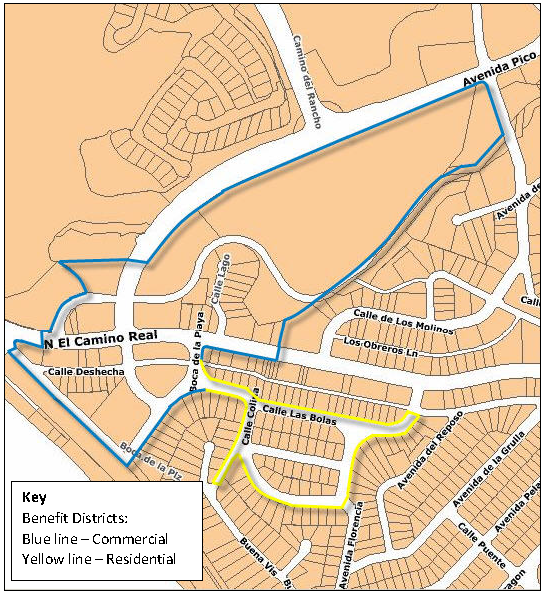
Applicability. .....The provisions in this section apply to all areas (Commercial and Residential Parking Benefits Districts) within the North Beach Parking (-NBP) Overlay District designation. Please refer to figure 17.56.080A for a map of the areas in the City which are included in this Overlay District.
Figure 17.56.080A, North Beach Parking Overlay Districts
(Commercial and Residential Parking Benefits Districts)
C.
Development Standards.
1.
Development Standards. The number of off-street parking spaces required for commercial lands uses located within the North Beach Parking Overlay District which join the Commercial Parking Benefit District by: (1) opening onsite parking up to the public; and (2) agree to implement and comply with the City's Parking Management Strategies as such strategies shall be adopted from time to time shall be as listed in Table 17.56.080a, Commercial Parking Benefit District Parking Standards. Table 17.56.080b, Parking Standards for Development prescribe the number of off-street parking spaces for commercial uses in the North Beach Parking Overlay District which do not participate in the Commercial Parking Benefits District,. Unless otherwise indicated, the parking requirements are for square feet of gross floor area occupied by the use, and in the case of nonresidential uses, includes the parking required for customers and employees. Parking standards for uses not specified in Table 17.56.080a and Table 17.56.080b, shall be provided in accordance with the requirements set forth in Section 17.64.050 of the Zoning Code.
Table 17.56.080a,
Commercial Parking Benefit District Parking Standards
Table 17.56.080b,
Parking Standards for Development that does not participate in the Commercial Parking
Benefits District
2.
Historic Preservation Parking Waivers. Historic Structures included on the City's Designated Historic Structures and Landmarks List or on the State of California Register of Historical Resources which are located within the North Beach Parking Overlay District shall be eligible to receive parking waivers per Section 17.64.125(B), and shall be evaluated on a case by case basis through the entitlement process.
3.
Neighborhood Electric Vehicles. Parking for Neighborhood Electric Vehicles (NEV), as defined in Vehicle Code Section 385.5, may be applied toward the total required parking at a maximum of four percent and not more than eight spaces of the required number of parking spaces for a project through the approval of a Development Permit or Cultural Heritage Permit. Additional NEV spaces can be provided however those spaces will not apply to the required parking. NEV spaces shall be located in areas of parking lots that cannot accommodate a standard parking space, unless the required number of standard spaces has been satisfied.
4.
Offsite Parking. Required onsite parking can be satisfied by locating parking offsite but within the North Beach Parking Overlay District with the approval of a Conditional Use Permit and execution of an offsite parking agreement approved by the City. Required residential parking must be located onsite. The offsite parking agreement shall comply with the following restrictions:
a.
The agreement shall restrict the use of the land on which the offsite parking is located for the duration of the use for which that parking is provided;
b.
The agreement shall be executed by the owner of the property on which the parking is located. Only the property owner may enter into these agreements; and
c.
The agreement shall be submitted for the review and approval of the City Attorney; and
d.
Following its approval, the agreement shall be recorded by the applicant and a copy furnished to the Community Development Department when applying for a permit, for inclusion in any related discretionary application files and the Building Division address files.
5.
Parking Management Program (Commercial and Residential Parking Benefits District). All required parking for commercial and/or office uses shall be accessible and available as public parking spaces subject to a uniform City parking management program. The City of San Clemente, will establish a parking management program for the both Commercial and Residential Parking Benefits Districts in the North Beach Parking Overlay District, which will identify the parking fees that shall be charged by location. The parking management program shall also address enforcement. All residential parking shall remain private. The following Parking Management Strategies have been identified by the City Council for implementation in North Beach:
a.
"Park Once";
b.
Distance Based Parking Pricing;
c.
Multi-space Parking Pay Stations;
d.
Way finding signage;
e.
Loading Zones;
f.
In-Lieu fees;
g.
Pedestrian and Bicycle Improvements;
h.
Preferential Parking for carpools/Vanpools/EVs/Golf Carts;
i.
Ridesharing Programs;
j.
OCTA Universal Pass Programs;
k.
Shuttle Circulator.
(Ord. No. 1518, § 3, 8-17-2010; Ord. No. 1759, § 3(Exh. A), 10-3-2023)
17.56.090 - Housing Overlay.
A.
Purpose and Intent. .....The purpose of this section is to provide for the development of qualified affordable housing development, including rental and for sale housing, in residential, commercial and mixed-use zones. The intent is to facilitate the development of affordable housing, enable the City to meet its housing goals, and ensure that affordable developments will be compatible with surrounding land uses by establishing an overlay district and standards.
B.
Applicability. .....This section applies to properties in the Housing Overlay [H]. Properties are identified on the Zoning Map by a "H" label after the base zone.
C.
Project Qualification. .....A "Qualified Affordable Housing Development" shall mean a multi-family rental or for sale housing project consisting of efficiency, studio, one-, two-, three-, and/or four-bedroom units, which meets the following requirements:
1.
The housing units on site shall provide at least the following percentage of affordable housing units, based on Orange County Median Income by household size, and the remainder of the units may be market rate rental units or sold as market rate condominiums.
i.
At least 20 percent of the housing units are restricted to low-income households; or
ii.
At least 40 percent of the housing units are restricted to moderate-income households
All affordable housing units may be in a single category (very low, low, or moderate) or part of a mixture of affordable housing types. An in-lieu fee may replace up to ½ of a single housing that would otherwise be provided [5], but shall not be used in lieu of providing actual affordable housing units on site. Once a qualifying percentage of affordable housing units have been provided, the remaining units on site may be market rate rental units or sold as market rate condominiums.
2.
If units within a project are proposed to be sold as condominiums, then the affordable portion of the project must be sold as condominiums to a 501(c)3 nonprofit housing development organization. The non-profit organization must rent out the enforceably restricted affordable units to households at the applicable income level.
3.
All condominiums must be regulated by a legal homeowner's association for the maintenance of the units.
D.
Review Requirements. .....Affordable housing projects are a permitted use in the Housing Overlay. Refer to use tables in Sections 17.32.030 (Residential Use Regulations), 17.36.030 (Commercial Zone Uses) and 17.40.030 (Mixed-Use Zone Uses). Qualified Affordable Housing Development shall be eligible for ministerial review, subject to the applicable objective design standards contained in Chapter 17.26 (Objective Design Standards for Multi-Family Residential and Residential Mixed-Use Development).
E.
Minimum Standards. .....Affordable housing projects shall conform to the underlying development standards of the underlying zone, with the exception of incentives, concessions and density bonuses as required by Government Code § 65915 or other applicable State law.
F.
Affordable Housing Agreement. .....A Qualified Affordable Housing Development project shall have a legally binding agreement between the applicant and the City, which shall be required to be executed, upon approval by the City Council, and be recorded against the property on which the Qualified Affordable Housing Development project is to be constructed to ensure that the requirements of this chapter are satisfied. The Affordable Housing Agreement shall be recorded against the Development Site prior to issuance of building permits for the Qualified Affordable Housing Development. The AffordableHousing Agreement shall be binding on all future owners and successors in interest. The Affordable Housing Agreement shall include, but not be limited to, the following:
1.
Term—A term consistent with the minimum number of years specified by State law or applicable project funding source, or greater, depending upon whether non-City funding sources require a longer affordability term. Where other public financing has a longer term, the longest term of affordability shall prevail.
2.
Property Management—A requirement that the owner shall provide for professional property management of the development including the owner's policies and procedures for renting, managing; maintaining and operating the affordable units. Property management shall also monitor the use of parking spaces within the development to assure that the parking spaces are provided, maintained and used in accordance with the terms of the Affordable Housing Agreement;
3.
Occupancy—A requirement that the occupancy of each unit in the development shall be limited so that it does not exceed more than two persons per bedroom plus one additional person;
4.
Priority of San Clemente residents—The obligation of the owner to provide first priority to people who live or work in the City to rent the qualified affordable units to the extent - the project is funded with San Clemente Developer's In-lieu fees or other housing funds, as permitted by law.
5.
Definitions of household income—Means those persons and families whose household income does not exceed the qualifying limits for acutely low, extremely low, very low, low, and moderate income families as established and amended from time to time by the California Department of Housing and Community Development.
(Ord. No. 1536, § 4(Exh. A), 6-21-2011; Ord. No. 1638, § 3(Exh. A, § 6), 1-17-2017; Ord. No. 1759, § 3(Exh. A), 10-3-2023; Ord. No. 1784, § 4(Exh. A), 12-10-2024)
e.g. If 2.4 units of low-income housing were required as part of a 12 unit project, the applicant could replace ⅖ of one required low-income unit with an in-lieu fee and provide two low-income units. This provision does not supersede application of the State Density Bonus law, which requires provision of actual affordable housing units rounded up to the nearest whole number.
17.56.100. - Emergency Shelter Overlay District.
A.
Purpose and Intent. .....The purpose of the Emergency Shelter Overlay Zone designation is to identify those areas where emergency shelters are allowed by right, subject to development and operation standards and in accordance with Section 65583 of the California Government Code. The Emergency Shelter Overlay Zone meets the requirements of state law (SB2) by designating specific areas where emergency shelters, also referred to as "homeless shelters", may be established and operated by right, to meet the shelter needs based on homeless population estimates established by current reliable information and in the City's General Plan Housing Element. The goals for areas with this designation are as follows:
1.
To facilitate efforts to address the needs of homeless persons in the City of San Clemente by identifying locations where emergency shelters are allowed by right and by establishing objective development and operation standards for emergency shelters.
2.
To protect public safety, maintain land use compatibility, and preserve property values, neighborhood quality and economic vitality while addressing an identified humanitarian need.
3.
To locate such facilities, to the maximum extent possible, close to public transportation, public and community services, near job centers, away from residential neighborhoods, schools and parks.
4.
To allow small-scale, family-oriented emergency shelters as an accessory use to churches and other religious institutions.
5.
To ensure that emergency shelters are designed in accordance with applicable standards, as allowed under state law, and that they comply with City standards and guidelines applying to all other uses in the zone.
6.
To ensure that emergency shelters are operated in a responsible and community-sensitive manner that prevents and avoids impacts to adjacent neighborhoods and enables residents, businesses and property owners to support, monitor, communicate with shelter operators, and seek City action to protect public health, safety and welfare.
7.
To achieve a housing element which complies with state law and that fully addresses all housing needs in the community while balancing other important community needs and goals, to protect public safety, neighborhood peace and aesthetics, and economic vitality.
B.
Application of Emergency Shelter Overlay District Requirements. .....The requirements of this section are for emergency shelters within the Emergency Shelter Overlay Zone. Emergency shelters that comply with these standards may be established without use permit or any other discretionary review.
C.
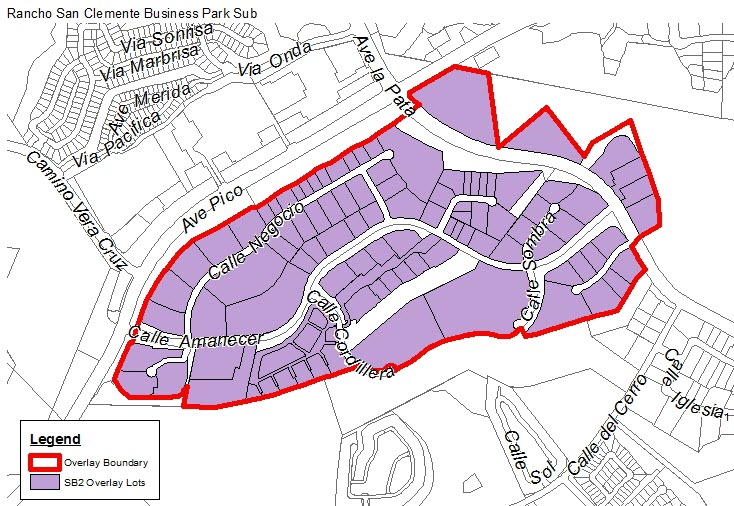
Emergency Shelter Overlay District Established. .....The City hereby establishes an "Emergency Shelter Overlay Zone" or District. In this District, emergency shelters which meet the following objective standards shall be allowed by right and are exempt from the provisions of the California Environmental Quality Act. The Emergency Shelter Overlay shall consist of the Rancho San Clemente Business Park Sub-Area. This sub-area is shown in Figure A below.
D.
Emergency Shelter Development Standards. .....Emergency shelters shall comply with the following objective standards:
1.
Separation. An emergency shelter shall not be established or operated at any location less than three hundred (300) feet from another emergency shelter providing shelter and other services to homeless persons, provided, however, that this standard shall not apply where homeless shelters proposed to be located within three hundred (300) feet of each other are operated by the same social service provider, as defined in Subdivision F.3 of this section.
2.
Number of Emergency Shelters. The number and capacity of emergency shelters allowed without a conditional use permit approval shall be limited to that required to meet the shelter needs of the number of estimated homeless persons in the City, as established by current reliable information and approved by the City Council. This number shall be updated every two (2) years, after the "point-in-time counts" are published for the County.
3.
Maximum Number of Beds. The maximum number of beds permitted per emergency shelter facility shall be the lesser of the following: 1) the most recent point-in-time count of unsheltered individuals within San Clemente at the time of application submittal; or 2) forty-five (45) beds per facility. Beds shall be made available to individuals meeting the City-defined criteria for local individuals; the emergency shelter facility shall not be a regional facility.
4.
On-site Waiting and Intake Areas. On-site waiting and client intake areas shall be provided in the emergency shelter building. Outdoor waiting areas, if provided, shall be visually screened from the public right-of-way and from adjacent land uses.
5.
Parking. Subject to Government Code Section 65583(a)(4)(BA)(ii), sufficient parking shall be provided to accommodate all staff working in the emergency shelter, provided that the standards do not require more parking for emergency shelters than other residential or commercial uses within the same zone on-site.
6.
Site Lighting. Site lighting shall be provided for safety and security, consistent with City standards and Design Guidelines.
7.
Personal Storage. A private storage area, such as a locker may be provided with each on-site bed. Regulations regarding personal storage use shall be set by City-approved policy, posted on-site, and provided upon intake to all clients.
8.
Shower and Toilet Facilities. Toilets, sinks, and showers shall be provided on-site. The emergency shelter manager shall be responsible for ensuring that all restroom and shower facilities comply with the City's Building Code requirements.
9.
Separate Housing for Families with Children. Families with children shall be housed separately from other clients and be provided separate restrooms and shower facilities.
10.
Food Service Areas. The emergency shelter manager shall be responsible for ensuring that any food service or on-site meal preparation areas comply with all applicable requirements of the County Health Department.
11.
Outdoor Storage. Emergency shelters shall screen all outdoor storage areas from all public rights-of-way and on-site and adjacent parking lots. The emergency shelter manager shall ensure that all outside storage areas be maintained in a neat, clean, and orderly manner at all times.
12.
Exterior Lighting. Lighting shall be provided in all parking and exterior waiting areas and along the periphery of the building without lighting adjoining properties.
13.
Architectural Review. Emergency Shelters shall comply with the City's Design Guidelines, Specific Plans, and the Zoning Ordinance regarding architectural and development standards to ensure shelters are compatible with their surroundings, provide adequate privacy between uses, and minimize potential impacts of the proposed shelter on adjacent uses.
The process to review emergency shelter compliance with these requirements shall be a ministerial review that shall be considered at the time of building permit review or business license review, which ever comes first. Emergency shelters shall be exempt from all discretionary review processes in compliance with state law.
E.
Emergency Shelters Management and Operational Standards. .....Emergency shelters shall be managed and operated in conformance with the following objective standards:
1.
Shelter Operator. The emergency shelter shall be operated by a social service provider, as defined in Section 17.56.105.C. [6]
2.
On-Site Management. The emergency shelter shall provide at least one (1) qualified on-site manager at all times, plus one (1) attendant for each twenty (20) occupants.
3.
Maximum Stay. Occupancy for any individual or family shall not exceed six (6) months in a three hundred sixty-five (365) day period. No individual shall be denied emergency shelter because of an inability to pay.
4.
Security Measures. Each emergency shelter operator shall submit to the Community Development Director a plan for security during hours that the emergency shelter is in operation, taking into account the location of the emergency shelter. Such security plan may include fencing, appropriate surveillance measures, and/or on-site security personnel. Said Plan shall include a Management Plan. Each emergency shelter operator shall submit to the Community Development Director a Management Plan which contains the following information:
a.
Client intake and screening processes;
b.
A description of services to be provided at the emergency shelter;
c.
Length of stay allowed for clients;
d.
Hours of operation;
e.
A set of facility rules and procedures for maintaining a safe environment within and outside the emergency shelter.
f.
The posting of signage regarding rules of the emergency shelter.
g.
Staff training programs.
h.
Referral service and distribution of resources available to clients for obtaining permanent shelter, mental and physical health care and other supportive services.
i.
Emergency plan, including, but not limited to emergency contact numbers, evacuation plans and on-site safety measures
j.
Submission of the Emergency Plan and the Management Plan to the Community Development Director shall be solely for informational purposes; said plans shall not be subject to discretionary review and/or approval.
F.
Definitions.
1.
"Emergency Shelter" (also referred to as "homeless shelter") means housing with minimal supportive services for homeless persons, and that is limited to occupancy of six (6) months in a three hundred sixty-five (365) day period by a homeless person.
2.
"Church or Religious Institution" means a building which is used as an established place of worship, has a regular congregation and regularly offers religious services, represents a recognized creed and form of worship, and is affiliated with an organization of ordained clergy.
3.
"Social Service Provider" means an agency or organization licensed or supervised by any federal, state or local health/welfare agency that participates in the federal Homeless Management Information System (HMIS) and has demonstrated experience with the homeless population by assisting individuals and families achieve economic self-sufficiency and self-determination through a comprehensive array of programs and actions.
(Ord. No. 1634, § 4(Exh. A), 11-1-2016; Ord. No. 1645, § 2, 9-19-2017; Ord. No. 1664, § 44, 9-18-2018; Ord. No. 1741, § 4, 12-20-2022; Ord. No. 1759, § 3(Exh. A), 10-3-2023; Ord. No. 1798, § 4(Exh. A), 12-9-2025)
Editor's note— Section 17.56.105 has been repealed by Ord. No. 1630, § 2, adopted Sept. 6, 2016.
17.56.101. - Reserved.
Editor's note— Ord. No. 1630, § 2, adopted Sept. 6, 2016, repealed § 17.56.101, which pertained to application of emergency shelter (ES) overlay zone requirements and derived from Ord. No. 1585, § 2(Exh. A), adopted Sept. 2, 2014.
17.56.102. - Reserved.
Editor's note— Ord. No. 1630, § 2, adopted Sept. 6, 2016, repealed § 17.56.102, which pertained to emergency shelter overlay district established and derived from Ord. No. 1585, § 2(Exh. A), adopted Sept. 2, 2014.
17.56.103. - Reserved.
Editor's note— Ord. No. 1630, § 2, adopted Sept. 6, 2016, repealed § 17.56.103, which pertained to development standards and derived from Ord. No. 1585, § 2(Exh. A), adopted Sept. 2, 2014 and Ord. No. 1611, § 1, adopted Dec. 1, 2015.
17.56.104. - Reserved.
Editor's note— Ord. No. 1630, § 2, adopted Sept. 6, 2016, repealed § 17.56.104, which pertained to emergency shelters and operational standards and derived from Ord. No. 1585, § 2(Exh. A), adopted Sept. 2, 2014 and Ord. No. 1611, § 1, adopted Dec. 1, 2015.
17.56.105. - Reserved.
Editor's note— Ord. No. 1630, § 2, adopted Sept. 6, 2016, repealed § 17.56.105, which pertained to definitions and derived from Ord. No. 1585, § 2(Exh. A), adopted Sept. 2, 2014.
17.56.110 - Mixed Use [MU] Overlay.
A.
Purpose and Intent. .....It is the purpose and intent of the Mixed Use [MU] Overlay to allow existing industrial uses to remain on properties with underlying Light Industrial [LI] zoning in the North Beach area, while providing an option for a vertical or horizontal mix of Neighborhood Serving Commercial, Community Serving Commercial, and allowing multifamily housing on the second floor or higher. With redevelopment, projects are to follow development standards and permitted uses required for the adjacent Mixed Use 1 [MU 1] zoning district.
B.
Applicability. .....The provisions in this section apply to all areas with Mixed Use Overlay [MU] Designation.
C.
Continuation of Light Industrial Uses. .....The [MU] Overlay allows a continuation of lawfully established existing light industrial uses on a property that is allowed by the underlying Light Industrial [LI] zoning district, except when a property is redeveloped or uses are established according to permitted uses and development standards required by subsection D.
D.
Permitted Uses and Development Standards. .....In the [MU] Overlay, new development or establishment of uses not permitted by the underlying Light Industrial [LI] zoning district shall comply with permitted uses and development standards for the adjacent Mixed Use 1 [MU 1] zoning district in Chapter 17.40 of this Zoning Code.
(Ord. No. 1652 § 4, 5-15-2018)
17.56.120 - Medical Office [MO] Overlay.
A.
Purpose and Intent. .....It is the purpose and intent of the Medical Office [MO] Overlay to provide an option of increasing the development potential (i.e. Floor Area Ratio or density) for the establishment of medical office uses with related ancillary retail and services, conditional upon the approval of a Master Plan. Community Commercial uses are permitted as an underlying land use (Community Commercial).
B.
Applicability. .....The provisions in this section apply to all areas with Medical Office Overlay [MO] Designation.
C.
Eligibility for Density Bonus for Medical Office. .....The MO Overlay is eligible for a maximum density North of Mira Costa of 1.0 FAR and 0.75 FAR south of Mira Costa, when new development or changes of use in an existing development are proposed, in which at least 50 percent of the net floor area of building space is occupied and operated as medical related uses.
(Ord. No. 1652 § 4, 5-15-2018)

