
San Clemente City Zoning Code
CHAPTER 17
32 - RESIDENTIAL ZONES AND STANDARDS
17.32.010 - Purpose and Intent.
The General Plan details the goals, objectives and policies for the City's residential zones, including the preservation of existing residential neighborhoods throughout the City. It is the purpose of this chapter to implement the General Plan's vision for the residential zones through development regulations that allow for a range of residential opportunities for all socioeconomic groups and ensure that new residential development maintains existing and achieves new high-quality, distinctive neighborhoods.
A.
Residential, Very Low (RVL) Density Zone. The RVL land-use designation is the least intense residential designation in the City, and is intended to preserve currently undeveloped canyons which are either geologically unstable or aesthetic, open-space, or biological resources. This zone is intended as an area for the development of single-family detached homes on significant acreage at a maximum density of 1.0 dwelling units per 20 gross acres or per legal parcel of record as of May 6, 1993, whichever is smaller in size.
B.
Residential, Low (RL) Density Zone. The RL land-use designation permits the development of low-density, single-family residential neighborhoods with single-family detached dwellings. A maximum density of 4.5 units per gross acre and 7.0 units per net acre is allowed in this zone.
C.
Residential, Medium-Low (RML) Density Zone. The RML land-use designation permits the development of medium-low-density residential development, including single-family detached, attached homes (including clustered homes), and townhomes. A maximum density of 7.0 units per gross acre and 10.0 units per net acre is allowed in this zone.
D.
Residential, Medium (RM) Density Zone. The RM land-use designation permits the development of housing opportunities of a more intense nature than single-family detached and attached residential, including clustered homes, townhomes and other multifamily structures. A maximum density of 15.0 units per gross acre and 24.0 units per net acre is allowed in this zone.
E.
Residential, High (RH) Density Zone. The RH land-use designation permits the development of the most intensive residential development allowed in the City for high-density, single-family attached and multifamily residential development. A maximum density of 24.0 units per gross acre and 36.0 units per net acre is allowed in this zone.
(Ord. 1172 § 3 (part), 1996)
(Ord. No. 1652, § 4, 5-15-2018)
17.32.020 - Residential Densities.
The Zoning Ordinance limits the maximum density for each residential zone; however, the density allowed for any residential project within the City may be limited further through the appropriate discretionary review process, when discretionary review is provided for in this title. The City Planner, Zoning Administrator, Planning Commission, and/or City Council shall have the authority to reasonably condition any residential development subject to discretionary review to ensure proper transition to and compatibility with adjacent residential developments, existing or proposed.
(Ord. 1172 § 3 (part), 1996; Ord. No. 1803, § 4(Exh. A), 4-21-2026)
17.32.030 - Residential Use Regulations.
A.
Permitted and Conditionally Permitted Uses. .....The uses identified in Table 17.32.030, Residential Zones Uses shall be the primary uses allowed to occur on a property. All uses except for those provided for in Section 17.28.210, Outdoor Display Areas, Permanent, Accessory and Section 17.28.300, Temporary uses and structures, of this title shall be conducted within enclosed structures. The primary uses identified in Table 17.32.030, shall be permitted or conditionally permitted, as indicated:
B.
Prohibited Uses. .....The following uses are prohibited:
1.
Uses that are listed in Table 17.32.030 but that are not identified as either permitted — "P" — or conditionally permitted — "MC" or "C"; and
2.
Uses that are excluded from Table 17.32.030, unless they are found by the City to be similar to permitted or conditionally-permitted uses.
3.
Uses where a blank cell appears in Table 17.32.030.
4.
As indicated in Table 17.32.030, the following uses are not permitted in any residential zone:
a.
Marijuana Manufacturing.
b.
Marijuana Testing Laboratory.
c.
Marijuana Delivery.
d.
Marijuana Dispensary.
5.
The cultivation of industrial hemp, as defined in Section 11018.5 of the California Health and Safety Code, is not permitted in any residential zone to the fullest extent allowed by state law.
Table 17.32.030 - Residential Zone Uses
1 Refer to Section 17.28.060, Animals, Commercial Grazing and Raising of Large Species, of this title, for special provisions for the commercial grazing of large species.
2 Refer to Section 17.28.090, Bed and Breakfast Inns, of this title, for special provisions for bed and breakfast inns.
3 Refer to Section 17.28.110, Congregate Care Facilities, of this title for special provisions for congregate care facilities.
4 Refer to Section 17.28.100, Child Day Care Facilities, of this title for special provisions for day care facilities.
5 Small-family and Large-family day care homes are permitted in a detached single-family dwelling, a townhouse, a dwelling unit within a dwelling, or a dwelling unit within a covered multi-family dwelling in which the underlying zoning allows for residential uses, or a legal non-conforming single-family dwelling unit in nonresidential zone. Small-family day care and large-family daycare homes only shall operate in buildings that were lawfully constructed.
6 Refer to Section 17.28.220, Parking Lots, of this title for special provisions for single-use parking lots.
7 Refer to Section 17.28.230, Public Park Facilities, of this title for review requirements for parks.
8 Refer to Section 17.28.240, Public Utilities, of this title for review requirements for public utilities/buildings.
9 Refer to Section 17.28.160, Home Occupations, of this title for special provisions for Home Occupations.
10 Reserved.
11 Refer to Section 17.28.190, Mobile homes, of this title for special provisions for mobile homes.
12 Refer also to Section 17.56.040, Planned Residential District Overlay, of this title, for special provisions for planned residential developments.
13 Refer to Section 17.28.270, Accessory Dwelling Units (ADUs), of this title for special provisions for ADUs.
14 Refer to Section 17.28.280, Senior Housing Projects, of this title for special provisions for senior housing projects.
15 Refer to Section 17.24.040, Accessory Buildings, of this title for special provisions for accessory buildings.
16 Refer to Section 17.24.040, Accessory Buildings, of this title for special provisions for accessory buildings.
17 Refer to Section 17.28.130, Grading, of this title, for special provisions for grading requests that are not accompanying development requests.
18 A boardinghouse may not be located within 300 feet of any other boardinghouse measured by following a straight line without regard to intervening buildings from the nearest point of the parcel on which the proposed boardinghouse is to be located to the nearest point of the parcel that contains the existing boardinghouse. No more than one boardinghouse is allowed on a legal parcel.
19 Refer to Section 17.28.292, STLUs, of this title for special provisions for STLUs including STARs.
20 STLUs are only permitted on lots that are designated for STLUs on the City's current adopted "Short-Term Lodging Units (STLU) Allowed Areas" map in Appendix C of this title.
21 STARs are permitted in all zones where STLUs are permitted with an STLU zoning permit in accordance with Section 17.16.45. STARs that are located in residential zones where STLUs are not permitted require a STAR permit in accordance with Section 17.16.146.
22 But if the boardinghouse is a Residential Care Facility (as defined by Section 17.88.030), allowed administratively under Chapter 5.38 (Residential Care Facility Boardinghouse—Streamlined Administrative Approval).
23 Qualified Affordable Housing Developments and Senior Housing Projects are permitted uses on all properties in the Housing Overlay but not on all Residential zoned properties. Refer to Section 17.56.090, Housing Overlay Zone for projects in Residential Zones of this title.
24 Market rate residential projects proposing four or fewer units that meet the applicable objective design standards contained in Chapter 17.26 shall be permitted ministerially. Market rate residential projects proposing five or more units and those that do not meet the objective design standards shall be considered as part of a discretionary review process.
25 Qualified Affordable Housing Developments, Senior Housing, and Market Rate Residential or Mixed Use projects shall not be allowed to convert existing hotel/motel uses which have provided lower cost visitor serving accommodation in the last five years, unless the project provides equivalent new lower cost visitor serving accommodation or unless required to be approved pursuant to State law.
(Ord. 1314 §§ 32—34, 2006; Ord. 1308 § 12, 2006; Ord. 1304 § 24, 2005; Ord. 1292 § 4, 2004; Ord. 1275 § 3, 2003; Ord. 1172 § 3 (part), 1996; Ord. No. 1575, § 3(Exh. A, § 7), 12-3-2013; Ord. No. 1613, § 5(Exh. A, 2, 3), 1-19-2016; Ord. No. 1622, § 9, 5-17-2016; Ord. No. 1632, § 3(Exh. A, §§ 3, 4), 11-15-2016; Ord. No. 1652, § 4, 5-15-2018; Ord. No. 1654, § 15, 5-15-2018; Ord. No. 1668, § 2, 3-5-2019; Ord. No. 1707, § 3, 2-2-2021; Ord. No. 1745, §§ 6, 7, 12-20-2022; Ord. No. 1759, § 3(Exh. A), 10-3-2023; Ord. No. 1784, § 4(Exh. A), 12-10-2024)
17.32.040 - Residential Zone General Development Standards.
The following property development standards shall apply to all land and permitted or conditionally permitted buildings located within their respective residential zone.
A.
General Requirements. .....Table 17.32.040, Residential Zone Development Standards, lists the site development standards required for residential development projects.
Table 17.32.040
Residential Zone Development Standards
1 For guidelines for development in the RVL zone, please refer to Section 17.24.060, Canyon Setbacks, Inland, of this title.
2 Refer to Section 17.32.050(B), Density Allowance for Lots with Less than 3,600 Square Feet of Lot Area, of this
title, for special provisions for lots with less than 3,600 square feet of lot area.
3 Refer to Section 17.32.050(D), Front Setbacks, Special Provisions for Reduction, of this title, for special
provisions for reduced front yard setback requirements for some lots. A minor adjustment
to the required front yard setback is available through the approval of a Minor Exception
Permit, in accordance with, Section 17.16.090, Minor Exception Permits, of this title.
4 Refer to Section 17.32.050(E), Garage Encroachment into the Front Yard Setback, of this title, for garage encroachment
into the front yard setback for some lots.
5 The minimum setback for a street-facing garage or carport shall be 20 feet, when
standard garage doors are provided, and 18 feet, when roll-up garage doors are provided.
Also refer to Section 17.64.060, Parking Setbacks, for further details regarding these standards and for provisions
for a shortened setback when roll-up garage doors are provided.
6 Refer to Section 17.32.050(F), Special Provisions for Dwelling Units with Front Entrances Located Along the
Side Property Line, of this title, for side yard setback requirements when front entrance
to dwelling unit is located on the side of the structure facing the side lot line.
A minor adjustment to the required side yard setback is available through the approval
of a Minor Exception Permit, in accordance with Section 17.16.090, Minor Exception Permits, of this title.
7 A minor adjustment to the required side yard setback is available through the approval
of a Minor Exception Permit, in accordance with Section 17.16.090, Minor Exception Permits, of this title.
8 A minor adjustment to the required rear yard setback is available through the approval
of a Minor Exception Permit, in accordance with Section 17.16.090, Minor Exception Permits, of this title.
9 Exceptions shall be granted when a reduced front yard setback is provided for in
an overlay district's zoning regulations, such as numbered Special Residential Zones,
where the garage setback may match the front yard setback.
10 Exceptions shall be granted in RL and RML Zones, where street-side yard setbacks
allow for less than an 18 or 20 feet setback and sufficient right-of-way exists from
the property line to the curb so that vehicles in the driveway will not overhang into
the street or onto the sidewalk, if a sidewalk exists.
B.
Special Residential Zones (Numbered Overlays). .....The City of San Clemente has a number of residential tracts that were developed with their own unique development standards. These tracts have individual overlays which are numbered. The standards for these tracts are listed in Appendix A of this title; otherwise, the development standards of the underlying zone contained in Table 17.32.040, Residential Zone Development Standards, shall apply, except front street-facing garage setbacks which may match the front yard setback of the underlying overlay district.
(Ord. 1314 § 35, 2006; Ord. 1172 § 3 (part), 1996)
(Ord. No. 1652, § 4, 5-15-2018; Ord. No. 1707, § 3, 2-2-2021; Ord. No. 1720, § 3, 12-21-2021)
17.32.050 - Residential Zone Special Development Standards.
This section and Chapter 17.24, General Development Standards, of this title include a number of special provisions affecting residential properties. Unless otherwise indicated in the following or referenced sections, or in other City documents regulating residential development, the following development standards shall apply to all residential zones described in this chapter.
Table 17.32.050A
Special Development Standards for All Residential Zones
A.
Arbors.
1.
Purpose and Intent. Structures in the front setback of residential zones are limited to a height of 42 inches to provide for an open street scene, to allow the primary structures on a street to be visible and to contribute to the visual character of the neighborhood, and to allow for unobstructed views of traffic to and from driveways. Arbors, typically taller than 42 inches and located in front yard setback, can be a desirable addition to the architecture of a residence and to the street scene. The purpose and intent of this section is to provide for arbors to exceed the height limit of structures in the front yard setback area, while addressing the potential negative impacts of these structures.
2.
Standards and Review Requirements. Arbors are permitted to encroach into the front yard setback in residential zones with the approval of a Minor Exception Permit, in accordance with Section 17.16.090, Minor Exception Permits, of this title, and in accordance with the maximum standards listed below in Table 17.32.050B, Arbor Standards, of this section.
Table 17.32.050B
Arbor Standards
3.
Required Findings. Prior to the approval of a Minor Exception Permit for arbors, all the following findings shall be made, along with the general findings for a Minor Exception Permit:
a.
The arbor does not create sight distance problems to and from the appropriate street(s);
b.
The arbor supports plant material;
c.
The style, materials, color, and finish of the arbor must be consistent with the style of the main building on the site; and
d.
The arbor is located entirely on private property;
e.
The arbor must be appropriate in scale with the main building on the site.
B.
Density Allowance for Lots with Less than 3,600 Square Feet of Lot Area. .....In the RM zone, when a lot has less than 3,600 square feet of lot area, a duplex will be permitted.
C.
Distance Between Primary Buildings, Minimum Required. .....Primary buildings shall be constructed so that a minimum of 10 feet between primary buildings is provided.
D.
Front Setback, Special Provisions for Reduction.
1.
Choice of Front Yard Setback. In residential zones where at least four lots in a block have been improved with primary buildings, the minimum required front yard setback shall be either:
a.
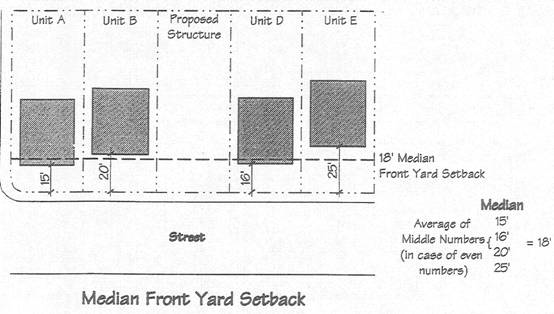
The median front yard setback—the median of the measurements taken from the front property line to the nearest point of the primary building (the "point of setback") on all improved lots within the block; or
Figure 17.32.050A
b.
The minimum front yard setback required for the given zone. Subdivision 1 of this subsection, Choice of Front Yard Setback, shall not apply in any subdivision where staggered setbacks have been approved and established.
2.
Measurements That Cannot Be Included in Calculating the Median Front Yard Setback. For the purpose of this section, the following measurements shall not be included in the calculation of the median front yard setback:
a.
Measurements to detached accessory buildings;
b.
Measurements to attached in-the-bank garages benefiting from the provisions of Section 17.32.050(K), Garage Encroachment into the Front Yard Setbacks, of this title;
c.
Measurements on a through lot, unless the primary building on the through lot has its main entry on the street on which the front yard setback median is being measured;
d.
Measurements to any structures on flag lots;
e.
Measurements to any garages on RVL, RM and RH lots.
3.
Additional Limits Upon the Median Front Yard Setback.
a.
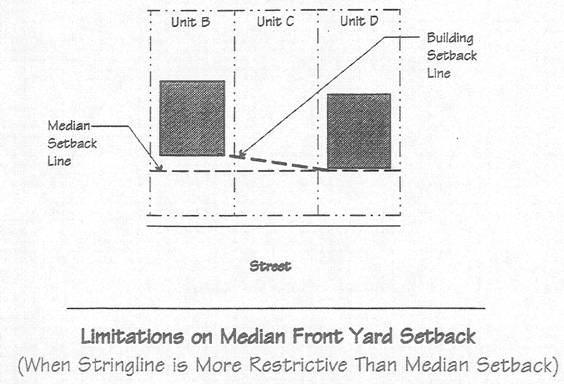
String Line Limits. When both adjacent lots have been used in the calculation of the median front yard setback for a block, then no structure on a lot shall encroach beyond a string line drawn between the points of setback on the adjacent lots.
Figure 17.32.050B
b.
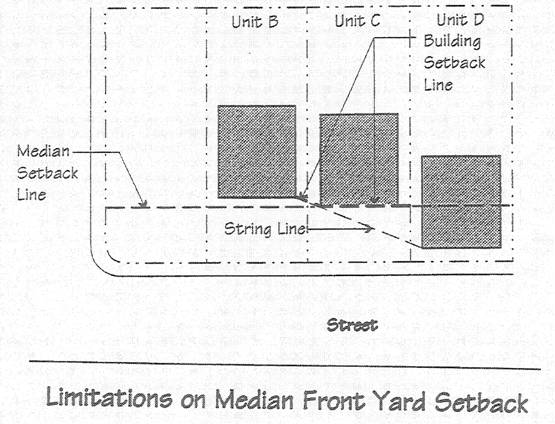
When the String Line Intersects and/or is Less Restrictive than the Median. Any portion of the string line that is less restrictive than the median shall not be used to allow a structure to encroach more than the median front yard setback established for the block.
Figure 17.32.050C
E.
Garage Encroachment Into the Front Yard Setback.
1.
Purpose and Intent. Some residential lots within the City have a steep topography. On these lots, the requirement of the standard front yard setback for a garage could result in significant grading and/or fill. The purpose of allowing garages to encroach into the front yard setback on these lots is to reduce the need for mass grading or fill and allow structures to follow the natural topography of the site, either stepping up or down with the lot.
2.
Review Requirements. Encroachment of new garages into the front setback, as provided for in this section, shall require the approval of a Minor Exception Permit, in accordance with Chapter 17.16, Applications, of this title.
3.
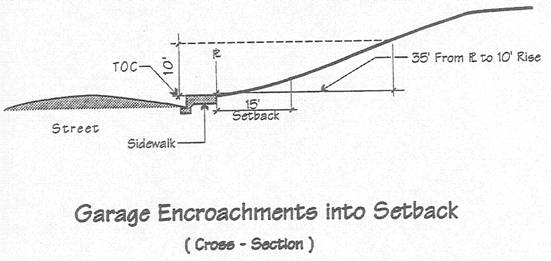
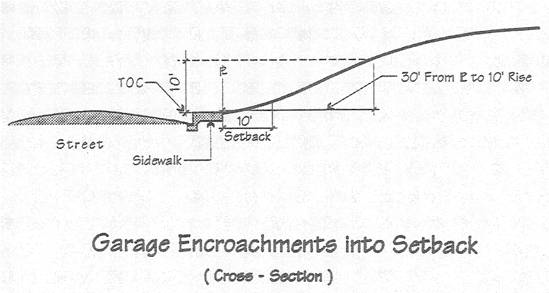
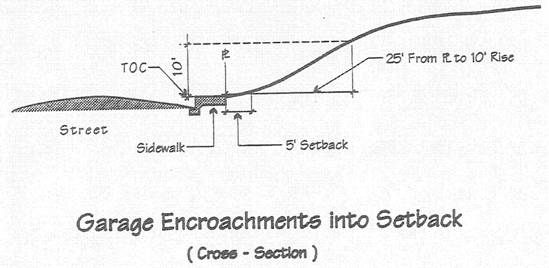
Encroachment. If the existing natural grade on the lot has a rise or fall in excess of 10 feet, as measured from the elevation at the established top of curb, attached garages may use the following setback and may be granted an exception to the required spacing between retaining walls in accordance with Section 17.24.180(D)2(b), Retaining Walls.
a.
A 15-foot front yard setback for the garage, when the 10-foot grade difference occurs within 35 feet of the front property line.
Figure 17.32.050D
b.
A 10-foot front yard setback for the garage, when the 10-foot grade difference occurs within 30 feet of the front property line.
Figure 17.32.050E
c.
A five-foot front yard setback for the garage, when the 10-foot grade difference occurs within 25 feet of the front property line.
Figure 17.32.050F
d.
The limitations imposed by Subsection (E)(3)(a) through (c) of this section may be modified through a Minor Exception Permit, in accordance with Section 17.16.090, Minor Exception Permits, of this title, when in the opinion of the decision-making authority for this permit, conditions justify such modifications.
4.
Other Requirements. Garages that benefit from this exception must comply with the following requirements:
a.
Maximum Height Limits.
i.
Flat-Roofed Garages. Flat-roofed garages shall not exceed 10 feet from the floor to top of roof, excluding open railings when required by the Uniform Building Code. The height of the railings shall not exceed the minimum necessary to comply with the Uniform Building Code.
ii.
Other Roofs. Roofs with architectural interest, as determined through the Minor Exception Permit process, may be allowed to exceed 10 feet up to a height of 15 feet.
b.
A certified topography map must be submitted when required by the grade. The topography map shall be prepared by a licensed land surveyor or registered civil engineer.
c.
Roll-up doors shall be required for garages encroaching within the front yard setback.
5.
Required Findings. Prior to approval of the Minor Exception Permit for garage encroachment, the decision-making authority shall make all of the following findings, along with the general findings for a Minor Exception Permit:
a.
The encroachment complies with the standards of this section;
b.
The slope of the front of the lot is significant enough in both length and width that requirement of the standard front yard setback will result in significant grading and/or fill; and
c.
The proposed project reduces the need for mass grading and/or fill and allows the structures on the site to follow the natural topography of the site.
F.
Special Provisions for Dwelling Units with Front Entrances Located Along the Side Property Line.
1.
Applicability. This section shall apply to residential properties meeting both of the following criteria:
a.
The front entrance to the dwelling unit is located on the side of the dwelling unit that faces the side property line; and
b.
The dwelling unit is located in the RML, RM or RH zone.
2.
Standards.
a.
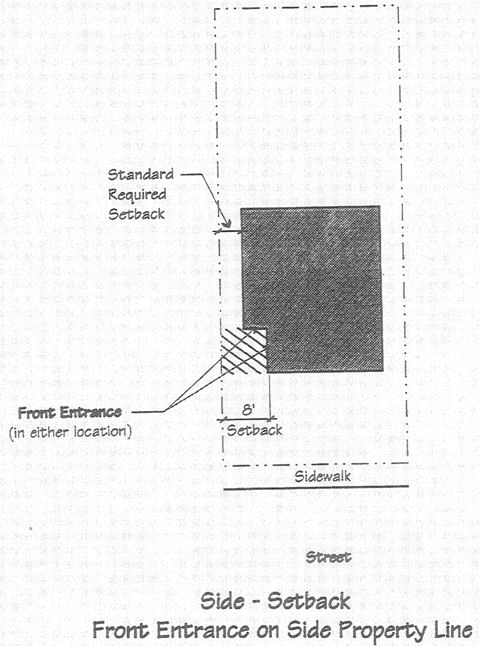
The interior-side yard setback, as measured from the property line to the rear side of the front entrance of a dwelling unit, shall be a minimum of eight feet.
b.
The minimum eight-foot interior-side yard setback is required for the story containing the front entrance. Stories above the story containing the front entrance are not subject to the side entrance requirement and shall 17.32.040, Residential Zone Development Standards. Stories below the story containing the front entrance must maintain the eight-foot interior-side yard setback for the portion of the story that includes the primary access to the front entrance.
Figure 17.32.050G
G.
Height Limitations for Structures used primarily for religious worship.
A.
Purpose and Intent. It is generally recognized that structures used primarily for religious worship are icons within the community that are characterized by tall structures with steeply pitched roofs. Structures used primarily for religious worship, which are typically taller than the height limits of the residential zone, can be a desirable addition to the architecture of a residential neighborhood and to the street scene. The purpose and intent of this section is to allow for structures used primarily for religious worship to exceed the maximum building height limits of the residential zone, while ensuring reasonable compatibility with adjacent and nearby land uses and addressing the potential negative impacts of these structures.
B.
Applicability. This section shall apply to all structures used primarily for religious worship in Residential Zones.
C.
Standards and Review Requirements. Structures used primarily for religious worship are permitted to exceed the height limits of the residential zone to a maximum height of 45 feet with the approval of a Conditional Use Permit, in accordance with Section 17.16.060, Conditional Use Permits, of this title, and in accordance with the Required Findings listed below in Section (4).
Church steeples in residential zones may exceed the 45 feet Church height limitation in accordance with Table 17.24.080(B), Maximum Encroachments into Setbacks and Height Limits.
D.
Required Findings. Prior to the approval of a Conditional Use Permit to allow structures used primarily for religious worship to exceed the height limits of the residential zone up to a maximum of 45 feet, all of the following findings shall be made, along with the general findings for a Conditional Use Permit:
a.
The structure(s) used primarily for religious worship is compatible with the surrounding land uses and will not create adverse impacts to surrounding uses; and
b.
The height of the structures used primarily for religious worship shall have minimal impacts on public views as demonstrated in visual simulations prepared by the applicant; and
c.
The increased building height adds to the architectural interest of the project; and
d.
The increased building height emphasizes primary buildings and/or distinct places within the institution's site; and
e.
The features of all structures on-site are reasonably compatible and consistent with the project site and the surrounding neighborhood.
(Ord. 1448 § 1, 2007; Ord. 1314 § 36, 2006; Ord. 1172 § 3 (part), 1996)
(Ord. No. 1489, §§ 3, 4, 7-7-2009; Ord. No. 1548, § 3(Exh. C, § 12), 3-6-2012; Ord. No. 1561, § 3(Exh. A, § 19), 11-27-2012; Ord. No. 1707, § 3, 2-2-2021)

