28 - SPECIAL USES
Given their unique nature, certain activities and uses have special impacts upon the community, giving rise to a need for special review procedures or standards. The purpose of this chapter is to identify and regulate such uses in order to ensure the maintenance of the public health, safety and welfare in accordance with the goals, objectives, policies, and implementation programs of the General Plan.
(Ord. 1172 § 3 (part), 1996)
The activities and uses covered or described in this chapter, when permitted within the zone in which they are to be located, shall comply with the provisions described here, as well as all other standards and provisions of this title.
(Ord. 1172 § 3 (part), 1996)
Please refer to Chapter 5.12, Adult-Oriented Businesses, of this code.
(Ord. 1172 § 3 (part), 1996)
A.
Purpose and Intent. The purpose of this section is to regulate personal, medical, and commercial marijuana uses. Nothing in this section shall preempt or make inapplicable any provision of state or federal law.
B.
Definitions. For purposes of this section, the following definitions shall apply:
1.
"Accessory structure" means an "accessory building," as defined by Section 17.88.030 of this code, that is fully enclosed and secured with a lock.
2.
"Commercial marijuana activity" includes the cultivation, possession, manufacture, distribution, processing, storing, laboratory testing, labeling, transportation, distribution, delivery or sale of marijuana and marijuana products.
3.
"Cultivation" means any activity involving the planting, growing, harvesting, drying, curing, grading, trimming, or processing of marijuana.
4.
"Delivery" means the commercial transfer of marijuana or marijuana products to a customer. "Delivery" also includes the use by a retailer of any technology platform owned and controlled by the retailer, or independently licensed under California law, that enables customers to arrange for or facilitate the commercial transfer by a licensed retailer of marijuana or marijuana products.
5.
"Distribution" means the procurement, sale, and transport of marijuana and marijuana products between entities for commercial use purposes.
6.
"Licensee" means the holder of any state issued license related to marijuana activities, including but not limited to licenses issued under Division 10 of the Business and Professions Code.
7.
"Limited home cultivation" means cultivation of up to six living marijuana plants, and possession of the marijuana produced by those plants, within the private residence of the person cultivating them or within an accessory structure to the person's private residence on the same grounds.
8.
"Manufacture" means to compound, blend, extract, infuse, or otherwise make or prepare a marijuana product.
9.
"Marijuana" means all parts of the plant Cannabis sativa L., whether growing or not; the seeds thereof; the resin extracted from any part of the plant; and every compound, manufacture, salt, derivative, mixture, or preparation of the plant, its seeds or resin. It does not include:
a.
Industrial hemp, as defined in Section 11018.5 of the California Health and Safety Code; or
b.
The weight of any other ingredient combined with marijuana to prepare topical or oral administrations, food, drink, or other product.
10.
"Marijuana accessories" means any equipment, products or materials of any kind which are used, intended for use, or designed for use in planting, propagating, cultivating, growing, harvesting, manufacturing, compounding, converting, producing, processing, preparing, testing, analyzing, packaging, repackaging, storing, smoking, vaporizing, or containing marijuana, or for ingesting, inhaling, or otherwise introducing marijuana or marijuana products into the human body.
11.
"Marijuana products" means marijuana that has undergone a process whereby the plant material has been transformed into a concentrate, including, but not limited to, concentrated cannabis, or an edible or topical product containing marijuana or concentrated cannabis and other ingredients.
12.
"Person" includes any individual, firm, co-partnership, joint venture, association, corporation, limited liability company, estate, trust, business trust, receiver, syndicate, or any other group or combination acting as a unit, and the plural as well as the singular.
13.
"Private residence" means a house, an apartment unit, a mobile home, or other similar dwelling that is a "residential dwelling unit," as defined by the California Building Code (24 Cal. Code Regs. § 202), that is fully enclosed and secured with a lock, and that is the primary residence of the person in possession.
14.
"Sale" includes any transaction whereby, for any consideration, title to marijuana is transferred from one person to another, and includes the delivery of marijuana or marijuana products pursuant to an order placed for the purchase of the same and soliciting or receiving an order for the same, but does not include the return of marijuana or marijuana products by a licensee to the licensee from whom such marijuana or marijuana product was purchased.
15.
Any term defined in this section also means the very term as defined in the California Business and Professions Code or the California Health and Safety Code, unless otherwise specified.
C.
Personal Use.
1.
For purposes of this subsection, personal recreational use, possession, purchase, transport, or dissemination of marijuana shall be considered unlawful in all areas of the City to the extent it is unlawful under California law.
2.
Outdoor Cultivation. A person may not cultivate marijuana outdoors in any zoning district of the City. "Outdoors" means not in a fully enclosed and secure building structure. It includes covered decks, carports, open-air garden courts, and similar situations that are not fully enclosed and secured with a lock. No use permit, building permit, variance, or any other permit or entitlement, whether administrative or discretionary, shall be approved or issued for any such use or activity.
3.
Indoor Cultivation. All indoor cultivation is prohibited except for limited home cultivation, as defined in Subsection B.7. Limited home cultivation is only allowed if each of the requirements of Section 9.04.025 is satisfied.
D.
Medical Use.
1.
Cultivation of medical marijuana pursuant to Section 11362.77 of the California Health and Safety Code is subject to the cultivation requirements laid out in Subsection C. of this section.
2.
The establishment or operation of any medical marijuana collective, cooperative, dispensary, delivery service, operator, establishment, or provider shall be considered a prohibited use in all zoning districts of the City. No use permit, variance, building permit, or any other entitlement or permit, whether administrative or discretionary, shall be approved or issued for the establishment of any collective, cooperative, dispensary, delivery service, operator, establishment, or provider in any zoning district, and no person shall otherwise establish such businesses or operations in any zoning district.
E.
Commercial Use. The establishment or operation of any business of commercial marijuana activity is prohibited. No use permit, variance, building permit, or any other entitlement or permit, whether administrative or discretionary, shall be approved or issued for the establishment or operation of any such business or operation. Such prohibited businesses or operations may include, but are not limited to:
1.
The transportation, delivery, storage, distribution, or sale of marijuana, marijuana products, or marijuana accessories;
2.
The cultivation of marijuana;
3.
The manufacturing or testing or marijuana, marijuana products, or marijuana accessories; or
4.
Any other business licensed by the state or other government entity under Division 10 of the California Business and Professions Code, as it may be amended from time to time.
F.
Penalty for Violation. No person, whether as principal, agent, employee or otherwise, shall violate, cause the violation of, or otherwise fail to comply with any of the requirements of this section. Every act prohibited and every failure to perform an act made mandatory by this section, shall be unlawful. In addition to the penalties provided in this section, any condition caused or permitted to exist in violation of any of the provisions of this section is declared a public nuisance and may be abated as provided in Chapter 1.16 and under state law.
(Ord. No. 1613, § 5(Exh. A, 1), 1-19-2016; Ord. No. 1632, § 3(Exh. A, § 2), 11-15-2016; Ord. No. 1664, § 42, 9-18-2018)
Editor's note— Ord. No. 1632, § 3(Exh. A, § 2), adopted Nov. 15, 2016 amended § 17.28.035, and in so doing changed the title of said section from "Cannabis Cultivation, Cannabis Manufacturing, Cannabis Testing Laboratory, Cannabis Delivery, and Cannabis Dispensary Uses" to "Marijuana Uses," as set out herein.
A.
Purpose and Intent. .....The purpose of this section is to provide regulations which mitigate the potential effects of the concurrent sale of alcoholic beverages and motor vehicle fuel, as provided for by the State of California.
B.
Applicability. .....This section applies to all facilities which sell both alcoholic beverages and motor vehicle fuel.
C.
Review Required. .....Please refer to the use tables in Chapters 17.32, Residential Zones and Standards, through 17.48, Public Zones and Standards, of this title.
D.
Minimum Standards. .....All persons owning or operating any facility which sells or otherwise dispenses both alcoholic beverages and motor vehicle fuel shall comply with the following requirements:
1.
No beer or wine shall be displayed within five feet of the cash register or the front door, unless such display is a permanently fixed cooler.
2.
No advertisement of alcoholic beverages shall be displayed at motor fuel islands.
3.
No sale of alcoholic beverages shall be made from a drive-in window.
4.
No display or sale of beer or wine shall be made from an ice tub.
5.
No beer or wine advertising shall be located on motor vehicle fuel islands and no self-illuminating advertising for beer or wine shall be located on buildings or windows.
6.
Employees on duty between 10:00 p.m. and 2:00 a.m. shall be at least 21 years of age to sell beer and wine.
7.
No establishment engaged in the concurrent sale of alcoholic beverages and motor vehicle fuel shall be located within:
a.
100 feet of residentially zoned property; or
b.
300 feet of any other establishment engaged in the sale of alcoholic beverages for off-site consumption; or
c.
100 feet of any school, hospital, playground or public park.
8.
The distances provided in this subsection shall be measured as follows:
a.
Between two uses on separate legal parcels: by following a straight line, without regard to intervening buildings, from the nearest point of the parcel of property upon which the proposed use is to be located to the nearest point of the parcel of property or the zoning district boundary line from which the proposed land use is to be separated;
b.
Between two uses that are part of a single integrated commercial development on multiple legal parcels: from the nearest point of the portion of the enclosed building in which the proposed use is to be located to the nearest point of the portion of the enclosed building in which the proposed use is to be separated;
c.
Between two uses on the same legal parcel: by following a straight line from the nearest point of the portion of the enclosed building in which the proposed use is to be located to the nearest point of the enclosed building from which the proposed use is to be separated.
(Ord. 1314 § 16, 2006; Ord. 1172 § 3 (part), 1996)
A.
Purpose and Intent. The noise, litter and other potential nuisances commonly associated with amusement centers tend to decrease, their compatibility with adjacent and surrounding uses. In order to mitigate these impacts on other land uses, specific location limitations, development standards, and provisions need to be imposed on amusement centers.
B.
Applicability. .....This section applies to all structures where mechanical or electrical games are the primary use proposed or when the use of 10 or more mechanical or electrical games is proposed as a secondary use.
C.
Review Required. .....Please refer to the permitted and conditional use tables in Chapters 17.36, Commercial Zones and Standards, through 17.48, Public Zones and Standards, of this title. In no case shall an amusement center be permitted to be closer than 200 feet to the boundary of any RL zone without the approval of a Conditional Use Permit, in accordance with Section 17.16.060, Conditional Use Permits, of this title.
D.
Minimum Standards.
1.
Adult Supervision. One adult supervisor shall be present at all times during hours of operation. One additional supervisor shall be added for every 30 games. The adult supervisor(s) shall be located so as to be able to readily observe all games and all areas of business.
2.
Bicycle Racks. Bicycle storage racks shall be maintained off the public sidewalk to adequately accommodate bicycles utilized by amusement center patrons.
3.
Hours of Operation. The hours of operation shall be determined through the Conditional Use Permit process, with 8:00 a.m. being the earliest an amusement center is allowed to open and 10:00 p.m. being the latest a center is allowed to close unless the amusement center is accessory to a use with longer hours.
4.
Lighting. The amusement center shall be fully and adequately lighted for easy observation of all areas of the premises.
5.
Litter. The premises shall be continuously maintained in a safe, clean and orderly condition.
6.
Location. Please refer to the permitted and conditional use tables in Chapters 17.32, Residential Zones and Standards, through 17.48, Public Zones and Standards, of this title.
7.
Noise. No amplified music shall be audible on the exterior of the premises.
8.
Rest Rooms. On-site rest rooms shall be provided for patrons and employees.
9.
Structures. All structures shall be constructed so that internal noise generated shall not be audible above daytime ambient noise levels beyond the property boundaries.
10.
Telephones. At least one public telephone shall be provided at each arcade or amusement center.
(Ord. 1172 § 3 (part), 1996; Ord. No. 1664, § 43, 9-18-2018)
A.
Purpose and Intent. .....Some zones allow the commercial grazing or raising of large species of animals. This section is intended to promote compatibility between these uses and other nearby uses and to mitigate any negative impacts associated with the use.
B.
Applicability. .....This section shall apply to all land uses which include commercial grazing and raising of large species.
C.
Review Required. .....Please refer to the permitted and conditional use tables in Chapters 17.32, Residential Zones and Standards, through 17.48, Public Zones and Standards, of this title.
D.
Minimum Standards.
1.
Adjacent Uses. Such grazing is at least 100 feet from the nearest neighboring residential building.
2.
Location. Please refer to the permitted and conditional use tables in Chapters 17.32, Residential Zones and Standards, through 17.48, Public Zones and Standards, of this title.
3.
Lot Size, Minimum. The minimum lot or site area is five acres.
4.
Other Uses. Proper grazing is not a part of, nor conducted in conjunction with, any dairy, livestock feed yard, livestock sales yard, or commercial riding academy located on the premises.
5.
Species. The use is limited to horses, cattle, sheep, goats, and other large species, as determined to be similar by the City Planner, subject to the concurrent review and appeal provisions in Section 17.12.090, Consideration of Concurrent Applications, and Section 17.12.140, Appeals of an Action, of this title.
(Ord. 1172 § 3 (part), 1996)
A.
Purpose and Intent. .....The purpose of this section is to establish review requirements and standards for the placement of antennas on City property so that potential safety and architectural impacts of antennas may be addressed.
B.
Applicability. This section shall apply to all antennas located on City property. This shall include all new/proposed, replacement of existing, addition to existing, and replacement/upgrade of antennas on City property. This section shall not apply to the replacement of or addition to an existing antenna used by the City. Please refer to Section 17.28.080, Satellite Antennas, for provisions for satellite antennas. Please refer to Section 17.28.240, Public Utilities and Table 17.24.080(B), Maximum Encroachments into Setbacks and Height Limits, for requirements for other types of antennas.
C.
Review Requirements. The following permits may be required for the replacement, addition, or erection of antennas on City property:
1.
New Antennas per Wireless Master Plan and Height Limit. A City Antenna Permit shall be required to allow a new antenna that complies with height limitations of the zoning district and is consistent with pre-approved design concepts for City properties identified in the City of San Clemente Wireless Master Plan. Refer to Section 17.16.130, City Antenna Permits, for general processing requirements.
2.
Other New Antennas. A Conditional Use Permit shall be required to allow other new antennas. Antenna height shall be measured from existing grade to the highest point on the antenna. Refer to Section 17.16.060, Conditional Use Permits, for general processing requirements.
3.
Modifications to Existing Antenna Facilities. The City Planner shall review and decide on requests to modify existing wireless towers or base station structures that support antennas, transceivers, or other related equipment. This includes the addition and removal of wireless transmission equipment such as the co-location of new transmission equipment, the removal of transmission equipment, or the replacement of transmission equipment. Modifications shall not substantially change the physical dimensions of the wireless tower or base station, as defined by the Federal Communications Commission. The City Planner may approve projects that meet minimum standards in Subsection D.
D.
Minimum Standards.
1.
Duration. An antenna on City property shall be allowed for the period of time established by the terms of the City lease agreement or as otherwise established through the City Antenna or Conditional Use Permit process.
2.
Lease Agreement. No person shall locate, erect, or construct an antenna on City property unless the owner of the antenna first enters into the appropriate lease agreement with the City, as determined by the City.
3.
Location. Antennas shall be allowed on City property in all zones, at the City's discretion.
4.
Federal and State Regulatory Compliance. Antennas shall comply with Federal Communication Commission regulations and other applicable Federal and State rules and guidelines.
5.
Modifications of Existing Wireless Towers or Base Station Structures. Projects shall also comply with the following standards:
a.
The modifications shall be designed to blend-in and be in character with the existing facility's design, materials, and location, if practical and feasible, so the project does not have adverse visual impacts on surrounding sites, uses, and structures. The City Planner may require design changes when it is practical and feasible to mitigate potential adverse visual impacts.
b.
The modifications shall enhance and improve the appearance of the existing facility and/or site in a manner that is relative to the scope of changes proposed, unless the City Planner determines it is not practical or pertinent to warrant facility and/or site improvements, based on sufficient evidence provided by the applicant.
c.
Equipment shall be screened from public view in a manner that is consistent with the City policies, guidelines, and rules. If possible, new or modified equipment shall be screened within an existing enclosure or screening material. Acceptable methods of screening may include parapet walls (textured and colored to match existing structural conditions), landscaping, architectural radio frequency screening materials, or other options deemed acceptable by the City Planner. Individual equipment screens may only be used for the project after all other methods of screening have been explored.
d.
When new landscaping is proposed or existing plants and irrigation must be replaced to make facility modifications, new plantings and irrigation shall be consistent with City policies, guidelines, and rules. For example, landscaping shall be drought tolerant and irrigation shall be efficient, unless certain exceptions are needed for the project to be integrated with existing site conditions.
e.
The project shall not interfere with the transmission or reception of other signals in the City, especially utility communication equipment (e.g. City SCADA system) and control signals. If interference is detected at any time, the applicant shall modify or relocate antennas, equipment, or other parts of the facility, as necessary at the applicant's expense, so the project no longer interferes with other communication equipment. If project modifications are necessary, the changes shall be reviewed and approved in compliance with the Zoning Ordinance and other applicable regulations.
f.
The applicant shall confirm in writing that the project will not interfere with the transmission or reception of utility communication equipment or control signals.
g.
The applicant shall agree in writing to restore landscaping, irrigation, and other public improvements, when impacted by a project. The City Planner determines what repairs are necessary to adequately address impacts to the site and surrounding area.
E.
Required Findings for City Antenna Permits. Refer to Section 17.16.175F. for required City Antenna Permit findings.
F.
Required Findings for Conditional Use Permits. In addition to general findings required in Section 17.16.060(F), the review authority shall also meet the following findings to approve a Conditional Use Permit for antenna projects:
1.
If the request is to exceed the allowable height, such an increase may be approved when:
a.
The increase in height is for public safety or community benefit; and
b.
There are exceptional circumstances that do not allow the antenna to meet the height standards for the zone within where it is located.
2.
The proposed project will not interfere with the transmission or reception of other signals in the City; and
3.
The proposed project will not create adverse visual impacts to the surrounding area or to the City at large.
G.
Modification or Revocation of City Antenna Permits or Conditional Use Permits for Antennas. The City may make changes or revoke the approval of applications when conditions of approval are violated, it is necessary to resolve a nuisance, and/or when the application contained incorrect, false, or misleading information. Refer to Section 17.12.175 for related procedures and required findings. In addition to the general findings in Section 17.12.175, the City may revoke or modify a City Antenna Permit or Conditional Use Permit if one or more of the following findings are made:
1.
The terms of the lease agreement with the City have not been fulfilled;
2.
The City receives new information that established a probable threat to the public health and safety as related to the antenna and its transmission or reception of signals; or
3.
The transmission or reception of signals from the antenna interferes with the City communications or other signals in the City.
(Ord. 1471 § 4, 2008: Ord. 1172 § 3 (part), 1996)
(Ord. No. 1594, § 3(Exh. A, § 27), 5-5-2015)
A.
Purpose and Intent. .....The purpose of this section is to mitigate the potential safety and aesthetic impacts of satellite antennas and to integrate such structures into neighborhoods with the least impact to the surrounding community. Please refer to Section 17.28.070, Antennas on City property, and Section 17.28.240, Public Utilities, for requirements for other types of antennas.
B.
Exceptions. .....Satellite antennae less than one meter (39.37″) in diameter are exempt from the provisions of this section except when located on designated historic property.
C.
Review Requirements.
1.
General Permit Requirements. No person shall be permitted to erect, construct, locate or maintain any satellite antenna on any property within the City without first obtaining a valid City Building Permit. Applications for Building Permits for satellite antennas shall be obtained from the Building Division of the City. A Building Permit shall be issued for a satellite antenna upon a determination that the satellite antenna complies with the requirements of this section and the provisions of the City building code or upon the granting of a Minor Exception Permit pursuant to Subsection (B)(2), Minor Exception Permits, of this section, and Section 17.16.090, Minor Exception Permits, of this title.
2.
Minor Exception Permits. Any person unable to satisfy the provisions of this section without preventing or substantially impairing the reception of unencoded satellite broadcast signals or without incurring excessive costs in light of the purchase and installation costs of the satellite antenna may obtain a Minor Exception Permit, in accordance with Section 17.16.090, Minor Exception Permits, of this title and Subsection (F), Minor Exception Permits for Satellite Antennas, of this section. The above notwithstanding, no person shall be entitled to a Minor Exception Permit if the buildings, structures, or landscape structures on that person's lot have been constructed, located or maintained in a manner which renders it impossible for that person to satisfy the requirements of this section.
For the purpose of this section, a person shall be deemed to be maintaining his or her property in a manner which renders it impossible to satisfy the requirements of this section when that person has constructed or maintains structures (other than the main structure) or landscaping on his or her property in such a manner so as to prohibit the placement of a satellite antenna on the property in the manner required by this section.
D.
Minimum Standards for Satellite Antennas in Residential Zones.
1.
Height. No satellite antenna shall exceed the height limits of the zone in which the satellite antenna is located as measured from the highest point of circumference or extension of the satellite antenna to grade level.
2.
Location.
a.
Ground-Mounted Satellite Antennas. All satellite antennas and their supporting structures shall be located on the flat pad area of the property, provided however, satellite antennas may be permitted on slope areas if screened from view of other properties by landscaping.
b.
Roof-Mounted Satellite Antennas. No satellite antenna shall be installed on the roof of any building in a residential district.
c.
Wall-Mounted Satellite Antennas. Provided the wall is located on the flat pad area of the property, and the antenna installation complies with all other requirements of this section, satellite antennas no larger than two feet in diameter shall be permitted to be attached to the wall of a structure.
d.
"Patio Cover" Satellite Antennas. Satellite antennas which appear as patio umbrellas need not be screened.
3.
Number. No more than one satellite antenna shall be permitted to be erected, constructed, and/or maintained on any lot within a residential zone of the City.
4.
Screening. All satellite antennas shall be screened by walls, fences or landscaping which conform to this title.
5.
Setbacks. Satellite antennas in residential zones shall conform to the following setback requirements:
a.
No portion of a satellite antenna or its supporting structure shall be permitted to encroach into any required rear, side yard or street side yard setback area, or be located within 10 feet of a structure on adjacent property.
b.
No satellite antenna or its supporting structure shall be placed in any area which is visible from the street and located between any portion of the façade of the structure and the street.
6.
Other Requirements. Please refer to Subsection (E), Minimum Standards for All Satellite Antennas, of this section.
E.
Minimum Standards for Satellite Antennas in Mixed-Use and Nonresidential Zones.
1.
Height.
a.
Ground-Mounted Satellite Antennas. No satellite antenna shall exceed the height limits of the zone in which the satellite antenna is located as measured from its highest point of circumference or extension of the satellite antenna to grade level. No ground-mounted satellite antenna shall exceed 10 feet in height as measured from the highest point of circumference or extension of the satellite antenna to finished grade.
b.
Roof-Mounted Satellite Antennas. No satellite antenna shall exceed the height limits of the zone in which the satellite antenna is located as measured from its highest point of circumference or extension of the satellite antenna to finished grade.
c.
Wall-Mounted Satellite Antennas. No wall-mounted satellite antenna shall project above the wall on which it is located or exceed the height limits of the zone in which it is located.
2.
Location.
a.
Ground-Mounted Satellite Antennas. All satellite antennas and their supporting structures shall be located on the flat pad area of the property, provided however, satellite antennas may be permitted on slope areas if screened from view of other properties by landscaping.
b.
Roof-Mounted Satellite Antennas. Roof-mounted satellite antennas shall only be permitted when placed on a flat portion of the roof and screened by parapets and/or other City-approved architectural treatments.
c.
Wall-Mounted Satellite Antennas. Provided the wall is located on the flat pad area of the property, and the antenna installation complies with all other requirements of this section, satellite antennas no larger than two feet in diameter shall be permitted to be attached to the wall of a structure.
3.
Number.
a.
Mixed-Use Zones. No more than one satellite antenna shall be erected, constructed and/or maintained to service residential users on any lot within a mixed-use zone of the City. All other uses within the mixed-use zone shall be subject to the same numerical limitation as nonresidential uses in other nonresidential zones, as provided for in Subsection (D)(3)(b), Nonresidential Zones, immediately below.
b.
Nonresidential Zones. Providing each satellite antenna satisfies the requirements of this title, the number of satellite antennas that can be erected, constructed and/or maintained in conjunction with a nonresidential use in nonresidential zones shall not be limited.
4.
Screening.
a.
Ground-Mounted Satellite Antennas. Ground-mounted satellite antennas shall be screened by walls, fences or landscaping which conforms to this title.
b.
Roof-Mounted Satellite Antennas. Roof-mounted satellite antennas shall be screened by parapets and/or other City-approved architectural treatments.
c.
Wall-Mounted Satellite Antennas. Provided the wall is located on the flat pad area of the property, and the antenna installation complies with all other requirements of this section, satellite antennas no larger than two feet in diameter shall be permitted to be attached to the wall of a structure.
d.
"Patio Cover" Satellite Antennas. Satellite antennas which appear as patio umbrellas need not be screened.
5.
Setbacks. Satellite antennas in mixed-use and nonresidential zones shall conform to the following setback requirements:
a.
No portion of any satellite antenna or its supporting structure shall be permitted within 10 feet of any structure located on adjacent property, any setback area or, if there is less than a five-foot required setback, within five feet of any property line.
b.
No portion of any satellite antenna or its supporting structure shall be permitted within any street side yard area.
c.
No satellite antenna or its supporting structure shall be placed in any area which is visible from the street and located between any portion of the façade of a structure on the property and the street.
6.
Other Requirements. Please refer to Subsection (E), Minimum Standards for All Satellite Antennas, of this section.
F.
Minimum Standards for All Satellite Antennas.
1.
Advertising. No advertising material shall be allowed on any satellite antenna or its supporting structure.
2.
Grounding. Grounding shall be in conformance with the provisions of the National Electric Code adopted by the City.
3.
Location/Individual Lot. Any satellite antenna, except for wall-mounted satellite antennas, shall be a separate structure detached from the principal and accessory structures.
4.
Location/Zone. Satellite antennas shall be allowed in all zones within the City, as an accessory use.
5.
Maintenance. Satellite antennas shall be installed and maintained in compliance with the requirements of the City's building codes.
6.
Permanent Mounting. All dish antennas shall be permanently mounted and no antenna may be installed on a portable or movable structure.
7.
Size. No ground-mounted or roof-mounted satellite antenna shall exceed six feet in diameter. No wall-mounted satellite antenna shall exceed two feet in diameter.
8.
Visual Impacts. The satellite antenna and supporting structures shall be located and designed so as to minimize the visual impact on other property. The satellite antenna shall not be unnecessarily bright, shiny, garish or reflective. The satellite antenna shall be painted to neutralize and blend the satellite antenna with its immediate surroundings.
9.
Wind. The Building Official may require a wind velocity test when the Building Official determines that the proposed location of the satellite antenna is susceptible to wind stress. The Building Official may require plans and structural calculations for various elements of the satellite antenna and its support structure. The design shall conform to the City's adopted version of the Uniform Building Code.
10.
Wiring. Electrical and guy wires associated with satellite antennas shall comply with the provisions of the National Electrical Code adopted by the City.
11.
Other Requirements.
a.
Dish antennas shall not be located in a way which reduces the size of any area required for parking, internal circulation, landscaping or other development standards required by this title.
b.
The City may prescribe additional requirements for the administration of this title on matters including, but not limited to the color of the dish, screening materials, etc., so long as such additional requirements neither prevent nor substantially impair the reception of unencoded satellite signals, nor result in excessive costs in light of the purchase and installation cost of the satellite antenna.
G.
Minor Exception Permits for Satellite Antennas.
1.
Purpose. The purpose of the Minor Exception Permit for satellite antennas is to allow substantially unimpaired reception of unencoded satellite broadcast signals within the City while still protecting the public health, safety and aesthetic interests which would be jeopardized by the unrestricted placement of satellite antennas.
2.
General Processing Requirements. Please refer to Section 17.16.090, Minor Exception Permits, for the general processing requirements for Minor Exception Permits.
3.
Consideration of the Application. When considering the application, the decision-making body shall approve or conditionally approve the Minor Exception Permit. In order to accommodate both satellite broadcast signal reception and the public's health, safety and aesthetic interests, the requirements of this section shall be waived in the following order until such time as unencoded satellite broadcast signal reception is not substantially impaired and excessive costs are not placed on the applicant in light of the purchase and installation cost of the satellite antenna:
a.
Prohibition against locating the satellite antenna within the rear side, or street side yard setback areas;
b.
Screening requirements;
c.
Height limits;
d.
Prohibition against roof mounting of satellite antennas;
e.
Prohibition against front yard placement of satellite antennas;
f.
Any other requirement which either prevents or substantially impairs the reception of unencoded satellite broadcast signals or imposes costs on the applicant which are excessive in light of the purchase and installation costs of the satellite antenna.
4.
Required Findings. Prior to the approval of Minor Exception Permit for satellite antennas, the following findings shall be made:
a.
The strict application of this section either:
i.
Substantially impairs or prevents the applicant's reception of unencoded satellite broadcast signals; or
ii.
Imposes costs on the applicant which are excessive in light of the purchase and installation costs of the satellite antenna; and
b.
The applicant's inability to satisfy the requirements of this section is not the result of the applicant maintaining his or her property in a manner which renders it impossible to satisfy the requirements of this section; and
c.
The public's health, safety and aesthetic interests are protected to the greatest extent possible given the limitations contained in 47 Code of Federal Regulations 25.104 which prohibit the City from preventing or substantially impairing the reception of satellite broadcast signals or imposing costs on satellite antennas owners which are excessive in light of the purchase and installation costs of the antenna.
The applicant shall have the burden of proof with regard to the above findings.
H.
Nonconforming Satellite Antennas. .....All satellite antennas lawfully constructed and erected prior to September 5, 1992, which do not conform to the requirements of this section shall be permitted to continue as legal nonconforming uses. Neither the replacement of this legal nonconforming use or a repair costing more than 50 percent of the current replacement cost of this nonconforming use shall be permitted.
(Ord. 1308 § 10, 2006; Ord. 1172 § 3 (part), 1996)
A.
Purpose and Intent. .....Bed and breakfast inns may be located in commercial, mixed-use and residential neighborhoods. When located in a zone containing residential development, special consideration must be given to the bed and breakfast inn in order to ensure that the existing character of the neighborhood is preserved and not adversely impacted.
B.
Review Requirements. .....Please refer to the use tables in Chapters 17.32, Residential Zones and Standards, through 17.48, Public Zones and Standards, of this title.
C.
Minimum Standards for Bed and Breakfast Inns in Residential Zones.
1.
Architectural Treatment. The exterior architectural appearance of any building utilized as a bed and breakfast inn, including any accessory structures, shall be maintained in a residential character and shall be compatible with the neighborhood in which it is located. No building shall be constructed or altered, nor shall the operation of the bed and breakfast inn be such that the structure may be recognized as serving a nonresidential use, either by color, materials, construction, lighting, signage, noise, landscaping, hours of operation, or by other similar effects.
2.
Character. No building shall be constructed or altered, nor shall the operation of the bed and breakfast inn be such that the structure may be recognized as serving a nonresidential use.
3.
Covenants, Conditions and Restrictions. The owner shall also submit covenants, conditions and restrictions limiting the use of the property in accordance with the provisions contained in this title. This document shall be subject to review and approval by the City Attorney.
Once approved, the owner shall have the document recorded in the County of Orange and a copy shall be provided to the City Clerk and the Planning Division of the City prior to the issuance of the business license.
4.
Food Service. No meals shall be served to anyone other than overnight guests. Meals served to guests shall be prepared in a central kitchen area.
5.
Location. Bed and breakfast inns are prohibited on lots zoned Residential Low (RL) and Residential Very Low (RVL) in that portion of the City of San Clemente seaward of Interstate 5 and in areas governed by Specific Plans. Bed and breakfast inns are permitted in single-family residential zones in other parts of the City, in accordance with the Discretionary Permits listed in the permitted and conditional use tables in Chapter 32, Residential Zones and Standards, of this title.
6.
Paving. Paving for parking areas shall not exceed the area necessary to meet the required number of parking spaces.
7.
Signs. On-premises identification for a bed and breakfast inn shall be limited to one sign only. The total area of any signage shall not exceed two square feet.
8.
Other Requirements. Please refer to Subsection (D), Minimum Standards for Bed and Breakfast Inns in all Zones, of this section.
D.
Minimum Standards for Bed and Breakfast Inns in All Zones.
1.
Character. The landscaping, scale and architectural character of the proposed bed and breakfast inn shall be compatible with the neighborhood in which it is located. The use shall be harmonious and compatible with the existing uses within the neighborhood.
2.
Density. The number of guest units shall be limited to a maximum density on the site of one unit per 500 square feet of lot area.
3.
Food Service. Regulations for food service to guests of bed and breakfast inns shall conform to the provisions of the Orange County Health Department, as well as all State laws regulating food handling establishments. No cooking facilities shall be permitted within any bed and breakfast unit.
4.
Location. Please refer to the permitted and conditional use tables in Chapters 17.32, Residential Zones and Standards, through 17.48, Public Zones and Standards, of this title.
5.
Operator. The operator of the inn shall reside on the premises. This operator shall be an owner of the property and the inn shall be the operator's permanent legal residence.
6.
Parking. One parking space shall be required for each bed and breakfast unit. Two parking spaces shall be required for the owner's unit. All parking shall be provided on site unless a Conditional Use Permit in accordance with Section 17.16.060, Conditional Use Permits, and Section 17.64.110, Off-Site Parking, of this title allows otherwise. Screening and landscaping for off-street parking areas shall comply with the provisions for off-street parking, in accordance with Section 17.64.060, Design Standards for Off-Street Parking Facilities, of this title.
(Ord. 1314 § 17, 2006; Ord. 1275 § 2, 2003; Ord. 1172 § 3 (part), 1996)
(Ord. No. 1759, § 3(Exh. A), 10-3-2023)
A.
Purpose and Intent. .....The purpose of this section is to ensure that child day care centers do not adversely impact the adjacent neighborhood, particularly when they are located in residential neighborhoods. While San Clemente residents need child day care centers in close proximity to residences and businesses, potential traffic, noise and safety impacts generated by these uses must be regulated. It is also the intent of this section to allow family day care homes in residential surroundings to give children a home environment that is conducive to healthy and safe development. This section is intended to comply with State law, Government Code § 1597.46.
B.
Review Requirements.
1.
Application Required. Please refer to the permitted and conditional use tables in Chapters 17.32, Residential Zones and Standards, through 17.48, Public Zones and Standards, of this title.
2.
Review Procedures. Applications for child day care centers shall be processed as specified in the permitted and conditional use tables in Chapters 17.32, Residential Zones and Standards, through 17.48, Public Zones and Standards, of this title.
C.
Minimum Standards for Child Day Care Centers in All Zones.
1.
Lighting. Lighting shall be stationary, directed away from adjacent properties and public rights-of-way, except passenger loading areas, and of an intensity compatible with the residential neighborhood.
2.
Location. Please refer to the permitted and conditional use tables in Chapters 17.32, Residential Zones and Standards, through 17.48, Public Zones and Standards, of this title.
3.
Noise. The decision-making body having authority to issue the permit shall consider whether additional noise abatement measures should be required, such as:
a.
A six-foot high solid fence or wall on the side and/or rear property lines of the parcel, in compliance with City standards; and/or
b.
A fence or wall in the front yard which complies with City standards. Materials, textures, colors, and design of any fence or wall shall be compatible with on-site development and adjacent properties. All fences or walls shall provide for safety with controlled points of entry.
4.
Outdoor Play Area. The provisions of the California Health and Safety Code governing child day care facilities shall provide the basic requirements for an outdoor play area. Stationary play equipment shall not be located in a required setback area.
5.
Passenger Loading. A passenger loading plan shall be approved by the decision-making body having authority over the permit.
6.
State and Other Licensing. All child day care centers shall be State licensed and shall be operated according to all applicable State and local regulations.
(Ord. 1172 § 3 (part), 1996)
(Ord. No. 1707, § 3, 2-2-2021)
A.
Purpose and Intent. .....The purpose of this section is to ensure that congregate care facilities do not adversely impact the surrounding neighborhoods and that they are developed in a manner which protects the health, safety, and general welfare of the nearby residents and business, while providing for the housing needs of an important segment of the community.
B.
Review Requirements. .....Please refer to the use tables in Chapters 17.32, Residential Zones and Standards, through 17.48, Public Zones and Standards, of this title.
C.
Minimum Standards in Residential Zones. .....Congregate care facilities located in a residential zones shall conform to the development standards required by that zone, as follows:
1.
Building Height, Maximum. Projects shall comply with the maximum height limits of the zone. Exceptions may be granted in zones where the maximum height limit is more restrictive than 45 feet, in accordance with Subsection (F), from the development standards of this section, provided that no portion of the building shall exceed 45 feet. Any building exceeding one story shall include elevators.
2.
Lot Area Per Dwelling Unit, Maximum. Projects shall comply with the maximum density limitations of the zone. Even though congregate care units do not meet the definition of dwelling units, the units shall be evaluated as dwelling units for the purpose of regulating density. Exceptions may be granted, as provided for in Subsection (E)(1), Minimum Standards for all Zones, Development Density, and (F), Required Findings for Exceptions from the Development Standards, of this section.
3.
Lot Coverage, Maximum. Projects shall comply with the maximum lot coverage limitations of the zone. Exceptions may be granted, in accordance with Subsection (F), Required Findings for Exceptions from the Development Standards, of this section, as follows:
a.
For new facilities, the maximum coverage shall not exceed 80 percent;
b.
For the conversion of existing buildings to congregate care facilities, the maximum lot coverage allowed may be the existing lot coverage.
4.
Lot Size, Minimum. Projects shall comply with the minimum lot size requirements of the zone. Exceptions may be granted in accordance with Subsection (F), Required Findings for Exceptions from the Development Standards, of this section, for the conversion of existing buildings to congregate care facilities.
5.
Lot Width, Minimum. Projects shall comply with the minimum lot width requirements of the zone. Exceptions may be granted in accordance with Subsection (F), Required Findings for Exceptions from the Development Standards, of this section, for the conversion of existing buildings to congregate care facilities.
6.
Setback Areas, Front, Side and Rear Yard. Projects shall comply with the minimum setback requirements of this zone. Exceptions may be granted in accordance with Subsection (F), Required Findings for Exceptions from the Development Standards, of this section, as follows:
a.
For new facilities, no setback area shall be less than five feet from the property line; and
b.
For the conversion of existing buildings to congregate care facilities, setbacks equal to the existing setbacks may be allowed.
7.
Other Requirements. Please refer to Subsection (E), Minimum Standards for All Zones, of this section.
D.
Minimum Standards in Nonresidential or Mixed-Use Zones. .....Congregate care projects located in a nonresidential or mixed-use zone shall conform to the following development standards:
1.
Building Height, Maximum. Projects shall comply with the height limits of the zone. Exceptions may be granted for projects in zones where the maximum height limit is more restrictive than 45 feet, in accordance with subsection (F), Required Findings for Exceptions from the Development Standards, of this section, provided that no portion of the building shall exceed 45 feet.
2.
Lot Coverage, Maximum. The maximum lot coverage shall be 80 percent. Exceptions may be granted, in accordance with Subsection (F), Required Findings for Exceptions from the Development Standards, of this section, for the conversion of existing buildings to congregate care facilities.
3.
Lot Size, Minimum. The minimum lot size shall be 6,000 square feet. Exceptions may be granted, in accordance with Subsection (F), Required Findings for Exceptions from the Development Standards, of this section, for the conversion of existing buildings to congregate care facilities.
4.
Setbacks.
a.
Front Yard Setbacks. 10 feet, exceptions may be granted provided that no setback area shall be less than five feet;
b.
Rear Yard Setback. Five feet abutting residentially zoned property; zero abutting nonresidential or mixed-use zoned property;
c.
Side Yard Setback. 10 feet abutting residentially zoned property; zero abutting commercially or mixed-use zoned property.
5.
Other Requirements. Please refer to the standards for congregate care facilities in all zones Subsection (E), Minimum Standards for All Zones, of this section.
E.
Minimum Standards for All Zones.
1.
Development Density. The maximum density for a congregate care project shall be determined as follows:
a.
Residential Zones. Within residential zoning districts, the density shall not exceed that allowed by the zone in which the project is located, as determined by the minimum lot area required for each dwelling unit. Exceptions may be granted based on the merits of the project, provided that the density does not exceed 45 dwelling units per net acre.
b.
Mixed Use and Nonresidential Zones. The appropriate density shall be decided through the Conditional Use Permit process for the facility; however, density shall not exceed 45 dwelling units per net acre.
2.
Parking.
a.
Manager's Unit. Two parking spaces shall be provided for each manager's unit. Manager's units shall also be included in calculating guest parking.
b.
Congregate Care Units. One covered space for every two residential units within a congregate care project. In addition, one guest parking space for each five dwelling units shall be provided on site. Guest parking in any project that has secured parking facilities shall be made separately accessible to the guests. All required parking shall be available to the residents of the project at no fee.
Exceptions to the parking requirements substantiated by a parking study may be approved through the discretionary review required for the congregate care facility.
3.
State Law. All congregate care facilities shall comply with the provisions of State law.
F.
Required Findings for Exceptions from the Development Standards. .....In return for the developer's agreement to provide housing for senior citizens in accordance with this section, the decision-making authority may grant exceptions to the development standards within the limitations established in subsections within this section and by the City of San Clemente General Plan, if such exceptions can be justified and the following findings can be made:
1.
In granting a reduction in the amount of required parking to be provided, the decision-making authority shall find that such reduction will not result in any adverse impact to the surrounding neighborhood due to excessive on-street parking, increased traffic congestion, or impaired vehicular or pedestrian circulation, in the vicinity of the congregate care project.
2.
In granting an increase in the development density allowed within a zoning district, the decision-making authority shall find that the additional density will not result in any adverse impacts to the surrounding neighborhood due to the addition of more residents than the area can reasonably accommodate.
3.
In granting an increase in building height, a reduction in required building setbacks, lot size and/or width, and/or an increase in the amount of lot coverage, the decision-making authority shall find that such increase and/or decrease will not result in any adverse impacts to adjacent properties due to an encroachment of building elements that would reduce such property's access to light and air, the privacy enjoyed by the adjacent residents, or otherwise reduce the reasonable use of the property.
G.
Required Findings for Approval. .....Prior to approval of the Discretionary Permits to allow congregate care project, the following findings shall be made along with the general findings required for the Discretionary Permit:
1.
The location of the project will afford the residents of the project convenient access to civic and commercial facilities and services available in the community.
2.
Any additional findings required in granting exceptions to the provisions of this section, as prescribed in Subsection (F), Required Findings for Exceptions From the Development Standards, of this section.
(Ord. 1314 § 18, 2006; Ord. 1172 § 3 (part), 1996)
A.
Purpose and Intent. .....The purpose of this section is to provide locational standards for convenience stores and parking standards which address the parking impacts of convenience stores and small facilities selling convenience items. The parking needs of a convenience store or retail establishment selling convenience items is typically more intense than the parking needs generated by a traditional grocery store or specialty food store.
B.
Applicability.
1.
Locational Standard. The locational standard in this section shall apply to retail establishments meeting the definition of convenience stores, in accordance with Chapter 17.88, Definitions, "Convenience Store," of this title.
2.
Parking Standards. The parking standards in this section shall apply to the following retail establishments:
a.
Retail establishments meeting the definition of convenience stores, in Chapter 17.88, Definitions, "Convenience Store," of this title;
b.
Other retail establishments of 2,500 square feet or less, which have floor area or outside area used for the display, storage, and/or sale of convenience items. (Please refer to the definition of outside area, Subsection (D)(2), Minimum Standards, Parking, provided with the parking requirements in this section).
C.
Review Requirements. .....Please refer to the permitted and conditional use tables in Chapters 17.36, Commercial Zones and Standards, through 17.48, Public Zones and Standards, of this title.
D.
Minimum Standards.
1.
Location of Convenience Stores. Please refer to the permitted and conditional use tables in Chapters 17.36, Commercial Zones and Standards, through 17.48, Public Zones and Standards, of this title.
2.
Parking.
a.
For retail establishments meeting the definition of convenience store, one parking space for each 200 square feet of gross floor area plus one parking space for each 200 square feet of outside area used for the display, storage or sale of convenience items.
b.
Other retail establishments of 2,500 square feet or less, one parking space for each 200 square feet of the retail establishment used for the display, storage or sale of convenience items, including floor area and outside area.
For the purposes of this requirement, "outside area" shall mean space which is: 1) used for the display, storage or sale of convenience items; and 2) located outside a building.
(Ord. 1172 § 3 (part), 1996)
A.
Purpose and Intent. .....The City's General Plan contains a number of policies related to the preservation of the community's natural topography, for biological and aesthetic reasons. Grading which does not accompany development can result in the unnecessary elimination of topographic and aesthetic resources, if the development plans for the site change, or in unsightly visual impacts for an uncertain length of time, if the land remains undeveloped. Requests to grade property prior to processing any development plans for a site require special consideration to ensure that grading is necessary and complies with the City's General Plan and Hillside Development Ordinance and to prevent unnecessary visual and topographic impacts.
B.
Review Requirements. .....All grading requests which do not accompany requests for development projects shall require the approval of a Conditional Use Permit, in accordance with Section 17.16.060, Conditional Use Permits, of this title, with the following exceptions to be determined by the City Engineer:
1.
Emergency grading for purposes of public safety; or
2.
Grading, including grading for the purpose of structure excavation, which does not result in substantial physical or visual changes in the existing area.
All grading requests require review by the City's Engineering Division. Please refer to the City's Grading Ordinance, Chapter 15.36 of this code, for further specifications related to grading and Grading Permits.
C.
Required Findings. .....Prior to the approval of a Conditional Use Permit for grading which does not accompany a development request, all of the following findings shall be made in addition to the general findings required for the approval of a Conditional Use Permit:
1.
The grading is necessary for proper maintenance of the property;
2.
The negative visual, topographic, and/or biological impacts have been reduced to an acceptable level, as determined by the City.
(Ord. 1172 § 3 (part), 1996)
Please refer to Chapter 17.80, Off-Site Hazardous Waste Facilities, of this title.
(Ord. 1172 § 3 (part), 1996)
A.
Purpose and Intent. .....The purpose of this section is to ensure that heliports and helipads do not result in an adverse impact on adjacent properties by reason of parking demand, traffic generation, fire, or safety hazard, visual blight, or noise. In the interest of protecting the health, safety and general welfare of the City and its residents, the following special regulations are imposed on heliports and helipads, consistent with the goals, objectives and policies of the General Plan.
B.
Applicability. .....These regulations shall not apply to: emergency landings, military or National Guard personnel engaged in official duties; or any medical, fire or police helicopter in emergency situations.
C.
Review Requirements. .....Please refer to the City's specific plans for zones in which heliports and helipads may be located.
D.
Minimum Standards.
1.
Fire Regulations. The use shall be approved by the Orange County Fire Department.
2.
Letters of Agreement. Letters of agreement concerning airspace procedures, altitude and flight tracks, shall be submitted to the City as part of the discretionary review process, if required by the City.
3.
Location.
a.
Please refer to the City's specific plans.
b.
The use must be centrally located within an area of need so that no unnecessary duplication of facilities will occur.
4.
Users. Only public heliports and private, noncommercial helipads shall be allowed. Ticket sales or any common carrier-type functions are strictly prohibited.
(Ord. 1172 § 3 (part), 1996)
A.
Purpose and Intent. .....The purpose of this section is to ensure that incidental and accessory home occupation uses are compatible with surrounding residential development. This section is intended to protect the rights of residents to engage in certain home occupations that are harmonious with a residential environment and to protect neighborhoods from the negative impacts that home occupations may have on a residential area.
B.
Review Requirements.
1.
General Review Requirements. Home Occupation Permits, in accordance with Section 17.16.140, Home Occupation Permits of this title, and City business licenses are required when businesses are conducted as an accessory use to a primary residential use in any zone. Please refer to Chapter 5.04, Business Licenses Generally, of this code for information regarding business licenses.
2.
Home Occupation Conducted Outside Enclosed Structure. A Conditional Use Permit, in accordance with Section 17.16.060, Conditional Use Permits, of this title, may be requested to conduct a home occupation in other than an enclosed structure.
a.
Exceptions.
i.
A home occupation consisting of swimming instruction for up to three students at one time may be conducted in an outdoor pool without a Conditional Use Permit.
ii.
Refer to Section 17.28.340, Food Cottages, of this title for regulations on the sale and manufacturing of food products outside enclosed structures.
C.
Minimum Standards. .....Any business licensed with the City shall comply with the following minimum standards. See Section 17.28.340, Cottage Food Operations, for minimum standards for businesses conducting the sale and manufacturing of food goods.
1.
Employees. Only the residents of the dwelling unit may be employed in the home occupation.
2.
Equipment. Electrical or mechanical equipment which creates visible or audible interference in radio, television or telephone or causes fluctuations in line voltage outside the dwelling unit shall be prohibited.
3.
Location. Home occupations are allowed within legal residential dwelling units in all zones.
4.
Noise. The home occupation shall not create noise or odors in excess of that normally associated with a residential use. No motor power, other than electrically operated motors, shall be used in connection with home occupation, and the total combined horsepower of such electrical motors shall not exceed two horsepower.
5.
Parking. The home occupation may be conducted in the garage but shall not use any space required for off-street parking.
6.
Sales. No direct sale to customers of any item or service related to a home occupation shall occur on the premises. Indirect sales such as telephone sales, catalog sales, or sales of services to be performed away from the premises may be allowed. Exceptions from this requirement are available for individual instruction in subjects which meet both of the following criteria:
a.
The instruction is of a self-improvement nature; and
b.
The instruction is related to the arts such as music (nonamplified), painting, crafts and dance.
7.
Setting. The home occupation shall be conducted in an enclosed structure; either the primary dwelling unit or a secondary structure on site. The appearance of the structure or premises shall not be altered to the extent that the structure or premises no longer resembles part or all of a residential structure. A Conditional Use Permit may be requested to conduct a home occupation in other than an enclosed structure. Exception: A home occupation consisting of swimming instruction for up to three students at one time may be conducted in an outdoor pool without a Conditional Use Permit.
8.
Signs. No signs for the home occupation shall be allowed.
9.
Storage. No goods, supplies, equipment, materials or product related to a home occupation shall be stored outside, or be visible from the outside of any structure or unit conducting a home occupation.
10.
Traffic. The dwelling unit shall not be the point of customer pickup or delivery, nor involve the use of commercial vehicles for delivery (except for commercial carriers), nor shall the home occupation cause an increase in vehicular traffic in the neighborhood.
11.
Transferability. A home occupation granted in accordance with the provisions of this title shall not be transferred, assigned or used by a person other than the permittee, nor be transferred to any location other than the one for which the permit was granted.
12.
Use. The home occupation shall be an incidental and accessory use and shall not change the principal character of the dwelling unit. The home occupation shall not involve more than 20 percent of the habitable dwelling floor area. A commercial or occupational use of a residential dwelling unit that involves more of the habitable dwelling floor area is prohibited unless specifically authorized by the code.
13.
Utilities. The home occupation shall not involve the connection of utilities or use of community facilities other than customary for residential purposes.
D.
Cottage Food Operations. .....Notwithstanding any of the provisions above, a cottage food operation as defined by the State of California under the provisions and allowances of Assembly Bill 1616 shall be allowed in any legally established residential unit in the City of San Clemente provided the following requirements are met:
1.
General Regulations.
a.
Cottage food operations shall conform to all county, state, and federal laws and regulations.
b.
Cottage food operations are subject to all residential zoning requirements set forth in this code, so long as such zoning requirements are not in conflict with the provisions of this chapter.
c.
Cottage food operations may not create noise levels in excess of those allowed by this code in the applicable zone in which the dwelling unit is located.
d.
The proposed home occupation shall not create levels of new light and glare inconsistent with existing amounts of light and glare within the surrounding residential neighborhood.
e.
The proposed home occupation shall not generate vibration, obnoxious odors, dust, heat, fumes, solid waste, electrical interference or other characteristics in excess of that customarily associated with similar residential uses in the surrounding neighborhood.
f.
Additional conditions relating to concentration, traffic control, parking, and noise control may be imposed as deemed necessary by the Planning Division.
2.
Registration.
a.
Cottage food operations shall be registered as "Class A" or "Class B" cottage food operations and shall meet the respective health and safety standards set forth in California Health and Safety Code § 114365 et seq.
b.
A cottage food home occupation business is permitted to produce foods that are defined as "non-potentially hazardous" by the State of California Department of Public health. A current list of approved cottage food products is limited to those listed by the California Department of Public Health.
c.
Gross annual sales shall not exceed the amount specified in California Health and Safety Code § 113758.
3.
Operation.
a.
The operator of a cottage food operation shall reside within the residential unit used for such activity as their primary residence.
b.
No dwelling shall be built or altered for the purpose of conducting the cottage food operation in such a manner as to change the residential character and appearance of the dwelling, or in such a manner as to cause the structure to be recognized as a place where a cottage food operation is conducted such as the inclusion of any display, sale or advertising signage.
c.
No equipment, materials or products associated with the cottage food operation shall be stored or displayed where visible from off the premises.
d.
Direct sales from the home shall not be conducted from an attached garage, accessory structure, or any place outside of the residential dwelling.
e.
On-site dining and customer loitering is prohibited other than the brief sampling of the cottage food products produced on the premises. No more than one customer may be allowed at the site at any given time.
f.
Between the hours of 7:00 p.m. one day and 8:00 a.m. the following day, no cottage food operation shall sell or offer for sale from the residence food items prepared from that residence.
g.
Commercial delivery of items used in a cottage food operation shall be prohibited between the hours of 7:00 p.m. one day and 8:00 a.m. the following day.
4.
Employees and Operator allowed.
a.
The cottage food operator must be a primary resident of the home where the cottage food home occupation business operates. A maximum of one full-time employee, exclusive of family/household members, may be employed by the cottage food home occupation business at the residence.
b.
Where any cottage food operation employs an individual other than the primary operator, all local, county, state and federal labor laws shall apply and be conformed with.
5.
Maintenance.
a.
Where a cottage food operation is conducted from any residential unit, the operator of the cottage food operation shall police, clean and maintain the property with regard to discarded items that may result from the cottage food operation.
b.
The cottage food operator shall contact the local waste disposal company to ascertain whether additional trash removal services shall be required for the level of food production being created. The cottage food operator shall provide to the City comments from the local waste disposal company that adequate trash removal shall occur for the level of activities added by the Cottage Food Operation.
6.
Parking.
a.
Delivery and loading vehicles shall not illegally park or sit idling, and shall not impede vehicular traffic or circulation at any time.
b.
At least one parking space is required to accommodate customers and deliveries. This required parking space shall not impede vehicular traffic or circulation, and shall not block a driveway or sidewalk. A residential driveway space of an appropriate size and/or a designated guest parking space within a multi-family development may satisfy this requirement.
c.
Operation of the cottage food home occupation business shall not occupy any required parking for the residential dwelling i.e., required garage parking.
d.
No vehicles, trailers (including pick-up trucks and vans) or other equipment, except those normally incident to the residential use, may be kept on the site or in the near vicinity in a manner that obstructs the free flow of traffic, or violates the provisions of this code applicable to parking in residential zones.
e.
On-site parking in an apartment complex or other multi-family residence requires written consent from the property owner, landlord, homeowners association or property manager.
7.
Revocation. A cottage food operating license issued in accordance with the provisions of this chapter may be revoked if the Planning Division finds that any of the following conditions exist:
a.
Any violation of this section or of California Health and Safety Code § 114365 et seq.
b.
That the cottage food operation has become detrimental to the public health or safety, or constitutes a nuisance.
c.
That the cottage food operation no longer maintains a valid Class A or Class B Permit.
(Ord. 1253 § 6, 2001; Ord. 1172 § 3 (part), 1996; Ord. No. 1622, § 7, 5-17-2016; Ord. No. 1707, § 3, 2-2-2021)
A.
Purpose and Intent. .....The purpose of this section is to provide the density limitations and parking standards for hotels and motels. Please refer to the definitions of hotels and motels in Chapter 17.88, Definitions, "Hotels" and "Motels," of this title for further distinctions between hotels and motels.
B.
Review Requirements. .....Please refer to the permitted and conditional use tables in Chapters 17.36, Commercial Zones and Standards, and 17.40, Mixed-Use Zones and Standards, of this title.
C.
Density Limitations.
1.
Hotels. The maximum density allowed for hotels shall be one unit per 500 square feet of lot area.
2.
Motels. The maximum density allowed for motels shall be one unit per 700 square feet of lot area.
D.
Parking. .....One per unit plus two per manager's unit plus one employee parking space for every 10 rooms; parking required for ancillary uses. Parking requirements may be reduced through a Conditional Use Permit, in accordance with Section 17.16.060, Conditional Use Permits, of this title, with a parking study.
(Ord. 1172 § 3 (part), 1996)
A.
Purpose and Intent. .....The purpose of these regulations is to ensure that the operation and maintenance of commercial kennels does not create a nuisance or otherwise impair the enjoyment of surrounding properties. These zoning regulations are in addition to those set forth in Title 6, Animals, of this code.
B.
Review Requirements. .....Please refer to the City's specific plans for zones in which commercial kennels can be located.
C.
Minimum Standards.
1.
Location.
a.
Please refer to the City's specific plans.
b.
No commercial kennels shall be located on property adjacent to residentially zoned property.
2.
Noise. The kennel area shall be sound attenuated or located so that the noise level measured at the property line does not exceed standards set for the adjacent uses.
3.
Setbacks. No animal runs, exercise areas, or keeping of the kenneled animals shall be located within a required setback area.
(Ord. 1172 § 3 (part), 1996)
A.
Purpose and Intent. .....The purpose of this section is to provide standards for massage establishments, where allowed in compliance with Title 17, Zoning, and Chapter 5.28, Massage Establishments, of the San Clemente Municipal Code. Prostitution and other businesses engaged in illegal activities may use the guise of a massage establishment to shroud their activities and can pose significant risks to massage patrons and massage technicians from improperly or insufficiently trained or managed massage technicians and practitioners. The regulations imposed by this section are reasonably necessary to protect the health, safety and welfare of the residents and visitors of the City and are consistent with all applicable laws of the State of California.
B.
Applicability. .....This section applies to all businesses proposing to conduct massage, including Accessory Massage Establishments. This section shall not apply to the following classes of individuals while engaged in the performance of the duties of their respective professions:
1.
Physicians, surgeons, chiropractors, osteopaths or physical therapists who are duly licensed to practice their respective professions in the State of California.
2.
Nurses registered under the laws of the State of California.
3.
Trainers of any amateur, semi-professional or professional athlete or athletic team.
4.
Barbers and beauticians who are duly licensed under the laws of the State of California when engaged in such practice within the scope of their employment.
5.
Hospitals, nursing homes, sanatoriums, or other health care facilities duly licensed by the State of California; provided that at all times such physicians, surgeons, chiropractors, osteopaths and physical therapists are acting in adherence with the provisions of the state law that govern massage.
6.
Accredited high schools and colleges and coaches and trainers therein while acting within the scope of their employment.
7.
Physical therapy students and massage therapy students, enrolled in a State approved educational program provided that said students are:
a.
Earning practical hours for school/education by providing massages;
b.
Providing massages at an approved educational facility; and
c.
Providing massages under the direct supervision of a State-certified, City-licensed physical therapist or massage therapist.
C.
Review Requirements. .....Please refer to the use tables in Chapter 17.36, Commercial Zones and Standards, and Chapter 17.40, Mixed Use Zones and Standards, of this title for Conditional Use Permit and Minor Conditional Use Permit requirements.
1.
Massage Establishment Business License required for massage approved with a Conditional Use Permit. All businesses that are proposing to conduct massage from a location with an approved and active Conditional Use Permit for massage services must obtain approval of a Massage Establishment Business License prior to the initiation of operations.
2.
Business License required for massage approved with a Minor Conditional Use Permit. All businesses that are proposing to conduct massage incidental to the primary business and from a location with an approved and active Minor Conditional Use Permit for an accessory massage establishment must obtain approval of a Business License for the primary business prior to the initiation of operations.
3.
Change of Tenancy or Ownership. Change of management, ownership, or tenancy of a Massage Establishment, which was legally established and operational by October 20, 2015, shall require a Conditional Use Permit/Minor Conditional Use Permit as required in Chapter 17.36, Commercial Zones and Standards, and Chapter 17.40, Mixed Use Zones and Standards, of this title, as determined by the City Manager. A change of management, ownership, or tenancy shall include, but not be limited to, the sale of at least 50 percent of the shares in any type of corporation, or a change in any of the principal officers in a corporation as determined by the City Manager or his or her designee. Notwithstanding the foregoing, if the licensee is a partnership and one or more of the partners should withdraw, one or more of the remaining partners may acquire, by purchase or otherwise, the interest of the partner or partners who withdrew without effecting a change in management, ownership, or tenancy, and in such case, the licensee shall be deemed to be the surviving partner(s).
4.
Police Services Review and Recommendation.
a.
San Clemente Police Services shall review and provide a recommendation for the following applications for massage services: Conditional Use Permit; Minor Conditional Use Permit; Massage Establishment Business License; and Business Licenses of any business seeking to operate an accessory massage establishment.
b.
Upon receipt of a complete application, the review authority shall forward a copy of the complete application to San Clemente Police Services.
c.
The ultimate determination with regard to approving or denying the applications provided in subsection (a) above lies with the City's review authority. In reaching its determination, the review authority shall take into account the recommendation from San Clemente Police Services.
D.
Facility Requirements.
1.
Massage Establishment Identifying Notice. A recognizable and readable notice, shall be posted inside at the main entrance and comply with all of the following:
a.
The notice shall be at least 8.5 inches by 11 inches in size;
b.
The notice is constructed of wood, metal, glass, acrylic, or other substantial material;
c.
The notice is permanently mounted in a location and oriented in a manner so as to be visible to all people entering the establishment;
d.
The notice identifies the establishment as a massage establishment, or accessory massage establishment; and
e.
The notice shall state, in English and Spanish, in lettering of a font size no smaller than 48 point: "Notice to All Patrons: This massage establishment and the massage rooms do not provide complete privacy and are subject to inspection by authorized City personnel without prior notice."
2.
Anti-Human Trafficking Notice. The notice developed by the Department of Justice and found at https://oag.ca.gov/human-trafficking/model-notice, of a size no smaller than eight and one-half inches by 11 inches in size, shall be posted in English, Spanish, and Vietnamese in the customer waiting room so as to be visible to all people entering the establishment, as well as in every private massage room.
3.
Turn Off Illuminated Signs. All illuminated signs, including, but not limited to, open signs, shall be turned off at close of business.
4.
If shower facilities are provided, an enclosed changing area, directly adjacent to the shower shall be provided. The changing area shall be designed to allow the patron utilizing the shower facility to exit the shower, and enter the changing area, without being exposed or visible to any other area of the massage establishment. A private changing area shall be provided for each shower facility provided. The minimum dimension of the changing area shall be 25 square feet, and meet ADA standards.
5.
A minimum of one separate washbasin shall be provided in each massage establishment for use by the establishment's massage technicians and employees. Said basin shall provide soap or detergent and hot and cold running water at all times, and shall be located within or as close as practicable to the area devoted to the performing of massage services. In addition, there shall be provided at each washbasin sanitary towels placed in permanently installed dispensers.
6.
The storefront windows of the massage establishment shall be transparent to provide clear visibility into the unit. The windows shall not be obscured by curtains, blinds, or other temporary devices during operating hours, except that window signs that comply with Title 17 are permitted.
7.
Table showers. If an establishment is proposing the use of table showers in the facility, the entire massage room where the table shower is located shall be designed and built as a shower facility pursuant to the requirements of the California Building Codes.
8.
Massage Room Locks. Locking doors are prohibited for any interior rooms where permitted massage services are rendered. No changing rooms or other types of rooms designed for privacy, if provided, shall be used to render massage services. In the context of this section, "locking doors" shall mean any type of device, temporary or permanent, living or otherwise, which restricts, prohibits, or slows entry into a room, or provides advanced notice of entry. Signs that state a massage is in progress are permitted.
E.
Operational Requirements.
1.
A massage business licensee shall have the premises supervised at all times when open for business by the operator or a designated manager. A person designated as the responsible managing officer shall be on the premises at all times of operation and must be registered with the City by the owner to receive all complaints and citations. The appointment of a managing officer in charge must be in writing with the managing officer in charge acknowledging this appointment. The violation upon the premises of any massage establishment of any provision of this section by any agent, massage technician, employee or independent contractor of the holder of a massage business license shall constitute a violation by the licensee.
2.
Whenever an act or omission is made unlawful by this section, it shall also be unlawful for any person to allow, permit, aid, abet, or conceal such act or omission.
3.
Each massage establishment shall have at least one person who has a valid California Massage Therapy Council (as defined in San Clemente Municipal Code Section 5.28.020—Definitions, and hereinafter referred to as "CAMTC") certification on the premises at all times while the establishment is open for business. All persons who perform or administer massage services are required to be licensed by CAMTC, pursuant to Business and Professions Code Chapter 10.5, commencing with section 4600, as amended.
4.
The operator of a massage establishment shall maintain a register of all persons employed as a massage technician and their CAMTC certification numbers, along with all receptionists, or other employees of the establishment. Such register shall be provided to the City upon application of a massage establishment license and business license, and shall be updated when an employee, massage technician, or independent contractor is added or discontinues services at the establishment. Notification shall be provided to the City within ten calendar days of the date an employee, massage technician, or independent contractor is added or discontinues service at the establishment. The register shall also be made available for inspection by representatives of the City at any time during the establishment's business hours. If the register is not made available during inspection, the establishment may receive an administrative citation, along with any individual, not including patrons, at the establishment that cannot be verified as a legal employee.
5.
In no circumstance shall any owner, operator, responsible managing employee, manager, massage technician, licensee, employee or independent contractor expose any specified anatomical areas (as defined in San Clemente Municipal Code Section 5.28.020, Definitions) to another person or persons while at the massage establishment.
6.
In no circumstance shall any specified sexual activities (as defined in San Clemente Municipal Code Section 5.28.020, Definitions) take place at any time at the massage establishment.
7.
No massage services shall be provided to a patron that results in intentional contact, or occasional repetitive contact, with specified anatomical areas (as defined in San Clemente Municipal Code Section 5.28.020, Definitions).
8.
No person or persons shall be allowed to live inside the massage establishment at any time. No food of any kind shall be prepared for sale or sold in the establishment unless an appropriate food vending license is obtained. There shall be no massage tables located in areas not designated specifically as massage rooms. Locker facilities shall be provided for all employees and independent contractors. All personal items of the employees or independent contractors shall be kept in the lockers while at the establishment.
9.
No massage establishment shall operate as a school of massage, or use the facilities as that of a school of massage.
10.
No massage establishment employing a massage technician shall be equipped with tinted or one-way glass in any room or office.
11.
There shall be no display, storage, or use of any instruments, devices, or paraphernalia which are designed for use in connection with specified sexual activities, including, but not limited to, vibrators, dildos, or condoms, or any goods or items which are replicas of, or which simulate or stimulate, specified anatomical areas (as defined in San Clemente Municipal Code Section 5.28.020, Definitions), or pornographic magazines, videos, or other material.
12.
Each service offered, the price thereof, and the minimum length of time such service shall be performed shall be posted in a conspicuous public location in each massage business or establishment. All letters and numbers shall be capitals not less than one inch in height. No services shall be performed and no sums shall be charged for services other than those posted. This posting requirement shall not apply to exempt physicians and/or surgeons who employ or retain non-exempt persons to perform massage therapy as part of licensed medical activities. All arrangements for services to be performed shall be made in a room that is not used for massage therapy.
13.
Alcoholic beverages may not be sold, served, furnished, kept, consumed, imbibed, or possessed on the premises without a Conditional Use Permit approved in compliance with Chapter 17.16.060, Conditional Use Permits, and any applicable California Department of Alcoholic Beverage Control licenses.
14.
Every massage establishment shall keep a written record of the date and hour of each treatment administered, the name and telephone number of each patron, the name of the massage therapist or massage practitioner administering treatment, and the type of treatment administered, to be recorded on a patron release form. In addition, every massage establishment shall obtain and retain (and every patron shall provide) a copy of the patron's driver's license or other state-issued photo identification at the time of a patron's first visit to the massage establishment. If a patron refuses to provide his/her photo identification for photocopying by the operator, the operator shall refuse service to the patron. Such records shall be open to inspection by officials charged with enforcement of this section as authorized by the law or court order, if necessary. Such records shall be kept on the premises of the massage establishment for a period of two years.
15.
Hours of operation shall be limited to the hours of 7:00 a.m. to 9:00 p.m. daily. A massage begun any time before 9:00 p.m. must nevertheless terminate at 9:00 p.m. The hours of operation shall be clearly displayed within a common area of the facility, or may be displayed as a form of window signage in compliance with Chapter 17.84, Sign Regulations, of this title.
16.
The owner or operator of each massage establishment shall display the business license issued to the establishment and the CAMTC license issued to each massage technician employed in the establishment in an accessible, visible, and conspicuous place on the premises. CAMTC certified massage practitioners shall have his or her original state certification at his or her place of business and his or her identification card in his or her possession while providing massage services. All subcontracted massage technicians, as defined by the Internal Revenue Service, operating within a massage establishment shall have his or her business license at his or her place of business.
17.
Every massage establishment shall keep a written record of the date and hour of each treatment administered, the name and telephone number of each patron, the name of the massage technician administering treatment, and the type of treatment administered, to be recorded on a patron release form. Such written record shall be open to inspection by officials charged with enforcement of this section as authorized by the law or court order, if necessary. Such records shall be kept on the premises of the massage establishment for a period of two years.
18.
No person shall give, or assist in giving, any massage or other body treatment to any other person under the age of 18 years, unless the parent or guardian of the minor person has consented thereto in writing.
19.
Entry and Exit. All clients shall enter and exit through the front door of the business. The front door shall face the street or, if no street-facing door exists, the door that is most visible from the customer-oriented and publicly-accessible area of the property. No entrance to any massage business shall be provided or permitted adjacent to any service/delivery area, City alley, utility/maintenance area, or, in the case of multi-tenant buildings or commercial centers, directly accessible to covered parking areas that are not directly accessible by other tenant suites visible from the massage business's entry. "Directly accessible" in the context of this section means public access to a business which occurs without passage through a common entryway, hall, staircase, courtyard, or corridor that provides the main public access to multiple tenant suites in the building or commercial center.
F.
Sanitation Requirements. .....In compliance with Orange County Health Department requirements:
1.
Adequate equipment for disinfecting and sterilizing instruments used in performing the acts of massage shall be provided.
2.
Hot and cold running water within the massage establishment shall be provided at all times.
3.
All walls, ceiling, floors, pools, showers, bathtubs, steam rooms, and all other physical facilities for the establishment must be in good repair and maintained in a clean and sanitary condition. Wet and dry rooms, steam and vapor rooms or cabinets, shower compartments, and toilet rooms shall be thoroughly cleaned each day the business is in operation. Bathtubs/table showers shall be cleaned after each use.
4.
Clean and sanitary towels and linens shall be provided for each patron of the establishment or each patron receiving massage services. No common use of towels or linens shall be permitted.
5.
Minimum ventilation shall be provided in accordance with the California Building Code.
G.
Attire Requirements.
1.
Dressing while engaging in the practice of massage for compensation, or while visible to clients in a massage establishment, in any of the following is a violation of Chapter 4609 California Business and Professions Code:
a.
Attire that is transparent, see-through, or substantially exposes the massage technician's undergarments.
b.
Swim attire, if not providing a water-based massage modality approved by CAMTC.
c.
A manner that exposes the massage technician's specified anatomical areas (as defined in San Clemente Municipal Code Section 5.28.020 Definitions).
d.
A manner that constitutes a violation of Section 314 of the Penal Code.
e.
A manner that is otherwise deemed by CAMTC to constitute unprofessional attire based on the custom and practice of the profession in California.
H.
Permit conditions. .....In approving a Minor Conditional Use Permit or Conditional Use Permit to establish a massage use, the review authority may impose conditions (e.g., security and safety measures, light, noise buffers, parking, etc.) on the use to ensure that it operates in a manner that provides adequate protection to the public health, safety, and general welfare. The following condition shall be added to a Minor Conditional Use Permit or Conditional Use Permit:
1.
A notarized statement signed by the applicant, massage business owner, property owner, and property manager, if applicable, acknowledging that the signatories shall be responsible for the conduct of all employees, massage technicians and independent contractors working on the premises of the massage establishment and that failure to comply with California Business and Professions Code Section 4600 et seq., with any local, state, or federal law, or with the provisions of this chapter or Title 17 may result in (1) the revocation of all City-issued license(s) and permit(s) related to, and for the purpose of conducting the massage business, and (2) civil, administrative, or criminal penalties. The signed statement shall include the acknowledgement that violations of this code, or any other local, county, state, or federal codes or regulations leading to a business license revocation will result in prohibition of a massage establishment in the same location (e.g. suite, tenant space) for two years from the date of said revocation.
I.
Inspection by Government Officials. .....The City Manager, or designee, shall have the right to enter massage establishments or businesses, anytime, unannounced, for the purposes of making reasonable inspections to observe and enforce compliance with this section and all laws of the City and State of California.
J.
Nuisances. .....No person, partnership, corporation, or other type of entity shall operate a massage establishment, or accessory massage establishment, anywhere in the City without first obtaining any and all necessary permits and licenses to operate a massage establishment or accessory massage establishment. Failure to obtain any and all necessary permits or licenses to operate a massage establishment, or accessory massage establishment, constitutes a misdemeanor and is unlawful and a public nuisance. The City Manager, City Attorney, or City Prosecutor, may in the exercise of discretion, in addition to or in lieu of prosecuting a criminal action hereunder, commence an action or actions, proceeding or proceedings, for the abatement, removal or enjoinment thereof, in a manner provided by law. Violations of this section or any permit provided pursuant to this section shall also be subject to enforcement under Title 1 of this code or suspension, revocation, or non-renewal of any applicable permit or license.
K.
Post-Decision Procedures. .....The procedures and requirements in section 17.16.060, Conditional Use Permits, and those related to appeals in section 17.12.140, Appeals of an action, shall apply following the decision on a massage establishment Conditional Use Permit application or accessory massage establishment Minor Conditional Use Permit application.
(Ord. No. 1608, § 10, 10-20-2015; Ord. No. 1702, § 3(Exh. A), 9-1-2020; Ord. No. 1704, § 3, 9-15-2020)
A.
Purpose and Intent. .....This section provides standards and procedures for individual mobilehomes on individual lots in residential zones and the development of new mobilehome parks. These standards are provided to ensure the compatibility of mobilehomes with other surrounding permitted uses, create a safe and desirable living environment for mobilehome residences, and address land use compatibility. This subsection shall not apply to existing mobilehomes and mobilehome parks, including existing nonconforming mobilehomes and mobilehome parks.
B.
Review Requirements. .....Please refer to the permitted and conditional use tables in Chapters 17.32, Residential Zones and Standards and 17.40, Mixed-Use Zones and Standards of this title.
C.
Minimum Standards for Mobilehome Parks. .....Mobilehome parks shall comply with the standards of the underlying zoning designation unless a Planned Residential District Overlay is approved in accordance with Section 17.56.040, Planned Residential District. In addition, the following design criteria apply in mobilehome parks.
1.
Circulation. Vehicular and pedestrian circulation ways shall be separate. Adequate sight distance and warning information shall be maintained wherever such circulation ways intersect.
2.
Trash and Recycling Storage. Where individual trash and recycling pick-up is not provided, common trash and recycling storage area(s) shall be provided within a totally walled and roofed structure with a roof not exceeding 12 feet in height. The enclosure or enclosures shall be located within 200 feet of all mobilehomes within the park.
3.
Perimeter Landscaping and Walls. A perimeter wall of six feet in height shall be provided along the perimeter of the mobilehome park. A minimum of five feet of landscaped area shall be provided along each side of the required perimeter wall when such wall is adjacent to an existing or proposed public or private street. A minimum 10-foot landscape area shall be provided between the perimeter wall and mobilehomes where the perimeter wall is not adjacent to an existing or proposed public or private street.
4.
Setbacks.
5.
Parking. Two parking spaces per mobilehome, plus one guest parking space for every three mobilehome sites in the development. Tandem parking is permitted for the parking provided for each mobilehome.
6.
Minimum Street Width. All mobilehome park streets shall have a width of not less than 30 feet, including curbs.
7.
Recreation Area. A central recreation area shall be provided within the mobilehome park. The size of such area shall be at least 200 square feet per mobilehome site. The recreation area may contain community clubhouses, swimming pools, shuffleboard courts and similar facilities. Decentralized recreational facilities may be approved by the City, provided the total recreational area meets the above Stated minimum size.
8.
Park Office. Mobilehome parks shall include a permanent building for office use. The office may be included as part of a recreational building.
9.
Storage Areas. Areas used for the storage of travel trailers, boats and other similar items may be established in a mobilehome park, provided they are adequately screened from public view and approved by the same discretionary permitting process as required for the mobilehome park.
D.
Minimum Standards for Individual Mobilehomes. .....Individual mobilehome installation on individual lots zoned for single-family residential development shall comply with the following additional standards for the zoning district.
1.
Each mobilehome installation shall at a minimum comply with the site development standards for the applicable zoning districts.
2.
Each mobilehome shall be placed on a foundation system consisting of a solid concrete or masonry wall under the outside perimeter of the mobilehome; or piers or other open construction meeting the requirements of the currently effective City building code, combined with skirting placed around the outside wall of the mobilehome in such a manner that the exterior siding appears to start at ground level.
3.
The exterior siding of the mobilehome shall be similar in appearance to siding material customarily used in conventionally built single-family dwellings.
4.
Roof pitch shall be similar to roofs of the same type and material on single-family dwellings in the neighborhood.
5.
Roofing material shall be consistent in color with existing single-family dwellings in the neighborhood.
6.
Roofs shall have an eave overhang of at least 12 inches, measured perpendicularly from the vertical side of the mobilehome.
7.
The exterior siding and roof materials of the garage shall be the same or very similar to the mobilehome siding/roof materials.
(Ord. 1321 § 3, 2006; Ord. 1172 § 3 (part), 1996; Ord. No. 1685, § 7, 12-3-2019)
A.
Purpose and Intent. .....On-shore oil facilities are currently prohibited in the City. This section is intended to establish and clarify the procedures necessary for any such facilities being approved.
B.
Minimum Regulatory Standards.
1.
Coastal Policy Conformity. Whenever any person, corporation, partnership or group seeks an amendment of either the City of San Clemente General Plan, the City of San Clemente Zoning Ordinance, or the City of San Clemente Certified Local Coastal Program to permit the development within the City's coastal zone of any on-shore oil facility, the City Council shall determine whether the then-proposed amendment is in conformity with the established coastal policies.
2.
Fees. The person, corporation, partnership or group seeking any such amendment to the City of San Clemente General Plan, the City of San Clemente Zoning Ordinance, or the City of San Clemente Certified Local Coastal Program (when approved), shall pay, to the extent permitted by law, any and all costs associated with the special or general election required herein.
3.
Health, Safety and Welfare Considerations. The amendment must also work to further the health, safety and welfare of the people of the City.
4.
Implementation. The proposed amendment shall not become effective unless approved by a majority of the San Clemente electors voting in the election.
5.
Referendum. If the City Council finds that the proposed amendment is consistent with the coastal policies and is not injurious to the health, safety and welfare of the people of the City, it shall submit the proposed amendment to a referendum vote of the people.
(Ord. 1172 § 3 (part), 1996)
A.
Purpose and Intent. .....The City recognizes the need to allow outdoor dining areas and facilities that help achieve General Plan goals. The purpose of this section is to allow outdoor dining facilities as an accessory use at indoor restaurants that add to the pedestrian ambiance of streets and address potential compatibility or safety issues.
B.
Applicability. .....This section shall apply to outdoor dining facilities that are an accessory use at indoor restaurants.
C.
Review Requirements.
1.
Outdoor Dining Areas on Private Property. To allow an outdoor dining area on private property, the following is required:
a.
Review of Exterior Modifications. Exterior modifications to establish outdoor dining areas require review in compliance with Section 17.16.095 (Administrative Development Permit), Section 17.16.100 (Development Permit), or Section 17.16.110 (Cultural Heritage Permit) for historic resources and landmarks on the City's designated historic resources and landmarks list.
b.
Outdoor Dining Without Alcohol Service or Entertainment. The City Planner may approve outdoor dining areas with a maximum of 16 seats and four tables on private property, provided that alcohol service or live entertainment is not proposed. A Minor Conditional Use Permit is required to allow outdoor dining areas with more than 16 seats and four tables.
c.
Outdoor Dining with Alcohol Service or Entertainment. Alcohol and/or entertainment may be allowed on outdoor dining areas, on private property, as a restaurant accessory use with the approval of a Conditional Use Permit or Minor Conditional Use Permit. Refer to Chapters 17.36 (Commercial Zones) through Chapter 17.48 (Public Zones) to determine if this is allowed.
2.
Outdoor Dining on Public Property. The following procedures are required to allow outdoor dining areas on public property, such as sidewalks:
a.
Review of Exterior Modifications. Exterior modifications to establish outdoor dining areas require review in compliance with Section 17.16.095 (Administrative Development Permit), Section 17.16.100 (Development Permit), or Section 17.16.110 (Cultural Heritage Permit) for historic resources and landmarks on the City's designated historic resources and landmarks list.
b.
Number of Outdoor Seats. A Minor Conditional Use Permit is required to allow outdoor dining areas with a maximum of 16 seats and four tables. A Conditional Use Permit is required to allow outdoor dining areas with more than 16 seats and four tables.
c.
Encroachment into Public Property. An Encroachment Permit is required to allow outdoor dining on public property per Chapter 12.20.
d.
Location of Outdoor Dining on Public Property. A Minor Conditional Use Permit is required to allow outdoor dining areas that are adjacent to private property. A Conditional Use Permit is required to allow outdoor dining in other areas, such as in a parkway, areas separated from private property, or areas directly adjacent to a street or parking.
e.
Outdoor Dining with Alcohol Service or Entertainment. Alcohol and/or entertainment may be allowed on outdoor dining areas, on public property, as a restaurant accessory use with the approval of a Conditional Use Permit or Minor Conditional Use Permit. Refer to Chapters 17.36 (Commercial Zones) through Chapter 17.48 (Public Zones) to determine if this is allowed.
D.
Minimum Standards for All Outdoor Dining Areas. .....The following restrictions shall apply to outdoor dining areas:
1.
Accessibility, Horizontal. Outdoor dining facilities shall not block access to businesses or to the sidewalk or street. Facilities must comply with State and Federal Disabled Access Requirements.
2.
Encroachment into Parking. No outdoor dining area shall occupy any part of a required parking area.
3.
Height. No outdoor dining area shall exceed the height limit of the zone, except that tables, chairs, and umbrellas and any safety-related guardrails located on rooftop decks may exceed the height limits of the zone so long as the permanent structures on which they are located comply with the height limits of the zone.
4.
Outdoor dining shall be a restaurant accessory use only. Outdoor dining areas may only be allowed as an accessory use to an indoor restaurant within a zoning district in which restaurants are a permitted use. Refer to Chapters 17.36 (Commercial Zones) through Chapter 17.48 (Public Zones) to determine if restaurants are permitted in the zoning district in which outdoor dining area is proposed.
5.
Parking.
a.
Outdoor dining areas shall comply with parking requirements shown in Table in 17.28.205:
Table 17.28.205—Parking Requirements for Outdoor Dining Areas
b.
Parking requirements may be waived or modified in some instances per Section 17.64.125.
c.
Parking requirements for outdoor dining facilities located within MU3-A and MU3-CB-A zones, may be exempted by the review authority if the following findings can be made:
i.
Off-street public parking is available within a block of the restaurant; and
ii.
The outdoor dining facility contributes and enhances the village/pedestrian atmosphere of the Architectural Overlay District it is located in by incorporating paseos and/or plazas that are specifically designed for outdoor dining facilities.
6.
Property Owner Agreement. The property owner shall consent to the outdoor dining facilities.
7.
Sight Distance Problems. Outdoor dining areas shall not create any sight distance problems to or from the appropriate streets, parking areas, and loading areas.
E.
Other Requirements for Outdoor Dining on Public Property. .....The following restrictions also shall apply to outdoor dining areas on public property:
1.
Accessibility, Vertical. Umbrellas and similar objects related to the facilities must be located so that they do not endanger the safety of pedestrians or block access to businesses or to the sidewalk or street. A minimum seven-foot clearance, as measured from the ground below an umbrella or similar object to the lowest portion of the umbrella shade or ribs, is recommended as a guideline, with the actual clearance to be determined through the review process.
2.
Indemnification. The applicant shall execute an agreement in a form acceptable to the City Attorney which defends, indemnifies and holds the City and its employees harmless from and against any loss or damage arising from the use or existence of the improvements and use of public property.
3.
Insurance. The applicant shall obtain and maintain in full force comprehensive general liability, broad form property damage and blanket contractual liability insurance in a combined single limit amount, per claim and aggregate, of at least $1,000,000.00 covering the applicant's operations on the sidewalk. Such insurance shall name, on a special endorsement form, the City, its elected and appointed boards, officers, agents and employees as additional insureds. The policy of insurance or special endorsement form shall state that the insurance is provided on an occurrence basis and is primary to the City's insurance. A certificate of insurance shall contain provisions that prohibit cancellations, modifications or lapse without 30 days prior written notice to the City.
4.
Maintenance. The public right-of-way will be maintained at a level acceptable to the City.
5.
Removal of Facilities.
a.
All materials associated with the outdoor dining facility on public property, including but not limited to tables, chairs, umbrellas, and partitions, shall be removed each day at the close of business and not reestablished until the opening of business the following day;
b.
The applicant shall immediately remove all materials on public property associated with the outdoor dining facility at the City's request to allow the City to perform maintenance, repair, replacement, and installation of new public facilities and private utilities.
6.
Setback from Alley, Driveway, or Street. When an outdoor dining area is located directly adjacent to an alley, driveway or street, a five-foot setback shall be maintained from the alley, driveway or street. This setback may be reduced to zero feet by the approving authority in circumstances where the public safety may be maintained to the satisfaction of the City.
7.
Setback, Street Corner. At street intersections, the triangular area formed by measuring 25 feet along the property line of each frontage from the intersection of the property lines at the comer shall remain free of outdoor dining facilities on public property. This setback may be reduced to ten feet by the approving authority in circumstances where the public safety may be maintained to the satisfaction of the City, particularly the City Traffic Engineer.
Figure 17.28.205A
Street Corner Setbacks for Outdoor Dining Areas on Public Property
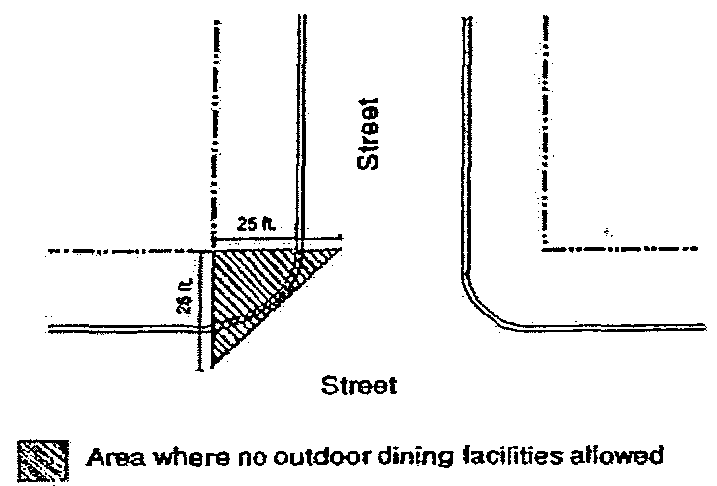
8.
Sidewalk Width. A minimum public sidewalk width of five feet shall be maintained. (Umbrellas and similar objects which comply with Subsection (D)(1) may protrude into this minimum sidewalk width.) The minimum sidewalk width may be reduced to four feet by the review authority in circumstances where the public safety may be maintained to the satisfaction of the City. When the sidewalk width is reduced to four feet by the decision-making body, it shall be explicitly noted in the minutes which are forwarded to the City Council for approval.
9.
Termination of Permit. The public right-of-way shall be left free of debris, litter, or any other evidence of the outdoor dining facility upon termination or removal of the use, and shall thereafter be used pursuant to the provisions of this code.
F.
Required Findings. .....Prior to the approval of outdoor dining areas, the review authority shall make the following findings:
1.
The outdoor dining area contributes to the village/pedestrian ambiance of the City, consistent with the City's General Plan;
2.
The outdoor dining area complies with the standards of this section;
3.
Any negative visual, noise, traffic, accessibility, and parking impacts associated with the outdoor dining area have been reduced to an acceptable level, as determined by the City;
4.
For outdoor dining areas on public property, the following findings shall also be made:
a.
The sidewalk's public use, including pedestrian, transit and business services needs, not limited to loading zones, bus stops, public phones, and benches, is not restricted by the facility;
b.
Pedestrian traffic volumes and accessibility are not inhibited by the facility;
c.
Street trees, utilities, fire equipment and similar items are not adversely impacted by the facility; and
d.
Public parking is not adversely impacted.
(Ord. 1314 §§ 19—23, 2006; Ord. 1190 § 9, 1997; Ord. 1182 § 10, 1997)
(Ord. No. 1561, § 3(Exh. A, § 13), 11-27-2012; Ord. No. 1594, § 3(Exh. A, § 28), 5-5-2015; Ord. No. 1759, § 3(Exh. A), 10-3-2023)
A.
Purpose and Intent. .....The temporary parklet regulations and design standards are established under State enabling legislation (AB 1217), which allow local agencies to adopt a program to support local business recovery from the impacts of the coronavirus pandemic by providing relief from parking restrictions to accommodate outdoor dining.
B.
.....This Section models the State's intent to allow for a streamlined process to expand temporary outdoor dining areas. This program is temporary, with a termination date of July 1, 2026. Requests for Permanent Outdoor Dining areas on either private or public property should refer to SCMC 17.28.205 - Outdoor Dining Areas.
C.
Applicability. .....This section shall apply to temporary outdoor facilities that are accessory to a food or beverage business licensed in the City of San Clemente. The facilities may be established:
a.
On the public right-of-way on streets with a speed limit of 25 mph or less; or
b.
On private property.
c.
Additionally, a business may apply for use of sidewalk space where the public path of travel is greater than ten feet in width under the exception process outlined in subsection D.
D.
Review Requirements. .....Requests for Parklet Permits that comply with this title and the approved Parklet Design Guidelines will be approved ministerially.
a.
General standards: These regulations apply to all temporary outdoor food and beverage spaces, both on public and private property:
i.
Hours of operation.
1.
Alcohol, food, or beverages shall not be served or allowed within the outdoor dining area:
a.
Before 7:00 a.m. and after 9:00 p.m. Sunday through Thursday; and
b.
Before 7:00 a.m. and after 10:00 p.m. Friday through Saturday and the day prior to a City Holiday.
2.
Outdoor Dining Areas shall comply with all State of California Department of Alcoholic Beverage Control license requirements, as applicable.
ii.
Use of space.
1.
Smoking or vaping shall not be permitted within the outdoor dining areas.
2.
Outdoor cooking and food preparation within the outdoor dining area is prohibited.
3.
Live entertainment, including but not limited to live music and performances, is not permitted within the outdoor dining area and must be requested separately via a Special Events Permit or Special Activities Permit.
iii.
Accessibility.
1.
A path of travel not less than five feet in width must be maintained free and clear adjacent to any outdoor dining area.
2.
An accessible path of travel shall connect the sidewalk to the accessible entry, deck surface, wheelchair turning space, and wheelchair resting space.
3.
A clear area of 60 inches in diameter located entirely within the outdoor dining area shall be provided for wheelchair turning, with a maximum overlap of 12 inches on the curb and sidewalk.
4.
At least one wheelchair accessible seating space shall be provided for every 20 seats, or portion thereof.
5.
Accessible Deck Surface:
a.
The accessible deck surface maximum cross slope (perpendicular to the sidewalk or curb) and the maximum running slope (parallel to the curb) shall not exceed two percent.
b.
The surface of the accessible route, clear floor spaces, and turning spaces shall be firm, stable, and slip-resistant.
c.
Openings in floor or deck surfaces shall not allow the passage of a sphere more than half an inch in diameter. Elongated openings shall be placed so that the longer dimension is perpendicular to the dominant direction of travel.
iv.
Design Guidelines: Additional guidelines may be contained within the City's Parklet Design Guidelines, which the City may adjust from time to time.
v.
Exceptions: Exceptions to the standards listed herein shall require a review by the Design Review Subcommittee, which shall provide a recommendation to the Community Development Director or Deputy Director. The Community Development Director shall make a final determination, appealable to the Planning Commission per the City's standard Appeals process (See 17.12.140 - Appeals of an Action).
b.
Parklets in the Street (Public Right-of-Way):
i.
Allowed Locations: Parklets may only be located adjacent to eating and drinking establishments at the following locations:
1.
Within the curb lane on streets where on-street metered or unmetered parking spaces exist adjacent to the front of the eating and drinking establishment; and
2.
Behind the buffer zone as indicated within the Parklet Design Guidelines. Each business is responsible for its own costs associated with procurement and installation of the buffer zone and parklet materials.
3.
Parklets may occupy up to three angle-in parking spaces or up to two parallel parking spaces. No more than six consecutive spaces may be used for outdoor dining operations.
ii.
Prohibited locations: Parklets may not be located or placed at any of the following locations:
1.
Along a street segment with a speed limit greater than 25 miles per hour.
2.
Within ten feet away from any intersection, street corner, alley, or driveway. The Public Works Department may increase or decrease this distance based on a site specific review of line of sight conditions; and
3.
Within an existing bike lane or within a proposed bike lane project identified in any of the City's comprehensive bicycle plan(s) or adopted land use plan(s).
4.
Within five feet of storm drain inlets or cleanouts.
5.
Over utility access panels, manhole covers, handholes, transformers, water meters, or water valves.
6.
Within five feet of a fire hydrant and/or any related emergency equipment.
7.
Within five feet of any natural gas or electric utility facility, including but not limited to any manholes, handholes or vaults, and any surface-level structures such as natural gas meters, monitors, pressure regulators, protection stations, poles, curbside electric meters, transformers, or green utility boxes.
iii.
Limitations:
1.
Parklets may occupy an on-street ADA parking space that is adjacent to the business's frontage; however, this request requires an applicant undergo the additional exceptions process, requiring review by the Design Review Subcommittee (DRSC) with input from the Public Works Director. The applicant shall be responsible for any costs associated with relocating accessible parking space, which shall be within 150 feet from the original space.
2.
The number of temporary parking waivers approved in the Downtown Parking Study area as part of the Limited Term Parking Relief Agreements shall not exceed 117, which is the number of unutilized parking waivers in the Downtown Parking Study Area as of February 16, 2022. (See SCMC 17.64.125.A.2).
a.
A maximum of 42 parking spaces may be used on Avenida Del Mar for the purpose of parklets.
3.
Parklets are limited to 24 seats per business.
iv.
Design Requirements for Parklets on public streets: Businesses should reference the City's Parklet Design Guidelines, which include (but are not limited to) the following standards:
1.
The width of the parklet shall not extend within four feet of the edge of the street travel lane.
2.
A parklet shall provide a setback of at least two feet from adjacent vehicle parking spaces.
3.
The deck of the parklet platform shall be flush with the sidewalk.
4.
Street deck/platforms should have a five inches by 18 inches minimum opening for curb drainage, unless approved otherwise by the City Engineer.
5.
Openings in floor or deck surfaces shall not allow the passage of a sphere more than half an inch in diameter.
6.
Bolting of fixtures, decks, and other surfaces into or onto the street, or otherwise penetrating into the surface of the road, shall not be permitted.
7.
A 42 inch high railing shall be placed at the edge of the parklet to serve as a barrier from vehicular traffic.
8.
No object, structure, or fixture shall stand or be placed more than 42 inches above the floor of the parklet, except for umbrellas and standing heaters, which may be up to eight feet in height. The business is responsible for securing umbrellas and heaters from wind.
9.
Umbrellas with an overhang of a minimum of 84 inches from the finished grade of the deck and/or sidewalk may be used in conjunction with a parklet, but no other covering, awning, roof, or shelter is permitted over the parklet. The canopy of the umbrella shall be contained within the parklet and shall not protrude into the sidewalk, adjacent parking spaces, adjacent parklets, or the travel or bike lane.
10.
Solar powered lights shall be permitted within the parklet, but electrical lighting elements that contain wires that cross the clear path of travel shall not be permitted.
11.
Signs: Only blade, menu, or stanchion signs are permitted within or around the parklet. Each business may only have four square feet of such signage, where only one side of a double-faced sign is counted toward this limit. Signs shall not exceed seven feet in height and shall not overhang the public sidewalk, adjacent parking spaces, adjacent parklets, or the travel or bike lane.
a.
A business that shares the frontage area of an adjacent business (which itself does not have its own parklet area) shall also pay for and produce a four square-foot blade sign with the name of the neighboring business using that business's trademark or logo if applicable. The neighboring business may waive this requirement in writing to the City if they do not desire the additional signage.
b.
Signs shall be specifically identified and requested within the Parklet application and shall not require a separate Administrative Sign Permit.
c.
Parklets on Private Property:
i.
Allowed Locations: Parklets may be permitted in any Zone as an accessory use of any food or beverage business with an active San Clemente Business License.
1.
Private Parklets may be established on private property in areas that do not obstruct required paths of travel and do not remove more than three parking spaces attributed to the business.
2.
The locations on private property should be within parking stalls, unless approved otherwise by the City Engineer or City Planner.
ii.
Prohibited locations: Parklets may not be located or placed at any of the following locations:
a.
ADA parking stalls.
b.
Within five feet of a fire hydrant and/or any emergency equipment.
c.
Within five feet of any natural gas or electric utility facility, including the perimeter of any manholes, handholes or vaults, and any surface-level structures such as natural gas meters, monitors, pressure regulators, protection stations, poles, curbside electric meters, transformers, or green utility boxes.
iii.
Design Requirements for Parklets on private property: Businesses should reference the City's Parklet Design Guidelines, which include (but are not limited to) the following standards:
a.
Private parklets are encouraged, but not required, to construct wooden platforms or decks under 30 inches in height and flush with the nearest path of travel.
b.
A parklet shall provide a setback of at least two feet from adjacent vehicle parking spaces.
c.
A backup distance of 20 feet must be maintained between the parklet edge and nearby parking stalls.
d.
Private parklets are encouraged to use market umbrellas for shade, but may use a single large tent (if approved by OCFA). They may not use ten-foot square pop up tents.
e.
A 42 inch high railing shall be placed at the edge of the parklet to serve as a barrier from vehicular traffic within parking lots.
f.
Parklets are limited to 24 seats per business.
d.
Limited Term Parking Relief Agreement Requirements:
i.
Prior to installation of any furniture or improvements and prior to operation of a parklet, an applicant shall obtain a Limited Term Parking Relief Agreement.
a.
Requests for approval of Limited Term Parking Relief Agreements that comply with the standards set forth in 17.28.206 and the City's Parklet Design Guidelines shall be reviewed administratively and approved by the City Manager or his or her designee.
b.
Agreements shall specify a fee, as set by the City Council, for the use of and operation of the parklet;
c.
Agreements shall require Insurance coverage, including Commercial General Liability, personal injury, and property damage liability, with minimum combined liability limits of $1,000,000.00 per occurrence.
ii.
Additional standards for parklets in the street / public right-of-way:
a.
Prior to installation of any furniture or improvements, a Limited Term Parking Relief Agreement must be executed between the City and the applicant.
b.
Parklets shall follow standard dimensions and plans as indicated within the Parklet Design Guidelines. Deviations from the standard approved construction templates shall require review by the Design Review Subcommittee.
c.
During hours of non-operation, tables shall be removed, but all chairs shall remain in a secured fashion that allows public access to the space outside of restaurant operating hours.
d.
Limited Term Parking Relief Agreements may indicate certain dates or events during which the restaurant shall agree to public or non-profit use of the parklet space.
iii.
Parklets shall be removed at the business operator's expense within 30 days of the end of the Parklet Program, which expires July 1, 2026.
(Ord. No. 1727, § 4, 2022; Ord. No. 1772, § 4(Exh. A), 2-6-2024)
Editor's note— Ord. No. 1594, § 3(Exh. A, § 29), adopted May 5, 2015 repealed § 17.28.206, which pertained to Outdoor dining areas on public property, permanent and accessory and derived from Ord. 1308 § 11, adopted in 2006; Ord. 1182 § 11, adopted in 1997; and Ord. No. 1561, § 3(Exh. A, §§ 14—16), adopted Nov. 27 2012.
A.
Purpose and Intent. .....It is the intent of this title to require that all businesses be conducted completely within an enclosed building. In recognition that certain types of uses require outdoor display, however, the purpose of this section is to allow accessory outdoor display for uses which functionally require outdoor display and mitigate potential visual impacts, parking impacts, traffic congestion, and noise impacts. This section also aims to integrate such activities into the appropriate zones with the least impact to the surrounding community.
This section applies to outdoor display on private property. For temporary outdoor display on private property, please refer to Section 17.28.300, Temporary Uses and Structures, in this chapter. For special events on public property, please see City Beaches, Parks and Recreation Department.
B.
Review Requirements. .....Accessory outdoor display areas require the approval of a minor Conditional Use Permit, in accordance with Section 17.16.070, Minor Conditional Use Permits, of this title, and subject to the concurrent review and appeal procedures defined in Section 17.12.090, Consideration of Concurrent Applications, and Section 17.12.140, Appeals of an Action, of this title. Exceptions: Vehicle dealerships which include outdoor display shall be subject to the requirements and review procedures found in Section 17.28.310, Vehicle Dealerships, of this title.
C.
Minimum Standards. .....The following restrictions shall apply to the outdoor display of goods and materials in nonresidential and mixed-use zones, where allowed:
1.
Encroachment into Public Right-of-Way and/or Parking. No outdoor display shall occupy any part of a required parking area, or encroach upon public right-of-way.
2.
Height. No outdoor display shall exceed the height limit of the zone.
3.
Location. Only goods and materials associated with pre-existing, indoor primary uses may be displayed. Outdoor accessory display areas are allowed, when all of the following criteria apply:
a.
The use engaged in the outdoor display and the outdoor display itself are located in a nonresidential or mixed-use zone.
b.
The use engaging in the outdoor display is permitted or conditionally permitted in the zone in which it is located, as listed in the Permitted and Conditionally Permitted Use Tables in Chapters 17.36, Commercial Zones and Standards, through 17.48, Public Zones and Standards, of this title.
c.
The primary use on the property and the goods displayed, as determined by the City, are as follows:
Table 17.28.210
Primary Uses with Outdoor Display
4.
Parking. No outdoor display shall occupy any part of a required parking area. Areas used for outdoor display and sales shall be calculated in determining the parking requirements for the primary use. Exception: Auto dealerships and rental facilities with 10 or fewer cars for sale/no repair are exempt from these requirements, as detailed in Section 17.28.310, Vehicle Dealerships.
5.
Visibility. Outdoor display shall not create any sight distance problems to or from the appropriate streets, as determined by the City Traffic Engineer.
D.
Required Findings. .....Prior to the approval of a minor Conditional Use Permit for outdoor display, all of the following findings shall be made in addition to the general findings required for the approval of a minor Conditional Use Permit:
1.
The nature of the use requires the outdoor display of goods associated with the use;
2.
The outdoor display area complies with the standards of this section; and
3.
The negative visual, noise, traffic and parking impacts associated with the outdoor display area have been reduced to an acceptable level, as determined by the City.
(Ord. 1182 § 12, 1997: Ord. 1172 § 3 (part), 1996)
A.
Purpose and Intent. .....The purpose of these standards is to address the visual, noise, and compatibility problems associated with sites which serve primarily as parking lots for other/adjacent sites, including parking lots in residential zones which serve nonresidential uses.
B.
Review Requirements. .....Please refer to the permitted and conditional use tables in Chapters 17.32, Residential Zones and Standards through 17.48, Public Zones and Standards, of this title.
C.
Minimum Standards for Parking Lots in Residential Zones.
1.
Purpose and Intent. It is appropriate in certain circumstances for the City to allow parking lots which serve adjacent nonresidential uses to be located in residential zones. The purpose of this subsection is to list the circumstances under which such a parking lot might be appropriate, the appropriate review process for such a request, and standards which reduce the impacts associated with such facilities upon adjacent residential development.
2.
Landscaping. The parking lot shall be subject to both the site landscaping requirements found in Chapter 17.68, Landscape Standards, and landscaping requirements for parking areas found in Section 17.64.060(C), Design Standards for Off-Street Parking Facilities, Landscaping, of this title. The parking lot shall comply with the landscaping standards for the nonresidential zone the lot is serving.
3.
Location. Please refer to the permitted and conditional use tables in Chapter 17.32, Residential Zones and Standards, of this title. The parking lot shall abut the property on which the nonresidential establishment the parking lot is serving is located or shall be separated only by a public alley.
4.
Screening. Parking lots designed for five or more vehicles shall be separated from adjacent residential properties by a six-foot wall, or view-obscuring fence, measured from the finished grade of the residential property. In no case shall the wall be less than five feet tall as measured from the finished grade of the nonresidential property. The wall shall be screened with landscaping, to minimize its visual impact upon the neighborhood.
5.
Setbacks. Parking spaces shall meet the setback standards for primary structures for the residential zone in which the parking lot is located.
6.
Signs. No signs of any kind, other than ones designating entrances, exits or conditions of use, shall be maintained on such parking lots. Any such sign as Stated above shall not exceed eight square feet in area.
7.
Type of Parking Lot. Parking lots in residential zones shall be limited to public or no-fee private parking lots for automobiles.
8.
Use of the Parking Lot, Limitations. The parking lot serving a nonresidential establishment shall be an accessory use to a permitted nonresidential establishment. The parking lot shall be restricted to the use of persons patronizing the nonresidential use it serves, as long as the use for which the parking is required continues. While a parking lot, the use of the site shall be limited to solely parking.
D.
Minimum Standards for Parking Lots in Nonresidential and Mixed-Use Zones.
1.
Landscaping. The parking lot shall be subject to both the site landscaping requirements found in Chapter 17.68, Landscape Standards, and the landscaping requirements for parking areas found in Section 17.64.060(C), Design Standards for Off-Street Parking Facilities, Landscaping, of this title. The parking lot shall comply with the landscaping standards for the zone in which it is located.
2.
Location. Please refer to the permitted and conditional use tables in Chapters 17.36, Commercial Zones and Standards through 17.48, Public Zones and Standards, of this title.
3.
Screening. Parking lots designed for five or more vehicles and located adjacent to residentially zoned property shall be separated from adjacent residential properties by a six-foot wall, or view-obscuring fence, measured from the finished grade of the residential property. In no case shall the wall be less than five feet tall as measured from the finished grade of the nonresidential property. The wall shall be screened with landscaping to minimize visual impact upon the neighborhood.
4.
Setbacks. No parking shall be allowed in the setback areas on the lot, as required for the zone in which the lot is located.
E.
Required Findings. .....Prior to approval of the parking lot, all of the following findings shall be made along with the general findings required for the Discretionary Permit required for the parking lot.
1.
Parking Lots in Residential Zones. The parking lot shall be used solely for the parking of private passenger vehicles.
2.
Parking Lots in All Zones.
a.
Any adjoining residential property will not be adversely affected by the granting of the permit.
b.
The parking lot complies with the standards of this section.
(Ord. 1172 § 3 (part), 1996)
A.
Purpose and Intent. .....The purpose of this section is to describe the architectural review procedures for public park facilities. For specific details regarding the review of parks and recreational facilities, please refer to the interim policy for the review of recreational facilities and streetscapes, until such time as this policy has been incorporated into the City's Parks and Recreation Master Plan.
B.
Review Requirements.
1.
Buildings. The development of new park facility buildings or additions to existing buildings require architectural review with the approval of a Development Permit (Section 17.16.100), or Cultural Heritage Permit (17.16.110) for historic resources and landmarks on the City's designated historic resources and landmarks list, such as the Municipal Golf Course. The Review Authority considers architectural and aesthetic impacts of proposals.
2.
Other Facilities. The development or addition of sports courts, landscaping, benches, trails and other recreational facilities which do not include the development of buildings shall be exempt from the discretionary review requirements of the Zoning Ordinance.
(Ord. 1172 § 3 (part), 1996)
(Ord. No. 1759, § 3(Exh. A), 10-3-2023)
A.
Purpose and Intent. .....The purpose of this section is to ensure that public utility facilities, such as substations or reservoirs, and antennas (other than satellite antennas and antennas on City property, which are regulated elsewhere) are located and built in a manner which is compatible with adjacent uses. An additional purpose of this section is to define the review process for public utilities initiated by the City and those initiated by outside agencies. Please refer to Section 17.28.070, Antennas on City Property, and Section 17.28.080, Satellite Antennas, for regulations for other types of antennas.
B.
Review Requirements.
1.
City Projects. For the required review process for City-initiated public utility projects, please refer to the City's Public Works Department policy on the review of capital improvement projects.
2.
Projects Initiated by Outside Agencies/Applicants.
a.
Major utilities shall require the approval of a Conditional Use Permit, in accordance with Section 17.16.060, Conditional Use Permits. Major utilities shall include, but shall not be limited to, reservoirs, utility substations, including electrical distribution and transmission substations, and above-ground pump stations, such as sewage and potable water system pump stations, antennas (other than satellite antennas, antennas on City property, and small cell facilities) and similar facilities. If the installation of the antenna is stealth, as determined by the City Planner, then the process is administrative and no Conditional Use Permit is required. The standards in Subsection (C)(1), Minimum Standards for Projects Initiated by Outside Agencies, Major Utilities, shall apply to major utilities initiated by outside agencies. The City Engineer shall be responsible for determining whether a utility is major.
b.
Minor utilities shall be permitted outright, subject to the concurrent review requirements found in Section 17.12.090, Consideration of Concurrent Applications. Minor utilities shall include, but shall not be limited to, below-ground pump stations, stand pipes, and transformers. The standards in Subsection (C)(2), Minimum Standards for Projects Initiated by Outside Agencies, Minor Utilities, shall apply to minor utilities initiated by outside agencies. The City Engineer shall be responsible for determining whether a utility is minor.
c.
Public utility distribution and transmission line towers and poles, and underground facilities for distribution of gas, water, telephone and electricity shall be allowed in all zones without obtaining a Conditional Use Permit. However, all routes and heights of proposed electric transmission systems of 69 KV and over, telephone main trunk cables, from one central office to another and water or gas transmission mains which are above ground, shall be located in conformance with the General Plan of the City.
d.
Small cell facilities shall require the approval of a Wireless Permit in accordance with Section 17.16.075.
3.
Modifications to Existing Antenna Facilities. The City Planner shall review and decide on requests to modify existing wireless towers or base station structures that support antennas, transceivers, or other related equipment. This includes the addition and removal of wireless transmission equipment such as the co-location of new transmission equipment, the removal of transmission equipment, or the replacement of transmission equipment. Modifications shall not substantially change the physical dimensions of the wireless tower or base station, as defined by the Federal Communications Commission. The City Planner may approve projects that meet minimum standards in Section 17.28.070(D)(5).
C.
Minimum Standards for Projects initiated by Outside Agencies.
1.
Major Utilities.
a.
Compatibility. All buildings, structures and landscaping shall be visually compatible with surrounding development.
b.
Development Standards. The standards for major utilities shall be determined through the Conditional Use Permit process.
c.
Location. Please refer to the permitted and conditional use tables in Chapters 17.32, Residential Zones and Standards through 17.48, Public Zones and Standards.
2.
Minor Utilities.
a.
Compatibility. All minor utilities shall be placed underground or shall be screened in accordance with Section 17.24.050, Building Equipment and Services and Their Screening.
b.
Development Standards. Minor utilities shall comply with the standards for ground-mounted equipment in Section 17.24.050, Building Equipment and Services and Their Screening.
c.
Location. Please refer to the permitted and conditional use tables in Chapters 17.32, Residential Zones and Standards through 17.48, Public Zones and Standards.
d.
Parking. The parking requirements for a public utility use such as an electric distribution and transmission substation, public utility service yard or similar use may be waived or modified, subject to the approval of a Conditional Use Permit in accordance with Section 17.16.060, Conditional Use Permits, upon a finding that the use requires no full-time or permanent employees.
3.
Modifications of Existing Wireless Towers or Base Station Structures. Refer to Section 17.28.070(D)(5) for minimum standards that apply to modifications of existing wireless towers or base station structures.
4.
Small Cell Facilities.
a.
Design and Development Standards. The design and development standards, which contain aesthetic and location criteria for small cell facilities shall be adopted by Resolution of the City Council.
(Ord. 1304 § 21, 2005; Ord. 1172 § 3 (part), 1996)
(Ord. No. 1594, § 3(Exh. A, § 30), 5-5-2015; Ord. No. 1690, § 3(Exh. A), 2-18-2020)
A.
Purpose and Intent. .....The purpose of this section is to mitigate the potential safety, aesthetic, and general impacts of recycling facilities and to integrate such facilities into appropriate areas with the least impact to the surrounding community. This section is also meant to provide for the establishment of recycling facilities, as the disposal of recyclable material creates great waste and unnecessarily depletes our limited supply of natural resources. The City desires to encourage the recycling of reusable material.
B.
Review Requirements.
1.
General Review Requirements. Please refer to the use tables in Chapters 17.36, Commercial Zones and Standards, through 17.48, Public Zones and Standards, of this title.
2.
Single Application for More than One Site. A single application may be filed for more than one reverse vending machine or small collection facility located on different sites under the following conditions:
a.
The operator of each of the proposed facilities is the same;
b.
The proposed facilities are determined by the Planning Division to be similar in nature, size and intensity of activity; and
c.
All of the applicable criteria and standards set forth in the following subsections are met for each such proposed facility.
C.
Minimum Standards for All Recycling Facilities. .....Recycling facilities permitted by right shall meet all of the applicable criteria and standards listed in this subsection. Those recycling facilities permitted through discretionary review shall meet the applicable criteria and standards, provided that the decision-making authority responsible for issuing the permit may relax the standards or impose stricter standards as provided for in Subsection (H), Required Finding for Relaxed or Stricter Standards, of this section, as an exercise of discretion upon a finding that such modifications are reasonably necessary in order to implement the general intent of this section and this title.
D.
Minimum Standards for Reverse Vending Machines.
1.
Construction. Reverse vending machines shall be constructed and maintained with durable waterproof and rustproof material.
2.
Floor Area. Reverse vending machines shall be limited to an area of no more than 50 square feet.
3.
Height. Reverse vending machines shall not be more than eight feet in height.
4.
Hours. Reverse vending machines shall be usable at least as long as the operating hours of the primary use.
5.
Identification. Reverse vending machines shall be clearly marked to identify the type of material to be deposited, operating instructions, and the identity and phone number of the operator or responsible person to call if the machine is inoperative.
6.
Lighting. Reverse vending machines shall be illuminated to ensure comfortable and safe operation.
7.
Location.
a.
Please refer to the permitted and conditional use tables in Chapters 17.36, Commercial Zones and Standards, through 17.48, Public Zones and Standards, of this title.
b.
Reverse vending machines shall be located within 30 feet of the entrance to the primary use and not obstruct pedestrian or vehicular circulation or be located in public right-of-way when an Encroachment Permit is obtained, in accordance with Chapter 12.20, Encroachment Permits, of this code.
8.
Maintenance. Reverse vending machines shall be maintained in a clean, attractive, and litter-free condition on a regular basis.
9.
Parking. Reverse vending machines shall not occupy parking spaces required by the primary use nor shall the machines require additional parking spaces.
10.
Signs. Reverse vending machines shall have a sign area of a maximum of four square feet per machine, exclusive of operating instructions.
11.
Use. Reverse vending machines shall be established in conjunction with a primary use which is in compliance with zoning and other regulations for the area.
E.
Minimum Standards for Small Collection Facilities and Mobile Recycling Units.
1.
Equipment. Small collection facilities and mobile recycling units shall use no power driven equipment other than that required to operate reverse vending machines.
2.
Expiration of Permit. If the permit expires without renewal, the facility shall be removed from the site on the day following permit expiration.
3.
Floor Area. Small collection facilities and mobile recycling units shall occupy less than 500 square feet of floor area.
4.
Hours. Operating hours shall be subject to the review and approval of the Planning Division or, in the case of Discretionary Permits, the required decision-making authority. Attended facilities located within 100 feet of a property zoned or occupied for residential use shall operate only during the hours between 9:00 a.m. and 7:00 p.m.
5.
Identification. Containers shall be clearly marked to identify the type of material which may be deposited; the facility shall be clearly marked to identify the name and telephone number of the facility operator and the hours of operation, and display a notice stating that no material shall be left outside the recycling enclosure or containers.
6.
Landscaping. These facilities shall not impair or reduce the landscaping required by local ordinance for any concurrent use by this title or any permit issued pursuant thereto.
7.
Location. Please refer to the permitted and conditional use tables in Chapter 17.36, Commercial Zones and Standards, through 17.48, Public Zones and Standards, of this title.
8.
Maintenance. These facilities shall be constructed and maintained with durable waterproof and material, covered when the site is not attended, secured form unauthorized entry of a capacity sufficient to accommodate materials collected. The facilities shall be maintained in a clean, attractive, and litter-free condition on a regular basis.
9.
Materials. Small collection facilities and mobile recycling units shall accept only glass, metals, plastic containers, and paper. Other items shall be accepted upon approval of the local public health official.
10.
Noise. The facility shall not exceed noise levels of 60 DBA as measured at the property line of residentially zoned or occupied property, otherwise shall not exceed 70 DBA.
11.
Occupation of Parking Spaces. The facilities shall occupy no more than three of the parking spaces required for the primary use, not including spaces required for the periodic removal of containers or materials. The facilities shall not obstruct pedestrian or vehicular circulation.
12.
Parking.
a.
No additional parking spaces will be required for customers of a Small Collection Facility located at the established parking lot of a host use. One space will be provided for the attendant, if needed.
b.
Mobile recycling units shall have an area clearly marked to prohibit other vehicular parking during hours when the mobile unit is scheduled to be present.
c.
Occupation of parking spaces by the facility and by the attendant may not reduce available parking spaces below the minimum number required for the primary host use unless all of the following conditions exist:
i.
The facility is located in a convenience zone or a potential convenience zone as designated by the California Department of Conservation;
ii.
A parking study shows that existing parking capacity is not already fully utilized during the time the recycling facility will be on the site;
iii.
The permit will be reconsidered at the end of 18 months.
d.
A reduction in available parking spaces in an established parking facility may then be allowed as follows:
i.
For a commercial host use:
ii.
For a community facility host use:
A maximum of five space reduction will be allowed when not in conflict with the parking needs of the host use.
13.
Setbacks.
a.
Containers. Containers for the 24-hour donation of materials shall be at least 30 feet from any property zoned or occupied for residential use unless there is a recognized service corridor and acoustical shielding between the containers and the residential use.
b.
Facility. The facility shall be set back at least 10 feet from any street line and shall not obstruct pedestrian or vehicular circulation.
14.
Signs. Signs may be provided as follows:
a.
Small Collection Facilities may have identification signs with a maximum of 16 square feet, in addition to information signs required in Subsection (E)(5), Identification, of this section;
b.
Signs must be consistent with the character of the location;
c.
Directional signs, bearing no advertising message, may be installed with the approval of the Planning Division, if necessary to facilitate traffic circulation, or if the facility is not visible from the public right-of-way;
d.
Zoning Administrator review will be required for all signage which meets the standard review parameters.
15.
Storage. The facility shall store all recyclable material in containers or in the mobile unit vehicle, and shall not leave materials outside of containers when attendant is not present.
F.
Minimum Standards for Large Collection Facilities.
1.
Distance. A large collection recycling facility shall maintain a 300-foot distance from property zoned for residential use.
2.
Floor Area. Large collection recycling facilities shall cover more than 500 square feet of floor area or be established independently of an existing commercial use.
3.
Hours of Operation. If the facility is located within 500 feet of property zoned, planned or occupied for residential use, it shall not be in operation between 7:00 p.m. and 7:00 a.m.
Operating hours shall be determined by the City through the required permitting process.
4.
Identification. The facility shall be clearly marked with the name and phone number of the facility operator and the hours of operation; identification and informational signs will meet the standards of the zone; and directional signs, bearing no advertising message, may be installed with the approval of the Planning Division, if necessary, to facilitate traffic circulation or if the facility is not visible from the public right-of-way.
5.
Litter. Site shall be maintained free of litter any other undesirable materials, and will be cleaned of loose debris on a daily basis.
6.
Location.
a.
Please refer to the permitted and conditional use tables in Chapters 17.36, Commercial Zones and Standards, through 17.48, Public Zones and Standards, of this title.
b.
The facility shall not abut a property zoned or planned for residential use.
7.
Maintenance.
a.
Facility. The facility shall be maintained in a clean, attractive, and litter-free condition on a regular basis. Covers and secure containers shall be provided for exterior storage of material.
b.
Noticing. The facility shall display a notice stating that no material shall be left outside the recycling containers.
8.
Noise. Noise levels shall not exceed 60 DBA as measured at the property line of residentially zoned property, or otherwise shall not exceed 70 DBA.
9.
Parking.
a.
Space will be provided on site for six vehicles or the anticipated peak customer load, whichever is higher, to circulate and to deposit recyclable materials, except where the Planning Division determines that allowing over-flow traffic above six vehicles is compatible with surrounding businesses and public safety;
b.
One parking space will be provided for each commercial vehicle operated by the recycling facility. Parking requirements will be as provided for in the zone, except that parking requirements for employees may be reduced when it can be shown that parking spaces are not necessary such as when employees are transported in a company vehicle to a work facility.
10.
Processing. Power-driven processing, including aluminum foil and can compacting, baling, plastic shredding, or other light processing activities necessary for efficient temporary storage and shipment of material, may be approved through a use permit process or at the discretion of the Planning Division if noise standards and other conditions are met.
11.
Screening. The facility will be screened from the public right-of-way by operating in an enclosed building or:
a.
Within an area enclosed by an opaque fence at least six feet in height with landscaping;
b.
At least 150 feet from property zoned or planned for residential use; and
c.
Meets all applicable noise standards in this title.
12.
Setback.
a.
Containers. Any containers provided for after-hours donation of recyclable materials will be at least 50 feet from any property zoned or occupied for residential use.
b.
Facility. Setbacks requirements shall be those provided for by the zoning district in which the facility is located.
13.
Storage. All exterior storage of material shall be in sturdy containers which are covered, secured, and maintained in good condition. All processed materials shall be baled and pelletized. Storage containers for flammable material shall be constructed of nonflammable material. Oil storage must be in containers approved by the Orange County Fire Authority. No storage, excluding truck trailers and overseas containers, will be visible above the height of the fencing. Storage shall have sufficient capacity to accommodate materials collected, and shall be secure from unauthorized entry or removal of materials.
14.
Other Requirements. Large recycling facilities shall comply with the NPDES Storm Water Permit Program. For further information on NPDES requirements, refer to the NPDES Ordinance, available from the City's Engineering Division.
G.
Minimum Standards for Processing Facilities.
1.
Hours of Operation.
a.
If the facility is located within 500 feet of property zoned or planned for residential use, it shall not be in operation between 7:00 p.m. and 7:00 a.m. The facility will be administered by on-site personnel during the hours the facility is open.
b.
Operating hours shall be determined by the City through the required permitting process.
2.
Location.
a.
Please refer to the permitted and conditional use tables in Chapters 17.36, Commercial Zones and Standards, through 17.48, Public Zones and Standards, of this title.
b.
The facility shall not abut a property zoned or planned for residential use.
3.
Maintenance.
a.
Facility. Site shall be maintained free of litter and any other undesirable materials, and will be cleaned of loose debris on a daily basis and will be secured from unauthorized entry and removal of materials when attendants are not present.
b.
Noticing. The facility shall display a notice stating that no material shall be left outside the recycling containers.
4.
Material Shipments. A light processing facility shall have no more than an average of two outbound truck shipments of material per weekday and may not shred, compact or ball ferrous metals other than food and beverage containers.
5.
Motor Oil. A processing facility may accept used motor oil for recycling in accordance with Section 25250.11 of the California Health and Safety Code.
6.
Parking.
a.
Space shall be provided on site for the anticipated peak load of customers to circulate, park and deposit recyclable materials. If the facility is open to the public, space will be provided for a minimum of 10 customers or the park load, whichever is higher, except where the Planning Division determines that allowing overflow traffic is compatible with surround businesses and public safety.
b.
One parking space will be provided for each commercial vehicle operated by the processing center. Parking requirements will otherwise be as mandated by the zone in which the facility is located.
7.
Processing. Power-driven processing shall be permitted, provided all noise level requirements are met. Light processing facilities are limited to baling, briquetting, crushing, compacting, grinding, shredding and sorting of source-separated recyclable materials and repairing of reusable materials.
8.
Setbacks.
a.
Containers. Any containers provided for after-hours donation of recyclable materials will be at least 50 feet from any property zoned or occupied for residential use.
b.
Facility. Setbacks requirements shall be those provided for by the zoning district in which the facility is located.
9.
Setting. In a heavy commercial or light industrial zone, processors will operate in a wholly enclosed building except for incidental storage, or:
a.
Within an area enclosed on all sides by an opaque fence or wall not less than eight feet in height and landscaped on all street frontages;
b.
Located at least 150 feet from property zoned or planned for residential use.
10.
Sign. Sign requirements shall be those provided for the zoning district in which the facility is located. In addition, facility will be clearly marked with the name and phone number of the facility operator and the hours of operation.
11.
Size. A light processing facility shall be no larger than 45,000 square feet.
12.
Storage. All exterior storage of material shall be in sturdy containers or enclosures which are covered, secured and maintained in good condition. All processed materials shall be baled and pelletized. Storage containers for flammable material shall be constructed of nonflammable material. Oil storage must be in containers approved by the Orange County Fire Authority. No storage, excluding truck trailers and overseas containers, will be visible above the height of the fencing. Storage shall have sufficient capacity to accommodate materials collected; and shall be secure from unauthorized entry or removal of materials.
13.
Other Requirements.
a.
No dust, fumes, smoke, vibration or odor above ambient level may be detectable on neighboring properties.
b.
Other Requirements. Processing facilities shall comply with the NPDES Storm Water Permit Program. For further information on NPDES requirements, refer to the NPDES Ordinance, available from the City's Engineering Division.
H.
Required Findings for Relaxed or Stricter Standards. .....The decision-making authority responsible for issuing the Discretionary Permit for recycling facilities may relax the standards or impose stricter standards than those in the above section upon a finding that such modifications are reasonably necessary in order to implement the general intent of this section and the Zoning Ordinance.
(Ord. 1314 § 23, 2006; Ord. 1172 § 3 (part), 1996)
A.
Purpose and Intent. .....The presence of drive-throughs may result in adverse impacts on adjacent properties and residents or on surrounding neighborhoods. The purpose of this section is to anticipate and mitigate these impacts. To this extent, this section considers customer and employee parking demand, traffic generation, noise, light, litter, and the cumulative impacts of such demands in one area. It is the intent of this section to ensure that drive-throughs are consistent with the goals, objectives and policies of the General Plan.
B.
Review Requirements. .....Please refer to the use tables in Chapters 17.36, Commercial Zones and Standards, through 17.40, Mixed-use Zones and Standards, of this title.
C.
Minimum Standards.
1.
Driveways and Queuing. To mitigate circulation impacts, ingress, egress, and queuing area shall be reviewed and approved by the City Engineer. The queuing area shall not interfere with on-or-off site circulation patterns.
2.
Hours of Operation. To mitigate noise impacts, limited hours of operation should be considered as part of the discretionary review process. An example measure would be to limit hours from 7:00 a.m. to 10:00 p.m. when located on a site adjacent to, or separated by an alley from, any residentially zoned property. Friday and Saturday night closing time could be extended by two hours to 12:00 a.m.
3.
Location. Please refer to the use tables in Chapters 17.36, Commercial Zones and Standards, through 17.40, Mixed-use Zones and Standards, of this title.
4.
Noise. Any speaker systems used on the site shall be designed to compensate for ambient noise levels in the immediate area and shall not be located within 30 feet of any residential zone or any property used for residential uses. Sound should be directed away from residences. A noise study may be required through the discretionary review process.
5.
Parking. One lane for each drive-up window with stacking spaces for six vehicles.
6.
Other Requirements. Any construction must conform to parking, height, setback, lot coverage, architectural review, fees, charges, and all other applicable General Plan, zoning and building requirements.
(Ord. 1314 §§ 24—25, 2006; Ord. 1172 § 3 (part), 1996)
(Ord. No. 1561, § 3(Exh. A, §§ 17, 18), 11-27-2012)
A.
Purpose and Intent. .....The purpose and intent of this section is to allow and regulate accessory dwelling units (ADUs) and junior accessory dwelling units (JADUs) within the City. The regulations in this section are intended to comply with California Government Code Sections 65852.2 and 65852.22, as they may be amended.
B.
Effect of Conforming. .....An ADU or JADU that conforms to the standards in this section will not be:
1.
Deemed to be inconsistent with the City's general plan and zoning designation for the lot on which the ADU or JADU is located;
2.
Deemed to exceed the allowable density for the lot on which the ADU or JADU is located;
3.
Considered in the application of any local ordinance, policy, or program to limit residential growth; and
4.
Required to correct a nonconforming zoning condition, as defined in Subsection C.7 below. This does not prevent the City from enforcing compliance with applicable building standards in accordance with Health and Safety Code Section 17980.12.
C.
Definitions. .....As used in this section, terms are defined as follows:
1.
"Accessory dwelling unit" or "ADU" means an attached or a detached residential dwelling unit that provides complete independent living facilities for one (1) or more persons and is located on a lot with a proposed or existing primary residence. An accessory dwelling unit also includes the following:
a.
An efficiency unit, as defined by California Health and Safety Code Section 17958.1; and
b.
A manufactured home, as defined by California Health and Safety Code Section 18007.
2.
"Accessory structure" means a structure that is accessory and incidental to a dwelling located on the same lot.
3.
"Complete independent living facilities" means permanent provisions for living, sleeping, eating, cooking, and sanitation on the same parcel as the single-family or multi-family dwelling is or will be situated.
4.
"Efficiency kitchen" means a kitchen that includes all of the following:
a.
A cooking facility with appliances.
b.
A food preparation counter and storage cabinets that are of a reasonable size in relation to the size of the JADU.
5.
"Junior accessory dwelling unit" or "JADU" means a residential unit that satisfies all of the following:
a.
It is no more than five hundred (500) square feet in size;
b.
It is contained entirely within an existing or proposed single-family structure. An enclosed use within the residence, such as an attached garage, is considered to be a part of and contained within the single-family structure;
c.
It includes its own separate sanitation facilities or shares sanitation facilities with the existing or proposed single-family structure;
d.
If the unit does not include its own separate bathroom, then it contains an interior entrance to the main living area of the existing or proposed single-family structure in addition to an exterior entrance that is separate from the main entrance to the primary dwelling; and
e.
It includes an efficiency kitchen, as defined in Subsection C.4 above.
6.
"Living area" means the interior habitable area of a dwelling unit, including basements and attics, but does not include a garage or any accessory structure.
7.
"Nonconforming zoning condition" means a physical improvement on a property that does not conform with current zoning standards.
8.
"Passageway" means a pathway that is unobstructed clear to the sky and extends from a street to one (1) entrance of the ADU or JADU.
9.
"Proposed dwelling" means a dwelling that is the subject of a permit application and that meets the requirements for permitting.
10.
"Public transit" means a location, including, but not limited to, a bus stop or train station or SC Rides, where the public may access buses, trains, subways, and other forms of transportation that charge set fares, run on fixed routes, and are available to the public.
11.
"Tandem parking" means that two (2) or more automobiles are parked on a driveway or in any other location on a lot, lined up behind one (1) another.
D.
Permit Procedures. .....The following approvals apply to ADUs and JADUs under this section:
1.
Building-Permit Only. If an ADU or JADU complies with each of the general requirements in Subsection E below, it is allowed with only a building permit in the following scenarios:
a.
Converted on Single-family Lot: One (1) ADU as described in this Subsection D.1.a and one (1) JADU on a lot with a proposed or existing single-family dwelling on it, where the ADU or JADU:
i.
Is either: within the space of a proposed single-family dwelling; within the existing space of an existing single-family dwelling; or (in the case of an ADU only) within the existing space of an accessory structure, plus up to one hundred fifty (150) additional square feet if the expansion is limited to accommodating ingress and egress; and
ii.
Has exterior access that is independent of that for the single-family dwelling; and
iii.
Has side and rear setbacks sufficient for fire and safety, as dictated by applicable building and fire codes; and
iv.
The JADU complies with the requirements of Government Code Section 65852.22.
b.
Limited Detached on Single-family Lot: One (1) detached, new-construction ADU on a lot with a proposed or existing single-family dwelling (in addition to any JADU that might otherwise be established on the lot under Subsection D.1.a above), if the detached ADU satisfies each of the following limitations:
i.
The side- and rear-yard setbacks are at least four (4) feet.
ii.
The total floor area is eight hundred (800) square feet or smaller.
iii.
The peak height above grade does not exceed the applicable height limit in Subsection E.2 below.
c.
Converted on Multifamily Lot: One (1) or more ADUs within portions of existing multi-family dwelling structures that are not used as livable space, including, but not limited to, storage rooms, boiler rooms, passageways, attics, basements, or garages, if each converted ADU complies with state building standards for dwellings. Under this Subsection D.1.c, at least one (1) converted ADU is allowed within an existing multi-family dwelling, up to a quantity equal to twenty-five percent (25%) of the existing multi-family dwelling units.
d.
Limited Detached on Multifamily Lot: No more than two (2) detached ADUs on a lot that has an existing or proposed multi-family dwelling if each detached ADU satisfies both of the following limitations:
i.
The side- and rear-yard setbacks are at least four (4) feet. If the existing multifamily dwelling has a rear or side yard setback of less than four (4) feet, the City will not require any modification to the multifamily dwelling as a condition of approving the ADU.
ii.
The peak height above grade does not exceed the applicable height limit provided in Subsection E.2 below.
2.
ADUs that Require an ADU Permit.
a.
Except as allowed under Subsection D.1 above, no ADU may be created without a building permit and an ADU permit in compliance with the standards set forth in Subsections E and F below.
b.
The City may charge a fee to reimburse it for costs incurred in processing ADU permits, including the costs of adopting or amending the City's ADU ordinance. The ADU permit processing fee is determined the Planning Division and approve by the City Council by resolution.
3.
Application Process and Timing.
a.
An ADU permit application is considered ministerially, without any discretionary review or a hearing.
b.
The City must approve or deny an application to create an ADU or JADU within sixty (60) days from the date that the City receives a completed application. If the City has not approved or denied the completed application within sixty (60) days, the application is deemed approved unless either:
i.
The applicant requests a delay, in which case the sixty (60) day time period is tolled for the period of the requested delay, or
ii.
When an application to create an ADU or JADU is submitted with a permit application to create a new single-family or multifamily dwelling on the lot, the City may delay acting on the permit application for the ADU or JADU until the City acts on the permit application to create the new single-family or multifamily dwelling, but the application to create the ADU or JADU will still be considered ministerially without discretionary review or a hearing.
c.
If the City denies an application to create an ADU or JADU, the City must provide the applicant with comments that include, among other things, a list of all the defective or deficient items and a description of how the application may be remedied by the applicant. Notice of the denial and corresponding comments must be provided to the applicant within the sixty (60) day time period established by Subsection D.3.b above.
d.
A demolition permit for a detached garage that is to be replaced with an ADU is reviewed with the application for the ADU and issued at the same time.
4.
Impact and Utility Fees. The following requirements apply to all ADUs and JADUs that are approved under Subsection D.1 or D.2 above.
a.
Impact Fees.
i.
No impact fee is required for an ADU that is less than seven hundred fifty (750) square feet in size. For purposes of this Subsection D.4.a, "impact fee" means a "fee" under the Mitigation Fee Act (Government Code Section 66000(b)) and a fee under the Quimby Act (Government Code Section 66477). "Impact fee" here does not include any connection fee or capacity charge for water or sewer service.
ii.
Any impact fee that is required for an ADU that is seven hundred fifty (750) square feet or larger in size must be charged proportionately in relation to the square footage of the primary dwelling unit. (e.g., the floor area of the ADU, divided by the floor area of the primary dwelling, times the typical fee amount charged for a new dwelling.)
b.
Utility Fees
i.
If an ADU is constructed with a new single-family home, a separate utility connection directly between the ADU and the utility and payment of the normal connection fee and capacity charge for a new dwelling are required.
ii.
Except as described in Subsection D.4.b.i, converted ADUs on a single-family lot that are created under Subsection D.1.a above are not required to have a new or separate utility connection directly between the ADU and the utility. Nor is a connection fee or capacity charge required.
iii.
Except as described in Subsection D.4.b.i, all ADUs that are not covered by Subsection D.4.b.ii require a new, separate utility connection directly between the ADU and the utility.
(a)
The connection is subject to a connection fee or capacity charge that is proportionate to the burden created by the ADU, based on either the floor area or the number of drainage-fixture units (DFU) values, as defined by the Uniform Plumbing Code, upon the water or sewer system.
(b)
The portion of the fee or charge that is charged by the City may not exceed the reasonable cost of providing this service.
E.
General ADU and JADU Requirements. .....The following requirements apply to all ADUs and JADUs that approved under Subsections D.1 and D.2 above:
1.
Zoning.
a.
An ADU or JADU subject only to a building permit under Subsection D.1 above may be created on a lot in a residential or mixed-use zone.
b.
An ADU subject to an ADU permit under Subsection D.2 above may be created on a lot that is zoned to allow single-family dwelling residential use or multi-family dwelling residential use.
2.
Height.
a.
Except as otherwise provided by Subsections E.2.b and E.2.c below, a detached ADU created on a lot with an existing or proposed single family or multifamily dwelling unit may not exceed sixteen (16) feet in height.
b.
A detached ADU may be up to eighteen (18) feet in height if it is created on a lot with an existing or proposed single family or multifamily dwelling unit that is located within one-half mile walking distance of a major transit stop or a high quality transit corridor, as those terms are defined in Section 21155 of the Public Resources Code, and the ADU may be up to two (2) additional feet in height (for a maximum of twenty (20) feet) if necessary to accommodate a roof pitch on the ADU that is aligned with the roof pitch of the primary dwelling unit.
c.
A detached ADU created on a lot with an existing or proposed multifamily dwelling that has more than one (1) story above grade may not exceed eighteen (18) feet in height.
d.
An ADU that is attached to the primary dwelling may not exceed twenty-five (25) feet in height or the height limitation imposed by the underlying zone that applies to the primary dwelling, whichever is lower. Notwithstanding the foregoing, ADUs subject to this Subsection E.2.d may not exceed two (2) stories.
e.
For purposes of this Subsection E.2, height is measured above existing legal grade to the peak of the structure.
3.
Fire Sprinklers.
a.
Fire sprinklers are required in an ADU if sprinklers are required in the primary residence.
b.
The construction of an ADU does not trigger a requirement for fire sprinklers to be installed in the existing primary dwelling.
4.
Rental Term. No ADU or JADU may be rented for a term that is shorter than thirty (30) days. This prohibition applies regardless of when the ADU or JADU was created.
5.
No Separate Conveyance. An ADU or JADU may be rented, but, except as otherwise provided in Government Code Section 65852.26, no ADU or JADU may be sold or otherwise conveyed separately from the lot and the primary dwelling (in the case of a single-family lot), or from the lot and all of the dwellings (in the case of a multi-family lot).
6.
Septic System. If the ADU or JADU will connect to an onsite waste-water treatment system, the owner must include with the application a percolation test completed within the last five (5) years or, if the percolation test has been recertified, within the last ten (10) years.
7.
Owner Occupancy.
a.
An ADU that is permitted after January 1, 2020, but before January 1, 2025, is not subject to any owner-occupancy requirement.
b.
Unless applicable law requires otherwise, all ADUs that are permitted on or after January 1, 2025 are subject to an owner-occupancy requirement. A natural person with legal or equitable title to the property must reside on the property as the person's legal domicile and permanent residence.
c.
As required by applicable law, all JADUs are subject to an owner-occupancy requirement. A natural person with legal or equitable title to the property must reside on the property, in either the primary dwelling or JADU, as the person's legal domicile and permanent residence. However, the owner-occupancy requirement in this Subsection E.7.c does not apply if the property is entirely owned by another governmental agency, land trust, or housing organization.
8.
Deed Restriction. Prior to issuance of a building permit for an ADU or JADU, a deed restriction must be recorded against the title of the property in the County Recorder's office and a copy filed with the Planning Division. The deed restriction must run with the land and bind all future owners. The form of the deed restriction will be provided by the City and must provide that:
a.
Except as otherwise provided in Government Code Section 65852.26, the ADU or JADU may not be sold separately from the primary dwelling.
b.
The ADU or JADU is restricted to the approved size and to other attributes allowed by this section.
c.
The deed restriction runs with the land and may be enforced against future property owners.
d.
The deed restriction may be removed if the owner eliminates the ADU or JADU, as evidenced by, for example, removal of the kitchen facilities. To remove the deed restriction, an owner may make a written request of the Planning Division, providing evidence that the ADU or JADU has in fact been eliminated. The Planning Division may then determine whether the evidence supports the claim that the ADU or JADU has been eliminated. Appeal may be taken from the Planning Division's determination consistent with other provisions of this code. If the ADU or JADU is not entirely physically removed, but is only eliminated by virtue of having a necessary component of an ADU or JADU removed, the remaining structure and improvements must otherwise comply with all applicable legal requirements, including those of the Zoning Code.
e.
The deed restriction is enforceable by the Planning Division for the benefit of the City. Failure of the property owner to comply with the deed restriction may result in legal action against the property owner, and the City is authorized to obtain any remedy available to it at law or equity, including, but not limited to, obtaining an injunction enjoining the use of the ADU or JADU in violation of the recorded restrictions or abatement of the illegal unit.
9.
Building and Safety.
a.
Must comply with building code. Subject to Subsection E.9.b below, all ADUs and JADUs must comply with all local building code requirements.
b.
No change in occupancy. Construction of an ADU does not constitute a Group R occupancy change under the local building code, as described in Section 310 of the California Building Code, unless the building official or Code Enforcement Division officer makes a written finding based on substantial evidence in the record that the construction of the ADU could have a specific, adverse impact on public health and safety. Nothing in this Subsection E.9.b prevents the City from changing the occupancy code of a space that was uninhabitable space or that was only permitted for nonresidential use and was subsequently converted for residential use in accordance with this section.
F.
Development Standards for ADUs that Require an ADU Permit. .....The following requirements apply only to ADUs that require an ADU permit under Subsection D.2 above.
1.
Passageway. No passageway is required for an ADU.
2.
Parking.
a.
Generally. One off-street parking space is required for each ADU. The parking space may be provided in setback areas or as tandem parking.
b.
No Replacement. When a garage, carport, or other covered parking structure is demolished in conjunction with the construction of an ADU or converted to an ADU, those off-street parking spaces are not required be replaced.
c.
Exceptions. No parking under Subsection F.2.a is required in the following situations:
i.
The ADU is located within one-half mile walking distance of public transit stops, as defined in Subsection C.10 above.
ii.
The ADU is located within an architecturally and historically significant historic district.
iii.
The ADU is part of the proposed or existing primary residence or an accessory structure under Subsection D.1.a above.
iv.
When on-street parking permits are required but not offered to the occupant of the ADU.
v.
When there is a city-sanctioned, posted car-share pick-up or drop-off location within one (1) block of the ADU.
vi.
When the permit application to create an ADU is submitted with an application to create a new single-family or new multifamily dwelling on the same lot, provided that the ADU or the lot satisfies any other criteria listed in Subsections F.2.c.i through F.2.c.v above.
3.
Setbacks. An ADU that is subject to this Subsection F must conform to:
a.
A 20-foot of the front-yard setback. In addition, the ADU may not be closer than the living area of the primary dwelling to the front property line. This Subsection F.3.a is subject to Subsection F.4.C below.
b.
Four (4) foot side- and rear-yard setbacks.
c.
A detached ADU must be a minimum of five (5) feet from the primary building, measured from the closest point of the ADU (whether wall, balcony, eave, etc.) to the closest point of the primary dwelling.
d.
No setback if the ADU is constructed in the same location and to the same dimensions as an existing accessory building.
4.
Maximum Size.
a.
The maximum size of an attached or detached ADU subject to this Subsection F is eight hundred fifty (850) square feet for a studio or one-bedroom unit and one thousand (1,000) square feet for a unit with two (2) or more bedrooms.
b.
An attached ADU that is created on a lot with an existing primary dwelling is further limited to fifty (50) percent of the floor area of the existing primary dwelling.
c.
Application of other development standards in this Subsection F, such as lot coverage, might further limit the size of the ADU, but no application of the percent-based size limit in Subsection F.4.b, a front setback, or lot coverage limit may require the ADU to be less than eight hundred (800) square feet.
5.
Lot Coverage. No ADU subject to this Subsection F may cause the total lot coverage of the lot to exceed fifty percent (50%) lot coverage, subject to F.4.c above.
6.
Driveway Access. The ADU and primary dwelling must use the same driveway to access the street, unless otherwise required for fire apparatus access as determined by the fire authority.
7.
Architecture Review.
a.
The materials and colors of the exterior walls, roof, and windows and doors must match the appearance and architectural design of those of the primary dwelling.
b.
The roof slope must match that of the dominant roof slope of the primary dwelling. The dominant roof slope is the slope shared by the largest portion of the roof.
c.
The exterior lighting must be limited to down-lights or as otherwise required by the building or fire code.
d.
The ADU must have an independent exterior entrance, apart from that of the primary dwelling.
e.
The interior horizontal dimensions of an ADU must be at least ten (10) feet wide in every direction, with a minimum interior wall height of seven (7) feet.
f.
Fencing, landscaping, privacy glass, or clerestory windows may be used to provide screening and prevent a direct line of sight to contiguous residential property.
8.
Historic Protections. An ADU that is on real property that is on or within six hundred (600) feet of real property that is listed in the California Register of Historic Resources must be located so as to not be visible from any public right-of-way.
G.
Nonconforming Zoning Code Conditions, Building Code Violations, and Unpermitted Structures.
1.
Generally. The City will not deny an ADU or JADU application due to a nonconforming zoning condition, building code violation, or unpermitted structure on the lot that does not present a threat to the public health and safety and that is not affected by the construction of the ADU or JADU.
2.
Unpermitted ADUs constructed before 2018.
a.
Permit to Legalize. As required by state law, the City may not deny a permit to legalize an existing but unpermitted ADU that was constructed before January 1, 2018, if denial is based on either of the following grounds:
i.
The ADU violates applicable building standards, or
ii.
The ADU does not comply with the state ADU law (Government Code Section 65852.2) or this ADU ordinance (Section 17.28.270).
b.
Exceptions.
i.
Notwithstanding Subsection G.2.a above, the City may deny a permit to legalize an existing but unpermitted ADU that was constructed before January 1, 2018, if the City makes a finding that correcting a violation is necessary to protect the health and safety of the public or of occupants of the structure.
ii.
Subsection G.2.a above does not apply to a building that is deemed to be substandard in accordance with California Health and Safety Code Section 17920.3.
H.
Accessory Dwelling Units, Non-qualifying ADUs and JADUs and Discretionary Approval. .....Any proposed ADU or JADU that does not conform to the objective standards set forth in subsections A through F of this section may be allowed by the City with a Development Permit or Cultural Heritage Permit, in accordance with the other provisions of this title.
(Ord. No. 1668, § 2, 3-5-2019; Ord. No. 1707, § 3, 2-2-2021; Ord. No. 1742, § 4, 12-20-2022; Ord. No. 1759, § 3(Exh. A), 10-3-2023)
Editor's note— Ord. No. 1668, § 2, adopted March 5, 2019, repealed § 17.28.270 and enacted a new section as set out herein. Former § 17.28.270 pertained to second residential dwelling units and derived from Ord. No. 1172, § 3(part), adopted in 1996.
A.
Purpose and Intent. .....The purpose of this section is to encourage the development of residential housing projects which are legally allowed to be set aside for the exclusive use and enjoyment of the senior citizens of San Clemente. The provisions of this section are intended to provide incentives which will ensure that housing meeting the special needs of senior citizens will be available to senior citizens within the City.
B.
Review Requirements. .....Please refer to the use tables in Chapters 17.32, Residential Zones and Standards, through 17.48, Public Zones and Standards, of this title.
C.
Minimum Standards in Residential Zones. .....Senior housing projects located in a residential zones shall conform to the development standards required by the zone, as follows:
1.
Building Height, Maximum. Projects shall comply with the maximum building height limits of the zone. Exceptions may be granted in zones where the maximum height is more restrictive than 45 feet, in accordance with Subsection (F), Required Findings for Approval, of this section, provided that no portion of the building shall exceed 45 feet. Any building exceeding one story shall include elevators.
2.
Lot Area Per Dwelling Unit, Minimum. Projects shall comply with the maximum density limitations of the zone. Exceptions may be granted, in accordance with subsections (E)(1), Minimum Standards for Senior Housing in All Zones, Development Density, of this section, and (F), Required Findings for Approval.
3.
Lot Coverage, Maximum. Projects shall comply with the maximum lot coverage limitations of the zones. Exceptions may be granted, in accordance with Subsection (F), Required Findings for Approval, of this section, as follows:
a.
For new facilities, the maximum coverage shall not exceed 80 percent;
b.
For the conversion of existing buildings to congregate care facilities, the maximum lot coverage allowed may be the existing lot coverage.
4.
Lot Size, Minimum. Projects shall comply with the minimum lot size requirements of the zone. Exceptions may be granted in accordance with Subsection (F), Required Findings for Approval, of this section, for the conversion of existing buildings to congregate care facilities.
5.
Lot Width, Minimum. Projects shall comply with the minimum lot width requirements of the zone. Exceptions may be granted in accordance with Subsection (F), Required Findings for Approval, of this section, for the conversion of existing buildings to congregate care facilities.
6.
Setback Areas, Front, Side and Rear Yard. Projects shall comply with the minimum setback requirements of the zone. Exceptions may be granted in accordance with Subsection (F), Required Findings for Approval, of this section, as follows:
a.
For new facilities, no setback shall be less than five feet from the property line; and
b.
For the conversion of existing buildings to congregate care facilities, setbacks equal to the existing setbacks may be allowed.
7.
Other Requirements. Please refer to the standards for senior housing projects in all zones, Subsection (E), Minimum Standards for Senior Housing in All Zones, of this section.
D.
Minimum Standards in Nonresidential and Mixed-Use Zones. .....Senior housing projects located in a nonresidential and mixed-use zones shall conform to the following development standards:
1.
Building Height, Maximum. Projects shall comply with the maximum building height limits of the zone. Exceptions may be granted in zones where the maximum height is more restrictive than 45 feet, in accordance with subsection (F), Required Findings for Approval, of this section, provided that no portion of the building shall exceed 45 feet. Any building exceeding one story shall include elevators.
2.
Lot Coverage, Maximum. The maximum lot coverage shall be 80 percent. Exceptions may be granted, in accordance with Subsection (F), Required Findings for Approval, of this section, for the conversion of existing buildings to senior housing projects.
3.
Lot Size, Minimum. The minimum lot size shall be 6,000 square feet. Exceptions may be granted, in accordance with Subsection (F), Required Findings for Approval, of this section, for the conversion of existing buildings to senior housing projects.
4.
Setbacks.
a.
Front Yard Setbacks. 10 feet, exceptions may be granted provided that no setback area shall be less than five feet.
b.
Rear Yard Setback. Five feet abutting residentially zoned property; zero abutting commercially zoned property.
c.
Side Yard Setback. 10 feet abutting residentially zoned property; zero abutting nonresidential or mixed-use property.
5.
Other Requirements. Please refer to these standards for senior housing in all zones, in Subsection (E), Minimum Standards for Senior Housing in All Zones, of this section.
E.
Minimum Standards for Senior Housing in All Zones.
1.
Development Density. The maximum density for a senior housing project shall be determined as follows:
a.
Residential Zones. Within residential zoning districts, the density shall not exceed that allowed by the zone in which the project is located, as determined by the minimum lot area required for each dwelling unit. Exceptions may be granted, in accordance with Section 17.24.070, Density Bonuses and Other Incentives.
b.
Mixed Use and Nonresidential Zones. Within mixed-use and nonresidential zoning districts, the density shall not exceed 45 dwelling units per acre and the floor area ratio allowed by the zone. Exceptions may be granted, in accordance with Section 17.24.070, Density Bonuses and Other Incentives, and Section 17.24.100, Increases in Floor Area Ratios, of this title.
2.
Parking.
a.
Manager's Unit. Two parking spaces shall be provided for manager's units. Manager's units shall also be included in calculating guest parking.
b.
Senior Units. For each residential dwelling unit within a senior housing project, one covered parking space shall be provided on site. In addition, one guest parking space for each five dwelling units, including the manager's unit, shall be provided on site. Guest parking in any project that has secured parking facilities shall be made separately accessible to the guests. All required parking shall be available to the residents of the project at no fee.
Exceptions to the parking requirements substantiated by a parking study may be approved through the discretionary review required for the senior housing project.
3.
State Law. All senior housing projects shall comply with the provisions of Section 51.2 et seq., of the State of California Civil Code.
F.
Required Findings for Approval.
1.
Finding for Approval of Project. Prior to approval of the Discretionary Permits to allow senior housing project, the following findings shall be made along with the general findings required for the Discretionary Permit:
The location of the project will afford the residents of the project convenient access to civic and commercial facilities and services available in the community.
2.
Findings for Exceptions from the Development Standards. In return for the developer's agreement to provide housing for senior citizens in accordance with this section, the decision-making authority may grant exceptions to the development standards within the limitations established in subsections within this section and by the City of San Clemente General Plan, if such exceptions can be justified and the following findings can be made:
a.
In granting a reduction in the amount of required parking to be provided, the decision-making authority shall find that such reduction will not result in any adverse impact to the surrounding neighborhood due to excessive on-street parking, increased traffic congestion, or impaired vehicular or pedestrian circulation, in the vicinity of the congregate care project.
b.
In granting an increase in the development density allowed within a zoning district, the decision-making authority shall find that the additional density will not result in any adverse impacts to the surrounding neighborhood due to the addition of more residents than the area can reasonably accommodate.
c.
In granting an increase in building height, a reduction in required building setbacks, lot size and/or width, and/or an increase in the amount of lot coverage, the decision-making authority shall find that such increase and/or decrease will not result in any adverse impacts to adjacent properties due to an encroachment of building elements that would reduce such property's access to light and air, the privacy enjoyed by the adjacent residents, or otherwise reduce the reasonable use of the property.
(Ord. 1304 §§ 22—23, 2005; Ord. 1172 § 3 (part), 1996)
A.
Purpose and Intent. .....The purpose of these standards is to ensure that service stations do not result in an adverse impact on adjacent land uses, especially residential uses. While service stations are needed by residents, visitors and employees in this City, the traffic and other impacts associated with service stations, particularly those open 24 hours per day, may be incompatible with nearby uses, particularly residential uses.
B.
Review Requirements. .....Please refer to the use tables in Chapters 17.36, Commercial Zones and Standards, through 17.48, Public Zones and Standards, of this title.
C.
Minimum Standards.
1.
Access and Circulation, Service Bay and Wash Racks. All lubrication bays and wash racks shall be located within a fully enclosed building. Access to the service bays and wash racks shall not be located within 50 feet of a residentially zoned property, and shall be oriented away from public rights-of-way.
2.
Air and Water. Each service station shall provide air and water to customers at a convenient location during hours when fuel is dispensed.
3.
Canopies. Canopies shall be at least 10 feet from any property line and shall be attached to and architecturally integrated with the structure to which it is attached.
4.
Height, Maximum Building. 30 feet.
5.
Landscaping. Along with the landscaping standards for the specific zone in which the service station is located, the service station site shall be landscaped pursuant to the following standards:
a.
A planting strip at least 10 feet wide shall be required along street frontages, except for driveway entrances. Planters shall be surrounded by masonry or concrete curbs and so arranged as to preclude motor vehicles from driving across the sidewalk at locations other than access driveways. Permanent landscaping or berming shall be provided and maintained in the planters at a height of not less than three feet above the average adjacent grade.
b.
A landscaped area, with a minimum of 150 square feet, shall be provided at the street corner.
6.
Location of Activities. All repair and service activities and operations shall be conducted entirely within an enclosed service building, except as follows:
a.
The dispensing of fuel, water and air from pump islands;
b.
Replacement service activities such as wiper blades, fuses, radiator caps, and lamps;
c.
The sale of items from vending machines placed next to the main building in a designated area not to exceed 32 square feet, and screened from public view;
d.
The display of merchandise offered for customer convenience on each pump island, provided that the aggregate display area on each island shall not exceed 12 square feet and that the products shall be enclosed in a specially designed case.
7.
a.
New Service Stations. New service stations may be established on properties in a zoning district that allows service stations in use tables in Chapters 17.36, Commercial Zones and Standards, through 17.48, Public Zones and Standards, of this title, except for:
i.
Properties fronting El Camino Real, or
ii.
Properties with a common border with residential or mixed use zones, or separated by a right-of-way, alley, or easement, excluding arterial streets, as defined in Section 17.88.030, or
iii.
Properties located within the Central Business (-CB) Overlay District, or
iv.
Properties fronting a street intersection, is a lawfully established service station exists at the same intersection.
b.
Facilities Existing as of the General Plan Adoption. Existing service stations not meeting criteria in paragraph a, above, may continue provided the use was lawfully established on or before February 4, 2014 (General Plan adoption date) and the use meets criteria in Chapter 17.72.030.C, Nonconforming Use Exemptions.
8.
Lot Size, Minimum. 6,000 square feet.
9.
Lot Width, Minimum. 60 feet.
10.
Operation of Facilities. The service station shall at all times be operated in a manner not detrimental to surrounding properties or residents. Site activities shall not produce or be reasonably anticipated to produce any of the following:
a.
Damage or nuisance from noise, smoke, odor, dust or vibration;
b.
Hazard from explosion, contamination or fire;
c.
Hazard occasioned by the unusual volume or character of traffic, or the congregating of a large number of people or vehicles.
11.
Parking. Parking shall be based on the uses conducted on site, with parking provided for each ancillary use, including, but not limited to:
a.
With convenience store: one per 200 square feet of gross floor area devoted to convenience items;
b.
With car wash:
i.
Single-bay self service: no additional spaces required,
ii.
Other self-service and full service car-wash facilities: refer to standards for car washes in Table 17.64.050, Number of Parking Spaces Required, of this title;
c.
With auto repair: one space per 400 square feet of repair area.
In no case shall fewer than three parking spaces be provided for any service station.
12.
Paving. The site shall be entirely paved, except for buildings and landscaping.
13.
Refuse Storage and Disposal. Trash areas shall be provided and screened, in accordance with Section 17.24.050, Building Equipment and Their Screening, of this title. Additional requirements are as follows:
a.
All trash shall be deposited in a gated trash area and the gates leading thereto shall be maintained in working order and shall remain closed except when in use.
b.
Refuse bins shall be provided and placed in a location convenient for customers.
c.
Trash areas shall not be used for storage. The premises shall be kept in a neat and orderly condition at all times and all improvements shall be maintained in a condition of reasonable repair and appearance. No used or discarded automotive parts or equipment, or permanently disabled, junked or wrecked vehicles may be stored outside the main building.
14.
Rest Rooms. Each service station shall provide a public rest room that is accessible to the general public and physically disabled persons during all hours the service station is open to the public. Rest rooms shall be attached to a structure on site with entrances or signage clearly visible from the fueling service area or cashier station, and concealed from view of adjacent properties by planters or decorative screening and shall be maintained on a regular basis.
15.
Telephones. At least one public telephone shall be provided at each service station in a location that is easily visible from public rights-of-way.
16.
Vending Machines. Coin-operated vending machines may be permitted within or abutting a structure for the purpose of dispensing items commonly found in service stations, such as refreshments and maps.
17.
Other Requirements. Service stations shall comply with the NPDES Storm Water Permit Program. For further information on NPDES requirements, refer to the NPDES Ordinance, available from the City's Engineering Division.
D.
Abandoned or Converted Service Stations.
1.
Definition and Requirements. Service stations that become vacant or cease operation beyond 180 days shall be deemed abandoned and, at the City's discretion, the owner shall be required to remove all underground storage tanks, all fuel pumps and pump islands, and free-standing canopies.
2.
Operation. In order to prevent the City from classifying a service station as abandoned, the owner must supply the City Planner with written verification prior to the 180 day that an allocation of gas has been delivered and operation of the station will commence within 30 days. However, if the station does not return to continued operation by the expiration of the 30-day period, the station shall be deemed abandoned and the owner shall perform the work required in Subsection (D)(1), Abandoned or Converted Service Stations, Definition and Requirements, of this section.
E.
Converted Service Stations. .....When a service station use is converted to another use, the service station structures and other improvements shall be removed or modified to an extent that makes the site compatible with the neighborhood and conforming to rules. The modification or removal of improvements requires the approval of an Administrative Development Permit (17.16.095) or Development Permit (Section 17.16.100). For example, the conversion of a service station could involve the removal of all fuel equipment and underground storage tanks, pole signs, removal of canopies, removal of pump islands, removal of overhead doors, the addition or modification of landscaping, addition of missing street improvements, exterior remodeling, etc. For nonconforming service stations, refer to change of use requirements in Chapter 17.72, Nonconforming Structures and Uses.
(Ord. 1314 § 27, 2006; Ord. 1172 § 3 (part), 1996)
(Ord. No. 1594, § 3(Exh. A, § 31), 5-5-2015; Ord. No. 1652, § 4, 5-15-2018)
A.
Purpose and Intent. .....The purpose of this section is to provide standards for Short-term Lodging Units ("STLU") and Short-term Apartment Rentals ("STAR"), where allowed in compliance with Title 17, Zoning, and Chapter 3.24, Transient Occupancy Tax, of the municipal code. STLUs and STARs are lodging uses (which are inherently commercial), typically located within structures designed for long-term residential tenancy. As such, special consideration must be given to STLUs and STARs to ensure that the existing character of residential neighborhoods are preserved and not adversely impacted.
B.
Applicability. .....This section applies to STLUs and STARs as those terms are defined in this title. STLU uses, including STARs, are permitted only within certain visitor-serving, mixed-use, and residential neighborhoods, as provided in the use tables in Chapters 17.32, Residential Zones and Standards, and 17.40, Mixed-Use Zones and Standards, of this title, and on terms consistent with the requirements of Chapter 3.24 and Title 17 of the municipal code.
C.
Operating Standards for STLUs. .....The following operational standards apply to STLUs:
1.
Architectural Treatment. The exterior architectural appearance of any building utilized as an STLU, including any accessory structures, shall be maintained in a residential character and shall be architecturally compatible with the neighborhood in which it is located. No building shall be constructed or altered, nor shall the operation of the STLU or STAR be such that the structure may be recognized as serving a nonresidential use either by color materials, construction, lighting, signage, landscaping, or by other similar effects.
2.
Rentals Per Unit. The maximum number of STLUs allowed within any single dwelling unit is one.
3.
Insurance. All STLU owners shall obtain and maintain vacation rental property insurance that covers the commercial lodging use of the site. Proof of insurance shall be provided to the Community Development Director or his or her designee. Proof of insurance for use of property as an STLU must also be resubmitted each year.
4.
Noise and Disorderly Conduct. STLU renters and their guests shall not create unreasonable noise or disturbances, engage in disorderly conduct, or violate provisions of this code or any state or federal law or regulation, including, but not limited to, those pertaining to noise disorderly conduct, the consumption of alcohol, or the use of illegal drugs. The STLU owner shall ensure compliance with this provision.
5.
Responsive Contact. The STLU owner shall provide a 24-hour emergency contact that will respond, on-site if requested, within 30 minutes to complaints about the condition, operation or conduct of STLU renters or their guests. Prior to any change to the 24-hour emergency contact, the STLU owner shall submit a revised STLU zoning permit application to the Community Development Director, or designee for approval.
6.
Compliance. The STLU owner shall comply with all applicable codes regarding fire building construction and safety, and all other relevant laws, regulations, and ordinances. The City's failure to inspect STLUs does not constitute a waiver of its right to perform future inspections.
7.
Posting the Permit. The STLU owner shall post a copy of the permit and house rules that comply with the conditions set forth in this section in a conspicuous place in the STLU.
8.
No Events. An STLU may only be used for overnight lodging. It shall not be used for a wedding, bachelor or bachelorette party, or other party conference, or any other similar event.
9.
Notice. Each STLU owner shall, upon issuance of any STLU zoning permit or upon any approved change to an existing STLU zoning permit, provide written notice to the Community Development Director and to all neighboring property owners (within a radius of 300 feet of the STLU property) the following information:
a.
The names of the STLU owner and of the STLU operator (if not the owner), including telephone numbers, at which those parties may be reached on a 24-hour basis.
b.
The City's Code Enforcement telephone number by which members of the public may report violations of this chapter.
c.
The maximum number of renters that are permitted to stay in the unit.
10.
The Community Development Director may request access to an STLU or to records related to the use and occupancy of the unit for the purpose of inspection or audit to determine that the objectives and conditions of this chapter are being fulfilled. On such request, the STLU owner shall provide access to the Director during normal business hours.
11.
Occupancy Limit. The maximum number of renters and guests in an STLU may not exceed two persons per legal bedroom plus two persons, but in no event may the maximum occupancy of any STLU exceed 10 or the maximum allowed under Title 15 of the code, whichever is lower; provided, however, that dwelling units with five or more legal bedrooms may apply to the Community Development Director for a waiver of the 10-person occupancy limit, which the Director may approve, conditionally approve, or deny based on reasonable and objective criteria. The Community Development Director's decision on a waiver of the 10-person occupancy limit is discretionary but shall not be unreasonably withheld. The Director shall establish reasonable and objective criteria, based upon legal bedrooms, for evaluating the 10-person waiver requests and shall submit the criteria to the City Council for adoption by resolution. The criteria may be amended by resolution. The STLU owner shall by written agreement with the renter limit overnight occupancy of the STLU to the maximum number of guests.
12.
Upon notification that an STLU renter or a renter's guest has violated Subsection 17.28.292(C)(5), Noise and Disorderly Conduct, or 17.28.292(C)(11), Occupancy Limit and Parking, above, the STLU owner shall promptly notify the renter of the violation and take such action as is necessary to prevent a recurrence. It is not intended that the owner act as a law-enforcement officer or place himself or herself in harm's way.
D.
Additional Operational Standard for STARs. .....In addition to the operating standards for STLUs specified in subsection C of this section, the following operating standard applies to STARs: A STAR owner or the owner's trained and qualified property manager must operate the STAR and must sleep within a habitable room in a unit on the property every night that a unit in the STAR is rented for short-term lodging purposes. The Director of Community Development shall develop reasonable and appropriate standards for property-manager training and qualification and shall submit them to the City Council for adoption by resolution. The standards may be amended by resolution.
E.
Minimum Development Standards for STLUs.
1.
Location. STLUs are permitted according to the limitations and requirements of the use tables in Chapters 17.32, Residential Zones and Standards and 17.40, Mixed-Use Zones and Standards, of this title, and the City's specific plans. In mixed-use zones, STLUs, including STARs are only permitted in the residential portion of mixed-use developments or in residential structures if the zone allows stand-alone residential uses. An STLU may not operate in a dwelling unit that has an affordable-housing restriction in place or that is currently included in the City's Inclusionary Housing Program.
2.
The number of STLUs excluding STARs, in any STLU Allowed Area, as reflected in the STLU Allowed Areas maps in Appendix C of this Title, shall be limited to a maximum of 20 percent of the total housing units within each STLU Allowed Area, as reflected in the STLU Allowed Areas maps in Appendix C of this Title.
3.
Trash. In addition to the requirements specified in Chapter 8.28, Collection and Disposal of Solid Waste, of the municipal code, STLUs with three or more bedrooms shall provide a minimum of two 90-gallon waste containers for trash and two 90-gallon waste containers for recycling or equivalent volume. All trash containers shall be placed for the purpose of collection by the City's authorized waste hauler on the subject site's scheduled trash-collection day in compliance with the requirements specified in Chapter 8.28, Collection and Disposal of Solid Waste.
F.
Additional Development Standards for STARs. .....In addition to the development standards for STLUs specified in Subsection E of this section, the following development standard applies to STARs: A STAR must be located at least 300 feet from every other STAR or STLU. This distance shall be measured by following a straight line without regard to intervening buildings from the nearest point of the parcel on which the proposed STAR is to be located to the nearest point of the parcel from which the proposed STAR is to be separated. In a situation where two STARs would be located on the same legal parcel in separately owned structures, the distance shall be measured by following a straight line from the nearest point of the portion of the enclosed building in which the proposed STAR is to be located to the nearest point of the enclosed building from which the proposed STAR is to be separated.
(Ord. No. 1622, § 8, 5-17-2016; Ord. No. 1654, §§ 9—14, 5-15-2018; Ord. No. 1656, § 8, 5-15-2018)
A.
Purpose and Intent. .....The purpose of this section is to provide regulations, which mitigate the potential negative effects of smoke or tobacco shops on and enhance compatibility with other uses.
B.
Applicability. .....This section applies to all smoke or tobacco shops.
C.
Review Requirements. .....Please refer to the use tables in Chapters 17.32, Residential Zones and Standards, through 17.40, Mixed-Use Zones and Standards, of this title.
D.
Minimum Standards.
1.
Location. Please refer to the permitted and conditional use tables in Chapters 17.36, Commercial Zones and Standards, through 17.40, Mixed-Use Zones and Standards, of this title.
2.
Hours of Operation. Hours of operation shall be determined though the Conditional Use Permit process, with 7:00 a.m. being the earliest a smoke or tobacco shop is allowed to open and 10:00 p.m. the latest a smoke or tobacco shop is allowed to close.
3.
Adjacent Uses. No smoke or tobacco shop shall be located within 500 feet of a residentially zoned property, school, hospital, playground, or public park, or any place where children are expected to be present. No smoke or tobacco shop shall be located in a Neighborhood Commercial Zone within 500 feet of existing development with residential uses. The distance requirement shall be measured from property lines of each use.
4.
Concentration of Uses. No smoke or tobacco shop shall be located within 500 feet of another smoke or tobacco shop. The distance requirement shall be measured from property lines of each use.
5.
Windows and Lighting. There shall be unobscured windows and adequate interior lighting levels during business hours to maintain clear visibility of tobacco shop operations from the exterior of the tenant space.
6.
Security Plan. In conjunction with the submittal of an application for a Conditional Use Permit, the applicant shall submit a security plan to prevent vandalism, breaking and entering, and other crimes at the establishment and to protect the safety of customers, employees, and other persons at the establishment. The security plan shall be subject to staff review and approval by the Planning Commission.
7.
No Smoking on Premises. No smoking shall be permitted on the premises at any time.
8.
Minor Supervision. It is unlawful for a smoke or tobacco shop to knowingly allow or permit a minor, not accompanied by his or her parent or legal guardian, to enter or remain within any smoke or tobacco shop.
9.
No Sales by Minors. No sales may be solicited or conducted on the premises by minors.
10.
Signage. Smoke or tobacco shops shall post clear signage stating that minors may not enter the premises unless accompanied by a parent or legal guardian. At least one such sign shall be placed in a conspicuous location near each public entrance to the smoke or tobacco shop. It shall be unlawful for a smoke shop and tobacco store to fail to display and maintain, or fail to cause to be displayed or maintained, such signage.
(Ord. No. 1681, § 4, 10-15-2019)
A.
Purpose and Intent. .....The purpose of this section is to control and regulate land use activities of a temporary nature on private property which may adversely affect the public health, safety and welfare. The intent is to ensure that temporary uses will be compatible with surrounding land uses, to protect the rights of adjacent residences, businesses, and land owners, and to minimize any adverse effects on surrounding properties and the environment.
B.
Applicability. .....This section shall apply to the special activities on private property described in (1) and (2) below and subsections (D), and/or (E) of this section. All other special activities not deemed similar by the City Planner shall be prohibited on private property, except for those provided for through Special Events Permits. For special activities allowed on public or private property through Special Events Permits, please refer to the City's Beaches, Parks and Recreation Department.
1.
Non-Residential Zones. A Special Activity is defined as any activity on private property (commercial or non-commercial) which temporarily intensifies the impacts (i.e., parking, traffic, noise, light and glare, etc.) of an existing permitted use or which create a potential conflict among land uses. Normal sales or functions which are incidental to the existing permitted use (i.e., sales conducted within the structure of an existing retail use, live entertainment if currently permitted under a Conditional Use Permit, etc.) shall not be considered a Special Activity. Typical activities that would be considered a Special Activity within non-residential zones would include, but not be limited to, art shows, open house, grand openings, and activities providing shuttle or valet service.
C.
Review Requirements. .....The review procedures for the temporary uses and structures allowed by this section are specified for each use in subsections (D), and/or (E) of this section.
D.
Commercial or Non-Commercial Special Activities (may include art shows, open house, or similar event). .....Commercial or non-commercial activities shall be permitted, subject to the following regulations:
1.
Location. Commercial or non-commercial activities shall be permitted in any commercial/mixed-use and business park/industrial zone in the city.
2.
Number of Occurrences. Commercial or non-commercial activities shall be limited to 15 days during a calendar year.
3.
Other Requirements. Each site occupied by a temporary use shall be left free of debris, litter, or any other evidence of the temporary use upon completion or removal of the use, and shall thereafter be used, pursuant to the provisions of this Zoning Ordinance.
4.
Review Requirements. Commercial or non-commercial activities shall require the approval of a Special Activities Permit, in accordance with Section 17.16.155, Special Activities Permits, of this title.
E.
Special Activities Providing Valet Parking and/or Shuttle Service. .....Special activities providing valet parking and/or shuttle service shall be permitted, subject to the following regulations:
1.
Location. Special activities providing valet parking and/or shuttle service shall be permitted in any commercial/mixed-use and business park/industrial zone in the city.
2.
Number of Occurrences. Special activities providing valet parking and/or shuttle service shall be limited to 15 days during a calendar year.
3.
Parking. Public parking shall not be negatively impacted.
4.
Other Requirements. Each site occupied by a temporary use shall be left free of debris, litter, or any other evidence of the temporary use upon completion or removal of the use, and shall thereafter be used, pursuant to the provisions of this Zoning Ordinance.
5.
Review Requirements. Special activities providing valet parking and/or shuttle service shall require the approval of a Special Activities Permit, in accordance with Section 17.16.155, Special Activities Permits, of this title.
F.
Conditions. .....As specified in Subsection (C), Review Requirements, of this section, a number of different permits are required for special activities. In approving any of the required discretionary applications for special activities, the review authority may impose conditions deemed necessary to ensure that the permit will be in accordance with the standards prescribed in this section and the findings required for the Discretionary Permit. These conditions may include, but are not limited to:
1.
Regulation of operating hours and days;
2.
Provision for temporary parking facilities, including vehicular ingress and egress;
3.
Regulation of nuisance factors such as, but not limited to, prevention of glare or direct illumination on adjacent properties, noise, vibration, smoke, dust, dirt, odors, gases and heat;
4.
Regulation of temporary structures and facilities, including placement, height and size, location of equipment and open spaces, including buffer areas and other yards;
5.
Provision for sanitary and medical facilities;
6.
Provision for solid, hazardous and toxic waste collection and disposal;
7.
Provision for security and safety measures;
8.
Regulation of signs;
9.
Submission of a deposit or other surety devices, satisfactory to the review authority, to ensure that any temporary facilities or structures used will be removed from the site within a reasonable time following the event and that the property will be restored to its former condition;
10.
If alcoholic beverages are available in conjunction with the Special Activity, signs shall be placed at each exit that say, "No alcohol beyond this point." Each sign shall be no smaller than one square foot;
11.
Any other conditions which will ensure the operation of the proposed special activity in an orderly and efficient manner and in accordance with the intent and purpose of this section.
(Ord. 1314 § 28, 2006)
A.
Purpose and Intent. .....The purpose of this section is to control and regulate land use activities of a temporary nature on private property which may adversely affect the public health, safety and welfare. The intent is to ensure that temporary uses will be compatible with surrounding land uses, to protect the rights of adjacent residences, businesses, and land owners, and to minimize any adverse effects on surrounding properties and the environment.
B.
Applicability. .....This section shall apply to the temporary uses and structures on private property described in subsections (D) through (I) of this section. All other temporary uses and structures not deemed similar by the City Planner shall be prohibited on private property. For temporary uses and activities allowed on public property through Special Events Permits, please refer to SCMC Chapter 12.34 and contact the City's Beaches, Parks and Recreation Department regarding the application process and fees for Special Events Permits.
C.
Review Requirements. .....The review procedures for the temporary uses and structures allowed by this section are specified for each use in subsections (D) through (I) of this section.
D.
Annual and Seasonal Holiday Sales. .....Annual and Seasonal Holiday Sales, including Christmas trees, pumpkins, or temporary uses of a similar nature as determined by the City Planner, shall be permitted subject to the following regulations:
1.
Elimination of Parking. Areas used for Annual and Seasonal Holiday Sales shall not eliminate or decrease the number of required parking spaces for the primary use on the site, if there is one, or for any other site.
2.
Lighting. All lighting shall be directed away from and shielded from adjacent residential areas.
3.
Location. Annual and Seasonal Holiday Sales shall be permitted for any nonresidential use in the City, and on vacant residential property abutting arterial highways.
4.
Merchandise. Annual and Seasonal Holiday Sales shall not engage in the sale of any merchandise not directly associated with the holidays with which the seasonal sales is associated.
5.
Review Requirements. Annual and Seasonal Holiday Sales shall be permitted without benefit of a Discretionary Permit from the Planning Division, provided the standards of this section are met.
6.
Signs. The total temporary signage on the site shall be limited to an aggregate sign area of one times the linear frontage of longest street frontage of the lot. No sign shall exceed 64 square feet. No prohibited signs, as defined in Chapter 17.84, Sign Regulations, shall be allowed.
7.
Outdoor Storage. Temporary outdoor storage containers or trailers ancillary to the permitted use are permitted for the storage of merchandise and other materials necessary for the display of Annual and Seasonal Holiday Sales items with review and approval by the City's Building, Planning, and Engineering Divisions.
8.
Time Limits. Annual and Seasonal Holiday Sales shall be limited to 55 days of operation per calendar year.
E.
Temporary Construction Project Uses and Structures. .....Construction offices, security quarters, storage yards, large containers, temporary fencing and similar structures on the site of an active construction project shall be conditionally permitted, subject to the following regulations:
1.
Expiration of Permits. Any permit issued pursuant to this section in conjunction with a construction project shall become invalid upon cancellation or completion of the Building Permit for which the use has been approved, or the expiration of the time for which the approval has been granted.
2.
Review Requirements. Construction offices, security quarters, storage yards, large containers, temporary fencing and similar structures on the site of an active construction project shall require the approval of Temporary Uses Permit in accordance with Section 17.16.150, Temporary Use Permits, of this title.
F.
Model Home Complexes and Sales Offices. .....Model home complexes and sales offices shall be conditionally permitted solely for the first sale of homes within a recorded tract or condominium subdivision, subject to the following regulations:
1.
Location. The model home complex and/or sales office shall be located on the same or adjacent premises as the subdivision or building project.
2.
Expiration of Permits. Permits are valid for one calendar year from the permit approval date, or six months after 90 percent or greater of homes are sold, whichever is sooner. The City Planner may approve 180 day time extensions. A maximum of two time extensions may be approved. To receive a time extension, a written request shall be submitted before the expiration date and state justified reasons for delays. For approval, the City Planner must meet required findings for a Temporary Use Permit. When a permit expires, the applicant may submit a new application and fees to request a Temporary Use Permit to maintain a model home complex and sales office use and improvements.
3.
Review Requirements. A Temporary Use Permit is required to allow model home complexes and/or sales offices for the sale of homes in any subdivision containing five or more units.
4.
Use. The sales office shall be used only for transactions involving the sale, rent or lease of lots or units within the tract or condominium subdivision.
5.
Other Issues for Consideration. The decision-making body responsible for reviewing the application for a model home complex and/or sales office shall consider the hours of operation, lighting, landscaping, signage, and any other factors that may affect the model home complexes maintenance and impacts on the surrounding area and shall condition the project accordingly. Please refer to Subsection (J}, Conditions, of this section.
G.
Temporary Outdoor Displays. .....The temporary outdoor display of merchandise shall be permitted, subject to the following regulations.
1.
Authorization. Written authorization for the sale/display shall be obtained from the property owner.
2.
Hazards. No item shall be displayed in a manner that causes a safety hazard; obstructs the entrance to any building; interferes with, or impedes the flow of, pedestrian or vehicle traffic; is unsightly or creates any other condition that is detrimental to the appearance of the premises or any surrounding property; or in any other manner is detrimental to the public health, safety or welfare or causes a public nuisance.
3.
Location. Merchandise cannot be displayed in required parking spaces for a business. Merchandise must be displayed along the front entrance of the store. (Refer to section I, Special Activities, for considerations of parking lot sales.).
4.
Merchandise. Only goods and materials associated with existing, indoor primary uses may be displayed and sold. The displayed item{s) shall not have advertisements or other signs attached. Where there is ambiguity, the Code Compliance Manager or designee shall decide.
5.
Parking. Adequate parking shall be provided and maintained during the course of the activity.
6.
Public Property. No item, or any portion thereof, shall be displayed on public property unless a Special Events Permit has been obtained from the City's Beaches, Parks and Recreation Department.
7.
Review Requirements. The temporary outdoor display of merchandise, including at grocery stores, shall be permitted without benefit of a Temporary Use Permit from the Planning Division, provided the standards of this section are met. Temporary outdoor display of merchandise not specified in this section, shall require the approval of a Temporary Use Permit, in accordance with Section 17.16.150, Temporary Use Permits.
8.
Time Limits. The temporary outdoor display of goods at a business shall only be displayed during the operating hours of the business displaying merchandise and shall be brought indoors after the closing of the business each day.
9.
Vehicle Ingress and Egress. Safe vehicle ingress and egress shall be provided at all times.
H.
Other Temporary Fencing for Security and Screening. .....Temporary fencing, other than what is required for active construction projects, is allowed for the purpose of providing security and screening to ensure the health, safety and welfare of the community at the discretion of the City Planner, subject to the following regulations.
1.
Review Requirements. Temporary fencing and similar structures erected higher than 42 inches and up to six feet in height shall require the approval of a Temporary Use Permit.
2.
Expiration of Permits. Any permit issued pursuant to this section shall become invalid upon the expiration of an approved permit for which the use has been approved.
3.
Minimum Standards. Temporary fencing and similar structures shall not be chain link. Acceptable materials are more permanent in nature and include wrought iron, wood, or similar material and must be compatible with the existing style of surrounding development. Temporary fences and similar structures shall be maintained in good condition with no unintentional rips/tears (except for minimization of wind effects), fading, or general disrepair. Maintenance shall not become so defective, unsightly, or in such condition of deterioration or disrepair to create a public nuisance as set forth in Section 5.82.030.
I.
Special Activities. .....A Special Activity is defined as any activity on private property (commercial or non-commercial) within any zoning district which temporarily intensifies the impacts (i.e., parking, traffic, noise, light and glare, etc.) of an existing permitted use or which create a potential conflict among land uses. Normal sales or functions which are incidental to the existing permitted use (i.e. sales conducted within the structure of an existing retail use, live entertainment if currently permitted under a Conditional Use Permit, etc.) shall not be considered a Special Activity. Special Activities typically include, but are not limited to, art shows, open houses, grand openings, circus/carnivals, food truck and/or music festivals, promotion, entertainment, firework displays, tent sales, farmers markets selling produce such as strawberries and similar goods, and activities providing shuttle or valet services.
1.
Non-Residential Special Activities. Non-Residential Special Activities shall be permitted subject to the following regulations:
a.
Location. Non-Residential Special Activities shall be permitted in any nonresidential zoning district in the city, except on publicly owned land.
b.
Number of Occurrences. Non-Residential Special Activities shall be limited to a maximum occurrence of 24 days during a calendar year, including activities allowed by Subsection 1.2, with a minimum of 5 days between Special Activities on the same site.
c.
Notification Requirements. Special Activities proposed for non-residential uses located in residential or mixed-use zoning districts shall require mailing notifications to all property owners within 300-foot radius from the exterior boundaries of the subject property. The applicant shall provide notification materials as part of an application.
d.
Review Requirements. Non-Residential Special Activities shall require the approval of a Temporary Use Permit, in accordance with Section 17.16.150, Temporary Use Permits, of this title.
2.
Special Activities Providing Valet Parking and/or Shuttle Service. Special Activities providing valet parking and/or shuttle service shall be permitted, subject to the following regulations:
a.
Location. Special Activities providing valet parking and/or shuttle service shall be permitted upon approval of a Temporary Use Permit in any nonresidential zoning district in the city, except on City property which is subject to the Special Events Permits process referenced in SCMC 12.34 and as implemented by the Beaches, Parks, and Recreation Department.
b.
Number of Occurrences. Special Activities providing valet parking and/or shuttle service shall be limited to a maximum occurrence of 24 days during a calendar year, including activities allowed by Subsection 1.1, with a minimum of 5 days between Special Activities on the same site.
c.
Parking. Public parking shall not be negatively impacted.
d.
Notification Requirements. Special Activities proposing shuttle or valet services on residential and non-residential properties require mailing notifications to all property owners within 300-foot radius measured from the exterior boundaries of the subject property.
e.
Review Requirements. Special Activities providing valet parking and/or shuttle service shall require the approval of a Temporary Use Permit, in accordance with Section 17.16.150, Temporary Use Permits, of this title.
3.
Parking Lot Sales. Special Activities proposing the sale of merchandise by a business in its on-site parking lot shall be permitted, subject to the following regulations:
a.
Authorization. Written authorization for the sale/display shall be obtained from the property owner.
b.
Number of Occurrences. Parking Lot Sales shall be limited to a maximum occurrence of 15 days during a calendar year with a minimum of 5 days between Special Activities on the same site.
c.
Hazards. The activity shall not present a hazard to pedestrians or encroach on a required building exit. No item shall be displayed in a manner that causes a safety hazard; obstructs the entrance to any building; interferes with, or impedes the flow of, pedestrian or vehicle traffic; is unsightly or creates any other condition that is detrimental to the appearance of the premises or any surrounding property; or in any other manner is detrimental to the public health, safety or welfare or causes a public nuisance.
d.
Merchandise. Only goods and materials associated with pre-existing, indoor primary uses may be displayed and sold.
e.
Parking. Adequate parking shall be provided and maintained during the course of the activity.
f.
Public Property. No item, or any portion thereof, shall be displayed on public property unless a Special Events Permit has been obtained from the City's Beaches, Parks and Recreation Department.
g.
Review Requirements. Parking Lot Sales shall require the approval of a Temporary Use Permit, in accordance with Section 17.16.150, Temporary Use Permits, of this title.
J.
Conditions. In approving a Temporary Use Permit, the review authority shall impose conditions deemed necessary to ensure that the permit will be in accordance with the standards prescribed in this section and the findings required for the permit. These conditions may include, but are not limited to:
1.
Regulation of operating hours and days;
2.
Provision for temporary parking facilities, including vehicular ingress and egress;
3.
Regulation of nuisance factors such as, but not limited to, prevention of glare or direct illumination on adjacent properties, noise, vibration, smoke, dust, dirt, odors, gases and heat;
4.
Regulation of temporary structures and facilities, including placement, height and size, location of equipment and open spaces, including buffer areas and other yards;
5.
Provision for sanitary and medical facilities;
6.
Provision for solid, hazardous and toxic waste collection and disposal;
7.
Provision for security and safety measures;
8.
Regulation of signs;
9.
Submission of a performance bond or other surety devices, satisfactory to the review authority, to ensure that any temporary facilities or structures used will be removed from the site within a reasonable time following the event and that the property will be restored to its former condition;
10.
Each site occupied by a temporary use shall be left free of debris, litter, or any other evidence of the temporary use upon completion or removal of the use, and shall thereafter be used, pursuant to the provisions of the Zoning Ordinance. The City may require a bond to ensure this requirement is met.
11.
If alcoholic beverages are available in conjunction with a Special Activity, signs shall be placed at each exit with the text, "No alcohol beyond this point." Each sign shall be no smaller than one square foot;
12.
The proposed sale and/or service of alcohol at a Special Activity within non-residential uses requires the applicant to obtain a liquor license issued by the California Department of Alcoholic Beverage Control ("ABC Office");
13.
Any other conditions which will ensure the proposed temporary use operates in an orderly and efficient manner and in accordance with the intent and purpose of this section.
(Ord. 1314 §§ 29—30, 2006; Ord. 1190 § 10, 1997; Ord. 1172 § 3 (part), 1966)
(Ord. No. 1594, § 3(Exh. A, §§ 32, 33), 5-5-2015; Ord. No. 1653, § 4, 5-15-2018; Ord. No. 1759, § 3(Exh. A), 10-3-2023)
A.
Purpose and Intent. .....The noise and traffic commonly associated with private storage facilities tend to decrease their compatibility with adjacent and surrounding uses. In order to mitigate these impacts on other land uses, specific location limitations, development standards, and provisions need to be imposed on private storage facilities in Mixed Use zones.
B.
Applicability. .....This section applies only to basement-level private storage located in Mixed Use zones.
C.
Review Required. .....Please refer to the permitted and conditional use tables in Chapters 17.40, Mixed Use Zones and Standards, of this title. Urban Private Storage shall require approval of a Conditional Use Permit, in accordance with Section 17.16.060, Conditional Use Permits, of this title.
D.
Minimum Standards.
1.
Location. Urban private storage shall be located exclusively at the basement level, with vehicle access from the street level provided by a driveway ramp and pedestrian access provided by an elevator and stair.
2.
Percentage of Floor Area. Such facilities shall comprise no more than 49 percent of the total floor area devoted to commercial uses.
3.
Transportation of Stored Items. All stored items shall be transported to and from the facility in vehicles capable of entering the basement level of the facility via the driveway ramp. Stored items shall not be loaded or unloaded from vehicles parked in the public right-of-way.
4.
Hours of Operation. The hours of operation shall be determined through the Conditional Use Permit process, with 8:00 a.m. being the earliest a facility is allowed to open and 6:00 p.m. being the latest a facility is allowed to close.
5.
Supervision. Such facilities shall be supervised by on-site staff during all hours of operation. On-site staff shall occupy office space at the ground level of the building.
6.
Security. Both pedestrian and vehicle access to the facility shall be restricted by gates operable by key or electronic code. Where such facilities coincide with parking facilities not allocated to private storage patrons (e.g. parking for other commercial or residential uses in the building), the private storage units shall be secured separately from these parking facilities by locked doors or gates during off-hours.
7.
Noise. All structures shall be constructed so that internal noise generated shall not be audible above daytime ambient noise levels beyond the property boundaries.
E.
Modification or Revocation of Conditional Use Permits for Urban Private Storage.
1.
Initiation and Review of Modification or Revocation. Please refer to Section 17.16.060, Conditional Use Permits, for the standard procedures for revocation of a Conditional Use Permit.
2.
Required Findings. A Conditional Use Permit for an urban private storage facility may be modified or revoked by the appropriate decision-making authority if the City receives information that:
a.
Non-permitted items are being stored at the facility;
b.
The facility is being operating outside of permitted hours;
c.
Individual storage units are being utilized for purposes other than private storage (e.g. as dwelling units, workshops, rehearsal spaces);
d.
Stored items are being loaded and/or unloaded in the public right-of-way.
e.
The conditions of the Conditional Use Permit are being violated and/or are not being satisfied.
f.
The use is being operated in a manner that constitutes a nuisance.
g.
The application contained incorrect, false or misleading information.
(Ord. 1442 § 4, 2007)
A.
Purpose and Intent. .....This section is to ensure that vehicle dealerships, rental, and sales do not create an adverse impact on adjacent properties and surrounding neighborhoods. The guidelines following attempt to mitigate the negative impacts of uses such as traffic generation, visual blight, bright light, and noise.
B.
Applicability. .....This section applies to uses: vehicle dealerships, including renting, leasing and vehicle sales.
C.
Review Requirements. .....Please refer to permitted and conditional use tables in Chapter 17.36, Commercial Zones and Standards, through 17.48, Public Zones and Standards, to determine if vehicle dealerships, rentals, and sales may be established in particular zoning districts.
D.
Minimum Standards.
1.
Landscaping. Along with the landscaping standards for the specific zone in which the vehicle dealership is located, the vehicle dealership site shall be landscaped pursuant to the following standards:
a.
A planting strip at least 15 feet wide shall be required along street frontages, except for driveway entrances and areas occupied by buildings.
b.
Planters shall be surrounded by masonry or concrete curbs and so arranged as to preclude motor vehicles from driving across the sidewalk at locations other than access driveways.
2.
Location.
a.
New Facilities. New vehicle dealerships, rental, and sales facilities may established on properties in a zoning district that allows facilities as a permitted or conditional use per use tables in Chapter 17.36, Commercial Zones and Standards, through 17.48, Public Zones and Standards, except for:
i.
Properties fronting El Camino Real, or
ii.
Properties with a common border with residential or mixed use zones, or separated by a right-of-way, alley, or easement, excluding arterial streets, as defined in Section 17.88.030, or
iii.
Properties located within the Central Business [CB] Overlay District.
b.
Facilities Existing as of General Plan Adoption. Existing vehicle dealerships, rental and sales facilities not meeting criteria in paragraph a above, may continue provided the use was lawfully established on or before February 4, 2014 (General Plan adoption date) and the use meets criteria in Chapter 17.72.030.C, Nonconforming Use Exemptions.
3.
Noise. There shall be no outdoor loudspeakers, when vehicle dealership, rental, and sales facilities are proposed across an arterial street (defined in Section 17.88.030) from residential or mixed use zones. Interior loudspeakers shall not be audible above daytime ambient noise levels beyond the property boundaries under normal conditions (e.g., with windows open if they are likely to be opened).
4.
Outdoor Display. Please refer to the outdoor display requirements found in Section 17.28.210.C, Minimum Standards.
5.
Parking Display Spaces. Each for sale-or-rental car shall be displayed in parking spaces which meet the size requirements in Section 17.64.060.A, Parking Space Size, and shall be provided in addition to those for employees and clients. Striping, aisle width, backup distance and other aspects of parking shall be determined by the City Engineer. Areas designated for employee and customer parking shall not be used for vehicle storage or display.
6.
Paving. All surfaces other than those used for structures and/or landscaping shall be paved.
7.
Required Parking. Parking is required for vehicle dealerships, rental, and sales facilities as follows:
a.
Vehicle rental and sales facilities with fewer than 10 vehicles on-site, a minimum of three parking spaces shall be provided.
b.
Vehicle rental and sales facilities with 10 or more vehicles on-site, a minimum of one parking space shall be provided per 400 square feet of showroom and office, plus one per 2,000 square feet of outdoor display area, plus one per 300 square feet of parts department area.
c.
Vehicle Dealerships, one parking space is required per 400 square feet of showroom and office, plus one space per 2,000 square feet of outdoor display area, plus one space per 500 square feet of vehicle repair area, plus one per 300 square feet of parts department area.
8.
Storm Water Permit Program. Land uses may be required to comply with the NPDES Storm Water Permit Program. For further information on NPDES requirements, refer to the NPDES Ordinance, available from the City's Engineering Division or contact the San Diego Office of the Regional Water Quality Control Board.
9.
Vehicle Dealership Repair Services. At vehicle dealerships, vehicle repairs shall comply with the following:
a.
No vehicles to be repaired shall be parked or stored on any public street or alley.
b.
Refer to Section 17.28.320, Vehicle Service and Repair-Related Facilities, of this chapter.
(Ord. No. 1652, § 4, 5-15-2018)
Editor's note— Ord. No. 1652, § 4, adopted May 15, 2018, repealed former § 17.28.310 and enacted a new section as set out herein. Former § 17.28.310 pertained to vehicle dealership and derived from Ord. No. 1176 § 3 (part), adopted in 1996.
A.
Purpose and Intent. .....The purpose of this section is to provide for the mitigation of potential noise, fumes, litter and parking problems associated with vehicle service and repair-related facilities. The special standards contained in this section are intended to ensure that vehicle repair facilities operate harmoniously and are compatible with adjacent and surrounding uses. In the interest of protecting the health, safety and welfare of the City and its residents, special conditions shall be imposed on facilities consistent with the goals, objectives and policies of the General Plan.
B.
Applicability. .....This section applies to vehicle service facilities.
C.
Review Requirements. .....Refer to chapter 17.36, Commercial Zones and Standards, through 17.48, Public Zones and Standards, to determine if vehicle service and repair-related facilities are permitted or conditionally permitted in the particular zoning districts.
D.
Minimum Standards.
1.
Landscaping. Along with the landscaping standards for the specific zone in which the vehicle service and repair-related facility is located, the site shall be landscaped pursuant to the following standards:
a.
A planting strip at least 10 feet wide shall be required along all street frontages, except for driveway areas and areas occupied by buildings.
b.
Planters shall be surrounded by masonry or concrete curbs and so arranged as to preclude motor vehicles from driving across the sidewalk at locations other than access driveways.
c.
Permanent landscaping or berming shall be provided and maintained in the planters at a height of not less than three feet above the average adjacent grade.
2.
Litter. The premises shall be kept in a neat and orderly condition at all times and all improvements shall be maintained in a condition of reasonable repair and appearance. No used or discarded automotive parts or equipment or permanently disabled, junked or wrecked vehicles may be stored in the surrounding areas of the parcel.
3.
Location.
a.
New Facilities. New vehicle service and repair-related facilities may established on properties in a zoning district that allows facilities as a permitted or conditional use per use tables in Chapter 17.36, Commercial Zones and Standards, through 17.48, Public Zones and Standards, except for:
i.
Properties fronting El Camino Real, or
ii.
Properties with a common border with residential or mixed use zones, or separated by a right-of-way, alley, or easement, excluding arterial streets, as defined in Section 17.88.030, or
iii.
Properties located within the Central Business [CB] Overlay District.
b.
Facilities Existing as of General Plan Adoption. Existing vehicle service and repair-related facilities not meeting criteria in paragraph a above, may continue provided the use was lawfully established on or before February 4, 2014 (General Plan adoption date) and the use meets criteria in Chapter 17.72.030.C, Nonconforming Use Exemptions.
4.
Enclosure of Use in Building. All repair and service activities and operations shall be conducted entirely within an enclosed service building.
5.
Operation of Facilities. The vehicle service and repair-related facility shall at all times be operated in a manner not detrimental to surrounding properties or residents. Site activities shall not produce or be reasonable anticipated to produce any of the following:
a.
Damage or nuisance from noise, smoke, odor, dust or vibration;
b.
Hazard from explosion, contamination or fire;
c.
Hazard occasioned by the unusual volume or character of traffic, or the congregating of a large number of people or vehicles.
6.
Parking.
a.
Vehicle Service and Repair-Related Facilities. Vehicle service and repair-related facilities shall have one parking space for each 400 square feet of gross floor area, with a minimum of five total spaces.
b.
Full Service Car Wash Facilities. Full service car wash facilities shall have a minimum of one parking space per three employees on the maximum shift plus 600 square feet of operations parking area for each 20 feet of conveyor length.
c.
Self Service Car Wash Facilities. Self service car wash facilities shall have a minimum of one parking space per self service car wash stall, plus a one space queuing lane in front of each self service car wash stall.
7.
Paving. All surfaces other than those used for structures and/or landscaping, shall be paved.
8.
Refuse Storage and Disposal. Trash areas shall be provided and screened in accordance with Section 17.24.050, Building Equipment Services and Their Screening, of this title. Additional requirements are as follows:
a.
All trash shall be deposited in the trash area and the gates leading thereto shall be maintained in working order and shall remain closed except when in use.
b.
Refuse bins shall be provided and placed in a location convenient for customers.
c.
Trash areas shall not be used for storage. The premises shall be kept in a neat and orderly condition at all times and all improvements shall be maintained in a condition of reasonable repair and appearance. No used or discarded automotive parts or equipment, or permanently disabled, junked or wrecked vehicles may be stored outside the main building.
9.
Storage. Exterior parking areas shall be used for employee and customer parking only, and not for the repair or finishing work or long term (over one week) storage of vehicles. No vehicles awaiting repair shall be parked or stored on any street or in any alley.
10.
Storm Water Permit Program. Vehicle service and repair-related facilities may be required to comply with the NPDES Storm Water Permit Program. For further information on NPDES requirements, refer to the NPDES Ordinance, available from the City's Engineering Division or contact the San Diego Office of the Regional Water Quality Control Board.
(Ord. No. 1652, § 4, 5-15-2018)
Editor's note— Ord. No. 1652, § 4, adopted May 15, 2018 repealed § 17.28.320 and enacted a new section as set out herein. Former § 17.28.320 pertained to vehicle repair facilities and derived from Ord. 1314 § 31, adopted in 2006 and Ord. 1172 § 3 (part), adopted in 1996.
A.
Purpose and Intent. .....The purpose of regulating tattoo and body piercing parlors is to prevent community-wide adverse impacts that can be brought about by the concentration of tattoo and body piercing parlors and their location near sensitive uses and to ensure compatibility of such uses with surrounding uses and properties and to avoid any impacts associated with such uses.
B.
Definitions. .....For purposes of this section, the following definitions shall apply:
1.
"Body art" means tattooing, permanent cosmetics and body piercing.
2.
"Body art operator" means any individual who is a practitioner of tattooing, permanent cosmetics and body piercing, including conducting body art procedures on another individual or technically advising the body art procedures performed by another individual.
3.
"Body piercing" means the creation of an opening in the human body for the purpose of inserting jewelry or other decoration. This includes, but is not limited to: lip, tongue, nose or eyebrow. This procedure can either be done by cutting an opening using a needle (usually a hollow medical needle) or scalpel. This does not include ear piercings.
4.
"Body Piercing Studio" means a business establishment where a person can obtain a body piercing and does not include beauty salons or cosmetology businesses involving ear piercings or permanent eye and lip lining.
5.
"Tattoo Parlor" means a business establishment where a person can obtain a tattoo and/or body piercing, and excludes businesses where a person can only obtain a body piercing and not a tattoo. Tattoo parlor does not include beauty salons or cosmetology businesses involving ear piercings or permanent eye and lip lining.
6.
"Tattoo" means any indelible design or mark that is placed on or under the skin with ink or colors by the aid of needles or other instruments and that cannot be removed without a surgical procedure or any design, letter, scroll, figure or symbol or other mark done by scarring on or under the skin.
7.
"Tattooing" means to insert pigment under the surface of the skin of a human being by pricking with a needle or otherwise to produce an indelible mark or figure visible through the skin.
C.
Applicability. .....The standards and criteria established in this section shall apply to body art establishments on private property, and as defined in subsection 17.28.325(B), which engage in tattooing and/or body piercing. All other body art establishments not deemed similar by the City Planner shall be prohibited on private property.
D.
Review Requirements. .....The review procedures for body art establishments allowed by this section are specified for each use in the permitted and conditional use tables in Chapter 17.36, Commercial Zones and Standards, and Chapter 17.40, Mixed Use Zones and Standards, of this title.
1.
A business license shall not be authorized unless sufficient evidence is provided that proprietors of the tattoo parlor and/or body piercing studio have registered with the Orange County Health Department pursuant to California Health and Safety Code § 119303, and that the proposed location has complied with all provisions of this chapter.
2.
Tattoo Parlors. All proposed tattoo parlors, unless permitted by-right, shall obtain approval of a Minor Conditional Use Permit in accordance with Section 17.16.070, Minor Conditional Use Permits, of this title, and shall comply with the regulations contained in this chapter prior to obtaining a certificate of occupancy or business license for the use.
E.
Minimum Standards for Body Art Establishments in All Zones. .....The following minimum restrictions shall apply to body art establishments in all zones.
1.
Location.
For the purposes of this section, all distances shall be measured in a straight line, without regard to intervening structures, from the nearest point of the property line in which the use is conducted to the nearest property line of any land use, land use district, or zone, or to the nearest point of the building or structure if less than the entire structure is occupied by or proposed to be occupied by a body art establishment in which an existing body art establishment is located.
a.
All body art establishments shall be in a permanent location. Temporary and mobile facilities will not be permitted.
b.
The use shall not be located within 1,000 feet of any other tattoo parlor and/or body piercing studio.
c.
The use shall not be located within 1,000 feet of any existing sexually oriented business.
d.
The use shall not be located within 500 feet of any church, religious institution, public or private school, boys club, girls' club, or similar existing youth organization, public park or recreation area, or any public facility regularly frequented by children such as a library or community center.
e.
The use shall not be within 250 feet of any business selling alcoholic beverages for off-site consumption.
f.
The use shall not be located within 500 feet of any existing residential zone or residential use, excluding residential uses in mixed use zoning districts.
2.
Hours of Operation.
a.
The hours of operation shall be no earlier than 7:00 a.m. and no later than 10:00 p.m.
3.
Regulations.
a.
All permitted establishments shall be responsible for individuals conducting body art within the permitted facility.
b.
All body art establishments shall keep a chronological log of every individual that receives body art services, consisting of the following information:
i.
Customer full name;
ii.
Address;
iii.
Date of birth;
iv.
Type of body art received;
v.
Date body art received.
c.
No tattoo shall be applied to any person under 18 years of age regardless of parental consent.
d.
No person under the age of 18 years of age may receive body piercing unless their parent or guardian accompanies them. The parent or guardian shall have valid picture identification. Nipple and genital piercing is prohibited on minors regardless of parental consent.
e.
All body art operators must be a minimum of 18 years of age.
f.
All body art establishments shall comply with state health standards.
g.
All body art facilities and facility employees are required to report infections or complications or diseases resulting from body art activity within 24 hours to the Count Health Department.
h.
There shall be no on-site consumption, sale and/or possession of alcoholic beverages.
i.
There shall be no on-site smoking or sale of tobacco products.
j.
All tattoo and body piercing parlors shall have signs posted inside the business with following messages:
i.
No One Under 18 Allowed Unless Accompanied By an Adult
ii.
No Smoking Allowed
iii.
No Alcoholic Beverages Allowed
k.
The body art establishment shall have posted at all times a legible sign, at least one inch in letter height that provides the following information so as to be clearly visible to patrons entering the establishment:
"Nipple and genital piercing shall not be performed on any person under eighteen years of age. Tattoos and permanent cosmetics shall not be applied to any person under eighteen years of age, except when authorized by a physician and performed with the consent and in the presence of the person's parent or guardian. Persons under eighteen years of age may receive body piercing to body parts other than nipples or genitalia provided the body piercing is performed with the consent and in the presence of the person's parent or guardian. For any procedure restricted under this section to persons age eighteen years of age or under or requiring the presence and consent of the person's parent or guardian, both the minor and his or her parent or guardian shall provide a valid picture identification, provide proof of parentage or legal guardianship and complete a consent form which conforms with the requirements established in departmental regulations."
4.
Development.
a.
Adequate security and lighting shall be provided to ensure the safety of persons at all times.
b.
The parking area for a body art establishment shall be developed in accordance with Section 17.65.050 of this code, which regulates off-street parking.
F.
Conditions. .....As specified in Subsection (C), Review Requirements, of this section, in approving a minor conditional use permit to establish a tattoo parlor, the review authority may impose conditions deemed necessary to ensure that the permit will be in accordance with the standards prescribed in this section and the findings required for the discretionary permit. These conditions may include, but are not limited to:
1.
Regulation of operating hours and days;
2.
Provision for sanitary and medical facilities;
3.
Provisions for security and safety measures;
4.
Provision for solid, hazardous and toxic waste collection and disposal; and
5.
Regulations of nuisance factors such as, but not limited to, the introduction of new light, noise, or traffic near a neighboring sensitive land use, including residences, businesses, schools, childcare, or pre-school facilities, that is beyond normal circumstances in that location.
G.
Required Findings for Approval. .....Prior to the approval of a body art establishment, the review authority shall make the following findings in addition to the findings required for a minor conditional use permit:
1.
A permit may be granted for the establishment if it appears to the review authority that the statements contained in the application are true and that the sanitary conditions prevailing upon the premises comply County Health regulations and the provisions of State law.
2.
Following the planning commission's review and approval, and before commencement of operation within the city, a body art establishment shall obtain, maintain and comply with all terms and conditions of a body art establishment permit and any other associated and required permits from the Orange County Department of Public Health.
3.
The operator and business owner of the tattoo parlor shall comply with all applicable state and local laws as they may be amended from time to time, including Health and Safety Code § 1193000 et seq. (California Safe Body Art Act), Penal Code § 653, and County of Orange Department of Environmental Health regulations.
(Ord. No. 1707, § 3, 2-2-2021)
Editor's note— Ord. No. 1652, § 4, adopted May 15, 2018, repealed § 17.28.330, which pertained to vehicle service and repair-related facilities, general locational requirements and derived from Ord. 1172 § 3 (part), adopted in 1996.
A.
Purpose and Intent. .....The purpose of this section is to ensure that skateboard ramps, as defined in this chapter, do not result in an adverse impact on adjacent properties by reason of visual or aesthetic significance, noise, or impose a fire and safety hazard to life and property. In the interest of protecting the health, safety, and general welfare of the City and its residents, the following special regulations are imposed on skateboard ramps, consistent with the goals, objectives, and policies of the General Plan.
B.
Applicability. .....These regulations apply to any outdoor ramp or similar device designed to create a slope, slant, or curve for the purposes of skating, skateboarding, dirt/freestyle/trick/racing bikes, or similar activities. A skateboard ramp may be constructed and used as an accessory use upon privately owned property located in all zoning districts subject to the provisions set forth below.
C.
Review Requirements. .....Proposals to construct skateboard ramps on private property will be reviewed by the Planning Division to ensure compliance with the Municipal Code, development standards, and use regulations set forth in this section. Building Division approval will be required prior to construction. A Conditional Use Permit, in accordance with Section 17.16.060, Conditional Use Permits, shall be required for all ramps which do not meet the minimum standards below.
D.
Minimum Standards.
1.
No such ramp, as defined in Section 17.88, Definitions, of this title, shall be constructed prior to the issuance of a building permit.
2.
Applications shall include a plan detailing the exact location and dimensions of the ramp(s), as required by standard development review, and shall further include a statement regarding the type of materials to be used in constructing the ramp.
3.
Location.
a.
No such ramp shall be constructed less than 10 feet of any occupied structure that exists on an adjacent lot.
b.
All such ramps are subject to the setbacks for accessory structures of the underlying zone, except as modified herein.
c.
It shall be unlawful to construct, erect, place, or maintain a skateboard ramp in the front yard of any property between the front property line and the primary structure unless the ramp is inconspicuous and adequately concealed from public view.
4.
No such ramp shall exceed 24 feet in length, or 12 feet in height. The height of the ramp shall be measured from the ground level and shall exclude railings erected for safety purposes.
5.
No such ramp shall be used for skating, skateboarding, or other similar activities earlier than two hours after sunrise or later than sundown.
6.
No such ramp shall be used for commercial purposes including charging or receiving compensation for the use of a skateboard ramp or to use or operate a skateboard ramp in a commercial manner.
(Ord. No. 1707, § 3, 2-2-2021)
A.
.....Supportive housing is a use by right in all zones where multifamily and mixed uses are permitted in accordance with Government Code Title 7, Division 1, Chapter 3, Article 11 (commencing with Section 65650). No minimum parking requirement is imposed on supportive housing under this paragraph that is within one-half mile of a public transit stop.
B.
.....Transitional housing and supportive housing are each considered a residential use of property and are subject to those restrictions that apply to other residential dwellings of the same type in the same zone, in accordance with Government Code Section 65583, subdivision (c)(3).
(Ord. No. 1744, § 6, 12-20-2022)
A.
Purpose. .....The purpose of this section is to comply with California Government Code Section 65660 et seq. regarding Low Barrier Navigation Centers (hereafter referred to as "LBNCs," and each singularly an "LBNC").
B.
Allowed Zones. .....LBNCs that comply with the provisions of Subsection (C) below are permitted by right in areas zoned for mixed use and nonresidential zones permitting multifamily uses.
C.
Operational and Development Standards. .....LBNCs must comply with all of the following:
1.
Separation. No LBNC may be established or operated at any location that is less than three hundred (300) feet from another LBNC.
2.
Operational Services. As required by Government Code Section 65662, each LBNC must satisfy all of the following:
a.
It offers services to connect people to permanent housing through a services plan that identifies services staffing.
b.
It is linked to a coordinated entry system, so that staff in the interim facility or staff who co-locate in the facility may conduct assessments and provide services to connect people to permanent housing. "Coordinated entry system" means a centralized or coordinated assessment system developed pursuant to Section 576.400(d) or Section 578.7(a)(8), as applicable, of Title 24 of the Code of Federal Regulations, as those sections read on January 1, 2020, and any related requirements, designed to coordinate program participant intake, assessment, and referrals.
c.
It complies with Chapter 6.5 (commencing with Section 8255) of Division 8 of the Welfare and Institutions Code.
d.
It has a system for entering information regarding client stays, client demographics, client income, and exit destination through the local Homeless Management Information System as defined by Section 578.3 of Title 24 of the Code of Federal Regulations.
3.
On-Site Personnel. Each LBNC must provide both of the following:
a.
At least one (1) qualified on-site manager at all times for each twenty (20) occupants; and
b.
At least one (1) qualified attendant at all times for each twenty (20) occupants.
4.
Floor Area; Beds. The maximum number of beds per LBNC may not exceed one (1) bed for every fifty (50) square feet of floor area used for sleeping purposes.
5.
Objective Development Standards. Low Barrier Navigation Centers must comply with all objective site, design, and construction standards included in Title 15 (Buildings and Construction), Title 16 (Subdivisions), and Title 17 (Zoning) of this Code as well as any objective design guidelines included in applicable specific plans or otherwise adopted by the City Council.
D.
Ministerial Review; Application Procedures. .....LBNC applications will be reviewed and processed ministerially—without discretionary review or a hearing—in accordance with the timelines set forth in Government Code Section 65664, as it may be amended from time to time.
E.
Sunset.
1.
Subject to Subsection (E)(2) below, this section shall remain in effect until January 1, 2027, and as of that date is repealed.
2.
If the Legislature amends Government Code Section 65668 to extend the effective date of Government Code Section 65660 et seq., then this section shall remain in effect until the date on which Government Code Section 65660 et seq. is repealed.
(Ord. No. 1743, § 5, 12-20-2022)

28 - SPECIAL USES
Given their unique nature, certain activities and uses have special impacts upon the community, giving rise to a need for special review procedures or standards. The purpose of this chapter is to identify and regulate such uses in order to ensure the maintenance of the public health, safety and welfare in accordance with the goals, objectives, policies, and implementation programs of the General Plan.
(Ord. 1172 § 3 (part), 1996)
The activities and uses covered or described in this chapter, when permitted within the zone in which they are to be located, shall comply with the provisions described here, as well as all other standards and provisions of this title.
(Ord. 1172 § 3 (part), 1996)
Please refer to Chapter 5.12, Adult-Oriented Businesses, of this code.
(Ord. 1172 § 3 (part), 1996)
A.
Purpose and Intent. The purpose of this section is to regulate personal, medical, and commercial marijuana uses. Nothing in this section shall preempt or make inapplicable any provision of state or federal law.
B.
Definitions. For purposes of this section, the following definitions shall apply:
1.
"Accessory structure" means an "accessory building," as defined by Section 17.88.030 of this code, that is fully enclosed and secured with a lock.
2.
"Commercial marijuana activity" includes the cultivation, possession, manufacture, distribution, processing, storing, laboratory testing, labeling, transportation, distribution, delivery or sale of marijuana and marijuana products.
3.
"Cultivation" means any activity involving the planting, growing, harvesting, drying, curing, grading, trimming, or processing of marijuana.
4.
"Delivery" means the commercial transfer of marijuana or marijuana products to a customer. "Delivery" also includes the use by a retailer of any technology platform owned and controlled by the retailer, or independently licensed under California law, that enables customers to arrange for or facilitate the commercial transfer by a licensed retailer of marijuana or marijuana products.
5.
"Distribution" means the procurement, sale, and transport of marijuana and marijuana products between entities for commercial use purposes.
6.
"Licensee" means the holder of any state issued license related to marijuana activities, including but not limited to licenses issued under Division 10 of the Business and Professions Code.
7.
"Limited home cultivation" means cultivation of up to six living marijuana plants, and possession of the marijuana produced by those plants, within the private residence of the person cultivating them or within an accessory structure to the person's private residence on the same grounds.
8.
"Manufacture" means to compound, blend, extract, infuse, or otherwise make or prepare a marijuana product.
9.
"Marijuana" means all parts of the plant Cannabis sativa L., whether growing or not; the seeds thereof; the resin extracted from any part of the plant; and every compound, manufacture, salt, derivative, mixture, or preparation of the plant, its seeds or resin. It does not include:
a.
Industrial hemp, as defined in Section 11018.5 of the California Health and Safety Code; or
b.
The weight of any other ingredient combined with marijuana to prepare topical or oral administrations, food, drink, or other product.
10.
"Marijuana accessories" means any equipment, products or materials of any kind which are used, intended for use, or designed for use in planting, propagating, cultivating, growing, harvesting, manufacturing, compounding, converting, producing, processing, preparing, testing, analyzing, packaging, repackaging, storing, smoking, vaporizing, or containing marijuana, or for ingesting, inhaling, or otherwise introducing marijuana or marijuana products into the human body.
11.
"Marijuana products" means marijuana that has undergone a process whereby the plant material has been transformed into a concentrate, including, but not limited to, concentrated cannabis, or an edible or topical product containing marijuana or concentrated cannabis and other ingredients.
12.
"Person" includes any individual, firm, co-partnership, joint venture, association, corporation, limited liability company, estate, trust, business trust, receiver, syndicate, or any other group or combination acting as a unit, and the plural as well as the singular.
13.
"Private residence" means a house, an apartment unit, a mobile home, or other similar dwelling that is a "residential dwelling unit," as defined by the California Building Code (24 Cal. Code Regs. § 202), that is fully enclosed and secured with a lock, and that is the primary residence of the person in possession.
14.
"Sale" includes any transaction whereby, for any consideration, title to marijuana is transferred from one person to another, and includes the delivery of marijuana or marijuana products pursuant to an order placed for the purchase of the same and soliciting or receiving an order for the same, but does not include the return of marijuana or marijuana products by a licensee to the licensee from whom such marijuana or marijuana product was purchased.
15.
Any term defined in this section also means the very term as defined in the California Business and Professions Code or the California Health and Safety Code, unless otherwise specified.
C.
Personal Use.
1.
For purposes of this subsection, personal recreational use, possession, purchase, transport, or dissemination of marijuana shall be considered unlawful in all areas of the City to the extent it is unlawful under California law.
2.
Outdoor Cultivation. A person may not cultivate marijuana outdoors in any zoning district of the City. "Outdoors" means not in a fully enclosed and secure building structure. It includes covered decks, carports, open-air garden courts, and similar situations that are not fully enclosed and secured with a lock. No use permit, building permit, variance, or any other permit or entitlement, whether administrative or discretionary, shall be approved or issued for any such use or activity.
3.
Indoor Cultivation. All indoor cultivation is prohibited except for limited home cultivation, as defined in Subsection B.7. Limited home cultivation is only allowed if each of the requirements of Section 9.04.025 is satisfied.
D.
Medical Use.
1.
Cultivation of medical marijuana pursuant to Section 11362.77 of the California Health and Safety Code is subject to the cultivation requirements laid out in Subsection C. of this section.
2.
The establishment or operation of any medical marijuana collective, cooperative, dispensary, delivery service, operator, establishment, or provider shall be considered a prohibited use in all zoning districts of the City. No use permit, variance, building permit, or any other entitlement or permit, whether administrative or discretionary, shall be approved or issued for the establishment of any collective, cooperative, dispensary, delivery service, operator, establishment, or provider in any zoning district, and no person shall otherwise establish such businesses or operations in any zoning district.
E.
Commercial Use. The establishment or operation of any business of commercial marijuana activity is prohibited. No use permit, variance, building permit, or any other entitlement or permit, whether administrative or discretionary, shall be approved or issued for the establishment or operation of any such business or operation. Such prohibited businesses or operations may include, but are not limited to:
1.
The transportation, delivery, storage, distribution, or sale of marijuana, marijuana products, or marijuana accessories;
2.
The cultivation of marijuana;
3.
The manufacturing or testing or marijuana, marijuana products, or marijuana accessories; or
4.
Any other business licensed by the state or other government entity under Division 10 of the California Business and Professions Code, as it may be amended from time to time.
F.
Penalty for Violation. No person, whether as principal, agent, employee or otherwise, shall violate, cause the violation of, or otherwise fail to comply with any of the requirements of this section. Every act prohibited and every failure to perform an act made mandatory by this section, shall be unlawful. In addition to the penalties provided in this section, any condition caused or permitted to exist in violation of any of the provisions of this section is declared a public nuisance and may be abated as provided in Chapter 1.16 and under state law.
(Ord. No. 1613, § 5(Exh. A, 1), 1-19-2016; Ord. No. 1632, § 3(Exh. A, § 2), 11-15-2016; Ord. No. 1664, § 42, 9-18-2018)
Editor's note— Ord. No. 1632, § 3(Exh. A, § 2), adopted Nov. 15, 2016 amended § 17.28.035, and in so doing changed the title of said section from "Cannabis Cultivation, Cannabis Manufacturing, Cannabis Testing Laboratory, Cannabis Delivery, and Cannabis Dispensary Uses" to "Marijuana Uses," as set out herein.
A.
Purpose and Intent. .....The purpose of this section is to provide regulations which mitigate the potential effects of the concurrent sale of alcoholic beverages and motor vehicle fuel, as provided for by the State of California.
B.
Applicability. .....This section applies to all facilities which sell both alcoholic beverages and motor vehicle fuel.
C.
Review Required. .....Please refer to the use tables in Chapters 17.32, Residential Zones and Standards, through 17.48, Public Zones and Standards, of this title.
D.
Minimum Standards. .....All persons owning or operating any facility which sells or otherwise dispenses both alcoholic beverages and motor vehicle fuel shall comply with the following requirements:
1.
No beer or wine shall be displayed within five feet of the cash register or the front door, unless such display is a permanently fixed cooler.
2.
No advertisement of alcoholic beverages shall be displayed at motor fuel islands.
3.
No sale of alcoholic beverages shall be made from a drive-in window.
4.
No display or sale of beer or wine shall be made from an ice tub.
5.
No beer or wine advertising shall be located on motor vehicle fuel islands and no self-illuminating advertising for beer or wine shall be located on buildings or windows.
6.
Employees on duty between 10:00 p.m. and 2:00 a.m. shall be at least 21 years of age to sell beer and wine.
7.
No establishment engaged in the concurrent sale of alcoholic beverages and motor vehicle fuel shall be located within:
a.
100 feet of residentially zoned property; or
b.
300 feet of any other establishment engaged in the sale of alcoholic beverages for off-site consumption; or
c.
100 feet of any school, hospital, playground or public park.
8.
The distances provided in this subsection shall be measured as follows:
a.
Between two uses on separate legal parcels: by following a straight line, without regard to intervening buildings, from the nearest point of the parcel of property upon which the proposed use is to be located to the nearest point of the parcel of property or the zoning district boundary line from which the proposed land use is to be separated;
b.
Between two uses that are part of a single integrated commercial development on multiple legal parcels: from the nearest point of the portion of the enclosed building in which the proposed use is to be located to the nearest point of the portion of the enclosed building in which the proposed use is to be separated;
c.
Between two uses on the same legal parcel: by following a straight line from the nearest point of the portion of the enclosed building in which the proposed use is to be located to the nearest point of the enclosed building from which the proposed use is to be separated.
(Ord. 1314 § 16, 2006; Ord. 1172 § 3 (part), 1996)
A.
Purpose and Intent. The noise, litter and other potential nuisances commonly associated with amusement centers tend to decrease, their compatibility with adjacent and surrounding uses. In order to mitigate these impacts on other land uses, specific location limitations, development standards, and provisions need to be imposed on amusement centers.
B.
Applicability. .....This section applies to all structures where mechanical or electrical games are the primary use proposed or when the use of 10 or more mechanical or electrical games is proposed as a secondary use.
C.
Review Required. .....Please refer to the permitted and conditional use tables in Chapters 17.36, Commercial Zones and Standards, through 17.48, Public Zones and Standards, of this title. In no case shall an amusement center be permitted to be closer than 200 feet to the boundary of any RL zone without the approval of a Conditional Use Permit, in accordance with Section 17.16.060, Conditional Use Permits, of this title.
D.
Minimum Standards.
1.
Adult Supervision. One adult supervisor shall be present at all times during hours of operation. One additional supervisor shall be added for every 30 games. The adult supervisor(s) shall be located so as to be able to readily observe all games and all areas of business.
2.
Bicycle Racks. Bicycle storage racks shall be maintained off the public sidewalk to adequately accommodate bicycles utilized by amusement center patrons.
3.
Hours of Operation. The hours of operation shall be determined through the Conditional Use Permit process, with 8:00 a.m. being the earliest an amusement center is allowed to open and 10:00 p.m. being the latest a center is allowed to close unless the amusement center is accessory to a use with longer hours.
4.
Lighting. The amusement center shall be fully and adequately lighted for easy observation of all areas of the premises.
5.
Litter. The premises shall be continuously maintained in a safe, clean and orderly condition.
6.
Location. Please refer to the permitted and conditional use tables in Chapters 17.32, Residential Zones and Standards, through 17.48, Public Zones and Standards, of this title.
7.
Noise. No amplified music shall be audible on the exterior of the premises.
8.
Rest Rooms. On-site rest rooms shall be provided for patrons and employees.
9.
Structures. All structures shall be constructed so that internal noise generated shall not be audible above daytime ambient noise levels beyond the property boundaries.
10.
Telephones. At least one public telephone shall be provided at each arcade or amusement center.
(Ord. 1172 § 3 (part), 1996; Ord. No. 1664, § 43, 9-18-2018)
A.
Purpose and Intent. .....Some zones allow the commercial grazing or raising of large species of animals. This section is intended to promote compatibility between these uses and other nearby uses and to mitigate any negative impacts associated with the use.
B.
Applicability. .....This section shall apply to all land uses which include commercial grazing and raising of large species.
C.
Review Required. .....Please refer to the permitted and conditional use tables in Chapters 17.32, Residential Zones and Standards, through 17.48, Public Zones and Standards, of this title.
D.
Minimum Standards.
1.
Adjacent Uses. Such grazing is at least 100 feet from the nearest neighboring residential building.
2.
Location. Please refer to the permitted and conditional use tables in Chapters 17.32, Residential Zones and Standards, through 17.48, Public Zones and Standards, of this title.
3.
Lot Size, Minimum. The minimum lot or site area is five acres.
4.
Other Uses. Proper grazing is not a part of, nor conducted in conjunction with, any dairy, livestock feed yard, livestock sales yard, or commercial riding academy located on the premises.
5.
Species. The use is limited to horses, cattle, sheep, goats, and other large species, as determined to be similar by the City Planner, subject to the concurrent review and appeal provisions in Section 17.12.090, Consideration of Concurrent Applications, and Section 17.12.140, Appeals of an Action, of this title.
(Ord. 1172 § 3 (part), 1996)
A.
Purpose and Intent. .....The purpose of this section is to establish review requirements and standards for the placement of antennas on City property so that potential safety and architectural impacts of antennas may be addressed.
B.
Applicability. This section shall apply to all antennas located on City property. This shall include all new/proposed, replacement of existing, addition to existing, and replacement/upgrade of antennas on City property. This section shall not apply to the replacement of or addition to an existing antenna used by the City. Please refer to Section 17.28.080, Satellite Antennas, for provisions for satellite antennas. Please refer to Section 17.28.240, Public Utilities and Table 17.24.080(B), Maximum Encroachments into Setbacks and Height Limits, for requirements for other types of antennas.
C.
Review Requirements. The following permits may be required for the replacement, addition, or erection of antennas on City property:
1.
New Antennas per Wireless Master Plan and Height Limit. A City Antenna Permit shall be required to allow a new antenna that complies with height limitations of the zoning district and is consistent with pre-approved design concepts for City properties identified in the City of San Clemente Wireless Master Plan. Refer to Section 17.16.130, City Antenna Permits, for general processing requirements.
2.
Other New Antennas. A Conditional Use Permit shall be required to allow other new antennas. Antenna height shall be measured from existing grade to the highest point on the antenna. Refer to Section 17.16.060, Conditional Use Permits, for general processing requirements.
3.
Modifications to Existing Antenna Facilities. The City Planner shall review and decide on requests to modify existing wireless towers or base station structures that support antennas, transceivers, or other related equipment. This includes the addition and removal of wireless transmission equipment such as the co-location of new transmission equipment, the removal of transmission equipment, or the replacement of transmission equipment. Modifications shall not substantially change the physical dimensions of the wireless tower or base station, as defined by the Federal Communications Commission. The City Planner may approve projects that meet minimum standards in Subsection D.
D.
Minimum Standards.
1.
Duration. An antenna on City property shall be allowed for the period of time established by the terms of the City lease agreement or as otherwise established through the City Antenna or Conditional Use Permit process.
2.
Lease Agreement. No person shall locate, erect, or construct an antenna on City property unless the owner of the antenna first enters into the appropriate lease agreement with the City, as determined by the City.
3.
Location. Antennas shall be allowed on City property in all zones, at the City's discretion.
4.
Federal and State Regulatory Compliance. Antennas shall comply with Federal Communication Commission regulations and other applicable Federal and State rules and guidelines.
5.
Modifications of Existing Wireless Towers or Base Station Structures. Projects shall also comply with the following standards:
a.
The modifications shall be designed to blend-in and be in character with the existing facility's design, materials, and location, if practical and feasible, so the project does not have adverse visual impacts on surrounding sites, uses, and structures. The City Planner may require design changes when it is practical and feasible to mitigate potential adverse visual impacts.
b.
The modifications shall enhance and improve the appearance of the existing facility and/or site in a manner that is relative to the scope of changes proposed, unless the City Planner determines it is not practical or pertinent to warrant facility and/or site improvements, based on sufficient evidence provided by the applicant.
c.
Equipment shall be screened from public view in a manner that is consistent with the City policies, guidelines, and rules. If possible, new or modified equipment shall be screened within an existing enclosure or screening material. Acceptable methods of screening may include parapet walls (textured and colored to match existing structural conditions), landscaping, architectural radio frequency screening materials, or other options deemed acceptable by the City Planner. Individual equipment screens may only be used for the project after all other methods of screening have been explored.
d.
When new landscaping is proposed or existing plants and irrigation must be replaced to make facility modifications, new plantings and irrigation shall be consistent with City policies, guidelines, and rules. For example, landscaping shall be drought tolerant and irrigation shall be efficient, unless certain exceptions are needed for the project to be integrated with existing site conditions.
e.
The project shall not interfere with the transmission or reception of other signals in the City, especially utility communication equipment (e.g. City SCADA system) and control signals. If interference is detected at any time, the applicant shall modify or relocate antennas, equipment, or other parts of the facility, as necessary at the applicant's expense, so the project no longer interferes with other communication equipment. If project modifications are necessary, the changes shall be reviewed and approved in compliance with the Zoning Ordinance and other applicable regulations.
f.
The applicant shall confirm in writing that the project will not interfere with the transmission or reception of utility communication equipment or control signals.
g.
The applicant shall agree in writing to restore landscaping, irrigation, and other public improvements, when impacted by a project. The City Planner determines what repairs are necessary to adequately address impacts to the site and surrounding area.
E.
Required Findings for City Antenna Permits. Refer to Section 17.16.175F. for required City Antenna Permit findings.
F.
Required Findings for Conditional Use Permits. In addition to general findings required in Section 17.16.060(F), the review authority shall also meet the following findings to approve a Conditional Use Permit for antenna projects:
1.
If the request is to exceed the allowable height, such an increase may be approved when:
a.
The increase in height is for public safety or community benefit; and
b.
There are exceptional circumstances that do not allow the antenna to meet the height standards for the zone within where it is located.
2.
The proposed project will not interfere with the transmission or reception of other signals in the City; and
3.
The proposed project will not create adverse visual impacts to the surrounding area or to the City at large.
G.
Modification or Revocation of City Antenna Permits or Conditional Use Permits for Antennas. The City may make changes or revoke the approval of applications when conditions of approval are violated, it is necessary to resolve a nuisance, and/or when the application contained incorrect, false, or misleading information. Refer to Section 17.12.175 for related procedures and required findings. In addition to the general findings in Section 17.12.175, the City may revoke or modify a City Antenna Permit or Conditional Use Permit if one or more of the following findings are made:
1.
The terms of the lease agreement with the City have not been fulfilled;
2.
The City receives new information that established a probable threat to the public health and safety as related to the antenna and its transmission or reception of signals; or
3.
The transmission or reception of signals from the antenna interferes with the City communications or other signals in the City.
(Ord. 1471 § 4, 2008: Ord. 1172 § 3 (part), 1996)
(Ord. No. 1594, § 3(Exh. A, § 27), 5-5-2015)
A.
Purpose and Intent. .....The purpose of this section is to mitigate the potential safety and aesthetic impacts of satellite antennas and to integrate such structures into neighborhoods with the least impact to the surrounding community. Please refer to Section 17.28.070, Antennas on City property, and Section 17.28.240, Public Utilities, for requirements for other types of antennas.
B.
Exceptions. .....Satellite antennae less than one meter (39.37″) in diameter are exempt from the provisions of this section except when located on designated historic property.
C.
Review Requirements.
1.
General Permit Requirements. No person shall be permitted to erect, construct, locate or maintain any satellite antenna on any property within the City without first obtaining a valid City Building Permit. Applications for Building Permits for satellite antennas shall be obtained from the Building Division of the City. A Building Permit shall be issued for a satellite antenna upon a determination that the satellite antenna complies with the requirements of this section and the provisions of the City building code or upon the granting of a Minor Exception Permit pursuant to Subsection (B)(2), Minor Exception Permits, of this section, and Section 17.16.090, Minor Exception Permits, of this title.
2.
Minor Exception Permits. Any person unable to satisfy the provisions of this section without preventing or substantially impairing the reception of unencoded satellite broadcast signals or without incurring excessive costs in light of the purchase and installation costs of the satellite antenna may obtain a Minor Exception Permit, in accordance with Section 17.16.090, Minor Exception Permits, of this title and Subsection (F), Minor Exception Permits for Satellite Antennas, of this section. The above notwithstanding, no person shall be entitled to a Minor Exception Permit if the buildings, structures, or landscape structures on that person's lot have been constructed, located or maintained in a manner which renders it impossible for that person to satisfy the requirements of this section.
For the purpose of this section, a person shall be deemed to be maintaining his or her property in a manner which renders it impossible to satisfy the requirements of this section when that person has constructed or maintains structures (other than the main structure) or landscaping on his or her property in such a manner so as to prohibit the placement of a satellite antenna on the property in the manner required by this section.
D.
Minimum Standards for Satellite Antennas in Residential Zones.
1.
Height. No satellite antenna shall exceed the height limits of the zone in which the satellite antenna is located as measured from the highest point of circumference or extension of the satellite antenna to grade level.
2.
Location.
a.
Ground-Mounted Satellite Antennas. All satellite antennas and their supporting structures shall be located on the flat pad area of the property, provided however, satellite antennas may be permitted on slope areas if screened from view of other properties by landscaping.
b.
Roof-Mounted Satellite Antennas. No satellite antenna shall be installed on the roof of any building in a residential district.
c.
Wall-Mounted Satellite Antennas. Provided the wall is located on the flat pad area of the property, and the antenna installation complies with all other requirements of this section, satellite antennas no larger than two feet in diameter shall be permitted to be attached to the wall of a structure.
d.
"Patio Cover" Satellite Antennas. Satellite antennas which appear as patio umbrellas need not be screened.
3.
Number. No more than one satellite antenna shall be permitted to be erected, constructed, and/or maintained on any lot within a residential zone of the City.
4.
Screening. All satellite antennas shall be screened by walls, fences or landscaping which conform to this title.
5.
Setbacks. Satellite antennas in residential zones shall conform to the following setback requirements:
a.
No portion of a satellite antenna or its supporting structure shall be permitted to encroach into any required rear, side yard or street side yard setback area, or be located within 10 feet of a structure on adjacent property.
b.
No satellite antenna or its supporting structure shall be placed in any area which is visible from the street and located between any portion of the façade of the structure and the street.
6.
Other Requirements. Please refer to Subsection (E), Minimum Standards for All Satellite Antennas, of this section.
E.
Minimum Standards for Satellite Antennas in Mixed-Use and Nonresidential Zones.
1.
Height.
a.
Ground-Mounted Satellite Antennas. No satellite antenna shall exceed the height limits of the zone in which the satellite antenna is located as measured from its highest point of circumference or extension of the satellite antenna to grade level. No ground-mounted satellite antenna shall exceed 10 feet in height as measured from the highest point of circumference or extension of the satellite antenna to finished grade.
b.
Roof-Mounted Satellite Antennas. No satellite antenna shall exceed the height limits of the zone in which the satellite antenna is located as measured from its highest point of circumference or extension of the satellite antenna to finished grade.
c.
Wall-Mounted Satellite Antennas. No wall-mounted satellite antenna shall project above the wall on which it is located or exceed the height limits of the zone in which it is located.
2.
Location.
a.
Ground-Mounted Satellite Antennas. All satellite antennas and their supporting structures shall be located on the flat pad area of the property, provided however, satellite antennas may be permitted on slope areas if screened from view of other properties by landscaping.
b.
Roof-Mounted Satellite Antennas. Roof-mounted satellite antennas shall only be permitted when placed on a flat portion of the roof and screened by parapets and/or other City-approved architectural treatments.
c.
Wall-Mounted Satellite Antennas. Provided the wall is located on the flat pad area of the property, and the antenna installation complies with all other requirements of this section, satellite antennas no larger than two feet in diameter shall be permitted to be attached to the wall of a structure.
3.
Number.
a.
Mixed-Use Zones. No more than one satellite antenna shall be erected, constructed and/or maintained to service residential users on any lot within a mixed-use zone of the City. All other uses within the mixed-use zone shall be subject to the same numerical limitation as nonresidential uses in other nonresidential zones, as provided for in Subsection (D)(3)(b), Nonresidential Zones, immediately below.
b.
Nonresidential Zones. Providing each satellite antenna satisfies the requirements of this title, the number of satellite antennas that can be erected, constructed and/or maintained in conjunction with a nonresidential use in nonresidential zones shall not be limited.
4.
Screening.
a.
Ground-Mounted Satellite Antennas. Ground-mounted satellite antennas shall be screened by walls, fences or landscaping which conforms to this title.
b.
Roof-Mounted Satellite Antennas. Roof-mounted satellite antennas shall be screened by parapets and/or other City-approved architectural treatments.
c.
Wall-Mounted Satellite Antennas. Provided the wall is located on the flat pad area of the property, and the antenna installation complies with all other requirements of this section, satellite antennas no larger than two feet in diameter shall be permitted to be attached to the wall of a structure.
d.
"Patio Cover" Satellite Antennas. Satellite antennas which appear as patio umbrellas need not be screened.
5.
Setbacks. Satellite antennas in mixed-use and nonresidential zones shall conform to the following setback requirements:
a.
No portion of any satellite antenna or its supporting structure shall be permitted within 10 feet of any structure located on adjacent property, any setback area or, if there is less than a five-foot required setback, within five feet of any property line.
b.
No portion of any satellite antenna or its supporting structure shall be permitted within any street side yard area.
c.
No satellite antenna or its supporting structure shall be placed in any area which is visible from the street and located between any portion of the façade of a structure on the property and the street.
6.
Other Requirements. Please refer to Subsection (E), Minimum Standards for All Satellite Antennas, of this section.
F.
Minimum Standards for All Satellite Antennas.
1.
Advertising. No advertising material shall be allowed on any satellite antenna or its supporting structure.
2.
Grounding. Grounding shall be in conformance with the provisions of the National Electric Code adopted by the City.
3.
Location/Individual Lot. Any satellite antenna, except for wall-mounted satellite antennas, shall be a separate structure detached from the principal and accessory structures.
4.
Location/Zone. Satellite antennas shall be allowed in all zones within the City, as an accessory use.
5.
Maintenance. Satellite antennas shall be installed and maintained in compliance with the requirements of the City's building codes.
6.
Permanent Mounting. All dish antennas shall be permanently mounted and no antenna may be installed on a portable or movable structure.
7.
Size. No ground-mounted or roof-mounted satellite antenna shall exceed six feet in diameter. No wall-mounted satellite antenna shall exceed two feet in diameter.
8.
Visual Impacts. The satellite antenna and supporting structures shall be located and designed so as to minimize the visual impact on other property. The satellite antenna shall not be unnecessarily bright, shiny, garish or reflective. The satellite antenna shall be painted to neutralize and blend the satellite antenna with its immediate surroundings.
9.
Wind. The Building Official may require a wind velocity test when the Building Official determines that the proposed location of the satellite antenna is susceptible to wind stress. The Building Official may require plans and structural calculations for various elements of the satellite antenna and its support structure. The design shall conform to the City's adopted version of the Uniform Building Code.
10.
Wiring. Electrical and guy wires associated with satellite antennas shall comply with the provisions of the National Electrical Code adopted by the City.
11.
Other Requirements.
a.
Dish antennas shall not be located in a way which reduces the size of any area required for parking, internal circulation, landscaping or other development standards required by this title.
b.
The City may prescribe additional requirements for the administration of this title on matters including, but not limited to the color of the dish, screening materials, etc., so long as such additional requirements neither prevent nor substantially impair the reception of unencoded satellite signals, nor result in excessive costs in light of the purchase and installation cost of the satellite antenna.
G.
Minor Exception Permits for Satellite Antennas.
1.
Purpose. The purpose of the Minor Exception Permit for satellite antennas is to allow substantially unimpaired reception of unencoded satellite broadcast signals within the City while still protecting the public health, safety and aesthetic interests which would be jeopardized by the unrestricted placement of satellite antennas.
2.
General Processing Requirements. Please refer to Section 17.16.090, Minor Exception Permits, for the general processing requirements for Minor Exception Permits.
3.
Consideration of the Application. When considering the application, the decision-making body shall approve or conditionally approve the Minor Exception Permit. In order to accommodate both satellite broadcast signal reception and the public's health, safety and aesthetic interests, the requirements of this section shall be waived in the following order until such time as unencoded satellite broadcast signal reception is not substantially impaired and excessive costs are not placed on the applicant in light of the purchase and installation cost of the satellite antenna:
a.
Prohibition against locating the satellite antenna within the rear side, or street side yard setback areas;
b.
Screening requirements;
c.
Height limits;
d.
Prohibition against roof mounting of satellite antennas;
e.
Prohibition against front yard placement of satellite antennas;
f.
Any other requirement which either prevents or substantially impairs the reception of unencoded satellite broadcast signals or imposes costs on the applicant which are excessive in light of the purchase and installation costs of the satellite antenna.
4.
Required Findings. Prior to the approval of Minor Exception Permit for satellite antennas, the following findings shall be made:
a.
The strict application of this section either:
i.
Substantially impairs or prevents the applicant's reception of unencoded satellite broadcast signals; or
ii.
Imposes costs on the applicant which are excessive in light of the purchase and installation costs of the satellite antenna; and
b.
The applicant's inability to satisfy the requirements of this section is not the result of the applicant maintaining his or her property in a manner which renders it impossible to satisfy the requirements of this section; and
c.
The public's health, safety and aesthetic interests are protected to the greatest extent possible given the limitations contained in 47 Code of Federal Regulations 25.104 which prohibit the City from preventing or substantially impairing the reception of satellite broadcast signals or imposing costs on satellite antennas owners which are excessive in light of the purchase and installation costs of the antenna.
The applicant shall have the burden of proof with regard to the above findings.
H.
Nonconforming Satellite Antennas. .....All satellite antennas lawfully constructed and erected prior to September 5, 1992, which do not conform to the requirements of this section shall be permitted to continue as legal nonconforming uses. Neither the replacement of this legal nonconforming use or a repair costing more than 50 percent of the current replacement cost of this nonconforming use shall be permitted.
(Ord. 1308 § 10, 2006; Ord. 1172 § 3 (part), 1996)
A.
Purpose and Intent. .....Bed and breakfast inns may be located in commercial, mixed-use and residential neighborhoods. When located in a zone containing residential development, special consideration must be given to the bed and breakfast inn in order to ensure that the existing character of the neighborhood is preserved and not adversely impacted.
B.
Review Requirements. .....Please refer to the use tables in Chapters 17.32, Residential Zones and Standards, through 17.48, Public Zones and Standards, of this title.
C.
Minimum Standards for Bed and Breakfast Inns in Residential Zones.
1.
Architectural Treatment. The exterior architectural appearance of any building utilized as a bed and breakfast inn, including any accessory structures, shall be maintained in a residential character and shall be compatible with the neighborhood in which it is located. No building shall be constructed or altered, nor shall the operation of the bed and breakfast inn be such that the structure may be recognized as serving a nonresidential use, either by color, materials, construction, lighting, signage, noise, landscaping, hours of operation, or by other similar effects.
2.
Character. No building shall be constructed or altered, nor shall the operation of the bed and breakfast inn be such that the structure may be recognized as serving a nonresidential use.
3.
Covenants, Conditions and Restrictions. The owner shall also submit covenants, conditions and restrictions limiting the use of the property in accordance with the provisions contained in this title. This document shall be subject to review and approval by the City Attorney.
Once approved, the owner shall have the document recorded in the County of Orange and a copy shall be provided to the City Clerk and the Planning Division of the City prior to the issuance of the business license.
4.
Food Service. No meals shall be served to anyone other than overnight guests. Meals served to guests shall be prepared in a central kitchen area.
5.
Location. Bed and breakfast inns are prohibited on lots zoned Residential Low (RL) and Residential Very Low (RVL) in that portion of the City of San Clemente seaward of Interstate 5 and in areas governed by Specific Plans. Bed and breakfast inns are permitted in single-family residential zones in other parts of the City, in accordance with the Discretionary Permits listed in the permitted and conditional use tables in Chapter 32, Residential Zones and Standards, of this title.
6.
Paving. Paving for parking areas shall not exceed the area necessary to meet the required number of parking spaces.
7.
Signs. On-premises identification for a bed and breakfast inn shall be limited to one sign only. The total area of any signage shall not exceed two square feet.
8.
Other Requirements. Please refer to Subsection (D), Minimum Standards for Bed and Breakfast Inns in all Zones, of this section.
D.
Minimum Standards for Bed and Breakfast Inns in All Zones.
1.
Character. The landscaping, scale and architectural character of the proposed bed and breakfast inn shall be compatible with the neighborhood in which it is located. The use shall be harmonious and compatible with the existing uses within the neighborhood.
2.
Density. The number of guest units shall be limited to a maximum density on the site of one unit per 500 square feet of lot area.
3.
Food Service. Regulations for food service to guests of bed and breakfast inns shall conform to the provisions of the Orange County Health Department, as well as all State laws regulating food handling establishments. No cooking facilities shall be permitted within any bed and breakfast unit.
4.
Location. Please refer to the permitted and conditional use tables in Chapters 17.32, Residential Zones and Standards, through 17.48, Public Zones and Standards, of this title.
5.
Operator. The operator of the inn shall reside on the premises. This operator shall be an owner of the property and the inn shall be the operator's permanent legal residence.
6.
Parking. One parking space shall be required for each bed and breakfast unit. Two parking spaces shall be required for the owner's unit. All parking shall be provided on site unless a Conditional Use Permit in accordance with Section 17.16.060, Conditional Use Permits, and Section 17.64.110, Off-Site Parking, of this title allows otherwise. Screening and landscaping for off-street parking areas shall comply with the provisions for off-street parking, in accordance with Section 17.64.060, Design Standards for Off-Street Parking Facilities, of this title.
(Ord. 1314 § 17, 2006; Ord. 1275 § 2, 2003; Ord. 1172 § 3 (part), 1996)
(Ord. No. 1759, § 3(Exh. A), 10-3-2023)
A.
Purpose and Intent. .....The purpose of this section is to ensure that child day care centers do not adversely impact the adjacent neighborhood, particularly when they are located in residential neighborhoods. While San Clemente residents need child day care centers in close proximity to residences and businesses, potential traffic, noise and safety impacts generated by these uses must be regulated. It is also the intent of this section to allow family day care homes in residential surroundings to give children a home environment that is conducive to healthy and safe development. This section is intended to comply with State law, Government Code § 1597.46.
B.
Review Requirements.
1.
Application Required. Please refer to the permitted and conditional use tables in Chapters 17.32, Residential Zones and Standards, through 17.48, Public Zones and Standards, of this title.
2.
Review Procedures. Applications for child day care centers shall be processed as specified in the permitted and conditional use tables in Chapters 17.32, Residential Zones and Standards, through 17.48, Public Zones and Standards, of this title.
C.
Minimum Standards for Child Day Care Centers in All Zones.
1.
Lighting. Lighting shall be stationary, directed away from adjacent properties and public rights-of-way, except passenger loading areas, and of an intensity compatible with the residential neighborhood.
2.
Location. Please refer to the permitted and conditional use tables in Chapters 17.32, Residential Zones and Standards, through 17.48, Public Zones and Standards, of this title.
3.
Noise. The decision-making body having authority to issue the permit shall consider whether additional noise abatement measures should be required, such as:
a.
A six-foot high solid fence or wall on the side and/or rear property lines of the parcel, in compliance with City standards; and/or
b.
A fence or wall in the front yard which complies with City standards. Materials, textures, colors, and design of any fence or wall shall be compatible with on-site development and adjacent properties. All fences or walls shall provide for safety with controlled points of entry.
4.
Outdoor Play Area. The provisions of the California Health and Safety Code governing child day care facilities shall provide the basic requirements for an outdoor play area. Stationary play equipment shall not be located in a required setback area.
5.
Passenger Loading. A passenger loading plan shall be approved by the decision-making body having authority over the permit.
6.
State and Other Licensing. All child day care centers shall be State licensed and shall be operated according to all applicable State and local regulations.
(Ord. 1172 § 3 (part), 1996)
(Ord. No. 1707, § 3, 2-2-2021)
A.
Purpose and Intent. .....The purpose of this section is to ensure that congregate care facilities do not adversely impact the surrounding neighborhoods and that they are developed in a manner which protects the health, safety, and general welfare of the nearby residents and business, while providing for the housing needs of an important segment of the community.
B.
Review Requirements. .....Please refer to the use tables in Chapters 17.32, Residential Zones and Standards, through 17.48, Public Zones and Standards, of this title.
C.
Minimum Standards in Residential Zones. .....Congregate care facilities located in a residential zones shall conform to the development standards required by that zone, as follows:
1.
Building Height, Maximum. Projects shall comply with the maximum height limits of the zone. Exceptions may be granted in zones where the maximum height limit is more restrictive than 45 feet, in accordance with Subsection (F), from the development standards of this section, provided that no portion of the building shall exceed 45 feet. Any building exceeding one story shall include elevators.
2.
Lot Area Per Dwelling Unit, Maximum. Projects shall comply with the maximum density limitations of the zone. Even though congregate care units do not meet the definition of dwelling units, the units shall be evaluated as dwelling units for the purpose of regulating density. Exceptions may be granted, as provided for in Subsection (E)(1), Minimum Standards for all Zones, Development Density, and (F), Required Findings for Exceptions from the Development Standards, of this section.
3.
Lot Coverage, Maximum. Projects shall comply with the maximum lot coverage limitations of the zone. Exceptions may be granted, in accordance with Subsection (F), Required Findings for Exceptions from the Development Standards, of this section, as follows:
a.
For new facilities, the maximum coverage shall not exceed 80 percent;
b.
For the conversion of existing buildings to congregate care facilities, the maximum lot coverage allowed may be the existing lot coverage.
4.
Lot Size, Minimum. Projects shall comply with the minimum lot size requirements of the zone. Exceptions may be granted in accordance with Subsection (F), Required Findings for Exceptions from the Development Standards, of this section, for the conversion of existing buildings to congregate care facilities.
5.
Lot Width, Minimum. Projects shall comply with the minimum lot width requirements of the zone. Exceptions may be granted in accordance with Subsection (F), Required Findings for Exceptions from the Development Standards, of this section, for the conversion of existing buildings to congregate care facilities.
6.
Setback Areas, Front, Side and Rear Yard. Projects shall comply with the minimum setback requirements of this zone. Exceptions may be granted in accordance with Subsection (F), Required Findings for Exceptions from the Development Standards, of this section, as follows:
a.
For new facilities, no setback area shall be less than five feet from the property line; and
b.
For the conversion of existing buildings to congregate care facilities, setbacks equal to the existing setbacks may be allowed.
7.
Other Requirements. Please refer to Subsection (E), Minimum Standards for All Zones, of this section.
D.
Minimum Standards in Nonresidential or Mixed-Use Zones. .....Congregate care projects located in a nonresidential or mixed-use zone shall conform to the following development standards:
1.
Building Height, Maximum. Projects shall comply with the height limits of the zone. Exceptions may be granted for projects in zones where the maximum height limit is more restrictive than 45 feet, in accordance with subsection (F), Required Findings for Exceptions from the Development Standards, of this section, provided that no portion of the building shall exceed 45 feet.
2.
Lot Coverage, Maximum. The maximum lot coverage shall be 80 percent. Exceptions may be granted, in accordance with Subsection (F), Required Findings for Exceptions from the Development Standards, of this section, for the conversion of existing buildings to congregate care facilities.
3.
Lot Size, Minimum. The minimum lot size shall be 6,000 square feet. Exceptions may be granted, in accordance with Subsection (F), Required Findings for Exceptions from the Development Standards, of this section, for the conversion of existing buildings to congregate care facilities.
4.
Setbacks.
a.
Front Yard Setbacks. 10 feet, exceptions may be granted provided that no setback area shall be less than five feet;
b.
Rear Yard Setback. Five feet abutting residentially zoned property; zero abutting nonresidential or mixed-use zoned property;
c.
Side Yard Setback. 10 feet abutting residentially zoned property; zero abutting commercially or mixed-use zoned property.
5.
Other Requirements. Please refer to the standards for congregate care facilities in all zones Subsection (E), Minimum Standards for All Zones, of this section.
E.
Minimum Standards for All Zones.
1.
Development Density. The maximum density for a congregate care project shall be determined as follows:
a.
Residential Zones. Within residential zoning districts, the density shall not exceed that allowed by the zone in which the project is located, as determined by the minimum lot area required for each dwelling unit. Exceptions may be granted based on the merits of the project, provided that the density does not exceed 45 dwelling units per net acre.
b.
Mixed Use and Nonresidential Zones. The appropriate density shall be decided through the Conditional Use Permit process for the facility; however, density shall not exceed 45 dwelling units per net acre.
2.
Parking.
a.
Manager's Unit. Two parking spaces shall be provided for each manager's unit. Manager's units shall also be included in calculating guest parking.
b.
Congregate Care Units. One covered space for every two residential units within a congregate care project. In addition, one guest parking space for each five dwelling units shall be provided on site. Guest parking in any project that has secured parking facilities shall be made separately accessible to the guests. All required parking shall be available to the residents of the project at no fee.
Exceptions to the parking requirements substantiated by a parking study may be approved through the discretionary review required for the congregate care facility.
3.
State Law. All congregate care facilities shall comply with the provisions of State law.
F.
Required Findings for Exceptions from the Development Standards. .....In return for the developer's agreement to provide housing for senior citizens in accordance with this section, the decision-making authority may grant exceptions to the development standards within the limitations established in subsections within this section and by the City of San Clemente General Plan, if such exceptions can be justified and the following findings can be made:
1.
In granting a reduction in the amount of required parking to be provided, the decision-making authority shall find that such reduction will not result in any adverse impact to the surrounding neighborhood due to excessive on-street parking, increased traffic congestion, or impaired vehicular or pedestrian circulation, in the vicinity of the congregate care project.
2.
In granting an increase in the development density allowed within a zoning district, the decision-making authority shall find that the additional density will not result in any adverse impacts to the surrounding neighborhood due to the addition of more residents than the area can reasonably accommodate.
3.
In granting an increase in building height, a reduction in required building setbacks, lot size and/or width, and/or an increase in the amount of lot coverage, the decision-making authority shall find that such increase and/or decrease will not result in any adverse impacts to adjacent properties due to an encroachment of building elements that would reduce such property's access to light and air, the privacy enjoyed by the adjacent residents, or otherwise reduce the reasonable use of the property.
G.
Required Findings for Approval. .....Prior to approval of the Discretionary Permits to allow congregate care project, the following findings shall be made along with the general findings required for the Discretionary Permit:
1.
The location of the project will afford the residents of the project convenient access to civic and commercial facilities and services available in the community.
2.
Any additional findings required in granting exceptions to the provisions of this section, as prescribed in Subsection (F), Required Findings for Exceptions From the Development Standards, of this section.
(Ord. 1314 § 18, 2006; Ord. 1172 § 3 (part), 1996)
A.
Purpose and Intent. .....The purpose of this section is to provide locational standards for convenience stores and parking standards which address the parking impacts of convenience stores and small facilities selling convenience items. The parking needs of a convenience store or retail establishment selling convenience items is typically more intense than the parking needs generated by a traditional grocery store or specialty food store.
B.
Applicability.
1.
Locational Standard. The locational standard in this section shall apply to retail establishments meeting the definition of convenience stores, in accordance with Chapter 17.88, Definitions, "Convenience Store," of this title.
2.
Parking Standards. The parking standards in this section shall apply to the following retail establishments:
a.
Retail establishments meeting the definition of convenience stores, in Chapter 17.88, Definitions, "Convenience Store," of this title;
b.
Other retail establishments of 2,500 square feet or less, which have floor area or outside area used for the display, storage, and/or sale of convenience items. (Please refer to the definition of outside area, Subsection (D)(2), Minimum Standards, Parking, provided with the parking requirements in this section).
C.
Review Requirements. .....Please refer to the permitted and conditional use tables in Chapters 17.36, Commercial Zones and Standards, through 17.48, Public Zones and Standards, of this title.
D.
Minimum Standards.
1.
Location of Convenience Stores. Please refer to the permitted and conditional use tables in Chapters 17.36, Commercial Zones and Standards, through 17.48, Public Zones and Standards, of this title.
2.
Parking.
a.
For retail establishments meeting the definition of convenience store, one parking space for each 200 square feet of gross floor area plus one parking space for each 200 square feet of outside area used for the display, storage or sale of convenience items.
b.
Other retail establishments of 2,500 square feet or less, one parking space for each 200 square feet of the retail establishment used for the display, storage or sale of convenience items, including floor area and outside area.
For the purposes of this requirement, "outside area" shall mean space which is: 1) used for the display, storage or sale of convenience items; and 2) located outside a building.
(Ord. 1172 § 3 (part), 1996)
A.
Purpose and Intent. .....The City's General Plan contains a number of policies related to the preservation of the community's natural topography, for biological and aesthetic reasons. Grading which does not accompany development can result in the unnecessary elimination of topographic and aesthetic resources, if the development plans for the site change, or in unsightly visual impacts for an uncertain length of time, if the land remains undeveloped. Requests to grade property prior to processing any development plans for a site require special consideration to ensure that grading is necessary and complies with the City's General Plan and Hillside Development Ordinance and to prevent unnecessary visual and topographic impacts.
B.
Review Requirements. .....All grading requests which do not accompany requests for development projects shall require the approval of a Conditional Use Permit, in accordance with Section 17.16.060, Conditional Use Permits, of this title, with the following exceptions to be determined by the City Engineer:
1.
Emergency grading for purposes of public safety; or
2.
Grading, including grading for the purpose of structure excavation, which does not result in substantial physical or visual changes in the existing area.
All grading requests require review by the City's Engineering Division. Please refer to the City's Grading Ordinance, Chapter 15.36 of this code, for further specifications related to grading and Grading Permits.
C.
Required Findings. .....Prior to the approval of a Conditional Use Permit for grading which does not accompany a development request, all of the following findings shall be made in addition to the general findings required for the approval of a Conditional Use Permit:
1.
The grading is necessary for proper maintenance of the property;
2.
The negative visual, topographic, and/or biological impacts have been reduced to an acceptable level, as determined by the City.
(Ord. 1172 § 3 (part), 1996)
Please refer to Chapter 17.80, Off-Site Hazardous Waste Facilities, of this title.
(Ord. 1172 § 3 (part), 1996)
A.
Purpose and Intent. .....The purpose of this section is to ensure that heliports and helipads do not result in an adverse impact on adjacent properties by reason of parking demand, traffic generation, fire, or safety hazard, visual blight, or noise. In the interest of protecting the health, safety and general welfare of the City and its residents, the following special regulations are imposed on heliports and helipads, consistent with the goals, objectives and policies of the General Plan.
B.
Applicability. .....These regulations shall not apply to: emergency landings, military or National Guard personnel engaged in official duties; or any medical, fire or police helicopter in emergency situations.
C.
Review Requirements. .....Please refer to the City's specific plans for zones in which heliports and helipads may be located.
D.
Minimum Standards.
1.
Fire Regulations. The use shall be approved by the Orange County Fire Department.
2.
Letters of Agreement. Letters of agreement concerning airspace procedures, altitude and flight tracks, shall be submitted to the City as part of the discretionary review process, if required by the City.
3.
Location.
a.
Please refer to the City's specific plans.
b.
The use must be centrally located within an area of need so that no unnecessary duplication of facilities will occur.
4.
Users. Only public heliports and private, noncommercial helipads shall be allowed. Ticket sales or any common carrier-type functions are strictly prohibited.
(Ord. 1172 § 3 (part), 1996)
A.
Purpose and Intent. .....The purpose of this section is to ensure that incidental and accessory home occupation uses are compatible with surrounding residential development. This section is intended to protect the rights of residents to engage in certain home occupations that are harmonious with a residential environment and to protect neighborhoods from the negative impacts that home occupations may have on a residential area.
B.
Review Requirements.
1.
General Review Requirements. Home Occupation Permits, in accordance with Section 17.16.140, Home Occupation Permits of this title, and City business licenses are required when businesses are conducted as an accessory use to a primary residential use in any zone. Please refer to Chapter 5.04, Business Licenses Generally, of this code for information regarding business licenses.
2.
Home Occupation Conducted Outside Enclosed Structure. A Conditional Use Permit, in accordance with Section 17.16.060, Conditional Use Permits, of this title, may be requested to conduct a home occupation in other than an enclosed structure.
a.
Exceptions.
i.
A home occupation consisting of swimming instruction for up to three students at one time may be conducted in an outdoor pool without a Conditional Use Permit.
ii.
Refer to Section 17.28.340, Food Cottages, of this title for regulations on the sale and manufacturing of food products outside enclosed structures.
C.
Minimum Standards. .....Any business licensed with the City shall comply with the following minimum standards. See Section 17.28.340, Cottage Food Operations, for minimum standards for businesses conducting the sale and manufacturing of food goods.
1.
Employees. Only the residents of the dwelling unit may be employed in the home occupation.
2.
Equipment. Electrical or mechanical equipment which creates visible or audible interference in radio, television or telephone or causes fluctuations in line voltage outside the dwelling unit shall be prohibited.
3.
Location. Home occupations are allowed within legal residential dwelling units in all zones.
4.
Noise. The home occupation shall not create noise or odors in excess of that normally associated with a residential use. No motor power, other than electrically operated motors, shall be used in connection with home occupation, and the total combined horsepower of such electrical motors shall not exceed two horsepower.
5.
Parking. The home occupation may be conducted in the garage but shall not use any space required for off-street parking.
6.
Sales. No direct sale to customers of any item or service related to a home occupation shall occur on the premises. Indirect sales such as telephone sales, catalog sales, or sales of services to be performed away from the premises may be allowed. Exceptions from this requirement are available for individual instruction in subjects which meet both of the following criteria:
a.
The instruction is of a self-improvement nature; and
b.
The instruction is related to the arts such as music (nonamplified), painting, crafts and dance.
7.
Setting. The home occupation shall be conducted in an enclosed structure; either the primary dwelling unit or a secondary structure on site. The appearance of the structure or premises shall not be altered to the extent that the structure or premises no longer resembles part or all of a residential structure. A Conditional Use Permit may be requested to conduct a home occupation in other than an enclosed structure. Exception: A home occupation consisting of swimming instruction for up to three students at one time may be conducted in an outdoor pool without a Conditional Use Permit.
8.
Signs. No signs for the home occupation shall be allowed.
9.
Storage. No goods, supplies, equipment, materials or product related to a home occupation shall be stored outside, or be visible from the outside of any structure or unit conducting a home occupation.
10.
Traffic. The dwelling unit shall not be the point of customer pickup or delivery, nor involve the use of commercial vehicles for delivery (except for commercial carriers), nor shall the home occupation cause an increase in vehicular traffic in the neighborhood.
11.
Transferability. A home occupation granted in accordance with the provisions of this title shall not be transferred, assigned or used by a person other than the permittee, nor be transferred to any location other than the one for which the permit was granted.
12.
Use. The home occupation shall be an incidental and accessory use and shall not change the principal character of the dwelling unit. The home occupation shall not involve more than 20 percent of the habitable dwelling floor area. A commercial or occupational use of a residential dwelling unit that involves more of the habitable dwelling floor area is prohibited unless specifically authorized by the code.
13.
Utilities. The home occupation shall not involve the connection of utilities or use of community facilities other than customary for residential purposes.
D.
Cottage Food Operations. .....Notwithstanding any of the provisions above, a cottage food operation as defined by the State of California under the provisions and allowances of Assembly Bill 1616 shall be allowed in any legally established residential unit in the City of San Clemente provided the following requirements are met:
1.
General Regulations.
a.
Cottage food operations shall conform to all county, state, and federal laws and regulations.
b.
Cottage food operations are subject to all residential zoning requirements set forth in this code, so long as such zoning requirements are not in conflict with the provisions of this chapter.
c.
Cottage food operations may not create noise levels in excess of those allowed by this code in the applicable zone in which the dwelling unit is located.
d.
The proposed home occupation shall not create levels of new light and glare inconsistent with existing amounts of light and glare within the surrounding residential neighborhood.
e.
The proposed home occupation shall not generate vibration, obnoxious odors, dust, heat, fumes, solid waste, electrical interference or other characteristics in excess of that customarily associated with similar residential uses in the surrounding neighborhood.
f.
Additional conditions relating to concentration, traffic control, parking, and noise control may be imposed as deemed necessary by the Planning Division.
2.
Registration.
a.
Cottage food operations shall be registered as "Class A" or "Class B" cottage food operations and shall meet the respective health and safety standards set forth in California Health and Safety Code § 114365 et seq.
b.
A cottage food home occupation business is permitted to produce foods that are defined as "non-potentially hazardous" by the State of California Department of Public health. A current list of approved cottage food products is limited to those listed by the California Department of Public Health.
c.
Gross annual sales shall not exceed the amount specified in California Health and Safety Code § 113758.
3.
Operation.
a.
The operator of a cottage food operation shall reside within the residential unit used for such activity as their primary residence.
b.
No dwelling shall be built or altered for the purpose of conducting the cottage food operation in such a manner as to change the residential character and appearance of the dwelling, or in such a manner as to cause the structure to be recognized as a place where a cottage food operation is conducted such as the inclusion of any display, sale or advertising signage.
c.
No equipment, materials or products associated with the cottage food operation shall be stored or displayed where visible from off the premises.
d.
Direct sales from the home shall not be conducted from an attached garage, accessory structure, or any place outside of the residential dwelling.
e.
On-site dining and customer loitering is prohibited other than the brief sampling of the cottage food products produced on the premises. No more than one customer may be allowed at the site at any given time.
f.
Between the hours of 7:00 p.m. one day and 8:00 a.m. the following day, no cottage food operation shall sell or offer for sale from the residence food items prepared from that residence.
g.
Commercial delivery of items used in a cottage food operation shall be prohibited between the hours of 7:00 p.m. one day and 8:00 a.m. the following day.
4.
Employees and Operator allowed.
a.
The cottage food operator must be a primary resident of the home where the cottage food home occupation business operates. A maximum of one full-time employee, exclusive of family/household members, may be employed by the cottage food home occupation business at the residence.
b.
Where any cottage food operation employs an individual other than the primary operator, all local, county, state and federal labor laws shall apply and be conformed with.
5.
Maintenance.
a.
Where a cottage food operation is conducted from any residential unit, the operator of the cottage food operation shall police, clean and maintain the property with regard to discarded items that may result from the cottage food operation.
b.
The cottage food operator shall contact the local waste disposal company to ascertain whether additional trash removal services shall be required for the level of food production being created. The cottage food operator shall provide to the City comments from the local waste disposal company that adequate trash removal shall occur for the level of activities added by the Cottage Food Operation.
6.
Parking.
a.
Delivery and loading vehicles shall not illegally park or sit idling, and shall not impede vehicular traffic or circulation at any time.
b.
At least one parking space is required to accommodate customers and deliveries. This required parking space shall not impede vehicular traffic or circulation, and shall not block a driveway or sidewalk. A residential driveway space of an appropriate size and/or a designated guest parking space within a multi-family development may satisfy this requirement.
c.
Operation of the cottage food home occupation business shall not occupy any required parking for the residential dwelling i.e., required garage parking.
d.
No vehicles, trailers (including pick-up trucks and vans) or other equipment, except those normally incident to the residential use, may be kept on the site or in the near vicinity in a manner that obstructs the free flow of traffic, or violates the provisions of this code applicable to parking in residential zones.
e.
On-site parking in an apartment complex or other multi-family residence requires written consent from the property owner, landlord, homeowners association or property manager.
7.
Revocation. A cottage food operating license issued in accordance with the provisions of this chapter may be revoked if the Planning Division finds that any of the following conditions exist:
a.
Any violation of this section or of California Health and Safety Code § 114365 et seq.
b.
That the cottage food operation has become detrimental to the public health or safety, or constitutes a nuisance.
c.
That the cottage food operation no longer maintains a valid Class A or Class B Permit.
(Ord. 1253 § 6, 2001; Ord. 1172 § 3 (part), 1996; Ord. No. 1622, § 7, 5-17-2016; Ord. No. 1707, § 3, 2-2-2021)
A.
Purpose and Intent. .....The purpose of this section is to provide the density limitations and parking standards for hotels and motels. Please refer to the definitions of hotels and motels in Chapter 17.88, Definitions, "Hotels" and "Motels," of this title for further distinctions between hotels and motels.
B.
Review Requirements. .....Please refer to the permitted and conditional use tables in Chapters 17.36, Commercial Zones and Standards, and 17.40, Mixed-Use Zones and Standards, of this title.
C.
Density Limitations.
1.
Hotels. The maximum density allowed for hotels shall be one unit per 500 square feet of lot area.
2.
Motels. The maximum density allowed for motels shall be one unit per 700 square feet of lot area.
D.
Parking. .....One per unit plus two per manager's unit plus one employee parking space for every 10 rooms; parking required for ancillary uses. Parking requirements may be reduced through a Conditional Use Permit, in accordance with Section 17.16.060, Conditional Use Permits, of this title, with a parking study.
(Ord. 1172 § 3 (part), 1996)
A.
Purpose and Intent. .....The purpose of these regulations is to ensure that the operation and maintenance of commercial kennels does not create a nuisance or otherwise impair the enjoyment of surrounding properties. These zoning regulations are in addition to those set forth in Title 6, Animals, of this code.
B.
Review Requirements. .....Please refer to the City's specific plans for zones in which commercial kennels can be located.
C.
Minimum Standards.
1.
Location.
a.
Please refer to the City's specific plans.
b.
No commercial kennels shall be located on property adjacent to residentially zoned property.
2.
Noise. The kennel area shall be sound attenuated or located so that the noise level measured at the property line does not exceed standards set for the adjacent uses.
3.
Setbacks. No animal runs, exercise areas, or keeping of the kenneled animals shall be located within a required setback area.
(Ord. 1172 § 3 (part), 1996)
A.
Purpose and Intent. .....The purpose of this section is to provide standards for massage establishments, where allowed in compliance with Title 17, Zoning, and Chapter 5.28, Massage Establishments, of the San Clemente Municipal Code. Prostitution and other businesses engaged in illegal activities may use the guise of a massage establishment to shroud their activities and can pose significant risks to massage patrons and massage technicians from improperly or insufficiently trained or managed massage technicians and practitioners. The regulations imposed by this section are reasonably necessary to protect the health, safety and welfare of the residents and visitors of the City and are consistent with all applicable laws of the State of California.
B.
Applicability. .....This section applies to all businesses proposing to conduct massage, including Accessory Massage Establishments. This section shall not apply to the following classes of individuals while engaged in the performance of the duties of their respective professions:
1.
Physicians, surgeons, chiropractors, osteopaths or physical therapists who are duly licensed to practice their respective professions in the State of California.
2.
Nurses registered under the laws of the State of California.
3.
Trainers of any amateur, semi-professional or professional athlete or athletic team.
4.
Barbers and beauticians who are duly licensed under the laws of the State of California when engaged in such practice within the scope of their employment.
5.
Hospitals, nursing homes, sanatoriums, or other health care facilities duly licensed by the State of California; provided that at all times such physicians, surgeons, chiropractors, osteopaths and physical therapists are acting in adherence with the provisions of the state law that govern massage.
6.
Accredited high schools and colleges and coaches and trainers therein while acting within the scope of their employment.
7.
Physical therapy students and massage therapy students, enrolled in a State approved educational program provided that said students are:
a.
Earning practical hours for school/education by providing massages;
b.
Providing massages at an approved educational facility; and
c.
Providing massages under the direct supervision of a State-certified, City-licensed physical therapist or massage therapist.
C.
Review Requirements. .....Please refer to the use tables in Chapter 17.36, Commercial Zones and Standards, and Chapter 17.40, Mixed Use Zones and Standards, of this title for Conditional Use Permit and Minor Conditional Use Permit requirements.
1.
Massage Establishment Business License required for massage approved with a Conditional Use Permit. All businesses that are proposing to conduct massage from a location with an approved and active Conditional Use Permit for massage services must obtain approval of a Massage Establishment Business License prior to the initiation of operations.
2.
Business License required for massage approved with a Minor Conditional Use Permit. All businesses that are proposing to conduct massage incidental to the primary business and from a location with an approved and active Minor Conditional Use Permit for an accessory massage establishment must obtain approval of a Business License for the primary business prior to the initiation of operations.
3.
Change of Tenancy or Ownership. Change of management, ownership, or tenancy of a Massage Establishment, which was legally established and operational by October 20, 2015, shall require a Conditional Use Permit/Minor Conditional Use Permit as required in Chapter 17.36, Commercial Zones and Standards, and Chapter 17.40, Mixed Use Zones and Standards, of this title, as determined by the City Manager. A change of management, ownership, or tenancy shall include, but not be limited to, the sale of at least 50 percent of the shares in any type of corporation, or a change in any of the principal officers in a corporation as determined by the City Manager or his or her designee. Notwithstanding the foregoing, if the licensee is a partnership and one or more of the partners should withdraw, one or more of the remaining partners may acquire, by purchase or otherwise, the interest of the partner or partners who withdrew without effecting a change in management, ownership, or tenancy, and in such case, the licensee shall be deemed to be the surviving partner(s).
4.
Police Services Review and Recommendation.
a.
San Clemente Police Services shall review and provide a recommendation for the following applications for massage services: Conditional Use Permit; Minor Conditional Use Permit; Massage Establishment Business License; and Business Licenses of any business seeking to operate an accessory massage establishment.
b.
Upon receipt of a complete application, the review authority shall forward a copy of the complete application to San Clemente Police Services.
c.
The ultimate determination with regard to approving or denying the applications provided in subsection (a) above lies with the City's review authority. In reaching its determination, the review authority shall take into account the recommendation from San Clemente Police Services.
D.
Facility Requirements.
1.
Massage Establishment Identifying Notice. A recognizable and readable notice, shall be posted inside at the main entrance and comply with all of the following:
a.
The notice shall be at least 8.5 inches by 11 inches in size;
b.
The notice is constructed of wood, metal, glass, acrylic, or other substantial material;
c.
The notice is permanently mounted in a location and oriented in a manner so as to be visible to all people entering the establishment;
d.
The notice identifies the establishment as a massage establishment, or accessory massage establishment; and
e.
The notice shall state, in English and Spanish, in lettering of a font size no smaller than 48 point: "Notice to All Patrons: This massage establishment and the massage rooms do not provide complete privacy and are subject to inspection by authorized City personnel without prior notice."
2.
Anti-Human Trafficking Notice. The notice developed by the Department of Justice and found at https://oag.ca.gov/human-trafficking/model-notice, of a size no smaller than eight and one-half inches by 11 inches in size, shall be posted in English, Spanish, and Vietnamese in the customer waiting room so as to be visible to all people entering the establishment, as well as in every private massage room.
3.
Turn Off Illuminated Signs. All illuminated signs, including, but not limited to, open signs, shall be turned off at close of business.
4.
If shower facilities are provided, an enclosed changing area, directly adjacent to the shower shall be provided. The changing area shall be designed to allow the patron utilizing the shower facility to exit the shower, and enter the changing area, without being exposed or visible to any other area of the massage establishment. A private changing area shall be provided for each shower facility provided. The minimum dimension of the changing area shall be 25 square feet, and meet ADA standards.
5.
A minimum of one separate washbasin shall be provided in each massage establishment for use by the establishment's massage technicians and employees. Said basin shall provide soap or detergent and hot and cold running water at all times, and shall be located within or as close as practicable to the area devoted to the performing of massage services. In addition, there shall be provided at each washbasin sanitary towels placed in permanently installed dispensers.
6.
The storefront windows of the massage establishment shall be transparent to provide clear visibility into the unit. The windows shall not be obscured by curtains, blinds, or other temporary devices during operating hours, except that window signs that comply with Title 17 are permitted.
7.
Table showers. If an establishment is proposing the use of table showers in the facility, the entire massage room where the table shower is located shall be designed and built as a shower facility pursuant to the requirements of the California Building Codes.
8.
Massage Room Locks. Locking doors are prohibited for any interior rooms where permitted massage services are rendered. No changing rooms or other types of rooms designed for privacy, if provided, shall be used to render massage services. In the context of this section, "locking doors" shall mean any type of device, temporary or permanent, living or otherwise, which restricts, prohibits, or slows entry into a room, or provides advanced notice of entry. Signs that state a massage is in progress are permitted.
E.
Operational Requirements.
1.
A massage business licensee shall have the premises supervised at all times when open for business by the operator or a designated manager. A person designated as the responsible managing officer shall be on the premises at all times of operation and must be registered with the City by the owner to receive all complaints and citations. The appointment of a managing officer in charge must be in writing with the managing officer in charge acknowledging this appointment. The violation upon the premises of any massage establishment of any provision of this section by any agent, massage technician, employee or independent contractor of the holder of a massage business license shall constitute a violation by the licensee.
2.
Whenever an act or omission is made unlawful by this section, it shall also be unlawful for any person to allow, permit, aid, abet, or conceal such act or omission.
3.
Each massage establishment shall have at least one person who has a valid California Massage Therapy Council (as defined in San Clemente Municipal Code Section 5.28.020—Definitions, and hereinafter referred to as "CAMTC") certification on the premises at all times while the establishment is open for business. All persons who perform or administer massage services are required to be licensed by CAMTC, pursuant to Business and Professions Code Chapter 10.5, commencing with section 4600, as amended.
4.
The operator of a massage establishment shall maintain a register of all persons employed as a massage technician and their CAMTC certification numbers, along with all receptionists, or other employees of the establishment. Such register shall be provided to the City upon application of a massage establishment license and business license, and shall be updated when an employee, massage technician, or independent contractor is added or discontinues services at the establishment. Notification shall be provided to the City within ten calendar days of the date an employee, massage technician, or independent contractor is added or discontinues service at the establishment. The register shall also be made available for inspection by representatives of the City at any time during the establishment's business hours. If the register is not made available during inspection, the establishment may receive an administrative citation, along with any individual, not including patrons, at the establishment that cannot be verified as a legal employee.
5.
In no circumstance shall any owner, operator, responsible managing employee, manager, massage technician, licensee, employee or independent contractor expose any specified anatomical areas (as defined in San Clemente Municipal Code Section 5.28.020, Definitions) to another person or persons while at the massage establishment.
6.
In no circumstance shall any specified sexual activities (as defined in San Clemente Municipal Code Section 5.28.020, Definitions) take place at any time at the massage establishment.
7.
No massage services shall be provided to a patron that results in intentional contact, or occasional repetitive contact, with specified anatomical areas (as defined in San Clemente Municipal Code Section 5.28.020, Definitions).
8.
No person or persons shall be allowed to live inside the massage establishment at any time. No food of any kind shall be prepared for sale or sold in the establishment unless an appropriate food vending license is obtained. There shall be no massage tables located in areas not designated specifically as massage rooms. Locker facilities shall be provided for all employees and independent contractors. All personal items of the employees or independent contractors shall be kept in the lockers while at the establishment.
9.
No massage establishment shall operate as a school of massage, or use the facilities as that of a school of massage.
10.
No massage establishment employing a massage technician shall be equipped with tinted or one-way glass in any room or office.
11.
There shall be no display, storage, or use of any instruments, devices, or paraphernalia which are designed for use in connection with specified sexual activities, including, but not limited to, vibrators, dildos, or condoms, or any goods or items which are replicas of, or which simulate or stimulate, specified anatomical areas (as defined in San Clemente Municipal Code Section 5.28.020, Definitions), or pornographic magazines, videos, or other material.
12.
Each service offered, the price thereof, and the minimum length of time such service shall be performed shall be posted in a conspicuous public location in each massage business or establishment. All letters and numbers shall be capitals not less than one inch in height. No services shall be performed and no sums shall be charged for services other than those posted. This posting requirement shall not apply to exempt physicians and/or surgeons who employ or retain non-exempt persons to perform massage therapy as part of licensed medical activities. All arrangements for services to be performed shall be made in a room that is not used for massage therapy.
13.
Alcoholic beverages may not be sold, served, furnished, kept, consumed, imbibed, or possessed on the premises without a Conditional Use Permit approved in compliance with Chapter 17.16.060, Conditional Use Permits, and any applicable California Department of Alcoholic Beverage Control licenses.
14.
Every massage establishment shall keep a written record of the date and hour of each treatment administered, the name and telephone number of each patron, the name of the massage therapist or massage practitioner administering treatment, and the type of treatment administered, to be recorded on a patron release form. In addition, every massage establishment shall obtain and retain (and every patron shall provide) a copy of the patron's driver's license or other state-issued photo identification at the time of a patron's first visit to the massage establishment. If a patron refuses to provide his/her photo identification for photocopying by the operator, the operator shall refuse service to the patron. Such records shall be open to inspection by officials charged with enforcement of this section as authorized by the law or court order, if necessary. Such records shall be kept on the premises of the massage establishment for a period of two years.
15.
Hours of operation shall be limited to the hours of 7:00 a.m. to 9:00 p.m. daily. A massage begun any time before 9:00 p.m. must nevertheless terminate at 9:00 p.m. The hours of operation shall be clearly displayed within a common area of the facility, or may be displayed as a form of window signage in compliance with Chapter 17.84, Sign Regulations, of this title.
16.
The owner or operator of each massage establishment shall display the business license issued to the establishment and the CAMTC license issued to each massage technician employed in the establishment in an accessible, visible, and conspicuous place on the premises. CAMTC certified massage practitioners shall have his or her original state certification at his or her place of business and his or her identification card in his or her possession while providing massage services. All subcontracted massage technicians, as defined by the Internal Revenue Service, operating within a massage establishment shall have his or her business license at his or her place of business.
17.
Every massage establishment shall keep a written record of the date and hour of each treatment administered, the name and telephone number of each patron, the name of the massage technician administering treatment, and the type of treatment administered, to be recorded on a patron release form. Such written record shall be open to inspection by officials charged with enforcement of this section as authorized by the law or court order, if necessary. Such records shall be kept on the premises of the massage establishment for a period of two years.
18.
No person shall give, or assist in giving, any massage or other body treatment to any other person under the age of 18 years, unless the parent or guardian of the minor person has consented thereto in writing.
19.
Entry and Exit. All clients shall enter and exit through the front door of the business. The front door shall face the street or, if no street-facing door exists, the door that is most visible from the customer-oriented and publicly-accessible area of the property. No entrance to any massage business shall be provided or permitted adjacent to any service/delivery area, City alley, utility/maintenance area, or, in the case of multi-tenant buildings or commercial centers, directly accessible to covered parking areas that are not directly accessible by other tenant suites visible from the massage business's entry. "Directly accessible" in the context of this section means public access to a business which occurs without passage through a common entryway, hall, staircase, courtyard, or corridor that provides the main public access to multiple tenant suites in the building or commercial center.
F.
Sanitation Requirements. .....In compliance with Orange County Health Department requirements:
1.
Adequate equipment for disinfecting and sterilizing instruments used in performing the acts of massage shall be provided.
2.
Hot and cold running water within the massage establishment shall be provided at all times.
3.
All walls, ceiling, floors, pools, showers, bathtubs, steam rooms, and all other physical facilities for the establishment must be in good repair and maintained in a clean and sanitary condition. Wet and dry rooms, steam and vapor rooms or cabinets, shower compartments, and toilet rooms shall be thoroughly cleaned each day the business is in operation. Bathtubs/table showers shall be cleaned after each use.
4.
Clean and sanitary towels and linens shall be provided for each patron of the establishment or each patron receiving massage services. No common use of towels or linens shall be permitted.
5.
Minimum ventilation shall be provided in accordance with the California Building Code.
G.
Attire Requirements.
1.
Dressing while engaging in the practice of massage for compensation, or while visible to clients in a massage establishment, in any of the following is a violation of Chapter 4609 California Business and Professions Code:
a.
Attire that is transparent, see-through, or substantially exposes the massage technician's undergarments.
b.
Swim attire, if not providing a water-based massage modality approved by CAMTC.
c.
A manner that exposes the massage technician's specified anatomical areas (as defined in San Clemente Municipal Code Section 5.28.020 Definitions).
d.
A manner that constitutes a violation of Section 314 of the Penal Code.
e.
A manner that is otherwise deemed by CAMTC to constitute unprofessional attire based on the custom and practice of the profession in California.
H.
Permit conditions. .....In approving a Minor Conditional Use Permit or Conditional Use Permit to establish a massage use, the review authority may impose conditions (e.g., security and safety measures, light, noise buffers, parking, etc.) on the use to ensure that it operates in a manner that provides adequate protection to the public health, safety, and general welfare. The following condition shall be added to a Minor Conditional Use Permit or Conditional Use Permit:
1.
A notarized statement signed by the applicant, massage business owner, property owner, and property manager, if applicable, acknowledging that the signatories shall be responsible for the conduct of all employees, massage technicians and independent contractors working on the premises of the massage establishment and that failure to comply with California Business and Professions Code Section 4600 et seq., with any local, state, or federal law, or with the provisions of this chapter or Title 17 may result in (1) the revocation of all City-issued license(s) and permit(s) related to, and for the purpose of conducting the massage business, and (2) civil, administrative, or criminal penalties. The signed statement shall include the acknowledgement that violations of this code, or any other local, county, state, or federal codes or regulations leading to a business license revocation will result in prohibition of a massage establishment in the same location (e.g. suite, tenant space) for two years from the date of said revocation.
I.
Inspection by Government Officials. .....The City Manager, or designee, shall have the right to enter massage establishments or businesses, anytime, unannounced, for the purposes of making reasonable inspections to observe and enforce compliance with this section and all laws of the City and State of California.
J.
Nuisances. .....No person, partnership, corporation, or other type of entity shall operate a massage establishment, or accessory massage establishment, anywhere in the City without first obtaining any and all necessary permits and licenses to operate a massage establishment or accessory massage establishment. Failure to obtain any and all necessary permits or licenses to operate a massage establishment, or accessory massage establishment, constitutes a misdemeanor and is unlawful and a public nuisance. The City Manager, City Attorney, or City Prosecutor, may in the exercise of discretion, in addition to or in lieu of prosecuting a criminal action hereunder, commence an action or actions, proceeding or proceedings, for the abatement, removal or enjoinment thereof, in a manner provided by law. Violations of this section or any permit provided pursuant to this section shall also be subject to enforcement under Title 1 of this code or suspension, revocation, or non-renewal of any applicable permit or license.
K.
Post-Decision Procedures. .....The procedures and requirements in section 17.16.060, Conditional Use Permits, and those related to appeals in section 17.12.140, Appeals of an action, shall apply following the decision on a massage establishment Conditional Use Permit application or accessory massage establishment Minor Conditional Use Permit application.
(Ord. No. 1608, § 10, 10-20-2015; Ord. No. 1702, § 3(Exh. A), 9-1-2020; Ord. No. 1704, § 3, 9-15-2020)
A.
Purpose and Intent. .....This section provides standards and procedures for individual mobilehomes on individual lots in residential zones and the development of new mobilehome parks. These standards are provided to ensure the compatibility of mobilehomes with other surrounding permitted uses, create a safe and desirable living environment for mobilehome residences, and address land use compatibility. This subsection shall not apply to existing mobilehomes and mobilehome parks, including existing nonconforming mobilehomes and mobilehome parks.
B.
Review Requirements. .....Please refer to the permitted and conditional use tables in Chapters 17.32, Residential Zones and Standards and 17.40, Mixed-Use Zones and Standards of this title.
C.
Minimum Standards for Mobilehome Parks. .....Mobilehome parks shall comply with the standards of the underlying zoning designation unless a Planned Residential District Overlay is approved in accordance with Section 17.56.040, Planned Residential District. In addition, the following design criteria apply in mobilehome parks.
1.
Circulation. Vehicular and pedestrian circulation ways shall be separate. Adequate sight distance and warning information shall be maintained wherever such circulation ways intersect.
2.
Trash and Recycling Storage. Where individual trash and recycling pick-up is not provided, common trash and recycling storage area(s) shall be provided within a totally walled and roofed structure with a roof not exceeding 12 feet in height. The enclosure or enclosures shall be located within 200 feet of all mobilehomes within the park.
3.
Perimeter Landscaping and Walls. A perimeter wall of six feet in height shall be provided along the perimeter of the mobilehome park. A minimum of five feet of landscaped area shall be provided along each side of the required perimeter wall when such wall is adjacent to an existing or proposed public or private street. A minimum 10-foot landscape area shall be provided between the perimeter wall and mobilehomes where the perimeter wall is not adjacent to an existing or proposed public or private street.
4.
Setbacks.
5.
Parking. Two parking spaces per mobilehome, plus one guest parking space for every three mobilehome sites in the development. Tandem parking is permitted for the parking provided for each mobilehome.
6.
Minimum Street Width. All mobilehome park streets shall have a width of not less than 30 feet, including curbs.
7.
Recreation Area. A central recreation area shall be provided within the mobilehome park. The size of such area shall be at least 200 square feet per mobilehome site. The recreation area may contain community clubhouses, swimming pools, shuffleboard courts and similar facilities. Decentralized recreational facilities may be approved by the City, provided the total recreational area meets the above Stated minimum size.
8.
Park Office. Mobilehome parks shall include a permanent building for office use. The office may be included as part of a recreational building.
9.
Storage Areas. Areas used for the storage of travel trailers, boats and other similar items may be established in a mobilehome park, provided they are adequately screened from public view and approved by the same discretionary permitting process as required for the mobilehome park.
D.
Minimum Standards for Individual Mobilehomes. .....Individual mobilehome installation on individual lots zoned for single-family residential development shall comply with the following additional standards for the zoning district.
1.
Each mobilehome installation shall at a minimum comply with the site development standards for the applicable zoning districts.
2.
Each mobilehome shall be placed on a foundation system consisting of a solid concrete or masonry wall under the outside perimeter of the mobilehome; or piers or other open construction meeting the requirements of the currently effective City building code, combined with skirting placed around the outside wall of the mobilehome in such a manner that the exterior siding appears to start at ground level.
3.
The exterior siding of the mobilehome shall be similar in appearance to siding material customarily used in conventionally built single-family dwellings.
4.
Roof pitch shall be similar to roofs of the same type and material on single-family dwellings in the neighborhood.
5.
Roofing material shall be consistent in color with existing single-family dwellings in the neighborhood.
6.
Roofs shall have an eave overhang of at least 12 inches, measured perpendicularly from the vertical side of the mobilehome.
7.
The exterior siding and roof materials of the garage shall be the same or very similar to the mobilehome siding/roof materials.
(Ord. 1321 § 3, 2006; Ord. 1172 § 3 (part), 1996; Ord. No. 1685, § 7, 12-3-2019)
A.
Purpose and Intent. .....On-shore oil facilities are currently prohibited in the City. This section is intended to establish and clarify the procedures necessary for any such facilities being approved.
B.
Minimum Regulatory Standards.
1.
Coastal Policy Conformity. Whenever any person, corporation, partnership or group seeks an amendment of either the City of San Clemente General Plan, the City of San Clemente Zoning Ordinance, or the City of San Clemente Certified Local Coastal Program to permit the development within the City's coastal zone of any on-shore oil facility, the City Council shall determine whether the then-proposed amendment is in conformity with the established coastal policies.
2.
Fees. The person, corporation, partnership or group seeking any such amendment to the City of San Clemente General Plan, the City of San Clemente Zoning Ordinance, or the City of San Clemente Certified Local Coastal Program (when approved), shall pay, to the extent permitted by law, any and all costs associated with the special or general election required herein.
3.
Health, Safety and Welfare Considerations. The amendment must also work to further the health, safety and welfare of the people of the City.
4.
Implementation. The proposed amendment shall not become effective unless approved by a majority of the San Clemente electors voting in the election.
5.
Referendum. If the City Council finds that the proposed amendment is consistent with the coastal policies and is not injurious to the health, safety and welfare of the people of the City, it shall submit the proposed amendment to a referendum vote of the people.
(Ord. 1172 § 3 (part), 1996)
A.
Purpose and Intent. .....The City recognizes the need to allow outdoor dining areas and facilities that help achieve General Plan goals. The purpose of this section is to allow outdoor dining facilities as an accessory use at indoor restaurants that add to the pedestrian ambiance of streets and address potential compatibility or safety issues.
B.
Applicability. .....This section shall apply to outdoor dining facilities that are an accessory use at indoor restaurants.
C.
Review Requirements.
1.
Outdoor Dining Areas on Private Property. To allow an outdoor dining area on private property, the following is required:
a.
Review of Exterior Modifications. Exterior modifications to establish outdoor dining areas require review in compliance with Section 17.16.095 (Administrative Development Permit), Section 17.16.100 (Development Permit), or Section 17.16.110 (Cultural Heritage Permit) for historic resources and landmarks on the City's designated historic resources and landmarks list.
b.
Outdoor Dining Without Alcohol Service or Entertainment. The City Planner may approve outdoor dining areas with a maximum of 16 seats and four tables on private property, provided that alcohol service or live entertainment is not proposed. A Minor Conditional Use Permit is required to allow outdoor dining areas with more than 16 seats and four tables.
c.
Outdoor Dining with Alcohol Service or Entertainment. Alcohol and/or entertainment may be allowed on outdoor dining areas, on private property, as a restaurant accessory use with the approval of a Conditional Use Permit or Minor Conditional Use Permit. Refer to Chapters 17.36 (Commercial Zones) through Chapter 17.48 (Public Zones) to determine if this is allowed.
2.
Outdoor Dining on Public Property. The following procedures are required to allow outdoor dining areas on public property, such as sidewalks:
a.
Review of Exterior Modifications. Exterior modifications to establish outdoor dining areas require review in compliance with Section 17.16.095 (Administrative Development Permit), Section 17.16.100 (Development Permit), or Section 17.16.110 (Cultural Heritage Permit) for historic resources and landmarks on the City's designated historic resources and landmarks list.
b.
Number of Outdoor Seats. A Minor Conditional Use Permit is required to allow outdoor dining areas with a maximum of 16 seats and four tables. A Conditional Use Permit is required to allow outdoor dining areas with more than 16 seats and four tables.
c.
Encroachment into Public Property. An Encroachment Permit is required to allow outdoor dining on public property per Chapter 12.20.
d.
Location of Outdoor Dining on Public Property. A Minor Conditional Use Permit is required to allow outdoor dining areas that are adjacent to private property. A Conditional Use Permit is required to allow outdoor dining in other areas, such as in a parkway, areas separated from private property, or areas directly adjacent to a street or parking.
e.
Outdoor Dining with Alcohol Service or Entertainment. Alcohol and/or entertainment may be allowed on outdoor dining areas, on public property, as a restaurant accessory use with the approval of a Conditional Use Permit or Minor Conditional Use Permit. Refer to Chapters 17.36 (Commercial Zones) through Chapter 17.48 (Public Zones) to determine if this is allowed.
D.
Minimum Standards for All Outdoor Dining Areas. .....The following restrictions shall apply to outdoor dining areas:
1.
Accessibility, Horizontal. Outdoor dining facilities shall not block access to businesses or to the sidewalk or street. Facilities must comply with State and Federal Disabled Access Requirements.
2.
Encroachment into Parking. No outdoor dining area shall occupy any part of a required parking area.
3.
Height. No outdoor dining area shall exceed the height limit of the zone, except that tables, chairs, and umbrellas and any safety-related guardrails located on rooftop decks may exceed the height limits of the zone so long as the permanent structures on which they are located comply with the height limits of the zone.
4.
Outdoor dining shall be a restaurant accessory use only. Outdoor dining areas may only be allowed as an accessory use to an indoor restaurant within a zoning district in which restaurants are a permitted use. Refer to Chapters 17.36 (Commercial Zones) through Chapter 17.48 (Public Zones) to determine if restaurants are permitted in the zoning district in which outdoor dining area is proposed.
5.
Parking.
a.
Outdoor dining areas shall comply with parking requirements shown in Table in 17.28.205:
Table 17.28.205—Parking Requirements for Outdoor Dining Areas
b.
Parking requirements may be waived or modified in some instances per Section 17.64.125.
c.
Parking requirements for outdoor dining facilities located within MU3-A and MU3-CB-A zones, may be exempted by the review authority if the following findings can be made:
i.
Off-street public parking is available within a block of the restaurant; and
ii.
The outdoor dining facility contributes and enhances the village/pedestrian atmosphere of the Architectural Overlay District it is located in by incorporating paseos and/or plazas that are specifically designed for outdoor dining facilities.
6.
Property Owner Agreement. The property owner shall consent to the outdoor dining facilities.
7.
Sight Distance Problems. Outdoor dining areas shall not create any sight distance problems to or from the appropriate streets, parking areas, and loading areas.
E.
Other Requirements for Outdoor Dining on Public Property. .....The following restrictions also shall apply to outdoor dining areas on public property:
1.
Accessibility, Vertical. Umbrellas and similar objects related to the facilities must be located so that they do not endanger the safety of pedestrians or block access to businesses or to the sidewalk or street. A minimum seven-foot clearance, as measured from the ground below an umbrella or similar object to the lowest portion of the umbrella shade or ribs, is recommended as a guideline, with the actual clearance to be determined through the review process.
2.
Indemnification. The applicant shall execute an agreement in a form acceptable to the City Attorney which defends, indemnifies and holds the City and its employees harmless from and against any loss or damage arising from the use or existence of the improvements and use of public property.
3.
Insurance. The applicant shall obtain and maintain in full force comprehensive general liability, broad form property damage and blanket contractual liability insurance in a combined single limit amount, per claim and aggregate, of at least $1,000,000.00 covering the applicant's operations on the sidewalk. Such insurance shall name, on a special endorsement form, the City, its elected and appointed boards, officers, agents and employees as additional insureds. The policy of insurance or special endorsement form shall state that the insurance is provided on an occurrence basis and is primary to the City's insurance. A certificate of insurance shall contain provisions that prohibit cancellations, modifications or lapse without 30 days prior written notice to the City.
4.
Maintenance. The public right-of-way will be maintained at a level acceptable to the City.
5.
Removal of Facilities.
a.
All materials associated with the outdoor dining facility on public property, including but not limited to tables, chairs, umbrellas, and partitions, shall be removed each day at the close of business and not reestablished until the opening of business the following day;
b.
The applicant shall immediately remove all materials on public property associated with the outdoor dining facility at the City's request to allow the City to perform maintenance, repair, replacement, and installation of new public facilities and private utilities.
6.
Setback from Alley, Driveway, or Street. When an outdoor dining area is located directly adjacent to an alley, driveway or street, a five-foot setback shall be maintained from the alley, driveway or street. This setback may be reduced to zero feet by the approving authority in circumstances where the public safety may be maintained to the satisfaction of the City.
7.
Setback, Street Corner. At street intersections, the triangular area formed by measuring 25 feet along the property line of each frontage from the intersection of the property lines at the comer shall remain free of outdoor dining facilities on public property. This setback may be reduced to ten feet by the approving authority in circumstances where the public safety may be maintained to the satisfaction of the City, particularly the City Traffic Engineer.
Figure 17.28.205A
Street Corner Setbacks for Outdoor Dining Areas on Public Property
8.
Sidewalk Width. A minimum public sidewalk width of five feet shall be maintained. (Umbrellas and similar objects which comply with Subsection (D)(1) may protrude into this minimum sidewalk width.) The minimum sidewalk width may be reduced to four feet by the review authority in circumstances where the public safety may be maintained to the satisfaction of the City. When the sidewalk width is reduced to four feet by the decision-making body, it shall be explicitly noted in the minutes which are forwarded to the City Council for approval.
9.
Termination of Permit. The public right-of-way shall be left free of debris, litter, or any other evidence of the outdoor dining facility upon termination or removal of the use, and shall thereafter be used pursuant to the provisions of this code.
F.
Required Findings. .....Prior to the approval of outdoor dining areas, the review authority shall make the following findings:
1.
The outdoor dining area contributes to the village/pedestrian ambiance of the City, consistent with the City's General Plan;
2.
The outdoor dining area complies with the standards of this section;
3.
Any negative visual, noise, traffic, accessibility, and parking impacts associated with the outdoor dining area have been reduced to an acceptable level, as determined by the City;
4.
For outdoor dining areas on public property, the following findings shall also be made:
a.
The sidewalk's public use, including pedestrian, transit and business services needs, not limited to loading zones, bus stops, public phones, and benches, is not restricted by the facility;
b.
Pedestrian traffic volumes and accessibility are not inhibited by the facility;
c.
Street trees, utilities, fire equipment and similar items are not adversely impacted by the facility; and
d.
Public parking is not adversely impacted.
(Ord. 1314 §§ 19—23, 2006; Ord. 1190 § 9, 1997; Ord. 1182 § 10, 1997)
(Ord. No. 1561, § 3(Exh. A, § 13), 11-27-2012; Ord. No. 1594, § 3(Exh. A, § 28), 5-5-2015; Ord. No. 1759, § 3(Exh. A), 10-3-2023)
A.
Purpose and Intent. .....The temporary parklet regulations and design standards are established under State enabling legislation (AB 1217), which allow local agencies to adopt a program to support local business recovery from the impacts of the coronavirus pandemic by providing relief from parking restrictions to accommodate outdoor dining.
B.
.....This Section models the State's intent to allow for a streamlined process to expand temporary outdoor dining areas. This program is temporary, with a termination date of July 1, 2026. Requests for Permanent Outdoor Dining areas on either private or public property should refer to SCMC 17.28.205 - Outdoor Dining Areas.
C.
Applicability. .....This section shall apply to temporary outdoor facilities that are accessory to a food or beverage business licensed in the City of San Clemente. The facilities may be established:
a.
On the public right-of-way on streets with a speed limit of 25 mph or less; or
b.
On private property.
c.
Additionally, a business may apply for use of sidewalk space where the public path of travel is greater than ten feet in width under the exception process outlined in subsection D.
D.
Review Requirements. .....Requests for Parklet Permits that comply with this title and the approved Parklet Design Guidelines will be approved ministerially.
a.
General standards: These regulations apply to all temporary outdoor food and beverage spaces, both on public and private property:
i.
Hours of operation.
1.
Alcohol, food, or beverages shall not be served or allowed within the outdoor dining area:
a.
Before 7:00 a.m. and after 9:00 p.m. Sunday through Thursday; and
b.
Before 7:00 a.m. and after 10:00 p.m. Friday through Saturday and the day prior to a City Holiday.
2.
Outdoor Dining Areas shall comply with all State of California Department of Alcoholic Beverage Control license requirements, as applicable.
ii.
Use of space.
1.
Smoking or vaping shall not be permitted within the outdoor dining areas.
2.
Outdoor cooking and food preparation within the outdoor dining area is prohibited.
3.
Live entertainment, including but not limited to live music and performances, is not permitted within the outdoor dining area and must be requested separately via a Special Events Permit or Special Activities Permit.
iii.
Accessibility.
1.
A path of travel not less than five feet in width must be maintained free and clear adjacent to any outdoor dining area.
2.
An accessible path of travel shall connect the sidewalk to the accessible entry, deck surface, wheelchair turning space, and wheelchair resting space.
3.
A clear area of 60 inches in diameter located entirely within the outdoor dining area shall be provided for wheelchair turning, with a maximum overlap of 12 inches on the curb and sidewalk.
4.
At least one wheelchair accessible seating space shall be provided for every 20 seats, or portion thereof.
5.
Accessible Deck Surface:
a.
The accessible deck surface maximum cross slope (perpendicular to the sidewalk or curb) and the maximum running slope (parallel to the curb) shall not exceed two percent.
b.
The surface of the accessible route, clear floor spaces, and turning spaces shall be firm, stable, and slip-resistant.
c.
Openings in floor or deck surfaces shall not allow the passage of a sphere more than half an inch in diameter. Elongated openings shall be placed so that the longer dimension is perpendicular to the dominant direction of travel.
iv.
Design Guidelines: Additional guidelines may be contained within the City's Parklet Design Guidelines, which the City may adjust from time to time.
v.
Exceptions: Exceptions to the standards listed herein shall require a review by the Design Review Subcommittee, which shall provide a recommendation to the Community Development Director or Deputy Director. The Community Development Director shall make a final determination, appealable to the Planning Commission per the City's standard Appeals process (See 17.12.140 - Appeals of an Action).
b.
Parklets in the Street (Public Right-of-Way):
i.
Allowed Locations: Parklets may only be located adjacent to eating and drinking establishments at the following locations:
1.
Within the curb lane on streets where on-street metered or unmetered parking spaces exist adjacent to the front of the eating and drinking establishment; and
2.
Behind the buffer zone as indicated within the Parklet Design Guidelines. Each business is responsible for its own costs associated with procurement and installation of the buffer zone and parklet materials.
3.
Parklets may occupy up to three angle-in parking spaces or up to two parallel parking spaces. No more than six consecutive spaces may be used for outdoor dining operations.
ii.
Prohibited locations: Parklets may not be located or placed at any of the following locations:
1.
Along a street segment with a speed limit greater than 25 miles per hour.
2.
Within ten feet away from any intersection, street corner, alley, or driveway. The Public Works Department may increase or decrease this distance based on a site specific review of line of sight conditions; and
3.
Within an existing bike lane or within a proposed bike lane project identified in any of the City's comprehensive bicycle plan(s) or adopted land use plan(s).
4.
Within five feet of storm drain inlets or cleanouts.
5.
Over utility access panels, manhole covers, handholes, transformers, water meters, or water valves.
6.
Within five feet of a fire hydrant and/or any related emergency equipment.
7.
Within five feet of any natural gas or electric utility facility, including but not limited to any manholes, handholes or vaults, and any surface-level structures such as natural gas meters, monitors, pressure regulators, protection stations, poles, curbside electric meters, transformers, or green utility boxes.
iii.
Limitations:
1.
Parklets may occupy an on-street ADA parking space that is adjacent to the business's frontage; however, this request requires an applicant undergo the additional exceptions process, requiring review by the Design Review Subcommittee (DRSC) with input from the Public Works Director. The applicant shall be responsible for any costs associated with relocating accessible parking space, which shall be within 150 feet from the original space.
2.
The number of temporary parking waivers approved in the Downtown Parking Study area as part of the Limited Term Parking Relief Agreements shall not exceed 117, which is the number of unutilized parking waivers in the Downtown Parking Study Area as of February 16, 2022. (See SCMC 17.64.125.A.2).
a.
A maximum of 42 parking spaces may be used on Avenida Del Mar for the purpose of parklets.
3.
Parklets are limited to 24 seats per business.
iv.
Design Requirements for Parklets on public streets: Businesses should reference the City's Parklet Design Guidelines, which include (but are not limited to) the following standards:
1.
The width of the parklet shall not extend within four feet of the edge of the street travel lane.
2.
A parklet shall provide a setback of at least two feet from adjacent vehicle parking spaces.
3.
The deck of the parklet platform shall be flush with the sidewalk.
4.
Street deck/platforms should have a five inches by 18 inches minimum opening for curb drainage, unless approved otherwise by the City Engineer.
5.
Openings in floor or deck surfaces shall not allow the passage of a sphere more than half an inch in diameter.
6.
Bolting of fixtures, decks, and other surfaces into or onto the street, or otherwise penetrating into the surface of the road, shall not be permitted.
7.
A 42 inch high railing shall be placed at the edge of the parklet to serve as a barrier from vehicular traffic.
8.
No object, structure, or fixture shall stand or be placed more than 42 inches above the floor of the parklet, except for umbrellas and standing heaters, which may be up to eight feet in height. The business is responsible for securing umbrellas and heaters from wind.
9.
Umbrellas with an overhang of a minimum of 84 inches from the finished grade of the deck and/or sidewalk may be used in conjunction with a parklet, but no other covering, awning, roof, or shelter is permitted over the parklet. The canopy of the umbrella shall be contained within the parklet and shall not protrude into the sidewalk, adjacent parking spaces, adjacent parklets, or the travel or bike lane.
10.
Solar powered lights shall be permitted within the parklet, but electrical lighting elements that contain wires that cross the clear path of travel shall not be permitted.
11.
Signs: Only blade, menu, or stanchion signs are permitted within or around the parklet. Each business may only have four square feet of such signage, where only one side of a double-faced sign is counted toward this limit. Signs shall not exceed seven feet in height and shall not overhang the public sidewalk, adjacent parking spaces, adjacent parklets, or the travel or bike lane.
a.
A business that shares the frontage area of an adjacent business (which itself does not have its own parklet area) shall also pay for and produce a four square-foot blade sign with the name of the neighboring business using that business's trademark or logo if applicable. The neighboring business may waive this requirement in writing to the City if they do not desire the additional signage.
b.
Signs shall be specifically identified and requested within the Parklet application and shall not require a separate Administrative Sign Permit.
c.
Parklets on Private Property:
i.
Allowed Locations: Parklets may be permitted in any Zone as an accessory use of any food or beverage business with an active San Clemente Business License.
1.
Private Parklets may be established on private property in areas that do not obstruct required paths of travel and do not remove more than three parking spaces attributed to the business.
2.
The locations on private property should be within parking stalls, unless approved otherwise by the City Engineer or City Planner.
ii.
Prohibited locations: Parklets may not be located or placed at any of the following locations:
a.
ADA parking stalls.
b.
Within five feet of a fire hydrant and/or any emergency equipment.
c.
Within five feet of any natural gas or electric utility facility, including the perimeter of any manholes, handholes or vaults, and any surface-level structures such as natural gas meters, monitors, pressure regulators, protection stations, poles, curbside electric meters, transformers, or green utility boxes.
iii.
Design Requirements for Parklets on private property: Businesses should reference the City's Parklet Design Guidelines, which include (but are not limited to) the following standards:
a.
Private parklets are encouraged, but not required, to construct wooden platforms or decks under 30 inches in height and flush with the nearest path of travel.
b.
A parklet shall provide a setback of at least two feet from adjacent vehicle parking spaces.
c.
A backup distance of 20 feet must be maintained between the parklet edge and nearby parking stalls.
d.
Private parklets are encouraged to use market umbrellas for shade, but may use a single large tent (if approved by OCFA). They may not use ten-foot square pop up tents.
e.
A 42 inch high railing shall be placed at the edge of the parklet to serve as a barrier from vehicular traffic within parking lots.
f.
Parklets are limited to 24 seats per business.
d.
Limited Term Parking Relief Agreement Requirements:
i.
Prior to installation of any furniture or improvements and prior to operation of a parklet, an applicant shall obtain a Limited Term Parking Relief Agreement.
a.
Requests for approval of Limited Term Parking Relief Agreements that comply with the standards set forth in 17.28.206 and the City's Parklet Design Guidelines shall be reviewed administratively and approved by the City Manager or his or her designee.
b.
Agreements shall specify a fee, as set by the City Council, for the use of and operation of the parklet;
c.
Agreements shall require Insurance coverage, including Commercial General Liability, personal injury, and property damage liability, with minimum combined liability limits of $1,000,000.00 per occurrence.
ii.
Additional standards for parklets in the street / public right-of-way:
a.
Prior to installation of any furniture or improvements, a Limited Term Parking Relief Agreement must be executed between the City and the applicant.
b.
Parklets shall follow standard dimensions and plans as indicated within the Parklet Design Guidelines. Deviations from the standard approved construction templates shall require review by the Design Review Subcommittee.
c.
During hours of non-operation, tables shall be removed, but all chairs shall remain in a secured fashion that allows public access to the space outside of restaurant operating hours.
d.
Limited Term Parking Relief Agreements may indicate certain dates or events during which the restaurant shall agree to public or non-profit use of the parklet space.
iii.
Parklets shall be removed at the business operator's expense within 30 days of the end of the Parklet Program, which expires July 1, 2026.
(Ord. No. 1727, § 4, 2022; Ord. No. 1772, § 4(Exh. A), 2-6-2024)
Editor's note— Ord. No. 1594, § 3(Exh. A, § 29), adopted May 5, 2015 repealed § 17.28.206, which pertained to Outdoor dining areas on public property, permanent and accessory and derived from Ord. 1308 § 11, adopted in 2006; Ord. 1182 § 11, adopted in 1997; and Ord. No. 1561, § 3(Exh. A, §§ 14—16), adopted Nov. 27 2012.
A.
Purpose and Intent. .....It is the intent of this title to require that all businesses be conducted completely within an enclosed building. In recognition that certain types of uses require outdoor display, however, the purpose of this section is to allow accessory outdoor display for uses which functionally require outdoor display and mitigate potential visual impacts, parking impacts, traffic congestion, and noise impacts. This section also aims to integrate such activities into the appropriate zones with the least impact to the surrounding community.
This section applies to outdoor display on private property. For temporary outdoor display on private property, please refer to Section 17.28.300, Temporary Uses and Structures, in this chapter. For special events on public property, please see City Beaches, Parks and Recreation Department.
B.
Review Requirements. .....Accessory outdoor display areas require the approval of a minor Conditional Use Permit, in accordance with Section 17.16.070, Minor Conditional Use Permits, of this title, and subject to the concurrent review and appeal procedures defined in Section 17.12.090, Consideration of Concurrent Applications, and Section 17.12.140, Appeals of an Action, of this title. Exceptions: Vehicle dealerships which include outdoor display shall be subject to the requirements and review procedures found in Section 17.28.310, Vehicle Dealerships, of this title.
C.
Minimum Standards. .....The following restrictions shall apply to the outdoor display of goods and materials in nonresidential and mixed-use zones, where allowed:
1.
Encroachment into Public Right-of-Way and/or Parking. No outdoor display shall occupy any part of a required parking area, or encroach upon public right-of-way.
2.
Height. No outdoor display shall exceed the height limit of the zone.
3.
Location. Only goods and materials associated with pre-existing, indoor primary uses may be displayed. Outdoor accessory display areas are allowed, when all of the following criteria apply:
a.
The use engaged in the outdoor display and the outdoor display itself are located in a nonresidential or mixed-use zone.
b.
The use engaging in the outdoor display is permitted or conditionally permitted in the zone in which it is located, as listed in the Permitted and Conditionally Permitted Use Tables in Chapters 17.36, Commercial Zones and Standards, through 17.48, Public Zones and Standards, of this title.
c.
The primary use on the property and the goods displayed, as determined by the City, are as follows:
Table 17.28.210
Primary Uses with Outdoor Display
4.
Parking. No outdoor display shall occupy any part of a required parking area. Areas used for outdoor display and sales shall be calculated in determining the parking requirements for the primary use. Exception: Auto dealerships and rental facilities with 10 or fewer cars for sale/no repair are exempt from these requirements, as detailed in Section 17.28.310, Vehicle Dealerships.
5.
Visibility. Outdoor display shall not create any sight distance problems to or from the appropriate streets, as determined by the City Traffic Engineer.
D.
Required Findings. .....Prior to the approval of a minor Conditional Use Permit for outdoor display, all of the following findings shall be made in addition to the general findings required for the approval of a minor Conditional Use Permit:
1.
The nature of the use requires the outdoor display of goods associated with the use;
2.
The outdoor display area complies with the standards of this section; and
3.
The negative visual, noise, traffic and parking impacts associated with the outdoor display area have been reduced to an acceptable level, as determined by the City.
(Ord. 1182 § 12, 1997: Ord. 1172 § 3 (part), 1996)
A.
Purpose and Intent. .....The purpose of these standards is to address the visual, noise, and compatibility problems associated with sites which serve primarily as parking lots for other/adjacent sites, including parking lots in residential zones which serve nonresidential uses.
B.
Review Requirements. .....Please refer to the permitted and conditional use tables in Chapters 17.32, Residential Zones and Standards through 17.48, Public Zones and Standards, of this title.
C.
Minimum Standards for Parking Lots in Residential Zones.
1.
Purpose and Intent. It is appropriate in certain circumstances for the City to allow parking lots which serve adjacent nonresidential uses to be located in residential zones. The purpose of this subsection is to list the circumstances under which such a parking lot might be appropriate, the appropriate review process for such a request, and standards which reduce the impacts associated with such facilities upon adjacent residential development.
2.
Landscaping. The parking lot shall be subject to both the site landscaping requirements found in Chapter 17.68, Landscape Standards, and landscaping requirements for parking areas found in Section 17.64.060(C), Design Standards for Off-Street Parking Facilities, Landscaping, of this title. The parking lot shall comply with the landscaping standards for the nonresidential zone the lot is serving.
3.
Location. Please refer to the permitted and conditional use tables in Chapter 17.32, Residential Zones and Standards, of this title. The parking lot shall abut the property on which the nonresidential establishment the parking lot is serving is located or shall be separated only by a public alley.
4.
Screening. Parking lots designed for five or more vehicles shall be separated from adjacent residential properties by a six-foot wall, or view-obscuring fence, measured from the finished grade of the residential property. In no case shall the wall be less than five feet tall as measured from the finished grade of the nonresidential property. The wall shall be screened with landscaping, to minimize its visual impact upon the neighborhood.
5.
Setbacks. Parking spaces shall meet the setback standards for primary structures for the residential zone in which the parking lot is located.
6.
Signs. No signs of any kind, other than ones designating entrances, exits or conditions of use, shall be maintained on such parking lots. Any such sign as Stated above shall not exceed eight square feet in area.
7.
Type of Parking Lot. Parking lots in residential zones shall be limited to public or no-fee private parking lots for automobiles.
8.
Use of the Parking Lot, Limitations. The parking lot serving a nonresidential establishment shall be an accessory use to a permitted nonresidential establishment. The parking lot shall be restricted to the use of persons patronizing the nonresidential use it serves, as long as the use for which the parking is required continues. While a parking lot, the use of the site shall be limited to solely parking.
D.
Minimum Standards for Parking Lots in Nonresidential and Mixed-Use Zones.
1.
Landscaping. The parking lot shall be subject to both the site landscaping requirements found in Chapter 17.68, Landscape Standards, and the landscaping requirements for parking areas found in Section 17.64.060(C), Design Standards for Off-Street Parking Facilities, Landscaping, of this title. The parking lot shall comply with the landscaping standards for the zone in which it is located.
2.
Location. Please refer to the permitted and conditional use tables in Chapters 17.36, Commercial Zones and Standards through 17.48, Public Zones and Standards, of this title.
3.
Screening. Parking lots designed for five or more vehicles and located adjacent to residentially zoned property shall be separated from adjacent residential properties by a six-foot wall, or view-obscuring fence, measured from the finished grade of the residential property. In no case shall the wall be less than five feet tall as measured from the finished grade of the nonresidential property. The wall shall be screened with landscaping to minimize visual impact upon the neighborhood.
4.
Setbacks. No parking shall be allowed in the setback areas on the lot, as required for the zone in which the lot is located.
E.
Required Findings. .....Prior to approval of the parking lot, all of the following findings shall be made along with the general findings required for the Discretionary Permit required for the parking lot.
1.
Parking Lots in Residential Zones. The parking lot shall be used solely for the parking of private passenger vehicles.
2.
Parking Lots in All Zones.
a.
Any adjoining residential property will not be adversely affected by the granting of the permit.
b.
The parking lot complies with the standards of this section.
(Ord. 1172 § 3 (part), 1996)
A.
Purpose and Intent. .....The purpose of this section is to describe the architectural review procedures for public park facilities. For specific details regarding the review of parks and recreational facilities, please refer to the interim policy for the review of recreational facilities and streetscapes, until such time as this policy has been incorporated into the City's Parks and Recreation Master Plan.
B.
Review Requirements.
1.
Buildings. The development of new park facility buildings or additions to existing buildings require architectural review with the approval of a Development Permit (Section 17.16.100), or Cultural Heritage Permit (17.16.110) for historic resources and landmarks on the City's designated historic resources and landmarks list, such as the Municipal Golf Course. The Review Authority considers architectural and aesthetic impacts of proposals.
2.
Other Facilities. The development or addition of sports courts, landscaping, benches, trails and other recreational facilities which do not include the development of buildings shall be exempt from the discretionary review requirements of the Zoning Ordinance.
(Ord. 1172 § 3 (part), 1996)
(Ord. No. 1759, § 3(Exh. A), 10-3-2023)
A.
Purpose and Intent. .....The purpose of this section is to ensure that public utility facilities, such as substations or reservoirs, and antennas (other than satellite antennas and antennas on City property, which are regulated elsewhere) are located and built in a manner which is compatible with adjacent uses. An additional purpose of this section is to define the review process for public utilities initiated by the City and those initiated by outside agencies. Please refer to Section 17.28.070, Antennas on City Property, and Section 17.28.080, Satellite Antennas, for regulations for other types of antennas.
B.
Review Requirements.
1.
City Projects. For the required review process for City-initiated public utility projects, please refer to the City's Public Works Department policy on the review of capital improvement projects.
2.
Projects Initiated by Outside Agencies/Applicants.
a.
Major utilities shall require the approval of a Conditional Use Permit, in accordance with Section 17.16.060, Conditional Use Permits. Major utilities shall include, but shall not be limited to, reservoirs, utility substations, including electrical distribution and transmission substations, and above-ground pump stations, such as sewage and potable water system pump stations, antennas (other than satellite antennas, antennas on City property, and small cell facilities) and similar facilities. If the installation of the antenna is stealth, as determined by the City Planner, then the process is administrative and no Conditional Use Permit is required. The standards in Subsection (C)(1), Minimum Standards for Projects Initiated by Outside Agencies, Major Utilities, shall apply to major utilities initiated by outside agencies. The City Engineer shall be responsible for determining whether a utility is major.
b.
Minor utilities shall be permitted outright, subject to the concurrent review requirements found in Section 17.12.090, Consideration of Concurrent Applications. Minor utilities shall include, but shall not be limited to, below-ground pump stations, stand pipes, and transformers. The standards in Subsection (C)(2), Minimum Standards for Projects Initiated by Outside Agencies, Minor Utilities, shall apply to minor utilities initiated by outside agencies. The City Engineer shall be responsible for determining whether a utility is minor.
c.
Public utility distribution and transmission line towers and poles, and underground facilities for distribution of gas, water, telephone and electricity shall be allowed in all zones without obtaining a Conditional Use Permit. However, all routes and heights of proposed electric transmission systems of 69 KV and over, telephone main trunk cables, from one central office to another and water or gas transmission mains which are above ground, shall be located in conformance with the General Plan of the City.
d.
Small cell facilities shall require the approval of a Wireless Permit in accordance with Section 17.16.075.
3.
Modifications to Existing Antenna Facilities. The City Planner shall review and decide on requests to modify existing wireless towers or base station structures that support antennas, transceivers, or other related equipment. This includes the addition and removal of wireless transmission equipment such as the co-location of new transmission equipment, the removal of transmission equipment, or the replacement of transmission equipment. Modifications shall not substantially change the physical dimensions of the wireless tower or base station, as defined by the Federal Communications Commission. The City Planner may approve projects that meet minimum standards in Section 17.28.070(D)(5).
C.
Minimum Standards for Projects initiated by Outside Agencies.
1.
Major Utilities.
a.
Compatibility. All buildings, structures and landscaping shall be visually compatible with surrounding development.
b.
Development Standards. The standards for major utilities shall be determined through the Conditional Use Permit process.
c.
Location. Please refer to the permitted and conditional use tables in Chapters 17.32, Residential Zones and Standards through 17.48, Public Zones and Standards.
2.
Minor Utilities.
a.
Compatibility. All minor utilities shall be placed underground or shall be screened in accordance with Section 17.24.050, Building Equipment and Services and Their Screening.
b.
Development Standards. Minor utilities shall comply with the standards for ground-mounted equipment in Section 17.24.050, Building Equipment and Services and Their Screening.
c.
Location. Please refer to the permitted and conditional use tables in Chapters 17.32, Residential Zones and Standards through 17.48, Public Zones and Standards.
d.
Parking. The parking requirements for a public utility use such as an electric distribution and transmission substation, public utility service yard or similar use may be waived or modified, subject to the approval of a Conditional Use Permit in accordance with Section 17.16.060, Conditional Use Permits, upon a finding that the use requires no full-time or permanent employees.
3.
Modifications of Existing Wireless Towers or Base Station Structures. Refer to Section 17.28.070(D)(5) for minimum standards that apply to modifications of existing wireless towers or base station structures.
4.
Small Cell Facilities.
a.
Design and Development Standards. The design and development standards, which contain aesthetic and location criteria for small cell facilities shall be adopted by Resolution of the City Council.
(Ord. 1304 § 21, 2005; Ord. 1172 § 3 (part), 1996)
(Ord. No. 1594, § 3(Exh. A, § 30), 5-5-2015; Ord. No. 1690, § 3(Exh. A), 2-18-2020)
A.
Purpose and Intent. .....The purpose of this section is to mitigate the potential safety, aesthetic, and general impacts of recycling facilities and to integrate such facilities into appropriate areas with the least impact to the surrounding community. This section is also meant to provide for the establishment of recycling facilities, as the disposal of recyclable material creates great waste and unnecessarily depletes our limited supply of natural resources. The City desires to encourage the recycling of reusable material.
B.
Review Requirements.
1.
General Review Requirements. Please refer to the use tables in Chapters 17.36, Commercial Zones and Standards, through 17.48, Public Zones and Standards, of this title.
2.
Single Application for More than One Site. A single application may be filed for more than one reverse vending machine or small collection facility located on different sites under the following conditions:
a.
The operator of each of the proposed facilities is the same;
b.
The proposed facilities are determined by the Planning Division to be similar in nature, size and intensity of activity; and
c.
All of the applicable criteria and standards set forth in the following subsections are met for each such proposed facility.
C.
Minimum Standards for All Recycling Facilities. .....Recycling facilities permitted by right shall meet all of the applicable criteria and standards listed in this subsection. Those recycling facilities permitted through discretionary review shall meet the applicable criteria and standards, provided that the decision-making authority responsible for issuing the permit may relax the standards or impose stricter standards as provided for in Subsection (H), Required Finding for Relaxed or Stricter Standards, of this section, as an exercise of discretion upon a finding that such modifications are reasonably necessary in order to implement the general intent of this section and this title.
D.
Minimum Standards for Reverse Vending Machines.
1.
Construction. Reverse vending machines shall be constructed and maintained with durable waterproof and rustproof material.
2.
Floor Area. Reverse vending machines shall be limited to an area of no more than 50 square feet.
3.
Height. Reverse vending machines shall not be more than eight feet in height.
4.
Hours. Reverse vending machines shall be usable at least as long as the operating hours of the primary use.
5.
Identification. Reverse vending machines shall be clearly marked to identify the type of material to be deposited, operating instructions, and the identity and phone number of the operator or responsible person to call if the machine is inoperative.
6.
Lighting. Reverse vending machines shall be illuminated to ensure comfortable and safe operation.
7.
Location.
a.
Please refer to the permitted and conditional use tables in Chapters 17.36, Commercial Zones and Standards, through 17.48, Public Zones and Standards, of this title.
b.
Reverse vending machines shall be located within 30 feet of the entrance to the primary use and not obstruct pedestrian or vehicular circulation or be located in public right-of-way when an Encroachment Permit is obtained, in accordance with Chapter 12.20, Encroachment Permits, of this code.
8.
Maintenance. Reverse vending machines shall be maintained in a clean, attractive, and litter-free condition on a regular basis.
9.
Parking. Reverse vending machines shall not occupy parking spaces required by the primary use nor shall the machines require additional parking spaces.
10.
Signs. Reverse vending machines shall have a sign area of a maximum of four square feet per machine, exclusive of operating instructions.
11.
Use. Reverse vending machines shall be established in conjunction with a primary use which is in compliance with zoning and other regulations for the area.
E.
Minimum Standards for Small Collection Facilities and Mobile Recycling Units.
1.
Equipment. Small collection facilities and mobile recycling units shall use no power driven equipment other than that required to operate reverse vending machines.
2.
Expiration of Permit. If the permit expires without renewal, the facility shall be removed from the site on the day following permit expiration.
3.
Floor Area. Small collection facilities and mobile recycling units shall occupy less than 500 square feet of floor area.
4.
Hours. Operating hours shall be subject to the review and approval of the Planning Division or, in the case of Discretionary Permits, the required decision-making authority. Attended facilities located within 100 feet of a property zoned or occupied for residential use shall operate only during the hours between 9:00 a.m. and 7:00 p.m.
5.
Identification. Containers shall be clearly marked to identify the type of material which may be deposited; the facility shall be clearly marked to identify the name and telephone number of the facility operator and the hours of operation, and display a notice stating that no material shall be left outside the recycling enclosure or containers.
6.
Landscaping. These facilities shall not impair or reduce the landscaping required by local ordinance for any concurrent use by this title or any permit issued pursuant thereto.
7.
Location. Please refer to the permitted and conditional use tables in Chapter 17.36, Commercial Zones and Standards, through 17.48, Public Zones and Standards, of this title.
8.
Maintenance. These facilities shall be constructed and maintained with durable waterproof and material, covered when the site is not attended, secured form unauthorized entry of a capacity sufficient to accommodate materials collected. The facilities shall be maintained in a clean, attractive, and litter-free condition on a regular basis.
9.
Materials. Small collection facilities and mobile recycling units shall accept only glass, metals, plastic containers, and paper. Other items shall be accepted upon approval of the local public health official.
10.
Noise. The facility shall not exceed noise levels of 60 DBA as measured at the property line of residentially zoned or occupied property, otherwise shall not exceed 70 DBA.
11.
Occupation of Parking Spaces. The facilities shall occupy no more than three of the parking spaces required for the primary use, not including spaces required for the periodic removal of containers or materials. The facilities shall not obstruct pedestrian or vehicular circulation.
12.
Parking.
a.
No additional parking spaces will be required for customers of a Small Collection Facility located at the established parking lot of a host use. One space will be provided for the attendant, if needed.
b.
Mobile recycling units shall have an area clearly marked to prohibit other vehicular parking during hours when the mobile unit is scheduled to be present.
c.
Occupation of parking spaces by the facility and by the attendant may not reduce available parking spaces below the minimum number required for the primary host use unless all of the following conditions exist:
i.
The facility is located in a convenience zone or a potential convenience zone as designated by the California Department of Conservation;
ii.
A parking study shows that existing parking capacity is not already fully utilized during the time the recycling facility will be on the site;
iii.
The permit will be reconsidered at the end of 18 months.
d.
A reduction in available parking spaces in an established parking facility may then be allowed as follows:
i.
For a commercial host use:
ii.
For a community facility host use:
A maximum of five space reduction will be allowed when not in conflict with the parking needs of the host use.
13.
Setbacks.
a.
Containers. Containers for the 24-hour donation of materials shall be at least 30 feet from any property zoned or occupied for residential use unless there is a recognized service corridor and acoustical shielding between the containers and the residential use.
b.
Facility. The facility shall be set back at least 10 feet from any street line and shall not obstruct pedestrian or vehicular circulation.
14.
Signs. Signs may be provided as follows:
a.
Small Collection Facilities may have identification signs with a maximum of 16 square feet, in addition to information signs required in Subsection (E)(5), Identification, of this section;
b.
Signs must be consistent with the character of the location;
c.
Directional signs, bearing no advertising message, may be installed with the approval of the Planning Division, if necessary to facilitate traffic circulation, or if the facility is not visible from the public right-of-way;
d.
Zoning Administrator review will be required for all signage which meets the standard review parameters.
15.
Storage. The facility shall store all recyclable material in containers or in the mobile unit vehicle, and shall not leave materials outside of containers when attendant is not present.
F.
Minimum Standards for Large Collection Facilities.
1.
Distance. A large collection recycling facility shall maintain a 300-foot distance from property zoned for residential use.
2.
Floor Area. Large collection recycling facilities shall cover more than 500 square feet of floor area or be established independently of an existing commercial use.
3.
Hours of Operation. If the facility is located within 500 feet of property zoned, planned or occupied for residential use, it shall not be in operation between 7:00 p.m. and 7:00 a.m.
Operating hours shall be determined by the City through the required permitting process.
4.
Identification. The facility shall be clearly marked with the name and phone number of the facility operator and the hours of operation; identification and informational signs will meet the standards of the zone; and directional signs, bearing no advertising message, may be installed with the approval of the Planning Division, if necessary, to facilitate traffic circulation or if the facility is not visible from the public right-of-way.
5.
Litter. Site shall be maintained free of litter any other undesirable materials, and will be cleaned of loose debris on a daily basis.
6.
Location.
a.
Please refer to the permitted and conditional use tables in Chapters 17.36, Commercial Zones and Standards, through 17.48, Public Zones and Standards, of this title.
b.
The facility shall not abut a property zoned or planned for residential use.
7.
Maintenance.
a.
Facility. The facility shall be maintained in a clean, attractive, and litter-free condition on a regular basis. Covers and secure containers shall be provided for exterior storage of material.
b.
Noticing. The facility shall display a notice stating that no material shall be left outside the recycling containers.
8.
Noise. Noise levels shall not exceed 60 DBA as measured at the property line of residentially zoned property, or otherwise shall not exceed 70 DBA.
9.
Parking.
a.
Space will be provided on site for six vehicles or the anticipated peak customer load, whichever is higher, to circulate and to deposit recyclable materials, except where the Planning Division determines that allowing over-flow traffic above six vehicles is compatible with surrounding businesses and public safety;
b.
One parking space will be provided for each commercial vehicle operated by the recycling facility. Parking requirements will be as provided for in the zone, except that parking requirements for employees may be reduced when it can be shown that parking spaces are not necessary such as when employees are transported in a company vehicle to a work facility.
10.
Processing. Power-driven processing, including aluminum foil and can compacting, baling, plastic shredding, or other light processing activities necessary for efficient temporary storage and shipment of material, may be approved through a use permit process or at the discretion of the Planning Division if noise standards and other conditions are met.
11.
Screening. The facility will be screened from the public right-of-way by operating in an enclosed building or:
a.
Within an area enclosed by an opaque fence at least six feet in height with landscaping;
b.
At least 150 feet from property zoned or planned for residential use; and
c.
Meets all applicable noise standards in this title.
12.
Setback.
a.
Containers. Any containers provided for after-hours donation of recyclable materials will be at least 50 feet from any property zoned or occupied for residential use.
b.
Facility. Setbacks requirements shall be those provided for by the zoning district in which the facility is located.
13.
Storage. All exterior storage of material shall be in sturdy containers which are covered, secured, and maintained in good condition. All processed materials shall be baled and pelletized. Storage containers for flammable material shall be constructed of nonflammable material. Oil storage must be in containers approved by the Orange County Fire Authority. No storage, excluding truck trailers and overseas containers, will be visible above the height of the fencing. Storage shall have sufficient capacity to accommodate materials collected, and shall be secure from unauthorized entry or removal of materials.
14.
Other Requirements. Large recycling facilities shall comply with the NPDES Storm Water Permit Program. For further information on NPDES requirements, refer to the NPDES Ordinance, available from the City's Engineering Division.
G.
Minimum Standards for Processing Facilities.
1.
Hours of Operation.
a.
If the facility is located within 500 feet of property zoned or planned for residential use, it shall not be in operation between 7:00 p.m. and 7:00 a.m. The facility will be administered by on-site personnel during the hours the facility is open.
b.
Operating hours shall be determined by the City through the required permitting process.
2.
Location.
a.
Please refer to the permitted and conditional use tables in Chapters 17.36, Commercial Zones and Standards, through 17.48, Public Zones and Standards, of this title.
b.
The facility shall not abut a property zoned or planned for residential use.
3.
Maintenance.
a.
Facility. Site shall be maintained free of litter and any other undesirable materials, and will be cleaned of loose debris on a daily basis and will be secured from unauthorized entry and removal of materials when attendants are not present.
b.
Noticing. The facility shall display a notice stating that no material shall be left outside the recycling containers.
4.
Material Shipments. A light processing facility shall have no more than an average of two outbound truck shipments of material per weekday and may not shred, compact or ball ferrous metals other than food and beverage containers.
5.
Motor Oil. A processing facility may accept used motor oil for recycling in accordance with Section 25250.11 of the California Health and Safety Code.
6.
Parking.
a.
Space shall be provided on site for the anticipated peak load of customers to circulate, park and deposit recyclable materials. If the facility is open to the public, space will be provided for a minimum of 10 customers or the park load, whichever is higher, except where the Planning Division determines that allowing overflow traffic is compatible with surround businesses and public safety.
b.
One parking space will be provided for each commercial vehicle operated by the processing center. Parking requirements will otherwise be as mandated by the zone in which the facility is located.
7.
Processing. Power-driven processing shall be permitted, provided all noise level requirements are met. Light processing facilities are limited to baling, briquetting, crushing, compacting, grinding, shredding and sorting of source-separated recyclable materials and repairing of reusable materials.
8.
Setbacks.
a.
Containers. Any containers provided for after-hours donation of recyclable materials will be at least 50 feet from any property zoned or occupied for residential use.
b.
Facility. Setbacks requirements shall be those provided for by the zoning district in which the facility is located.
9.
Setting. In a heavy commercial or light industrial zone, processors will operate in a wholly enclosed building except for incidental storage, or:
a.
Within an area enclosed on all sides by an opaque fence or wall not less than eight feet in height and landscaped on all street frontages;
b.
Located at least 150 feet from property zoned or planned for residential use.
10.
Sign. Sign requirements shall be those provided for the zoning district in which the facility is located. In addition, facility will be clearly marked with the name and phone number of the facility operator and the hours of operation.
11.
Size. A light processing facility shall be no larger than 45,000 square feet.
12.
Storage. All exterior storage of material shall be in sturdy containers or enclosures which are covered, secured and maintained in good condition. All processed materials shall be baled and pelletized. Storage containers for flammable material shall be constructed of nonflammable material. Oil storage must be in containers approved by the Orange County Fire Authority. No storage, excluding truck trailers and overseas containers, will be visible above the height of the fencing. Storage shall have sufficient capacity to accommodate materials collected; and shall be secure from unauthorized entry or removal of materials.
13.
Other Requirements.
a.
No dust, fumes, smoke, vibration or odor above ambient level may be detectable on neighboring properties.
b.
Other Requirements. Processing facilities shall comply with the NPDES Storm Water Permit Program. For further information on NPDES requirements, refer to the NPDES Ordinance, available from the City's Engineering Division.
H.
Required Findings for Relaxed or Stricter Standards. .....The decision-making authority responsible for issuing the Discretionary Permit for recycling facilities may relax the standards or impose stricter standards than those in the above section upon a finding that such modifications are reasonably necessary in order to implement the general intent of this section and the Zoning Ordinance.
(Ord. 1314 § 23, 2006; Ord. 1172 § 3 (part), 1996)
A.
Purpose and Intent. .....The presence of drive-throughs may result in adverse impacts on adjacent properties and residents or on surrounding neighborhoods. The purpose of this section is to anticipate and mitigate these impacts. To this extent, this section considers customer and employee parking demand, traffic generation, noise, light, litter, and the cumulative impacts of such demands in one area. It is the intent of this section to ensure that drive-throughs are consistent with the goals, objectives and policies of the General Plan.
B.
Review Requirements. .....Please refer to the use tables in Chapters 17.36, Commercial Zones and Standards, through 17.40, Mixed-use Zones and Standards, of this title.
C.
Minimum Standards.
1.
Driveways and Queuing. To mitigate circulation impacts, ingress, egress, and queuing area shall be reviewed and approved by the City Engineer. The queuing area shall not interfere with on-or-off site circulation patterns.
2.
Hours of Operation. To mitigate noise impacts, limited hours of operation should be considered as part of the discretionary review process. An example measure would be to limit hours from 7:00 a.m. to 10:00 p.m. when located on a site adjacent to, or separated by an alley from, any residentially zoned property. Friday and Saturday night closing time could be extended by two hours to 12:00 a.m.
3.
Location. Please refer to the use tables in Chapters 17.36, Commercial Zones and Standards, through 17.40, Mixed-use Zones and Standards, of this title.
4.
Noise. Any speaker systems used on the site shall be designed to compensate for ambient noise levels in the immediate area and shall not be located within 30 feet of any residential zone or any property used for residential uses. Sound should be directed away from residences. A noise study may be required through the discretionary review process.
5.
Parking. One lane for each drive-up window with stacking spaces for six vehicles.
6.
Other Requirements. Any construction must conform to parking, height, setback, lot coverage, architectural review, fees, charges, and all other applicable General Plan, zoning and building requirements.
(Ord. 1314 §§ 24—25, 2006; Ord. 1172 § 3 (part), 1996)
(Ord. No. 1561, § 3(Exh. A, §§ 17, 18), 11-27-2012)
A.
Purpose and Intent. .....The purpose and intent of this section is to allow and regulate accessory dwelling units (ADUs) and junior accessory dwelling units (JADUs) within the City. The regulations in this section are intended to comply with California Government Code Sections 65852.2 and 65852.22, as they may be amended.
B.
Effect of Conforming. .....An ADU or JADU that conforms to the standards in this section will not be:
1.
Deemed to be inconsistent with the City's general plan and zoning designation for the lot on which the ADU or JADU is located;
2.
Deemed to exceed the allowable density for the lot on which the ADU or JADU is located;
3.
Considered in the application of any local ordinance, policy, or program to limit residential growth; and
4.
Required to correct a nonconforming zoning condition, as defined in Subsection C.7 below. This does not prevent the City from enforcing compliance with applicable building standards in accordance with Health and Safety Code Section 17980.12.
C.
Definitions. .....As used in this section, terms are defined as follows:
1.
"Accessory dwelling unit" or "ADU" means an attached or a detached residential dwelling unit that provides complete independent living facilities for one (1) or more persons and is located on a lot with a proposed or existing primary residence. An accessory dwelling unit also includes the following:
a.
An efficiency unit, as defined by California Health and Safety Code Section 17958.1; and
b.
A manufactured home, as defined by California Health and Safety Code Section 18007.
2.
"Accessory structure" means a structure that is accessory and incidental to a dwelling located on the same lot.
3.
"Complete independent living facilities" means permanent provisions for living, sleeping, eating, cooking, and sanitation on the same parcel as the single-family or multi-family dwelling is or will be situated.
4.
"Efficiency kitchen" means a kitchen that includes all of the following:
a.
A cooking facility with appliances.
b.
A food preparation counter and storage cabinets that are of a reasonable size in relation to the size of the JADU.
5.
"Junior accessory dwelling unit" or "JADU" means a residential unit that satisfies all of the following:
a.
It is no more than five hundred (500) square feet in size;
b.
It is contained entirely within an existing or proposed single-family structure. An enclosed use within the residence, such as an attached garage, is considered to be a part of and contained within the single-family structure;
c.
It includes its own separate sanitation facilities or shares sanitation facilities with the existing or proposed single-family structure;
d.
If the unit does not include its own separate bathroom, then it contains an interior entrance to the main living area of the existing or proposed single-family structure in addition to an exterior entrance that is separate from the main entrance to the primary dwelling; and
e.
It includes an efficiency kitchen, as defined in Subsection C.4 above.
6.
"Living area" means the interior habitable area of a dwelling unit, including basements and attics, but does not include a garage or any accessory structure.
7.
"Nonconforming zoning condition" means a physical improvement on a property that does not conform with current zoning standards.
8.
"Passageway" means a pathway that is unobstructed clear to the sky and extends from a street to one (1) entrance of the ADU or JADU.
9.
"Proposed dwelling" means a dwelling that is the subject of a permit application and that meets the requirements for permitting.
10.
"Public transit" means a location, including, but not limited to, a bus stop or train station or SC Rides, where the public may access buses, trains, subways, and other forms of transportation that charge set fares, run on fixed routes, and are available to the public.
11.
"Tandem parking" means that two (2) or more automobiles are parked on a driveway or in any other location on a lot, lined up behind one (1) another.
D.
Permit Procedures. .....The following approvals apply to ADUs and JADUs under this section:
1.
Building-Permit Only. If an ADU or JADU complies with each of the general requirements in Subsection E below, it is allowed with only a building permit in the following scenarios:
a.
Converted on Single-family Lot: One (1) ADU as described in this Subsection D.1.a and one (1) JADU on a lot with a proposed or existing single-family dwelling on it, where the ADU or JADU:
i.
Is either: within the space of a proposed single-family dwelling; within the existing space of an existing single-family dwelling; or (in the case of an ADU only) within the existing space of an accessory structure, plus up to one hundred fifty (150) additional square feet if the expansion is limited to accommodating ingress and egress; and
ii.
Has exterior access that is independent of that for the single-family dwelling; and
iii.
Has side and rear setbacks sufficient for fire and safety, as dictated by applicable building and fire codes; and
iv.
The JADU complies with the requirements of Government Code Section 65852.22.
b.
Limited Detached on Single-family Lot: One (1) detached, new-construction ADU on a lot with a proposed or existing single-family dwelling (in addition to any JADU that might otherwise be established on the lot under Subsection D.1.a above), if the detached ADU satisfies each of the following limitations:
i.
The side- and rear-yard setbacks are at least four (4) feet.
ii.
The total floor area is eight hundred (800) square feet or smaller.
iii.
The peak height above grade does not exceed the applicable height limit in Subsection E.2 below.
c.
Converted on Multifamily Lot: One (1) or more ADUs within portions of existing multi-family dwelling structures that are not used as livable space, including, but not limited to, storage rooms, boiler rooms, passageways, attics, basements, or garages, if each converted ADU complies with state building standards for dwellings. Under this Subsection D.1.c, at least one (1) converted ADU is allowed within an existing multi-family dwelling, up to a quantity equal to twenty-five percent (25%) of the existing multi-family dwelling units.
d.
Limited Detached on Multifamily Lot: No more than two (2) detached ADUs on a lot that has an existing or proposed multi-family dwelling if each detached ADU satisfies both of the following limitations:
i.
The side- and rear-yard setbacks are at least four (4) feet. If the existing multifamily dwelling has a rear or side yard setback of less than four (4) feet, the City will not require any modification to the multifamily dwelling as a condition of approving the ADU.
ii.
The peak height above grade does not exceed the applicable height limit provided in Subsection E.2 below.
2.
ADUs that Require an ADU Permit.
a.
Except as allowed under Subsection D.1 above, no ADU may be created without a building permit and an ADU permit in compliance with the standards set forth in Subsections E and F below.
b.
The City may charge a fee to reimburse it for costs incurred in processing ADU permits, including the costs of adopting or amending the City's ADU ordinance. The ADU permit processing fee is determined the Planning Division and approve by the City Council by resolution.
3.
Application Process and Timing.
a.
An ADU permit application is considered ministerially, without any discretionary review or a hearing.
b.
The City must approve or deny an application to create an ADU or JADU within sixty (60) days from the date that the City receives a completed application. If the City has not approved or denied the completed application within sixty (60) days, the application is deemed approved unless either:
i.
The applicant requests a delay, in which case the sixty (60) day time period is tolled for the period of the requested delay, or
ii.
When an application to create an ADU or JADU is submitted with a permit application to create a new single-family or multifamily dwelling on the lot, the City may delay acting on the permit application for the ADU or JADU until the City acts on the permit application to create the new single-family or multifamily dwelling, but the application to create the ADU or JADU will still be considered ministerially without discretionary review or a hearing.
c.
If the City denies an application to create an ADU or JADU, the City must provide the applicant with comments that include, among other things, a list of all the defective or deficient items and a description of how the application may be remedied by the applicant. Notice of the denial and corresponding comments must be provided to the applicant within the sixty (60) day time period established by Subsection D.3.b above.
d.
A demolition permit for a detached garage that is to be replaced with an ADU is reviewed with the application for the ADU and issued at the same time.
4.
Impact and Utility Fees. The following requirements apply to all ADUs and JADUs that are approved under Subsection D.1 or D.2 above.
a.
Impact Fees.
i.
No impact fee is required for an ADU that is less than seven hundred fifty (750) square feet in size. For purposes of this Subsection D.4.a, "impact fee" means a "fee" under the Mitigation Fee Act (Government Code Section 66000(b)) and a fee under the Quimby Act (Government Code Section 66477). "Impact fee" here does not include any connection fee or capacity charge for water or sewer service.
ii.
Any impact fee that is required for an ADU that is seven hundred fifty (750) square feet or larger in size must be charged proportionately in relation to the square footage of the primary dwelling unit. (e.g., the floor area of the ADU, divided by the floor area of the primary dwelling, times the typical fee amount charged for a new dwelling.)
b.
Utility Fees
i.
If an ADU is constructed with a new single-family home, a separate utility connection directly between the ADU and the utility and payment of the normal connection fee and capacity charge for a new dwelling are required.
ii.
Except as described in Subsection D.4.b.i, converted ADUs on a single-family lot that are created under Subsection D.1.a above are not required to have a new or separate utility connection directly between the ADU and the utility. Nor is a connection fee or capacity charge required.
iii.
Except as described in Subsection D.4.b.i, all ADUs that are not covered by Subsection D.4.b.ii require a new, separate utility connection directly between the ADU and the utility.
(a)
The connection is subject to a connection fee or capacity charge that is proportionate to the burden created by the ADU, based on either the floor area or the number of drainage-fixture units (DFU) values, as defined by the Uniform Plumbing Code, upon the water or sewer system.
(b)
The portion of the fee or charge that is charged by the City may not exceed the reasonable cost of providing this service.
E.
General ADU and JADU Requirements. .....The following requirements apply to all ADUs and JADUs that approved under Subsections D.1 and D.2 above:
1.
Zoning.
a.
An ADU or JADU subject only to a building permit under Subsection D.1 above may be created on a lot in a residential or mixed-use zone.
b.
An ADU subject to an ADU permit under Subsection D.2 above may be created on a lot that is zoned to allow single-family dwelling residential use or multi-family dwelling residential use.
2.
Height.
a.
Except as otherwise provided by Subsections E.2.b and E.2.c below, a detached ADU created on a lot with an existing or proposed single family or multifamily dwelling unit may not exceed sixteen (16) feet in height.
b.
A detached ADU may be up to eighteen (18) feet in height if it is created on a lot with an existing or proposed single family or multifamily dwelling unit that is located within one-half mile walking distance of a major transit stop or a high quality transit corridor, as those terms are defined in Section 21155 of the Public Resources Code, and the ADU may be up to two (2) additional feet in height (for a maximum of twenty (20) feet) if necessary to accommodate a roof pitch on the ADU that is aligned with the roof pitch of the primary dwelling unit.
c.
A detached ADU created on a lot with an existing or proposed multifamily dwelling that has more than one (1) story above grade may not exceed eighteen (18) feet in height.
d.
An ADU that is attached to the primary dwelling may not exceed twenty-five (25) feet in height or the height limitation imposed by the underlying zone that applies to the primary dwelling, whichever is lower. Notwithstanding the foregoing, ADUs subject to this Subsection E.2.d may not exceed two (2) stories.
e.
For purposes of this Subsection E.2, height is measured above existing legal grade to the peak of the structure.
3.
Fire Sprinklers.
a.
Fire sprinklers are required in an ADU if sprinklers are required in the primary residence.
b.
The construction of an ADU does not trigger a requirement for fire sprinklers to be installed in the existing primary dwelling.
4.
Rental Term. No ADU or JADU may be rented for a term that is shorter than thirty (30) days. This prohibition applies regardless of when the ADU or JADU was created.
5.
No Separate Conveyance. An ADU or JADU may be rented, but, except as otherwise provided in Government Code Section 65852.26, no ADU or JADU may be sold or otherwise conveyed separately from the lot and the primary dwelling (in the case of a single-family lot), or from the lot and all of the dwellings (in the case of a multi-family lot).
6.
Septic System. If the ADU or JADU will connect to an onsite waste-water treatment system, the owner must include with the application a percolation test completed within the last five (5) years or, if the percolation test has been recertified, within the last ten (10) years.
7.
Owner Occupancy.
a.
An ADU that is permitted after January 1, 2020, but before January 1, 2025, is not subject to any owner-occupancy requirement.
b.
Unless applicable law requires otherwise, all ADUs that are permitted on or after January 1, 2025 are subject to an owner-occupancy requirement. A natural person with legal or equitable title to the property must reside on the property as the person's legal domicile and permanent residence.
c.
As required by applicable law, all JADUs are subject to an owner-occupancy requirement. A natural person with legal or equitable title to the property must reside on the property, in either the primary dwelling or JADU, as the person's legal domicile and permanent residence. However, the owner-occupancy requirement in this Subsection E.7.c does not apply if the property is entirely owned by another governmental agency, land trust, or housing organization.
8.
Deed Restriction. Prior to issuance of a building permit for an ADU or JADU, a deed restriction must be recorded against the title of the property in the County Recorder's office and a copy filed with the Planning Division. The deed restriction must run with the land and bind all future owners. The form of the deed restriction will be provided by the City and must provide that:
a.
Except as otherwise provided in Government Code Section 65852.26, the ADU or JADU may not be sold separately from the primary dwelling.
b.
The ADU or JADU is restricted to the approved size and to other attributes allowed by this section.
c.
The deed restriction runs with the land and may be enforced against future property owners.
d.
The deed restriction may be removed if the owner eliminates the ADU or JADU, as evidenced by, for example, removal of the kitchen facilities. To remove the deed restriction, an owner may make a written request of the Planning Division, providing evidence that the ADU or JADU has in fact been eliminated. The Planning Division may then determine whether the evidence supports the claim that the ADU or JADU has been eliminated. Appeal may be taken from the Planning Division's determination consistent with other provisions of this code. If the ADU or JADU is not entirely physically removed, but is only eliminated by virtue of having a necessary component of an ADU or JADU removed, the remaining structure and improvements must otherwise comply with all applicable legal requirements, including those of the Zoning Code.
e.
The deed restriction is enforceable by the Planning Division for the benefit of the City. Failure of the property owner to comply with the deed restriction may result in legal action against the property owner, and the City is authorized to obtain any remedy available to it at law or equity, including, but not limited to, obtaining an injunction enjoining the use of the ADU or JADU in violation of the recorded restrictions or abatement of the illegal unit.
9.
Building and Safety.
a.
Must comply with building code. Subject to Subsection E.9.b below, all ADUs and JADUs must comply with all local building code requirements.
b.
No change in occupancy. Construction of an ADU does not constitute a Group R occupancy change under the local building code, as described in Section 310 of the California Building Code, unless the building official or Code Enforcement Division officer makes a written finding based on substantial evidence in the record that the construction of the ADU could have a specific, adverse impact on public health and safety. Nothing in this Subsection E.9.b prevents the City from changing the occupancy code of a space that was uninhabitable space or that was only permitted for nonresidential use and was subsequently converted for residential use in accordance with this section.
F.
Development Standards for ADUs that Require an ADU Permit. .....The following requirements apply only to ADUs that require an ADU permit under Subsection D.2 above.
1.
Passageway. No passageway is required for an ADU.
2.
Parking.
a.
Generally. One off-street parking space is required for each ADU. The parking space may be provided in setback areas or as tandem parking.
b.
No Replacement. When a garage, carport, or other covered parking structure is demolished in conjunction with the construction of an ADU or converted to an ADU, those off-street parking spaces are not required be replaced.
c.
Exceptions. No parking under Subsection F.2.a is required in the following situations:
i.
The ADU is located within one-half mile walking distance of public transit stops, as defined in Subsection C.10 above.
ii.
The ADU is located within an architecturally and historically significant historic district.
iii.
The ADU is part of the proposed or existing primary residence or an accessory structure under Subsection D.1.a above.
iv.
When on-street parking permits are required but not offered to the occupant of the ADU.
v.
When there is a city-sanctioned, posted car-share pick-up or drop-off location within one (1) block of the ADU.
vi.
When the permit application to create an ADU is submitted with an application to create a new single-family or new multifamily dwelling on the same lot, provided that the ADU or the lot satisfies any other criteria listed in Subsections F.2.c.i through F.2.c.v above.
3.
Setbacks. An ADU that is subject to this Subsection F must conform to:
a.
A 20-foot of the front-yard setback. In addition, the ADU may not be closer than the living area of the primary dwelling to the front property line. This Subsection F.3.a is subject to Subsection F.4.C below.
b.
Four (4) foot side- and rear-yard setbacks.
c.
A detached ADU must be a minimum of five (5) feet from the primary building, measured from the closest point of the ADU (whether wall, balcony, eave, etc.) to the closest point of the primary dwelling.
d.
No setback if the ADU is constructed in the same location and to the same dimensions as an existing accessory building.
4.
Maximum Size.
a.
The maximum size of an attached or detached ADU subject to this Subsection F is eight hundred fifty (850) square feet for a studio or one-bedroom unit and one thousand (1,000) square feet for a unit with two (2) or more bedrooms.
b.
An attached ADU that is created on a lot with an existing primary dwelling is further limited to fifty (50) percent of the floor area of the existing primary dwelling.
c.
Application of other development standards in this Subsection F, such as lot coverage, might further limit the size of the ADU, but no application of the percent-based size limit in Subsection F.4.b, a front setback, or lot coverage limit may require the ADU to be less than eight hundred (800) square feet.
5.
Lot Coverage. No ADU subject to this Subsection F may cause the total lot coverage of the lot to exceed fifty percent (50%) lot coverage, subject to F.4.c above.
6.
Driveway Access. The ADU and primary dwelling must use the same driveway to access the street, unless otherwise required for fire apparatus access as determined by the fire authority.
7.
Architecture Review.
a.
The materials and colors of the exterior walls, roof, and windows and doors must match the appearance and architectural design of those of the primary dwelling.
b.
The roof slope must match that of the dominant roof slope of the primary dwelling. The dominant roof slope is the slope shared by the largest portion of the roof.
c.
The exterior lighting must be limited to down-lights or as otherwise required by the building or fire code.
d.
The ADU must have an independent exterior entrance, apart from that of the primary dwelling.
e.
The interior horizontal dimensions of an ADU must be at least ten (10) feet wide in every direction, with a minimum interior wall height of seven (7) feet.
f.
Fencing, landscaping, privacy glass, or clerestory windows may be used to provide screening and prevent a direct line of sight to contiguous residential property.
8.
Historic Protections. An ADU that is on real property that is on or within six hundred (600) feet of real property that is listed in the California Register of Historic Resources must be located so as to not be visible from any public right-of-way.
G.
Nonconforming Zoning Code Conditions, Building Code Violations, and Unpermitted Structures.
1.
Generally. The City will not deny an ADU or JADU application due to a nonconforming zoning condition, building code violation, or unpermitted structure on the lot that does not present a threat to the public health and safety and that is not affected by the construction of the ADU or JADU.
2.
Unpermitted ADUs constructed before 2018.
a.
Permit to Legalize. As required by state law, the City may not deny a permit to legalize an existing but unpermitted ADU that was constructed before January 1, 2018, if denial is based on either of the following grounds:
i.
The ADU violates applicable building standards, or
ii.
The ADU does not comply with the state ADU law (Government Code Section 65852.2) or this ADU ordinance (Section 17.28.270).
b.
Exceptions.
i.
Notwithstanding Subsection G.2.a above, the City may deny a permit to legalize an existing but unpermitted ADU that was constructed before January 1, 2018, if the City makes a finding that correcting a violation is necessary to protect the health and safety of the public or of occupants of the structure.
ii.
Subsection G.2.a above does not apply to a building that is deemed to be substandard in accordance with California Health and Safety Code Section 17920.3.
H.
Accessory Dwelling Units, Non-qualifying ADUs and JADUs and Discretionary Approval. .....Any proposed ADU or JADU that does not conform to the objective standards set forth in subsections A through F of this section may be allowed by the City with a Development Permit or Cultural Heritage Permit, in accordance with the other provisions of this title.
(Ord. No. 1668, § 2, 3-5-2019; Ord. No. 1707, § 3, 2-2-2021; Ord. No. 1742, § 4, 12-20-2022; Ord. No. 1759, § 3(Exh. A), 10-3-2023)
Editor's note— Ord. No. 1668, § 2, adopted March 5, 2019, repealed § 17.28.270 and enacted a new section as set out herein. Former § 17.28.270 pertained to second residential dwelling units and derived from Ord. No. 1172, § 3(part), adopted in 1996.
A.
Purpose and Intent. .....The purpose of this section is to encourage the development of residential housing projects which are legally allowed to be set aside for the exclusive use and enjoyment of the senior citizens of San Clemente. The provisions of this section are intended to provide incentives which will ensure that housing meeting the special needs of senior citizens will be available to senior citizens within the City.
B.
Review Requirements. .....Please refer to the use tables in Chapters 17.32, Residential Zones and Standards, through 17.48, Public Zones and Standards, of this title.
C.
Minimum Standards in Residential Zones. .....Senior housing projects located in a residential zones shall conform to the development standards required by the zone, as follows:
1.
Building Height, Maximum. Projects shall comply with the maximum building height limits of the zone. Exceptions may be granted in zones where the maximum height is more restrictive than 45 feet, in accordance with Subsection (F), Required Findings for Approval, of this section, provided that no portion of the building shall exceed 45 feet. Any building exceeding one story shall include elevators.
2.
Lot Area Per Dwelling Unit, Minimum. Projects shall comply with the maximum density limitations of the zone. Exceptions may be granted, in accordance with subsections (E)(1), Minimum Standards for Senior Housing in All Zones, Development Density, of this section, and (F), Required Findings for Approval.
3.
Lot Coverage, Maximum. Projects shall comply with the maximum lot coverage limitations of the zones. Exceptions may be granted, in accordance with Subsection (F), Required Findings for Approval, of this section, as follows:
a.
For new facilities, the maximum coverage shall not exceed 80 percent;
b.
For the conversion of existing buildings to congregate care facilities, the maximum lot coverage allowed may be the existing lot coverage.
4.
Lot Size, Minimum. Projects shall comply with the minimum lot size requirements of the zone. Exceptions may be granted in accordance with Subsection (F), Required Findings for Approval, of this section, for the conversion of existing buildings to congregate care facilities.
5.
Lot Width, Minimum. Projects shall comply with the minimum lot width requirements of the zone. Exceptions may be granted in accordance with Subsection (F), Required Findings for Approval, of this section, for the conversion of existing buildings to congregate care facilities.
6.
Setback Areas, Front, Side and Rear Yard. Projects shall comply with the minimum setback requirements of the zone. Exceptions may be granted in accordance with Subsection (F), Required Findings for Approval, of this section, as follows:
a.
For new facilities, no setback shall be less than five feet from the property line; and
b.
For the conversion of existing buildings to congregate care facilities, setbacks equal to the existing setbacks may be allowed.
7.
Other Requirements. Please refer to the standards for senior housing projects in all zones, Subsection (E), Minimum Standards for Senior Housing in All Zones, of this section.
D.
Minimum Standards in Nonresidential and Mixed-Use Zones. .....Senior housing projects located in a nonresidential and mixed-use zones shall conform to the following development standards:
1.
Building Height, Maximum. Projects shall comply with the maximum building height limits of the zone. Exceptions may be granted in zones where the maximum height is more restrictive than 45 feet, in accordance with subsection (F), Required Findings for Approval, of this section, provided that no portion of the building shall exceed 45 feet. Any building exceeding one story shall include elevators.
2.
Lot Coverage, Maximum. The maximum lot coverage shall be 80 percent. Exceptions may be granted, in accordance with Subsection (F), Required Findings for Approval, of this section, for the conversion of existing buildings to senior housing projects.
3.
Lot Size, Minimum. The minimum lot size shall be 6,000 square feet. Exceptions may be granted, in accordance with Subsection (F), Required Findings for Approval, of this section, for the conversion of existing buildings to senior housing projects.
4.
Setbacks.
a.
Front Yard Setbacks. 10 feet, exceptions may be granted provided that no setback area shall be less than five feet.
b.
Rear Yard Setback. Five feet abutting residentially zoned property; zero abutting commercially zoned property.
c.
Side Yard Setback. 10 feet abutting residentially zoned property; zero abutting nonresidential or mixed-use property.
5.
Other Requirements. Please refer to these standards for senior housing in all zones, in Subsection (E), Minimum Standards for Senior Housing in All Zones, of this section.
E.
Minimum Standards for Senior Housing in All Zones.
1.
Development Density. The maximum density for a senior housing project shall be determined as follows:
a.
Residential Zones. Within residential zoning districts, the density shall not exceed that allowed by the zone in which the project is located, as determined by the minimum lot area required for each dwelling unit. Exceptions may be granted, in accordance with Section 17.24.070, Density Bonuses and Other Incentives.
b.
Mixed Use and Nonresidential Zones. Within mixed-use and nonresidential zoning districts, the density shall not exceed 45 dwelling units per acre and the floor area ratio allowed by the zone. Exceptions may be granted, in accordance with Section 17.24.070, Density Bonuses and Other Incentives, and Section 17.24.100, Increases in Floor Area Ratios, of this title.
2.
Parking.
a.
Manager's Unit. Two parking spaces shall be provided for manager's units. Manager's units shall also be included in calculating guest parking.
b.
Senior Units. For each residential dwelling unit within a senior housing project, one covered parking space shall be provided on site. In addition, one guest parking space for each five dwelling units, including the manager's unit, shall be provided on site. Guest parking in any project that has secured parking facilities shall be made separately accessible to the guests. All required parking shall be available to the residents of the project at no fee.
Exceptions to the parking requirements substantiated by a parking study may be approved through the discretionary review required for the senior housing project.
3.
State Law. All senior housing projects shall comply with the provisions of Section 51.2 et seq., of the State of California Civil Code.
F.
Required Findings for Approval.
1.
Finding for Approval of Project. Prior to approval of the Discretionary Permits to allow senior housing project, the following findings shall be made along with the general findings required for the Discretionary Permit:
The location of the project will afford the residents of the project convenient access to civic and commercial facilities and services available in the community.
2.
Findings for Exceptions from the Development Standards. In return for the developer's agreement to provide housing for senior citizens in accordance with this section, the decision-making authority may grant exceptions to the development standards within the limitations established in subsections within this section and by the City of San Clemente General Plan, if such exceptions can be justified and the following findings can be made:
a.
In granting a reduction in the amount of required parking to be provided, the decision-making authority shall find that such reduction will not result in any adverse impact to the surrounding neighborhood due to excessive on-street parking, increased traffic congestion, or impaired vehicular or pedestrian circulation, in the vicinity of the congregate care project.
b.
In granting an increase in the development density allowed within a zoning district, the decision-making authority shall find that the additional density will not result in any adverse impacts to the surrounding neighborhood due to the addition of more residents than the area can reasonably accommodate.
c.
In granting an increase in building height, a reduction in required building setbacks, lot size and/or width, and/or an increase in the amount of lot coverage, the decision-making authority shall find that such increase and/or decrease will not result in any adverse impacts to adjacent properties due to an encroachment of building elements that would reduce such property's access to light and air, the privacy enjoyed by the adjacent residents, or otherwise reduce the reasonable use of the property.
(Ord. 1304 §§ 22—23, 2005; Ord. 1172 § 3 (part), 1996)
A.
Purpose and Intent. .....The purpose of these standards is to ensure that service stations do not result in an adverse impact on adjacent land uses, especially residential uses. While service stations are needed by residents, visitors and employees in this City, the traffic and other impacts associated with service stations, particularly those open 24 hours per day, may be incompatible with nearby uses, particularly residential uses.
B.
Review Requirements. .....Please refer to the use tables in Chapters 17.36, Commercial Zones and Standards, through 17.48, Public Zones and Standards, of this title.
C.
Minimum Standards.
1.
Access and Circulation, Service Bay and Wash Racks. All lubrication bays and wash racks shall be located within a fully enclosed building. Access to the service bays and wash racks shall not be located within 50 feet of a residentially zoned property, and shall be oriented away from public rights-of-way.
2.
Air and Water. Each service station shall provide air and water to customers at a convenient location during hours when fuel is dispensed.
3.
Canopies. Canopies shall be at least 10 feet from any property line and shall be attached to and architecturally integrated with the structure to which it is attached.
4.
Height, Maximum Building. 30 feet.
5.
Landscaping. Along with the landscaping standards for the specific zone in which the service station is located, the service station site shall be landscaped pursuant to the following standards:
a.
A planting strip at least 10 feet wide shall be required along street frontages, except for driveway entrances. Planters shall be surrounded by masonry or concrete curbs and so arranged as to preclude motor vehicles from driving across the sidewalk at locations other than access driveways. Permanent landscaping or berming shall be provided and maintained in the planters at a height of not less than three feet above the average adjacent grade.
b.
A landscaped area, with a minimum of 150 square feet, shall be provided at the street corner.
6.
Location of Activities. All repair and service activities and operations shall be conducted entirely within an enclosed service building, except as follows:
a.
The dispensing of fuel, water and air from pump islands;
b.
Replacement service activities such as wiper blades, fuses, radiator caps, and lamps;
c.
The sale of items from vending machines placed next to the main building in a designated area not to exceed 32 square feet, and screened from public view;
d.
The display of merchandise offered for customer convenience on each pump island, provided that the aggregate display area on each island shall not exceed 12 square feet and that the products shall be enclosed in a specially designed case.
7.
a.
New Service Stations. New service stations may be established on properties in a zoning district that allows service stations in use tables in Chapters 17.36, Commercial Zones and Standards, through 17.48, Public Zones and Standards, of this title, except for:
i.
Properties fronting El Camino Real, or
ii.
Properties with a common border with residential or mixed use zones, or separated by a right-of-way, alley, or easement, excluding arterial streets, as defined in Section 17.88.030, or
iii.
Properties located within the Central Business (-CB) Overlay District, or
iv.
Properties fronting a street intersection, is a lawfully established service station exists at the same intersection.
b.
Facilities Existing as of the General Plan Adoption. Existing service stations not meeting criteria in paragraph a, above, may continue provided the use was lawfully established on or before February 4, 2014 (General Plan adoption date) and the use meets criteria in Chapter 17.72.030.C, Nonconforming Use Exemptions.
8.
Lot Size, Minimum. 6,000 square feet.
9.
Lot Width, Minimum. 60 feet.
10.
Operation of Facilities. The service station shall at all times be operated in a manner not detrimental to surrounding properties or residents. Site activities shall not produce or be reasonably anticipated to produce any of the following:
a.
Damage or nuisance from noise, smoke, odor, dust or vibration;
b.
Hazard from explosion, contamination or fire;
c.
Hazard occasioned by the unusual volume or character of traffic, or the congregating of a large number of people or vehicles.
11.
Parking. Parking shall be based on the uses conducted on site, with parking provided for each ancillary use, including, but not limited to:
a.
With convenience store: one per 200 square feet of gross floor area devoted to convenience items;
b.
With car wash:
i.
Single-bay self service: no additional spaces required,
ii.
Other self-service and full service car-wash facilities: refer to standards for car washes in Table 17.64.050, Number of Parking Spaces Required, of this title;
c.
With auto repair: one space per 400 square feet of repair area.
In no case shall fewer than three parking spaces be provided for any service station.
12.
Paving. The site shall be entirely paved, except for buildings and landscaping.
13.
Refuse Storage and Disposal. Trash areas shall be provided and screened, in accordance with Section 17.24.050, Building Equipment and Their Screening, of this title. Additional requirements are as follows:
a.
All trash shall be deposited in a gated trash area and the gates leading thereto shall be maintained in working order and shall remain closed except when in use.
b.
Refuse bins shall be provided and placed in a location convenient for customers.
c.
Trash areas shall not be used for storage. The premises shall be kept in a neat and orderly condition at all times and all improvements shall be maintained in a condition of reasonable repair and appearance. No used or discarded automotive parts or equipment, or permanently disabled, junked or wrecked vehicles may be stored outside the main building.
14.
Rest Rooms. Each service station shall provide a public rest room that is accessible to the general public and physically disabled persons during all hours the service station is open to the public. Rest rooms shall be attached to a structure on site with entrances or signage clearly visible from the fueling service area or cashier station, and concealed from view of adjacent properties by planters or decorative screening and shall be maintained on a regular basis.
15.
Telephones. At least one public telephone shall be provided at each service station in a location that is easily visible from public rights-of-way.
16.
Vending Machines. Coin-operated vending machines may be permitted within or abutting a structure for the purpose of dispensing items commonly found in service stations, such as refreshments and maps.
17.
Other Requirements. Service stations shall comply with the NPDES Storm Water Permit Program. For further information on NPDES requirements, refer to the NPDES Ordinance, available from the City's Engineering Division.
D.
Abandoned or Converted Service Stations.
1.
Definition and Requirements. Service stations that become vacant or cease operation beyond 180 days shall be deemed abandoned and, at the City's discretion, the owner shall be required to remove all underground storage tanks, all fuel pumps and pump islands, and free-standing canopies.
2.
Operation. In order to prevent the City from classifying a service station as abandoned, the owner must supply the City Planner with written verification prior to the 180 day that an allocation of gas has been delivered and operation of the station will commence within 30 days. However, if the station does not return to continued operation by the expiration of the 30-day period, the station shall be deemed abandoned and the owner shall perform the work required in Subsection (D)(1), Abandoned or Converted Service Stations, Definition and Requirements, of this section.
E.
Converted Service Stations. .....When a service station use is converted to another use, the service station structures and other improvements shall be removed or modified to an extent that makes the site compatible with the neighborhood and conforming to rules. The modification or removal of improvements requires the approval of an Administrative Development Permit (17.16.095) or Development Permit (Section 17.16.100). For example, the conversion of a service station could involve the removal of all fuel equipment and underground storage tanks, pole signs, removal of canopies, removal of pump islands, removal of overhead doors, the addition or modification of landscaping, addition of missing street improvements, exterior remodeling, etc. For nonconforming service stations, refer to change of use requirements in Chapter 17.72, Nonconforming Structures and Uses.
(Ord. 1314 § 27, 2006; Ord. 1172 § 3 (part), 1996)
(Ord. No. 1594, § 3(Exh. A, § 31), 5-5-2015; Ord. No. 1652, § 4, 5-15-2018)
A.
Purpose and Intent. .....The purpose of this section is to provide standards for Short-term Lodging Units ("STLU") and Short-term Apartment Rentals ("STAR"), where allowed in compliance with Title 17, Zoning, and Chapter 3.24, Transient Occupancy Tax, of the municipal code. STLUs and STARs are lodging uses (which are inherently commercial), typically located within structures designed for long-term residential tenancy. As such, special consideration must be given to STLUs and STARs to ensure that the existing character of residential neighborhoods are preserved and not adversely impacted.
B.
Applicability. .....This section applies to STLUs and STARs as those terms are defined in this title. STLU uses, including STARs, are permitted only within certain visitor-serving, mixed-use, and residential neighborhoods, as provided in the use tables in Chapters 17.32, Residential Zones and Standards, and 17.40, Mixed-Use Zones and Standards, of this title, and on terms consistent with the requirements of Chapter 3.24 and Title 17 of the municipal code.
C.
Operating Standards for STLUs. .....The following operational standards apply to STLUs:
1.
Architectural Treatment. The exterior architectural appearance of any building utilized as an STLU, including any accessory structures, shall be maintained in a residential character and shall be architecturally compatible with the neighborhood in which it is located. No building shall be constructed or altered, nor shall the operation of the STLU or STAR be such that the structure may be recognized as serving a nonresidential use either by color materials, construction, lighting, signage, landscaping, or by other similar effects.
2.
Rentals Per Unit. The maximum number of STLUs allowed within any single dwelling unit is one.
3.
Insurance. All STLU owners shall obtain and maintain vacation rental property insurance that covers the commercial lodging use of the site. Proof of insurance shall be provided to the Community Development Director or his or her designee. Proof of insurance for use of property as an STLU must also be resubmitted each year.
4.
Noise and Disorderly Conduct. STLU renters and their guests shall not create unreasonable noise or disturbances, engage in disorderly conduct, or violate provisions of this code or any state or federal law or regulation, including, but not limited to, those pertaining to noise disorderly conduct, the consumption of alcohol, or the use of illegal drugs. The STLU owner shall ensure compliance with this provision.
5.
Responsive Contact. The STLU owner shall provide a 24-hour emergency contact that will respond, on-site if requested, within 30 minutes to complaints about the condition, operation or conduct of STLU renters or their guests. Prior to any change to the 24-hour emergency contact, the STLU owner shall submit a revised STLU zoning permit application to the Community Development Director, or designee for approval.
6.
Compliance. The STLU owner shall comply with all applicable codes regarding fire building construction and safety, and all other relevant laws, regulations, and ordinances. The City's failure to inspect STLUs does not constitute a waiver of its right to perform future inspections.
7.
Posting the Permit. The STLU owner shall post a copy of the permit and house rules that comply with the conditions set forth in this section in a conspicuous place in the STLU.
8.
No Events. An STLU may only be used for overnight lodging. It shall not be used for a wedding, bachelor or bachelorette party, or other party conference, or any other similar event.
9.
Notice. Each STLU owner shall, upon issuance of any STLU zoning permit or upon any approved change to an existing STLU zoning permit, provide written notice to the Community Development Director and to all neighboring property owners (within a radius of 300 feet of the STLU property) the following information:
a.
The names of the STLU owner and of the STLU operator (if not the owner), including telephone numbers, at which those parties may be reached on a 24-hour basis.
b.
The City's Code Enforcement telephone number by which members of the public may report violations of this chapter.
c.
The maximum number of renters that are permitted to stay in the unit.
10.
The Community Development Director may request access to an STLU or to records related to the use and occupancy of the unit for the purpose of inspection or audit to determine that the objectives and conditions of this chapter are being fulfilled. On such request, the STLU owner shall provide access to the Director during normal business hours.
11.
Occupancy Limit. The maximum number of renters and guests in an STLU may not exceed two persons per legal bedroom plus two persons, but in no event may the maximum occupancy of any STLU exceed 10 or the maximum allowed under Title 15 of the code, whichever is lower; provided, however, that dwelling units with five or more legal bedrooms may apply to the Community Development Director for a waiver of the 10-person occupancy limit, which the Director may approve, conditionally approve, or deny based on reasonable and objective criteria. The Community Development Director's decision on a waiver of the 10-person occupancy limit is discretionary but shall not be unreasonably withheld. The Director shall establish reasonable and objective criteria, based upon legal bedrooms, for evaluating the 10-person waiver requests and shall submit the criteria to the City Council for adoption by resolution. The criteria may be amended by resolution. The STLU owner shall by written agreement with the renter limit overnight occupancy of the STLU to the maximum number of guests.
12.
Upon notification that an STLU renter or a renter's guest has violated Subsection 17.28.292(C)(5), Noise and Disorderly Conduct, or 17.28.292(C)(11), Occupancy Limit and Parking, above, the STLU owner shall promptly notify the renter of the violation and take such action as is necessary to prevent a recurrence. It is not intended that the owner act as a law-enforcement officer or place himself or herself in harm's way.
D.
Additional Operational Standard for STARs. .....In addition to the operating standards for STLUs specified in subsection C of this section, the following operating standard applies to STARs: A STAR owner or the owner's trained and qualified property manager must operate the STAR and must sleep within a habitable room in a unit on the property every night that a unit in the STAR is rented for short-term lodging purposes. The Director of Community Development shall develop reasonable and appropriate standards for property-manager training and qualification and shall submit them to the City Council for adoption by resolution. The standards may be amended by resolution.
E.
Minimum Development Standards for STLUs.
1.
Location. STLUs are permitted according to the limitations and requirements of the use tables in Chapters 17.32, Residential Zones and Standards and 17.40, Mixed-Use Zones and Standards, of this title, and the City's specific plans. In mixed-use zones, STLUs, including STARs are only permitted in the residential portion of mixed-use developments or in residential structures if the zone allows stand-alone residential uses. An STLU may not operate in a dwelling unit that has an affordable-housing restriction in place or that is currently included in the City's Inclusionary Housing Program.
2.
The number of STLUs excluding STARs, in any STLU Allowed Area, as reflected in the STLU Allowed Areas maps in Appendix C of this Title, shall be limited to a maximum of 20 percent of the total housing units within each STLU Allowed Area, as reflected in the STLU Allowed Areas maps in Appendix C of this Title.
3.
Trash. In addition to the requirements specified in Chapter 8.28, Collection and Disposal of Solid Waste, of the municipal code, STLUs with three or more bedrooms shall provide a minimum of two 90-gallon waste containers for trash and two 90-gallon waste containers for recycling or equivalent volume. All trash containers shall be placed for the purpose of collection by the City's authorized waste hauler on the subject site's scheduled trash-collection day in compliance with the requirements specified in Chapter 8.28, Collection and Disposal of Solid Waste.
F.
Additional Development Standards for STARs. .....In addition to the development standards for STLUs specified in Subsection E of this section, the following development standard applies to STARs: A STAR must be located at least 300 feet from every other STAR or STLU. This distance shall be measured by following a straight line without regard to intervening buildings from the nearest point of the parcel on which the proposed STAR is to be located to the nearest point of the parcel from which the proposed STAR is to be separated. In a situation where two STARs would be located on the same legal parcel in separately owned structures, the distance shall be measured by following a straight line from the nearest point of the portion of the enclosed building in which the proposed STAR is to be located to the nearest point of the enclosed building from which the proposed STAR is to be separated.
(Ord. No. 1622, § 8, 5-17-2016; Ord. No. 1654, §§ 9—14, 5-15-2018; Ord. No. 1656, § 8, 5-15-2018)
A.
Purpose and Intent. .....The purpose of this section is to provide regulations, which mitigate the potential negative effects of smoke or tobacco shops on and enhance compatibility with other uses.
B.
Applicability. .....This section applies to all smoke or tobacco shops.
C.
Review Requirements. .....Please refer to the use tables in Chapters 17.32, Residential Zones and Standards, through 17.40, Mixed-Use Zones and Standards, of this title.
D.
Minimum Standards.
1.
Location. Please refer to the permitted and conditional use tables in Chapters 17.36, Commercial Zones and Standards, through 17.40, Mixed-Use Zones and Standards, of this title.
2.
Hours of Operation. Hours of operation shall be determined though the Conditional Use Permit process, with 7:00 a.m. being the earliest a smoke or tobacco shop is allowed to open and 10:00 p.m. the latest a smoke or tobacco shop is allowed to close.
3.
Adjacent Uses. No smoke or tobacco shop shall be located within 500 feet of a residentially zoned property, school, hospital, playground, or public park, or any place where children are expected to be present. No smoke or tobacco shop shall be located in a Neighborhood Commercial Zone within 500 feet of existing development with residential uses. The distance requirement shall be measured from property lines of each use.
4.
Concentration of Uses. No smoke or tobacco shop shall be located within 500 feet of another smoke or tobacco shop. The distance requirement shall be measured from property lines of each use.
5.
Windows and Lighting. There shall be unobscured windows and adequate interior lighting levels during business hours to maintain clear visibility of tobacco shop operations from the exterior of the tenant space.
6.
Security Plan. In conjunction with the submittal of an application for a Conditional Use Permit, the applicant shall submit a security plan to prevent vandalism, breaking and entering, and other crimes at the establishment and to protect the safety of customers, employees, and other persons at the establishment. The security plan shall be subject to staff review and approval by the Planning Commission.
7.
No Smoking on Premises. No smoking shall be permitted on the premises at any time.
8.
Minor Supervision. It is unlawful for a smoke or tobacco shop to knowingly allow or permit a minor, not accompanied by his or her parent or legal guardian, to enter or remain within any smoke or tobacco shop.
9.
No Sales by Minors. No sales may be solicited or conducted on the premises by minors.
10.
Signage. Smoke or tobacco shops shall post clear signage stating that minors may not enter the premises unless accompanied by a parent or legal guardian. At least one such sign shall be placed in a conspicuous location near each public entrance to the smoke or tobacco shop. It shall be unlawful for a smoke shop and tobacco store to fail to display and maintain, or fail to cause to be displayed or maintained, such signage.
(Ord. No. 1681, § 4, 10-15-2019)
A.
Purpose and Intent. .....The purpose of this section is to control and regulate land use activities of a temporary nature on private property which may adversely affect the public health, safety and welfare. The intent is to ensure that temporary uses will be compatible with surrounding land uses, to protect the rights of adjacent residences, businesses, and land owners, and to minimize any adverse effects on surrounding properties and the environment.
B.
Applicability. .....This section shall apply to the special activities on private property described in (1) and (2) below and subsections (D), and/or (E) of this section. All other special activities not deemed similar by the City Planner shall be prohibited on private property, except for those provided for through Special Events Permits. For special activities allowed on public or private property through Special Events Permits, please refer to the City's Beaches, Parks and Recreation Department.
1.
Non-Residential Zones. A Special Activity is defined as any activity on private property (commercial or non-commercial) which temporarily intensifies the impacts (i.e., parking, traffic, noise, light and glare, etc.) of an existing permitted use or which create a potential conflict among land uses. Normal sales or functions which are incidental to the existing permitted use (i.e., sales conducted within the structure of an existing retail use, live entertainment if currently permitted under a Conditional Use Permit, etc.) shall not be considered a Special Activity. Typical activities that would be considered a Special Activity within non-residential zones would include, but not be limited to, art shows, open house, grand openings, and activities providing shuttle or valet service.
C.
Review Requirements. .....The review procedures for the temporary uses and structures allowed by this section are specified for each use in subsections (D), and/or (E) of this section.
D.
Commercial or Non-Commercial Special Activities (may include art shows, open house, or similar event). .....Commercial or non-commercial activities shall be permitted, subject to the following regulations:
1.
Location. Commercial or non-commercial activities shall be permitted in any commercial/mixed-use and business park/industrial zone in the city.
2.
Number of Occurrences. Commercial or non-commercial activities shall be limited to 15 days during a calendar year.
3.
Other Requirements. Each site occupied by a temporary use shall be left free of debris, litter, or any other evidence of the temporary use upon completion or removal of the use, and shall thereafter be used, pursuant to the provisions of this Zoning Ordinance.
4.
Review Requirements. Commercial or non-commercial activities shall require the approval of a Special Activities Permit, in accordance with Section 17.16.155, Special Activities Permits, of this title.
E.
Special Activities Providing Valet Parking and/or Shuttle Service. .....Special activities providing valet parking and/or shuttle service shall be permitted, subject to the following regulations:
1.
Location. Special activities providing valet parking and/or shuttle service shall be permitted in any commercial/mixed-use and business park/industrial zone in the city.
2.
Number of Occurrences. Special activities providing valet parking and/or shuttle service shall be limited to 15 days during a calendar year.
3.
Parking. Public parking shall not be negatively impacted.
4.
Other Requirements. Each site occupied by a temporary use shall be left free of debris, litter, or any other evidence of the temporary use upon completion or removal of the use, and shall thereafter be used, pursuant to the provisions of this Zoning Ordinance.
5.
Review Requirements. Special activities providing valet parking and/or shuttle service shall require the approval of a Special Activities Permit, in accordance with Section 17.16.155, Special Activities Permits, of this title.
F.
Conditions. .....As specified in Subsection (C), Review Requirements, of this section, a number of different permits are required for special activities. In approving any of the required discretionary applications for special activities, the review authority may impose conditions deemed necessary to ensure that the permit will be in accordance with the standards prescribed in this section and the findings required for the Discretionary Permit. These conditions may include, but are not limited to:
1.
Regulation of operating hours and days;
2.
Provision for temporary parking facilities, including vehicular ingress and egress;
3.
Regulation of nuisance factors such as, but not limited to, prevention of glare or direct illumination on adjacent properties, noise, vibration, smoke, dust, dirt, odors, gases and heat;
4.
Regulation of temporary structures and facilities, including placement, height and size, location of equipment and open spaces, including buffer areas and other yards;
5.
Provision for sanitary and medical facilities;
6.
Provision for solid, hazardous and toxic waste collection and disposal;
7.
Provision for security and safety measures;
8.
Regulation of signs;
9.
Submission of a deposit or other surety devices, satisfactory to the review authority, to ensure that any temporary facilities or structures used will be removed from the site within a reasonable time following the event and that the property will be restored to its former condition;
10.
If alcoholic beverages are available in conjunction with the Special Activity, signs shall be placed at each exit that say, "No alcohol beyond this point." Each sign shall be no smaller than one square foot;
11.
Any other conditions which will ensure the operation of the proposed special activity in an orderly and efficient manner and in accordance with the intent and purpose of this section.
(Ord. 1314 § 28, 2006)
A.
Purpose and Intent. .....The purpose of this section is to control and regulate land use activities of a temporary nature on private property which may adversely affect the public health, safety and welfare. The intent is to ensure that temporary uses will be compatible with surrounding land uses, to protect the rights of adjacent residences, businesses, and land owners, and to minimize any adverse effects on surrounding properties and the environment.
B.
Applicability. .....This section shall apply to the temporary uses and structures on private property described in subsections (D) through (I) of this section. All other temporary uses and structures not deemed similar by the City Planner shall be prohibited on private property. For temporary uses and activities allowed on public property through Special Events Permits, please refer to SCMC Chapter 12.34 and contact the City's Beaches, Parks and Recreation Department regarding the application process and fees for Special Events Permits.
C.
Review Requirements. .....The review procedures for the temporary uses and structures allowed by this section are specified for each use in subsections (D) through (I) of this section.
D.
Annual and Seasonal Holiday Sales. .....Annual and Seasonal Holiday Sales, including Christmas trees, pumpkins, or temporary uses of a similar nature as determined by the City Planner, shall be permitted subject to the following regulations:
1.
Elimination of Parking. Areas used for Annual and Seasonal Holiday Sales shall not eliminate or decrease the number of required parking spaces for the primary use on the site, if there is one, or for any other site.
2.
Lighting. All lighting shall be directed away from and shielded from adjacent residential areas.
3.
Location. Annual and Seasonal Holiday Sales shall be permitted for any nonresidential use in the City, and on vacant residential property abutting arterial highways.
4.
Merchandise. Annual and Seasonal Holiday Sales shall not engage in the sale of any merchandise not directly associated with the holidays with which the seasonal sales is associated.
5.
Review Requirements. Annual and Seasonal Holiday Sales shall be permitted without benefit of a Discretionary Permit from the Planning Division, provided the standards of this section are met.
6.
Signs. The total temporary signage on the site shall be limited to an aggregate sign area of one times the linear frontage of longest street frontage of the lot. No sign shall exceed 64 square feet. No prohibited signs, as defined in Chapter 17.84, Sign Regulations, shall be allowed.
7.
Outdoor Storage. Temporary outdoor storage containers or trailers ancillary to the permitted use are permitted for the storage of merchandise and other materials necessary for the display of Annual and Seasonal Holiday Sales items with review and approval by the City's Building, Planning, and Engineering Divisions.
8.
Time Limits. Annual and Seasonal Holiday Sales shall be limited to 55 days of operation per calendar year.
E.
Temporary Construction Project Uses and Structures. .....Construction offices, security quarters, storage yards, large containers, temporary fencing and similar structures on the site of an active construction project shall be conditionally permitted, subject to the following regulations:
1.
Expiration of Permits. Any permit issued pursuant to this section in conjunction with a construction project shall become invalid upon cancellation or completion of the Building Permit for which the use has been approved, or the expiration of the time for which the approval has been granted.
2.
Review Requirements. Construction offices, security quarters, storage yards, large containers, temporary fencing and similar structures on the site of an active construction project shall require the approval of Temporary Uses Permit in accordance with Section 17.16.150, Temporary Use Permits, of this title.
F.
Model Home Complexes and Sales Offices. .....Model home complexes and sales offices shall be conditionally permitted solely for the first sale of homes within a recorded tract or condominium subdivision, subject to the following regulations:
1.
Location. The model home complex and/or sales office shall be located on the same or adjacent premises as the subdivision or building project.
2.
Expiration of Permits. Permits are valid for one calendar year from the permit approval date, or six months after 90 percent or greater of homes are sold, whichever is sooner. The City Planner may approve 180 day time extensions. A maximum of two time extensions may be approved. To receive a time extension, a written request shall be submitted before the expiration date and state justified reasons for delays. For approval, the City Planner must meet required findings for a Temporary Use Permit. When a permit expires, the applicant may submit a new application and fees to request a Temporary Use Permit to maintain a model home complex and sales office use and improvements.
3.
Review Requirements. A Temporary Use Permit is required to allow model home complexes and/or sales offices for the sale of homes in any subdivision containing five or more units.
4.
Use. The sales office shall be used only for transactions involving the sale, rent or lease of lots or units within the tract or condominium subdivision.
5.
Other Issues for Consideration. The decision-making body responsible for reviewing the application for a model home complex and/or sales office shall consider the hours of operation, lighting, landscaping, signage, and any other factors that may affect the model home complexes maintenance and impacts on the surrounding area and shall condition the project accordingly. Please refer to Subsection (J}, Conditions, of this section.
G.
Temporary Outdoor Displays. .....The temporary outdoor display of merchandise shall be permitted, subject to the following regulations.
1.
Authorization. Written authorization for the sale/display shall be obtained from the property owner.
2.
Hazards. No item shall be displayed in a manner that causes a safety hazard; obstructs the entrance to any building; interferes with, or impedes the flow of, pedestrian or vehicle traffic; is unsightly or creates any other condition that is detrimental to the appearance of the premises or any surrounding property; or in any other manner is detrimental to the public health, safety or welfare or causes a public nuisance.
3.
Location. Merchandise cannot be displayed in required parking spaces for a business. Merchandise must be displayed along the front entrance of the store. (Refer to section I, Special Activities, for considerations of parking lot sales.).
4.
Merchandise. Only goods and materials associated with existing, indoor primary uses may be displayed and sold. The displayed item{s) shall not have advertisements or other signs attached. Where there is ambiguity, the Code Compliance Manager or designee shall decide.
5.
Parking. Adequate parking shall be provided and maintained during the course of the activity.
6.
Public Property. No item, or any portion thereof, shall be displayed on public property unless a Special Events Permit has been obtained from the City's Beaches, Parks and Recreation Department.
7.
Review Requirements. The temporary outdoor display of merchandise, including at grocery stores, shall be permitted without benefit of a Temporary Use Permit from the Planning Division, provided the standards of this section are met. Temporary outdoor display of merchandise not specified in this section, shall require the approval of a Temporary Use Permit, in accordance with Section 17.16.150, Temporary Use Permits.
8.
Time Limits. The temporary outdoor display of goods at a business shall only be displayed during the operating hours of the business displaying merchandise and shall be brought indoors after the closing of the business each day.
9.
Vehicle Ingress and Egress. Safe vehicle ingress and egress shall be provided at all times.
H.
Other Temporary Fencing for Security and Screening. .....Temporary fencing, other than what is required for active construction projects, is allowed for the purpose of providing security and screening to ensure the health, safety and welfare of the community at the discretion of the City Planner, subject to the following regulations.
1.
Review Requirements. Temporary fencing and similar structures erected higher than 42 inches and up to six feet in height shall require the approval of a Temporary Use Permit.
2.
Expiration of Permits. Any permit issued pursuant to this section shall become invalid upon the expiration of an approved permit for which the use has been approved.
3.
Minimum Standards. Temporary fencing and similar structures shall not be chain link. Acceptable materials are more permanent in nature and include wrought iron, wood, or similar material and must be compatible with the existing style of surrounding development. Temporary fences and similar structures shall be maintained in good condition with no unintentional rips/tears (except for minimization of wind effects), fading, or general disrepair. Maintenance shall not become so defective, unsightly, or in such condition of deterioration or disrepair to create a public nuisance as set forth in Section 5.82.030.
I.
Special Activities. .....A Special Activity is defined as any activity on private property (commercial or non-commercial) within any zoning district which temporarily intensifies the impacts (i.e., parking, traffic, noise, light and glare, etc.) of an existing permitted use or which create a potential conflict among land uses. Normal sales or functions which are incidental to the existing permitted use (i.e. sales conducted within the structure of an existing retail use, live entertainment if currently permitted under a Conditional Use Permit, etc.) shall not be considered a Special Activity. Special Activities typically include, but are not limited to, art shows, open houses, grand openings, circus/carnivals, food truck and/or music festivals, promotion, entertainment, firework displays, tent sales, farmers markets selling produce such as strawberries and similar goods, and activities providing shuttle or valet services.
1.
Non-Residential Special Activities. Non-Residential Special Activities shall be permitted subject to the following regulations:
a.
Location. Non-Residential Special Activities shall be permitted in any nonresidential zoning district in the city, except on publicly owned land.
b.
Number of Occurrences. Non-Residential Special Activities shall be limited to a maximum occurrence of 24 days during a calendar year, including activities allowed by Subsection 1.2, with a minimum of 5 days between Special Activities on the same site.
c.
Notification Requirements. Special Activities proposed for non-residential uses located in residential or mixed-use zoning districts shall require mailing notifications to all property owners within 300-foot radius from the exterior boundaries of the subject property. The applicant shall provide notification materials as part of an application.
d.
Review Requirements. Non-Residential Special Activities shall require the approval of a Temporary Use Permit, in accordance with Section 17.16.150, Temporary Use Permits, of this title.
2.
Special Activities Providing Valet Parking and/or Shuttle Service. Special Activities providing valet parking and/or shuttle service shall be permitted, subject to the following regulations:
a.
Location. Special Activities providing valet parking and/or shuttle service shall be permitted upon approval of a Temporary Use Permit in any nonresidential zoning district in the city, except on City property which is subject to the Special Events Permits process referenced in SCMC 12.34 and as implemented by the Beaches, Parks, and Recreation Department.
b.
Number of Occurrences. Special Activities providing valet parking and/or shuttle service shall be limited to a maximum occurrence of 24 days during a calendar year, including activities allowed by Subsection 1.1, with a minimum of 5 days between Special Activities on the same site.
c.
Parking. Public parking shall not be negatively impacted.
d.
Notification Requirements. Special Activities proposing shuttle or valet services on residential and non-residential properties require mailing notifications to all property owners within 300-foot radius measured from the exterior boundaries of the subject property.
e.
Review Requirements. Special Activities providing valet parking and/or shuttle service shall require the approval of a Temporary Use Permit, in accordance with Section 17.16.150, Temporary Use Permits, of this title.
3.
Parking Lot Sales. Special Activities proposing the sale of merchandise by a business in its on-site parking lot shall be permitted, subject to the following regulations:
a.
Authorization. Written authorization for the sale/display shall be obtained from the property owner.
b.
Number of Occurrences. Parking Lot Sales shall be limited to a maximum occurrence of 15 days during a calendar year with a minimum of 5 days between Special Activities on the same site.
c.
Hazards. The activity shall not present a hazard to pedestrians or encroach on a required building exit. No item shall be displayed in a manner that causes a safety hazard; obstructs the entrance to any building; interferes with, or impedes the flow of, pedestrian or vehicle traffic; is unsightly or creates any other condition that is detrimental to the appearance of the premises or any surrounding property; or in any other manner is detrimental to the public health, safety or welfare or causes a public nuisance.
d.
Merchandise. Only goods and materials associated with pre-existing, indoor primary uses may be displayed and sold.
e.
Parking. Adequate parking shall be provided and maintained during the course of the activity.
f.
Public Property. No item, or any portion thereof, shall be displayed on public property unless a Special Events Permit has been obtained from the City's Beaches, Parks and Recreation Department.
g.
Review Requirements. Parking Lot Sales shall require the approval of a Temporary Use Permit, in accordance with Section 17.16.150, Temporary Use Permits, of this title.
J.
Conditions. In approving a Temporary Use Permit, the review authority shall impose conditions deemed necessary to ensure that the permit will be in accordance with the standards prescribed in this section and the findings required for the permit. These conditions may include, but are not limited to:
1.
Regulation of operating hours and days;
2.
Provision for temporary parking facilities, including vehicular ingress and egress;
3.
Regulation of nuisance factors such as, but not limited to, prevention of glare or direct illumination on adjacent properties, noise, vibration, smoke, dust, dirt, odors, gases and heat;
4.
Regulation of temporary structures and facilities, including placement, height and size, location of equipment and open spaces, including buffer areas and other yards;
5.
Provision for sanitary and medical facilities;
6.
Provision for solid, hazardous and toxic waste collection and disposal;
7.
Provision for security and safety measures;
8.
Regulation of signs;
9.
Submission of a performance bond or other surety devices, satisfactory to the review authority, to ensure that any temporary facilities or structures used will be removed from the site within a reasonable time following the event and that the property will be restored to its former condition;
10.
Each site occupied by a temporary use shall be left free of debris, litter, or any other evidence of the temporary use upon completion or removal of the use, and shall thereafter be used, pursuant to the provisions of the Zoning Ordinance. The City may require a bond to ensure this requirement is met.
11.
If alcoholic beverages are available in conjunction with a Special Activity, signs shall be placed at each exit with the text, "No alcohol beyond this point." Each sign shall be no smaller than one square foot;
12.
The proposed sale and/or service of alcohol at a Special Activity within non-residential uses requires the applicant to obtain a liquor license issued by the California Department of Alcoholic Beverage Control ("ABC Office");
13.
Any other conditions which will ensure the proposed temporary use operates in an orderly and efficient manner and in accordance with the intent and purpose of this section.
(Ord. 1314 §§ 29—30, 2006; Ord. 1190 § 10, 1997; Ord. 1172 § 3 (part), 1966)
(Ord. No. 1594, § 3(Exh. A, §§ 32, 33), 5-5-2015; Ord. No. 1653, § 4, 5-15-2018; Ord. No. 1759, § 3(Exh. A), 10-3-2023)
A.
Purpose and Intent. .....The noise and traffic commonly associated with private storage facilities tend to decrease their compatibility with adjacent and surrounding uses. In order to mitigate these impacts on other land uses, specific location limitations, development standards, and provisions need to be imposed on private storage facilities in Mixed Use zones.
B.
Applicability. .....This section applies only to basement-level private storage located in Mixed Use zones.
C.
Review Required. .....Please refer to the permitted and conditional use tables in Chapters 17.40, Mixed Use Zones and Standards, of this title. Urban Private Storage shall require approval of a Conditional Use Permit, in accordance with Section 17.16.060, Conditional Use Permits, of this title.
D.
Minimum Standards.
1.
Location. Urban private storage shall be located exclusively at the basement level, with vehicle access from the street level provided by a driveway ramp and pedestrian access provided by an elevator and stair.
2.
Percentage of Floor Area. Such facilities shall comprise no more than 49 percent of the total floor area devoted to commercial uses.
3.
Transportation of Stored Items. All stored items shall be transported to and from the facility in vehicles capable of entering the basement level of the facility via the driveway ramp. Stored items shall not be loaded or unloaded from vehicles parked in the public right-of-way.
4.
Hours of Operation. The hours of operation shall be determined through the Conditional Use Permit process, with 8:00 a.m. being the earliest a facility is allowed to open and 6:00 p.m. being the latest a facility is allowed to close.
5.
Supervision. Such facilities shall be supervised by on-site staff during all hours of operation. On-site staff shall occupy office space at the ground level of the building.
6.
Security. Both pedestrian and vehicle access to the facility shall be restricted by gates operable by key or electronic code. Where such facilities coincide with parking facilities not allocated to private storage patrons (e.g. parking for other commercial or residential uses in the building), the private storage units shall be secured separately from these parking facilities by locked doors or gates during off-hours.
7.
Noise. All structures shall be constructed so that internal noise generated shall not be audible above daytime ambient noise levels beyond the property boundaries.
E.
Modification or Revocation of Conditional Use Permits for Urban Private Storage.
1.
Initiation and Review of Modification or Revocation. Please refer to Section 17.16.060, Conditional Use Permits, for the standard procedures for revocation of a Conditional Use Permit.
2.
Required Findings. A Conditional Use Permit for an urban private storage facility may be modified or revoked by the appropriate decision-making authority if the City receives information that:
a.
Non-permitted items are being stored at the facility;
b.
The facility is being operating outside of permitted hours;
c.
Individual storage units are being utilized for purposes other than private storage (e.g. as dwelling units, workshops, rehearsal spaces);
d.
Stored items are being loaded and/or unloaded in the public right-of-way.
e.
The conditions of the Conditional Use Permit are being violated and/or are not being satisfied.
f.
The use is being operated in a manner that constitutes a nuisance.
g.
The application contained incorrect, false or misleading information.
(Ord. 1442 § 4, 2007)
A.
Purpose and Intent. .....This section is to ensure that vehicle dealerships, rental, and sales do not create an adverse impact on adjacent properties and surrounding neighborhoods. The guidelines following attempt to mitigate the negative impacts of uses such as traffic generation, visual blight, bright light, and noise.
B.
Applicability. .....This section applies to uses: vehicle dealerships, including renting, leasing and vehicle sales.
C.
Review Requirements. .....Please refer to permitted and conditional use tables in Chapter 17.36, Commercial Zones and Standards, through 17.48, Public Zones and Standards, to determine if vehicle dealerships, rentals, and sales may be established in particular zoning districts.
D.
Minimum Standards.
1.
Landscaping. Along with the landscaping standards for the specific zone in which the vehicle dealership is located, the vehicle dealership site shall be landscaped pursuant to the following standards:
a.
A planting strip at least 15 feet wide shall be required along street frontages, except for driveway entrances and areas occupied by buildings.
b.
Planters shall be surrounded by masonry or concrete curbs and so arranged as to preclude motor vehicles from driving across the sidewalk at locations other than access driveways.
2.
Location.
a.
New Facilities. New vehicle dealerships, rental, and sales facilities may established on properties in a zoning district that allows facilities as a permitted or conditional use per use tables in Chapter 17.36, Commercial Zones and Standards, through 17.48, Public Zones and Standards, except for:
i.
Properties fronting El Camino Real, or
ii.
Properties with a common border with residential or mixed use zones, or separated by a right-of-way, alley, or easement, excluding arterial streets, as defined in Section 17.88.030, or
iii.
Properties located within the Central Business [CB] Overlay District.
b.
Facilities Existing as of General Plan Adoption. Existing vehicle dealerships, rental and sales facilities not meeting criteria in paragraph a above, may continue provided the use was lawfully established on or before February 4, 2014 (General Plan adoption date) and the use meets criteria in Chapter 17.72.030.C, Nonconforming Use Exemptions.
3.
Noise. There shall be no outdoor loudspeakers, when vehicle dealership, rental, and sales facilities are proposed across an arterial street (defined in Section 17.88.030) from residential or mixed use zones. Interior loudspeakers shall not be audible above daytime ambient noise levels beyond the property boundaries under normal conditions (e.g., with windows open if they are likely to be opened).
4.
Outdoor Display. Please refer to the outdoor display requirements found in Section 17.28.210.C, Minimum Standards.
5.
Parking Display Spaces. Each for sale-or-rental car shall be displayed in parking spaces which meet the size requirements in Section 17.64.060.A, Parking Space Size, and shall be provided in addition to those for employees and clients. Striping, aisle width, backup distance and other aspects of parking shall be determined by the City Engineer. Areas designated for employee and customer parking shall not be used for vehicle storage or display.
6.
Paving. All surfaces other than those used for structures and/or landscaping shall be paved.
7.
Required Parking. Parking is required for vehicle dealerships, rental, and sales facilities as follows:
a.
Vehicle rental and sales facilities with fewer than 10 vehicles on-site, a minimum of three parking spaces shall be provided.
b.
Vehicle rental and sales facilities with 10 or more vehicles on-site, a minimum of one parking space shall be provided per 400 square feet of showroom and office, plus one per 2,000 square feet of outdoor display area, plus one per 300 square feet of parts department area.
c.
Vehicle Dealerships, one parking space is required per 400 square feet of showroom and office, plus one space per 2,000 square feet of outdoor display area, plus one space per 500 square feet of vehicle repair area, plus one per 300 square feet of parts department area.
8.
Storm Water Permit Program. Land uses may be required to comply with the NPDES Storm Water Permit Program. For further information on NPDES requirements, refer to the NPDES Ordinance, available from the City's Engineering Division or contact the San Diego Office of the Regional Water Quality Control Board.
9.
Vehicle Dealership Repair Services. At vehicle dealerships, vehicle repairs shall comply with the following:
a.
No vehicles to be repaired shall be parked or stored on any public street or alley.
b.
Refer to Section 17.28.320, Vehicle Service and Repair-Related Facilities, of this chapter.
(Ord. No. 1652, § 4, 5-15-2018)
Editor's note— Ord. No. 1652, § 4, adopted May 15, 2018, repealed former § 17.28.310 and enacted a new section as set out herein. Former § 17.28.310 pertained to vehicle dealership and derived from Ord. No. 1176 § 3 (part), adopted in 1996.
A.
Purpose and Intent. .....The purpose of this section is to provide for the mitigation of potential noise, fumes, litter and parking problems associated with vehicle service and repair-related facilities. The special standards contained in this section are intended to ensure that vehicle repair facilities operate harmoniously and are compatible with adjacent and surrounding uses. In the interest of protecting the health, safety and welfare of the City and its residents, special conditions shall be imposed on facilities consistent with the goals, objectives and policies of the General Plan.
B.
Applicability. .....This section applies to vehicle service facilities.
C.
Review Requirements. .....Refer to chapter 17.36, Commercial Zones and Standards, through 17.48, Public Zones and Standards, to determine if vehicle service and repair-related facilities are permitted or conditionally permitted in the particular zoning districts.
D.
Minimum Standards.
1.
Landscaping. Along with the landscaping standards for the specific zone in which the vehicle service and repair-related facility is located, the site shall be landscaped pursuant to the following standards:
a.
A planting strip at least 10 feet wide shall be required along all street frontages, except for driveway areas and areas occupied by buildings.
b.
Planters shall be surrounded by masonry or concrete curbs and so arranged as to preclude motor vehicles from driving across the sidewalk at locations other than access driveways.
c.
Permanent landscaping or berming shall be provided and maintained in the planters at a height of not less than three feet above the average adjacent grade.
2.
Litter. The premises shall be kept in a neat and orderly condition at all times and all improvements shall be maintained in a condition of reasonable repair and appearance. No used or discarded automotive parts or equipment or permanently disabled, junked or wrecked vehicles may be stored in the surrounding areas of the parcel.
3.
Location.
a.
New Facilities. New vehicle service and repair-related facilities may established on properties in a zoning district that allows facilities as a permitted or conditional use per use tables in Chapter 17.36, Commercial Zones and Standards, through 17.48, Public Zones and Standards, except for:
i.
Properties fronting El Camino Real, or
ii.
Properties with a common border with residential or mixed use zones, or separated by a right-of-way, alley, or easement, excluding arterial streets, as defined in Section 17.88.030, or
iii.
Properties located within the Central Business [CB] Overlay District.
b.
Facilities Existing as of General Plan Adoption. Existing vehicle service and repair-related facilities not meeting criteria in paragraph a above, may continue provided the use was lawfully established on or before February 4, 2014 (General Plan adoption date) and the use meets criteria in Chapter 17.72.030.C, Nonconforming Use Exemptions.
4.
Enclosure of Use in Building. All repair and service activities and operations shall be conducted entirely within an enclosed service building.
5.
Operation of Facilities. The vehicle service and repair-related facility shall at all times be operated in a manner not detrimental to surrounding properties or residents. Site activities shall not produce or be reasonable anticipated to produce any of the following:
a.
Damage or nuisance from noise, smoke, odor, dust or vibration;
b.
Hazard from explosion, contamination or fire;
c.
Hazard occasioned by the unusual volume or character of traffic, or the congregating of a large number of people or vehicles.
6.
Parking.
a.
Vehicle Service and Repair-Related Facilities. Vehicle service and repair-related facilities shall have one parking space for each 400 square feet of gross floor area, with a minimum of five total spaces.
b.
Full Service Car Wash Facilities. Full service car wash facilities shall have a minimum of one parking space per three employees on the maximum shift plus 600 square feet of operations parking area for each 20 feet of conveyor length.
c.
Self Service Car Wash Facilities. Self service car wash facilities shall have a minimum of one parking space per self service car wash stall, plus a one space queuing lane in front of each self service car wash stall.
7.
Paving. All surfaces other than those used for structures and/or landscaping, shall be paved.
8.
Refuse Storage and Disposal. Trash areas shall be provided and screened in accordance with Section 17.24.050, Building Equipment Services and Their Screening, of this title. Additional requirements are as follows:
a.
All trash shall be deposited in the trash area and the gates leading thereto shall be maintained in working order and shall remain closed except when in use.
b.
Refuse bins shall be provided and placed in a location convenient for customers.
c.
Trash areas shall not be used for storage. The premises shall be kept in a neat and orderly condition at all times and all improvements shall be maintained in a condition of reasonable repair and appearance. No used or discarded automotive parts or equipment, or permanently disabled, junked or wrecked vehicles may be stored outside the main building.
9.
Storage. Exterior parking areas shall be used for employee and customer parking only, and not for the repair or finishing work or long term (over one week) storage of vehicles. No vehicles awaiting repair shall be parked or stored on any street or in any alley.
10.
Storm Water Permit Program. Vehicle service and repair-related facilities may be required to comply with the NPDES Storm Water Permit Program. For further information on NPDES requirements, refer to the NPDES Ordinance, available from the City's Engineering Division or contact the San Diego Office of the Regional Water Quality Control Board.
(Ord. No. 1652, § 4, 5-15-2018)
Editor's note— Ord. No. 1652, § 4, adopted May 15, 2018 repealed § 17.28.320 and enacted a new section as set out herein. Former § 17.28.320 pertained to vehicle repair facilities and derived from Ord. 1314 § 31, adopted in 2006 and Ord. 1172 § 3 (part), adopted in 1996.
A.
Purpose and Intent. .....The purpose of regulating tattoo and body piercing parlors is to prevent community-wide adverse impacts that can be brought about by the concentration of tattoo and body piercing parlors and their location near sensitive uses and to ensure compatibility of such uses with surrounding uses and properties and to avoid any impacts associated with such uses.
B.
Definitions. .....For purposes of this section, the following definitions shall apply:
1.
"Body art" means tattooing, permanent cosmetics and body piercing.
2.
"Body art operator" means any individual who is a practitioner of tattooing, permanent cosmetics and body piercing, including conducting body art procedures on another individual or technically advising the body art procedures performed by another individual.
3.
"Body piercing" means the creation of an opening in the human body for the purpose of inserting jewelry or other decoration. This includes, but is not limited to: lip, tongue, nose or eyebrow. This procedure can either be done by cutting an opening using a needle (usually a hollow medical needle) or scalpel. This does not include ear piercings.
4.
"Body Piercing Studio" means a business establishment where a person can obtain a body piercing and does not include beauty salons or cosmetology businesses involving ear piercings or permanent eye and lip lining.
5.
"Tattoo Parlor" means a business establishment where a person can obtain a tattoo and/or body piercing, and excludes businesses where a person can only obtain a body piercing and not a tattoo. Tattoo parlor does not include beauty salons or cosmetology businesses involving ear piercings or permanent eye and lip lining.
6.
"Tattoo" means any indelible design or mark that is placed on or under the skin with ink or colors by the aid of needles or other instruments and that cannot be removed without a surgical procedure or any design, letter, scroll, figure or symbol or other mark done by scarring on or under the skin.
7.
"Tattooing" means to insert pigment under the surface of the skin of a human being by pricking with a needle or otherwise to produce an indelible mark or figure visible through the skin.
C.
Applicability. .....The standards and criteria established in this section shall apply to body art establishments on private property, and as defined in subsection 17.28.325(B), which engage in tattooing and/or body piercing. All other body art establishments not deemed similar by the City Planner shall be prohibited on private property.
D.
Review Requirements. .....The review procedures for body art establishments allowed by this section are specified for each use in the permitted and conditional use tables in Chapter 17.36, Commercial Zones and Standards, and Chapter 17.40, Mixed Use Zones and Standards, of this title.
1.
A business license shall not be authorized unless sufficient evidence is provided that proprietors of the tattoo parlor and/or body piercing studio have registered with the Orange County Health Department pursuant to California Health and Safety Code § 119303, and that the proposed location has complied with all provisions of this chapter.
2.
Tattoo Parlors. All proposed tattoo parlors, unless permitted by-right, shall obtain approval of a Minor Conditional Use Permit in accordance with Section 17.16.070, Minor Conditional Use Permits, of this title, and shall comply with the regulations contained in this chapter prior to obtaining a certificate of occupancy or business license for the use.
E.
Minimum Standards for Body Art Establishments in All Zones. .....The following minimum restrictions shall apply to body art establishments in all zones.
1.
Location.
For the purposes of this section, all distances shall be measured in a straight line, without regard to intervening structures, from the nearest point of the property line in which the use is conducted to the nearest property line of any land use, land use district, or zone, or to the nearest point of the building or structure if less than the entire structure is occupied by or proposed to be occupied by a body art establishment in which an existing body art establishment is located.
a.
All body art establishments shall be in a permanent location. Temporary and mobile facilities will not be permitted.
b.
The use shall not be located within 1,000 feet of any other tattoo parlor and/or body piercing studio.
c.
The use shall not be located within 1,000 feet of any existing sexually oriented business.
d.
The use shall not be located within 500 feet of any church, religious institution, public or private school, boys club, girls' club, or similar existing youth organization, public park or recreation area, or any public facility regularly frequented by children such as a library or community center.
e.
The use shall not be within 250 feet of any business selling alcoholic beverages for off-site consumption.
f.
The use shall not be located within 500 feet of any existing residential zone or residential use, excluding residential uses in mixed use zoning districts.
2.
Hours of Operation.
a.
The hours of operation shall be no earlier than 7:00 a.m. and no later than 10:00 p.m.
3.
Regulations.
a.
All permitted establishments shall be responsible for individuals conducting body art within the permitted facility.
b.
All body art establishments shall keep a chronological log of every individual that receives body art services, consisting of the following information:
i.
Customer full name;
ii.
Address;
iii.
Date of birth;
iv.
Type of body art received;
v.
Date body art received.
c.
No tattoo shall be applied to any person under 18 years of age regardless of parental consent.
d.
No person under the age of 18 years of age may receive body piercing unless their parent or guardian accompanies them. The parent or guardian shall have valid picture identification. Nipple and genital piercing is prohibited on minors regardless of parental consent.
e.
All body art operators must be a minimum of 18 years of age.
f.
All body art establishments shall comply with state health standards.
g.
All body art facilities and facility employees are required to report infections or complications or diseases resulting from body art activity within 24 hours to the Count Health Department.
h.
There shall be no on-site consumption, sale and/or possession of alcoholic beverages.
i.
There shall be no on-site smoking or sale of tobacco products.
j.
All tattoo and body piercing parlors shall have signs posted inside the business with following messages:
i.
No One Under 18 Allowed Unless Accompanied By an Adult
ii.
No Smoking Allowed
iii.
No Alcoholic Beverages Allowed
k.
The body art establishment shall have posted at all times a legible sign, at least one inch in letter height that provides the following information so as to be clearly visible to patrons entering the establishment:
"Nipple and genital piercing shall not be performed on any person under eighteen years of age. Tattoos and permanent cosmetics shall not be applied to any person under eighteen years of age, except when authorized by a physician and performed with the consent and in the presence of the person's parent or guardian. Persons under eighteen years of age may receive body piercing to body parts other than nipples or genitalia provided the body piercing is performed with the consent and in the presence of the person's parent or guardian. For any procedure restricted under this section to persons age eighteen years of age or under or requiring the presence and consent of the person's parent or guardian, both the minor and his or her parent or guardian shall provide a valid picture identification, provide proof of parentage or legal guardianship and complete a consent form which conforms with the requirements established in departmental regulations."
4.
Development.
a.
Adequate security and lighting shall be provided to ensure the safety of persons at all times.
b.
The parking area for a body art establishment shall be developed in accordance with Section 17.65.050 of this code, which regulates off-street parking.
F.
Conditions. .....As specified in Subsection (C), Review Requirements, of this section, in approving a minor conditional use permit to establish a tattoo parlor, the review authority may impose conditions deemed necessary to ensure that the permit will be in accordance with the standards prescribed in this section and the findings required for the discretionary permit. These conditions may include, but are not limited to:
1.
Regulation of operating hours and days;
2.
Provision for sanitary and medical facilities;
3.
Provisions for security and safety measures;
4.
Provision for solid, hazardous and toxic waste collection and disposal; and
5.
Regulations of nuisance factors such as, but not limited to, the introduction of new light, noise, or traffic near a neighboring sensitive land use, including residences, businesses, schools, childcare, or pre-school facilities, that is beyond normal circumstances in that location.
G.
Required Findings for Approval. .....Prior to the approval of a body art establishment, the review authority shall make the following findings in addition to the findings required for a minor conditional use permit:
1.
A permit may be granted for the establishment if it appears to the review authority that the statements contained in the application are true and that the sanitary conditions prevailing upon the premises comply County Health regulations and the provisions of State law.
2.
Following the planning commission's review and approval, and before commencement of operation within the city, a body art establishment shall obtain, maintain and comply with all terms and conditions of a body art establishment permit and any other associated and required permits from the Orange County Department of Public Health.
3.
The operator and business owner of the tattoo parlor shall comply with all applicable state and local laws as they may be amended from time to time, including Health and Safety Code § 1193000 et seq. (California Safe Body Art Act), Penal Code § 653, and County of Orange Department of Environmental Health regulations.
(Ord. No. 1707, § 3, 2-2-2021)
Editor's note— Ord. No. 1652, § 4, adopted May 15, 2018, repealed § 17.28.330, which pertained to vehicle service and repair-related facilities, general locational requirements and derived from Ord. 1172 § 3 (part), adopted in 1996.
A.
Purpose and Intent. .....The purpose of this section is to ensure that skateboard ramps, as defined in this chapter, do not result in an adverse impact on adjacent properties by reason of visual or aesthetic significance, noise, or impose a fire and safety hazard to life and property. In the interest of protecting the health, safety, and general welfare of the City and its residents, the following special regulations are imposed on skateboard ramps, consistent with the goals, objectives, and policies of the General Plan.
B.
Applicability. .....These regulations apply to any outdoor ramp or similar device designed to create a slope, slant, or curve for the purposes of skating, skateboarding, dirt/freestyle/trick/racing bikes, or similar activities. A skateboard ramp may be constructed and used as an accessory use upon privately owned property located in all zoning districts subject to the provisions set forth below.
C.
Review Requirements. .....Proposals to construct skateboard ramps on private property will be reviewed by the Planning Division to ensure compliance with the Municipal Code, development standards, and use regulations set forth in this section. Building Division approval will be required prior to construction. A Conditional Use Permit, in accordance with Section 17.16.060, Conditional Use Permits, shall be required for all ramps which do not meet the minimum standards below.
D.
Minimum Standards.
1.
No such ramp, as defined in Section 17.88, Definitions, of this title, shall be constructed prior to the issuance of a building permit.
2.
Applications shall include a plan detailing the exact location and dimensions of the ramp(s), as required by standard development review, and shall further include a statement regarding the type of materials to be used in constructing the ramp.
3.
Location.
a.
No such ramp shall be constructed less than 10 feet of any occupied structure that exists on an adjacent lot.
b.
All such ramps are subject to the setbacks for accessory structures of the underlying zone, except as modified herein.
c.
It shall be unlawful to construct, erect, place, or maintain a skateboard ramp in the front yard of any property between the front property line and the primary structure unless the ramp is inconspicuous and adequately concealed from public view.
4.
No such ramp shall exceed 24 feet in length, or 12 feet in height. The height of the ramp shall be measured from the ground level and shall exclude railings erected for safety purposes.
5.
No such ramp shall be used for skating, skateboarding, or other similar activities earlier than two hours after sunrise or later than sundown.
6.
No such ramp shall be used for commercial purposes including charging or receiving compensation for the use of a skateboard ramp or to use or operate a skateboard ramp in a commercial manner.
(Ord. No. 1707, § 3, 2-2-2021)
A.
.....Supportive housing is a use by right in all zones where multifamily and mixed uses are permitted in accordance with Government Code Title 7, Division 1, Chapter 3, Article 11 (commencing with Section 65650). No minimum parking requirement is imposed on supportive housing under this paragraph that is within one-half mile of a public transit stop.
B.
.....Transitional housing and supportive housing are each considered a residential use of property and are subject to those restrictions that apply to other residential dwellings of the same type in the same zone, in accordance with Government Code Section 65583, subdivision (c)(3).
(Ord. No. 1744, § 6, 12-20-2022)
A.
Purpose. .....The purpose of this section is to comply with California Government Code Section 65660 et seq. regarding Low Barrier Navigation Centers (hereafter referred to as "LBNCs," and each singularly an "LBNC").
B.
Allowed Zones. .....LBNCs that comply with the provisions of Subsection (C) below are permitted by right in areas zoned for mixed use and nonresidential zones permitting multifamily uses.
C.
Operational and Development Standards. .....LBNCs must comply with all of the following:
1.
Separation. No LBNC may be established or operated at any location that is less than three hundred (300) feet from another LBNC.
2.
Operational Services. As required by Government Code Section 65662, each LBNC must satisfy all of the following:
a.
It offers services to connect people to permanent housing through a services plan that identifies services staffing.
b.
It is linked to a coordinated entry system, so that staff in the interim facility or staff who co-locate in the facility may conduct assessments and provide services to connect people to permanent housing. "Coordinated entry system" means a centralized or coordinated assessment system developed pursuant to Section 576.400(d) or Section 578.7(a)(8), as applicable, of Title 24 of the Code of Federal Regulations, as those sections read on January 1, 2020, and any related requirements, designed to coordinate program participant intake, assessment, and referrals.
c.
It complies with Chapter 6.5 (commencing with Section 8255) of Division 8 of the Welfare and Institutions Code.
d.
It has a system for entering information regarding client stays, client demographics, client income, and exit destination through the local Homeless Management Information System as defined by Section 578.3 of Title 24 of the Code of Federal Regulations.
3.
On-Site Personnel. Each LBNC must provide both of the following:
a.
At least one (1) qualified on-site manager at all times for each twenty (20) occupants; and
b.
At least one (1) qualified attendant at all times for each twenty (20) occupants.
4.
Floor Area; Beds. The maximum number of beds per LBNC may not exceed one (1) bed for every fifty (50) square feet of floor area used for sleeping purposes.
5.
Objective Development Standards. Low Barrier Navigation Centers must comply with all objective site, design, and construction standards included in Title 15 (Buildings and Construction), Title 16 (Subdivisions), and Title 17 (Zoning) of this Code as well as any objective design guidelines included in applicable specific plans or otherwise adopted by the City Council.
D.
Ministerial Review; Application Procedures. .....LBNC applications will be reviewed and processed ministerially—without discretionary review or a hearing—in accordance with the timelines set forth in Government Code Section 65664, as it may be amended from time to time.
E.
Sunset.
1.
Subject to Subsection (E)(2) below, this section shall remain in effect until January 1, 2027, and as of that date is repealed.
2.
If the Legislature amends Government Code Section 65668 to extend the effective date of Government Code Section 65660 et seq., then this section shall remain in effect until the date on which Government Code Section 65660 et seq. is repealed.
(Ord. No. 1743, § 5, 12-20-2022)
