
San Clemente City Zoning Code
CHAPTER 17
84 - SIGN REGULATIONS
17.84.010 - Administration.
A.
Purpose and Intent. .....The purpose and intent of this chapter is to establish regulations for signs. The City recognizes the need for signs to identify businesses and properties within the community. The City also recognizes that signs are an important design element of the physical environment which serve to express the individuality of the business as well as the character of the community. Sign regulations which implement the City's goals and objectives are necessary. These sign regulations will help ensure both individual expression and an attractive community character.
The City's goals are to protect and enhance the City's historical, nonhistorical and residential character, as well as to enhance the City's economic base. These goals are accomplished through approving appropriately designed signs, controlling the size, location and maintenance of the signs, eliminating visually conflicting and competing sign displays and avoiding potential traffic and pedestrian safety hazards.
The City has determined these goals are best served by following the specific objectives set forth below. It is anticipated that these objectives and associated regulations will contribute to the economic viability of the City and its overall attractiveness to the residents, visitors and businesses. The City thereby establishes the following objectives:
1.
To implement sign design standards that are consistent with the City's General Plan;
2.
To present a set of reasonable, content-neutral, sign standards and procedures that enable fair and consistent enforcement;
3.
To facilitate the improvement and protection of the environment by prohibiting misuse of certain signs and ensuring information is presented safely and effectively;
4.
To promote a high quality business environment by assuring that signs are complementary to the City's goals for historic preservation and quality urban design;
5.
To ensure that signs are carefully designed, aesthetically pleasing, appropriately maintained, and professional in appearance;
6.
To invite artistry and innovation in signs while maintaining and improving the appearance of buildings and neighborhoods in which they are placed;
7.
To reduce possible traffic and safety hazards through reduced sign clutter, the elimination of unauthorized signs in the public right-of-way, and minimizing visual competition among signs;
8.
To minimize the visual and lighting impacts of business signs on adjacent residential neighborhoods.
B.
Clarification of Ambiguities/Interpretations. .....If ambiguity arises within the meaning and intent of this chapter, or if ambiguity exists with respect to any standards, requirements or enforcement as set forth herein, the ambiguity shall be resolved in accordance with Section 17.04.040, Interpretations, of this title.
C.
Relationship to Other Applicable Documents Including Local and State Regulations. .....In addition to the provisions discussed in this chapter, there are other City and State regulations that may also apply depending on the specific sign and/or its location. These other regulations include, but are not limited to, the State Highway Code, Business and Professions Code, and Civil Code, as well as the City's Design Guidelines, Master Landscape Plan for Scenic Corridors and the applicable specific plan. The applicable specific plan may include additional sign standards and regulations beyond those of this chapter. If the specific plan is silent regarding certain sign standards, the regulations of this chapter shall prevail. Uniform Building and National Electrical Codes may also apply, when Building and Electrical Permits are required.
D.
Appeals. .....Any appeal of a decision made pursuant to this chapter shall be processed in accordance with Section 17.12.140, Appeals of an Action, of this title.
E.
Sign Violations.
1.
Enforcement by Person Appointed by the City Manager. It shall be the duty of the person appointed by the City Manager to enforce the provisions of this ordinance pertaining to the use of signs and the erection, construction, reconstruction, moving, alteration or addition to any signs, abandoned, or unmaintained signs or any violation of this chapter. Any permit or license of any type issued by any department or officer of the City in conflict with the provisions of this chapter is declared to be null and void.
2.
Public Nuisance and Enforcement. Any sign erected, constructed, altered, enlarged, converted, or moved contrary to the provisions of this ordinance, and any illegal, abandoned, or unmaintained signs contrary to the provisions of this ordinance, are hereby declared to be public nuisances; refer to Section 8.52.110, Abatement by City, of this code.
F.
Removal of Temporary Signs by Unauthorized Persons—Prohibited. .....Except as provided below, no person other than those authorized by Section 17.84.010(E)(1) shall remove any temporary sign from any property not owned or leased by that person, including any temporary sign within a public right-of-way. The above notwithstanding, a person not otherwise authorized by Section 17.84.010(E)(1) may remove temporary signs placed within the public right-of-way on property owned or leased by that person.
(Ord. 1245 § 1, 2000; Ord. 1172 § 3 (part), 1996)
17.84.020 - General Regulations.
A.
Purpose and Intent. .....The purpose of these general regulations is to define the parameters for design, size, height and location of signs. The requirements related to the number, design type and size of signs outlined in this chapter are intended to be maximum standards which do not necessarily ensure compatibility with building architecture, the neighborhood and the community appearance. Consideration shall be given to the sign's relationship to the overall appearance of the subject property and surrounding area.
B.
General Design Standards.
1.
Construction of Signs.
a.
Signs shall be constructed as to not obstruct line of sight for pedestrians, bicyclists or vehicular drivers.
b.
All permanent sign faces shall be constructed of permanent materials including, but not limited to, painted and/or sandblasted wood, ceramic tile, applied letters, carved wood, metal, plastic or other compatible, durable and waterproof material. No material more combustible than treated wood shall be used in the construction of any permanent sign.
c.
All signs shall be constructed in accordance with all applicable Uniform Building Code and National Electrical Code provisions.
d.
Sign support hardware shall be of a compatible material and design with the sign it supports and shall compliment the architecture and design of building to which it is affixed. Sign supports of a permanent sign shall be reviewed as part of the sign application.
e.
Signs shall be designed and oriented to minimize light or glare upon adjacent residential properties and public rights-of-way.
f.
Sign design, scale, color and materials shall be selected that are compatible in style with the building it serves.
2.
Lighting of Signs.
a.
Electrical lines from buildings to signs shall be concealed from public view. Exposed raceways are prohibited.
b.
Light fixtures in planted areas or within support structures shall be screened.
c.
All external lighting shall be directed away from any adjacent residential uses and public rights-of-way.
d.
Internally lighted signs shall be a maximum of 200,000 lumens. Neon lighting may be used as an alternative lighting source.
3.
Landscaping.
a.
Landscaped planters shall be required to be installed at the base of all permanent freestanding signs.
b.
The area of the landscaped planter shall be at least equal in size to the area of two sign faces for pole signs and one sign face for monument signs.
c.
All landscaped planters shall be irrigated and landscaped with living plant material. Drought tolerant, low maintenance plants shall be utilized wherever possible.
d.
The type of irrigation required will be dependent on the type of landscaping proposed. Plants requiring extensive watering shall require automatic irrigation systems.
e.
All landscaped planter areas and plant materials shall be maintained in a neat and healthy manner and shall be kept free of all debris and trash.
C.
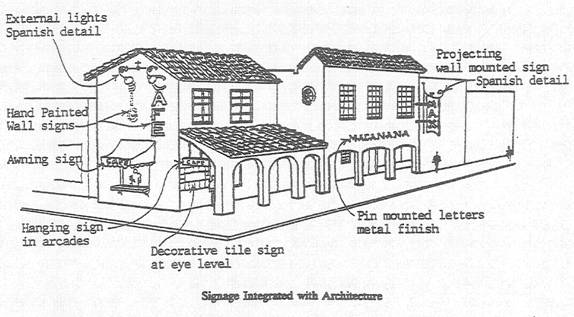
Design of signs within an Architectural Overlay District. .....The Architectural Overlay District sign standards are intended to maintain or enhance the character of the area. Public and private buildings have been constructed and maintained in the traditional Spanish Colonial Revival style of architecture. The district emphasizes a pedestrian orientation giving the area a distinct identity. The design, scale, color and materials of signs should be compatible with both the Spanish Colonial Revival style of architecture and the unique character of the district in which the sign is to be located. Therefore, signs within the Architectural Overlay District shall comply with the following additional standards:
1.
All signs shall be hand-crafted in appearance.
2.
Acceptable sign materials may include, but are not limited to, sandblasted and carved wood, hand-painted, glazed tile, pinned metal or wood letters, or other similar materials. All signs shall be constructed of and mounted and supported with materials compatible with the Spanish architectural theme including, but not limited to, stained wood supports and accents, troweled stucco applications, painted terra cotta tiles, ornamental wrought iron, canvas awnings or other similar materials.
3.
Signs may be illuminated as follows:
a.
External lighting (e.g. spot lighting, goose neck lights).
b.
Back lighting.
c.
Neon lighting with the approval of a Discretionary Sign Permit per Section 17.16.250.
Figure 17.84.020A
D.
Sign Area Allowed.
1.
Maximum Sign Area Limitations for a Site.
a.
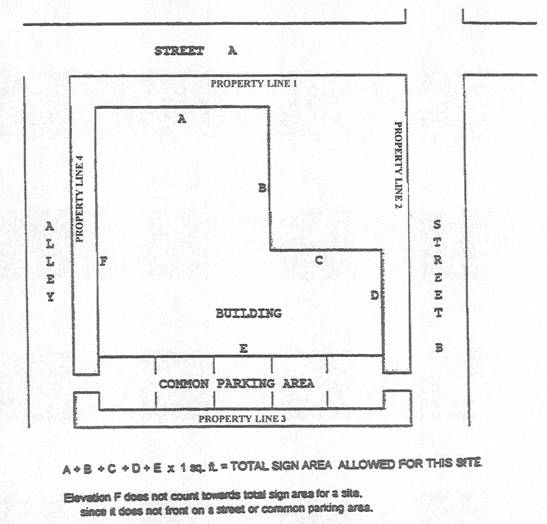
Purpose and Intent. The purpose of this subsection is to regulate the maximum sign area allowed for a site. The intent of these regulations is to make the total sign area allowed on a site proportionate to the length of business frontage. The intent is also to limit the total sign area along any one boundary of a site. Within this subsection, service stations are treated differently than other businesses, in terms of the total sign area permitted, because of the typically limited scale of buildings on a service station site.
b.
Maximum Sign Area Allowed Per a Site.
The maximum sign area allowed for a site shall be as follows:
i.
For nonresidential buildings, one square foot of sign allowed for each lineal foot of all business façade;
ii.
For service stations, one square foot of sign area allowed for each lineal foot of street frontage.
Figure 17.84.020B
c.
Maximum Sign Area Oriented Toward Any One Property Line of a Site, Common Parking Area, Pedestrian Area, Driveway or Alley.
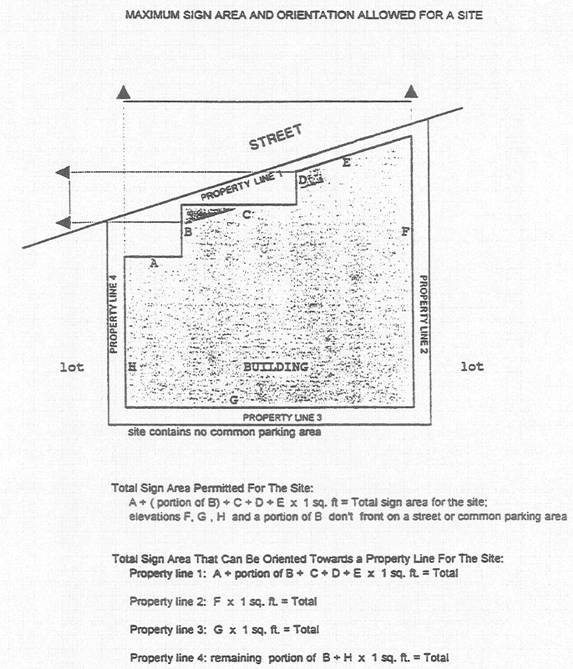
The maximum sign area oriented toward any one property line of a site or common parking area, pedestrian space, or driveway shall be limited as follows:
i.
For nonresidential buildings, one square foot of sign allowed for each lineal foot of adjacent building elevation;
ii.
For service stations, one square foot of sign area allowed for each lineal foot of adjacent street frontage;
iii.
For signs oriented toward alleys, a maximum of one six square foot nonilluminated sign per business shall be permitted.
Figure 17.84.020C
d.
Computation of Sign Area.
i.
Sign Area of Individual Single-Faced Signs. The area of a sign shall be computed based on the entire area within a single continuous perimeter enclosing the extreme limits of the sign, including all words, symbols, emblems, representations or other display, together with any material or color forming an integral part of the sign or display. The area of a sign shall also include all nonstructural perimeter trim, but excludes the structures or uprights on which the sign is supported, unless such supports or uprights are designed in a manner so as to form an integral background of the sign.
ii.
Sign Area of Window Signs. The area of a window sign shall be the area composed of words, letters, symbols or other display. For maximum window sign area allowed, refer to sign matrix, Section 17.84.030(C) of this chapter.
iii.
Sign Area of Multifaced Signs. Except for monument signs, the sign area for a sign with more than one face shall be computed by adding together the area of all sign faces. For monument signs, when two identical sign faces are placed back-to-back and not more than three feet apart at all points, the sign area shall be computed by the measurement of only one of the sign faces.
e.
Maximum Sign Area Allowed Per Sign. The maximum sign area allowed per sign is 64 square feet.
f.
Maximum Length of a Sign Allowed Per Business Façade. The maximum length of a sign allowed is 75 percent of the length of the business façade.
g.
Maximum Sign Area Allowed Per Business. The maximum sign area allowed per business shall be as follows:
i.
For signs within an Architectural Overlay district, less than 25 square feet unless a Discretionary Sign Permit is approved.
ii.
For signs within areas other than an Architectural Overlay district, 64 square feet unless a Discretionary Sign Permit is approved.
E.
Computation for Sign Height. .....The height of a sign shall be computed as the distance from the base of the sign at finished grade to the top of the highest attached component of the sign. In the case when the finished grade cannot be reasonably determined, sign height and/or finished grade shall be determined by the City Planner or their designee.
F.
Maintenance of Signs. .....If any sign is not maintained free of all defects, including but not limited to cracking, peeling, rusting or other States of disrepair, it shall be the duty of the owner of the sign or the property owner of the business or building to repair, if necessary paint or remove the sign. If the sign is not repaired, painted or removed, the City Planner shall initiate the public nuisance abatement procedures to cause the sign to be repaired, maintained or removed at the expense of the owner of the sign or the property owner of the business or building. Also see Section 17.84.010(E), Sign Violations, of this chapter.
G.
Master Sign Program.
1.
Purpose and Intent. The purpose of this section is to establish a procedure to ensure coordination of the design of new signs concurrent with the design of the project. The intent is to improve the architecture, streetscape, signs and overall aesthetics of the site. A Master Sign Program provides a clear understanding of what the standards are for new and existing signs on the site. A Master Sign Program will also provide for consistent and streamlined review, approval and administration of existing and new signs for the site. A Master Sign Program requires a Discretionary Sign Permit.
2.
Applicability. A Master Sign Program shall be required for the following:
a.
Any nonresidential or mixed-use building or site on which the owner proposes to add and/or modify four or more signs with a total sign area of 25 square feet or more in the Architectural Overlay District, or more than a total sign area of 64 square feet outside the Architectural Overlay District;
b.
Any gas/service station that proposes new signs or modifications to existing signs, except as allowed by State law.
3.
Exemptions. Subsequent signs installed that are part of a previously approved Master Sign Program and are consistent with the provisions of that Master Sign Program shall require an Administrative Sign Permit but shall be considered exempt from Discretionary Sign Permit Review.
4.
Application. Applications for a Master Sign Program shall be made in writing on the Discretionary Sign Permit application form provided by the Planning Division and submitted to the Planning Division along with the required fees.
H.
Removal of Signs. .....The City shall require removal of any sign, at the owners' expense and without compensation, that meets any of the following criteria.
1.
Any sign erected without first complying with all ordinances and regulations in effect at the time of its construction, erection or use;
2.
Any sign which was lawfully erected, but whose use has ceased, or the structure upon which the sign has been abandoned by its owner, for a period of not less than 90 days;
3.
Any sign which has been more that 50 percent destroyed, and the destruction is other than facial copy replacement, and the sign cannot be repaired within 30 days of the date of its destruction;
4.
Any sign whose owner seeks relocation thereof and relocates the sign;
5.
Any sign that is temporary;
6.
Any sign for which there has been an agreement between the sign owner and the City, for its removal as of any given date;
7.
Any sign whose owner, outside a change of copy, requests permission to remodel and remodels that sign, or expand or enlarge the building or land use upon which the sign is located, and the sign is affected by the construction, enlargement or remodeling, or the cost of construction, enlargement or remodeling of the sign exceeds 50 percent of the cost of the reconstruction of the building;
8.
Any sign which is or may become a danger to the public or is unsafe;
9.
Any sign which constitutes a traffic hazard not created by a relocation of streets or by acts of the City or County.
10.
Any nonconforming sign where there has been a change of use on the subject site.
(Ord. 1172 § 3 (part), 1996; Ord. 1308 §§ 15—16, 2006; Ord. 1314 §§ 65—67, 2006; Ord. No. 1561, § 3(Exh. A, §§ 30, 31), 11-27-2012; Ord. No. 1619, § 4, 4-5-2016; Ord. No. 1803, § 4(Exh. A), 4-21-2026)
17.84.030 - Specific Regulations by Sign Type.
A.
Purpose and Intent. .....The purpose of this section is to identify the specific sign standards relating to sign type, sign size, number of signs, height of signs, location of signs, general provisions and the Sign Permits required.
B.
General Notes. .....The following general notes shall apply to all signs listed in the following matrix, unless otherwise indicated:
1.
Signs that require Administrative or Discretionary Sign Permits are indicated in the following matrix. Other sign characteristics besides those indicated in the following matrix may also require administrative or discretionary review.
2.
Signs may be governed by other sections of this code and those sections shall also apply. If there is a conflict in regulations, the most restrictive shall apply.
3.
Change of copy to an existing sign that is identical in sign area, sign size, sign type, location and materials requires an Administrative Sign Permit.
4.
Any change to an existing sign other than a change of copy as defined above requires compliance with the provisions of this chapter. For removal of signs, refer to Section 17.84.020(H), Removal of Signs, of this chapter.
5.
All temporary signs are prohibited in the public right-of-way unless otherwise authorized by this chapter.
6.
All signs listed, unless exempt from both Administrative and Discretionary Sign Permits, will count towards the total allowable sign area.
7.
For Master Sign Programs, see Section 17.84.020(G), Master Sign Program, of this chapter.
8.
For size of signs, see Section 17.84.020(D), Sign Area Allowed, of this chapter.
9.
For height of signs, see Section 17.84.020(E), Computation for Sign Height, of this chapter.
10.
For signs overhanging the public right-of-way, see Section 17.84.030(E), Permanent Signs Encroaching into Public Right-of-Way, of this chapter.
11.
For sign exceptions, see Section 17.16.260, Sign Exception Permits, of this title.
12.
Fascia signs cannot extend more than 18 inches above the lower edge of a sloping roof.
13.
Unless otherwise permitted pursuant to this chapter, no person shall display or cause to be displayed any sign on, within or over any public street or right-of-way or public property in the City.
14.
Unless otherwise permitted pursuant to this chapter, no person shall display or cause to be displayed any sign on, within or over any private property in the City without the written consent of the owner, lessee or other person lawfully in possession of the property.
15.
Except as expressly permitted or authorized in this chapter, all other signs are prohibited within the City.
16.
Any non-commercial message may be substituted for the copy on any commercial sign that is allowed under the municipal code.
Table 17.84.030A
Matrix of Sign Types
C.
Portable Signs. .....Portable signs, excluding banner signs, shall be allowed for businesses subject to the following:
1.
Design of Portable Signs.
a.
The portable sign shall be hand-crafted in appearance.
b.
Acceptable materials may include, but not be limited to, metal, painted wood, plastic, ceramics, or other similar durable materials. Paper, light cloth, exposed or unpainted wood and particle board are prohibited.
c.
Portable signs cannot be lighted.
d.
Portable signs shall be well maintained.
e.
The sign area of a portable sign shall not count towards the total sign area permitted for business or building.
2.
Location of Portable Signs.
a.
Portable signs must be located immediately adjacent along the business storefront and in close proximity to the main public entrance of the business advertised.
b.
At no time shall portable signs be placed within any landscaped area.
c.
The portable sign must be able to be easily carried and transported, not permanently affixed to the street, sidewalk, wall, awning, public fixtures, or other similar public improvements.
d.
The portable sign may remain outside only during those hours the business is open.
e.
The portable sign shall be located outside the public right-of-way.
f.
The portable sign cannot interfere with pedestrian or vehicular traffic or parking.
g.
The portable sign cannot pose a safety threat.
D.
Permanent Signs Encroaching into Public Right-of-Way. .....The following permanent sign types may be allowed to encroach into the public right-of-way when all of the following standards are complied with:
1.
Maximum Encroachment.
Table 17.84.030B
Maximum Encroachments of Permanent
Signs into the Public Right-of-Way
2.
The sign must be permanently affixed to the building it serves.
3.
The sign shall not create a traffic hazard for pedestrians or vehicles.
4.
The sign shall not extend beyond the edge of sidewalk or curb adjacent to the street.
5.
The sign shall maintain a minimum of eight feet vertical clearance between the sidewalk and bottom of the sign.
6.
The owner of the sign encroaching into the public right-of-way shall be required to enter into an agreement with the City that indemnifies the City from all liability associated with the sign that encroaches.
7.
For temporary banners over the public right-of-way refer to temporary banner sign policy.
E.
Temporary Signs.
1.
Unpermitted Temporary Signs Found in the Right-of-Way. Any unpermitted temporary sign found to be on or over any public street or right-of-way shall promptly be removed and confiscated by the designated official of the City. If a confiscated temporary sign advertises or relates to a specific event, the City will retain it for 10 days after the event ends. If the sign does not advertise or relate to a specific event, the City will retain it for 45 days from the date of confiscation.
2.
A sign's owner or the sign owner's agent may reclaim a confiscated sign by paying a storage fee to the City of $10.00 per sign. The person reclaiming the sign must sign a receipt indicating that the person is either the owner or the owner's agent. Any sign not reclaimed by the end of the applicable retention period will be destroyed.
F.
Signs on Vacant or Unimproved Property. .....Before placing a sign on vacant or unimproved property, each of the following must be satisfied:
1.
The sign owner must file with the City Clerk a written form signed by the owner, lessee, or other person lawfully in possession of the property consenting in writing to the placement of the sign and agreeing to be responsible for removal within the applicable time period; and
2.
The sign must be located a minimum of three feet behind the sidewalk or, if no sidewalk exists, a minimum of eight feet behind the back of the curb or edge of the roadway; and
3.
If the sign relates to a specific event, the sign must be removed within three days after the event ends; and
4.
The sign must comply with all other design criteria established by this code.
G.
Blade Signs. .....Blade signs shall be allowed for businesses in the A-O District subject to the following criteria:
1.
Design of Blade Signs.
a.
The blade sign shall be hand-crafted in appearance.
b.
Three-dimensional blade signs are encouraged.
c.
Acceptable sign materials may include, but not be limited to, metal, painted wood, plastic, ceramics, or other similar durable materials. Paper, light cloth, exposed or unpainted wood and particle board are prohibited.
d.
Sign supports, brackets and standards shall be made of wood and/or wrought iron. They may be painted or carved.
e.
Blade signs shall have a maximum thickness of not more than six inches.
f.
Blade signs shall be well maintained.
g.
The sign area of a blade sign shall not count towards the total sign area permitted for business or building providing all existing signage is in conformance with the Sign Code.
h.
Blade signs meeting the design criteria of this section may be added to buildings which are subject to a Master Sign Program, per Section 17.84.020(G), and shall not require modification or amendment to such Master Sign Program, so long as the Master Sign Program has been implemented and all existing signs on the building are in accordance with that Master Sign Program.
i.
Blade signs shall not be illuminated except as provided for in other discretionary processes.
2.
Location of Blade Signs.
a.
A total of two blade signs per tenant shall be permitted, although only one blade sign shall be permitted per tenant street frontage; the other shall be permitted per tenant frontage along a pedestrian way, arcade, paseo or courtyard, all of which must be internal to the project.
b.
A blade sign must provide a minimum of eight-foot clearance between the bottom of the sign and the ground.
c.
A blade sign may project a maximum of four feet from the wall of a building.
H.
Temporary Banner Signs. .....Temporary Banner Signs shall be allowed for businesses city-wide, excluding home-occupations.
1.
Temporary Banner Sign Criteria.
a.
Each business shall be permitted a maximum of one temporary banner sign per business at any given time.
b.
The temporary banner sign cannot exceed 64 square feet. A temporary banner sign will not count towards a business's total sign area allowance.
c.
The temporary banner sign shall be placed on-site and flush on the building. These banners are prohibited in the following locations: city right-of-way, free-standing walls, fences or other areas or fixtures not part of the business's primary structure; other locations as determined by the City Planner to be inconsistent with the intent of this section. No portion of the temporary banner sign shall be free-hanging and all corners of the banner shall be secured to the building.
d.
Temporary banner signs shall be constructed of cloth, canvas, fabric, plastic or other similar durable material.
e.
The temporary banner sign shall be maintained in good condition, free of any defects, including cracking, torn or ripped material, or faded copy.
f.
Each business may have up to four permits per calendar year. Each permit allows the display of a banner sign up to 30 calendar days. Renewals of permits are allowed, but in no case shall a business display a temporary banner for more than 120 days per calendar year. Banners may be replaced during the authorized period so long as they are the same or smaller size and installed in the approved location. These provisions are to ensure temporary banner signs are not used as permanent display or in-lieu of permanent signs for the business.
(Ord. 1172 § 3 (part), 1996; Ord. 1205 §§ 1—4, 1998; Ord. 1257 § 2, 2002; Ord. 1304 §§ 33—34, 2005; Ord. 1308 §§ 18—19, 2006; Ord. 1314 § 68, 2006; Ord. No. 1561, § 3(Exh. A, § 32), 11-27-2012; Ord. No. 1594, § 3(Exh. A, §§ 42, 43), 5-5-2015; Ord. No. 1599, § 4(Exh. A, 1), 7-7-2015; Ord. No. 1619, § 4, 4-5-2016; Ord. No. 1660, § 3, 9-4-2018; Ord. No. 1759, § 3(Exh. A), 10-3-2023; Ord. No. 1808, § 4(Exh. A), 5-19-2026)
17.84.040 - Nonconforming Wall-Mounted Signs.
A.
Continuation. .....A legal nonconforming wall-mounted sign may continue in existence so long as the sign is maintained in a safe, neat, and attractive manner, subject to other provisions of this chapter.
B.
Maintenance. .....A legal nonconforming wall-mounted sign may be updated and maintained, including change of copy, illumination upgrades, and replacement as long as the location is the same and the sign area is less than or equal to that of the existing legal nonconforming wall-mounted sign.
C.
Change of use. .....A legal nonconforming wall-mounted sign shall be removed or brought into conformance with current Sign Ordinance provisions when a change of the advertised use occurs, as change of use is defined by Section 17.88.030.
(Ord. No. 1619, § 4, 4-5-2016)

