
San Clemente City Zoning Code
CHAPTER 17
72 - NONCONFORMING STRUCTURES AND USES7
Editor's note— Ord. No. 1548, § 3(Exh. A, § 1), adopted March 6, 2012, amended Ch. 17.72, in its entirety, to read as herein set out. Prior to inclusion of said ordinance, Ch. 17.72 pertained to similar subject matter. See also the Code Comparative Table and Disposition List.
17.72.010 - Purpose and Intent.
A.
Purpose. .....This chapter regulates Nonconforming Structures and Uses that were lawfully established, but that are prohibited, regulated, or restricted differently by existing requirements.
B.
Intent.
1.
The City intends that Nonconforming Structures and Uses be made to comply with the General Plan, any applicable Specific Plan, and zoning requirements to promote the public health, safety, and general welfare.
2.
The City encourages improvements to Nonconforming Structures to increase their compatibility with surrounding properties, enhance the quality of development, and to have structures and land uses become conforming over time.
(Ord. No. 1548, § 3(Exh. A, § 1), 3-6-2012)
17.72.020 - Definitions.
Definitions of terms used in this Chapter are below, except that definitions of terms related to Mobilehome Parks and Mobilehomes are located in the State laws and regulations, including without limitation, Mobilehome Parks Act, California Health and Safety Code §§ 18200 et seq.; Manufactured Housing Act, California Health and Safety Code §§ 18000 et seq.; and California Code of Regulations, Title 25, §§ 1000 et seq., as amended from time to time.
A.
"Accident" means an event that damages or destroys property and/or development, including, but not limited to: earthquakes, fires, floods, other natural disasters, social conflict, and acts of war or other actions not taken by a property owner. Events shall be excluded from being "accidents" if they are illegally or voluntarily caused by a property owner. Termite, mold, or other pest damage is considered an accident.
B.
"Addition" means an increase to the floor area of a nonconforming structure.
C.
"Interior Addition" means an addition that is not visible on the exterior of a structure, does not move exterior walls, and/or is entirely below the grade of a project site (e.g. loft additions, crawlspace conversions, basement additions).
D.
"Interior Alteration" means an alteration that is not made to the exterior materials, finish, design, size, shape, massing, location, configuration, or other exterior characteristics of structures.
E.
"Living Area." Please refer to definition in Municipal Code Section 17.88.030.
F.
"Minor Exterior Alteration" means an alteration to the exterior finish, architectural details, and building materials of nonconforming structures, excluding alterations to the structural frame of exterior walls and roofs. Examples of minor architectural alteration projects include but are not limited to: changing building materials, changing colors and finishes of materials; replacing wood/aluminum windows for vinyl windows, installing doors and windows in new openings; and modifying the color and type of guardrails.
G.
"Major Alteration" means an alteration to the structural frame of exterior walls and roofs.
H.
"Nonconforming Accessory Structure." See definitions of "Nonconforming Structure" in this section and "Structure, Accessory" in Municipal Code Section 17.88.030.
I.
"Nonconforming Building." See definitions of "Nonconforming Structure" in this section, and definitions of "Building, Primary" and "Building, Accessory" in Municipal Code Section 17.88.030.
J.
"Nonconforming Structure" means a structure that was lawfully constructed, according to the development standards that were in effect at the time the applicant obtained a vested right to develop the structure, but the structure no longer is in compliance with development standards required in this title, including, but not limited to: floor area ratio, height, lot coverage, number of required parking spaces, parking design standards, and setbacks [see Section 17.72.030(C)(2) for structures that are exempt from nonconforming structure requirements in this chapter].
K.
"Nonconforming Use" means a land use that was lawfully established according to land use requirements that were in effect when the use was initiated, and any of the following criteria apply [see Section 17.72.030(C)(3) for land uses that are exempt from nonconforming use requirements in this chapter].
a.
The use is not consistent with the purpose and intent of the zoning district in which the use is located.
b.
The use is specifically prohibited or is not identified and interpreted to be a permitted or conditionally permitted use of the zoning district in which the use is located.
c.
The use does not provide the number of parking spaces required in this title.
d.
The use does not have an entitlement required by this title to establish the existing use.
L.
"Nonconformity" means a portion of a structure, site, or use that does not comply with requirements in this title.
M.
"Primary Structure." See definition of "Nonconforming Structure" in this section and definition of "Building, Primary" in Municipal Code Section 17.88.030.
N.
"Repair" means the refinishing, restoring, reinstalling, or replacing building materials to maintain a structure. Repairs exclude the replacement of: accident damage, the structural frame of exterior walls or roofs, and accessory structures. Examples of repair projects include, but are not limited to: replacing siding, replacing existing paint colors and exterior finishes, replacing drywall or stucco on exterior walls; and replacing roof tiles, roof sheathing, and roof weather proofing.
O.
"Replacement" means the act of partially or entirely reconstructing or rebuilding a structure to the condition that existed before construction work is initiated or a structure is damaged by an accident.
P.
"Replacement Cost" means the value of work to replace a structure, according to current City and State of California policies, codes, and guidelines.
Q.
"Residential Accessory Building" means an accessory building for a residential principal use. Also, refer to the definitions of "Building, Accessory" and "Principal Use" in Municipal Code Section 17.88.030.
R.
"Structural Frame" means structural members that are integral to resisting lateral forces and or horizontal or vertical loads, including, but not limited to: joists, beams, studs, blocks, and headers.
(Ord. No. 1548, § 3(Exh. A, § 1), 3-6-2012; Ord. No. 1685, § 4, 12-3-2019; Ord. No. 1707, § 3, 2-2-2021)
17.72.030 - Applicability.
A.
Legal structures and uses. .....This chapter applies to nonconforming structures and uses that have been "lawfully established." Nonconforming Structures and Uses are "lawfully established" when structures are constructed and uses are established with the required and properly issued City approvals and/or permits and are consistent with regulations in effect when nonconforming structures or uses were established.
B.
Exemptions.
1.
State and Federal Law. Structures and land uses are exempt from this chapter if State or Federal law requires structural or site plan alterations to be made that result in a structure becoming nonconforming [e.g. earthquake retrofitting safety standards; the Americans with Disabilities Act (ADA)]. For example, ADA can require a parking space to be widened to improve disabled access. To comply with this requirement, the number of parking spaces may need to be reduced or the parking lot redesigned. A reduction in the number parking spaces can make some structures and uses nonconforming in terms of parking requirements.
2.
Nonconforming Structures. The following structures are exempt from nonconforming structure regulations in this Chapter:
a.
Structures that comply with all zoning requirements except landscape standards.
b.
Single-family dwellings constructed with a single-car garage or carport ("parking structure") in residential zones prior to April 4, 1962 are exempt from being a Nonconforming Structure due to insufficient parking, except when a project removes or alters the single-family dwelling's structural frame in 50 percent or greater of the structure's exterior walls, as described in Section 17.72.050(E). Then, the residence and parking structure shall be made to comply zoning requirements as described in this Chapter.
c.
In-the-bank garages located in residential zones which do not comply with front yard setback regulations.
d.
National, state or locally designated historic structures may be exempted from this Chapter with the approval of a Cultural Heritage Permit in compliance with Section 17.16.100.
3.
Nonconforming Uses. The following land uses are exempt from nonconforming use regulations in this Chapter:
a.
Multiple-family dwellings constructed in the Residential Low Density zoning district prior to April 4, 1962.
b.
Service stations and vehicle service and repair-related facilities are exempt, provided the uses were lawfully established on or before February 4, 2014 (adoption date of General Plan), the uses have not been discontinued more than 365 consecutive calendar days, and the uses meet any of the criteria below:
i.
The service station or vehicle service repair-related use is on property fronting El Camino Real, or fronting other arterial streets defined in Section 17.88.030, or
ii.
The service station use is located on property in gateway areas (identified in the General Plan Urban Design Element) abutting interstate-5 off-ramps and intersections.
c.
Nonconforming uses associated with the historical significance of national, state or locally designated historic structures may be exempted from this Chapter with the approval of a Cultural Heritage Permit in compliance with Section 17.16.110.
d.
Mobile home Parks in compliance with any applicable Conditional Use Permit shall be exempt from all provisions of Chapter 17.72, except as provided in SCMC Subsection 17.72.060.E.
(Ord. No. 1548, § 3(Exh. A, § 1), 3-6-2012; Ord. No. 1652, § 4, 5-15-2018; Ord. No. 1685, § 5, 12-3-2019; Ord. No. 1707, § 3, 2-2-2021; Ord. No. 1759, § 3(Exh. A), 10-3-2023)
17.72.040 - General Requirements.
A.
Proof of legal nonconforming status.
1.
Property owner responsibility. The property owner shall provide evidence to the satisfaction of the City Planner to prove a Nonconforming Structure or Use was lawfully established.
2.
City Planner determination. The City Planner determines whether a Nonconforming Structure or Use was lawfully established.
B.
Code compliance of projects. .....The expansion and alteration of nonconforming structures shall comply with development standards, unless exceptions are granted with the approval of a Minor Exception Permit, Variance, or other provision in this Title.
C.
Determining the safety of structures. .....The City Building Official determines whether a structure is safe for occupancy and use, according to building and safety regulations.
D.
Appeal of administrative decisions. .....City Planner and Community Development Director decisions may be appealed per Section 17.12.140.
(Ord. No. 1548, § 3(Exh. A, § 1), 3-6-2012; Ord. No. 1759, § 3(Exh. A), 10-3-2023)
17.72.050 - Repair, Alteration, and Expansion of Nonconforming Structures.
A.
Applicability of other review procedures. .....This Title may require approval of permits to allow the modification of nonconforming structures according to Chapter 17.16 to ensure projects are consistent with the General Plan, Design Guidelines, and regulations.
B.
Repairs. .....Nonconforming structures may be repaired according to City and State Codes, policies, and guidelines.
C.
Interior alterations. .....The interior of nonconforming structures may be altered.
D.
Minor Exterior Alterations. .....Minor exterior alterations are permitted. Examples of minor exterior alterations include but are not limited to: changing building materials, changing colors and finishes of materials; replacing wood/aluminum windows for vinyl windows; installing doors and windows in new openings; and modifying the color and type of guardrails.
E.
Removal, replacement, and Major Alteration of Exterior Walls. .....The structural frame of a nonconforming structure's exterior walls may be removed, replaced, or altered as follows:
1.
Nonconforming status may be continued. A nonconforming structure may continue to be nonconforming if a project:
a.
Removes the structural frame in less than 50 percent of a structure's exterior walls.
b.
Alters the structural frame in less than 50 percent of a structure's exterior walls.
2.
Fifty percent or greater of exterior walls removed or altered. The following requirements apply when the structural frame is removed or altered in 50 percent or greater of a structure's exterior walls:
a.
Nonconforming status shall be terminated. Nonconforming structures shall be made to comply with zoning requirements.
b.
Substandard parking in garages and carports. If garages or carports contain required parking for primary buildings (e.g. a house) that do not meet parking requirements (e.g. size, location, number of spaces), the required parking spaces shall be modified to meet zoning requirements.
3.
Measuring exterior walls.
a.
Multiple stories. Exterior walls are measured on all stories.
b.
Units of measurement. Exterior walls are measured in lineal feet.
c.
Calculation. Exterior wall improvements are regulated based on the percentage of exterior walls that are removed or altered. The percentage of improvements is calculated by dividing the total length of exterior walls that are removed or altered by the total length of a structure's exterior walls. This fraction is multiplied by 100. For example, when wood framing is removed from the exterior wall of a wood framed building, then that wall would be counted along the entire length of the area where the wood framing is removed. See Figure 17.72.050 A. for explanation.
Figure 17.72.050 A—Measuring Exterior Walls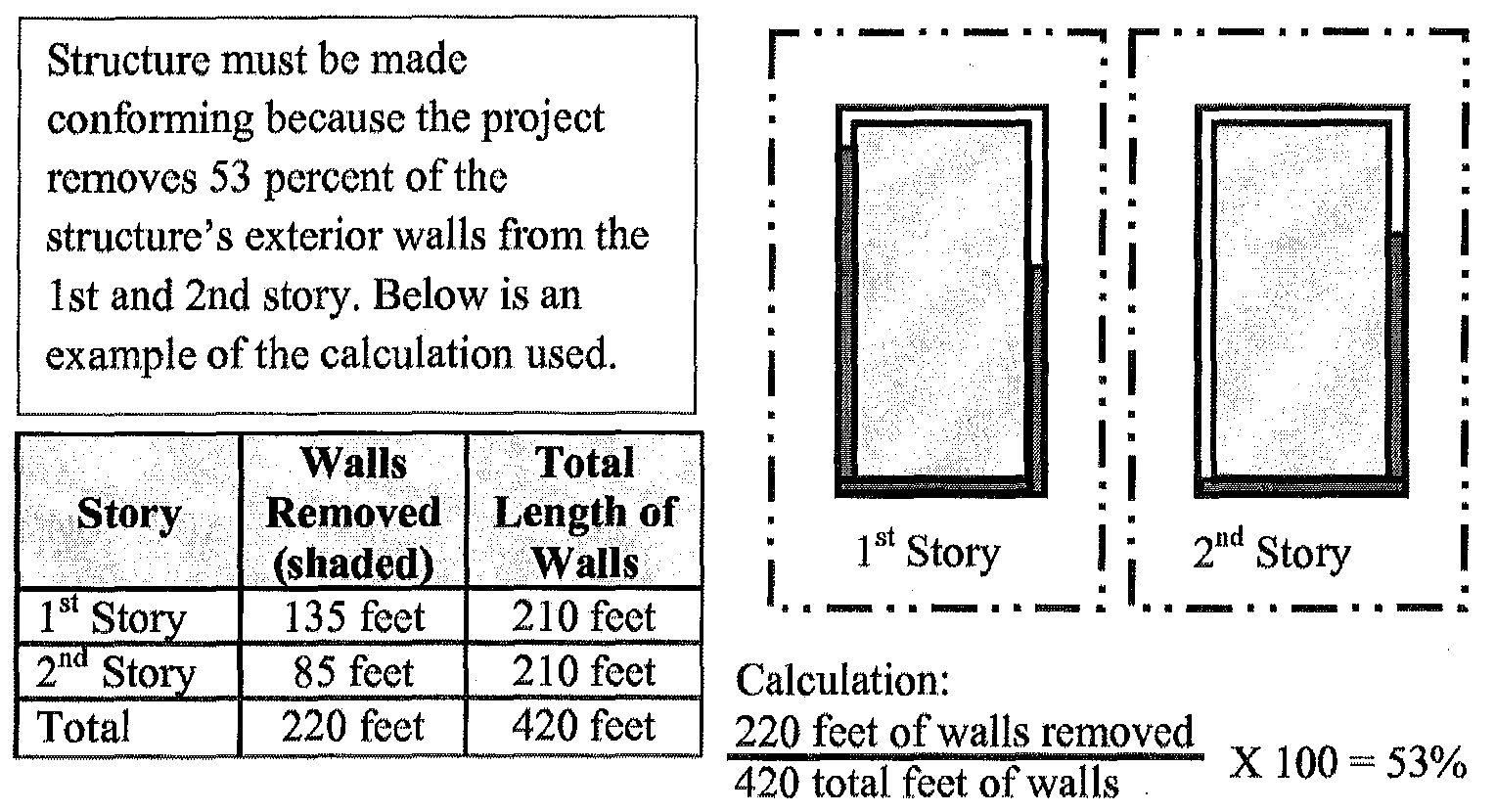
4.
Exceptions.
a.
Exception for safety, compatibility, or architectural improvements. Major alterations are not restricted, if the City Planner finds one or more of the following:
i.
The major alterations improve the safety of structures.
ii.
The major alterations improve the compatibility of the structure with the neighborhood.
iii.
The major alterations improve the architecture's compatibility with the City of San Clemente Design Guidelines.
b.
Single-family dwellings less than 1,400 square feet. Nonconforming single-family dwellings with less than 1,400 square feet are exempt from Subsection (2), with the approval of a Minor Exception Permit per Section 17.16.090. For approval, the following finding must be made: the proposed minor exception permit is necessary for the general appearance of a project to be in character with the neighborhood. The general required findings shall also be met for the approval of a minor exception permit.
F.
Voiding of Minor Exception Permits. .....Minor exception permits allow structures to encroach into required setbacks and for required setbacks to be reduced per Section 17.16.090. Minor exception permits shall be voided if any of the following criteria applies:
1.
A project removes the exterior walls that were allowed to encroach into required setbacks by a minor exception permit.
2.
A project removes 50 percent or greater of a structure's exterior walls.
Figure 17.72.050 B—Voiding of Minor Exception Permits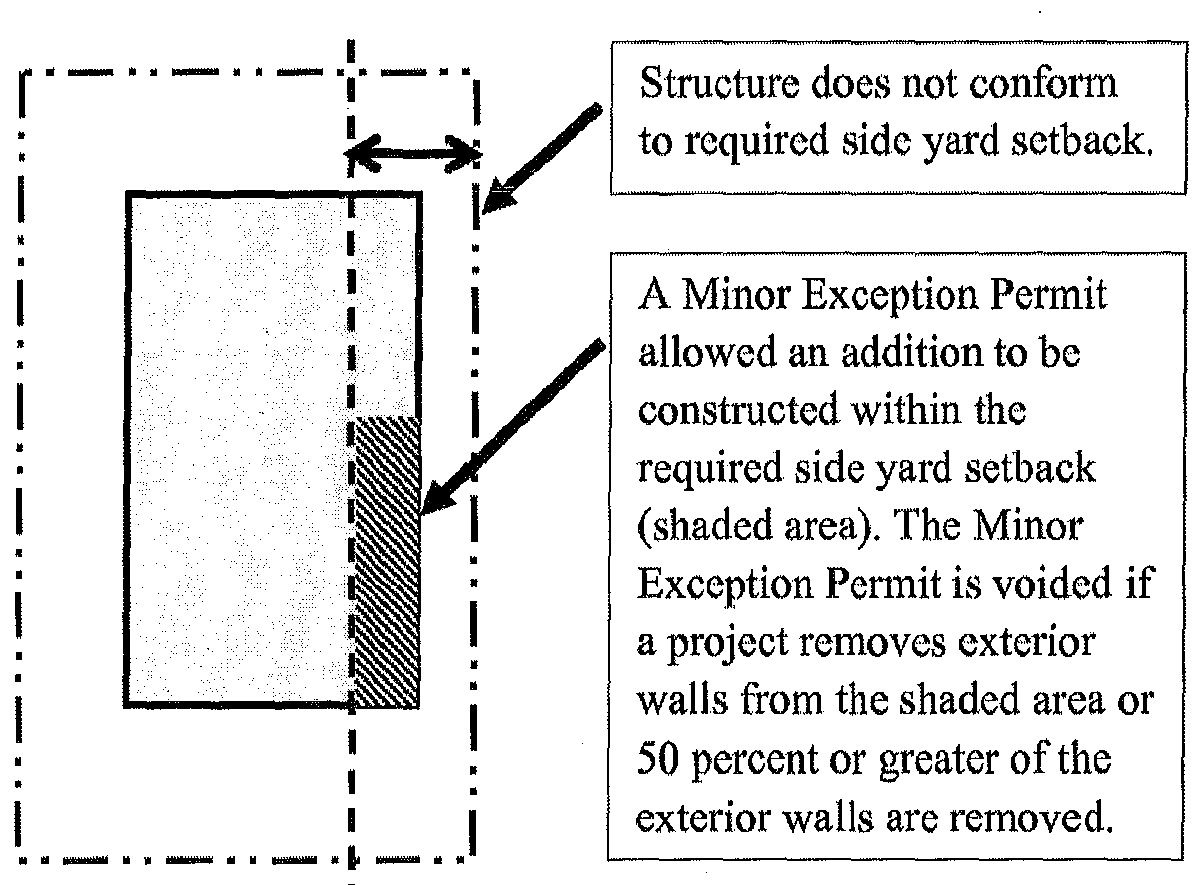
G.
Removal, replacement, and Major Alteration of Roofs. .....The structural frame of a nonconforming structure's roof may be removed, replaced, or altered as follows:
1.
Roofs which comply with height requirements. Roofs of nonconforming structures may be partially or completely removed, replaced, or altered if their height complies with height requirements.
2.
Over-height roofs. When a nonconforming structure has a roof that does not comply with height requirements, the roof's height shall be reduced to meet requirements, when 50 percent or greater of a roof's structural frame is removed or altered.
a.
Exception for safety, compatibility, or architectural improvements. Major alterations are not restricted, if the City Planner finds one or more of the following:
i.
The major alterations improve the safety of structures.
ii.
The major alterations improve the compatibility of the structure with the neighborhood.
iii.
The major alterations improve the architecture's compatibility with the City of San Clemente Design Guidelines.
3.
Measuring roofs.
a.
Units of measurement. Roof area is measured in square feet of surface area.
b.
Calculation. Roof improvements are regulated based on the percentage of roof area that is removed or altered. The percentage of improvements is calculated by dividing the square footage of roof area that is removed or altered by the total roof area of a structure. This fraction is multiplied by 100. See Figure 17.72.050 C. for explanation.
Figure 17.72.050 C—Measuring Roofs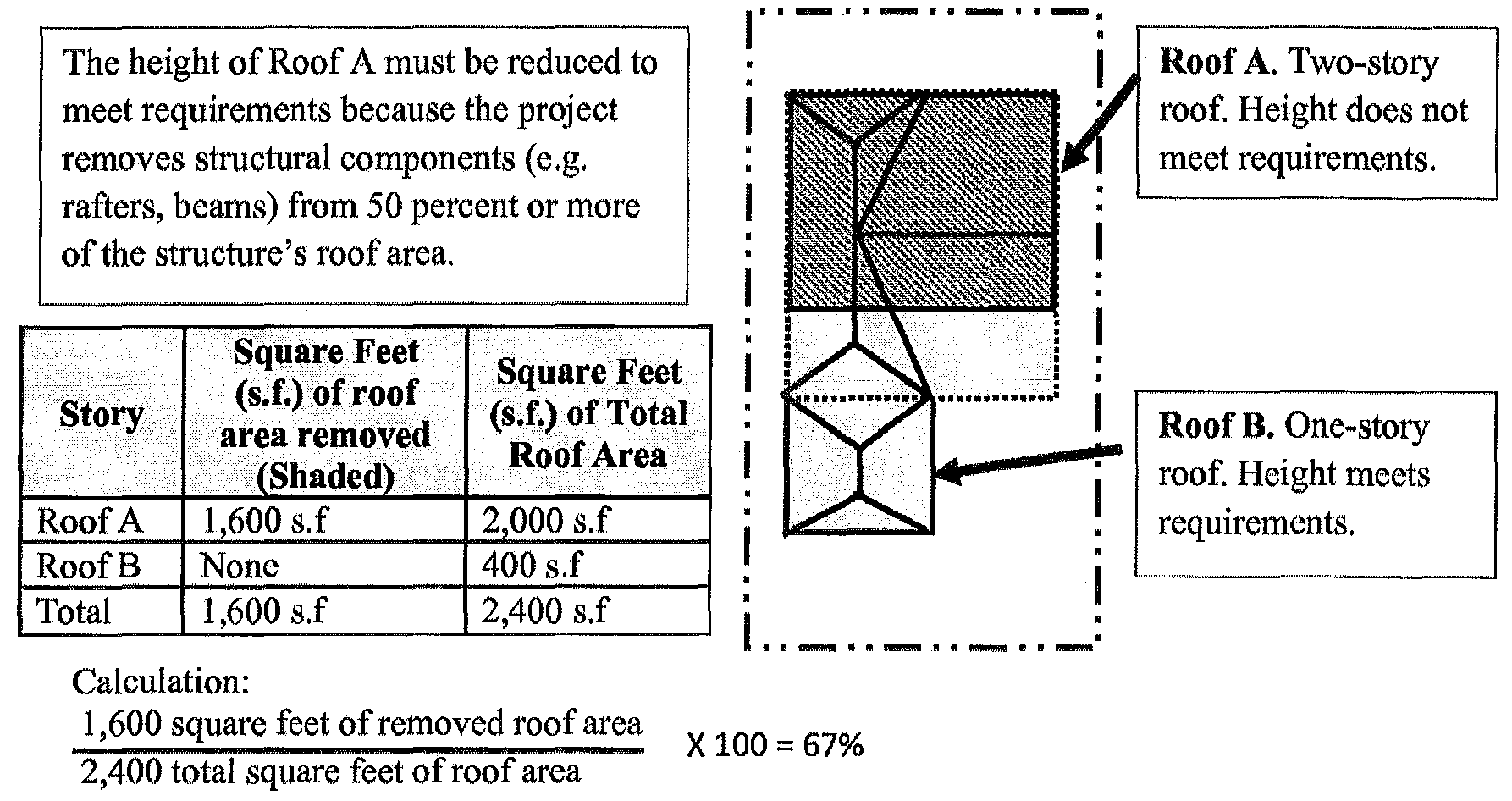
H.
Nonconforming Accessory Structures. .....Projects involving nonconforming accessory structures shall comply with the following:
1.
Nonconforming status may be continued.
a.
Less than 50 percent of structures removed. Nonconforming accessory structures (e.g. patio covers, decks, stairways, walls) may continue to be nonconforming when a project removes portions of the accessory structure and the project's value is less than 50 percent of the accessory structure's replacement cost.
b.
Expansion of accessory structures. Nonconforming accessory structures may be expanded and continue to be nonconforming. Expansions shall comply with zoning requirements.
2.
Nonconforming status shall be terminated.
a.
Fifty percent or greater of structures removed. Nonconforming accessory structures shall lose nonconforming status and be made to comply with zoning requirements if a project removes portions of the accessory structure and the project's value is 50 percent or greater of the accessory structure's replacement cost.
b.
Accessory structures attached to Nonconforming Buildings. A nonconforming accessory structure shall be made to comply with zoning requirements if it is attached to a nonconforming building that must be made conforming by this chapter.
3.
Determining project value and structure replacement cost.
A project's value and accessory structure's replacement cost is based on the City's adopted fee schedule for building plan review and inspection, according to project valuations. For purposes of applying the City adopted fee schedule, a structure is considered a "wall" when it supports a roof and a "fence" is a freestanding structure.
I.
Additions.
1.
Less than 50 percent Addition. Nonconforming buildings may be expanded less than 50 percent and continue to be nonconforming if the addition complies with zoning requirements.
2.
50 percent or greater Addition. The following requirements apply when a nonconforming building is expanded by 50 percent or greater.
a.
Nonconforming status shall be terminated. Nonconforming buildings expanded by 50 percent or greater shall be made to conform to zoning requirements, except as follows:
i.
Exception for single-family dwellings less than 1,400 square feet. Nonconforming single-family dwellings, smaller than 1,400 square feet, may be expanded to a maximum of 2,100 square feet and continue to be nonconforming with the approval of a Development Permit (Section 17.16.100) or a Cultural Heritage Permit (17.16.110) for historic resources and landmarks on the City's designated historic resources and landmarks list.
b.
Substandard parking in garages and carports. If garages or carports contain required parking for primary buildings (e.g. dwelling) that do not meet parking requirements (e.g. size, location, number of spaces), the required parking spaces shall be modified to meet requirements, except as follows:
i.
Exception for single-family dwellings less than 1,400 square feet. Nonconforming single-family dwellings, smaller than 1,400 square feet, may be expanded to a maximum of 2,100 square feet without modifying parking, provided that a Minor Exception Permit is approved. For approval, the following finding must be made: the proposed Minor Exception Permit is necessary for the general appearance of a project to be in character with the neighborhood. The general required findings shall also be met for the approval of a Minor Exception Permit per Section 17.16.090.
3.
Measurement.
a.
Floor area measured. Floor area used to calculate the size of an addition, according to paragraph (b) below is based on the following:
i.
For dwelling units, the living area is used to calculate the size of an addition.
ii.
For residential accessory buildings, floor area includes the interior area of an accessory building measured to the structural members of outermost walls. For example, the floor area of an attached or detached residential garage is measured to the structural frame of the building.
iii.
For nonresidential uses, gross floor area is used to calculate the size of an addition.
b.
Calculation. Additions are regulated by percentages. The percentage of an addition ("or percent added") is calculated by dividing the square footage of an addition's floor area by the square footage of a building's existing floor area. This fraction is then multiplied by 100. See Figure 17.72.050(D) for explanation.
c.
Measurement of multiple projects. If a building has been expanded more than once, regulations are applied based on the total amount of floor area that is added to a building on or after March 21, 1996. For example, if a building is expanded by 10 percent in 1997 and expanded another 20 percent in 1999, then the building has been expanded a total of 30 percent since March 21, 1996.
Figure 17.72.050 D—Measuring Additions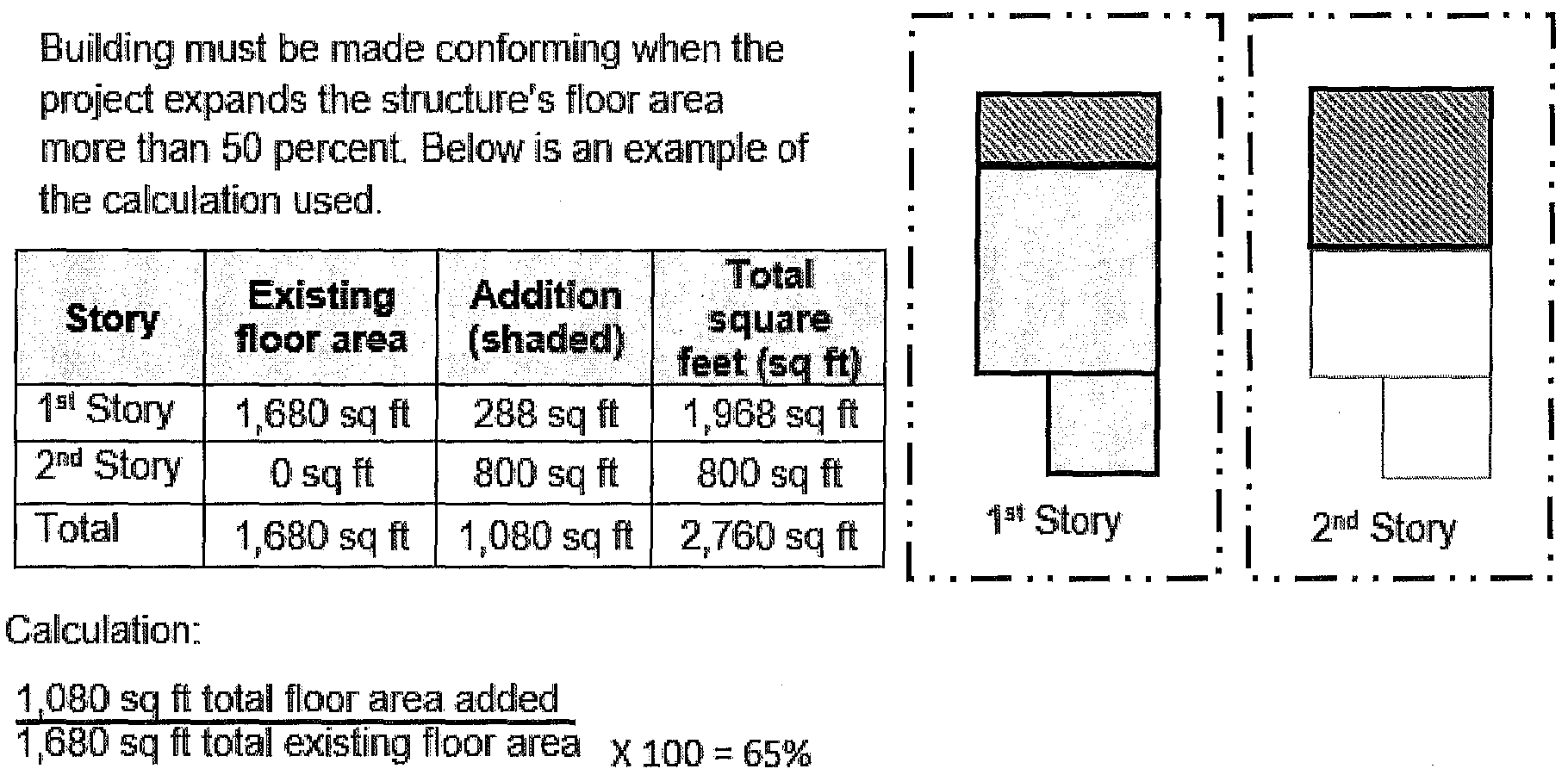
(Ord. No. 1548, § 3(Exh. A, § 1), 3-6-2012; Ord. No. 1561, § 3(Exh. A, §§ 27, 28), 11-27-2012; Ord. No. 1594, § 3(Exh. A, § 41), 5-5-2015; Ord. No. 1707, § 3, 2-2-2021; Ord. No. 1759, § 3(Exh. A), 10-3-2023; Ord. No. 1803, § 4(Exh. A), 4-21-2026)
17.72.060 - Nonconforming Use Restrictions.
A.
Change of tenancy or ownership. .....Change of management, ownership, or tenancy of a Nonconforming Use shall not affect its nonconforming status provided the use is not expanded, as determined by the City Planner.
B.
Discontinued uses.
1.
Nonconforming Uses. Nonconforming Uses discontinued for more than one-year (365 consecutive calendar days) shall be rebuttably presumed to have been abandoned. Abandoned uses shall be converted to uses that meet zoning requirements.
2.
Nonconforming alcoholic beverage sales. Nonconforming alcoholic beverage sales shall be terminated if the City Planner determines any of the following criteria applies:
a.
The sale of alcoholic beverages is discontinued for more than 90 consecutive calendar days.
b.
The sale of alcoholic beverages is discontinued for more than 180 consecutive calendar days to complete repairs, alterations, or to replace structural damage, according to City approved plans and permits.
c.
The sale of alcoholic beverages is discontinued for any period of time as a result of: a duly conducted abatement proceeding and suspension, a closure ordered by the City of San Clemente or the State of California Alcohol Beverage Control Board, or the order of any court.
3.
Burden to prove a Nonconforming Use may continue.
a.
Property owner responsibility. Property owners, tenants, or their representatives shall have the burden to prove how many consecutive days a use has been discontinued and/or prove a use has not been abandoned.
b.
City Planner determination. The City Planner determines how much time has passed since a Nonconforming Use was discontinued.
C.
Changes of use.
1.
Change to a conforming use. Once converted to a conforming use, a Nonconforming Use shall be not be reestablished.
2.
Change of use when the required number of parking spaces is not provided. A non conforming use may be changed to another use allowed by zoning regulations. When the required number of parking spaces is not provided, one of the following criteria must be met:
a.
The proposed use is required to provide the same number or fewer parking spaces as the existing use.
b.
The proposed use is required to provide more parking spaces than the existing use and parking is being added to meet the required increase. For example, if the existing use requires four spaces and the new use requires eight, four spaces must be added.
c.
Parking spaces will be provided to fully comply with zoning regulations.
3.
Change from prohibited use to a different prohibited use. A Conditional Use Permit is required to replace a prohibited land use with another prohibited land use. For approval, the following findings shall be met in addition to the generally required findings for the approval of Conditional Use Permits per Section 17.16.060.
a.
The proposed use has less impacts upon the neighborhood than the use(s) being replaced, including, but not limited to, impacts upon parking, traffic, neighborhood aesthetics, noise levels, and residential density.
b.
The proposed Nonconforming Use more closely meets the intent of the Zoning Ordinance and the zone in which the Nonconforming Use is located than the use(s) being replaced.
c.
The proposed use is less detrimental to the public welfare and to surrounding properties than the use(s) being replaced.
D.
Expansion of Nonconforming Uses.
1.
Expansion of permitted uses with nonconforming parking. A land use may be expanded if the use is permitted but does not have the required number of parking spaces. To expand, off-street parking spaces shall be added that are equal to or are greater than the number of spaces required for the addition. For example, if two parking spaces are required to add 400 square feet of medical office space, then two parking spaces or more shall be added.
2.
Expansion of prohibited uses. A Nonconforming Use shall not be expanded if the use is prohibited. An expansion includes but is not limited to changes that:
a.
Construct a new structure or increase the gross square footage of an existing structure to increase the floor space that is occupied by a Nonconforming Use.
b.
Install new or expand existing equipment that increases the capacity, function, or output of a Nonconforming Use.
c.
Increase the operating hours of a Nonconforming Use.
d.
Increase the occupancy of a structure.
e.
Increase the parking, noise, traffic, dust, water quality, or other adverse impacts of a Nonconforming Use.
E.
Nonconforming Mobilehome and Mobilehome Park Uses. .....Nonconforming mobilehomes may be replaced, renovated, remodeled, expanded or repaired. New mobilehome accessory structures and utility improvements are permitted. Mobilehome park common areas, roadways, and utility improvements may also be added, repaired, renovated, remodeled, expanded or replaced. All mobilehome and mobilehome park improvements shall comply with state mobilehome statutes, regulations and policies, including, without limitation Mobilehome Parks Act, California Health and Safety Code §§ 18200 et seq.; Manufactured Housing Act, California Health and Safety Code §§ 18000 et seq.; California Code of Regulations, Title 25, §§ 1000 et seq.; as well as federal mobilehome statutes including the National Manufactured Housing Construction and Safety Standards Act of 1974, 42 U.S.C. §§ 5401 et seq. and applicable regulations. SCMC subsections 17.72.030.C.3.d and 17.72.060.E shall control as to Mobilehome Parks and Mobilehomes.
F.
Nonconforming Group Counseling Uses.
1.
Any group-counseling use that is legal nonconforming as of March 1, 2016, is subject to an amortization period of three years.
2.
The owner or operator of a legal nonconforming group-counseling use may apply for an extension of the amortization period by making a written request to the Community Development Director. Such request shall be made before the amortization period ends unless the Community Development Director determines that good cause is shown for late submission of the request.
3.
Upon the conclusion of the amortization period, any legally established nonconforming use shall cease all business operations and all signs, advertising, and displays relating to said business shall be removed within 30 days.
G.
Nonconforming Residential Uses.
1.
STLUs and STARs.
a.
Generally. Any residential use that was legally established and legally operating as of February 2, 2016 (including any legitimate legal and appropriately licensed home occupation and any other legitimate and legal incidental and accessory commercial use) but that is categorized by the provisions of this title as a Short-term Lodging Unit ("STLU") or Short-term Apartment Rental ("STAR") and does not conform to the development standards of Subsections 17.28.292.E. and F. is subject to an amortization period of two years, or until the sale or transfer of the property whichever occurs first, as long as that STLU or STAR is operated according to the operational standards of Subsections 17.28.292.C and D. with a valid STLU operating license under Chapter 3.24 and in accordance with other local, state, and federal law.
b.
Notwithstanding subsection G.1.a. above, the owner of an STLU outside of the RVL and RL zones may, if the owner is in good standing, extend the two-year amortization period to ten years by submitting a complete, written application to extend the amortization period on a form provided by the Director of Community Development within 30 days after -the Director makes extension application forms available to the public. "In good standing" here means: current on remittance of STLU TOT to the City and with no violation of the City's municipal code, including the TOT ordinance, that was not cured within 30 days of the notice of violation. The Director's decision on amortization-extension applications is ministerial.
c.
Any amortization extension granted under subsection G.1.b above constitutes a use permit that is specific and personal to the STLU owner and does not run with the land, and it terminates upon any sale or transfer of the STLU property as defined in subsection G.3 below.
2.
Boarding Houses. Any residential use that was legally established and legally operating as of May 3, 2016, (including any legitimate legal and appropriately licensed home occupation and any other legitimate and legal incidental and accessory commercial use) but that is categorized by the provisions of this Title as a boarding house is subject to an amortization period of two years or until the sale or transfer of the property whichever occurs first, as long as that boarding house is operated in accordance with other local, state, and federal law.
3.
Change of Ownership. A change of ownership for purposes of Subsections 17.72.060G.1. and 2. above includes, but is not limited to, the sale of at least 50 percent of the shares in any type of corporation, or a change in any of the principal officers in a corporation as determined by the City Manager or his or her designee. Notwithstanding the foregoing, if the permittee is a partnership and one or more of the partners withdraws, one or more of the remaining partners may acquire by purchase or otherwise the interest of the partner or partners who withdrew without effecting a change in ownership, and in such case the permittee is deemed to be the surviving partner(s).
4.
Amortization Extension.
a.
Eligibility. The owner of (i) a legal nonconforming STLU or STAR in an RVL or RL zone or (ii) a legal nonconforming boarding house in any residential zone may apply for an extension of the amortization period by making a written request to the Community Development Director. (Legal nonconforming STLUs and STARs in other residential zones are subject to a different amortization process under subsection G.1.b.
b.
Timing. Such request shall be made before the amortization period ends unless the Community Development Director determines that good cause is shown for late submission of the request.
c.
Hearing Officer. A timely request for an extension of the amortization period shall be heard by a neutral third-party hearing officer within 30 days of receipt of the request. The party requesting the extension shall pay the costs of the hearing, including the cost of the hearing officer, and shall deposit funds sufficient to cover those costs when the written request for extension is submitted to the City.
d.
Criteria. A request for an extension of the amortization period shall only be issued if the property owner demonstrates to the hearing officer's satisfaction that the specified amortization period is unreasonably short and that an extension is in fact necessary to avoid a constitutional taking. Factors may include, but are not limited to, the extent of the particular owner's investment that is unique to the non-conforming use and does not serve any conforming use of the property, the extent of the owner's investment that will not be recovered on sale of the property the owner's investment-backed expectations in light of current and pending regulation at the time that the investment was made, replacement cost of improvements that might have been made that only serve the nonconforming use, and the length of time that the owner has had the benefit of the investment before the use became nonconforming.
e.
Burden. The burden is on the owner to demonstrate that the general two-year period is unreasonable in the owner's particular case.
5.
The owner or operator of a legal nonconforming STLU or STAR may apply for a waiver of certain operating standards during the amortization period by making a written request to the Community Development Director, accompanied by evidence demonstrating that enforcement of the standard or standards creates an exceptional hardship. The operating standard subject to possible waiver is limited to that found in Subsection 17.28.292C.11, Occupancy and Parking.
6.
Upon the conclusion of the amortization period, any legally established nonconforming STLU, STAR, or boarding house shall cease all business and lodging operations. This does not prevent the dwelling unit from being used as a long-term residential rental.
7.
All STLUs and STARs, but not boarding houses, that are nonconforming at the end of the amortization period for no reason other than they do not meet the requirements specified in Subsections 17.28.292E.2, Zone Density, or F., STAR Minimum Distancing, of this Title, may remain a nonconforming use in compliance with the general standards for nonconforming uses specified in Subsections B through D of this section, but any change of ownership, as described in Subsection G.3. of this section, shall immediately require that the use of the property as a STLU or STAR be terminated.
(Ord. No. 1548, § 3(Exh. A, § 1), 3-6-2012; Ord. No. 1561, § 3(Exh. A, § 29), 11-27-2012; Ord. No. 1591, § 3, 1-6-2015; Ord. No. 1616, § 12, 2-2-2016; Ord. No. 1622, § 12, 5-17-2016; Ord. No. 1654, §§ 16, 17, 5-15-2018; Ord. No. 1685, § 6, 12-3-2019)
17.72.070 - Deferred Repairs and Accident Damage of Nonconforming Structures and Uses.
A.
Deferred Repairs. .....Structures, and the uses that occupy them, shall be made to comply with zoning requirements if structures are damaged by deferred maintenance or repairs and the City Planner finds either of the following:
1.
The damaged structure is a public nuisance and/or is unsafe for occupancy due to deferred repairs.
2.
The cost of replacing structural damage is equal to or greater than the damaged structure's replacement cost.
B.
Accident Damage. .....Structures, and the uses that occupy them, may be replaced when structures are damaged by an accident, as follows:
1.
Exemption of multi-family dwellings. Multi-family dwellings are exempted from requirements in this Subsection, provided that a building permit is approved within three years (1,095 consecutive days), from the date of an accident that causes damage. Per California Government Code Section 65852.25, multi-family dwellings are "any structure designed for human habitation that is divided into two or more independent living quarters."
2.
Nonconforming single-family dwellings located in residential zones. Nonconforming single-family dwellings may be replaced if dwellings are located in residential zoning districts. To replace a dwelling, a building permit shall be approved within three years (1,095 consecutive days) from the date of an accident that causes damage.
3.
Nonconforming Structures located in non-residential zones. Nonconforming Structures may be replaced as follows when they are located in non-residential zones:
a.
Structures damaged less than 50 percent of a structure's replacement cost. Nonconforming structures may be replaced if the cost to replace or repair accident damage is less than 50 percent than the structure's replacement cost. To replace a structure, a building permit shall be approved within three years (1,095 consecutive days) from the date of an accident that causes damage.
b.
Structures damaged by 50 percent or greater of a structure's replacement cost. A Conditional Use Permit is required to replace Nonconforming Structures if the cost to replace or repair accident damage is 50 percent or greater than the structure's replacement cost, immediately before the damage occurred. To replace a structure, a Conditional Use Permit application shall be submitted within two years (730 consecutive days) from the date of an accident that causes damage. For permit approval, the following findings shall be made and the general required findings for Conditional Use Permits:
i.
The proposed structure has less impacts upon the neighborhood than the structure(s) being replaced, including, but not limited to, impacts upon parking, traffic, neighborhood aesthetics, noise levels, and residential density.
ii.
The proposed Nonconforming Structure more closely meets the intent and development standards of the Zoning Ordinance and the zone in which the Nonconforming structure is located than the structure(s) being replaced.
iii.
The proposed structure is less detrimental to the public welfare and to surrounding properties than the structure(s) being replaced.
4.
Structures occupied by a Nonconforming Use. A Nonconforming Use shall be terminated when a use occupies a structure that is damaged by an accident and the cost to replace or repair the accident damage is 50 percent or greater than the structure's replacement cost, immediately before the damage occurred. The structure shall be occupied by a use that complies with zoning requirements.
5.
Time extensions. The Community Development Director may grant one or more 90-day time extensions for the issuance of building permits, if he/she determines permits have been pursued in good faith and there has been a justifiable cause for the delays.
6.
Progress of construction. Construction work shall be completed within required time frames per Title 15 of the Municipal Code.
7.
Estimating replacement cost.
a.
Property owner responsibility. Property owners or their representative shall submit a detailed written analysis of a structure's replacement cost.
b.
Professional analysis. A qualified and experienced construction cost estimator shall estimate the cost to replace structures and other applicable site improvements, according to existing construction cost estimating indices, to the approval of the City Planner.
c.
City Planner determination. The City Planner has the sole discretion to determine a structure's replacement cost based upon substantial evidence. The City Planner may require a third-party review of a replacement cost analysis. If required, a third-party review shall be entirely paid for by the property owner or their representative.
(Ord. No. 1548, § 3(Exh. A, § 1), 3-6-2012)

