
San Clemente City Zoning Code
CHAPTER 17
68 - LANDSCAPE STANDARDS
17.68.010 - Purpose and intent.
The purpose of this chapter is to establish landscaping standards for private property that enhance the appearance of developments, increase the compatibility between different land uses, reduce the heat and glare generated by development, and protect public health, safety and welfare by minimizing the impacts of soil erosion, visual pollution, and promoting water conservation on private and public land.
(Ord. 1172 § 3 (part), 1996; Ord. No. 1707, § 3, 2-2-2021)
17.68.020 - Applicability.
A.
Applicability of Standards.
1.
New Development. The standards in this chapter apply to all nonresidential, mixed-use, and residential development proposed after the effective date of this title, March 21, 1996, with the exception of those projects exempted from this title in accordance with Section 17.04.030(C), Exempt Projects.
2.
Existing Development. All development existing prior to the effective date of this title, March 21, 1996, shall comply with the maintenance requirements in Section 17.68.060, Maintenance Requirements. Existing development shall comply with the standards in Section 17.68.040, General Landscaping Requirements, and Section 17.68.050, Landscaping Requirements for Specific Zones, in the following manner:
a.
Existing Development Requiring Zoning Administrator, Planning Commission or City Council Review. Existing development which requests improvements or a change of use through a discretionary process shall be reviewed for compliance with the general and specific standards contained in Sections 17.68.040, General Landscaping Requirements, and 17.68.050, Landscaping Requirements for Specific Zones, of this chapter. Through the discretionary review process, compliance or partial compliance may be required by the City when the improvements or change of use are significant enough to warrant landscape improvements.
b.
Existing Development Requiring Administrative Review. Existing development which requests improvements or a change of required landscaping areas shall be reviewed for compliance with the general and specific standards contained in Sections 17.68.040, General Landscaping Requirements, and 17.68.050, Landscaping Requirements for Specific Zones, of this chapter.
c.
Other Existing Development. Other development which requests improvements or a change of required landscaping areas shall be reviewed for compliance with the standards contained in Sections 17.68.040, General landscaping requirements, and 17.68.050, Landscaping Requirements for Specific Zones, of this chapter.
B.
Requirements for Landscape Plans. .....Preliminary and comprehensive landscape plans are required for specific types of projects receiving discretionary and ministerial review. Please refer to the Planning Division's Guidelines and Specifications for Landscape Development to determine which type of landscape plan is required for a discretionary and ministerial project, and for submittal requirements. While the standards contained in this chapter pertain only to landscaping on private property, the City also has requirements for landscaping in the public right-of-way and water efficiency regulations for public property. The Planning Division and the City's Beaches, Parks and Recreation Department should be consulted regarding landscaping and water efficiency standards for the public right-of-way and public property. Landscape plans must include the public rights-of-way, as well as private property.
(Ord. 1172 § 3 (part), 1996; Ord. 1314 §§ 58—59, 2006; Ord. No. 1707, § 3, 2-2-2021; Ord. No. 1808, § 4(Exh. A), 5-19-2026)
17.68.030 - Related documents.
The following are City documents containing information regarding landscape requirements or guidelines:
A.
City of San Clemente General Plan and Other Documents. Please refer to Section 17.04.070, Relationship to Other City Documents, of this title, for a description of the General Plan, Urban Design Guidelines, Master Landscape Plan for Scenic Corridors, and Hillside Development Ordinance.
B.
Specific and Master Plans. Please refer to Section 17.04.070, Relationship to Other City Documents, of this title, for a description of the City's specific and Master Plans. Regulations and guidelines related to landscaping can be found in Chapters 2, 3 and 5 of the specific plans, except for the Pier Bowl Specific Plan, where regulations and guidelines can be found in Chapters 4 and 10.
C.
Zoning Ordinance, Parking and Sign Chapter. Please refer to Chapter 17.64, Parking and Access Standards, and Chapter 17.84, Sign Regulations, of this title, for landscaping requirements relating to parking areas and signs.
D.
City of San Clemente Guidelines and Specifications for Landscape Development. This document provides the guidelines for plans for landscape development in the City. The document includes a section on plan preparation, materials and installation and maintenance.
(Ord. 1172 § 3 (part), 1996)
17.68.040 - General landscaping requirements.
This section contains general landscaping requirements for all new development and improvements to existing development warranting landscape improvements, as determined through the City's review process. The requirements contained in this chapter are for landscaping on private property while water efficiency standards in this section apply to both private and public property. The Planning Division and the Beaches, Parks and Recreation Department should be consulted for general landscape requirements for public property.
The following are general landscaping requirements for new development and improvements to existing development warranting landscape improvements:
A.
Living Plant Materials. Landscaping shall consist primarily of drought tolerant living plant material. In required landscaped areas, living plant material shall be permanently maintained and California Native plant species shall be planted in at least 75 percent of required landscaped areas. Up to 25 percent of required landscaped areas may be covered with natural grass or non-drought tolerant, non-native plant material.
B.
Landscaping on Private Property. Only landscaping on private property shall count toward the landscaping requirements of this chapter. Landscaping for parking areas and signs, provided in accordance with Section 17.64.060(C), Landscaping, and Section 17.84.020(B)(3), Landscaping, shall count toward the landscaping requirements of this chapter.
C.
Artificial Turf and Permeable Paving. Artificial turf and permeable paving are allowed in areas currently covered with natural grass, and in areas where living plant material is not required. Any existing non-living plant material can be replaced in-kind with other non-living plant material, including artificial turf or pavers.
D.
Interference from Landscaping. Trees and shrubs planted on private property shall be planted so that at maturity they do not interfere with service lines, traffic safety visibility area and basic property rights of adjacent property owners.
E.
Physical Damage from Landscaping. Trees planted (on private property) near public bicycle trails or curbs shall be of a species and installed in a manner which prevents physical damage to sidewalks, curbs, gutters and other public improvements. Root control barriers shall be utilized.
F.
Irrigation Systems. All landscaping for nonresidential, mixed-use, and multi-family residential projects shall have automatic irrigation systems. Duplexes and single-family residential projects need not have automatic irrigation systems, but shall have a permanent means of irrigating landscaping. Low precipitation and drip-type systems are encouraged.
G.
State Model Water Ordinance. The State Model Water Efficiency Landscape Ordinance (MWELO), in accordance with provisions established in present-day State Assembly Bill, shall apply to all new and rehabilitated public and private projects, as specified in the City of San Clemente guidelines and specifications for WELO compliance.
H.
Utilities. Utilities may occur within required landscaped areas, but only if underground utilities will not preclude appropriate planting of trees, and the utility facilities are screened from public view.
I.
More Restrictive Provision Shall Apply. Should any provision of this chapter conflict with any other provisions of this title or any adopted specific or Master Plans, the more restrictive requirements shall apply.
(Ord. 1172 § 3 (part), 1996; Ord. No. 1652, § 4, 5-15-2018; Ord. No. 1707, § 3, 2-2-2021; Ord. No. 1808, § 4(Exh. A), 5-19-2026)
17.68.050 - Landscaping requirements for specific zones.
This section contains specific landscaping requirements, by zone, for new development and improvements to existing development warranting landscape improvements, as determined through the discretionary review process. Additional landscaping requirements may be found in Section 17.64.060(C), Landscaping, and Section 17.84.020(B)(3), Landscaping, for landscaping standards for off-street parking areas and signs.
A.
Residential Zones.
1.
Residential Uses. All residential uses shall comply with the following standards:
a.
Minimum landscaping for front yard setback areas for single-family development. 50 percent of the front yard setback area shall have a surface that remains permeable and is to be planted and permanently maintained, as provided for in Sections 17.68.040, General Landscaping Requirements, and 17.68.060, Maintenance Requirements, of this chapter. Exceptions: On lots with lot width 40 feet or less, 45 percent of the front yard setback area shall have a surface that remains permeable and is to be planted and permanently maintained, as provided for in Sections 17.68.040, General Landscaping Requirements, and 17.68.060, Maintenance Requirements, of this chapter.
Exceptions may be granted with the approval of a Minor Exception Permit, in accordance with Section 17.16.090, of this title. In addition to the general findings required for specific permits, one of the following findings shall be made prior to the approval of a Minor Exception Permit:
i.
The project incorporates a driveway design that aesthetically improves the property beyond the required landscaping requirements of the Zoning Ordinance; or
ii.
Due to special circumstances applicable to the subject property including size, shape, topography, location or surroundings, the strict application of the Zoning Ordinance is found to deprive the subject property of privileges enjoyed by other properties in the vicinity under identical zone classifications.
b.
A minimum of one 15-gallon tree or equivalent, as approved by the City Planner, per 25 lineal feet of street frontage shall be planted in the front yard setback area; and
c.
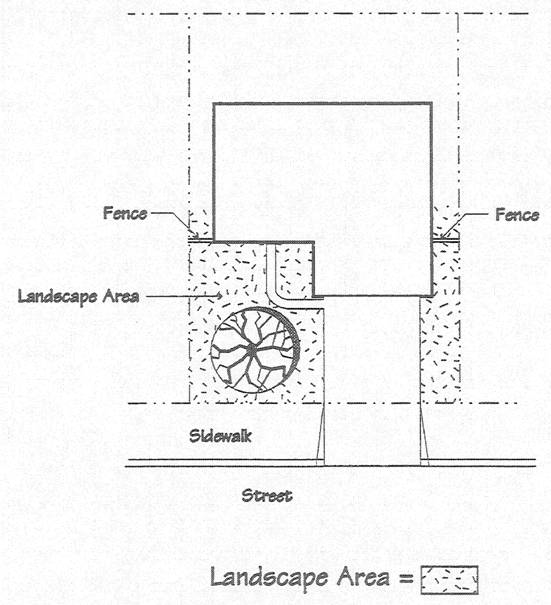
Minimum landscaping for front yard setbacks for all other residential development. All setback areas visible from a public street, with the exception of the minimum areas necessary for entry sidewalks and parking (including driveways and required parking spaces), shall have a surface that remains permeable and is to be planted and permanently maintained, as provided for in Sections 17.68.040, General Landscaping Requirements, and 17.68.060, Maintenance Requirements, of this chapter.
Figure 17.68.050
Minimum landscaping for front yard setbacks for all other residential development.
d.
For landscaping requirements for parking areas or lots, refer to Section 17.64.060(C), Landscaping, and Section 17.28.220, Parking Lots, of this title. Parking lot landscaping shall count toward the total landscaping requirements for a development site;
e.
For landscaping requirements for signs, refer to Section 17.84.020(B)(3), Landscaping, of this title. Sign landscaping shall count toward the total landscaping requirements for a development site.
2.
Nonresidential Uses. Please refer to the landscaping standards for nonresidential uses in nonresidential zones, below. A minimum of 10 percent of the gross lot area shall be provided in landscaping; however, more may be required through the discretionary review process to ensure compatibility of the use with nearby residential development.
3.
Exceptions. When the Orange County Fire Authority requires fuel modification zones for defensible space, it shall be at the discretion of the City Planner to grant relief from landscaping requirements set forth in this section.
B.
All Nonresidential Zones.
1.
Commercial Zones. All uses in commercial zones shall comply with the following standards:
a.
A minimum of one 15-gallon tree or equivalent, as approved by the City Planner, per 25 lineal feet of street frontage shall be planted on the site; and
b.
The following minimum amount of landscaping shall be provided for an individual development site:
Table 17.68.050
Landscaping as a Percent of Gross Lot Area
c.
For landscaping requirements for parking areas or lots, refer to Section 17.64.060(C), Landscaping, and Section 17.28.220, Parking Lots, of this title. Parking lot landscaping shall count toward the total landscaping requirements for a development site;
d.
For landscaping requirements for signs, refer to Section 17.84.020(B)(3), Landscaping, of this title. Sign landscaping shall count toward the total landscaping requirements for a development site.
2.
Mixed-Use Zones, except MU5.
Development in the MU 1, MU2, MU3.0, MU3.1, MU3.2, and MU3.3 zones (MU zones except MU 5) shall comply with the following landscaping standards:
a.
A minimum of one 15-gallon tree or equivalent, as approved by the City Planner, per 25 lineal feet of street frontage shall be planted on the site; and
b.
Urban Open Area Requirement. Landscaping requirements have been combined with open area requirements for this zone to allow the creation of urban open areas, such as courtyards, pedestrian walkways, outdoor seating areas and pedestrian walkways, accentuated with landscaping. The following are urban open area requirements for developments:
Exceptions to these requirements may be granted through the approval of a Minor Exception Permit in accordance with Section 17.40.050(C), Exceptions to the Development Standards for Lots of 12,000 Square Feet or Smaller of this title.
c.
For landscaping requirements for parking areas or lots, refer to Section 17.64.060(C), Landscaping, and Section 17.28.220, Parking Lots, of this title. Parking lot landscaping shall count toward the total landscaping requirements for a development site.
d.
For landscaping requirements for signs, refer to Section 17.84.020(B)(3), Landscaping, of this title. Sign landscaping shall count toward the total landscaping requirements for a development site.
3.
MU 5 Zones.
a.
Residential uses in MU 5 shall comply with the landscaping standards for residential uses found in subsection A.1, Residential Uses, of this section.
b.
Nonresidential uses in MU 5 shall provide a minimum landscaping requirement of 10% of the gross lot area.
4.
Exceptions.
a.
All nonresidential zones, as stated in Subsection B, may utilize landscaping (i.e., vines, wall planters, etc.) if site constraints prevent minimum standard compliance. Vertical planting area is calculated as wall surface area covered with plant material based on expected plant size at maturity, with vine specimens being expected to cover ten square feet even if smaller at the time of planting.
b.
When the Orange County Fire Authority requires fuel modification zones for defensible space, it shall be at the discretion of the City Planner to grant relief from landscaping requirements set forth in this section.
(Ord. 1172 § 3 (part), 1996; Ord. 1252 § 19, 2001; Ord. 1314 §§ 60—64, 2006; Ord. No. 1652, § 4, 5-15-2018; Ord. No. 1808, § 4(Exh. A), 5-19-2026)
17.68.060 - Maintenance requirements.
The following standards shall be required of all development, new and existing:
A.
Maintenance of Landscape. .....All landscaped areas shall be maintained in an orderly, attractive and healthy condition. This shall include proper pruning, mowing of turf areas, weeding, removal of litter, fertilization, replacement of plants when necessary, and the regular application of appropriate quantities of water to all landscaped areas.
B.
Irrigation Systems Maintenance. .....All irrigation systems shall be maintained in proper operating condition and, if applicable, adhere to the City's approved maximum applied water allowance. Waterline breaks, head/emitter ruptures, overspray or runoff conditions and other irrigation system failures shall be repaired immediately.
(Ord. 1172 § 3 (part), 1996)
(Ord. No. 1707, § 3, 2-2-2021)

