
San Clemente City Zoning Code
CHAPTER 17
24 - GENERAL DEVELOPMENT STANDARDS
Sections:
17.24.010 - Purpose and Intent.
The intent of this chapter is to provide general development standards for the City, resulting in new development that is harmonious with existing and potential development in the surrounding area. The standards provided in this chapter apply to all zones, unless otherwise indicated. The standards are minimum or maximum requirements and may be modified to be more stringent through the discretionary review process, when it is required for a project.
(Ord. 1172 § 3 (part), 1996)
17.24.020 - Maintenance of Properties.
A.
Maintenance of All properties. .....All properties within the City shall be kept and maintained in a clean, neat, orderly, operable, safe and usable condition. This section applies to buildings, paving, fences, walls, landscaping, water, earth, and any other structures or natural features.
B.
Maintenance of Historic properties.
1.
Purpose and Intent. The purpose and intent of this subsection is to preserve, protect, and perpetuate the elements of the historic fabric unique to the historic resource or site and to stabilize the historic authenticity of the historic resource, building or site to prevent need for demolition or destruction due to neglect of important resources in the City's history. For purposes of maintenance and repairs, every effort shall be made to stabilize the resource, building or site so that its historical integrity is preserved in a manner consistent with the Secretary of the Interior's Standards.
2.
Maintenance Requirements. To help meet the purpose and intent, the following maintenance requirements are established:
a.
Water Protection. Structures shall be maintained in a watertight condition to preclude intrusion by dry rot and other decay problems caused by water. Deteriorated, insufficient, or ineffective waterproofing or weather protection of exterior walls, roofs, foundations, floors, windows, or doors shall be promptly addressed and repaired to prevent further decay, deterioration, or possibility of injury to members of the public and/or property.
b.
Façade. The façade shall be properly maintained through repair, paint, or any necessary treatment, so as to prevent decay, water or moisture intrusion, damage to the structure, and/or injury to the public. Defective or insufficient weather protection for exterior treatments and façades, including lack of paint or protective covering, shall be promptly addressed, and repaired or stabilized to prevent further decay, deterioration, and possibility of injury to members of the public and/or property.
c.
Structure. Roof, foundation, and structure shall be maintained through proper treatment and repair, to prevent decay, demolition by neglect, loss of historic materials and features, damage to the structure, and/or injury to the public. Defective materials or deterioration which may cause any or all portions of roofs, foundations, walls, or other structural members to deteriorate shall be promptly addressed, and repaired or stabilized to prevent further decay, deterioration, loss of historic fabric, and possibility of injury to members of the public and/or property.
d.
Character Defining Features. The building's elements such as cornices, chimneys, etc. shall be properly maintained to prevent decay, demolition by neglect, loss of historic fabric, and possibility of injury. Deteriorated or defective building elements shall be promptly addressed, and repaired or stabilized to prevent further decay, deterioration, loss of historic fabric, and possibility of injury to members of the public and/or property.
C.
Enforcement and Penalties. .....In addition to any other penalty authorized by law, failure to do so maintain shall constitute a public nuisance pursuant to Chapter 8.52 of this Code resulting in the issuance of an order that the owner perform the maintenance necessary to comply with this section. Any failure to comply with such an order shall entitle the City to cause the maintenance to be performed at the owner's expense and in addition to the penalties provided by this code for violation thereof, such cost may be recovered of such owner or occupant by civil action in any court of competent jurisdiction. In addition, any such costs shall become a lien against the property as provided for in Chapter 8.52.
(Ord. 1446 § 3, 2007: Ord. 1172 § 3 (part), 1996)
17.24.030 - Nuisances.
Neither the provisions of this title nor the granting of any permit provided for in this title shall authorize or legalize the creation or maintenance of any public or private nuisance.
(Ord. 1172 § 3 (part), 1996)
17.24.040 - Accessory Buildings and Structures.
A.
General Requirements for Accessory Buildings and Structures in All Zones.
1.
When Accessory Buildings and Accessory Structures May be Constructed. Attached or detached accessory buildings and accessory structures may be constructed with, or subsequent to, the construction of the primary building as provided for herein. Exceptions may be granted as deemed by the City Planner or designee.
2.
Requirements Not Included in This Section. Along with the regulations found in this section:
a.
Please refer to provisions in chapters on the individual zones for other standards applicable to accessory buildings; and
b.
The provisions within this section shall not apply to fences, walls, hedges, retaining walls and skirt walls. Please refer to Section 17.24.090, Fences, Walls, and Hedges; Section 17.24.180, Retaining Walls, and Section 17.24.190, Skirt Walls, of this Title for specific regulations pertaining to Fences, Walls, Hedges, Retaining Walls and Skirt Walls.
B.
Standards for Attached Accessory Buildings and Structures (Except Fences, Walls, Hedges, Retaining Walls and Skirt Walls) in All Zones.
1.
Setbacks. With the exception of garages in residential zones which qualify for encroachment into the front yard setback, as provided for in Section 17.32.050(E), Garage Encroachment into the Front Setback, and except as modified by Table 17.24.080 B., Maximum Encroachments into Setbacks and Height limits, attached accessory buildings/structures shall comply in all respects with the setback requirements for the primary building.
2.
Height Limits. Attached accessory buildings/structures may have the same height limit as primary buildings.
C.
Standards for Detached Accessory Buildings and Structures (Except Fences, Walls, Hedges, Retaining Walls and Skirt Walls) in Residential Zones and on Residential Lots in Mixed-Use Zones.
1.
Setbacks. Except as modified by Table 17.24.080 B., Maximum Encroachments into Setbacks and Height Limits of this Title, a detached accessory building/structure shall adhere to the following general setbacks:
a.
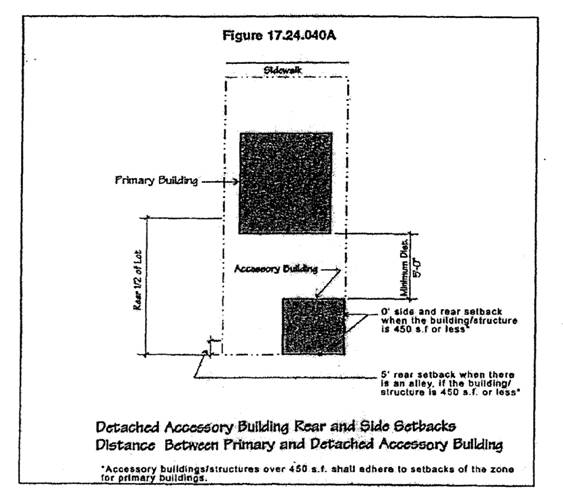
There shall be a five-foot minimum setback between an accessory building/structure and a primary building, measured at the closest distance between the wall or post of structures.
b.
When located wholly in the front one-half of the lot, a detached accessory building/structure shall follow the setbacks for the primary building, as prescribed by the zone.
c.
Except for through lots as described in Section 17.24.210, when located wholly in the rear one-half of the lot:
i.
A detached accessory building with 450 square feet or less floor area may encroach into the interior-side yard and/or rear yard setback of the zone up to a property line. One accessory building may encroach into required setbacks on lots 6,000 square feet or smaller, and two buildings may encroach on lots over 6,000 square feet, if they are separated a minimum of 10 feet.
ii.
A detached accessory building with over 450 square feet of floor area shall conform to the setbacks of the underlying zone.
iii.
A detached accessory structure shall adhere to the setbacks of the zone for the primary building, except as modified by Table 17.24.080 B., Maximum Encroachments into Setbacks and Height Limits.
d.
When portions of the detached accessory building/structure are located in both the front and rear half of the lot, respective portions of both Subsection (C)(1)(a) and (b) of this section shall apply.
e.
A detached accessory building/structure shall not be located within five feet of any alley.
f.
On a Corner Lot or a Reverse Corner Lot.
i.
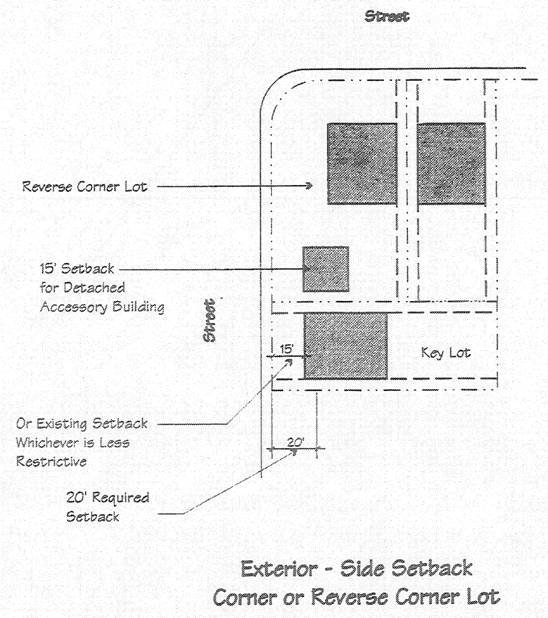
Exterior Side Setback. The exterior side setback for a detached accessory building/structure shall be the required or existing front yard setback on the adjacent key lot, whichever is less restrictive. The required or existing front yard setback may be established using any legally constructed building, attached or detached, accessory or primary.
ii.
Rear Setback. Notwithstanding Subsection (C)(1)(a), (1)(b), (1)(c), (1)(d), and (1)(e)(i), above, the rear setback for a detached accessory building/structure shall be five feet when the accessory building is adjacent to the front two-thirds of the adjacent key lot.
Figure 17.24.040B
iii.
Detached garages may encroach into the front yard setback as provided for attached garages in Section 17.32.050(E), Garage Encroachment into the Front Setback, of this Title.
2.
Height Limit for Detached Accessory Structures. Except as modified by Section 17.24.080, Maximum Encroachments into Setbacks and Height Limits, General; the height limit for detached accessory structures shall be as follows:
a.
Front Half of the Lot. Detached accessory structures in the front half of the lot shall not exceed 15 feet in height;
b.
Rear Half of the Lot. Detached accessory structures shall have a maximum height of 15 feet, however; the height limit may be increased to the height limit of the zone with the approval of a Development Permit (Section 17.16.100) or Cultural Heritage Permit (Section 17.16.110).
3.
Height Limits for Detached Accessory Buildings. Except as modified by Section 17.24.080, Maximum Encroachments into Setbacks and Height Limits, General; the height limit for detached accessory buildings shall be as follows:
a.
Front Half of the Lot. Detached accessory buildings in the front one-half of the lot shall not exceed 15 feet in height;
b.
Rear Half of the Lot.
i.
Accessory Buildings with Setback Encroachments. Detached accessory buildings in the rear half of the lot encroaching into required setbacks may be constructed over 15 feet high, up to the height limit of the zone with the approval of a Development Permit (Section 17.16.100) or Cultural Heritage Permit (Section 17.16.110). Setback encroachments require compliance with Section 17.24.080 or the approval of an application in Chapter 17.16; and
ii.
Accessory Buildings with Setback Compliance. Detached accessory buildings in the rear one-half of the lot may be constructed up to the height limit of the zone if detached accessory buildings comply with required setbacks of the zoning district for the primary building.
D.
Standards for Detached Accessory Buildings and Structures (Except Fences, Walls, Hedges, Retaining Walls and Skirt Walls) in Nonresidential Zones and on Nonresidential and Mixed-Use Lots in Mixed-Use Zones.
1.
Setbacks. Detached accessory buildings/structures shall meet all of the setback requirements for primary buildings, except as modified by Table 17.24.080B, Maximum Encroachments into Setbacks and Height Limits of this Title. The setback is measured at the closest distance between the wall or post of accessory structures and the property line.
2.
Height Limits. Detached accessory buildings/structures shall have the same height as the primary building, except as modified by Table 17.24.080B, Maximum Encroachments into Setbacks and Height Limits of this Title.
3.
Setback From the Primary Building. A detached accessory building/structure shall be a minimum of five feet from the primary building, except as modified by Table 17.24.080B, Maximum Encroachments into Setbacks and Height Limits of this Title. The setback is measured at the closest distance between the wall or post of accessory structures and the primary building.
(Ord. 1172 § 3 (part), 1996; Ord. 1322 § 3, 2006; Ord. No. 1561, § 3(Exh. A, § 9), 11-27-2012; Ord. No. 1707, § 3, 2-2-2021; Ord. No. 1759, § 3(Exh. A), 10-3-2023; Ord. No. 1808, § 4(Exh. A), 5-19-2026)
17.24.050 - Building Equipment and Services and Their Screening.
A.
Purpose and Intent. .....The location of trash enclosures and mechanical and other similar types of equipment on private property can significantly affect the visual quality of a project. Particularly important is the view of projects and their related equipment and services from adjacent streets. Because of San Clemente's varied topography, views of roof-mounted equipment need to be considered, as well. The requirements of this subsection are meant to address the negative visual impacts resulting from the location of trash enclosures and mechanical equipment on private property, while recognizing that they are necessary aspects of development. The requirements of this section are supplemented by the City's Design Guidelines, which contain guidelines for the treatment of building equipment and services.
B.
Trash Enclosures. .....Trash enclosures which enclose dumpsters shall be of sufficient size to accommodate the trash and recyclable materials generated by the uses on the parcel(s) being served. All outdoor storage of trash, garbage, refuse, and other items or material intended for discarding or collection shall be screened from public view on at least three sides by a solid wall, constructed of concrete block, compatible with the project's architecture and shall not be less than five feet in height or, alternatively, such other material or design approved by the appropriate decision making authority. The fourth side shall contain an opaque gate which shall be constructed of steel frame, be maintained in working order, and remain closed except when in use. The minimum dimensions of a trash enclosure which encloses a dumpster shall be nine feet wide by six feet deep.
C.
Ground and Roof-Mounted Equipment.
1.
Ground-Mounted Equipment on Private Property. Where feasible, ground-mounted equipment, such as air conditioning units, landscape irrigation's controls, transformers, fuse boxes, telephone equipment, gas meters, water meters, stand pipes, and fire sprinkler connectors, shall be located as follows:
a.
Underground; or
b.
Outside the front yard setback and, when no front yard setback is required outside the area between the street and the building closest to the street.
Where it is infeasible to locate ground-mounted equipment outside the front yard, ground-mounted equipment located in the front yard shall be screened from public view. Screening of ground-mounted equipment must be similar to adjacent landscaping, architecture and/or materials.
2.
Roof-Mounted Equipment. All roof-mounted appurtenances including, but not limited to air conditioning units, and mechanical equipment shall be shielded and architecturally screened from view from on-site parking areas, adjacent public streets and adjacent residentially zoned property as follows:
a.
All roof-mounted equipment shall be located in an equipment well which is screened by a screening wall, parapet wall or equipment well. The height of such equipment, mounted in the well, shall not exceed the height of the architectural element used to screen the well. Viewsheds and sightlines shall be taken into consideration and the equipment should be placed in a location, which effects maximum screening. The Planning Division may also require additional screening devices in conjunction with tenant improvements as deemed necessary where the screening wall, parapet wall or equipment well does not provide adequate screening from the above-referred views.
b.
Roof screens shall be sheathed in a matching or complementary material to the exterior building and may include metal panels, parapet walls or screens constructed of exterior grade plywood or other durable materials.
(Ord. 1172 § 3 (part), 1996)
17.24.055 - Commercial amplified sound.
A.
Definition; Permit Required. ....."Amplified sound" means any sound, including, but not limited to, music and human speech, whose volume is increased by any external aid, whether using electricity, computers, motors, or other mechanisms, or not. Shouting, group chanting, and acoustic musical instruments without any external aid shall be exempt from this definition, but shall be subject to the general non-amplified sound regulations under Chapter 8.48. The use of amplified sound within a business, restaurant, bar or other commercial establishment is not permitted except under a Minor Conditional Use Permit issued in accordance with Section 17.16.070, Minor Conditional Use Permits.
B.
Findings and Review. .....For a Minor Conditional Use Permit, in addition to the findings required by Section 17.16.070, subsection F:
1.
The review authority shall consider the potential of such amplified sound to result in a violation of other provisions of Chapter 8.48, and shall establish amplifier settings and other limitations on the use of such amplified sound as conditions of approval.
2.
Review and approval shall not consider the information content of the amplified sound, but only its noise level and resulting potential to violate other provisions of this chapter.
3.
Prior to approval of a Minor Conditional Use Permit, the review authority shall solicit the comments and any recommendation of Police Services.
C.
Location. .....No Minor Conditional Use Permit shall be issued that allows the use or operation of sound amplifying equipment in any residential zone or on residential property.
D.
Standards. .....Any Minor Conditional Use Permit that allows the use or operation of sound amplifying equipment shall include, at a minimum, the following requirements:
1.
Noise from such sound amplifying equipment shall comply with the noise standards of Sections 8.48.050 and 8.48.060, except that:
i.
The sound level meter used to obtain the noise measurements shall be configured to use the C-weighting network instead of the A-weighting network.
ii.
The noise standards identified in Sections 8.48.050 and 8.48.060 shall be denoted as "dB(C)" instead of "dB(A)".
2.
The City may require submission of written proof by a qualified acoustical consultant that said sound amplifying equipment complies with these standards.
E.
Conditions. .....In addition, the following should be considered and, where deemed appropriate by the review authority, related conditions or limits should be included as part of the permit:
1.
Hours and days of operation.
2.
The potential for such sound amplifying equipment to interfere with or disturb the occupants of any hospital, sanitarium, school, church, courtroom, place of residence or public assemblage.
3.
The construction of the building or structure, if any, in which sound amplifying equipment is to be located and the ability of said structure to contain noise.
4.
Operational controls to be implemented during the use of sound amplifying equipment including, but not limited to, closing of doors and/or windows, security/administrative controls, etc.
5.
Any other consideration deemed appropriate by the permit authority.
(Ord. No. 1717, § 3, 10-19-2021)
17.24.060 - Canyon Setbacks, Inland.
A.
Purpose and Intent. .....The purpose of setback requirements for noncoastal canyons is to preserve important topographical features and/or habitat found in San Clemente.
B.
Applicability. .....Lots subject to the requirements of this section are shown on the Zoning Map with an "IC" overlay designation and detailed in Appendix A of this title.
C.
Standards.
1.
Inland Canyon Lots with an RL Designation. The canyon setback for development on noncoastal canyon lots shall be established by the City Planner, after an on-site visit by Planning Division staff and depending upon site characteristics, and shall be one of the following:
a.
A minimum of 30 percent of the depth of the lot; or
b.
In accordance with house and deck/patio stringlines drawn between the nearest corners of adjacent structures.
2.
Inland Canyon Lots with a Combination RL/OS Designation. New construction on inland canyon lots which have both a residential and an open space designation shall comply with the setback standards for lots with an RL designation, as detailed in Subdivision 1 of this subsection.
3.
Inland Canyon Lots with an RVL Designation. New construction on inland canyon lots with an RVL designation requires discretionary review, as described in Table 17.32.030, Residential Zone Uses, and Table 17.32.040, Residential Zone Development Standards. Through discretionary review, the standards listed in Subsection (C)(1), Inland Canyon Lots with an RL Designation, shall be used to guide development within these lots, which are often located entirely within inland canyons. The primary factor guiding development on these lots shall be to avoid development within the canyon, when feasible. When there is no other feasible location for development but within a canyon, development shall minimize topographical and aesthetic impacts upon the canyon and adjacent residential development, as determined through the prescribed discretionary review process.
4.
Inland Canyon Lots with an OS Designation. New construction on inland canyon lots with an OS designation requires discretionary review, as described in Table 17.44.020, Permitted and Conditional Uses within Open Space Zones, and Table 17.44.030, Open Space Zone Development Standards. Through discretionary review, the standards listed in Subsection (C)(1), Inland Canyon Lots with an RL Designation, shall be used to guide development within these lots, which are often located entirely within inland canyons. The primary factor guiding development on these lots shall be to avoid development within the canyon, when feasible. When there is no other feasible location for development but within a canyon, development shall minimize topographical and aesthetic impacts upon the canyon and adjacent residential development, as determined through the prescribed discretionary review process.
(Ord. 1314 § 13, 2006; Ord. 1172 § 3 (part), 1996)
17.24.070 - Density Bonuses and Other Affordable Housing Incentives.
A.
Purpose. .....The purpose of this section is to allow density bonuses and other affordable housing incentives to qualifying projects in accordance with state law.
B.
Density Bonus and Affordable Housing Incentives. .....The density bonuses and other affordable housing incentives required by state law, including, but not limited to, Government Code Section 65915 et seq., shall be available to applicants on the terms and conditions specified in state law.
(Ord. 1172 § 3 (part), 1996)
(Ord. No. 1499, § 1, 12-15-2009; Ord. No. 1536, § 4(Exh. A), 6-21-2011; Ord. No. 1649, § 1, 2-20-2018; Ord. No. 1652, § 4, 5-15-2018; Ord. No. 1740, § 4, 12-20-2022)
17.24.080 - Encroachments into Setbacks and Height Limits, General.
A.
Purpose and Intent. .....The regulations included in this section provide for the encroachment of architectural and functional features into setback areas. Limitations have also been established as a measure to control the overuse of the projection provisions in this section.
The maximum percentages will help prevent aesthetically inappropriate architectural façades or features that would pose a detriment to adjacent properties.
B.
Maximum Length of Encroachments.
1.
General Limitations.
a.
The total horizontal length of encroachments allowed in Table 17.24.080B, Maximum Encroachments into Setbacks and Height Limits, of this chapter on a given building elevation shall not exceed the maximum percentage of building elevation length as specified below:
Table 17.24.080A
General Limitations on Encroachments into Setbacks
b.
Building elevation length shall be measured at the first floor.
2.
Exceptions. At the discretion of the City Planner, the total length of all projections on a given elevation may be reduced to a smaller number in order to implement the intent of this section.
C.
Encroachments.
1.
General Notes Regarding Encroachments. In this section, encroachments into the minimum setback areas required in the development standard tables in each of the zones are described in the following two ways:
a.
Minimum Distance from Property Line. When stated in terms of a minimum distance from the property line, the encroachment into the required setback area is allowed to some minimum distance from the property line.
b.
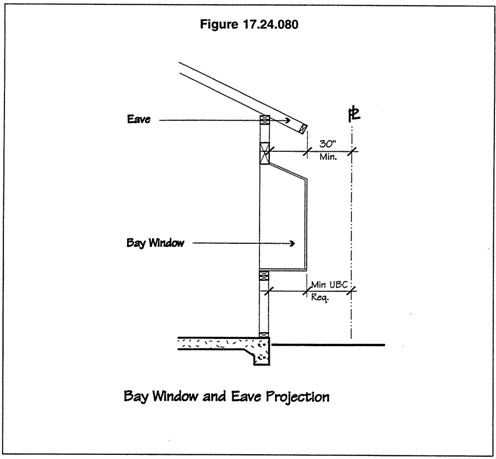
Maximum Projection. When stated in terms of a projection, the encroachment into the required setback area is a projection into the setback measured from the setback line. 1
2.
Specific Encroachments. The following items may encroach into required yards or extend beyond the maximum height limits, subject to the conditions identified in the table.
Table 17.24.080B
Maximum Encroachment into Setbacks and Height Limits
1 The setback line may be reestablished with a change in the front, side, and/or rear yard setback, through the approval of a Minor Exception Permit, in accordance with Section 17.16.090, Minor Exception Permits, of this title.
2 An increase of up to 10 percent of the permitted projection of architectural features into any required front yard may be granted through the approval of a minor exception, in accordance with Section 17.16.090, Minor Exception Permits, of this title. The projection must be counted from the minimum front yard setback for the zone, and may only be counted from the median front yard setback provided for in Section 17.32.050(D), Front Setback, Special Provisions for Reduction, if a Minor Exception Permit is approved in accordance with Section 17.16.090, Minor Exception Permits, of this title.
3 Providing that the floor of the open, uncovered structure and the entire stairway, in the case of stairways, is no higher than the main entrance of the primary building. Entrances to in-the-bank garages, as provided for [in] Section 17.32.050(E), Garage Encroachment into the Front Yard Setback, shall not count as the main entrance to the primary building. The six-foot encroachment must be counted from the minimum front yard setback for the zone, and may only be counted from the median front yard setback provided for in Section 17.32.050(D), Front Setback, Special Provisions for Reduction, if a Minor Exception Permit is approved, in accordance with Section 17.16.090, Minor Exception Permits, of this title.
4 An increase of up to 10 percent of the permitted encroachment of balconies, porches, decks, landing places and stairways which are open, uncovered, and 30 inches or taller into any required side yard may be granted through the approval of a minor exception, as detailed in Section 17.16.090, Minor Exception Permits, of this title.
5 An increase of up to 10 percent of the permitted encroachment of balconies, porches, decks, landing places and stairways which are open, uncovered, and 30 inches or taller into any required rear yard may be granted through the approval of a minor exception, as detailed in Section 17.16.090, Minor Exception Permits, of this title.
6 An increase of up to 10 percent of the permitted encroachment of balconies, porches, decks, landing places and stairways which are open, uncovered, and 30 inches or taller into any required front yard may be granted through the approval of a minor exception, as detailed in Section 17.16.090, Minor Exception Permits, of this title.
7 The projection must be counted from the minimum front yard setback for the zone, and may only be counted from the median front yard setback provided for in Section 17.32.050(D), Front Setback, Special Provisions for Reductions, if a Minor Exception Permit is approved, in accordance with Section 17.16.090, Minor Exception Permit, of this title.
8 An increase of up to 10 percent of the permitted projection of bay windows into any required front yard may be granted through the approval of a Minor Exception Permit, as detailed in Section 17.16.090, Minor Exception Permits, of this title.
9 Chimneys may exceed the height limit of the zone in which they are located by more than two feet through the approval of a Conditional Use Permit, as described in Section 17.16.060, Conditional Use Permits, of this title.
10 Elevator towers may exceed the height limit of the zone in which they are located by more than six feet through the approval of a Minor Conditional Use Permit, as described in Section 17.16.070, Minor Conditional Use Permits, of this title.
11 With the approval of a Conditional Use Permit (Section 17.16.060), architectural projections may exceed the height limitations of a zoning district, as follows: flag poles and church steeples in residential zones; and flag poles, antennas (other than satellite antennas or antennas on City property), cupolas, church steeples, monuments, and similar structures in nonresidential zones. Except for flag poles, structures may not exceed the height limit of a nonresidential zone by more than 10 feet. Antennas (other than satellite antennas or antennas on City property) that are not for the exclusive use of the occupant of a site are regulated like a public utility; please refer to Section 17.28.040, Public Utilities, of this title. For regulations for satellite antennas and antennas on City property, please refer to Sections 17.28.070, Antennas on City property and 17.28.080, Satellite Antennas.
12 Patio covers allowed within setback area may exceed 15 feet through the approval of a Conditional Use Permit, in accordance with Section 17.16.060, Conditional Use Permits, of this title.
13 Storage tanks, gas holders, water tanks, and similar structures in nonresidential zones may exceed the height limit of the zone in which they are located with the approval of a Conditional Use Permit, as described in Section 17.16.060, Conditional Use Permits, of this tide.
14 An exception may be granted to allow pools, spas, hot tubs and other bodies of water in the front yard setback or street side yard setback with the approval of a Minor Exception Permit per Section 17.16.090, Minor Exception Permits.
15 The five feet distance from the property line may be reduced when the equipment is soundproofed to the satisfaction of the City Building Official and the degree of soundproofing is demonstrated in an acoustical report approved by the City Building Official.
(Ord. 1314 § 14, 2006; Ord. 1304 § 18, 2005; Ord. 1253 § 5, 2001; Ord. 1190 § 8, 1997; Ord. 1172 § 3 (part), 1996)
(Ord. No. 1561, § 3(Exh. A, § 10), 11-27-2012; Ord. No. 1575, § 3(Exh. A, § 5), 12-3-2013; Ord. No. 1594, § 3(Exh. A, § 22, 23), 5-5-2015; Ord. No. 1609/1610, § 6(Exh. D, 8), 11-17-2015; Ord. No. 1707, § 3, 2-2-2021)
17.24.090 - Fences, Walls and Hedges.
A.
Purpose and Intent. The purpose and intent of this section is to establish standards for fences, walls and hedges that limit their visual and traffic impacts, but allow for the privacy and architectural interest afforded by such structures. The purpose of a stricter fence height limit in the front yard is to provide for an open street scene, to allow the primary structures on a street to be visible and to contribute to the visual character of the neighborhood, and to allow for unobstructed views of traffic to and from driveways.
B.
Standards for Fences, Walls, and Hedges in All Zones.
1.
Maintenance. Fences, Walls or Hedges shall be constructed and maintained so that they do not constitute a hazard to traffic, persons or property.
2.
Prohibited Types of Fences. Barbed wire and razor fences are prohibited in all zones, except when such materials are needed to restrict access to public utility equipment such as high voltage transformers.
3.
Measuring Height. The height of fences, hedges and walls and all structural elements supporting fences, walls and hedges, including pilasters, trellises, etc., shall be measured from the lower side of finished grade to the top of the fence, hedge or wall.
C.
Standards for Fences, Walls and Hedges in Residential Zones.
1.
Height Limits. Table 17.24.090 provides the maximum height limit for fences, walls, and hedges in residential zones. In front yards and portions of street side yards, fences, walls and hedges have a stricter height limit to maintain an open street scene, preserve the visibility of primary structures; enhance neighborhood character, and provide unobstructed views of traffic to and from driveways.
Table 17.24.090
Height Limits for Fences, Walls and Hedges in Residential Zones
2.
Exceptions.
a.
A Minor Exception Permit is required to allow the height of a fence, wall or hedge in front yards and street side yard setback areas (within five feet of property line) to be increased to a maximum of six feet per Section 17.16.080, Minor Exception Permits.
b.
A Conditional Use Permit is required to allow the height of a fence, wall, or hedge in the rear half of a lot to exceed six feet when the fence, wall, or hedge encloses tennis courts, other similar recreational areas, or private screened outdoor areas, per Section 17.16.060, Conditional Use Permits.
c.
Required Findings. In addition to the general findings required for permits, the following specific findings shall be made to allow height exceptions for fences, walls, or hedges:
i.
The height of the fence, wall or hedge will not be unsightly or incompatible with the character of or uses in the neighborhood;
ii.
The height of the fence, wall, or hedge will not have negative visual impacts upon the street scene or obstruct views of traffic to and from driveways.
D.
Standards for Fences, Walls and Hedges in Nonresidential Zones. .....In nonresidential zones, fences, walls, and hedges shall comply with the following requirements:
1.
Height and Materials. The height limit and other features of fences, walls, and hedges are determined through an architectural review process with required approval of a Development Permit (Section 17.16.100), or Cultural Heritage Permit (Section 17.16.110) for historic resources and landmarks on the City's designated historic resources and landmarks list.
2.
Fencing Around Parking Areas. For requirements for fencing around parking lots, please refer to Section 17.28.220, Parking Lots.
(Ord. 1304 § 18, 2005; Ord. 1172 § 3 (part), 1996)
(Ord. No. 1594, § 3(Exh. A, § 24), 5-5-2015; Ord. No. 1759, § 3(Exh. A), 10-3-2023)
17.24.100 - Floor Area Ratios, Increase in.
A.
Increase in Permitted Floor Area Ratios. .....The standard floor ratio for commercial and mixed-use zones is specified in Chapters 17.36, Commercial Zones and Standards, and 17.40, Mixed-Use Zones and Standards, of this title. New buildings and additions to existing buildings may be allowed to increase the maximum floor area ratio for the zone in which they are located through either the Site Plan Permit process or Minor Site Plan Permit process, in accordance with Section 17.16.050, Site Plan Permits and Minor Site Plan Permits, of this title. In no event shall the increased floor area ratio approved exceed the maximum floor area ratios specified below:
Table 17.24.100
Increase in Floor Area Ratios
B.
Required Findings. .....In order to approve a request for an increase in floor area ratio based on public benefit, the following finding shall be made:
1.
The requested increase will not significantly contribute to the temporary or cumulative demands for public facilities or services; and
2.
One of the following findings shall be made:
a.
The proposed project warrants increased intensity because it demonstrates exceptional design quality exceeding City standards and guidelines, or
b.
The proposed project provides significant or exceptional public amenities or benefits beyond those warranted by the development, or
c.
The proposed project provides significant or exceptional public benefits, as defined in Chapter 17.88, Definitions, Public Benefit, of this title, that promote the goals and policies of the General Plan.
3.
For projects in the NC 2 zone, excluding the Coastal Overlay Zone, which propose on-site preservation of a designated historic structure, a maximum FAR increase equal to the historic structure's existing square footage may be approved by the decision-making body only if the following finding is made in addition to the preceding findings in subsections (B)(1) and (B)(2) of this section:
The on-site preservation is in accordance with the Secretary of the Interior's Standards for Treatment of Historic Properties and will ensure continued preservation of the structure to the extent feasible.
4.
For projects in the NC 2 zone, excluding the Coastal Overlay zone, which propose relocation of a designated historic structure, a maximum FAR increase of less than the historic structure's existing square footage may be approved at the discretion of the decision-making body based on merit if the following findings are made in addition to the preceding findings in subsections (B)(1) and (B)(2) of this section:
a.
The relocation is to a site located within the same zone, or to a more appropriate land use and/or overlay zone, that will not be contrary to the continued preservation of the structure.
b.
Conditions of approval are included that will ensure to the extent feasible successful relocation, restoration and continued preservation of the historic structure in accordance with the Secretary of the Interior's Standards for Treatment of Historic Properties.
(Ord. 1231 § 3, 1999; Ord. 1172 § 3 (part), 1996)
(Ord. No. 1652, § 4, 5-15-2018)
17.24.110 - Height Limitations.
A.
Purpose and Intent. .....One of San Clemente's defining characteristics is its varied topography. The City's building height regulations are intended to:
1.
Preserve the natural topography by encouraging residential structures that follow the topography of the lots on which they are located and by discouraging significant grading or fill on infill lots. The calculation of height by individual roof element is intended to assist these objectives, by allowing roof elements to step up or down with the natural topography of the lot. The measurement of height from original grade is also intended to assist these objectives, by establishing height limits which are relative to the natural topography;
2.
Accommodate the special difficulties of developing on sloped properties by allowing height to be averaged within roof elements;
3.
Encourage developments with full roofs. The establishment of a height limit to plate line and a height limit to top of roof, in specific mixed-use and nonresidential zones where traditional architecture is required, is intended to assist with this objective; and
4.
Discourage excessively massive structures. The establishment of a story limit in mixed-use and nonresidential zones is intended to assist with this objective. The exemption of subterranean portions of structures from counting toward the story limit is intended to assist this objective, as well.
B.
General Regulations for the Measurement of Height. .....The following regulations for calculating height shall apply to all development within the City of San Clemente:
1.
Measurement of Height From Original or Finished Grade.
a.
Developments With Mass Recontouring. In the case of subdivisions and/or land development where mass recontouring has been or will be permitted by the City, building height shall be measured from finished grade based on City approved plans. Please refer to Figure 17.24.110A for a map of those areas in the City which have had mass recontouring. This subsection does not include properties with significant grading which have received the approval of a variance from height limits; please refer to the following paragraph b, for the method of measuring height on these properties.
b.
All Other Development. In the case of developments where mass recontouring has not been permitted, or where significant grading has been allowed but through the approval of a variance from the height limit, building height shall be measured from original grade.
c.
In cases where it is ambiguous whether building height should be measured from finished or original grade, or where a determination of finished or original grade is difficult, the City Planner shall make such determination, subject to the appeal provisions in Section 17.12.140, Appeals of an Action, of this title.
2.
Measurement of Height by Roof Element. The building height limits for a zone shall be applied to and measured for each roof element of a structure. No individual roof element may exceed the height limits for the zone.
3.
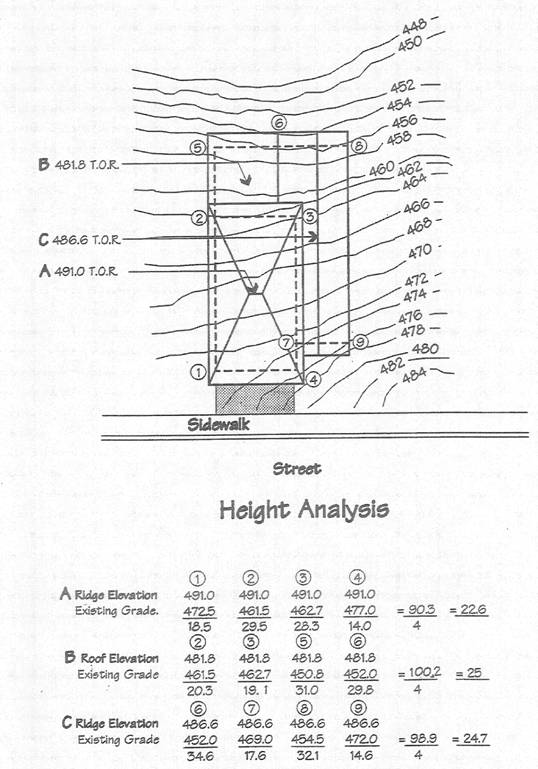
Measurement of Height to the Top of a Roof Element (TOR). Unless additional height limits are indicated in the development standard tables in Chapters 17.32, Residential Zones and Standards, through 17.48, Public Zones and Standards, of this title, the maximum height limit stated for a zone shall be a limit upon the "average height to the top of the roof element." The average height to the top of a roof element is calculated by:
a.
Measuring the height of each corner of the roof element. The height of each corner of the roof element is the vertical distance between original or finished grade and a projection of the top of the roof element, at each corner. Please refer to subsection (B)(1), Measurement of Height from Original or Finished Grade, of this section, regarding whether original or finished grade should be used; and
b.
Averaging the sum of the height of each corner of the roof element.
4.
A chimney is not counted or included in the measurement for height, building or used in the method for determining building height.
C.
Height Limits in Residential Zones.
1.
Height Limits. The maximum building height limits for structures in residential zones are described in Table 17.32.040, Residential Zone Development Standards, of this title.
Figure 17.24.110A
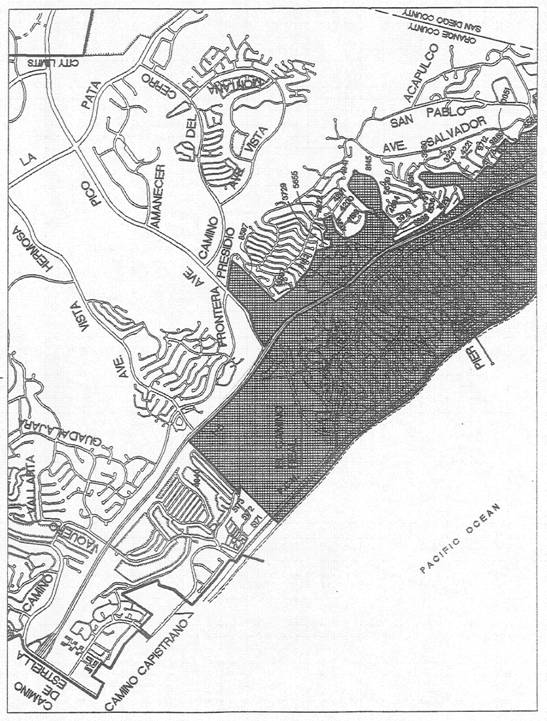
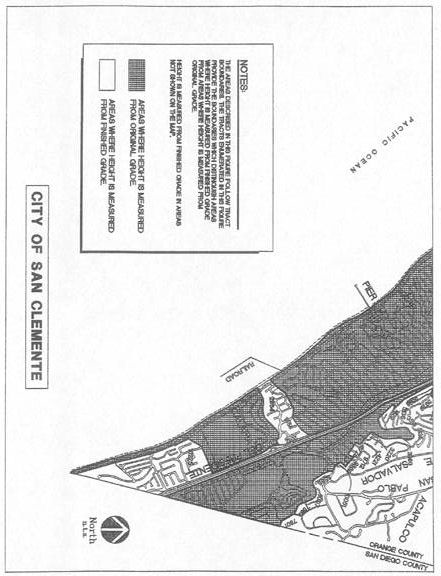
Figure 17.24.110B
2.
Measurement of Height. Structures in residential zones must comply with the general regulations for measuring height in Subsection (B), General Regulations for the Measurement of Height, of this section.
D.
Height Limits in Nonresidential and Mixed-Use Zones.
1.
Height Limits. The maximum building height limits for structures in nonresidential and mixed-use zones are described in the development standard tables in Chapters 17.36, Commercial Zones and Standards, through 17.48, Public Zones and Standards, of this title. Maximum building height limits for nonresidential and mixed-use structures are expressed in terms of both numerical height limits and a story limit; structures must comply with all the height limits for the zone.
2.
Measurement of Height. Please refer to the general regulations for the measurement of height in Subsection (B), General Regulations for the Measurement of Height, of this section. In addition to compliance with the general regulations above, height in non-residential and mixed-use zones shall, when required in Chapters 17.36, Commercial Zones and Standards, through 17.48, Public Zones and Standards, comply with the following regulations:
a.
Story Limits. The number of stories in each roof element shall not exceed the story limit for each zone, as indicated in Chapters 17.36, Commercial Zones and Standards, through 17.48, Public Zones and Standards. The following may be excepted from the story limits of this subsection:
i.
Residential structures in the MU 5.1 zone do not have story limits;
ii.
Basements shall not be counted toward the story limits for a structure.
b.
Height Limit to Plateline (PL). For zones specified in the development standard tables, as required in Chapters 17.36, Commercial Zones and Standards, through 17.48, Public Zones and Standards, of this title, a height limit to the plateline of a roof has been established. The height of the plate line of a roof element shall be a measurement of the "average height of the plateline." The average height of the plate line of the roof element is calculated as follows:
i.
Measuring the height to the plate line at each corner of the roof element. The height to the plate line at each corner of the roof element is the vertical distance between original or finished grade and the plate line, at each corner. Please refer to Subsection (B)(1), Measurement of Height from Original or Finished Grade, of this section, regarding whether original or finished grade should be used; and
ii.
Averaging the sum of the heights to the plate line at each corner of the roof element.
iii.
Plate Line is defined as the top of the highest horizontal framing member or solid wall of a building or structure or part thereof, upon which roof beams or ceiling rafters rest. Features excluded from measurement under this definition shall include gable ends, sloping roofs, parapet walls and other vertical extensions which are normally controlled by limits on roof height as set forth in this section.
E.
Visual Analysis Tools. .....The City Planner and review authority may require the submittal of visual analysis tools to evaluate visual impacts of projects that require a discretionary permit application. Visual analysis tools may include, but are not limited to, story pole staking, visual simulations, models, etc. Refer to Section 17.12.060.
(Ord. No. 1561, § 3(Exh. A, § 11), 11-27-2012; Ord. No. 1575, § 3(Exh. A, § 6), 12-3-2013; Ord. No. 1594, § 3(Exh. A, § 25), 5-5-2015; Ord. No. 1609/1610, § 6(Exh. D, 2), 11-17-2015; Ord. No. 1707, § 3, 2-2-2021; Ord. No. 1759, § 3(Exh. A), 10-3-2023)
17.24.120 - Inclusionary Housing Requirements.
A.
Purpose and Intent. .....The purpose of this section is to implement the inclusionary housing requirements included in the City's Housing Element.
B.
Applicability. .....The standards in this section shall apply to residential projects outlined in the Inclusionary Housing Program hi the City's Housing Element. Please refer to the program for applicability.
C.
Inclusionary Housing Standards. .....The following are standards for affordable housing provided in the Inclusionary Housing Program in the City's Housing Element. Please refer to the program for guidelines related to affordable housing.
1.
Number and Type of Units Required. New developments subject to the Inclusionary Housing Program in the City's Housing Element shall provide affordable residential units equal to 15 percent of the new units, according to the following requirements:
a.
Rental Units. Seven and one-half percent of the new units must be very low income units and seven and one-half percent must be low income units.
b.
For-Sale Units. Three percent of the new units must be very low income units, four percent must be low income units, four percent must be moderate income I, and four percent moderate income II.
For the purposes of this section, please refer to the City's Housing Element for definitions of very low income, low income, and moderate income I and II units.
2.
Three Options for Providing Affordable Units. The City may allow affordable units to be provided in the following three ways:
a.
The affordable units may be provided with the development project being proposed; or
b.
The affordable units may be provided off-site, but within City limits; or
c.
The affordable units may be provided through the payment of an in-lieu fee by the developer. Until a City-wide in-lieu fee program has been established, in-lieu fees may be established on a case-by-case basis.
3.
Number of Bedrooms. Affordable units shall have the same proportionate number of bedrooms as other units in the project for which they are required.
4.
Phasing. To the extent feasible, the required percentage of affordable units shall be constructed and occupied within the same general development phase as market rate units.
5.
Require Term for Participation in the Program. Affordable units required under the provisions of this section shall be retained in the program for a minimum of 20 years.
6.
Implementation Agreements. Prior to the issuance of Building Permits for the market-rate units, the developer shall enter into an implementation agreement with the City to provide affordable units at the earliest possible stage in the development process. The implementation agreement shall be recorded with the deed to the property in the office of the Orange County Recorder. The implementation agreement shall provide for the following:
a.
For rental units:
i.
Flexibility in the length of time a unit must be offered to an eligible household. If a qualified renter cannot be found within the time specified in the agreement, restrictions upon the qualifications of the renter may be adjusted or lifted for the duration of the renter's tenancy in accordance with the recorded implementation agreement.
ii.
The rent charged for an affordable rental unit shall be restricted for the term of the program to the appropriate level of affordability.
b.
For-sale units:
i.
Flexibility in the length of time a unit must be offered to an eligible household. If a bona fide offer cannot be found for an affordable for sale unit, restrictions may be adjusted or lifted in accordance with the recorded implementation agreement.
ii.
The sale price of an affordable unit that is proposed for sale before the required term expires shall be restricted.
D.
Conditions of Approval. .....Subsection (C)(6), Inclusionary Housing Standards, Implementation Agreements, of this title, shall be included as a condition of approval for projects complying with the provisions of this section.
(Ord. 1304 §§ 19—20, 2005; Ord. 1172 § 3 (part), 1996)
17.24.130 - Lighting.
Exterior lighting shall be energy-efficient and shielded or recessed so that direct glare and reflections are contained within the boundaries of the parcel, and shall be directed downward and away from adjoining properties and public rights-of-way. No lighting shall blink, flash, or be of unusually high intensity or brightness. All lighting fixtures shall be appropriate in scale, intensity and height to the use. Security lighting shall be provided at all entrances/exits.
(Ord. 1172 § 3 (part), 1996)
17.24.140 - Lot Frontage Requirements, Minimum.
A.
For Lots on Straight/Linear Portions of a Street. .....The minimum lot frontage is the required lot width of the zone.
B.
For Lots on Curved/Curvilinear Portions of a Street. .....The minimum lot frontage may be reduced from the required lot width of the zone through the discretionary review process, but in no case shall the lot width be reduced to less than 35 feet, except for flag lots approved through tentative map process.
(Ord. 1172 § 3 (part), 1996)
17.24.150 - Off-Street Loading Areas.
A.
Applicability. .....All new industrial and commercially zoned developments with buildings totaling more than 10,000 square feet shall be designed in compliance with the provisions of this section.
B.
Loading Spaces.
1.
Minimum Number of Spaces. The following minimum number of loading spaces shall be provided for a new project:
Table 17.24.140
Minimum Number of Loading Spaces
2.
Minimum Loading Space Size. The minimum dimensions for any required loading space shall be 10 feet wide and 25 feet long, with 14 feet of unobstructed vertical clearance.
3.
Circulation. Loading facilities shall not in any way block vehicular movement to or from a street, driveway, drive aisle, or parking stall. Loading facilities shall be located so that they may be accessed and utilized without maneuvering in the public right-of-way.
4.
Turning Radius. Access to all loading areas shall have an adequate turning radius, as determined by the City Engineer, to enable vehicles to maneuver without backing into a street or alley.
(Ord. 1172 § 3 (part), 1996)
17.24.160 - Relocation of Structures.
A.
Review Requirements. .....The relocation of a building or other structure from one lot to another requires the approval of a Minor Conditional Use Permit (Section 17.16.060) and a Development Permit (17.16.100) or Cultural Heritage Permit (17.16.110) for historic resources and landmarks on the City's designated historic resources and landmarks list.
B.
Minimum Standards. .....The relocation of a building or structure requires the following:
1.
Compliance. Compliance with the requirements, relative to the building or structure, of the zone to which the building is being relocated; and
2.
Conformance. Conformance with or improvement upon the general character of the existing buildings in the neighborhood.
C.
Public Notification. .....Public notification for the required discretionary approvals shall be provided, as described in Section 17.12.100, Public Hearing and Notification, of this title, and shall be provided for both the original location of the building or structures and the location to which the building or structure is being moved.
(Ord. 1172 § 3 (part), 1996)
(Ord. No. 1759, § 3(Exh. A), 10-3-2023)
17.24.170 - Residentially Zoned Property, Development Adjacent to.
A.
Purpose and Intent. .....The purpose of this section is to establish review procedures for nonresidential and mixed-use development adjacent to residentially zoned property. The purpose of review is to allow development adjacent to residential property while addressing potential impacts related to noise, light and glare, parking and circulation and privacy.
B.
Building Setbacks from Adjacent Residentially Zoned Property. .....Except as provided for within this section, new nonresidential and mixed-use buildings and/or additions to existing buildings shall maintain a minimum 20-foot setback from adjacent residential property lines. Encroachment of the nonresidential or mixed-use building and/or addition into this setback shall be allowed through the discretionary review process required for the project based on measures included in the project to address noise, parking, lighting, massing and other similar impacts upon adjacent residential development.
C.
Additions Within 50 Feet of Existing Single-Family Residences. .....Any nonresidential or mixed-use building addition that is closer than 50 feet to an existing single-family residence shall require the approval of a Development Permit (Section 17.16.100), or a Cultural Heritage Permit (Section 17.16.110) for historic resources and landmarks on the City's designated historic resources and landmarks list.
(Ord. 1172 § 3 (part), 1996)
(Ord. No. 1759, § 3(Exh. A), 10-3-2023)
17.24.180 - Retaining Walls.
A.
Purpose and Intent. .....In a community with sloping topography, retaining walls are often necessary to create developable or usable areas. The purpose and intent of this section is to establish standards that allow for retaining walls, while limiting their visual and traffic impacts. The purpose of a stricter height limit in the front yard is to provide for an open street scene, to allow the primary structures on a street to be visible and to contribute to the visual character of the neighborhood, and to allow for unobstructed views of traffic to and from driveways. The standards are also meant to minimize the height of retaining walls and their impacts upon adjacent structures.
B.
Standards for Retaining Walls in All Zones.
1.
Construction and Maintenance. Retaining walls shall be constructed and maintained so that they do not constitute a hazard to traffic, persons or property.
2.
Measuring Height. The height of retaining walls shall be measured from the lower side of finished grade to the top of the retaining wall.
3.
Landscaping. There shall be a minimum of a two-foot-deep area at the base of retaining walls in the following areas that shall be planted consistent with landscape standards in Section 17.68.040:
a.
Front Yard Setbacks.
b.
Street-Side Yard Setbacks.
c.
Within Inland Canyon (IC) Overlays or Coastal Canyon Setbacks.
d.
Within 10 feet from Open Space zones or open-space easements.
C.
Standards for Retaining Walls in Nonresidential Zones. .....The height limit, design, materials, stepping, and other retaining wall features of retaining walls are reviewed and approved through an architectural review process with the required approval of a Development Permit (Section 17.16.100), or a Cultural Heritage Permit (Section 17.16.110) for historic resources and landmarks on the City's designated historic resources and landmarks list.
D.
Standards for Retaining Walls in Residential Zones. .....Unless otherwise provided for in the applicable zones, the following standards shall apply to retaining walls and to all structural elements supporting the retaining walls, including pilasters, trellises, etc. In addition to the regulations set forth in this section, all retaining walls shall be constructed and maintained so that they do not constitute a hazard to traffic, persons, or property.
1.
Height Limits. The maximum height limits for residential retaining walls are shown in Table 17.24.180, Height Limits for Residential Retaining Walls, below.
2.
Stepping of Retaining Walls. A number of retaining walls (stepping) may be constructed to substitute for one tall retaining wall if both of the following occur:
a.
The height of each retaining wall must comply with the height limits of Table 17.24.180, Height Limits for Retaining Walls, above; and
b.
The minimum distance between any two retaining walls shall be equal to or greater than the height of the taller of the two retaining walls. The distance between the two walls shall be measured as the horizontal separation between the two closest wall faces: the back face of the downslope retaining wall and the front face of the up slope retaining wall. The distance between stepped walls in-the-bank-garages may be reduced with the approval a minor exception permit as described in Section 17.16.090, Minor Exception Permits.
3.
Distance Between Retaining Walls and Other Walls, Fences, or Similar Structures. The minimum distance between a retaining wall and any other wall, fence, or similar structure shall be equal to or greater than the height of the taller of the two structures, measured from the back face of the retaining wall and the front face of the adjacent structure.
Figure 17.24.180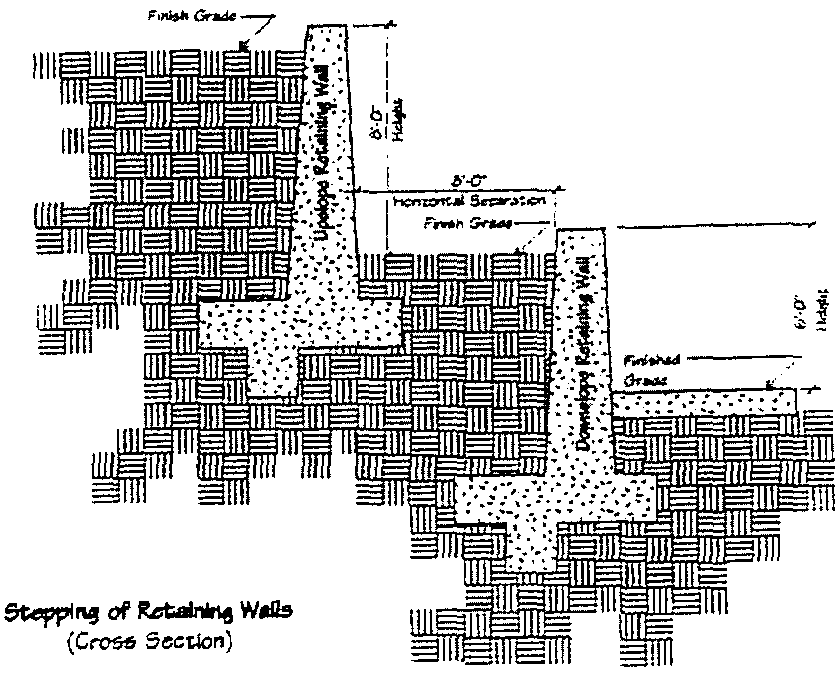
4.
Guardrail Requirements.
a.
Guardrail Height. The height of guardrails constructed on top of retaining walls 30 inches or more in height shall be no higher than the minimum height required by the Building Code. The height is measured from the top of the retaining wall to the top of the guardrail.
b.
Materials for Guardrails. Guardrails shall be designed and constructed of materials that limit visual impacts. Unless the City Planner finds it is unnecessary to limit visual impacts, any structure serving as a required guardrail and located in a front yard setback, rear yard setback (on through lots), street side yard setback (within five feet of street side property line), or in other instances where retaining walls are in a location or have a height that will have significant visual impacts, shall be designed or constructed of materials that are mostly open or transparent. Guardrails are "mostly open" when they are constructed of materials that may include, but are not limited to glass or have metal or wood pickets. The City Planner determines if the design and materials of guardrails will adequately limit visual impacts. The City Planner's decision may be appealed per Chapter 17.12.140.
c.
Guardrails with Pilasters. When incorporated into guardrails required by the Building Code, pilasters shall be allowed above retaining walls as follows:
i.
The maximum height of pilasters shall not exceed 42 inches as measured from the top of the retaining wall to the top of pilasters. In the case where swimming pools are proposed, the height of the pilasters shall be no higher than the minimum height required by the Swimming Pool Code.
ii.
The minimum centerline distance between pilasters shall not be less than six feet when the pilaster is part of the required guardrail and not less than four feet when the pilaster is part of the required hand rail for stairways.
5.
Exceptions.
a.
The following exceptions are allowed with the approval of a Minor Exception Permit per Section 17.16.090, of this title.
i.
An increase in the permitted height of retaining walls up to a maximum height of six feet for walls located in front yards, rear yards (on through lots), or located within five feet of street-side yard property lines.
ii.
An increase in the permitted height of a retaining wall up to a maximum height of eight feet, six inches for walls not located in front yards, rear yards (on through lots), or street-side yards.
b.
Required Findings. In addition to the general findings required in Section 17.16.090(F), all of the following findings shall be made prior to the approval of a Minor Exception Permit to exceed the standards for retaining walls:
i.
The height of the retaining wall will not be unsightly or incompatible with the character of or uses in the neighborhood;
ii.
The height of the retaining wall will not have negative visual impacts upon the street scene or obstruct views of traffic to and from driveway;
iii.
The additional height is necessary, given topographical constraints.
(Ord. 1172 § 3 (part), 1996; Ord. No. 1594, § 3(Exh. A, § 26), 5-5-2015; Ord. No. 1638, § 3(Exh. A, § 2), 1-17-2017; Ord. No. 1707, § 3, 2-2-2021; Ord. No. 1759, § 3(Exh. A), 10-3-2023; Ord. No. 1808, § 4(Exh. A), 5-19-2026)
17.24.190 - Skirt Walls and Stem Walls.
Skirt and stem walls shall not exceed 22 feet in height as measured from finished grade to the underside of the finished floor of the structure, unless there exists a horizontal offset of at least four feet. In addition, when columns are utilized on the rear elevations below the underside of the finished floor, a standard of one square inch in area for every one vertical foot in height shall be required for such columns.
(Ord. 1172 § 3 (part), 1996)
(Ord. No. 1561, § 3(Exh. A, § 12), 11-27-2012)
17.24.200 - Substandard Lots.
A.
Purpose and Intent. .....Because the standards for lot size and width have been amended a number of times since San Clemente's incorporation as a City, there are a number of substandard residential and nonresidential lots in the City. The purpose of this section is to provide for the development of lots which are currently substandard but existed legally at the time of their creation.
B.
Regulations. .....Structures may only be erected or enlarged on a substandard lot, if the substandard lot met the minimum size and width requirements for the zone in which it is located on the day the lot became a legal lot of record.
(Ord. 1172 § 3 (part), 1996)
17.24.210 - Through Lots, Rear Yard Setbacks for.
A.
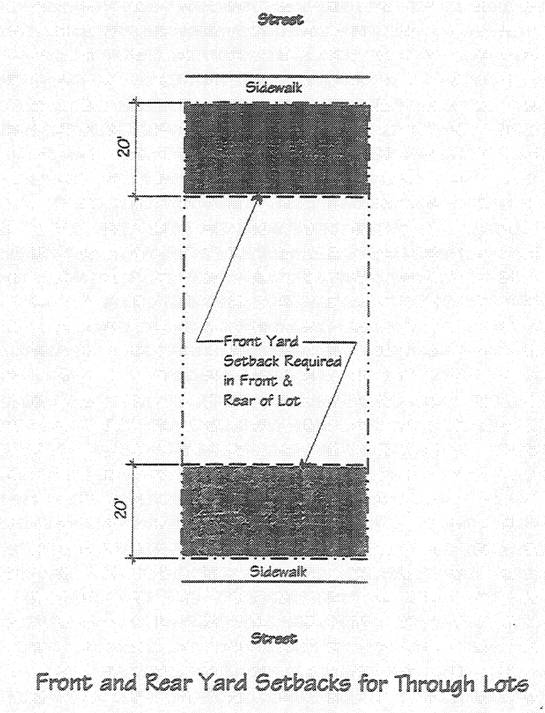
Residential Zones and Residential Lots In Mixed-Use Zones. .....In the case of through lots, the rear yard setback shall be the same numerical requirement as the front yard setback. The rear yard setback for a through lot may not be reduced by using the provisions for the median front yard setback found in Section 17.32.050(J), Residential Zone Special Development Standards, Front Setback, Special Provisions for Reduction, of this title.
Figure 17.24.210
B.
All Other Zones and Lots. .....For all other lots and zones, the rear yard setback for a through lot shall be the rear yard setback required in the development standard tables in each zone.
(Ord. 1172 § 3 (part), 1996)
17.24.220 - Trip Reduction Measures for Projects with Greater Than 100 Employees.
Please refer to Chapter 17.76, Transportation Demand Ordinance, for requirements related to projects that will employ 100 or more individuals.
(Ord. 1172 § 3 (part), 1996)
17.24.230 - Lot Consolidation.
A.
Purpose and Intent. .....Lot consolidation is the merging of existing parcels into fewer parcels through the elimination or modification of shared property lines and pertains only to lots identified in the Housing Element's Vacant and Undeveloped Residential Site Inventory. Development proposing the consolidation of two or more contiguous parcels or units of land listed on the site inventory, and which have been created under the provisions of the Subdivision Map Act, or any prior law regulating to the division of land, or these regulations enacted pursuant thereto, are eligible for the incentives provided herein. Development projects requesting to consolidate lots not listed on the site inventory are ineligible for incentives provided in this chapter and are subject to the policies and provisions of Chapter 16.44, Lot Mergers.
The purpose and intent of this chapter is to facilitate housing development, and redevelopment, through the consolidation of multiple adjacent parcels. Lot consolidation is intended to incentivize development in underutilized portions of the City and support more compact and higher-density rental and owner-occupied multi-family residential developments affordable across low and very low income levels. As a main incentive for lot consolidation, this chapter allows developers an increase in allowable density for projects that propose to build the maximum number of residential units permitted on site.
B.
Authority. .....In accordance with Section 17.12.020, Review Authorities, and Section 2.32.020, Planning Commission, the Planning Commission is the final authority for projects requesting additional units and incentives and all applicable discretionary and administrative permits, following the review and recommendation of the Architectural Review Subcommittee, unless state law specifies architectural review is not required. The City Planner shall have full authority in determining a project's compliance with this chapter prior to scheduling a public hearing.
C.
Applicability. .....The Lot Consolidation Incentives apply only to parcels identified in the City's Housing Element Vacant and Undeveloped Residential Site Inventory. All parcels identified in the site inventory are eligible for the incentives in this chapter provided that the resulting lot, subsequent to consolidation, meets minimum standards as listed in Table 17.24.230 A.
D.
Submittal Requirements. .....A lot consolidation request requires the applicant to apply for the consolidation of lots and incentives simultaneously, including incentives accumulated through the State By-right Density Bonus, provided in Table 17.24.070(6), Calculation of Density Bonus. The application will be reviewed against the findings in this chapter, Section 17.24.230 H., Required Findings, and the findings for all necessary discretionary and administrative permits.
E.
Process Review. .....The City Planner shall determine that projects proposing to consolidate lots meet all minimum standards in Section 17.24.230 F., prior to scheduling a public hearing for review by the final authoritative body. Projects proposing buildout beyond the development incentives granted in this chapter, or land uses that require separate entitlements, shall apply for the applicable discretionary permits concurrently and in accordance with Section 17.12.090, Consideration of Concurrent Applications.
F.
Minimum Standards for Lot Consolidation. .....To qualify for incentives, a lot consolidation request, as defined in Section 17.24.230 A. of this ordinance, must meet the minimum standards listed in this section, 17.24.230 F.1 through 3, and have a resulting lot that meets all of the criteria as indicated in Table 17.24.230 A.
1.
Consolidating Lots with Different Zoning. In the event two or more parcels with dissimilar zoning districts are proposed to be consolidated, resulting in a single parcel, the rezoning of the new parcel will be made concurrently with the submittal of a lot consolidation request with a determination made by the Planning Commission in relation to supporting congruency with the surrounding zoning districts. In the event that the consolidated single-zoned parcel would not result in greater neighborhood compatibility, including zoning districts with contrasting development standards or other potential negative influencing factors, the review authority will determine the resulting zoning district for the consolidated lot.
2.
Consolidating Lots in the Coastal Zone. In no case can incentives granted by the consolidation of lots in the City's designated Coastal Zone cause a project's density to exceed the density allowed in the San Clemente Coastal Land Use Plan, unless all lots considered for consolidation are located collectively in the Coastal Exclusion Order Area.
3.
Term of Affordability and Resale.
a)
An applicant entitling a rental project shall enter into an Affordable Housing Agreement and Restrictive Covenant with the City which shall ensure the additional units awarded pursuant to this ordinance shall be rented to low and very low income households at an affordable housing cost, as that term is defined in Health and Safety Code § 50052.5, for not less than 30 years or a longer period of time as may be required by other project funding sources. Household income and rents for the low and very low income units must be reported annually to the Community Development Department. For purposes of this Section 17.24.230, lower income households shall be defined by Health and Safety Code § 50079.5 and very low income households shall be defined by Health and Safety Code § 50105. The Restrictive Covenant shall be recorded against the property prior to the issuance of the first building permit.
b)
An applicant for a for-sale residential project shall enter into an Equity Sharing Agreement and Restrictive Covenant with the City which shall ensure that all additional units allowed pursuant to this Section 17.24.230 shall be sold to low and very low income households at an affordable housing cost. The City shall enforce the equity sharing agreement, unless it is in conflict with the requirements of another public funding source or law. The following apply to the equity sharing agreement:
i.
Upon resale, the seller of the unit shall retain the value of any documented improvements, the down payment, and the seller's proportionate share of appreciation. The City shall recapture any initial subsidy, as defined in subparagraph F.3(b)(ii), and its proportionate share of appreciation, as defined in subparagraph F.3(b)(iii).
ii.
For purposes of this subdivision, the City's initial subsidy shall be equal to the fair market value of the home at the time of initial sale minus the initial sale price to the moderate-income household, plus the amount of any down payment assistance or mortgage assistance provided by the City, if any. If upon resale the market value is lower than the initial market value, then the value at the time of the resale shall be used as the initial market value.
iii.
For purposes of this subdivision, the City's proportionate share of appreciation shall be equal to the ratio of the City's initial subsidy to the fair market value of the home at the time of initial sale.
c)
The Community Development Director shall promulgate guidelines for the implementation of this programs.
G.
Incentives. .....Lot Consolidation projects are entitled to all by-right incentives, as identified in Section 17.24.230(G)(1)(a)—(e), By-right Incentives, and one optional incentive when utilizing the State Density Bonus, as identified in Section 17.24.230(G)(2)(a)—(c), Optional Density Bonus Incentive.
1.
By-right Incentives. Lot consolidation projects approved by the review authority in compliance with this section are entitled to all of the following by-right incentives and shall be established upon the submittal of the application:
a)
Additional Units. Lot consolidation projects are awarded additional residential units calculated at a 25 percent increase from the maximum allowed density for the zone, provided 50 percent or more of the added units are affordable (very low and low income levels). Table 17.24.230 B provides the calculated density increase per zone.
Projects that take advantage of the State Density Bonus, pursuant to Section 17.24.070, Density Bonuses and Other Incentives for Affordable and Senior Housing Projects, further increasing the maximum allowed units, are eligible for one additional incentive found in Section 17.24.230(G)(2)(a)—(c), Optional Density Bonus Incentive.
b)
Coverage. When the project proposes the maximum density allowed for the zone, in addition to the amount necessary to physically accommodate the increased density provided for by this section, a project is entitled to the following:
i.
A five percent increase in maximum allowed building coverage; and
ii.
A ten percent reduction in the minimum open space/landscaping requirement of the zone.
c)
Setbacks. When the project proposes to build at maximum allowed density, in addition to the amount necessary to physically accommodate the increase density provided for by this ordinance, required setbacks shall be reduced to five feet, except when the property line of the parcel subject to lot consolidation abuts a parcel zoned single-family residential, in which case the setbacks identified in the underlying zoning shall control.
d)
Waiver and Reduction of Lot Merger Fees. Upon review of the project the Public Works department will waive or reduce the fee associated with a lot merger, in accordance with Chapter 16.44, Lot Merger, and only require a recordation of the deed regardless of the number of parcels involved with the assurance that the resulting parcel meets the established provisions in this section.
e)
Waiver and Reduction of Development Fees. The City will offer a waiver of development application filing fees for development in residential and mixed-use zones when minimum standards for lot consolidation are met.
2.
Optional Affordable Density Bonus Incentive. Projects are eligible for one of the following optional incentives when the project utilizes the State Density Bonus, pursuant to Section 17.24.070, choosing to further increase the maximum number of units allowed on site. The new density granted for lot consolidation projects, in accordance with Section 17.24.230(G)(1)(a), Additional Units, is considered by right and serves as the base density for calculating the State Affordable Density Bonus provisions for affordable housing. See Table 17.24.230 B for an example of graduated unit increase when utilizing both the by-right additional unit incentive and State Density Bonus.
Both by-right and optional incentives offered in this chapter shall be considered inclusionary to the incentives and concessions offered in Section 17.24.070 C(4)c, Regulatory Incentives and Concessions. Any amount of affordable units required to consolidate lots count towards the number of affordable units required to meet the State Density Bonus requirements.
a)
Parking Reduction. If a lot consolidation project is located within one-half mile radius of a transit stop, and there is unobstructed access to the major transit stop when walking from the project site, the development may request the following parking ratios as the project's Optional Incentive. Nonresidential parking is subject to existing off-street parking standards for nonresidential uses in the Zoning Code.
Residential parking.
b)
FAR. The minimum nonresidential floor area ratio allowed in a zone for mixed-use projects will be .20. The FAR incentive shall apply to the gross square footage of the consolidated parcel.
c)
Height Increase. The height may be increased according to Table 17.24.230 C, Additional Height.
H.
Required Findings. .....In order to grant the incentives for lot consolidation, the review authority shall make the following findings:
1.
The project meets the Minimum Standards for Lot Consolidation, Section 17.24.230 F, and proposes development accommodating the allowed maximum density.
2.
In granting an increase in allowable density, 50 percent or more of the additional units are affordable at a low or very-low income level in congruence with the Orange County median income and an agreement with the City is established ensuring the unit's continued affordability for 30 years or longer.
3.
In granting an increase in building height, a reduction in required building setbacks, and/or an increase in the amount of lot coverage, the decision-making authority shall find that such increase and/or decrease will not result in any adverse impacts to adjacent properties due to an encroachment of building elements that would substantially reduce such property's access to light and air, the privacy enjoyed by the adjacent residents, or otherwise reduce the reasonable use of the property.
4.
If deemed necessary, an impact study must show that the proposed increase in density or number of units on site does not cause a significant impact to the City's sewer and water infrastructure systems.
(Ord. No. 1708, § 3(Exh. A), 1-19-2021)

