
Wendell City Zoning Code
CHAPTER 10
PARKING
10.1 - Purpose and Intent
Parking lots, loading areas, and similar facilities are necessary elements in the urban environment. The purpose of this chapter is to provide for these necessary elements while:
•
Ensuring adequate parking for future commercial and residential parking.
•
Managing stormwater volume and velocity,
•
Limiting surface pollutants,
•
Reducing surface level heat and glare,
•
Increasing the efficiency of the connecting street system, and
•
Protecting the operations of the surrounding pedestrian and bicycle network.
To provide adequate service, the Town has enacted standards to regulate the construction, expansion, and renovation of such facilities.
10.2 - Applicability
At the time of erection of any new building, permanent parking spaces shall be provided in all districts in the amount specified by this Chapter.
10.3 - Off-Street Parking Area Design Specifications
Off-street parking areas should be designed to minimize breaks in the pedestrian network along public streets and create safe and comfortable passage for pedestrians. In order to accomplish this purpose, the following standards shall be met:
A.
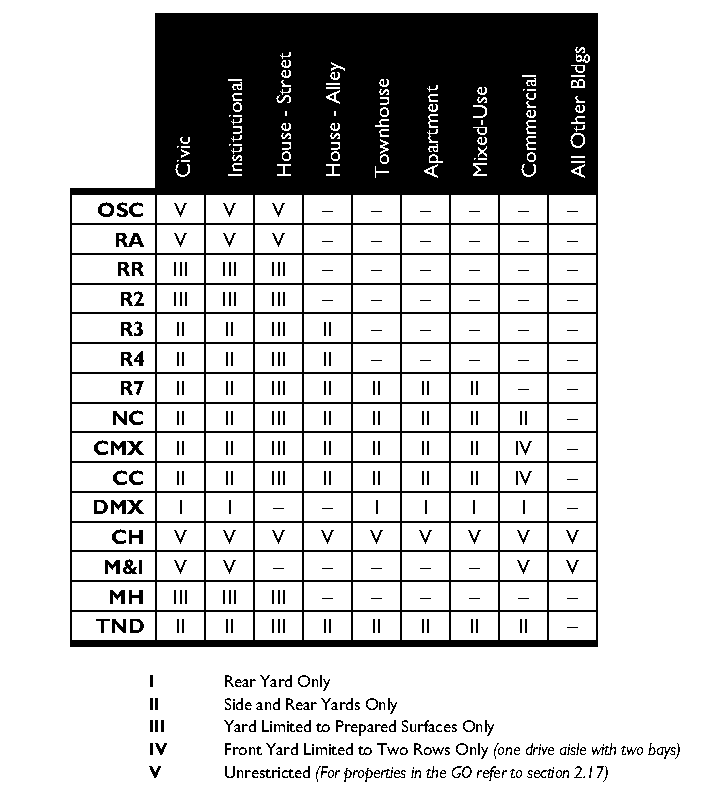
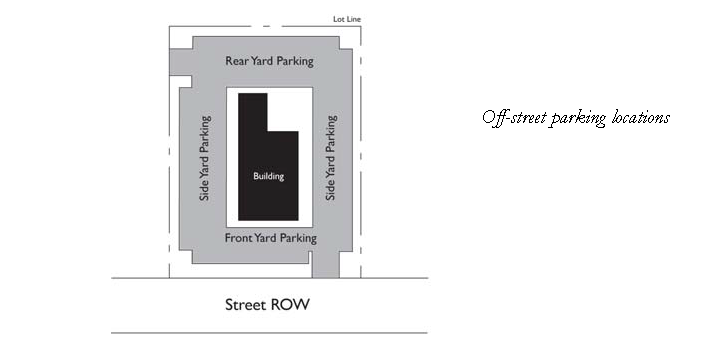
Permitted Off-Street Parking Locations by Building Type
B.
Parking Area Location: Parking lots and parking structures as stand-alone uses in the NC, CMX, CC, DMX or TND districts shall not abut intersections, pedestrian-oriented (i.e., streets with ground floor commercial uses) streets, or civic buildings; be adjacent to squares or parks; or occupy lots which terminate a vista (i.e., the view at the end of a street/corridor).
C.
Landscaping & Curbing/Bioretention: Landscaping shall be provided in accordance with Section 8.11, Parking Lot Landscaping.
D.
Sidewalk Corridors: Parking Areas shall be designed to allow pedestrians to safely move from their vehicles to the building. Sidewalk corridors shall be provided within the parking area and/or along the perimeter to provide safe building access for pedestrians.
E.
Connectivity: Adjoining parking lots serving non-residential buildings shall be interconnected except where topographic conditions prohibit a feasible connection.
F.
Circulation and Maneuvering:
1.
Off-street parking areas shall be designed to facilitate adequate movement and access by sanitation, emergency, utility, and other public service vehicles without posing a danger to pedestrians or impeding the function of the parking area.
2.
Except for single-family dwellings with separated parking areas and driveways, parking and maneuvering areas shall be arranged to allow vehicles to enter and leave the premises or parking areas in a forward motion. When more than two required spaces are provided in a single parking area, then entering and leaving in a forward motion is required.
G.
Encroachment: Off-street parking areas shall be designed so that parked vehicles do not encroach upon or extend onto public rights-of-way or sidewalks; or strike against or damage any wall, vegetation, utility, or other structures.
H.
Disabled Parking: Disabled parking shall be provided in accordance with the North Carolina Accessibility Code and federal ADA standards.
I.
Parking Area Lighting: Parking lots shall be lighted in such a manner as to provide adequate lighting per standards of Chapter 11, Lighting.
10.4 - General Parking Requirements
A.
Parking Ratios
(a) All square footage is in gross square feet.
(b) Required bicycle parking spaces are based on one bicycle parking space per the indicated number of auto parking spaces provided. A single "inverted U" bicycle parking rack will count as two bicycle parking spaces. The maximum required bicycle spaces shall be 20, equivalent to ten racks. The minimum required shall be two spaces or one rack.
(c) Bicycle parking is only required for multi-family dwellings of more than four units/building.
(d) Restaurants shall not provide less than eight parking spaces, even if no seating is provided.
(e) Applicants may select a minimum parking ratio within the range provided to apply to their development/business.
B.
Exemptions and Adjustments
1.
DMX: Developments in the DMX District are expected to provide parking under the requirements of this Chapter or pay a fee in lieu of the required improvements.
2.
On-Street Parking: Where parking on-street is permitted, the on-street spaces directly along a parcel's frontage for any use except a single-family dwelling may count toward the minimum parking requirement.
3.
Housing Services for the Elderly: The Board of Commissioners may authorize a reduction in off-street parking requirements for multi-family dwellings that provide Housing Services to the Elderly (including duplexes and multi-family buildings of four or more units) to no less than three off-street parking spaces for each four dwelling units or fraction thereof: Should a change of use occur such that the building is no longer providing Housing Services for the Elderly as the primary use, parking requirements shall meet the minimum ratio for residential uses as required in the table above (Section 10.4.A).
4.
Tree Preservation: The minimum number of parking spaces required may be adjusted by the Administrator when it has been determined that the reductions are necessary to preserve a healthy tree or trees (with a 12-inch or greater diameter at breast height) from being damaged or removed, and where the site plan provides for the retention of said tree or trees. (See Chapter 8.)
C.
Shared/Combined Parking: The parking spaces required for one use may be used to satisfy the parking requirements for a second use on the same zoning lot, subject to certification by the Administrator that such joint usage of parking complies with the following:
1.
The peak usage of the parking facility by one use will be at night or on Sundays (such as with theaters, assembly halls, or churches), and the peak usage of the parking facility by the second use will be at other times; or,
2.
The second use is an accessory use to the first use, such as restaurants and meeting rooms to hotels and motels.
3.
The joint use of shared off-street parking between two uses may be made by contract between two or more adjacent property owners.
D.
Parking Space Dimensions
1.
Parking space dimensions (other than those designed for the disabled) shall be a minimum of 18 feet long and nine feet wide.
2.
Parallel parking space dimensions shall be a minimum of 20 feet by eight feet (20 by seven feet may be used in constrained conditions or on residential streets). The dimension is measured from the face of the curb and may include the gutter.
E.
Driveway Widths for Parking Lots: Driveways for parking lots shall be a minimum of 12 feet in width for one-way traffic and 24 feet in width for two-way traffic. Driveway widths shall not exceed 24 feet, except as required by the Town of Wendell or the North Carolina Department of Transportation (NCDOT).
F.
Bicycle Parking: Bicycle parking is required to encourage the use of bicycles for personal transportation and to provide for bicycle access to employment, retail, and other destinations in Wendell.
1.
Required Racks: Where bicycle racks are used, "Inverted U" type racks or other racks that support the bicycle at two points on the bicycle frame are required.
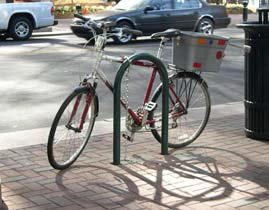
"Inverted U" bicycle rack
2.
Rack Siting and Dimensions:
a.
Racks shall be secured to the ground on a hard surface such as concrete, asphalt or unit pavers.
b.
Each bicycle parking space shall provide six feet by two feet in area per bicycle plus the area needed for access.
c.
Bicycle parking shall be located no closer than three feet from any wall to provide adequate space for access and maneuvering.
Minimum bicycle rack area dimensions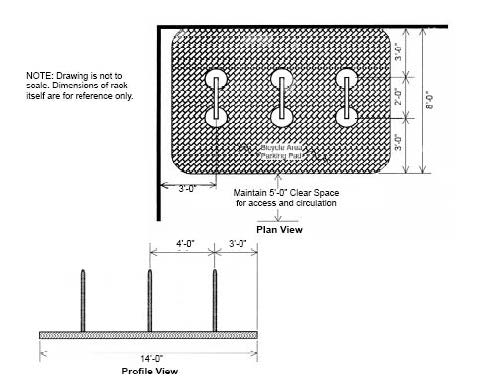
d.
At least four feet between parallel racks shall be provided for access.
e.
Bicycle racks installed on sidewalks should provide for a clear, unobstructed width of at least five feet for pedestrians and should be installed parallel to and at least three feet from the face of curb.
f.
Bicycle racks shall be placed a minimum of four feet from existing street furniture (i.e., mailboxes, light poles, benches) and be no closer than 12 feet from the edge of fire hydrants.
g.
Racks should be placed along a major building approach line and clearly visible from the approach and no more than 50 feet from building entrances. Rack placement should allow for visual monitoring by people within the building and/or people entering the building.
h.
If required bicycle parking is not visible from the street or main building entrance, a sign shall be posted at the main entrance indicating the location of the parking.
i.
Uses with several major, actively used entrances shall locate a portion of the required bicycle parking at each entrance.
3.
Shared Bicycle Parking: Any property owner required to have bicycle parking may elect to establish shared bicycle parking with any other property owner within the same block to meet the combined requirements.
G.
Satellite Parking: Satellite parking may be permitted, subject to certification by the Administrator that the following requirements have been met:
1.
The use being served by the off-site parking shall be a permitted principal use, as established in Chapter 2, in the zoning districts within which the lot containing such parking is located;
2.
The off-site parking spaces shall be located within 500 feet walking distance, and accessible by sidewalks or other designated safe walkways, of a public entrance to the structure or zoning lot containing the use for which such spaces are required;
3.
The continued availability of off-site parking spaces necessary to meet the requirements of this section shall be ensured by an appropriate condition that the continued validity of the zoning compliance or special use permit shall be dependent upon the permit holder's continued ability to provide the requisite number of parking spaces.
H.
Structured Parking
1.
Where an above-ground parking structure fronts a public street, it shall be screened in such a way that cars are not visible from the street. The ground level of a parking structure should be wrapped by retail, office or some other active use along the primary facade, at least.
2.
Along pedestrian oriented streets, parking structure facades shall be treated with high quality materials and given vertical articulation and emphasis compatible with the principle structure. The facade shall be designed to visually screen cars.
3.
Pedestrian entries shall be clearly visible. The vertical circulation should not be located in the center of the structure so that it is difficult to locate.
4.
The location of off-street bicycle parking spaces in parking structures is highly encouraged. Where bicycle parking is located in a parking structure, it shall be located on the level closest to the street and/or a primary building entrance.
I.
Use of Parking Spaces
1.
Required parking areas shall be available for the parking of operable vehicles of residents, customers and employees, and shall not be used for the storage of vehicles or materials, or for the parking of vehicles used for loading or unloading, or in conducting the use.
J.
Circulation Drives: A one-way circulation drive may be permitted around the front of the building but may not encroach into the front setback or any required landscape area. If provided, this drive shall be designed to be the minimal width required (not to exceed ten feet in width). See 10.4E for drive widths in parking lots.
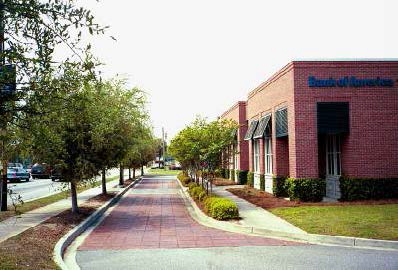
Circulation drives, if provided, should be minimized
K.
Surfacing: All vehicle accommodation area surfacing shall be constructed in accordance with the following:
1.
Porous Paving Permitted: The Administrator may permit and/or require that porous paving materials be substituted for paved surfaces in some portion of a vehicular surface area where it finds it is necessary to protect the root system of an existing tree or trees from damage or reduce the amount of impervious surface.
2.
Overflow Parking: Off-street areas used for special event parking (to accommodate occasional overflow volumes) may be constructed of any dust-free compacted, pervious ground cover. The owner of the property shall be responsible for the maintenance of such parking areas in a clean and dust-free condition. Grass and mulch are examples of acceptable pervious ground cover.
3.
Pervious Paving Required: When parking areas exceed the minimum parking requirements a portion of the excess spaces (as detailed in the table below) shall be constructed using a pervious technique approved by the Administrator including but not limited to pervious pavers, pervious pavement, grass block, or grass with structural supports. It is the responsibility of the owner to maintain these parking areas as pervious. This provision shall not apply to those developments which would result in a parking layout with five or less pervious paving spaces.
Example: A 60,000 square foot retail use is required to provide a minimum of two spaces per 1,000 square feet or 120 parking spaces. If the developer chooses to provide three parking spaces per 1,000 square feet or 180 spaces (150 percent of required minimum), then 36 of the spaces (20 percent) shall be constructed using a pervious paving technique.
If the developer chooses to provide 4.5 spaces per 1,000 square feet or 270 spaces, then all of the spaces in excess of 200% of the minimum spaces (120 spaces × 200% = 240 spaces; 270—240 = 30 spaces); PLUS 20% of the spaces up to 200% (240 × 20% = 48 spaces + 30 spaces = 78 spaces) shall be constructed using a pervious paving technique.
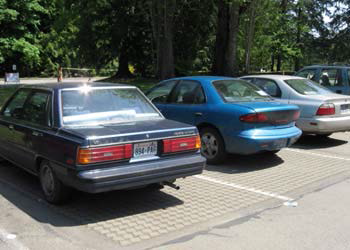
Pervious pavers and other pervious paving techniques allow stormwater to infiltrate
into the ground below.
4.
Exceptions to Paved Parking: The following situations are exempted from the requirements of this Section:
a.
An overflow parking lot used only for occasional use (Use that occurs on two or fewer days per week) or is temporary in nature (not exceeding 24 months).
b.
Whenever a proposed development involves only one of the following:
i.
An accessory structure; or
ii.
A change in use which will not increase the number of required parking spaces by more than 25 percent and the existing parking lot is not paved.
c.
The Administrator may exempt up to 75 percent of the required employee parking spaces in Manufacturing and Industrial (M&I) zoning district from the paving requirements of the Section. The exemption is based upon the following criteria: if the employee parking area is not visible, either by effective buffer screening or because of the grade of the site, from any public right-of-way or a residentially or commercially zoned property.
5.
Non-Paved Areas: Whenever a permanent parking area is exempt from the paved parking requirements or otherwise not required to be paved, the Administrator shall:
a.
Require that landscape aisles or spatial separations be provided where the Administrator finds it is desirable to ensure that the parking spaces will be readily identifiable to the users; and
b.
Require the perimeter of the vehicle accommodation area encompassing the parking stalls and the side of any unpaved drive or aisle leading to said stalls, to be edged with brick, pressure treated timbers, or cast in place concrete, and anchored into place. Alternate borders may be considered on a case by case basis.
L.
Vehicle Stacking Requirements
1.
Adequate space must be made available on-site for the stacking, storage and queuing of vehicles.
2.
Vehicles using drive-thru facilities may not encroach on or interfere with the public use of streets, sidewalks, and crosswalks by vehicles or pedestrians.
3.
A restaurant with drive-thru facilities must provide at least eight queuing spaces for vehicles when one drive-thru lane exists and six spaces at each drive-thru when more than one lane exists, measured from the pickup window.
4.
Any use with gas pump islands must provide a minimum of 30 feet of stacking space from each end of the island.
5.
Other uses utilizing drive-thru facilities must provide a minimum of three queuing spaces per drive-thru lane.
6.
Each vehicle stacking space in a drive-thru lane shall be a minimum of 20 ft. in length.
7.
An escape lane shall be provided parallel to the drive-through lane from the beginning of the drive-through lane to the pickup window.
8.
Drive-thru lanes shall be screened in the same manner as parking lots, as described in Chapter 8 of the UDO.
(Ord. No. O-13-2017, § 6, 6-12-2017; Ord. No. O-10-2019, § 1, 6-24-2019)

