
Wendell City Zoning Code
CHAPTER 8
TREE PROTECTION AND LANDSCAPING
8.1 - Purpose and Intent
The appropriate use of existing and supplemental landscaping enhances the aesthetic appearance of new development and blends new development with the natural landscape. The conservation of native evergreen and deciduous plant materials blends the built environment with new construction while maintaining the aesthetic character of the Town. This Chapter is intended to establish minimum standards for the protection of existing trees and design of landscapes to enhance Wendell's visual and environmental character by:
A.
Encouraging the conservation of existing trees and vegetation, which contribute to preservation of wildlife habitat; promotion of natural diversity; air quality; groundwater recharge; energy conservation; and reduced stormwater runoff.
B.
Separating incompatible land uses in order to minimize potential nuisances such as the transmission of noise, dust, odor, litter, and glare of lights;
C.
Enhancing property values and establishing a sense of privacy.
D.
Preserving and protecting the identity and character of Wendell and enhancing the business economy.
E.
Encouraging cooperation with Wake County Capital Tree Program to preserve and protect trees recognized by the program.
8.2 - Applicability
A.
After the adoption date of this ordinance, these requirements shall apply to:
1.
New Development: New residential, commercial, industrial, institutional, or mixed-use buildings, developments, or subdivisions;
2.
Building Expansion: Any existing principal structure which is expanded by 25 percent or more. The landscaping improvements are required for the expanded portion of existing development only.
3.
Parking Lot Expansion: Any existing parking lot (paved or unpaved) expanded or improved to add 12 or more spaces. If a parking lot is expanded, then buffers and parking lot landscaping requirements shall be applicable.
4.
Change of Use: If the zoning district classification changes for an existing use then the parcel shall comply with the landscaping requirements of this Chapter or, at a minimum, the intent of this Chapter as prescribed by the Administrator. The owner or developer may need to install additional plant material on the parcel in order to meet the intent of this Chapter, especially on developed sites, or to bring the parcel up to the standards for the type of buffer landscaping which would be required under this Chapter.
B.
Where the requirements of this Chapter and a zoning district's dimensional requirements differ, the more restrictive requirement will apply.
8.3 - General Provisions
A.
Existing Vegetation, Fences, Walls, and Berms: Existing trees or shrubs will be conserved to satisfy the landscaping requirements of this Chapter. Significant existing vegetation within landscaped areas shall be preserved and credited toward required landscaping. Existing berms, walls, or fences within the landscaped area, but not including chain link fencing, may be used to fulfill the standards for the type of landscaping required, provided that these elements are in good condition.
B.
Protection of Vegetation During Design: The Town expects new development, through the protection of trees and existing vegetation, to be creative in design and placement of buildings, structures, parking and other impervious surfaces as to preserve natural features and to complement the existing topography.
C.
Installation of New Vegetation and Other Features: New plant material should complement existing vegetation. If existing significant vegetation and other site features do not fully meet the standards for the type of landscaping required, then additional vegetation and/or site features (including fences) shall be planted or installed within the required landscaping area.
D.
Grading and Development in Required Landscape Areas: The required landscaping shall not contain any development, impervious surfaces, or site features that do not function to meet these standards or that require removal of existing significant vegetation. No grading, development, or land-disturbing activities shall occur within required landscaped areas if forest canopy, specimen trees, or significant vegetation exists within the buffer yard, unless approved by the Administrator. If grading within a planting yard is proposed, slopes of 3:1 or less are encouraged to ensure the proper transition of grades to the adjacent property and to facilitate landscaping and maintenance.
E.
Easements & Rights-of-Way: Nothing shall be planted or installed within an underground or overhead utility easement or a drainage easement without the consent of the Administrator and the easement holder at the time of site plan approval.
F.
Building Setbacks: Required building setbacks (as listed in Chapter 5) shall supersede Buffer or Street Yard requirements.
G.
Protection during Surveying: No tree greater than 12 inches in diameter at breast height (DBH) located on public property or within a required tree protection area shall be removed for the purpose of surveying without an approval from the Administrator.
H.
Tree Trimming: Every owner of any tree overhanging any street or right-of-way within the Town shall prune the branches so that such branches shall not obstruct the view of any street intersection and so that there shall be a clear space of eight feet above the surface of the street or sidewalk. Said owners shall remove all dead, diseased or dangerous trees, or broken or decayed limbs which constitute a menace to the safety of the public in accordance with the standards specified in section 'M' below. The Town is authorized to remove and/or trim trees and shrubs from public properties and public rights-of-way. The North Carolina Department of Transportation is authorized to remove and or trim trees and shrubs in the public rights-of-way owned by the State of North Carolina. Approval from the Administrator is required to trim a tree in a tree save area, required landscaping area, or buffer yard more than 25 percent of its overall canopy.
I.
Removal by Utility Companies: Trees to be removed from the public right-of-way by electric utilities and other overhead utilities must be replaced by such entity in equal quantity and minimum caliper size with an approved species.
J.
Tree Topping/Shearing: Tree topping and/or shearing shall be prohibited on all trees on public property, designated rights-of-way, required tree save areas, landscaping, and buffer yards unless otherwise approved by the Tree Board. Trees severely damaged by storms or other causes, or certain trees under utility lines or other obstructions where other pruning practices are impractical may be exempted from this Chapter at the determination of the Administrator.
K.
Tree Replacement: Should any tree designated in a tree save area, required landscaping area, planting strip or planting yard die within two years of issuance of the certificate of occupancy, the owner of the property/developer shall replace it within 180 calendar days. See Section 8.12 for more information.
L.
Removal of Dead Trees on Public Property: Approval by the Tree Board shall be required for removal of trees that are dead, infected by disease, or determined to be a hazard to public safety and welfare.
M.
Tree Removal on Private Property: The Town shall have the right to cause or approve the removal of any dead or diseased trees or tree parts on private property when such trees constitute a hazard to life and property, or harbor insects or disease which constitutes a potential threat to other trees in the Town. The Administrator or their designee will notify in writing the owner(s) of such trees or tree parts. Removal shall be done at the owner(s) expense within 90 calendar days after the date of service of notice. In the event of failure of the owner(s) to comply with such provisions, the Town shall have the authority to remove such trees and charge the cost of removal to the owner.
N.
Stumps: All stumps of trees shall be removed or shall be ground up within 90 calendar days of tree removal. This applies to both public and private property.
O.
Alternate Methods of Compliance:
1.
Alternate landscape plans, plant materials, or methods may be used in situations where strict adherence to the provisions of this Chapter would result in impractical or unreasonable situations. Such situations may result from severe topography, natural rock formations, and utility easements, lot configurations, or other physical conditions. The Administrator must approve alternate methods of compliance.
2.
Alternate landscape plans shall be reviewed based on their effectiveness and performance in meeting the spirit and intent of this ordinance. The Administrator shall review the alternate plan taking into account adjacent land uses, amount of plantings, species arrangement, and coverage.
8.4 - Landscape Plan
A.
Applicability:
1.
A landscape plan, to include tree preservation, shall be required prior to any land disturbance for any proposed development plan. (Predevelopment site grading, or any land disturbing activity of one acre or more that is not regulated by a previously approved site plan, shall be governed by the provisions of Chapter 6, Environmental Protection.) The plan shall contain the information detailed in Section 16.8, Landscape Plan Requirements.
2.
Minor changes or additions to existing development or approved plans may be submitted via an abbreviated site plan. An abbreviated site plan shall be allowed when a proposed change is physically limited to only a portion of the site. An abbreviated site plan shall include, but not be limited to, items listed in Section 16.10. The Administrator shall determine when an abbreviated site plan may be submitted for a detailed site plan and what items shall be included.
B.
Revisions to Approved Landscape Plans: Due to lack of plant availability, approved landscape plans may require minor revisions. Minor revisions to landscape plans may be approved by the Administrator if:
1.
There is no reduction in the quantity of plant material.
2.
There is no significant change in size or location of plant materials.
3.
The new plants are of the same general category (i.e., canopy trees, understory trees, shrubs, groundcover) and have the same general design characteristics (mature height, crown spread) as the materials being replaced.
(Ord. No. O-4-2017, § 5, 1-9-2017)
8.5 - Tree Protection
A.
Protection and Preservation
1.
General Provisions
a.
Wooded sites offer the distinct advantages of providing shade and aesthetically pleasing views. Vegetation on sloping sites plays a critical role in maintaining aesthetic quality, water quality, and in minimizing erosion and downstream flooding. Selective retention of significant vegetation should occur, particularly in areas or portions of a site that are located within a fragile ecological setting.
b.
Significant forest stands, natural vegetation, specimen trees, severe natural topography, drainage features and water courses should be preserved to the extent that is reasonable and practical while otherwise not reasonably prohibiting development. Forested and vegetated areas whose physical site conditions render them unsuitable for development should be set aside as conservation areas or as open space. Isolated pockets of existing trees, specimen trees, Heritage Trees, and trees recognized under the Capital Trees Program should be protected as a valuable asset of the property where practical.
c.
Planting Season: The planting season for trees shall be September 1 through May 31 unless otherwise permitted by the Administrator.
2.
Preservation of Existing Trees
a.
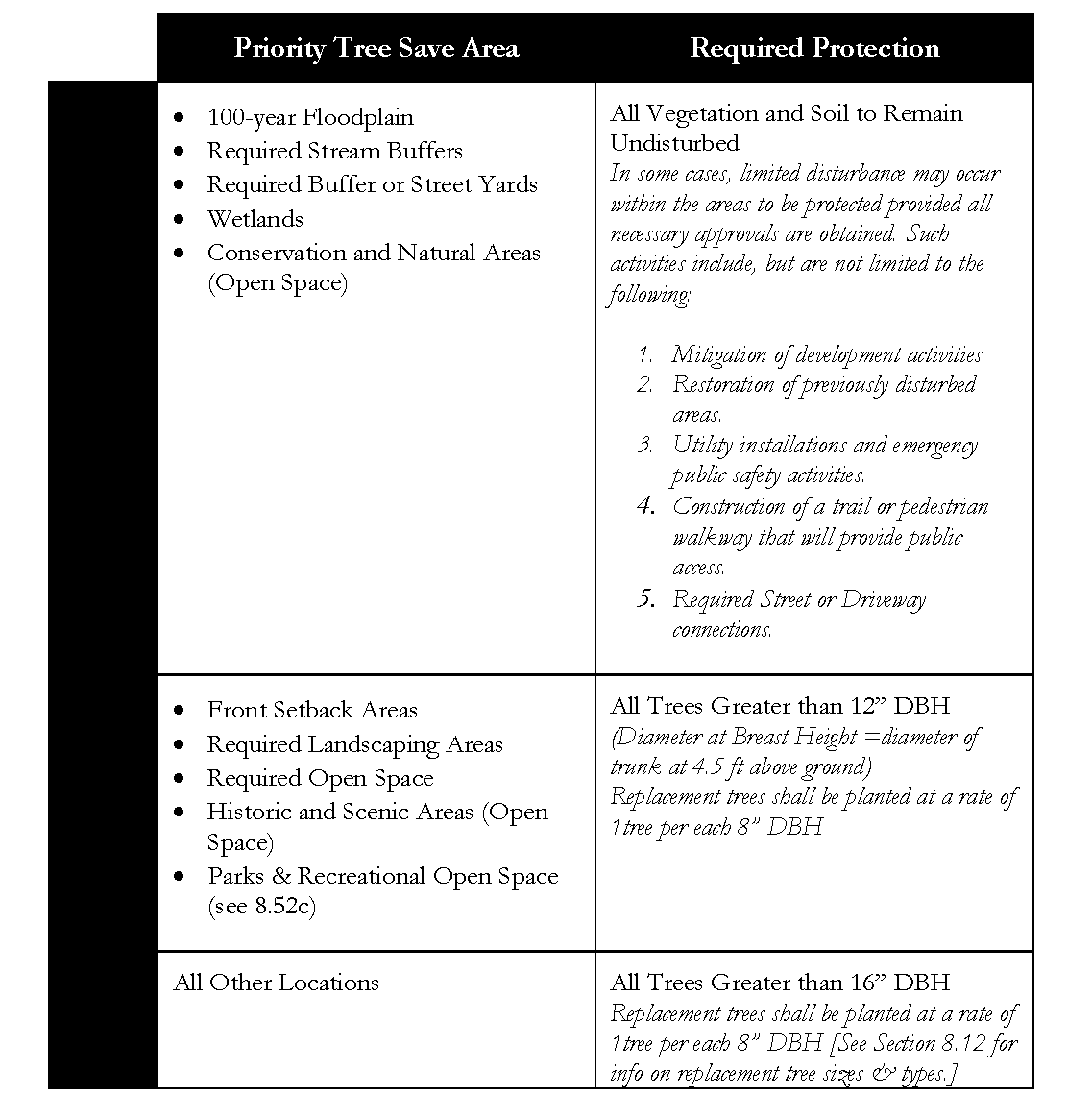
Required Tree Save Areas: Trees and existing vegetation shall be preserved in accordance with the table above. Exceptions shall be approved by the Administrator, who shall work jointly with the developer and design team during the project approval process. Surveyors should use a GPS device to flag trees for preservation or further study.
b.
Existing Trees: Notwithstanding the requirements in the table above, canopy trees at least 12 inches DBH and all understory trees greater than four inches DBH anywhere on the site shall be preserved to the greatest extent practical and incorporated into the required landscaping.
c.
All plans to remove trees greater than 12 inches DBH for Parks & Recreational Open Space uses shall be approved by the Board of Commissioners.
d.
Tree Protection Plan:
i.
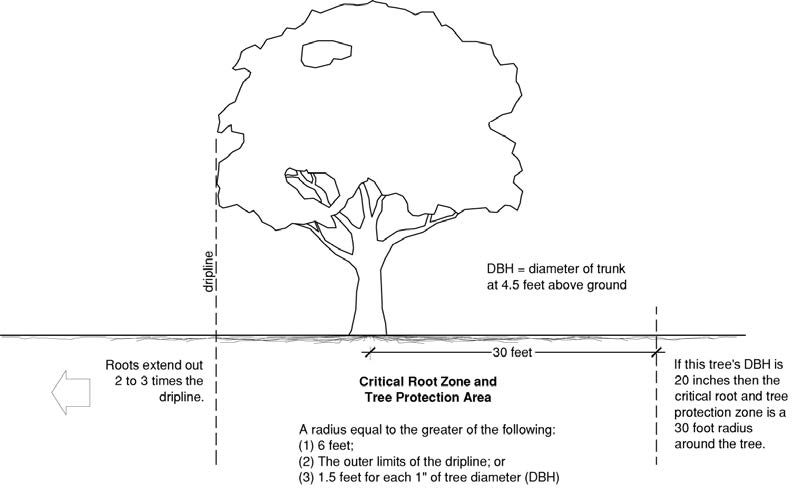
A tree protection plan, showing there will be no disturbance in the Critical Root Zone (CRZ) shall be submitted prior to grading. Trenching, placing backfill, driving, or parking equipment in the CRZ, and the dumping of materials detrimental to plant health in close proximity of the trees to be preserved is prohibited.
ii.
Where existing trees are to be preserved in a buffer zone, limits of grading shall maintain a minimum 20-foot separation from the base of each tree or to the dripline.
e.
When selecting which trees to preserve, the following shall be considered:
i.
Age, condition, and type of tree, not limited solely to species, but to include: uniqueness, historical significance, placement, etc.
ii.
Existing and proposed grading;
iii.
Location of site improvements and utility connections.
f.
Landscape Credits for Tree Preservation: Preserved trees shall be credited toward the satisfaction of the minimum landscape planting requirements based on the following details:
i.
Minimum size requirement to qualify for tree preservation credit is four inches in diameter at breast height (DBH).
ii.
Landscape credits for existing trees in parking areas and buffer or street yards shall be given at a rate of one tree per four inches of DBH of existing tree preserved.
iii.
Credits for tree preservation are only offered when a tree preservation plan is submitted prior to grading the site.
iv.
These credits shall only be given if the trees preserved are located in or within 15 feet of the specific area (street/buffer planting areas and parking area). For example: The trees preserved in the street planting area shall be given credit for the street planting requirements only. Credit for trees preserved in the parking area shall apply only to the parking requirements, etc.
g.
Replacement of Preserved Trees: Should any tree designated for preservation in the tree protection plan die within two years of issuance of the certificate of occupancy, the owner of the property/developer shall replace it within 180 calendar days with landscaping equal to what would be required in this Chapter.
8.6 - Buffers and Screening
A.
Required Buffer Yards:
1.
Buffer yards are planting areas located parallel to the side and rear lot lines designed to separate incompatible adjacent uses and provide privacy and protection against potential adverse impacts of an adjoining incompatible use or zoning district.
2.
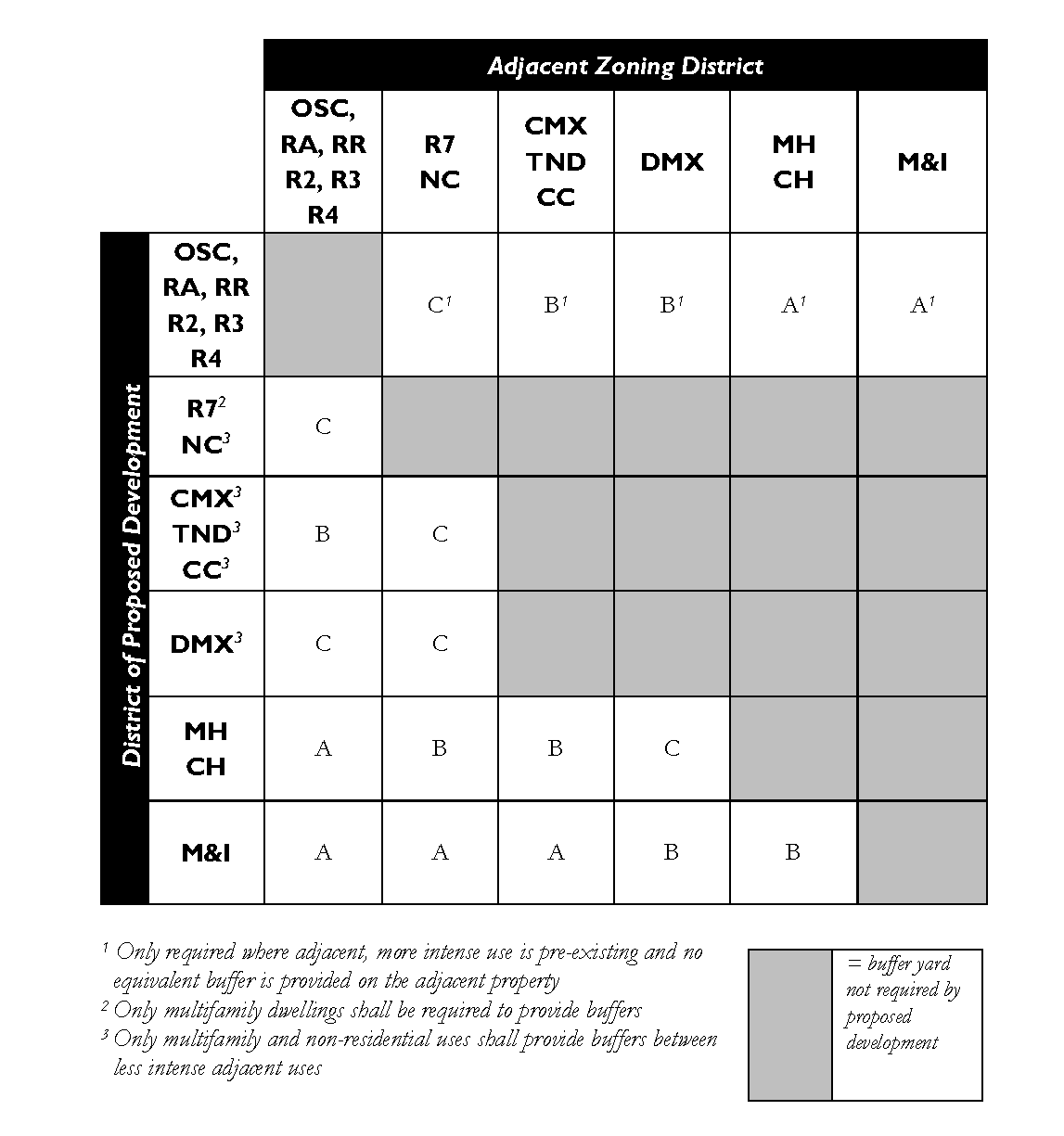
The size of a buffer shall be determined both by the zoning district of the proposed development and by the adjacent zoning district(s). Buffer yards shall be required in accordance with the table below when any use is being established on a property that abuts an existing developed lot or less intense zoning district.
a.
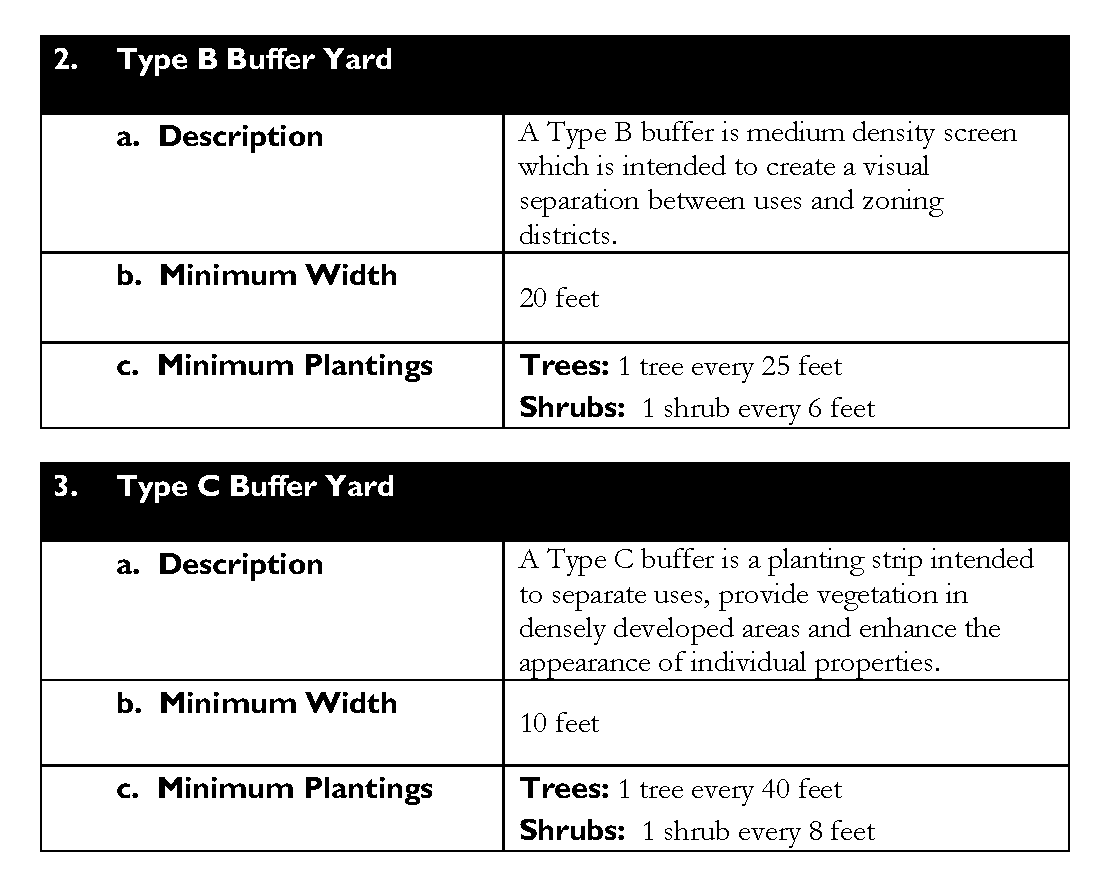
Notwithstanding the following chart, where a more intense proposed use abuts an existing single family residential use within any zoning category, a Type B buffer yard shall be required. This provision shall not negate the requirement for Type A buffer yards to be installed where required by this section.
3.
Buffer yards are intended to be constructed along the perimeter of the property; however, when there is irregular topographic conditions such as the perimeter of the property is at a lower grade than the use being screened, the Administrator may require the relocation of the required buffer yard in order to better serve its purpose.
4.
Where a proposed use or development type abuts multiple use types or zoning districts along the same side or rear year, the largest buffer will apply.
5.
Buffers shall not be located on any portion of any existing or proposed street right-of-way. Buffers shall be permitted to intersect utility easements or run parallel with them; however, they shall not be permitted to run linear with and be superimposed on them.
B.
Buffer Yard Types
C.
Additional Buffer Requirements
1.
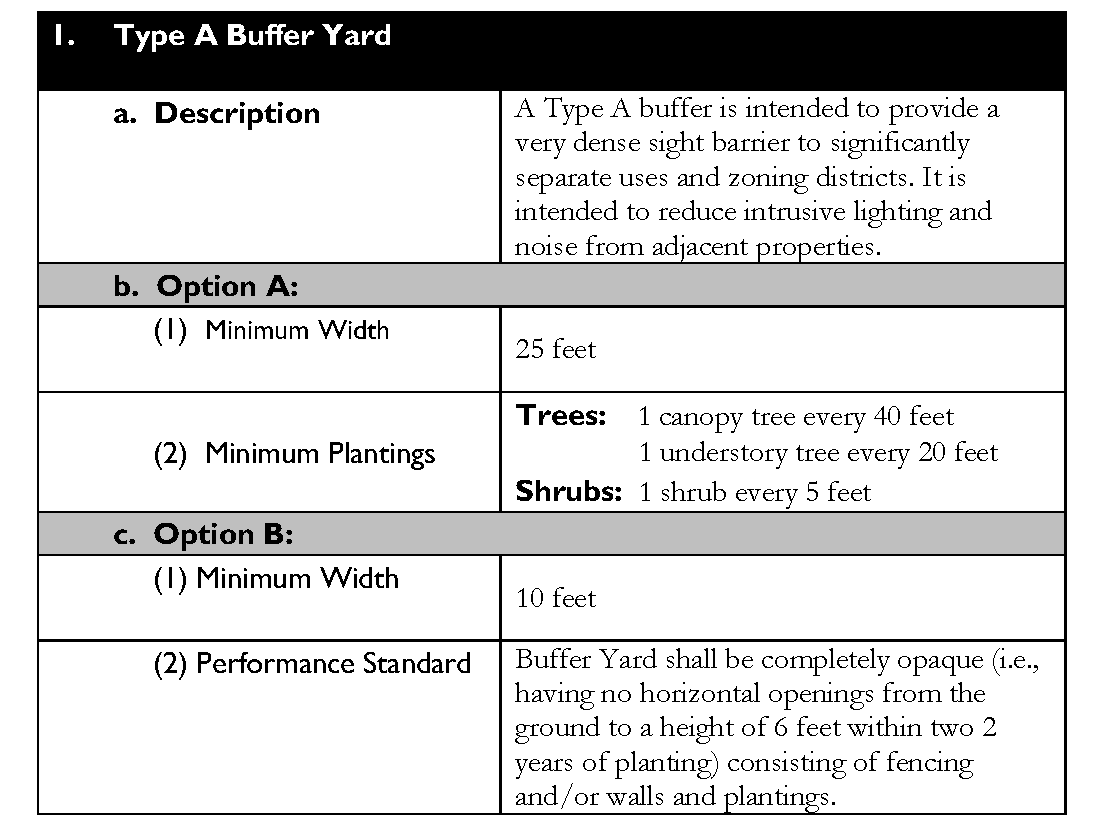
Fences and Walls: A six-foot tall privacy fence or wall made of treated and stained wood, brick, stone, or other composite material as approved by the Administrator and maintained in a like-new manner, may be used to reduce the required buffer width by 25 percent. (This reduction shall not apply to Buffer Yard Type A, Option B.)
2.
Berms: All berms, if provided, shall not exceed a slope with maximum rise of one foot to a run of two feet (a ratio of 1:2) and a maximum height of four feet. All berms, regardless of size, shall be stabilized with a ground cover or other suitable vegetation or permanent slope retention device. Berms taller than four feet shall be approved by the Administrator on a case by case basis.
3.
Existing Vegetation: Existing vegetation within the buffer yard which meets or exceeds the standards of this section shall be maintained and may receive partial or total credit toward screening requirements.
8.7 - Subdivision Plantings
A.
Applicability: Residential uses with front setbacks of five feet or more in a residential or mixed-use subdivision that includes more than five dwelling units. Foundation planting requirements shall apply to all residential development.
B.
Required Planting:
1.
A front yard planting shall be required for single family dwellings with setbacks of 15 feet or more. Front yard plantings shall be located within the front yard of the property boundary and do not remove the requirement for street tree plantings within the right-of-way. The developer may choose a tree from the Acceptable Plant Material List (Appendix A). The type of front yard planting required shall vary according to the lot width as follows:
a.
0—49 feet: one understory or ornamental tree required
b.
50—99 feet: one canopy tree required
c.
100+ feet: one canopy tree required per 50 feet of lot width
2.
Required street trees (see Section 8.8) and/or existing trees over four inches DBH may be counted toward fulfillment of the front yard planting requirement above.
3.
Where there are abutting rear yards, one tree and one shrub shall be planted on each lot for every 15 feet of rear property line. Existing vegetation may be used towards satisfying this requirement.
4.
Planted areas around cable boxes and HVAC units shall be provided with a minimum of four three-gallon evergreen shrubs, unless some other opaque screening is provided, planted five feet on center surrounding the box/unit. Shrubs shall have a minimum planted height of 18 inches (1.5 ft.).
5.
Foundation plantings are required at a rate of one shrub per five linear feet of dwelling frontage. Multi-family uses shall install foundation plantings along the foundation of all street facing sides, whether public or private, with the exception of rear alleys.
8.8 - Street Tree Plantings
Trees shall be planted in the right-of-way in planting strips or in tree wells, as indicated in the following table. Spacing of trees should allow for a clear view of buildings and land uses.
A.
Applicability:
1.
Street trees shall be planted in the right-of-way, between the street and the sidewalk, in all zoning districts except in OSC, RA districts, where no street trees are required. This requirement shall apply to newly constructed streets and as feasible on existing or reconstructed streets, as determined by the TRC.
2.
Where sidewalk is only required on one side of the street, street trees shall be planted at the same intervals and the same distance from the curb on both sides of the street.
3.
Where specific cross-sections or streetscape plans have been developed as part of an adopted corridor or small area plan, the required plantings shall adhere to said plan.
B.
Planting strips shall have a minimum width of seven feet for canopy and understory trees. See Appendix F for an approved street tree list. Planting strips are permitted and encouraged to be designed as bio swales (rain gardens) to substitute for conventional piped storm drainage.
C.
In mixed-use districts along street frontages that contain ground floor retail uses and on-street parking, or where specified on an adopted area plan, trees shall be planted in tree wells. Tree wells shall provide an adequate root aeration zone around the base of a tree. Tree grates or ground cover shall cover the exposed area of soil and protect this zone. The wells shall be a minimum of five feet square.
D.
Planting strips shall not be required in alleys.
E.
Street trees shall be planted as canopy trees and installed at an average distance of 40 feet on-center. Where overhead utilities exist prior to development, understory trees may be substituted, installed at an average distance of 25 feet on-center.
F.
Street trees shall be placed at least eight feet from light poles and ten feet from electrical transformers in order to allow these utilities to be safely serviced.
G.
Along State-maintained roads, plantings shall comply with NCDOT standards.
H.
Where conflicts exist which prevent required street trees from being installed within the road right-of-way, the required plantings shall be installed on private property parallel to the road as a Street Yard instead.
I.
Street tree species should be consistent within a given block, as determined by the administrator. Appendix F includes approved street tree species.
(Ord. No. O-14-2023, § 1, 6-12-2023)
8.9 - Street Yards
A Street Yard consists of a planting area parallel to a public right-of-way but on private property, typically between the sidewalk and new development. It is designed to provide continuity of vegetation along the right-of-way and to soften the impact of development by providing a pleasing view from the road.
A.
Applicability:
1.
Any use with a rear yard that abuts a street right-of-way.
2.
All non-residential uses in CH districts with front setbacks greater than 20 feet.
3.
All uses in MH, MHO, and M&I districts
B.
Minimum Width: Street Yards shall be a minimum of ten feet wide.
C.
Required Landscaping:
1.
Commercial and Industrial Uses: Two canopy trees or four understory trees, and eight shrubs (five to seven gallon) per 100 linear feet or a combination thereof to include a minimum of 50 percent evergreens.
2.
Multi-Family Uses: Two canopy trees per 100 linear feet of frontage. Foundation plantings shall be provided for multi-family uses at a rate of one shrub per five linear feet of dwelling frontage.
D.
Landscape Credits: Landscape credits for existing trees within Street Yards will be given at the rate of one shade tree per each existing tree four inches in DBH or greater.
E.
Tree Spacing: These trees shall be evenly distributed along the street frontage, but they are not required to be at absolute equal intervals. This will allow for some flexibility in design while discouraging long intervals without trees.
F.
No more than 20 percent of the Street Yard may be used for walkways or signs.
G.
Parking, merchandise display and off-street loading are prohibited in the Street Yard.
H.
All trees in Street Yards shall be planted no closer than four feet from any public right-of-way.
8.10 - Parking Lot Screening
A.
Applicability: Perimeter yard of all parking areas visible from the street (except single-family homes).
B.
Minimum Planting: Semi-Opaque Screen from the ground to at least a height of 3.5 feet for screening of car lights and glare (minimum width: ten feet).
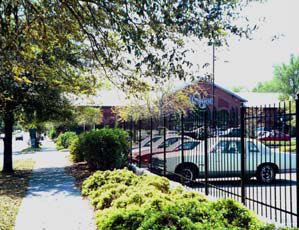
Screen parking lots from the street with
landscaping or a solid decorative wall or fence or combination thereof.
C.
Performance Standard: This type of screening functions as a semi-opaque screen around the perimeter of a parking lot from the ground to at least 3.5 feet for the screening of car lights and glare. This shall only be required along the parking area that fronts the public right-of-way or any side of a parking lot that is not protected by a Type C buffer yard. The location of such yards shall be determined by the Administrator upon review. Effective screening devices may include solid decorative brick walls, wood fences, earth berms, and tight evergreen hedges which shall reach the required height within two years of planting, or any combination of the above. Groundcover, exclusively, shall be planted in the sight triangle on each side of drives or streets. A six-foot opening shall be allowed every 150 feet to permit pedestrian passage where a formal connection to a sidewalk or pathway is provided.
D.
Screening of Open Storage, Above Ground Utilities, and Dumpsters: Any open storage of merchandise, equipment, materials or goods (other than those on display for retail sales), above ground utilities, loading areas, and dumpsters areas shall be screened from view from any street right-of-way. These areas shall include adjacent planting islands and shall be landscaped with an evergreen screen and fully enclosed in a fence or wall of at least six feet in height (see also Section 4.3, Containment Areas for Trash and Recyclables).
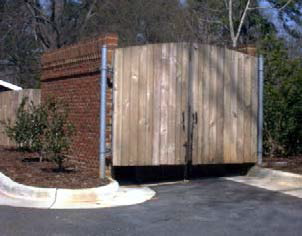
Enclose dumpsters and storage areas with
plantings and walls or fences.
8.11 - Parking Lot Landscaping
A.
Intent: Planting areas within and adjacent to parking areas designed to provide shade and improve the attractiveness of a large area of pavement.
B.
Applicability: Interiors of all parking areas with more than 12 spaces.
C.
Minimum Plantings:
1.
Trees: One canopy tree per 12 parking spaces.
2.
Shrubs: Four per 12 parking spaces.
3.
Plantings shall be in a planting area within the parking lot measuring at least 300 square feet and protected by curbs or wheel stops. Planting areas may have no bare soil.
4.
For parking lots of 24 spaces or less, trees and shrubs may be planted at the end of parking rows or in planting strips as defined above.
D.
Performance Standards: Parking lot landscaping functions as a tree ceiling over a parking area providing shelter from sun and rain and minimizing the impact of runoff by providing "green" surface area on which to collect.
1.
Canopy trees shall be planted in a manner that provides shade for the entire parking area at maturity. No parking space shall be more than 60 feet from the base of a canopy tree (parking lots using bioretention areas, as outlined in the section below, are exempt from this requirement). The use of existing vegetation to satisfy this requirement is encouraged.
2.
Landscape credits for existing trees in parking areas shall be given at a rate of one tree per each four inches DBH of existing plant preserved.
E.
Curbing/Bioretention Options:
1.
All parking areas and landscaped islands shall either be curbed using a vertical curb or wheel stops. Curbing may be discontinuous or perforated allowing stormwater to enter landscaped areas constructed for bioretention. Where bioretention areas are constructed, wheel stops may be used in place of curbing. Where landscaping is above grade, curbing must be continuous to prevent landscaping material from eroding into the parking area.
2.
Bioretention Areas: Required parking lot landscaping may be substituted with one or more consolidated bioretention areas. Bioretention areas shall be located where it is most practical to capture stormwater, manage parking lot traffic and facilitate pedestrian use, including adjacent to and connecting with vegetated areas on the perimeter of a parking lot. Bioretention areas shall be designed and landscaped to trap and mitigate runoff from paved surfaces consistent with the description and intent of EPA Storm Water Technology Fact Sheet—Bioretention (EPA 832-F-99-012, September 1999;), or equivalent, including NC Cooperative Extension Bulletin, Designing Rain Gardens (Bio-Retention Areas), 2001. These documents are included in Appendix B.
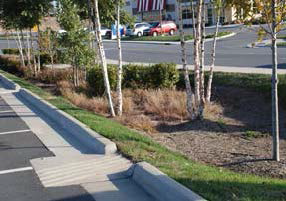
Example of discontinuous curbing around
parking lot bioretention area.
3.
Parking Dimension Bonus: A portion of the space devoted to motor vehicle parking may be landscaped instead of paved, as follows:
a.
A landscaped area may include up to two feet of the front of the parking space as measured from a line parallel to the direction of the bumper of a vehicle using the space, as shown at right. The landscape strip shall be a minimum of six feet in width.
b.
The landscaped area within the parking space counts toward parking lot landscaping requirements and toward any overall site landscaping requirements.
c.
In order to utilize this parking dimension bonus, landscaping must be below grade and designed as a bio-retention area.
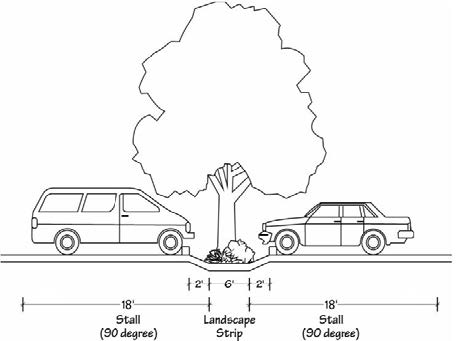
Required parking landscaped areas may include up to 2 feet of the front of a parking
space as measured from a line parallel to the direction of the bumper of a vehicle
using the space, as shown.
F.
Responsibility of Owner: Owners shall be responsible for maintaining parking lot landscaping consistent with specifications above.
8.12 - General Installation and Maintenance Standards
A.
Plant Material Classifications and Standards:
1.
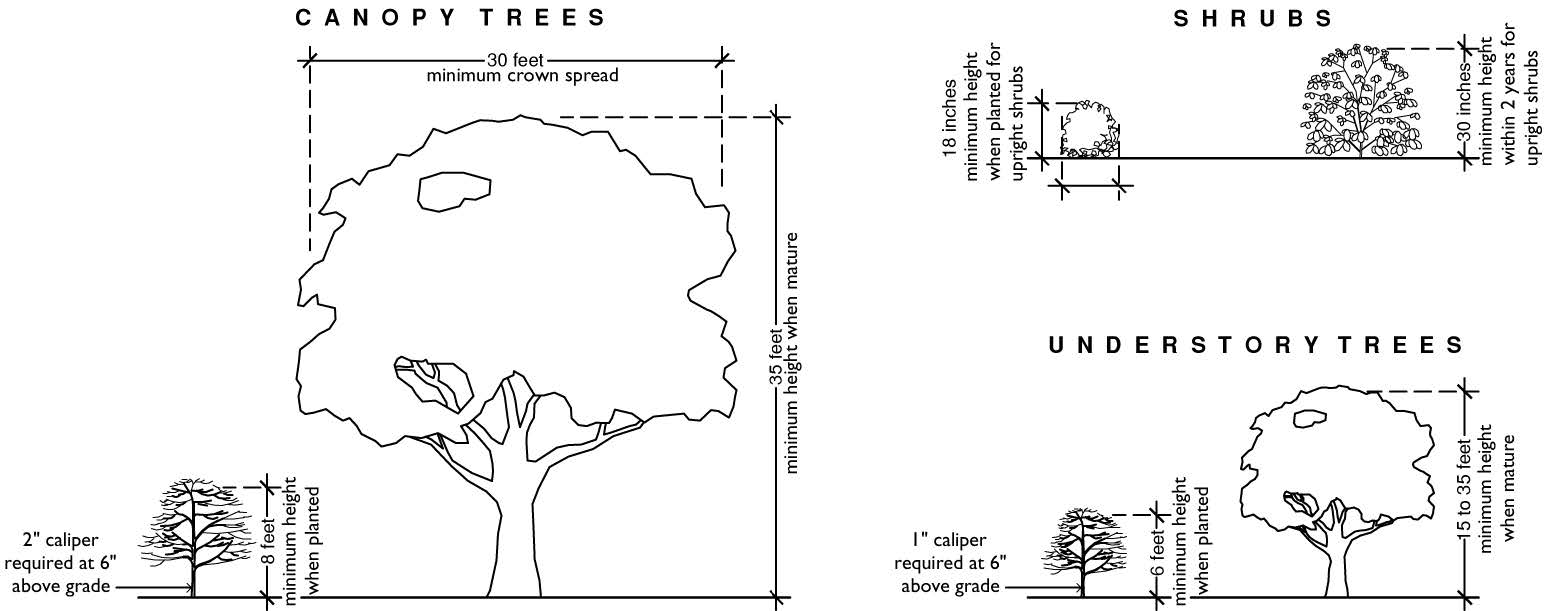
Canopy (Large Shade) Trees: Canopy trees must be a locally adapted species with an expected mature height of approximately 35 feet and an expected mature crown spread of approximately 30 feet. Canopy trees, existing or planted, must be a minimum of eight feet high, and have a minimum caliper of two inches measure six inches above grade. Multi-stemmed trees shall have at least three stalks and be at least eight feet in height.
2.
Understory (Small) Trees: Understory trees must be a minimum of six feet high and one-inch in caliper, measured six inches above grade when planted. When mature, understory trees should have an expected height of 15 to 35 feet.
3.
Shrubs: All shrubs shall be a minimum of one and one-half feet in height when planted. All shrubs shall reach a height of 36 inches and a minimum spread of 30 inches within two years of planting.
4.
Groundcover: All required groundcover type plants must be a minimum of one and one-half to two and one-half inch pots with a four-inch minimum length. Groundcover must be planted with on-center spacing equivalent to the average mature spread for each particular species.
B.
Landscaping Standards
1.
Retention of Existing Vegetation: Existing vegetation shall be retained and maintained to the maximum extent possible so as to permit such vegetation to contribute to buffer and screening requirements. Such retained vegetation, which meets or exceeds the standards of this ordinance, may receive partial or total credit toward planting requirements.
2.
Planting standards:
a.
All plant materials shall be installed in accordance with the standards found in the latest edition of American Standards For Nursery Stock published by the American Association of Nurserymen. After installation, plant materials shall be mulched with a two to three-inch layer of appropriate material.
b.
Landscaping should be of sufficient size so that mature appearance will be achieved within three to five years of installation (Canopy trees shall not be subject to this requirement).
c.
Where new landscape materials are to be installed, the type of material used shall be complementary to plant materials existing on the property and on adjoining properties. The use of drought tolerant vegetation that is native to the area is encouraged to reduce dependency upon irrigation.
d.
All portions of the landscaping area not planted with shrubs and trees or covered by a wall or other screening device shall be planted with ground cover and/or grass, or covered with natural mulch with a minimum depth of two inches.
e.
Each canopy tree shall be provided with a minimum pervious ground area of 300 square feet for root growth and should be planted on slopes not to exceed 4:1 horizontal to vertical distance.
f.
If canopy trees are required and overhead utility lines exist, understory trees planted one per 20 linear feet shall be substituted with the approval of the Administrator.
g.
No trees or shrubs shall be planted within the sight distance triangle at an intersection, or driveway access point as defined by this Ordinance or NCDOT. (See Chapter 9, Section 9.3E3)
3.
Materials permitted: The Administrator shall maintain a list of acceptable plant material, which may be used to satisfy the requirements of this ordinance. (See Acceptable Plant Material List, Appendix A.) If the applicant proposes a species which is not on the approved list, the Administrator may approve the plant material so long as it is appropriate for the local climate and meets the definition for the use for which it is intended.
4.
Installation of Required Plant Materials:
a.
Certificate of Occupancy: A final certificate of occupancy for commercial, industrial, multi-family, and and/or non-residential uses shall not be issued until all required landscaping is in place. Required trees for residential subdivisions should be planted upon completion of construction and will be a requirement for certificate of occupancy.
b.
Requests for Delay: Where weather conditions or construction activity would endanger the health and survivability of required plantings, the Administrator may delay the installation. The developer shall submit a copy of signed contract for installation of the required planting areas and may be required to post a surety equal to 125 percent of the amount of the contract. The surety shall not be issued for more than 180 calendar days. For commercial, industrial, multi-family, and non-residential projects, a temporary certificate of occupancy may be issued.
C.
Protection of Existing Vegetation During Construction:
1.
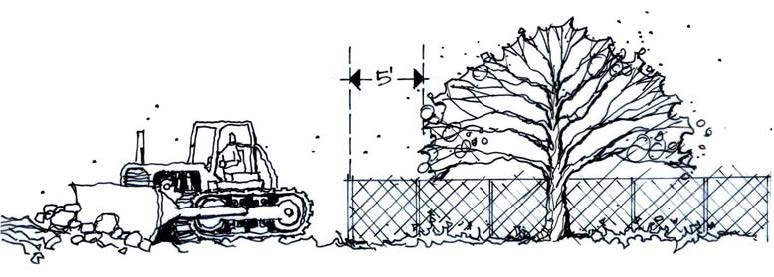
Protective barricades shall be placed around all trees designated to be saved, prior to the start of development activities or grading. Protective barricades shall remain in place until development activities are completed. The following conditions are required:
a.
Barricades may consist of two by four-inch posts with one by four-inch rails, orange safety fence, or a similar treatment and shall remain in place until development activities are complete.
b.
The barricaded area shall remain free of all building materials, stockpiled soil or other construction debris.
c.
Construction traffic, storage of vehicles and materials, and grading shall not take place within the protective areas of the existing trees.
d.
Barricades shall be erected at a recommended minimum distance from the base of protected trees according to the following standards:
i.
For trees ten inches or less in caliper: Place at a minimum distance of six feet from the base of each protected tree, or outside the dripline, whichever is greater.
ii.
For trees greater than ten inches in caliper: Place at a minimum distance equal to 1.5 feet for each one inch in caliper, or outside the dripline, whichever is greater.
2.
Construction access to a site should occur where an existing or proposed entrance/exit is located.
3.
Land disturbance within a tree dripline is prohibited except for driveway access points, sidewalks, curb and gutter.
4.
Where grading within a tree dripline cannot be avoided, cut and fill shall be limited to one-fourth to one-half of the area within the dripline, and tree roots must be pruned with clean cuts at the edge of the disturbed area. (No fill shall be placed within the dripline of a tree without venting to allow air and water to reach the roots.)
5.
Storage of construction materials and any other construction activities that contribute to soil compaction should be limited to areas of the site within the limits of construction.
D.
Irrigation: The use of irrigation is permitted in all required landscaping areas as required by this Chapter. The use of moisture metering devices and automatic timers is required. The use of water conserving practices and drip irrigation is also encouraged, unless otherwise required.
1.
If automatic irrigation systems are permitted, moisture sensor regulators, soil moisture regulators, or drip irrigation shall be used.
2.
Irrigation systems may connect to the main water connection for the building unless otherwise restricted and/or through other Town ordinances or policies.
E.
Maintenance:
1.
Maintenance: All vegetation and other screening devices shall be maintained so as to continue their effectiveness. The owner shall replace any required plantings, which die or otherwise fail to satisfy the requirements of this Chapter, within 180 calendar days with an equal or similar species and size. When plant material is severely damaged due to unusual weather conditions or other acts of God, the owner shall have up to two years to replant with submittal of a guarantee.
2.
Inspection of Site: The Administrator may inspect the site once a year after the issuance of a permanent certificate of occupancy in order to ensure compliance with the approved site plan and to ensure that the landscape is properly maintained. The Administrator may issue a Notice of Violation to comply with the provisions of this ordinance if warranted upon an inspection under the provisions of Chapter 18 of this Ordinance.
F.
Replacement of Disturbed and Damaged Vegetation:
1.
The disturbance of any landscaped area or vegetation required by this Code shall constitute a violation of the site or sketch plan. All disturbed landscaped areas and vegetation shall be replanted to meet the standards of this section as well as the approved site or sketch plan.
2.
Where the vegetation that has been disturbed or damaged existed on the site at the time the development was approved, all replacement vegetation shall meet the standards set forth in this section taking into account any unique site conditions and significant vegetation remaining within the landscaped area. Required trees, vegetation, or other landscaping that die shall be removed and replaced with new vegetation of equal or greater size.
3.
Existing vegetation required to be preserved that has been damaged or destroyed during the course of development activity shall be subject to civil penalty and replaced in accordance with the requirements of this section.
4.
A revegetation plan shall be submitted that takes into consideration the development condition of the site, significant vegetation remaining within landscaped areas, and the replacement plant materials. The Town of Wendell may require equal amounts of new vegetation to be installed equal to the size of the vegetation removed.
5.
Replacement consists of one or a combination of any of the following measures:
a.
Replant according to the requirements of this Chapter. A replanting plan denoting the proposed installation shall be submitted to the Administrator for approval.
b.
Replace damaged or destroyed significant vegetation in both perimeter and or interior landscaped areas with an equal amount of new vegetation according to the size of vegetation removed.
i.
Any tree with a DBH of at least four inches that is damaged or removed shall be replaced with one or more trees of an equivalent classification (see 8.12.A) and variety with a cumulative caliper equal to or greater than the original tree.
ii.
Trees less than four inches DBH that are damaged or destroyed shall be replaced with a tree of an equivalent classification and variety and meeting the planting standards of this section.
iii.
Understory plantings may also be required to restore the buffer performance criteria for the disturbed area.
6.
A revegetation plan denoting the proposed installation shall be submitted to the Administrator for approval. The Administrator may elect to present the revegetation plan to the Tree Board for final approval. This requirement may be modified by the Administrator based upon site conditions.
7.
For all other cases where existing vegetation is damaged or removed, the type and amount of replacement vegetation required shall be of the type and amount that is necessary to provide the type of landscaping required under this Chapter.
8.
Replanting should be located within the vicinity of the violation. If the area is too small for sufficient growth, a more suitable location on the site may be selected as permitted by the Administrator.
(Ord. No. O-14-2023, § 2, 6-12-2023)

