
Wendell City Zoning Code
CHAPTER 12
SIGNS
12.1 - General Purpose and Intent
It is the purpose of this Chapter to permit signs of a commercial nature in districts which have appropriate uses and to regulate the size and placement of signs intended to be seen from a public right-of-way in the interest of public safety and general welfare. This Chapter shall serve the following purposes:
•
To preserve Wendell as a community that is attractive to business;
•
To encourage the effective use of signs as a means of communication in the Town;
•
To enhance and maintain the pleasing look of the Town, which attracts to the Town major events and regional and statewide interest;
•
To improve pedestrian and traffic safety;
•
To minimize the possible adverse effects of signs on nearby public and private property; and
•
To implement relevant provisions of the Town's Comprehensive Plan.
Additionally, this Chapter intends to fulfill Principle 5 of the Town Plan of Wendell's Statement of General Principles: "Promote Wendell's attractiveness to business and people of all walks of life."
12.2 - Applicability
A.
All signs within the jurisdictional area shall be covered by these regulations and shall be erected, constructed, or maintained in accordance with the provisions of this Chapter.
B.
Except as otherwise provided, no sign shall be erected, altered, constructed, moved, converted or enlarged except in accordance with the provisions of this chapter and pursuant to issuance of a Sign Permit. No Sign Permit shall be issued unless plans and supporting information have been submitted to clearly demonstrate that the sign will conform to all applicable requirements of this Chapter, or to clearly demonstrate that the sign is exempt from issuance of a Sign Permit.
C.
Notwithstanding the above, changing or replacing the permanent copy of an existing lawful sign shall not require a permit, provided the copy does not change the nature of the sign so as to render it in violation of this ordinance.
D.
Per G.S. 160D-908, Fence wraps displaying signage when affixed to perimeter fencing at a construction site are exempt from zoning regulation pertaining to signage under this Article until the certificate of occupancy is issued for the final portion of any construction at that site or 24 months from the time the fence wrap was installed, whichever is shorter. No fence wrap affixed pursuant to this subsection may display any advertising other than advertising sponsored by a person directly involved in the construction project and for which monetary compensation for the advertisement is not paid or required.
1.
If construction is not completed at the end of 24 months from the time the fence wrap was installed, the Town shall regulate the signage in the same manner as banners affixed to a building.
(Ord. No. O-08-2017, § 1, 3-13-2017; Ord. No. O-07-2021, § 2, 2-22-2021)
12.3 - General Provisions
A.
The scale of the sign(s) should be appropriate for the building on which they are placed. Signs should reflect the proportional and dimensional relationships of the structure.
B.
Signs should not obscure building elements such as windows, cornices, or decorative details and should be integrated with the design of the building.
C.
Any structurally unsafe sign that endangers the public safety shall be immediately removed.
D.
In no way shall a sign hinder or obstruct visibility of the right-of-way, either at intersections or points of ingress or egress from parking lots, or be located in a sight triangle.
E.
Signage on buildings should be pedestrian-oriented in pedestrian-oriented areas (e.g. Downtown Wendell and other mixed-use areas) as well as near entrances.
F.
Overhead signs shall be placed so as not to be easily reached by pedestrian traffic. The bottom of the sign shall be located a minimum of eight feet above grade immediately under the sign, if the sign is within 15 feet of the edge of the street right-of-way.
G.
Illumination devices for signs such as, but not limited to, flood or spot lights shall be so placed and so shielded as to prevent the rays of illumination from being cast on neighboring buildings or vehicles approaching from either direction.
H.
No non-governmental sign shall be attached to or painted on power poles, traffic signs or other objects not intended to support a sign.
I.
No signs shall be permanently erected within the public right-of-way, except that signs for buildings permitted to have zero-foot setbacks may over hang the right-of-way with approval from NCDOT on State-maintained roads. Temporary signs, such as sandwich board signs, may be allowed in the right-of-way consistent with the regulations in this Chapter and/or approval by the Administrator.
12.4 - Computation of Signage Area
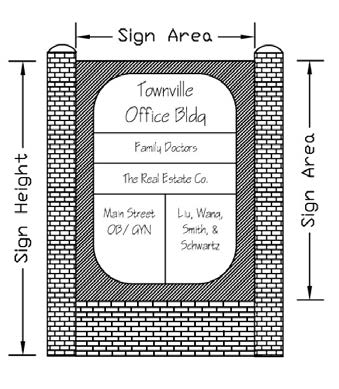
The area of a sign face (which is also the sign area of a wall sign or other sign with only one face) shall be computed by means of the smallest rectangle that will encompass the extreme limits of the writing, representation, emblem or other display, together with any material or color forming an integral part of the background of the display or used to differentiate the sign from the backdrop or structure against which it is placed, but not including any supporting framework, base, bracing or decorative fence or wall when such fence or wall otherwise meets the regulations of this chapter and is clearly incidental to the display itself.
For a single wall on a single-occupant building, all pieces of information or other graphic representations on that wall shall be measured as though part of one sign, encompassed within one rectangle, which may not exceed the permitted total wall area to which the sign is affixed. For a single wall on a multi-occupant building, the area of signs shall be computed using these principles and each individual sign shall not exceed the permitted total wall area to which the sign(s) is affixed.
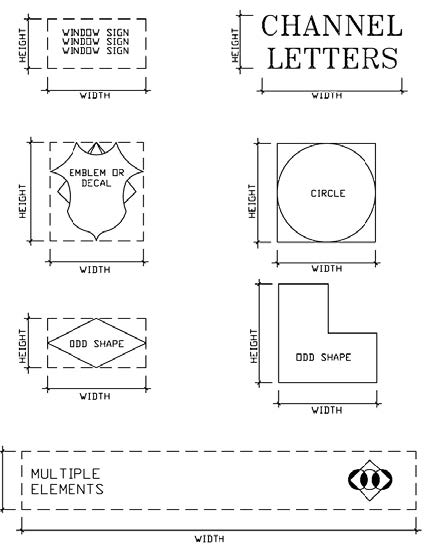
Where the sign faces of a double-faced sign are parallel or the interior angle formed by the faces is 60 degrees or less, only one display face shall be measured in computing sign area. If the two faces of a double-faced sign area of unequal area, the area of the sign shall be the area of the larger face. In all other cases, the areas of all faces of a multi-faced sign shall be added together to compute the area of the sign.
12.5 - Computation of Sign Height
The maximum height shall be as measured from street grade or the sidewalk (where one exists), whichever is less.
12.6 - Signage Types & Requirements
A.
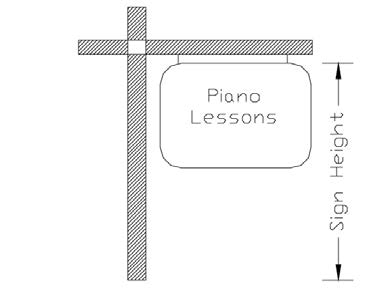
Suspended Single Post Signs
1.
All suspended Single Post Signs shall be located behind the street right-of-way and no portion shall overhang the street right-of-way.
2.
Suspended Single Post Signs shall not be internally illuminated
3.
Suspended Single Post Signs and their supporting posts shall be of a color and material which are similar or complimentary to those of the structure housing the subject establishment.
4.
Suspended single post signs may not exceed five feet in height, as measured from the top of the sign face.
5.
For non-residential lots between 50 and 99 feet wide, the sign face shall not exceed six square feet. For lots 100 feet wide or greater, suspended single post signs substituted for a monument sign may have 12 sq. feet of signage per sign face.
B.
Wall Signs
1.
The maximum permitted aggregate area of Wall Signs includes the area of any windows or doorways.
2.
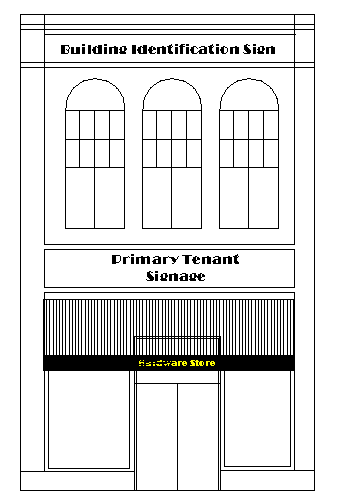
The preferred location for Wall Signs is between the first floor window and window sill of second floor, or on a sign frieze area of the building if original to the building. (Exception: Building identification which is an integral part of the building's design and architectural character shall not be considered a sign for the purposes of this Standard.)
3.
Signs on Windows and Doors: Signage posted on windows and doors shall not exceed 25 percent of the window/door.
4.
Except awning signs, no Wall Sign shall project more than 12 inches from the building wall. Further, no Wall Sign or its supporting structure shall cover any window or part of a window, nor shall it extend beyond the highest point of a roofline, parapet, or eave line.
5.
More than one wall sign may be erected provided the total surface area regulation is not exceeded
6.
Principal building walls and service station canopies may have signage on all faces which front on a public street.
7.
Signs on awnings shall be considered Wall Signs. Maximum Awning Sign Area: 50 percent of Awning area.
C.
Canopy Signs
1.
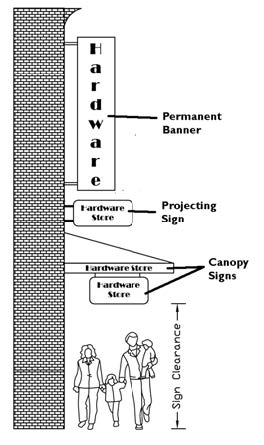
If suspended from a canopy, the principal use sign must be at least eight feet above the sidewalk level.
i.
Maximum Dimensions:
Height: 16 inches
Width: 40 inches
ii.
Sign Clearance: eight feet
D.
Projecting Signs
1.
Minimum Width of Facade: 20 feet (except in the DMX District)
2.
Maximum Height: eight feet (Sign may not extend above the soffit, parapet, or eave line, as appropriate, of the building to which it is attached.)
3.
Maximum Area: 16 square feet per side
4.
Maximum Projection from Wall: five feet
E.
Monument Signs
1.
Only buildings set back more than 25 feet from the right-of-way and having 100 feet or more of street frontage may use a Monument Sign.
2.
All Monument Signs shall be located a minimum of five feet behind the street right-of-way.
3.
No Monument Sign shall be located within 10 feet of a side property line or 20 feet from any right-of-way intersection.
4.
A Suspended Shingle Post Sign may be substituted for a Monument Sign but shall meet all height and area requirements as provided.
5.
Monument signs shall include a support or base (min. two ft. in height) constructed of rock, brick, or other masonry material.
6.
Development with over 200,000 square feet of retail commercial space and adjacent to a limited-access highway are allowed to exceed specified maximum height and area computations as recommended by the Administrator and subject to approval of the Board of Commissioners.
7.
Monument signs shall be broken into two categories: Low Monument sign and Tall Monument sign. Tall monument signs may only be used for single or multi-tenant developments where the total square footage equals or exceeds 50,000 square feet of retail commercial space and is adjacent to a limited-access highway.
8.
The maximum height of sign copy for all monument signs shall be one foot less than the maximum sign height. The purpose of this provision is to allow decorative borders or sign toppers to extend an additional foot beyond the height of the sign face.
9.
All monument signs shall be fully encased or skirted at a minimum width that is one-half of the width of the sign face so as to present an appearance of pillars or other substantial supports.
F.
Decorative Flags:
1.
Maximum Number: One flag for every ten feet of linear building frontage.
12.7 - Permitted Principal Use Signs
A.
General Provisions
1.
Each principal use sign shall require a sign permit and may require a building permit.
2.
Principal use signs may be illuminated consistent with the provisions of this Chapter. (See Section 12.10, Illumination.)
B.
Permitted Signs in Primarily Residential Districts (OSC, RA, RR, R2, R3, R4, R7, NC, MH)
C.
Mixed-Use, Primarily Commercial, and Industrial Districts (NC, CMX, CC, DMX, CH, M&I) and Permitted Civic/Institutional Uses in any district.
*On corner lots, the secondary facade may receive an additional one sq. ft. of signage per linear foot of secondary building frontage/tenant space (100 sq. ft. maximum for the building/tenant space still applies).
D.
Temporary Signs Requiring a Permit: A temporary sign permit, obtained from the Administrator, shall be required for the following sign types. No more than four total sign permits combined (excluding "Ground Signs—Small") may be issued to any party within the same calendar year. Signs enumerated below shall be located either behind a sidewalk or ditch line, or where neither is present, signs must be located at least five feet from the edge of pavement. Ground mounted signs (excluding lighter-than-air and mobile signs) shall be limited to seven feet in height. The applicant must obtain permission from the property owner to post the sign. All temporary signs shall be properly maintained and kept in an upright position or may be subject to removal by the Town.
1.
Lighter-Than-Air Signs: A lighter than air sign may be permitted on the premises of any given business up to two times per year for no longer than three consecutive calendar days per use. The sign shall be situated so that the height of the sign is directly proportional to the distances to the property lines, not to exceed 100 feet in height.
2.
Seasonal Farm Product Signs: Off-premise signs advertising the seasonal sale of farm products may be permitted for a maximum period of 60 calendar days. Signs are not to exceed three square feet in size and are to be located on private property. No more than six signs will be allowed at any one time.
3.
Reserved.
4.
Banners and Pennants: Banners and pennants may be displayed on a commercial building under the following conditions:
a.
Only one banner may be displayed by each business at any time and shall be no greater than 32 square feet in area. Banners may be erected for 30 days at a time no more than four times per calendar year.
b.
No banner and/or pennant may be displayed unless the commercial message contained in the banner relates to a specific, special promotion of limited duration.
c.
No banner and/or pennant may be displayed or used as a general or ongoing advertisement of the business or its customary activities.
d.
No banner and/or pennant may be displayed or used as a replacement for permanent signage.
e.
The administrator may exempt the applicant from the requirements listed in b—d of this section if they have obtained an approved commercial building permit for a permanent sign.
f.
The Administrator shall have the authority to order the removal of any banner and/or pennant that:
i.
Is, or appears to be, out of date.
ii.
Is, or appears to be deteriorated, or in a state of disrepair, wear, or neglect.
iii.
Is, or appears to be, abandoned.
5.
Ground Signs—Small: Ground mounted signs not exceeding three square feet in size and erected by a non-profit operating within the Town's jurisdiction, or a business located within the Town's jurisdiction must adhere to the following conditions:
a.
Such signs shall not exceed 12 per business or non-profit.
b.
No more than two signs shall be permitted on any single property.
c.
Signs adhering to these standards shall have no limit on the duration of the permit.
d.
Such signs shall be properly maintained and kept in an upright position or may be subject to removal by the Town.
6.
All Other Temporary Signs: All other temporary signs not enumerated in section 12.7D shall be limited by the additional standards herein. Such signs shall not exceed six per event and the combined square footage of the signs shall not exceed 32 square feet. If more than one ground-mounted sign is placed on the same property, the sign area allowed per sign shall be reduced to three square feet each. The sign permit shall be valid for 14 calendar days.
E.
Billboard signs are free-standing signs exceeding 12 feet in height, but not taller than 50 feet in height above road grade. Billboard signs are permitted with the following standards:
1.
Billboards are only permitted on private property within land zoned CC (Community Center), CH (Highway Commercial) or M&I (Manufacturing & Industrial) along and facing Interstate 87 (I-87) and US 64 Business (Wendell Boulevard) west of Selma Road.
2.
Electronic Billboard signs shall be placed a minimum of 7,920 linear feet (1.5 miles) apart, measured between the centers of Billboard sign poles facing the same street, on both sides of the road, regardless of whether such sign is within the Town's planning jurisdiction.
3.
Where the structural support is visible from any street, the display shall be constructed on a single steel pole.
4.
The immediate premises shall be kept free from debris or undergrowth. Where the base of the pole is visible from any public street (as determined by the administrator), landscaping shall be installed and maintained as follows:
a.
A minimum of 18 shrubs planted in a landscape area no less than 100 square feet and maintained to the standards of Section 8.12 of the UDO. An approved Landscape Plan required.
5.
All displays shall be maintained in a state of good repair. The backs and supporting structures of all billboard signs shall be kept painted in a neutral color to blend with the natural environment.
6.
While minor repairs, maintenance, and the posting of new messages on billboard signs made nonconforming by this UDO are permitted, no changes in size shall be permitted except to make the sign comply with the requirements.
7.
Billboard signs may be placed back-to-back or in a v-type construction. Not more than one face is allowed on each side of the display.
8.
All Billboard signs must be Digital Billboards or Smartboards. Digital Billboards or Smartboards are defined as a type of Billboard sign utilizing digital technology, capable of changing the static message or copy on the sign electronically. A digital billboard may be internally or externally illuminated. Digital Billboards shall contain static messages only and shall not have animation, movement, or the appearance or optical illusion of movement, of any part of the sign structure. Each static message shall not include flashing, scintillating lighting or the varying of light intensity.
9.
The digital message of a Digital Billboard shall not change more than once every eight seconds.
10.
The required setbacks must comply with the UDO and are measured from the street's future cross-section.
11.
Size, height, and setback requirements are as follows:
(Ord. No. O-19-2017, § 4, 6-12-2017; Ord. No. O-34-2017, § 2, 11-13-2017; Ord. No. O-22-2019, § 1, 11-12-2019; Ord. No. O-24-2021, § 1, 6-28-2021)
Editor's note— Ord. No. O-08-2017, § 4, adopted Mar. 13, 2017, provides: "That enforcement of temporary signs regulated by Section 12.7D (Temporary signs requiring a permit) be suspended for a period of 1 year from the date of this ordinance, with the following exceptions:
1 Signs must be located either behind the sidewalk, behind the ditch, or at least five feet behind the edge of pavement when no sidewalk or ditch is present.
2. Signs must be upright and properly maintained.
3. No non-governmental sign shall be attached to or painted on power poles, traffic signs or other objects not intended to support a sign."
12.8 - Signs Not Requiring a Permit
The following types of signs may be allowed in any district without a permit, subject to the specific provisions below. Signs enumerated below shall be located either behind a sidewalk or ditch line, or where neither is present, signs must be located at least five feet from the edge of pavement.
A.
Any sign that is required by law.
B.
Business and/or House Number Signs. Signs bearing only property numbers, post office box numbers, names of occupants, or other identification not having commercial connotations.
C.
Directional and Information Signs. Signs erected and maintained by public agencies and governmental bodies.
D.
Bulletin Boards. Churches, schools, community centers, and similar public and institutional uses may erect one sign or bulletin board not to exceed 12 square feet in area for the purpose of displaying the name of the institution and related information. Such signs shall be used as wall signs or shall be located a minimum of 12 feet from the street line and side lot lines. Where side yards are required, no such sign shall be erected in the side yards. Such signs may be indirectly illuminated.
E.
Construction Signs. During the construction, repair, or alteration of a structure, temporary signs which denote builder, or other participants in the project, or which denote the name of the structure and its occupants-to-be may be placed within the required yard setbacks as ground, wall, or roof signs. The total area of such signs shall not exceed 32 square feet.
F.
Development Advertising Signs. Subdivision signs advertising the sale of lots, buildings within new subdivisions, or nonresidential development are permitted on site provided:
1.
They do not exceed 32 square feet;
2.
They are non illuminated or indirectly illuminated;
3.
Not more than one such sign may be erected at each major entrance to the development;
4.
They meet all requirements applicable to principal structures with respect to yard, setback, and height requirements;
5.
Display of such signs shall be reviewed every two years. Once development is complete signs of a temporary nature must be removed or replaced with a sign of a permanent nature. Signs of a permanent nature shall be constructed in accordance with sections 12.1—12.7 of this chapter.
G.
Governmental Flags, Banners, Signs, and Insignias. Flags of the United States, the State, the Town, foreign nations having diplomatic relations with the United States, and any other flag adopted or sanctioned by an elected legislative body of competent jurisdiction, provided that such a flag shall not exceed 60 square feet in area and shall be flown from a safe and properly-installed pole, the top of which is more than 45 feet in height. All flags must be flown in accordance with protocol established by the Congress of the United States for the Stars and Stripes.
H.
Temporary Political Signs.
1.
Signs may be erected 30 days before the beginning date of "one-stop" early voting.
2.
Signs shall be removed within ten calendar days following election.
3.
At the voting place, any number of political signs not to exceed six square feet each in size may be erected. Such signs shall not be placed 24 hours preceding the opening of the polls and shall be removed within 24 hours following the closing of the polls. The candidate shall be responsible for collecting the signs within 24 hours following the closing of the polls.
4.
No sign located within the right-of-way shall be higher than 42 inches above the edge of the pavement of the road.
5.
No sign shall be larger than six square feet if it is within the right-of-way. These signs must be at least three feet from the edge of pavement.
6.
Signs outside of the right-of-way and at least 15 feet off the roadway do not have size limitations subject to the other rules regarding sight obstructions within this chapter. Large signs may be subject to the North Carolina Building Code and may require a building permit.
7.
No sign shall obscure or replace another sign.
8.
Signs are not allowed in the medians of any roadways within the town limits or its planning jurisdiction.
9.
The candidate must obtain the permission of any property owner of a residence, business or religious institution fronting the right-of-way where a sign would be erected.
I.
Holiday Decorations. As part of customary holiday decorations and annual civic events, signs and decorations may be displayed so long as they are not placed in any public right-of-way and shall be displayed for a period of not more than 60 consecutive calendar days, or more than 30 calendar days following the holiday or event.
J.
Real Estate Signs (On-Premise).
1.
Signs advertising the sale, rental or lease of the premises on which the sign is located, provided such signs do not exceed one sign per street frontage, and do not exceed three square feet in area per display surface for a residential premises.
2.
For properties in excess of one acre, signs may not exceed 32 square feet of aggregate signage per street frontage. Signs are to be located a minimum of ten feet off the right-of-way. The sign must be removed within 90 calendar days of the sale of the property.
3.
Real estate signs are not to be located on any right-of-way.
4.
Signs in residential districts may not be illuminated.
K.
Realtor and Non-Realtor Open House Signs, and Yard Sale Signs (Off-Premise).
1.
Authorized Time Period for Display: Yard sale signs, realtor and non-realtor open house signs shall only be displayed on or after 4:00 p.m. on the Friday before the yard sale, open house, or special event, whichever is applicable, and shall be removed no later than 7:00 p.m. on the Sunday of the weekend of the yard sale, or open house, whichever is applicable.
2.
Size of Signs: Yard sale signs, realtor and non-realtor open house signs shall not exceed nine square feet in size, not including the device attaching the sign to the ground.
3.
Placement of Sign: Yard sale signs, realtor and non-realtor open house signs shall not be placed on utility poles, stop signs, street signs, public rights-of-way, nailed to trees, or placed on private property without permission of the property owner, etc.
4.
This policy does not authorize non-compliance with other provisions of this Chapter or with Section 4.6.B.7, Yard Sales, except as set forth in this policy.
L.
Signs Inside a Building: Any sign inside a building, not attached to a window or door that is not legible from a distance of more than three feet beyond the lot line of the parcel on which such sign is located.
M.
Ballpark Signage: Signage within ballfields and sports stadiums that is directed within the facility including, but not limited to, banners, fixed placards and scoreboards does not require a permit.
N.
Memorial Signs and Date Blocks: Memorial signs or tablets, and names and construction dates of buildings when cut into any masonry surface, or inscribed on or otherwise affixed to a permanent metal plaque.
O.
Sandwich Board Signs: Sandwich board signs may be placed on or directly behind sidewalks in the NC, CC, CMX, or DMX districts provided they maintain clear pedestrian access a minimum of four feet in width and are removed each night after the business is closed. Neither face shall exceed three feet in width or 12 square feet in area. The sandwich board must be located in front of the business it pertains to. The chalk board frame shall be a non-reflective material or color.
P.
Traffic Control Signs on Private Property: Signs directing and guiding traffic and parking on private property on which the signs are located, provided such signs are not internally or indirectly illuminated and do not exceed four square feet in sign area for each sign face. Exemptions to this area requirement are permitted only for signage erected in accordance with the Federal Highway Administration's Manual for Uniform Traffic Control Devices (MUTCD).
Q.
Murals or Wall Art: A mural as defined in Chapter 19 of this ordinance is subject to the following regulations:
1.
Murals are generally discouraged from being placed on the primary façade of a building. However, the Town Board reserves the right to approve a primary façade mural if it does not exceed 50 square feet in size.
2.
Murals are not intended to be placed on residential structures or their accessory structures.
3.
The mural shall not extend more than six inches from the plane of the wall upon which it is tiled or painted or to which it is affixed.
4.
If the name of any business within the town's jurisdiction is included, it will be counted as a sign and must meet the regulations for signage.
5.
The proposed mural must be recommended by the Appearance Commission and the final decision made by the Board of Commissioners prior to any paint being added to the building to review for appropriateness. A certificate of appropriateness will be issued by the administrator if approved by the Board of Commissioners.
(Ord. No. O-08-2017, §§ 2, 3, 3-13-2017; Ord. No. O-4-2017, § 1, 1-9-2017; Ord. No. O-3-2020, 2-10-2020)
12.9 - Prohibited Signs
All signs not expressly permitted under this ordinance or exempt from regulation hereunder in accordance with this Chapter are prohibited. Such signs include but are not limited to:
A.
Signs that Impact Traffic Safety. No sign shall be erected or continued that:
1.
Obstructs the sight distance along a public right-of-way or at intersections;
2.
Would tend by its location, color or nature to be confused with or obstruct the view of traffic signs or signals or would tend to be confused with a flashing light of an emergency vehicle; or
3.
Uses admonitions such as "stop," "go," "slow," "danger" and the like which might be confused with traffic directional signals.
B.
Flashing Signs. No flashing or intermittent illumination shall be permitted on any advertising sign or structure.
1.
Electronic message board signs shall not be considered flashing or intermittent provided the graphic message does not change faster than every eight seconds.
C.
Animated, Rotating or Moving Signs. No animated, rotating, or moving signs shall be permitted.
1.
Electronic message board signs shall not be considered an animated sign simply due to the changing nature of its graphic message.
D.
Permanent off premise signs.
E.
Pennants and strings of lights strung between poles, pillars or buildings unless they are from a recognized non-profit or charitable organization.
F.
Signs on vehicles that are parked or placed in a stationary position.
G.
Roof signs.
H.
Pole signs.
I.
Temporary electronic message board signs.
1.
This provision shall not include directional or information signs erected and maintained by public agencies or governmental bodies, which are permitted by Section 12.8.
(Ord. No. O-19-2017, §§ 1, 2, 6-12-2017; Ord. No. O-34-2017, § 1, 11-13-2017; Ord. No. O-24-2021, § 1, 6-28-2021)
12.10 - Sign Illumination
A.
All lighted signs shall have their lighting directed in such a manner as to illuminate only the face of the sign. If separate fixtures are used to illuminate a sign, lighting fixtures used to illuminate an outdoor advertising sign either shall be by directed ground lighting or mounted on the top of the sign, and shall comply with shielding requirements.
B.
Wall Signs: Wall signs may be illuminated provided such signs shall be lighted from behind to silhouette letters and figures, or those utilizing floodlighting or other non-internally illuminated light sources shall be contained within a concealed fixture and angled so as to prevent a direct view of the light source from a public street or adjacent property.
C.
Time of Operation: No sign within 100 linear feet of a pre-existing residential structure may be illuminated between the hours of midnight and 6:00 a.m. A residence shall be deemed "pre-existing" for purposes of this Chapter if it has a valid building permit in effect for construction of said structure or if construction of said structure was complete on or prior to the effective date of this provision.
D.
All lighting shall be in conformance with Chapter 11, Lighting.
12.11 - Maintenance and Upkeep of Signs
A.
All signs shall be maintained in proper working order.
B.
Lights and /or bulbs of illumination signs shall be replaced as needed. Burnt out, defective or missing bulbs shall be replaced within ten working days following notification of the violation.
C.
Signs that are broken, vandalized, torn, rotten, faded or otherwise become unsightly or fall into a state of disrepair shall be improved, removed, or replaced within 60 calendar days following notification of the violation.
D.
Whenever a sign becomes structurally unsafe or endangers the safety of a building or the public safety the Administrator shall order the sign be made safe or removed. A period of ten calendar days following receipt of the order by the person, firm, or corporation owning or using the sign shall be allowed for compliance.
E.
Abandoned signs. Signs meeting the definition of obsolete shall be classified as abandoned. When the establishment to which a sign is related ceases or the building is vacated for more than 180 days, the sign shall be classified as obsolete. Signs classified as abandoned must be removed within 60 calendar days of notification by the Town. Owners of property on which an abandoned sign is located shall be subject to authorized enforcement procedures should an abandoned sign fail to be removed within the allotted time.
12.12 - Non-Conforming Signs
(See Chapter 13, Nonconformities)
12.13 - Penalties for Violations
(See Chapter 18, Violations and Penalties)
12.14 - Alternative Standards for Master Planned Developments
A.
The following additional standards and exceptions to the general provisions of Chapter 12 shall apply to signage within Master Planned developments in excess of 500 acres. In the event of a conflict between the provisions of this section and the standards otherwise contained in Chapter 12, the provisions of this section shall apply.
1.
No sign types permitted under this section may incorporate flashing or animated sign elements.
2.
Notwithstanding Section 12.6E5 of the UDO, neighborhood entrance signs are considered a type of monument sign and shall include a support or base (min two ft. in height) with a minimum of 60 percent of said base constructed of rock, brick, or other masonry material.
a.
Neighborhood entrance signs may be substituted with a pedestal entry sign. Pedestal entry signs shall be limited to five feet tall by five feet wide, with a maximum depth of three feet. Pedestal entry signs shall not require a rock, brick, or other masonry material base, but shall require rock, brick, or masonry accents.
3.
The developer shall be allowed one 'Gateway Entry sign' per 250 acres included in the development, to be located along primary entrances of the development. Gateway Entry signs shall meet the following requirements:
a.
Unless otherwise approved by NCDOT along a state maintained road, all gateway entry signs shall be located a minimum of five feet behind the street right-of-way.
b.
No gateway entry sign shall be located within ten feet of a side property line or 20 feet from any right-of-way intersection.
c.
Gateway entry signs shall include a support or base (min. two ft. in height) constructed of rock, brick, or other masonry material.
d.
Gateway entry signs shall not exceed 20 feet in height if located adjacent to roadways of four or more lanes in width, or 15 feet in height if located adjacent to roadways of less than four lanes in width.
e.
Sign text may not exceed ten feet in height.
f.
Sign copy may not exceed 175 sq. feet.
g.
Commercial advertising for businesses other than the developer(s) is not permitted.
4.
Auto-oriented wayfinding signs shall be permitted, but must adhere to the following standards:
a.
These signs shall be placed along primary and secondary routes around the development, for the purpose of guiding visitors to specific areas of the development.
b.
Specific business names may not be included on the sign.
c.
Sign Height may not exceed 13 feet.
d.
Sign width may not exceed five feet.
e.
Signs located along the same side of the road must be distanced a minimum of 500 feet apart.
f.
Vinyl is not permitted as a building material.
5.
Pedestrian-oriented wayfinding signs shall be permitted, but must adhere to the following standards:
a.
These signs are geared toward the pedestrian and meant to help guide him/her to specific destinations. These signs will be installed along sidewalks, trails, and at crosswalks.
b.
Pedestrian oriented signs should be installed so they are easily read by a pedestrian, and in a way that does not encroach on movement or create a hazard to pedestrians or automobiles.
c.
Specific business names may not be included on the sign.
d.
Sign height may not exceed 11 feet.
e.
Sign width may not exceed three feet six inches.
f.
Vinyl is not permitted as a building material.
6.
Pedestrian-oriented Kiosks shall be permitted, but must adhere to the following standards:
a.
Pedestrian-oriented Kiosks should be installed in places where pedestrians are likely to congregate, but they should not impede movement along a sidewalk or the movement of automobiles into and out of parking spaces.
b.
Pedestrian-oriented Kiosks may include maps, directional information, and promotional information for the development or community events occurring within the Town, but may not contain commercial advertisement.
c.
Kiosk height may not exceed eight feet.
d.
Kiosk width may not exceed six feet.

