
Wendell City Zoning Code
CHAPTER 4
GENERAL LOT AND STRUCTURE PROVISIONS
4.1 - Applicability
The following provisions shall apply throughout the jurisdiction of this Ordinance, regardless of the underlying zoning district provisions.
4.2 - Basic Lot Standards
A.
All Lots to Front on Public Street or Public Space: All lots shall front upon a public street. With provision of alley access, lots may front upon a public open space, but access shall be of sufficient design to allow for the provision of emergency services.
B.
Number of Principal Buildings per Lot: In any zoning district, more than one building housing a permitted principal use may be erected on a single lot, provided that setback, minimum lot area, and other requirements of this Ordinance shall be met for each building as though it were on an individual lot.
C.
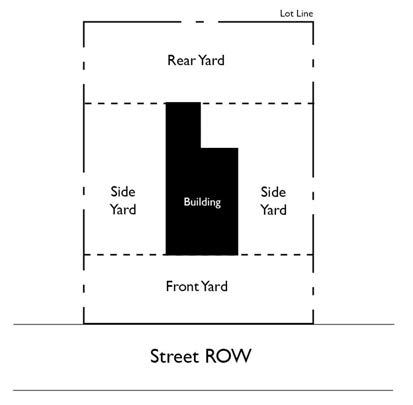
Location of Required Yards:
1.
Front Yard: A space extending the full width of the lot between the architectural front of a building (the front setback) and the front lot line or the fronting street right-of-way measured perpendicular to the building at the closest point to the front lot line. Typically this yard is required to remain open and unoccupied by structures, with the exception of certain encroachments such as porches, bay windows, porticos, arcades, stoops, sidewalks, handicapped accessibility facilities, street furniture, fences, walls, and landscaping.
2.
Side Yard: A space extending from the front yard to the rear yard between the principal building facade and the side lot line and measured perpendicular from the side lot line to the closest point of the principal building facade. Side yards extend from the sides of a building to a street right-of-way or property line.
3.
Rear Yard: A space extending across the full width of the lot between the architectural rear of the principal building and the rear lot line and measured perpendicular to the building to the closest point of the rear lot line. Rear yards extend from the back of a building to a property line.
4.
Corner lots: Any building on any corner lot shall comply with the minimum front setback for each street which the corner lot abuts.
5.
No yard for one principal building shall be considered as a yard for any other principal building.
D.
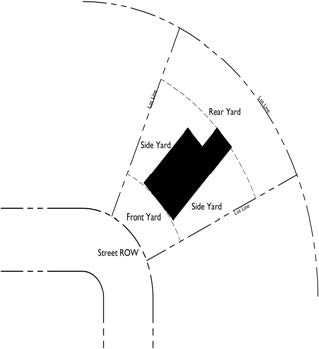
Irregular Lot Setbacks: The location of required front, side and rear yards (or setbacks) on irregularly shaped lots shall be determined by the Administrator. The determination will be based on the intent and purpose of this Ordinance to achieve an appropriate spacing and location of buildings and buildings on individual lots. Where questions arise as to appropriateness, the subdivider may be requested to provide additional design information.
E.
Side Lot Lines: Side lot lines shall be substantially at right angles or radial to street lines. (See illustration.)
F.
May Not Reduce/Create Lot(s) Below Minimum Requirements:
1.
Yards or lots created after the effective date of this Ordinance shall meet the minimum requirements established by this Ordinance. See Chapter 5.
2.
No lot shall be reduced or changed in size so that the total area, minimum frontage, front, side, or rear setbacks, or other dimensions, areas, or open spaces required by this Ordinance are not maintained.
3.
No lot shall be reduced in size so as to produce an additional lot that is not in conformity with these regulations unless the lot is combined with other land to produce a conforming lot or unless the lot is needed and accepted for public use.
4.
These prohibitions shall not be construed to prevent the purchase or condemnation of narrow strips of land or parcels for public utilities, substations, street rights-of-way, or similar purposes.
G.
Dimensional Standards for Infill Lots: For infill lots in already built upon areas of the Town, the minimum lot width and front setback shall be equal to the average dimensions on the same side of the street within 300 feet or one block length (whichever is greater), except with approval of the TRC.
H.
Substandard Lots of Record: Any lot of record existing as of February 4, 1965, which has an area or a width which is less than required by this chapter, shall be subject to the following exceptions and modifications:
1.
Adjoining lots: When two or more undeveloped adjoining lots with continuous frontage are in one ownership at any time after the adoption of this chapter, and such lots individually are less than the minimum square footage or have less than the minimum width required in the district in which they are located, such group of lots shall be considered as a single lot or several lots of minimum permitted width and area for the district in which located.
2.
Lots not meeting the minimum lot size requirements: Except as set forth in subsection 1 above, in any district in which single family dwellings are permitted, any lot of record existing at the time of the adoption of this chapter which has an area or a width which is less than required by these regulations may be used as a building site for a single-family dwelling.
I.
Flag Lots: Flag (or "pipe stem") lots shall be prohibited in all zoning districts except the OSC and the RA districts, where they shall be allowed if the width of the stem is at least 60 feet.
J.
Double frontage lots: Double frontage lots should be avoided. However, on lots having frontage on two streets, but not located on a corner, the minimum front yard shall be provided on each street in accordance with the provisions of this ordinance. On lots having frontage on more than two streets, the minimum front yard shall be provided in accordance with the regulations set forth in this ordinance on at least two of the street frontages. The minimum front yard on the other frontage or frontages may be reduced along the other streets in accordance with the street side yard requirements of the district.
K.
Setbacks along Thoroughfares: Setbacks along existing thoroughfares shall be measured from the future right-of-way as determined by the locally adopted Thoroughfare Plan and/or Long Range Transportation Plan for roadway widening.
L.
Rights-of-Way Not Considered in Yard Requirements: Rights-of-way or easements for streets and roads shall not be considered a part of a lot or open space, or front, side, or rear yards for the purpose of meeting yard requirements.
4.3 - Containment Areas for Commercial Trash and Recyclables
All containment devices for commercial trash and recyclables, including compactors, dumpsters, commercial roll-out bins, and areas for storing cardboard shall be located and designed so as not to be visible from the view of adjacent streets and shall be placed in the side or rear yards only.
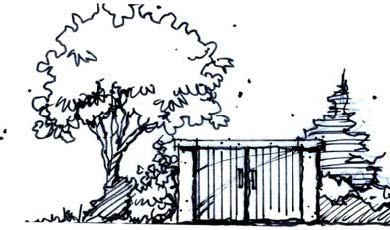
Image depicts appropriate screening of dumpsters.
All commercial containment areas for trash and recyclables shall meet the following standards:
A.
All containment areas shall be enclosed to contain windblown litter.
B.
The enclosure shall be at least as high as the highest point of the compactor or dumpster.
C.
The enclosure shall be made of a material that is opaque at the time of installation and compatible with and/or similar to the design and materials of the principal building.
D.
All compactors and dumpsters shall be placed on a concrete pad that is large enough to provide adequate support, allows for positive drainage, and conforms to the Wake County Health Department regulations governing compactor pads. A concrete apron the same width as the compactor pad shall also extend from the pad for support.
E.
The enclosure shall contain gates to allow for access and security.
F.
Dumpsters and compactors shall be located within the side or rear yard behind buildings and away from sidewalks or pedestrian circulation. Such locations should be accessible to service vehicles.
G.
Enclosures shall be landscaped in accordance with Section 8.10.D.
4.4 - Accessory Structures and Uses
A.
Principal Buildings Required: The construction of an accessory building is not permitted unless a principal building is located on the lot. Accessory and principal buildings may be constructed concurrently.
B.
General Building Requirements:
1.
Location: Residential accessory structures shall be located only in side or rear yards for non-corner (interior) lots. Residential accessory structures shall be in rear yards only for corner lots. All non-residential accessory structures must be located in the rear yard.
2.
Materials: Accessory structures not subject to regulation under the North Carolina Residential Code for one and two-family dwellings must be primarily clad in wood clapboard, cementitious fiber board, wood shingle, wood drop siding, primed board, wood board and batten, brick, stone, stucco, vinyl, metal (Horizontal lap siding only. Vertically oriented metal siding is not allowed), or synthetic materials similar and/or superior in appearance and durability.
3.
Accessory structures not subject to regulation under the North Carolina Residential Code for one and two-family dwellings shall be painted or finished in such a manner that appears to match or compliment the primary structure on the lot.
4.
Accessory structures shall be limited to two per lot, except in the RA District.
5.
For all zoning districts except Residential Agricultural (RA), the aggregate area of accessory use buildings shall not exceed 50 percent of the floor space of the principal use building. In the RA zoning district, the aggregate area of accessory use buildings shall not exceed 50 percent of the floor space of the principal use building for parcels less than one acre in size and shall not exceed 100 percent of the floor space of the principal use building for parcels of one acre or more in size.
6.
A building permit is required for all accessory structures greater than 12 feet in any direction or greater than 144 square feet including all appurtenances.
7.
Lots with non-residential uses that utilize an accessory structure must have a Type B buffer along the rear property line. See Chapter 8 for planting rates and information.
8.
A garage for more than three motor vehicles shall not be permitted as an accessory use in connection with any one family or two family dwelling, except in the RA District.
9.
See Chapter 5 for applicable setbacks based on type of principal building.
C.
Permitted Uses: The following non-commercial uses are permitted within enclosed residential accessory buildings:
1.
Parking
2.
Gazebo
3.
Pool House
4.
Equipment Enclosure
5.
Garage/Carport
6.
Fall-out Shelters
7.
Artist Studio Space
8.
Sauna
9.
Workshop
10.
Conservatory/Greenhouse
11.
Customary Home Occupation
12.
Personal Storage
D.
Doghouses and Kennels: Doghouses and fenced dog kennels may be placed in rear yards only. Doghouses and fenced dog kennels must be set back from rear and side property lines by at least five feet.
E.
Pools (for Single Family Homes):
1.
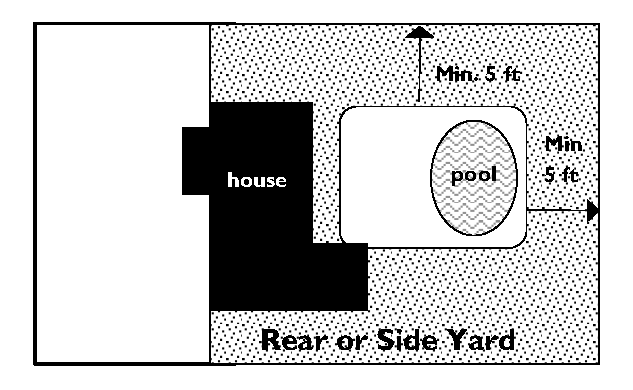
All pools for single family homes, whether above-ground or in-ground, may be built in the side or rear yards. The definition of a pool shall include all buildings, and walks or patio areas of cement, stone, or wood, at or above grade, built for, and used in conjunction with the pool.
2.
Pools, as defined above, shall be set back a minimum of five feet from all side and rear property lines.
3.
Pools utilizing a pump shall be enclosed by a fence (with self-latching gate) at a minimum height of four feet and a maximum of six feet. The distance between boards or slats shall be no greater than four inches.
4.5 - Fences and Walls
A.
Residential Fences:
1.
Front Yard: Fences or garden/decorative walls shall be no greater than four feet in height in the front yard. (Refer to Section 9.E.3 for height requirements of fences placed within sight triangles on corner lots.)
2.
Side/Rear Yard: Fences or garden/decorative walls shall be no greater than six feet in height in the side or rear yard.
3.
Materials: Garden/decorative walls may be of brick, stone, wrought iron, or stucco matching the principal building. Retaining walls shall be wood, brick, stone or stucco. Front yard fences shall be wood picket, wrought iron or materials similar in appearance and durability. Side and rear yard fences may be green or black chain link, wood, wrought iron, or similar material.
4.
Exceptions: Engineered retaining walls that may be needed due to topography are not subject to height limitations.
B.
Commercial, Mixed-Use, Civic and Institutional Fences.
1.
Front Yard: Fences and garden/decorative walls shall be no greater than three feet in height in the front yard.
2.
Side/Rear Yard: Fences or garden/decorative walls shall be no greater than eight feet in the side or rear yard. For recreation uses, including athletic fields, fences may be of a height sufficient to accommodate activities proposed for an outdoor space or field.
3.
Materials: Front yard fences shall be wrought iron or similar looking material only. Fence piers may be brick or stone. Side and rear yard fences shall be brick, stucco, wrought iron, stone, or wood maintained in a like-new manner. Decorative walls and retaining walls shall be brick, stone, stucco, or similar materials.
4.
Exceptions: Engineered retaining walls that may be needed due to topography are not subject to height limitations. Black or green vinyl coated chain link fences may be allowed in the side or rear yard for the following uses: Child/Adult Daycare Center; Recreation Facilities, Outdoor; Schools—Elementary and Secondary.
C.
Industrial Fences:
1.
Front Yard: Fences shall be no greater than six feet in height in the front yard.
2.
Side/Rear Yard: Fences or decorative walls shall be no greater than eight feet in height in the side or rear yard unless topography necessitates additional height. The Administrator may approve fences or walls no greater than nine feet. Requests for heights above nine feet are subject to approval from the Board of Commissioners.
3.
Materials: Barbed wire fences are permitted in rear yards not visible from a street and are not permitted adjacent to any lot in residential use or zoning. Retaining walls shall be brick, stone or stucco or similar materials.
4.
Exceptions: Engineered retaining walls that may be needed due to topography are not subject to height limitations.
(Ord. No. O-10-2017, § 1, 3-13-2017; Ord. No. O-19-2022, § 1, 7-11-2022; Ord. No. O-13-2023, § 1, 6-12-2023)
4.6 - Temporary Uses
Temporary buildings and uses may be permitted in compliance with the provisions of this Ordinance and all other ordinances of the Town of Wendell.
A.
General Requirements:
1.
The Administrator may attach any conditions to a temporary use permit needed to protect the public health, safety and welfare.
2.
All permits for temporary uses may be renewed provided that:
a.
The use is clearly of a temporary nature;
b.
The use will cause no traffic congestion; and
c.
The use will not create a nuisance to surrounding uses.
B.
Uses and Buildings Permitted:
The following temporary buildings and uses shall be permitted:
1.
Carnivals or Circus: Carnivals or circuses are permitted for a period not to exceed 21 calendar days, subject to the approval of Board of Commissioners.
2.
Religious Meeting: Religious meetings are permitted in a tent or other temporary building, for a period not to exceed 30 calendar days.
3.
Christmas Tree Lots, Firework Sales, Other Holiday and Special Sale Lots: Christmas tree, firework sales, and other holiday and special event sales in open lots within industrial and commercial districts are permitted for a period not to exceed 45 calendar days provided the lot otherwise complies with the standards of this Ordinance. Christmas tree lots are also permitted in the Residential Agriculture zoning district, in addition to industrial and commercial districts.
4.
Contractor's Office and Equipment Shed: A contractor's office and equipment shed is permitted in any district for a period covering construction phase of the project not to exceed two years, provided that such office be placed on the property where the construction is taking place.
5.
Mobile Storage Units: Mobile storage units (such as PODS) shall not remain on a property longer than 90 calendar days except that units used as part of a construction or renovation project may be in place for up to one year. Storage units used for construction/renovation shall be removed within 45 calendar days of the conclusion of construction or issuance of a certificate of occupancy, whichever comes first.
6.
Seasonal Buildings: Tents, and other temporary buildings for a period not to exceed 90 calendar days. These buildings shall be removed on their expiration date.
7.
Yard Sales: Yard sale, garage sales, or any such sales are not to be conducted on the same lot for more than three calendar days (whether consecutive or not) during a 90 calendar day period.
8.
Other Temporary Uses: The Administrator may issue a permit for any other temporary use provided that:
a.
The use is clearly of a temporary nature;
b.
The use is limited to a period not to exceed one year; and
c.
The use is in keeping with the requirements and intent of this Ordinance.

