
Wendell City Zoning Code
CHAPTER 15
ADMINISTRATION
15.1 - Purpose and Intent
In order to establish an orderly process to develop land within the jurisdiction of the Town of Wendell consistent with standard development practices and terminology it is the purpose of this Chapter to provide a clear and comprehensible development process that is fair and equitable to all interests including the petitioners, affected neighbors, Town staff and related agencies, and the Board of Commissioners. The intent of this Chapter is as follows:
•
To ensure that land, parcels, and lots are appropriately subdivided so that their use and development complies with all applicable requirements of this Ordinance;
•
To ensure that development is in a manner generally harmonious with surrounding properties and without the endangerment of the health, safety, and general welfare of existing, prospective, or future owners, users, surrounding and adjoining properties, and the public; and
•
To provide for the adequate and efficient provision of facilities and/or infrastructure, and the dedication of land, rights-of-way, and easements, so as not to burden the fiscal resources of the Town. This includes the construction of buildings and utilities, streets and sidewalks, landscaping, open spaces, and other provisions required for the public good of the Town of Wendell.
The Wendell Board of Commissioners shall adopt from time to time, a schedule of fees for application and processing as specified in this Ordinance.
15.2 - General Applicability
A.
The provisions of this Chapter shall be applicable to all development activity under the jurisdiction of the Town of Wendell.
B.
No land shall be used or occupied and no structures shall be erected, moved, extended, or enlarged, nor shall any excavation or filling of any lot for the construction of any building be initiated until the Administrator has issued a zoning permit which will certify that the proposed work is in conformity with the provisions of this chapter.
C.
No person shall commence or proceed with development without first securing a development approval from the Town of Wendell.
•
The development approval shall be in writing and may be issued in print or electronic form. Any development approval issued exclusively in electronic form shall be protected from further editing once issued.
•
Applications for development approvals may be made by the landowner, a lessee or person holding an option or contract to purchase or lease land, or an authorized agent of the landowner. An easement holder may also apply for development approval for such development as is authorized by the easement.
D.
If an application made in accordance with this ordinance is submitted for a development approval required pursuant to subsection C. above and a development regulation changes between the time the application was submitted and a decision is made, the applicant may choose which version of the development regulation will apply to the application. If the development permit applicant chooses the version of the rule or ordinance applicable at the time of the permit application, the development permit applicant shall not be required to await the outcome of the amendment to the rule, map, or ordinance prior to acting on the development permit. This section applies to all development approvals issued by the Town of Wendell.
(Ord. No. O-28-2021, § 1, 7-26-2021)
15.3 - Administrator
The authority to establish an Administrator for the Town of Wendell is granted under the authority of G.S. 160D-402.
A.
General Responsibilities: The various provisions of this Ordinance shall be administered by the Town of Wendell Planning Department under the primary direction of the Planning Director. For purposes of the administration of this Ordinance, the Planning Director and subordinate staff are collectively referred to as the Administrator. The Administrator has the authority to determine the interpretation of this ordinance. Any person may request an interpretation by submitting a written request to the Administrator, who shall respond in writing within 30 calendar days to the party who sought the determination, if different from the owner. The written notice shall be delivered by personal delivery, electronic mail, or by first-class mail. The notice shall be delivered to the last address listed for the owner of the affected property on the county tax abstract and to the address provided in the application or request for a determination. The Administrator shall keep on file a record of all written interpretations of this Ordinance.
B.
Maintain Records and Files: The Administrator shall maintain a record of all permits and approvals on file and copies shall be made available to interested parties.
C.
Stormwater Ordinance Administration: Any act authorized by the Sections 6.5, Post-Construction Stormwater Control (Phase II Stormwater Ordinance) shall be carried out by the Administrator or their designee. The Administrator has the authority to determine the interpretation of this ordinance. Any person may request an interpretation by submitting a written request to the Administrator, who shall respond in writing within 30 calendar days. The Administrator shall keep on file a record of all written interpretations of this ordinance.
In addition to the powers and duties that may be conferred by other provisions of the Unified Development Ordinance and other laws, the Administrator shall have the following powers and duties under this Ordinance:
1.
To review and approve, approve with conditions, or disapprove applications for approval of plans pursuant to the Stormwater Ordinance.
2.
To make determinations and render interpretations of the Stormwater Ordinance.
3.
To establish application requirements and schedules for submittal and review of applications and appeals, to review and make recommendations to the Town of Wendell on applications for development or redevelopment approvals.
4.
To enforce the provisions of the Stormwater Ordinance in accordance with its enforcement provisions.
5.
To maintain records, maps, and official materials as related to the adoption, amendment, enforcement, or administration of the Stormwater Ordinance.
6.
To provide expertise and technical assistance to the Board of Commissioners upon request.
7.
To designate appropriate other person(s) who shall carry out the powers and duties of the Stormwater Administrator.
8.
To take any other action necessary to administer the provisions of the Stormwater Ordinance.
[D.]
Administrative Staff. No staff member shall make a final decision on an administrative decision required by this Chapter if the outcome of that decision would have a direct, substantial, and readily identifiable financial impact on the staff member or if the applicant or other person subject to that decision is a person with whom the staff member has a close familial, business, or other associational relationship. If a staff member has a conflict of interest under this section, the decision hall be assigned to the supervisor of the staff person or such other staff person as may be designated by the development regulation or other ordinance.
No staff member shall be financially interested or employed by a business that is financially interested in a development subject to regulation under this Chapter unless the staff member is the owner of the land or building involved. No staff member or other individual or an employee of a company contracting with a local government to provide staff support shall engage in any work that is inconsistent with his or her duties or with the interest of the local government, as determined by the local government.
(Ord. No. O-07-2021, § 2, 2-22-2021; Ord. No. O-11-2021, § 2, 3-22-2021; Ord. No. O-28-2021, § 1, 7-26-2021)
15.4 - Administrative Permit Procedures—General Provisions
A.
Permit Not Required: Not withstanding any other provisions of this Ordinance, a zoning permit is not required for the following uses:
1.
Street construction or repair by NCDOT or the Town of Wendell.
2.
Electric power, telephone, telegraph, cable television, gas, water, and sewer lines, wires or pipes, together with supporting poles or structures, located within a public right-of-way in accordance with all applicable municipal franchise agreements.
3.
Specific signs exempted in Chapter 12.
4.
Mailboxes, newspaper boxes, birdhouses, flag poles, pump covers, and doghouses.
B.
Waiver of Certain Application Requirements: The Administrator may waive certain application requirements for the following items if she/he determines that the submission of a complete Development Plan in accordance with Chapter 16, Development Plan Requirements, would serve no useful purpose.
1.
Signs
2.
Interior alterations and renovations requiring a county building permit which do not alter the footprint or height of an otherwise conforming use and/or structure (i.e. HVAC, re-roofing, steps, or siding).
3.
Accessory structures for all building types;
4.
Any enlargement of a principal building by less than 20 percent of its existing size provided such enlargement will not result in site or landscaping improvements or the expansion of parking areas;
5.
A change in principal use where such change would not result in a change in lot coverage, off-street parking access or other external site characteristics.
C.
Application for Zoning Permit Approval Required: Upon receipt of a complete application, the Administrator shall review and approve, approve with conditions, or deny the application. Applications that are denied shall have the reasons for denial, in writing, attached to the application.
D.
Expiration of Permit: Any zoning permit issued in accordance with this Ordinance will lapse and become invalid unless the work for which it was issued is started within six months (one year for infrastructure improvements) of the date of issue, or if the work authorized by it is suspended or abandoned for a period of at least one year.
E.
Zoning Permit Extension: Upon approval by the Town Manager, the Administrator shall have the authority to grant one six-month extension to previously issued zoning permits, provided no changes have occurred or are proposed which are contrary to what was initially submitted and that the initial issuance of the permit occurred no more than one year prior to the extension.
F.
Temporary permit
1.
The Administrator is authorized to issue a temporary zoning permit for bazaars, fairs, carnivals, and similar uses. Such permits shall be issued for a fixed period of time, but shall not exceed 90 calendar days and shall be subject to such limitations as the Administrator may impose to protect the character of the district affected.
G.
Compliance and Violations: Zoning permits issued on the basis of dimensional plans approved by the Administrator authorize only the use, arrangement, and construction set forth in such approved plans and applications. Use, arrangement, or construction which differs from that authorized by the zoning permit shall be deemed a violation of this Ordinance and shall be subject to civil penalties per Chapter 18, Violations and Penalties.
H.
Right of Appeal: If a request for a zoning permit is denied or if a ruling of the Administrator is questioned, any aggrieved party may appeal such ruling to the Zoning Board of Adjustment in accordance with Section 15.16, Administrative Appeals.
I.
Certificate of Occupancy
1.
No previously unoccupied structure shall be used or occupied until a Certificate of Occupancy has been issued by the Administrator, stating that the building or proposed use complies with the provisions of this Ordinance and the North Carolina State Building Code.
2.
A Certificate of Occupancy, either for the whole or a part of a building shall be applied for before the structure is occupied, and shall be issued within five working days of the determination by the Administrator that the erection or alteration of the building, or part thereof, has been completed in conformity with the provisions of this Ordinance.
15.5 - Floodplain Development Permits
A.
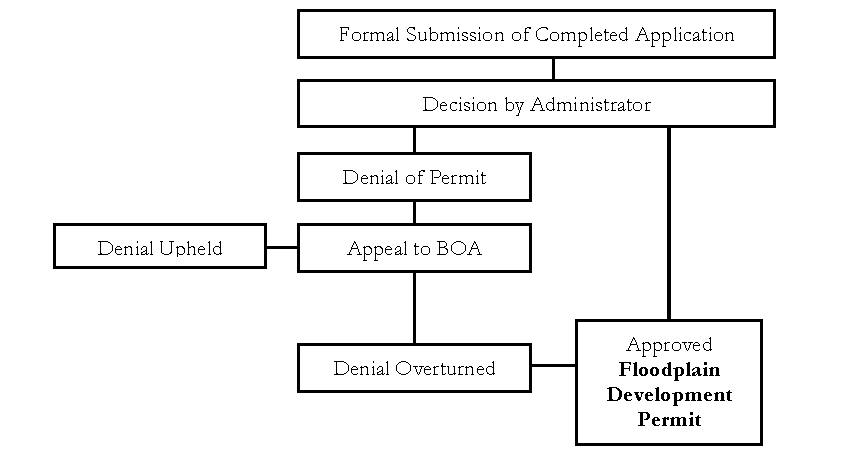
Applicability: A Floodplain Development Permit with an accompanying Elevation Certificate shall be submitted for any proposed development within 100 feet of a flood protection zone. Floodplain Development Permits shall be approved by the Administrator.
No structure or land shall be located, extended, converted or structurally altered without full compliance with the term of this Chapter and Chapter 6. In addition to those federal, state, and county government agency approvals, the applicant must also be in compliance with the provisions of this Ordinance.
Any activity which differs from that authorized by the Floodplain Development Permit shall be deemed a violation of this Ordinance and shall be subject to civil penalties as specified in Chapter 18.
B.
Required Procedure for Floodplain Development Approval: Upon receipt of a completed application, the Administrator shall approve, approve with conditions or deny the application. Applications that are denied shall have the reasons for denial, in writing, attached to the application.
The applicant's surveyor or engineer will certify the actual elevation (in relation to mean sea level) of the lowest floor (including basement) and the actual elevation to which the new or substantially improved buildings have been flood-proofed. Certification from the property owner's or developer's Project Engineer or Surveyor must accompany this application.
15.6 - Site Plans
A.
Minor Site Plans:
1.
Applicability:
a.
Duplexes.
b.
Multi-family with four or fewer units.
c.
Non-residential development with structures totaling less than 10,000 square feet.
2.
Procedure:
a.
Informal review of Sketch Plan by Administrator.
b.
Minor Site Plan:
1.
Reviewed by Technical Review Committee.
2.
If site does not need rezoning or a Special Use Permit, it will be reviewed and approved or denied by the Administrator.
3.
A reduced site plan is allowed if a Special Use Permit is required. Refer to Section 15.15 for Special Use Permit requirements and procedures.
4.
Minor Site Plan must conform with all ordinance requirements prior to submission of Construction Drawings.
5.
Where there are no extensions of public utilities, no Construction Drawings will be required if the Site Plan contains all pertinent information needed to ensure construction is designed to the standards of all reviewing agencies.
c.
Construction Drawings (if applicable).
d.
Development Plans Approved and Signed.
B.
Major Site Plans:
1.
Applicability:
a.
Multifamily buildings with more than four units.
b.
Non-residential Development 10,000 square feet or greater.
c.
Industrial Development.
2.
Procedure:
a.
Informal review of Sketch Plan by Administrator:
1.
Reviewed by Technical Review Committee.
2.
If site does not need rezoning or a Special Use Permit, it will be reviewed and approved or denied by the Administrator.
3.
A reduced site plan is allowed if a Special Use Permit is required. Refer to Section 15.15 for Special Use Permit requirements and procedures.
4.
Master Plan/Site Plan must conform with all ordinance requirements prior to submission of Construction Drawings.
5.
Where there are no extensions of public utilities, no Construction Drawings will be required if the Site Plan contains all pertinent information needed to ensure construction is designed to the standards of all reviewing agencies.
c.
Construction Drawings (if applicable).
d.
Development Plans Approved and Signed.
(Ord. No. O-23-2019, § 1, 11-12-2019; Ord. No. O-07-2022, § 1, 2-14-2022)
15.7 - Minor Subdivisions
A.
Applicability: Minor subdivisions are those which involve five lots or fewer and which in the opinion of the Administrator:
1.
Do not involve any public street dedication and will not require any new street, public or private, to provide access to interior lots or parcels; and
2.
Do not involve the extension of public sewerage or water lines; and
3.
Do not adversely affect the development of the remainder of the parcel or of adjoining property and would not block future street connectivity.
B.
The minor subdivision process is not intended to permit the consecutive subdivision of land in order to avoid making improvements otherwise required by this Ordinance. No more than five lots under one owner from one tract shall be considered for a minor subdivision in any three-year period.
C.
Procedure:
1.
Review of Final Plat by applicable Technical Review Committee members.
2.
Decision by Administrator.
(Ord. No. O-07-2022, § 1, 2-14-2022)
15.7A - Family Subdivisions
A.
Applicability: Family subdivisions shall be defined as the division of land into not more than five parcels (or lots) from the original tract as it existed on July 1, 2015 for the purpose of conveying the resultant parcels or lots to the grantee or grantees who are in any degree of lineal kinship to the grantor.
B.
Purpose: The specific purpose of a family subdivision is to allow the creation of lots from larger tracts where lots are conveyed to or developed for building purposes by members of the lineal family.
C.
Minimum Standards:
1.
Parent Tract: The original tract as it existed on July 1, 2015 must be a minimum of ten acres, and a plat of the original tract is required to be on file with the Administrator so that the department can determine the number of lots subdivided.
2.
Conveyance: Only lineal family members acting personally or through their legal representatives, including but not limited to: estate executors, trustees, attorneys-in-fact or legal guardians; may be grantees of the land from the grantor as stated in the definition of family subdivision in subsection "A" above. Any transfer of land from the grantee to a non-lineal family member within a ten-year period from the approval date of the family subdivision is considered a violation, which is subject to any and all penalties, including the requirement of the subdivision to come into compliance with any or all minor or major subdivision requirements which would have otherwise been required by a subdivision not subject to the Town's "Family Subdivision" provision. For the purpose of this section, lineal family members shall include spouses, parents, siblings, children, grandparents, grandchildren, and great-grandchildren.
3.
Deeds: The deed for each lot in a family subdivision must contain an express statement that the conveyance is a conveyance of a lot within a family subdivision and must contain an express grant of a public or private right-of-way to a public street. Said statement must include the information contained under the section entitled "Conveyance."
4.
Zoning Conformity: All lots proposed under the family subdivision section shall conform to the zoning requirements of the zoning district in which the subdivision is located, including, but not limited to, minimum lot size and width.
5.
Street Frontage: All lots proposed for subdivision, including the original tract, shall front on a dedicated private or public right-of-way which meets the minimum requirements of a local street as defined by the UDO and connects to a public street. The final plat is required to show this right-of-way.
6.
Street Standards: All lots proposed for subdivision, including the original tract, shall front on a street built to the following standards:
a.
If determined by the Town to be a logical location for a street, a minimum 54-foot public or private right-of-way is required.
b.
If determined by the Town to be an area where the future street location is not determined a minimum 54-foot private easement or right-of-way is required.
c.
All access streets shall be constructed to a minimum NCDOT standard with base course, but are not required to be constructed with pavement, curb, gutter or sidewalk.
d.
A note is to be added to the plat that maintenance is to be the responsibility of all adjacent property owners of said right-of-way and unimproved street. A maintenance agreement is required to be recorded at the Wake County Register of Deeds and approved by the Town Attorney.
7.
Public Utilities: If any lot proposed by the family subdivision is within 300 feet from the public water line and/or public sewer system, the lot shall connect to the public water system and/or public sewer system if a residence is proposed. A voluntary annexation petition is required to be submitted if connecting to Town water and/or sewer.
8.
Additional Right-of-Way Dedication: Family subdivision lots fronting on an existing public street, which is identified as a thoroughfare or collector street as identified on the Town's Arterial and Collector Street Plan and which are not currently constructed to the ultimate cross section shall not be required to build the street to the standard section and shall not be required to pay a fee in lieu of such street construction, but shall be required to dedicate the ultimate required right-of-way.
9.
Right-of-Way Reservation: Where a planned NCDOT or Town of Wendell street is located within the boundaries of the family subdivision land, a reservation of the right-of-way is required to be shown on the plat to reserve the land for the future street.
(Ord. No. O-20-2016, § 9, 11-14-2016; Ord. No. O-07-2022, § 1, 2-14-2022)
Editor's note— Ord. No. O-20-2016, § 9, adopted Nov. 14, 2016, set out provisions intended for use as § 15.7. To avoid duplication of section numbers, and at the editor's discretion, these provisions have been included as § 15.7A.
15.8 - Exception Plat Subdivision
A.
Applicability:
1.
The combination or recombination of portions of previously subdivided and recorded lots where the total number of lots is not increased and the resultant lots are equal to, or exceed, the standards of the town as required by this ordinance.
2.
The division of land into greater than ten acres where no street right-of-way dedication is involved;
3.
The public acquisition by purchase of strips of land for the widening or opening of streets or for public transportation system corridors; or
4.
The division of a tract in single ownership whose entire area is no greater than two acres into not more than three lots, where no street right-of-way dedication is involved and where the resultant lots are equal to, or exceed, the standards of the Town as required by this ordinance.
B.
Procedure:
1.
Review of Final Plat by applicable Technical Review Committee members.
2.
Decision by Administrator.
(Ord. No. O-07-2022, § 1, 2-14-2022)
15.9 - Major Subdivisions
A.
Applicability: A Major Subdivision is a subdivision of land that exceeds the minimum thresholds for Exception Plats and Minor Subdivisions.
B.
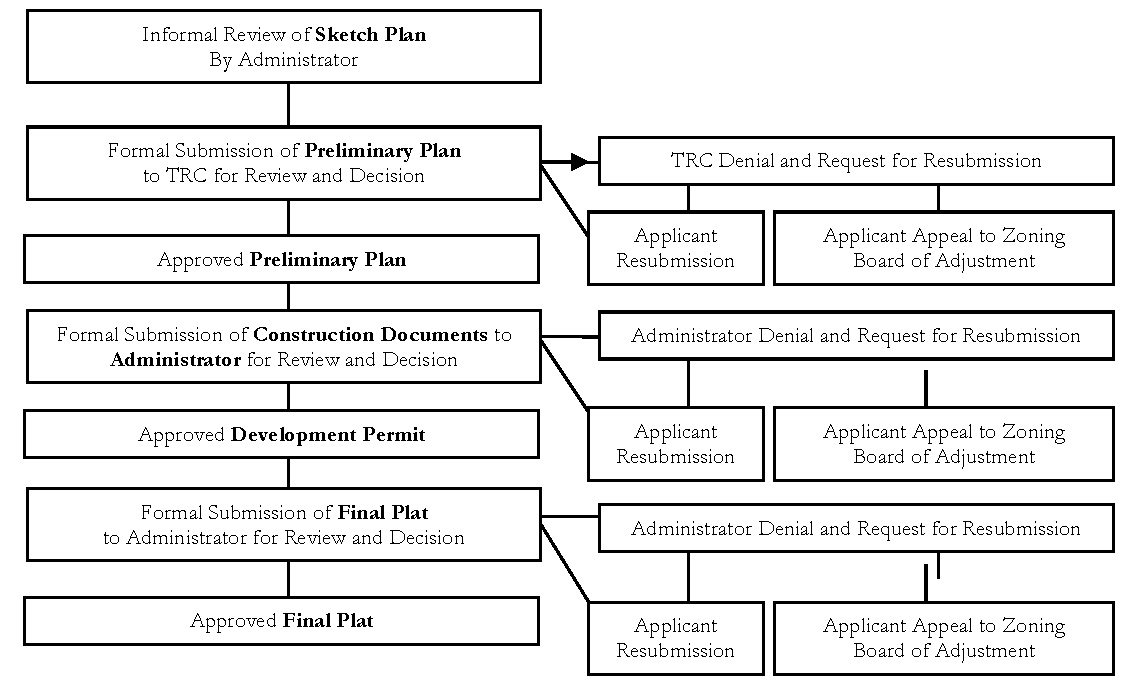
Procedure:
15.10 - Additional Procedures for Minor and Major Subdivisions
A.
Approval to Proceed with Construction Activity: A developer shall begin grading, soil erosion, and infrastructure construction for a development only after receiving Final Plat approval for a Minor Subdivision or Construction Drawing approval for Major Subdivisions as prescribed by this Chapter and other written approval and necessary permits from the appropriate regulating agencies (including, but not limited to, a Wake County Sediment and Erosion Control Permit).
B.
Sketch Plans:
1.
Sketch Plan approval shall authorize the subdivider to proceed to prepare the Preliminary Plan.
C.
Master Plan/Preliminary Plan
1.
Master Plan/Preliminary Plan approval shall constitute tentative approval of the Final Plat if the Final Plat is in substantive agreement with the Master Plan/Preliminary Plan and shall entitle the subdivider to proceed to Construction Drawings, if applicable, and/or to proceed to prepare the Final Plat. Approval of Construction Drawings shall entitle the subdivider to proceed with construction of subdivision improvements and no construction, including grading, shall proceed without such approval. In addition, the Administrator may require, as a prerequisite to Preliminary Plan approval, the submittal for review and approval of all or part of subdivision Construction Drawings in order to ascertain the feasibility of all or part of a proposed subdivision.
2.
If a Final Plat of all or part of the area shown on a Preliminary Plan is not recorded in the office of the Register of Deeds within 24 months of approval of the Preliminary Plan, or if there is a lapse of more than 12 months between the recording of sections, the Administrator may require the re-submittal of the unrecorded portion as a Preliminary Plan, notwithstanding permit extension acts granted by the State of North Carolina.
3.
The approval of the Preliminary Plan shall become null and void within two years, unless the developer has completed required improvements (or posted the appropriate guarantee of improvements) and submitted for approval the Final Plat as required by this ordinance or shall have applied for and received an extension of time from the Administrator. The Technical Review Committee may, at its discretion, require a Preliminary Plan to adhere to any new requirements before granting this extension. If a Preliminary Plan becomes null and void, the subdivider may resubmit for an updated approval; however, the resubmitted Preliminary Plan may be subject to any new requirements for Preliminary Plans, and fees shall be paid at current standard cost rates.
4.
Multiple Phases Not Approved: Approval of a Preliminary Plan constituting an individual phase of a multi-phase project, which has not been entirely approved, does not constitute approval by the Town of any remaining phases. For approved Preliminary Plans consisting of multiple phases, only the phase that is to be developed immediately shall be submitted for Final Plat approval.
D.
Final Plats:
1.
Final Plat approval shall entitle the subdivider to record the Final Plat. The Final Plat shall constitute a complete phase of the approved Construction Drawings.
2.
Plats to be Recorded: Approved Final Plats shall be filed by the applicant for recording with the Register of Deeds of Wake County within 30 calendar days of the date of approval by the Administrator; otherwise, such approval shall be null and void.
3.
Improvements Required: No Final Plat shall be approved unless and until the developer has installed in that area all improvements required per the approved plans; or has posted any required improvement guarantees approved by the Administrator and prescribed by this Ordinance in Section 17.17, Guarantee of Required Improvements and Warranty Against Defects in Stormwater Improvements.
4.
In addition, no Final Plat shall be approved for recording unless such plat is in substantial agreement, as determined by the Administrator, with the approved Preliminary Plan. Final Plats not in substantial agreement shall be resubmitted as Preliminary Plans as provided for herein.
5.
After the Final Plat is recorded, lots as shown on the Plat may be sold or otherwise conveyed by reference to the Plat. Building permits may be authorized to be issued and Certificates of Occupancy may be issued provided all required improvements, including individual building connections, have been installed and inspected and approved by CORPUD and the Administrator. The subdivider shall provide the Administrator with a certified copy of the as built drawings of all public improvements.
6.
Restrictive Covenants
a.
Must be submitted and approved by the Administrator prior to recording and recorded prior to Final Plat approval.
b.
All amendments to the Restrictive Covenants must be recorded with the Wake County Register of Deeds.
c.
All amendments to the Restrictive Covenants, in cases where the Restrictive Covenants were part of the approval process, must be approved by the Board of Commissioners.
(Ord. No. O-4-2017, § 8, 1-9-2017; Ord. No. O-07-2022, § 1, 2-14-2022)
15.11 - Text Amendments
A.
Purpose: The purpose of this Section is to establish uniform procedures for amending the text of the Ordinance.
B.
Application Required: An amendment to the text of this Ordinance may be initiated by the Board of Commissioners, the Planning Board, the Administrator, or any private citizen by filing an application with the Administrator.
C.
Procedure: All petitions to amend this ordinance shall be directed to the administrator, who shall transmit them to the Town Planning Board for review and recommendation.
(Ord. No. O-4-2017, § 6, 1-9-2017; Ord. No. O-07-2022, § 1, 2-14-2022; Ord. No. O-19-2022, § 3, 7-11-2022)
15.12 - Map Amendments (Rezonings)
A.
Purpose: The purpose of this Section is to establish uniform procedures for amending the zoning classification of land as shown on the Zoning Map.
B.
Application Required: An amendment to the Zoning Map may be initiated by the Board of Commissioners, the Planning Board, the Administrator, or any private citizen by filing an application with the Administrator.
C.
Procedure: All petitions to amend this ordinance shall be directed to the administrator, who shall transmit them to the Town Planning Board for review and recommendation.
D.
Neighborhood Meeting Required: A neighborhood meeting shall be required for all rezonings, including Conditional Districts.
1.
Method: The applicant may hold this meeting in person or virtually. The applicant is responsible for mailed notifications and organization of this meeting. No town staff will be in attendance.
2.
Notification Requirements: The applicant must notify all property owners adjacent to the subject parcel by mailed notice at least 10 days in advance of the meeting. A list of adjacent property owners should be obtained from Planning staff.
3.
Timing: Applicants are urged to have this neighborhood meeting early in the review process to provide the greatest amount of time for public engagement. Minutes from the neighborhood meeting, as well as a list of property owners who were notified, and a list of attendees, must be submitted to the Planning Department no later than two weeks before the scheduled Planning Board meeting.
4.
Rezonings will not be placed on the Planning Board agenda until the Neighborhood Meeting has been held.
(Ord. No. O-4-2017, § 7, 1-9-2017; Ord. No. O-07-2022, § 1, 2-14-2022; Ord. No. O-19-2022, § 4, 7-11-2022)
15.13 - Conditional Districts
A.
Purpose: The purpose of the Conditional Districts is to provide an alternative means of land development and an alternative zoning procedure that may be used to establish residential, commercial, and industrial Conditional Districts at appropriate locations and in accordance with the planning and development objectives of the Town.
A Conditional District (CD) established according to the provisions of this section may depart from the strict application of the requirements of the town's general zoning districts, as outlined in Section 2.18, Conditional Districts. The CD alternative may allow uses which are not currently defined or contemplated by the Code. A primary purpose of this section is to provide standards by which such flexibility may be achieved while maintaining and protecting the public health, safety and welfare of the citizens.
A second purpose of this section is to establish a more complete living and working environment through the application of enlightened and imaginative approaches to community planning and property design. A CD should provide a variety of natural features and scenic areas, efficient and economical land use, improved amenities, orderly and economical development, and the protection of existing and future adjacent development.
B.
General Requirements:
1.
Applicant: Conditional District classification shall only be considered upon the request of the owners and/or their representatives of all the property to be included. A CD shall consist of land under unified control which may be planned and developed as a single development or as an approved programmed series of development phases by multiple developers. "Unified control" means that all land to be included within a CD shall be owned or otherwise under the legal control of the person or legal entity which has applied for a Conditional District. Such person or entity shall be legally capable of providing a commitment to the town that the CD development will comply with all documents, plans, standards and conditions ultimately approved by the town.
2.
Standards of District to be Met: Within an approved Conditional District, no use shall be permitted except pursuant to the conditions imposed by the applicant on the Conditional District in the approval of the rezoning. The Board of Commissioners may request additional reasonable and appropriate conditions or safeguards to serve the purpose and intent of this Section, and to preserve public welfare, and justice. Only those conditions mutually approved by the Board of Commissioners and the applicant may be incorporated into the zoning regulations. The applicant or landowner must provide written consent to all conditions approved by the Board of Commissioners.
3.
Content of Application:
a.
A Conditional District shall consist of the CD Master Development Plan, individually, or in combination with a CD Final Development Plan; as well as any other plans, drawings, renderings, elevations, maps and documents specifically included as development documents for approval by the Board of Commissioners. The Master Plan, as a site-specific Conditional Zoning Plan, is itself a condition of the Conditional District rezoning.
b.
Master Development Plan: The development concept of all land areas encompassed by a Conditional District shall be adequately described by a Master Development Plan comprised of scaled drawings and associated reports. At a minimum, the Master Development Plan shall adequately describe:
i.
The overall boundary and area of the district, including underlying zoning districts;
ii.
The general location, orientation and size of principal structures and associated parking areas; landscape and buffer areas; open space areas; the location, size and general treatment of environmentally sensitive areas; the general location and size of existing and proposed water mains and sewer trunk lines required to service the development; and general traffic routes (external and internal) to and from the development with major access points identified;
iii.
Tabular data, including the range and scope of proposed land uses, proposed densities, floor area ratios or impervious surface ratios as applicable to development type; and land areas devoted to each type of general land use and phase of development;
iv.
Full list of proposed uses consistent in character with the underlying zoning district;
v.
A proposed development schedule if the project is to be phased.
c.
Final Development Plan: All Final Development Plans shall conform to the general development concept of an approved Master Development Plan. A final plan shall consist of a detailed set of construction plans that fully demonstrate compliance with all applicable construction regulations and provisions of the Town of Wendell and with all applicable performance criteria, conditions, and other requirements of the enacting Conditional District zoning ordinance.
d.
In addition to the Master Plan, the applicant shall provide the exact land use classifications proposed for the Conditional District. Such use classifications may be selected from any of the uses, whether permitted, by right or conditional, allowed in the general zoning district upon which the Conditional District is based. Uses not otherwise permitted within the general zoning district shall not be permitted within the Conditional District.
4.
Fair and Reasonable Conditions: The provisions of the CD Master Plan shall replace all conflicting development regulations set forth in this Ordinance which would otherwise apply to the development site. The Planning Board may recommend and the Board of Commissioners may request reasonable and appropriate conditions including, but not limited to, the location, nature, hours of operation, and extent of the proposed use(s). Conditions and site-specific standards shall be limited to those that address conformance of the development and use of the site to this Ordinance and officially adopted plans and those standards and conditions that address the impacts reasonably expected to be generated by the development and use of the site. The applicant will have a reasonable opportunity to consider and respond to any additional requests proposed by either the Planning Board or the Board of Commissioners prior to final action.
C.
Ability to Proceed: The applicant may proceed with development only after approval of the Conditional District Master Plan by Board of Commissioners. A simple majority vote of the Board of Commissioners is required when the Conditional District Master Plan receives a favorable recommendation from the Planning Board. When the Planning Board recommends against the Conditional District Master Plan, a supermajority, or four-fifths, vote from the Board of Commissioners is required for approval. A Conditional District Final Development Plan must also be approved by the Zoning Administrator and the applicable plat must be recorded with the Wake County Register of Deeds. The development and use of all land within the Conditional District shall be in keeping with the approved Master Plan and all applicable provisions therein.
D.
Approval Process:
1.
The procedure for approval of the Master Plan shall follow the procedures outlined in Section 15.10 Additional Procedures for Minor and Major Subdivisions and Section 15.12, Map Amendments (Rezonings).
E.
Final Approval by Stages: If so reflected on the Master Plan, the Board of Commissioners may allow the staging of final development. Each phase of development shall adhere to all applicable provisions and standards of this section and the applicable CD Master Plan.
F.
Substantial Changes: Any substantial change to a Master Plan as noted below shall be reviewed by the Planning Board and approved or denied by the Board of Commissioners as an amended Conditional District.
1.
The following changes to a CD Master Plan or subsequent Final Plan shall require approval by the Board of Commissioners:
a.
Land area being added or removed from the Conditional District.
b.
Modification of special performance criteria, design standards, or other requirements specified by the enacting ordinance.
c.
A change in land use or development type beyond that permitted by the approved Master Plan.
d.
When there is introduction of a new vehicular access point to an existing street, road or thoroughfare not previously designated for access.
e.
When there is an increase in the total number of residential dwelling units originally authorized by the approved Master Plan.
f.
When the total floor area of a commercial or industrial classification is increased more than ten percent beyond the total floor area last approved by Board of Commissioners.
2.
All other changes to a CD Master Plan or subsequent Final Plan shall receive approval by the Zoning Administrator. However, if in the judgment of the Zoning Administrator, the requested changes alter the basic development concept of the CD, the Zoning Administrator may require review and recommendation by the Planning Board, followed by approval by the Board of Commissioners.
G.
Recission of Conditional Districts: The Applicant shall secure a valid building or construction permit(s) within a 12-month period from date of approval of the Conditional District unless otherwise specified. If such project is not complete and a valid building or construction permit is not in place at the end of the 12-month period, the Administrator shall notify the applicant of either such finding. Within 60 calendar days of notification, the Administrator shall make a recommendation concerning the rescission of the Conditional District to the Board of Commissioners. The Board of Commissioners may then rescind the Conditional District or extend the life of the Conditional District for a specified period of time.
(Ord. No. 16-2016, § 2, 7-11-2016; Ord. No. 0-14-2020, § 1, 6-8-2020; Ord. No. O-23-2021, 6-28-2021; Ord. No. O-07-2022, § 1, 2-14-2022)
15.14 - Vested Rights
A.
General Procedures/Establishment of Vesting:
1.
Pursuant to G.S. 160D-108 and not withstanding any other provision or amendment, a landowner may apply for approval of a site-specific development plan as defined in the statute that shall entitle said landowner to develop property in accordance with the previously approved plan.
2.
The approval authority may approve a site specific development plan upon such terms and conditions as may reasonably be necessary to protect the public health, safety, and general welfare.
3.
Approval of site specific development plan with the condition that a variance be obtained shall not confer a zoning vested right unless and until the necessary variance is obtained.
4.
A site specific development plan shall be deemed approved upon the effective date of the approval authority's action ordinance relating thereto.
5.
The establishment of a zoning vested right shall not preclude the application of overlay zoning that imposes additional requirements but does not affect the allowable type or intensity of use, or ordinances or regulations that are general in nature and are applicable to all property subject to land use regulation by the Town, including but not limited to, building, fire, plumbing, electrical, and mechanical codes. Otherwise, applicable new or amended regulations shall become effective with respect to property that is subject to a site specific development plan upon the expiration or termination of the vested right in accordance with this subchapter.
6.
A zoning vested right is not a personal right, but shall attach to and run with the applicable property. After approval of a site specific development plan, all successors to the original landowner shall be entitled to exercise such right while applicable.
B.
Approval procedures and approval authority
1.
Except as otherwise provided in this section, an application for site specific development plan approval shall be processed in accordance with the procedure established by ordinance and shall be considered by the designated approval authority for the specific type of zoning or land use permit or approval for which the application is made.
2.
Notwithstanding the provisions of Section 15.14.B.1 above, if the authority to issue a particular zoning or land use permit or approval has been delegated by ordinance to a board, committee, or administrative official other than the Board of Commissioners in order to obtain a zoning vested right, the applicant must request in writing at the time of the application that the application be considered and acted on by the Board of Commissioners following notice and a public hearing as provided in North Carolina General Statute § 160D-601.
3.
In order for a zoning vested right to be established upon approval of a site specific development plan, the applicant must indicate at the time of application, on a form to be provided by the Town, that a zoning vested right is being sought.
4.
The Board of Commissioners may not require the landowner to waive his vested right as a condition of development approval.
5.
Each map, plat, site plan, or other document evidencing a site specific development plan shall contain the following notation: "Approval of this plan establishes a zoning vested right under North Carolina General Statute § 160D-108. Unless terminated at an earlier date, the zoning vested right shall be valid until _______."
6.
All requests for Vested Rights shall be accompanied by a copy of the approved Site-Specific Development Plan (Master Plan), Special Use Permit, Zoning Permit, or Subdivision Preliminary Plan that is not a phased development plan in accordance with the provisions of this Chapter. Notwithstanding the foregoing, neither a variance, a Sketch Plan, nor any other document that fails to describe with reasonable certainty the type and intensity of use for a specified parcel or parcels of property shall constitute a site-specific development plan.
7.
Following approval or conditional approval of site specific development plan, nothing in this subchapter shall exempt such a plan from subsequent reviews and approvals to ensure compliance with the terms and conditions of the original approval, provided that such reviews and approval are not inconsistent with the original approval.
8.
Nothing in this subchapter shall prohibit the revocation of the original approval or other remedies for failure to comply with applicable terms and conditions of the approval or the Ordinance.
C.
Duration
1.
A zoning right that has been vested as provided in this subchapter shall remain vested for a period of two years unless specifically and unambiguously provided otherwise pursuant to subsection C.2 below. The vesting shall not be extended by any amendments or modifications to a site specific development plan unless expressly provided by the approval authority at the time the amendment or modification is approved.
2.
Notwithstanding the provisions of subsection C.1 above, the approval authority may provide that rights shall be vested for a period exceeding two years but not exceeding five years where warranted in light of all relevant circumstances, including, but not limited to, the size of the development, the level of investment, the need for or desirability of the development, economic cycles, and market conditions. A multiphase development shall be vested for the entire development with the zoning regulations, subdivision regulations, and unified development ordinances in place at the time a site plan approval is granted for the initial phase of the multiphase development. This right shall remain vested for a period of seven years from the time a site plan approval is granted for the initial phase of the multiphase development. For purposes of this subsection, "multiphase development" means a development containing 25 acres or more that (i) is submitted for site plan approval for construction to occur in more than one phase and (ii) is subject to a master development plan with committed elements, including a requirement to offer land for public use as a condition of its master development plan approval.
These determinations shall be in the sound discretion of the approval authority at the time the site specific development plan is approved.
3.
Upon issuance of a building permit, the expiration provisions of North Carolina General Statute § 160D-1111 and the revocation provisions of North Carolina General Statute § 160D-1115 shall apply, except that a building permit shall not expire or be revoked because of the running of time while a zoning vested right under this section is outstanding.
D.
Termination: A zoning right that has been vested as provided in this subchapter shall terminate:
1.
At the end of the applicable vesting period with respect to buildings and uses for which no valid building permit applications have been filed;
2.
With the written consent of the affected landowner;
3.
Upon findings by the Town Board of Commissioners, or by resolution after notice and a public hearing, that natural or manmade hazards on or in the immediate vicinity of the property, if uncorrected, would pose a serious threat to the public health, safety, and general welfare if the project were to proceed as contemplated in the site specific development plan;
4.
Upon payment to the affected landowner of compensation for all costs, expenses, and other losses incurred by the landowner, including, but not limited to, all fees in consideration of financing, and all architectural, planning, marketing, legal, and other consultant's fees incurred after approval by the town, together with interest thereon at the legal rate until paid. Compensation shall not include any diminution in the value of the property which is caused by such action;
5.
Upon findings by the Town Board of Commissioners, by ordinance after notice and a hearing that the landowner or his representative intentionally supplied inaccurate information or made material misrepresentations which made a difference in the approval by the approval authority of the site specific development plan; or
6.
Upon the enactment or promulgation of a state or federal law or regulation that precludes development as contemplated in the site specific development plan, in which case the approval authority may modify the affected provisions, upon a finding that the change in state or federal law has fundamental effect on the plan, or by resolution after notice and hearing.
E.
Voluntary Annexation
1.
A petition for annexation filed with the Town under North Carolina General Statute § 160A-31 or North Carolina General Statute § 160A-58.1 shall contain a signed statement declaring whether or not any zoning vested right with respect to the properties subject to petition has been established under North Carolina General Statute § 160D-108 or North Carolina General Statute § 160A-344.1, or the failure to sign a statement declaring whether or not a zoning vested right has been established, shall be binding on the landowner and any such zoning vested right shall be determined.
F.
Limitations
1.
Nothing in this subchapter is intended or shall be deemed to create any vested right other than those established pursuant to North Carolina General Statute § 160D-108.
G.
Repealer
1.
In the event that North Carolina General Statute § 160D-108 is repealed, this subchapter shall be deemed repealed and the provisions hereof no longer effective.
(Ord. No. O-07-2021, § 2, 2-22-2021; Ord. No. O-28-2021, § 1, 7-26-2021; Ord. No. O-07-2022, § 1, 2-14-2022)
15.15 - Special Use Permits
A.
Purpose: Special uses are land uses that are generally compatible with the land uses permitted by right in a zoning district, but which require individual review of their location, design, and configuration so as to evaluate the potential for adverse impacts on adjacent property and uses. Special uses ensure the appropriateness of the use at a particular location within a given zoning district.
B.
General Requirements:
1.
Only those uses enumerated as Special Uses in a zoning district shall be authorized by the Board of Commissioners.
2.
The evaluation and approval of the Special Use Permit shall be governed by quasi-judicial proceedings, which are based upon the sworn testimony and evidence presented at the hearing relevant to the following standards:
a.
That the proposed use does not affect adversely the general plans for the physical development of the town as embodied in this Ordinance and in any plan or portion thereof adopted by the Board of Commissioners;
b.
The proposed use will not be contrary to the purposes stated for these regulations;
c.
The proposed use will not adversely affect the health and safety of residents and workers in the town;
d.
The proposed use will not be detrimental to the use of development of adjacent properties or other neighborhood uses;
e.
The proposed use will not be affected adversely by the existing uses;
f.
The proposed use will be placed on a lot of sufficient size to satisfy the space requirements of the use;
g.
The proposed use will not constitute a nuisance or hazard because of the number of persons who will attend or use the facility, vehicular movement, noise, or fume generation or type of physical activity;
h.
The standards set forth for each particular use/project for which a permit may be granted have been met;
i.
The Board may impose or require such additional restrictions and conditions as may be necessary to protect the health and safety of works and residents in the community, and to protect the value and use of property in the general neighborhood;
j.
The proposed use shall be subject to the minimum area, setback, and other location requirements of the zoning district in which it will be located; and
k.
The proposed use shall be subject to the off-street parking and service requirements of these regulations; provided, however, that an approved PUD Plan document may include modifications of such requirements.
l.
Wherever the Board shall find, in the case of any permit granted pursuant to the provisions of this chapter, that any of the terms, conditions, or restrictions, on which such permit was granted are not being complied, the Board shall rescind and revoke the permit after giving due notice to all parties concerned and granting full opportunity for a public hearing. The Town shall follow the same review and approval process required for issuance of the Special Use Permit, including any required notice or hearing, in the review and approval of any revocation of that permit. A Special Use Permit shall be revoked for any substantial departure from the approved application, plans, or specifications; for refusal or failure to comply with the requirements of any applicable local development regulation or any State law delegated to the local government for enforcement purposes in lieu of the State; or for false statements or misrepresentations made in securing the approval.
C.
Procedures:
1.
The processing of a Special Use Permit shall be conducted by the Board of Commissioners. The applicant, the Town, and any person who would have standing to appeal the decision under G.S. 160D-1402(c) shall have the right to participate as a party at the evidentiary hearing, including presenting evidence, cross-examining witnesses, objecting to evidence, and making legal arguments. During the evidentiary hearing, all parties presenting testimony and evidence shall be duly sworn. Testimony both in favor and against the Special Use Permit application shall be presented and will be considered in formulating the findings-of-fact required for a decision. Objections regarding jurisdictional and evidentiary issues, including, but not limited to, the timeliness of an appeal or the standing of a party, may be made to the board. The Mayor shall rule on any objections, and the Mayor's rulings may be appealed to the full board. These rulings are also subject to judicial review pursuant to G.S. 160D-1402. Objections based on jurisdictional issues may be raised for the first time on judicial review.
2.
The Board of Commissioners may attach reasonable and appropriate conditions on the location, nature, and extent of the proposed use. The applicant shall have up to 30 calendar days to consider and respond to any additional requirements prior to approval or denial by the Board of Commissioners.
3.
A notice of each evidentiary hearing shall be published in a newspaper of general circulation in the town, at least one time a week for two consecutive weeks prior to the evidentiary hearing.
D.
Neighborhood Meeting Required: A neighborhood meeting shall be required for all Special Use Permit requests.
1.
Method: The applicant may hold this meeting in person or virtually. The applicant is responsible for mailed notifications and organization of this meeting. No town staff will be in attendance.
2.
Notification Requirements: The applicant must notify all property owners adjacent to the subject parcel by mailed notice at least 10 days in advance of the meeting. A list of adjacent property owners should be obtained from Planning staff.
3.
Timing: Applicants are urged to have this neighborhood meeting early in the review process to provide the greatest amount of time for public engagement. Minutes from the neighborhood meeting, as well as a list of property owners who were notified, and a list of attendees, must be submitted to the Planning Department no later than two weeks before the scheduled Board of Commissioners meeting.
4.
Special Use Permits will not be placed on the Town Board agenda until the Neighborhood Meeting has been held.
E.
Effect of Approval: If an application is approved, the Special Use Permit that is established and all conditions which may have been attached to the approval are binding on the property. All subsequent development and use of the property shall be in accordance with the approved plan and conditions. The applicant shall record the approved Special Use Permit with the Register of Deeds and submit a copy to the Town. The authorization of the Board of Commissioners for a Special Use Permit and all supporting documentation shall become a part of the certificate of occupancy.
F.
Substantial Changes: Any substantial change to a Special Use Permit that results in the increase of the intensity, density, or character of the use shall be approved or denied by the Board of Commissioners as an amended Special Use Permit. Minor field alterations or minor revisions to approved Special Use Permits may be approved by the Administrator if the Special Use still meets the intent of the standards established with the original approval.
G.
Appeal: The determination of the Board of Commissioners shall be conclusive and final and there shall be no further appeal to the Zoning Board of Adjustment or any other administrative board or commission except the State Superior Court. A request for a review may be made in the same manner as an original request. Evidence in support of the request shall initially be limited to that which is necessary to enable the Board of Commissioners to determine whether there has been a substantial change in the facts, evidence, or conditions in the case. It shall thereupon treat the request in the same manner as the original request. Otherwise, the Board of Commissioners may terminate any further consideration of such request. The Board of Commissioners may, however, review its authorization and the conditions thereof and after such review may modify or change the conditions of the Special Use Permit or may terminate the Special Use Permit only upon agreement with one or more of the criterions set forth in 15.15.G.3, below. Any appeal for administrative review concerning the enforcement of a Special Use Permit shall be to the Board of Commissioners.
H.
Recission of Special Use Permits:
1.
The applicant shall secure a valid building permit within a 12-month period from date of approval of the Special Use Permit unless otherwise specified.
2.
If such project is not complete and a valid building permit is not in place at the end of the 12-month period, the Administrator shall notify the applicant of either such finding. Within 30 calendar days of said notification, the Administrator shall make a recommendation concerning the rescission of the Special Use Permit to the Board of Commissioners. The Board of Commissioners may then rescind or extend the Special Use Permit, for a specified period of time.
3.
Other criterion for which a Special Use Permit may be rescinded or terminated shall be as follows:
a.
Non-compliance with adopted conditions.
b.
Expressed diminution of value of surrounding properties that may only be found during the evidentiary hearing and made a part of the Findings of Fact.
c.
Expressed negative impacts related to the general safety, health, and welfare of the surrounding community, which may only be found during the evidentiary hearing and made a part of the Findings of Fact.
d.
Recorded and repeated Code violations.
e.
Any non-conformity created by amortization of the permitted use which would only be established as a condition of the permit.
f.
Any zoning map amendment to a zoning district that would create a nonconformity between the district and associated permit.
H.
Reserved.
I.
Reduced Site Plan Requirements: The Reduced Site Plan for Special Use Permit shall be drawn to the following specifications and shall contain or be accompanied by the information listed below. All plans shall be submitted at a scale not less than one inch = 50 feet unless otherwise authorized by the Administrator. No processing or review of a Reduced Site Plan for Special Use Permit will proceed without all of the information required below:
1.
Plat book or deed book references.
2.
Names of adjoining property owners (or subdivision or developments of record) with plat book and/or deed book reference.
3.
The boundary, as determined by survey, of the area to be developed with:
a.
All bearings, curve data and distances on outside boundaries and street centerlines;
b.
Street centerlines tied to the boundary;
c.
The location within the area, or contiguous to it, of any existing streets, railroad lines, perennial streams, wetlands, easements or other significant features of the tract;
d.
At least one corner tied to the NC grid with grid coordinates provided where at least one of two control monuments needed are within 2,000 feet of the boundary. Otherwise, boundary should be tied to the nearest street intersections;
e.
Locations of intersecting property boundary lines of adjoining properties.
4.
Site calculations including total acreage of tract, acreage in recreational open space and other non-residential uses, total number and acreage of parcels, and the total number of housing units.
5.
Building elevations required for all Major Site Plans.
6.
The location of:
a.
Proposed buildings;
b.
Parking and loading areas;
c.
Streets and alleys with total right-of-way dimensions;
d.
Sidewalk and Greenway locations;
e.
Property lines and minimum building setbacks;
f.
Building restriction areas (i.e., flood hazard and riparian buffer areas).
7.
Conceptual Landscape Plan showing general location of proposed landscape material, Tree Protection Fence location.
8.
Transportation Impact Assessment (TIA): Not required at time of submittal. However, the Wendell Board of Commissioners reserves the right to require a TIA for any SUP request at their discretion.
(Ord. No. O-23-2019, § 2, 11-12-2019; Ord. No. O-16-2021, § 1, 4-26-2021; Ord. No. O-23-2021, 6-28-2021; Ord. No. O-07-2022, § 1, 2-14-2022)
15.16 - Administrative Appeals
A.
Applicability: The Zoning Board of Adjustment shall hear and decide appeals of any order, requirement, decision, interpretation or citation made by the Administrator, or the Technical Review Committee and apply such interpretation to particular fact situations. The Board of Commissioners shall hear such cases involving nonconformities.
B.
An appeal may be made by any aggrieved party or by any officer, department or board of Wendell who has received a ruling from the Administrator, or the Technical Review Committee, upon the submission of a completed application. An appeal to the Zoning Board of Adjustment and/or the Board of Commissioners shall be made within 30 calendar days from written notice of a final, binding administrative decision. In the absence of evidence to the contrary, notice given pursuant to G.S. 160D-403(b) by first-class mail shall be deemed received on the third business day following deposit of the notice for mailing with the United States Postal Service. An appeal shall be placed on the Zoning Board of Adjustment and/or the Board of Commissioners agenda within 30 calendar days of filing. The filing of any application stays all proceedings unless the Administrator certifies that a stay in his opinion will cause imminent peril to life or property, or, that because the violation charged is transitory in nature a stay would seriously interfere with enforcement of the Ordinance. In that event, proceedings shall not be stayed except by a restraining order, which may be granted by the Zoning Board of Adjustment, the Board of Commissioners or by a judicial court of law.
C.
Board Powers and Responsibilities: The Zoning Board of Adjustment and/or the Board of Commissioners may, after having held an evidentiary hearing conducted in the nature of a quasi-judicial proceeding with all findings of fact supported by competent, material evidence as required by G.S. 160D-406 on the matter, reverse or affirm, wholly or partly, or may modify the order, requirement, decision or determination appealed. The Zoning Board of Adjustment and/or the Board of Commissioners shall have all the powers of the Administrator in making any order, requirement, decision, interpretation or determination with reference to an appeal or petition. Objections regarding jurisdictional and evidentiary issues, including, but not limited to, the timeliness of an appeal or the standing of a party, may be made to the board. The Board Chair/Mayor shall rule on any objections, and the Chair's/Mayor's rulings may be appealed to the full board. These rulings are also subject to judicial review pursuant to G.S. 160D-1402. Objections based on jurisdictional issues may be raised for the first time on judicial review.
D.
Simple-Majority Required: The concurrent simple-majority vote of three-fifths of the voting members of the Zoning Board of Adjustment and/or the Board of Commissioners shall be necessary to make an interpretation of the Ordinance, reverse any order, requirement, or decision or determination of the Administrator. In all matters coming before the Zoning Board of Adjustment and/or the Board of Commissioners, the applicant shall have the burden of providing clear, competent and material evidence in support of the application. The applicant, the Town, and any person who would have standing to appeal the decision under G.S. 160D-1402(c) shall have the right to participate as a party at the evidentiary hearing, including presenting evidence, cross-examining witnesses, objecting to evidence, and making legal arguments. All decisions of the Zoning Board of Adjustment and/or the Board of Commissioners shall be in writing and filed with the Administrator. Every variance decision of the Board of Adjustment and/or the Board of Commissioners shall be subject to review by the Wake County Superior Court. Any appeal to the Wake County Superior Court shall be taken within 30 calendar days after the decision of the Board of Adjustment and/or the Board of Commissioners is filed in the office of the Administrator. The Administrator shall notify they applicant by registered mail within 30 calendar days of the Board of Adjustment's and/or the Board of Commissioners decision.
E.
Appeals
1.
Appeals from the enforcement and interpretation of this Ordinance, and requests for variances shall be filed with the Administrator, who shall transmit all such records to the Board of Adjustment and/or the Board of Commissioners.
2.
It is the intention of this Ordinance that all questions arising in connection with the enforcement of this Ordinance shall be presented first to the Administrator. All appeals from the Administrator's decisions shall be presented to the Board of Adjustment and/or the Board of Commissioners. The Wake County Superior Court provides the next recourse from the Board of Adjustment and/or the Board of Commissioners decisions under this chapter.
3.
The Board of Adjustment shall fix a reasonable time, not to exceed 60 calendar days for an evidentiary hearing on appeals of the decision of the Administrator. A notice of each evidentiary hearing shall be published in a newspaper of general circulation in the town, at least one time a week for two consecutive weeks prior to the evidentiary hearing.
4.
An appeal stays all proceedings in furtherance of the action appealed from, unless the Administrator certifies to the Board of Adjustment and/or the Board of Commissioners that, based on the records of the case, a stay would cause damage to life or property, in which case proceedings shall not be stayed otherwise than by an order from the Wake County Superior Court. In those instances where enforcement is not stayed, the appellant may request an expedited hearing. If that request is made, the board must meet within 15 days to hear the appeal.
5.
The official who made the decision or the person currently occupying that position, if the decision maker is no longer employed by the Town, shall be present at the evidentiary hearing as a witness.
(Ord. No. O-07-2021, § 2, 2-22-2021; Ord. No. O-23-2021, 6-28-2021; Ord. No. O-28-2021, § 1, 7-26-2021)
15.17 - Variances
A.
Applicability: When practical difficulties, special conditions or unnecessary hardships would result from carrying out the strict letter of this Ordinance, the Zoning Board of Adjustment shall have the power to vary or modify any of the regulations or provisions of this Ordinance. The Board of Commissioners shall hear such cases involving nonconformities.
B.
Applicant with Standing: A petition for a variance may be initiated only by the owner of the affected property, an agent authorized in writing to act on the owner's behalf, or a person having a written contractual interest in the affected property upon the submission of a completed application. The filing of any application stays all proceedings unless the Administrator certifies that a stay in his opinion will cause imminent peril to life or property, or, that because the violation charged is transitory in nature a stay would seriously interfere with enforcement of the Ordinance. In that event, proceedings shall not be stayed except by a restraining order, which may be granted by the Zoning Board of Adjustment, Board of Commissioners or by a judicial court of law.
C.
Required Findings of Fact: The Zoning Board of Adjustment and/or the Board of Commissioners may only grant a variance having first held an evidentiary hearing conducted in the nature of a quasi-judicial proceeding with all findings of fact supported by competent, material evidence as required by G.S. 160D-406, and having made the following determinations:
1.
There are unnecessary hardships in the way of carrying out the strict letter of the Ordinance; and
2.
That the variance is in harmony with the general purpose and intent of this Ordinance and preserves its spirit; and
3.
That in the granting of the variance, the public safety and welfare have been assured and substantial justice has been done; and
4.
That the reasons set forth in the application justify the granting of a variance, and that the variance is a minimum one that will make possible the reasonable use of land or structure; and,
5.
The following are not cause for a variance:
a.
The citing of other nonconforming or conforming uses of land or structures in the same or other districts.
b.
The request for a particular use expressly, or by inference, prohibited in the district involved.
c.
Economic hardship or the fact that property may be utilized more profitably with a variance.
D.
Board May Apply Conditions to Motion: The Zoning Board of Adjustment and/or the Board of Commissioners, in granting a variance, may prescribe appropriate conditions and safeguards in conformity with this Ordinance. Violation of such conditions and safeguards, when made a part of the terms under which a variance is granted, shall be deemed a violation of this Ordinance and shall be punishable as prescribed in Chapter 18.
E.
Supermajority Required for Decision: The concurrent, supermajority vote of four-fifths of the voting members of the Zoning Board of Adjustment and/or the Board of Commissioners shall be necessary to grant a variance. In all matters coming before the Zoning Board of Adjustment and/or the Board of Commissioners, the applicant shall have the burden of providing clear, competent, and material evidence in support of the application. The applicant, the Town, and any person who would have standing to appeal the decision under G.S. 160D-1402(c) shall have the right to participate as a party at the evidentiary hearing, including presenting evidence, cross-examining witnesses, objecting to evidence, and making legal arguments. Objections regarding jurisdictional and evidentiary issues, including, but not limited to, the timeliness of an appeal or the standing of a party, may be made to the board. The Board Chair/Mayor shall rule on any objections, and the Chair's/Mayor's rulings may be appealed to the full board. These rulings are also subject to judicial review pursuant to G.S. 160D-1402. Objections based on jurisdictional issues may be raised for the first time on judicial review. All decisions of the Zoning Board of Adjustment and/or the Board of Commissioners shall be in writing and filed with the Administrator.
F.
Time for Decision: Except for minor variances noted in Section 15.18.G.1, the Zoning Board of Adjustment and/or the Board of Commissioners shall hold an evidentiary hearing on an application no later than 60 calendar days after a complete application has been filed with the Administrator. The Zoning Board of Adjustment and/or the Board of Commissioners shall decide on the matter which was presented at the evidentiary hearing within 30 calendar days of the close of the evidentiary hearing. If the Board of Adjustment and/or the Board of Commissioners fails to render a decision within the allotted time, the variance request is deemed to be not approved.
G.
Rehearings: An application for a rehearing shall be made in the same manner as provided for an original hearing within a period of 15 calendar days after the date of the Zoning Board of Adjustment's and/or the Board of Commissioners decision. In addition, specific information to enable the Zoning Board of Adjustment and/or the Board of Commissioners to determine whether or not there has been a substantial change in facts, evidence, or conditions in the case, shall be presented in writing or graphically. A rehearing shall be denied by the Zoning Board of Adjustment and/or the Board of Commissioners, if, in its judgment, such change in facts, evidence or conditions has not been proven. A public hearing shall not be required to be held by the Zoning Board of Adjustment and/or the Board of Commissioners to consider holding such a rehearing. Approval of said consideration shall, however, require an affirmative vote of at least four voting members. In the event that the Zoning Board of Adjustment and/or the Board of Commissioners find that a rehearing is warranted, it shall proceed as in the original hearing except that the application fee shall be waived.
H.
Effect of Denial-Time to Resubmit: Upon the denial of an original application, or upon the denial of an application from which a rehearing has been conducted, a similar application may not be filed for a period of one year after the date of denial of the original application.
(Ord. No. O-23-2021, 6-28-2021)
15.18 - Modification of Dimensional Standards
A.
In keeping with the purpose of these regulations to accomplish coordinated, balanced, and harmonious development in a manner which will best promote the health, safety, and general welfare while avoiding undue and unnecessary hardships, on approval by the Town Manager, the Administrator is authorized to approve requests that deviate from required setbacks set forth in this Ordinance by up to ten percent of the required setbacks or 24 inches, whichever is greater, upon determination that one or more of the following conditions exists:
1.
There are site or structural conditions that preclude strict adherence to the setback requirements, such as, but not limited to: the lot does not meet the dimensional standards established for the zoning district in which it is located; the lot has topographic limitations that require placement of the structure into the required setback area; or the structure is physically in line with an existing, legally established wall or walls of a principal structure already within the minimum setback area.
2.
The part of the proposed structure that would encroach into the minimum setback area is less than 50 percent of the width of the affected building facade(s), provided the part of the structure that would encroach into a front setback shall either be open (such as a porch or screen room) or not subject to occupancy (such as a chimney).
3.
The part of the proposed structure that encroaches into the minimum setback area is necessitated by a life-safety code, flood hazard reduction, Americans with Disabilities Act standard, or other public safety code requirements.
4.
The proposed structure will allow the preservation of significant existing vegetation.
5.
A good faith error was made in the location of a building foundation not exceeding one foot due to either field construction or survey error.
Prior to rendering a decision, the Administrator shall notify the Town Manager in writing of any minor deviation for approval.
B.
The authority given to the Administrator to grant such modification shall be construed to be permissive and not mandatory and the Administrator may decline to make such modification. In the event this occurs, the applicant shall have the right to submit an application to the Zoning Board of Adjustment and/or the Board of Commissioners to grant a variance to these requirements.
C.
Nothing in this section shall be construed as limiting the Administrator's duties and rights under this Chapter, or an applicant's right to appeal the decision of the Administrator to the Zoning Board of Adjustment and/or the Board of Commissioners.
15.19 - Legislative Procedures—General Provisions
A.
Purpose: The purpose of this Section is to establish uniform procedures for processing matters requiring a legislative approval process.
B.
Required Compliance with Comprehensive Plans:
1.
Text and Zoning Map amendments shall be made in accordance with the Town Plan of Wendell or other adopted comprehensive or related plan. Prior to adopting or rejecting any zoning amendment, the Board of Commissioners shall adopt a statement describing whether its action is consistent with the adopted comprehensive plan and explaining why the Board of Commissioners considers the action taken to be reasonable and in the public interest. That statement is not subject to judicial review.
2.
The Planning Board shall advise and comment on whether the proposed amendment is consistent with any comprehensive plan that has been adopted and any other officially adopted plan that is applicable. The Planning Board shall provide, within 30 calendar days of its decision, a written recommendation to the governing board that addresses plan consistency and other matters as deemed appropriate by the Planning Board.
3.
A comment by the Planning Board that a proposed amendment is inconsistent with the comprehensive plan shall not preclude consideration or approval of the proposed amendment by the Board of Commissioners. However, a four-fifths majority vote by the Board of Commissioners shall be required to amend this Ordinance when the Planning Board recommends against such amendments. A simple majority of the Board shall be required to amend the Ordinance when recommendation by the Planning Board is favorable.
C.
Notice Requirements:
1.
Hearing with Published Notice. Before adopting, amending, or repealing any ordinance or development regulation authorized by this Chapter, the Board of Commissioners shall hold a legislative hearing. A notice of the hearing shall be given once a week for two successive calendar weeks in a newspaper having general circulation in the area. The notice shall be published the first time not less than 10 days nor more than 25 days before the date scheduled for the hearing. In computing such period, the day of publication is not to be included but the day of the hearing shall be included.
2.
Notice of hearing on proposed Zoning Map Amendments
a.
Mailed Notice. The owners of affected parcels of land and the owners of all parcels of land abutting that parcel of land shall be mailed a notice of the hearing on a proposed zoning map amendment by first-class mail at the last addresses listed for such owners on the county tax abstracts. For the purpose of this section, properties are "abutting" even if separated by a street, railroad, or other transportation corridor. This notice must be deposited in the mail at least 10 but not more than 25 days prior to the date of the hearing. If the zoning map amendment is being proposed in conjunction with an expansion of municipal extraterritorial planning and development regulation jurisdiction under G.S. 160D-202, a single hearing on the zoning map amendment and the boundary amendment may be held. In this instance, the initial notice of the zoning map amendment hearing may be combined with the boundary hearing notice and the combined hearing notice mailed at least 30 days prior to the hearing.
b.
Optional Notice for Large-Scale Zoning Map Amendments. The first-class mail notice required under subsection a. of this section shall not be required if the zoning map amendment proposes to change the zoning designation of more than 50 properties, owned by at least 50 different property owners, and the Town elects to use the expanded published notice provided for in this subsection. In this instance, the Town may elect to make the mailed notice provided for in subsection (a) of this section or, as an alternative, elect to publish notice of the hearing as required by G.S. 160D-601, provided that each advertisement shall not be less than one-half of a newspaper page in size. The advertisement shall only be effective for property owners who reside in the area of general circulation of the newspaper that publishes the notice. Property owners who reside outside of the newspaper circulation area, according to the address listed on the most recent property tax listing for the affected property, shall be notified according to the provisions of subsection (a) of this section.
c.
Posted Notice. When a zoning map amendment is proposed, the Town shall prominently post a notice of the hearing on the site proposed for the amendment or on an adjacent public street or highway right-of-way. The notice shall be posted not less than 10 days nor more than 25 days before the date scheduled for the hearing. When multiple parcels are included within a proposed zoning map amendment, a posting on each individual parcel is not required but the Town shall post sufficient notices to provide reasonable notice to interested persons.
d.
Actual Notice. Except for a government-initiated zoning map amendment, when an application is filed to request a zoning map amendment and that application is not made by the landowner or authorized agent, the applicant shall certify to the Town that the owner of the parcel of land as shown on the county tax listing has received actual notice of the proposed amendment and a copy of the notice of the hearing. Actual notice shall be provided in any manner permitted under G.S. 1A-1, Rule 4(j). If notice cannot with due diligence be achieved by personal delivery, certified mail, or by a designated delivery service authorized pursuant to 26 U.S.C. § 7502(f)(2), notice may be given by publication consistent with G.S. 1A-1, Rule 4(j1). The person or persons required to provide notice shall certify to the Town that actual notice has been provided, and such certificate shall be deemed conclusive in the absence of fraud.
D.
Down-Zoning. No amendment to zoning regulations or a zoning map that down-zones property shall be initiated nor is it enforceable without the written consent of all property owners whose property is the subject of the down-zoning amendment, unless the down-zoning amendment is initiated by the Town. For purposes of this section, "down-zoning" means a zoning ordinance that affects an area of land in one of the following ways:
1.
By decreasing the development density of the land to be less dense than was allowed under its previous usage.
2.
By reducing the permitted uses of the land that are specified in a zoning ordinance or land development regulation to fewer uses than were allowed under its previous usage.
E.
Town Board Decision: Once the public hearing has been conducted the Town Board shall render a decision on the petition. All decisions shall be by simple majority vote unless the Planning Board has recommended against the proposed amendment.
1.
A decision concerning a petition for rezoning shall be as follows:
a.
Grant the rezoning as requested; or,
b.
Grant the rezoning with a reduction in the area requested; or,
c.
Grant the rezoning to a more restrictive general zoning district; or,
d.
Grant the rezoning with a combination of b and c above; or,
e.
Deny the application.
2.
A decision concerning the petition to amend the text of this Ordinance shall be as follows:
a.
Adoption of the amendment as written; or,
b.
Adoption of the amendment as revised; or,
c.
Rejection of the amendment.
F.
Ordinance Required. A development regulation adopted pursuant to this Chapter shall be adopted by ordinance.
G.
Rehearing:
1.
An application for a rehearing shall be made in the same manner as provided for an original hearing within a period of 15 calendar days after the date of the Board of Commissioners decision.
2.
Specific information to enable the Board of Commissioners to determine whether or not there has been a substantial change in facts, evidence, or conditions in the case, shall be presented in writing or graphically.
3.
A rehearing shall be denied by the Board of Commissioners, if, in its judgment, such change in facts, evidence or conditions have not been proven.
4.
A public hearing shall not be required to be held by the Board of Commissioners to consider holding such a rehearing. Approval of said consideration shall, however, require an affirmative vote of at least four voting members. In the event that the Board of Commissioners finds that a rehearing is warranted, it shall then proceed as in the original hearing except that the application fee shall be waived.
5.
Upon the denial of an original application, or upon the denial of an application from which a rehearing has been conducted, a similar application may not be filed for a period of one year after the date of denial of the original application.
H.
Appeals: Every legislative decision of the Board of Commissioners shall be subject to review by the Superior Court Division of the General Courts of Justice of the State of North Carolina by proceedings in the nature of certiorari. Any petition for review by the Superior Court shall be duly verified and filed with the Clerk of Superior Court within 30 calendar days after the decision of the Board is filed in the office of the Town Clerk, or after a written copy is delivered to every aggrieved party who has filed a written request for such copy with the Administrator at the time of the hearing of the case by the Board of Commissioners, whichever is later.
I.
Application Withdrawal:
1.
The petitioner may withdraw his application before submission of the public notice to the newspaper announcing the public hearing.
2.
After submission of such notice, an application may be withdrawn at the discretion of the Planning Board or Board of Commissioners at the public hearing.
3.
No more than two withdrawals may occur on the same parcel or portion of land within a one-year period.
4.
No application shall be filed on the same parcel or portion of land within a one-year period after the date of the second withdrawal.
(Ord. No. O-23-2021, 6-28-2021)
15.20 - Administrative Design Adjustment
A.
Applicability: The Zoning Administrator has the authority to approve a request for a design adjustment to new and existing streets as set forth in this UDO. Design adjustments shall relate to the location or dimensions of curb and gutter, sidewalks, vehicular lanes, bike lanes, street trees, medians, or the verge. Administrative design adjustments may be appropriate when an existing building would impede expansion, when transitioning from a different street section, or where strict compliance with this UDO would pose a safety hazard. All design adjustments shall be reviewed in accordance with the provisions of this section and the applicable design adjustment findings.
B.
Application Requirements: A request for a design adjustment must be submitted at the time of application for a preliminary subdivision plan, plot plan or site plan or at such time the design adjustment is proposed in conjunction with the review of infrastructure construction plans, a plot plan, or site plan.
A request for a design adjustment must be made in writing and be signed and notarized by the property owner in order to initiate a request for an adjustment.
The applicant shall submit pertinent material necessary for review; in addition to the submittal material required for a subdivision, plot plan or site plan. This may include detailed landscape plans, roadway cross-sections, site or subdivision layout or other project-specific information.
C.
Administrator Action: In reviewing the design adjustment, the Zoning Administrator shall consult with the members of the Technical Review Committee (TRC) to check the proposed request against the requirements of this UDO and other applicable technical requirements of the Town. The Administrator may require the approved adjustment to be designed and certified by a Professional Engineer.
D.
Required Findings: The Zoning Administrator may approve an existing or new street design adjustment, subject to all of the following findings:
1.
The approved adjustment provides adequate travel lanes for vehicles, cyclists and pedestrians;
2.
The approved adjustment does not increase congestion or compromise safety;
3.
The approved adjustment conforms with the Comprehensive Plan and adopted Town Plans;
4.
The approved adjustment shall address stormwater collection and conveyance and not adversely impact stormwater collection;
5.
The approved adjustment does not create additional maintenance responsibilities for the Town; and
6.
The approved adjustment is as minimal a change as necessary to meet the intent of this section.
(Ord. No. O-20-2016, § 21, 11-14-2016)

