
Wendell City Zoning Code
CHAPTER 11
LIGHTING
11.1 - Purpose and Intent
Exterior lighting shall be designed to provide the minimum lighting necessary to ensure adequate safety, night vision, and comfort and not create or cause excessive glare onto adjacent properties and public street rights-of-way.
Levels of illumination to achieve a certain function or desired effect should also reduce or eliminate the hazardous aspects and nuisance of glare and light spillage. All exterior lighting—with the exception of street lighting—that is used around buildings, recreation areas, parking lots, and signs, shall be designed to protect against the spillage of light to adjacent properties.
11.2 - General Standards
All exterior lighting, except street lighting, shall conform to the following standards:
A.
Unless otherwise specified in subsections below, the maximum light level shall be 0.5 maintained foot-candles at any property line in a residential district, or on a lot occupied by a dwelling, congregate care or congregate living structure, unless otherwise approved by the Administrator.
B.
All other exterior lighting shall be designed and located such that the maximum illumination measured in foot-candles at the property line shall not exceed one foot-candle.
C.
All floodlights shall be installed such that the fixture shall be aimed down at least 45 degrees from vertical. Flood lights and display lights shall be positioned such that any fixture located within 50 feet of a public street right-of-way is mounted and aimed perpendicular to the right-of-way, with a side-to-side horizontal aiming tolerance not to exceed 15 degrees from perpendicular to the right-of-way.
D.
All flood lamps emitting 1,000 or more lumens shall be aimed at least 60 degrees down from horizontal or shielded such that the main beam from the light source is not visible from adjacent properties or the public street right-of-way.
E.
All wall pack fixtures shall be cutoff fixtures. Wall packs on buildings may be used at entrances to a building to light unsafe areas. They are not intended to draw attention to the building or provide general building or site lighting.
F.
Exterior lighting shall not shine directly into the yard or into the windows of an adjacent residence.
G.
Exterior lighting shall be designed, located, and mounted at heights no greater than 18 feet above grade for pedestrian lights, or 37 feet above grade for street or parking area lights.
H.
All outdoor and parking lot lighting fixtures, including: metal halide, mercury vapor, fluorescent, induction, white high-pressure sodium and color-improved high-pressure sodium lamps used in non-cutoff fixtures shall be coated with an internal white frosting inside the outer lamp envelope.
I.
Floodlights shall be hooded or shielded so that the light source is not visible from any public right-of-way or adjacent property.
J.
Flickering, rotating, or flashing lights, or search lights shall not be permitted.
11.3 - Design Procedures and Illumination Levels
A.
The maximum permitted points of illumination shall be measured from ground level in accordance to the standards expressed in this Chapter. The following standards shall be required of all exterior lighting with the exception of public street lighting which is exempt.
B.
The quantity of fixtures to be provided shall be based upon the desired level of uniform illumination as established by the following table and current standards of the Illuminating Engineering Society of North America (IESNA). Fixture locations should be chosen to minimize the hazard of glare and to minimize conflicts with landscaping plans.
C.
Illumination Levels: The level of illumination shall be based upon the primary activity in each area to be lighted as outlined below:
1.
Open Parking Facilities
a.
For lighted parking lots, the minimum light level shall be no less than 0.2 foot-candles (FC). All light levels are measured at ground level.
b.
The minimum light level requirements vary depending on the use/task classification. The specified minimum FC value above 0.2 FC as outlined in the following table means that the lowest light level point or location in the parking lot must not exceed the minimum stated FC value in the table (i.e. 0.9 FC for large shopping centers). An average to minimum uniformity ratio of 4:1 means that the average FC to minimum FC ratio cannot be worse (higher) than 4:1. See the following table:
Source: IESNA 8th Edition Lighting Handbook with modifications
c.
Illumination levels are horizontal on the task, e.g. at grade or area surface.
d.
Uniformity ratios dictate that average illuminance values shall not exceed minimum values by more than the product of the minimum value and the specified ratio. For example, for commercial parking medium/low activity, the average foot-candles shall not be in excess of 2.8 (0.7 × 4).
e.
The Administrator shall be responsible for determining the activity level of a development. Applicants may appeal this decision to the Planning Board.
2.
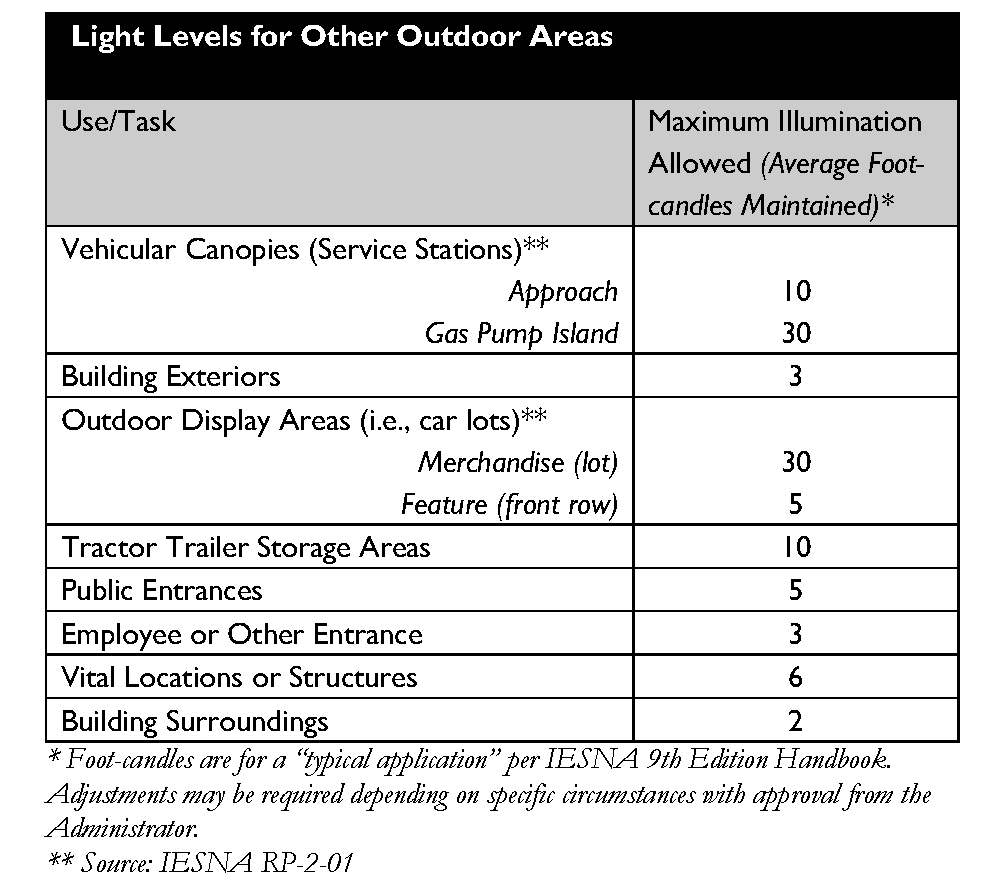
Other Outdoor Areas
11.4 - Additional Standards for Lighting in Parking Lots and Outdoor Areas
A.
Other than flood lights and flood lamps, all outdoor area and parking lot lighting fixtures shall be cutoff fixtures or comply with subsection D below.
B.
The mounting height of all exterior lighting, except outdoor sports field lighting and outdoor performance area lighting shall not exceed 37 feet above finished grade, unless approved by the Planning Board as having no adverse effect.
C.
All metal halide fixtures equipped with a medium base socket must utilize either an internal refractive lens or a wide-body refractive globe as described in Chapter 19, Definitions.
D.
Non-Cutoff fixtures:
1.
Non-cutoff fixtures may be used when the maximum initial lumens generated by each fixture shall not exceed 9,500 initial lamp lumens per fixture.
2.
All metal halide, mercury vapor, fluorescent, induction, white high pressure sodium and color improved high pressure sodium lamps used in non-cutoff fixtures shall be coated with an internal white frosting inside the outer lamp envelope.
11.5 - Additional Standards for Gas Station/Convenience Store Aprons and Canopies
Lighting under canopies shall be designed so as not to create glare off-site. Acceptable methods include one or more of the following:
A.
Recessed fixture incorporating a lens cover that is either recessed or flush with the bottom surface (ceiling) of the vehicular canopy that provides a cutoff or shielded light distribution.
B.
Surface mounted fixture incorporating a flat glass that provides a cutoff or shielded light distribution.
C.
Other method approved by the Administrator.
D.
Lights shall not be mounted on the top or sides of the canopy and the sides of the canopy shall not be externally illuminated.
11.6 - Additional Standards for Lighting of Outdoor Display Areas (Car Lots, etc.)
A.
Parking lot outdoor areas shall be illuminated in accordance with the requirements for subsection 11.3 above.
B.
All light fixtures shall meet the IESNA definition of cutoff fixtures. Forward throw fixtures (type IV light distribution, as defined by the IESNA) are required within 25 feet of any public street right-of-way. Alternatively, directional fixtures (such as floodlights) may be used provided they shall be aimed in accordance with subsections 11.2.C of this Chapter.
C.
The mounting height of outdoor display area fixtures shall not exceed 37 feet above finished grade.
11.7 - Lighting of Buildings and Landscaping
A.
Lighting fixtures shall be selected, located, aimed, and shielded so that direct illumination is focused exclusively on the building facade, plantings, and other intended site feature and away from adjoining properties and the public street right-of-way.
B.
Maximum illumination on any vertical surface or angular roof shall not exceed 5.0 foot-candles average maintained.
C.
To the extent practical and where possible, lighting fixtures shall be directed downward rather than upward.
D.
When upward aiming lighting is used, placing low wattage fixtures with shields as needed close to the building to graze the facade is encouraged to minimize reflected light from windows and other surfaces that would be present from a flood design.
11.8 - Outdoor Sports Fields
A.
The mounting height of outdoor sports field lighting fixtures shall not exceed 80 feet from finished grade unless approved by the Planning Board as having no adverse effect or approved by the Town as part of a Special Use Permit.
B.
All outdoor sports field and outdoor performance area lighting fixtures shall be equipped with a glare control package (louvers, shields, or similar devices).
C.
The fixtures must be aimed so that their beams are directed and fall within the primary playing or performance area.
D.
Non-conforming fixtures lighting sports fields may be replaced or otherwise changed on an individual/small cluster basis with new non-conforming fixtures. However, when all the fixtures are upgraded or otherwise changed, the fixtures must be brought into compliance with the requirements of this Chapter.
E.
The hours of operation for the lighting system for any game or event shall not exceed one hour after the end of the event.
11.9 - Sign Lighting
Lighting fixtures illuminating signs shall be aimed and shielded so that direct illumination is focused exclusively on the sign. Top down mounting of light fixtures is required where feasible.
11.10 - Street Lighting
A.
Street lighting shall be placed on all streets by the developer to allow for the safe use of streets by both cars and pedestrians. Developer placed lighting shall also include all improved frontages on local and NCDOT streets (with DOT approval). Developers requesting upgrades from the Town's minimum street light specification of a 25-foot fiberglass pole with a fully-shielded, arm-mounted LED fixture must follow the procedures outlined in the Town's Street Light Policy. All street lighting shall be placed in accordance with the following design standards:
1.
Average street light spacing:
Zoning administrator has the ability to approve lighting plan based on existing conditions, public safety and lighting details.
2.
Lighting shall be placed at street intersections and at the end of cul-de-sacs or street stubs 200 feet or longer, and is preferred at street curves.
3.
Pedestrian-scaled lighting (no taller than 18 feet) is required in the DMX zoning district. Developers electing to use pedestrian lighting in other zoning districts may do so with the Administrator's approval, using the same spacing requirement as listed for the DMX district. Where used, pedestrian lighting should be placed in a manner to limit the casting of shadows on sidewalks.
4.
All lighting shall utilize a cutoff fixture. Where buildings are close to the street (less than 15 feet from the right-of-way), full cutoff fixtures are required to limit glare and light spillage on upper levels.
5.
Nothing in these provisions shall exempt the developer from meeting any additional NCDOT lighting standards along state maintained roadways.
6.
The construction of a single dwelling not part of a major or minor subdivision, or which is located within a Family Subdivision shall not initiate street light requirements.
B.
Alleys are excluded from the spacing and lighting requirements of this Chapter.
C.
More information on Street Lighting may be found in the Town's Street Light Policy.
(Ord. No. O-38-2017, § 1, 8-13-2018; Ord. No. O-37-2021, § 1, 10-11-2021)
11.11 - Walkways, Bikeways/Greenways and Parks (Sections to be lighted only)
Walkway, pathway or ground areas that are to be lighted shall be illuminated to a level of at least 0.2 and no more than 0.5 average horizontal maintained foot-candles.
11.12 - Lighting Plan Requirements
See Chapter 16, Development Plan Requirements
11.13 - Nonconformities
See Chapter 13, Nonconformities
11.14 - Exemptions
A.
Lighting of the United States of America or State of North Carolina flags and other non-commercial flags expressing constitutionally protected speech. Current official flags of the United States of America, State of North Carolina, County of Wake, and Town of Wendell are permitted by right. Whenever these flags are used, they should follow the Federal Flag Code whenever possible. The Federal Flag Code was established by Congress on July 7, 1976—Public Law 94-344, 94th Congress, S.J. Res 49.
B.
Circus, fair, carnival, or other Board of Commissioners recognized civic or community event.
C.
Construction and emergency lighting are exempt from the provisions of this Chapter provided said lighting is temporary and is discontinued immediately upon completion of the construction work or abatement of the emergency necessitating said lighting.
D.
Underwater lighting used for illumination of swimming pools and fountains is exempt from shielding standards.
E.
Holiday decorations lighting (i.e., Christmas trees and lighting).

