Wendell City Zoning Code
CHAPTER 5
BUILDING TYPES AND DESIGN STANDARDS
5.1 - Purpose and Intent
The standards in this Chapter are intended to attach the same or greater level of importance to building design as is placed on the uses contained within buildings. The established architectural vernacular of the Town of Wendell exhibits a wide variety of common building types and this Ordinance has established regulations specific to these typologies. The rich architectural history and vocabulary of the Town presents a wide variety of development options for using traditional building forms. New and renovated buildings in Wendell are expected to contribute to the vibrancy and attractiveness of the Town.
This chapter is guided by and intends to fulfill the following principles of the Town Plan of Wendell:
•
Preserve the small-town feel and historic character of the community.
•
Protect and enhance the strengths of the downtown core.
•
Promote Wendell's attractiveness to business and people of all walks of life.
•
Provide for a range of housing opportunities, including upscale housing, senior housing, and downtown living choices.
5.2 - Applicability
The following provisions shall apply throughout the jurisdiction of this Ordinance, regardless of the underlying zoning district provisions. However, the building type standards only apply to those buildings which are specified for the various zoning districts in this chapter.
5.3 - General Building Design Requirements
Unless otherwise noted, all buildings except manufactured buildings and those regulated by the North Carolina Building Code for One and Two-Family Dwellings shall meet the following provisions:
A.
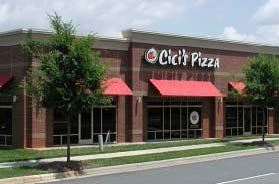
All Buildings to Front on Street or Public Space: All buildings except for buildings in the M&I District shall front on a public street or public space. Such buildings shall include a principal building entrance and architectural front. With the provision of alley access, lots may front upon a public open space which shall have public street access, but shall be of sufficient design to allow for access by emergency services.
B.
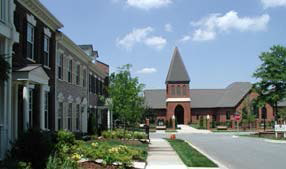
Building Entrances: A primary entrance facade shall be oriented toward the street, be designed for the pedestrian, and be distinguishable from the rest of the building and other entrances. Additional entrances may be oriented toward side or rear parking lots. Service entrances for shipping and receiving shall be oriented away from the public street.
C.
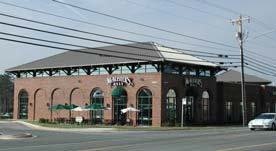
Architectural Style: When a building design exhibits a known architectural style (e.g., Colonial, Victorian, Classical Revival) the details shall be complementary with that style.
D.
Termination of Vistas: Important street vistas identified in any adopted plan should terminate in a focal point, such as a building or other architectural or natural feature.
E.
Compatibility: Adjacent buildings should relate in similarity of scale, roof pitch, height, architectural elements, and/or lot configuration.
F.
Wall Materials: When two or more materials are used on a facade, the visually heavier material (i.e., masonry) should be placed below the lighter material (i.e., siding) to give the sense of support and grounding.
G.
Underground Wiring: To reduce the visual impact of overhead wiring, new utility services shall be located underground.
H.
Type of Construction: Manufactured, mobile, and metal units shall be prohibited, except as may be allowed in Section 4.6, Temporary Uses, for a temporary office or classrooms, site management, or storage uses during construction projects.
I.
Roof Pitch: Roof pitches less than 4:12 and flat roofs will require a parapet wall.
J.
Public Art: Public art, such as statues, fountains, and other works of art are encouraged.
5.4 - Exceptions
A.
While it is expected that some new building types will be introduced to the Town, these variations should be based upon the predominant types listed in this Chapter. Innovative planning or design ideas for development in any district where the proposed building types are different than those allowed by the base district requirements may be approved subject to the approval of a Conditional District.
B.
Buildings in the M&I District are exempt from the building design requirements of this chapter, except for those requirements in Section 5.6, Encroachments.
C.
Where specific architectural elements are required as part of an adopted plan or associated with local historic guidelines, these shall take precedence over the building design requirements of this chapter.
5.5 - Building Heights
Building heights shall be as specified in the building type sections that follows and shall be determined according to the provisions below.
A.
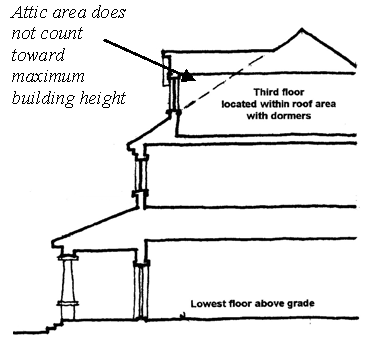
Story: That part of a building or building above ground level and between a floor and the floor or roof next above shall be considered a story. A mezzanine shall be considered a story if it exceeds one-third of the area of the floor immediately below. A penthouse shall be considered a story if it exceeds one-third of the area of the roof. The under-roof area with dormers does not count as a story.
B.
Items Not Included in Calculation: The height limitations of this Ordinance shall not apply to church spires, belfries, cupolas, and domes not intended for human occupancy, monuments, water towers, mechanical penthouses (provided they are set back 20 feet from the front elevation), observation towers, transmission towers, chimneys, smokestacks, conveyors, flagpoles, masts and antennas (provided evidence from appropriate authorities is submitted to the effect that such building or buildings will not interfere with any airport zones or flight patterns).
As noted above, the portion of a residential building that is located within a pitched roof areas (attic area) shall not be counted toward the maximum story requirement.
5.6 - Encroachments
Certain architectural features are permitted to encroach into the front setback (except as noted). The following standards shall be established for encroachments:
A.
Arcades: Building arcades, if provided, should be designed to avoid the swing of car doors parked parallel to the arcade. In addition the sidewalk within the arcade should be sufficient to accommodate the intended uses (i.e. outdoor seating) while providing suitable clearances per the American with Disabilities Act Accessibilities Guidelines (ADAAG).
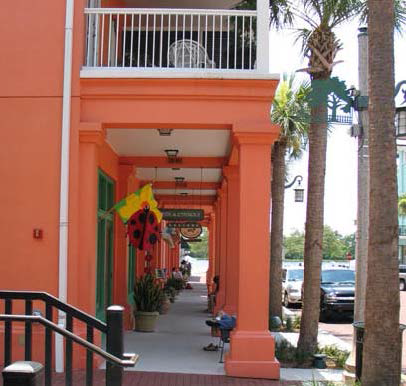
Building arcades should avoid the swing of car doors and provide adequate space for
pedestrians.
B.
Awnings: All commercial awnings, if provided, may encroach and shall be supported by means of a frame attached directly to the building receiving beneficial use of the awning. In no case shall awnings be supported by a frame attached to a sidewalk or other public right-of-way.
C.
Bay Windows: Commercial Bay windows shall not exceed a maximum projection of two feet from the primary wall. In addition, it shall not contain habitable floor space, but may provide seating as an integral element.
D.
Balconies, Porches, and Stoops: Only open balconies, porches, and stoops are permitted as encroachments. To the extent possible, these features are to remain visually permeable so that the front door can be easily seen from the street or sidewalk. Roofs and Ordinance-required railings are permitted. Enclosure of these areas with screening is considered an enclosure for the purposes of this section.
E.
Handicapped Ramps: A ramp installed on a residential building to provide access for a disabled resident may encroach into the front setback, unless a less obtrusive means of access can be provided at another entry point (i.e., the back door).
F.
Rear Yard Encroachments: Open decks, porches, patios, and other similar buildings not exceeding a finished height above grade of 30 inches may encroach into the side and rear setback to within five feet of the property line.
G.
Encroachments over the Public Rights-of-Way: With approval of the Town or NCDOT (whichever has authority over a street), upper story balconies or bay windows may encroach into the right-of-way, but shall be a minimum of three feet behind the curb.
H.
Shrubbery, Driveways, Retaining Walls, Fences, Curbs, Ornamental Objects, and Buffer strips: Shrubbery, driveways, retaining walls, fences, curbs, ornamental objects, and planted buffer strips shall not be construed to be encroachments on yards.
5.7 - Building Type Summary Table
There are seven major building types provided for in this ordinance. These include:
•
Civic Building
•
Institutional Building
•
House
•
Townhouse
•
Apartment Building
•
Mixed-Use Building
•
Commercial Building
The sections that follow outline the specific design standards for the various building types. The table below indicates the zoning districts in which the various building types are allowed.
• = building type allowed
* = see Section 2.14
5.8 - General Design Requirements for Residential Building Types
The following standards apply to all apartment buildings and manufactured housing.
A.
Materials.
1.
Building Walls:
a.
Building walls shall be primarily clad in wood clapboard, cementitious fiber board, wood shingle, wood drop siding, primed board, wood board and batten, brick, stone, stucco, vinyl, or synthetic materials similar and/or superior in appearance and durability.
b.
Vinyl: Vinyl may only be used on buildings that are no closer than 30 feet from the next closest building and that do not contain mixed occupancy or attached dwelling units.
c.
EIFS: Exterior insulation finishing systems (EIFS) may be used above eight feet from the base of residential buildings (Townhouse, Apartment and Mixed-Use buildings only) and may not be used for House building types.
2.
Roofs: Roofs shall be clad in wood shingles, asphalt shingles, standing seam metal, terne, slate, or synthetic materials similar and/or superior in appearance and durability.
B.
Other Requirements.
1.
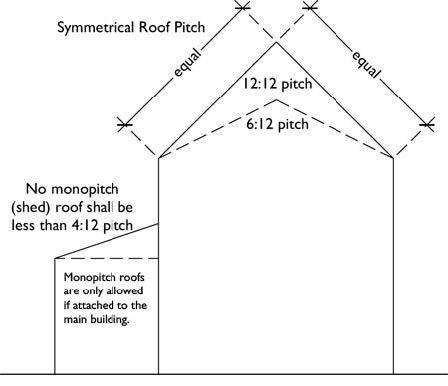
Roof Pitch: Main roofs on House or Townhouse-type buildings shall have gables or hips with a front pitch between 6:12 and 12:12. Monopitch (shed) roofs are allowed only if they are attached to the wall of the main building. No monopitch roof shall be less than 4:12.
2.
Crawlspace: The crawlspace of buildings shall be enclosed with solid/permanent material that complements the dwelling style.
3.
Overhanging Eaves: Overhanging eaves may expose rafters.
4.
Flush Eaves: Flush eaves shall be finished by profiled molding or gutters.
5.
Visitability/Accessibility Standard: For residential buildings in developments designed for residents aged 55 and older, there shall be provided one zero-step entrance to each building from an accessible path at the front, side, or rear of each building. This does not eliminate the requirements for residential buildings to have raised front entrances.
5.9 - Building Type: House
A.
Description: The house is the predominant building type in the Town of Wendell. This building type is flexible in use, accommodating: single family uses, home occupations, professional offices, and limited retail uses based on the zoning district in which it is located.
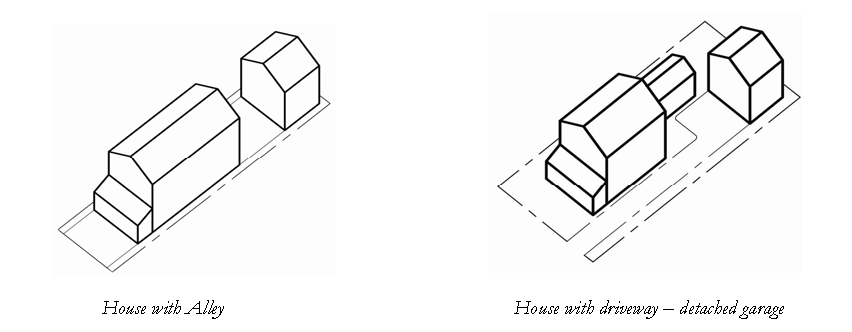
The two basic House building types—House with Driveway and House with Alley—are a function of how the lot is accessed by automobile.
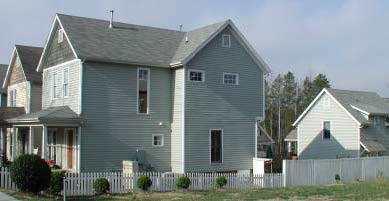
House with detached garage and alley
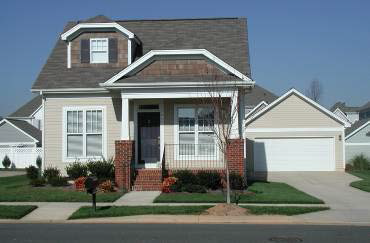
House with driveway
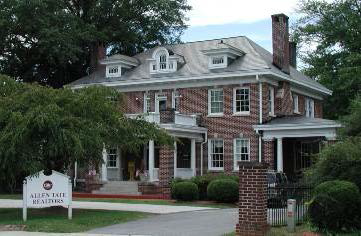
House: Professional Offices
In general, within a block, building types should be uniform in their use of driveways or alleys.
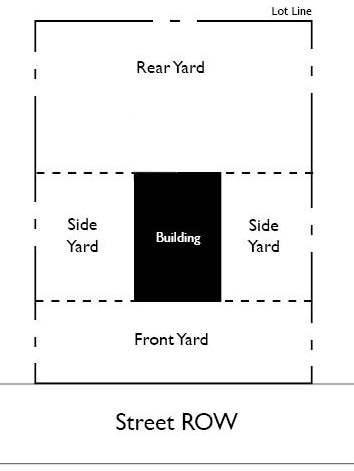
B.
Yards: The House typically has four yards (front yard; two side yards; and rear yard). Variations include setting the building on one of the side property lines.
C.
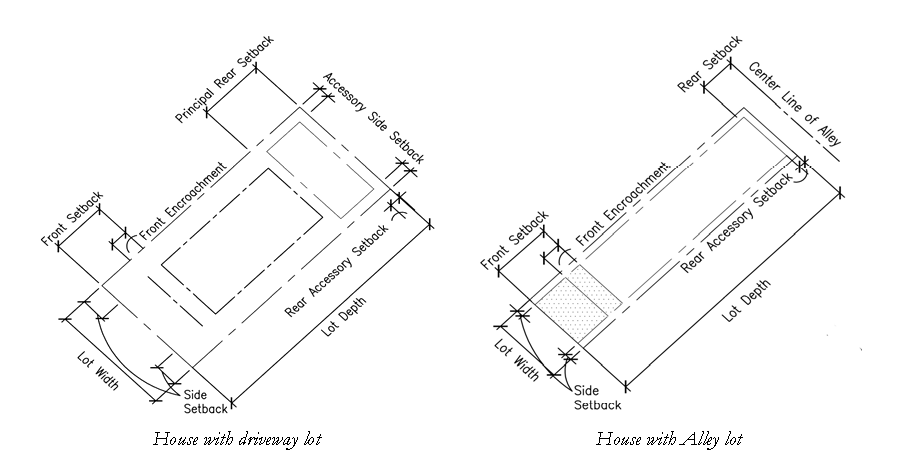
Dimensional Standards by Zoning District: The House building type is allowed in the zoning districts noted in the table below according to the dimensional standards noted therein.
Notes:
(a) See Chapter 2 for additional dimensional standards.
(b) For corner lots, the building shall utilize the front setbacks for both streets.
(c) Balconies, stoops, stairs, chimneys, open porches, bay windows, and raised doorways are permitted to encroach into the front setback. See section 5.6 Encroachments.
(d) In new developments only (vs. infill lots), the entire setback may be allocated to one side with a minimum of six feet total building separation, providing the setback condition is consistent with the block.
(e) Accessory Structure either needs to be attached or must have at least four feet of separation.
(f) Where garages are allowed see 5.9D1b.
D.
General Requirements:
1.
Garages and Off-Street Parking Location:
a.
For houses on lots less than 50 feet wide, garages or off-street parking areas shall be accessed from an alley leading to a detached garage or parking area.
b.
No garage door shall be any closer than 20 feet from the right-of-way.
c.
All garages with more than two bays shall be turned such that no more than two bays are visible from the street.
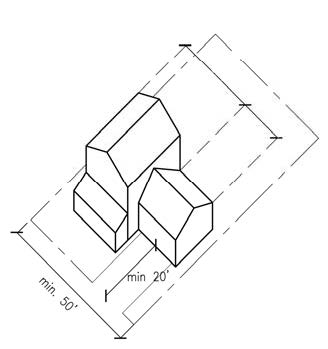
House with driveway—attached garage
E.
Additional Requirements for Manufactured Housing: In addition to the above criteria, a manufactured home must bear a seal certifying it was built to the standards adopted on July 1, 1976 by the U.S. Department of Housing and Urban Development. In addition, manufactured homes must also satisfy each of the following criteria:
1.
A continuous, permanent brick or architectural Concrete Masonry Unit (CMU) foundation or curtain wall, unpierced except for required ventilation and access, shall be installed upon a poured concrete footer after placement on the lot, and before occupancy.
2.
Stairs, porches, entrance platforms and other means of entrance and exit to the manufactured home shall be installed and constructed in accordance with the standards set by the N.C. Department of Insurance. The entrance platform shall be a minimum of 24 square feet.
3.
The roof of the manufactured home shall have an eave extending at least ten inches from each vertical exterior wall. A site installed gutter may be counted in the width of the eave.
4.
The front facade of the building shall extend parallel to the street right-of-way.
5.
The manufactured home is set up on the site in accordance with the standards set by the N.C. Department of Insurance.
6.
The tongue, axles, transporting lights, and removable towing apparatus are removed after placement on the lot and before occupancy.
(Ord. No. O-4-2017, § 2, 1-9-2017)
5.10 - Townhouse Buildings
A.
Description: The townhouse is a building with two or more residential units that are located side by side. The use permitted within the building is determined by the District in which it is located. When an entrance is provided at-grade, the townhouse may be used as a live-work unit. Standards in this section are also applicable to duplex dwellings.
B.
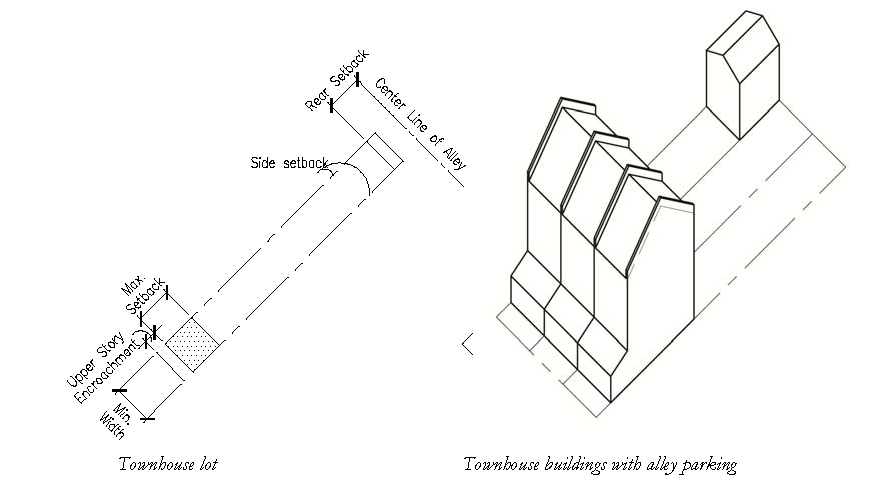
Yards: The Townhouse typically has one yard (Rear) though variations include a small front setback to provide some landscaping.
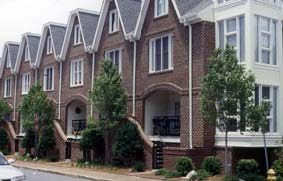
Townhomes with Alley
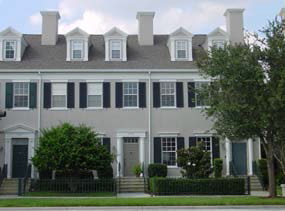
Townhomes with Alley
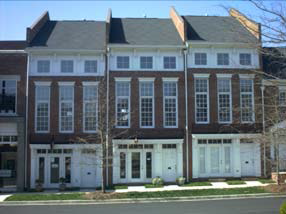
Live-Work Townhomes
C.
Dimensional Standards by Zoning District: The Townhouse building type is allowed as a Special Use in the zoning districts noted in the table below according to the dimensional standards noted therein.
Notes:
*The front setback shall be 20 feet when vehicular access/garage is located on the front elevation of the townhouse. The rear setback shall be 20 feet when vehicular access/garage is located on the rear elevation of the townhouse.
(a) Along designated thoroughfares or collector streets, the minimum front setback shall be ten feet.
(b) Balconies, stoops, stairs, chimneys, open porches, bay windows, and raised doorways are permitted to encroach into the front setback. Upper story balconies may encroach into the right-of-way (over the sidewalk only) with permission from the Administrator.
D.
General Requirements.
1.
Bulk and Scale: The bulk and scale of townhouse infill development shall be similar to and consistent with the surrounding neighborhood as evaluated by the bulk of buildings adjacent, abutting and surrounding the proposed development.
(Ord. No. O-07-2022, § 1, 2-14-2022)
5.11 - Apartment Buildings
A.
Description: A multiple-unit building with dwelling units vertically arranged (generally) and with parking located below or behind the buildings. Units may be for rental or for sale in condominium ownership or may be designed as continuing care facilities. The ground floor may be available for commercial uses. The uses permitted within the building are determined by the District in which the building is located.
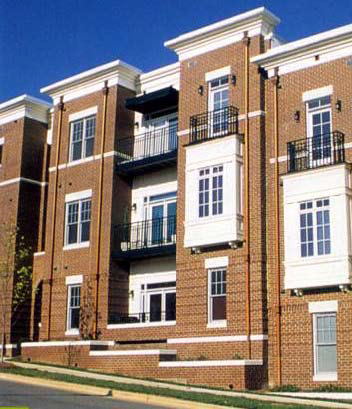
Multi-Family Apartment Building
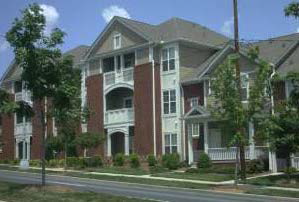
Multi-Family Apartment Building
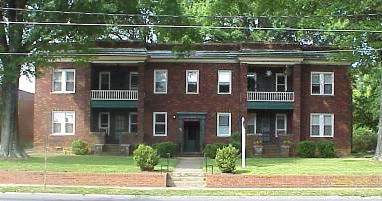
Eight-Plex Apartment Building
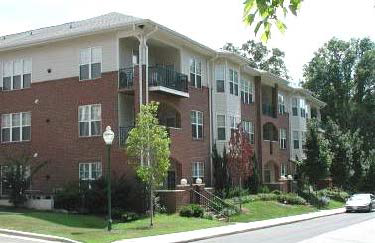
Multi-Family Apartment Building
B.
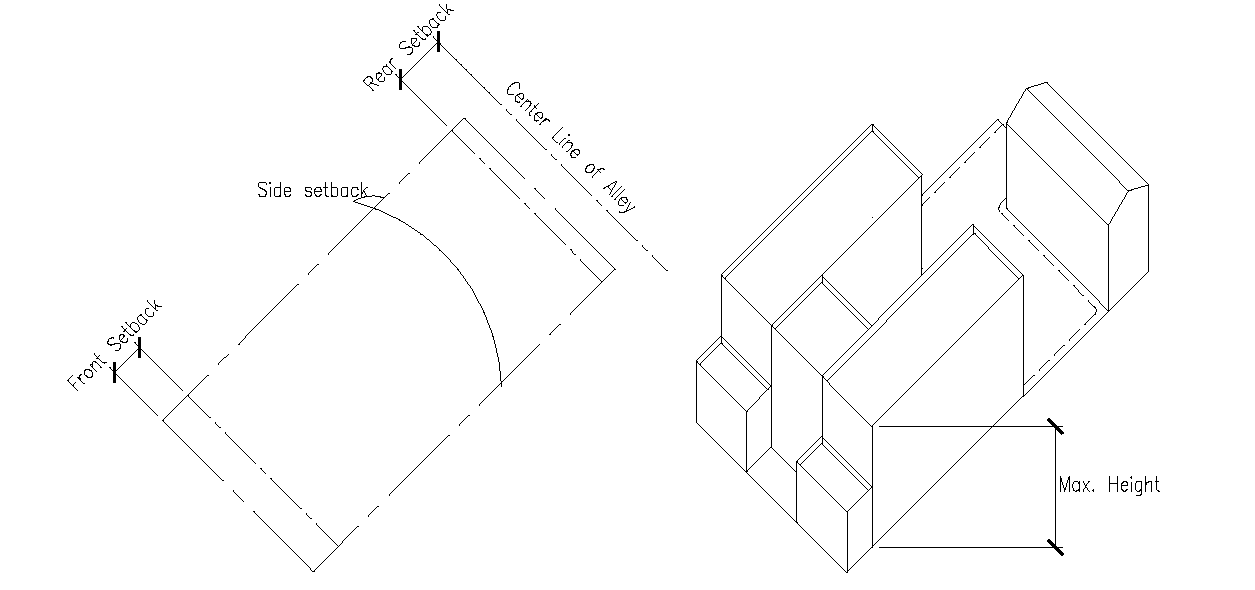
Yards: The Apartment Building typically has one yard (Rear) though variations include a small front setback to provide some landscaping.
C.
Dimensional Standards by Zoning District: The Apartment building type is allowed as a Special Use in the zoning districts noted in the table below according to the dimensional standards noted therein.
Notes:
(a) Along designated thoroughfares, the minimum front setback shall be ten feet.
(b) Balconies, stoops, stairs, chimneys, open porches, bay windows, and raised doorways are permitted to encroach into the front setback. Upper story balconies may encroach into the right-of-way (over the sidewalk only) with permission from the Administrator.
D.
General Requirements.
1.
Bulk and Scale: The bulk and scale of apartment infill development shall be similar to and consistent with the surrounding neighborhood as evaluated by the bulk of buildings adjacent, abutting and surrounding the proposed development. All buildings should be designed to adhere to the existing architectural pattern of the surrounding neighborhood.
2.
Porches and Stoops: Useable porches and stoops shall form a predominate motif of the building design and be located on the front and/or side of the building. Useable front porches are at least eight feet deep and extend more than 30 percent of the facade width.
3.
Garage Doors: Garage doors are not permitted on the front elevation of any apartment building.
4.
Building Elevations: All building elevations visible from the street shall provide doors, porches, balconies, and/or windows. A minimum of 60 percent of front elevations, and a minimum of 30 percent of side and rear building elevations, as applicable, shall meet this standard. "Percent of elevation" is measured as the horizontal plane (lineal feet) containing doors, porches, balconies, terraces and/or windows. This standard applies to each full and partial building story.
5.
Raised Entrances: All front entrances shall be raised from the finished grade (at the building line) a minimum of one and one-half feet.
6.
Design Details: All apartment buildings shall provide detailed design along all primary elevations and elevations facing a public street or open space. Detailed design shall be provided by using at least three of the following architectural features as appropriate for the proposed building type and style (may vary features on rear/side/front elevations):
a.
Dormers.
b.
Gables.
c.
Recessed entries.
d.
Covered porch or stoop entries.
e.
Cupolas or towers.
f.
Pillars or posts.
g.
Eaves (minimum ten-inch projection which may include gutter).
h.
Off-sets in building face or roof (minimum 16 inches).
i.
Window trim (minimum four inches wide).
j.
Bay windows.
k.
Balconies.
l.
Decorative patterns on exterior finish (e.g., scales/shingles, wainscoting, ornamentation, and similar features).
m.
Decorative cornices and roof lines (for flat roofs).
n.
Other architectural features appropriate to the architectural style of the unit.
7.
Roof Pitch: If pitched roofs are used, they shall be symmetrical gables or hips with a pitch between 6:12 and 12:12.
8.
Rooftop Equipment: All rooftop equipment shall be screened from view.
5.12 - General Design Requirements for Building Types: Mixed-Use, Commercial, Civic, Institutional
A.
Facade Treatment.
1.
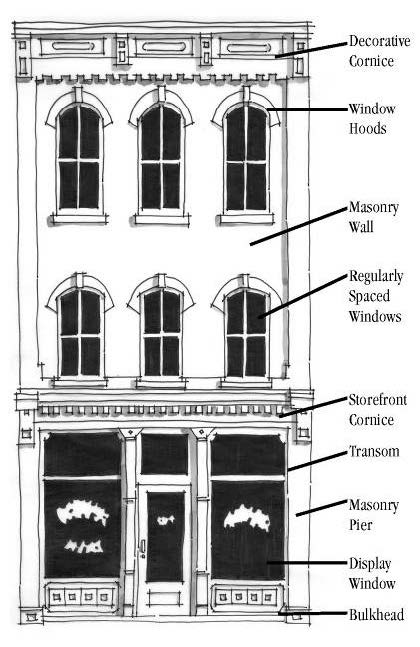
Architectural Elements: Architectural elements such as windows and doors, bulkheads, masonry piers, transoms, cornice lines, window hoods, awnings, canopies, and other similar details shall be provided on all facades facing public rights-of-way.
2.
Building Wall and Roofline Offsets: Building wall offsets, including projections, recesses and changes in floor level shall be used in order to add architectural interest and variety, relieve the visual effect of a single, long wall; and subdivide the wall into human size proportions. Similarly, roofline offsets shall be provided to lend architectural interest and variety to the massing of a building and to relieve the effect of a single, long roof.
B.
Ground Level Treatment: The ground level of the building shall offer pedestrian interest along sidewalks and paths. This includes windows, entrances, and architectural details. Incidental signage on buildings (in accordance with Chapter 12), awnings and ornamentation are encouraged.
1.
Street Walls: The first floors of non-residential buildings (NC, CC, CMX, DMX, and TND only) and all mixed-use buildings shall be designed to encourage and complement pedestrian-style interest and activity by adhering to the following provisions:
a.
Windows and Doors: The first floor of all buildings fronting directly on a street shall include transparent windows and doors arranged so that the uses inside are visible from and/or accessible to the street on at least 40 percent (65 percent for NC, CC and DMX) of the length of the first floor building elevation along the first floor street frontage.
b.
Window dimensions:
i.
Maximum Sill Height (1st Floor): 42 inches (as measured from the finished floor elevation).
ii.
Minimum Area: 16 sq. ft.
iii.
Minimum Width: three feet.
iv.
Minimum Height: four feet.
c.
Blank Walls: Expanses of blank walls may not exceed 25 feet in length. (A "blank wall" is a facade that does not contain transparent windows or doors.)
i.
Facades without transparent windows or doors must be divided into architecturally distinct sections or bays with each section taller than it is wide and no wider than 25 linear feet. The following techniques may be used to delineate the different bays:
a.
The use of columns, ribs, pilasters piers, or an equivalent element that otherwise visually subdivides the wall through at least 50 percent of its height.
b.
The use of parapets, arches, wing walls, or porches that extend from the vertical plane of the facade at least six feet; and/or
c.
The incorporation of a clearly defined, highly visible, public entrance that features one or more of the following: canopies, awnings, porticos, colonnades, arcades or similar weather protection.
ii.
Rear Facades which do not front streets or civic gathering places and which do not adhere to the standards in Section 5.12.B.1.c.i must be screened from view by a Type B buffer.
d.
Ventilation Grates and Exit Doors: Ventilation grates or emergency exit doors located at the first floor level in the building facade, which are oriented to any public street, shall be decorative.
C.
Building Entrances: A primary entrance facade shall be oriented toward the street, be designed for the pedestrian, and be distinguishable from the rest of the building. Such entrances shall provide a sense of entry and add variety to the streetscape. Additional entrances may be oriented toward side or rear parking lots. Service entrances for shipping and receiving shall be oriented away from the public street.
D.
Building Canopy: A building canopy, awning, or similar weather protection may be provided and should project a minimum of five feet from the facade when used above a primary building entrance.
E.
Materials: The standards in this subsection shall apply to all facades except rears, unless facing streets or civic gathering places.
1.
At least 80 percent of the facades shall consist of one or more of the following approved materials: Brick or glazed brick, wood, cementitious fiber board, stone, cast stone, stone masonry units, architectural concrete block, metal composite panels, glass, marble or similar material. Metal composite panels shall be a minimum of 2' × 2' in size and shall have a generally flat appearance (i.e. shall not have a corrugated or lap-siding exterior appearance). All buildings which use metal composite panels as a facade material shall include a non-metal base around all sides of the building.
2.
Facades may also consist of the following materials provided that they comprise no greater than 20 percent of the facade area: Concrete masonry units (CMU), Exterior insulation finishing systems (EIFS), split face block, concrete (pre-cast or cast in place), or concrete block. Cinder block is not permitted.
3.
Pitched roofs shall be clad in wood shingles, standing seam metal, corrugated metal, slate, or asphalt shingles.
F.
Screening of Utility Elements: Utility devices (including, but not limited to, HVAC units, storage tanks, compactors, generators, etc.) must not be visible from the public right-of-way or private street. If ground mounted this may be through the use of fences/walls and landscaping. All roof-mounted elements shall be 100 percent screened from view from the public right-of-way and/or adjacent properties, preferably through the use of parapet walls. If not feasible with a parapet, another screening device of similar color and material that is compatible with the principal building may be used.
(Ord. No. O-19-2022, § 2, 7-11-2022)
5.13 - Mixed-Use Building
A.
Description: A multi-story small scale structure which can accommodate a variety of uses. A group of mixed-use buildings can be combined to form a mixed-use neighborhood center. Individual mixed-use buildings can be used to provide some commercial service, such as a neighborhood store, in close proximity to homes. The uses permitted within the building are determined by the District in which it is located.
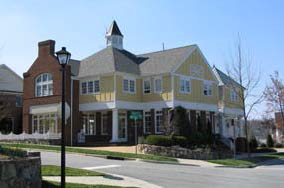
Office over Retail/Restaurant
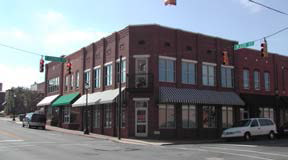
Office over Retail/Office
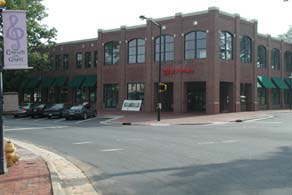
Residential/Office over Retail

Office over Office/Retail
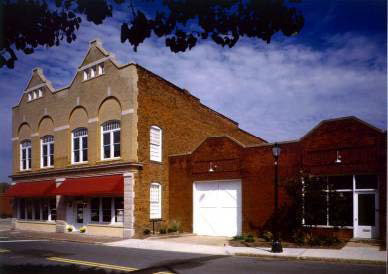
Residential over Residential/Office/Retail
B.
Yards: The Mixed-Use Building typically has one yard (Rear) though variations include a small front plaza or courtyard to provide public space for outdoor seating as well as a building with complete lot coverage where parking is handled in a manner other than on-site surface parking.
C.
General Requirements: Building Height. Mixed-use buildings shall have a minimum of two stories.
D.
Dimensional Standards by Zoning District: The Mixed-use building type is allowed in the zoning districts noted in the table below according to the dimensional standards noted therein.
Notes:
(a) Along designated thoroughfares, the minimum front setback shall be ten feet.
(b) Balconies, stoops, stairs, chimneys, open porches, bay windows, and raised doorways are permitted to encroach into the front setback. Upper story balconies may encroach into the right-of-way (over the sidewalk only) with permission from the Administrator.
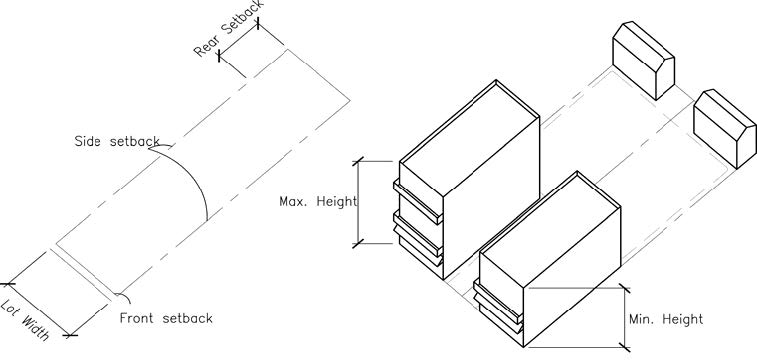
5.14 - Commercial Building
A.
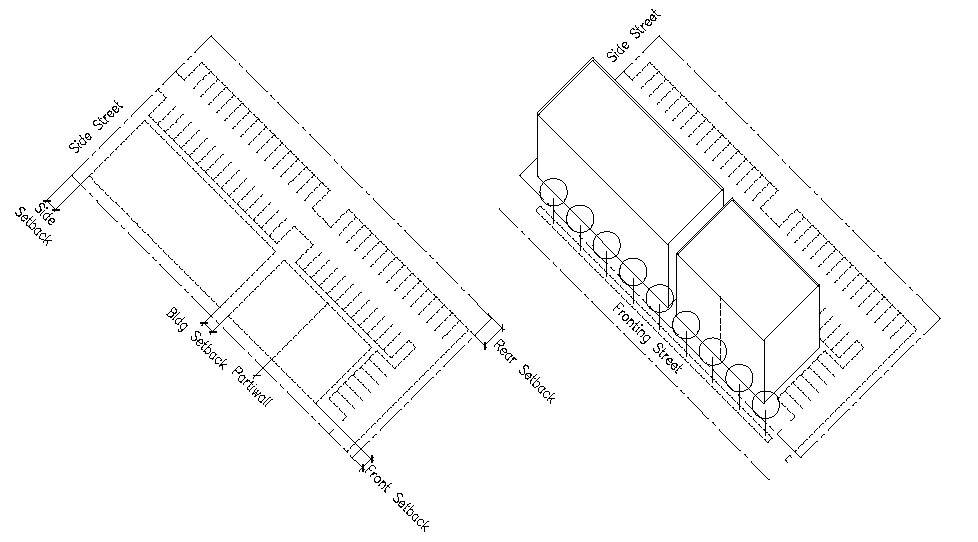
Description: This building type provides convenient automobile access from the fronting thoroughfare, while minimizing impacts of parking lots on an active pedestrian realm. The uses permitted within the building are determined by the District in which it is located.
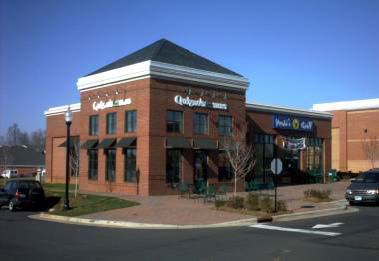
Retail
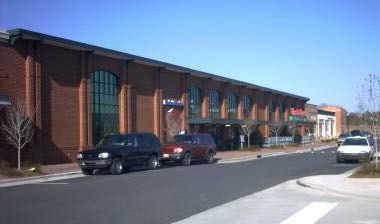
Grocery Store
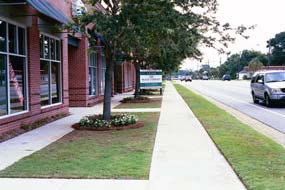
Retail along a thoroughfare
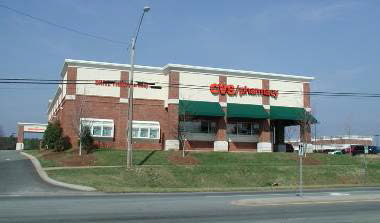
Pharmacy with Drive Thru
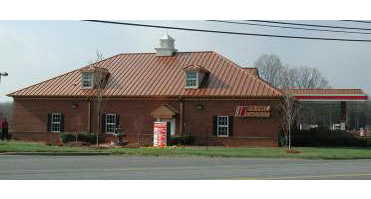
Gas Station
B.
Yards: The Commercial Building typically has one yard (Rear) though variations include a small front plaza or courtyard to provide public space for outdoor seating.
C.
Dimensional Standards by Zoning District: The Commercial building type is allowed in the zoning districts noted in the table below according to the dimensional standards noted therein.
Notes:
(a) Along designated thoroughfares, the minimum front setback shall be ten feet.
(b) Balconies, stoops, stairs, chimneys, open porches, bay windows, and raised doorways are permitted to encroach into the front setback. Upper story balconies may encroach into the right-of-way (over the sidewalk only) with permission from the Administrator.
5.15 - Civic
A.
Description: The Civic Building serves as a landmark and a public gathering place. Such buildings should be constructed as permanent additions to the long-term vibrancy of the Town and should serve to exemplify the very best architectural designs and building practices.
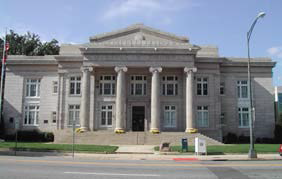
Courthouse
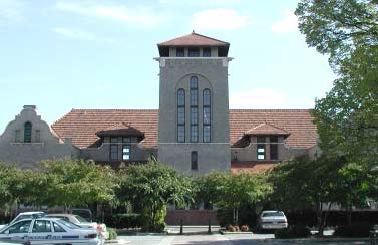
Transportation Terminal
B.
Applicability: The Civic Building type includes public buildings such as town halls, libraries, transit stations, and post offices, as well as semi-public buildings such as museums and observatories.
C.
Requirements:
1.
They should be built so that they terminate a street vista whenever possible.
2.
They should be designed to create visual anchors for the community.
3.
Two wall materials may be combined horizontally on one facade. The heavier material (based on appearance) should be below. (i.e., stone and brick are visually heavier than siding and shakes).
4.
All rooftop equipment shall be screened from view.
5.16 - Institutional
A.
Description: Institutional Buildings also often serve as landmarks and public gathering places. However, because most institutional uses serve specialized populations (i.e., children, elderly, college students, or the infirmed) they have unique characteristics that require design control. Like Civic buildings, Institutional buildings should be constructed as permanent additions to the long-term vibrancy of the Town and should serve to exemplify the very best architectural designs and building practices.
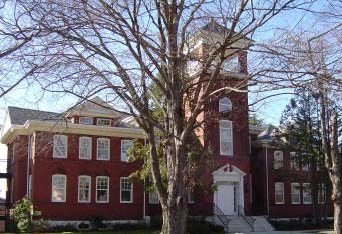
College Building

Church
B.
Applicability: Uses appropriate for the Institutional building type include governmental offices, schools, hospitals and long-term care facilities, churches, synagogues and non-profit or charitable clubs and organizations.
C.
General Requirements:
1.
Institutional buildings should be of sufficient design to create visual anchors for the community.
2.
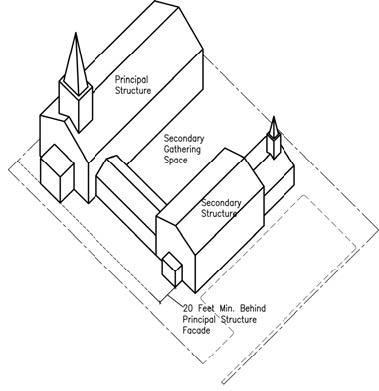
Secondary Buildings: Building(s) incidental to the principal structure shall be behind line a minimum of 20 feet behind the front facade of the principal structure, and if more than one, shall be arranged to create secondary gathering spaces within the lot.
3.
Building Walls: Institutional building walls shall be clad in clapboard, stone, stucco, cementitious fiber board, brick, or marble. Decorative concrete masonry units (CMU), exterior insulation finishing systems (EIFS) and/or vinyl siding may be used as a secondary element, or on facades not facing public streets.
4.
Roofs: Flat roofs are allowed, but principal buildings adjacent to residential structures shall have similar architectural features such as pitched roofs to ensure compatibility.