
Apple Valley City Zoning Code
CHAPTER 9
36 - Specific Use Regulations/Commercial and Office Districts
9.36.010 - Purpose and General Plan Consistency
The purpose of this Chapter is to implement the General Plan and the Comprehensive Economic Development Plan through the use of regulations for specific types of uses. In the implementation of the provisions of this Development Code, It is recognized that there are some uses that, because of their very nature, have potentially serious objectionable operational characteristics. Special regulation of these uses is necessary to ensure that these uses do not produce adverse effects and contribute to a blighting or downgrading of the surrounding neighborhood.
In addition, the purpose of this Chapter is to guide the growth and development of the Town in an orderly manner consistent with the goals, policies and action plans of the General Plan and the Comprehensive Economic Development Plan; to protect and enhance the quality of the natural and improved environment; and to promote the public health, safety and welfare by achieving the following:
A.
Providing appropriately located areas for office uses, retail stores and service establishments to meet the needs of the Town.
B.
Supporting development compatible with surrounding uses and neighborhoods while suggesting uniqueness and character.
C.
Providing for open spaces and areas for landscaping through the use of Site Development Standards to protect the property values of existing business developments from inappropriately located uses and to enhance the investment of residents and business owners.
D.
Encouraging commercial and office uses to be grouped.
E.
Allowing for the development of projects that include residential and commercial and/or office development in an integrated, master planned project in the Mixed Use zone.
The Town Council finds that specific use regulations such as, but not limited to, restricting of location, minimum distance from similar uses, minimum distance from residential uses, religious, educational, or other sensitive facilities or uses, and clustering of uses, are necessary for potentially objectionable uses to protect the public health, safety and welfare and achieve the goals of adopted Town plans.
The provisions of this Chapter shall prevail over conflicting provisions of any other Chapter of this Development Code, except Chapter 9.07, Nonconforming Uses and Structures, of this Code, and shall be in addition to any other applicable regulations and ordinances.
9.36.015 - High Desert Corridor Near Commercial Districts
A.
Applicability. The following regulations shall apply to all Commercial Districts adjacent to or abutting the High Desert Corridor.
B.
General Provisions. Any proposed commercial development occurring adjacent to the High Desert Corridor shall submit a request letter to the California Department of Transportation (Caltrans) in order to ascertain Caltrans requirements for development occurring in proximity to the High Desert Corridor. Current contact information for the High Desert Corridor design/construction team shall be available in the Planning and Engineering Divisions at the Town offices.
9.36.020 - Accessory Uses
A.
Purpose. The purpose of this Section is to mitigate the potential adverse health, safety and aesthetic impacts of accessory uses, consistent with the goals, objectives and policies of the General Plan.
B.
Accessory Uses in Pedestrian Malls. Accessory uses may be located in pedestrian mall areas provided that:
1.
There are no entrances directly from the street to such businesses.
2.
There are no signs or other evidence indicating the existence of such businesses visible from the outside.
3.
Such uses are limited to 200 square feet and shall not be permanently affixed to the floor of the mall.
C.
Accessory Wholesaling. Retail establishments may include accessory wholesaling, but not wholesale distribution centers. For purposes of this Chapter, accessory wholesaling is defined as wholesaling not to exceed twenty (20) percent of the gross floor area of the establishment.
D.
Accessory Uses for Service Stations. The following accessory uses may be permitted in conjunction with a service station:
1.
Vehicle washing and lubricating services;
2.
The sale and servicing of tires, batteries, replacement items and other automotive accessories;
3.
Minor automotive repair, within an enclosed building;
4.
Towing service limited to two (2) tow trucks.
9.36.030 - Adult Businesses
A.
Purpose and General Plan Consistency. The purpose of this Section is to establish reasonable and uniform regulations for the location, development, and operation of adult businesses within the Town of Apple Valley. The following objectives have been formulated for adult businesses to implement the goals, objectives, policies and action plans of the General Plan and the Comprehensive Economic Development Plan:
1.
Permit adult businesses in a manner that will not adversely affect the family oriented environment of the Town.
2.
Permit the establishment of adult businesses in the Town in locations which will minimize negative impacts on the community image and that will avoid creating nuisances among adjacent land uses.
3.
The purpose of this Section is not to establish community standards on obscenity or to restrict free expression, but to provide appropriate areas where adult materials and entertainment can be exhibited without nuisance to those who may be harmed or offended by exposure to such materials or entertainment.
4.
Maintain and protect the economic vitality and property values of neighborhoods by preventing a concentration of adult uses in any one area.
5.
Provide locations for adult businesses that would minimize public view of the use to residential areas, schools, churches, public parks and playgrounds, and other areas where minors are likely to congregate.
6.
Promote appropriate exterior design standards that would minimize general public view of materials or activities that are strictly limited to adults.
B.
Adult Businesses in the General Commercial C-G District. Adult businesses are permitted, subject to approval of a Conditional Use Permit, only in the C-G District. The following are included as adult entertainment businesses:
1.
Adult Arcade;
2.
Adult Bookstore;
3.
Adult Cabaret;
4.
Adult Hotel and Motel;
5.
Adult Motion Picture Theater;
6.
Adult Theater;
7.
Reserved;
8.
Sexual Encounter Establishment;
9.
Other Adult Entertainment Businesses.
C.
Development Standards
1.
Adult businesses shall exhibit the same high standards of site planning, architecture and landscape design required of all commercial developments.
2.
All development standards of the zoning district in which the adult business is located shall be applied.
3.
The interior of any bookstore shall be lighted and constructed so that every portion thereof is readily visible to the clerk or other supervisory personnel from the counter or other regular station.
4.
Advertisements, displays, or other promotional materials shall not be shown or exhibited so as to be visible to the public, from a public right-of-way, from pedestrian sidewalks or walkways, from areas where minors are allowed, or from other public or semi-public areas.
5.
All adult entertainment businesses shall be designed and constructed to blend into, and appear as an integral part of, the built environment that characterizes the surrounding area.
6.
Vehicle parking and public entry to free-standing adult businesses shall be located along the street frontage.
D.
Signs
1.
No exterior signs or graphics shall be permitted which display or represent specified anatomical areas or specified sexual activities.
2.
An interior sign, with a surface area of at least four (4) square feet, shall be posted in a prominent location within the adult entertainment business, stating in both English and Spanish the following:
3.
Exclusion of Minors. Access to any adult entertainment business by a minor is prohibited. A sign, approved by the Director shall be posted at all entrances restricting inclusion or entrance of minors. No minors shall be employed in an adult entertainment business nor permitted entrance to the premises.
E.
Location Requirements.
1.
No adult entertainment businesses shall be established or conducted within one thousand (1,000) feet [5] of:
•
Another adult entertainment business;
•
A public or private school for minors;
•
A licensed day care facility for minors;
•
A church, synagogue, or other religious facility;
•
A park, library, or other public facility;
•
Any residential use or district, including hotels, motels or other transient lodging;
Any State highway or river.
2.
No adult entertainment business shall be located on a lot abutting State highway right-of-way or on a lot abutting street right-of-way designated by the Streets and Roads Plan of the General Plan as major divided or major roads.
F.
Exterior Display
1.
No adult entertainment business shall be operated in such a way so as to permit the observation of material or activities depicting or describing "Specified Anatomical Areas" or "Specified Sexual Activities" from any location outside of the building in which an adult entertainment business is operating.
2.
All building openings, doors, windows, and the like, shall be screened in such a way so as to prevent a view from outside of the building into that portion of the interior of an adult entertainment business where any activities or displays relating to "Specified Anatomical Areas" or "Specified Sexual Activities" are occurring or portrayed.
G.
Operational Requirements
1.
All activities pertaining to the operation of an adult entertainment business shall be conducted inside the walls of the proposed building, out of sight and sound from any location outside the building. This provision does not apply to approved outdoor signage for the purpose of notifying potential customers of the business.
2.
Within the adult entertainment business, all image-producing devices shall be located so that the machines are open to view from any side and are without obstructions or separations that would block from open sight any patrons using said machines.
3.
A responsible adult shall be present on the premises at all times and shall observe and supervise the use of all image-producing devices and all areas of the business available to public access. Adult entertainment businesses containing more than forty (40) image-producing machines shall require the presence of two (2) responsible adults to observe and supervise all areas of the business available to public access.
H.
Lighting
Adult entertainment businesses, except adult theaters and adult motion picture theaters, shall maintain a light level of at least two (2)-candlefoot power at floor level in every portion of the establishment to which the public is admitted.
I.
Maximum Occupancy
1.
No person shall operate an adult entertainment business in which the number of persons in any room or partitioned portion of a room where an image-producing device is located exceeds a density of one (1) person per thirty (30) square feet. The maximum occupancy permitted in any room or partitioned portion of a room in which an image-producing device is located shall be conspicuously posted by the operator and shall remain posted at the entrance to each room or partitioned portion of a room.
2.
No person shall operate an adult entertainment business in which the number of image-producing devices exceeds the maximum occupancy load of any room or partitioned portion of a room in which an image-producing device is located.
J.
Nonconforming Adult Entertainment Businesses
1.
Any adult entertainment business that has been legally established and conducted prior to the time of the effective date of the adoption of this Chapter, February 10, 1994, and not in conformance with the requirements of this Chapter is deemed to be a legal nonconforming use.
2.
Legal nonconforming uses are required to comply with the requirements of this Chapter within forty-eight (48) months of the adoption of this Chapter. If compliance with the provisions of this Chapter is not possible, then the legal nonconforming use shall cease to operate within forty-eight (48) months of the effective date of this Chapter, which is February 10, 1994.
3.
Any existing legal nonconforming adult entertainment business shall not be enlarged or changed by any of the following means, unless such a change will bring the business into full compliance with the requirements of this Chapter:
a.
Any increase in the size of the floor area or use area of a building or portion of a building in which the business is located;
b.
Use of an adjacent building in whole or in part, whether on the same lot or on an adjacent lot;
c.
The conversion of an existing adult entertainment business to any other adult entertainment business;
d.
The addition of another adult entertainment business to an existing adult entertainment business.
4.
After an adult entertainment business has been legally established and is in conformance with the provisions of this Chapter and any other applicable regulations, and in the event that a use listed in Section 9.36.030.B of this Chapter is constructed within the distances listed in Section 9.36.030.E, of this Chapter, said construction shall not, in and of itself, require the removal of the existing legally established adult entertainment business, provided that said adult entertainment business is complying with all other provisions of this Chapter and all other applicable regulations.
K.
Adult Newsstands. Adult materials offered for sale from newsstands, shall not be displayed in such a manner as to expose to public view photographs, illustrations, or representations of "Specified Anatomical Areas" or "Specified Sexual Activities". Outdoor newsstands shall comply with the zoning and distance requirements of this Chapter.
L.
Impounding of Adult Newsstands
1.
The provisions of Section 9.36.030.J, Nonconforming Adult Entertainment Businesses, of this Chapter, do not apply to adult newsstands. All adult newsstands shall comply with the provisions of this Chapter. An adult newsstand found in violation of this Chapter may be impounded by any police officer of the Town of Apple Valley after the following actions have occurred:
a.
A notice of violation has been affixed to the adult newsstand(s) stating the Section of this Article that has been violated and stating that the adult newsstand will be impounded if the violation is not abated within ten (10) working days;
b.
The violation has not been abated within ten (10) working days of the posting of the notice of violation;
c.
The Police Department has presented to any magistrate affidavits or other evidence sufficient to show a prima facie violation of this Chapter;
d.
A magistrate has issued a written order permitting the impounding of the adult newsstands in accordance with this Chapter.
2.
Whenever an adult newsstand is impounded, a complaint for violation for the Section of this Chapter for which the adult newsstand was impounded, must be filed within fourteen (14) days of the impounding. If such action is not commenced within fourteen (14) days, or if a final appealable decision in such action is rendered more than sixty (60) days from the filing of the action, the adult newsstand, together with its contents and all monies, if any, shall be released to any person who provides sufficient proof of ownership of such adult newsstand, without requiring the payment of any impound fees; provided, however, that no adult newsstand shall be released because a final appealable decision was not rendered within sixty (60) days of the filing of the action if the claimant of the adult newsstand is responsible for extending the judicial determination beyond the allowable time limit.
3.
The person who provides sufficient proof of ownership of such adult newsstand may have such adult newsstand, together with its contents and all monies, if any, returned upon paying an impound fee of twenty-five (25) dollars, or upon order of the magistrate who authorized the seizure of the newsstand, or in accordance with the terms of the proceeding paragraph above. Should there be a dismissal of the action charging a violation of this Chapter, or an acquittal of such charges, the court ordering such dismissal or entering such acquittal may provide for the release of any adult newsstand and its contents, if any, impounded or the return of any impound fee paid for the release of an adult newsstand impounded in accordance with such charges.
M.
Regulations Nonexclusive
Nothing in this Chapter is intended to authorize, legalize or permit the establishment of, operation or maintenance of any business, building or use which violates any Town ordinance or statute of the State of California regarding public nuisances, sexual conduct, lewdness, or obscene or harmful matter, or the exhibition or public display thereof.
The regulations set forth in this Chapter are not intended to be exclusive and compliance therewith shall not excuse noncompliance with any other regulations pertaining to the operation of adult entertainment establishments set forth elsewhere in applicable ordinances.
(Ord. No. 531, § 4, 8-11-2020)
(1) All distances shall be measured on a line between the closest points on the lot lines of the lots in question.
9.36.050 - Amusement Devices and Arcades (Amended Ord. 383)
A.
Purpose
The purpose of this Section is to mitigate the adverse impacts associated with video arcades on surrounding properties and on the community and to utilize development standards to increase compatibility with adjacent land uses, consistent with the goals, objectives, policies and action plans of the General Plan. and the Comprehensive Economic Development Plan.
B.
Applicability
1.
Amusement Devices. Amusement devices are permitted in commercial establishments, except in the O-P district, as an accessory use subject to the following:
a.
Up to five (5) amusement devices, not to exceed ten (10) percent of the public floor area, may be permitted per business without it being considered an arcade and is subject to a Special Use Permit.
b.
The amusement devices shall not obstruct entries, exits, aisles, doorways, bicycle parking facilities or other pedestrian areas.
c.
Adult supervision is required and the amusement devices shall be placed in an area that is visible to the supervisor at all times.
d.
At least one bicycle parking space shall be provided for each amusement device.
2.
Arcades. Locations containing more than five (5) amusement devices shall be considered arcades for the purposes of this Chapter. Arcades are permitted in the C-G, C-S, C-R and C-V districts subject to approval of a Special Use Permit.
C.
Minimum Development Standards for Arcades
1.
Adult Supervision. An adult supervisor shall be located on a raised dais located to facilitate the observation of all games and all areas of business in the arcade. The adult supervisor shall be present at all times during the hours of operation, and, if the number of amusement devices exceeds forty (40), there shall be two (2) adult supervisors.
2.
Bicycle Racks. Bicycle storage racks shall be provided in accordance with Chapter 9.72, Off-Street Parking and Loading Regulations, of this Code.
3.
Hours of Operation. The hours of operation of arcades shall be limited to between the hours of 8:00 a.m. and 12:00 a.m. Sunday through Thursday and 8:00 a.m. to 2:00 a.m. Friday and Saturday. Hours may be more restrictive adjacent to residential districts.
4.
Lighting. All arcades shall be fully lighted to the extend that all areas of the premises are easily observable.
5.
Litter. The premises shall be continuously maintained in a safe, clean and orderly condition with trash receptacles provided.
6.
Maximum Number of Machines. The maximum number of games shall not exceed one (1) machine per each thirty (30) square feet of public floor area.
7.
Noise. The sound created by any arcade or by its patrons shall not be detectable from outside the arcade or from adjacent uses. and shall comply with the provisions of Chapter 9.70, Performance Standards, of this Code.
8.
On-site Security. After review by the Town's Police Chief, a determination may be made that on-site security may be required based on the following:
a.
The square footage of the arcade;
b.
Expected customer attendance;
c.
Design of the interior and/or exterior of the arcade;
d.
The nature and character of the neighborhood and the surrounding area;
e.
The location of the arcade within a shopping center and the effects thereof;
f.
The building occupancy limit;
g.
The nature and character of adjacent uses and other uses in the area.
9.
Smoking and Drinking. Alcoholic beverages or cigarettes shall not be sold or consumed on the premises. Appropriate signs shall be displayed within the premises.
10.
Telephone. At least one public telephone shall be provided at each arcade.
9.36.055 - Internet Cafés (Added By Ord. 450)
A.
Purpose. The purpose of this Section is to provide standards for Internet Cafes so that such use is operated in a manner that is compatible with the surrounding neighborhood, and to address the conditions set forth in the findings made by the Town in adopting these regulations, all in accordance with the goals, objectives and policies of the Town General Plan.
B.
Permit Required. Except as otherwise provided by the Municipal Code or state or federal law, no person or entity shall advertise, conduct, maintain, operate, or provide admission for any Internet-Cafe within the incorporated areas of the Town without possessing an unexpired, unsuspended, and unrevoked Internet-Cafe permit as identified on the "Permitted Uses" Table 9.35.030-A. A Special Use Permit for an Internet-Cafe shall not be subject to the following findings set forth in Section 9.16.090 of the Municipal Code; Findings (2), (5), (9) or (10).
C.
Development Standards. Internet Cafes are subject to a Special Use Permit and the following standards:
1.
Internet Cafe:
a.
An approval letter of the Bureau of Gambling Control must be posted on site next the Town of Apple Valley's business license, and County health permit (if serving food and non alcoholic drinks) must be displayed during hours of operation.
b.
The Special Use Permit issued for the Internet-Cafe may be revoked by the Planning Commission if the Community Development Director or Police Chief receive excessive complaints from the public related to parking, noise, or other related conditions required for the approved use. The Planning Commission may also revoke the Special Use Permit if the use is not operated in accordance with the standards and requirements set forth in this Section 9.36.055.
c.
The business shall not operate sweepstakes, gaming-related computer, or machine device that promote or allow any electronic or non electronic gaming style entertainment for prizes or cash prizes and credits for additional game play or possession consumption, with the exception of licensed California Lottery vendors.
d.
The adult supervisor shall be present at all times during the hours of operation, and, if the number of internet stations exceeds forty (40), there shall be two (2) adult supervisors.
e.
Bicycle storage racks shall be provided in accordance with Chapter 9.72, Off-Street Parking and Loading Regulations, of this Code.
f.
The hours of operation of Internet-Cafes shall be limited to between the hours of 8:00 a.m. and 12:00 a.m. Sunday through Thursday and 8:00 a.m. to 2:00 a.m. Friday and Saturday. Hours may be more restrictive adjacent to residential districts.
g.
All Internet-Cafes shall be fully lighted to the extent that all areas of the premises are easily observable.
h.
The premises shall be continuously maintained in a safe, clean and orderly condition with trash receptacles provided. The premises shall be maintained and operated, at all times, in accordance with all applicable local, state and federal laws, rules and regulations, and in a manner so as not to constitute a nuisance within the Town.
i.
The sound created by any Internet-Cafe or by its patrons shall not be detectable from outside the arcade or from adjacent uses, and shall comply with the provisions of Chapter 9.70, Performance Standards, of this Code.
j.
"No Loitering" signs shall be posted at the entrance of the business.
9.36.060 - Automatic Teller Machines
A.
Purpose
The purpose of this Section is to promote customer safety through the regulation of the installation of automatic teller machines in accordance with State law and consistent with the goals, objectives and policies of the Town General Plan.
B.
Automatic Teller Machines (ATMs) shall be installed in accordance with State law.
C.
The following safety features shall be provided:
1.
Lighting during hours of darkness for the ATM and any defined parking area, access area and the exterior of an enclosed ATM installation;
2.
A minimum of ten (10)-candlefoot power at the face of the ATM, extending five (5) feet outward, unobstructed;
3.
A minimum of two (2)-candlefoot power within fifty (50) feet from all directions, unobstructed. If the ATM is located within ten (10) feet of the corner of the building and the ATM is generally accessible from the adjacent side, a minimum of two (2)-candlefoot power along the first forty (40) feet, unobstructed, of the adjacent side of the building;
4.
A minimum of two (2)-candlefoot power in that portion of the defined parking area within sixty (60) feet of the ATM.
5.
ATMs shall face a parking lot or thoroughfare.
9.36.070 - Automobile/Vehicle Sales, Rental and Display
A.
Purpose
The purpose of this Section is to ensure that automobile or other vehicle dealerships, rental agencies or the display of vehicles do not create an adverse impact on adjacent properties and surrounding neighborhoods because of insufficient on-site customer and employee parking, traffic generation, visual blight, bright lights, noise, fumes, or drainage run-off; consistent with the goals, objectives and policies of the General Plan.
B.
Applicability
The parking or placement of more than one (1) vehicle on a public or private street, parking lot or any public or private property for the purpose of displaying such vehicle for sale or rental, constitutes a dealership or agency. If more than one (1) vehicle is parked on private property for the purpose of sale or rent, the property owner shall be required to secure approval of a Conditional Use Permit or remove the vehicles.
Approval of a Conditional Use Permit is required for all dealerships and rental agencies (which include, for the purposes of this Section, agencies or businesses engaged primarily in the sale or rental of automobiles or other vehicles). All dealerships and rental agencies shall comply with the development standards of the zoning district in which they are located and this Section.
A Conditional Use Permit shall be required for all dealerships and rental agencies existing on the effective date of this Chapter at such time as any permit for remodeling or expansion is applied for.
C.
Development Standards
1.
Adjustments. The Conditional Use Permit approval may adjust or add to any of the standards set forth in this Section when it is found that the public health, safety or welfare is served thereby.
2.
Air Quality
a.
All mechanical ventilating equipment shall be directed to top story exhaust vents that are directed away from adjacent residential uses or districts.
b.
Required exhaust systems shall be equipped with appropriate and reasonably available control technology to minimize or eliminate noxious pollutants that would otherwise be emitted.3. Gasoline Storage. Gasoline storage tanks shall meet all State and local health, safety and Fire District regulations, and shall be constructed and maintained under the same conditions and standards as apply for service stations.
4.
Landscaping. A minimum ten (10)-foot wide buffer area shall be provided along the street frontage of all vehicle display areas. A minimum twenty-five (25)-foot buffer is required along side or rear property lines if the dealership or rental agency is adjacent to residential uses or districts. These buffer areas shall be Landscaped in accordance with Chapter 9.75, Water Conservation/Landscaping Regulations, of this Code.
5.
Lighting. Lighting shall comply with the provisions of Chapter 9.70, Performance Standards, of this Code.
6.
Loading and Unloading of Vehicles
a.
Where adjacent to residential, the loading and unloading of vehicles is limited to the hours of 8:00 a.m. to 6:00 p.m., excluding Sunday and legal holidays. Unloading of vehicles shall be accomplished on-site.
b.
Unloading of vehicles shall be accomplished on-site. Off-site unloading of vehicles requires the written approval of the Town Engineer. Loading and unloading of vehicles shall not block any streets or the ingress or egress of any adjacent property.
7.
Minimum Lot Size. The minimum lot size for a automobile sales or rental agency shall be 20,000 square feet.
8.
Noise Control. Noise levels shall conform to the requirements of Chapter 9.70, Performance Standards, of this Code, in addition to the following:
a.
Outdoor loudspeakers shall produce no more than forty-five (45) dba at a boundary adjacent to a residential use or district and a maximum of sixty-five (65) dba when adjacent to a non-residential use or district.
b.
All noise generating equipment exposed to the exterior shall be muffled with sound absorbing material to minimize noise impacts on adjacent properties, such equipment shall not be operated before 8:00 a.m. or after 6:00 p.m.
c.
Rooftop vehicle storage areas shall be screened with noise absorbing material to minimize noise impacts on adjacent properties.
9.
Parking. Areas designated for employee and customer parking in accordance with Chapter 9.72, Parking Regulations, of this Code, shall not be used for vehicle display or storage.
10.
Repair of Vehicles. The repair and service facility of any dealership or rental agency shall comply with the provisions of Section 9.36.080, Automobile/Vehicle Repair, of this Chapter.
11.
Service Area Stacking Space. Stacking lanes of sufficient size to hold at least one and one-half (1½ ) vehicles shall be provided for each service bay. On-site driveways may be used for stacking space provided that access to required parking spaces is not obstructed. Required parking spaces may not be used as stacking space.
12.
Storage of Vehicles. Vehicles to be displayed, sold, rented or repaired shall not be parked or stored on any street or alley or in parking spaces required by Chapter 9.72, Off-Street Parking and Loading Regulations, of this Code, and shall be maintained in an orderly manner in a clearly designated parking area.
13.
Test Driving. Test driving is not permitted on local residential streets or on alleys. Existing dealerships and rental agencies shall, within sixty (60) days of the effective date of this Chapter, submit a plan to the Town Engineer for approval showing the desired test drive routes. New dealerships and rental agencies are required to obtain written approval from the Town Engineer of desired test driving routes, prior to the issuance of a Certificate of Occupancy.
14.
Washing of Vehicles. Hand washing, rinsing or hosing down of dealership or rental agency vehicles is permitted as an incidental use. An automatic carwash, for dealership or rental agency vehicles only, may be permitted subject to the approval of a Conditional Use Permit. Vehicle washing practices shall be consistent with all applicable Town water conservation programs or requirements.
9.36.080 - Automobile/Vehicle Repair
A.
Purpose
The purpose of this Section is to protect the health, safety and welfare of the residents of the Town through the mitigation of potential noise, fumes, litter and parking problems associated with the operation of automobile/vehicle repair shops. The standards contained in this Section are intended to ensure that such facilities are compatible with adjacent uses and surrounding neighborhoods and consistent with the goals, objectives and policies of the General Plan.
B.
Applicability
Automobile/vehicle repair facilities are permitted in the applicable commercial districts subject to the approval of a Conditional Use Permit. All such facilities, including those within a dealership or rental agency, shall conform to the development standards of the zoning district in which it is located, and this Chapter.
C.
Development Standards
1.
Enclosures. Repair facilities for body and fender work or similar noise-generating activities shall be conducted in fully-enclosed structures with walls of concrete block or similar materials. All painting shall occur within an approved fully enclosed booth.
2.
Hazardous Material. Any handling, treatment, storage or use of hazardous material shall be in conformance with Chapter 9.70, Performance Standards, of this Code.
3.
Litter. The premises shall be kept in a neat and orderly condition at all times. Improvements shall be maintained in a condition of reasonable repair and appearance. Used or discarded automotive parts or equipment or permanently disabled, junked or wrecked vehicles may be stored outside the main building, in locations not visible from any adjacent property or any public right-of-way.
4.
Paving. All areas of the site not used for buildings and landscaping shall be paved. Existing uses that are not currently paved shall conform with this requirement within five (5) years from the effective date of this Chapter.
5.
Repair Activities. All repair activities and operations shall be conducted entirely within an enclosed building, except that service bay doors may be open during business hours. Outdoor service bays, hoists or lifts are prohibited.
6.
Service Bays. Service bay doors shall not face adjacent residential uses or districts.
7.
Storage. Exterior parking areas shall be used for employee and customer parking only., not for the repair or finishing work or long term (more than one week) storage of vehicles. Vehicles to be repaired shall not be parked or stored in any street or alley.
9.36.090 - Commercial Stables, Boarding and Show Arenas
A.
Purpose. The purpose of this Section is to protect the health, safety and welfare of the residents of the Town through the mitigation of potential noise and odor problems associated with the operation of commercial equestrian riding/, rental and stables, boarding stables and show arenas. The standards contained in this Section are intended to ensure that such facilities are compatible with adjacent uses and surrounding neighborhoods and consistent with the goals, objectives and policies of the Town General Plan.
B.
Access. All commercial riding/rental or boarding stables or combinations thereof shall have direct access to the City's equestrian trail system. Commercial show arenas, when not in combination with either riding/rental stables or boarding stables, are not subject to this requirement.
C.
Minimum Lot Size. The minimum lot size for any commercial equestrian riding/rental stable, boarding stable or show arena shall be three (3) acres.
D.
Parking. Parking lots required by this Section shall provide fifty (50) percent of the required spaces for trailers. The dimensions of trailer spaces shall be twelve (12) feet by twenty-five (25) feet. When more than one of the following uses is proposed, the number of required spaces shall be determined by adding the number of spaces required for each separate use.
1.
Riding/rental stables - One and one-quarter (1¼ ) parking spaces per horse stall;
2.
Boarding stables - One (1) parking space per horse stall; and/or
3.
Show arenas - One and one-half (1½) parking spaces per horse stall if stalls are provided or one (1) parking space per 250 square feet of the largest arena, whichever is more. In addition, if spectator seating or refreshment stands are provided, the provisions of Chapter 9.72, Off-Street Parking and Loading Regulations, of this Code, shall apply.
9.36.100 - Commercial Kennels
A.
Purpose. The purpose of this Section is to protect the health, safety and welfare of the residents of the Town through the mitigation of potential noise and odor problems associated with the operation of commercial kennels, catteries, dog training schools, animal shelters and dog and cat breeding establishments with outside runs. The standards contained in this Section are intended to ensure that such facilities are compatible with adjacent uses and surrounding neighborhoods and consistent with the goals, objectives and policies of the General Plan.
B.
Applicability. Commercial kennels, dog training schools, animal shelters and dog and cat breeding establishments with outside runs are permitted in the applicable commercial districts subject to the approval of a Conditional Use Permit. All such facilities shall conform to the development standards of the zoning district in which it is located, this Section and Chapter 9.37, Commercial and Office Districts Design Standards, of this Code.
C.
Development Standards.
All commercial kennels, dog training schools, animal shelters and dog and cat breeding establishments with outside runs are subject to the following standards:
1.
All animal runs shall be of adequate size for animals held therein;
2.
All animal runs shall be constructed or coated with non-porous material to discourage the breeding of ticks and other similar pests;
3.
All animal runs and animal holding areas shall have concrete or other durable flooring sloped for proper drainage;
4.
All animal runs shall have adequate enclosures to provide protection from inclement weather;
5.
All animal runs shall be provided with sufficient drains to control drainage and daily washing of the runs;
6.
All kennels and shall be serviced by sewer and/or all excrement produced by the animals shall be properly disposed of on a regular basis so as to control flies and odor, or stored in an enclosed container and dispersed on a regular basis;
7.
The kennel area shall be sound attenuated so that noise levels measured at the property lines comply with Chapter 9.70, Performance Standards, of this Code, and do not exceed the standards set for the adjacent uses;
8.
Animal runs, exercise areas or kennels for the keeping of animals shall not be located within any required the setback;
9.
All facilities for dog kennels, dog training schools, animal shelters and dog and cat breeding establishments are subject to the setback requirements for the zoning district in which they are located.
9.36.110 - Congregate Care Facilities
A.
Purpose. The purpose of this Section is to provide for the development of congregate care facilities consistent with the goals, objectives and policies of the General Plan.
B.
Applicability. Congregate care facilities are permitted in all commercial districts, subject to approval of a Conditional Use Permit. Congregate care facilities are also subject to the standards of the zoning district in which they are located, and all applicable local, County, State and Federal regulations.
C.
Development Standards
1.
Kitchen and Bath Facilities. Each dwelling unit shall contain a full bathroom and may contain a kitchen. A common kitchen and dining facility shall be provided to serve all the residents where such facilities are not provided in each dwelling unit.
2.
Floor Area. The minimum floor area for each residential unit shall be as follows:
a.
Studio: 410 square feet.
b.
One-bedroom: 510 square feet.
c.
Two-bedroom: 610 square feet.
3.
Minimum Lot Size. The minimum lot size required for a congregate care facility shall be the same as required for the district in which it is proposed, unless modified by any other applicable provision of this Development Code.
4.
Separation Between Buildings. The minimum required separation between buildings shall be twenty (20) feet for buildings not more than twenty (20) feet in height. An additional one (1)-foot of separation is required for every one (1)-foot of building height greater than twenty (20) feet. Where two buildings are not the same height, the separation shall be the average of the buildings' combined height, but in no case less than twenty (20) feet.
5.
Common Open Space. Common recreational and entertainment activities of a size and scale consistent with the number of dwelling units shall be provided. The minimum size of recreational facilities shall be 100 square feet per dwelling unit.
6.
Pedestrian Circulation. An interior walkway system with a minimum width of four (4) feet shall be incorporated into the project for the purpose of providing direct access to and from all individual dwelling units, trash storage areas, parking areas, recreational areas, and other outdoor common spaces. The main pedestrian entrance to the development, common areas, and the parking facility shall be provided with access for the handicapped.
7.
Indoor Common Areas. Indoor common areas and living units shall be adaptable for the handicapped and provided with all necessary safety equipment (e.g., safety bars, etc.), as well as emergency signal/intercom systems.
8.
Bus Turnout. A bus turnout shall be dedicated to the Town and a bus shelter shall be installed on the street frontage of the project if the project is located on a bus route.
9.
Entry Statements. Developments with ten (10) or more units shall provide an entry statement in accordance with the provisions of subsection 9.31.040.C, Entry Statements, of this Code.
10.
Community Focal Points. Projects containing more than twenty (20) units require installation of at least one (1) community focal point per project. The community focal point shall be designed to function as a central meeting place for use by project residents and shall consist of a plaza, courtyard, or other type of landmark feature. The focal points shall be protected from the extreme elements characteristic of the desert environment, such as wind and high and low temperatures. These areas should include shading, seating, and decorative features consistent with the style and design of the units, or may be enclosed to function as a recreation room or cabana. If enclosed, the structure shall be architecturally embellished to signify a focal point. The focal point shall be centrally located and accessible to all residents.
11.
Landscaping. All landscaped areas shall be planted with appropriate combinations of drought tolerant trees, shrubs, and ground cover, consistent with Chapter 9.75, Water Conservation/Landscape Regulations, of this Code.
12.
Permitted Installations Within the Required Building Setback Lines. Unless specifically regulated by another section of this Development Code or the Town Municipal Code, permitted installations within the required building setback lines may include landscaping, garden walls, parking lots (paving no closer than fifteen (15) feet from the front property line, five (5) feet from the side and rear property lines), recreational facilities (side and rear yards only), entry statements (decorative block/stucco, boulders, signage, architectural statements), sidewalks and driveways, underground utilities, lighting and similar fixtures.
13.
Parking. Off-street parking shall be provided in accordance with Chapter 9.72, Off-Street Parking and Loading Regulations, of this Code, and may be adjusted subject to a parking study based on project location and proximity to services for senior citizens including but not limited to, medical offices, shopping areas, mass transit, etc. In addition, the following standards shall apply:
a.
Communal and guest parking areas shall be partially screened from the dwellings within the development.
b.
Where parking areas are to be located immediately adjacent to a peripheral boundary, a landscape buffer shall be provided to insure the privacy of adjacent property and an attractive streetscape.
c.
Parking shall be provided in a manner that allows vehicles to enter onto public streets in a forward motion.
14.
The project shall be designed to provide maximum security for residents, guests and employees.
15.
All parts of all structures shall be within 150 feet of paved access for single story buildings and within fifty (50) feet for multi-story buildings.
16.
Common laundry facilities of sufficient number and accessibility, consistent with the number of dwelling units, or a laundry service, shall be provided. Such facilities shall have keyed access for tenants only.
17.
The development shall provide one (1) or more of the following specific internal common facilities for the exclusive use of the resident senior citizens:
a.
Beauty salon and barber shop and newsstands;
b.
Small scale pharmacy;
c.
Transportation, maintained and operated by the development;
d.
Other facilities for the sole enjoyment of the residents.
18.
Lighting
a.
The following areas shall be lighted during the hours of darkness in a manner consistent with the Performance Standards contained in Section 9.70.020.H, Light and Glare, of this Code, and the Town Lighting Ordinance:
1.
Private streets and drive aisles;
2.
Parking Areas;
3.
Walkways or pedestrian paths;
4.
Individual dwelling entries;
5.
Addresses;
6.
Recreational facilities;
7.
Active outdoor play areas;
8.
Project entryways.
b.
All on-site lighting shall be stationary, directed away from adjacent properties and public rights-of-way.
c.
Lighting fixtures shall be of a type and shall be located such that no light or reflected glare is directed off-site and shall provide that no light is directed above a horizontal plane passing through the bottom of the fixture.
d.
When on-site lighting occurs, low-rise, pedestrian scale lighting fixtures shall be used in common open space areas, adjacent to dwellings, and along pedestrian paths. The maximum height of such a fixture shall be fifteen (15) feet.
19.
Trash Enclosures. Trash enclosures shall be provided and comply with the minimum standards set forth in Section 9.35.090, Trash Enclosures, of this Code. Locate trash enclosures at convenient distances from buildings they serve. Site them to minimize visual, odor, and noise impacts to abutting properties.
20.
Internal Separation Walls. All party walls (floors and walls separating dwelling units) shall be constructed with acoustical insulation with a fifty (50) sound transmission class (STC) rating.
21.
Security Devices. Each door providing ingress and egress to any congregate care dwelling unit shall be equipped with the following devices:
a.
A peephole allowing a person inside the unit to see, at a wide angle, persons outside of the unit at the door, without the person inside being seen.
b.
A deadbolt lock attached to the construction studding. Attachment to the doorjamb or trim shall not be sufficient to comply with this standard.
22.
Fire Sprinklers. Fire sprinklers shall be installed in all living areas, and in garages where applicable.
23.
Roofs. Wood-shake roof materials are prohibited in new congregate care facilities due to fire hazards and the increased risk posed by wood-shake in the desert environment (high wind, low humidity).
D.
Buffer Area. A buffer area between new development and abutting properties shall be provided as required by subsection 9.75.040.D, Landscape Buffers/Perimeter Landscape Strips, of this Code:
1.
A minimum ten (10)-foot wide landscape buffer between new congregate care facilities and existing multi-family residential development.
2.
A minimum fifteen (15)-foot wide, densely planted landscape buffer between new congregate care facilities and existing single family developments or zoning districts or non-residential uses or zoning districts.
E.
Density Bonus
1.
Applicability. The floor area of a senior congregate care facility may exceed the limits of the General Plan by twenty-five (25) percent if it complies with the criteria, regulations, procedures, findings and standards for affordable housing density bonus in Section 9.28.090, Density Bonuses, of this Code. In the C-L District a density bonus shall be based upon the number of units allowed per acre by the Town General Plan and the underlying zoning district if the land has a residential land use designation.
9.36.120 - Convenience Stores
A.
Purpose. The purpose of this Section is to mitigate the adverse impacts associated with convenience stores on surrounding properties and on the community and to utilize development standards to increase compatibility with adjacent land uses, consistent with the goals, objectives and policies of the Town General Plan.
B.
Development Standards. The retail sale of groceries, staples, sundry items, alcoholic beverages and/or gasoline where the gross floor area of the store is less than 5,000 square feet is subject to development in accordance with Table 9.35.030-A, Permitted Uses and the following standards:
1.
Bicycle Rack. A bicycle rack in compliance with Chapter 9.72, Off-Street Parking and Loading Regulations, of this Code, shall be provided in a location visible from the inside of the store.
2.
Dispensing of Gasoline. If the on-site dispensing of gasoline is provided, the design, location and operation of such facilities shall comply with Section 9.36.190, Service (Gasoline) Stations, of this Chapter.
3.
Landscaping. Landscaping shall be provided as required by Chapter 9.75, Water Conservation/Landscaping Regulations, of this Code.
4.
Lighting. All on-site lighting shall comply with Chapter 9.70, Performance Standards, of this Code.
5.
Location. Convenience stores shall not be located within 1,000 feet of an existing elementary, junior high, or high school ; such distance to be measured from the closest points on the property lines of the lots in question.
6.
Parking and Loading. All on-site parking and loading shall comply with Chapter 9.72, Off-Street Parking and Loading Regulations, of this Code.
7.
Public Pay Telephones. Public pay telephones provided on-site shall not be set up for incoming calls, such telephones shall feature call out service only.
8.
Screening Wall. Convenience stores adjacent to any residential use or district shall have a six (6)-foot high decorative masonry wall along property lines adjacent to such use or district. Screening and buffering shall be in accordance with Chapter 9.37, Commercial and Office Districts Design Standards, of this Code.
9.
Signs. All on-site signs shall comply with Chapter 9.74, Signs and Advertising Displays, of this Code
10.
Site Area. The minimum site area shall be 12,500 square feet.
11.
Trash Enclosures. Trash enclosures shall be provided in accordance with the provisions contained in Section 9.35.090, Trash Enclosures, of this Code.
12.
Video Games. Video games may be provided in compliance with Section 9.36.050, Amusement Devices and Arcades, of this Chapter.
9.36.130 - Child Day Care Homes/Centers (Amended Ord. 383)
A.
Purpose. The purpose of this Section is to provide for and encourage the location of child day care facilities within Commercial and Office districts and to mitigate the adverse impacts associated with such facilities on surrounding properties and on the community and to utilize development standards to increase compatibility with adjacent land uses, and to ensure consistency with the goals, objectives, policies and action plans of the General Plan and the Comprehensive Economic Development Plan.
All child day care facilities shall be State licensed and operated in accordance with all applicable State, County and local health and safety regulations.
B.
Child Day Care Centers, Facilities for Fifteen (15) or More Children. Child day care centers for fifteen (15) or more children are subject to the approval of a Special Use Permit and the following standards:
1.
Development Standards. The day care facility shall comply with all property development standards of the zoning district in which it is located, this Chapter and Chapter 9.37, Commercial and Office Districts Design Standards, of this Code.
2.
Landscaping. Landscaping shall be installed and permanently maintained in compliance with Chapter 9.75, Water Conservation/Landscaping Regulations, of this Code.
3.
Lighting. All on-site lighting shall comply with Chapter 9.70, Performance Standards, of this Code.
4.
Outdoor Activities. Outdoor activities shall be limited to the hours of 8:00 a.m. to 8:00 p.m.
5.
Outdoor Play Area. An outdoor play area of seventy-five (75) square feet per child, but no less than 750 square feet, shall be provided. The outdoor play area shall be located in the rear of the lot. Any stationary play equipment shall not be located in the front or side setbacks.
6.
Parking. All on-site parking shall comply with Chapter 9.72, Off-Street Parking and Loading Regulations, of this Code.
7.
Screening. A six (6) foot high solid decorative wall or fence shall be constructed on all property lines, except in the front setback. In the front setback, a solid wall or fence shall not exceed three (3) feet in height and an open fence shall not exceed four (4) feet in height.
8.
Signs. All on-site signs shall comply with Chapter 9.74, Signs and Advertising Displays, of this Code.
9.
Trash Enclosures. Trash enclosures shall be provided in accordance with the provisions contained in Section 9.35.090, Trash Enclosures, of this Code.
9.36.140 - Drive-In/Drive-Thru Restaurants
A.
Purpose. The purpose of this Section is to ensure that drive-in, drive-thru, delivery, and take-out restaurants do not impose adverse impacts on adjacent uses or the surrounding neighborhood because of customer or employee parking demand, traffic generation, noise, light, or litter, consistent with the goals, objectives and policies of the General Plan.
B.
Applicability. All drive-in, drive-thru, delivery and take-out restaurants are subject to approval as shown in Table 9.35.030-A, Permitted Uses, and shall comply with the development standards of the zoning district in which they are located, this Section and Chapter 9.37, Commercial and Office Districts Design Standards, of this Code. Deviations and reductions to these provisions may be considered by the review authority when it can be demonstrated through documentation and mitigation that the requested reduction will not result in a negative impact upon the site or surrounding land uses.
C.
Development Standards.
1.
Site Design.
a.
Drive-thru areas shall be designed to be an integral part of the main structure.
b.
Building placement shall be oriented to screen the drive-thru lane whenever possible.
c.
Drive-thru windows are discouraged on any building elevation directly facing a public right-of-way.
d.
Drive-thru facilities shall be provided screening and protection from sun and wind through the use of special landscape and architectural treatments such as berming and bays around the drive aisle.
e.
Drive thru lanes shall be setback a minimum of twenty-five (25) feet from the ultimate curb face.
2.
Drive-in/Drive-thru Stacking Space. Stacking lanes for drive-in/drive-thru customers shall be of sufficient length to hold at least eight (8) vehicles (twenty [20]-foot in length per vehicle), with four (4) located behind the order point and four (4) between the order point and pick-up window. On-site driveways may be used for stacking space provided that access to required parking spaces is not obstructed. Reduced requirements may be allowed when sufficient evidence is provided, to the satisfaction of the reviewing authority, to demonstrate that such reduction will not impair traffic safety on the site or surrounding roadways. Documentation could include data relating to traffic counts, operational efficiency and customer projections.
3.
Access and Circulation.
a.
Drive-in, drive-thru, delivery or take-out restaurant sites shall have two (2) points of ingress/egress either to a public street system or to an interior parking lot circulation system which serves a group of businesses subject to approval of the Town Engineer.
b.
Vehicle entrances to drive-thru businesses shall be located a minimum of 150 feet, 200 feet is preferred, from the nearest intersection.
c.
Drive-thru facilities shall be provided separate queuing and circulation for drive-thru traffic to insure access for other traffic to parking spaces or exits without waiting in drive-thru service lanes.
d.
Parking aisles shall not terminate at the drive-thru lane exit.
e.
Drive-thru lanes shall have a minimum width of twelve (12) feet and a twenty five (25)-foot interior radius at curve.
f.
Pedestrian walkways should not intersect the drive-thru lane, but when necessary, the crosswalk shall be emphasized by decorative pavement and markings.
4.
Hours of Operation. A drive-in, drive-thru, delivery or take-out restaurant located adjacent to any residential use or district shall not open prior to 6:00 a.m. or after 10:00 p.m. The review authority may further restrict the hours of operation for such restaurants when adjacent to other uses or districts and where modified hours are necessary to mitigate potential adverse impacts related to noise, traffic or lighting.
5.
Landscaping.
a.
Berming and landscaping shall be provided to screen the entire drive-thru area.
b.
Landscaping shall be installed and permanently maintained in compliance with Chapter 9.75, Water Conservation/Landscaping Regulations, of this Code.
6.
Lighting. All on-site lighting shall comply with Chapter 9.70, Performance Standards, of this Code.
7.
Noise. Drive-in, drive thru, delivery or take-out restaurants shall comply with the provisions of Chapter 9.70, Performance Standards, of this Code.
8.
Parking. A parking and vehicular circulation plan encompassing adjoining street, alleys and uses shall be submitted for the review and approval of the Town Engineer prior to the approval by the review authority. In addition, all on-site parking shall comply with Chapter 9.72, Off-Street Parking and Loading Regulations, of this Code.
9.
Signs.
a.
Signs guiding and directing traffic shall consist of freestanding directional signs and directional markings painted on the pavement.
b.
Menu boards shall face away the street or be screened with dense landscaping.
c.
Menu boards shall comply with the minimum building setback requirements.
d.
All on-site signs shall comply with Chapter 9.74, Signs and Advertising Displays, of this Code.
10.
Trash Enclosures. Trash enclosures shall be covered and provided in accordance with the provisions contained in Section 9.35.090, Trash Enclosures, of this Code."
9.36.160 - Mini-Storage
A.
Purpose. The purpose of this Section is to provide standards for mini-storage facilities so that they are compatible with the surrounding neighborhood, all in accordance with the goals, objectives, policies and action plans of the Town General Plan and the Town Comprehensive Economic Development Plan.
B.
Development Standards. Mini-storage facilities are subject to approval of a Conditional Use Permit and the following standards:
1.
Business Activity. Business activity, other than the rental of storage spaces for inactive storage use, shall not be conducted within a mini-storage facility.
2.
Caretaker. Residential quarters for a manager or caretaker may be provided within the development.
3.
Enclosed Structures. All storage shall be within a fully enclosed structure.
4.
Hazardous Material. Hazardous or flammable materials shall not be stored on-site.
5.
Landscaping. Landscaping shall be provided as required by Chapter 9.75, Water Conservation/Landscaping Regulations, of this Code.
6.
Lighting. All on-site lighting shall comply with Chapter 9.70, Performance Standards, of this Code.
7.
Outdoor Displays or Sales. Outdoor display or sale of merchandise is not permitted. However, limited outdoor sales may be allowed in accordance with Chapter 9.16, Conditional and Special Use Permits, of this Code.
8.
Parking and Circulation. A parking and vehicular circulation plan encompassing adjoining streets, alleys and uses shall be submitted for the review and approval of the Town Engineer prior to the approval of the Conditional Use Permit. In addition, all on-site parking shall comply with Chapter 9.72, Off-Street Parking and Loading Regulations, of this Code.
9.
Paving. The site shall be entirely paved except for structures and landscaping.
10.
Screening Wall. Screening and buffering shall be in accordance with Chapter 9.37, Commercial and Office Districts Design Standards, of this Code. In addition, the site shall be completely enclosed with a six (6)-foot high solid decorative masonry wall except for points of ingress and egress (including emergency fire access) and shall be properly gated. The gate(s) shall be maintained in good working order and shall remain closed except when in use. Spires or spikes or other detailing may be used to impede trespassing. Barbed wire, electrification or similar barriers are not permitted.
11.
Signs. All on-site signs shall comply with Chapter 9.74, Signs and Advertising Displays, of this Code.
12.
Site Area. The minimum site area shall be one (1) acre.
13.
Trash Enclosures. Trash enclosures shall be provided in accordance with the provisions contained in Section 9.35.090, Trash Enclosures, of this Code.
9.36.165 - Mixed Use Projects
A.
Applicability. The following standards apply to all projects proposed in the Mixed Use district. All projects in the Mixed Use District must receive, at a minimum, approval of a Development Permit. Special Use Permits, Conditional Use Permits and other similar permits may also be required for specific uses, pursuant to Table 9.35.030-A, Permitted Uses.
B.
Development Standards. All projects developed in the Mixed Use district shall conform to the following standards.
1.
Mixed Use projects must be a minimum of one (1) acre in size, unless proposed on a lot of record of less than one acre as of the date of adoption of this Ordinance. Mixed Use projects are encouraged to be proposed on lot assemblages or lots greater than one (1) acre, however, to maximize design options.
2.
Mixed Use projects must include both a commercial and/or office component and a multi-family residential component. The two components must be fully integrated in terms of access, connectivity, and public safety. Residential development in a Mixed Use Project shall include:
a)
A minimum of 4 dwelling units per acre; or
b)
A minimum of 1 dwelling unit (only for existing lots of record of less than one acre as of the date of adoption of this Ordinance).
3.
Mixed use projects may be constructed with commercial and/or office development below residential development, or commercial and/or office development adjacent to residential development.
4.
Commercial and/or office development within a Mixed Use project shall be constructed to meet or exceed the development standards contained in Sections 9.35, 9.36 and 9.37 of this Code.
5.
Residential development within a Mixed Use project shall be constructed to meet or exceed the development standards contained in Sections 9.28 and 9.29 of this Code.
6.
Commercial and/or office development may occur on the first (ground) and second story of multi-story structures. Residential development may occur on any story of a multi-story structure. Commercial and/or office development may occur above residential development with approval of a Conditional Use Permit.
7.
All Mixed Use projects shall comply with Section 9.72, Off-Street Parking and Loading Regulations, with the following exceptions:
a.
Parking standards can be modified through the preparation of a parking study, using accepted professional standards (for example, Urban Land Institute's shared parking publications). The parking study may include shared parking assumptions to reduce parking requirements within the project. The parking study must be submitted with the project application, and must be approved by the Planning Commission as a Conditional Use Permit.
b.
Guest parking for the residential units may be incorporated into the parking study. Parking required for each residential unit may not be included in a parking reduction request.
c.
Parking should be provided on the rear or side of the lot. Parking lots adjacent to the street are discouraged.
8.
Bicycle racks shall be provided for both the commercial and residential components of the project.
9.
Pedestrian connections shall be provided throughout the project. Pedestrian connection shall not include parking lot drive aisles. Sidewalks, trails and/or crosswalks shall be provided within each component of the project, between the residential and commercial and/or office components, and to adjacent streets and bus stops. Pedestrian connections must be off-street and outside vehicular travel lanes.
10.
Mixed use projects shall incorporate public amenities into their design, including but not limited to plazas, shaded benches, public art and other similar features.
11.
Landscaping shall be installed and permanently maintained in compliance with Chapter 9.75, Water Conservation/Landscaping Regulations, of this Code. Additional or enhanced landscaping may be required to reduce the impact on adjacent uses.
12.
Outdoor lighting shall comply with the provisions of Chapter 9.70, Performance Standards, of this Code.
13.
Physical barriers such as walls between commercial or office and residential components of a Mixed Use project are discouraged, and should only be included when necessary for the screening of outdoor storage areas or for public safety.
14.
Public address systems are prohibited.
9.36.170 - Outdoor Displays, Sales and Uses (Amended Ord. 251, 285, 383)
A.
Purpose. The purpose of this Section is to bring outdoor displays, sales and uses into a state of compatibility with surrounding properties and to establish development standards to preserve the integrity of adjacent land uses, consistent with the goals, objectives, policies and action plans of the General Plan and the Comprehensive Economic Development Plan.
B.
Outdoor Displays and Sales of Merchandise. All businesses shall be conducted completely within an enclosed building, except that the following outdoor sales and commercial activities may be permitted to operate outdoors, within their respective districts and subject to any required reviews and permits:
1.
Automobile/vehicle sales and rental, subject to approval of a Conditional Use Permit.
2.
Building material, supplies and equipment, rental and sales, subject to approval of a Conditional Use Permit.
3.
Fruit and vegetable stands, subject to approval of a Special Use Permit.
4.
Horticultural nurseries.
5.
Outdoor recreation uses, see paragraph D, below.
6.
Parking lot and sidewalk sales, subject to approval of a Special Event Permit, see Code Section 9.21.110 " Parking Lot and Sidewalk Sales".
7.
Swap Meets (outdoor) subject to approval of a Conditional Use Permit.
C.
Apple Valley Village. Reflective of the Town's commitment to the revitalization and improvement of the Apple Valley Village commercial area for its historical contribution to the Town of Apple Valley and High Desert region in general, all properties zoned C-G, C-S or C-V with frontage upon Outer Highway 18 within the proposed Apple Valley Village Business Improvement District between Navajo and Mesquite Roads, shall be allowed outdoor display and sale of merchandise when directly related to and associated with a retail business located on the site as the items on display and/or for sale. Such outside display or sales merchandise shall besubject to Administrative approval of an Outdoor Display/Sale Permit (formerly suggested as a Special Use Permit) and conform to the following:
1.
The merchandise on display, or for sale, shall be located outside of an enclosed building only during the business hours of the related or associated business. No merchandise shall be stored or displayed outdoors on a twenty-four (24) hour basis.
2.
All merchandise displayed or made available outside an enclosed building shall consist of new items, collectables and/or antiques (as defined herein) and new hand-made crafts. No second-hand or previously used items (except antiques and collectables) shall be displayed or allowed for sale outside of an enclosed building. No items shall be displayed upon the ground, except those items which, by their nature (such as antique furniture), are too large or too heavy to be placed upon a display table.
3.
All merchandise displayed or made available outside an enclosed building shall not obstruct the entrance/exit to the development or any building, drive isle, driveway, emergency isle or exit or required parking spaces. Said merchandise shall not be placed in or be allowed to damage or negatively impact landscaped areas on site.
4.
All merchandise displayed or made available outside of an enclosed building shall not be placed in a manner so as to become a visual distraction to motorists or pedestrians using the public right-of-way, or interfere with traffic signals or controls.
5.
The merchandise displayed or made available for sale outside an enclosed building shall not interfere with, or impede the flow of, pedestrian or vehicular traffic, on, within or through the site.
6.
No items, or any portion of a displayed item, shall be displayed in the public right-of-way.
D.
Cargo Container. All properties zoned Village Commercial (C-V) and Service Commercial (C-5) within the Apple Valley Village area may use a cargo container for storage purposes subject to a Minor Development Permit and conforms to the below standards. For this purpose, the Apple Valley Village area shall be defined as the area east of Navajo Road, south of Esaws Road, west of Central Road and north of Nisqually Road:
1.
Cargo container shall mean for the purposes of this Code Section, a storage container that was built for intermodal freight transport, meaning these containers were used across different modes of transport - from ship to rail to truck - without unloading and reloading their cargo. This does not include any freight container that was previously attached to an axle with wheels such as a railcar or commercial tractor trailer.
2.
No cargo container shall be visible from any lot frontage(s).
3.
Maximum number of containers shall be limited to two (2). Each container shall not exceed forty (40) feet in length, ten (10) feet in width, and nine and one-half (9.5) feet in height.
4.
The use of the cargo container for storage shall be directly related to and associated with a legally established primary use on-site.
5.
The container may not occupy required parking, drive aisles, fire lane or landscape area.
6.
Stored material must be business related and may not include hazardous material.
7.
Placement of the container shall meet all required setback standards.
8.
Architecturally the cargo container shall be limited to a single color. No signage, lettering or graphics on the container is allowed. The cargo container must remain graffiti free.
E.
Outdoor Recreational Facilities. Outdoor recreational facilities shall conform to all property development standards of the zoning district in which they are located and the following:
1.
Hours of Operation. The hours of operation may be restricted to ensure compatibility with adjacent uses and the surrounding neighborhoods.
2.
Landscaping. Landscaping shall be installed and permanently maintained in compliance with Chapter 9.75, Water Conservation/Landscaping Regulations, of this Code. Additional or enhanced landscaping may be required to reduce the impact of outdoor recreational areas on surrounding uses.
3.
Lighting. All outdoor recreational areas shall be well lit with sufficient lighting to illuminate all areas. However, lighting shall not exceed 0.5 foot-candlepower at the property lines and shall comply with the provisions of Chapter 9.70, Performance Standards, of this Code.
4.
Parking. Outdoor recreational facilities shall provide off-street parking facilities as designated in Chapter 9.72, Off-Street Parking and Loading Regulations, of this Code, for each type of use to be conducted concurrently on the site.
5.
Public Address Systems. Public address systems shall not be used after 9:00 p.m. Sunday through Thursday and 10:00 p.m. on Friday and Saturday. Noise levels from the public address system shall not exceed sixty-five (65) dba at the property lines.
6.
Screening. Screening and buffering shall be in accordance with Chapter 9.37, Commercial and Office Districts Design Standards, of this Code. A solid decorative masonry wall or fence, or other material found appropriate by the Planning Commission, shall be installed on property lines adjacent to residential uses or districts.
F.
As used herein, the following shall define antiques, collectibles and second-hand merchandise:
1.
An antique is defined as any hand-made or manufactured product, such as an automobile, a work of art, piece of furniture, jewelry, clothing or decorative object, produced during or prior to World War II or which is indicative of a specific period of craftsmanship and design.
2.
A collectible is any mass-produced product, no longer manufactured and of limited availability, such as coins, books, stamps, clothing, bric-a-brac, curios or similar objects, regardless of its age, which represents an earlier period, style or fad, and which, when originally produced, carried an inexpensive retail price but has taken on an intrinsic value greater than that original value and which continues to appreciate with time.
3.
Second-hand merchandise pertains to any products, goods or items offered or displayed for sale or exchange to the general public which have been previously used by the seller or other(s) but which cannot be classified as antiques or collectibles.
G.
An Outdoor Display/Sales Permit shall not be approved for any applicant (whether individual, company or corporation), or at a location where the property owner, a tenant or lessee, has either of the following:
1.
Any combination of two or more outstanding citations of the Town of Apple Valley Municipal Code, or adjudicated citations found in favor of the Town of Apple Valley by a court of competent jurisdiction, issued within the twenty-four (24) months preceding the proposed initiation date of the Outdoor Display/Sale listed upon the Outdoor Display/Sales Permit application and directly or indirectly related to, or similar to, any property, event, activity or use for which the Outdoor Display/Sales Permit application is proposed; or
2.
The individual, company or corporation listed as the applicant upon the Outdoor Display/Sales Permit application has, or where the property owner, a tenant or lessee, of the property listed upon the Outdoor Display/Sales Permit application as the intended site of the outdoor display and/or sale, has a Municipal Code violation(s) being processed by the Town of Apple Valley or pending before a Court of competent jurisdiction and directly or indirectly related to, or similar to, any property, event, activity or use for which the Outdoor Display/Sales Permit application is proposed.
(Ord. No. 490, § 4, 12-13-2016; Ord. No. 523, § 7, 1-14-2020)
9.36.180 - Recycling Facilities
A.
Purpose. The purpose of this Section is to increase citizen participation rates in recycling, improve material recovery levels and to reduce landfill dependency through the convenient location of recycling redemption and processing facilities while protecting the surrounding uses and neighborhood, consistent with the goals, objectives and policies of the Town General Plan.
B.
Applicability. Recycling facilities shall be certified by the State of California and are subject to review in all commercial districts according to Table 9.35.030-A, Permitted Uses.
C.
Site Clean-up Required. The operator and the host business of any recycling collection or processing facility shall, on a daily basis, remove any and all recyclable materials or solid wastes that have accumulated or are deposited outside the containers, bins, or enclosures intended as receptacles for these materials.
D.
Development Standards. The review authority may relax or impose stricter standards at their discretion upon a finding that such modifications are reasonably necessary to implement the general intent of this chapter and the purposes of the Development Code. The criteria and standards for recycling facilities are as follows:
1.
Reverse Vending Machines. Reverse vending machines located completely within a commercial or industrial building need not comply with the following criteria and standards. Such machines outside of a building shall be a permitted as an accessory use and shall comply with the following criteria:
a.
Machines shall be established in conjunction with a commercial use or community service facility that is in compliance with this Development Code and the building and fire codes of the Town.
b.
Only one (1) machine or group of machines shall be permitted per commercial development.
c.
Machines shall be located within thirty (30) feet of the entrance to the commercial structure on a surfaced site and shall not obstruct pedestrian or vehicular circulation.
d.
Machines shall be setback a minimum of 100 feet from any residential use or zoning designation.
e.
Machines shall not occupy parking spaces required by the primary use.
f.
Machines shall occupy no more than fifty (50) square feet of floor space per installation, including any protective enclosure, and shall be no more than eight (8) feet in height.
g.
Machines shall be constructed and maintained with durable, waterproof and rustproof material. The color of the machine shall be compatible with the colors utilized on the site upon which it is located.
h.
Machines shall be clearly marked to identify the type of material to be deposited, operating instructions, and the identity and phone number of the operator or responsible person to call if the machine is inoperative.
i.
Machines shall have a sign area of a maximum of four (4) square feet per machine, exclusive of operating instructions.
j.
Machines shall be maintained in a clean, sanitary, and litter-free condition on a daily basis.
k.
Operating hours shall be consistent with the primary commercial use.
l.
Machines shall be illuminated to insure comfortable and safe operation if the operating hours are between dusk and dawn.
m.
Machines shall maintain an adequate on-site refuse container for disposal of nonhazardous waste.
2.
Small Collection Facilities. Small collection facilities shall comply with the standards of the zoning district in which they are located and the following criteria:
a.
Facilities shall be established in conjunction with a commercial use or community service facility that is in compliance with this Development Code and the building and fire codes of the Town.
b.
Facilities shall be no larger than 500 square feet and located within a convenience zone.
c.
No more than one (1) small collection facility shall be permitted in each convenience zone. A "convenience zone" is the area within a one-half mile radius of a supermarket as defined within PRC 14509.4 and PRC 14562.5. In the event two or more permit applications are received for a convenience zone which does not possess a recycling facility, the development services director or his/her designee, in his/her discretion, may choose to allow a second facility based on other factors such as convenience of use for pedestrian and vehicular traffic safety, aesthetic and site compatibility.
d.
Facilities shall be located upon a paved surface. When located within a parking lot, the facility may occupy no more than five (5) parking spaces, not including space that will be periodically needed for removal of materials or exchange of containers.
e.
All previously approved or required drive aisles and vehicular circulation areas and access drives shall be maintained clear and unobstructed at all times.
f.
Facilities shall not obstruct pedestrian or vehicular traffic and must comply with the minimum front and street side yard setbacks for the zoning designation, and be set back at least ten (10) feet from any other property line.
g.
Facilities shall not be visible from the public right-of-way.
h.
Recycling facilities shall be designed in a manner consistent with the architecture of the host business and are encouraged to use existing planters and site features when choosing a location.
i.
The hours of operation shall be 9:00 a.m. to 7:00 p.m. or consistent with the primary commercial use on the site.
j.
Facilities shall accept only glass, metals, plastic containers, papers and reusable items.
k.
Collection of scrap metal, solid wastes, yard wastes, or hazardous wastes as defined within Municipal Code Section 6.20.010 shall be prohibited.
l.
Facilities shall use no power-driven processing equipment except reverse vending machines.
m.
Facilities shall use containers that are:
1)
Constructed and maintained with durable waterproof and rustproof material;
2)
Covered when the site is not attended;
3)
Secured from unauthorized entry or removal of material; and
4)
Of sufficient capacity to accommodate materials collected and the collection schedule.
n.
All recyclable material shall be stored in containers or in the mobile unit vehicle and shall not be left outside of containers when the attendant is not present.
o.
Facilities shall be maintained in a clean and sanitary manner free of litter and any other undesirable material.
p.
Noise levels shall not exceed sixty-five (65) dba as measured at the property lines of adjacent residential uses or districts.
q.
Facilities shall not be located within 100 feet of any residential use or district.
r.
Collection containers shall be clearly marked to identify the type of material that may be deposited, to identify the name and phone number of the operator of the facility, the hours of operation, and to display a notice that no material shall be left outside the recycling enclosure or containers.
s.
A "No Loitering" sign shall be posted. Other signs may be provided as follows:
1)
Recycling facilities may have identification signs with a maximum area of fifteen (15) percent per side of a structure or sixteen (16) square feet, whichever is larger. In the case of a wheeled facility, the side shall be measured from the ground to the top of the container.
2)
Signs shall be compatible with existing signs at the location.
3)
Directional signs, with no advertising message, may be installed with the approval of the Director if necessary to facilitate traffic circulation or if the facility is not visible from the public right-of-way.
t.
The recycling facility shall not harm or interfere with the required landscaping on the site.
u.
No additional parking spaces shall be required for customers of a small collection facility located within the established parking lot of the primary use. One space will be provided for the attendant, if necessary.
v.
An area for mobile recycling units shall be clearly marked to prohibit other vehicular parking during the hours when the mobile unit is scheduled to be present.
w.
Occupation of parking spaces by the recycling facility and by the attendant shall not reduce the available parking spaces below the minimum number required by the primary use unless a parking study shows that existing parking capacity is not fully utilized during the time that the recycling facility will be on the site. The approval for shared parking will be reconsidered after eighteen (18) months;
x.
Facilities shall maintain an adequate on-site refuse container for disposal of non-hazardous waste.
3.
Large Collection Facilities. Large collection facilities shall comply with the standards of the zoning district in which they are located and the following criteria:
a.
Large collection facilities occupy over 500 square feet and shall be setback a minimum of 500 feet from any residential uses or districts.
b.
The facility shall be screened from the public right-of-way by operating within an enclosed building, or within an area enclosed by a six (6)-foot high solid decorative masonry wall. Only truck trailers and overseas containers may be visible above the wall.
c.
Structure setbacks and landscape requirements shall be as required in the zoning district in which the facility is located.
d.
All exterior storage of material shall be in sturdy containers that are covered, secured and maintained in good condition. Storage containers for flammable materials shall be in containers constructed of nonflammable materials.
e.
The site shall be maintained clean, sanitary and free of litter and any other undesirable materials, and shall be cleaned of loose debris on a daily basis.
f.
Enough space shall be provided on-site for six (6) vehicles to circulate and drop off recyclable materials.
g.
Four (4) parking spaces for employees plus one (1) space for each commercial vehicle operated by the facility shall be provided on-site.
h.
Noise levels shall not exceed sixty-five (65) dba at the property lines.
i.
If the facility is within 500 feet of a residential use or district, it shall not operate between 7:00 p.m. and 7:00 a.m.
j.
Containers provided for the after hours donation of recyclable materials shall be of sturdy, rust proof construction, shall have sufficient capacity to accommodate the materials collected, and shall be secure from unauthorized entry or removal of materials; such containers shall be located at least ten (10) feet from any building.
k.
Donation areas shall be kept free of litter and any other undesirable material and the containers shall be clearly marked to identify the type of material that may be deposited. The facility shall display a notice stating that no material may be left outside the recycling containers.
l.
The facility shall be clearly marked with the name and phone number of the operator and the hours of operation. Identification and informational signs shall comply with the provisions of the zoning district in which it is located. Directional signs, with no advertising message, may be installed with the approval of the Director if necessary to facilitate traffic circulation or if the facility is not visible from the public right-of-way.
m.
Power-driven processing, including aluminum foil and can compacting, bailing, plastic shredding, or other light processing activities necessary for efficient temporary storage and shipment of material, may be approved through the applicable review process.
n.
The facility shall maintain an adequate on-site refuse container for disposal of non-hazardous waste.
4.
Light Processing Facilities. Light processing facilities shall comply with the standards of the zoning district in which they are located and the following criteria:
a.
Light processing facilities shall not be located adjacent to residential uses or districts;
b.
The facility shall operate completely within a fully enclosed building;
c.
Power-driven processing is permitted provided that the operation is in compliance with the provisions of Chapter 9.70, Performance Standards, of this Code;
d.
A light processing facility is limited to 50,000 square feet gross floor area and operations such as baling, briquetting, crushing, compacting, grinding, shredding, and the sorting of source-separated recyclable materials. The baling, shredding, compacting or other processing of ferrous metals is not permitted, except that such processing of small food and beverage containers is permitted. The repairing of reusable items is not permitted.;
e.
Structure setbacks and landscape requirements shall be as required in the zoning district in which the facility is located;
f.
All exterior storage of material shall be in sturdy containers that are covered, secured and maintained in good condition. Storage containers for flammable materials shall be in containers constructed of nonflammable materials.
g.
The site shall be maintained in a clean and sanitary condition, shall be free of litter and any other undesirable materials, and shall be cleaned of loose debris on a daily basis;
h.
If the facility is open to the public, enough space shall be provided on-site for ten (10) vehicles to circulate and drop off recyclable materials;
i.
One (1) space for each commercial vehicle operated by the facility and parking required by this Development Code shall be provided on-site;
j.
Noise levels shall not exceed sixty-five (65) dba at the property lines;
k.
If the facility is within 500 feet of a residential use or district, it shall not operate between 7:00 p.m. and 7:00 a.m.;
l.
Containers provided for the after hours donation of recyclable materials shall be of sturdy, rust proof construction, shall have sufficient capacity to accommodate the materials collected, and shall be secure from unauthorized entry or removal of materials; such containers shall be located at least ten (10) feet from any building;
m.
Donation areas shall be kept free of litter and any other undesirable material and the containers shall be clearly marked to identify the type of material that may be deposited. The facility shall display a notice stating that no material may be left outside the recycling containers;
n.
The facility shall be clearly marked with the name and phone number of the operator and the hours of operation. Identification and informational signs shall comply with the provisions of the zoning district in which it is located;
o.
There shall be no dust, fumes, smoke, vibration, odor or noise above ambient levels detectable on adjacent properties, in compliance with Chapter 9.70, Performance Standards, of this Code;
p.
The facility shall maintain adequate on-site refuse containers for disposal of non-hazardous waste.
5.
Yard Waste Composting Facilities. Yard waste composting facilities are facilities that accept garden, wood, and other organic waste to reprocess into compost, soil amendments, wood chips or other products. Such facilities shall meet the same requirements as Large Collection Facilities in paragraph 9.36.180.C.3 of this Chapter.
9.36.190 - Service (Gasoline) Stations
A.
Purpose. The purpose of this Section is to set forth standards for service (gasoline) stations so as to minimize conflicts between pedestrians and vehicles, to assure that service stations do not detract from the aesthetic quality and operational safety of adjacent land uses, and to promote the safe operation of the stations themselves, all in conformance with the goals, objectives, policies and action plans of the Town General Plan and the Town Comprehensive Economic Development Plan.
B.
Applicability. Service stations are permitted in the applicable district subject to the approval of a Special Use Permit as shown in Table 9.35.030-A of this Code, Permitted Uses. The provisions of this Section shall apply to:
1.
All new service stations; and
2.
A Special Use Permit shall be required for all such establishments existing on the effective date of this Chapter at such time as any permit for remodeling or expansion is applied for.
C.
Minimum Development Standards
1.
No more than two (2) gasoline/service stations can be located on the hard corners of an intersection of two (2) or more streets. Additional gasoline/service stations, and access thereto, must be located a minimum of 300 feet from the intersection of two (2) or more streets, if more than two (2) gasoline/service stations have already been entitled or legally built at said intersection on the hard corners. The existing entitlement must be valid and not expired.
2.
Buildings or structures shall not be located within twenty (20) feet of any street right-of-way, or within five (5) feet of any interior property line.
3.
Fuel pump islands shall be designed to minimize traffic conflicts. Gasoline pumps shall be at least twenty (20) feet from any property line.
4.
Canopies shall be at least ten (10) feet from any property line and shall be architecturally integrated with, the main structure.
5.
Service stations shall be compatible with adjacent commercial developments through the use of compatible materials, textures, colors, landscaping treatment and access.
6.
Screening and buffering shall be in accordance with Chapter 9.37, Commercial and Office Districts Design Standards, of this Code. In addition, service stations shall be separated from adjacent residential district or use by a minimum six (6)-foot high decorative masonry wall. Materials, texture, color and design of the wall shall be compatible with on-site and adjacent development.
7.
Landscaping shall be installed and permanently maintained in compliance with Chapter 9.75, Water Conservation/Landscaping Regulations, of this Code, and the following:
a.
A minimum of ten (10) percent of the site shall be landscaped, including a minimum three (3)-foot wide planting strip along all interior property lines and adjacent to buildings. Landscaped areas shall be surrounded by a concrete curb to preclude vehicles from driving over the sidewalk at other than access driveways. Permanent opaque landscaping or berming shall be maintained in street frontage landscaped areas at a minimum height of three (3) feet, except in any driveway or intersection clear sight triangle.
b.
A minimum of 150 square feet of landscaped area shall be provided at the intersection of two property lines at a street corner.
c.
All landscaped areas shall be maintained in a neat, orderly and safe manner. Such landscaping and maintenance shall include, but is not limited to, the installation and use of an automatic irrigation system, permanently and completely installed so as to deliver water directly to all landscaped areas.
8.
One driveway, with a maximum width of thirty-two (32) feet, shall be permitted on any one street frontage and shall be located as follows:
a.
Driveways shall not be located closer than 150 feet from the intersection of major roads and 100 feet for other roads from the beginning curb return of a street intersection or twenty-five (25) feet from a residential property line or alley. Driveways shall not interfere with the movement and safety of vehicular and pedestrian traffic. Any deviation requires the written approval of the Town Engineer.
b.
All lubrication and wash racks shall be located within a fully enclosed building. Access to the service bays and wash racks shall not be located within fifty (50) feet of a residential use or district.
9.
All service stations shall provide air and water to customers.
10.
All service stations shall provide at least one (1) men's and one (1) women's restroom. Restrooms shall be accessible to the general public and to the physically disabled during normal operating hours.
11.
Coin-operated vending machines shall not be allowed outside a structure for the purpose of dispensing items commonly found in a service station, such as refreshments and maps.
12.
All repair and service activities and operations shall be conducted entirely within a fully enclosed building, except as follows:
a.
The dispensing of petroleum products, water and air; and
b.
The replacement of items such as wiper blades, fuses, radiator caps and lamps.
13.
Trash Enclosures. Trash enclosures shall be provided in accordance with the provisions contained in Section 9.35.090, Trash Enclosures, of this Code.
14.
All service stations shall, at all times, be operated in a manner not detrimental to surrounding properties or residents. Site activities shall comply with Chapter 9.70, Performance Standards, of this Code, and shall not produce any of the following:
a.
Damage or nuisance from noise, smoke, odor, dust, or vibration;
b.
Hazard from explosion, contamination, or fire; or
c.
Hazard occasioned by the unusual volume or character of traffic, or the congregating of a large number of people or vehicles.
15.
All service stations selling alcoholic beverages shall conspicuously post the premises with signs prohibiting the consumption of alcoholic beverages on-site.
D.
Accessory Uses (also see Section 9.36.020 of this Chapter). Major vehicle repair is not considered an accessory use. Accessory uses may include the following:
1.
Vehicle washing and lubricating services;
2.
The sale and servicing of tires, batteries, replacement items and other automotive accessories;
3.
Minor automotive repair;
4.
Towing service limited to two (2) tow trucks; and
5.
The rental of trailers and trucks shall be permitted as an accessory use subject to the following:
a.
The rental equipment does not occupy or interfere with the required parking for the service station;
b.
The rental operation is clearly incidental to and secondary to the primary use;
c.
Rental equipment shall not obstruct vehicle or pedestrian access or line-of-sight;
d.
Screening and buffering shall be in accordance with Chapter 9.37, Commercial and Office Districts Design Standards, of this Code.
e.
Service stations that remain vacant or cease operations for more than 180 days shall be required to have all underground storage tanks (unless waived in writing by the Apple Valley Fire District and the San Bernardino County Environmental Health Services Department), all gasoline pumps and pump islands, and free-standing canopies, removed. This requirement does not apply to tanks that have never been utilized for fuel storage.
f.
If the service station is to resume operation after one year, the approval of a Special Use Permit is required.
g.
Converted Service Stations. Service station sites and buildings which are proposed for conversion to another use are subject to the approval of a Conditional Use Permit.
6.
Above ground liquid petroleum or natural gas tanks shall be permitted as an accessory use subject to the following:
a.
Above ground tanks can be located in landscaped areas provided that there is a ten (10)-foot setback from ultimate right-of-way and shall be maintained in accordance with the Fire Code. Tanks shall not be located within the required clear-sight-triangle.
b.
Three sides of the tank shall be screened with a block wall and spacing between the wall and the tank shall comply with Fire Code standards.
c.
Tanks must be accessible to recreational vehicles, trailers and large vehicles and shall not interfere with vehicular circulation of the site or with access to required parking spaces.
9.36.200 - Shopping Centers (Amended Ord. 347)
A.
Purpose. The purpose of this Section is to provide standards for the review of the design and layout of proposed shopping centers to ensure that they maintain an appropriate relationship to adjacent uses, minimize conflicting vehicular and pedestrian movements, provide for the safety and convenience of shoppers, and to provide for the mitigation of any adverse impacts associated with the center.
Additionally, the purpose of this Section is to ensure that the goals, objectives, policies and action plans of the General Plan and the Town Comprehensive Economic Development Plan are implemented through:
1.
The requirement for the approval of a Development Permit or a Conditional Use Permit for all shopping centers;
2.
The mitigation of the potential adverse impacts associated with shopping centers on surrounding properties;
3.
To increase compatibility with adjacent land uses.
B.
Applicability. This Section shall apply to all new shopping centers and any expansion or enlargement to an existing shopping center for which a permit is required.
C.
Development Standards (Figure 9.36.200-A)
1.
The shopping center shall include features which provide for a proper transition from more sensitive land uses and incorporate buffering methods to mitigate commercial activities such as loading, lighting, and trash collection;
2.
The design of the shopping center shall reflect the concept that it has been planned as a group of organized uses and structures;
3.
The shopping center shall be designed with one theme, with all buildings, signs and landscaping designed to carry out that theme (similar architectural style, similar exterior building materials, and a coordinated landscaping theme);
4.
The shopping center shall make provisions for consistent maintenance, reciprocal access and reciprocal parking;
5.
Vehicle and pedestrian access shall be coordinated and logically linked to provide a comprehensive circulation system.
6.
Professional office uses shall be encouraged to locate on the second floor of a shopping center or shall be physically separated from the retail and service uses within the shopping center.
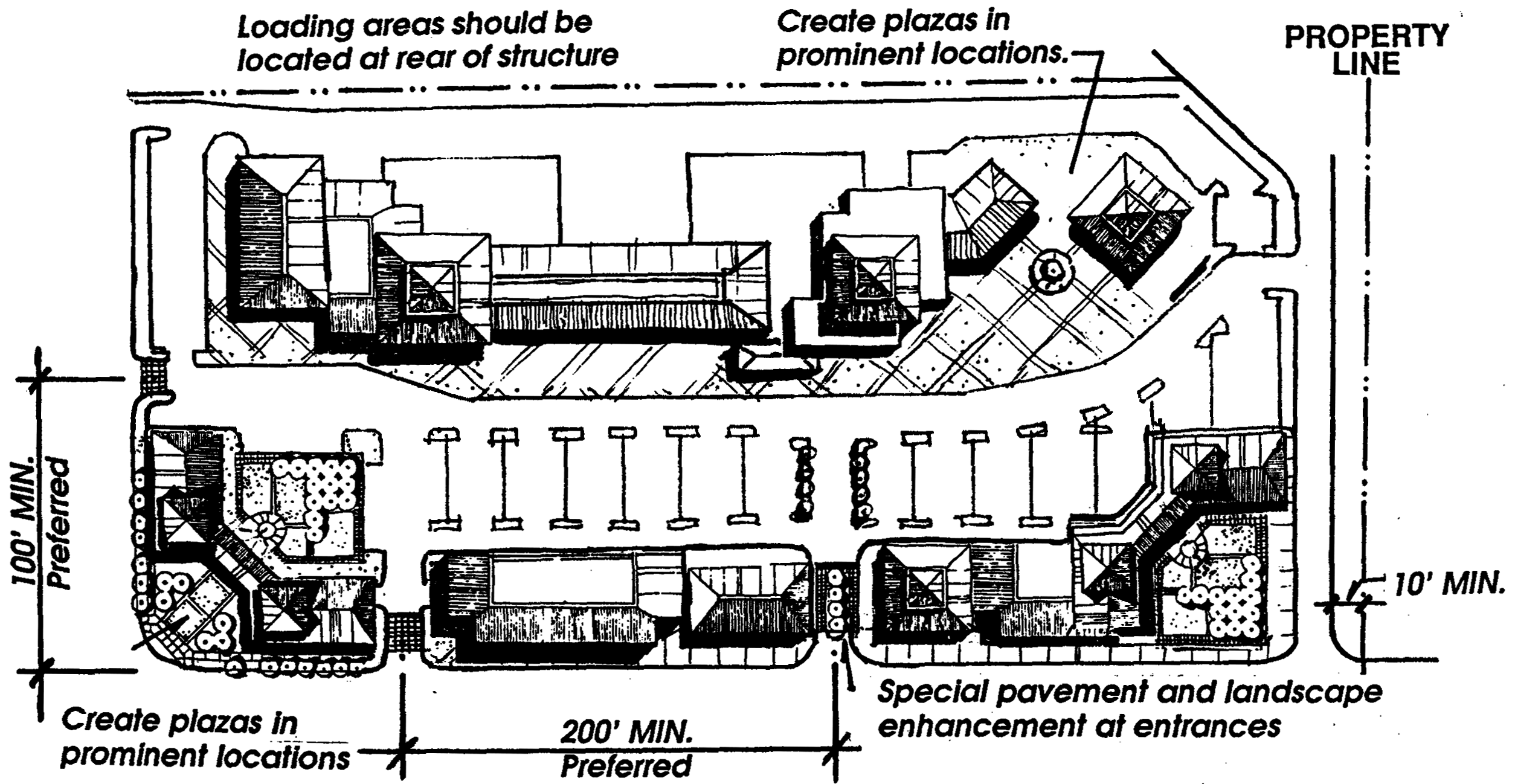
Figure 9.36.200-A Shopping Centers
9.36.210 - Hookah Bar/Lounge (Added By Ord. 450)
A.
Purpose. The purpose of this Section is to provide standards for Hookah Bar/Lounge use so it is operated in a manner that is compatible with the surrounding neighborhood, all in accordance with the goals, objectives and policies of the Town General Plan.
B.
Permit Required. Except as otherwise provided by the Municipal Code or state or federal law, no person or entity shall advertise, conduct, maintain, operate, or provide admission for any Internet-Cafe within the incorporated areas of the Town without possessing an unexpired, unsuspended, and unrevoked Hookah Bar/Lounge permit as identified on the "Permitted Uses" Table 9.35.030-A.
C.
Development Standards. Hookah Bar/Lounge is subject to a Special Use Permit and the following standards:
1.
Hookah Bar/Lounge:
a.
The Special Use Permit issued for the Hookah Bar/Lounge may be revoked by the Planning Commission if the Community Development Director or Police Chief receive excessive complaints from the public related to parking, noise, or other related conditions required for the approved use. The Planning Commission may also revoke the Special Use Permit if the use is not operated in accordance with the standards and requirements set forth in this Section 9.36.210.
b.
California Labor Code Section 6404.5, state law prohibits smoking in nearly all enclosed workplaces. Smoking is prohibited in a Hookah Bar/Lounge, unless the establishment comes within one of the Labor Codes established exemptions and future exemptions as required by the state:
i.
An owner-operated business (and thus has absolutely no employees); or
ii.
A small business with five (5) or fewer employees.
c.
Under exemption ii above, in order for a Hookah establishment to operate as a small business, the establishment must have five (5) or fewer employees and meet all the following four (4) conditions under Labor Code Section 6404.5(d)(14):
i.
The smoking area must not be, accessible to minors;
ii.
It is the responsibility of the owner/operator that all employees who enter the smoking area must consent to the patron's smoking;
iii.
Air from the smoking area must be exhausted directly to the outside by an exhaust fan; and
iv.
The employer must comply with all applicable State and Federal ventilation standards.
d.
Illegal smoking in an enclosed building area and outdoors is not permissible and public disturbance shall be self-regulated and enforced by the Town described as below:
i.
Only Shisha (flavored tobacco) or other legal tobacco products purchased on site may be smoked on the premises. No outside substance may be smoked on onsite;
ii.
Outdoor smoking is permitted, in conformance with state law, in a designated and enclosed patio area. Smoking is prohibited in non-designated areas;
iii.
Business must be at least 1,000 feet from another Hookah Bar/Lounge;
iv.
All Hookah Bars/Lounges shall be fully lighted to the extent that all areas of the premises are easily observable;
v.
The premises shall be continuously maintained in a safe, clean and orderly condition with trash receptacles provided. The premises shall be maintained and operated, at all times, in accordance with all applicable local, state and federal laws, rules and regulations, and in a manner so as not to constitute a nuisance within the Town;
vi.
The sound created by any Hookah Bar/Lounge or by its patrons shall not be detectable from outside the arcade or from adjacent uses. and shall comply with the provisions of Chapter 9.70, Performance Standards, of this Code; and
vii.
Except as otherwise limited by state law, coffee, tea, juices, soft drinks and water may be served on the premises. No food and/or alcoholic beverages are to be prepared and/or served on-site to customers.
D.
Bonding and Insurance. The applicant shall be required to provide sufficient liability insurance naming the Town as an additional named insured. The insurance shall be sufficient to protect, defend, and indemnify the Town, its agents, employees, officers, servants, and volunteers from and against any claim, damage, injury, liability, and loss of any nature arising out of, or in any way connected to, the Internet-Cafe or Hookah Bar/Lounge business. The amount, quality, and type of the insurance shall be determined in compliance with the policy established by the Risk Management Division.
9.36.220 - Places of Assembly as an Ancillary Use (Added By Ord. 461)
A.
Permit Required. A place of assembly as an ancillary use to a school or commercial use that accommodates the assemblage of people such as a theater, auditorium, community center, banquet facility or restaurant may be allowed in any commercial district provided a Special Use Permit is approved for the use and provided the use complies with the following regulations and standards.
B.
General Standards. The following general standards shall apply:
1.
The place of assembly as an ancillary use is permitted provided the primary use is a school or commercial service facility that accommodates the assemblage of people such as a theater, auditorium, community center, banquet facility or restaurant.
2.
The use may only operate during off-peak hours of the primary use or not more than one (1) day of the week for a commercial service facility.
3.
The site shall have sufficient on-site parking to accommodate the ancillary use. The primary and ancillary use may not operate concurrently unless parking is provided for both uses in accordance with the Off-Street Parking Regulations.
4.
The site must have a valid certificate of occupancy to allow the assemblage of people.
5.
The site shall have paved access.
6.
The use shall be conducted indoors and in a manner that is in compliance with Chapter 9.73 Noise Control.
C.
Compatibility. The ancillary use shall be located within the existing site to minimize adverse impacts upon surrounding uses and function of the primary use.
D.
Other Conditions. Additional or different conditions or restrictions, including but not limited to, restrictions on intensity, seating capacity, parking, hours of operation may be placed on any place of assembly as an ancillary use to meet specific concerns.
9.36.230 - Cannabis Dispensaries, Cannabis Manufacturers, and the Cultivation and Delivery of Cannabis
A.
Purpose. The purpose of this Section is to regulate personal, medical, and commercial marijuana uses in the Town. Nothing in this Section shall preempt or make inapplicable any provision of State or Federal law. No provisions of this Section shall hinder or supersede any other applicable State or Federal statute.
B.
Definitions. For purposes of this Section, the following definitions shall apply:
1.
"Commercial marijuana activity" includes the cultivation, possession, manufacture, distribution, processing, storing, laboratory testing, labeling, transportation, distribution, delivery or sale of marijuana and marijuana products.
2.
"Cultivation" means any activity involving the planting, growing, harvesting, drying, curing, grading, or trimming of marijuana.
3.
"Delivery" means the commercial transfer of marijuana or marijuana products to a customer. "Delivery" also includes the use by a retailer of any technology platform owned and controlled by the retailer, or independently licensed under California law, that enables customers to arrange for or facilitate the commercial transfer by a licensed retailer of marijuana or marijuana products.
4.
"Distribution" means the procurement, sale, and transport of marijuana and marijuana products between entities for commercial use purposes.
5.
"Licensee" means the holder of any State issued license related to marijuana activities, including, but not limited to, licenses issued under Division 10 of the Business & Professions Code.
6.
"Manufacture" means to compound, blend, extract, infuse, or otherwise make or prepare a marijuana product.
7.
"Marijuana" means all parts of the plant Cannabis sativa L. Linnaeus, Cannabis indicial, or Cannabis ruderalis, whether growing or not; the seeds thereof; the resin extracted from any part of the plant; and every compound, manufacture, salt, derivative, mixture, or preparation of the plant, its seeds or resin. It does not include:
a.
Industrial hemp, as defined in Section 11018.5 of the California Health & Safety Code; or
b.
The weight of any other ingredient combined with marijuana to prepare topical or oral administrations, food, drink, or other product.
8.
"Marijuana accessories" means any equipment, products or materials of any kind which are used, intended for use, or designed for use in planting, propagating, cultivating, growing, harvesting, manufacturing, compounding, converting, producing, processing, preparing, testing, analyzing, packaging, repackaging, storing, smoking, vaporizing, or containing marijuana, or for ingesting, inhaling, or otherwise introducing marijuana or marijuana products into the human body.
9.
"Marijuana products" means marijuana that has undergone a process whereby the plant material has been transformed into a concentrate, including, but not limited to, concentrated cannabis, or an edible or topical product containing marijuana or concentrated cannabis and other ingredients.
10.
"Person" includes any individual, firm, co-partnership, joint venture, association, corporation, limited liability company, estate, trust, business trust, receiver, syndicate, or any other group or combination acting as a unit, and the plural as well as the singular.
11.
"Sale" includes any transaction whereby, for any consideration, title to marijuana is transferred from one person to another, and includes the delivery of marijuana or marijuana products pursuant to an order placed for the purchase of the same and soliciting or receiving an order for the same, but does not include the return of marijuana or marijuana products by a licensee to the licensee from whom such marijuana or marijuana product was purchased.
12.
Any term defined in this Section also means the very term as defined in the California Business & Professions Code or the California Health & Safety Code, unless otherwise specified.
C.
Commercial Use
1.
Medical marijuana shall be pursuant to Section 11362.77 of the California Health & Safety Code.
2.
The establishment or operation of any medical marijuana collective, cooperative, dispensary, delivery service, operator, establishment, or provider shall be considered a prohibited use in all zoning districts of the Town and no use permit, variance, building permit, or any other entitlement or permit, whether administrative or discretionary, shall be approved or issued for the establishment of any collective, cooperative, dispensary, delivery service, operator, establishment, or provider in any zoning district, and no person shall otherwise establish such businesses or operations in any zoning district.
3.
The establishment or operation of any business of commercial marijuana activity is prohibited. No use permit, variance, building permit, or any other entitlement or permit, whether administrative or discretionary, shall be approved or issued for the establishment or operation of any such business or operation. Such prohibited businesses or operations may include, but are not limited to:
a.
The transportation, delivery, storage, distribution, or sale of marijuana, marijuana products, or marijuana accessories, except to the extent allowed under California Code of Regulations, Title 16, Division 42, Section 5416;
b.
The cultivation of marijuana;
c.
The manufacturing or testing of marijuana, marijuana products, or marijuana accessories; or
d.
Any other business licensed by the State or other government entity under Division 10 of the California Business & Professions Code, as it may be amended from time to time.
D.
Penalty for Violation. No person, whether as principal, agent, employee or otherwise, shall violate, cause the violation of, or otherwise fail to comply with any of the requirements of this Section. Every act prohibited or declared unlawful, and every failure to perform an act made mandatory by this Section shall be a misdemeanor or an infraction, at the discretion of the Town Attorney or the District Attorney. In addition to the penalties provided in this Section, any condition caused or permitted to exist in violation of any of the provisions of this Section is declared a public nuisance and may be abated as provided in Article III of Chapter 1.01 and Chapter 6.30 of the Apple Valley Municipal Code and/or under any other applicable provision of State law.
(Ord. No. 487, § 2, 9-27-2016; Ord. No. 528, § 1, 2-25-2020)

