
Apple Valley City Zoning Code
CHAPTER 9
08 - Definitions
Abutting (Adjacent)
Two or more parcels sharing a common boundary of at least one point.
Abandon
To cease or suspend from developing or maintaining a building or use for a stated
period of time.
Abandoned Activity
A business or activity with no reported sales or activity for a period of at least
one hundred eighty (180) days. Exceptions are temporary closures for repairs, alterations
or other similar situations.
Access
Safe, adequate and usable ingress or egress to a property or use.
Accessory Building or Structure
A structure detached from a principal structure on the same lot and incidental to
the principal building.
Accessory Dwelling Unit or ADU
An attached or detached residential dwelling unit which provides complete independent
living facilities for one or more persons and is located on a lot with a proposed
or existing primary residence. An accessory dwelling unit also includes the following:
(a)
An efficiency unit, as defined by Section 17958.1 of the California Health and Safety Code; and
(b)
A manufactured home, as defined in Section 18007 of the California Health and Safety Code.
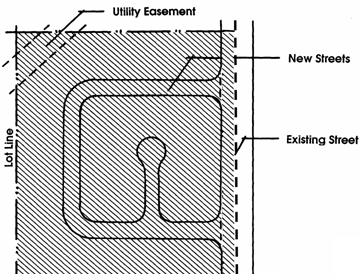
Figure 9.08-1 Acres, Gross
Acres, Gross
The entire acreage of a site. Gross acreage is calculated to the centerline of bounding
streets. In cases where all required dedications have occurred, gross acreage equals
net acreage (Figure 9.08-1).
Acres, Net
The portion of a site not reserved for public use. The following are not included
in the net acreage of a site: public or private road rights-of-way, common or public
open space, and floodways.
Action
The decision made by the review authority on a land use application, including appropriate
findings, environmental determination and conditions of approval, where applicable.
Active Solar System
A system that uses a mechanical device, such as pumps or fans run by electricity in
addition to solar energy, to transport air or water between a solar collector and
the interior of a building for heating or cooling.
Adaptive Reuse
The conversion of obsolete old or historic buildings from their original or most recent
use to a new use. For example, the conversion of former hospital or school buildings
to residential use, or the conversion of an historic single-family home to office
use.
Adult-Oriented Businesses
Adult-oriented businesses are subcategorized as the following types:
A.
Adult Arcade. An establishment where, for any form of consideration, one or more motion picture projectors, slide projectors or similar machines, for viewing by five (5) or fewer persons each, are used to show films, motion pictures, video cassettes, slides or other photographic reproductions which are characterized by an emphasis upon the depiction or description of "specified sexual activities" or "specified anatomical areas".
B.
Adult Bookstore. An establishment which has as a substantial portion of its stock in trade and offers for sale for any form of consideration any one or more of the following:
1.
Books, magazines, periodicals or other printed matter, or photographs, films, motion pictures, video cassettes, slides or other visual representations which are characterized by an emphasis upon the depiction or description of "specified sexual activities" or "specified anatomical areas"; or
2.
Instruments, devices, or paraphernalia which are designed for use in connection with "specified sexual activities".
C.
Adult Cabaret. Nightclub, bar, restaurant or similar establishment which regularly features live performances which are characterized by the exposure of "specified anatomical areas" or by "specified sexual activities", or films, motion pictures, video cassettes, slides or other photographic reproductions which are characterized by an emphasis upon the depiction or description of "specified sexual activities" or "specified anatomical areas".
D.
Adult Hotel and Motel. A motel or similar establishment offering public accommodations for any form of consideration which provides patrons with closed circuit television transmission, films, motion pictures, video cassettes, slides, or other photographic reproductions which are characterized by an emphasis on the depiction or description of "specified sexual activities" or "specified anatomical areas".
E.
Adult Motion Picture Theater. An establishment where for any form of consideration, films, motion pictures, video cassettes, slides, or similar photographic reproductions are shown, and in which a substantial portion of the total presentation time is devoted to the showing of material which is characterized by an emphasis upon the depiction or description of "specified sexual activities" or "specified anatomical areas".
F.
Adult Theater. A theater, concert hall, auditorium or similar establishment which, for any form of consideration, regularly features live performances which are characterized by the exposure of "specified anatomical areas" or by "specified sexual activities".
G.
Reserved.
H.
Sexual Encounter Establishment. An establishment, other than a hotel, motel or similar establishment offering public accommodations, which, for any form of consideration, provides a place where two or more persons may congregate, associate or consort in connection with "specified sexual activities" or the exposure of "specified anatomical areas". This definition does not include an establishment where a medical practitioner, psychologist, psychiatrist or similar professional person licensed by the State engages in sexual therapy.
I.
Other Adult Entertainment Businesses. Any business in which employees or patrons expose "specified anatomical areas" or engage in "specified sexual activities" as defined below and/or, any business which offers its patrons services or entertainment characterized by an emphasis on matter depicting, exposing, describing, discussing or relating to "specified anatomical areas" or "specified sexual activities" as defined below.
1.
Specified Anatomical Areas. Includes any of the following:
a.
Less than completely and opaquely covered human genitals, pubic region, buttocks, anus or female breasts below a point immediately above the top of the areola; or
b.
Human male genitals in a discernibly turgid state, even if completely and opaquely covered.
2.
Specified Sexual Activities. Includes any of the following:
a.
The fondling or other erotic touching of human genitals, pubic region, buttocks, anus or female breasts;
b.
Sex acts, normal or perverted, actual or simulated, including intercourse, oral copulation or sodomy;
c.
Masturbation, actual or simulated; or
d.
Excretory functions as a part of or in connection with any of the activities set forth in paragraphs a through c above.
Adverse Impact
A negative consequence for the physical, social or economic environment resulting
from an action or project.
Affordable Housing
Housing that can be purchased or rented by a household with very low, low or moderate
income and based on a household's ability to make monthly payments necessary to obtain
housing. Housing is considered affordable when a household pays less than thirty percent
(30%) of its gross monthly income for housing, including utilities.
Agriculture
Use of land for the production of food and fiber, including the growing of crops and/or
the grazing of animals on natural prime or improved pasture land.
Air Pollution
Concentrations of substances found in the atmosphere that exceed naturally occurring
quantities and are undesirable or harmful in some way.
Airport or Heliport
Any area of land designated and set aside for the landing and taking off of any aircraft
regulated by the Federal Aviation Administration.
Alley
Any public way or thoroughfare less than twenty-four (24) feet but not less than twelve
(12) feet in width which has been dedicated or deeded to the public for public use.
Alteration
Any construction or physical change in the internal arrangement of rooms or the supporting
members of a building or structure, or change in the appearance of any building or
structure.
Amenity
Aesthetic or other characteristics of a development that increase its desirability
to the community or its marketability to the public. Amenities differ from development
to development but may include recreational and nonrecreational facilities.
Amenity, Recreational
Amenities that provide opportunity for physical activity such as exercise, entertainment
or athletic facilities. These could include, but are not limited to, recreation rooms,
fitness centers, outdoor exercise equipment, swimming pools and spas, tennis courts,
putting greens, playgrounds, splash pads, outdoor grill areas with shaded seating,
dog park or community vegetable gardens.
Amenity, Nonrecreational
Amenities providing for passive enjoyment and/or convenience facilities. Convenience
facilities may include but are not limited to, security systems, package lockers,
bicycle lockers, in-unit washer and dryer, high speed internet, or electric car charging
stations. Passive enjoyment amenities may include but are not limited to enhanced
common open areas incorporating water features, fire pits (non-wood burning) or public
art with shaded seating areas. Providing fifteen (15) percent of the project site
as common usable open space shall count as a single non-recreational amenity.
Amortization
A term used in zoning to mean the process by which nonconforming uses and structures
must be discontinued or made to conform to requirements of the ordinance at the end
of a specified period or time. The term itself is a variation of the real estate term
by which borrowers are required to pay back a debt in regular payments over a fixed
period of time, e.g., installment payments on the principal of a mortgage.
Amusement Arcade
A building or part of a building in which five (5) or more amusement devices occupying
more than ten (10) percent of the public floor area are displayed and available for
use by the public.
Amusement Device
A player operated electronic or electrical coin-operated game available for use in
return for compensation, examples of amusement devices include pinball machines and
video games.
Ancillary Use
A use that is accessory to a principal use located on the same lot or parcel.
Animal(Also see Section 15.01.010 of the Town of Apple Valley Municipal Code)
A nonhuman organism distinguished from a plant by structural and functional characteristics,
such as the ability to move. For the purposes of this Development Code, animals are
categorized as follows:
A.
Small Animals. Pigmy goats, pot belly pigs, poultry, rabbits, domestic animals and other comparably sized animals distinguished from those defined as medium or large animals.
B.
Medium Size Animals. Swine, pigmy horses, goats, sheep and other comparably sized animals distinguished from those defined as small or large animals.
C.
Large Size Animals. Equine and bovine and other animals assumed by their size, weight, and or appearance to be large animals.
Animal Hospital
A place where animals or pets are given medical or surgical treatment and are cared
for during the time of such treatment; the ancillary use of the premises as a kennel
or a place where animals or pets are boarded for remuneration.
Antenna
The arrangement of wires, metal rods or dish used in the sending and/or receiving
of electromagnetic waves.
Antenna Height
The overall vertical distance from the property's grade to the highest point of the
antenna mounted on its support structure.
Antenna Support Structure
A free-standing, guyed or building-mounted structure, mast, pole, tripod or tower
(including appurtenances) utilized for the purpose of supporting an antenna, antennas
or dish intended for airway communication purposes.
Apartment
A.
One or more rooms of a building used as a place to live, in a building containing at least one other unit used for the same purpose.
B.
A separate suite, not owner occupied, which includes kitchen facilities and is designed for and rented as the home, residence or sleeping place of one or more persons living as a single housekeeping unit.
Applicant
Owner(s) or lessee(s) of property, or their agent(s), or person(s) who have contracted
to purchase property contingent upon their ability to acquire the necessary permits
under this Development Code, or the agent(s) of such persons.
Applicant
Ancillary to an approved commercial use, production or putting together products,
for the purpose of installation or sale of goods or services as allowed by an approved
commercial activity.
Artisan Beverage Maker
A small business that independently produces custom beverages including, but not limited
to, micro-breweries, craft distilleries, cider makers, coffee roasters, soda maker
or cocktail mixers that may include tasting, food service and entertainment.
Assembly of Products
Ancillary to an approved commercial use, production or putting together products,
for the purpose of installation or sale of goods or service as allowed by an approved
commercial activity.
Attached
Any structure that has an interior wall or roof in common with another structure.
Automobile Sales Lot
An open area used for the display, sale and/or rental of new or used automobiles.
Automobile Service Station
A business which provides for the servicing or fueling of motor vehicles, including
tube and tire repairs, battery charging, storage of merchandise and supplies related
to the servicing of motor vehicles, sale of gasoline and other fuel and lubricants,
motor vehicle washing, grease racks, and motor vehicle repairs, excluding body and
fender work, engine overhauling and replacement, transmission work and other similar
activities.
Automobile Wrecking
The act of or an area used, or intended to be used, for the physical destruction,
disassembly, or dismantling of motor vehicles, boats, trailers, or similar vehicles,
or the storage, sale, restoration, or dumping of said physically destroyed, disassembled,
or dismantled motor vehicles, boats, trailers, or similar vehicles.
Automotive and Vehicular Repair (Minor)
Activities including, but not limited to, the wholesale or retail sale or exchange
of goods and/or services for the repair, restoration, overhaul, or maintenance of
automobiles, light trucks, boats, trailers, or other vehicles (of less than 6,000
lbs.), whether performed on site or elsewhere, and the cleaning and washing, by hand
or machine, of the same. Such repair, restoration, overhaul, or maintenance activities
shall be limited to those acts which do not involve, require, or use open flames,
welding, body work, or painting (whether within or outside of a paint booth), or acts
involving the removal, in whole or in part, of the vehicle's engine, transmission,
transfer case, front or rear axle, fenders, exterior skin, or bumpers. The wholesale
or retail sales of vehicle parts or accessories, including engine, transmission, front
or rear axle, fenders, exterior metal skin, or bumpers, for installation at another
location shall be permitted.
Automotive and Vehicle Repair (Major)
Activities including, but not limited to, the wholesale or retail sale or exchange
of goods and/or services for the repair, restoration, overhaul, or maintenance of
automobiles, trucks, boats, trailers, or other vehicles, and the cleaning and washing,
by hand or machine, of the same. Such repair, restoration, overhaul, or maintenance
activities may include those acts which involve, require, or use open flames, welding,
body work, or painting (whether within or outside of a paint booth), or acts involving
the removal, in whole or in part, of the vehicle's engine, transmission, transfer
case, front or rear axle, fenders, exterior metal skin, or bumpers, or the installation
of major accessories.
Awning
A roof-like cover that is attached to and extends from the wall of a building to provide
shielding of windows and entrances from inclement weather or sun.
Basement
Any floor level below the first story in a building, except that a floor level in
a building having only one (1) floor level shall be classified as a basement unless
such floor level qualifies as a first story as defined herein.
Bed and Breakfast
A transient lodging establishment primarily engaged in providing overnight or otherwise
temporary lodging for the general public and may provide meals to the extent otherwise
permitted by law.
Beer Manufacturer
A.
Large Beer Manufacturer. A brewery operation that produces over 60,000 barrels per year.
B.
Small Beer Manufacturer. A brewery operation that produces less than 60,000 barrels per year.
C.
Micro-brewery. A brewery operation that generally produces approximately 15,000 barrels a year. Its beer products are primarily intended for local and/or regional consumption and may include a restaurant or pub on their manufacturing plant.
D.
Brewpub. A very small brewery with a restaurant where the beer it produces is sold in draft form exclusively at its own premises. This operation may sell other supplier's bottled beer, including other hand-crafted or micro-brewed beers as well as wine or spirits to patrons for on-site consumption.
Berm
A mound or embankment of earth (Figure 9.08-2).
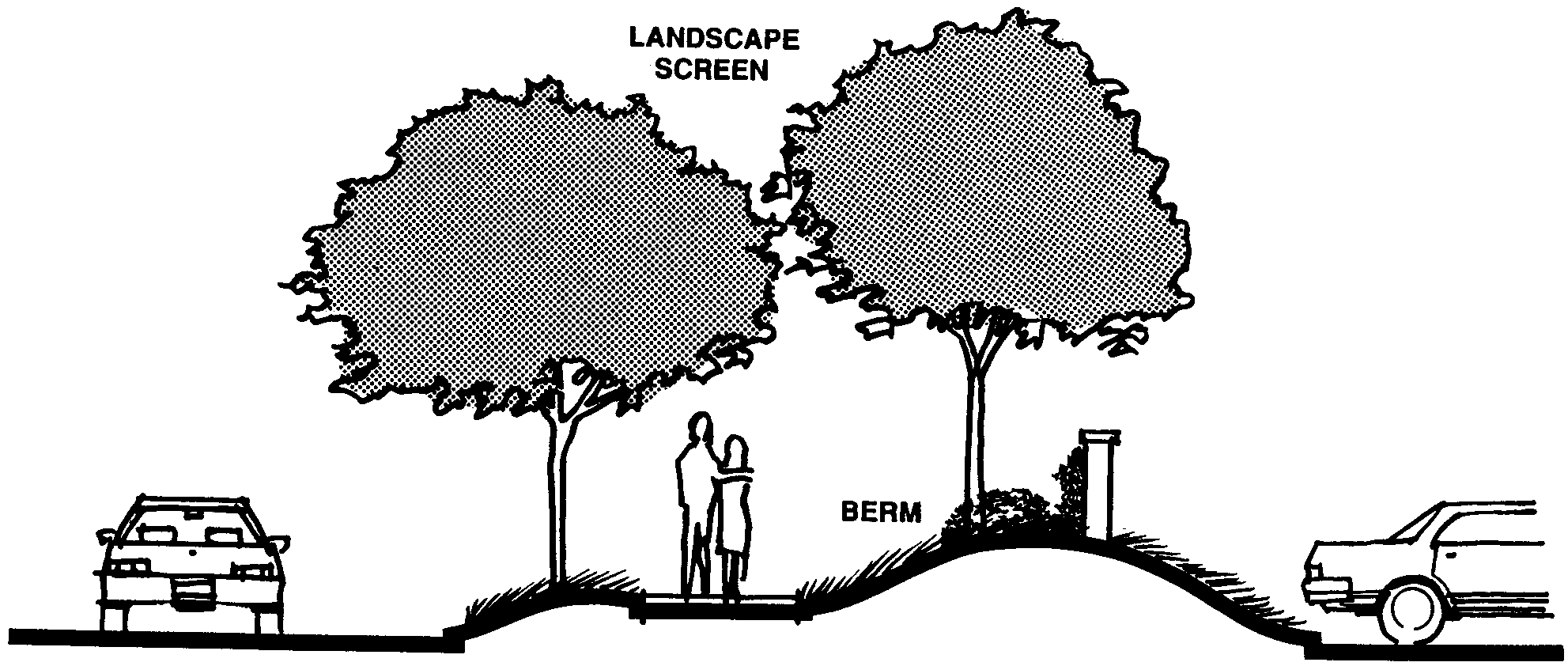
Figure 9.08-2 Berm
Block
A parcel of land surrounded by public streets, highways, freeways, railroad right-of-way,
flood control channels, creeks, washes, rivers or unsubdivided acreage or any combination
thereof (Figure 9.08-3).
Block Face
One complete side of a block, usually facing a public street (Figure 9.08-3).
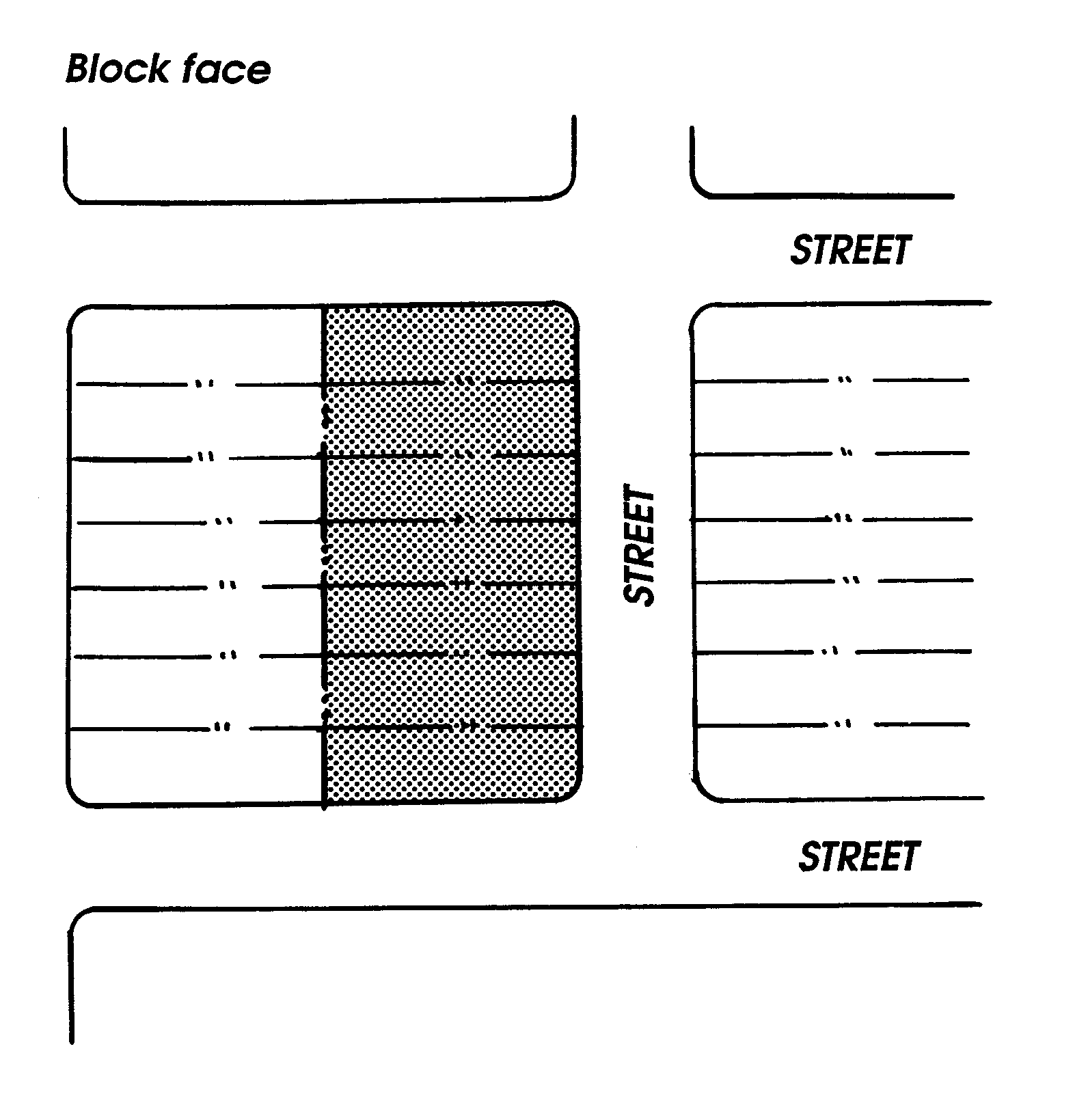
Figure 9.08-3 Block/Block Face
Boarding House
A structure where lodging and meals for seven or more boarders is provided for compensation.
Borrow Pit
Any place or premises where dirt, soil, sand, gravel or other material is removed
below the grade of surrounding land for any purpose other than that necessary and
incidental to site grading or building construction.
Buffer Area
A strip of land established to protect one type of land use from another land use
that is incompatible. A buffer includes plantings, berms or other screens which block
vision, noise or other negative impacts of more intense uses on less intense uses
(Figure 9.08-4).
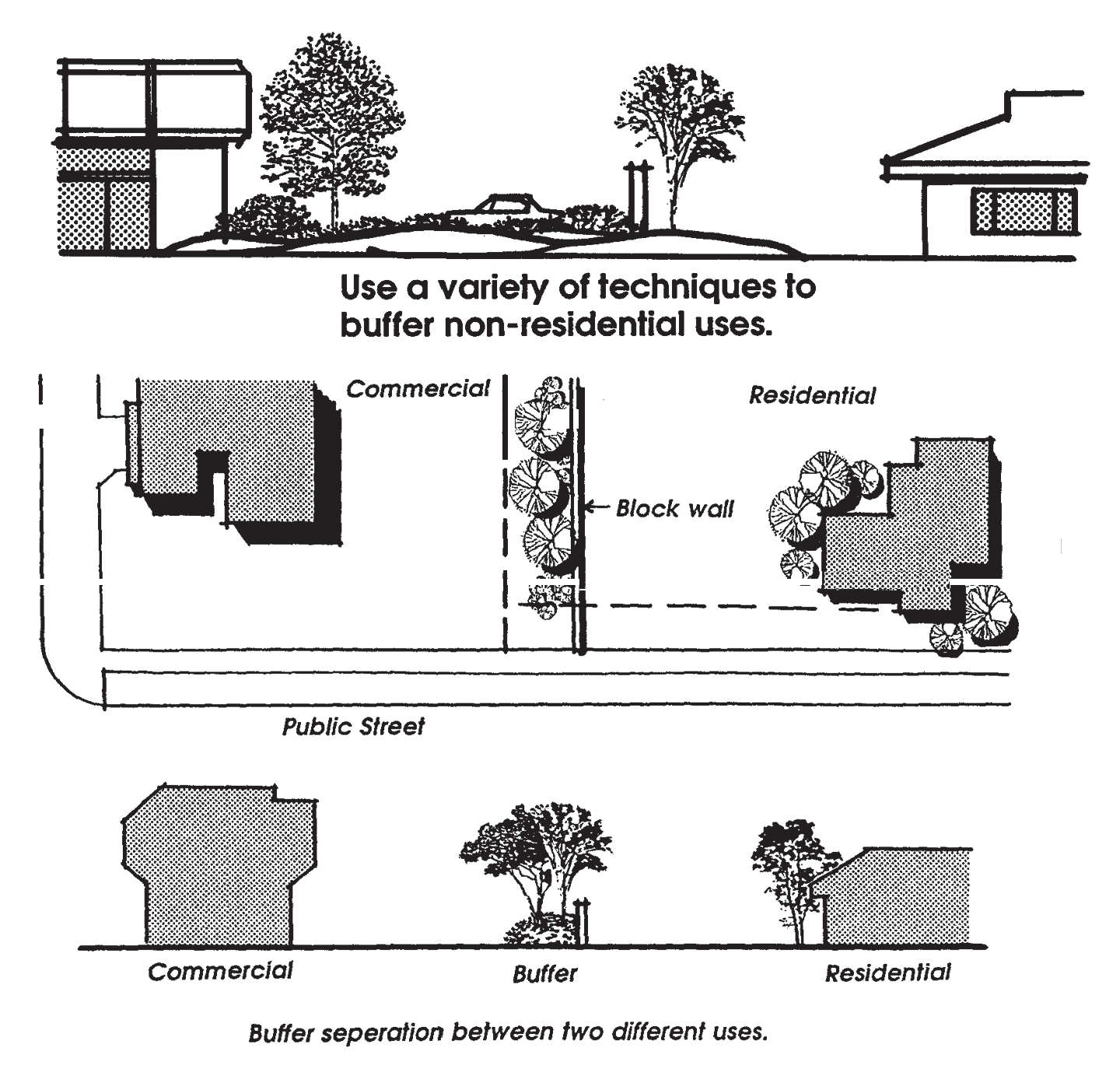
Figure 9.08-4 Buffer Area
Building
Any structure used or intended for supporting or sheltering any use or occupancy.
Building Area
The net portion of the lot remaining after deducting all required setbacks from the
gross area of the lot.
Building Coverage
The percent of lot area which may be covered by all the footprints of buildings or
structures on a lot.
Building Height
The vertical distance above a reference datum to the highest point of the coping of
a flat roof, or to the deck line of a mansard roof, or to the average height of the
highest gable of a pitched or hipped roof. The reference datum shall be selected by
either of the following, whichever yields a greater height of building:
A.
The elevation of the highest adjoining sidewalk or ground surface within a five (5)-foot horizontal distance of the exterior wall of the building when such sidewalk or ground surface is not more than ten (10) feet above lowest grade; or
B.
An elevation ten (10) feet higher than the lowest grade when the sidewalk or ground
surface described in paragraph A above is more than ten (10) feet above lowest grade.
The height of a stepped or terraced building is the maximum height of any segment
of the building.
Building, Principal
A building in which the principal use is conducted.
Building Site
The ground area of a building together with all open spaces required by this Development
Code.
Business Center
A development in which businesses and structures are designed as an architecturally
integrated and interrelated development. Such design is independent of the number
of structures, lots, or parcels making up the center.
California Environmental Quality Act (CEQA)
A State law requiring State and local agencies to regulate activities with consideration
for environmental protection. If a proposed activity has the potential for a significant
adverse environmental impact, a Negative Declaration or Environmental Impact Report
must be prepared and certified before an action is taken on the project.
Canopy
A permanent roof-like structure constructed of durable material extending from part
or all of a building face.
Carport
A permanent roofed structure with not more than two completely enclosed sides used,
or intended to be used, for vehicle storage for the occupants of the premises.
Certificate of Occupancy
A permit issued by the Planning and Building Services Divisions prior to occupancy
of a structure to assure that the structure is ready for occupancy with all defects
corrected and all construction debris removed and the site graded to final grade.
Additionally, all on-site amenities (i.e., paving, landscaping, etc.) shall be in
place prior to the issuance of the permit.
Church(or Place of Religious Worship)
An institution that people regularly attend to participate in or hold religious services,
meetings, and other activities. The Term "church" shall not carry a secular connotation
and shall include buildings in which the religious services of any denomination are
held. A place where religious worship is held.
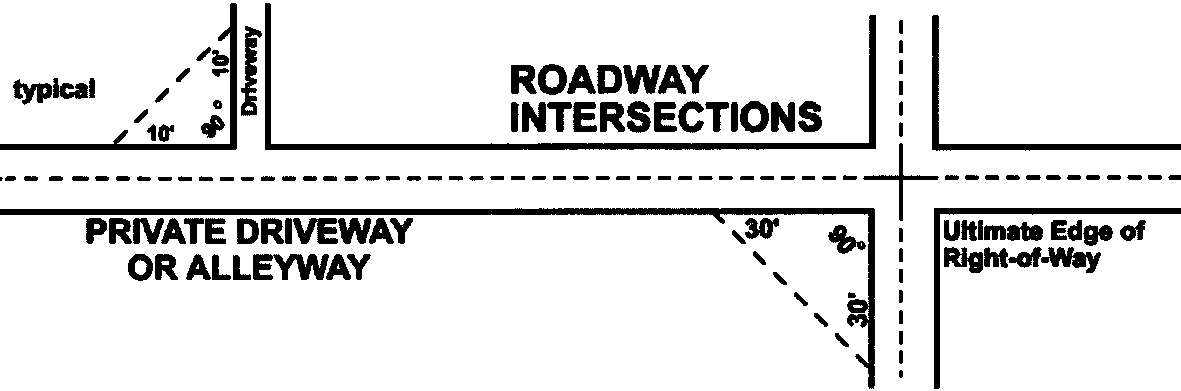
Figure 9.08-5 Clear Site Triangle
Clear Sight Triangle
The area within the triangle formed by connecting the points thirty (30) feet (10
feet at driveways) from the inter-section of the two right-of-way lines. Trees within
the Clear Sight Triangle shall be trimmed (to the trunk) to a line at least six (6)
feet above the nearest street elevation (Figure 9.08-5).
Clinic
A place for outpatient medical services to human patients.
Club
An association of persons (whether or not incorporated) organized for some common
purpose, but not including a group organized primarily to render a service customarily
carried on as a business.
Cluster Development
Development in which a number of dwelling units are placed in closer proximity than
usual, or are attached, with the purpose of retaining an open space area (Figure 9.08-6).
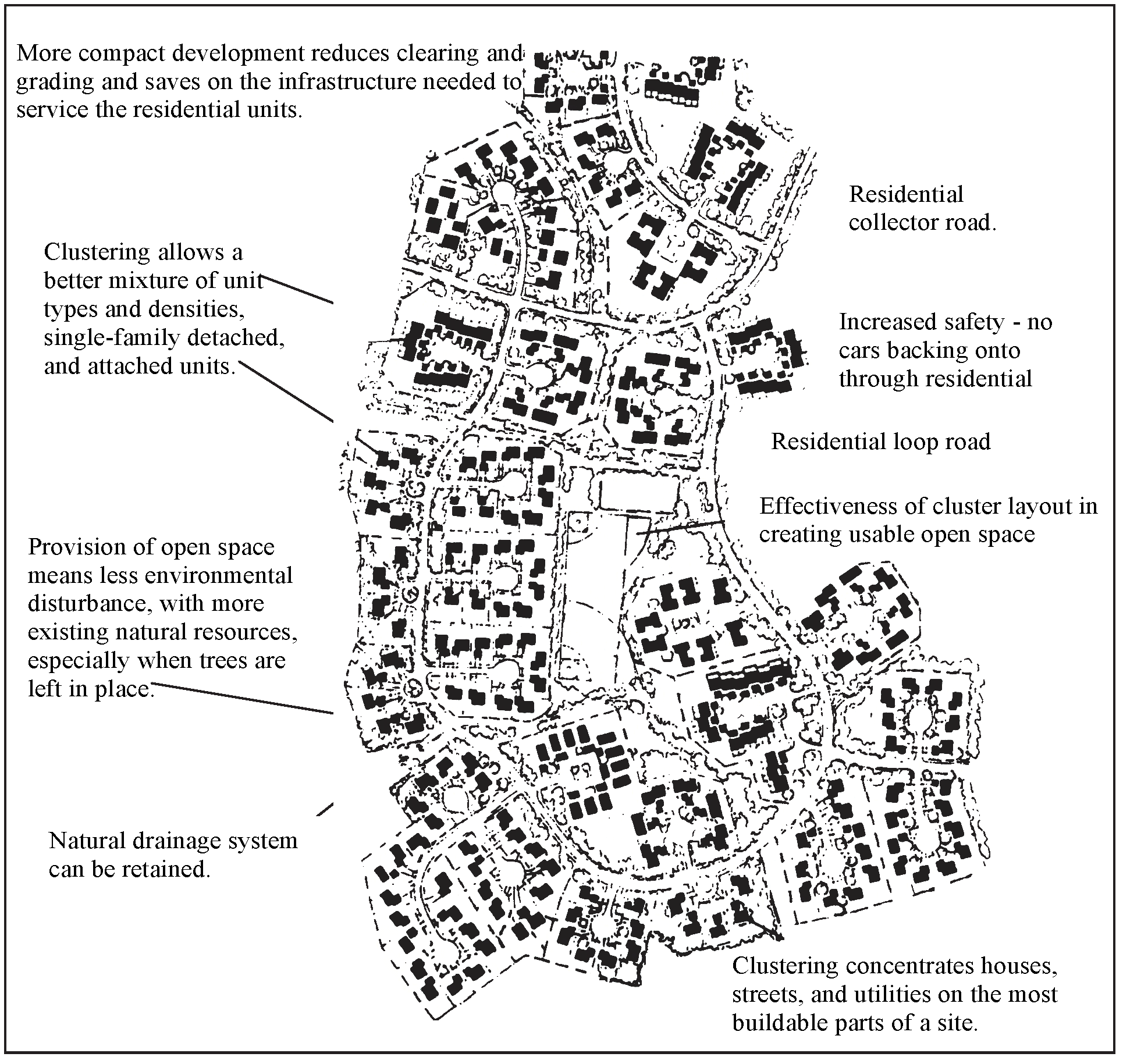
Figure 9.08-6 Cluster Development
Clustered Subdivision
A subdivision development in which building lots are sized to conform to the "footprint"
of the structures and sited closer together than conventional development, usually
in groups or clusters, provided that the total density does not exceed that which
is permitted under conventional zoning and subdivision regulations. The additional
land that remains undeveloped is preserved as open space and recreation land. Private
development easements around the structures are permitted for inclusion of private
landscaping, pools, spas, yards, etc.
Commercial
A land use classification that permits facilities for the buying and selling of commodities
and services.
Commercial Vehicle
A vehicle customarily used as part of a business for the transportation of goods or
people.
Commission
The Planning Commission of the Town of Apple Valley.
Common Open Space
Land within or serving as a part of a development, not individually owned or dedicated
for public use, which is designed and intended for the common use or enjoyment of
the residents of the development and may include such complementary structures and
improvements as are necessary and appropriate.
Community Apartment
A development in which an undivided interest in the land is coupled with the right
of exclusive occupancy of an apartment located on the land.
Community Care Facility
Community care facilities are defined as skilled nursing or intermediate care facilities,
and shall, consistent with California Health and Safety Code (Section 1267.8), include
provisions for developmentally disabled habilitative nursing or congregate living.
Conditional Use/Development Permit
A discretionary entitlement which may be granted under the provisions of this Development
Code and which when granted authorizes a specific use to be made of a specific property,
subject to compliance with all terms and conditions imposed on the entitlement.
Condominium
A structure in which the individual ownership is defined by the interior walls of
the units; the balance of the property (both land and building) is owned in common
by the owners of the individual units.
Congregate Care
Apartment housing, usually for seniors, in a group setting that includes independent
living and sleeping accommodations in conjunction with shared dining and recreational
facilities.
Consistent
Free from variation or contradiction.
Construction Commencement
The act of obtaining a building permit for the construction of a primary structure
upon a site and the act of physically changing the site in conformance to the approved
plans for which the permit(s) are issued, and the successful passage of the first
building inspection for such permit.
Convalescent Home
A facility licensed by the State Department of Public Health, the State Department
of Social Welfare, or the County Health Department, which provides bed and ambulatory
care for patients with postoperative convalescent, chronically ill, or dietary problems,
and persons aged or infirmed unable to care for themselves; but not including substance
abusers or persons with mental or contagious diseases or afflictions.
Convenience Store
Any retail establishment offering for sale prepackaged food products, household items,
and other goods commonly associated with same and having a gross floor area of less
than five thousand (5,000) square feet.
Council
The Town Council composed of the Mayor and Councilmembers of the Town of Apple Valley.
County
The County of San Bernardino, hereinafter referred to as County.
Court
An open, unoccupied space, other than a yard, on the same lot with a building and
bounded on two or more sides by the walls of a building.
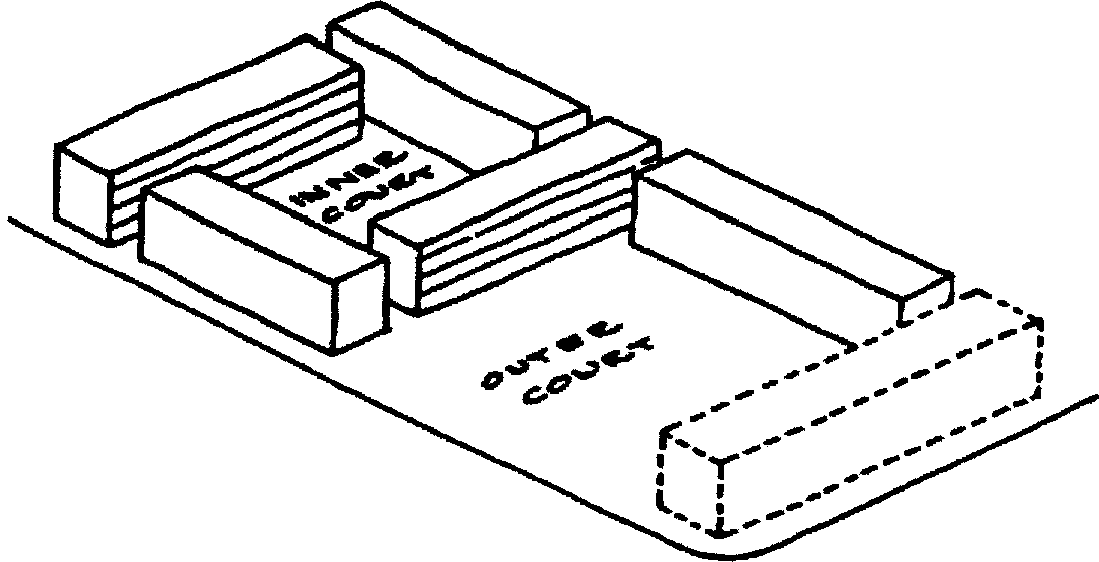
Figure 9.08-7 Courts
A.
Court, Inner. An open area, unobstructed from the ground to the sky, which is bounded on more than three sides by the exterior walls of one or more buildings (Figure 9.08-7).
B.
Court, Outer. An open area, unobstructed from the ground to the sky, which is bounded on not more than three sides by the exterior walls of one or more buildings (Figure 9.08-7).
Covenants, Conditions And Restrictions (CC&RS)
A term used to describe restrictive limitations that may be placed on property and
its use, and which usually are made a condition of holding title or lease.
Day Care Facility, Children
A facility which provides nonmedical care to children under 18 years of age in need
of personal services, supervision or assistance essential for sustaining the activities
of daily living or for the protection of the individual on less than a twenty-four
(24)-hour basis. Family day care homes are further divided into the following categories:
small (up to 6 children) and large (7 to 12 children). Day care facilities include
family day care homes, day care centers (13 or more children), infant centers, and
preschools.
Days
Shall always be consecutive calendar days unless otherwise stated.
Dedication
The turning over by an owner or developer of private land for public use, and the
acceptance of land for such use by the governmental agency having jurisdiction over
the public function for which it will be used. Dedications for roads, parks, school
sites or other public uses often are made conditions for approval of a development
by the Town.
Density
The number of dwelling units per gross acre, unless otherwise stated, for residential
uses.
Density Bonus
An increase in the number of permitted residential units that may be built upon a
property over the otherwise allowable residential density under the applicable land
use element limitations of the adopted General Plan. Any and all density bonus application(s)
shall be processed and shall conform to the requirements, allowances and limitations
as specified within California Government Code Sections 65915 et al.
Destination Retail
Retail businesses that generate a special purpose trip and that do not necessarily
benefit from a high volume pedestrian location.
Detached
Any building or structure that does not have a wall or roof in common with any other
building or structure.
Developable Land
Land that is suitable as a location for structures and that can be developed free
of hazards to, disruption of, or significant impact on natural resource areas.
Development
The placement or erection of any solid material or structure; discharge or disposal
of any dredged material or any gaseous liquid, solid or thermal waste; grading, removing,
dredging, mining or extraction of any soil or materials; change in the density or
intensity of use of land, including lot splits, except where the land division is
brought about in connection with the purchase of such land by a public agency for
public recreational use; change in the intensity or use of water, or of access thereto;
construction; reconstruction, demolition or alteration of the size of any structure
including any facility of any private, public or municipal utility; and the removal
of any major vegetation. A project, as defined in Government Code Section 65931, is
included in this definition.
Development Code
A unified text incorporating areas of regulation including administration, development
review, residential districts, commercial and office districts, industrial districts,
other districts, overlay districts, general standards, and other related topics.
Development Permit
A discretionary entitlement approved by the Planning Commission or Director which
may be granted under the provisions of this Development Code and which when granted
authorizes a specific structure to be built upon a specific property, subject to compliance
with all terms and conditions imposed on the entitlement.
Development Rights
The right to develop land by a land owner who maintains fee simple ownership over
the land or by a party other than the owner who has obtained the rights to develop.
Director
The Director of Economic and Community Development of the Town of Apple Valley or
his/her designee.
Discretionary Decision
An action taken by a governmental agency that calls for the exercise of judgment in
deciding whether to approve and/or how to carry out a project.
Dormitory
A structure intended principally for sleeping accommodations where no individual kitchen
facilities are provided and where such structure is related to an educational or public
institution or is maintained and operated by a recognized nonprofit welfare organization.
Duplex
A property under single ownership containing one (1) structure consisting of two (2)
living units.
Dwelling, Multiple
A single property containing more than two (2) attached dwelling units or a combination
of two (2) or more detached single-family dwelling units.
Dwelling
A structure or portion thereof designed for residential occupancy, not including hotels
or motels.
Dwelling, Multiple
A structure containing two (2) or more dwelling units or a combination of two (2)
or more separate single family dwelling units.
Dwelling Unit
A room or group of rooms (including sleeping, eating, cooking and sanitation facilities,
but not more than one kitchen, which constitutes an independent housekeeping unit,
occupied or intended for occupancy by one family on a long-term basis.
Easement
A grant of one (1) or more property rights by the property owner for use by the public,
a corporation or another person or entity.
Easement, Conservation
A tool for acquiring open space with less than full fee purchase whereby a public
agency buys or is granted only certain specific rights from the land owner. these
may be positive rights (providing the public with the opportunity to hunt, fish, hike
or ride over the land), or they may be restrictive rights (limiting the uses to which
the land owner may devote the land to in the future).
Educational Institution
A school, college or university, supported wholly or in part by public funds or giving
general academic instruction equivalent to the standards prescribed by the State Board
of Education.
Emergency Shelter
Consistent with Health and Safety Code Section 50801(e), a facility that provides
immediate and short-term housing and minimal supplemental services for the homeless.
Shelters come in many sizes, but an optimum size is considered to be twenty (20) to
forty (40) beds. Supplemental services may include food, counseling and access to
other social programs. Occupancy is limited to six months or less and may not be denied
to any person or household because of an inability to pay. See also Single Room Occupancy,
Supportive Housing, Transitional Housing.
Entertainment, Live
Any act, play, revue, pantomime, scene, dance act, or song and dance act, or any combination
thereof, performed by one or more persons whether or not they are compensated for
the performance.
Environment
The physical conditions which exist within the area which will be affected by a proposed
project, including land, air, water, mineral, flora, fauna, noise, and objects of
historic or aesthetic significance.
family
One (1) or more individuals occupying a dwelling unit as a single household unit.
Feasible
Capable of being done, executed or managed successfully from the standpoint of the
physical and/or financial abilities of the implementer(s).
Findings
The result(s) of an investigation and the basis upon which decisions are made. Findings
are used by government agencies to justify action taken by them.
Floor Area, Gross
A.
The area of all floors or levels included within the surrounding walls of a building or structure. Space devoted only to the following shall not be considered in determining the gross floor area within a building or structure for the purposes of calculating parking requirements or floor area ratios:
1.
Enclosed vertical stair shafts;
2.
Elevator shafts;
3.
Courts;
4.
Parking spaces and access thereto;
5.
Rooms exclusively housing building operating equipment or machinery;
6.
Pedestrian mall areas.
B.
Gross Floor Area as used in this Development Code shall not include space used or provided within a building or structure for publicly owned off-street parking facilities.
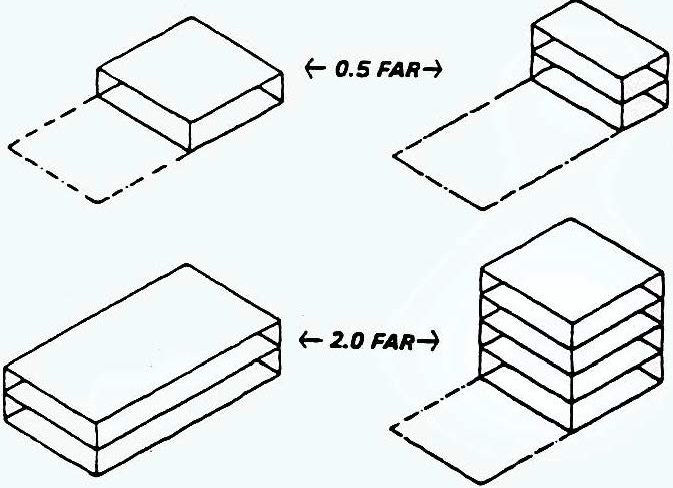
Figure 9.08-8 Floor Area Ratio (FAR)
Floor Area Ratio (F.A.R.)
The floor area permitted on a site divided by the total gross area of the site, expressed
in decimals to one or two places. For example, on a site with 10,000 gross sq. ft.
of land area, a Floor Area Ratio of 1.0 will allow a maximum of 10,000 sq. ft. of
building floor area to be built. Similarly, an F.A.R. of 1.5 would allow 15,000 sq.
ft. of floor area; an F.A.R. of 2.0 would allow 20,000 sq, ft.; an F.A.R. of 2.5 would
allow 25,000 sq. ft.; and an F.A.R. of 0.5 would allow only 5,000 sq. ft. to be built.
F.A.R.s shall be applied on a parcel by parcel basis as opposed to an average F.A.R.
for an entire land use or zoning district (Figure 9.08-8).
Frontage
The side of a lot abutting a street (the front lot line), except the side of a corner
lot (the street side lot line). On corner lots the narrowest frontage shall be considered
the front of the lot. The frontage of a non-rectangular lot or a lot located on a
cul-de-sac, curved street or dead-end street with a curved turn-around shall be measured
as the chord drawn between the terminuses of the side property lines at their intersection
with the street right-of-way (Figure 9.08-10).
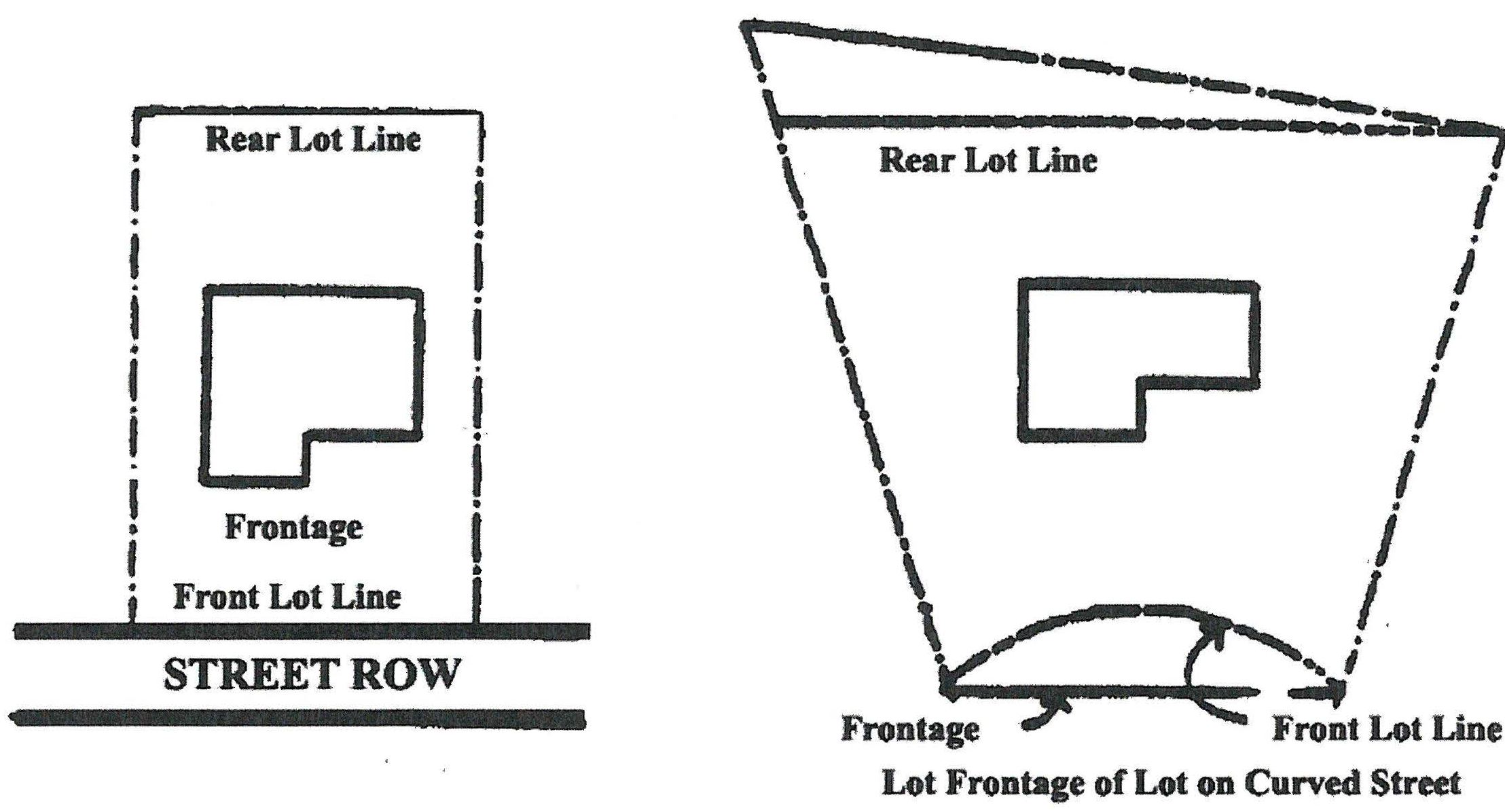
Figure 9.08-10 Frontage
Front Wall
The nearest wall of a structure to the street upon which the structure faces, but
excluding cornices, canopies, eaves or any other architectural embellishment.
Garage
An enclosed building or a portion of an enclosed building used for the parking of
vehicles.
General Plan
The Town of Apple Valley General Plan as adopted by the Town Council.
Grade
The elevation of the surface of the ground.
Grade, Adjacent Ground Elevation
The lowest point of elevation of the finished surface of the ground, paving or sidewalk
within the area between the building and the property line; or, when the property
line is more than five (5) feet from the building, between the building and a line
five (5) feet from the building.
Grade, Finished
The elevation of the surface of the ground after grading, construction or landscaping
activities.
Grade, Natural
The elevation of the surface of the ground before the ground elevation is altered
by any grading, construction or landscaping activities.
Group Home
Any residential structure or unit, whether operated by an individual for profit or
by a non-profit entity, which is not licensed by the State of California. For purposes
of this development code, Group Homes is a distinct category from either Transitional
Housing Supportive Housing, community care facility or residential care facility,
each of which is defined separately herein.
Guest Quarters
Any structure, whether attached to or detached from the main residence on a residential
lot, or a lot used for residential purposes, containing living quarters for the use
by temporary guests of the residents of the main residential structure on the same
premises.
Habitable Floor Area
Interior residential space used for living purposes that contains heat, plumbing,
and electricity. It includes foyers, hallways, bedrooms, kitchen, restrooms, closets,
storage, and other common areas within a building. Habitable Floor Area does not include
patio, porch, garage, carport or other accessory structures.
Habitable Structure
A building which includes space for living, sleeping, eating or cooking. This can
include bathrooms, toilet compartments, closets, halls, storage or utility space,
and similar areas.
Half Story
A story under a gable, hip or gambrel roof, plates of which are not more than two
(2) feet above the floor of such story.
Home Occupation
A commercial activity conducted in compliance with Chapter 9.19 of this Development Code, carried out by an occupant and conducted as an accessory
use within the primary dwelling unit.
Hookah Bar/Lounge
A Hookah Bar/Lounge is an establishment where patrons share flavored tobacco (Shisha
- a smokable mixture of tobacco, dried fruits and molasses) or a non-tobacco based
substitute from a communal Hookah (a water pipe device for smoking). A hookah is a
water pipe of Middle Eastern origin that is used to smoke sweet, often flavored, tobacco.
The smoke is filtered through water at the base of the Hookah's pipe. Live Belly Dancing
can be affiliated with the experience of a Hookah Bar/Lounge.
Hospital
An institution designed within an integrated campus setting for the diagnosis, care
and treatment of human illness, including surgery and primary treatment.
Hotel
A facility in which guest rooms or suites are offered for compensation to the general
public for lodging with or without meals and where no provision is made for cooking
in any individual guest room or suite.
Human Scale
The relationship of a building or portions of a building to a human being. Harmonious
relationship of the size of parts to one another and to the human figure, usually
around eight (8) to ten (10) feet in size. This distance is about the limit of sensory
perception of communication between people including voice inclination and facial
expression. This distance is also about the limit of an up-stretched arm reach for
human beings which is another measure of human scale.
Hydrophyte
A plant that grows in and is adapted to an aquatic or very wet environment.
Impact
The effect of any direct man-made actions or indirect repercussion of man-made actions
on existing physical, social or economic conditions.
Impervious Surface
Surface through which water cannot penetrate, such as roof, road, sidewalk or paved
parking lot. The amount of impervious surface increases with development and establishes
the need for drainage facilities to carry the increased runoff.
Improvement
Any man-made, immovable item which becomes part of, placed upon, or is affixed to,
real estate.
Industrial
The manufacture, production and processing of consumer goods. Industrial is often
divided into "heavy industrial" uses, such as construction yards, quarrying and factories;
and "light industrial" uses such as research and development and less intensive warehousing
and manufacturing.
Industrial Park
A planned, coordinated development of a tract of land with two or more separate industrial
buildings. Such development is planned, designed, constructed and managed on an integrated
and coordinated basis with special attention given to on-site vehicular circulation,
parking, utility needs, building design and orientation, and open space.
An industrial park is designed as a coordinated environment for a variety of industrial
and related activities. The project is developed or controlled by one proprietary
interest. It has an enforceable master plan and/or CC&Rs.
Infill Development
Development of vacant land within areas that are already largely developed.
Institutional Use
A.
Publicly or privately owned and operated activities that are institutional in nature, such as hospitals, museums and schools;
B.
Churches and other religious organizations; and
C.
Other nonprofit activities of a welfare, educational or philanthropic nature that can not be considered a residential, commercial or industrial activity.
Intermittent Stream
A stream that normally flows for at least thirty (30) days after the last major rain
of the season and is dry a large part of the year.
Internet-Cafe
An Internet-Cafe is a bona-fide business establishment that sells Internet time, which
allows customers to surf the web and use computers for personal use. An Internet-Cafe
can also have ancillary use of food and refreshments for patrons. Internet-Cafes are
not permitted to allow promotional sweepstakes or any other gambling-themed games
for cash, magnetic sliding cards (or similar card), credits, monetary gifts or similar
winnings or prizes (excluding California lottery sales by licensed California Lottery
vendors).
Junk And Salvage Facility
Primary or accessory use of structures and/or land for storage, dismantling and/or
selling of cast-off, unused, scrap or salvage material of any sort.
Kennel
Any lot where six (6) or more dogs, cats or other small animals over the age of four
(4) months are kept, whether such keeping is for pleasure, profit, breeding or exhibiting,
including places where said animals are boarded, kept for sale or hire.
Kitchen
Any room, all or part of which is designed and/or used for storage, refrigeration
cooking and the preparation of food.
Kiosk Structure
An accessory building used for key shops, photo drops and the like, and generally
located in a shopping center parking lot.
Landscaping
Planting, including trees, shrubs, and ground covers, suitably designed, selected,
installed, and maintained so as to enhance a site or roadway permanently.
Land Use
The occupation or utilization of land area for any human activity or any purpose defined
in the General Plan.
Land Use Zoning District
A portion of the Town within which certain uses of land and structures are defined,
and regulations are specified.
Lot
A parcel, tract or area of land established by plat, subdivision, or as otherwise
permitted by law, to be used, developed or built upon. The classification of lots
are (Figure 9.08-11):
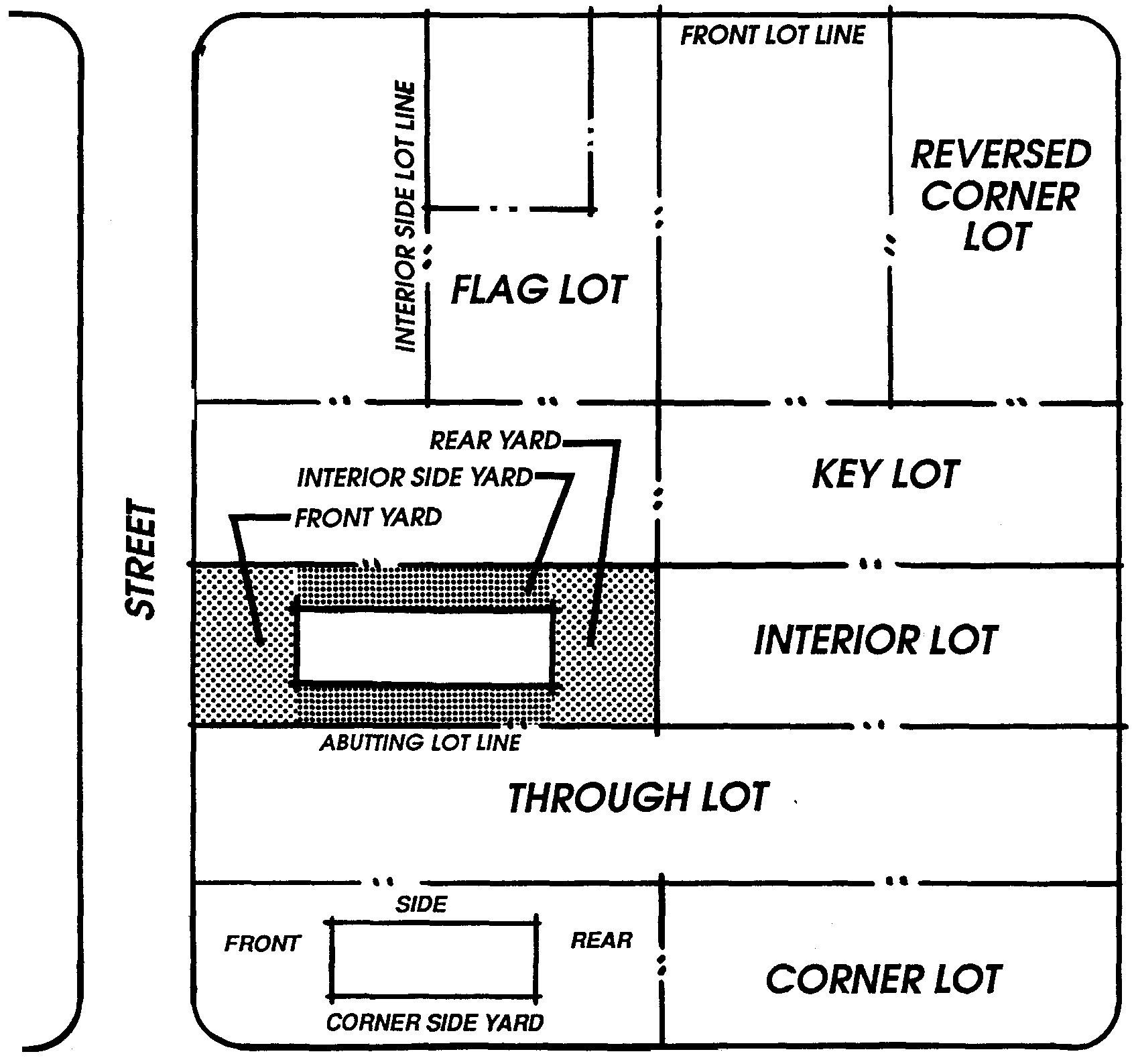
Figure 9.08-11
A.
Corner. A lot located at the intersection of two (2) or more streets at an angle of not more than 135 degrees. If the angle is greater than 135 degrees, the lot shall be considered an "interior lot";
B.
Flag. A lot having access or an easement to a public or private street by a narrow, private right-of-way;
C.
Interior. A lot abutting only one street;
D.
Irregular. A nonrectangular lot or rectangular lot not abutting a public street
E.
Key. A lot with a side line that abuts the rear line of any one (1) or more adjoining lots;
F.
Reverse Corner. A corner lot, the rear of which abuts the side of another lot;
G.
Through. A lot having frontage on two (2) generally parallel streets, with only one (1) primary access.
Lot Area
The total horizontal area included within the lot lines of a lot.
Lot Depth
Lot depth is the horizontal distance between the midpoint of the front lot line and
the midpoint of the rear lot line; in the case of a triangular or other irregularly
shaped lot, the rear lot line is defined as a line within the lot having a length
not less than ten (10) feet, parallel to and most distant from the front lot line
(Figure 9.08-12).
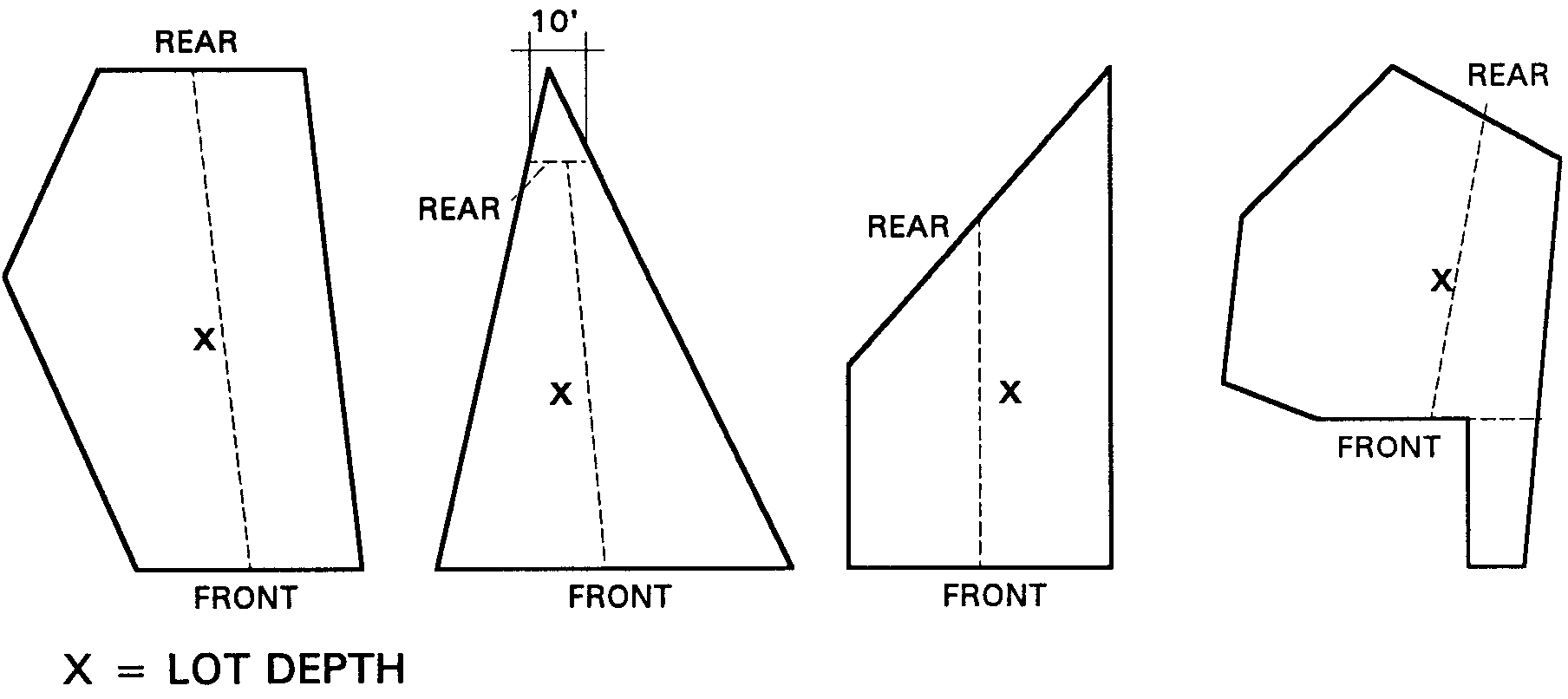
Figure 9.08-12 Lot Depth
Lot Frontage
The portion of the lot contiguous to the street. On corner lots the narrowest frontage
shall be considered the front of the lot. On a lot located on a cul-de-sac, curved
street, or dead-end street with a curved turn-around, the frontage shall be measured
as the chord drawn between the terminuses of the side property lines at their intersection
with the street right-of-way (Figure 9.08-13).
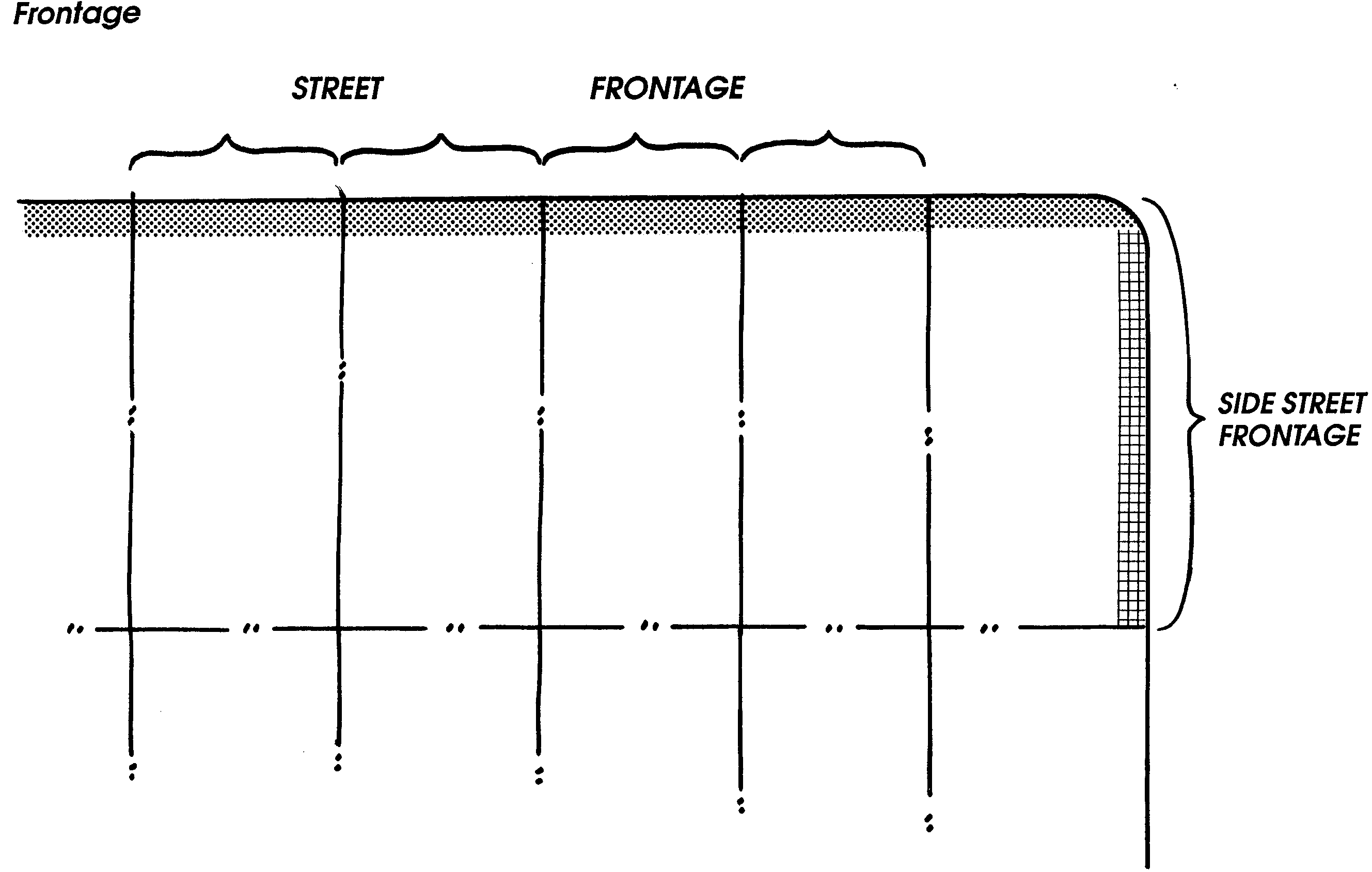
Figure 9.08-13
Lot Line
Any boundary of a lot. The classifications of lot lines are (Figure 9.08-14):
A.
Front. On an interior lot, the line separating the parcel from the street right-of-way. On a corner lot, the lot line along the narrowest street frontage. On a through lot, the lot line abutting the street providing the primary access to the lot. On a flag lot, the interior lot line most parallel to and nearest the street from which access is obtained;
B.
Interior. A lot line not intersecting a street which is not a front, rear or side lot line. For purposes of this Code setbacks from interior lot lines shall be the same as for side or street side lot lines, whichever is applicable;
C.
Rear. A lot line which intersects a side lot line and which is most distant from and most closely parallel to the front lot line. In the case of a triangular or otherwise irregularly shaped lot, a line within the lot having a length not less than ten feet, parallel to and most distant from the front lot line shall be interpreted as the rear lot line for the purpose of determining required setbacks and other provisions of this Development Code;
D.
Side. Those two lot lines which intersect the rear line of the front setback and at least one of which extends from the street right-of-way to the rear property line, the other may extend to an interior lot line.
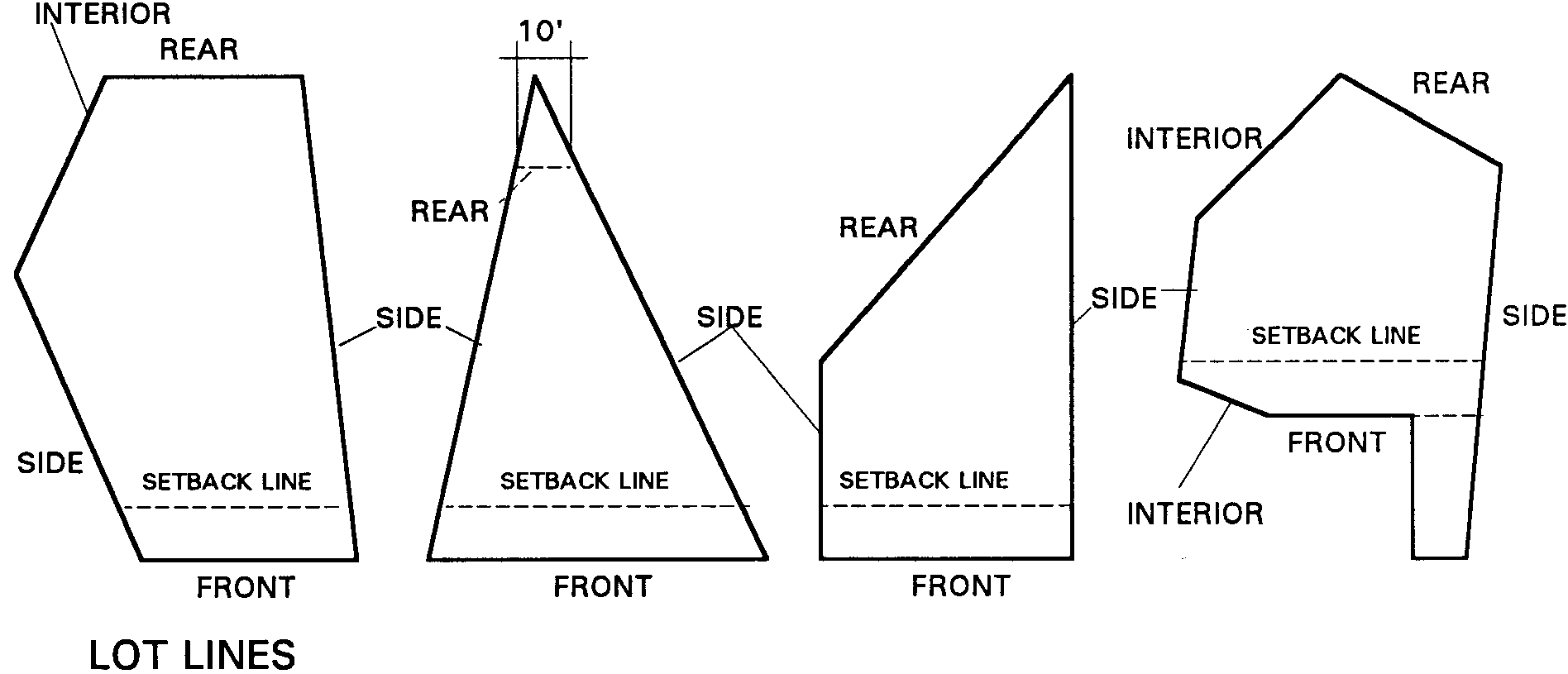
Figure 9.08-14 Lot Lines
Lot of Record
A lot that is part of a recorded subdivision or a parcel of land that has been recorded
at the County recorder's office containing property tax records.
Lot Width
The horizontal distance between the side lot lines, measured at the required front
setback line (Figure 9.08-15).
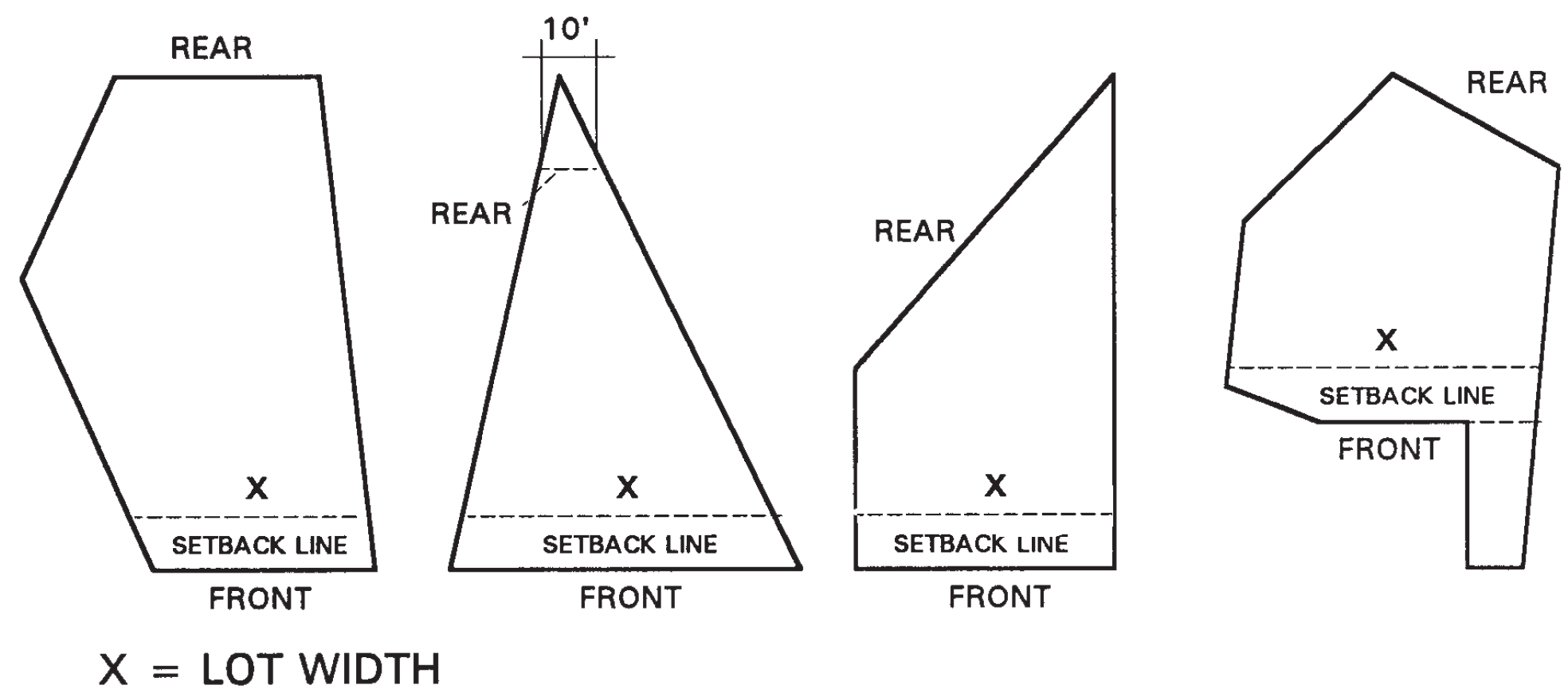
Figure 9.08-15 Lot Width
Manufactured Housing
Residential structures that are constructed entirely in the factory, and that since
June 15, 1976 have been regulated by the Federal Manufactured Home Construction and
Safety Standards Act of 1974 under the administration of the U.S. Department of Housing
and Urban Development (HUD).
May
For the purpose of this Development Code, "may" is generally used to indicate a standard
or requirement that is permitted or allowed.
Median Strip
A paved or planted area separating a street or highway into two (2) or more opposing
lanes of travel.
Micro-Climate
The climate of a small, distinct area, such as a city street or a building's courtyard;
can be favorably altered through functional landscaping, architecture, or other design
features.
Mini-Mall
A shopping center of from eighty thousand (80,000) to one hundred fifty thousand (150,000)
square feet in size located on a site of eight (8) to fifteen (15) acres where tenants
are located on both sides of a covered walkway having direct pedestrian access to
all establishments from the walkway. Mini-malls usually function as neighborhood shopping
centers or specialty shopping centers. Mini-malls usually do not require an anchor
store.
Mining
The act or process of extracting resources, such as coal, oil, or minerals, from the
earth.
Mitigate
To ameliorate, alleviate, or avoid to the extent reasonably feasible.
Mixed Use
Properties on which various uses, such as office, commercial, institutional, and residential,
are combined in a single building or on a single site in an integrated development
project with significant functional interrelationships and a coherent physical design.
A single site may include contiguous properties.
Mobile Home
A structure, transportable in one (1) or more sections, built on a permanent chassis
and designed for use as a single family dwelling unit and that:
A.
Has a minimum of four hundred (400) square feet of living space;
B.
Has a minimum width greater than one hundred two (102) inches;
C.
Is connected to all available permanent utilities; and
D.
Is tied down to either; (1), a permanent foundation on a lot owned or leased by the homeowner or (2), is set on piers, with wheels removed and skirted, in a mobile home park.
Motel
A.
A hotel for motorists.
B.
A facility in which guests rooms or suites are offered to the general public for lodging with or without meals and for compensation, and where guest parking is provided in proximity to guest rooms. Quite often, provision is made for cooking in individual guest rooms or suites.
Noise
Any sound that is undesirable because it interferes with speech and hearing, or is
intense enough to damage hearing, or is otherwise annoying. Noise, simply, is unwanted
sound.
Noise Attenuation
Reduction of the level of a noise source using a substance, material, or surface,
such as earth berms and/or solid concrete walls.
Nonconforming, Illegal
A structure, lot, or use which did not conform to applicable laws when constructed
or initiated, and does not conform to the provisions of this Development Code.
Nonconforming Lot (Legal)
A lot, the area, frontage or dimensions of which do not conform to the provisions
of this Development Code but which did conform to applicable laws at the time it was
subdivided.
Nonconforming Structure (Legal)
A structure which conformed to applicable laws when constructed but does not conform
to the provisions of this Development Code.
Nonconforming Use (Legal)
A use complying with applicable laws when established but does not conform to the
provisions of this Development Code.
Office
A room, or group of rooms, used for conducting the affairs of a business, profession,
service, industry, or government and generally furnished with desks, tables, files,
and communication equipment.
Parcel
A lot, or contiguous group of lots, in single ownership or under single control, usually
considered a unit for purposes of development.
Parkway
The area of a public street that lies between the curb and the adjacent property line
or physical boundary definition such as fences or walls, which is used for landscaping
and/or passive recreational purposes.
Passive Solar System
A system that distributes collected heat via direct transfer from a thermal storage
medium rather than mechanical power. Passive systems rely on building design and materials
to collect and store heat and to create natural ventilation for cooling.
Performance Standards
Zoning regulations that set standards of operation. Performance standards provide
specific criteria limiting noise, air pollution, emissions, odors, vibration, dust,
dirt, glare, heat, fire hazards, wastes, traffic impacts and visual impact of a use.
Person
Any individual, firm, co-partnership, joint venture, association, social club, fraternal
organization, company, joint stock association, corporation, estate, trust, organization,
business, business trust, public agency, school district, State of California and
its political subdivisions or instrumentalities, receiver, syndicate or any group
or combination thereof, acting as a unit, including any trustee or assignee.
Permitted Use
Any use allowed in a land use zoning district and subject to the provisions applicable
to that district.
Places Of Assembly
Places of assembly shall include public and private institutions, such as religious
uses, lodges, clubs, senior citizen centers, youth centers, community centers and
YMCA/YWCA facilities.
Planned Residential Development (PRD)
A type of development characterized by comprehensive planning for the project as a
whole, clustering of structures to preserve usable open space and other natural features,
and a mixture of housing types within the prescribed densities.
Plaza
An open space which is improved and landscaped, usually surrounded by streets and
buildings.
Principal Building
A building in which the primary use of the lot on which the building is located is
conducted.
Principal Use
The primary or predominant use of any lot, building or structure.
Private Recreational Facilities
Facilities including, but not limited to, Country Clubs, tennis and swim clubs, golf
courses, racquetball and handball facilities, YMCA, YWCA, and limited commercial uses
which are commonly associated and directly related to these primary uses.
Professional Offices
A use providing professional or consulting services in the fields of law, medicine,
architecture, design, engineering, accounting and similar professions, but not including
financial institutions or real estate or insurance offices.
Public Park
A park, playground, swimming pool, beach, pier, reservoir, golf course or athletic
field within the Town which is under the control, operation or management of the Town,
the County or the State.
Public Right-Of-Way
A strip of land acquired by reservation, dedication, prescription or condemnation
and intended to be occupied by a road, trail, water line, sanitary sewer and/or other
public use(s).
Quarry
A place where rock, ore, stone and similar materials are excavated and processed for
sale or for off-site use.
Queue Line
An area for the temporary waiting of motor vehicles while obtaining a service or other
activity such as a drive-thru restaurant or a car wash.
Recreation, Active
A type of recreation or activity that requires the use of organized play areas including,
but not limited to, softball, baseball, football and soccer fields, tennis and basketball
courts and various forms of children's play equipment.
Recreation, Passive
A type of recreation or activity that does not require the use of organized play areas.
Recreational Courts
Facilities developed for the purpose of playing court sports, including but not limited
to tennis, paddle tennis, handball, racquetball, and other similar uses.
Recreational Vehicle
A vehicle towed or self-propelled on its own chassis or attached to the chassis of
another vehicle and designed or used for recreational or sporting purposes. The term
recreational vehicle includes, but is not limited to, travel trailers, pickup campers,
camping trailers, motor coach homes, converted trucks or buses, boats and boat trailers,
and all terrain vehicles.
Recycling
The process by which waste products, including automobiles, are reduced to raw materials
and transformed into new products.
Recycling Center
A building in which used material is separated and processed prior to shipment to
others who will use the material to manufacture new products. A facility that is not
a junkyard and in which recoverable resources, such as newspapers, glassware, and
metal cans, are collected, stored, flattened, crushed, or bundled, essentially by
hand within a completely enclosed building.
Recycling Collection Point
An incidental use that serves as a neighborhood drop-off point for temporary storage
of recoverable resources where no processing of such items is allowed. This facility
would generally be located in a shopping center parking lot or in other public/quasi-public
area, such as churches and schools.
Recycling Plant
A facility that is not a junkyard and in which recoverable resources, such as newspapers,
magazines, books, and other paper products; glass; metal cans; and other products
are recycled, reprocessed, and treated to return such products to a condition in which
they may again be used for production.
Religious Institution
A structure which is used primarily for religious worship and related religious activities.
Residential Care Facility
For the purposes of this Development Code, Residential Care Facility shall mean a
State licensed community care facility, congregate care facility, intermediate care
facility, foster home, or other State-licensed group home serving mentally disordered
or otherwise handicapped persons or dependent and neglected children on a twenty-four
(24) hour basis.
Residential Care Facility For The Elderly
A State-licensed facility providing a housing arrangement chosen voluntarily by the
resident, the resident's guardian, conservator or other responsible person; where
the residents are sixty (60) years of age or older and where varying levels of care
and supervision are provided, as agreed to at time of admission or as determined necessary
at subsequent times of reappraisal, in accordance with the Community Care Facilities
Act (California Health and Safety Code Section 1500-1518).
Resort Hotel
A group of buildings containing guest rooms and providing outdoor recreational activities.
Rest Home
Premises used for the housing of and assisted caring for the aged and infirmed. There
shall be only incidental convalescent care not involving either a nurse or physician
residing on the premises. There shall be no surgery, physical therapy or other similar
activities.
Restaurant
A use providing preparation and retail sale of food and beverages; such uses include
cafes, coffee shops, sandwich shops, ice cream parlors, fast food take-out (i.e.,
pizza), and similar uses, and may include licensed on-site provision of alcoholic
beverage for consumption on the premises when accessory to such food service.
Restaurant, Drive-Thru
A use providing preparation and retail sale of food and beverages, as defined under
Restaurant with the added provision of one (1) or more drive-thru lanes for the ordering
and dispensing of food and beverages to patrons remaining in their vehicles.
Review Authority
The person, committee, Commission or Council responsible for the review and/or final
action on a land use entitlement or discretionary decision.
Rezoning
An amendment to the map and/or text of a zoning ordinance to effect a change in the
nature, density, intensity or regulation of uses allowed in a zoning district and/or
on a designated parcel or land area or an amendment to procedures regarding implementation
of zoning regulations.
Riparian Lands
Riparian lands are comprised of the vegetative and wildlife areas adjacent to perennial
and intermittent streams. Riparian areas are delineated by the existence of plant
species normally found near fresh water.
Rounding of Quantities
The consideration of distances, unit density, density bonus calculations, or other
aspects of development or the physical environment expressed in numerical quantities
which are fractions of whole numbers; the numbers are to be rounded to the nearest
highest whole number when the fraction is 0.5 or more, and to the next lowest whole
number when the fraction is less than 0.5, except as otherwise may be provided in
this Development Code.
Runoff
That portion of rain or snow that does not percolate into the ground and is instead
discharged into streams or other bodies of water.
Satellite Dish Antenna
An apparatus capable of receiving or transmitting communications from a satellite.
Scale
The measurement of the relationship of the size and bulk of one object to another
object.
School
An institution of learning for minors, whether public or private, which offers instruction
in those courses of study required by the California Education Code or which is maintained
pursuant to standards set by the State Board of Education. This definition includes
a nursery school, kindergarten, elementary school, junior high school, senior high
school or any special institution of education, but it does not include a vocational
or professional institution of higher education, including a community or junior college,
or university.
Screening
The method by which a view of one site from another adjacent site is shielded, concealed,
or hidden. Screening techniques include fences, walls, hedges, trees and/or other
plantings, berms or other features.
Second Dwelling Unit
A self-contained living unit, either attached to or detached from, and in addition
to, the primary residential unit of a single lot, and which includes permanent provisions
for living, sleeping, eating, cooking and sanitation on the same parcel as the single
family dwelling is situated, and also as referenced in California Government Code,
Section 65852.2
Senior (Senior Citizen)
A person who is 55 years of age or older.
Senior Congregate Care Housing
A structure(s) providing residence for a group of senior citizens with or without
common kitchen and dining facilities with separate bedrooms and/or living quarters.
Setback
The horizontal distance between the property line and any structure.
Shall
For the purposes of this Development Code, the word "shall" is used to indicate a
requirement or standard that is mandatory.
Single-Room Occupancy
A building or buildings that provides multiple sleeping or living facilities that
accommodate one person per unit. Each unit may include sanitary and cooking facilities
or both, or these facilities may be shared with the facility. See also Emergency Shelter,
Supportive Housing, Transitional Housing.
Shopping Center
A building, or sets of buildings, that can contain retail stores, restaurants and
other service oriented businesses. Shopping centers have interconnecting walkways
for pedestrian ease to walk from shop to shop and have a common parking lot. Shopping
centers are anchored by one or more large scaled retail store(s) or service business
(e.g. theater).
Should
For the purpose of this Development Code, "should" is used to indicate the preferred
option.
Sidewalk/Parking Lot Sale
A promotional sales event conducted by one or more businesses which is held outside
the confines of the commercial or manufacturing structure(s) in which such business
is normally conducted. Such sale involves outdoor display within a paved or concreted
area on the same lot as the structure(s), of merchandise which is normally displayed
within the structure(s). Sale events shall be conducted solely on private property
and not encroach within public rights-of-way.
Slope
The land gradient described as the vertical rise divided by the horizontal run, and
expressed in terms of percent.
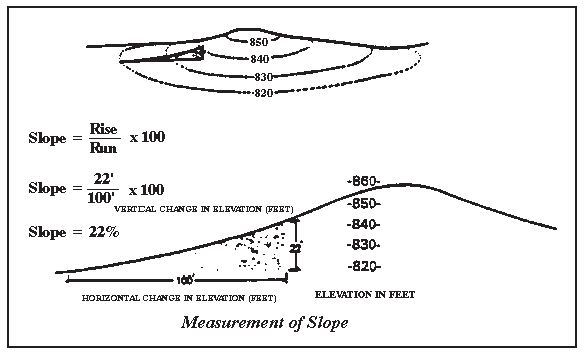
Figure 9.08-16
Solar Access
The provision of direct sunlight to an area specified for solar energy collection
when the sun's azimuth is within forty-five (45) degrees of true south.
Solar Facilities
The airspace over a parcel that provides access for a solar energy system to absorb
energy from the sun.
Specific Plan
A plan consisting of text, maps, and other documents and exhibits regulating development
within a defined area of the Town, consistent with the General Plan and the provisions
of Government Code Section 65450 et. seq.
Square
A public open space in a developed area.
Stable, Commercial
A structure for the keeping of horses, mules or ponies which are boarded for compensation.
Stable, Private
An accessory structure for the keeping of horses or ponies for the use of occupants
of the premises.
Staff
The staff of the various departments or divisions of the Town of Apple Valley.
Standard
A.
A rule or measure establishing a level of quality or quantity that must be complied with or satisfied. Examples of standards might include the number of acres of park land per 1,000 population that the community will attempt to acquire and improve, or the planned traffic level of service (LOS).
B.
Requirements in a zoning ordinance that govern building and development as distinguished from use restrictions; for example, site design regulations such as minimum lot area, height limit, frontage, landscaping and floor area ratio.
Standard Industrial Classification (SIC) System
The classification of establishments by type of activity which is determined by its
principal product or group of products produced or distributed, or services rendered.
The purpose of the system is to facilitate the collection, tabulation, presentation
and analysis of data relating to the establishments. This system is detailed in the
Federal Office of Management and Budget's Standard Industrial Classification Manual,
as amended.
Storage
A space or place where goods, materials and/or personal property is put for more than
twenty-four (24) hours.
Story
That portion of a building included between the upper surface of any floor and the
upper surface of the floor next above, except that the topmost story shall be that
portion of a building included between the upper surface of the topmost floor and
the ceiling or roof above. If the finished floor level directly above a usable or
unused under floor space is more than six (6) feet above grade as defined herein for
more than fifty (50) percent of the total perimeter or is more than twelve (12) feet
above grade as defined herein at any point, such usable or unused under-floor space
shall be considered as a story.
Story, First
The lowest story in a building which qualifies as a story, as defined herein, except
that a floor level in a building having only one (1) floor level shall be classified
as a first story, provided such floor level is not more than four (4) feet below grade,
as defined herein, for more than fifty (50) percent of the total perimeter, or not
more than eight (8) feet below grade, as defined herein, at any point.
Street
Any thoroughfare or public way not less than sixteen (16) feet in width which has
been dedicated or deeded to the public for public use.
Street Furniture
Man-made above-ground items that are usually found in street rights-of-way, including
benches, kiosks, plants, canopies, shelters and phone booths.
Street Hardware
Mechanical and utility systems within a street right-of-way such as hydrants, manhole
covers, traffic lights and signs, utility poles and lines, parking meters and the
like.
Streetscape
Streetscape is an urban design component that concentrates on making the road system
and road environment useful as a instrument in understanding and organizing the urban
development. It may be defined as the sensitive placement of landscaping, signage,
lighting. and street furniture. views, driver orientation, meaningful visual sequences,
and the design of compatible land use edge conditions are essential objectives of
a streetscape system. The primary objective of a streetscape system is to design the
major streets with a consistent landscape pattern and appropriate scale to distinguish
them from the lesser streets and provide strong visual orientation for the driver.
Strip Development
Commercial or retail development, usually one store deep, that fronts a street.
Structure
That which is built or constructed, an edifice or building of any kind, or any piece
of work artificially built up or composed of parts joined together in some definite
manner. (By this definition all buildings are structures, however, not all structures
are buildings.)
Supportive Housing
Housing with no limit on length of stay that is occupied by a target population defined
as having low incomes and one or more disabilities, including mental illness, HIV
or AIDS, substance abuse, or other chronic health conditions, or individuals eligible
for services provided under the Lanterman Development Disabilities Services Act (Division
4.5, commencing with Section 4500 of California Welfare and Institutions Code). Target
populations may include but are not limited to adults, emancipated youth, families,
families with children, elderly persons, young adults aging out of the foster care
system, individuals exiting from institutional settings, veterans, and homeless people.
As defined in this development code, sexual offenders, parolees or persons on probation
are not permitted to be housed in supportive housing facilities. Supportive housing
is linked to onsite or offsite services that assist the supportive housing resident
in retaining the housing, improving his or her health status, and maximizing his or
her ability to live and, when possible, work in the community. See also Emergency
Shelter, Single Room Occupancy, Transitional Housing.
Swap Meets
Any indoor or outdoor place, location, or activity where new or used goods or secondhand
personal property is offered for sale or exchange to the general public by a multitude
of individual, licensed vendors, usually in compartmentalized spaces. A fee may be
charged to prospective buyers for admission, or a fee may be charged for the privilege
of offering or displaying such merchandise. The term swap meet is interchangeable
with and applicable to: flea markets, auctions, open air markets, farmers markets,
or other similarly named or labeled activities; but the term does not include the
usual supermarket or department store retail operations.
Temporary Use
A use established for a specified period of time, with the intent to discontinue the
use at the end of the designated time period.
Topography
Configuration of the surface of land, including its relief and the position of natural
and man-made features.
Town
The Town of Apple Valley.
Townhouse; Townhome
An attached single family dwelling in which each unit has its own front and rear access
to the outside, no unit is located over another unit, and each unit is separated from
any other unit by one (1) or more common and fire-resistant walls. Townhouses usually
have separate utilities; however, in some condominium situations, common areas are
serviced by utilities purchased by a homeowners' association on behalf of all members
of the association.
Transient Basis
A continuous period of two (2) weeks or less.
Transit
The conveyance of persons or goods from one place to another by means of a local,
public transportation system.
Transit, Public
A system of regularly-scheduled buses and/or trains available to the public on a fee-per-ride
basis. Also called mass transit.
Transitional Housing
A type of supportive housing provided to homeless persons or families for an extended
period and generally integrated with other social services and counseling programs
to assist in the transition to self-sufficiency. Consistent with California Health
and Safety Code Section 50675.2(h), buildings designated for use for transitional
housing are configured as rental housing developments, but operated under program
requirements that call for the termination of assistance and recirculation of the
assisted unit to another eligible program recipient at some pre-determined future
point in time of no less than six (6) months and may be as long as twenty-four (24)
months (Health and Safety Code Section 50801(i)). Rents and services fees are limited
to an ability-to-pay formula reasonably consistent with the U.S. Department of Housing
and Urban Development's requirements for subsidized housing for low-income persons,
and may wholly or partially be reserved to assist residents in moving to permanent
housing. As defined in this development code, parolees or persons on probation are
not permitted to be housed in transitional housing. See also Emergency Shelter, Single
Room Occupancy, Supportive Housing.
Transportation Demand Management
A strategy for reducing demand on the road system by reducing the number of vehicles
using the roadways and/or increasing the number of persons per vehicle. TDM attempts
to reduce the number of persons who drive alone on the roadway during the commute
period and to increase the number in carpools, vanpools, buses, trains, walking and
biking.
Trip
A one-way journey that proceeds from an origin to a destination via a single mode
of transportation; the smallest unit of movement considered in transportation studies.
Each trip has one production end (or origin, often from home, but not always) and
one attraction end (destination).
Undevelopable
Specific areas where topographic, geologic, and/or surface soil conditions indicate
a significant danger to future occupants and a liability to the Town are designated
as undevelopable by the Town.
Urban Design
The attempt to give form, in terms of both beauty and function, to selected urban
areas or to whole cities. Urban design is concerned with the location, mass, and design
of various urban components and combines elements of urban planning, architecture
and landscape architecture.
Use
The purpose for which a lot or structure is or may be leased, occupied, maintained,
arranged, designed, intended, constructed, erected, moved, altered and/or enlarged
in accordance with this Development Code.
Usable Common Open Space
Areas that are readily accessible, practical and generally acceptable for active and/or
passive recreational use. Usable common open space shall be devoted primarily to active
recreational opportunities (i.e., pool, court games, wading pools, barbecue area or
other recreational facilities, for the common use of all residents.
Use Initiation
The implementation of a use on a parcel or occupancy of a structure, or construction
of substantial site improvements after a building permit has been issued, subject
to determination by the Director.
Variance
A departure from any provision of the zoning requirements except use, for a specific
parcel without changing the zoning ordinance or the underlying zoning of the parcel.
A variance usually is granted only upon demonstration of hardship based on the peculiarity
of the property in relation to other properties in the same zoning district.
View Corridor
The line of sight identified as to height, width and distance of an observer looking
toward an object of significance to the community (e.g., ridgeline, river, historic
building, etc.); the route that directs the viewers attention.
Viewshed
The area within view from a defined observation point.
Wetland
An area that is inundated or saturated by surface water or groundwater at a frequency
and duration sufficient to support, and that, under normal circumstances, does support,
a prevalence of vegetation typically adapted for life in saturated soil conditions,
commonly known as hydrophytic vegetation (see Hydrophyte).
Wildlands
Any area of land that is essentially unimproved, in a natural state of hydrology,
vegetation and animal life, and not under cultivation.
Yard
An open space on a parcel of land, other than a court, unobstructed and unoccupied
from the ground upward, except for projections permitted by this Development Code.
Yard, Front (Setback)
An area extending across the full width of the lot between the front lot line or the
existing or future street right-of-way and the front structural setback line.
Yard, Rear (Setback)
An area extending across the full width of the lot between the rear lot line and the
rear structural setback line.
Yard, Side or Street Side (Setback)
An area bounded by the front and rear structural setback lines, the side lot lines
or street right-of-way, and the side or street side structural setback line.
Zero Lot Line
The location of a structure on a lot in such a manner that one or more of the structure's
sides rest directly on a lot line (Figure 9.08-17).
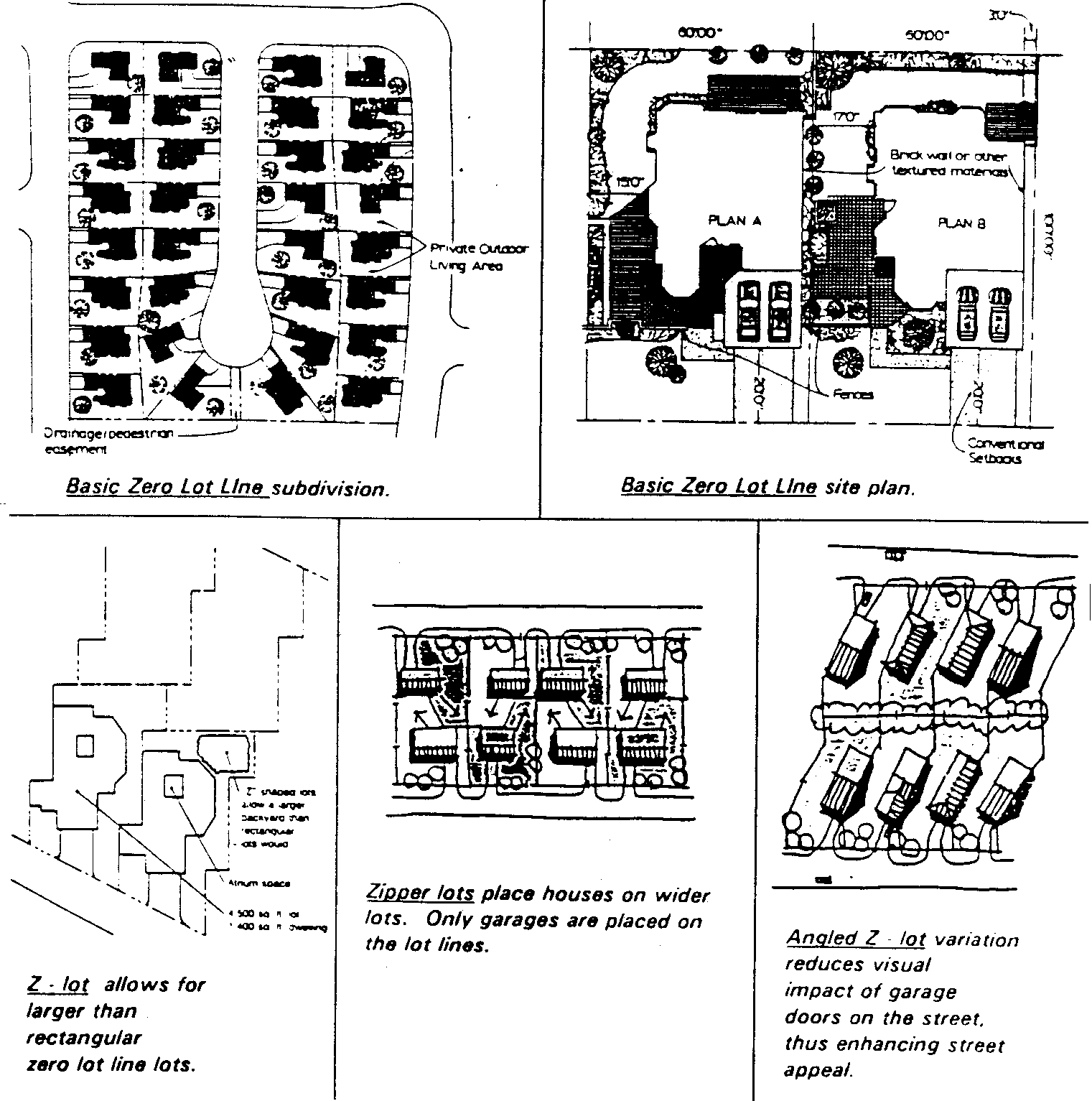
Figure 9.08-17 Zero Lot Line Configuration
Zoning
The division of the Town by legislative regulation into areas, districts or zones,
which specify allowable uses for real property and size restrictions for structures
within these areas; a program that implements the policies of the General Plan.
Zoning District
A designated section of the Town for which prescribed land use requirements and building
and development standards are uniform.
Zoning, Exclusivity
Development regulations that result in the exclusion of low and moderate income families
from a community.
Zoning, Inclusiveness
Regulations which increase housing choice by providing the opportunity to construct
more affordable, diverse, and economical housing to meet the needs of low and moderate
income families.
(Ord. No. 487, § 4, 9-27-2016; Ord. No. 488, § 2A, 9-27-2016; Ord. No. 502, § 3, 5-8-2018; Ord. No. 517, § 3, 10-8-2019; Ord. No. 518, § 4, 10-8-2019; Ord. No. 519, § 2, 10-22-2019; Ord. No. 523, § 6, 1-14-2020; Ord. No. 530, § 3, 3-24-2020; Ord. No. 531, § 5, 8-11-2020; Ord. No. 544, § 4, 3-23-2021)

