
Apple Valley City Zoning Code
CHAPTER 9
72 - Off-Street Parking and Loading Regulations
9.72.010 - General Provisions (Amended Ord. 251, 383)
A.
Purpose. The Town Council finds that the unique characteristics and qualities of the Town of Apple Valley warrant regulations to preserve its aesthetic appeal on a Town-wide basis. Accordingly, The purpose of this Chapter is to achieve the following:
1.
To promote the general welfare by alleviating traffic congestion and by preventing a shortage of off-street parking, loading, bicycle and equestrian facilities;
2.
To ensure the usefulness of parking, loading, bicycle and equestrian facilities;
3.
To protect the public safety by providing properly lighted and accessible parking facilities and by assuring the maneuverability of emergency vehicles;
4.
To protect and preserve the appearance, character and value of surrounding neighborhoods by providing for the installation and maintenance of landscaping and screening for parking facilities; and
5.
To insulate surrounding residential land uses from the effects of vehicular noise and traffic congestion.
B.
Applicability. The regulations in this Chapter shall be applicable to any new use or structure and/or altered use or structure. When the occupancy or use of any premises is changed to a different use, parking to meet the requirements of this Chapter shall be provided for in the new use or occupancy. When an existing use or structure is enlarged or expanded, additional parking to meet the requirements of this Chapter shall be provided for the enlarged or expanded portion only, while maintaining previously existing parking for that use.
C.
Calculation of Space Requirements. If, in the application of the provisions of this Chapter in the calculation of parking space requirements, a fractional number is obtained, one parking space shall be required for a fraction of one-half (½) or more and no space required for a fraction less than one-half (½). Except as may be noted elsewhere in this Chapter, gross floor area (gfa) shall be used as the basis for the calculation of parking spaces required.
D.
Joint Uses. When two (2) or more uses are located in the same development or structure, the parking requirements shall be the sum of the separate requirements per use, except as specifically provided for in this Chapter.
E.
Maintenance
1.
All required parking and loading spaces and driveways shall be maintained in good condition and available for their intended use as long as the use for which parking and loading spaces and driveways was required continues to operate or exist. Parking areas shall be kept free of litter, trash, debris and display or advertising not specifically approved in accordance with this Development Code.
2.
Except in residential developments, inside garage storage shall not encroach into required parking and loading spaces or driveways and vehicles shall not be continuously parked in these areas. All vehicles so parked shall be operable and currently registered.
F.
New Construction, Changes, Alterations or Modifications
1.
New Construction, Changes, alterations or modifications to an existing parking lot or an approved parking plan are not permitted without the required approval in accordance with this Development Code.
2.
Prior to the occupancy of any building or property, except a single family residence, or prior to the modification or alteration of any existing parking lot, approval of a Development Permit from the Planning Division is required. Projects for which approval of a Development Permit is required for other purposes may include the parking lot improvements as a part of the same Development Permit.
3.
The parking lot plan shall contain the following information:
a.
Name, address and location of the development;
b.
Scale, north arrow and vicinity map showing the closet major streets and distances to cross streets on each side;
c.
Property lines and lot dimensions;
d.
Location and width of all easements;
e.
Footprint of all structures and any overhangs or projections;
f.
Location of all entrances and loading doors;
g.
Location of all curbs and wheel stops;
h.
Location, typical dimensions, and type of surfacing for all driveways, parking and loading spaces, and thickness of the paving;
i.
Location of all trash enclosures, transformers, and any equipment outside the building;
j.
striping plan;
k.
Location and type of any lighting fixtures;
l.
Location and types of any signs;
m.
Grading and drainage plan;
n.
Landscaping and irrigation plan;
o.
Statistical summary of the project including total gross square feet of each building and the total gross square feet of the project, the number of covered parking spaces, and the total number of parking and loading spaces.
G.
Nonconforming Parking. Structures or uses which have insufficient parking per the requirements of this Ordinance and are a legal nonconforming use shall not be expanded unless sufficient additional parking can be provided in accordance with the requirements Section of 9.72.020 of this Chapter. Existing parking shall be counted as meeting this requirement only if it is in compliance with the standards in effect at the time of its development. Nonconforming parking shall also comply with the provisions of Chapter 9.07 of this Ordinance.
H.
Commercial Vehicle Parking. (See Section 12.38 of the Municipal Code "Commercial Vehicle Parking".)
I.
Use of Parking Spaces
1.
Required parking spaces shall be used only for the parking of vehicles for property owners, guests, renters, patrons or employees.
2.
Vacant lots, privately owned lots and the parking lots of commercial and industrial businesses shall not be used for the advertising, sale, rental or repair of motor vehicles, boats, trailers or similar property unless they are duly licensed by the Town to do so. Occupied property may be used for the sale of personal vehicles of the property owners providing that not more than one (1) vehicle may be displayed which is not otherwise prohibited by this Code and shall be subject to the provisions of subsection 9.74.050 "Prohibited Signs" of this Code.
3.
Vehicles, boats, trailers or similar property shall not be parked or stored on any vacant or undeveloped property in any zoning district, except that no more than three (3) noncommercial motor vehicles that are operable and currently registered to the occupant of an abutting developed residential lot may be parked on such vacant or undeveloped lot in the R-VLD, R-LD, R-A, R-E, R-E¾, R-SF, and the R-EQ (single family) zoning districts. The portions of such lots that are used for parking shall be paved to Town standards.
4.
Parking and loading spaces or driveways shall not be used for the habitation of a trailer, camper or recreational vehicle unless otherwise allowed in accordance with this Development Code.
J.
Trailers, campers, fifth-wheels, recreational vehicles, buses, or similar vehicles shall not be used or occupied for any residential purpose, and any such residential use of such vehicle(s) is expressly prohibited except as defined herein. A trailer, camper, fifth-wheel, recreational vehicles, bus, or similar vehicle may be placed, for a residential purpose, on a site for up to fifteen (15) days within any one (1) calendar year. Upon approval of a Temporary Use Permit, a trailer, fifth-wheel, bus, or similar vehicle may be placed, for a residential purpose, on a site for up to sixty (60) days within any one (1) calendar year."
9.72.020 - Parking and Loading Spaces Required Per Use (Amended Ord. 314, 347, 383)
Minimum off-street vehicle parking and loading spaces shall be provided in accordance with the requirements of Table 9.72.020-A and Table 9.72.020-B respectively for all new buildings or uses and when any building or use is altered, extended, changed, or intensified. In cases of mixed uses in a building or on a lot, the total requirement for off-street parking shall be the sum of the requirements for the various uses computed separately.
Abbreviations sf = square feet
gfa = gross (total) floor area
A.
Parking for Uses Not Specified. In cases where the off-street parking requirement is not specified herein for a particular type of use, the Director shall determine the parking requirement based on parking demand information contained in such appropriate reference sources as Institute of Traffic Engineers manuals, Planning Advisory Service studies, Urban Land Institute studies, the requirements of other similar cities, and the parking requirement for similar uses in this Code.
B.
Bicycle Parking. Bicycle spaces may be required for some uses including fast food restaurants, theaters, shopping centers, schools, etc., to be determined by the Director. A rack or other secure device for the purpose of storing and protecting bicycles from theft shall be installed. Such devices shall have a minimum capacity of one (1) bicycle per twenty (20) required parking spaces and shall be located in such a way as not to interfere with pedestrian or vehicular traffic.
C.
Compact Parking. Where a total of at least twenty (20) parking spaces are provided, a maximum of fifteen (15) percent of the required parking may use compact parking stalls having a minimum size of eight (8) feet by seventeen (17) feet. No more than one-third (⅓) of the compact parking stalls may be located adjacent to or within close proximity to the main entrance to a business, the remaining compact stalls shall be distributed throughout the parking area.
Table 9.72.020-A Required Parking Spaces
(1) Where a total of at least twenty (20) parking spaces are provided, a maximum of
fifteen (15) percent of the required parking may use compact parking stalls having
a minimum size of eight (8) feet by seventeen (17) feet. No more than one-third (1/3)
of the compact parking stalls may be located adjacent to or within close proximity
to the main entrance to a business, the remaining compact spaces shall be distributed
throughout the parking area.
(2) Twenty-five (25) percent of the required parking spaces for equestrian uses shall accommodate trailers. Such spaces shall be a minimum of twelve (12) feet by twenty-five (25) feet.
(3) Parking requirements for senior housing
(4) In accordance with Section 9.36.110.(E.1), off-street parking requirements for congregate care facilities that provide senior citizen housing may be adjusted subject to a parking study based on project location and proximity to services for senior citizens including but not limited to, medical offices, shopping areas, mass transit, etc.
Table 9.72.020-B Required Loading Spaces
The following minimum number of loading spaces shall be provided for each use.
(1) Unless otherwise required by Section 9.72.060.C of this Code.
(Ord. No. 539, §§ 4—10, 12-8-2020; Ord. No. 544, § 15, 3-23-2021)
9.72.030 - Adjustments to Off-Street Parking Requirements (Amended Ord. 330)
A.
Shared Parking.
Parking facilities may be shared if two (2) or more uses located in the same development or structure generate parking demands primarily during hours when the remaining uses are not in operation. The applicant shall have the burden of proof for a reduction in the total number of required off-street parking spaces, and documentation shall be submitted substantiating the reasons for the requested parking reduction. Requests for a reduction in parking facilities for shared parking shall be in accordance with the provisions for Special Use Permits (Chapter 9.16 of this Code) and the following:
1.
A reduction in the minimum parking requirements for the individual uses within a development may be granted by the reviewing authority where the joint use of parking facilities will mitigate peak parking demand.
2.
Requests for reductions in the required number of parking spaces resulting from joint usage may be required to provide supporting information prepared by a traffic engineer registered by the State of California. Requests for shared parking shall be reviewed as follows:
a.
Initial project review. Provide documentation and quantification of proposed land uses and anticipated functional relationships between the parking needs of different land uses. The initial review shall also consist of data gathering regarding proximity to transit facilities, the general location of parking facilities, surrounding land uses and mix, predicted pedestrian patterns, and similar variables which affect parking needs;
b.
Adjustments for peak parking factor. Include calculations for the number of off-street parking spaces required for each land use within the area proposed for joint parking use based on the requirements of Table 9.72.020-A. Other elements to be considered include seasonal demand and the availability of public transit facilities;
c.
Analysis of hourly accumulation. Provide an estimation of hourly parking accumulations for each land use during a typical weekday and weekend day; and
d.
Estimate of shared parking. Merge the hourly parking demand estimates to calculate the overall parking required to be provided within the area being considered for shared parking facilities.
3.
A maximum of fifty (50) percent of the parking facilities required by this Chapter may be considered for shared parking.
4.
Required findings.
In granting parking reductions for the shared use of parking facilities, the reviewing authority shall make at least one of the following findings:
a.
The applicant has provided documentation, which may include a traffic engineering report, that justifies the requested parking reduction based upon the presence of two or more adjacent land uses which, because of their substantially different operating hours and/or difference in peak parking characteristics, will allow joint use of the same parking facilities; or
b.
The applicant has provided documentation, which may include a traffic engineering report, that indicates that there are public transportation facilities and/or pedestrian circulation opportunities which justify the requested reduction of parking facilities; or
c.
The applicant has provided documentation, which may include a traffic engineering report that finds that the clustering of land uses is such that a reduced number of parking spaces can serve multiple trip purposes to the area in question.
5.
Additional documents, covenants, deed restrictions or other agreements, as deemed necessary by the Director of Planning Services, shall be executed to assure that the required parking spaces are maintained and that uses with similar hours and parking requirements as those sharing the parking facilities remain for the life of the development.
B.
Off-Site Parking Facilities.
Required parking may be provided off the site in certain instances. Requests for off-site parking facilities shall be in accordance with the provisions for Special Use Permits (Chapter 9.16 of this Code) and the following:
1.
The off-site parking shall be located so as to adequately serve the use for which it is intended. The reviewing authority shall consider the following in making this determination:
a.
Proximity of the proposed off-site parking facilities to the use it is intended to serve;
b.
Ease of and the security of pedestrian access to the proposed off-site parking facilities;
c.
The type of use that the proposed off-site parking facilities are intended to serve, recognizing that such facilities are generally not desirable for high-turnover uses; and
d.
The need for and the resulting benefit of the proposed off-site parking.
2.
Additional documents, covenants, deed restrictions or other agreements, as deemed necessary by the Director of Planning Services, shall be executed to assure that the off-site parking spaces are maintained and that the off-site parking facilities remain for the life of the development.
C.
Accessory Uses. Parking requirements for accessory uses located in the same commercial or industrial building or structure or on the same site as is the principal use, may be reduced by up to fifty (50) percent upon a determination by the reviewing authority that such a reduction is justified based on the size, shape, and location of the site and the combination of the intended uses involved. However, in some cases, such as an accessory commercial use within an industrial use or structure, accessory uses may result in an increased parking space requirement.
D.
Valet Parking. Requests for valet parking shall be in accordance with the provisions for Special Use Permits (Chapter 9.16 of this Code). Required parking for no more than sixty-six (66) percent (⅔) of the total required parking can be provided through valet parking. Valet parking, for the purposes of meeting the required off-street parking regulations, is only permitted in the "Village" area of Apple Valley for restaurant establishments. A minimum of thirty-three (33) percent of the required parking shall be provided on-site. The valet serve shall be located on-site; however, the parking area for the valet service may be located off-site and must conform to the requirements of subsection B above, for off-site parking facilities. Valet parking shall be free of charge and limited to the peak hours for a restaurant use of 5:00 p.m. to closing. However, these hours can be changed by the review authority.
9.72.040 - Regulations for Residential Uses
A.
Location. Parking spaces within the Multi-Family Residential (R-M) District, shall comply with the provisions of Section 9.29.070 "Multi-Family Housing Standards". Parking shall be setback a minimum of fifteen (15) feet from the front or street side property lines. Parking shall be screened from the public rights-of-way with a minimum ten-foot wide landscaped buffer. This buffer shall be landscaped, using berms or short three-foot wall(s) to reduce the visual impact of the parked vehicles. Off-street parking spaces shall be located on the same lot or parcel on which the dwelling is located and as further modified below.
When a garage is specifically required, or provided to meet required parking, entry doors shall be maintained in an operable condition at all times, and no structural alteration or obstruction shall be permitted within the required parking area which would reduce the number of required parking spaces. Use of garages shall be limited to vehicular and general storage purposes only and shall not conflict with any applicable building, housing or fire codes.
1.
Single family detached dwellings. Additional parking for single family detached dwellings beyond that which is required by this Chapter may be placed in a required side setback or in the required front setback alongside the driveway on the side closest to the side property line, provided the driveway is at least twenty (20) feet long. Such additional parking shall be paved in accordance with required standards.
2.
Other Residential Developments. Off-street parking spaces for all other dwelling types shall be located on the same development site, except as provided for in paragraph 9.72.030.B of this Chapter, within 150 feet of the dwelling which it serves and shall not be located across a street.
B.
Covered Parking
1.
Single Family Detached Dwellings. Two (2) parking spaces per dwelling unit shall be within an enclosed garage. Said garage shall have a minimum clear gross floor area of twenty (20) feet by twenty (20) feet free of any obstructions including mechanical equipment.
2.
Mobile Homes. In mobile home park developments, both of the required two (2) spaces per unit shall be covered.
3.
Other Residential Developments. Parking spaces required by Table 9.72.020-A, per dwelling unit, shall be within an enclosed garage. Said garage shall have a minimum clear floor area of ten (10) feet by twenty (20) feet per space free of any obstructions including mechanical equipment. In addition, additional required parking for such developments shall be covered but need not be enclosed. Required guest parking may be uncovered.
C.
Senior Citizen Developments. The Planning Commission may reduce the total number of parking spaces required for senior citizen housing by up to twenty-five (25) percent based upon a finding that the parking demand is reduced because the proposed development is located within close proximity to a shopping center, or is adequately served by a private or public transportation system.
The number of required covered parking spaces may be reduced by up to fifty (50) percent based upon evidence submitted by the developer that the reduction is directly related to providing dwelling units to meet the needs of lower and moderate income senior citizen households as identified in the Town of Apple Valley General Plan Housing Element. In no instance shall the number of covered parking spaces be fewer than one (1) per two (2) dwelling units.
D.
Assigned Spaces for Multi-Family Developments. At least one assigned parking space shall be provided per dwelling unit a maximum of 200 feet from the dwelling unit it serves.
E.
Guest Parking. Guest parking shall be included as required by Section A.3 of Table 9.72.020-A in this Chapter, and need not be covered.
(Ord. No. 539, §§ 12, 13, 12-8-2020; Ord. No. 544, § 16, 3-23-2021)
9.72.050 - Regulations for Commercial and Industrial Uses (Amended Ord. 251)
A.
Location of Required Parking and Loading Spaces
1.
In commercial and industrial districts, off-street parking spaces shall be located on the same lot and shall be located within 400 feet of the main structure they serve. Such distance shall be computed from the nearest point of the structure's public access to the most distant point of the parking area. Or, with a recorded reciprocal parking ingress and egress agreement, on a lot contiguous to the building, structure or use to be served, also subject to the above distance requirement.
2.
The required parking spaces shall not be located in the rear of commercial buildings unless secure and well lit direct customer access to the facility is provided. Required parking spaces may be located in required front, side and rear setbacks provided that all other requirements, such as landscaping and the dedication of required easements and rights-of-way, have been satisfied.
3.
Parking for commercial, office, institutional and industrial uses adjacent to residential uses or districts shall be set back a minimum distance equal to the required setback for the residential property or twenty-five (25) feet, whichever is greater. Refer to Section 9.72.080 for possible reductions to this standard.
4.
Required loading spaces shall be located immediately adjacent to the exterior wall of the building. Such spaces shall not be located in the required front or side building setbacks.
5.
Loading spaces shall be set back a minimum of twenty-five (25) feet from any residential use or district.
6.
Loading spaces shall be located and designed so that trucks are not required to back into public rights-of-way for ingress or egress. Truck maneuvering areas shall be provided where appropriate.
7.
Parking spaces required to be provided for the physically handicapped shall be located as near as possible to the primary building entrance.
B.
Underbuilding, Underground, Rooftop Parking or Parking Structures. The minimum dimensions for such parking shall be the same as that required for uncovered surface area parking as specified throughout this Chapter.
A level transition area between the street and a ramp serving underground or decked parking shall be provided for a distance, a minimum of twenty (20) feet, which will provide adequate site distance at the street.
1.
General
a.
The development of parking structures shall be subject to the Development Permit process and subject to approval by the Planning Commission.
b.
Interior parking lot landscaping shall not be required for parking spaces located within parking structures.
c.
Stair wells within parking structures shall be open to permit casual observation.
d.
Ramps within parking structures shall have a maximum slope of twenty (20) percent with a transitional slope of ten (10) percent for the first and last ten (10) feet.
e.
Parking facilities with controlled access shall provide stacking space for three (3) cars, a minimum of sixty (60) feet.
2.
Underground Parking Facilities
a.
Openings for ingress and egress shall be located behind the required building setback line.
b.
Exits from underground parking facilities shall provide adequate sight distance in compliance with Town standards.
c.
Underground parking facilities may be located in the required building setbacks.
d.
Underground parking facilities shall not be counted as a floor nor counted against the building height limitations of the base district in which it is located.
3.
Underbuilding Parking Facilities
a.
Underbuilding parking facilities shall not be located within required building setbacks.
b.
Underbuilding parking facilities shall be counted as a story where the finished floor of the first level of the main structure exceeds three (3) feet above the grade of the nearest street, except for openings for ingress or egress.
c.
Exits from underbuilding parking facilities shall provide adequate sight distance in compliance with Town standards.
4.
Rooftop Parking and Parking Structures
a.
Above ground parking facilities shall comply with the height and building setback requirements of the zoning district in which it is located.
b.
The exterior elevations of parking structures shall comply with the provisions of Chapter 9.37, Commercial Design Standards of this Code, so as to minimize the use of blank concrete facades.
c.
The perimeter of parking structures shall be landscaped at ground level with a minimum of one (1) tree, twenty-four (24)-inch box minimum size when installed, for every twenty (20) feet of facade length, in addition to the requirements of Chapter 9.75, Water Conservation/Landscaping Regulations of this Code.
d.
Interior parking lot landscaping shall be in accordance with Chapter 9.75, Water Conservation/Landscaping Regulations of this Code.
9.72.060 - Design Standards for Parking and Loading Spaces (Amended Ord. 272, 314, 383)
A.
Parking Space Dimensions and Design
1.
Covered Spaces. Each covered parking space shall be located within a carport or enclosed garage as follows:
a.
Carport. Minimum size of shall be nine (9) feet by twenty (20) feet clear of any obstructions including walls or structural supports.
b.
Garage. Enclosed garages shall have a clear, unobstructed minimum area of ten (10) feet by twenty (20) feet for each one (1) car parking space provided.
2.
Uncovered Spaces. Each uncovered ninety (90)-degree parking space shall be a minimum of nine (9) feet wide by nineteen (19)-feet deep. The depth may be reduced by two (2) feet where a minimum four (4)-foot clear sidewalk width remains uncovered by vehicle overhang. Vehicle overhang may also be permitted onto landscaped areas. Vehicle overhang is not permitted within any public right-of-way or public easement.
3.
Parallel Spaces. Each parallel parking space shall have a minimum dimension of nine (9)-feet wide by twenty-four (24)-feet long. However, if adequate access exists, the length of end spaces may be reduced to twenty (20) feet, as shown in Figure 9.72.060-A below.
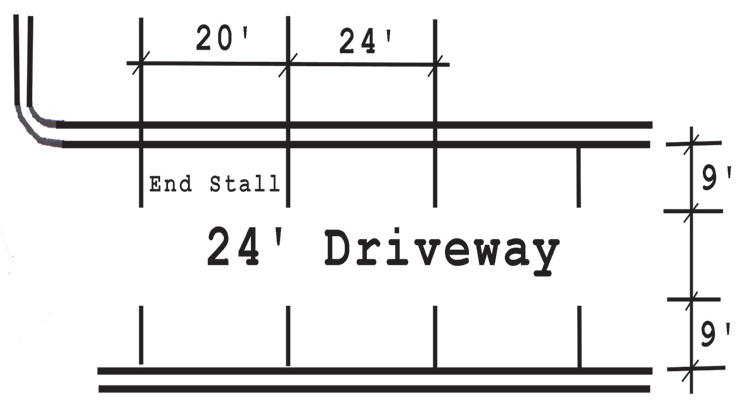
Figure 9.72.060-A Parallel
Parking
4.
Tandem Spaces. Except for single family residences and mobile home parks, uncovered parking spaces shall not be in tandem, one behind the other in a single line, except for valet parking areas as permitted under Section 9.72.030.D. Where permitted, each tandem parking space shall be a minimum of nine (9) feet wide by twenty-two (22) feet in depth.
5.
Angled Parking. If Angled parking spaces are utilized they shall be designed in accordance with the dimensions provided in Table 9.72.060-A and delineated in Figure 9.72.060-B below.
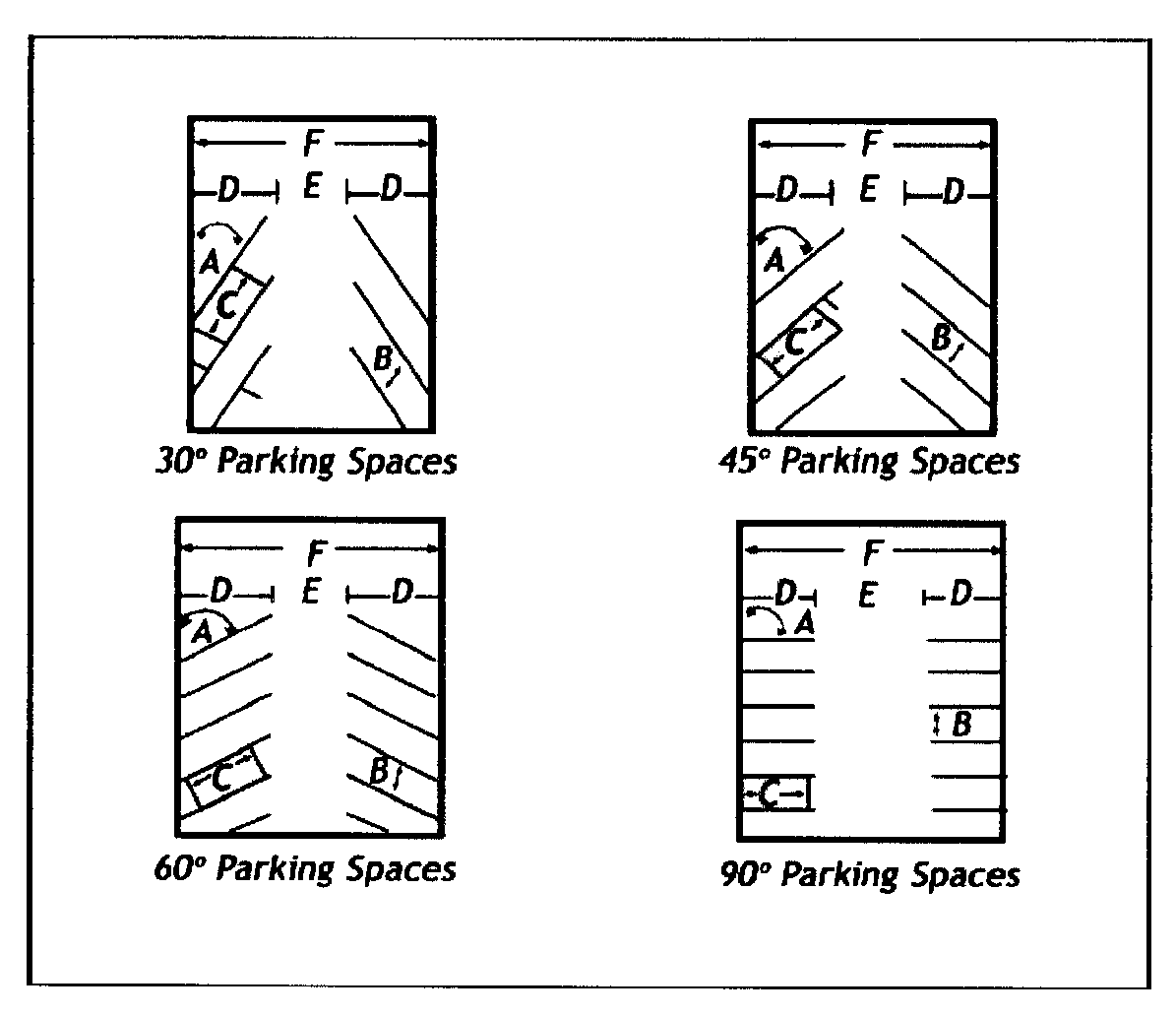
Figure 9.72.060-B Angled Parking
Table 9.72.060-A Minimum Off-Street Parking Dimensions
(1) minimum drive aisle width may be increased based upon specific use and the fire department access requirements.
6.
Driveway width for multi-family development. Multi-family development projects which have a maximum of two (2) access points to a public right-of-way or which are enclosed private drives shall be permitted to use two-way private driveways with a minimum width of twenty-eight (28) feet in accordance with the Multi-family Housing Standards, Section 9.29.070 within this Code.
7.
Parking for the Handicapped. All projects shall provide parking spaces for the handicapped in compliance with Title 24 of the California Administrative Code. Ramps, striping, identification and signing for such spaces shall also be in compliance with Title 24 of the California Administrative Code.
8.
Recreational Vehicle Parking. Recreational vehicle spaces shall contain not less than 400 square feet per space with minimum dimensions of ten (10) feet by forty (40) feet.
B.
Standard Improvements
1.
Directional Arrows and Signs. Within parking facilities, all aisles, approach lanes and maneuvering areas shall be clearly marked with directional arrows on the surface of the pavement to facilitate vehicular movement. Directional signs may also be required to ensure safe and efficient vehicular movement.
2.
Drainage. All parking facilities, except those that serve one or two residential dwelling units, and all loading facilities shall be designed and graded to prevent the flow of surface water over sidewalks or onto adjacent property.
3.
Safety Features. Additional requirements for parking facility safety, including overall design, internal layout, acceptable turning radii, pavement slope, potential vehicular, bicycle, pedestrian, equestrian conflicts, and other design features may be required by the Town Engineer.
4.
Striping and Identification. All vehicle parking spaces shall be clearly delineated with double white lines on the surface of the parking facility as shown in Figure 9.72.060-F below. All loading spaces shall be clearly and conspicuously marked.
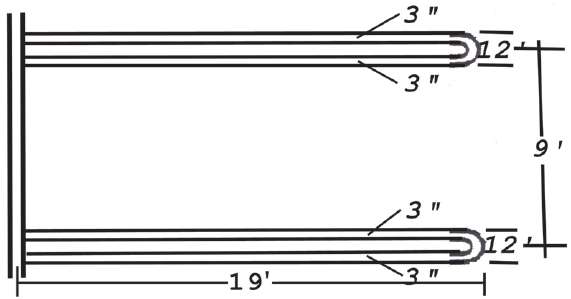
Figure 9.72.060-F Striping
5.
Loading Spaces. All loading spaces shall be clearly and conspicuously marked.
6.
Surfacing. Permanent vehicle parking, loading, maneuvering and driveway areas shall be paved with asphalt, concrete or other all-weather surface as approved by the Town Engineer and shall be permanently maintained in a dust-free manner and kept clear of any litter, trash or debris. The following standards shall also apply:
a.
The flooring material for garages and carports in all zoning districts shall be portland cement concrete.
b.
Parking and loading spaces and driveways shall be paved and maintained in a good and safe condition and shall be so graded and drained as to dispose of all surface water run-off and to prevent such run-off from accessing adjacent property without the permission of that property owner. The paving of driveways for single-family residences may be waived where paved streets are not installed. Drainage courses and swales in parking lots shall be paved with concrete. Asphalt parking lots shall be finished with a seal coat.
c.
Temporary parking facilities shall be surfaced as approved by the Town Engineer and maintained in a dust-free manner.
7.
Lighting. All parking areas shall be well lit with sufficient lighting to illuminate all areas for security and safety and shall comply with the provisions of Chapter 9.70, Performance Standards of this Code.
8.
Wheel Stops/Curbing. Continuous concrete curbing at least six (6) inches high and six (6) inches wide, and a minimum of six (6) inches below grade shall be provided as follows:
a.
Continuous concrete curbing shall be provided a minimum of five (5) feet from any wall, fence, property line, walkway, or structure where parking and/or drive aisles are located adjacent thereto. Refer to Section 9.25.030(E) for deviations to this requirement.
b.
The area between the curb and the wall, fence, property line, walkway, or structure shall be landscaped or constructed with a sidewalk providing connection to building entrance. Walkways adjacent to overhanging parked cars shall have a clear width of four (4) feet. Refer to Section 9.25.030.E for deviations to this requirement.
c.
All parking lots shall have continuous concrete curbing around all parking areas, driveways, aisles and planters; wheel stops are not permitted in lieu of curbing, to protect landscaping, signage, structures and walls.
C.
Loading Areas
Loading areas for freight, equipment or passengers shall be provided in accordance with Table 9.72.020-B and the following. Sites which cannot meet the dimension requirements for large delivery trucks shall limit deliveries to the hours between 12:00 a.m. and 8:00 a.m., except UPS and US Mail deliveries.
1.
Dimensions
a.
Off-street loading facilities shall be a minimum of fifteen (15) feet by fifty (50) feet long with a minimum of fourteen (14) feet of vertical clearance.
b.
Where passenger loading facilities are required, such facilities shall be a minimum of fifteen (15) feet wide by forty (40) feet long.
2.
Location. Loading spaces shall be located only in the side or rear portions of the lot, however, loading spaces shall not be located within any required setback adjacent to residential; and loading areas shall be:
a.
Adjacent to, or as close as possible to, the structures they serve;
b.
Located so as to provide for adequate maneuvering space on-site and not require maneuvering into public rights-of-way, alleys or into traffic lanes.
c.
Passenger loading spaces shall be located close to the structure entrance so that passengers are not required to cross lanes of traffic to reach the entrance.
3.
Hours of Operations. Loading areas located within 200 feet of residential uses or districts shall not be operated between the hours of 10:00 p.m. and 7:00 a.m.
4.
Design Requirements
a.
Loading doors shall not face public rights-of-way, except alleys or local industrial streets.
b.
Loading doors shall be screened from public rights-of-way and residential uses or districts by the use of wing walls, screening walls, landscaping or any combination thereof approved by the reviewing authority (Figure 9.72.060-H).
c.
Screening and wing walls for the screening of loading areas shall be of sufficient height to screen the loading activity and shall be architecturally compatible with the primary structure on the site.
d.
A line of sight analysis shall be provided with all site plans for which loading areas are proposed. Such analysis shall show that all loading doors are screened from public view from any right-of-way or adjacent residential use or district.
e.
Loading spaces shall not encroach into any drive aisles or required parking spaces.
f.
Wherever a loading space is adjacent to required parking spaces there shall be a protective landscaped buffer a minimum of five (5) feet in width separating them.
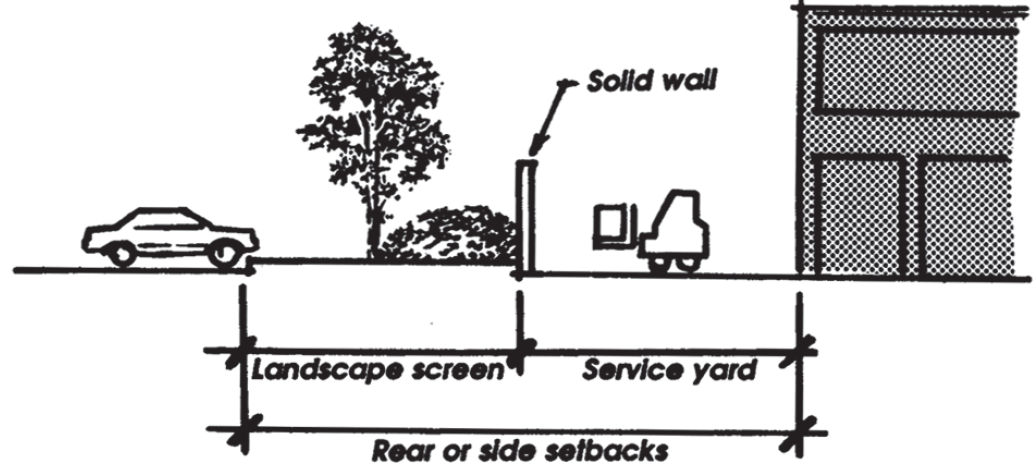
Figure 9.72.060-H Loading Areas
D.
Bicycle Parking
1.
Each bicycle parking space shall be a minimum of six (6) feet long and two (2) feet wide, exclusive of auto drive aisles and access areas and pedestrian access areas.
2.
Where provided, storage sheds for bicycles shall be a minimum of three (3) feet by six (6) feet by four (4) feet.
3.
Each bicycle parking space shall have a parking rack capable of supporting bicycles of various sizes in a vertical position.
4.
Bicycle parking racks shall be securely fastened to the surface with sufficient structural strength to resist vandalism and theft.
5.
Bicycle parking spaces shall be clustered in lots of not more than ten (10) spaces each and such lots shall be dispersed throughout the development.
(Ord. No. 473, § 4, 8-25-2015; Ord. No. 539, §§ 16—24, 12-8-2020)
9.72.070 - Access Standards for Parking and Loading Spaces (Amended Ord. 236, 239, 251, 265, 272, 383)
A.
Parking Access from Streets
1.
Parking areas shall provide adequate maneuvering area such that all vehicles may enter an abutting street in a forward motion. Single family residences are exempt from this requirement, however, semi-circular driveways within single family residential districts are encouraged.
2.
Parking spaces shall not be accessed directly from a public street. Parking spaces shall be accessed from drive aisles within the parking facility.
3.
Parking spaces shall not be located to require a vehicle to maneuver within twenty (20) feet of a vehicular entrance, measured from the property line.
4.
Parking lots shall be designed to provide complete and through circulation wherever possible. In any case, adequate turning radii and turnarounds shall be provided for emergency vehicles and trash and delivery trucks.
5.
Any structure which extends above a drive aisle shall have a minimum vertical clearance of fourteen (14) feet.
6.
Drive aisles shall be in compliance with Table 9.72.060-A "Parking Space Dimensions".
B.
Driveways and Ramps
1.
Driveways. For purposes of this Section, a driveway is an access from a public right-of-way or private street to a parking area or from one parking area to another. Driveways do not include ramps, aisles or maneuvering area. Driveways shall comply with the following:
a.
Driveways for single family residences shall be at least twelve (12) feet wide and shall be maintained clear of all obstructions.
b.
Driveways for single family residences shall include the area from the right-of-way to the designated parking area (i.e., garage, carport) and shall be no wider than such designated parking area.
c.
Driveways for single-family attached, multi-family and nonresidential uses shall comply with the following:
1)
Width, excluding flares or curb returns
2)
Right turn radius
3)
Minimum spacing
2.
Ramps
a.
One-way ramps shall have a minimum width of fourteen (14) feet, unless a wider ramp is needed for emergency vehicle access.
b.
Two-way ramps shall have a minimum width of twenty (20) feet.
C.
Gated Entries
Gated entries, including those for single family detached residences, may be utilized subject to review and approval of the Town Engineer. Requests for gated entries shall include a study addressing the following:
1.
The type and operation of the gate;
2.
Stacking Space. Provide adequate vehicle stacking space at the rate of a minimum of twenty (20) feet per vehicle, for the use being served, as follows:
a.
Single family detached residence, stacking space for one (1) vehicle;
b.
All other residential uses, stacking space for three (3) vehicles;
c.
Industrial uses, stacking space for six (6) vehicles;
3.
Turnaround area. Provide a turnaround area outside the gate, except for single family detached residences;
4.
Effect of the gated entry on parking usage and distribution on the site;
5.
Effect of the gated entry on parking for adjacent uses; and
6.
Emergency vehicle access.
D.
Access to Loading Areas. Adequate on-site maneuvering area shall be provided for loading spaces. Access to loading areas shall not interfere with on-site vehicular or pedestrian traffic.
9.72.080 - Landscaping and Screening Requirements
Wherever any parking area, except for single family residences, is provided, landscaping consisting of trees, shrubs, groundcover, of combinations thereof, and permanent irrigation shall be installed and permanently maintained in accordance with the provisions of Chapter 9.75Water Conservation/Landscaping Regulations of this Code, and the following standards:
A.
Landscape Coverage. The minimum landscape coverage requirement of the underlying zoning district shall govern. In addition, the following minimum standards shall apply to the interior and perimeter of parking lots and may add to the site requirement. For the purposes of this Section the interior of a parking lot includes the parking stalls, aisles and maneuvering space.
1.
A minimum of five (5) percent of the interior of parking lots shall be landscaped.
2.
For lots or commercial centers greater than two (2) acres in size, a landscaped strip with a minimum width of ten (10) feet shall be provided where parking lots are adjacent to a public right-of-way or residential uses or districts For lots or commercial centers two (2) acres or less in size, a landscape strip with a minimum of five (5) feet shall be provided, where parking lots are adjacent to a public right-of-way or residential uses or districts. For gas stations, regardless of size, a landscape strip with a minimum of five (5) feet shall be provided, where parking lots are adjacent to a public right-of-way or residential uses or districts. The required setback between parking lots adjacent to residential uses or districts can be reduced with a Deviation Permit approved by the Director. The setback reduction shall require the erection of a decorative block wall adjacent to the property line. Said wall shall be a minimum of six (6) feet in height, up to a maximum of eight (8) feet, subject to surrounding topography and potential neighborhood impacts. If the commercial parcel or center is adjacent to an existing commercial development with a landscaped setback strip that is less than the required amount specified above, a reduction in width is permitted. This reduction in width must be similar in width of the adjacent landscaped setback, and designed with a gradual taper, back to the required width on the subject parcel or center.
3.
Provide a minimum of one (1) tree (minimum fifteen (15) gallon size when planted) for each seven (7) parking spaces located so as to visually disrupt long rows of parking spaces, trees may be clustered where appropriate.
4.
Landscaping along a property line abutting vacant property shall utilize a concrete curb, a block wall, or a mowing strip (at least four (4) inches wide and six (6) inches deep) along said property line for definition.
5.
All landscaped areas shall be bordered by a concrete curb and shall be at least five (5) feet wide. Concrete mow strips at least four (4) inches wide and six (6) inches deep shall be used to separate turf areas from shrub areas.
6.
Low walls, berms or landscaping, thirty-six (36) to forty-two (42) inches in height, as measured from the finished grade of the parking area, shall be used adjacent to public rights-of-way to screen the parking area. The height of such wall or berm may be reduced where the parking lot grade is lowered (Figure 9.72.080-B).
7.
All areas within a parking lot not used for driveways, maneuvering areas, parking spaces, aisles or walkways shall be permanently landscaped.
8.
Parking and driveway areas in commercial and residential zoning districts shall be separated from buildings by a landscaped planter.
9.
Where a drive aisle abuts the side of a parking space a landscaped planter shall separate the parking space from the drive aisle.
10.
For purposes of determining landscaped setbacks, the parcel line adjacent to the right-of-way shall be the ultimate right-of-way. If the ultimate right-of-way has been dedicated, but will not be immediately improved, encroachment of the required landscaping may occur within the right-of-way with the approval of a Deviation Permit by the Director.
11.
To encourage creativity and unique landscape design, commercial centers greater than two (2) acres in size may deviate from the landscape standards through development of a landscape program approved by a Deviation Permit approved by the Planning Commission. An additional finding must be made by the Planning Commission explaining how the design of the overall landscape program compliments the development and the reduction in landscaping does not degrade the appearance of the project or the surrounding area.
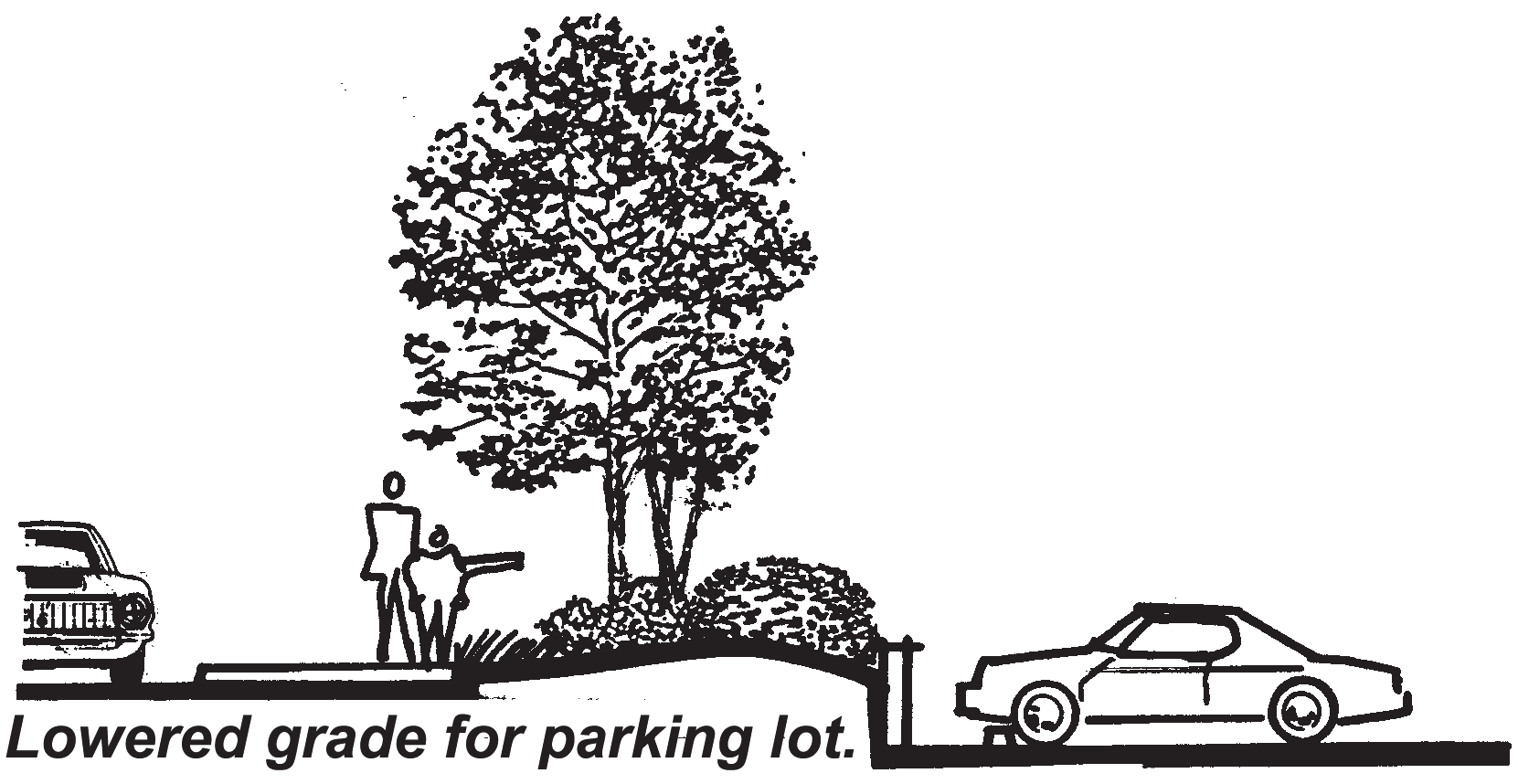
Figure 9.72.080-B Landscape Screens
B.
Landscape Maintenance. The required landscaping shall be maintained in a neat, clean and healthy condition. This shall include pruning, mowing of lawns, weeding, removal of litter, fertilizing, replacement of plants where necessary, and the regular watering of all plant material.

