
Apple Valley City Zoning Code
CHAPTER 9
47 - Industrial Design Standards
9.47.010 - Purpose and General Plan Consistency, Objectives and Applicability
A.
Purpose and General Plan Consistency.
The purpose of this Chapter is to implement the goals, objectives, and policies of the Town General Plan and Comprehensive Economic Development Plan and to complement the development standards for the various types of development found in Chapters 9.45 and 9.46 of this Development Code with respect to the design features of a given project. In addition, the purpose of these standards is to assist the developer in understanding the Town's goals and objectives for high quality industrial development, as described in the General Plan.
B.
Objectives. The following are objectives of the design standards:
1.
To encourage and promote designs that relate to and are compatible with the community's desert environment;
2.
To establish measures for the buffering of both new and established uses from industrial activities;
3.
To establish projects that will exhibit design and planning excellence; and
4.
To protect the investments and property values of existing businesses and property owners from new developments of inferior quality.
C.
Applicability
The provisions of this Chapter shall apply to all new industrial development within the Town and any addition, remodeling, relocation or construction requiring a building permit within any industrial district.
The overall intent of these standards is to provide a framework that defines the type of built environment desired by the Town that can be used by developers, Town staff, the Planning Commission and the Town Council to design and evaluate development proposals. Final design review of all industrial development, including new construction, exterior modifications and additions, is subject to the provisions of Development Code Chapter 9.17 "Development Permit.
9.47.015 - Reserved.
Editor's note— Section 11 of Ord. No. 513, adopted Aug. 27, 2019, removed Section 9.47.015, Applicability, as amended by Ords. 236, 265 and 211, in its entirety.
9.47.020 - Site Planning (Amended Ord. 272)
A.
Site Planning
1.
Significant site features such as Joshua trees, topography, and natural rock outcroppings shall be preserved.
2.
Buildings shall be sited to complement existing buildings and landscape, the shape of the parcel, and natural conditions such as topography and rock outcroppings and significant vegetation.
3.
Building footprints should be varied throughout a site plan. Repetitious or continuous expanses of rectangular buildings shall always be avoided in favor of varied and articulated footprints.
4.
Building placement on adjoining parcels along a street shall be varied to avoid creating a monotonous block-face type streetscape.
5.
Buildings shall be sited so that main entrances are generally oriented toward the driveway (parking circulation area). Visitor parking shall be located outside of any fenced area.
6.
Encroachment onto utility or other public or private easement is prohibited. Buildings shall be sited or arranged so as not to encroach on any utility, public, or private easements.
7.
The orientation of buildings and activities on a site shall be compatible with the existing layout of the adjacent property.
8.
All trash, loading and service areas shall be screened from public rights-of-way and adjacent residential uses or districts. Loading areas shall be located to the rear of the site and service bays shall be oriented away from public rights-of-way and adjacent residential uses or districts.
9.
Solar Access. Buildings shall be designed and sited so that solar access for the buildable lot area of adjacent properties are protected to the maximum extent feasible when such properties are vacant.
10.
A variety of building and parking setbacks shall be provided in order to avoid monotony in building facades.
11.
Large industrial complexes containing more than one (1) building or a site larger than five (5) acres shall include a focal point such as a plaza area, created using hardscape and landscape treatments (Section 9.46.060, Intensity Bonus, of this Code).
12.
Street Address. Street addresses shall be conspicuously displayed along the street frontage, and visible from the street, of any new construction or any development which is subject to a review and approval by the Planning Commission under a Development Permit as specified under Development Code Section 9.17.020 "Applicability". Street addresses for structures of 50,000 square feet or less in size shall be electronically illuminated during the hours of darkness, with numbering a minimum of six (6) inches in height with a minimum three-quarter (3/4) inch stroke. Street addresses for structures over 50,000 square feet in size shall be electronically illuminated during the hours of darkness, with numbering a minimum of twelve (12) inches in height with a minimum one and one-half (1 1/2) inch stroke.
Where any such structure is located more than 200 feet from the front property line, additional non-illuminated contrasting twelve (12) inch numbers shall be displayed at the property entrance.
Grading (Amended Ord. 407)
A.
General
1
Site grading and disturbance shall be minimized.
2
The site plan shall be designed to integrate the development into existing topography and natural vegetation as much as possible.
3
Grading for building pads shall follow the contours of the existing landform. Mass grading, which can alter the integrity of the natural landform, shall be avoided.
4
Terraces shall be used if more than six (6) of height is required in front or street side setback areas.
5
Transitions at top and toe of manufactured or cut and fill slopes shall be rounded.
6
Individual parcels shall be graded in such a way as to direct runoff away from buildings and into drainage facilities.
7
Grading and the use of berming within the streetscape shall be coordinated with development pad location and landscaping to screen parking or loading areas.
B.
Drainage Facilities and Storm Water Runoff
Obstructions, diversions, bridging or confining of the existing drainage channels through which surface water in time of storms naturally flows upon and across any lot shall not be made in such a manner as to cause damage to other properties. All industrial projects, including but not limited to, subdivisions and in-fill developments, shall comply with the following:
1.
Peak storm water pass-through runoff from a property proposed for development shall be at least 10% less than what the runoff was from the property prior to development, or as determined by the Town Engineer.
a.
The methodology used to determine compliance with this guideline shall be in conformance with the procedures contained in the County of San Bernardino Hydrology Manual. The design storm event shall be a 100-year storm.
2.
All proposed development shall capture, retain and infiltrate 100% of a 100-year one (1) hour storm event that falls on the site, or as determined by the Town Engineer.
3.
The planned storm water runoff occurring after development shall be in such a manner that no increase in potential adverse impacts to downstream properties will occur.
4.
The preferred methods of handling storm runoff will be through the use of common area retention basins, detention basins, storm water chambers, and/or dry wells. For new subdivisions, individual lot retention/detention basins shall not be allowed.
5.
In situations where, in the opinion of the Town Engineer, channels are required to handle the storm runoff, such channels shall be constructed in an aesthetically pleasing manner with the use of plants (if feasible) and stone linings. The use of common concrete channels shall be avoided.
6.
Where feasible, retention/detention basins shall be designed as dual use facilities.
7.
Retention/detention basins less than one (1) acre in size shall not be greater than four (4) feet in depth, unless otherwise approved by the Planning Commission under a Development Permit or other applicable land entitlement.
8.
Retention/detention basins greater than one (1) acre in size shall not be greater than eight (8) feet in depth, unless otherwise approved by the Planning Commission under a Development Permit or other applicable land entitlement.
9.
The basin depths given above may be deviated from if such deviation serves a recreational purpose (i.e. construction of a golf course).
10.
The maximum slope within any retention/detention basins shall be 4:1.
11.
Retention/detention basins shall be completely landscaped in accordance with Section 9.75 "Water Conservation/Landscaping Regulations of this Code. For any tentative subdivision map, conceptual landscaping plans shall be included with the tentative map application. Said landscaping plans will be forwarded to the Planning Commission at the same time the tentative subdivision map is being reviewed.
12.
Landscape assessment districts shall be formed to provide the ongoing maintenance of common retention/detention basins.
13.
Dry wells constructed in parking areas or, within public or private street rights-of-way, shall be constructed with an "interceptor well" per Town standards.
14.
All retention basins shall include dry wells or other approved devices, to help facilitate the rapid removal of storm water, and be able to infiltrate the design volume within seventy-two (72) hours of the conclusion of a rainfall event."
9.47.040 - Access and Circulation
A.
General
1.
Adequate visibility for vehicular and pedestrian traffic shall be provided by clear sight triangles at all ninety (90) degree angle intersections of public rights-of-way and private driveways. The Clear Sight Triangle is defined as the area within the triangle formed by connecting the points thirty (30) feet, ten (10) feet at driveways, from the intersection of the two right-of-way lines or two direct lines of travel. Trees within the Clear Sight Triangle shall be trimmed (to the trunk) to a line at least six (6) feet above the nearest street elevation.
2.
Opposing driveways and intersections along major streets shall be spaced a minimum of one hundred fifty (150) feet apart, except as not possible due to existing lot size.
Driveway access to a site shall be located a (minimum of 150 feet) from a street intersection, except where not possible due to existing lot size. The number of access points shall be limited to the minimum to provide adequate circulation.
3.
Corner lots with frontage on both major and secondary or local industrial streets shall concentrate access on the secondary or local industrial street. Access from local industrial streets is preferred. Access to local residential streets from industrial developments is not permitted (Figures II-5 amd II-6 of the Circulation Element of the General Plan).
4.
Driveway access to a site shall be located as far as possible from a street intersection. The number of access points shall be limited to the minimum to provide adequate circulation (Figure 9.47.040-A).
5.
Driveway access to parking lots or garages shall be perpendicular to the right-of-way.
6.
Driveway access shall be adequate to accommodate all emergency and delivery vehicles.
7.
The location of curb cuts shall be reviewed and approved by the Town Engineer.
8.
Directional arrows for one way entrances and exits shall be clearly defined on the pavement.
9.
On-site directional signs shall be used selectively to avoid cluttering the site with unnecessary signage or confusing directions.
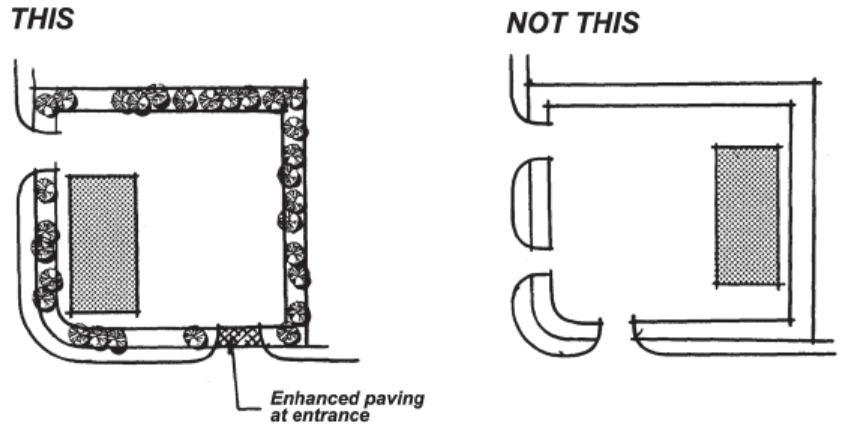
Figure 9.47.040-A Site Access
B.
Parking Areas
1.
Reciprocal ingress and egress, circulation and parking arrangements shall be required where possible and feasible to facilitate ease of vehicular movement between adjoining properties and to limit superfluous driveways.
2.
Off-street parking areas shall be adequate to meet all of the parking and loading demands generated by the use as required by Chapter 9.72 of this Code.
3.
Parking areas shall be designed so that all vehicles shall enter and exit public streets in a forward movement only.
4.
All parking spaces shall be clearly outlined on the surface of the parking facility with painted white lines or stone, brick, textured or smooth concrete banding.
5.
Visitor parking shall be located outside of any fenced area.
C.
Transit Facilities. Recommendations of the local transit district shall be considered to ensure the provisions of adequate opportunities for transit services and facilities such as turnouts and bus shelters.
D.
Bicycle and Equestrian Trails. Where a project is located along bicycle and/or equestrian trails as shown in the General Plan, trail improvements shall be provided in accordance with the standards on file at the Planning Division offices.
9.47.050 - Landscaping
A.
General
1.
Landscaping, earth berms, decorative walls and other buffers shall be used to define project boundaries and to reduce impacts on adjacent properties.
2.
Plant materials protected by the Town's Native Plant Protection Ordinance shall be undisturbed or retained wherever possible during site development and shall be maintained with proper irrigation and regular pruning and clearing.
3.
Landscaping shall be provided along the project frontage, at the periphery of the parking areas and between parking areas and the structure. Landscaping shall accent the building entrance.
4.
Individual developments shall integrate on-site landscaping with the streetscape landscaping in the project vicinity.
5.
Landscaping shall consist of native or drought-tolerant plants capable of surviving the desert environment and climate with a minimum of maintenance and supplemental watering. A list of plants determined capable of meeting this criterion is contained in Section 9.75.070, Water Conservation/Landscaping Regulations, of this Code. Other plants may be considered on their merits in meeting this criterion. Determinations of plant species suitability will be made by the Director upon submission of project plans.
6.
Landscaping shall be used to break up uninterrupted building mass, frame views, and connect development on adjacent pads.
7.
All landscaping shall utilize xeriscape practices in recognition of the Town's desert climate. Concrete mow strips shall separate turf from shrub areas.
8.
Landscaping shall be provided in sufficient size and quantity to adequately screen and soften the effect of new building planes within the first year (typically a mix of 24" box and 15 gal. trees and 5 gal. shrubs). Tree clusters shall be used to reduce the linear appearance of building planes and to soften the otherwise harsh appearance of the building height and mass.
9.
A minimum of one tree planting shall be provided for every thirty (30) linear feet of street and access drive frontage with trees informally clustered and grouped. Gaps between plantings should not exceed 50 feet.
B.
Parking Areas
1.
The visual impact of parking areas shall be reduced by landscaping, hedges, berming, planted islands and fingers.
2.
Low walls, berms or landscaping (36 to 42 inches in height) shall be used to screen automobile headlights in parking areas along major roads and across from residential areas. Such landscape walls shall also be used as edge treatments to define private space and act as a border between the natural desert landscape or public domain and intense use areas (Figure 9.47.050-A).
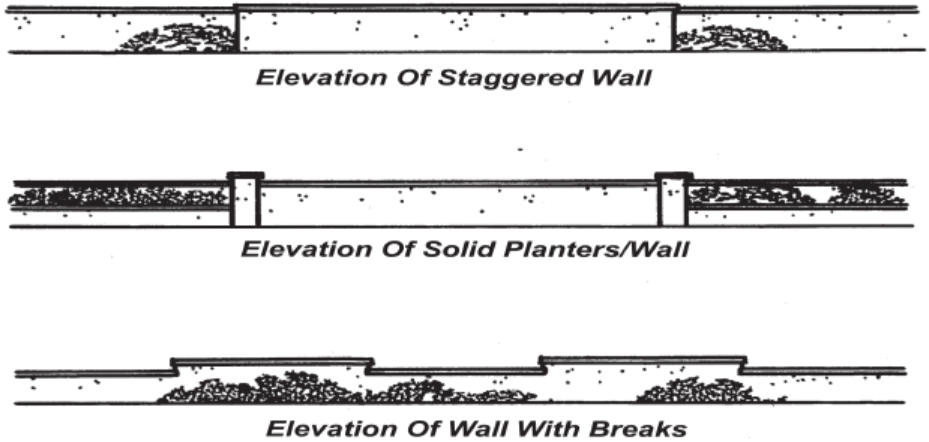
Figure 9.47.050-A Recommended Design Features
3.
Trees shall be distributed throughout parking areas in islands and fingers between parking spaces to shade parking areas and reduce the accumulation and radiation of heat from large paved areas. A minimum of one landscape island or finger containing a shade tree or trees per seven (7) parking spaces shall be provided.
4.
Concrete curbs shall be provided in parking areas to keep vehicles from disturbing landscape areas.
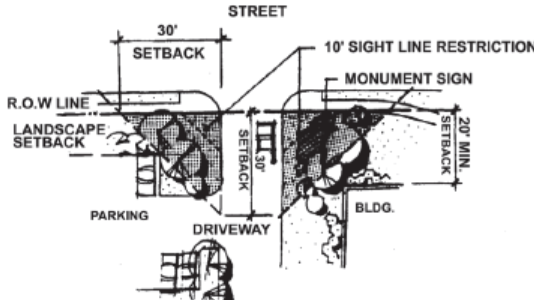
Figure 9.47.050-B Corner
Landscaping
5.
Driveways perpendicular to street shall have triangular shaped extended/landscape areas, with one side running along the driveway and one side running along the street right-of way each measuring 30 feet. This will create areas for enhanced landscaping and monument signs, however, the clear sight triangle provisions of paragraph 9.47.040.A.1 shall be observed (Figure 9.47.050-B).
9.47.060 - Buffering and Screening
A.
General
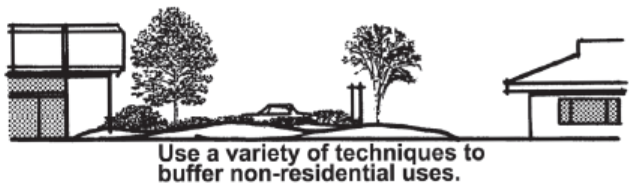
Figure 9.47.060-A Buffering and
Screening
1.
Landscaping, earth berms, decorative walls and other buffers shall be used to define project boundaries and to reduce impacts on adjacent properties (Figure 9.47.060-A).
2.
Where screening is required, a combination of elements shall be used, including solid masonry wall, berms and landscaping (Figure 9.47.060-B).
3.
Accessory structures and service areas such as trash enclosures or loading areas shall be screened from public streets and adjacent properties through a combination of landscaping and walls (Figure 9.47.060-C).
4.
Screening for outdoor storage shall be a minimum of six (6) feet and a maximum of ten (10) feet in height. Chain link fencing with redwood or neutral colored slats is acceptable screening material for areas of a lot not visible from any public right-of-way or residential use or district
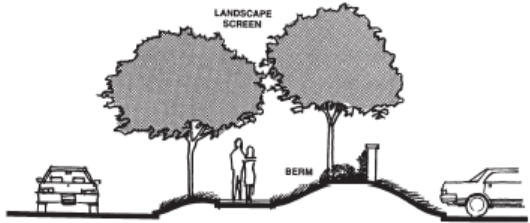
Figure 9.47.060-B Buffering and Screening
5.
The edges of larger development projects which border open space areas shall be informally landscaped using native species found out-side the project boundaries in order to provide a transition to open space vegetation.
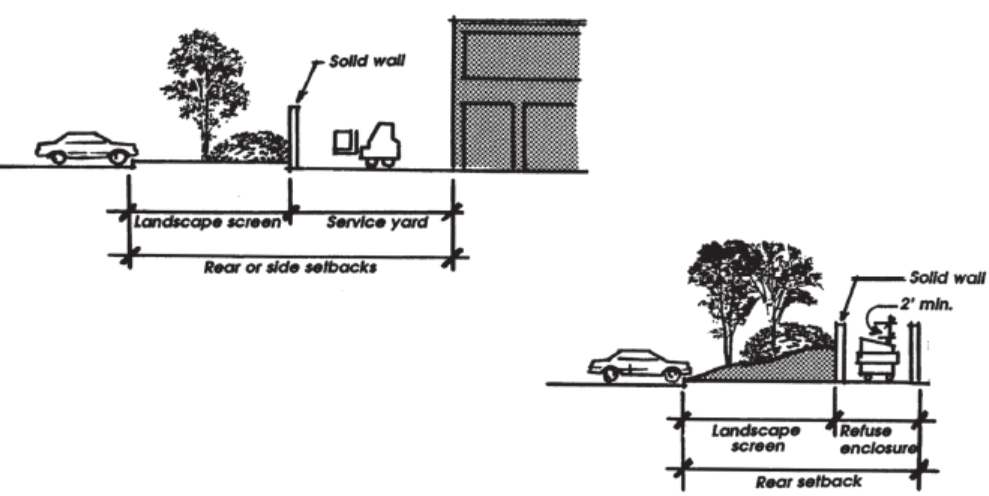
Figure 9.47.060-C Buffering and Screening
6.
All outdoor mechanical and electrical equipment, whether rooftop, side of structure, or on the ground, shall be screened from view from the public street by architectural elements designed to be an integral part of the building. Plans submitted shall include the locations and elevations of all outdoor equipment. Plumbing, vents and ducts should be grouped together whenever possible to minimize roof penetration (Figure 9.47.060-D).
7.
Roof equipment shall be located below the tallest vertical architectural element of the roof (Figure 9.47.060-D).
8.
Acoustical buffering shall be provided when necessary to protect adjacent sensitive uses such as schools, hospitals, and residences. Noise levels at the property line of such uses shall not exceed 60 Ldn or CNEL.
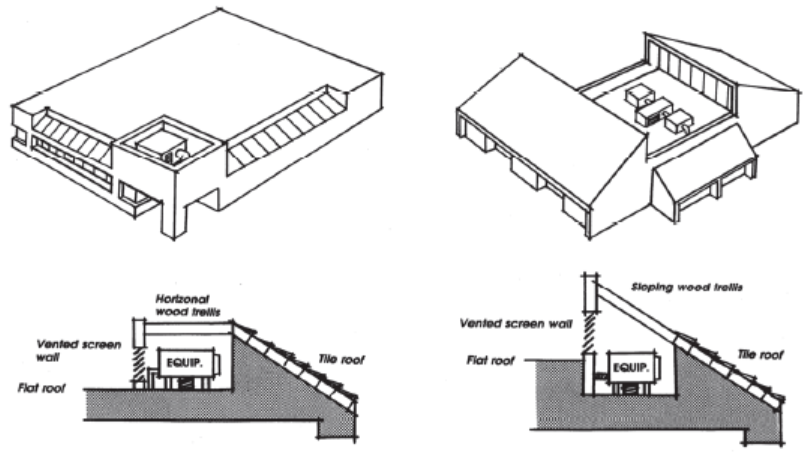
Figure 9.47.060-D Screening of Mechanical
Equipment
9.47.070 - Walls and Fences
A.
General
1.
The design and architecture of all walls, retaining walls, and fences shall reinforce the Town's desert character by the use of natural looking materials which can be expected to withstand the extremes of the high desert climate.
2.
Wall design shall be compatible with the architectural character of the primary structures and the surrounding area (Figure 9.47.070-A).
3.
Long expanses of wall surface or fence surface shall be offset and architecturally designed to avoid monotony. Pilasters shall be provided at regular intervals consistent with the length and scale of the wall but at a minimum of every fifty (50) feet and landscape pockets shall be provided.
4.
Construction materials and colors shall be consistent with the project architecture and provide an element of continuity throughout the project.
5.
Walls shall be designed to blend with the architecture of the site. Both sides of all walls shall be finished.
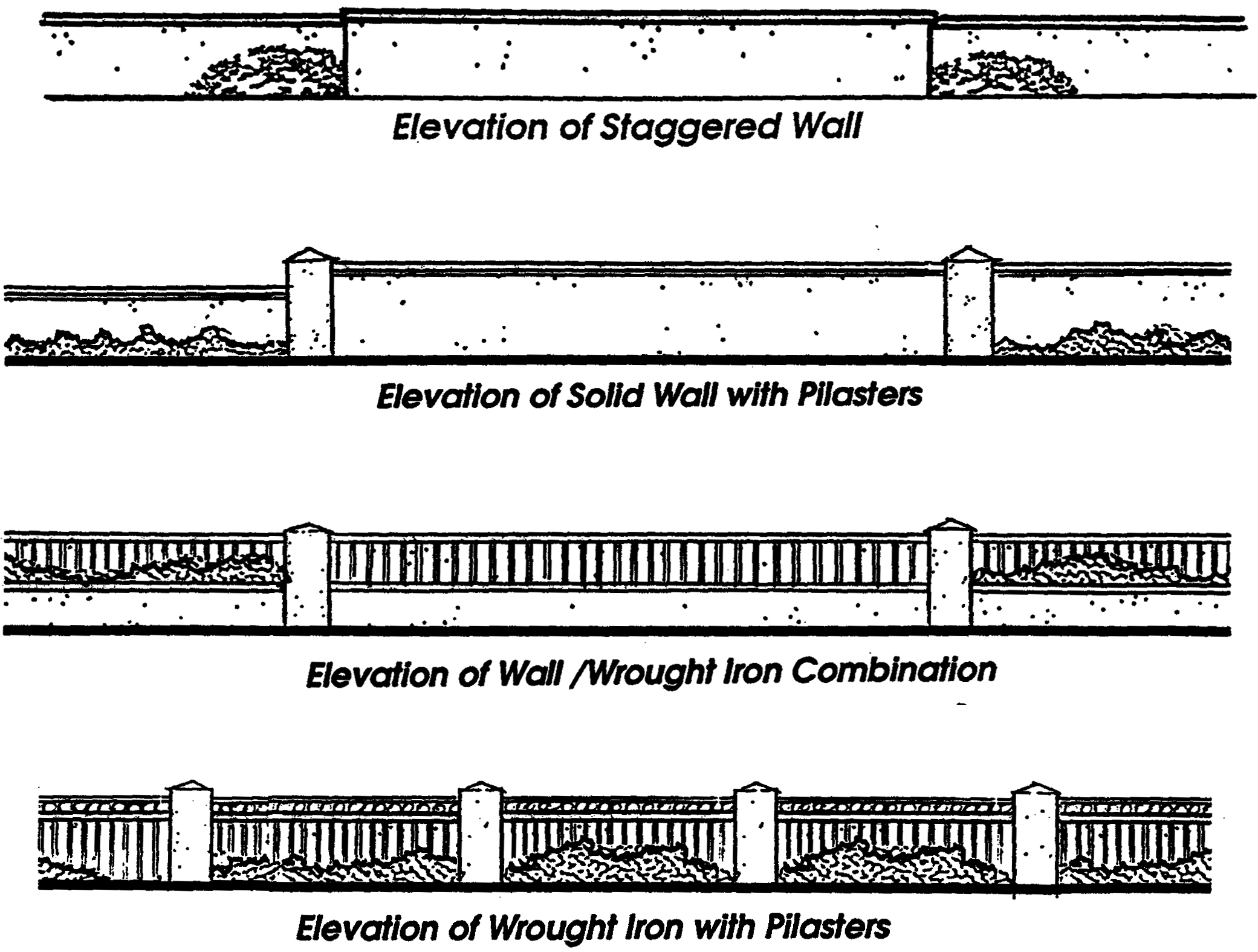
Figure 9.47.070-A Recommended Design Features
and Materials
B.
Location and Height. On all other lots, and corner lots outside of the Clear Sight Triangle, a maximum six (6)-foot high solid wall or fence may be located anywhere except in the required front or street side setback, unless greater height is required to screen an outdoor use in accordance with Section 9.06.0305, of this Code. A Wall Height Permit shall be required for a wall or fence above six (6) feet in height, up to a maximum of eight (8) feet in height, as measured from the lowest grade adjacent to either side of the wall, and may be approved by the Planning Division, where such wall or fence separates a commercial or industrial use from an existing residential use or residentially zoned property. The Wall Height Permit shall not be approved or issued until the Planning Division has received written acceptance of the proposed wall or fence from all adjacent property owners. Further, the fence or wall shall be architecturally and aesthetically consistent with the primary commercial or industrial structure built on site. Within the required front or street side setback, solid walls or fences are limited to forty-two (42) inches in height; open fences constructed of wrought iron incorporating decorative features, such as pilasters and spires or other embellishments, may be six (6) feet in height.
C.
Fencing of Vacant Property. Fencing of vacant industrially zoned property is prohibited. Exceptions to this include the following:
1.
On vacant property, a fence is needed to fulfill required environmental mitigation or security requirements imposed by the Town, State and/or Federal Government. In such cases, the fence height, location and materials shall be subject to the review and approval of the Director. Organic types of barriers (i.e., boulders, logs placed horizontally, incremental placement of wood posts vertically to block vehicular movement) should be used when possible, rather than traditional fencing. If fencing is used it should be wrought iron (or equivalent) or vinyl/plastic coated chain link. Wind protection material or slats (plastic, metal or redwood) shall not be used, unless used at a construction site. All fencing must be maintained or replaced due to dilapidation or unsightliness in accordance with Section 6.30.030.F.15 of the Town's Municipal Code.
2.
On vacant or developed property, it can be demonstrated for review and approval by the Director that a continued security problem exists which exceeds those same problems incurred by similar properties in the vicinity.
(Ord. No. 476, § 6, 10-27-2015)
9.47.080 - Architecture (Amended Ord. 239, 313)
A.
General
1.
Architecture should reflect the Town's desert setting and long term traditional values. Building design options should be compatible with existing development to the greatest extent possible.
2.
A variety of building designs and a mixture of one and two story profiles are encouraged in office areas.
3.
Rooftop mechanical and electrical equipment shall be screened as an integral part of the architecture.
4.
Similar architectural treatments shall be used to create a theme or sense of unity among buildings in a development.
5.
Plazas and courtyards shall be sited to best take advantage of sun angles, wind protection, and vistas.
6.
Building design and interior layout shall incorporate noise buffering sufficient to meet the Community Noise Exposure standards contained in Table N-1 of the Town General Plan.
B.
Entries
1.
Building entries shall be identified through the use of architectural elements such as arches, columns and colonnades, recessed entries, projecting architectural treatments, loggias, overhangs, entry path paving, arcades, and entries through plazas and courtyards.
2.
Entries shall be consistent with the scale and massing of the building.
C.
Scale
1.
Recesses that provide shade and create an interplay of light and shadow, such as building pop-outs, covered walkways, colonnades, arcades, and other human scale openings shall be provided to reduce the impact of building mass and to create visual interest (Figure 9.47.080-A).
D.
Building Materials. Building materials shall provide architectural aesthetic quality, durability and ease of maintenance, and shall be consistent with the architectural style of the building.
E.
Metal Buildings. Buildings constructed on site, or structures assembled from modular or similar units on site, or structures assembled off site and moved on site as one unit, may use metal exteriors when the Planning Commission determines, during a project's Development Permit or Conditional Use Permit review, that the proposed structure shall have an appearance emulating and simulating the color, texture and appearance of other structures within the surrounding area or where it can be clearly demonstrated that the proposed structure shall be an enhancement to the surrounding area. Said metal exterior must provide the same texture depth and other physical characteristics as the exterior of the main structure on the surrounding properties.
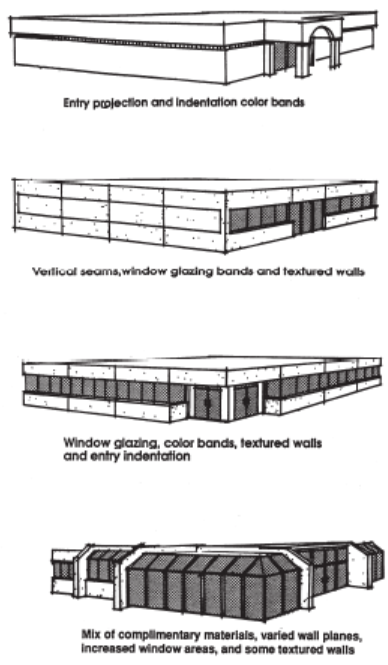
Figure 9.47.080-A Recommended Design Features and Materials
9.47.090 - Lighting (Amended Ord. 290)
A.
General
1.
Lighting shall be used only for the functional requirements of safety, security, and identification. Unnecessary lighting is prohibited in the interest of energy efficiency and preservation of the night sky views.
2.
All glare shall be directed onto the site and away from adjacent properties (Figure 9.47.090-A).
3.
Light standards shall blend architecturally with buildings, pedestrian areas, and other hardscape elements.
4.
Lighting fixtures in the vicinity of the airport shall be compatible with airport operations.
5.
Flag poles displaying official flags of the United States, the State of California, and other states of the nation, counties, municipalities, and official flags of foreign nations are accessory structures that may be allowed up to thirty-five feet (35') in height anywhere upon a property, except within the required front-yard or street side-yard setback area. Said flag poles, when a flag is flown, may be illuminated provided any such lighting is shielded in a manner so that all glare shall be directed onto the site and away from adjacent properties and that such lighting standards shall blend architecturally with buildings, pedestrian areas, and other hardscape elements on the site. A maximum of three (3) flag poles shall be allowed per recorded lot.
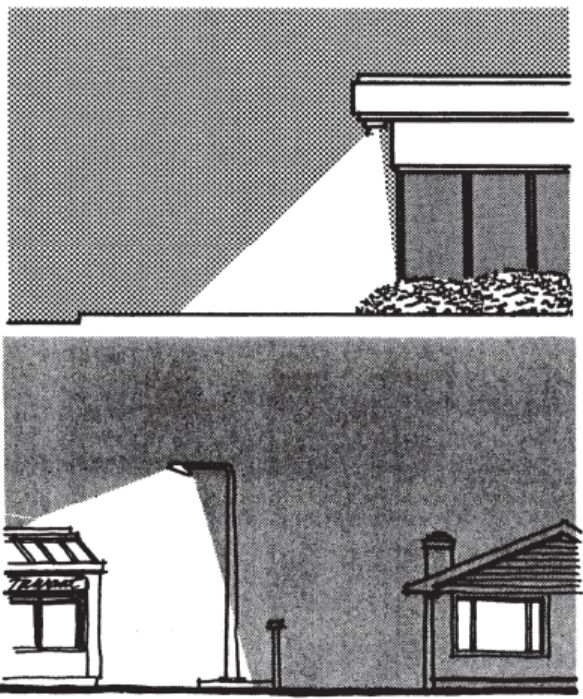
Figure 9.47.090-A Directed Light

