
Apple Valley City Zoning Code
CHAPTER 9
74 - Signs and Advertising Displays Amended in its entirety by Ord. 456
9.74.010 - Purpose
The Town of Apple Valley recognizes the needs of businesses and property owners within the community to identify their businesses through signing and other means of advertisement. It shall be the purpose of this chapter to:
A.
Promote and protect the general health, safety, welfare and community environment by establishing a comprehensive system for the regulation on all advertising devices, displays, signs and their housing, structure or form, while maintaining or improving economic stability through attractive sign programs;
B.
Protect the general public from damage and injury which may be caused by the faulty and uncontrolled construction of signs within the city;
C.
Protect pedestrians and motorists within the Town of Apple Valley from damage or injury caused, or partially attributable to the distractions and obstructions caused by improperly situated signs; and
D.
Promote the public safety, welfare, convenience and enjoyment of travel and the free flow of traffic within the Town of Apple Valley.
E.
Provide equitable standards for the protection of property values, visual aesthetics, and the public health, safety and general welfare, while still providing ample opportunities for businesses and the visual advertising industry to operate successfully and effectively.
9.74.020 - Applicability
No signs shall be erected, placed, displayed, or maintained in any district within the Town, except as specifically allowed in this Chapter. The number, design, type and size of signs, as outlined in this Chapter, are intended to be minimum standards which do not necessarily ensure compatibility with building architecture, the neighborhood, and community appearance. Therefore, in addition to these standards, consideration shall be given to a sign's relationship to the overall appearance of the subject property as well as the surrounding community. Compatible design, simplicity and sign effectiveness, and conformance to the design guidelines provided by Section 9.74.110 General Design Criteria and Standards of this Chapter, are to be used in determining sign approvals. Any sign not specifically listed or addressed in its sign code shall be subject to review and approval by the Director.
9.74.030 - Administration
A.
Administration. The Director is authorized by the Town Council to administer and enforce the provisions of this Chapter, unless otherwise provided in this Chapter. The Director may designate a representative to act in his/her place.
B.
Interpretation
1.
This Chapter shall be interpreted in a manner which best fulfills the intent of its provisions.
2.
Questions arising from the application of the Chapter shall be interpreted by the Director. If any inconsistency still exists in the interpretation, an appeal application shall be referred to the Planning Commission for its determination.
3.
It is the Town's policy to regulate signs in a constitutional manner that is content neutral as to noncommercial messages which are within the protections of the First Amendment to the U.S. Constitution and the corollary provisions of the California Constitution.
4.
Subject to the property owner's consent, a protected noncommercial message of any type may be substituted for any duly permitted or allowed commercial message, provided that the sign structure or mounting device is legal without consideration of approval or permitting. This provision prevails over any more specific provision to the contrary within this Chapter. The purpose of this provision is to prevent any inadvertent favoring of commercial speech over protected noncommercial speech, or favoring of any particular noncommercial message over any other noncommercial message. This provision does not create a right to increase the total amount of signage on a parcel, lot or land use; does not affect the requirement that a sign structure or mounting device be properly permitted; does not allow a change in the physical structure of a sign or its mounting device; does not allow the substitution of an off-site commercial message in place of an on-site commercial message; and does not allow one particular on-site commercial message to be substituted for another without a permit.
C.
Appeals
1.
Any decision or determination by the Director may be appealed to the Planning Commission in accordance with the provisions of this Development Code.
2.
Any decision of the Planning Commission may be appealed to the Town Council in accordance with the provisions of this Development Code.
D.
Severability Clause. If any section, sentence, clause, or phrase of this Chapter is for any reason to be held invalid or unconstitutional by a decision of a court of competent jurisdiction, such decision shall not affect the validity of the remaining portions of this Chapter. The Town Council declares that it would have passed this Chapter and each section, sentence, clause or phrase thereof, irrespective of the fact that any one or more sections, subsections, sentences, clauses, or phrases be declared invalid or unconstitutional.
9.74.040 - Definitions
Abandoned Sign. A sign pertaining to, or located on, a property, building suite or premises which is vacant and unoccupied for a period of ninety (90) days, or a sign which is damaged, in disrepair, or vandalized and not repaired within ninety (90) days of the date of the damaging event. Animated Sign. Any sign which uses movement, lighting, or special materials to depict action or create a special effect or scene.
Architectural Sign. A sign incorporated into architectural elements such as an archway, fountain, or sculptured garden which is integrated with, but subordinate to, the overall architectural element.
Advertising Devices. A commercial temporary device other than signs, used for grand openings and special promotions. Advertising devices could consist of, but not be limited to, balloons, flags, search lights, clowns, etc.
Area of Sign. "Sign area" means the entire area within the outside border of the sign. The area of a sign having no continuous border or lacking a border shall mean the entire area within a single continuous perimeter formed by no more than eight straight lines enclosing the extreme limits of writing, representations, emblem, or any fixture or similar character, integral part of the display or used as a border, excluding the necessary supports or uprights on which such sign is placed. Where a sign has two or more faces, the area of all faces shall be included in determining the area of the sign, except that where two such faces are placed back-to-back and are at no point more than three feet from one another, the area of the sign shall be taken as the area of one face if the two faces are of equal area, or as the area of the larger face if the two faces are of unequal area.
Awning/Canopy Sign. Signs which are placed on or integrated into fabric awnings, or other material canopies, which are mounted on the exterior of a building which extend from the wall of a building to provide shielding of windows and entrances from inclement weather and the sun (Figure 9.74.040-A).
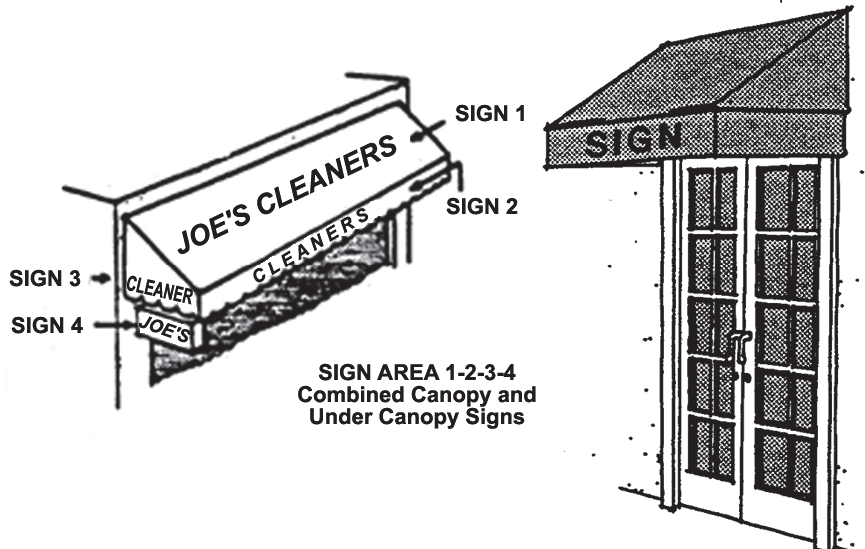
Figure 9.74.040-A Awning/Canopy Signs
Backlit Channel Lettering. A type of sign utilizing opaque channel lettering with an open back containing a light source which throws light onto the sign field (background) against which the channel letters are silhouetted (Figure 9.74.040-B).

Figure 9.74.040-B Backlit Channel Lettering
Balloon. Any mobile, portable, temporary structure that is inflated with gaseous material and is used for the purpose of attracting attention whether or not it contains a written or graphic message.
Banner, Flag, Pennant or Streamers. Any cloth, bunting, plastic, paper, or similar material, used for advertising purposes, attached to any structure, staff, pole, line, framing, vehicle, but not including official flags of the United States, the State of California, and other states of the nation, counties, municipalities, and official flags of foreign nations (Figure 9.74.040-C).
Berm. A mound or embankment of earth.
Billboard. An outdoor advertising structure or device that contains a message relating to an activity or product that is not located on the site on which the device and message are located or an advertising device erected by a company or individual for the purpose of selling advertising messages for profit. This definition does not include Civic Gateway Signs or Kiosk Signs.
Building Facade. The exterior wall of a building exposed to public view or that wall viewed by persons not within the building.
Building Wall. The individual sides of a building.
Business Entrance Identification. A sign adjacent to, or on the entrance door of a business which names, gives the address and such other appropriate information as store hours and telephone numbers.
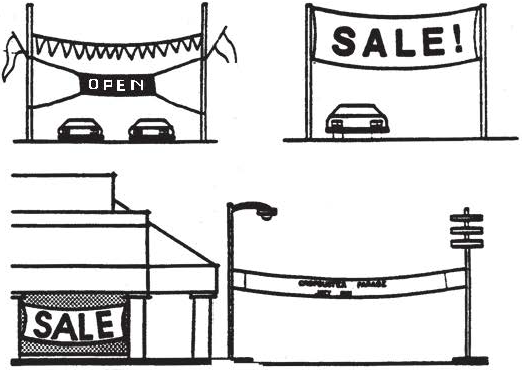
Figure 9.74.040-C Banner, Flag, Pennant or Streamer
Cabinet Sign. A three-dimensional structure which includes a frame, borders, and sign face panel and may include internal lighting upon which the sign letters and logos are placed or etched, and is architecturally integrated with the building.
Cabinet Sign, Sculptured. A single piece sign structure designed to simulate individual letters and will not support a change of face (Figure 9.74.040-D).

Figure 9.74.040-D Sculptured Cabinet Sign
Can Sign. A three-dimensional sign structure consisting of an internally lighted, sheet metal box designed for an interchangeable sign face.
Center. A center contains businesses and buildings designed as an integrated and interrelated development sharing such elements as architecture, access, and parking. Such design is independent of the number of structures, lots, or parcels making up the center.

Figure 9.74.040-E Channel
Lettering
Changeable Copy Sign. A sign designed to allow the changing of copy through manual, mechanical, or electrical means, including time and temperature. The changeable copy of a "Changeable Copy Sign" shall not change at a frequency in excess of one alteration per five (5) seconds, shall not use scrolling or animated characterization nor be located within the direct line-of-sight of any existing residential unit within 150 feet of said sign.
Channel Letter Sign. Three dimensional individually cut letters or figures, illuminated or unilluminated, affixed to a building or sign structure (Figure 9.74.040-E).

Figure 9.74.040-G Directional Signs
Civic Event Sign. A temporary sign, other than a commercial sign, posted to advertise a civic event sponsored by a public, religious, charitable, educational, or cultural agency.
Civic Gateway Sign. A Town sponsored sign structure positioned along a freeway, prominently located near the entrance to the Town, and may contain a digital advertising display.
Clear Sight Triangle. See Chapter 9.08 of this Code, for Clear Sight Triangle definition.
Digital Advertising Display. An advertising display of still, scrolling or moving images including video or animation, that may be changed remotely through electronic means and utilizes a series of grid lights, including but not limited to cathode ray, light-emitting diode (LED), plasma screen, liquid crystal display (LCD) fiber optic or other electronic media or technology. A digital advertising display may also be known as a changeable copy sign.
Directional Sign. Signs limited to directional messages, principally to direct pedestrian or vehicular traffic, such as "one way", "entrance", or "exit" (Figures 9.74.040-G). These signs provide information which will assist the operators of vehicles and the flow of traffic. Such signs may use names, logos, or symbols of buildings, businesses, activities, uses or places as a means of providing directions.
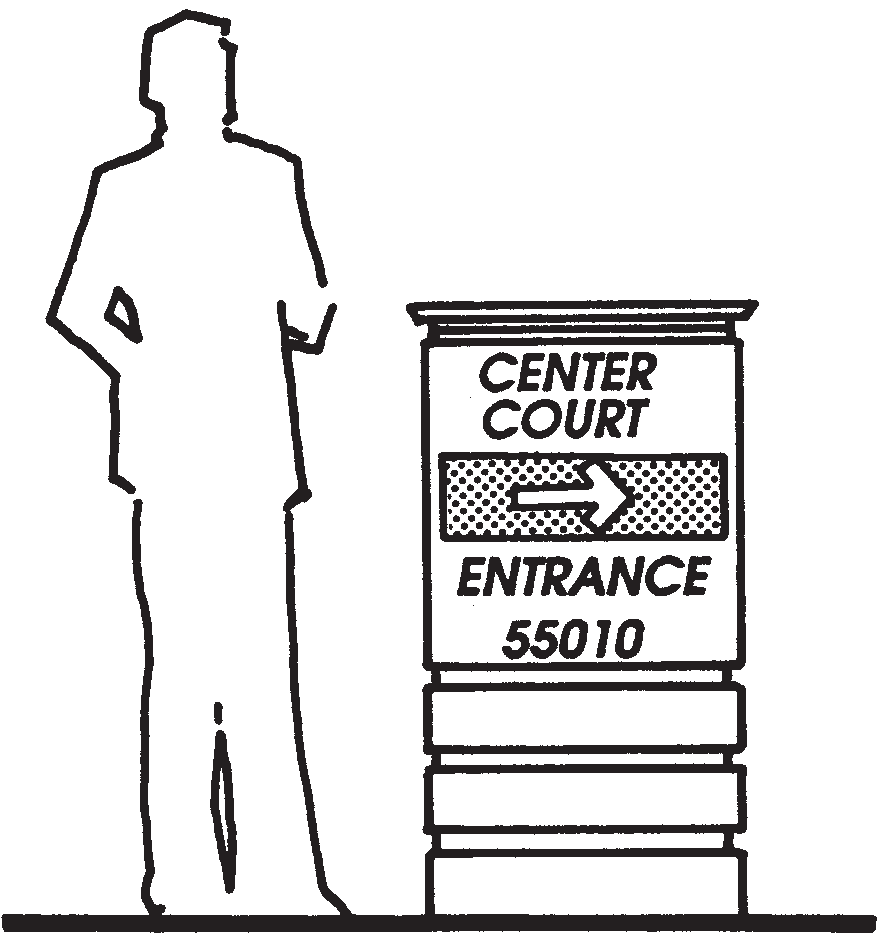
Figure 9.74.040-H
Directory Signs
Directory Sign. A sign which provides a listing of the names of businesses, tenants, activities, addresses, locations, uses, or places within a building, complex of buildings, or multi-use project (Figure 9.74.040-H).
Double-Faced Sign. A single sign structure designed with the intent of providing copy on both sides in which the sides are not separated by more than three (3) feet.
Eave. That part of a roof that overhangs the side walls or the lowest part of the roof extending over an arcade.
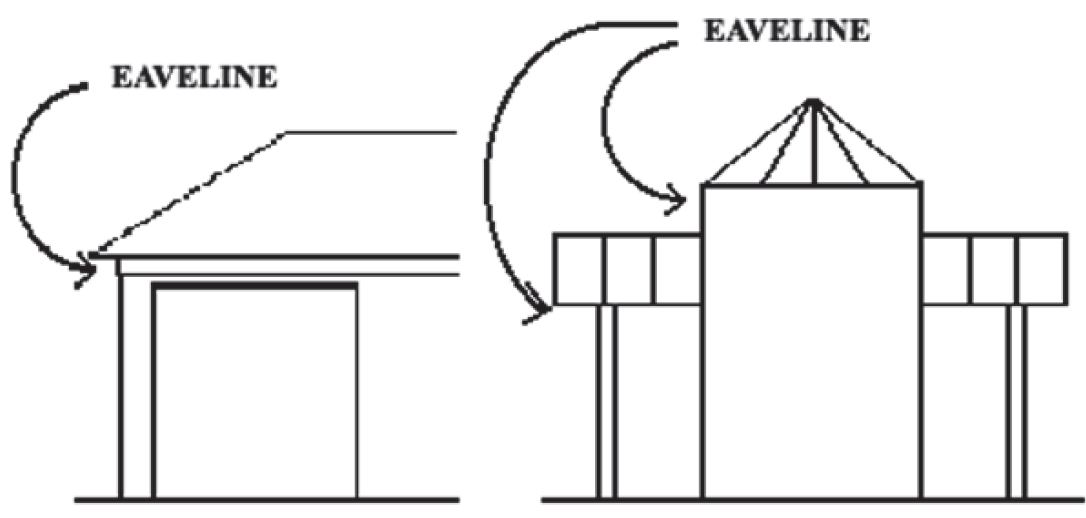
Figure 9.74.040-I Eaveline
Eaveline. The eaveline is the bottom of the eave (Figure 9.74.040-I).
Entryway Sign. A sign which is placed on the perimeter of a recorded subdivision, townhouse project, commercial district, master planned community, hotel, motel, or guest ranch at a major street or driveway entrance to identify the name of the interior project. Such signs may flank both sides of the entrance and may include monument or landscape wall sign types (Figure 9.74.040-J).
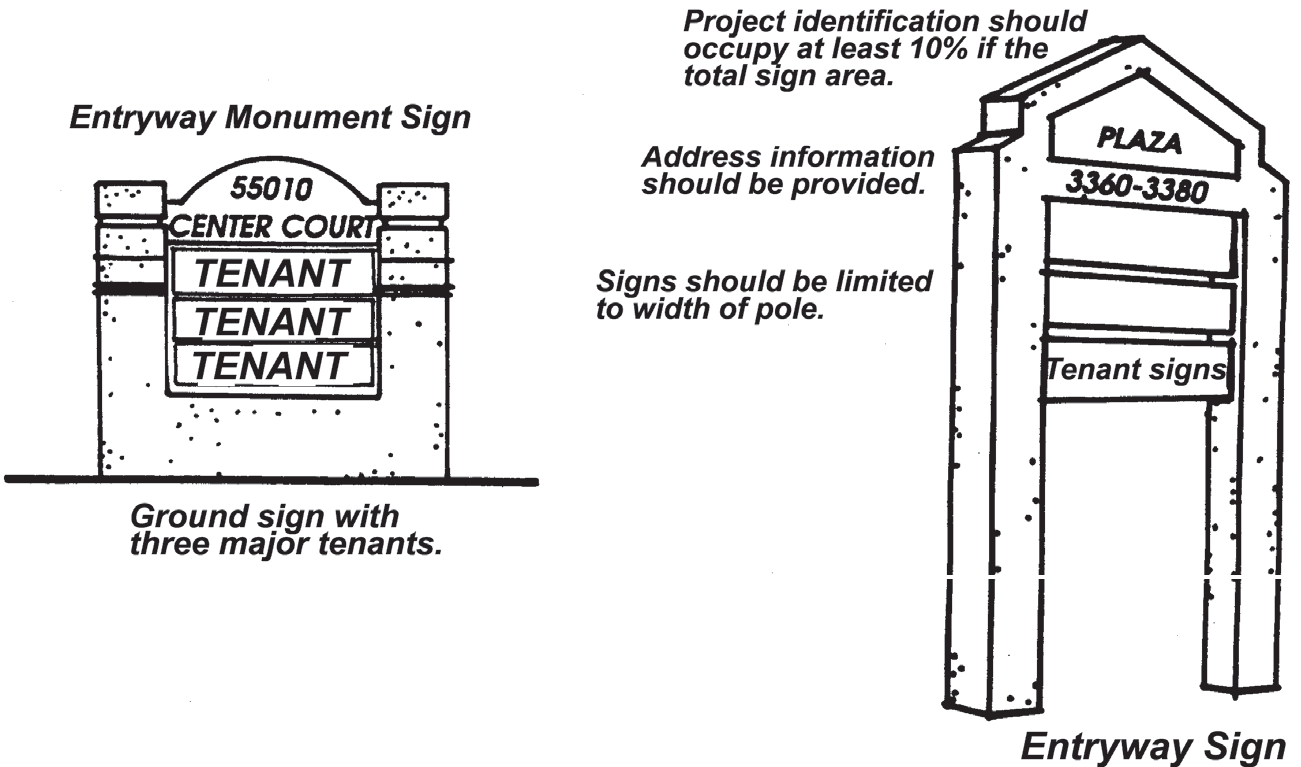
Figure 9.74.040-J Entryway Signs
Fascia Sign. A sign placed on a parapet-type wall used as part of the face of a flat roofed building and projecting not more than one (1) foot from the building face immediately adjacent thereto (Figure 9.74.040-K).
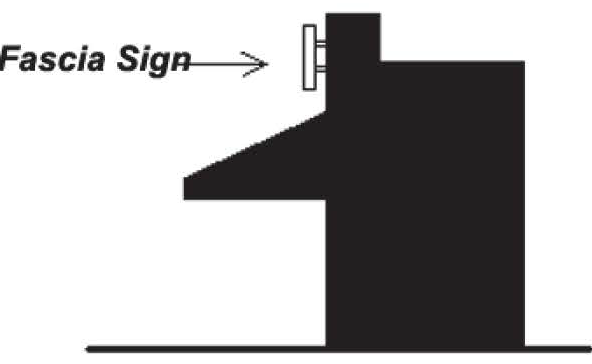
Figure 9.74.040-K Fascia Sign
Flag. A fabric sheet or square, rectangular or triangular shape which is mounted on a pole, cable, or rope at one end.
Flag, Decorative. A flag which contains no text or graphics.
Flashing Sign. A sign that contains an intermittent or sequential flashing light source.
Free-Standing Sign. A sign that is not attached to any building.
Freeway. A major highway which carries high speed traffic without interruption by traffic signals.
Frontage. Linear measurement of a lot or building facade or portion of the facade which encloses an individual tenant or business which fronts on either a street, freeway, parking lot, or pedestrian mall, not including loading or service areas, and is used as the basis for determining the maximum sign area and number of signs allowed for individual activities. For wall signs, building frontage may also include linear footage of the building facing an adjacent commercial or industrial designated lot, which is not adjacent to another building.
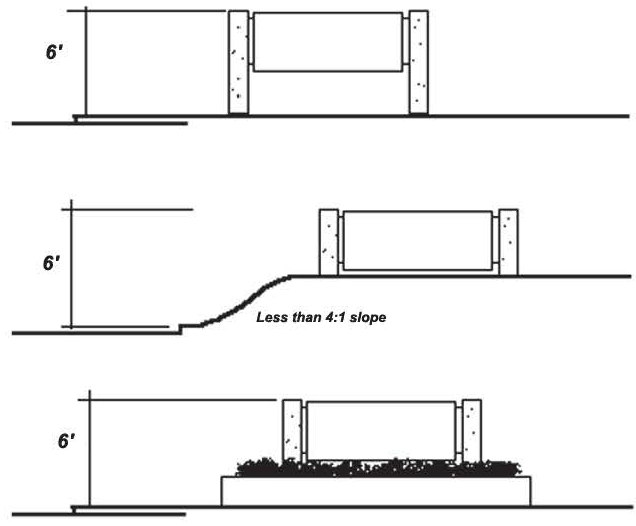
Figure 9.74.040-L Height
Height, Sign. The distance from ground level to the highest point of the structure, providing, however that where the structure is on a berm, mound or slope, the slope shall not exceed a four to one (4:1) horizontal to vertical ratio. If the slope exceeds this ratio, then height shall be measured from the toe (or bottom) of the slope, or a point where the slope does not exceed four to one (4:1) (Figure 9.74.040-L).
Human Operated Signage. Signs held and/or movement operated by a person, typically located on a street corner.
Identification Sign. A sign on a building wall or landscape wall, a ground sign or temporary sign used to present the name of a major residential project, master planned community information center.
Illegal Sign. Any sign erected without first obtaining a sign permit, or a sign for which the permit has expired or been revoked.
Illuminated Sign. A sign which has characters, letters, figures, designs or outline backlighted or internally illuminated by electric lights or luminous tubes as a part of the sign proper.
Incidental Sign. A sign, emblem or decal conveying information to the general public of goods, facilities or services available on the premises including, but not limited to the following: restrooms, hours of operation, acceptable credit cards, property ownership or management, phone booths and recycling containers.
Indirect Lighting. Illumination so arranged that the light is reflected from the sign to the eyes of the viewer. Indirect lighting is typically external illumination located away from the sign, which lights the sign, but which is itself not visible to persons viewing the sign from any street, sidewalk, or adjacent property.
Individual Letters. A cut-out or etched letter or logo which is individually placed on a landscape, screen wall, building wall, or ground sign.
Institutional Sign. A sign identifying the premises of a church, school, hospital, rest home, or similar institutional facility.
Internal Lighting. A source of illumination entirely within the sign which makes the contents of the sign visible at night by means of the light being transmitted through a translucent material but wherein the source of illumination is not visible.

Figure 9.74.040-M Internal
Backlighting
Internal Backlighting. A source of illumination entirely within the individual letter, cabinet, or structure which makes the sign visible at night by means of lighting the background upon which the individual letter is mounted. The letters are opaque, and thus are silhouetted against the background. The source of illumination is not visible (Figure 9.74.040-M).
Kiosk Sign. An off-premises sign used for directing people to the sales office or models of a residential subdivision project or to businesses within the Town of Apple Valley (Figure 9.74.040-N).
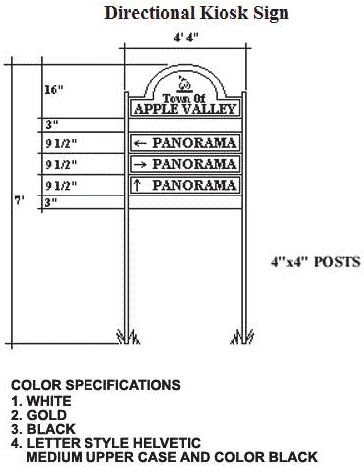
Figure 9.74.040-N Kiosk Sign
Landscape Wall Sign. A free-standing sign architecturally integrated with the building, mounted on a screen or perimeter wall and having individual letters. The sign is mounted on, or to, a wall or base which may or may not be an attachment or extension of a building wall.
Logo. A graphic symbol representing an activity, use, or business.
Lot. A parcel, tract, or area of land established by plat, subdivision, or as otherwise permitted by law, to be used, developed or built upon.
Maintenance. The replacing or repairing of a part or portion of a sign necessitated by ordinary wear, tear, or damage beyond the control of the owner. The reprinting of existing copy without changing the wording, composition, or color of said copy.
Menu Board. An outdoor sign listing food and beverage items available at restaurants with drive-through windows for take-out service.
Message, Commercial. Any message, the prevailing purpose of which is to propose a lawful, commercial transaction.
Message, Noncommercial. Any message which is not determined to be commercial speech as defined herein, but instead coveys an opinion, idea, concept or similar message.
Monument Sign. A free-standing cabinet or panel sign mounted on, or within, a base (above grade) which is detached from any building (Figure 9.74.040-O).
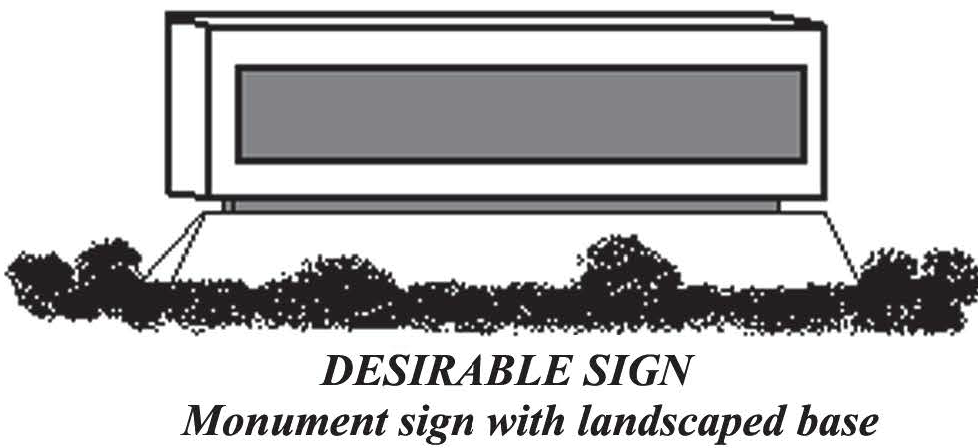
Figure 9.74.040-O Monument Sign
Multiple Tenant Commercial Building. A commercial development in which there exists two or more businesses and which is designed to provide a single area in which the public can obtain a variety of products and services. Distinguishing characteristics of a multiple tenant commercial building may, but need not, include common ownership of the real property upon which the center is located, common-wall construction and multiple occupant commercial use of a single structure.
Name Plate. A small sign which identifies a resident's or home's name and address or the name of a farm, ranch, or commercial stable. Such sign may be shingle, building wall, or archway-mounted.
Neon Signs. Signs made of gaseous light tubing that is covered or uncovered by a transparent cover, allowing the tubing to be visible.
Neon Color. Bright, fluorescent colors usually in orange, yellow, pink, and green.
Occupancy. A purpose for which a building, or part thereof, is used or intended to be used.
Off-Site Subdivision Directional Sign. A sign providing direction to a residential land development project which is not located within the subject subdivision.
On-Site Subdivision and Model Home Directional Sign. A sign providing direction to a residential land development project located within the boundaries of the subdivision.
Off-Site Open House Directional Sign. Any sign located off the subject property erected for the purpose of directing persons to property that is for sale, rent, or lease.
Outdoor Type Business. A business; all or most of whose trade is conducted, or items displayed, in an open area subject to the regulations of the Town Code.
Panel. A two-dimensional visual background behind the sign letters and logos which is visually separated from the mounting upon which the sign letters and logos are placed by the presence of a border, different colors, different materials, or other technique of visual framing around the letters or logo.
Parapet Wall. That portion of building exterior wall projecting above the plate line of the building (see "Projecting Sign").
Pennant. See Banner or Flag.
Permanent Sign. Any permitted sign which is intended to be and is so constructed as to be a lasting and enduring condition remaining unchanged in character, condition (except normal wear) and position, and in a permanent manner affixed to the ground, wall, or building.
Pole or Pylon Signs. Pole signs are signs that are supported by a pole or post (sometimes more than one) and otherwise separated from the ground by air. Pole signs are almost always separated from buildings and other structures.
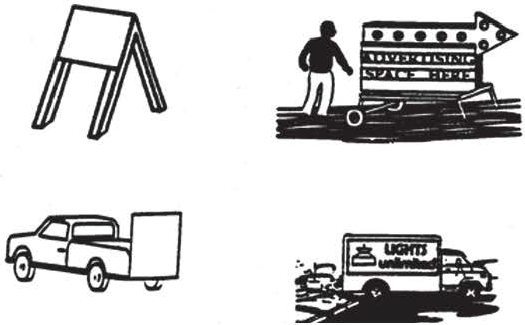
Figure 9.74.040-P Portable Signs
Portable Sign. A sign that is not permanently affixed to a structure or the ground. Portable signs include signs that are hauled or parked in a manner consistent with a billboard (Figure 9.74.040-P).
Projecting Sign. Sign other than a wall sign suspended from, or supported by, a building or structure and projecting outward (Figure 9.74.040-Q).
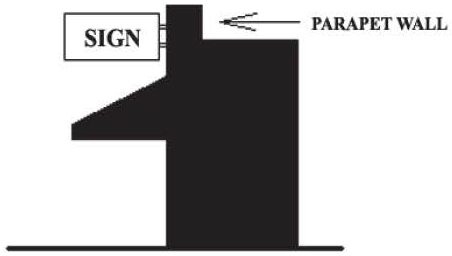
Figure 9.74.040-Q Projecting Signs
Raceway. A metal conduit or channel containing the electrical power lines for illuminated signs.
Required Landscaping. The specific area (on-site) to be landscaped at the base of a free-standing sign.
Roof Sign. A sign that extends above the roof line (Figure 9.74.040-R).
Setback. The required distance that a building, structure, parking, or other designated item must be located from a lot line.
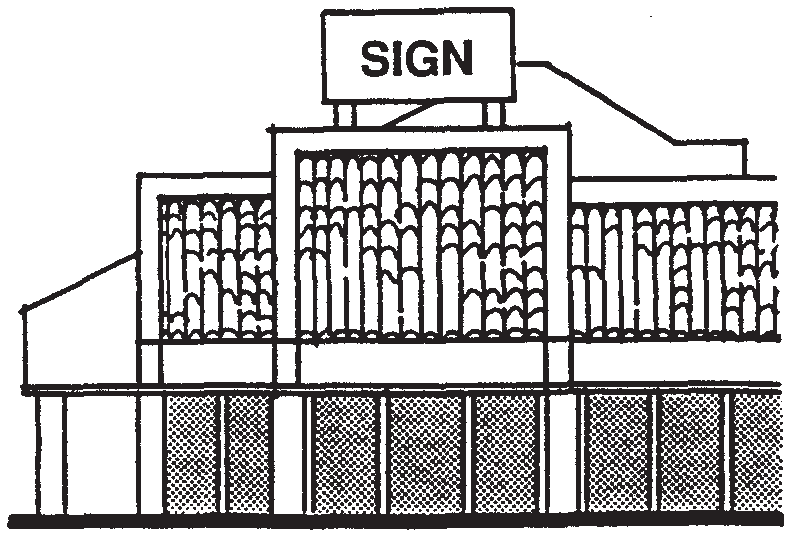
Figure 9.74.040-R Roof Signs
Shingle Sign (Canopy Sign). A sign suspended from a roof overhang of a covered porch or walkway which identifies the tenant of the adjoining space (see "Under Canopy Sign").
"Sign". Any words, letters, numerals, emblems, designs, or other marks shown on any flag, card, cloth, paper, metal, painted surface, glass, wood, plaster, stone or other device of any kind or character by which anything is made known and used to attract attention. "Sign" does not include:
A.
Official notices issued by any court or public body or officer;
B.
Notices posted by any public officer in performance of a public duty or by any person in giving any legal notice;
C.
Directional, warning or information signs or structures required by or authorized by law or federal or state authority.
Sign Budget. The total cumulative sign area for all types of signs allowed for a parcel or project.
Sign Copy. Letters or figures that make up the sign's message.
Sign Program. A specific set of design standards established for the purpose of unifying a variety of signs associated with a multi-tenant or multi-use project, building or complex of buildings.
Sign Structure. Any structure which supports any sign.
Snipe Sign. Temporary signs fastened to fences, trees, utility poles, stakes in the ground, with or without the use of receptacles, or other non-sign structures.
Special Event Sign/Banner. A temporary sign or banner that is intended to inform the public of a unique happening, action, purpose, or occasion, such as a grand opening or community event (see Banner).
Special Service Sign. Small signs associated with gasoline or service stations such as "full service", "water and air", "cashier", "smog certificates", etc.
Temporary Sign. A sign usually constructed of cloth or fabric, cardboard, wallboard, wood or other light material intended to be displayed for a short period of time as set forth in this Chapter.
Traffic Directional Sign. Signs used at driveways to improve public safety and to enhance public access to the site from public streets. These signs provide information which will assist the operators of vehicles and the flow of traffic. Such signs may use names, logos, or symbols of buildings, businesses, activities, uses or places as a means of providing directions.
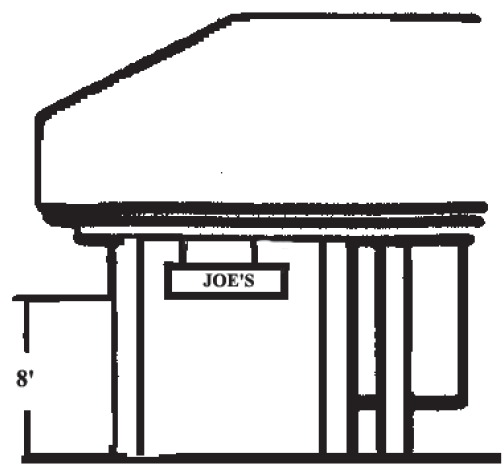
Figure 9.74.040-S Under
Canopy Sign
Under Canopy Sign. Any sign attached to the underside of a projecting canopy protruding over a private or public sidewalk or right-of-way (Figure 9.74.040-S).
Vehicle Sign. A sign which is attached to, or painted on, a vehicle which is parked on or adjacent to any property, the principal purpose of which is to attract attention to a product sold or business not located on such property. This does not include vehicle that contain permanently affixed graphics or door magnets that do not protrude from the vehicle on which it is placed, unless the vehicle is discernibly parked in a manner consistent with this definition, provided that this provision does not apply if the advertising is incidental to the use of the vehicle (i.e., delivery)
V-Type Sign. A sign with two (2) sign faces which are not parallel and are separated by more than three (3) feet at any one point.
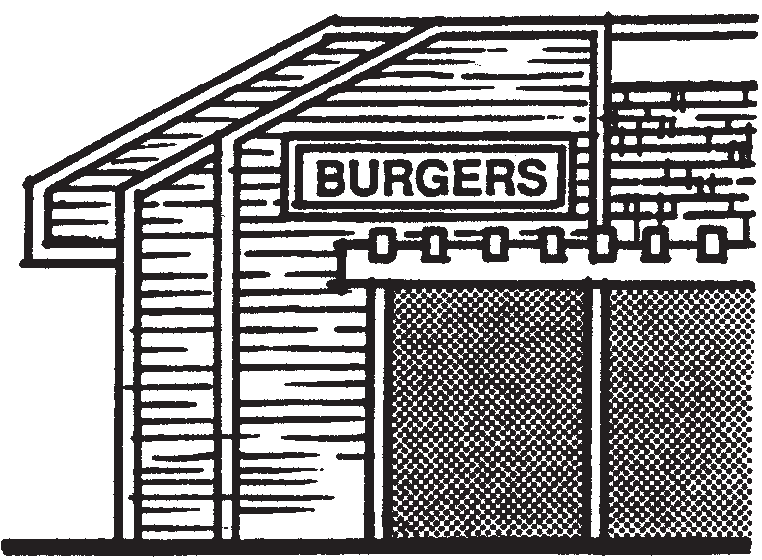
Figure 9.74.040-T Wall Sign
Wall Sign. A sign that is affixed to the wall or fascia of a building (Figure 9.74.040-T).
Window Sign. Any sign posted, painted, placed, or affixed in or on any window exposed to public view. Any interior sign which faces any window exposed to public view and is located within three (3) feet of the window (Figure 9.74.040-U).
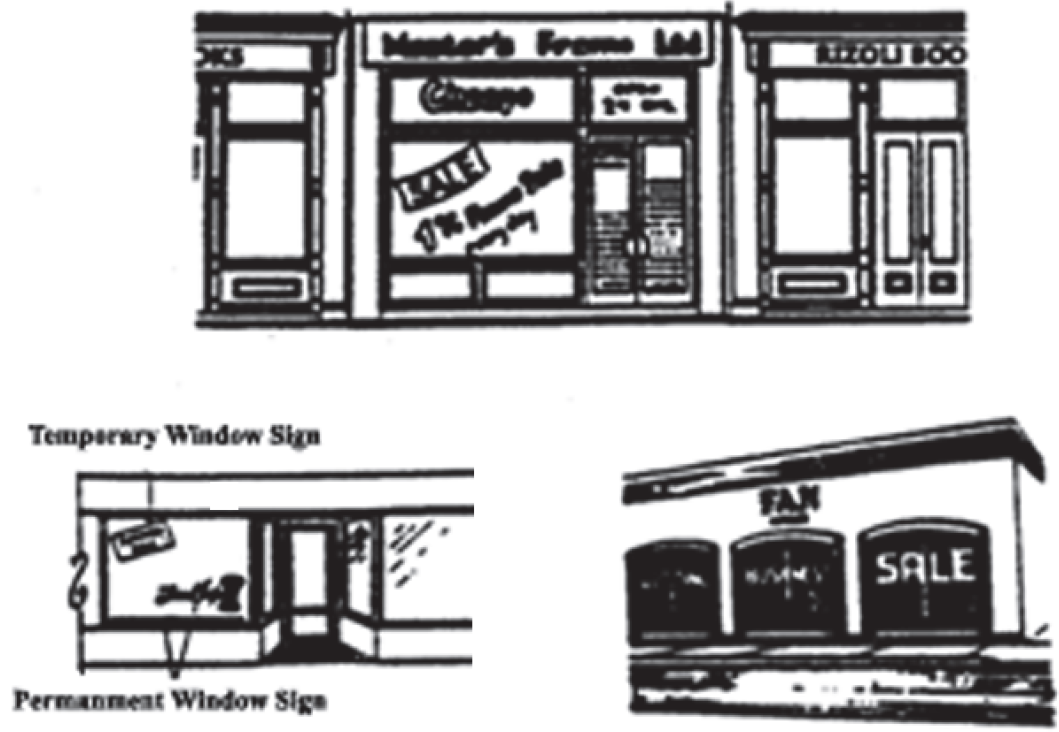
Figure 9.74.040-U Window Sign
9.74.050 - Prohibited Signs
The following signs are inconsistent with the purposes and standards set forth in establishing this Chapter and are, therefore, prohibited. In addition, signs which are not specifically permitted by this Chapter are also prohibited. Any sign which is prohibited by this Section which is subsequently erected, placed, or displayed shall be subject to immediate abatement in accordance with the provisions of Section 9.74.230, (Enforcement).
A.
Signs which make sounds.
B.
Portable signs, unless otherwise exempt under this Chapter.
C.
Vehicle Signs.
D.
Animated or moving signs, or signs which contain any moving parts, except as expressly set forth in Section 9.74.110.G, Digital Advertising Displays.
E.
Any sign, lighting, or other advertising display located in such a manner as to constitute a hazard to pedestrian or vehicular traffic, or in such a manner as to obstruct free and clear vision at any location where, by reason of the position, shape, color, or movement may interfere with, obstruct the view of, or be confused with any authorized traffic sign, signal, or device. Nor shall such sign or advertising structure make use of any word, phrase, symbol, or character in such a manner as to interfere with, mislead, or confuse traffic.
F.
Sign faces pertaining to activities which have ceased, whose structure has been abandoned by their owner, are not maintained, or which identify occupants which have discontinued use of the premises, where the use is discontinued for a period of ninety (90) days or more.
G.
Signs which are not effectively shielded so as to prevent beams or rays of light being directed at any portion of the traveled way or which are of such intensity or brilliance as to cause glare or to impair the vision of the driver of any motor vehicle, or which otherwise interfere with any driver of a motor vehicle.
H.
Signs painted on fences, garden walls, roofs, or natural features, such as rocks.
I.
Signs on vehicles, trailers, boats, or other similar property parked on public or private property within the Town limits for the purpose of advertising said vehicle, trailer, boat, or similar property for rent, sale, or lease, unless:
1.
Such property is on the premises owned, rented, or leased by the owner of the vehicle, trailer, boat, or similar property, and the subject premises is occupied by the owner as a business or residence; or
2.
Such property is on a business premises licensed by the Town to engage in the sale, rental, or lease of such property; or
3.
Only one (1) sign, three (3) square feet or less in area, is displayed which does not interfere with driver visibility as may be allowed by the State Vehicle Code.
J.
Searchlights or similar lights directed into the sky.
K.
Roof signs.
L.
Off-site signs, except as otherwise specifically provided in this chapter.
M.
Snipe signs located in the public right-of-way that do not conform to the requirements of Temporary Subdivision and Model Home Signs in Section 9.74.150(E).
9.74.060 - Exempt Signs
The following non-illuminated signs and advertising displays shall be permitted in all districts with no permit required, subject to the limitations provided in this Chapter, or as otherwise provided by State law:
A.
Signs within a structure and not visible from outside.
B.
Non-advertising warning signs or trespassing signs on private property posted no closer than one hundred (100) feet apart not exceeding three (3) square feet in area.
C.
Signs, flags, emblems, notices erected, or issued, by a constituted governmental body, public agency, court, person, or officer in performance of a public duty, including traffic or highway signs, railroad crossing signs, or similar regulatory or warning devices, and legal notices.
D.
Utility company signs not exceeding six (6) square feet identifying conduits, cables, danger, or providing other such similar notice.
E.
Non-advertising displays, signs, and decorations commemorating municipal, State or nationally designated holidays; providing, however, that said displays are not detrimental to public health, safety, and general welfare and are not otherwise prohibited by this Chapter.
F.
Residential identification signs in compliance with Section 9.74.120.
G.
One (1) single-faced identification nameplate or sign on an apartment house, boarding or rooming house, or similar use, not exceeding six (6) square feet in area; provided that said sign is attached to or mounted parallel to the face of the building and not exceeding one (1) foot from the wall.
H.
One (1) nameplate or occupational sign denoting the name, occupation, address and telephone number of an occupant in a commercial building or public institutional building, provided that said sign does not exceed two (2) square feet in area and is attached and mounted parallel to the face of the building, not exceeding four (4) inches from the wall.
I.
On-site directional signs for public and private developments, denoting the entrance, exit, and direction of traffic flow and not exceeding four (4) square feet in area, or four (4) feet in height. There shall not be more than one (1) sign per entry or exit.
J.
Window signs in commercial and industrial zones and for institutional use not exceeding four (4) square feet in area and limited to business identification, address, telephone number, hours of operation, "open" or "closed" and emergency information.
K.
Temporary sale, lease, or rent signs not exceeding eighteen (18) square feet, subject to the regulations in Section 9.74.160Temporary Real Estate Signs of this Chapter.
L.
Civic event signs are permitted on private property in all districts subject to the following:
1.
Event and other non-commercial signs shall not be displayed more than fifty (50) days prior to an event.
2.
Each business or use may display one (1) such sign in its window containing a maximum of four (4) square feet in area.
3.
In residential districts, signs shall have maximum area of six (6) square feet, with a maximum height of four (4) feet for free-standing signs, except as specified below.
4.
In nonresidential districts, and on vacant property in residential districts that are located on major divided, major or secondary roads, as indicated in the General Plan, signs may have a maximum area of twenty-four (24) square feet with a maximum height of eight (8) feet for free-standing signs.
5.
Signs may only be placed or erected upon property with the written permission of the property owner or tenant.
6.
Signs shall not be located in the Clear Sight Triangle.
7.
Signs shall be removed within ten (10) days after the scheduled event to which it pertains.
8.
Each special event sign shall include, in legible 12 point type, the name, address and phone number of the responsible party on the back of the sign.
M.
Temporary window signs not exceeding twenty-four (24) square feet or fifteen (15) percent of the window area per frontage of the unit in which it is displayed, whichever is greater. No temporary window signs shall be displayed for more than sixty (60) consecutive days except signs advertising the building or portion of the building in which it is displayed for sale, lease or rent. Except for signs for sale, lease or rent, such temporary window advertising displays shall not be displayed more than four (4) times per year, and not exceeding a total aggregate of one hundred and eighty (180) days per year.
N.
Signs on a coin operated vending machine, gasoline pump, telephone booth, news rack, or other such incidental signs provided all of the following conditions exist:
1.
Signs identify only the product contained therein, display operating instructions, or show notices required by law.
2.
No such signs shall exceed an area of three (3) square feet.
O.
Construction signs, such as those identifying the developer, architect, engineer, contractor, lending institution or pending development, may be permitted subject to the following provisions:
1.
Parcels in residential districts may be allowed one (1) sign per street frontage, not exceeding a maximum of six (6) square feet in area and six (6) feet in height.
2.
Parcels in nonresidential districts may be allowed one (1) sign per street frontage not exceeding a maximum of thirty-two (32) square feet in area and six (6) feet in height.
P.
Incidental signs provided all of the following conditions exist:
1.
No more than four (4) signs are allowed;
2.
Signs shall be attached to the building or are within a window;
3.
Maximum sign area of any sign shall not exceed one (1) square foot.
Q.
Copy applied to fuel pumps or dispensers for fuel identification, station logo, and other signs required by law.
R.
Temporary political signs, subject to the regulations in Section 9.74.170 Temporary Political Signs of this Chapter.
S.
Protected, non-commercial messages are expressly allowed wherever commercial messages are permitted.
T.
Shingle (projecting/under canopy) signs are permitted subject to the following:
1.
Signs shall be suspended from a canopy or shall project no more than three (3) feet from the building face.
2.
The sign shall be a minimum of eight (8) feet clear of the walkway or ground directly below the sign.
3.
Maximum permitted size is 3.5 square feet.
4.
Maximum number is one per building entrance.
U.
Signs located on the site of a public school for grades K through 12, not regulated by the Town of Apple Valley.
V.
Special Event window signs not exceeding twenty five percent (25%) of any window area.
W.
All signage located within any public park or public facility, including bus stop shelters, subject to the Town's Display Advertising Policy.
X.
Temporary portable signs are permitted subject to the following:
1.
Only one (1) on-site, portable sign is allowed per business. Off-site signs are not permitted.
2.
Maximum size is six (6) square feet and the sign may be two (2) sided.
3.
Maximum sign height is four (4) feet above grade.
4.
Signs may only be displayed during the posted hours the business is open to conduct business.
5.
Signs must be professionally constructed and all lettering done in a professional workmanlike manner.
6.
Signs may not be illuminated or contain any electrical components.
7.
Construction must be such that the sign will be weighted against falling or blowing over.
8.
Signs shall have a minimum separation distance of thirty (30) feet on private property, along the right-of-way or twenty (20) feet if located along privately owned drive aisles or pedestrian walkways.
9.
Signs may be placed on privately owned sidewalks within commercial centers provided a four (4)-foot wide unobstructed pedestrian path is maintained.
10.
Prohibited Sign Locations:
a.
Clear Site Triangle
b.
Any public right-of-way
c.
Anywhere outside the boundaries of affected private property
d.
On fences, boulders, planters, on other signs, vehicles, utility facilities or any structure.
Y.
Human-operated commercial signs are permitted subject to the following:
1.
Signs may not be located within a residential zone.
2.
Signs may not be located within or adjacent to, or in front of access areas to emergency/public safety facilities, such as police stations, fire stations and hospitals are prohibited. Said signs must maintain a separation distance of 200 feet, not including major roadways more than 100 feet in width, to access areas to emergency/public safety facilities, such as police stations, fire stations and hospitals.
3.
Signs shall not exceed eighteen (18) square feet in size.
4.
Sign operator shall have physical control of the sign at all times. Any sign movement shall occur in a safe manner as to not pose any hazard to pedestrians or vehicular traffic.
9.74.070 - Sign Permits
A.
Sign Permits Required. No exterior sign shall be erected, placed, displayed, or altered, including change of face, without registration and the prior issuance of a sign permit by the Planning Division, unless exempted by Section 9.74.060Exempt Signs of this Chapter. Sign permits are not required for minor maintenance or minor repairs to existing legally erected signs which are not altered or do not involve a change of sign face. Building and/or electrical permits may also be required from the Building Division. Any sign permitted under this Chapter may display any noncommercial message.
B.
Applications and Fees
1.
Applications for sign permits shall be made on forms provided by the Planning Division and be accompanied by the information, materials and submittal requirements as specified on the forms.
2.
Fees shall be paid as established by the Town fee schedule.
3.
Any fees shall be doubled for signs erected or placed prior to issuance of a sign permit or any required building and electrical permits.
C.
Review of Sign Permit Application. The Director shall review all applications for consistency with the purpose, intent and provisions of this Chapter. Review of applications shall include consideration of size, color, material, illumination, location, and other elements of design as contained in the design guidelines in Section 9.74.110General Design Criteria and Standards of this Chapter. The Director shall approve or approve subject to modifications and/or conditions and consequently issue a sign permit, or deny the sign application.
D.
Conformity to Approval. Signs shall be erected in conformance with the provisions of this Code and any applicable specific plan, master sign program, and any conditions of approval of the sign permit.
E.
Appeals. A decision of the Director may be appealed within ten (10) days to the Planning Commission. Appeals shall be made on forms provided by the Planning Division and fees shall be paid as established by the Town fee schedule.
F.
Variances. Except as provided in this Chapter, in Sections 9.74.080Design Merit Sign Permits and Section 9.74.090Landmark Sign Permits of this Chapter, any proposed sign design which does not conform to the standards provided in this Chapter shall be subject to the Variance provisions of this Development Code. Applications for a Variance shall be made on forms provided by the Planning Division and fees shall be paid as established by the Town fee schedule.
9.74.080 - Design Merit Sign Permits
A.
Purpose. The purpose of these provisions is to provide flexibility in sign regulations which apply to permanent signs in order to encourage exceptional quality in sign design and construction. These provisions are also intended to implement the goals and objectives of the Town General Plan to encourage and promote designs which relate to and are harmonious with the region's desert character and which enhance the quality of life of the Town.
B.
Application Procedures
1.
Applications for Design Merit Sign Permits shall be made on forms provided by the Planning Division and shall be accompanied by the information, materials and submittal requirements as specified on the forms, including information which will enable the required findings to be made. Applications shall clearly demonstrate exceptional design and construction quality in order to be considered for Design Merit Sign Permits.
2.
Fees shall be paid as established by the Town fee schedule.
C.
Approval. The Director shall review all applications for a Design Merit Sign Permit for consistency with the review criteria described in subsection E, below, as well as consistency with all other standards and guidelines in this Chapter. Specifically, review shall include focus on the overall integration and relationship of the proposed sign with the buildings and site and the integration of all elements relating to the sign to achieve the purpose of this Section for exceptional quality that is harmonious with the desert character. Consideration may include size, color, materials, illumination, location, as well as all other elements of sign design and construction. Signs which do not clearly demonstrate exceptional quality in design, use of materials, and craftsmanship shall not be considered for any increase in size or height as allowable by this Section.
D.
Allowable Sign Area and Height. The following increases in sign area and height may be allowed when consistent with the purpose, criteria and findings of Design Merit Sign Permits.
1.
Free-Standing Signs in Commercial and Industrial Districts. Up to a maximum of thirty (30) additional square feet of sign area (not to exceed a cumulative increase of twenty-five (25) percent) and up to a maximum height of fifteen (15) feet may be allowed for free-standing signs for free-standing single tenant buildings and sites pursuant to Sections 9.74.130 and 9.74.140 of this Chapter. The maximum height of fifteen (15) feet shall only be allowed along major divided, major and secondary roads per the Circulation Element of the Town's General Plan. In other locations, the provisions of paragraph 2, below, shall apply.
2.
Other Signs. Up to a maximum of a twenty-five (25) percent increase in size and a fifty (50) percent increase in height for free-standing signs may be allowed for signs not included in paragraph 1, above.
E.
Review Criteria
1.
The Design Criteria and Standards included in Section 9.74.110 are minimum requirements that apply to all signs. Each Design Merit Sign Permit application shall be reviewed by the Director to determine how exceptional design and materials beyond these minimum standards have been incorporated into the proposed sign and whether these elements have been successfully integrated to create a sign that is consistent with the purposes of this Section, which represents exceptional quality, enhances community design and is harmonious with the desert character because it:
a.
Evokes a special relationship to the structures and uses located on site by incorporating elements of the structural architecture and/or natural features of the site, without dominating the site;
b.
Makes use of high quality and/or natural or indigenous building materials including, but not limited to, rock, adobe, timber, carved wood and incised lettering in stone;
c.
Identifies the site or use without extensive sign copy (text) by use of graphic imagery and/or logo;
d.
Utilizes reverse channel lettering or opaque sign field (background) with illuminated routed copy.
2.
Treatments more specific to wall signs that may qualify for the Design Merit Permit include:
a.
Graphic or logo sign only (without text or type face);
b.
Reverse channel lettering on opaque background;
c.
Bas-relief lettering.
d.
Painted sign copy, graphics and/or murals on any exterior wall surface.
F.
Required Findings. Before granting a Design Merit Sign Permit, the Director shall find that the circumstances listed below do apply:
1.
The proposed sign exhibits exceptional design quality and incorporates high quality materials that enhance the overall development and appearance of the site;
2.
The proposed sign is well integrated with the buildings and other elements of the property and site and is harmonious with the desert character;
3.
The proposed sign is consistent with the criteria provided in paragraph E, above;
4.
The proposed sign, by its design, construction and location, contribute to the Town's unique character and quality of life;
5.
That granting the Design Merit Sign Permit is based upon its distinct quality and does not constitute a granting of special privileges beyond those provided for by this Chapter.
9.74.090 - Landmark Sign Permits
A.
Purpose. The purpose of this Section is to allow for flexibility in the Town Sign Regulations to allow new permanent sign structures that provide landmark value to the community, as well as sign support. Landmark value shall be defined as evoking a ready reference and connection to the history of the Town or a local landmark. Examples include structures typically associated with prospecting and mining, ranching, western settlement, or extensions of architectural landmarks. The purpose of a Landmark Sign shall not be to gain additional sign area.
B.
Application Procedures
1.
An application for a Landmark Sign Permit shall be made on forms provided by the Planning Division and shall be accompanied by the information, materials and submittal requirements as specified on the forms, including information which will enable the required findings to be made. Applications shall clearly demonstrate the landmark quality and features of the proposed sign in order to be considered for the Landmark Sign Permit.
2.
Fees shall be paid as established by the Town fee schedule.
C.
Approval
1.
The Director shall review all applications for a Landmark Sign Permit for consistency with the review criteria described within this Section as well as for reference and connection to the history of the Town or a local landmark. Consistency with all other standards and guidelines in this Chapter shall also be considered. Specifically, review shall include consideration of size, color, materials, illumination, location, as well as all other elements of sign design and construction. Signs which do not clearly demonstrate reference to historic events or conditions, or a local landmark, shall not be considered allowable by this Section.
2.
Permit applications requesting increases in size or height shall be reviewed utilizing the criteria and procedures described in Section 9.74.080Design Merit Sign Permits of this Chapter.
D.
Allowable Sign Area
1.
Landmark Sign area shall be measured in a manner consistent with the computation method specified within the Design Criteria and Standards Section of this Chapter.
2.
Up to a twenty-five (25) percent increase in area may be requested through the Landmark Sign Permit when consistent with the purposes, criteria, procedures and findings that define Design Merit Signs as provided within this Chapter. Design Merit and Landmark Sign provisions shall not result in more than a twenty-five (25) percent cumulative increase in sign area.
E.
Design Standards and Review Criteria
1.
The sign face of a Landmark Sign shall be compatible with and clearly integrated with the sign structure and shall not dominate the structure in any way. Lettering style and color should meet these criteria.
2.
The maximum height of the Landmark Sign structure shall not exceed the height of structures on the site.
3.
Landmark Sign structures shall not dominate structures on the site, but may provide a focal point for an area.
4.
Landmark Sign structures shall be architecturally compatible with structures on site, (i.e., same style or building materials).
5.
Landmark Signs shall be compatible to the maximum extent possible with the design criteria and standards contained in Section 9.74.110 of this Chapter. Landmark Sign structure dimensions may be exempted from the height computation method specified within the Design Criteria and Standards Section of this Chapter and the various use regulations if such an exception is necessary to allow an authentic historical artifact or reproduction to be used as the sign structure and provided that the sign structure meets the other provisions of this Section and Section 9.74.110 of this Chapter.
6.
Landmark Signs shall in no way obstruct vehicular sight distance, view of right-of-way or pedestrian/bicycle circulation.
F.
Required Findings. Before granting a Landmark Sign Permit, the Director shall find that the circumstances listed below do apply:
1.
The proposed sign is distinct from other signs in the Town and the area in that it clearly provides a reference and connection to the history of the Town or a local landmark;
2.
The proposed sign is consistent with the criteria provided in paragraph E, above;
3.
The proposed sign incorporates exceptional design and high quality materials that, by its design and construction, contribute to the Town's unique character and quality of life;
4.
That approval of the Landmark Sign Permit is based upon its distinct quality and does not constitute a granting of special privileges beyond those provided for by this Chapter.
9.74.100 - Sign Programs
A.
Purpose. The purpose of a sign program is to integrate signs with building and landscape design into a unified architectural statement and to insure that all signs are in harmony with other on-site signs, buildings and surrounding development. Sign programs are also intended to provide a means of flexible application of sign regulations so as to encourage maximum creativity in the design and display of signs.
B.
Applicability. A sign program shall be developed for any business, shopping center or group of business uses with shared sign facilities. Master planned communities and specific plans may require the review and approval of a sign program subject to this section and provisions within this Chapter.
C.
Application Requirements. In addition to applicable application forms and fees, the following information is required for review of a sign program:
1.
Site plan, to scale, indicating the location of all existing and proposed signs with sign area dimensions;
2.
Building elevation(s), to scale, with sign location depicted and dimensioned;
3.
Sign details indicating sign area, dimensions, colors, materials, letter style, proposed copy, if available, letter and/or graphic height and method of illumination;
D.
Approval. The Director shall have authority to approve, conditionally approve, or deny a sign program based on findings that the proposed sign program is in compliance with the intent of this Section and the design guidelines contained in Section 9.74.110General Design Criteria and Standards of this Chapter.
E.
Master Planned Communities (Specific Plans and PUDS). Master planned communities may be allowed within the project boundaries sign programs to facilitate identification or different uses and areas designated for future uses or construction phases in accordance with the following standards:
1.
The sign program may include a combination of the signs typically allowed for the particular uses in the various zoning districts where those uses are permitted;
2.
Master planned community entryway signs shall be limited to sixty (60) square feet and six (6) feet in height per sign and shall otherwise be consistent with the provisions of subsection 9.74.120.A Residential Identification Signs of this Chapter. The total number of such signs shall not exceed the total number of entrances to the master planned community;
3.
Kiosk directional signs may be allowed at an interval not less than three hundred (300) feet and may be located at intersections in a manner that will not impair clear sight of traffic in all directions. Such signs may identify specific community destinations within the master planned communities. Kiosk signs shall be reviewed and approved by the Director and otherwise administered and maintained in a manner consistent with this Chapter or by a master property owners association of the master planned community.
4.
Future uses for land which is vacant or has no building within the master planned community (including commercial services, schools, parks, or residential phases), may be identified with temporary signs that shall not exceed sixteen (16) square feet in area and six (6) feet in height, unless requirements for Landmark Signs are met. Other temporary signs may be allowed consistent with the standards provided in Section 9.74.150 of this Chapter.
F.
Sign Programs Part of a Specific Plan. Sign Programs for special or unique uses as a part of a specific plan may be approved containing standards other than provided in this Chapter except that the provisions of Section 9.74.110General Design Criteria and Standards of this Chapter, shall apply.
G.
Design Guidelines. The following guidelines are encouraged in developing a sign program:
1.
A theme, styles, types, colors or placement of signs that will unify and identify the center and integrate the signs with the building and landscape design should be provided. Consideration should be given to different types of tenants (e.g., major and minor) and placement locations consistent with the architectural design;
2.
Sign color should be compatible with building color. In general, limit the number of primary colors on any sign to no more than two with secondary colors used for accent or shadow detail. Variations in color may be used as long as the remaining components of the program remain consistent with the overall program;
3.
Use the same type of cabinet supports or method of mounting for signs of the same type;
4.
Use the same type of construction material for same components, such as monument bases, panels, cabinets, and supports;
5.
Use the same form of illumination for all signs of a given type, or by using varied forms of illumination that have been determined by the approving body to be compatible; and
6.
Consideration should be provided for logos or trademarks.
H.
Revisions to Sign Programs
1.
Minor Revisions. A revision to a sign program may be approved by the Director if it is determined that the revision is minor in nature and that the intent of the original approval, and any conditions attached thereto, are not affected.
2.
Major Revisions. For any revisions which are determined to be major by the Director, a new application shall be filed in accordance with this Chapter.
3.
The submittal materials required to accompany the application for a revision to a sign program shall be the same as those required within this Section.
9.74.110 - General Design Criteria and Standards
Signs make public statements about what they identify through the quality of materials and workmanship, size and positioning, and the method of illumination. The cumulative effect of high quality signs results in a higher quality image for the Town. The purpose of this Section is to assist designers and the general public in understanding the Town's goals and objectives for achieving high quality, efficient signage within the Town.
These criteria and standards are intended to promote the purpose set forth in establishing this Chapter and to provide inspiration, ideas and direction. These criteria and standards will be used during the Town's development review process to encourage the highest degree of sign quality while providing the flexibility necessary to encourage creativity on the part of sign designers.
The criteria and standards in this Section apply to all sign proposals. These criteria and standards should be followed unless the purpose of this Chapter can better be achieved through other design techniques. Sign standards for particular land uses are provided in Sections 9.74.120 thru 150 of this Chapter.
A.
Computations. The following methods shall be used to measure sign height, sign area and the number and location of signs.
1.
Sign Height
a.
The distance from ground level to highest point of the sign structure, providing, however, that where the structure is on a berm, mound or slope, the slope shall not exceed a four to one (4:1) horizontal to vertical ratio. If the slope exceeds this ratio then height shall be measured from the toe (or bottom) of the slope, or a point where the slope does not exceed four to one. Where a planter or retaining wall exists, the height shall be measured from the top of the footing, unless the wall is on the side of the sign away from the public right-of-way and is not visible from the public right-of-way;
b.
Where visibility of a free-standing sign face is obstructed by a grade differential, the height of the sign may be increased so that the base of the sign would be considered as that point where there is no obstruction of the line of sight for a driver in any lane of the main highway or road (not including outer highway or frontage roads). This also shall not apply to grade differentials from the I-15 Freeway.
2.
Sign Area
a.
Sign area is defined as the entire area within the outside border of the sign. The area of a sign having no continuous border or lacking a border shall mean the entire area within a single continuous perimeter formed by no more than eight straight lines enclosing the extreme limits of writing, representations, emblem, or any fixture or similar character, integral part of the display or used as a border excluding the necessary supports or uprights on which such sign is placed.
Where a sign has two (2) or more faces, the area of all faces shall be included in determining the area of the sign, except that where (2) two such faces are placed back-to-back and are at no point more than three feet (3) from one another, the area of the sign shall be taken as the area of one (1) face if the two faces of equal area, or as the area of the larger face if the two (2) faces are of unequal area.
b.
Building or street frontages may not be combined to permit a larger area on any one frontage.
3.
Number and Location of Signs
a.
Except as otherwise specified, the total cumulative sign area of each sign type (i.e., free-standing signs or wall signs) allowed for a building or street frontage may be divided among more than one sign, of the same sign type (i.e., free-standing signs or wall signs) provided that the total of all signs of each sign type, except exempt signs, does not exceed the cumulative sign area allowed for that sign type and signs comply with the following criteria. This applies to wall and free-standing signs.
1)
Free-standing signs on an individual property shall be a minimum of two hundred (200) feet apart, which may limit the permissible number of signs. Signs on separate properties shall be located to minimize obstruction of signs on other properties to the greatest extent feasible.
2)
The number of free-standing signs shall not exceed the number of entrances to a site, except that sign area may be allocated for individual free-standing buildings occupied by a single tenant within a project to allow free-standing signs for such tenants.
3)
Free-standing signs shall be located near an entrance to the site or near a street intersection or adjacent to the free-standing business to which it relates.
b.
Signs shall not obstruct vehicular sight distance, view of right-of-way, or pedestrian/bicycle circulation. In no case shall signs be allowed to interfere with the "Clear Sight Triangle" (see definition in Chapter 9.08 of this Code).
c.
Commercial signs shall not be allowed for frontages on local residential streets.
B.
Architectural Compatibility and Context
1.
Relationship to Buildings
a.
Signs shall be designed as an integral part of the total building and site design and shall relate to the architectural style of the buildings or structures with which they are associated.
b.
Signs shall be consistent with the scale and proportions of building elements within the facade rather than conceal, compete, detract from or dominate them. The shape and layout of architectural features of the building shall be reflected in the sign shape (vertical and horizontal rectangles, arches, squares, etc.). For instance, dominant horizontal or rectangular architectural elements shall not be accompanied by square or vertically oriented signs. Dominant building lines shall not be obscured by the sign shape.
c.
Signs shall be designed to incorporate or be compatible with the predominant visual elements of the building, such as type of construction materials, architectural elements, color, or other design detail or style.
d.
Signs shall be adequately separated to avoid clutter and difficulty in reading the message.
2.
Relationship to Other Signs. Signs on the same lot or within the same center shall be related to each other by incorporating similar design elements or theme.
3.
Relationship to the Site
a.
Signs shall provide a visual reference to business or building location. Signs shall be placed to indicate the location of access to a building or business. Whenever possible, signs shall be placed at or near the entrance to a building or site to indicate the most direct access to the business. The identification of each building or unit's address in a minimum of six (6) inch high numbers over the entry doorway or within ten (10) feet of the main entry, shall be required.
b.
Signs shall be located entirely on the site to which the sign pertains and shall be set back a minimum of one (1) foot from any public right-of-way to any portion of the sign structure.
c.
All free-standing signs shall be located in a planted landscaped area which is of a shape, design, and size that will provide a compatible setting and ground definition to the sign, a minimum ratio of four (4) square feet of landscaped area for each one (1) square foot of sign area shall be required.
d.
The design and placement of signs shall insure that no lighting sources create negative impacts on surrounding properties or roadways.
4.
Scale and Proportion
a.
All signs and sign structures shall reflect proportion and scale appropriate to its location and overall design.
b.
All free-standing signs and sign structures shall be consistent and compatible with the scale and proportions of the buildings and elements of the site where such signs are located.
C.
Sign Copy
1.
Letter size shall be proportional to the background and overall sign size. Sign copy shall not occupy more than a maximum of seventy-five (75) percent of the portion of the facade or building element where it is placed.
2.
Graphics consistent with the nature of the product to be advertised are encouraged, i.e., hammer symbol for hardware, or mortar and pestle for a drug store. However, these shall be considered as part of the sign area.
3.
Logos are encouraged and are considered part of the sign area.
4.
Free-standing signs shall include the address of the site in letters or numerals at least six (6) inches high. Addresses using letters or numerals larger than ten (10) inches in height shall be calculated as part of sign area. Centers shall display the range of addresses for that site on any free-standing signs.
D.
Materials
1.
All signs, except those otherwise permitted as temporary signs shall be permanent in nature and shall reflect the architectural design of structures and natural features of the site with which they are associated by containing unifying features and materials.
2.
High quality and natural materials, such as exterior grade building materials are encouraged.
3.
Materials shall be selected to contribute to legibility and design integrity.
4.
Individual channel letters, including reverse channel letters and sculptured cabinet signs are permitted for all commercial and industrial zones.
5.
Can signs constructed of sheet metal, cabinets with an interchangeable sign face shall not be permitted on any exterior wall surface.
E.
Illumination
1.
Preservation of Night Sky.
a.
In order to preserve views of the night skies, sign illumination shall minimize the potential for glare. Harsh or unnecessarily bright sign lighting shall also be minimized to avoid negative impacts on surrounding properties or roadways.
b.
Internally illuminated signs. The illumination level of a sign shall be reduced if it is determined by a Town Official to be excessive. Illumination shall be considered excessive if it is substantially greater than the illumination level of other nearby signs, if it interferes with the visibility of other signs or with the perception of objects or buildings in the vicinity of the sign, if it directs glare toward streets or motorists, if it adversely impacts nearby residents or neighborhoods, or if the illumination reduces the nighttime readability of the sign.
c.
Externally illuminated signs. The light source for externally illuminated signs shall be arranged and shielded to confine all direct light rays to the sign face and away from streets and adjacent properties. External lighting shall not allow light or glare to shine above the horizontal plane of the top of the sign.
d.
Sign illumination shall conform to the Town of Apple Valley's Lighting Ordinance.
F.
Neon Signs
1.
Exterior neon signs. Neon tubing may be permitted as a material in exterior monument signs and wall signs subject to the following provisions:
a.
Exterior neon signs shall be permitted in all commercial districts;
b.
Within shopping centers, neon signs may be allowed as a part of a sign program;
c.
Exterior neon signs shall be limited to business identification only, and may include graphic symbols; and
d.
Exterior neon signs shall be prohibited adjacent to or across the street from residential areas.
2.
Interior neon signs. Neon tubing may be permitted as a sign material for interior window signs subject to the following standards:
a.
Permitted in commercial districts only;
b.
No more than two (2) neon window signs shall be permitted per business; and
c.
Neon window signs shall not exceed four (4) square feet per sign. A combination of graphic symbols and names may be used; however, the total combined sign area of interior neon signs shall not exceed eight (8) square feet.
G.
Digital Advertising Displays (Digital Signs)
1.
Permitted Locations
a.
Digital advertising displays are only permitted within the Regional Commercial (C-R); General Commercial (C-G); and Village Commercial (C-V) zoning designations.
b.
Project site must have a minimum lot frontage of 100 feet.
c.
Digital advertising displays may only be installed on developed property with frontage along I-15; Major Divided Arterial, Major Divided Parkway or Major Road as identified within the Town's Circulation Element of the General Plan.
d.
Single tenant buildings and sites may be permitted one (1) digital sign.
e.
Digital advertising displays may not be located within 150 feet of any residential unit or district, as measured from the sign.
2.
Design Standards
a.
Digital advertising displays are accessory to, and must be architecturally integrated with non-digital, permanent freestanding or wall signs.
b.
The digital portion of any sign may only occupy up to eighty (80) percent of the sign area, or thirty (30) square feet, whichever is less (Figure 9.74.110-A). This provision does not apply to billboards adjacent to the freeway.
c.
The digital portion of any freestanding sign shall not exceed eight (8) feet in height as measured from the top of the sign to the ground, except that this provision does not apply to signs fronting the I-15. Nothing in this section shall be construed to imply that any sign may exceed its permitted height based upon its digital component.
d.
Digital wall signs, visible from the public right-of-way, are limited to text only reader boards.
e.
Text only reader boards are limited to one (1) single color.
f.
Digital advertising displays may not be added to legal, nonconforming signs.
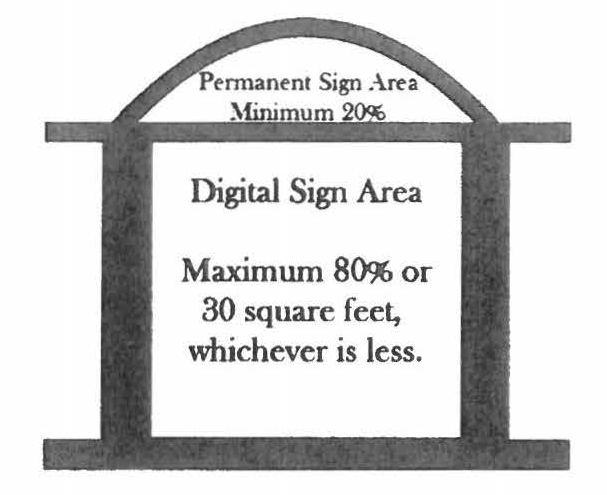
Figure 9.74.110-A Freestanding Digital Sign
3.
Operating Standards
a.
Signs visible from the public right-of-way shall not change at a frequency in excess of one alteration per five (5) seconds.
b.
Transition between slides shall not exceed one (1) second.
c.
Each slide shall contain one (1) complete message; messages shall not be truncated between slides.
d.
Scrolling or animated characterization is not permitted.
e.
All digital advertising displays shall be equipped with a light meter to automatically adjust the display brightness to ambient light conditions.
f.
All digital advertising displays must comply with the illumination provisions of this Section.
g.
Digital advertising displays located along pedestrian mall areas, not visible from a public right-of-way, may use scrolling and animated characterization.
h.
Digital advertising displays may advertise off-site businesses.
(Ord. No. 472, § 3, 10-27-2015; Ord. No. 485, § 3, 7-26-2016)
9.74.120 - Signs in Residential and Agricultural Districts
No sign, outdoor advertising structure, or display of any kind shall be permitted in Residential Zones except those provided for below and those provided in Section 9.74.060, Exempt Signs, and Sections 9.74.150 thru 170 Temporary Signs or as otherwise provided in this Chapter. The number and size of signs regulated by this Section are intended to be maximum standards and do not necessarily insure good design or architectural compatibility. Therefore, in addition to the standards provided below, consideration shall be given to a sign's relationship to the overall appearance of the subject property as well as the surrounding community. Compatibility and simplicity of design, and overall sign effectiveness shall be considered in the Town's review of sign applications. Minimum design criteria and standards are provided in Section 9.74.110General Design Criteria and Standards of this Chapter.
A.
Residential Identification Signs. These signs are exempt subject to the following:
1.
Only one (1) sign per street frontage is allowed;
2.
A maximum sign area of two (2) square feet is permitted;
3.
Signs may be attached to a building or free-standing;
4.
Free-standing signs shall not exceed four (4) feet in height.
B.
On-site Subdivision and Mobile Home Park Identification Signs
1.
One (1) wall or monument identification or landscape wall sign per public street entrance to the project, not to exceed a maximum of two (2) such signs, placed ten (10) feet from the project's boundary, not exceeding twenty-four (24) square feet maximum each.
2.
Maximum allowable height shall be six (6) feet and may not extend above a wall or fence.
3.
Each monument sign should be located within a planted landscaped area which is of a shape and design that will provide a compatible setting and ground definition to the sign.
4.
Such identification signs shall only be allowed if maintenance responsibility is assigned to a community association or a park owner for mobile home parks.
C.
Multi-family Residential Uses
1.
Apartments and multi-family residential developments having more than four (4) units may be permitted a cumulative sign area per frontage containing no more than one (1) square foot per each ten (10) feet of linear frontage and shall not exceed a maximum of twenty-four (24) square feet per frontage. Such signs may be monument or wall signs.
More than one (1) sign may be allowed in accordance with Section 9.74.110, General Design Criteria and Standards.
2.
Sign copy shall be limited to the name of the complex, address, and manager's phone number.
3.
Residential monument signs shall have an overall maximum height of four (4) feet and shall be located within a planted landscaped area that will provide a compatible setting and ground definition to the sign.
4.
A wall sign shall be located below the roof eave line or awning or canopy, and be fastened parallel to the surface of the main building and may be placed at a height not greater than two-thirds (2/3) of the height of the building surface upon which it is located. Signs may be allowed on the fascia of an awning or on a canopy.
5.
All signs shall harmonize with the architecture and scale of the development.
D.
Directory Signs
1.
For multi-family residential developments of twelve (12) or more units or mobile home parks, one (1) site directory monument sign per vehicle entrance may be allowed where necessary to direct visitors and emergency vehicles to buildings. Such signs shall be in accordance with the following:
a.
Maximum sign area shall not exceed twenty-four (24) square feet;
b.
Sign height shall not exceed four (4) feet if located within the required front or street side setback or six (6) feet if located behind required setbacks;
c.
Signs shall locate buildings, driveway locations and addresses for each building; and
d.
Fire hydrant or Knox box locations shall also be shown as required by Fire District regulations.
E.
Signs for Nonresidential Uses
1.
Free-Standing Signs
Nonresidential uses located in Residential Zones, such as institutional uses and places of assembly including churches, schools, funeral homes, and cemeteries; recreational uses; and agriculture related signs in Agricultural Zones may be permitted. Free-standing signs with a cumulative sign area per frontage not exceeding more than one (1) square foot per each ten (10) linear feet of frontage. More than one sign may be allowed provided that the maximum cumulative sign area is not exceeded. Monument signs shall be a minimum of one hundred (100) feet apart. The maximum cumulative sign area shall be thirty-two (32) square feet, and
a.
The maximum allowable height shall be four (4) feet and may not extend above a wall or fence;
b.
No free-standing signs shall be allowed for street frontages of less than one hundred (100) linear feet.
2.
Wall Signs
a.
Nonresidential uses as described in subsection 1 above may be permitted a cumulative sign area per building frontage of one quarter (1/4) square foot per each linear foot of building frontage.
b.
Wall signs shall not be located above an eave or roof line, parapet, awning or canopy, and in no case shall be higher on a building than twenty (20) feet above finished grade. Signs may be allowed on the fascia of an awning or on a canopy.
c.
Signs shall not be internally illuminated.
9.74.130 - Signs in Commercial and Office Districts
No sign, outdoor advertising structure, or display of any kind shall be permitted in Commercial and Office Zones except those provided for in this Section and those provided for in Section 9.74.060, Exemptions and Sections 9.74.150 thru 170 Temporary Signs or as otherwise provided in this Chapter. No sign shall be permitted that does not pertain directly to an approved business or other activity conducted on the premises, except as provided in Section 9.74.060, Exempt Signs.
The number and size of signs regulated by this Section are intended to be maximum standards and do not necessarily insure good design or architectural compatibility. Therefore, in addition to the standards provided below, consideration shall be given to a sign's relationship to the overall appearance of the subject property as well as the surrounding community. Compatibility and simplicity of design, and overall sign effectiveness shall be considered in the Town's review of sign applications. Minimum design criteria and standards are provided in Section 9.74.110 of this Chapter.
A.
Signs for Free-Standing Single Tenant Buildings and Sites
1.
Wall Signs
a.
The cumulative total sign area per frontage allowed for wall signs shall be one (1) square foot per linear foot of building frontage. Any wall sign removed or obstructed due to construction of an adjacent building cannot be relocated unless a new sign permit is obtained and it complies with all the requirements for new signs.
b.
Awnings or canopy signs may be allowed, with their sign area allocated against the total cumulative sign area for wall signs.
c.
Permanent window signs may also be allowed to identify the business or use with their sign area allocated against the total cumulative sign area for wall signs.
2.
Free-Standing Signs
a.
The cumulative total sign area allowed for free-standing signs shall be two (2) square feet per ten (10) linear feet of street frontage on which the sign is located.
b.
No single sign shall exceed sixty (60) square feet in area.
c.
Maximum height of a free-standing sign shall not exceed six (6) feet.
3.
Projecting or Shingle Signs. Small projecting, shingle or suspended signs may be permitted subject to the following:
a.
A maximum of one (1) such sign per building entrance is permitted provided that it is perpendicular to the main face of the building suspended from a canopy or projects not more than three (3) feet from the building face;
b.
Projecting or shingle signs shall not exceed two (2) square feet in area and shall have a minimum ground clearance of eight (8) feet;
c.
All such signs shall be non-energized and non-electrical.
4.
Nameplate and permanent window signs are allowed in accordance with the provisions of Section 9.74.060, Exempt Signs.
B.
Signs for Tenants Within Shopping Centers and Multiple Tenant Buildings
1.
Sign Programs. A sign program shall be required for all business or shopping centers or any group of business uses with shared sign facilities to insure that all signs are integrated and compatible. Sign programs shall comply with all of the provisions of Section 9.74.100, Sign Programs. All signs in such developments shall comply with the provisions of the approved sign program in addition to the provisions of this Chapter.
2.
Wall Signs. The cumulative total sign area allowed for wall signs shall be one (1) square foot per linear foot of building frontage. Subject to the approval of a sign program, the property owner may apportion the sign area to individual uses or overall building, or certain identification, provided that the total cumulative sign area is not exceeded.
3.
Free-Standing Signs
a.
The cumulative total sign area allowed for free-standing signs shall be two (2) square feet per ten (10) linear feet of street frontage on which the sign is located.
b.
No single sign shall exceed two hundred (200) square feet.
c.
Maximum height of free-standing signs shall comply with the following:
1)
Center identification signs shall not exceed the maximum sign heights as specified below:
2)
Other free-standing signs which may be permitted for a center shall not exceed a maximum height of six (6) feet.
d.
Subject to approval of a sign program, the property owner may apportion the sign area to individual uses or overall center or building identification, provided that the total cumulative sign area per each type of sign is not exceeded. This allows a center to apportion sign area for free-standing signs, for example, between a center identification sign and monument signs for individual free-standing tenants in accordance with Section 9.74.110 of this Chapter.
e.
All free-standing signs in excess of six (6) feet in height shall reflect high quality, enhance community design and be harmonious with the desert character through the following:
1)
Evokes a special relationship to the structures and uses located on site by incorporating elements of the structural architecture and/or natural features of the site, without dominating the site;
2)
Makes use of high quality and/or natural or indigenous building materials including, but not limited to, rock, adobe, timber, carved wood and incised lettering in stone;
3)
Identifies the site or use without extensive sign copy (text) by use of graphic imagery and/or logo;
4)
Utilizes reverse channel lettering or opaque sign field (background) with illuminated routed copy.
4.
Projecting or Shingle Signs. Small projecting, shingle or suspended signs may be permitted subject to the following:
a.
A maximum of one (1) such sign per building entrance is permitted provided that it is perpendicular to the main face of the building and suspended from a canopy or projects not more than three (3) feet from the building face;
b.
Signs shall not exceed six (6) square feet in area and shall have a minimum ground clearance of eight (8) feet;
c.
All such signs shall be non-energized and non-electrical.
5.
Nameplate and permanent window signs are allowed in accordance with the provisions of Section 9.74.060, Exempt Signs.
C.
Freeway Identification Signs. On-site signs oriented to freeway traffic shall be permitted subject to the following criteria:
1.
Properties containing such signs shall be adjacent to a freeway or a freeway ramp;
2.
Wall Signs. Wall signs may be permitted for properties facing the freeway subject to the same criteria allowed for frontages on a public right-of-way;
3.
Free-Standing Signs. Free-standing signs may be permitted subject to the following criteria:
a.
Signs for centers and multiple tenant buildings may be permitted subject to the same criteria for major roads;
b.
One (1) free-standing sign may be allowed per shopping center subject to the following:
1)
Maximum sign area shall not exceed two-hundred (200) square feet;
2)
Maximum height shall not exceed twenty-five (25) feet above the elevation of the freeway lane nearest the sign location;
3)
Signs shall not be within five hundred (500) feet of another such freeway sign;
4)
Sign shall be located only on the property to which the sign pertains, unless the sign is located on a property that is part of the center or complex of which the business is a part. More than one business may be identified on a sign.
D.
Gasoline and Vehicular Fuel Stations. Signs for gasoline and vehicular fuel dispensing establishments shall be the same as for other businesses, except for the following:
1.
Free-standing signs shall not be within one-hundred feet (100) of another free-standing sign on the same property.
2.
Signs on dispensers and dispenser islands shall be limited to identification and directions for use of pumps and payments, or other signs required by State regulations, except that video display terminals not exceeding thirteen (13) inches, measured diagonally, may be allowed.
E.
Fast Food Menu Boards. In addition to the provisions for Free-standing Commercial Businesses under Paragraph A of this Section, fast food restaurants with drive-thru or walk-up facilities may be allowed two (2) menu or reader boards with a maximum area of twenty-five (25) square feet each. Any pictures, photographs, representations, or logos within or on the perimeter of the board shall be included in the computation of maximum area for such boards.
F.
Automated Service Facilities. Signs for drive-up or walk-up service windows or machines, whether free-standing or incorporated into a building, require special consideration for which uniform sign regulations cannot be established because of their unlimited variety and character. Therefore, the sign allowance for such facilities shall be determined on the basis of their function and use, when the sign permit application is being reviewed.
1.
In no event shall such signs exceed five (5) square feet in area.
2.
Automated service signs shall not be allowed as a method for increasing the basic sign allowance for the principal use or to function as off-site advertising of the principal use. Examples of such facilities are drive-up or walk-up machines for banking and drive-up or walk-up windows for restaurants, grocery stores, and film processing.
9.74.140 - Signs in Industrial Districts
No sign, outdoor advertising structure, or display of any kind shall be permitted in Industrial Zones except those provided for below and those provided for in Section 9.74.060, Exempt Signs and Sections 9.74.150 thru 170 (temporary signs) or as otherwise provided in this Chapter. No sign shall be permitted that does not pertain directly to an approved business or other activity conducted on the premises, except as provided in Section 9.74.060, Exempt Signs.
The number and size of signs regulated by this Section are intended to be maximum standards and do not necessarily insure good design or architectural compatibility. Therefore, in addition to the standards provided below, consideration shall be given to a sign's relationship to the overall appearance of the subject property as well as the surrounding community. Compatibility and simplicity of design, and overall sign effectiveness shall be considered in the Town's review of sign applications. Minimum design criteria and standards are provided in Section 9.74.110 of this Chapter.
A.
Signs for Free-Standing Single Tenant Buildings and Sites
1.
Wall Signs
a.
The cumulative total sign area allowed for wall signs shall be one-half (1/2) square foot per linear foot of building frontage. Any wall sign removed or obstructed due to construction of an adjacent building cannot be relocated unless a new sign permit is obtained and it complies with all the requirements for new signs.
b.
Awnings or canopy signs may be allowed, with their sign area allocated against the total cumulative sign area for wall signs.
c.
Permanent window signs may also be allowed to identify the business or use, with their sign area allocated against the total cumulative sign area for all signs.
2.
Free-Standing Signs
a.
The cumulative total sign area allowed for free-standing signs shall be one (1) square foot per ten (10) linear feet of street frontage on which the sign is located.
b.
No single sign shall exceed sixty (60) square feet in area.
c.
Maximum height of a free-standing sign shall not exceed six (6) feet.
3.
Projecting or Shingle Signs
a.
Small projecting, shingle or suspended signs may be permitted subject to the following:
1)
A maximum of one (1) such sign per building entrance is permitted provided that it is perpendicular to the main face of the building suspended from a canopy or projects not more than three (3) feet from the building face;
2)
Signs shall not exceed two (2) square feet in area and shall have a minimum ground clearance of eight (8) feet;
3)
All such signs shall be non-energized and non-electrical.
4.
Nameplate and permanent window signs are allowed in accordance with the provisions of Section 9.74.060, Exempt Signs of this Chapter.
B.
Signs for Tenants Within Multiple Tenant Buildings and Developments
1.
Sign Program. A sign program shall be required for all business or shopping centers or any group of business uses with shared sign facilities to insure that all signs are integrated and compatible. Sign programs shall comply with all of the provisions of Section 9.74.100, Sign Programs of this Chapter. All signs in such developments shall comply with all provisions of the approved sign program in addition to the provisions of this Chapter.
2.
Wall Signs. The cumulative total sign area allowed for wall signs shall be one-half (1/2) square foot per linear foot of building frontage. Subject to the approval of a sign program, the property owner may apportion the sign area to individual uses or overall building, or certain identification, provided that the total cumulative sign area is not exceeded.
3.
Free-Standing Signs
a.
The cumulative total sign area allowed for free-standing signs shall be one (1) square foot per ten (10) linear feet of street frontage on which the sign is located.
b.
No single sign shall exceed two hundred (200) square feet.
c.
Maximum height of free-standing signs shall not exceed six (6) feet.
d.
Subject to approval of a sign program, the property owner may apportion the sign area to individual uses or overall center or building identification, provided that the total cumulative sign area is not exceeded.
4.
Projecting or Shingle Signs
Small projecting, shingle or suspended signs may be permitted subject to the following:
a.
A maximum of one (1) such sign per building entrance is permitted provided that it is perpendicular to the main face of the building and suspended from a canopy or projects not more than three (3) feet from the building face;
b.
Signs shall not exceed two (2) square feet in area and shall have a minimum ground clearance of eight (8) feet;
c.
All such signs shall be non-energized and nonelectrical.
5.
Nameplate and permanent window signs are allowed in accordance with the provisions of Section 9.74.060, Exempt Signs of this Chapter.
C.
Gasoline and Vehicular Fuel Stations. Signs for gasoline and vehicular fuel dispensing establishments shall be the same as for other businesses, except for the following:
1.
Free-standing signs shall not be within one-hundred feet (100) of another free-standing sign on the same property.
2.
Signs on dispensers and dispenser islands shall be limited to identification and directions for use of pumps and payments, or other signs required by State regulations, except that video display terminals not exceeding thirteen (13) inches, measured diagonally, may be allowed.
9.74.150 - Temporary Subdivision and Model Home Signs
A.
All temporary subdivision and model home signs shall be subject to approval of a Temporary Use Permit and compliance with the provisions of this Section.
B.
These regulations shall apply to tracts and model home signs except for signs within developments with a sign program adopted in accordance with subsection 9.74.100.D Master Planned Communities of this Chapter. For purposes of this Section the following definitions shall apply:
1.
Tracts. Residential subdivisions of contiguous lots within a recorded tract where five (5) or more lots are concurrently undergoing construction.
2.
Model Home. Single family residential structure used as a temporary sales office and model home for the sale of construction services to build single family residential units on vacant lots.
C.
On-site Signs and Advertising Devices
1.
Model homes and residential subdivisions of less than five (5) lots not along a secondary, major or major divided road may be permitted one (1) free-standing sign per street frontage not to exceed a maximum area of sixteen (16) square feet and a maximum height of six (6) feet.
2.
Temporary subdivision and model home signs along a secondary, major or major divided road may be permitted on one (1) free-standing sign on such a road with a maximum area of thirty-two (32) square feet and a maximum height of six (6) feet.
3.
Temporary signs for tracts that are twenty (20) acres or larger may be permitted. One free-standing sign per perimeter street frontage with a maximum sign area of sixty-four (64) square feet and a maximum height of twelve (12) feet. Sign area may be split between two signs where their frontage exceeds six hundred (600) linear feet along one street, but total cumulative sign area shall not exceed sixty-four (64) square feet.
4.
In addition, two (2) small signs containing the name or information relating to the model may be displayed subject to the following:
a.
Sign area shall not exceed a maximum of four (4) square feet;
b.
Sign height shall not exceed four (4) feet;
c.
Signs may only be displayed on the individual lot containing a model home;
d.
Signs shall only be allowed within the front setback area and shall be a minimum of thirty (30) feet from the right-of-way.
5.
Flags may be permitted subject to the following:
a.
Three (3) flags may be allowed for each model;
b.
Flags shall have a maximum area of six (6) square feet each;
c.
The maximum height of flag poles shall not exceed twelve (12) feet above the ground;
d.
Flags may only be displayed in front of the models and along the entrance street into the subdivision from a major and secondary road. Flags will not be permitted along a perimeter street of a subdivision unless directly in front of the models.
6.
Banners, balloons, or other advertising devices, except as specified above shall not be permitted.
D.
Residential Kiosk Directional Signs
The following shall regulate and establish a standardized program of off-site residential directional kiosk signs for the Town of Apple Valley. For the purposes of this subsection, residential projects with an approved model home permit may participate in the approved kiosk directional program.
1.
The kiosk location plan, sign structure and panel design shall be approved by the Planning Commission at a public hearing.
2.
A kiosk sign structure shall be located not less than three hundred (300) feet from any other kiosk sign for any single direction of traffic. Kiosk sign structures shall be permitted within any public right-of-way, subject to issuance of an encroachment permit, provided such right-of-way is not controlled or maintained by the California Department of Transportation.
3.
Each kiosk sign shall require the submittal of a detailed site plan showing the specific location of the sign which shall be reviewed and approved by the Planning Division in accordance with the requirements of the this Code.
4.
The placement of panels on the kiosk structure shall be reviewed and approved by the Director.
5.
All kiosk sign structures placed on private property shall require written consent of the property owner which shall be filed with the Planning Division prior to the issuance of a sign permit. All kiosk signs located on Town property or within a designated Town right-of-way shall require an encroachment permit through the Public Works Department, and a hold harmless agreement or other form of liability insurance, deemed necessary and approved by the Town Attorney and effective on the date of installation of any sign.
6.
There shall be no additions, tag signs, streamers, devices, display boards, or appurtenances added to the kiosk signs as originally approved. Further, no other directional signs may be used, such as posters or trailer signs.
7.
Subdivisions, mobile home parks and other residential developments which have illegal directional signs posted within the Town of Apple Valley shall remove such signs prior to issuance of a new sign permit for a kiosk panel for their project.
8.
At the option of the Town, an administrator may be assigned to monitor, approve, assign, and otherwise manage the kiosk sign and/or kiosk sign program.
9.
New residential developments listed on a kiosk sign providing units for rent/lease or other similar circumstances shall be removed within one year from the date of approval to place a panel on a kiosk sign.
10.
All approvals for temporary off-site subdivision signs which received approval through the temporary occupancy permit process shall become null and void six months after the adoption of kiosk program.
11.
All kiosk signs shall be constructed in accordance with the requirements of the Uniform Building Code (UBC) and all applicable requirements of the Public Works Department.
12.
All kiosk signs shall be permitted in any land use or zoning district, subject to the requirements of this Section and the limitations of the specific land use and zoning district in which the sign is located.
13.
All kiosk sign structures shall conform with the following standard regulations:
a.
No more than three (3) panels per development per side of a kiosk is permitted;
b.
Double sided kiosk signs are permitted;
c.
Kiosk sign panels may only contain the name of the subdivision and a directional arrow, and one (1) sign copy color as indicated in Figure 9.74.150-A;
d.
Kiosk sign structures shall not encroach within the clear sight triangle as defined in Chapter 9.08 of this Code;
e.
Design, size and height of kiosk structures and panels shall be approved by the Planning Commission.
E.
Temporary Off-Site Weekend Directional Signs. In addition to Residential Kiosk Directional Signs permitted in subsection 9.74.150.D above, temporary off-site weekend directional signs may be permitted on major and secondary roads for purposes of providing direction to projects with an approved model home permit, subject to the following regulations:
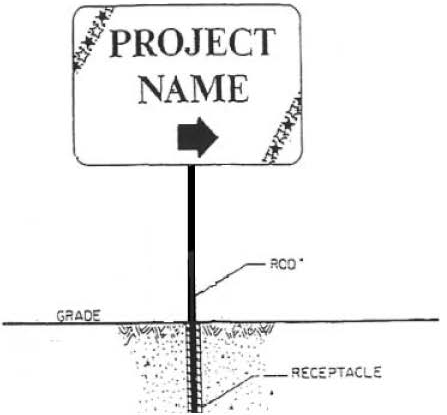
Figure 9.74.150-C
1.
Signs may only be posted on weekends between 6:00 p.m. on Friday and 6:00 p.m. on Sunday, or until 6:00 p.m. on legal holidays following a weekend, and between 8:00 a.m. and 6:00 p.m. on legal holidays not in conjunction with a weekend;
2.
Such snipe sign may be posted within the public right-of-way, provided that the installation of the sign is in compliance with Figure 9.74.150-C, which includes a rectangular receptacle placed at least two (2) feet in the ground made of metal or pvc material. The receptacles shall be removed at the completion of the tract. Snipe signs on wood stakes or other posts without a receptacle shall be prohibited;
3.
There shall be no more than one (1) sign per direction of traffic at any intersection;
4.
Snipe signs shall be at least five hundred (500) feet from any other sign for that subdivision, except at intersections. Snipe signs may not be within fifty (50) feet of an approved sign for any other subdivision and shall in no way obscure, obstruct, detract, or interfere with any traffic or safety sign;
5.
Maximum area of directional signs shall not exceed three (3) square feet nor shall any sign be erected in excess of four (4) feet in height;
6.
Signs may be posted on private property only with permission of the property owner;
7.
Prior to posting any snipe signs, each subdivision must obtain approval of a Temporary Use Permit, free of charge, from the Planning Division. A sign location plan shall be prepared showing the site of each sign.
9.74.155 - Business Directional Kiosk Signs
The following shall regulate and establish a standardized program of off-site, business directional kiosk signs Village and Desert Knolls Business District.
A.
Applicability. The following neighborhoods may participate in the off-site, business directional kiosk sign program:
1.
The Village Business District - generally defined as the corridor along Highway 18, between Navajo Road and Mesquite Road, and Ottawa Road to the south and Esaws Road to the north.
2.
The Desert Knolls Business District - generally defined as the corridor along Highway 18, between Tao Road and the western Town boundary, between Desert Knolls Wash to the south and Siskiyou Road to the north. Eligible businesses must not have visible frontage along Highway 18, or existing signage along Highway 18.
B.
Business Directional Kiosk Sign
1.
The kiosk location plan, sign structure and panel design shall be approved by the Planning Commission at a public hearing.
2.
A kiosk sign structure shall be located not less than three hundred (300) feet from any other kiosk sign for any single direction of traffic. This also includes kiosks for residential development.
3.
Each kiosk sign shall require the submittal of a detailed site plan showing the specific location of the sign which shall be reviewed and approved by the Planning Division in accordance with the requirements of this Code.
4.
The placement of panels on the kiosk structure shall be reviewed and approved by the Director.
5.
All kiosk sign structures placed on private property shall require written consent of the property owner which shall be filed with the Planning Division.
6.
All kiosk signs located on Town property, or within a designated Town right-of-way, shall require an encroachment permit through the Public Works Division, and a hold harmless agreement, or other form of liability insurance, deemed necessary and approved by the Town Attorney. No kiosk sign structures shall be permitted within any public right-of-way controlled or maintained by the California Department of Transportation.
7.
There shall be no additions, tag signs, streamers, devices, display boards, or appurtenances added to the kiosk signs as originally approved. Further, no other directional signs may be used, such as posters or trailer signs.
8.
At the option of the Town, an administrator may be assigned to monitor, approve, assign, and otherwise manage the kiosk sign and/or kiosk sign program.
9.
Kiosk signs shall be constructed in accordance with the requirements of the Uniform Building Code (UBC) and all applicable requirements of the Public Works Division.
10.
Kiosk signs shall be permitted in any commercial zoning district within the Village Business District, and along Highway 18 within the Desert Knolls Business District, subject to the requirements of this Section.
11.
Kiosk sign structures shall conform to the following standard regulations:
a.
Kiosk structure shall not exceed a maximum height of seven (7) feet and four (4) feet four (4) inches wide as shown in Figure 9.74.040-N.
b.
No more than three (3) panels per side of a kiosk are permitted;
c.
Double sided kiosk signs are permitted;
d.
Kiosk sign panels may only contain the name of the business and a directional arrow;
e.
No more than one panel per business per side of a kiosk sign is permitted.
f.
Kiosk sign structures shall not encroach within the clear sight triangle as defined in Chapter 9.08 of this Code or create a traffic hazard;
g.
Design, size and height of kiosk structures and panels shall be approved by the Planning Commission.
9.74.157 - Village District Commemorative Street Light Banners
The following shall regulate and establish a standardized program for commemorative banners/pennants upon light poles within the Village Business District.
A.
No more than two (2) vertical pole commemorative banners shall be allowed to be attached to an existing street light pole within the Village District. Such banners shall not exceed twelve and one-half (12 ½) square feet in area; shall have a maximum width of two and one-half (2 ½) feet and a maximum height of five (5) feet.
B.
Such commemorative banners attached to public utility light pole shall be approved by Southern California Edison (SCE) prior to attachment.
C.
The commemorative banners shall not be used for commercial or political advertising, except that logos and trademarks of the Village District shall be permitted.
D.
All parts, portions, and materials shall be maintained and kept in good repair. Failure to adequately maintain the banners shall make the banners subject to abatement in accordance with the provisions of Section 9.74.230Enforcement of this Chapter.
9.74.160 - Temporary Real Estate Signs
A.
General Requirements. All temporary sale, lease or rent signs shall be subject to the following requirements:
1.
Signs shall be removed within ten (10) days following the close of escrow, completion of the rental or lease agreement, or once the property is no longer listed for sale or lease.
2.
Signs shall only be placed on the parcel of land to which the sign pertains, except as provided for temporary off-site signs as provided elsewhere in this Chapter.
3.
Sign permits are not required for temporary real estate signs described within this section; however, all signs must be constructed, installed and permitted in accordance with the Uniform Building Code.
4.
Signs applicable to this section may be utilized to identify future tenants.
5.
One (1) added sign, commonly referred to as a "rider" not to exceed six (6) inches times the width of primary sign, may be attached and will not be counted towards maximum sign area.
6.
All parts, portions, and materials shall be maintained and kept in good repair. Signs found to be in disrepair shall be subject to abatement in accordance with the provisions of Section 9.74.230Enforcement of this Chapter.
7.
Sign illumination is prohibited.
8.
Signs must not be installed within the clear site triangle, which is the area within the triangle formed by connecting the points thirty (30) feet (10 feet at driveways) from the intersection of the two right-of-way lines.
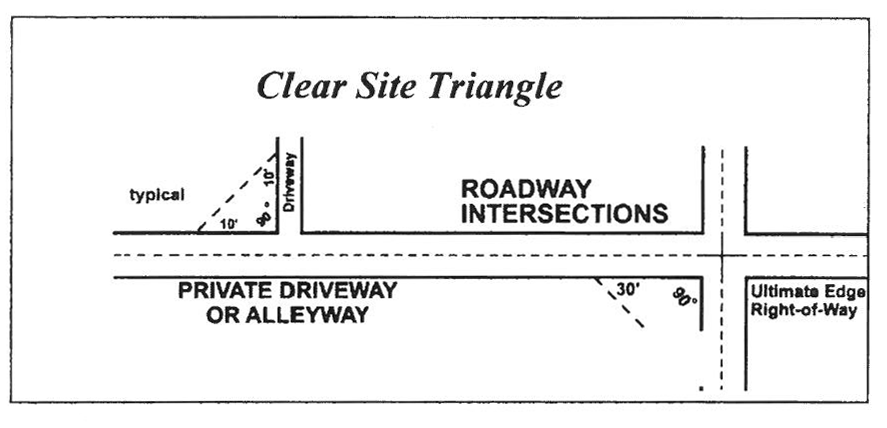
B.
Signs for Residential Property and Use
1.
Temporary signs advertising residential subdivisions shall comply with those regulations contained within Section 9.74.150, Temporary Subdivision and Model Home Signs.
2.
A maximum of one (1) temporary, on-site free-standing sign per street frontage and per park or golf course frontage may be allowed for a parcel in any district.
3.
Wall signs are prohibited.
4.
The maximum area of any sign shall be six (6) square feet and the maximum height shall be six (6) feet.
C.
Signs for Non-Residential Property or Uses
1.
The maximum area and height of any free-standing sign shall be as follows:
a.
On parcels less than fifteen (15) acres in size located in commercial and industrial zones, the maximum area of any sign shall be twenty-four (24) square feet and the maximum height shall be six (6) feet.
b.
On parcels or contiguous parcels within the same center of fifteen (15) acres or larger, and located in commercial and industrial zones, the maximum area of any sign shall be sixty-four (64) square feet and the maximum height shall be twelve (12) feet.
2.
A maximum of two (2) temporary, on-site free-standing signs per street frontage may be allowed.
3.
Signs located on a single property must maintain a minimum separation distance of 600 feet.
4.
All free-standing signs in commercial and industrial zones shall have a minimum setback of five (5) feet from any property line or from the edge of the planned or ultimate right-of-way of any street, if this is greater.
5.
Window Signs. The maximum size of any window sign shall be six (6) square feet, or fifteen (15) percent of the window area per frontage of the unit in which it is displayed, whichever is greater.
6.
Wall Signs.
a.
Sign area shall not exceed one-half (½) square foot per linear foot of building frontage, with a maximum size of twenty-four (24) square feet;
b.
Signs shall be constructed of a durable material and shall be maintained in good condition;
c.
One (1) wall sign shall be permitted per building facade which fronts on any street, freeway, parking lot, or pedestrian mall, not including loading or service areas.
7.
Existing, permanent signage may not be utilized for the display of temporary real estate advertising.
D.
Open House Directional Signs
1.
Temporary off-site, open house directional signs may be allowed for single residences subject to the following:
a.
Maximum area of directional signs shall not exceed six (6) square feet, nor shall any sign exceed four (4) feet in height. Signs shall be mounted on their own stakes and shall not be placed on street or traffic signs, utility poles or trees. Signs shall be constructed of wood or similar rigid material;
b.
There shall be no more than one (1) sign per direction of traffic at any intersection and signs shall not be posted within twenty-five (25) feet of the corner;
c.
Signs may not be posted more than four (4) days per week for any one residence;
d.
Signs shall not be placed within the public right-of-way;
e.
Signs may be placed on private property with the permission of the property owner;
f.
Such signs shall be used only when a sales person is on duty or scheduled to be on duty for an open house. Signs shall be permitted overnight if a sales person is scheduled to be on duty the following day. Under no circumstances shall signs be left up when no one is on duty or scheduled to be on duty during the following twenty-four (24) hours;
g.
Signs in violation of this Section may be subject to removal and disposition without notice or warning.
2.
Temporary On-site Open House Signs
a.
Four (4) flags, with a maximum area of three (3) square feet each and a maximum height of six (6) feet, may be allowed on the lot where the open house is conducted.
b.
One (1) "Open House" sign per street frontage may also be allowed on the lot where the open house is conducted with a maximum area of six (6) square feet and a maximum height of six (6) feet.
(Ord. No. 466, § 3, 2-10-2015)
9.74.170 - Temporary Political Signs
A.
Temporary political signs are permitted on private property in all districts subject to the following:
1.
Election signs shall not be displayed more than forty-five (45) days prior to an election, except for signs which are pertinent to a primary and run-off election, and shall be removed within seven (7) days after the election;
2.
Other political signs shall not be displayed for more than fifty (50) days unless a permit is issued in accordance with other provisions of this Chapter;
3.
In residential districts, signs shall have maximum area of six (6) square feet, with a maximum height of four (4) feet for free-standing signs, except as specified below;
4.
In nonresidential districts, and on vacant property in residential districts that is located on major divided, major or secondary roads, as indicated in the General Plan, signs shall have a maximum area of eighteen (18) square feet with a maximum height of six (6) feet for free-standing signs;
5.
Signs may only be placed or erected upon property with the permission of the property owner or tenant.
6.
Signs shall not be located in the Clear Sight Triangle (see definition in Section 9.08 of this Chapter).
B.
Temporary political signs which exceed the limitations in subsection A above may be permitted, subject to the following:
1.
Signs shall have a maximum area of thirty-two (32) square feet;
2.
Signs shall not exceed a maximum height of six (6) feet;
3.
Signs may only be placed or erected on property with the written permission of the property owner or tenant.
9.74.180 - Grand Openings and Special Promotions
A.
Notification and General Requirements
1.
All commercial temporary signs and advertising devices for grand openings and special promotions require the review and approval of a Temporary Sign Permit and/or Special Event Permit by the Town Planning Division.
2.
Temporary signs and advertising devices may only be displayed on the property where the grand opening actually occurs.
B.
Length of Time and Number of Events
1.
Temporary signs and advertising devices may be permitted for grand openings for a maximum of thirty (30) consecutive days.
2.
Temporary signs and advertising devices may be permitted for special promotions for a maximum of four (4) events per calendar year. Display of temporary signs and advertising devices for special promotions shall not exceed a total of fourteen (14) days per event. However, events may be consecutive or combined.
C.
Regulations
1.
Balloons and other inflatable devices shall not exceed a maximum height of twenty (20) feet above the roof of the building to any part of the balloon. Balloons shall not contain advertising, other than the name or logo of the tenant or products. Only one (1) balloon or inflatable device which exceeds a capacity of three (3) cubic feet shall be permitted per event.
2.
Pennant streamers, spinners or other animated or moving signs are not permitted.
3.
One (1) temporary, single flag pole sign with a maximum height of twelve (12) feet, located on private property. No other free-standing signs shall be permitted.
4.
Sign area of banners shall not exceed one-half (1/2) square foot per linear foot of building frontage on which the sign is located, with a maximum total cumulative sign area not to exceed sixty (60) square feet.
5.
Only one (1) banner shall be permitted per building frontage.
6.
Banners shall be attached to the building or canopy parallel to the building face. No portion of any banner shall project more than six (6) inches from the face of the building or canopy to which it is attached.
9.74.185 - Civic Gateway Signs
A Civic Gateway Sign is intended to provide the Town of Apple Valley a significant entry statement for those traveling along Interstate 15. The development guidelines and procedures presented within this Section are intended to further the purpose and standards set forth in establishing this Chapter.
A.
A Civic Gateway Sign may be permitted subject to a Development Agreement approved by the Town Council. As the discretion of the Town, an administrator may be assigned to monitor and otherwise manage the construction and maintenance of the sign.
B.
The sign shall comply with all applicable CALTRANS standards for signs adjacent to freeways and other applicable Government Code, including the Outdoor Advertising Act.
C.
The sign structure shall be a monument design utilizing adobe, stucco, smooth plasters, earthen color block, natural stone, wood and terra cotta tile as the dominant building materials in response to the Town's desert environment. Final design review and approval is subject to the terms and conditions set forth within the Development Agreement.
D.
The maximum sign area for a Civic Gateway Sign shall be 750-square-feet.
E.
The Civic Gateway Sign may include a digital advertising display. The maximum size for the electronic message board portion of the sign shall be 300-square-feet or fifty percent of the overall sign area, whichever is smaller. Any digital advertising display must comply with the provisions set forth in this chapter.
F.
The maximum height for Civic Gateway Sign shall be forty-five (45) feet above the elevation of the freeway lane nearest to the sign location. However, the actual approved size and height of civic gateway sign may be less than the maximum dimensions. The approved size and height shall be based upon a site specific study and a determination made by the Town of the smallest size and the lowest height necessary to accomplish the appropriate level of visibility.
G.
All utilities to said sign must be underground. The use of generators is prohibited.
9.74.187 - Billboards
Billboards may be permitted with the review and approval of a Conditional Use Permit, subject to the following criteria:
A.
Regulatory Compliance. All sign structures shall comply with all applicable CALTRANS standards for signs adjacent to freeways and other applicable Government Codes, including the Outdoor Advertising Act (California Business and Professions Code Sections 5200 et seq.).
B.
Location.
1.
Only permitted within the Regional Commercial (C-R) zoning designation.
2.
May be located upon any parcel within 660 feet of Interstate 15.
3.
Billboards shall be erected, constructed, or maintained, to ensure that the message displayed on the signs shall be designed to be viewed by the operators of vehicles traveling on Interstate 15.
C.
Separation. Must maintain a minimum separation of 2,500 feet from any other billboard or Civic Gateway sign. Separation shall be measured from the footing of the sign nearest to the right-of-way.
D.
Height. Maximum height is thirty-five (35) feet;
E.
Sign Area
1.
The maximum vertical height of the face shall be twenty-five (25) feet;
2.
The maximum horizontal width of the face shall be fifty (50) feet;
3.
The maximum sign area shall be 500 square feet;
4.
Two-sided signs and V-shaped signs are permitted.
F.
Illumination. All illumination shall be in conformance with the Design Criteria of this Chapter.
G.
Utilities. All utilities shall be underground and the use of generators is prohibited.
H.
State Outdoor Advertising Permit. A copy of the current valid State Outdoor Advertising Permit, when required by the State, shall be submitted to the Building Official prior to issuance of a Building Permit.
9.74.190 - Nonconforming Signs and Advertising Displays
A.
The Town shall comply with all applicable provisions of the California Business and Professions Code, Section 5490 et seq., regarding enforcement and removal of on-premises advertising displays and signs, and California Business and Professions Code, Section 5400 et seq., regarding enforcement and removal of off-premises advertising displays and signs, as such terms are used in the California Code. A legally established, permanent sign which had received all required permits at the time of erection, or was otherwise allowed by the Code in effect upon construction, which fails to conform to sign regulations contained in this Chapter enacted by the Town, shall be allowed continued use until amortized in accordance with the provisions of this Section, except that any advertising display which is determined to have historic value, as determined by the Historic Advisory Committee, and in accordance with this Section, may be allowed to continue. Any sign not found to be of historic value which meets any of the following criteria shall be removed without compensation, unless otherwise required by law, or made to conform to this Chapter.
1.
Any advertising display erected without first complying with all ordinances and regulations in effect at the time of its construction and erection or use.
2.
Any advertising display which was lawfully erected anywhere within the Town of Apple Valley, but whose use has ceased, or the structure upon which the display has been abandoned by its owner, for a period of not less than 90 days. Costs incurred in removing an abandoned display may be charged to the legal owner.
3.
Any advertising display which has been more than 50 percent destroyed, and the destruction is other than facial copy replacement, and the display cannot be repaired within 30 days of the date of its destruction.
4.
Any advertising display whose owner, outside of a change of copy, requests permission to remodel and remodels that advertising display, or expand or enlarge the building or land use upon which the advertising display is located, and the display is affected by the construction, enlargement, or remodeling, or the cost of construction, enlargement, or remodeling of the advertising display exceeds 50 percent of the cost of reconstruction of the building.
5.
Any advertising display whose owner seeks relocation thereof and relocates the advertising display.
6.
Any advertising display for which there has been an agreement between the advertising display owner and the city or county, for its removal as of any given date.
7.
Any advertising display which is temporary.
8.
Any advertising display which is or may become a danger to the public or is unsafe.
9.
Any advertising display which constitutes a traffic hazard not created by relocation of streets or highways or by acts of any city or county.
B.
Sign copy and sign faces may be changed and shall not be considered a structural change or alteration.
C.
Abatement of nonconforming signs shall be in accordance with the procedures specified in Section 9.74.230 of this Chapter.
D.
Amortization of Signs. Any on-premise sign which lawfully existed at the time of the adoption of this Section or was lawfully constructed in accordance with a permit issued by San Bernardino County and was later incorporated into or annexed to the Town of Apple Valley, but which is not in conformance with the requirements of the Town's sign regulations, shall be deemed a legal nonconforming use which shall be allowed to remain until the expiration of the sign's amortization period.
E.
General Amortization Period. All legal nonconforming signs shall have a legal and useful life of fifteen (15) years, unless a shorter period is permitted by law, which shall be calculated from the date the Community Development Director, upon receiving direction from the Town Council, mails the owner or user of the sign written notice that the sign is nonconforming. Upon expiration of the amortization period, the sign shall be removed by the owner without compensation. At termination of the legal and useful life, the Community Development Director, upon receiving direction from the Town Council, will issue written notice to the owner or user of the sign or to the owner of the property on which the nonconforming sign is located, requiring conformance or removal if unable to conform. If, after a reasonably diligent attempt to serve notice, the owner and user have not received notice, the Town will either post the notice or publish the notice in a local newspaper customarily used for notice by the Town. If the sign remains thereafter, the Town may proceed with abatement procedures or other legal methods as permitted by State law, with the costs of removal to be charged against the owner.
F.
Historic Signs
1.
The owner of a nonconforming sign may apply, on forms to be provided by the Director, to have said sign designated as a "Historic Sign". The application shall be reviewed by the Town Historic Advisory Committee which shall make a recommendation to the Town Council. The Town Council shall make the final determination of the subject sign's "Historic" status. The Historic Advisory Commission shall find in recommending a sign as "Historic" that:
a.
The sign is representative of a place or event that is of historic interest or value to residents or visitors to Apple Valley; and
b.
The sign is not or will not become a safety hazard.
2.
Except for purposes of routine maintenance, signs determined to be "Historic" may not be altered without approval of the Historic Advisory Committee and subsequent ratification by the Town Council.
3.
Abatement of nonconforming signs determined by the Town Council to be "Historic" shall be stayed for as long as the subject sign retains it's "Historic" designation. If the sign is changed without the approval of the Historic Advisory Committee and the Town Council, then the sign shall be amortized in whatever time is remaining from the original amortization period which commenced with the adoption of this ordinance.
9.74.210 - Sign Construction and Maintenance
A.
Every sign and all parts, portions, and materials shall be manufactured, assembled, and erected in compliance with all applicable County, State, Federal, and Town regulations and the Uniform Building Code.
B.
Every sign including those specifically exempt from the provisions of this Chapter with respect to permits and permit fees, and all parts, portions, and materials shall be maintained and kept in good repair. The display surface of all signs shall be kept clean, neatly painted, and free from rust and corrosion. It shall be the responsibility of the owner of any sign to maintain such signs and keep them in good repair.
C.
Failure to adequately maintain signs shall make such signs subject to abatement, in accordance with the provisions of Section 9.74.230Enforcement of this Chapter.
9.74.220 - Abandoned or Obsolete Signs
A.
Sign faces of signs pertaining to enterprises or occupants that are no longer using a property shall be blanked, by the property owner, within ninety (90) days after the associated enterprise or occupant has vacated the premises.
B.
If the same or an alternative enterprise or occupant does not reestablish or establish occupancy of the property or suite within a complex within 180 days from vacating the premises as described above, and place a sign face relating to the reestablished or new enterprise or occupant, the property owner or complex owner shall cause the complete removal of the sign, including all supporting or related appurtenances and structures to the sign. This provision shall apply equally to signs that conform to the provisions of Chapter 9.74 "Signs and Advertising Displays" on the date of its enactment and legal, nonconforming signs.
C.
Failure to blank the sign face of abandoned or obsolete signs within ninety (90) days prescribed above or failure of the property owner to cause the complete removal of the sign, including all supporting or related appurtenances and structures to the sing, within 180 days prescribed above shall make such signs subject to abatement, in accordance with the provisions of Section 9.74.230Enforcement paragraph "D" of this Chapter.
9.74.230 - Enforcement
A.
Stop Work Orders. The issuance of a building permit shall not construe a waiver of any provisions of this Chapter or any other ordinance of the Town. The Building Official, or other designated person, is authorized to issue a stop work order for any sign or advertising display installation which is being erected or displayed in violation of this Chapter, or any other ordinance of the Town.
B.
Revocation. The Director is authorized and empowered to revoke any permit or inspection sticker, with a written statement of the reasons for revocation, upon failure of the holder or applicant to comply with the provisions of this Chapter or the conditions of approval of the sign permit.
C.
Public Nuisances
1.
The following signs and advertising displays are hereby declared to be public nuisances:
a.
Any sign or advertising display illegally erected, placed, or encroaching on or over any public right-of-way, or any obsolete sign in any public right-of-way;
b.
Any sign or advertising display declared to be hazardous or unsafe by the Building Official or the Director of Economic and Community Development.
2.
A Town enforcement officer may, without notice, move, remove, and/or dispose of a sign or advertising structure that has been declared a public nuisance in accordance with paragraph 1 above. In addition, an enforcement officer may authorize any work required to correct a hazardous or unsafe condition.
3.
A Town enforcement officer shall charge the cost of processing, moving, removing, disposing, correcting, storing, repairing or working on a sign or sign structure to any one or all of the following, each of which shall be jointly and individually liable for said expense:
a.
The permittee; and/or
b.
The owner of the sign; and/or
c.
The owner of the premises on which the sign is located.
4.
The charge for expenses shall be in addition to any penalty for the violation and recovery of the sign does not necessarily cancel the penalty.
5.
Signs made of paper, cardboard, lightweight wood or plastic, or similar materials which are removed, may be discarded immediately. All other removed signs shall be held thirty (30) days by the Town, during which period it may be recovered by the owner upon paying the Town for costs of removal, storage, and processing. If not recovered within the allowed thirty (30) day period, the sign and structure is hereby declared abandoned and title thereto shall vest to the Town.
D.
Abatement of Signs. The Director shall order the abatement, abate, or cause to be abated any temporary or permanent sign erected, placed, or displayed in violation of this Chapter in accordance with the following:
1.
Notice
a.
A written notice shall be sent or delivered to the owner of the sign or advertising display, or his representative, ordering abatement of the illegal or obsolete display. Temporary signs or advertising displays shall be ordered to be removed or abated immediately. Signs other than temporary signs or advertising displays shall be ordered to be abated within ten (10) days.
b.
Subsequent to or in lieu of the notice described in subsection "a" above, the Director may cause to be mailed by registered or certified mail written notice to the owner of the sign, if known, at the last known address or to the owner of the property as shown on the latest assessment roll, or to the occupant of the property at the property address. The notice shall describe the sign and specify the violation involved, and indicate that the sign will be removed if the violation is not corrected within ten (10) days.
2.
Appeal. The owner may, within the ten (10) day period, appeal the notice to the Town Council. Appeals shall be made on forms provided by the Planning Division and fees shall be paid as established by the Town fee schedule. Abatement shall be stayed until a decision is rendered by the Town Council.
3.
Abatement. Subsequent to the expiration of the ten (10) day notice period, the enforcement officer may enter the property and abate the sign or advertising display. The Town may also contract for the abatement.
4.
Assessments. The Town may order a special assessment and place a lien against the property for reimbursement of all costs in enforcing the abatement, including investigation, clerical, and all other related costs.
5.
Alternatives. In addition to, or in lieu of the process described above, the Town may pursue citation for violation of the Municipal Code, or follow the process set forth in Section 5499.1 et seq., of the Business and Professions Code."

