
Lafayette City Zoning Code
SECTION 26
14.- GENERAL PROVISIONS
Sec. 26-14-1.- Land and building use regulations.
In addition to regulations contained elsewhere in this chapter, the use of the land and buildings shall be governed by the following provisions.
(Ord. No. 1986-01, § 2, 2-4-86)
Sec. 26-14-2. - Utilities.
Nothing in this chapter shall be construed to prevent construction or installation of a public utility use or structure necessary for the transmission of commodities or services of a utility company, including mains, or distribution lines, substations or exchanges in any zone district. Storage, maintenance facilities and business offices shall be restricted to an appropriate zone district. Location of power transmission lines with a capacity of 100KV or over shall be subject to review and approval by the planning commission. Notwithstanding the foregoing, pipelines associated with oil and gas operations shall be subject to, and comply with, the provisions of section 26-22.1.
(Ord. No. 1986-01, § 2, 2-4-86; Ord. No. 2021-21, § 2, 11-1-21)
Sec. 26-14-3. - Accessory uses.
Accessory uses are permitted in any zone district, provided such use complies with the use limitations contained within this chapter. An accessory use shall be permitted only in conjunction with an existing principle use. A permitted accessory use shall not dominate the lawful principal use in area, extent or purpose, or otherwise substantially alter the character of the principle use.
(Ord. No. 1986-01, § 2, 2-4-86; Ord. No. 1987-02, § 2, 2-17-87; Ord. No. 1993-44, § 1, 10-19-93; Ord. No. 1998-25, § 6, 8-18-98)
Sec. 26-14-4. - Frontage.
Each lot or tract in separate ownership shall have at least twenty-five (25) lineal feet of frontage on a public street unless otherwise provided for under planned unit development provisions. Every principal, as opposed to accessory, building devoted wholly or in part to residential use shall front a public street unless otherwise provided pursuant to planned unit development provisions. Every accessory building devoted wholly or in part to residential use shall be constructed in accordance with section 26-14-19 of this chapter.
(Ord. No. 1986-01, § 2, 2-4-86; Ord. No. 1998-29, § 17, 8-18-98; Ord. No. 2002-31, § 5, 11-5-02)
Sec. 26-14-5. - Reserved.
Editor's note— Section 2 of Ord. No. 2001-42, adopted Nov. 20, 2001, repealed § 26-14-5, which pertained to nonconforming lot of record, and derived from Ord. No. 1986-01, adopted Feb. 4, 1986; Ord. No. 1987-04, adopted March 17, 1987; and Ord. No. 1993-6, adopted March 2, 1993.
Sec. 26-14-6. - Yard requirements.
(a)
On "double frontage lots" (lots extending from one street to another paralleling street), both streets shall be considered street frontages for purposes of calculating front yard setbacks.
(b)
On corner lots, the owner shall determine which yard shall be the rear yard if the definition of a rear yard defines more than one (1) rear yard.
(c)
On lots bordered on two (2) contiguous sides by streets, the required front yard setback shall be observed along both streets except that, in the Old Town Residential zone district, the lot line that fronts on an east/west street shall be considered the front lot line and the lot line that fronts on a north/south street shall be considered the side street lot line for purposes of determining setbacks and height of buildings.
(d)
Where a lot in a commercial or industrial zone district shares a common side or rear lot line with a lot in a residential district, the required side or rear yard setback of the residential district shall be observed along the common lot line in the commercial or industrial district.
(e)
Where the side yard of a lot in a commercial or industrial district is an extension of the front yard of a lot in an adjacent residential district, a side yard setback equal to one-half the required front yard setback of the residential district shall be observed by the lot.
(f)
For purposes of setback calculations, a two-family dwelling shall be construed as one (1) building occupying one (1) lot.
(g)
On a vacant lot bordered on two (2) sides by previously constructed legal nonconforming buildings which do not meet the required front yard setback for the district, the required front yard setback for the vacant lot shall be established as the average front yard setback of the two (2) adjacent buildings. Where a vacant lot is bordered on only one (1) side by a previously constructed legal nonconforming building which does not meet the required front yard setback for the district, the required front yard setback for the vacant lot shall be established as the average front yard setback of the adjacent building and the minimum front yard setback for the district.
(h)
Except as otherwise provided in subsection (i) of this section, every part of a required yard shall be unobstructed by buildings from ground level upward except for projections of architectural features as follows:
(1)
Cornices, sills and ornamental features, not to exceed twelve (12) inches;
(2)
Roof eaves, not to exceed eighteen (18) inches;
(3)
Uncovered porches, slabs and patios; walks and steps; all when less than thirty-six (36) inches above the ground;
(4)
Fire escapes and individual balconies not used as passageways may project eighteen (18) inches into any required side yard, or four (4) feet into any required front or rear yard;
(5)
Solar collection devices and equipment, not to exceed eighteen (18) inches or ten (10) percent of the required setback, whichever is greater.
(i)
In the Old Town Residential zone district, an unenclosed covered porch that is attached to a principal dwelling unit, which dwelling unit was in existence as of the effective date of this section, November 15, 2002, may encroach into the front or side street yard setback area up to a distance of six (6) feet from such dwelling unit, but in no case shall any portion of such encroachment be closer than three (3) feet from the front or side street lot line, as the case may be. For the purposes of this subsection, an unenclosed covered porch shall mean that the front and sides of the porch are unobstructed by walls, screening, glass or any other material except support columns, in all areas of such front and sides that are more than three (3) feet above the floor of the porch.
(j)
In the Old Town Residential zone district, an addition to a previously constructed legal nonconforming principal dwelling unit may encroach into the front, side street or rear yard setback area in an amount that is equal to but not greater than the legal nonconforming encroachment of such dwelling unit into the front, side street or rear lot line setback area, respectively, but in no case may the addition be closer than three (3) feet from the front, side or rear lot line, as the case may be.
(Ord. No. 1986-01, § 2, 2-4-86; Ord. No. 1991-31, §§ 1, 2, 11-19-91; Ord. No. 1998-25, § 7, 8-18-98; Ord. No. 2002-31, § 6, 11-5-02)
Sec. 26-14-7. - Fences, hedges and walls.
All fences, hedges and walls may be permitted in the required yards of any district subject to the following conditions and requirements:
(1)
All fences and walls over three (3) feet in height shall not be constructed without first obtaining a building permit.
(2)
It shall be the responsibility of the property owner to locate all property lines. No fence, hedge or wall may extend beyond or across a property line except with the joint written agreement of the abutting property owner.
(3)
No fence, hedge or wall shall be placed nearer than twelve (12) inches to any public sidewalk.
(4)
No barbed wire, sharp-pointed, or electrically charged fence shall be permitted except in the M1, DR and P zoned areas. Such fences located in a DR zone must be placed fifteen (15) feet from all property lines.
(5)
Fences, or walls shall not exceed six (6) feet in height. The height shall be measured at the finished grade on the side nearest the street or abutting property.
(6)
No fence, hedge or wall over thirty-six (36) inches in height shall be placed within the sight vision clearance area as defined by section 26-14-16.
(7)
Fences may be located in easements, provided the property owner has notified the owner of the easement of the proposed construction prior to beginning construction of the fence and has received written permission of the city.
(8)
Fence construction standards:
a.
Posts for fences greater than three (3) feet in height shall be set in concrete to a depth of eighteen (18) inches, except for temporary fences not to stand for more than twelve (12) months.
b.
Posts must be placed such that no more than forty-eight (48) square feet of fence material exists between upright posts. At least two (2) horizontal supporting members must be placed between upright posts.
(Ord. No. 1986-01, § 2, 2-4-86; Ord. No. 1991-31, § 3, 11-19-91; Ord. No. 1998-26, § 12, 8-18-98)
Sec. 26-14-8. - Height provisions.
(a)
Maximum permitted height. The maximum permitted height of buildings or other structures in each zone district shall be as shown in Table 26-B of this chapter, except as provided otherwise in this section.
(b)
Height determination. The height of buildings or other structures shall not exceed the maximum permitted height shown in Table 26-B as measured from any point at the top of a flat or mansard roof or from the midpoint between the highest eave line and highest ridge line of a gable, gambrel, hip, shed or similar pitched roof to the over-lot grade elevation, which shall be based on an approved grading plan, directly below such point. It is the intent of this regulation that a building plane be established that runs parallel to the over-lot grading elevation of the lot and no higher than the maximum permitted height shown in Table 26-B. Such plane shall act as a ceiling beyond which a flat or mansard roof does not protrude and beyond which the midpoint between the eave line and ridge line of a gable, gambrel, hip, shed or similar pitched roof does not protrude.
(c)
Maximum height for appurtenances. Except as may be permitted by sections 26-14-21 and 26-22.5-7 of this chapter, the maximum permitted height of stacks, vents, antennae, cooling towers, elevator bulkheads, solar panels, tanks, monuments, cupolas, domes, towers, spires and similar mechanical and nonhabitable structural appurtenances shall be no more than ten (10) feet above the highest point of the principal building on the property in question or ten (10) feet above the maximum permitted height in the zone district, whichever is less.
(d)
Emergency warning equipment exempt.
(1)
For purposes of this section, "emergency warning equipment" means emergency and warning sirens, audible warning devices, transmission equipment for public safety services, and associated towers and poles on which such equipment is mounted or attached.
(2)
Emergency warning equipment is exempt from the spatial requirements, including maximum height limits, in Table 26-B, and is subject to the spatial and other requirements in this subsection. The height of the emergency warning equipment shall be the minimum necessary to accomplish its intended function and shall be setback from any adjacent private property a distance equal to or greater than the total height of the emergency warning equipment.
(3)
Towers, poles, and equipment must be structurally engineered, meet applicable building code requirements, and receive necessary building permits.
(4)
This exemption is limited to emergency warning equipment and shall not be construed to apply to wireless communication facilities, which are regulated under section 26-22.5 of the Code.
(Ord. No. 1986-01, § 2, 2-4-86; Ord. No. 2000-26, § 1, 8-15-00; Ord. No. 2006-01, § 1, 3-7-06; Ord. No. 2009-09, § 3, 3-3-09; Ord. No. 2025-16, § 1, 9-2-25)
Sec. 26-14-9. - Home occupations.
A home occupation may be placed in a zone when the following standards can be met and maintained:
(1)
No persons other than family members residing in the dwelling or Mobile home are to be engaged in the business.
(2)
No more than twenty-five (25) percent of the floor area of the dwelling or mobile home is used for the business.
(3)
An accessory building may be used provided the floor area requirements of subsection (b) above are not exceeded and the accessory building can be converted to a common accessory building on termination of the home occupation.
(4)
A minimum of one (1) or more additional parking spaces may be required by the planning director.
(5)
The use must maintain a nonbusiness, noncommercial appearance at all times.
(6)
One (1) sign not to exceed one and one-half (1½) square feet.
(7)
The home occupation is not a nuisance to surrounding properties due to noise, odor or increased traffic. If a home occupation is lawfully established and a nuisance or abuse of an approved plan is determined to exist after the establishment of the use, the planning director shall give the owners one hundred twenty (120) days in which to correct the nuisance, relocate the use, or terminate use of the property for the home occupation.
(8)
The following uses shall not be considered home occupations: Automotive repair shops, construction equipment storage yards, welding shops, and other similar uses that generate undue noise, on-site storage, or require storage of toxic or flammable materials.
(Ord. No. 1986-01, § 2, 2-4-86; Ord. No. 2011-33, § 14, 9-20-11; Ord. No. 2019-06, § 3, 2-19-19)
Sec. 26-14-10. - Swimming pools.
All residential and commercial pools shall have a six-foot high fence around them of either chain link or solid wood construction.
(Ord. No. 1986-01, § 2, 2-4-86)
Sec. 26-14-11. - Restrictions applicable to registered sex offenders.
(a)
Except as provided in section 26-14-11(b), it is unlawful for any sex offender to reside in a dwelling unit or a halfway house with any other sex offender unless such individuals are related as parent and child, as siblings, or by marriage.
(b)
A dwelling unit or halfway house may be used as a residence for not more than three (3) sex offenders between the ages of ten (10) and eighteen (18) years, if such dwelling unit or halfway house is supervised by at least one (1) individual who:
(1)
Holds all requisite licenses and permits pursuant to Article 6 of Title 26 of the Colorado Revised Statutes, as amended, to operate a foster care home; and
(2)
Holds a Master of Social Work degree or a Master's degree in behavioral science with an emphasis in child development and/or family relations and a minimum of two (2) years paid full time or equivalent part-time experience in social work.
(c)
If, on November 15, 2000, any dwelling unit or halfway house within the city limits is in use in such a manner as to cause a violation of subsection (a) of this section 26-14-11, such use must be discontinued within twelve (12) months of said date.
(Ord. No. 2000-24, § 2, 11-7-00)
Sec. 26-14-12. - Halfway houses.
No halfway house shall be located within seven hundred fifty (750) feet of another halfway house, school or daycare center.
(Ord. No. 2000-24, § 3, 11-7-00)
Sec. 26-14-13. - Temporary real estate office, construction office or storage building.
Such uses may be permitted within any zoned district subject to the approval of the planning director for a period of up to twelve (12) months. The director may extend such use for additional time as necessary to accommodate up to ninety-five (95) percent build out of a residential project or twelve (12) months for other projects. The uses shall be located in accordance with all principal building setbacks for the zone in which they are located. Signage shall conform to the provisions of Section 26-21 of the chapter.
(Ord. No. 1991-31, § 4, 11-19-91; Ord. No. 2011-33, § 14, 9-20-11; Ord. No. 2019-06, § 3, 2-19-19)
Sec. 26-14-14. - Recreational vehicles and trailers.
Recreational vehicles, as hereinafter defined, or trailers, as hereinafter defined, which are stored on private property, shall be stored behind the front yard setback or on a paved or graveled area within the front yard area, however, a recreational vehicle or trailer shall not be stored within a sight-restriction area for visibility purposes. No recreational vehicle or trailer shall be stored on private property in such a manner that it projects over a public right-of-way or is located within eighteen (18) inches of a public sidewalk. No more than one (1) recreational vehicle and one (1) trailer may be stored within the front yard area. For the purposes of this section "recreational vehicles" are defined to include motor homes, boats, travel trailers, campers, camper trailers, and similar recreational equipment, and "trailers" are defined to include any wheeled vehicle without motive power, which is designed to be drawn by a motor vehicle and to carry its cargo load wholly upon its own structure and which is commonly used to carry and transport property over the public highways.
(Ord. No. 1986-15, § 1, 5-6-86; Ord. No. 2012-20, § 1, 8-21-12; Ord. No. 2016-21, § 1, 6-20-16)
Sec. 26-14-15. - Permanent outdoor sales, storage or display of merchandise.
Unless otherwise approved as part of a planned unit development, the sale, storage or display of general merchandise inclusive of salvage material, automobiles not for sale, lumber, plumbing, other construction equipment, and similar material is allowed provided such sale, storage or display complies with the conditions listed below:
(1)
Except as authorized by section 26-14-15.1, it shall be unlawful to sell, store or display merchandise outdoors without first obtaining a site plan approval therefor, in compliance with the provisions of this section 26-14-15 and any other applicable requirements.
(2)
Except for the lawful principal use of property as an enclosed, fenced storage yard as shown by Table 26-B, such sale, storage or display is part of or related to the business located permanently within the principal building on the property where the sale, storage or display is occurring.
(Ord. No. 1988-18, § 1, 9-20-88; Ord. No. 1989-35, § 1, 6-20-89; Ord. No. 1991-01, § 1, 3-19-91; Ord. No. 1998-24, § 2, 8-18-98)
Sec. 26-14-15.1. - Temporary outdoor sales, storage or display of merchandise.
(a)
The occupant of a building may engage in the temporary outdoor sale, storage or display of general merchandise on the lot or tract occupied by such building provided the occupant complies with the conditions listed below:
(1)
Unless otherwise approved as part of a planned unit development, it shall be unlawful temporarily to sell, store or display merchandise outdoors without first obtaining a permit therefor in compliance with the provisions of this section 26-14-15.1.
(2)
Each applicant must possess a current city sales tax license.
(3)
An applicant who qualifies as a transient merchant, itinerant merchant or itinerant vendor, as those terms are defined in chapter 55 hereof, must possess a current license in compliance with Section 55-31
(4)
Any signage proposed to be displayed by the applicant must comply with the permit requirements of section 26-21-3.
(5)
An application for a permit will be filed with the planning department. The following shall be included in such application:
a.
A sketch of the area to be occupied in sufficient detail to indicate the following: proposed access; parking; location of any vending cart, truck, other temporary structure or proposed display area; location of any proposed display area; location of any proposed utility or sanitation connection; location of any flammables or other hazardous materials; location of any proposed sign; and location of all existing and proposed structures.
b.
The applicant must demonstrate adequate facilities to dispose of all trash or other waste generated by the temporary outdoor sale, storage or display.
c.
The applicant shall document ownership of, a leasehold interest in, or the consent of the owner or lessee of the property to be occupied.
d.
Each application shall be submitted with the fee established for that application pursuant to section 26-17-3(f).
(6)
In each calendar year, the aggregate total number of days for which a temporary outdoor sales, storage or display permit is granted shall not exceed one hundred twenty (120) days per lot or tract.
(7)
The applicant must demonstrate there will be adequate parking for the existing uses as well as the proposed temporary outdoor sales, storage or display.
(8)
All trucks, tents or other structures, including associated parking, must be located on asphaltic, concrete or equivalent surface unless the applicant can demonstrate no adverse effect on drainage, access, or the intent of this chapter as determined by the planning director.
(9)
The outdoor location must not interfere with public passage or the otherwise normal flow of pedestrian or vehicular traffic.
(10)
The planning director may require an applicant to obtain written approval from the appropriate city official, including, but without limitation, the building inspector or fire marshal, whenever, in the opinion of the planning director, the proposed outdoor location presents potential risks to persons or property sufficient to warrant such additional review.
(11)
The outdoor location may be on an adjacent public sidewalk, provided that the applicant executes a license and indemnity agreement in form required by the city.
(b)
A person other than the occupant of a building may engage in the temporary outdoor sale, storage or display of general merchandise on the lot or tract occupied by a building, provided, however, that prior to engaging in the temporary outdoor sale, storage or display, the applicant provides a plan for storage of any vending cart or motorized vehicle for hours of nonoperation, in addition to complying with the conditions listed above in subsection (a) above.
(c)
If after reviewing the application for a permit and the accompanying information, the planning director or designee finds it to be in conformance with the requirements of this chapter, a temporary outdoor sales, storage or display permit shall be issued to the applicant.
(Ord. No. 1998-24, § 3, 8-18-98; Ord. No. 2011-33, §§ 13, 14, 9-20-11; Ord. No. 2019-06, §§ 2, 3, 2-19-19)
Sec. 26-14-16. - Sight vision clearance area.
No structure or plant material over thirty-six (36) inches in height, except for single trunk trees that are trimmed from the ground to a line at least seven (7) feet above the level of the intersection, shall be placed or maintained within the sight triangle areas defined below:
See Figure 14-16 for location of D, L and R distances. All distances are measured from a point where the two (2) curb lines, if extended, or the edge of the roadway if no street curb exists, would intersect.
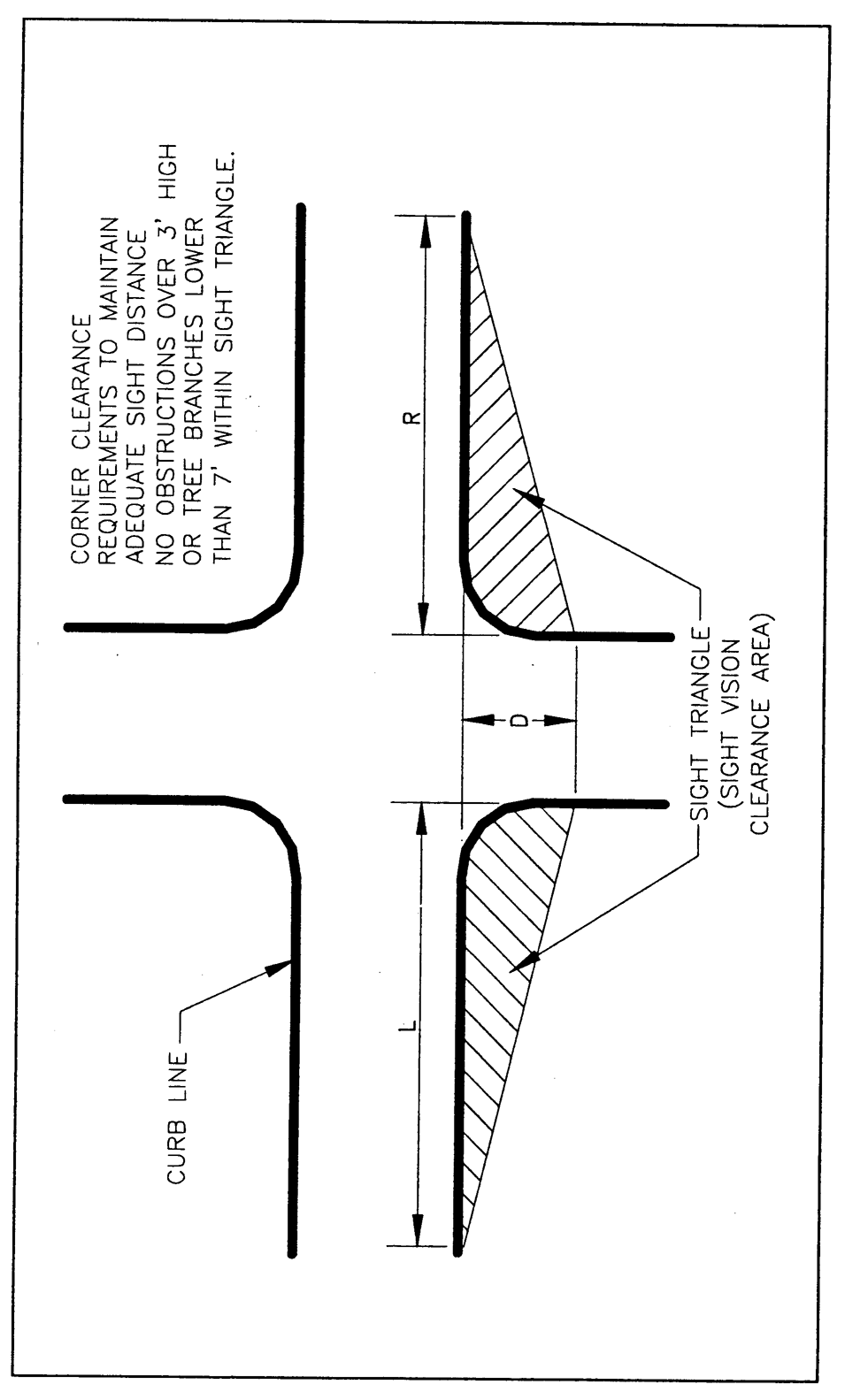
Figure 14-16
(Ord. No. 1991-31, § 5, 11-19-91; Ord. No. 1998-29, § 18, 8-18-98; Ord. No. 2005-22, § 2, 8-2-05)
Sec. 26-14-17. - Principal buildings.
Only one (1) principal building shall be permitted on any one (1) lot unless otherwise approved as part of a planned unit development.
(Ord. No. 1998-25, § 9, 8-18-98; Ord. No. 2011-15, § 2, 5-3-11)
Sec. 26-14-18. - Principal uses.
The principal use of a principal building, lot or tract is the primary function for which the same is used.
(Ord. No. 1998-25, § 10, 8-18-98)
Sec. 26-14-19. - Accessory buildings, structures and dwelling units.
(a)
Accessory buildings and structures are permitted in any zone district, subject to all limitations contained in this chapter including, without limitation, the following:
(1)
Construction of an accessory building or structure must occur concurrently with or subsequent to construction of a principal building.
(2)
The maximum floor area of an accessory building located in a residential zone shall not exceed the lesser of ten (10) percent of the lot area or seven hundred fifty (750) square feet. In a residential zone, accessory buildings larger than those permitted by this subsection (2) may be allowed through a special use review as defined in Section 26-15. In a nonresidential zone, the maximum floor area shall not exceed thirty (30) percent of the lot area.
(3)
An accessory structure is any device with a surface area of four (4) square feet or larger, including a microwave dish, antenna or other similar device, and is subject to all regulations applicable to accessory buildings and structures including height requirements. Amateur radio antennas and towers shall be subject to the requirements of section 26-14-21 of this chapter.
(4)
All accessory buildings and structures shall maintain side yard or side street yard setbacks equal to the side yard or side street yard setbacks required for the principal building located on the lot and a front yard setback equal to the front yard setback for the principal building plus an additional ten (10) feet. Any accessory building or structure located in a side yard must be screened so as not to be visible from any public street. Notwithstanding the foregoing, flagpoles may be located one (1) foot behind the rear edge of any sidewalk or property line, whichever location is further from the property line.
(b)
Accessory dwelling units are permitted in certain zone districts per Table 26-A subject to all limitations contained in this chapter including, without limitation, the following:
(1)
The following applies to all accessory dwelling units:
a.
Accessory dwelling units are permitted as an accessory use to a principal single-family dwelling unit.
b.
Accessory dwelling units shall be located on the same lot as the principal single-family dwelling unit.
c.
Not more than one (1) accessory dwelling unit may be constructed on any single lot or parcel of land.
d.
The floor area of an accessory dwelling unit shall not exceed seven hundred fifty (750) square feet.
e.
Mobile homes, independent or dependent mobile homes, camping vehicles, travel trailers, or other similar structures shall be prohibited for use as an accessory dwelling unit.
f.
For a property designated as a historic landmark or located within a historic district in accordance with chapter 47, the historic preservation commission may make a decision or make a recommendation to staff regarding an application for development of an accessory dwelling unit based on the standards set forth in chapter 47.
(2)
The following applies to all detached accessory dwelling units:
a.
Detached accessory dwelling units shall maintain a setback from the front lot line in an amount that is equal to the required front yard setback for a principal structure plus an additional ten (10) feet.
b.
Detached accessory dwelling units shall be constructed not less than six (6) feet from the principal dwelling unit.
c.
When located on a corner lot, detached accessory dwelling units shall be oriented towards the primary street frontage or the side street frontage.
d.
To avoid potential impacts to adjacent properties, when a detached accessory dwelling unit is located within ten (10) feet from the side or rear lot line, the entrances shall be oriented away from those lot lines. Properties served by an alley are exempt from the rear lot line restriction.
e.
An accessory dwelling unit may be contained within the same accessory structure or building that is provided for a separate accessory use, provided, however, that the building footprint of such combined accessory structure shall not exceed seven hundred fifty (750) square feet.
f.
When an accessory dwelling unit is contained within the same accessory structure or building that is provided for a separate accessory use, the building height limitation applicable to accessory dwelling units shall apply to the structure.
(Ord. No. 1998-25, § 11, 8-18-98; Ord. No. 2002-31, § 7, 11-5-02; Ord. No. 2003-05, § 1, 4-15-03; Ord. No. 2009-09, § 4, 3-3-09; Ord. No. 2017-49, § 1, 11-6-17; Ord. No. 2023-16, § 4, 9-5-23; Ord. No. 2025-10, § 4, 5-20-25)
Sec. 26-14-20. - Vacation of roadways and easements.
(a)
Definitions. As used in this Article 14, unless the context otherwise requires:
(1)
Access easement includes any land or interest therein or designated public improvement dedicated to the city for the purposes of vehicular or pedestrian access or travel, whether or not it has been used as such.
(2)
Easement includes any land or interest therein or designated public easement dedicated to the city, whether or not it has been used.
(3)
Roadway includes any platted or designated public street, alley, lane, parkway, avenue, road or other public way or right of way, whether or not it has been used as such.
(4)
Vacation means the extinguishment by ordinance of all right, title or interest of the city in and to any roadway or easement.
(b)
Vacation by ordinance. All right, title or interest of the city in and to any roadway or easement shall be divested only upon adoption by the city council of an ordinance vacating any roadway or easement or portion thereof located within the corporate limits of the city. If a roadway constitutes a boundary line of the city, it may be vacated only by joint action of the board of county commissioners of the county and the city council, or by joint action of the city council and the governing body of any adjacent municipality.
(c)
Findings. Any ordinance effecting a vacation under this article shall contain the following findings, if applicable:
(1)
That no land adjoining any roadway to be vacated is left without an established public road connecting said land with another established public road.
(2)
That the land to be vacated is no longer necessary for the public use and convenience.
(d)
Vacation procedures. Before final action by the city council may be taken on such ordinance, the following procedures shall have occurred:
(1)
Submission of a complete application for vacation by the city's director of planning or by the record owners of more than fifty (50) percent of property abutting the roadway or easement to be vacated, including payment of an application fee in an amount authorized in chapter 4 of this Code. The application shall include the following information:
a.
Name, address and telephone number of the applicant(s).
b.
Accurate legal description of the roadway or easement to be vacated.
c.
A map showing the roadway or easement to be vacated and abutting properties. The planning director may require the applicant to furnish a survey of the roadway or easement to be vacated.
d.
Names and addresses of all record owners of property abutting that portion of the roadway or easement to be vacated.
e.
Reasons for the requested vacation.
f.
Certification by the applicant that the statements referred to in subsection (b) above are true.
g.
Signature of the applicant.
(2)
Review of the proposal by the city staff and preparation of a staff report, and in the case of the proposed vacation of an easement which is not being referred to the planning commission, preparation of a proposed vacation ordinance.
(3)
Vacations of roadways and access easements shall be referred to the planning commission for a public hearing and recommendation to the city council. The planning director may refer the vacation of an easement which is not an access easement to the planning commission for a public hearing and recommendation to the city council, if the director determines that such a referral would assist the city council in determining whether or not to grant the vacation request.
(4)
The public hearing before the planning commission shall be noticed in accordance with the provisions of section 26-16-9(b) and (c) of this chapter. Notice as provided by section 26-16-9(a) shall not be required; however, ten (10) days prior to the date of the public hearing notice shall be sent by first class mail to all real property owners owning property abutting the roadway or easement to be vacated. This notice shall be in accordance with section 26-16-9(d) of this chapter.
(5)
The city council shall consider the proposed vacation of roadway and access easements at a public hearing noticed in accordance with the provisions of section 26-16-9(b), (c) and (d) of this chapter. A public hearing is not required for the vacation of a utility easement. Additionally, ten (10) days prior to the date of a public hearing for the vacation of roadways and access easements notice shall be sent by first class mail to all real property owners owning property abutting the roadway or easement to be vacated. This notice shall be in accordance with section 26-16-9(d) of this chapter. The planning director may notice and schedule a public hearing before city council on the request for vacation of an easement which is not an access easement, if the director determines that such a hearing would assist the city council in determining whether or not to grant the vacation request.
(e)
Vacation of portion of request. The city shall have the right, in its discretion, to refuse any vacation request, or to vacate only a portion of the total area requested for vacation.
(f)
Reservation of rights-of-way or easements. In the event of a vacation in accordance with this article, rights-of-way or easements may be reserved for the continued use of existing or future sewer, gas, water or similar pipelines and appurtenances, for overland drainage, drainage facilities or canals and appurtenances, and for electric, cable television, telephone and similar lines and appurtenances, or any other public purpose.
(g)
Conditions on vacation. The planning commission may recommend, and the city council in the ordinance effecting a vacation may impose, reasonable conditions on said vacation, to preserve and promote the public health, safety and welfare of the inhabitants of the city and the public generally. Such reasonable conditions may include the payment of money to the city as consideration for a vacation, when the vesting of title upon vacation may confer a benefit upon the new owner of the vacated roadway or easement, or where the city has purchased or will purchase a roadway or easement to replace that being vacated.
(h)
Recordation of vacation. In the event of a vacation in accordance with this article, the vacation documents, including but not necessarily limited to any resolution, ordinance, deed, conveyance document, plat or survey, shall be recorded in the office of the clerk and recorder of the county in which the roadway or easement is located.
(i)
Preservation of access. No roadway or easement or part thereof shall be vacated so as to leave any land adjoining said roadway or easement without an established public road connecting said land with another established public road.
(j)
Vesting of title upon vacation. Any ordinance effecting a vacation of a roadway under this article shall vest title to the vacated land in accordance with Colorado law.
(k)
Adjacent platted lands. Where title to a vacated roadway vests with the owner of adjacent platted land, said owner shall, within ninety (90) days of the adoption of the ordinance effecting such vacation, take all necessary steps to include said vacated roadway within the plat of the adjacent land.
(Ord. No. 1999-17, § 1, 5-18-99; Ord. No. 2005-10, § 10, 3-1-05; Ord. No. 2005-22, § 3, 8-2-05; Ord. No. 2006-22, §§ 3, 4, 6-6-06; Ord. No. 2009-09, § 5, 3-3-09; Ord. No. 2011-33, § 14, 9-20-11; Ord. No. 2014-14, § 1, 5-20-14; Ord. No. 2019-06, § 3, 2-19-19; Ord. No. 2025-25, § 13, 11-18-25)
Sec. 26-14-21. - Amateur radio antennas and towers.
(a)
Purpose. The purpose of this section is to provide reasonable accommodations for amateur radio operators and to provide practicable regulations regarding amateur radio towers in order to protect the health, safety and welfare of the citizens of City of Lafayette.
(b)
Zone districts allowed. The use of a property for an amateur radio operation shall be allowed in any zone district, but only as an accessory use, with any amateur radio tower being considered as an accessory structure.
(c)
Permitted height of amateur radio towers. Notwithstanding the limitations on permitted heights for structures set forth in section 26-14-8 of this chapter, an amateur radio operator having the right of occupancy of any building shall be permitted to construct an amateur radio tower of a height not exceeding the following:
(1)
Freestanding amateur radio towers, or amateur radio towers mounted as appurtenances to an accessory building, shall be limited in height to the allowable principal building height of the zoning district where such tower is to be located.
(2)
Amateur radio towers mounted as appurtenances to a principal building shall be limited in height to ten (10) feet above the allowable principal building height of the zoning district where such tower is to be located.
All other applicable building code provisions, including building permit and structural requirements, shall remain in full force and effect. At the time that an application for a building permit for an amateur radio tower is submitted, a copy of a valid F.C.C. license for the amateur radio operator shall be provided to the building official.
(d)
Exceptions to permitted height. Amateur radio towers higher than permitted in this section may occur when approved in accordance with Section 26-15, Special Use Application Requirements and Procedures. Any applicant requesting an amateur radio tower height in excess of that permitted in this section shall include as part of their submittal sufficient data to justify the need for the additional height. Any approval for a tower height in excess of that permitted by this section shall be the minimum necessary to provide the amateur radio operator with the communications that he/she desires to engage in.
(e)
Permitted locations of amateur radio towers.
(1)
Amateur radio towers and any supporting apparatus shall be confined to the applicant's property.
(2)
Amateur radio towers shall be located in the rear yard or a side yard. Such side yard shall not abut a public street.
(3)
Freestanding amateur radio towers shall be set back from any side or rear yard property line a minimum of fifteen (15) feet. All antennas and guy-wires associated with freestanding amateur radio towers shall have a minimum side and rear yard setback of five (5) feet.
(4)
Amateur radio towers attached as an appurtenance to a building shall comply with the setback requirements of the zoning district for the building. All antennas and guy-wires associated with the amateur radio tower shall have a minimum side and rear yard setback of five (5) feet.
(f)
Removal of amateur radio tower. When an amateur radio operator no longer holds the requisite F.C.C. license, or is no longer in possession of the underlying property, and if no person being an amateur radio operator continues to occupy the property, then the amateur radio tower shall be removed in compliance with the building code within thirty (30) days, unless the city council grants an extension of time for good cause shown, not to exceed ninety (90) days.
(g)
Violations. The city may bring an action before any court of competent jurisdiction to seek removal of an amateur radio tower that does not comply with this chapter.
(Ord. No. 2009-09, § 6, 3-3-09)
Sec. 26-14-22. - Short-term rentals.
Short-term rentals, as defined in this chapter and where permitted in Table 26-A, may only be operated in a dwelling unit and shall comply with the following regulations:
(1)
Accessory use only. Short-term rentals shall be clearly incidental and subordinate to the principal use of a dwelling unit as a primary residence on the lot on which the short-term rental is located.
(2)
License required. It is unlawful to operate any short-term rental in the city without first obtaining a short-term rental license that has been duly issued pursuant to section 55-63 of the Code.
(3)
Primary residence. It shall be unlawful for any person to operate a short-term rental in a dwelling unit that is not the person's primary residence, except as provided in subsection (4) of this section.
(4)
Primary and accessory dwellings. On lots where there is both a single-family dwelling unit and accessory dwelling unit, short-term rentals are allowed in either dwelling unit; however, a short-term rental cannot be operated in the principal single-family dwelling unit by a person maintaining their primary residence in the accessory dwelling unit.
(5)
Allowed signage. A short-term rental shall be allowed one (1) non-illuminated (neither internally nor indirectly illuminated) wall or window sign, not to exceed one and one-half (1½) square feet in size.
(6)
Safety requirements. During each short-term rental occupancy, each short-term rental shall be equipped with the minimum facilities required in applicable building codes, including, but not limited to, a smoke detector, carbon monoxide detector, and fire extinguisher. The city's planning director or designee may inspect the dwelling unit proposed to be licensed for the purpose of verifying compliance with such requirements. Refusal by the applicant to allow such inspection shall be grounds for denial, non-renewal, suspension, or revocation of a short-term rental license issued pursuant to section 55-63 of the Code.
(7)
Maximum guests permitted. The maximum number of persons allowed to occupy a short-term rental shall not exceed two (2) persons per bedroom, plus two (2) persons.
(8)
Parking. Parking intended to serve a short-term rental shall be located on the same lot as the short-term rental unless there is no established parking on the lot. A maximum of two (2) vehicles are permitted to park off-site when there is no established parking on the property.
(9)
Simultaneous short-term rentals prohibited. Short-term rentals shall not include simultaneous rental to more than one (1) party under separate contracts. This limitation is intended to prevent more than one (1) short-term rental contract from operating within the same dwelling unit at the same time, or within a dwelling unit and its associated accessory dwelling unit at the same time. This limitation applies even when multiple short-term rental license holders maintain the same dwelling unit as their primary residence.
(10)
Local responsible party. During every short-term rental period, the property owner or the property owner's designated local responsible party shall be available twenty-four (24) hours per day, seven (7) days per week, for the purpose of responding within one (1) hour to complaints regarding the condition or operation of the short-term rental or the conduct of persons at the short-term rental. For purposes of this section, "local responsible party" shall have the meaning set forth in section 55-62 of this Code.
(Ord. No. 2023-15, § 4, 9-5-23)

