
Lafayette City Zoning Code
SECTION 26
21.- SIGN REGULATIONS
Sec. 26-21-1.- Legislative intent.
(a)
The purpose of these regulations is to protect the health, safety and welfare of the residents of the city by regulating the design, construction and installation of signs in the city. The council recognizes that signs are a necessary means of visual communication for the public convenience and that businesses, services and other activities have the right to identify themselves by using signs that are accessory and incidental to the use of the premises where the signs are located. In these regulations, the city council intends to provide a reasonable balance between the right of an individual to identify its business and the right of the public to be protected against the visual discord that results from the unrestricted proliferation of signs. The city council also intends by these regulations to ensure that signs are compatible with adjacent land uses and with the total visual environment of the community. Another purpose of these regulations is to protect the public from hazardous conditions by prohibiting signs that:
(1)
Are structurally unsafe;
(2)
Obscure or distract the vision of motorists; or
(3)
Compete or conflict with necessary traffic signs and warning signals.
In adopting these regulations, the council recognizes that the size of signs that provide adequate identification in pedestrian-oriented areas differs from that necessary in vehicular-oriented areas where traffic is heavy, travel speeds are greater and required setbacks are greater.
(b)
The council also recognizes in adopting these regulations that instances may occur where strict application of its provisions may deprive a person of the reasonable use of a sign and that such person should have a procedure to obtain variances from the requirements of these regulations for good cause.
(c)
[Reserved.]
(d)
The city council finds that certain types of devices that might be considered to be signs are not appropriate for any regulation because they:
(1)
Would not create a structural safety or traffic safety hazard;
(2)
Would promote public safety or the dissemination of public information; or
(3)
Do not impede aesthetic concerns.
(e)
The city council further finds that certain other signs of a small size do not create traffic safety hazards or aesthetic disruption so as to require a permit and inspection pursuant to these regulations but must comply with structural and setback requirements of this section. With respect to real estate signs, the council finds that a small "for sale" or "for rent" sign is a viable means of advertising real estate and does not create a traffic hazard.
(Ord. No. 1986-01, § 2, 2-4-86; Ord. No. 2015-38, § 1, 11-2-15)
Sec. 26-21-2. - Application of regulations.
(a)
It shall be unlawful to display, construct, erect, alter, use or maintain any sign in the city except in conformance with the provisions of this chapter.
(b)
It shall be unlawful to perform or order the performance of any act contrary to the requirements of this chapter or fail to perform any act required by the provisions of this chapter.
(c)
The following signs are exempt from the provisions of this section:
(1)
Signs that are not visible beyond the boundaries of the tract or parcel on which they are located or from any public thoroughfare or right-of-way, but such signs are not exempt from the safety regulations of the city building code.
(2)
Official government notices and notices posted by government offices in the performance of their duties, government signs controlling traffic, regulating public conduct, identifying streets, or warning of danger.
(3)
Works of art that in no way identify or advertise a product or business or impede traffic safety.
(4)
Temporary decorations or displays, if they are clearly incidental to and are customarily and commonly associated with any national, local or religious celebration, but not freestanding structures.
(5)
Temporary or permanent signs erected by public utilities or construction companies to warn of danger or hazardous conditions in the public right-of-way as required, including without limitation, signs indicating the presence of underground cables, gas lines, and similar devices.
(6)
Signs displayed on motor vehicles that are being operated or stored in the normal course of a business, such as signs indicating the name of the owner of the business, that are located on moving vans, delivery trucks, rental trucks and trailers; but only if the primary purpose of such vehicles is not for the display of signs and only if such vehicles are parked or stored in areas appropriate to their use as commercial or delivery vehicles.
(7)
Signs carried by a person and not set on or affixed to the ground.
(d)
For the purpose of determining the number of signs that may be subject to the provisions of this section, a sign shall be considered to be a single display surface or display device containing elements clearly organized, related and composed to form a unit. Where matter is displayed in a random manner without organized relationship of elements or where there is reasonable doubt about the relationship of elements, each element shall be considered a single sign.
(Ord. No. 1986-01, § 2, 2-4-86; Ord. No. 1987-02, §§ 10, 11, 2-17-87; Ord. No. 1998-29, § 28, 8-18-98; Ord. No. 1999-41, §§ 1, 2, 10-19-99)
Sec. 26-21-3. - Permits and application.
(a)
Except as provided in section 26-21-8, no person shall display, erect, relocate or alter any sign without first applying to the planning director or his designee and obtaining a permit under this chapter.
(b)
The owner of multi-tenant property or an agent of the owner shall apply for all sign permits for the property or shall develop a plan for apportioning permitted sign area among tenants and file such plan with the planning director, in which case each tenant may apply for a sign permit in conformity with the plan.
(c)
No permit is required for maintenance, as defined in this chapter, but replacing or repairing a sign or sign structure that has been damaged to an extent exceeding fifty (50) percent of its replacement cost, as determined by the planning director, is maintenance only when the sign conforms to all of the applicable provisions of this chapter and only when the damage resulted from an act of God or violent accident.
(d)
No person issued a sign permit under this chapter, shall change, modify, alter or otherwise deviate from the terms or conditions of the permit without first requesting and obtaining approval to do so from the planning director.
(e)
The owner or tenant of the property on which the sign is to be located or an authorized agent thereof or a sign contractor shall apply for a sign permit in writing on forms furnished by the planning director, shall sign the application and shall pay the fee prescribed in section 26-21-7.
(f)
Within five (5) working days of the date of the application, the planning director shall either approve or deny the application or refer it back to the applicant for further information.
(g)
The applicant shall submit the following information as part of the application:
(1)
The name, address and telephone number of the owner or persons entitled to possession of the sign and of the sign contractor or installer;
(2)
The street address location of the proposed sign structure;
(3)
Complete information required on application forms provided by the planning director, including a site plan and elevation drawings of the proposed sign, caption of the proposed sign and other data pertinent to the application;
(4)
Plans indicating the scope and structural detail of the work to be done, including details of all connections, guy lines, supports, footings and materials to be used;
(5)
A complete application for an electrical permit for all electrical signs if the person building the sign is to make the electrical connection;
(6)
Verification of all existing signs and sign areas in existence on the property; and
(7)
A statement of valuation (cost).
(Ord. No. 1986-01, § 2, 2-4-86; Ord. No. 1999-41, § 3, 10-19-99; Ord. No. 2011-33, § 14, 9-20-11; Ord. No. 2019-06, § 3, 2-19-19)
Sec. 26-21-4. - Revocation of permit.
(a)
If the planning director finds that work under any permit issued does not comply with the information supplied in the permit application or violates any provision of this section or any other ordinance or code of the city, the planning director may notify the owner or installer of the sign by first class mail to the address on the sign permit application that if the violation is not corrected within thirty (30) days, the planning director will proceed to revoke the permit. Nothing herein shall be construed to prevent or limit the authority of the city to seek enforcement of this section or any other ordinance or code of the city by citation of any person to the Lafayette Municipal Court.
(b)
If the person so notified fails to make or commence the required corrections, the city planning director may revoke the permit after allowing in writing an opportunity for a hearing before the city council.
(c)
If the person to whom a permit is granted under this section has not commenced work on the sign within sixty (60) days from the date the permit was issued or if substantial building operations under such permit are suspended for a period of sixty (60) consecutive days, the permit automatically expires, but the planning director may grant an extension of the time limits provided in this subsection for construction delays that are not the result of willful acts or neglect by the permittee, upon a written request for such an extension.
(d)
The planning director may not refund any permit fees paid under this section if any permit is revoked or expires.
(Ord. No. 1986-01, § 2, 2-4-86; Ord. No. 1999-41, § 3, 10-19-99; Ord. No. 2011-33, § 14, 9-20-11; Ord. No. 2019-06, § 3, 2-19-19)
Sec. 26-21-5. - Identification and marking of signs.
Each sign erected or remodeled shall bear thereon a clearly legible identification plate not exceeding fifteen (15) square inches in area that states the name of the person responsible for its construction and erection, with installation date and permit number thereon. All electrical signs shall be marked with input amperes at full load input.
(Ord. No. 1986-01, § 2, 2-4-86; Ord. No. 2019-06, § 3, 2-19-19)
Sec. 26-21-6. - Inspections.
(a)
In enforcing the provisions of this section, the planning director or her designee and any peace or code enforcement officer may enter any building structure or premises in the city at reasonable times to perform any duty imposed by this section.
(b)
The planning director may require footing inspections on the day of excavation for all freestanding signs.
(c)
The planning director may require inspection of electrical signs before their erection within forty-eight (48) hours after being notified that the sign is ready for inspection.
(d)
The permit holder or agent thereof shall notify the planning director when signs are complete and ready for final inspection.
(Ord. No. 1986-01, § 2, 2-4-86; Ord. No. 1999-41, § 4, 10-19-99; Ord. No. 2011-33, § 14, 9-20-11; Ord. No. 2019-06, § 3, 2-19-19)
Sec. 26-21-7. - Sign permit fees.
(a)
An applicant for a sign permit shall be assessed fees in accordance with the permit fee provisions of that version of the uniform building code that is currently adopted by the city.
(b)
An applicant for an appeal or variance to the zoning board of adjustment shall pay a fee in an amount authorized in chapter 4 of this Code.
(Ord. No. 1986-01, § 2, 2-4-86; Ord. No. 1999-41, § 5, 10-19-99; Ord. No. 2025-25, § 19, 11-18-25)
Sec. 26-21-8. - Sign permits not required.
(a)
The following signs are permitted in all zoning districts and shall comply with all applicable provisions of this section, but no sign permit or sign permit fee is required:
(1)
Nonilluminated, internally illuminated, or indirectly illuminated identification signs that do not exceed two (2) square feet per face or four (4) square feet in total surface area, up to a maximum of six (6) feet in height, and no more than one (1) such sign per use or per building, whichever is the greater number.
(2)
Signs in the nature of cornerstones, commemorative tablets, and historical signs that do not except four (4) square feet per face in area and six (6) feet in height and that are not illuminated or that are indirectly illuminated.
(3)
Temporary, nonilluminated real estate signs that do not exceed six (6) square feet per face in total area and four (4) feet in height and no more than one (1) such sign per street frontage, but only if the sign remains in place no more than seven (7) days after sale or rental of the subject property.
(4)
Private traffic directional signs guiding or directing vehicular or pedestrian traffic onto or off of a lot or within a lot that do not exceed three (3) square feet per sign per face in area and eight (8) feet in height, do not contain any advertising or trade name identification, and are not illuminated, are not internally illuminated or are not indirectly illuminated; but private traffic control signs that conform to the standards of the "Traffic Control Manual", Colorado Department of Highways, may exceed three (3) square feet per face in area but shall not exceed seven (7) square feet per face or eight (8) feet in height.
(5)
Signs required or specifically authorized for a public purpose by any law, statute or ordinance of any type, number, area, height above grade, location or illumination authorized by the law, statute or ordinance under which such signs are required or authorized, but no such sign may be placed in the public right-of-way unless specifically authorized or required by law, statute, or ordinance; except for warning signs or barricades of a temporary nature, all such signs shall be permanently affixed to the ground, a building or another structure.
(6)
Window signs, placed at or below the second floor level when the total area of such signs:
a.
Does not exceed twenty-five (25) percent of the total window area in the same vertical plane at the ground floor level on the side of the building or business unit upon which the signs are displayed; and
b.
Does not exceed twenty-five (25) percent of the total allowable sign area for the premises.
(7)
Signs commonly associated with and limited to information and directions related to the permitted use on the lot on which the sign is located, but only if each such sign does not exceed one hundred fifty (150) square inches and is nonilluminated, internally illuminated, or indirectly illuminated, including, without limitation, such signs as "no smoking", "rest room", "no solicitors", "self-service" and "vacancy".
(8)
Nonilluminated or indirectly illuminated signs that identify items as a courtesy to customers such as credit cards accepted, redemption stamps offered, menus, or prices, but no more than one (1) sign for each use and no more than four (4) square feet per face or eight (8) square feet in total area; such signs may be attached to the building, as projecting or wall signs, suspended from a canopy, or included as an integral part of a freestanding sign, but if any such sign is located in the area described in section 26-21-12, it shall meet the requirements of that section.
(9)
Noncommercial signs in residential areas under six (6) square feet per face and four (4) feet in height and all noncommercial signs inside buildings.
(10)
A flag, pennant or insignia of any nation, organization of nations, state, county, city, religious, civic or fraternal organization or any educational institution, except such flags used in connection with a commercial promotion or as an advertising device.
(11)
Sign faces which are a part of vending machines not exceeding fifteen (15) square feet per vending machine sign face. Vending machines must comply with principal building setbacks. A total of fifty (50) square feet of such signage per property ownership is permitted without a sign permit. Advertising on vending machines shall advertise only products sold in the machine. Additional signage associated with vending machines shall comply with the allocation requirements of the specific property and require sign permits as required by section 26-21-3.
(b)
No permit is required for copy changes on a conforming bulletin board, poster board, display case, or marquee, for maintenance where no structural changes are made, or for copy changes on signs using interchangeable letters.
(c)
The signs permitted without a permit in subsection (a) of this section are allowed in addition to the signs permitted by sections 26-21-20 through 26-21-21 and are not counted against the total allowable sign area or total number of signs permitted for the premises.
(Ord. No. 1986-01, § 2, 2-4-86; Ord. No. 1991-01, §§ 2, 3, 3-19-91; Ord. No. 1998-24, § 5, 8-18-98)
Sec. 26-21-9. - Prohibited signs.
No person shall erect, install or maintain the following signs in the city:
(1)
Animated or flashing signs with the exception of:
a.
Electronic message signs that are a component of freestanding signs in the C-1 Zone District only;
b.
Time-temperature-date signs;
c.
Traditional barber poles; and
d.
Gauges and dials that may be animated to the extent necessary to display correct measurement.
(2)
Strings of light bulbs used in connection with commercial premises for commercial purposes, other than traditional holiday decorations during the holiday season, except when the following conditions are met:
a.
Strings of light bulbs composed of miniature light bulbs which miniature light bulbs measure no larger than one and one-half (1½) inches in length and three-eighths inch in width and which light bulbs have no more than three (3) volts or nine (9) watts in light output and which light bulbs are clear and produce only a white light; and
b.
Light bulbs that do not flash, flutter, or in any way simulate movement; and
c.
Light bulbs that are not placed upon signs or sign structures.
(3)
Wind signs, except as permitted in section 26-21-21(h).
(4)
Signs that incorporate projected images, emit any sound that is intended to attract attention or involve the use of live animals.
(5)
Any sign, together with its supporting structure, that, ninety (90) days or more after the premises have been vacated, advertises an activity, business, product or service no longer produced or conducted upon the premises upon which such sign is located. If the sign or sign structure is covered or the identifying symbols or letters are removed, the planning director may grant an extension of time under this subsection upon a showing of good cause. But nothing in this subsection prohibits permanent signs accessory to businesses that are open only on a seasonal basis, if there is a clear intent to continue operation of the business.
(6)
Any sign that is installed or erected in or projects into or over any public right-of way except in the case of a sign for which a permit has been issued under this section.
(7)
Signs not permanently affixed or attached to the ground or to any structure except for real estate signs, noncommercial signs attached to posts driven into the ground, window signs, temporary barriers, signs carried by person, and sidewalk signs.
(8)
Any sign or structure that is structurally unsafe, constitutes a hazard to safety or health by reason of inadequate maintenance or dilapidation, is not kept in good repair, or is capable of causing electrical shock to persons likely to come into contact with it.
(9)
Any sign or structure that:
a.
In any way obstructs the view of, may be confused with or purports to be an official traffic sign, signal or device or any other official sign; or
b.
Creates any other unsafe distraction for motor vehicle operators; or
c.
Obstructs the view of motor vehicle operators entering a public roadway from any parking area, service drive, private driveway, alley, or other thoroughfare.
(10)
Any sign that obstructs free ingress to or egress from a required door, window, fire escape or other required exit way.
(11)
Illegal nonconforming signs.
(12)
Roof signs, except as specifically permitted by section 26-21-21.
(13)
Off-premises advertising signs or any other sign not appurtenant and clearly incidental to the permitted use on the property where located, except for noncommercial signs and signs permitted under the provisions of section 26-21-33.
(14)
No sign shall be attached to a tree or utility pole on public property.
(Ord. No. 1986-01, § 2, 2-4-86; Ord. No. 1987-04, § 1, 2-17-87; Ord. No. 2000-6, § 1, 4-4-00; Ord. No. 2005-38, § 3, 12-13-05; Ord. No. 2011-33, § 14, 9-20-11; Ord. No. 2012-11, §§ 2, 3, 5-15-12; Ord. No. 2019-06, § 3, 2-19-19)
Sec. 26-21-10. - Computation of sign area.
(a)
In computing the area of a sign, standard mathematical formulas for common regular geometric shapes, including, without limitation, triangles, parallelograms, circles, ellipses or combinations thereof shall be used.
(b)
In the case of an irregularly shaped sign or a sign with letters or symbols directly affixed to or painted on the wall of a building, the area of the sign is the entire area within a single continuous rectilinear perimeter of not more than eight (8) straight lines enclosing the extreme limits of writing, representation, emblem or any other figure of similar character, together with any material or color forming an integral part or background of the display or used to differentiate such sign from the backdrop or structure against which it is placed.
(c)
In computing the total sign area, the portion of the sign structure to be included is that which is visible and viewed in the same plane as the sign face and which either exceed fifty (50) percent of the area of the display or is made an integral part of the background of the display.
(d)
Where a sign has two (2) or more display faces, the area of all faces is included in determining sign area.
(e)
The total surface area of multiple-unit signs includes the vertical and horizontal spacing between the letters that constitute the word or words that convey the sign's message.
(f)
Where three-dimensional figures are used as signs, the area is the total area, projected on a vertical plane, of each side of the figure that is visible beyond the boundaries of the lot upon which the figure is located. For purposes of this section, a figure is considered to have no less than one (1) nor more than four (4) sides, and the number of sides to be measured shall be determined by the location and visibility of the figure.
(g)
Street or building frontage used as the basis of determining permitted sign area for one (1) building or use may not be used again as the basis for determining the permitted sign area for another building or use, but nothing in this subsection shall be construed to prohibit the additional building or use from erecting a sign that would otherwise be authorized by the provisions of this section. In the case of a lot or tract having two (2) or more multiple use principal buildings in existence, total sign area shall not exceed two (2) square feet for the first two hundred (200) total feet of building frontage and one-half (½) square foot of sign area for each addition lineal foot of building frontage. The calculation of building frontage shall be construed pursuant to provisions contained in Section 26-21 of this Code.
(h)
All temporary and permanent riders or attachments to signs or sign structures are included as part of the total sign area for the sign to which they are attached.
(Ord. No. 1986-01, § 2, 2-4-86; Ord. No. 1988-18, § 3, 9-20-88; Ord. No. 1998-29, § 29, 8-18-98)
Sec. 26-21-11. - Required setbacks for freestanding signs.
Freestanding signs in any zoning district shall be set back the following distances, and no point on any such sign may extend beyond the required setback line:
(a)
Sign up to and including seven (7) feet in height shall be set back ten (10) feet from any property line adjacent to a street except when buildings on adjoining lots have front setbacks of less than ten (10) feet in which event the setback of the adjoining buildings shall be the minimum sign setback; provided, however, that if the property is located on Public Road north of Spaulding Street and south of Baseline Road or on Simpson Street west of Michigan Avenue and east of Public Road, a zero-foot setback for all signs of seven (7) feet in height or less and a ten-foot setback for signs over seven (7) feet high to twenty-five (25) feet high or one and twenty-five one hundredths (1.25) times the height of the building, whichever is less, shall be allowed.
(b)
The minimum setback distances for signs over seven (7) feet in height is twenty-five (25) feet from any property line adjacent to a street.
(c)
No signs in business and industrial districts may be located less than twenty-five (25) feet from any property line adjacent residential zoning district line.
(d)
In planned unit developments, the city council may vary the setback requirements of this section.
(e)
A flag, pennant or insignia of any nation, organization of nations, state, county, city, religious, civic or fraternal organization or any educational institution may be located closer to the required setback line if located on a building.
(Ord. No. 1986-01, § 2, 2-4-86; Ord. No. 1987-02, § 15, 2-17-87; Ord. No. 1989-01, § 3, 2-21-89; Ord. No. 1991-01, § 4, 3-19-91)
Sec. 26-21-12. - Signs at street intersections.
No person shall erect or maintain a sign, except a wall sign, or sign structure on a corner lot between a height of two and one-half (2½) feet and ten (10) feet above the street elevation, other than a pole twelve (12) inches or less in cross-sectional area, within the sight vision clearance area as defined in section 26-14-16.
(Ord. No. 1986-01, § 2, 2-4-86; Ord. No. 1991-31, § 13, 11-19-91)
Sec. 26-21-13. - Illumination.
No person shall erect or maintain an illuminated sign except in conformity with the following requirements:
(a)
Any light used for the illumination of a sign is shielded so that the beams or rays of light will not shine directly onto surrounding areas.
(b)
Neither the direct nor the reflected light from any light source creates a traffic hazard or distraction to operators of motor vehicles on public thoroughfares.
(c)
Signs in residential and agricultural zoning districts shall be nonilluminated, not internally illuminated or not indirectly illuminated.
(d)
Signs in public, business and industrial zoning districts may be indirectly, directly or internally illuminated. Any illuminated sign visible from and located within three hundred (300) feet of any lot in a residential zoning district shall be turned off no later than 11:00 p.m. or one-half hour after the use to which it is appurtenant is closed, whichever is later; but this time limit does not apply to any light primarily used for the protection of the premises or provision of light for safety purposes.
(Ord. No. 1986-01, § 2, 2-4-86)
Sec. 26-21-14. - Signs on fences and walls used as fences.
Signs displayed upon fences or upon walls that are not an integral part of a building or that are used as fences shall be erected or mounted in a plane parallel to the fence or wall and shall not extend above the top of the fence or wall or project more than fifteen (15) inches from the face of the fence or wall. Such signs shall be subject to all requirements of this Section applicable to freestanding signs, including, without limitation, maximum area per sign, maximum sign height, minimum setback and number of permitted signs.
(Ord. No. 1986-01, § 2, 2-4-86)
Sec. 26-21-15. - Window signs.
(a)
When permanent or temporary nonilluminated signs are displayed in a window so as to be visible beyond the boundaries of the lot upon which such signs are displayed the area of all such window signs exceeding twenty-five (25) percent of the total window area in the same vertical plane at ground floor level on the side of the building or business unit upon which the signs are displayed or twenty-five (25) percent of the total allowable sign area for the premises is included in the total allowable sign area for the premises. Illuminated window signs are included in the total allowable sign area for the premises.
(b)
No window sign exceeding four (4) square feet in area may be displayed in any window above the ground floor level, and no window signs may be displayed in any window area above the second floor level.
(c)
Nothing in this section applies to temporary posters announcing or advertising events sponsored by noncommercial organizations.
(Ord. No. 1986-01, § 2, 2-4-86)
Sec. 26-21-16. - Temporary signs.
(a)
Signs advertising subdivision, development, construction or other improvement of a property in any zoning district are permitted only if they are:
(1)
Limited to freestanding, wall or window signs not exceeding sixty-four (64) square feet in total area or thirty-two (32) square feet per face and not exceeding eight (8) feet in height, with no riders or attachments.
(2)
On-premises sign: An on-premises sign may be displayed on the property to which the sign pertains, up to one (1) such sign per street upon which the property either has frontage or has an entrance from a major thoroughfare, but the minimum distance between signs on any single subdivision or property is one thousand (1,000) feet.
(3)
Off-premises signs: A permit may be issued for a temporary off-premises freestanding sign advertising subdivision, development, construction, or other property improvement projects to be placed at a major intersection located at a distance no greater than one-half (½) mile from the referenced location. The permit may be issued upon a finding by the planning director that (1) the signage placed within the development/subdivision project cannot be reasonably viewed from a major thoroughfare, and (2) the signage will not impede or otherwise interfere with vehicular or pedestrian traffic. The permit for a temporary off-premises sign shall state the approved duration thereof, and shall not exceed one (1) year, subject to renewal by the city. The sign shall be limited to the promotion of residential and commercial subdivision developments that have received final plan approval within twenty-four (24) months of the permit application, and shall not be deemed appropriate for individual commercial businesses. No more than two (2) temporary off-premises signs shall be allowed per development, only one (1) of which may be permitted at any intersection. A maximum of two (2) temporary off-premises signs may be permitted at the same intersection corner. No permit shall be issued for a temporary off-premises sign within the city without the applicant providing the city with proof of permission from the property owner where such temporary off-premises sign is proposed to be located. Off-premises signs shall be set back from the street right-of-way a minimum of twenty-five (25) feet.
(4)
In the case of a subdivision, displayed on or after the date of official filing of the subdivision plat and removed within two (2) years from the date of issuance of the first building permit in the project or within thirty (30) days from the time that seventy-five (75) percent of the lots or dwellings in the subdivision or filing thereof have been sold, whichever time period is shorter, or removed pursuant to time extensions granted by the city council.
(5)
In the case of construction other than a subdivision, displayed only for the duration of construction until issuance of a certification of occupancy.
(6)
In residential developments consisting of five (5) dwelling units or less, no more than six (6) square feet per face for each dwelling unit being constructed.
(7)
In the case of a model home sign identifying each different model, limited to an area not exceeding six (6) square feet and no more than one (1) such sign on each lot upon which a model home is located and removed at the time the unit ceases to be a model home.
(8)
In the case of an open house sign which is displayed for the purpose of advising the general public that a particular residential home may be viewed for the purpose of sale, the following shall apply: the total sign area of a real estate open house sign shall not exceed one (1) square foot per face; and, no more than five (5) off-premises open house signs may be placed in conjunction with an open house. Such signs shall be placed for a time period not to exceed two (2) eight-hour periods in any two-week period. This subsection is not applicable and shall not apply to a subdivision being developed, model homes within a new subdivision, or to more than one (1) residential home under the same ownership.
(b)
[Reserved.]
(c)
Noncommercial signs are permitted only if they meet the requirements of sections 26-21-11, 26-21-20, 26-21-22 and 26-21-29.
(d)
Signs in the right-of-way are permitted only if they are determined by the planning director to be necessary for traffic regulation or for special activities of general public interest.
(e)
Temporary signs not specifically regulated by this section are permitted as follows:
(1)
Any business may display one (1) or more temporary signs on the lot or tract of land on which the business is located, provided that the total temporary signage may not exceed thirty (30) square feet in the aggregate. Such temporary signs may be window signs, wall signs, not more than one (1) freestanding sign, or any combination thereof.
(2)
A business or businesses at a single business mailing address shall not display temporary signs for more than sixty (60) days during the first half of each calendar year and sixty (60) days during the second half of each calendar year.
(3)
The planning director must approve a permit for temporary signage prior to the placement of any temporary sign on a lot or tract.
(f)
Signs advertising a garage sale shall not exceed two (2) square feet per face and a maximum of six (6) of such signs may be placed off the premises of the garage sale.
(Ord. No. 1986-01, § 2, 2-4-86; Ord. No. 1987-02, § 16, 2-17-87; Ord. No. 1988-18, §§ 4—6, 9-20-88; Ord. No. 1989-35, §§ 2, 3, 6-20-89; Ord. No. 1998-24, § 6, 8-18-96; Ord. No. 2005-22, § 7, 8-2-05; Ord. No. 2009-09, § 15, 3-3-09; Ord. No. 2011-27, §§ 2, 3, 8-2-11; Ord. No. 2011-33, § 14, 9-20-11; Ord. No. 2015-38, § 2, 11-2-15; Ord. No. 2019-06, § 3, 2-19-19)
Sec. 26-21-16.1. - Sidewalk signs.
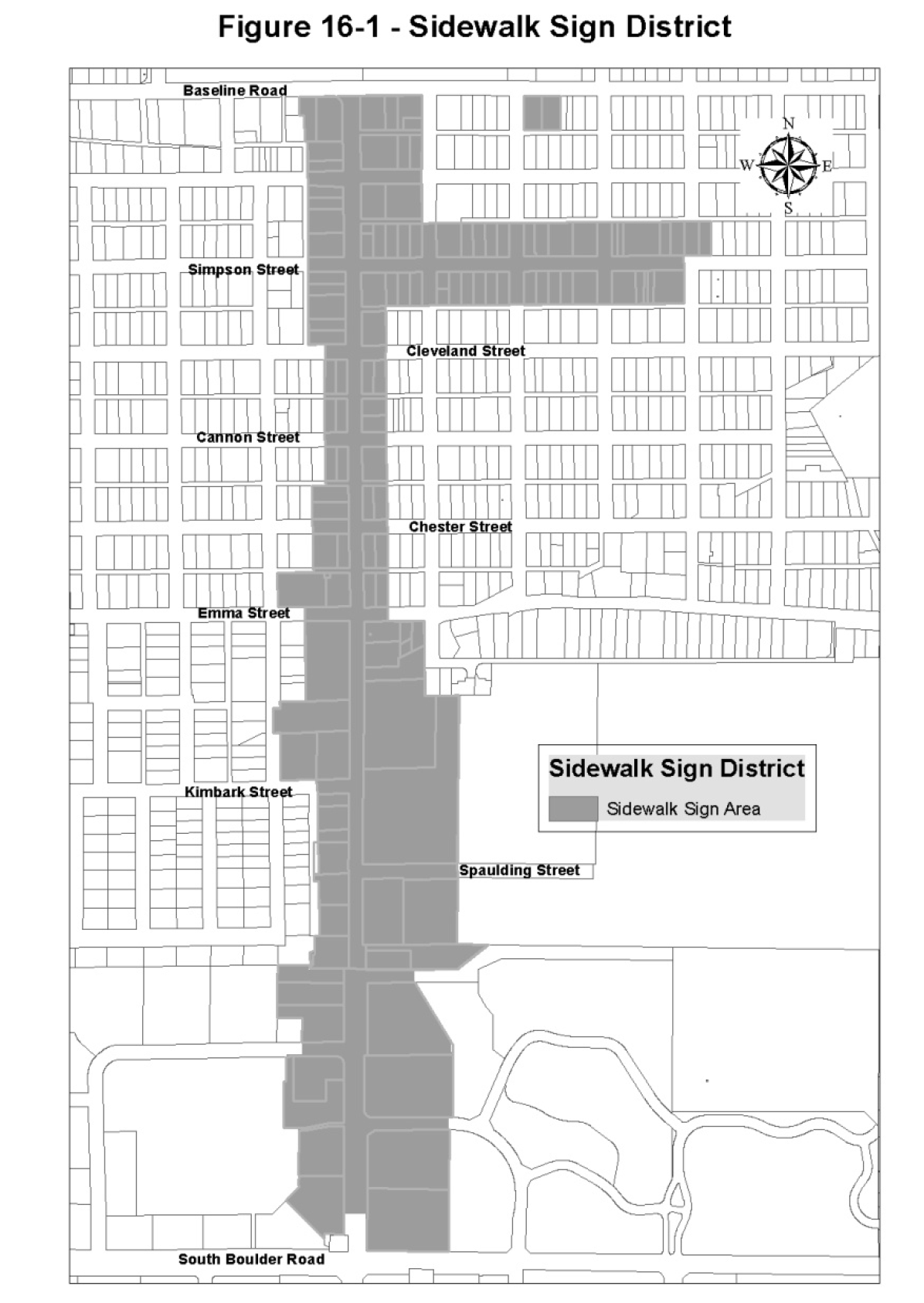
Nonresidential properties located within the shaded area defined by Figure 16-1 may display sidewalk signs under the following provisions:
(a)
One (1) sidewalk sign is permitted for each physical business address. Multiple signs are allowed within multi-tenant buildings, however such signs for businesses in multi-tenant buildings must not be displayed together or side by side.
(b)
Sidewalk signs may be displayed only during the business's hours of operation.
(c)
Sidewalk signs must be placed outside of required Americans with Disabilities Act (ADA) walkways, outside of any required exits and/or entrances, and outside of driveways.
(d)
Prior to placement of a sidewalk sign, the design, size, and height shall be subject to the review and approval by the Lafayette Urban Renewal Authority if such sign is proposed within an urban renewal area or by the planning director if such sign is proposed outside any urban renewal area.
(e)
The applicant shall propose some method to care for sign during windy weather to ensure the sign does not blow over, block walkways, and/or interfere with pedestrian or vehicular traffic. Measures may include approved weighting material or removal during such conditions.
(f)
Sidewalk signs may be allowed on sidewalks located in the public right-of-way of city streets if the proposed location does not inhibit the free flow of pedestrian or vehicular traffic and meets the provision of subsection (c) above. Sidewalk signs shall not be placed within the public right-of-way of a state highway unless the owner receives approval from the Colorado Department of Transportation.
(g)
A no-fee sign permit shall be required in accordance with section 26-21-3 prior to placement of a sidewalk sign.
(Ord. No. 2005-38, § 2, 12-13-05; Ord. No. 2006-26, § 2, 6-19-06; Ord. No. 2011-33, § 14, 9-20-11; Ord. No. 2012-29, § 1, 11-5-12; Ord. No. 2019-06, § 3, 2-19-19)
Sec. 26-21-17. - Signs accessory to nonconforming uses.
Signs accessory to legal nonconforming uses shall be permitted subject to all regulations of the zoning district wherein such signs and uses are located as set forth in section 26-21-20.
(Ord. No. 1986-01, § 2, 2-4-86)
Sec. 26-21-18. - Signs in planned unit developments.
Signs located in planned unit developments shall conform to all regulations of this section, including those of the district in which the planned units are located, unless specifically exempted therefrom as a part of the site plan approval by the city council.
(Ord. No. 1986-01, § 2, 2-4-86)
Sec. 26-21-19. - Signs accessory to uses permitted by special review.
Signs that are accessory to those uses specified in the zoning sections as "special review uses" shall conform to all requirements of this section, including those of the district in which the use is to be located, unless specifically exempted therefrom as a part of the special review approval procedure.
(Ord. No. 1986-01, § 2, 2-4-86)
Sec. 26-21-20. - Use district sign regulations.
(a)
The use districts set forth in this chapter shall apply to this section, and the boundaries of such districts are determined by reference to the zoning map of the city and to interpretation of such map.
(b)
No person shall erect or maintain a sign except as provided in this section and in the district in which it is permitted, nor shall any person use any sign for any purpose or in any manner except as allowed in this section for the district in which such sign is proposed or maintained.
(c)
The types of signs permitted, the regulation of the number, placement, area and use of signs in the use districts in the city, are shown in Table 26-D. The total signage on a site shall not exceed the total allowed by the calculation of the principal building frontage for all signage unless authorized through the provisions of a PUD or a variance.
(d)
Within a multiple-use building or within a shopping center containing multiple uses, the maximum sign area may be exceeded if the average signage for all businesses with external entries and external display windows does not exceed an average of twenty-four (24) square feet per business or use.
(Ord. No. 1986-01, § 2, 2-4-86; Ord. No. 1988-18, §§ 7, 8, 9-20-88)
Sec. 26-21-21. - Additional regulations for signs in T1, B1, C1 and MI districts.
(a)
For the purpose of determining total allowable sign area for uses with more than one (1) street or building frontage, the following criteria apply:
(1)
Where a use has more than one (1) building or street frontage, the maximum sign area for that use is based on the total horizontal length of not more than two (2) contiguous building frontages; and
(2)
Signs may be located on any side of the building involved, but the total sign area on any one (1) side of the building may not exceed the area permitted on the basis of that frontage considered independently of other frontages.
(b)
Freestanding signs shall meet the following conditions:
(1)
No more than one (1) freestanding sign is maintained for each street frontage of the premises involved.
(2)
Where a lot has more than one (1) street frontage, the freestanding sign permitted for each lot is located adjacent to that frontage and the minimum horizontal distance between such signs on the same lot is seventy-five (75) feet.
(3)
Except as provided in subsections (i) and (j) of this section, the maximum total area of all freestanding signs on a lot is one and one-half (1½) square feet of sign area for each linear foot of building frontage or one (1) square foot of sign area for each linear foot of street frontage, whichever is greater; the maximum total surface area of any freestanding sign is one hundred (100) square feet; and the maximum area of any one (1) face of a sign is fifty (50) square feet.
(4)
Unless otherwise specified in section 26-21-20, the maximum height of freestanding signs is the lesser of: Twenty-five (25) feet or one and one-fourth (1¼) times the height of the principal building on the lot where the sign is located.
(5)
The horizontal distance between freestanding signs on adjacent lots is not less than the height of the taller sign.
(6)
Freestanding signs in the C-1 Zone District only may use an electronic message sign module, subject to the following limitations:
a.
Only one (1) electronic message sign shall be permitted per lot.
b.
The maximum height of an electronic message sign shall be seven (7) feet.
c.
The sign area of the electronic message sign shall not exceed twenty-five (25) square feet.
d.
The displayed message shall not change more frequently than once per eight (8) seconds.
e.
The sign shall contain static messages only, and may not otherwise have movement, or the appearance or optical illusion of movement, on any part of the sign structure, display or pictorial segment of the sign, including the movement or appearance of movement of any illumination or the flashing, scintillating, or varying of light intensity. The messages may be changed only through dissolve or fade transitions, and the change of messages using a dissolve or fade transition shall not exceed of one (1.0) second of time between each message displayed on the sign.
f.
The sign shall have automatic dimmer software or solar sensors to control brightness for nighttime viewing. The intensity of the light source shall not produce glare, the effect of which constitutes a traffic hazard. Lighting from the message module shall not exceed five hundred (500) nits or candelas per square meter between dusk to dawn as measured by the equivalent "percentage of maximum brightness-nighttime" setting on the applicant's sign controlling software. Applications for sign permits containing an electronic message sign shall include the manufacturer's specifications and nit (candela per square meter) rating.
g.
Commercial messages displayed on the module shall only direct attention to a business, product, service or entertainment conducted, sold or offered on the premises on which the sign is located.
h.
Any current or existing electronic message signs operating under separate authority within the city shall adjust said signage to conform to the provisions of this section upon making any modifications, changes, or revisions, structural or otherwise, to an existing electronic message sign.
(c)
Signs displayed on canopies, awnings and architectural projections that extend more than fifteen (15) inches beyond the face of the building shall meet the following conditions:
(1)
The total area of such signs does not exceed thirty (30) percent of the following described area: The width of the projections multiplied by the vertical height of the projection or one hundred fifty (150) square feet, whichever is less.
(2)
Any sign displayed upon a nonvertical face of a canopy or other architectural projection is located within the upper three-fourths of that face.
(3)
Except for suspended signs, the face of any such sign is in a plane parallel to the plane of the building wall to which the sign is oriented, and any such sign does not project above or below the face of the canopy, awning or architectural projection. But such signs may project horizontally beyond the face of a canopy or architectural projection the distance necessary to accommodate the letter thickness and required electrical equipment, but not more than a total of twelve (12) inches measured from the bottom of the sign.
(4)
Signs displayed on awnings do not project beyond the surface of the awning.
(5)
Signs displayed on architectural projections that extend fifteen (15) inches or less from the face of the building may be considered to be wall signs, subject to the requirements of subsection (f) of this section.
(d)
Projecting signs shall comply with the following conditions:
(1)
Signs projecting over public property shall not project more than forty-eight (48) inches from the face of the building and the maximum total area for any such sign is the lesser of:
a.
One (1) square foot of sign area for each linear foot of frontage of the building or unit upon which such sign is displayed; or
b.
Thirty (30) square feet per sign, with no face exceeding fifteen (15) square feet, with a minimum eight-foot clearance to public sidewalks, private drives or ground level.
(2)
Signs projecting over private property do not project more than six (6) feet from the face of the building, and do not exceed thirty (30) square feet in total area, with no face of any sign exceeding fifteen (15) square feet.
(3)
Projecting signs have a minimum clearance above the sidewalk of eight (8) feet and do not extend above an elevation of fifteen (15) feet above the sidewalk on a multi-story building nor above the roof line on a one-story building.
(4)
No more than one (1) projecting sign is maintained on the face of a building.
(e)
Suspended signs are subject to the safety standards of this Section; may not exceed ten (10) square feet in total surface area, nor five (5) square feet per face; may not project beyond the outside limits of the arcade, marquee, or canopy to which they are attached; and shall have a minimum clearance above the sidewalk of eight (8) feet. The minimum horizontal distance between suspended signs shall be fifteen (15) feet.
(f)
Wall signs shall comply with the following conditions:
(1)
The total area of all wall signs on any face of a building does not exceed twenty-five (25) percent of the area of that portion of the building facade between ground level and the roof line or twenty-five (25) feet above grade level, whichever is less, upon which the signs are located.
(2)
No part of a wall sign is located more than twenty-five (25) feet above grade level, but a wall sign may project above the roof line or parapet wall of the building upon which the sign is located, if the maximum vertical projection is no more than twenty-four (24) inches or one-third of the total height of the sign.
(3)
No wall sign is attached to or displayed against any parapet wall that does not extend around the entire perimeter of the building.
(4)
Any sign erected upon or against the side of a roof having an angle of forty-five (45) degrees or less from the vertical, complies with the provisions of paragraphs (1) and (2) of this subsection and does not project more than a total of fifteen (15) inches horizontally, measured at the bottom of the sign, from the side of the roof upon which it is displayed.
(g)
Except as provided in section 26-21-2, subsection (c)(vi), vehicle-mounted signs are subject to the requirements of this Section and persons maintaining them shall obtain permits therefor. Such signs may not be located in any public right-of-way and shall comply with the setback requirements of section 26-21-11. The area of a vehicle-mounted sign is determined by the broadside dimensions of the vehicle upon which the sign is displayed, and such area is included in the total allowable sign area for the premises upon which the sign is located.
(h)
Wind signs may be permitted in connection with a bona fide grand opening for any permitted use in a business or industrial zoning district if the person wishing to display such sign applies therefore and obtains the approval of the planning director, but such signs may only be displayed for a period of thirty (30) days, and no time extensions may be granted.
(i)
Joint identification signs may be freestanding, projecting, or wall signs, and are subject to the applicable provisions of subsections (b), (d) and (f) of this section, except that freestanding joint identification signs are subject to the area and height limitations therefor prescribed by section 26-21-20. Where a freestanding joint identification sign is used to identify tenants in a single building or a business or industrial complex, no other freestanding signs are permitted on the premises. One (1) joint identification sign is permitted for each one thousand (1,000) feet of total street frontage, or fraction thereof, adjacent to the premises.
(j)
Time-temperature-date signs that do not exceed ten (10) square feet per face are not included in the allowable sign area permitted in section 26-21-20. But any identification or advertising that is attached to or made part of the same sign structure is included in such allowable sign area for the premises. The owner of the signs shall maintain such signs and ensure that they are kept accurate; if such owner fails to do so, the owner shall remove the sign.
(k)
Any building or portion of a building that is proposed to be erected in a business or industrial zoning district and that is classified as a sign under this Section shall be permitted only upon application for and approval of a special exception therefor from the planning director.
(1)
The planning director shall determine whether or not such proposed building or portion thereof will be classified as a sign before issuing the building permit therefor, and shall notify the owner or builder of the proposed building of such findings. The planning director shall not issue a building permit for any such building until the building has been approved as a sign under the provisions of this section.
(2)
At the time of applying for a building permit, the owner or builder shall furnish to the planning director building plans, elevations and details that are adequate to enable the planning director to determine whether the building is a sign.
(3)
The owner or builder of any building that is classified as a sign by the planning director may appeal such interpretation to the zoning board of adjustment under the procedures of this Section.
(Ord. No. 1986-01, § 2, 2-4-86; Ord. No. 1989-01, § 4, 2-21-89; Ord. No. 1991-01, § 5, 3-19-91; Ord. No. 2011-33, § 14, 9-20-11; Ord. No. 2012-11, § 4, 5-15-12; Ord. No. 2019-06, § 3, 2-19-19)
Sec. 26-21-22. - Structural design requirements.
(a)
Signs and sign structures shall be designed and constructed as specified in this Section to resist wind and seismic forces. All bracing systems shall be designed and constructed to transfer lateral forces to the foundations. For signs on buildings, the dead and lateral loads shall be transmitted through the structural frame of the building to the ground so as not to overstress any of the elements thereof. The overturning moment produced from lateral forces may not exceed two-thirds (⅔)of the dead load resisting moment. The structural frame of the building or the anchoring of the sign shall be adequate to resist uplift due to overturning. The weight of earth superimposed over footings may be used in determining the dead load resisting moment, if it is carefully placed and thoroughly compacted.
(b)
Signs and sign structures shall be designed and constructed in compliance with the city building code, including all requirements to resist seismic forces.
(c)
Wind loads and seismic loads need not be combined in the design of signs or sign structures. Signs shall be designed to withstand the loading that produces the larger stresses. Vertical design loads, other than roof line loads, shall be assumed to be acting simultaneously with the wind or seismic shock.
(d)
The design of structural members shall conform to the requirements of the city building code. Vertical and horizontal loads exerted on the soil shall not produce stresses exceeding those specified in the city building code.
(e)
The working stresses of wire rope and its fastenings shall not exceed twenty-five (25) percent of the ultimate strength of the rope or fasteners. Working stresses for wind loads combined with dead loads may be increased as specified in the city building code.
(Ord. No. 1986-01, § 2, 2-4-86)
Sec. 26-21-23. - Construction standards.
(a)
Signs and sign structures shall be securely built, constructed and erected in conformity with the requirements of this Section.
(b)
Supports for signs or sign structures shall not be placed in or upon public right-of-way or public easements, except pursuant to the terms of a lease where the right-of-way has been leased to an adjacent property owner, or except under the provisions of section 26-21-16.1.
(c)
Materials of construction for signs and sign structures shall be of the quality and grade specified for buildings in the city building code. Plastic materials shall be those specified in the building code that have a flame spread rating 225 or less and a smoke density no greater than that obtained from the burning of untreated wood under similar conditions when tested in accordance with the building code standards in the way intended for use. The products of combustion shall be no more toxic than the burning of untreated wood under similar conditions.
(d)
All sign structures, except for construction signs, those signs specifically excepted in section 26-21-8; window signs; and signs located inside buildings, shall have structural members of heavy timber or incombustible material. Wall signs, projecting signs and signs on arcades and marquees shall be constructed of incombustible material, except as provided in subsection (e) of this Section or as specifically approved by the planning director. No combustible materials other than approved plastics shall be used in the construction of electrical signs.
(e)
Nonstructural trim may be of wood, metal, approved plastic or any combination thereof.
(f)
Members supporting unbraced signs shall be so proportioned that the bearing loads imposed on the soil either vertically or horizontally shall not exceed safe values. Braced ground signs shall be anchored to resist specified wind or seismic loads acting in any direction. Anchors and supports shall be designed for safe bearing loads on the soil for effective resistance to pull-out amounting to a force of twenty-five (25) percent greater than the required resistance to a depth of not less than three (3) feet. Anchors and supports shall be guarded and protected when near driveways, parking lots or similar locations where they could be damaged by moving vehicles.
(g)
Signs attached to masonry, concrete or steel shall be safely and securely fastened thereto by means of metal anchors, bolts or approved expansion screws of sufficient size and anchorage to support safely the loads applied.
(h)
No anchor or support of any sign, except flat wall signs, shall be connected to or supported by an unbraced parapet wall.
(i)
Display surfaces in all types of signs may be of metal or other approved materials.
(j)
Noncommercial signs less than six (6) square feet per face and under four (4) feet in height may be constructed by any sturdy material and shall be anchored securely to the ground or a building, fence or other structure.
(k)
The planning director may approve the use of any materials if an applicant submits sufficient technical data to substantiate such proposed use and if the planning director determines that such materials are satisfactory for the use intended.
(Ord. No. 1986-01, § 2, 2-4-86; Ord. No. 2005-38, § 4, 12-13-05; Ord. No. 2011-33, § 14, 9-20-11; Ord. No. 2019-06, § 3, 2-19-19)
Sec. 26-21-24. - Clearance.
(a)
No person shall locate a sign with less than three (3) feet horizontal or eight (8) feet vertical clearance from overhead electric conductors that are energized in excess of seven hundred fifty (750) volts.
(b)
No person shall erect a sign or sign structure in such a manner that any portion of its surface or supports will interfere in any way with free use of any fire escape, exit or standpipe. No person shall erect or maintain a sign that obstructs any window to such an extent that any light or ventilation is reduced to a point below that required by any provision of this chapter or other ordinance of the city.
(Ord. No. 1986-01, § 2, 2-4-86)
Sec. 26-21-25. - Freestanding signs.
(a)
Freestanding signs may be constructed of any material meeting the requirements of this section.
(b)
Supports for freestanding signs shall be designed in accordance with the requirements of this section and may not be placed upon public right-of-way or public easements, except pursuant to the terms of a lease where the right-of-way has been leased to the adjacent property owner. Where freestanding signs are located in vehicular parking and circulation areas, a base or barrier of concrete or steel, not less than thirty (30) inches high, shall be provided to protect the base of the sign from possible damage by vehicles.
(c)
Where any freestanding sign has a clearance of less than eight (8) feet from the ground, there shall be provided a barrier or other adequate protection to prevent hazard to pedestrians and motorists.
(Ord. No. 1986-01, § 2, 2-4-86)
Sec. 26-21-26. - Wall signs.
(a)
Wall signs shall be constructed of incombustible material meeting the requirements of this section.
(b)
Projecting wall signs shall be designed in accordance with the requirements of this section.
(Ord. No. 1986-01, § 2, 2-4-86)
Sec. 26-21-27. - Marquee signs.
Signs may be placed on, attached to or constructed in a marquee. For purposes of determining projection, clearance, height and materials, such signs shall be considered a part of and shall meet the requirements for a marquee in the city building code.
(Ord. No. 1986-01, § 2, 2-4-86)
Sec. 26-21-28. - Electric signs.
(a)
Electric signs shall be constructed of incombustible materials meeting the requirements of this section. Electric signs shall be raintight; service holes fitted with waterproof covers may be provided to each compartment of such signs. All electrical signs installed or erected in the city shall bear the label of Underwriters Laboratories, Inc.
(b)
No electric sign shall be erected or maintained that does not comply with the city electric code.
(c)
No electric equipment or electrical apparatus of any kind that causes interferences with radio or television reception shall be used in the operation of illuminated signs. Whenever interference is caused by a sign that is unfiltered, improperly filtered or otherwise defective, or by any other electrical device or apparatus connected to the sign, the planning director may order the sign disconnected until it is repaired.
(Ord. No. 1986-01, § 2, 2-4-86; Ord. No. 2011-33, § 14, 9-20-11; Ord. No. 2019-06, § 3, 2-19-19)
Sec. 26-21-29. - Sign maintenance.
No person shall fail to maintain a sign on such person's premises, including signs exempt from the permit requirements by section 26-21-8, in good structural condition at all times. All signs, including all metal parts and supports thereof that are not galvanized or of rust-resistant metals, shall be kept neatly painted. The planning director shall inspect and may order the painting, repair, alteration or removal of a sign that constitutes a hazard to safety, health or public welfare because of inadequate maintenance, dilapidation or obsolescence, under the procedures prescribed by section 26-21-32.
(Ord. No. 1986-01, § 2, 2-4-86; Ord. No. 2011-33, § 14, 9-20-11; Ord. No. 2019-06, § 3, 2-19-19)
Sec. 26-21-30. - Continuation of legal nonconforming signs.
A legal nonconforming sign that is not required to be discontinued under the provisions of section 26-21-31 may be continued for a period of seven (7) years from September 15, 1984, or sixty (60) days after the date the sign premises becomes annexed to the city; however, said sign shall be maintained and in good condition as required by section 26-21-29, but it shall not be:
(a)
Structurally changed to another nonconforming sign, but its contents may be changed; or
(b)
Structurally altered in order to prolong the life of a sign, except to meet safety requirements; or
(c)
Altered so as to increase the degree of nonconformity of the sign; or
(d)
Expanded; or
(e)
Re-established after its discontinuance for ninety (90) days; or
(f)
Continued in use after cessation or change of the business or activity to which the sign pertains; or
(g)
Re-established after damage or destruction if the estimated cost of reconstruction exceeds fifty (50) percent of the appraised replacement cost as determined by the planning director.
(Ord. No. 1986-01, § 2, 2-4-86; Ord. No. 1989-35, § 4, 6-20-89; Ord. No. 2011-33, § 14, 9-20-11; Ord. No. 2019-06, § 3, 2-19-19)
Sec. 26-21-30.1. - Continuation of legal nonconforming signs for multi-tenant buildings.
Signage for multi-tenant buildings may be maintained for existing uses when a change of use occurs for tenants provided the owner of a nonconforming sign signs a disclosure recognizing that a nonconforming sign will have to be removed by September 15th, 1991 or sooner if the use ceases or the business changes. Total signage allowed on a multi-tenant property shall not exceed the total allowed by this chapter in any case.
(Ord. No. 1989-35, § 5, 6-20-89)
Sec. 26-21-31. - Discontinuance of prohibited signs.
Any nonconforming sign prohibited by section 26-21-9 shall be removed or brought into conformity with this section as follows:
(a)
Within sixty (60) days after the date the sign premises becomes annexed to the city.
(b)
Any sign described in subsections 26-21-9(i) through (m) shall be brought into conformity with the requirements of this section within sixty (60) days of September 15, 1984.
(c)
Any "temporary sign" or "real estate sign" as defined by this section shall be brought into conformity with this section or removed within sixty (60) days of September 15, 1984.
(Ord. No. 1986-01, § 2, 2-4-86)
Sec. 26-21-32. - Remedies for violations.
(a)
Any display, construction, erection, alteration, use or maintenance of any sign in the city that is not in conformance with the provisions of this chapter shall be unlawful and shall be cause for the citation of any owner, possessor or user of the sign or owner of the property on which the sign is located to the Lafayette Municipal Court for violation of this Section 26-21. As an alternative to enforcement in the Lafayette Municipal Court, the planning director may, but shall have no obligation to, seek enforcement through the provisions of this section 26-21-32.
(b)
If the planning director finds that any sign is maintained in violation of the provisions of this section, the director may require that the owner or possessor of the sign or the owner of the property where the sign is located alter the sign to bring it into conformity with the requirements of this section or remove the sign. Nothing herein shall be construed to prevent or limit the authority of the city to seek enforcement of this section or any other ordinance or code of the city by citation of any person to the Lafayette Municipal Court.
(c)
If the planning director determines, pursuant to subsection (b) above, that an owner or possessor shall be required to bring a sign into conformity or remove a sign, the planning director shall notify the sign owner or possessor or property owner of the duty to alter or remove and that such person has thirty (30) days from the date of the notice, or such longer period as the planning director finds is reasonably necessary, to complete such alteration or removal. Notice under this subsection shall be deemed sufficient if it is deposited in the mail first class to the address on the application for the sign permit under this section, or, if no permit is required, to the last known owner of the real property on which the sign is located on the records of the Boulder County Assessor.
(d)
If the property owner or sign owner or possessor fails to complete alteration or removal as required by the notice prescribed by subsection (c) of this section, the planning director may cause such sign to be altered or removed at the expense of the owner or possessor of the property or sign and charge the costs thereof to such person.
(e)
If any person fails or refuses to pay when due any charge imposed under this section, the planning director may, in addition to taking other collection remedies, certify due and paid charges, including interest, to the Boulder County Treasurer to be levied against the person's property for collection by the county in the same manner as delinquent general taxes upon such property are collected.
(f)
Before certifying charges to the county for collection as prescribed by subsection (e) of this section, the planning director shall provide to the property owner an opportunity for hearing to contest the need for alteration or removal or the amount of the charges. The hearing shall be conducted by the city council and the notice of the hearing to the property or sign owner shall be mailed first class to the address on the application for the sign permit under this section, or, if no permit is required, to the last known owner of the real property on which the sign is located on the records of the Boulder County Assessor. If the city council affirms the imposition of the charges for the alteration or removal of the sign, the decision shall include notice that the charges are due and payable within ten (10) days of the date of the decision and that if not paid when due, they will be certified to the Boulder County Treasurer for collection, along with ten (10) percent for the costs of the county collection.
(g)
Whenever the planning director certifies any charges to the Boulder County Treasurer for collection, the director shall record notice of such certification with the Boulder County Clerk and Recorder.
(Ord. No. 1986-01, § 2, 2-4-86; Ord. No. 1999-41, § 6, 10-19-99; Ord. No. 2011-33, § 14, 9-20-11; Ord. No. 2019-06, § 3, 2-19-19)
Sec. 26-21-33. - Appeals and variances.
(a)
When the planning director finds that a violation of Section 26-12 exists, except a failure to obtain a permit under section 26-21-3, the director may follow the procedure prescribed by section 26-21-32. Nothing herein shall be construed to prevent or limit the authority of the city to seek enforcement of this section or any other ordinance or code of the city by citation of any person to the Lafayette Municipal Court.
(b)
Any aggrieved person who believes the alleged violation to be factually or legally contrary to this section may appeal the notice of violation to the zoning board of adjustment pursuant to this section, or may request that a variance be granted. An appeal and a request for variance may be filed in the alternative.
(1)
An appellant shall file the appeal, request for variance or both in the alternative to the zoning board of adjustment within thirty (30) days from the date of service of the notice of alleged violation. The appellant may request more time to file. If the applicant makes such request before the end of the time period and shows good cause therefor, the planning director may extend for a reasonable period the time to file.
(c)
Any aggrieved person may also appeal to the zoning board of adjustment a decision or ruling of the planning director involving the interpretation of any provision or term of this section. Before the board hears an appeal, however, from a ruling of the planning director that a particular proposed building or other structure will itself constitute a sign, for which reason the planning director has refused to issue a building permit, the board shall receive an advisory report from the planning department, stating its opinion whether the proposed structure constitutes a sign.
(d)
An applicant for an appeal or a variance under this section shall pay the fee in an amount authorized in chapter 4 of this Code.
(e)
If an applicant requests that the board of adjustment grant a variance from the requirements of this section, the board shall not grant a variance unless it finds that each of the following conditions exist or that any specific condition does not apply to the requested variance. If the board finds that a condition is not applicable, it shall make specific findings in support thereof.
(1)
There are special circumstances or conditions such as the existence of buildings, topography, vegetation, sign structures, or other matters on adjacent lots or within the adjacent public right-of-way, that would sufficiently restrict the effectiveness of the sign in question, and that such special circumstances or conditions are peculiar to the particular business or enterprise to which the applicant desires to draw attention, and do not apply generally to all businesses or enterprises in the area.
(2)
The variance would be consistent with the purposes of this section, and would not injure the neighborhood in which the business or enterprise to which the applicant desires to draw attention is located.
(3)
The variance is the minimum one necessary to permit the applicant reasonably to draw attention to its business or enterprise.
(4)
When the requested variance is to grant an extension of the amortization period set forth in sections 26-21-30 and 26-21-30.1, the applicant must prove that (1) conditions not listed in section 26-21-33(e)(1) exist or (2) a public service is provided by the sign or (3) that the sign has been recognized by the state historical board as a historically significant sign structure. No variance granting a time extension shall exceed five (5) years without further board of adjustment approval of a new variance. However, should there be a change of the use category of the property as listed within Table 26-A, said change of use category shall automatically void the granted variance. No sign approved under this section shall be allowed to remain in an unsafe location or unsafe condition as determined by this chapter.
(f)
The zoning board of adjustment may grant a variance subject to any conditions that it deems necessary or desirable to make the device that is permitted by the variance compatible with the purposes of this section.
(Ord. No. 1986-01, § 2, 2-4-86; Ord. No. 1991-01, §§ 6, 7, 3-19-91; Ord. No. 1999-41, § 7, 10-19-99; Ord. No. 2005-22, § 10, 8-2-05; Ord. No. 2011-33, §§ 13, 14, 9-20-11; Ord. No. 2019-06, §§ 2, 3, 2-19-19; Ord. No. 2025-25, § 20, 11-18-25)

