
Pine City City Zoning Code
CHAPTER 13
08 GENERAL PROVISIONS
13.08.010 Title
This chapter shall be known as the "Municipal Development Ordinance of the City of Pine City, Minnesota," except as referred to herein, where it shall be known as "this title" or "title."
(Prior Code, § 10.100.0100)
Adopted by Ord. 21-10 on 10/6/2021
13.08.020 Intent And Purpose
- The intent of this title shall be to protect the public health, safety, and general welfare of the City and its people through the establishment of minimum regulations governing land development and use.
- This title shall divide the City into use districts and establish regulations in regard to location, erection, construction, reconstruction, alteration, and use of structures and land.
- Such regulations are established to:
- Provide adequate light, air and convenience of access to property;
- Prevent congestion in the public right-of-way; to prevent of overcrowding of land and undue concentration of structures by regulating land, buildings, yards and density of population;
- Provide for compatibility of different land uses;
- Provide for administration of this title;
- Provide for amendments;
- Prescribe penalties for violation of such regulations;
- Define powers and duties of the City Staff, the Planning Commission, and the City Council in relation to the Zoning Ordinance;
- Protect the character and stability of residential, recreation, commercial, industrial, and open space areas within the City of Pine City and promote their orderly and beneficial development;
- Provide privacy and convenience of access to property;
- Fix reasonable standards to which land, buildings, structures, and their uses must conform;
- Prohibit uses, buildings, or structures which are incompatible with the character of development or uses, buildings, or structures permitted within specified zoning districts;
- Prevent illegal additions or alterations of existing buildings or structures;
- Protect against fire, explosion, noxious fumes and odor, heat, dust, smoke, glare, noise, vibration, radioactivity, and other nuisances and hazards in the interest of public health, safety, and general welfare;
- Provide for the completion, restoration, reconstruction, extension, or substitution of nonconforming uses.
(Prior Code, § 10.100.0200)
Adopted by Ord. 21-10 on 10/6/2021
13.08.030 Relation To Comprehensive Municipal Plan
It shall be the policy of the City of Pine City that the enforcement, amendment, and administration of this title be accomplished with due consideration of the recommendations contained in the City’s Comprehensive plan as the policy for responsibility to regulate land use and development in accordance with the policies as set forth in this title.
(Prior Code, § 10.100.0300)
Adopted by Ord. 21-10 on 10/6/2021
13.08.040 Standard And Minimum Requirements
- Standard requirements. Where the conditions imposed by any provisions of this title are either more or less restrictive than comparable conditions imposed by other ordinances, rule or regulation of the City, the title, rule or regulation which imposes the more restrictive condition standard or requirements shall prevail. In the event of any conflict between this title with any private restrictions, protections and covenants, the provisions of this title shall apply.
- Minimum requirements. In their interpretation and application, the provisions of this title shall be held to be the minimum requirements for the promotion of the public health, safety and welfare.
(Prior Code, § 10.100.0400)
Adopted by Ord. 21-10 on 10/6/2021
13.08.050 Conformity With Provisions
- No structure shall be erected, converted, enlarged, reconstructed or altered, and no structure or land shall be used for any purpose nor in any manner which is not in conformity with the provisions of this title.
- No land required for yards, open spaces, or off-street parking or loading spaces about an existing building or any building hereafter erected or structurally altered shall be considered as a required yard or lot area for more than one building.
- Every building hereafter erected or structurally altered shall be located on a lot and in no case shall there be more than one main building on one lot except as otherwise provided in this title.
- This title is not intended to abrogate or annul any easement, covenant, or other private agreement, provided that where any provisions of this title are more restrictive or imposes a higher standard or requirement than such easement, covenant, or other private agreement, the provisions of this title shall apply.
(Prior Code, § 10.100.0500)
Adopted by Ord. 21-10 on 10/6/2021
13.08.060 Building Permits Required
Except as herein provided in this title, no building, structure or premises shall hereafter be used or occupied and no Building Permit shall be granted that does not conform to the requirements of this title.
- Scope. From and after the effective date of this Code, it shall be unlawful to proceed with the construction, alteration, repair, enlargement, demolition, or removal of any building or structure, or part thereof, without first obtaining a Building Permit.
- Application. Request for a Building Permit shall be filed with the Building Official on an official application form. A site and floor plan drawn to scale showing the dimensions of the lot to be upon shall accompany each application for a permit. The size and location of all principle and accessory buildings and parking areas, and such additional information deemed necessary for the proper review and enforcement of this title and any other applicable building codes. The fee for a Building Permit shall be based upon the fee schedule approved by the City Council.
- Issuance of permit. The Building Inspector/Official shall issue the Building Permit only when the plans comply with this title and other or City ordinances.
(Prior Code, § 10.100.0600)
Adopted by Ord. 21-10 on 10/6/2021
13.08.070 Conditional Uses, Interim Uses And Variances
Nothing within this title shall be construed so to deny any property owner his right to apply for a Conditional Use Permit, Interim Use Permit or variance (this section and PCC 13.08.080).
(Prior Code, § 10.100.0800)
Adopted by Ord. 21-10 on 10/6/2021
13.08.080 Uses Not Provided For Within Zoning Districts
Whenever in any zoning district a use is neither specifically permitted nor denied, the use shall be considered prohibited. In such case the City Council or the Planning Commission, on their own initiative or upon request, may conduct a study to determine if the use is acceptable and, if so, what zoning district would be most appropriate and the determination as to conditions and standards shall be imposed relating to development of the use. The City Council, Planning Commission or property owner, shall, if appropriate, initiate an amendment to the Zoning Ordinance to provide for the particular use under consideration or unless the Council or Planning Commission shall find that the use is not compatible for development within the City.
(Prior Code, § 10.100.0900)
Adopted by Ord. 21-10 on 10/6/2021
13.08.090 Rules Of Interpretation
The language set forth in the text of this title shall be interpreted in accordance with the following rules of construction:
- The singular number includes the plural, and the plural the singular, unless the context clearly indicates the contrary.
- The present tense includes the past and the future tenses, and the future the present, unless the context clearly indicates the contrary.
- The term "must" is always mandatory, while the terms "may" or "should" are permissive.
- The masculine gender includes the feminine and neuter.
- Words or terms not interpreted by this title shall be used with a meaning of common or standard utilization.
- The terms "use" or "occupy" shall include the terms "intended," "designed," or "arranged" to be used or occupied.
(Prior Code, § 10.100.1000)
Adopted by Ord. 21-10 on 10/6/2021
13.08.100 Definition Of Terms
The following words, terms and phrases, when used in this title, shall have the meanings ascribed to them in this section, except where the context clearly indicates a different meaning:
Accessory building or use means a subordinate building, structure or use which is located on the same lot on which the main building or use is situated and is reasonably necessary and incidental to the conduct of the primary or principal use of such building or main use.
Accessory dwelling unit means a dwelling unit that is located on the same lot as a principal residential structure to which it is accessory, and that is subordinate in area to the principal dwelling. There are three types: attached, internal and detached.
Accessory structure or facility means any building or improvement subordinate to a principal use.
Accessory use means a use incidental and subordinate to the principal use of the premises.
Active outdoor recreational means and includes all recreational land uses located on public or private property which involves active recreational activities. Such land uses include play courts (such as tennis courts and basketball courts), play fields (such as ball diamonds, football fields, soccer fields), tot lots, outdoor swimming pools and spas, swimming beach areas, fitness courses, public golf courses, and similar land uses.
Address sign means a sign communicating street address only, whether written or in numerical form.
Agricultural means the use of land for agricultural purposes, including farming, dairying, pasturage, agriculture, horticulture, floriculture, viticulture and animal and poultry husbandry and the necessary accessory uses for packing, treating, or storing the produce; provided, however, that the operation of any such accessory uses shall be secondary to that of the normal agricultural activities. The operation of commercial feedlots or pens, sales yards and auction yards for cattle or hogs shall be deemed an industrial and not an agricultural use.
Agriculture uses means those uses commonly associated with the growing of produce on farms. These include field crop farming; pasture for hay; fruit growing; tree, plant, shrub or flower nursery without building; truck gardening; roadside stand for sale in season; and livestock raising and feeding; but not including fur farms, and commercial animal feed lots.
Airport/heliport means transportation facilities providing takeoff, landing, servicing, storage, and other services to any type of air transportation. The operation of any type of air vehicle within the jurisdiction of this title shall occur only in conjunction with an approved airport or heliport.
Amenity area means, in a Planned Unit Development, an area of open space.
Animal feedlot means a facility as defined by Minn. R. Pt. 7020.0300.
Apartment means a room or a suite of rooms arranged, intended or designed for a place of residence of a single family or group of individuals living together as a single housekeeping unit.
Area plan means in a Planned Unit Development, the initial plan submitted by the developer to include elements listed in this title.
Arterial means any Federal or State numbered route, controlled-access highway, or other major radial or circumferential street or highway designated by the City of Pine City as part of a major arterial system or highway.
Artificial light means illumination resulting from internal or external artificial light sources, including glare and reflected light byproducts of artificial light sources.
Artificial obstruction means any obstruction which is not a natural obstruction.
As-built plans means construction plans revised to show a facility or structure as actually constructed and as it appears on the tract of land involved.
Bad repair means being in such condition as to seem in danger of collapsing; very dilapidated, rickety or structurally unsound.
Banner means any sign of fabric, paper, vinyl, or similar material that is mounted to a pole or a building at one or more edges. National, state, or municipal flags, or the official flag of any country, are not considered a banner.
Basement means a portion of a building located partially underground but having less than one-half its floor to ceiling height below the average land grade. In the case of the floodplain ordinance, any area of a structure, including crawl spaces, having its floor or base subgrade (below ground level) on all four sides, regardless of the depth of excavation below ground level.
Bed and breakfast establishment means establishments that are exclusively indoor lodging facilities which provide meals only to their paying customers. Such land uses may provide indoor recreational facilities for the exclusive use of their customers.
Berm means a mound or bank of earth, used especially as a buffer, barrier or to provide insulation between nonresidential and residential land uses and zoning districts.
Billboard means any permanent, nongovernmental sign with not more than two sides advertising products, services, commodities, entertainment, or other message, not referring specifically to the location of the sign, or not exclusively related to the premises on which the sign is located.
Blight means any of numerous factors, including, but not limited to, the storage of junk, vacant or abandoned structures, junk automobiles and poisonous vegetation that may have a detrimental impact on the City or impede progress and prosperity within the City.
Block means an area of land within a subdivision that is entirely bounded by streets, highways, or right-of-way, except alleys, or between streets, highways, streams, parks, etc., or any other barrier, or combination thereof, to the continuity of development.
Bluff means a topographic feature such as a hill, cliff, or embankment having the following characteristics:
- Part or all of the feature is located in a shoreland area;
- The slope must drain toward the waterbody;
- The slope rises at least 25 feet above the toe of bluff;
Bluff impact zone means a bluff and land located within 20 feet of the top of a bluff.
Bluff, toe of, means the lower point of a 50-foot segment with an average slope exceeding 18 percent or the ordinary high-water level, whichever is higher.
Figure 1. Illustration of Bluff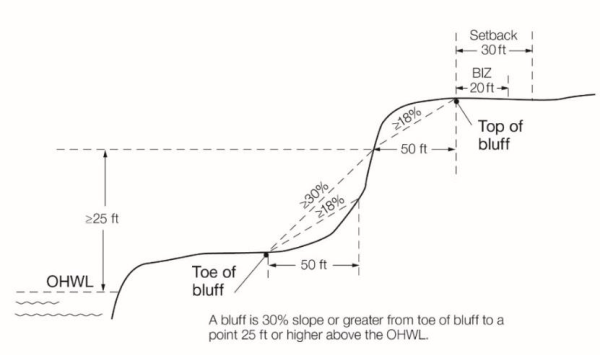 Figure 2. Exception to Bluff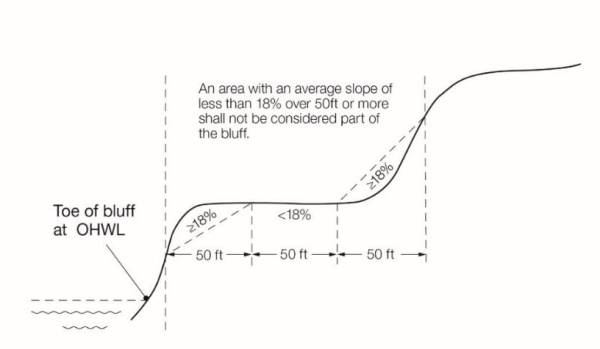
Bluff, top of, means, for the purposes of measuring setbacks, bluff impact zone, and administering vegetation management standards, the higher point of a 50-foot segment with an average slope exceeding 18 percent.
Boathouse means a structure used solely for the storage of boats or boating equipment. The term "boathouse" means a facility as defined by Minn. Stats. § 103G.245.
Body art establishment means a retail business providing the service of physical body adornment using, but not limited to, tattooing and body piercing. Tattooing means any method of placing indelible ink or other pigments into or under the skin or mucosa with needles or other instruments used to puncture the skin, resulting in permanent coloration of the skin or mucosa. Tattooing also includes micropigmentation and cosmetic tattooing. Body piercing means the penetration or puncturing of the skin by any method for the purpose of inserting jewelry or other object in or through the body. Body art does not include practices and procedures that are performed by a licensed medical or dental professional if the procedure is within the professional’s scope of practice.
Boulevard means the portion of the street right-of-way between the curb line and the property line.
Brewery or brew pub means an establishment that produces ales, beers, meads, hard ciders, and/or similar beverages to serve on-site. Sale of beverages for off-site consumption is also permitted in keeping with the regulations of the Minnesota Department of Public Safety and State Law. This land use may also include a cocktail room, distillery and/or a taproom.
Buffer means a vegetative feature as defined by Minn. Stats. § 103F.48.
Buffer yard means a buffer yard is a combination of distance and a visual buffer or barrier between two affected properties. The term "buffer yard" includes an area, together with the combination of plantings, berms and/or fencing that are required to eliminate or reduce existing or potential nuisances. These nuisances can occur between adjacent zoning districts and between different land uses. Such nuisances include dirt, litter, noise, and glare of lights, signs and incompatible land uses, buildings or parking areas.
Buildable area means the portion of a lot remaining after required yards have been provided.
Building means any structure having a roof supported by columns or walls built for the support, shelter, or enclosure of persons, animals, chattels, or property of any kind, but not including any vehicle, trailer (with or without wheels) nor any movable device, such as furniture, machinery, or equipment. The term "building means any structure used or intended for supporting or sheltering any use or occupant.
Building coverage means the proportion of the lot area, expressed as a percent, that is covered by the maximum horizontal cross-section of a building or buildings.
Building height means a distance to be measured from the mean ground level to the top of a flat roof, to the mean distance of the highest gable on a pitched or hip roof, to the deck-line of a mansard roof, and to the uppermost point on other roof types.
Building line means a line parallel to a lot line or the ordinary high-water level at the required setback beyond which a structure may not extend.
Building line or setback line means a line or curve equidistant at each point from the closest point on the corresponding street right-of-way line, edge of stream, or other property line established on a parcel of land or lot, for the purpose of prohibiting construction of a building or structure in the area between such building line/setback line and the right-of-way, stream bank, or other property line.
Building setback means the minimum horizontal distance between the building and the specified lot line as prescribed in this title.
Bulk. The term "bulk" is used to indicate the size and setback of a building or structure and the location of same with respect to another building or structure or to a lot line and includes the following:
- The size and height of a building or structure;
- The location of exterior walls of a building in relation to lot lines, streets, or other buildings;
- The floor area of a building in relation to the area of the lot on which it is located;
- The open space allocated to and surrounding a building; and
- The amount of lot area per dwelling unit.
Business means any establishment, occupation, employment or enterprise where merchandise is manufactured, exhibited or sold, or where services are offered for compensation.
Camper means a motor vehicle with space and equipment, either in a rear compartment or in an attached trailer, for sleeping and simple housekeeping, used for camping and recreational travel.
Campground means includes any facilities designed for overnight accommodations of persons in tents, travel trailers, or other mobile or portable shelter or vehicles.
Cellar means that portion of a building having more than one-half of the floor to ceiling height below the average land grade.
Channel means a natural or artificial depression of perceptible extent, with definite bed and banks to confine and conduct water either continuously or periodically.
Church means a building, together with its accessory buildings and uses, where persons regularly assemble for religious worship and which building, together with its accessory buildings and uses, is maintained and controlled by a religious body organized to sustain public worship.
City means the City of Pine City, Minnesota. In the case of needing City approval, City may mean staff, Planning Commission and/or Council of the City of Pine City, Minnesota.
City Council means the governing body of the City of Pine City having jurisdiction.
Clear-cutting means the removal of an entire stand of trees.
Collector means a street or road providing for travel between local streets and the arterial street network, or serving multifamily development or neighborhood centers or services such as schools, parks or fire stations.
Commercial agricultural means the use of land for the growing and/or production of field crops, livestock and livestock products.
Commercial apartments means dwelling units which are located above the ground floor of a building used for a commercial land use, most typically an office or retail establishment.
Commercial indoor lodging means a building having provision for ten or more guests in which lodging is provided for compensation, and which is open to transient or permanent guests or both, and in which ingress and egress to and from all rooms is made through an inside lobby or office supervised by a person in charge. This type of facility may also include meeting rooms, on-site restaurant and/or bars, fitness centers or other public amenities for guests and which may also be available for use by the general public. A Conditional Use Permit is required for any accessory use to the principal Commercial Indoor Lodging use which is located in a separate or accessory building on the same property.
Commercial Planned Unit Developments means developments that provide transient, short-term lodging spaces, rooms, or parcels and their operations are essentially service-oriented. For example, hotel/motel accommodations, resorts, recreational vehicle and camping parks, and other primarily service-oriented activities are Commercial Planned Unit Developments.
Commercial recreation means bowling alley, cart track, golf, pool hall, vehicle racing or amusement, dance hall, skating, trampoline, tavern, theater, firearms range, boat rental, amusement rides, campgrounds, deer park, and similar uses for which fees are charged for admission or use of the facility.
Commercial sign means a sign announcing a for-profit, business, or economic nature that references a product, service, name or logo.
Commercial use means the principal use of land or buildings for the sale, lease, rental, or trade of products, goods, and services.
Commercial uses means all permitted, conditional and accessory uses allowed in the GB, CBD, and HB districts.
Commissioner means the commissioner of the Department of Natural Resources.
Communications tower means and includes all freestanding broadcasting, receiving, or relay structures and similar principal land uses; and any office, studio, or other land uses directly related to the function of the tower.
Community living arrangement means and includes child welfare agencies, group homes for children, and community based residential facilities. The term "community living arrangements" does not include day care centers, nursing homes, general hospitals, special hospitals, prisons, or jails.
Comprehensive plan means a comprehensive land use plan made and adopted by the Planning Commission and City Council for the City of Pine City which through any combination of text, charts, and maps sets forth proposals for general locations for various land uses, streets, parks, schools, public buildings, utilities, and for the physical development of Pine City.
Concept plan means a concept plan is the demonstrated, generalized future land use of a specified area to be developed, used by the City to:
- Guide the preparation of detailed structure plans undertaken by developers;
- Promote orderly development within the area encompassed by the plan boundaries; and
- Provide guidance to administration and Council in reviewing future zoning, subdivision and development proposals.
Conditional use means a conditional use is a use that would not be appropriate generally or without restriction throughout the Zoning District but which if controlled as to number, area, location, or relation to the neighborhood, would promote the public health, safety, morals, order, comfort, convenience, appearance, prosperity, or general welfare. Such uses may be permitted in such Zoning Districts as conditional uses, if specific provisions for such conditional use are made in this Zoning Code. The term "conditional use" means a land use or development as defined by ordinance that would not be appropriate generally but may be allowed with appropriate restrictions upon a finding that certain conditions as detailed in the Zoning Ordinance exist, the use or development conforms to the comprehensive land use plan of the community, and the use is compatible with the existing neighborhood.
Conditional Use Permit means a permit issued by the Council in accordance with procedures specified in this title, as well as its compatibility with the City Comprehensive Plan, as a flexibility device to enable the City Council to assign dimensions to a proposed use or conditions surrounding it after consideration of adjacent uses and their functions and the special problems which the proposed use presents.
Condominium. See Townhouse/condominium.
Construction plans means the engineering drawings showing types of materials and construction details for physical structures and facilities, excluding dwelling units to be installed in conjunction with development of a subdivision.
Construction sign means a non-illuminated sign announcing the names of architects, engineers, contractors, financiers, or other individuals or firms involved with the construction, alteration, or repair of a building (but not including any advertisement of any product) or announcing the character of the building, enterprise, or purpose for which a building is intended.
Controlled access lot means a lot used to access public waters or as a recreation area for owners of nonriparian lots within the same subdivision containing the controlled access lot.
Corner lot means a lot abutting upon two or more streets at their intersection.
County board means the governing body of Pine County.
Crosswalk or pedestrian way means a publicly-owned right-of-way which crosses a block and furnished pedestrians access to adjacent streets or property.
Day care. See Group day care center, Family day care home, and Multifamily day care.
Deck means a horizontal, unenclosed platform with or without attached railings, seats, trellises, or other features, attached or functionally related to a principal use or site and at any point extending more than three feet above ground.
Dedication means intentional transfer by the developer to the public of ownership of or an interest in land for a public purpose. Dedication may be effected by formal deed of conveyance, or by any other method recognized by the laws of the State of Minnesota.
Density means the number of dwelling units per acre of gross land area.
Deposition means any rock, soil, gravel, sand or other material deposited naturally or by man into a waterbody, watercourse, floodplains or wetlands.
Design standards means specifications to landowner or subdivisions for the preparation of plats, both preliminary and final, indicating among other things, the optimum, minimum, or maximum dimensions of such things as rights-of-way, blocks, easements, and lots.
Developed site means a lot on which the primary structure has obtained an Occupancy Permit that does not require Site Plan approval per PCC 13.84.060.
Developer means any person, persons, corporation, or Government agency undertaking any development as defined in the Code. The term "developer" includes such commonly used references as subdivider, owner, and proprietor.
Development means any subdivision of land as herein defined or any material change in the use or appearance of any parcel of land subject to provisions of this title, or the act of building structures and/or installing site improvements.
Directional sign means a sign that is freestanding, the primary purpose of which is to give directions to employees, visitors, or delivery trucks for parking lots, exits, entrances, drive-through windows, or similar directions.
Disabled person parking space means a designated parking space in accordance with Minnesota Accessibility Code, Minn. R. Ch. 1341, that has adequate room for passenger loading and unloading. The amount of handicapped spaces required in a given parking area and their individual dimensions shall comply with this Code.
Distribution center means and includes facilities oriented to the short-term storage or trans-shipment of materials involving the activities and products of four or fewer businesses.
District means a section of the City for which the zoning regulations governing the use of buildings and premises, the height of buildings, the size of yards, and the intensity of use are uniform.
Diversion means a channel that intercepts surface water runoff and that changes the accustomed course of all or part of a stream.
Dog kennel means a place where three dogs or more over six months of age are boarded, bred and/or offered for sale, except a veterinary clinic.
Double frontage lot means a lot having frontage on two parallel or approximately parallel streets.
Draining means the removal of surface water or groundwater from land.
Dredging means to enlarge or clean-out a waterbody, watercourse or wetland.
Duplex/villa means two-family housing units, neither of which is an accessory dwelling unit, and that share a common wall space.
Duplex, triplex, and quad means a dwelling structure on a single lot, having two, three, and four units, respectively, attached by common walls and each unit equipped with separate sleeping, cooking, eating, living, and sanitation facilities.
Dwelling means a building or portion thereof, designated exclusively for residential occupancy, including one-family, two-family and multiple-family dwellings, but not including hotels, motels, and boardinghouses.
Dwelling area means the area of a dwelling unit composed of those rooms designed for and exclusively used for residential purposes, including bedrooms, kitchen, dining room, den/library, bathrooms, family and living rooms, and hallways connecting these rooms.
Dwelling site means a designated location for residential use by one or more persons using temporary or movable shelter, including camping and recreational vehicle sites.
Dwelling unit means any structure or portion of a structure, or other shelter designed as short- or long-term living quarters for one or more persons, including rental or timeshare accommodations such as motel, hotel, and resort rooms and cabins. The term "dwelling unit" means any building or portion thereof that contains living facilities, including provisions for sleeping, eating, cooking and sanitation, as required by this Code, for not more than one family.
Dynamic sign means signs that move, give the appearance of motion (flashing, rotating, scrolling, etc.), or change in color or intensity.
Earth sheltered buildings means buildings constructed so that more than 50 percent of the exterior surface area of the buildings, excluding garages and other accessory buildings, is covered with earth and the building code standards are satisfied. Partially completed buildings shall not be considered earth sheltered.
Easement means a right or privilege to use a portion of another's property for a particular purpose.
Electronic programmable message sign means an illuminated sign on which artificial light, messages, or lines of text are stationary and constant in intensity and color, but may change periodically.
Engineer means a professional engineer registered in the State of Minnesota. The term "engineer" can also refer to the City or County Engineer, or a duly authorized consulting engineer.
Equal degree of encroachment means a method of determining the location of encroachment lines so that the hydraulic capacity of floodplain lands on each side of a stream are reduced by an equal amount when calculating the increases in flood stages due to floodplain encroachments.
Essential services means underground or overhead gas, electrical, steam or water distribution systems; collection, communication, supply or disposal system including poles, wires, mains, drains, sewer, pipes, conduits, cables, fire alarm boxes, traffic signals, hydrants or other similar equipment and accessories in conjunction therewith; but not including buildings or transmission services.
Exterior side yard means a yard located on a corner lot which extends from the front yard to the rear yard, along the abutting street or avenue, and is considered the secondary street frontage of the corner lot. The principal street frontage shall be determined by consideration of parcel dimensions, address, driveway location, usability of the lot, configuration of adjacent lots, and likely future development in the area. Should there be any question on this, the City shall make a determination.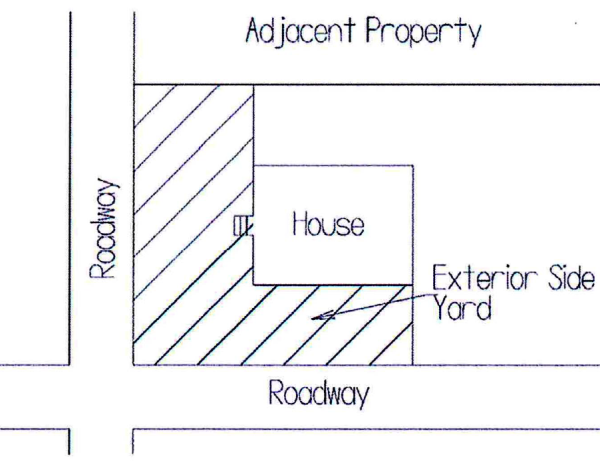
Extraction use means any land use involving the removal of soil, clay, sand, gravel, rock, minerals, peat, or other materials in excess of that required for approved on-site development or agricultural activities.
Extractive use means the use of land for surface of subsurface removal of sand, gravel, rock, industrial minerals, other nonmetallic minerals, and peat not regulated under Minn. Stats. §§ 93.44--93.51.
Family means one or more persons who are related by blood, marriage, or adoption, living together and occupying a single housekeeping unit with single kitchen facilities, or a group of not more than five living together by joint agreement and occupying a single housekeeping unit with single kitchen facilities, on a nonprofit cost-sharing basis.
Family day care home means occupied residences in which a qualified person provide day care for no more than 14 children at a time.
Farm means a tract of land ten or more acres which is principally used for commercial agriculture, all of which is owned and operated by a single family, farm corporation, individual or corporation.
Farm dwelling means a single-family dwelling located on a farm used or intended for use by the farm’s owner, a relative of the owner, or a person employed thereof.
Fence means a barrier forming a boundary to, or enclosing some area.
Final plat means the final map, drawing, or chart on which the subdividers plan of subdivision which will be submitted to the County Recorder's Office. Said plat must conform to these subdivision regulations and all appropriate State laws.
Financial institution means an office building or portion thereof which provides for the custody, loan, exchange, or issuance of money, the extension of credit, or facilitating the transmission of funds, and which may include accessory drive-up units on the same premises where permitted by the Zoning Code. Such uses are permissible only if insured by the FDIC (Federal Deposit Insurance Corporation), FSLIC (Federal Savings and Loan Insurance Corporation), or the NCUA (National Credit Union Association).
Flag means a piece of fabric or other flexible material containing distinctive colors, patterns, standards, words, or emblems, used as a symbol of an organization or entity, including, but not limited to, political jurisdictions, such as the United States.
Flood means a temporary rise in stream flow or stage or temporary increase in the stage of a wetland or lake that results in inundation of the areas adjacent to the channel.
Flood frequency means the average frequency, statistically determined, for which it is expected that a specific flood stage or discharge may be equaled or exceeded.
Flood fringe means that portion of the floodplain outside of the floodway. The term "flood fringe" is synonymous with the term "floodway fringe" used in the flood insurance study for the City.
Floodplain means that area of land adjoining the channel of a river, stream, watercourse, lake or similar body of water which will be inundated by a flood which can be expected once every 100 years for that region, as defined by the U.S. Army Corps of Engineers and required by the National Flood Insurance Act.
Floodproofing means a combination of structural provisions, changes, or adjustments to properties and structures subject to flooding, primarily for the reduction or elimination of flood damages.
Floodway means the channel of the watercourse and those portions of the adjoining floodplain which are reasonably required to carry, store and discharge the regional flood.
Floor area means for commercial business and industrial building or buildings, containing mixed uses; the sum of the gross horizontal areas of the several floors of the building measured from the exterior walls, but not including:
- Attic space providing headroom of less than seven feet;
- Easement space not used for retailing;
- Accessory water and cooling towers.
For residential buildings; the gross horizontal areas of the several floors of a dwelling exclusive of garages, basements and open porches measured from the external faces of the exterior walls.
Forest land conversion means the clear cutting of forested lands to prepare for a new land use other than reestablishment of a subsequent forest stand.
Forestry means the management, including logging, of a forest, woodland, or plantation, and related research and educational activities, including the construction, alteration or maintenance of woodlands, skidroads, landing area and fences.
Freestanding sign means any sign which has supporting framework that is placed on, or anchored in, the ground and which is independent of any building or other structure.
Freight terminal means and includes facilities oriented to the short-term storage and trans-shipment of materials and/or the outdoor storage of trucks and related equipment.
Front lot line means the boundary between a lot and the public right-of-way on which it fronts.
Front yard means a yard across the full width of the lot extending from the front line, or face, of the main building to the front line of the lot.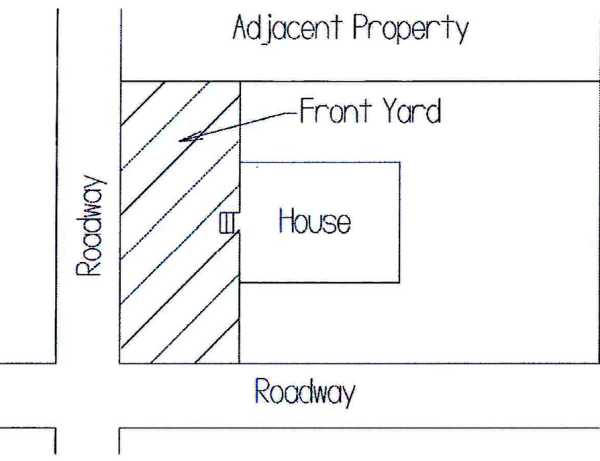
Frontage means the length of the property abutting on one side of a street measured along the dividing line between the property and the street right-of-way.
Garage or yard sale means a private sale of personal property, used to dispose of personal household possessions, not for the use of any commercial venture.
Garage, private, means an accessory building or accessory portion of the principal building which is intended for and used to store the private passenger vehicles of the family or families resident upon the premises, and in which no business service or industry is carried on, provided that not more than one-half of the space may be rented for the private vehicles of persons not resident on the premises, except that all the space in a garage of one- or two-car capacity may be so rented. A private garage shall be considered attached to the residence when it shares a common wall or any portion of a common wall with the habitable space in the residence. A private garage that is connected to a residence by a breezeway or other similar connection shall be considered detached. The area of the connection shall be included in calculating the total area and the percent of the total rear yard that may be occupied by accessory buildings.
Garage, public, means a building or portion of a building, except as herein defined in this title as a private garage or as a repair garage, used for the storage of motor vehicles, or where any such vehicles are kept for remuneration or hire and which any sale of gasoline, oil and accessories is only incidental to the principal traffic.
Garage sales mean all general sales open to the public, conducted from or on residential premises in any residential zone district for the purpose of disposing of personal property, including, but not limited to, all sales entitled "estate," "garage," "lawn," "yard," "attic," "porch," "room," "backyard," "patio," "flea market" or "rummage sale."
Governing body means the City Council.
Government sign means any temporary or permanent sign erected and maintained by the City, County, State, or Federal government for traffic direction or for designation of or direction to any school, hospital, historic site, or public service, property, or facility.
Grade (adjacent ground elevation) means the lowest point of elevation of the finished surface of the ground, paving or sidewalk within the area between the building and the property line, or when the property line is more than five feet from the building, between the building and a line five feet from the building.
Grading means changing the natural or existing topography of land.
Group/multiple-family day care center means and includes day care centers and nursery schools. Such land uses shall not be located within a residential building. Such land uses may be operated on a for-profit or not-for-profit basis. Such land uses may be operated in conjunction with another principal land use on the same environs, such as a church, school, or business as an accessory use.
Growth management system means the goals, policies, programs, ordinances, and regulations used to guide the City's growth and development.
Guest cottage means a structure used as a dwelling unit that may contain sleeping spaces and kitchen and bathroom facilities in addition to those provided in the primary dwelling unit on a lot.
Heavy industrial means industrial facilities that comply with one or more of the following criteria:
- Are conducted entirely within an enclosed building;
- Are not potentially associated with nuisances such as odor, noise, heat, vibration, and radiation which are detectable at the property line;
- Does not pose a significant safety hazard (such as danger of explosion). More specifically, heavy industrial land uses are industrial land uses which may have the potential to create nuisances which are detectable at the property line; may involve materials which pose a significant safety hazard.
Examples include meat product producers; alcoholic beverage producers; paper, pulp, or paperboard producers; chemical and allied product producers (except drug producers) including poison or fertilizer producers; petroleum and coal product producers; primary metal producers; heavy metal producers; electrical distribution equipment producers; electrical industrial apparatus producers; transportation vehicle producers; commercial sanitary sewage treatment plants; railroad switching yards; and recycling facilities not involving the on-site storage of salvage materials.
Height. See Building height.
Height of building means the vertical distance between the highest adjoining ground level at the building or ten feet above the lowest adjoining ground level, whichever is lower, and the highest point of a flat roof or average height of the highest gable of a pitched or hipped roof.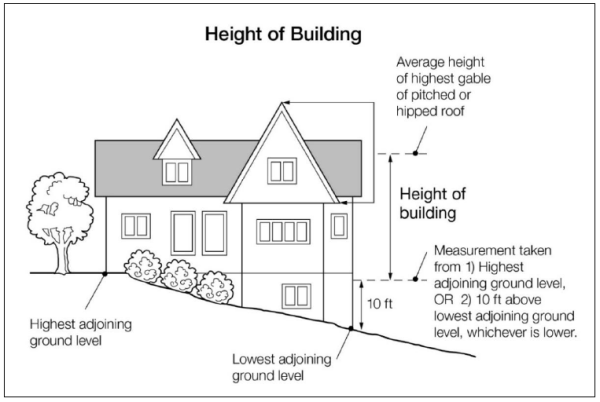
High technology means and includes land uses for scientific, research, development, educational, computer, software, design, and applied technology office, laboratories, facilities, and organizations.
Home occupation means any occupation or profession carried on by a member of the family residing on the premises, provided that the use is clearly incidental and secondary to the use of the dwelling for dwelling purposes, does not change the character of the dwelling, and does not utilize more than one-third of the building’s floor area.
Identification sign means a sign to identify a single-family residence or the name of a subdivision, apartment complex or neighborhood in a multiple-family residence or in a PUD.
Illuminated means any sign that has characters, letters, fixtures, designs, or outlines with an artificial light source, either directed upon it or emanating from it.
Impervious surface means a constructed hard surface that prevents or retards entry of water into the soil and causes water to run off the surface in greater quantities and at an increased rate of flow than prior to development, including rooftops; decks; sidewalks; patios; swimming pools; parking lots; concrete, asphalt, or gravel driveways; and other similar surfaces.
Indoor commercial entertainment means and includes all land uses which provide entertainment services entirely within an enclosed building. Such activities have operating hours which extend significantly later than most other commercial land uses. Examples of such land uses include restaurants, taverns, theaters, health or fitness centers, all forms of training studios (dance, art, martial arts, etc.), bowling alleys, arcades, roller rinks, and pool halls.
Indoor institutional means and includes all indoor public and not-for-profit recreational facilities (such as gymnasiums, swimming pools and spas, libraries, museums, and community centers) public and private schools, churches, funeral homes, nonprofit civic organizations, nonprofit fraternal organizations, convention centers, and similar land uses.
Indoor maintenance service means and includes all land uses which perform maintenance services (including repair) and contain all operations within an enclosed building.
Indoor sales incidental to light industrial use means and includes any retail sales activity conducted exclusively indoors which is incidental to a principal land use such as warehousing, wholesaling, or any light industrial use on the same site.
Indoor sales or service means and includes all land uses which conduct or display sales or rental merchandise or equipment, or non-personal or non-professional services entirely within an enclosed building. This includes self-service facilities such as coin-operated laundromats. Artisan craft production such as consumer ceramics, custom woodworking, or other production activities directly associated with retail sales are permitted as accessory uses.
Indoor storage or wholesaling means and includes uses primarily oriented to the receiving, holding, and shipping or packaged materials for a single business or a single group of businesses. With the exception of loading and parking facilities, such land uses are contained entirely within an enclosed building. Examples of this land use include conventional warehouse facilities, long-term indoor storage facilities, and joint warehouse and storage facilities.
Industrial use means all permitted, conditional and accessory uses allowed in the TI-1 and TI-2 districts. The term "industrial use" means the use of land or buildings for the production, manufacture, warehousing, storage, or transfer of goods, products, commodities, or other wholesale items.
Inorganic areas means areas where the ground is covered by permeable, but non-living, substances. Examples include, but are not limited to, decorative rock, gravel, wood chips.
Institution means a building occupied by a nonprofit corporation or a nonprofit establishment.
Institutional residential means and includes group homes, convents, monasteries, nursing homes, convalescent homes, limited care facilities, rehabilitation centers, and similar land uses not considered to be community living arrangements.
Intensive vegetation clearing means the complete removal of trees or shrubs in a contiguous patch, strip, row, or block.
Interim use means a temporary use of property until a particular date or until the occurrence of a particular event.
Interim Use Permit means a permit issued by the Council in accordance with procedures specified in this title, as well as its compatibility with the City Comprehensive Plan, as a flexibility device to enable the City Council to assign time limits and conditions to a proposed use after consideration of current or future adjacent uses and their functions.
Interior lot means a lot whose side lines do not abut upon any street.
In-vehicle sales and service means and includes all land uses which perform sales and/or services to persons in vehicles, or to vehicles which may be occupied at the time of such activity. Such land uses often have traffic volumes which exhibit their highest levels concurrent with peak traffic flows on adjacent roads. Examples of such land uses include drive-in, drive-up, and drive-through facilities, vehicular fuel stations, and all forms of car washes. If performed in conjunction with a principal land use (for example, a convenience store, restaurant, or bank), in vehicle sales and service land uses shall be considered an accessory use except in the Mixed-Use District.
Junkyards and inoperative vehicles means a parcel or land upon which the principal or accessory use is the accumulation of used, discarded, or worn out materials, or manufactured products, any of which may or may not be reusable or salable.
Landscaping means contouring or planting of flowers, shrubs or trees to adorn or improve a section of ground.
Light industrial means and includes industrial facilities at which all operations (with the exception of loading):
- Are conducted entirely within an enclosed building;
- Are not potentially associated with nuisances such as odor, noise, heat, vibration, and radiation which are detectable at the property line;
- Do not pose a significant safety hazard (such as danger of explosion); and comply with all the performance standards for potential nuisances.
Light industrial uses may conduct retail sales activity as an accessory use.
Light industrial incidental to indoor sales means and includes any light industrial activity conducted exclusively indoors which is incidental to a principal land use such as indoor sales and service on the same site.
Loading space means a space within the main building or on the same lot, providing for the standing, loading, or unloading of trucks, which space shall have a minimum dimension of 12 by 35 feet and a vertical clearance of at least 14 feet.
Local street means any public street not designated as a major thoroughfare, freeway or highway and not situated within the existing/and/or planned pattern of streets in a manner to cause it to function as a collector street. A street or road which is intended primarily to serve traffic within a neighborhood or limited residential district and which is not contentious through several residential districts. A local street should provide access to adjacent land over short distances.
Lot means a measured portion of a parcel or a tract of land, set forth in a Recorded Plat, recorded or proposed to be recorded, and intended as a unit for transfer of ownership or for development. The term "lot" means a parcel of land designated by plat, metes and bounds, registered land survey, auditors plot, or other accepted means and separated from other parcels or portions by said description for the purpose of sale, lease, or separation.
Lot (of record) means a parcel of land, whether subdivided or otherwise legally described of record as of the effective date of the ordinance from which this title is derived or approved by the City as a lot subsequent to such date and which is occupied by or intended for occupancy by one principal building or principal use together with any accessory buildings and such open spaces as required by this title and having its principal frontage on a street, or a proposed street approved by the Council.
Lot area means the area of a horizontal plane within the lot lines.
Lot coverage means the percentage of the lot covered by impervious improvements.
Lot depth means the mean horizontal distance between the street right-of-way line and the opposite rear line of the lot measured in the general direction of the side lot lines.
Lot width means the horizontal distance between side lot lines, measured at the front building line. The term "lot width" means the minimum distance between:
- Side lot lines measured at the midpoint of the building line; and
- Side lot lines at the ordinary high-water level, if applicable.
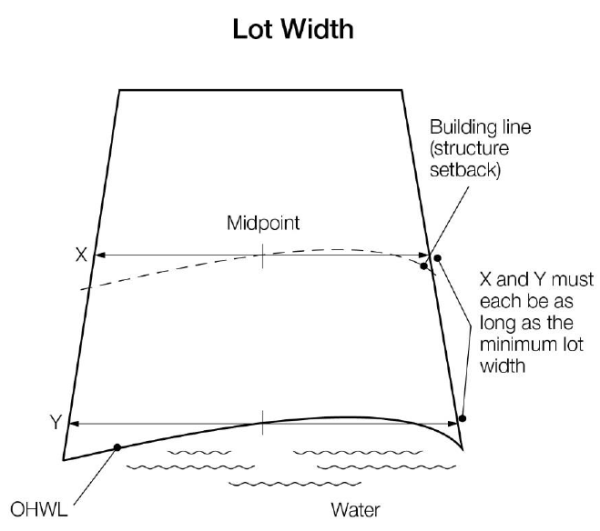
Lot frontage means the front of a lot shall be that boundary abutting a public right-of-way.
Lot line means a property boundary line of any lot held in single or separated ownership, except that where any portion of the lot extends into the abutting street or alley, the lot line shall be deemed to be the street or alley right-of-way.
Lowest floor means the lowest floor of the lowest enclosed area (including basement). An unfinished or flood resistant enclosure, used solely for parking vehicles, building access, or storage in an area other than a basement area, is not considered a building’s lowest floor.
Manufactured home means a structure, transportable in one or more sections, which is built on a permanent chassis and is designed for use with or without a permanent foundation when attached to the required utilities. The term "manufactured home" does not include the term "recreational vehicle."
Manufactured home park means any site, lot, field or tract of land upon which two or more occupied manufactured homes are located, either free of charge or for compensation, and includes any building, structure, tent, vehicle or enclosure used or intended for use as part of the equipment of the manufactured home park.
Maximum height of sign means the vertical distance measured from the mean finished grade within ten feet of the base to the top of the sign.
Memorial sign means an integral sign or tablet, with the name of a building or date of erection, when cut into any masonry surface or when constructed of bronze or other noncombustible material and mounted on the face of a building. Gravestones and monument tributes also fall under the definition of memorial signs.
Metallic minerals and peat has the meaning given under Minn. Stats. §§ 93.44--93.51.
Mobile homes means any factory-built home designed to be potentially moved to multiple locations that were produced before June 15, 1976, the date when building regulations and standards were formally enforced on the industry by HUD. Homes built after this date are called manufactured homes.
Modular homes means the same as manufactured homes, except that they are built to the state, local or regional building codes where the home will be located rather than the HUD code. They have a steel frame that is used for transport only; after which it is removed.
Motion sign means any sign that revolves, rotates, has any moving parts, or gives the illusion of motion e.g., zip flashers, flashing signs, or similar devices.
Motor vehicle means a self-propelled wheeled conveyance, such as a car or truck that does not run on rails.
Movable Tiny Home means a unit that is between 100-400 square feet; intended for separate, independent living quarters; movable on wheels; and designed as a permanent, year-round residence for one household which includes basic functional areas that support normal daily routines including cooking, sleeping, and sanitation and that meets the following conditions:
- Is licensed and registered with the Department of Driver and Vehicle Services and meets ANSI 119.5 requirements or the National Fire Protection Association (NFPA) 1192 standards as inspected and certified for compliance with the requirements in this subdivision by a licensed professional engineer or qualified third-party inspector for ANSI compliance accredited pursuant to either the American Society for Testing and Materials Appendix E541, or ISO/IEC 17020.
- Is towable by a bumper hitch, frame-towing hitch, or fifth-wheel connection, and is not designed to move under its own power; and is no larger than allowed by State Law for movement on public highways and in no case may exceed 14 feet in width.
- Has at least 100 square feet of first floor interior living space.
- Limited to a maximum height of 15 feet.
- The unit shall be designed to look like a conventional residential structure rather than a recreational vehicle. This shall be done by incorporating design features and materials typically used for houses, such as typical siding or roofing materials, pitched roofs, eaves, residential windows, including the following:
- Materials used as exterior wall covering shall be natural or man-made materials of a non-reflective nature, except that reflective materials may be used as accent panels when approved as part of a conditional use permit in a tiny home community.
- Windows shall be at least double pane glass and labelled for building use, and shall include exterior trim.
- Includes insulation with values of at least R13 for the walls and R19 for floor and ceiling.
- Wall framing studs are 16”-24” on center, with a minimum of 2X4 wood or metal studs or equivalent SIP panels.
- Is connected to water, sewer and electricity. Electricity may be provided by off-grid solar system.
- When sited, the unit is to be anchored to the ground and is to have skirting that covers wheels, axles, anchors and hitch.
Movable Tiny Home Community means a collection of movable tiny homes on one parcel, built in accordance with the requirements of Section 13.16.090 and A-O zoning. Movable tiny home communities shall only be permitted in the A-O District with a conditional use permit.
Multifamily (apartment) means a building containing more than four housing units, not including an accessory dwelling unit.
Multiple tenant building means a single structure housing two or more retail, offices or commercial uses sharing the same lot, access and/or parking facilities or a coordinated Site Plan.
Natural drainage system means all land surface areas which by nature of their contour configuration, collect, store, and channel surface water runoff.
Natural obstruction means any rock, tree, gravel or analogous natural matter that is an obstruction and has been located within a waterbody, watercourse, or wetland by a non-human cause.
Negative easement means a grant by the developer to the public, a corporation, or person for use of a recorded strip of land for open space or other non-developed purposes.
Non-access reservation means a parcel or tract of subdivision land withheld from development and subject to private use and access restrictions for the purpose of protecting the environment of subdivision, or to enhance a street right-of-way, or to improve traffic flow on a principal street.
Noncommercial means of a not-for-profit, social, religious, ideological, public service, informational, or political nature, in contrast to a for-profit, business, or economic nature.
Nonconforming use, building or yard means a use, building or yard existing legally at the time of the passage of this title or any amendment thereto which does not, by reason of design, use, or dimensions, conform to the regulations of the district in which it is situated.
Nonconformity means any legal use, structure or parcel of land already in existence, recorded, or authorized before the adoption of official controls or amendments to those controls that would not have been permitted to become established under the terms of the official controls as now written.
Non-financial institution money-lending businesses means commonly referred to as "pawn shops", "check cashing establishments" or "loans until payday" establishments. Any establishment in which the owner, operator, proprietor or employees thereof lends or exchanges money for future remuneration, property, or possessions that does not meet the regulations of a financial institution.
Nonresidential district means and includes CBD, MXU, GB, HB, TI-1 and TI-2, as defined in this Code.
Non-storage building means structures not meant for the purpose of storing possessions or holding them for their future use. Examples of such buildings include playhouses and gazebos.
Obstruction means any dam, wall, wharf, embankment, levee, dike, pike, abutment, projection, excavation, channel rectification, culvert, building, wire, fence, stockpile, refuse, fill, structure, or matter in, along, across, or projecting into any channel, watercourse, or regulatory flood hazard area which may impede, retard, or change the direction of the flow of water, either in itself or by catching or collecting debris carried by such water, or that is placed where the flow of water might carry the same downstream to the damage of life or property.
Off-premises sign means a commercial sign that directs attention to a business, commodity, service, or entertainment, conducted, sold, or offered elsewhere than upon the parcel where the sign is located. Off-premises signs include billboards. For the purposes of this title, easements and other appurtenances shall be considered to be outside such platted parcel of land, and any sign located or proposed to be located in an easement or other appurtenance shall be considered an off-premises sign.
Off-site parking lot means and includes any areas used for the temporary parking of vehicles which are fully registered, licensed, and operative which are not contained on the same lot as the use which the parking lot is intended to serve. In no instance shall an off-site parking lot be used for storage of vehicles or any other material nor shall any activity other than temporary parking or other permitted temporary use be allowed.
Off-street loading space means a space accessible from the street, alley, or way, in a building or on the lot, for the use of trucks while loading or unloading merchandise or materials. Such space shall be of such size as to accommodate one truck of the type typically used in the particular business.
Office means and includes all exclusively indoor land uses whose primary functions are the handling of information or administrative services. Such land uses do not typically provide services directly to customers on a walk-in or on-appointment basis.
Open sales lot means any open land used or occupied for the purpose of buying, selling and/or renting merchandise and for the storing of same prior to sale.
Open space means land dedicated or reserved for use by the general public or for use by residents of the subdivision, or land held out of development and retained in its natural conditions, with or without public access. The term "open space" includes, but is not limited to, parks, parkways, playgrounds, school sites, wildlife or plant life preserves, and nature study areas.
Open space recreational use means recreational use particularly oriented to and utilizing the character of an area; including hiking and riding trails, primitive campsites, campgrounds, waysides, parks, and recreational areas.
Ordinary high-water level means the boundary of public waters and wetlands, and shall be an elevation delineating the highest water level which has been maintained for a sufficient period of time to leave evidence upon the landscape, commonly that point where the natural vegetation changes from predominantly aquatic to predominantly terrestrial. For watercourses, the ordinary high-water level is the elevation of the top of the bank of the channel. For reservoirs and flowages, the ordinary high-water level is the operating elevation of the normal summer pool.
Ordinary high-water mark means a mark delineating the highest water level which has been maintained for a sufficient period of time to leave evidence upon the landscape. The ordinary high-water mark is commonly that point where the natural vegetation changes from predominantly aquatic to predominantly terrestrial.
Outdoor commercial entertainment means and includes all land uses which provide entertainment services partially or wholly outside an enclosed building. Such activities often have the potential to be associated with nuisances related to noise, lighting, dust, trash, and late operating hours. Examples of such land uses include outdoor commercial swimming pools and spas, driving ranges, miniature golf facilities, amusement parks, drive-in theaters, go-cart tracks, and racetracks.
Outdoor institutional means and includes public and private cemeteries, privately held permanently protected green space areas, country clubs, non-public golf courses and similar land uses.
Outdoor storage or wholesaling means and includes all land uses primarily oriented to the receiving, holding, and shipping of packaged materials for a single business or single group of businesses. Such a land use in which any activity beyond loading and parking is located outdoors is considered an outdoor storage and wholesaling facility. Examples of this land use include contractors’ storage yards, equipment yards, lumber yards, coal yards, landscaping materials yards, construction materials yards, and shipping materials yards. Such land uses do not include the storage of inoperative vehicles or equipment, or other materials typically associated with a junkyard or salvage yard.
Owner means a person, partnership, firm, association, corporation, or combination thereof recorded as such on official records and including a duly authorized agent or notary, purchaser, lessee, devisee, judiciary; any person having a vested or contingent interest in the property or business in question.
Parcel or tract means a continuous area or acreage of land which can be divided or subdivided as provided by this title.
Parking area means a hard-surfaced area used for parking vehicles exclusively as an accessory use to the on-site primary structure. No sales or service, or other business activity may occur nor may fees be charged.
Parking lot means an open surfaced area used exclusively as a primary use for the temporary storage of fully operable and licensed motor vehicles for which fees may be charged, but no vehicles may be equipped, repaired, rented or sold.
Parking ramp means an accessory structure or use for the storage of motor vehicles at, below and/or above grade.
Parking space means a rectangular area of at least 19 feet long and ten feet wide that has adequate access to a public street. Lines differentiating parking spaces may be drawn at various angles in relation to curbs or aisles, so long as the parking spaces so created contain within them the rectangular area required.
Passive outdoor recreational means and includes all recreational land uses located on public or private property which involves passive recreational activities. Such land uses include arboretums, natural areas, wildlife areas, hiking trails, bike trails, cross-country ski trails, horse trails, open grassed areas not associated with any particular active recreational land use, picnic areas, picnic shelters, fishing areas, and similar land uses.
Pedestrian way means public or private right-of-way across a block or within a block to provide access for pedestrians and which may be used for the installation of utility lines.
Percentage of grade means the rise and fall in feet and tenths of a foot or each 100 feet or horizontal distance measured at the centerline of the street.
Permanent foundation means a concrete slab to which a home is attached. Blocks, tie downs and posts are not considered a permanent foundation. Most homes are on permanent foundations; however, mobile homes and manufactured homes often are not.
Permanent outdoor display and sales as a primary or principal use means and includes all land uses which conduct sales or display merchandise or equipment on a permanent basis outside of an enclosed building as the principal or primary use of the lot. Examples of such land uses would include vehicle and equipment sales or rental, manufactured housing sales, monument sales and garden centers. Such land uses do not include the storage or display or inoperative vehicles or equipment, or other materials typically associated with a junk or salvage yard.
Permitted use means a use which may be lawfully established in a particular district or districts, provided it conforms with all requirements, regulations, and performance standards (if any) of such districts.
Personal or professional service means personal service and professional land uses include all exclusively indoor land uses whose primary function is the provision of services directly to on individual on a walk-in or on-appointment basis. Examples of such land uses include professional services, insurance services, realty office, financial services, medical offices and clinics, veterinary clinics, barbershops, beauty shops, body art establishments and related land uses.
Personal property means property which is owned, utilized and maintained by an individual or members of his residence and acquired in the normal course of living in or maintaining a residence. It does not include merchandise which was purchased for resale or obtained on consignment.
Personal storage facility means and includes land uses oriented to the indoor storage of items entirely within partitioned buildings having an individual access to each partitioned area. Such storage areas may be available on either a condominium or rental basis. These land uses are typically known as mini-warehouses.
Planned Unit Development (PUD) means a tract of land consisting of at least one acre to be developed as an entity according to a plan and which may contain multiple uses; a Planned Unit Development (PUD) may be planned, developed, and regulated as a single land use unit. The term "Planned Unit Development" means a type of development characterized by a unified site design for a number of dwelling units or dwelling sites on a parcel, whether for sale, rent, or lease, and also usually involving clustering of these units or sites to provide areas of common open space, density increases, and a mix of structure types and land uses. These developments may be organized and operated as condominiums, time-share condominiums, cooperatives, full fee ownership, commercial enterprises, or any combination of these, or cluster subdivisions of dwelling units, residential condominiums, townhouses, apartment buildings, dwelling grounds, recreational vehicle parks, resorts, hotels, motels, and conversions of structures and land uses to these uses.
Planning Commission means the Planning Commission of the City of Pine City.
Plant unit means a plant unit shall consist of a combination of landscape materials which shall equal 30 points where:
- Deciduous canopy trees measuring two to 2½ inch caliper equal ten points each;
- Evergreen trees measuring six to eight feet tall equal ten points each;
- Ornamental deciduous trees measuring 1½ to two-inch caliper equal five points each; and
- Shrubs measuring 18 to 24 inches tall or three to four feet wide equal one point each.
All sizes specified are at the time of planting. While any combination of materials may be used to achieve the total point requirement, the mixture of a combination of types of materials is strongly encouraged. An example of various plant unit alternatives is listed in PCC 32.108.
Plat means a map or drawing indicating the subdivision or re-subdivision of land, intended to be filed for record.
Portable sign means a sign designed to be movable from one place to another, not affixed to the ground or to a structure; the sign can have changeable lettering; also called a portable billboard or mobile sign.
Preliminary plat means the preliminary plat map, drawing, or chart indicating the proposed layout of the subdivision to be submitted to the Planning Commission and the Council for their consideration as to its compliance with the growth management goals, policies, and these regulations, along with required supporting data.
Premises means an area of land with its appurtenances and buildings which, because of its unity of use, may be regarded as the smallest conveyable unit of real estate.
Principal use means the primary or main use of land or buildings as distinguished from subordinate, incidental or accessory uses.
Project area means:
- Gross project area. Total project area.
- Net project area. Total project area less land allocated to public street right-of-way, private streets, parking areas and any land allocated to specified non-project uses such as schools and churches when determining the "net residential project area" to be used as a basis for calculating the number of permitted dwelling units for a Planned Unit Development.
Projecting sign means a sign that is attached to the wall of a building and extends outward from the building wall.
Protective covenants mean contracts made between private partners as to the manner in which land may be used, with the view to protecting and preserving the physical and economic integrity of any given area.
Public service and utilities mean all City, County, State, and Federal facilities, emergency service facilities such as fire departments and rescue operations, wastewater treatment plants, public and/or private utility substations, water towers, utility and public service related distribution facilities and similar land uses.
Public uses mean uses owned or operated by municipal, school districts, County, State or other governmental units.
Public waters means any water as defined in Minn. Stats. § 103G.005, Subds. 15, 15a. The term "public waters" mean any water as defined in Minn. Stats. § 103G.005, Subds. 15, 15a.
Reach means a hydraulic engineering term to describe a longitudinal segment of a stream or river influenced by a natural or manmade obstruction. In an urban area, the segment of a stream or river between two consecutive bridge crossings would most typically constitute a reach.
Real estate sign means a sign placed upon a property advertising that particular property (land and/or building) for sale, lease, rent, pending sale, or having been sold.
Rear yard means a yard extending across the full width of the lot and lying between the rear line of the lot and the nearest line of the building.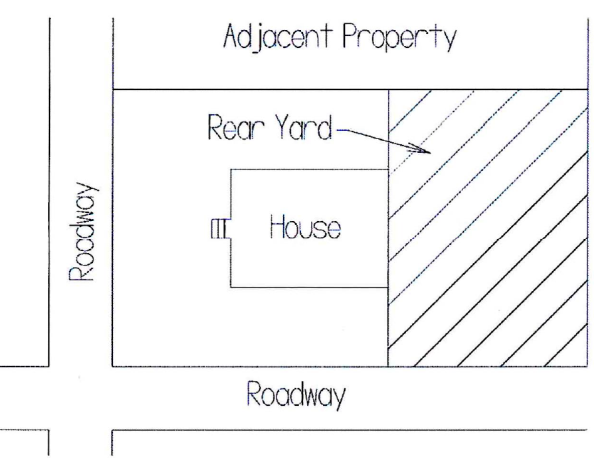
Rear lot line means the boundary line or lines opposite and most distant from the front street line; except that in the case of uncertainty the Building Inspector shall determine the rear line.
Recreational vehicle means a vehicle that is built on a single chassis, is 400 square feet or less when measured at the largest horizontal projection, is designed to be self-propelled or permanently towable by light duty truck, and is designed primarily not for use as a permanent dwelling but as a temporary living quarters for recreational, camping, travel, or seasonal use. For the purposes of this title, the term "recreational vehicle" shall be synonymous with the term "travel trailer/travel vehicle."
Regional flood means a flood which is representative of large floods known to have occurred generally in Minnesota and reasonably characteristic of what can be expected to occur on an average frequency in the magnitude of the 100-year recurrence interval. Regional flood is synonymous with the term "base flood" used in a flood insurance study.
Regulatory flood protection elevation means a point not less than one foot above the water surface profile associated with the regional flood plus any increases in flood heights attributable to encroachments on the floodplain. It is the elevation to which uses regulated by this title are required to be elevated or floodproofed.
Residential district means and includes A-O, R-1, R-1A, R-2, MFR-1, MFR-2 and MHP Districts, as defined in this Code.
Residential Planned Unit Development means a use where the nature of residency is non-transient and the major or primary focus of the development is not service-oriented. For example, residential apartments, manufactured home parks, time-share condominiums, townhouses, cooperatives, and full fee ownership residences would be considered as Residential Planned Unit Developments. To qualify as a residential Planned Unit Development, a development must contain at least five dwelling units or sites.
Residential use means a permanent place of residence for a family. A residential use located in any zoning district shall not include rentals for periods of less than 31 days or one calendar month, whichever is less, or which is advertised or held out to the public as a place rented for periods of less than 31 days or one calendar month, whichever is less.
Resort has the meaning in Minn. Stats. § 103F.227.
Reverse frontage means when a subdivision lot occurs between two non-intersecting streets, one of which is a parkway, thoroughfare, or collector and the other is a minor residential street, the lot will front on the minor residential street and a non-access reservation will be provided buffering the rear of the lot from the traffic artery.
Right-of-way or rights-of-way means the land opened, reserved, or dedicated for a street, sewer, water, walk, drainage course or other public purpose.
Riverine means riparian; relating to a system of inland wetlands and deep-water habitats associated with non-tidal flowing water, characterized by the absence of trees, shrubs, or emergent vegetation.
Sandwich board means a portable sign also known as a "signboard" or an "A-frame" that typically consists of two hinged boards used to display advertisements on one or both sides.
Security means and includes, but is not limited to, a surety bond, cash escrow, Certificate of Deposit, securities, or cash deposit.
Selective cutting means the removal of single scattered trees.
Semipublic use means the use of land by a private, nonprofit organization to provide a public service that is ordinarily open to some persons outside the regular constituency of the organization.
Setback means the minimum horizontal distance between a structure or sanitary facility and a road or highway right-of-way or property lot line, or between a structure or sanitary facility and the ordinary high-water mark. The term "setback" means the minimum horizontal distance between the front part of the building or structure (excluding steps, unroofed porches and overhangs) and the front lot line (unless specifically designated otherwise). The term "setback" means the minimum horizontal distance between a structure, sewage treatment system, or other facility and an ordinary high-water level, sewage treatment system, top of a bluff, road, highway, property line, or other facility.
Sewage disposal system means any system for the collection, treatment and dispersion of sewage, including, but not limited to, septic tanks, soil absorption systems, and drain fields.
Sewage treatment system has the meaning given under Minn. R. Pt. 7080.1100, Subpt. 82.
Sewer system means pipelines or conduits, pumping stations, and force main, and all other construction, devices, appliances, or appurtenances used for conducting sewage or industrial waste or other wastes to a point of ultimate disposal.
Sexual material means anything in print or writing, or any sexual picture, drawing, photograph, motion picture film, videotape or videotape production, or pictorial representation, or any sexual recording or transcription, or any sexual mechanical, chemical or electrical reproduction, or anything sexual which is or may be used as a means of communication. The term "sexual material" includes undeveloped sexual photographs, printing plates and other latent representational objects.
Sexually oriented land use means a land use definable by having more than 25 percent of the gross leasable area devoted to sexual materials and those sexually oriented land uses otherwise defined in this title.
Sexually oriented land uses mean and include bookstores, motion picture theaters, mini motion picture theaters, bath houses, massage parlors, modeling studios, body painting studios, cabarets, and video stores and are more specifically defined as the following:
Adult bookstore means an establishment having as a substantial or significant portion of its stock-in-trade in books, magazines and other periodicals which are distinguished or characterized by their emphasis on matter depicting, describing or relating to "specified sexual activities" or "specified anatomical areas" as defined in this section or an establishment with a segment or section devoted to the sale or display of such material.
Adult motion picture theater means an enclosed building with a capacity of 50 or more persons used for presenting material distinguished or characterized by an emphasis on matter depicting, describing or relating to "specified sexual activities" or "specified anatomical areas" as defined in this section for observation by patrons therein.
Adult motion picture theater, outdoor, means a parcel of land from which individuals may view a motion picture presented out of doors which present material distinguishably characterized by an emphasis on matter depicting, describing or relating to specified sexual activity or specified anatomical areas.
Adult mini-motion picture theater means an enclosed building with a capacity for less than 50 persons used for presenting materials distinguished or characterized by an emphasis on matter depicting, describing or relating to "specified sexual activities" or "specified anatomical areas" as defined herein for observation by patrons therein.
Adult bath houses mean as establishment or business which provides the services of baths of all kinds, including all forms and methods of hydrotherapy, that is not operated by a medical practitioner or a professional physical therapist licensed by the State of Minnesota and which establishment provides to its patrons an opportunity for engaging in "specified sexual activities" as defined in this section.
Adult massage parlors mean an establishment or business with or without sleeping accommodations which provides the services of massage and body manipulation, including exercises, heat and light treatments of the body, and all forms and methods of physiotherapy, not operated by medical practitioner or professional physical therapist licensed by the State of Minnesota and which establishment provides for its patrons the opportunity to engage in "specified sexual activity" as defined in this section.
Adult modeling studios mean an establishment or business which provides the services of modeling for the purpose of reproducing the human body wholly or partially in the nude by means of photography, painting, sketching, drawing or otherwise.
Adult body painting studios mean an establishment or business wherein patrons are afforded an opportunity to paint images on a body which is wholly or partially nude. For purposes of this title, the adult body painting studio shall not be deemed to include a body art establishment.
Adult cabaret means an establishment or business which features male and/or female topless and/or bottomless dancers, go-go dancers, exotic dancers, strippers, burlesque shows, male or female impersonators, or similar entertainers.
Adult novelty shop means an establishment or business having as a substantial or significant portion of its stock-in-trade in novelty or other items which are distinguished or characterized by their emphasis on, or designed for "specified sexual activity" as defined in this section or stimulating such activity.
Adult video store means an establishment having as a substantial or significant portion of its stock and trade in videotapes for sale or rent which are distinguished or characterized by their emphasis on matter depicting, describing or relating to "specified sexual activities" or "specified anatomical areas" as defined in this section or an establishment with a segment or section devoted to the sale, display or rental of such material.
Shopping center means an integrated grouping of commercial stores, under single ownership or control.
Shore impact zone means land located between the ordinary high-water level of a public water and a line parallel to it at a setback of 50 percent of the structure setback.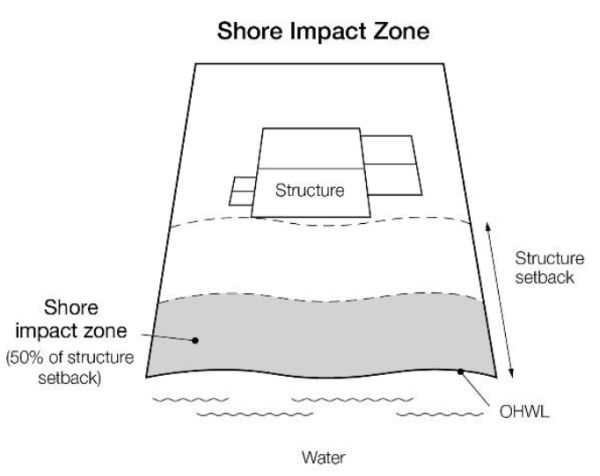 Shore recreation facilities means swimming areas, docks, watercraft mooring areas and launching ramps and other water recreation facilities.
Shoreland means land located within the following distances from public waters:
- 1,000 feet from the ordinary high-water level of a lake, pond, or flowage; and
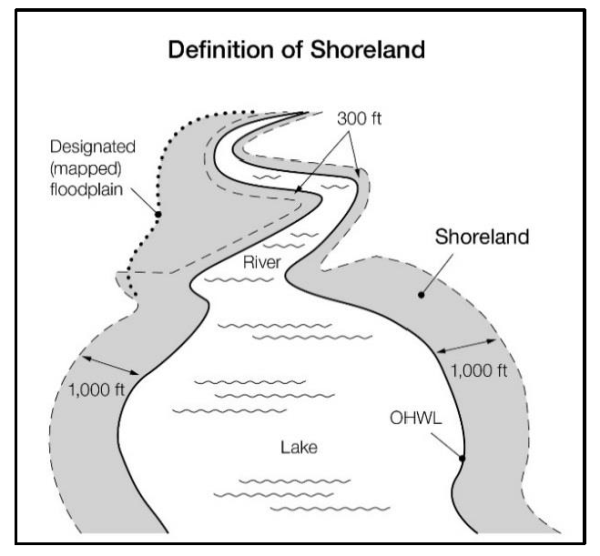
- 300 feet from a river or stream, or the landward extent of a floodplain designated by ordinance on a river or stream, whichever is greater.
Side lot line means any lot boundary line not a front or rear line thereof; a side line may be a party lot line, a line bordering on an alley or place or a side street line.
Side yard means a yard between the main building and the adjacent side line of the lot, and extending entirely from a front yard to the rear yard.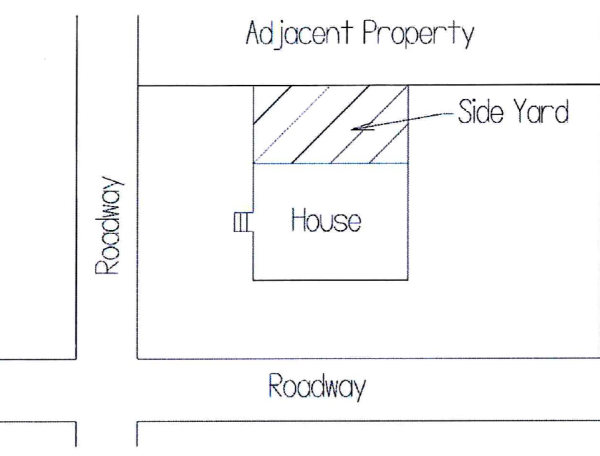 Sign means any letter, word, symbol, poster, picture, statuary, reading material, or representation in the nature of advertisement, announcement, message, or visual communication, whether painted, posted, printed, affixed, or constructed, including all associated brackets, braces, supports, wires, and structures, which is displayed for informational or communicative purposes. In the case of signs made up of discrete letters and/or logos attached individually to a building wall, but designed and constructed so that all elements are integral to the whole, the sign area shall be calculated as the area of the smallest rectangle enclosing all individual elements.
Significant historic site means any archaeological site, standing structure, or other property that meets the criteria for eligibility to the National Register of Historic Places or is listed in the State Register of Historic Sites, or is determined to be an un-platted cemetery that falls under the provisions of Minn. Stats. § 307.08. A historic site meets these criteria if it is presently listed on either register or if it is determined to meet the qualifications for listing after review by the Minnesota State Archaeologist or the Director of the Minnesota Historical Society. All un-platted cemeteries are automatically considered to be significant historic sites.
Single-family, detached, means a housing unit designed to be utilized by one family, except that the structure may also contain an accessory dwelling unit where expressly authorized pursuant to this title. A detached accessory dwelling unit shall not be considered a single-family dwelling unit for the purposes of this title.
Site Plan means a plan, to scale, showing uses and structures proposed for a parcel of land as required by the regulations involved. The term "Site Plan" includes lot lines, streets, building sites, reserved open space, buildings, major landscape features-both natural and manmade-and, depending on requirements, the locations of proposed utility lines.
Slope means the degree of deviation of a surface from the horizontal, usually expressed in percent or degrees.
Solid fuel-fired heating devices mean any equipment device or apparatus, or any part thereof, which is installed, affixed or situated outdoors for the primary purpose of combustion of fuel to produce heat or energy used as a component of a heating system providing heat for any interior space or water source.
Specified anatomical areas mean anatomical areas consisting of:
- Less than completely and opaquely covered human genitals, pubic region, buttock, anus, or female breast below a point immediately above the top of the areola;
- Human male genitals in a discernable turgid state, even if completely and opaquely covered.
Specified sexual activities means activities consisting of the following:
- Actual or simulated sexual intercourse, oral copulation, anal intercourse, oral-anal copulation, bestiality, direct physical stimulation of unclothed genitals, flagellation or torture in the context of a sexual relationship, or the use of excretory functions in the context of a sexual relationship, and any of the following sexually oriented acts or conduct: anilingus, buggery, coprophagy, coprophilia, cunnilingus, fellatio, necrophilia, pederasty, pedophilia, piquerism, sapphism, zooerasty;
- Clearly depicted human genitals in the state of sexual stimulation, arousal or tumescence; or
- Use of human or animal ejaculation, sodomy, oral copulation, coitus, or masturbation or other sexually explicit contact.
The term "specified sexual activities" is also defined as:
- Human genitals in a state of sexual stimulation or arousal;
- Acts of human masturbation, sexual intercourse or sodomy;
- Fondling or other erotic touching of human genitals, pubic region, buttock or female breast;
- Flagellation or torture in the context of a sexual relationship;
- Masochism, erotic or sexually oriented torture, beating or the infliction of pain;
- Erotic touching, fondling or other such contact with an animal by a human being; or
- Human excretion, urination, menstruation, vaginal or anal irrigation as part of or in connection with any of the activities set forth in Subsections (a) through (f) of this section.
Stationary Tiny Home means a dwelling unit that is between 100-400 square feet; intended for separate, independent living quarters; installed permanently on the property; and designed as a year-round residence for one household which includes basic functional areas that support normal daily routines including cooking, sleeping, and sanitation.
Steep slope means having average slopes over 12 percent, as measured over horizontal distances of 50 feet or more, which are not bluffs.
Storage building means structures meant for the purpose of storing possessions or holding them for their future use.
Story means that portion of a building included between the upper surface of a floor and upper surface of the floor next above, except that the top-most story shall be that portion of the building included between the upper surface of the top-most floor and ceiling or roof above. If the finished floor level directly above a basement or cellar, or unused underfloor space is more than six feet above grade as defined herein for more than 50 percent of the total perimeter or is more than 12 feet above grade as defined herein at any point, such basement, cellar, or unused underfloor space shall be considered as a story. Otherwise, a basement shall not be counted as a story.
Street means a general term denoting a public or private thoroughfare which affords the principal means of access to abutting property. The term "street" includes all facilities which normally are found within the right-of-way; it shall also include such other designations as highway, thoroughfare, parkway, throughway, road, pike, avenue, boulevard, lane, place, court, or other such terms but shall not include pedestrian way or alley.
Street, collector, means a feeder street which provides connection primarily between arterial streets or arterial streets and minor streets. Collector streets include the principal entrance streets of a residential development and the principal streets for circulation within such developments.
Street, cul-de-sac, means a comparatively short minor street having one end open to traffic and the other end permanently terminated by a vehicular turn-around.
Street frontage means the proximity of a parcel of land to one or more streets. An interior lot has one street frontage and a corner lot has two frontages. The principal street frontage of a corner lot shall be determined by consideration of parcel dimensions, address, driveway location, usability of the lot, configuration of adjacent lots, and likely future development in the area. Should there be any question on this, the City shall make a determination.
Street, major or arterial, means a street of considerable continuity, which is used primarily for heavy through traffic between major traffic generation areas.
Street, marginal access, means a minor street which is parallel and adjacent to a highway or an arterial street, and which provides access to abutting properties and protection from traffic.
Street, minor or local, means a street which serves primarily as access to abutting properties and is not intended to carry through traffic.
Street width means the street right-of-way width, measured at right angles to the centerline of the street.
Structural alterations means any change in the supporting members of a structure, such as bearing walls, columns, beams or girders.
Structure means anything which is built, constructed or erected on the ground or attached to the ground or on-site utilities, including, but not limited to, buildings, factories, sheds, detached garages, cabins, manufactured homes, and recreational vehicles not meeting the exemption criteria specified in PCC 13.88.010(j)(5)c.2.i.A.2 and other similar items. The term "structure" means any building or appurtenance, including decks, except aerial or underground utility lines, such as sewer, electric, telephone, telegraph, gas lines, towers, poles, and other supporting facilities.
Subdivider means any individual, firm, association, syndicate, partnership, corporation, trust, or legal entity having sufficient interest in the land sought to be subdivided to commence and maintain proceedings to subdivide under this title.
Subdivision means the separation of an area, parcel, or tract of land under single ownership into two or more parcels, tracts, lots, or long-term leasehold interests where the creation of the leasehold interest necessitates the creation of streets, roads, or alleys, for residential, commercial, industrial, or other use or any combination thereof, except those separations:
- Where all the resulting parcels, tracts, lots, or interests will be 20 acres or larger in size and 500 feet in width for residential uses and five acres or larger in size for commercial and industrial uses;
- Creating cemetery lots;
- Resulting from court orders, or the adjustment of a lot line by the relocation of a common boundary.
The term "subdivision" means land that is divided for the purpose of sale, rent, or lease, including Planned Unit Developments.
Substandard use means any use existing prior to the date this title was adopted which is permitted within the applicable zoning district but does not meet the minimum lot area, frontage, setbacks, water frontage length, or other dimensional standards of this title.
Substantial damage means damage of any origin sustained by a structure whereby the cost of restoring the structure to its before damaged condition would equal or exceed 50 percent of the market value of the structure before the damage occurred.
Substantial improvements means within any consecutive 365-day period, any reconstruction, rehabilitation (including normal maintenance and repair), repair after damage, addition, or other improvement of a structure, the cost of which equals or exceeds 50 percent of the market value of the structure before the start of construction of the improvement. The term "substantial improvements" includes structures which have incurred substantial damage, regardless of the actual repair work performed. The term "substantial improvements" does not, however, include either:
- Any project for improvement of a structure to correct existing violations of State or local health, sanitary, or safety code specifications which have been identified by the City and which are the minimum necessary to ensure safe living conditions; or
- Any alteration of an historic structure, provided that the alteration will not preclude the structure's continued designation as an historic structure.
Suitability analysis means an evaluation of land to determine if it is appropriate for the proposed use. The analysis considers factors relevant to the proposed use and may include the following features: susceptibility to flooding; existence of wetlands; soils, erosion potential; slope steepness; water supply, sewage treatment capabilities; water depth, depth to groundwater and bedrock, vegetation, near-shore aquatic conditions unsuitable for water-based recreation; fish and wildlife habitat; presence of significant historic sites; or any other relevant feature of the natural land.
Surfaced means describing ground that has had asphalt, concrete or similar material applied to it to make it impervious or solid.
Tangent means a straight line that is perpendicular to the radius of a curve where it intersects a curve.
Temporary sign means a non-permanent sign or advertising display intended to be displayed for a short, usually fixed, period of time.
Temporary uses means any use not approved or intended for permanent use.
Through lot means an interior lot having frontage on two streets.
Townhouse/condominiums means owner-occupied multiple-family dwelling, neither of which is an accessory dwelling unit, but sharing one or more common walls subject to the provisions of the Minnesota Condominium Act (Minn. Stats. §§ 515.01--515.19, as amended).
Transit stop means includes enclosed or partially enclosed structures intended as waiting areas for public transit.
Transition means a strip of land located between incompatible land uses which is subject to private use restrictions, or a negative easement, or is dedicated to public uses as open space, for the purpose of protecting the built environment of a development or to enhance a street right-of-way, or both.
Triplex/quadplex means three or four dwelling unit complex that shares at least one common wall.
Use means the purpose or activity for which the land or building thereon is designated, arranged, or intended, or for which it is occupied, utilized or maintained, and shall include the performance of such activity as defined by the performance standards of this title.
Vacant dwelling means an abandoned dwelling that is not maintained in a safe or secure condition so as to cause a potential hazard to the community.
Variance means a modification of the specific requirements of this title granted by the Board of Adjustment in accordance with the terms of this title for the purpose of assuring that no property because of special circumstances applicable to it shall be deprived of privileges commonly enjoyed by other properties in the same vicinity and Zoning District. Such modifications shall not include authorizing a use not among the uses specified by this title as permitted in the district in which such property is located. The term "variance" also means the same as that defined in Minn. Stats. § 462.357, Subd. 6(2).
Vegetation means the sum total of plant life in some area; or a plant community with distinguishable characteristics.
Vehicle. See Motor vehicle.
Vehicle repair and sales means any business oriented toward the sales, repair, or maintenance of motorized vehicles.
Vertical curve means the surface curvature on a street centerline located between lines of different percentage of grade.
Wall sign means a sign that is affixed directly to or painted on, or otherwise inscribed on an exterior wall or window of any building, and projects therefrom no more than 12 inches.
Warning sign means a sign exclusively devoted to warning the public of dangerous conditions and unusual hazards such as drop offs, high voltage, fire danger, and explosives.
Waste disposal facility means and includes any areas used for the disposal of solid wastes.
Water-dependent use means the use of land for commercial, industrial, public or semi-public purposes, where access to and use of a public water is an integral part of the normal conduct of operation. Marinas, resorts, and restaurants with transient docking facilities are examples of commercial uses typically found in shoreland areas.
Water-oriented accessory structure or facility means a small, above ground building or other improvement, except stairways, fences, docks, and retaining walls, which, because of the relationship of its use to surface water, reasonably needs to be located closer to public waters than the normal structure setback. Examples of such structures and facilities include, watercraft and watercraft equipment storage structures, gazebos, screen houses, fish houses, pump houses, saunas, patios, and detached decks. Boathouses and boat storage structures given the meaning under Minn. Stats. § 103G.245 are not a water-oriented accessory structures.
Waterbody means a body of water (lake, pond) in a depression of land or expanded part of a river, or an enclosed basin that holds water and is surrounded by land.
Watercourse means a channel or depression through which water flows, such as rivers, streams, or creeks, and may flow year-round or intermittently.
Watershed means the area drained by the natural and artificial drainage system, bounded peripherally by a bridge or stretch of high land dividing drainage areas.
Watershed management or flood control structure means a dam, floodwall, wingdam, dike, diversion channel, or an artificially deepened or widened stream channel following the same or approximately the same course as the natural channel, or any other structure for altering or regulating the natural flow condition of a river or stream. The term "watershed management or flood control structure" does not include pilings, retaining walls, gabion baskets, rock riprap, or other facilities intended primarily to prevent erosion and which must be authorized by period from the Commissioner of the Minnesota Department of Natural Resources.
Wayfinding means several different types of signage, including: Directional signs that point the way to various locations. They can be simple or complex, and usually appear at junctions or along a route to lead the way to a particular place. They keep people or vehicles moving toward something.
Wetland has the meaning given under Minn. R. Pt. 8420.0111.
Wetlands means as provided in this section. (See Wetland.)
Wildlife means all free living animals.
Winery means those wine producing land uses where all aspects of production occur within the footprint of the site. Use includes fruit processing, fermentation, pressing, barrel and bottle storage, bottling, wine tasting, and direct retail sale of wine.
Yard means an open space at grade between a building and the adjoining lot lines, unoccupied and unobstructed by any portion of a structure from the ground upward, except as otherwise provided. In measuring a yard for the purpose of determining the width of a side yard, the depth of a front yard or the depth of a rear yard, the least horizontal distance between the lot line and the building shall be used. Where lots abut a street, all yards abutting said street shall be measured from the street right-of-way.
Yard, front, means a yard across the full width of the lot extending from the front line, or face, of the main building to the front line of the lot.
Yard, rear, means a yard extending across the full width of the lot and lying between the rear line of the lot and the nearest line of the building.
Yard, side, means a yard between the side line of the lot and the nearest line of the building and extending from the front line of the lot to the rear yard. An exterior side yard is a yard located on a corner lot which extends from the front yard to the rear yard, along the abutting street or avenue.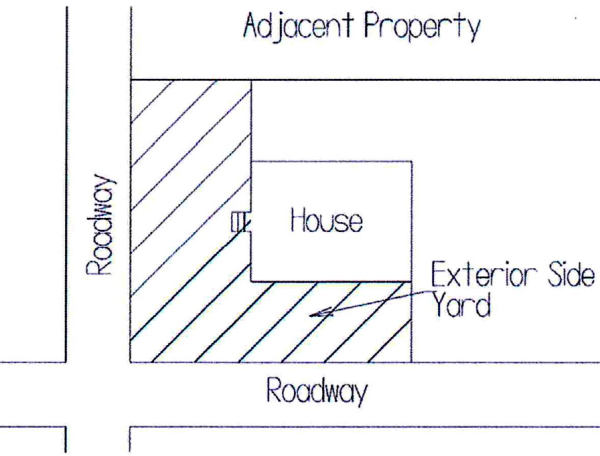
Zoning Administrator means a person appointed by the City Council to enforce the Zoning Ordinance.
Zoning code means the duly approved, enacted, and amended ordinance which controls and regulates zoning in the City of Pine City.
Zoning map means the maps incorporated into this title as part thereof, and as amended, designating the zoning district.
(Prior Code, §§ 10.100.1100, 10.400.0810, 10.500.0330, 10.500.0510, 10.700.0110; Ord. No. 20-04, 8-5-2020; Ord. No.17-02, 4-5-2017; Ord. of 5-4-2017)
Adopted by Ord. 21-10 on 10/6/2021
Amended by Ord. 2025-05 on 4/2/2025

