
Pine City City Zoning Code
CHAPTER 13
76 DEVELOPMENT AND STRUCTURES
ARTICLE I DEVELOPMENT AND STRUCTURES IN GENERAL (RESERVED)
Adopted by Ord. 21-10 on 10/6/2021
21-10
2025-05
2025-14
13.76.110 Purpose
The purpose of this chapter is to determine minimum yard, area and building size requirements to be provided for each zoning district.
(Prior Code, § 10.400.0205)
Adopted by Ord. 21-10 on 10/6/2021
13.76.120 General Statement
No new lot, yard, or other open space shall be reduced in area or dimension so as to make such lot, yard or open space less than a minimum required by this article. If the existing yard or other open space is less than the minimum required, it shall not be further reduced.
(Prior Code, § 10.400.0210)
Adopted by Ord. 21-10 on 10/6/2021
13.76.130 Yard Requirements
The minimum yard setback distances from the appropriate lot lines set forth within the district provisions of this article.
- Front yard setbacks. Where existing structures within a block have front yard setbacks different from those required, the front yard minimum setback shall be the average of the adjacent structures. If there is only one adjacent structure, the front yard minimum setback shall be the average of the required setback and the setback of the adjacent structure. In no case shall the required front yard setback exceed 30 feet.
- Corner lots. Where a lot is located at the intersection of two or more streets, the width of the yard along the side street, also defined as an exterior side yard, shall not be less than that of the district front yard requirements and vision clearance must be maintained as outlined in PCC 13.72.050.
- Through lots. On a lot fronting on two parallel streets, both street lines shall be front lot lines for applying the yard regulations of this article.
- Earth sheltered buildings. Computations for yard requirements shall be based upon measurements from the exposed exterior surface of the building.
- Exceptions. The following shall not be considered as encroachment into yard requirements.
- Terraces, steps, stoops, decks, or similar features provided, in each case that the structure’s height does not exceed 2½ feet above the height of the principal structure’s main floor level and that the structure does not extend to a distance less than five feet from any lot line.
- Architectural projections extending not more than three feet into a yard area, except, in rear yards, recreational and laundry drying equipment, trellises and air conditioning equipment and heat pumps.
(Prior Code, § 10.400.0215)
Adopted by Ord. 21-10 on 10/6/2021
13.76.140 Lot Area Requirements
The minimum lot area requirements shall be as set forth within the district provisions of this article; lot area exception. A lot of record existing upon the effective date of this Code which does not meet the area or width requirements of this article may be utilized, provided the measure of such area or width is within 60 percent of the requirements of this article and that due to ownership patterns, the combining of adjacent lots to meet the requirements of this article is not possible.
(Prior Code, § 10.400.0220)
Adopted by Ord. 21-10 on 10/6/2021
13.76.150 Building Size And Architectural Requirements
The following building size and architectural standards shall apply to all districts unless otherwise specified.
- Height exceptions. The building height limits established shall not apply to belfries, cupolas, domes, spires, monuments, airway beacons, radio towers, flag poles, chimneys or flues; nor to elevators, water tanks, poles, towers and other structures for essential services; nor to similar structures for essential services; nor to similar structures extending above the roof of any building and not occupying more than 25 percent of the area of the roof.
- Architectural requirements. The following architectural requirements shall apply to A-O (Agricultural and Open Space) and all residential districts except the MHP Manufactured Home Park District:
- Dwelling shall contain a total area of at least 401 square feet, unless it is on a nonconforming lot and will be a tiny home. Tiny home square footage will be 100-400 square feet.
- Dwellings shall be placed on a permanent foundation forming a complete enclosure under exterior walls.
- Exterior and foundation walls shall have the appearance of wood or masonry regardless of their actual composition.
(Prior Code, § 10.400.0225)
Adopted by Ord. 21-10 on 10/6/2021
Amended by Ord. 2025-05 on 4/2/2025
13.76.160 Accessory Structures, Uses And Equipment
- General statements. An accessory building shall be considered an integral part of the principal building if it is connected to the principal building by a covered passageway.
- Location. No accessory structures shall be located in the front yard or within ten feet of the principal structure unless it is attached to the principle structure.
- Height. Accessory structures shall not exceed 18 feet in height in the R-1, R-1A and R-2 districts.
- Setbacks. Accessory structures shall:
- Be located seven feet or more from all lot lines of adjoining lots, except as otherwise permitted within this article.
- Not be located within a utility easement.
- Size. No accessory building shall exceed 1,008 square feet in size.
- Building design standards. The architectural design and appearance of all accessory buildings, and structures shall comply with the following standards:
- The exterior finish of all accessory buildings in the R-1 and R-2 districts shall match as close as possible the exterior finish of the dwelling unit on the lot. For example, lap siding on the dwelling unit shall make lap siding on the accessory building mandatory; board and batten siding shall make board and batten siding on the accessory building mandatory; and boxed eves and rakes (roof slants) on accessory buildings shall be required where they occur on the dwelling unit. Brick, stucco, and stone dwellings shall justify a variance for an accessory building. An attached garage’s square footage much be included in calculations and the roofing must match the siding.
- Exceptions. Lawn or storage sheds 200 square feet or less in floor area shall be exempt from these standards.
(Prior Code, § 10.400.0230)
Adopted by Ord. 21-10 on 10/6/2021
13.76.170 Accessory Buildings In R-1 And R-2 Districts
- Accessory buildings in R-1 and R-2 (Residential) districts on lots where a garage is attached to the home, shall be limited to one additional storage building and one non-storage building, so long as the total floor area does not exceed 1,200 square feet or result in a total lot coverage by buildings of 25 percent or more; accessory buildings on lots where a garage is not attached to the home shall be limited to two storage buildings and one non-storage building, with the total floor area not to exceed 1,800 square feet or result in a total lot coverage by buildings of 25 percent or more.
- On R-2 non-conforming lots with stationary tiny homes (any dwelling unit less than 401 square feet), accessory structures shall be allowable by conditional use permit. The accessory structure shall not exceed the total square footage or height of the tiny home.
(Prior Code, § 10.400.0235)
Adopted by Ord. 21-10 on 10/6/2021
Amended by Ord. 2025-05 on 4/2/2025
13.76.180 Accessory Dwelling Units In A-O, R-1 And R-2 Districts
Internal, attached and detached accessory dwelling units (including stationary tiny homes) shall be permitted or conditional single-family dwelling; accessory dwelling units shall be prohibited accessory to all other uses. Internal, attached and detached accessory dwelling units shall be allowed, subject to the following development standards.
- Height. The maximum height of a detached accessory dwelling unit may be varied, provided that the height of the detached accessory dwelling unit shall not exceed the height of the principle structure.
- Use. Either the accessory dwelling unit or the principle structure must be owner-occupied for the entire calendar year.
- Size. The minimum gross floor area for all types of an accessory dwelling unit shall be 100 square feet.
- Setbacks. The accessory dwelling unit structure shall be located seven feet or more from all lot lines of adjoining lots, except as otherwise permitted within this article. The structure shall not be located within a utility easement or within the front yard of the principle use structure.
- Quantity. No more than one accessory dwelling unit shall be allowed on a parcel.
- Subdivision. The creation of an accessory dwelling unit shall not create a separate tax parcel.
- Internal accessory dwelling units.
- Size. Internal accessory dwelling units are limited to 800 square feet. In no case shall the floor area of the internal accessory dwelling unit exceed the floor area of the first floor of the primary structure.
- Location. The entire internal accessory dwelling unit shall be located on one level.
- Design. The creation of the accessory dwelling unit shall not result in additional entrances facing the public street on the primary structure. Any stairways leading to the accessory dwelling unit shall be enclosed.
- Attached accessory dwelling units.
- Size. The maximum floor area for an attached accessory dwelling unit shall be 800 square feet.
- Design. The creation of the accessory dwelling unit shall not result in additional entrances facing the public street on the primary structure. Any stairways leading to an upper story of an accessory dwelling unit shall be enclosed. The primary exterior materials of an attached accessory dwelling unit shall match the primary exterior materials of the principal structure.
- Detached accessory dwelling units.
- Height. A detached accessory dwelling unit shall not exceed the height of the principal residential structure or 18 feet, whichever is less. In no case shall the highest point of the roof of the detached accessory dwelling unit exceed the highest point of the roof of the principal residential structure.
- Size. The floor area of a detached accessory dwelling unit shall not exceed 1,000 square feet, including any areas designed or intended to be used for parking of vehicles and any half-story floor area. When a lot includes a detached accessory dwelling unit, the combined floor area of the footprint of the detached accessory dwelling unit, and all other accessory structures and uses designed or intended to be used for parking of vehicles, shall not result in total lot coverage by buildings of 25 percent or more.
- Location. Detached accessory dwelling units shall be located entirely to the rear of the principle structure and not within ten feet of the principal structure.
- Design. The primary exterior materials of an attached accessory dwelling unit shall match the primary exterior materials of the principal structure and shall be durable, including, but not limited to, masonry, brick, stone, wood, cement-based siding or glass. Exterior stairways shall be allowed, provided that the finish of the railing matches the finish or trim of the detached accessory dwelling unit. Raw or unfinished lumber shall not be permitted on an exterior stairway.
(Prior Code, § 10.400.0240)
Adopted by Ord. 21-10 on 10/6/2021
Amended by Ord. 2025-05 on 4/2/2025
13.76.190 Fencing And Retaining Walls
The requirements of this section shall apply to all fences and retaining walls unless otherwise stated. These regulations do not apply to fences and retaining walls required by regulations of a State or Federal agency, or by the City for reasons of public safety.
- Height.
- No fence shall exceed four feet in the front yard or exterior side yard, or seven feet in the side or rear yard in height as measured from the average point between the highest and lowest grade. Taller fencing may be constructed only through the approval of a Conditional Use Permit.
- Retaining walls over 48 inches, measured from the top of the footing to the top of the wall, are required to be designed and certified by a registered professional licensed in Minnesota. A copy of the signed construction drawings should be submitted with a Site Plan or building permit.
- Setback.
- All fences, including footings, shall be located entirely upon the property whose owner or occupant constructs the fence. It is the property owner’s or occupant’s responsibility to locate property lines. No fence, screen, or structure which obstructs the view shall be located within the vision clearance area, as indicated by PCC 13.72.050 which reads: The vision clearance area shall be a triangular shape with two sides following the lot lines parallel to the curb, to a point 25 feet from the corner, and a third side being a line connecting those two points. The clear vision area shall contain no planting, fence, wall, structure or temporary or permanent obstruction to sight exceeding 36 inches above the adjacent street grade, except for trees with branches and foliage removed to a height of eight feet above the ground.
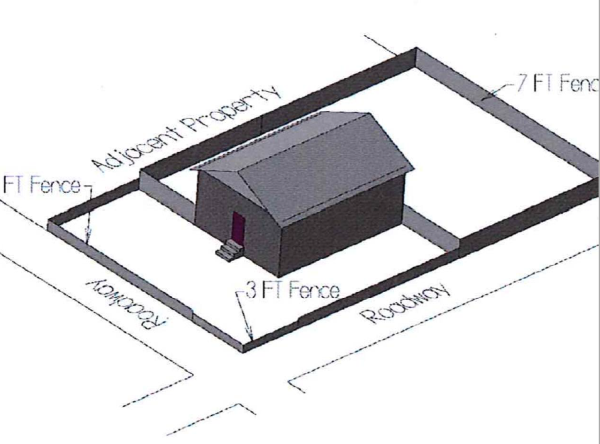
- There is no specific or nominal setback from rear or side property lines for retaining walls, however, impacts to drainage will be considered by the City’s engineer in determining setbacks. In no case shall any portion of a retaining wall or its reinforcement encroach over a property line, without consent of the property owner, which must be recorded against both properties. Retaining walls cannot encroach into any easement of record, including drainage and utility easements or right-of-way without the City’s approval.
- All fences, including footings, shall be located entirely upon the property whose owner or occupant constructs the fence. It is the property owner’s or occupant’s responsibility to locate property lines. No fence, screen, or structure which obstructs the view shall be located within the vision clearance area, as indicated by PCC 13.72.050 which reads: The vision clearance area shall be a triangular shape with two sides following the lot lines parallel to the curb, to a point 25 feet from the corner, and a third side being a line connecting those two points. The clear vision area shall contain no planting, fence, wall, structure or temporary or permanent obstruction to sight exceeding 36 inches above the adjacent street grade, except for trees with branches and foliage removed to a height of eight feet above the ground.
- Design.
- The finished side of a fence shall face the adjacent property. Razor wire, concertina, aboveground electrical fences and barbed wire fences are prohibited; except in the Agricultural-Open Space District.
- Retaining walls supporting an embankment to be retained on any lot that exceeds 48 inches in height shall be benched so that no individual vertical segment of a retaining wall exceeds a height of six feet except where the City’s engineer determines that topography requires a wall of greater height. Each individual horizontal bench segment, so constructed, shall be a minimum width of 36 inches.
- Maintenance. All fences and retaining walls shall be maintained in good repair, by the property owner. Any fence or retaining wall that is potentially dangerous or in disrepair shall be removed or repaired, at the cost of the property owner.
- Other. Except as provided in Subsection (b) of this section, fences, retaining walls, hedges, or shrubs, less than four feet in height may be located on any part of the lot.
(Prior Code, § 10.400.0250; Ord. No. 19-17, 11-14-2019; Ord. No. 20-05, 8-5-2020)
Adopted by Ord. 21-10 on 10/6/2021
13.76.195 Regulations For Temporary Sheds/Non-Permanent Structures In The R-2 Districts
- Purpose. The purpose of this section is to provide for the erection of small temporary sheds/non-permanent structures (such as a shed, pergola, gazebo, greenhouse, arbor, workshop, playhouse, or carport) when used for residential accessory purposes requiring a permit. A temporary structure is defined pursuant to Minnesota Building Code.
- Permits, regulations per Zoning District. All temporary sheds/non-permanent structures with a proposed location within a required yard setback shall require an Interim Use Permit (PCC 13.84.080, Interim Use Permits (IUP)) in R-2 Zoning District.
- Special requirements.
- Temporary sheds/non-permanent structures shall consume an area of no more than 200 square feet, be no more than 12 feet in height, and have side walls of no more than eight feet in height.
- Temporary structures may be placed in a required yard area, provided that reasonable efforts have been taken to comply with the setback regulations listed in PCC 13.76.160, Accessory Structures, Uses and Equipment, and no such structure may be placed to obstruct visibility at any intersection or driveway.
- No permit shall be issued for temporary sheds/non-permanent structures unless a site plan has also been approved by the fire inspector and Pine City Building Official.
- The temporary structure does not involve the erection of a substantial structure nor require any other permanent commitment of the land and shall conform to the structural strength, fire safety, means of egress, accessibility, light, ventilation and sanitary requirements of this Code as necessary to ensure public health, safety and general welfare.
- A temporary structure approval granted, shall be valid for a time limit identified with certainty by the City, at which time the approval shall expire and the structure shall be dismantled and removed from the property within 30 days.
- No temporary structure shall incorporate outside lighting which creates a nuisance due to glare or intensity, as provided for in PCC 13.76.410 et seq., Exterior Lighting Standards.
- Where applicable, all city, state and federal laws, regulations and ordinances shall be complied with and all necessary permits secured.
- Whenever a permit for erection of a temporary structure has been issued, a similar application for an permit for erection of a temporary structure shall not be considered again by the Zoning Administrator for at least one year from the date of approval.
(Ord. No. 21-06, 6-2-2021)
Adopted by Ord. 21-10 on 10/6/2021
13.76.200 Purpose
It is the purpose of this section to provide for the regulation of and design standards for off-street parking facilities within the City, to minimize congestion on the public rights-of-way, and to maximize the safety and general welfare of the public.
(Prior Code, § 10.400.0305)
Adopted by Ord. 21-10 on 10/6/2021
13.76.210 General Provisions
- No provision of any section of this article shall be less restrictive than those outlined in this section. The off-street parking requirements and off-street loading requirements of this section shall apply within all zoning districts.
- At the time of erection of a new structure, or at the time of enlargement or change in use of an existing structure within any district in the City, off-street parking or loading spaces shall be provided as in this section, unless the City deems it in the public interest to waive or modify this requirement. Parking shall be adequate to meet the demand in all cases. In such case where reconstruction enlarges bulk or floor area or other such measurable unit prescribed in this article, parking and loading facilities shall be provided for that measurable unit beyond the original type or use of structure.
- Determination of required number of spaces (also see PCC 13.100.010).
- Fractional spaces. When determination of the number of off-street parking spaces required by this regulation results in a requirement of a fractional space, the fraction of one-half or less may be disregarded, and a fraction in excess of one-half shall be counted as one parking space.
- Employees. Employees, when used as a measurement for determining the number of parking spaces for a new or established expanding business, shall be estimated in a manner approved by the Planning and Zoning Commission.
- Parking for multiple use buildings. The number of parking spaces required for land or buildings used for two or more purposes, shall be the sum of the requirements for the various uses, computed in accordance with this article, excepting properties in the Mixed-Use District. Parking facilities for one use shall not be considered as providing the required parking facilities for any other use, except churches. The required parking spaces per use are specified in PCC 13.100.010.
- Use of required parking spaces. Required accessory off-street parking facilities provided for the uses hereinafter listed shall be solely for the parking of motor vehicles in operating condition of patrons, occupants, or employees of such uses and shall not be used for the storage of vehicles, boats, motor homes, campers, mobile homes or materials or for the parking of trucks used in conducting the business or use.
- Residential areas. No person, firm, corporation, or partnership shall drive through, park, or conduct any activity from a pick-up truck rated more than one-ton, four-wheel van, semi-tractor, or commercial vehicle upon any street, highway, or roadway within a residential area except for local deliveries. Delivery shall mean the active loading or unloading of the vehicle or part of the same and shall not exceed 15 minutes. The parking of such vehicles upon any private or public parking lot in any residential area is expressly prohibited without the permission of the property owner or agent for said property. The driver of any semi-tractor and trailer is hereby prohibited from allowing any motors that are a part of the semi-tractor or trailer from running while parked in any residential area regardless of location. The City may cause the removal of any vehicle or part thereof from any residential area where found in violation of the requirements of this article. Any expense incurred by said removal shall be at the expense of the driver, operator, or owner of the towed unit.
- Location of off-street parking. All required off-street parking facilities shall be located within 350 feet of the primary entrance.
- Walkways adjacent to primary structures. All walkways, except for those walkways immediately adjacent to the entrance to the structure, must be kept a minimum of five feet from the structure except for properties zoned CBD, Central Business District. This five-foot setback shall be landscaped with a minimum of one plant unit per every 50 linear feet or portion thereof.
- Parking of commercial vehicles or equipment.
- In a residential district. No commercial vehicles, or equipment, exceeding 30,000 pounds gross weight, shall be parked, stored, or otherwise continued in a residential district for a maximum of three 24-hour periods per month unless in a completely enclosed structure or unless they are being used in conjunction with a legitimate service being rendered for the benefit of the residential premises.
- In a commercial/industrial district. Parking of commercial vehicles for the purposes of construction in a commercial area shall be permitted, provided that they are not parked prior to issuance of a Building Permit or remain after a Certificate of Occupancy. Such commercial vehicles shall be confined to the site of construction, alteration or repair and shall be removed within two years of the date of issuance of the first Building Permit or when the particular project is completed, whichever is sooner as determined by the Zoning Official.
- Parking and storage of certain vehicles. Automotive vehicles or trailers of any kind or type without current legal license plates, for sale or rent, or those inoperable shall not be parked or stored on any residentially zoned property other than in completely enclosed building.
- Maintenance. It shall be the joint responsibility of the lessee and/or owner of the principal use or building to maintain in a neat and adequate manner, the parking area, striping, landscaping and screening.
(Prior Code, § 10.400.0310; Ord. No. 19-15, 10-2-2019)
Adopted by Ord. 21-10 on 10/6/2021
13.76.220 Parking Plan And Requirements
All Site Plans shall be accompanied by a Site Plan drawn to scale and dimensioned indicating the location of all off-street parking and loading spaces in compliance with the requirements of this section. Such plan shall be reviewed by the Planning Commission and approved by the City Council, in accordance with the criteria developed in this section. The Site Plan should include at least the following:
- Delineation of individual parking and loading spaces by adequate striping.
- Circulation area necessary to serve spaces.
- Access to streets and property to be served.
- Curb cuts.
- Dimensions, continuity, and substance of required screening.
- Grading, drainage, surfacing, and subgrading details.
- Delineation of obstacles to parking and circulation in finished parking area.
- Specification as to signs and bumper guards.
- Sidewalks, curbs and gutters.
- Landscaping and screening.
- Lighting. Other pertinent details.
- Zoning, setback, and statement of use.
- North point and scale.
- All adjacent streets and public and private improvements within 200 feet.
- Critical dimensions indicating setback and parking lot design layout.
(Prior Code, § 10.400.0315)
Adopted by Ord. 21-10 on 10/6/2021
13.76.230 Design Requirements
Upon review and recommendation by the Planning Commission and approval by the City Council, all off-street parking plans shall comply with the following design standards, consistent with Minnesota State Law and applicable state and local codes:
- Surfacing. All parking and driveway areas shall be surfaced with asphalt, concrete, or other durable, dustless materials as approved by the Planning Commission and City Council, in accordance with Minnesota Stormwater Manual guidelines and local erosion control standards.
- Drainage. All off-street parking areas must be properly graded and drained to prevent surface water runoff onto adjacent properties or public rights-of-way, in accordance with MN Rules Chapter 7050 and applicable watershed district regulations.
- Lighting. All lighting used to illuminate off-street parking areas shall be fully shielded to prevent light spill onto adjacent properties or public right-of-way and comply with Minnesota Pollution Control Agency (MPCA) lighting standards and city code Article IV.
- Signs. No signage shall be so located as to restrict the sight, orderly operation, and traffic movement within any parking area.
- Screening. All parking lots shall be screened in accordance with PCC 13.76, Art. IV.
- Design standards. All parking areas must meet the minimum design standards established in this article, including: the minimum number of required stalls, dimensions, and required number of accessible stalls as mandated by MN Rules Chapter 1341 and the Americans with Disabilities Act (ADA) and PCC 13.04.010.
- Setback. Unless otherwise specified, parking and maneuvering areas may be located within required yards, provided a minimum 10-foot setback is maintained from all property lines or buffer yards.
- Striping required. All parking lots must be clearly delineated with pavement striping that meets the size requirements listed in Subsection (i).
- Minimum parking space dimensions. All stall dimensions and drive aisle widths must comply with the following:
| Angle of Parking | Maneuvering Lane Width (in feet) | Minimum Stall Width (in feet) | Minimum Stall Depth (in feet) | Total Width of One Tier of Space Plus Maneuvering Lane (in feet) | Length Along Curb Stall (in feet) |
| Parallel Parking | 12 | 8 | 21 | 20 | |
| Angled 30-53 degrees | 12 | 8.6 | 18 | 30.6 | 12.7 |
| Angled 54-75 degrees | 15 | 8.6 | 18 | 35 | 10.4 |
| Perpendicular 75-90 degrees | 20 | 8.6 | 18 | 38 | 12.7 |
*Maximum legal speed limit must be 30 mph.
*At least two through-traffic lanes must be provided.
*Diagonal parking provisions must be established by a cooperative agreement between the local road authority and the business.
1. Must include angle and pavement markings.
2. Must comply with MN Stat. § 169.34.
3. Minimum 2-foot clearance from curb to fixed objects.
Exception. In lots with 10 or more spaces, up to 20% of spaces may be designated for compact cars (min. size: 7.5 ft x 15 ft) and must be clearly marked.
(j) Access/egress. Entrances or exits for off-street parking lots with over four spaces shall not be located within 75 feet of the intersection of two public right-of-way lines, in compliance with MN MUTCD visibility triangle standards.
(k) Lighting. All parking lot lighting shall conform to Article IV and any applicable state light pollution and dark sky compliance guidelines.
(l) Cross access easements. Cross-access drives shall be required between all non-residential properties. Final construction shall occur following the execution of a recorded easement agreement between adjacent property owners.
(m) Curb cuts. Each property is entitled to one curb cut. Single-family lots may only access local or minor streets, unless such access is unavailable. Curb cuts must comply with MnDOT access spacing guidelines.
(n) Handicap accessible. Design requirements:
| Type | Width (in feet) | Aisle Space (in feet) | Vertical Clearance (in feet) | Notes |
| Standard | 8 | 5 | No Minimum | Shared aisle allowed |
| Van-Accessible | 8 | 8 | 8.2 | OR 11 feet + 5 feet aisle |
(Prior Code, § 10.400.0320)
Adopted by Ord. 21-10 on 10/6/2021
Amended by Ord. 2025-14 on 1/21/2026
13.76.240 Completion Time For Parking Lots
All required parking areas must be completed and made usable prior to final building inspection and issuance of occupancy certificate, consistent with MN Building Code requirements for site improvements.
(Prior Code, § 10.400.0325)
Adopted by Ord. 21-10 on 10/6/2021
Amended by Ord. 2025-14 on 1/21/2026
13.76.250 Joint Facilities
- Joint parking for multiple uses within a block or vicinity is permitted, provided: The total number of spaces equals the sum of requirements unless otherwise approved by Conditional Use Permit.
- The City Council with recommendation from Planning Commission may allow a reduction in total spaces by CUP if::
- Uses are within 300 feet of shared lot.
- Operating hours do not significantly overlap.
- No physical barriers (i.e., wall, grade, etc.) block access.
- Requirements of this section are met.
(Prior Code, § 10.400.0330)
Adopted by Ord. 21-10 on 10/6/2021
Amended by Ord. 2025-14 on 1/21/2026
13.76.260 Loading Requirements
Loading/unloading spaces shall be provided for all uses except single and two-family dwellings.
- Site Plan Submittal. Site plans must show loading areas, ingress/egress, and on-site circulation.
- Design standards. Loading Space Dimensions:
District Type Width (in feet) Length (in feet) Height (in feet) (if covered) Residential 10 25 14 Commercial/Industrial 12 60 15 - Location. Loading zones may be placed in side/rear yards except along side streets on corner lots. No part of the required front yard may contain a loading space.
- Setback. No loading space or driveway shall be within 50 feet of a residential lot unless fully enclosed. No loading facilities may be placed in required transition ares. (See Article III of this chapter)
(Prior Code, § 10.400.0335; Ord. No. 20-05, 8-5-2020)
Adopted by Ord. 21-10 on 10/6/2021
Amended by Ord. 2025-14 on 1/21/2026
13.76.310 Purpose
The purpose of the landscaping and screening regulation is:
- To provide for greenery to visually soften paved areas and buildings.
- To establish healthy environmental conditions by providing shade, air purification, oxygen regeneration, ground water recharge, stormwater runoff retardation, and noise, glare, and heat abatement.
- To ensure that the local stock of native trees is replenished, plant material shall generally be native or hardy to this region.
- To buffer uncomplimentary land uses and generally enhance the quality and appearance over the entire site of the project.
(Prior Code, § 10.400.0410)
Adopted by Ord. 21-10 on 10/6/2021
13.76.320 Authority
The City has the authority to approve the Landscape Plan subject to additional requirements as may be deemed necessary by the Planning Commission or City Council to promote the purpose of this article.
(Prior Code, § 10.400.0415)
Adopted by Ord. 21-10 on 10/6/2021
13.76.330 Application
- All plans submitted in support of a Final Development Plan, Site Plan, or Building Permit shall hereafter include a landscape plan with a transition strip where applicable. Upon an application of a Building Permit, this article shall apply to the following zones:
- MFR-1 Moderate Density Multi-Family Residential.
- MFR-2 Higher Density Multi-Family Residential.
- MHP Manufactured Home Park.
- MXU Mixed Use District.
- GB General Business District.
- HB Highway Business District.
- TI-1 Limited Technology/Industrial District.
- TI-2 General Technology/Industrial District.
- Multifamily dwellings in R-1, R-1A and R-2 Zones.
- The following zones shall be exempt from this article:
- A-O Agricultural-Open Space.
- CBD Central Business District.
- Single-Family and Duplex Dwellings in R-1, R-1A and R-2 Zones.
(Prior Code, § 10.400.0420)
Adopted by Ord. 21-10 on 10/6/2021
13.76.340 Landscape Plan Requirements
- Information required. All plans submitted for approval of a landscape plan shall have the following information included at a minimum.
- North point and scale.
- Topographic information and final grading adequate to identify and properly specify planting for areas needing slope protection.
- The location, size and surface of materials of all structures and parking areas.
- The location, size, and type of all aboveground and underground utilities and structures with proper notation, where appropriate, as to any safety hazards to avoid during landscape installation.
- The approximate location, type, size and quantity of all proposed landscape materials, along with the names of all plant species. The size, grading and condition shall be specified according to American Association of Nurserymen standards.
- The location, size and common name of all existing plant materials to be retained on the site. Large masses of trees may be indicated by mass outline only.
- Mature sizes of plant material shall be drawn to scale and called out on plan by common name or appropriate key.
- Location of hose connections and other water sources.
- The location of all existing trees, 12 inches in diameter or larger measured at 4½ feet above ground level on sites that are proposed for removal.
- The location, size and type of required screening methods as required in Subsection (b) of this section.
- Minimum tree requirements per zoning district.
- Residential Districts (R-1, R-1A, R-2, MFR-1, MFR-2, and MHP).
- One plant unit per 75 feet or portion thereof, of street frontage, public or private, shall be required within the landscape setback abutting said street frontage. Said plant units may be clustered or arranged within the setback and need not be placed evenly at 75-foot intervals.
- In addition to the required plant units, based upon street frontage, one plant unit shall also be required for every two multifamily or mobile home dwelling units.
- Commercial Districts and Industrial Districts (CBD, GB, HB, I-1, I-2).
- One plant unit per 50 feet or portion thereof, of street frontage, public or private, shall be required within the landscape setback abutting said street frontage. Said plant units may be clustered or arranged within the setback and need not be placed evenly at 50-foot intervals.
- In addition to the required plant units, based upon street frontage, one plant unit shall also be required for every 3,000 square feet of landscaped open space.
- Existing plant units saved. Existing plant units saved on the site during construction may be credited toward the minimum tree requirements specified for each zoning district. All existing plant units saved shall be healthy and free of mechanical injury.
- Residential Districts (R-1, R-1A, R-2, MFR-1, MFR-2, and MHP).
- Additional planting requirements.
- Grass-seeding. As appropriate to provide complete coverage within the first growing season.
- Sod. As necessary to provide coverage and soil stabilization.
(Prior Code, § 10.400.0425)
Adopted by Ord. 21-10 on 10/6/2021
13.76.410 Purpose
The purpose of this article is to regulate the spill-over of light and glare on operators of motor vehicles, pedestrians and land uses in the vicinity of a light source in order to promote traffic safety and to prevent the creation of nuisances.
(Prior Code, § 10.400.0510)
Adopted by Ord. 21-10 on 10/6/2021
13.76.420 Applicability
The requirements of this article apply to all private exterior lighting within the jurisdiction of this article, except for lighting within public rights-of-way and/or lighting located on public property.
(Prior Code, § 10.400.0520)
Adopted by Ord. 21-10 on 10/6/2021
13.76.430 Depiction On Required Site Plan
Any and all exterior lighting shall be depicted as to its location, orientation, intensity of illumination, and configuration on the Site Plan required for the development of the subject property. This shall show illumination intensity on all exterior portions of the Site Plan. (Refer to PCC 13.80.060.)
(Prior Code, § 10.400.0530)
Adopted by Ord. 21-10 on 10/6/2021
13.76.440 Requirements
- Orientation of fixture. In no instance shall an exterior lighting fixture be oriented so that the lighting element (or a transparent shield) is visible from a property located within a residential zoning district. The use of shielded luminaries and/or careful fixture placement is required so as to facilitate compliance with this requirement.
- Intensity of illumination. In no instance shall the amount of illumination attributable to exterior lighting, as measured at the property line, exceed 0.5 foot candles.
- Flashing, flickering and other distracting lighting. Flashing, flickering and/or other lighting which may distract motorists is prohibited.
- Minimum lighting standards. All areas designated on required Site Plans for vehicular parking, loading, or circulation and used for any such purpose after sunset shall provide artificial illumination in such areas at a minimum intensity of 0.4 foot candles.
- Height of fixtures. Lighting shall be permitted at heights reasonable to meet the minimum illumination requirements while maintaining complete compliance with the intensity, location and orientation standards of this section.
- Nonconforming lighting. All lighting fixtures legally existing prior to the effective date of the ordinance from which this article is derived shall be considered as legal nonconforming uses.
(Prior Code, § 10.400.0540)
Adopted by Ord. 21-10 on 10/6/2021
13.76.510 Purpose
The purpose of this article is to ensure that the visual impact of outdoor mechanical units and other appliances are visually screened from the view of adjacent properties and public rights-of-way to promote a visually pleasing and uncluttering environment.
(Prior Code, § 10.400.0610)
Adopted by Ord. 21-10 on 10/6/2021
13.76.520 Applicability
The requirements of this article apply to all nonresidential development within the jurisdiction of this article.
(Prior Code, § 10.400.0620)
Adopted by Ord. 21-10 on 10/6/2021
13.76.530 Requirements
- Subject to the review and approval of the City Staff and/or the Planning Commission, all outside trash containers, HVAC units, satellite dishes, and rooftop mechanical apparatus shall be thoroughly screened with materials and/or landscaping to conceal the visibility of such items from the views of rights-of-way and/or adjacent properties. Rooftop mechanical apparatus shall be screened by use of an architectural feature such as increased parapet wall height. Trash containers larger than 100 gallons shall be screened at a minimum by a six-foot-high solid wall with a sight proof gate consistent with the architectural theme of the primary structure on site.
- Sight line studies. In certain instances, the City Staff and/or the Planning and Zoning Commission may require submittal of sight line studies to ensure that such apparatus is appropriately screened.
- Electric and telephone lines, and gas meters. Where possible, it is required that all electric and telephone lines and gas meters are placed in discreet locations, not visible from adjoining properties or rights-of-way.
(Prior Code, § 10.400.0630)
Adopted by Ord. 21-10 on 10/6/2021
13.76.610 Purpose
This Article provides the landscaping and width requirements for buffer yards on lots developed after the effective date of the ordinance from which this article is derived. A buffer yard is a combination of distance and a visual buffer or barrier. It includes an area, together with the combination of plantings, berms and/or fencing that are required to eliminate or reduce existing or potential nuisances. These nuisances can occur between adjacent zoning districts and between different land uses. Such nuisances include dirt, litter, noise, and glare of lights, signs and incompatible land uses, buildings or parking areas.
(Prior Code, § 10.400.0710)
Adopted by Ord. 21-10 on 10/6/2021
13.76.620 Rationale
One of the most important functions of a Zoning Code is the separation of land uses into districts, which have similar character and contain compatible uses. The location of districts is supposed to provide protection, but in the City of Pine City, this is not the case since zoning districts permitting uses as diverse as single-family residential and industrial use were located adjacent to each other long before the effective date of the ordinance from which this article is derived. Buffer yards will operate to minimize the negative impact of any future use on its neighboring uses.
(Prior Code, § 10.400.0720)
Adopted by Ord. 21-10 on 10/6/2021
13.76.630 Required Locations For Buffer Yards
Buffer yards shall be located along (and within) the outer perimeter of a lot wherever two different zoning districts or a nonresidential land use and a residential land use abut one another. Buffer yards are not required adjacent to any right-of-way nor between residential development and properties designated A-O Agriculture and Open Space.
(Prior Code, § 10.400.0730)
Adopted by Ord. 21-10 on 10/6/2021
13.76.640 Determination Of Required Buffer Yard
The following subsections shall be used to select the minimum levels of buffer yard width, landscaping, berming and/or fencing needed to achieve the minimum level of screening for the required buffer yard. The landscaping component of each option is given in plant units. For any given buffer yard, any combination of options for the same level of screening may be used. This approach provides a range of choice for buffer yard width, landscaping, berming and/or fencing, which can be varied according to site features. Note that in all instances, buffer yard areas must remain as permanent green space although they may be included within the required building setback areas.
- For commercial zoning districts or uses otherwise permitted in commercial districts which abut any residentially zoned property or property projected for future residential development by the City’s Comprehensive Plan, the following buffer yard options shall be available. For every 100 feet of frontage where the buffer yard is required, one of the following options shall be employed:
- A total of three plant units and a sight proof, six-foot-high (as measured from the adjacent finished grade) white vinyl fence or other fence as approved by the Planning Commission, shall be provided within a minimum 20-foot-wide buffer yard area. If no fence is provided, four plant units;
- A total of five plant units and a five-foot-high berm, at no more than a three to one slope for maintenance, shall be provided within a minimum 40-foot-wide buffer yard area; or
- A total of six plant units shall be provided within a minimum 50-foot-wide buffer yard area.
- For industrial zoning districts or uses otherwise permitted in industrial districts, which abut any residentially zoned property or property projected for future residential development by the City’s Comprehensive Plan, the following buffer yard options shall be available. For every 100 feet of frontage where the buffer yard is required, one of the following options must be employed:
- A total of four plant units and a sight proof, six-foot-high (as measured from the adjacent finished grade) fence as approved by the Planning and Zoning Commission, shall be provided within a minimum 30-foot-wide buffer yard area; or
- A total of six plant units and a five-foot-high berm shall be provided within a minimum 50-foot-wide buffer yard area.
- For multifamily zoning districts (MFR-1, MFR-2, and MHP) or uses otherwise permitted in these districts, which abut any R-1, R-1A or R-2 residentially zoned property or property projected for future very low or low density residential development by the City’s Comprehensive Plan the following buffer yard options shall be available: (Note: Given that a variety of housing types are possible within the City’s residential districts, the intent of this article is to provide a buffer between single-family and triplex or greater density developments. However, the Planning Commission may at their discretion require or not require a buffer yard, depending on the densities involved.) For every 100 feet of frontage where the buffer yard is required, one of the following options must be employed:
- A total 2.5 plant units and a sight-proof, six-foot-high (as measured from the adjacent finished grade) fence as approved by the Planning Commission, shall be provided within a minimum 15-foot-wide buffer yard area;
- A total of 3.5 plant units and a four-foot-high berm shall be provided within a minimum 30-foot-wide buffer yard area; or
- A total of four plant units shall be provided within a minimum 50-foot-wide buffer yard area.
- For the mixed use district (MXU) which abuts any R-1, R-1A, or R-2 residentially zoned property or property projected for such zones by the City’s Comprehensive Plan, the following buffer yard options shall be available. For every 100 feet of frontage where the buffer yard is required:
- A sight-proof, six-foot-high (as measured from the adjacent finished grade) fence as approved by the Planning Commission, shall be provided. This fence shall be placed upon the property line.
- The Planning Commission may request a berm of up to four feet in height (as measured from the adjacent grade) to be placed under the sight-proof fence to act as an additional buffer.
- For the Cluster Residential District (R-1A). A setback of at least 100 feet from the property line is required. In areas where the provisions of PCC 10.200.420 do not apply, the following buffer yard is required for every 100 linear feet of frontage.
- A total of three plant units within the 100-foot depth of the setback and a four-foot-high berm along the outer perimeter of the buffer yard, excepting areas used for public or private rights-of-way.
- A total of six plant units shall be provided within a minimum 50-foot-wide outer perimeter of the buffer yard area.
(Prior Code, § 10.400.0740)
Adopted by Ord. 21-10 on 10/6/2021
13.76.650 Credits For Maintaining Existing Landscaping
- The maintenance of existing mature landscaping on a property where it may serve the buffer yard requirements is strongly encouraged and to this end the following incentive for its retention is offered. Existing landscaping that is retained within a required buffer yard area shall count toward meeting plant unit point total requirements based on the size of the materials. For instance, a ten-inch diameter deciduous canopy tree will count as 50 points in that it is equal to five trees under the plant unit definition. The amounts that such existing landscaping will count toward meeting plant unit requirements will be at the discretion of the Planning Commission.
- Special circumstances such as topography may necessitate changes in the location of the screen fencing as recommended by Staff and approved by the Planning Commission. Increased screening may be required by the Planning Commission through the Site Plan or Conditional Use Permit processes where the Commission finds that such screening is necessary based on the nature of the proposed commercial or industrial use and its relationship to the adjacent residential district.
(Prior Code, § 10.400.0750)
Adopted by Ord. 21-10 on 10/6/2021
13.76.660 Installation, Maintenance, And Enforcement
- Landscaping in place prior to occupancy permit. All landscape material, living and non-living, shall be in place prior to issuance of the final Occupancy Permit.
- Maintenance.
- The trees, shrubs, fences, walls, and other landscaping materials depicted on plans approved by the City shall be considered as elements of the project in the same manner as parking, building materials, and other details are elements of the plan.
- The developer, his successor and/or subsequent owners and their agents shall be responsible for the continued maintenance.
- Plant material which exhibits evidence of insect pests, disease, and/or damage shall be appropriately treated, and dead plants promptly removed and replaced within the next planting season.
- All landscaping will be subject to periodic inspection by the City's Code Enforcement Officer or his designee.
(Prior Code, § 10.400.0760)
Adopted by Ord. 21-10 on 10/6/2021
13.76.710 Purpose
The purpose of this article is to provide standards for solid fuel-fired heating devices as herein defined.
(Prior Code, § 10.400.0805)
Adopted by Ord. 21-10 on 10/6/2021
13.76.720 Regulations For Solid Fuel-Fired Heating Devices
- Regulations per zoning district. All solid fuel devices require a Conditional Use Permit in R-1, R-1A, R-2, MFR-1, MFR-2, MHP, MXU, CBD, GB and HB Zoning Districts. Such devices are allowed only in the A-O Zoning District.
- Emission standards. All solid fuel devices installed within the City limits are required to meet emission standards currently required by the Environmental Protection Agency (EPA). Emission standards currently required by the EPA are hereby adopted by reference together with any amendments or modifications made to them in the future.
- Manufacturer’s instructions. All outdoor devices shall be installed, operated and maintained in strict conformance with the manufacturer’s instructions and the regulations of this article. In the event of a conflict, the regulations of this article shall apply unless the manufacturer’s instructions are stricter than the regulations of this article, in which case the manufacturer’s instructions shall apply.
- Substantive requirements. All outdoor devices shall be installed, operated and maintained pursuant to the conditions in this section.
- Fuel. Fuel shall be only natural untreated dried shelled corn, wood or wood specifically permitted by the manufacturer. The following fuels are strictly prohibited:
- Garbage;
- Treated wood;
- Plastic products;
- Rubber products;
- Waste petroleum products;
- Paints and paint solvents;
- Coal;
- Glossy or colored paper;
- Particle board;
- Cob corn; or
- Any other material not intended by a manufacturer for use as fuel in a solid fuel-heating device.
- Existing outdoor solid fuel heating devices. All existing units shall immediately comply with all manufacturer’s specifications and subject to above-mentioned entitled fuel requirements within 30 days from effective date of the ordinance from which this article is derived. All existing nonconforming devices upon the compliant of a Pine City resident shall be removed, replaced or modified to meet the requirements of this article within 45 days of notification of noncompliance from the City Zoning Administrator.
(Prior Code, § 10.400.0815)
Adopted by Ord. 21-10 on 10/6/2021
13.76.730 Application
- Permits. No person shall maintain, use or allow the use of an outdoor wood or corn furnace in the City of Pine City without first having obtained a Conditional Use Permit. The application form for a Conditional Use Permit may be obtained from the Zoning Administrator. Permit fee is per schedule adopted by the City Council. Exempt from this requirement are those residents who live in an A-O district.
- Finding of fact. The City Planning Commission will make a finding of fact and present a recommendation to the Council based on the following:
- In placement of the boiler system, the land area setback requirements shall be the minimum established for the district according to the City of Pine City Ordinance.
- The chimney height shall not be lower than 15 feet from the ground.
- The appearance of the boiler system, properly screened, should not be so dissimilar to the existing structures or area as to cause impairment in property values or constitute a blighting influence.
- Access to the boiler system should be restricted to those who live at, manage or work for the site.
- The appliance must be inspected by the Fire Inspector prior to operation.
- If the EPA approved wood burning appliance happens to be altered, reinstalled, or disassembled in anyway not specified by the manufacturer, or is operated in any manner that would result in emissions exceeding the U.S. EPA standard set forth in 40 CFR Part 60, Subpart AAA, it shall be considered a non-U.S. EPA compliant appliance and must be removed.
- The wood/corn burning appliance shall be operated according to the manufacturer’s specifications.
- The wood or corn burning appliance shall meet the following criteria:
- UL (Underwriter’s Lab) approved;
- U.S. EPA Phase II Certified wood/corn heater; and/or
- Determined to meet the U.S. EPA Phase II emission standard, and is approved in writing by the APCO.
- Spark arrestors must be installed on the heating appliance.
- Documentation must be submitted to the Pine City Building Official stating that the requirements of this article are met.
- Where applicable, all City, State and Federal laws, regulations and ordinances shall be complied with and all necessary permits secured.
- The CUP is subject to annual review by City Staff or Council. Should all conditions not be met, the CUP will be revoked.
- Variance. Where the City finds that extraordinary hardship will occur from the enforcement of this local ordinance, upon application to the City of Pine City, the Board of Adjustment may vary the regulations contained herein to afford substantial justice, provided that such variation will not have the effect of nullifying the intent and purpose of this article.
(Prior Code, § 10.400.0820)
Adopted by Ord. 21-10 on 10/6/2021
13.76.740 Violations And Penalty
- Violations. A permit may be suspended in the event the owner fails to comply with this article.
- Penalty. Any person who constructs, erects or fails to remove, replace or modify any outdoor solid fuel-fired heating devices that do not meet the requirements of this article shall forfeit $25.00 per day for each day the noncomplying unit remains on the premises.
(Prior Code, § 10.400.0825)
Adopted by Ord. 21-10 on 10/6/2021
13.76.810 Opt-Out Of Minn Stats Section 462.3593
Pursuant to authority granted by Minn. Stats. § 462.3593, Subd. 9, the City of Pine City opts-out of the requirements of Minn. Stats. § 462.3593, which defines and regulates Temporary Family Health Care Dwellings.
(Prior Code, § 10.400.0910)
Adopted by Ord. 21-10 on 10/6/2021

