
Redford Charter Township
City Zoning Code
City Zoning Code
ARTICLE XIX
SCHEDULE OF REGULATIONS
SECTION 19.01 - SCHEDULE LIMITING HEIGHT, BULK, DENSITY, AND AREA BY ZONING DISTRICT
(a)
For each additional bedroom over three (3), the lot area per dwelling unit shall be increased by five hundred (500) square feet.
(b)
No multiple-family dwelling shall contain more than twelve (12) dwelling units or exceed a length of 360 linear feet.
(c)
The minimum lot area and width, and the maximum percentage of coverage shall be determined on the basis of required yard setbacks, screening, and off-street parking and loading areas as provided for the various uses and use districts herein.
(d)
A minimum usable floor area of four hundred and eighty (480) square feet shall be provided at the ground floor level for all commercial structures.
(e)
When buildings have been constructed on the majority of parcels on the same block frontage at the time of adoption of this ordinance, the required setback line shall be that line established by the existing buildings on that block frontage. In instances where the existing buildings have variable setbacks, the minimum front yard setback shall be determined by using the average front yards for the then existing buildings, within 120 feet of the subject parcel, on that block frontage. (Effective December 28, 1989) (f) In no instance shall the distance between dwellings be less than ten (10) feet. A side yard abutting a street shall not be less than six (6) feet in depth at the first floor level.
(g)
A minimum residential floor area of six hundred and twenty-four (624) square feet shall be provided at the ground floor level for two (2) story single-family dwellings and two-family dwellings.
A minimum residential floor area of eight hundred (800) square feet shall be provided at the ground floor level for one and one-half (1½) story single-family dwellings.
A minimum residential floor area of four hundred (400) square feet shall be required for a second floor income unit with a minimum occupancy load of two (2) persons. An additional one hundred (100) square feet of residential floor area shall be provided for each additional inhabitant.
(h)
Mobile home park developments are subject to the maximum requirements and standards as established by the Mobile Home Commission Act, Act 96 of 1987, as amended, and any and all general rules and regulations promulgated pursuant to Act 96, as may be amended.
(i)
Where a side yard is adjacent to any R-1 or R-2 District, the following side yards shall be provided:
A side yard abutting a street shall not be less than 25 feet.
(j)
No side yard is required on interior lots where building walls abutting the common interior lot lines are without window or door penetrations and are of fireproof construction. In all other instances, a minimum side yard of six (6) feet shall be provided.
A side yard abutting a street shall not be less than ten (10) feet in depth.
(k)
Where an alley exists at the rear of such property, the total width of the alley may be included in measuring the depth of rear yard.
(l)
Minimum spacing between multiple dwellings shall be as follows:
(m)
Where adjacent existing buildings have a setback greater than the minimum herein required, buildings hereafter erected shall comply with the established setback line.
(n)
If all portions of the building within ten (10) feet of the lot line are enclosed with an unpierced wall of fireproof construction, and with a parapet wall extending not less than eighteen (18) inches above all roof construction, said building may be extended out to the lot line, provided no passageway of less than three (3) feet shall be left between the lot line and building.
(o)
No side yard is required on ONE side if all building walls abutting the common interior lot line are without window or door penetrations and are of fireproof construction. A minimum side yard of ten (10) feet shall be provided in all other cases.
(p)
Where lots are greater than one hundred (100) feet in width a minimum front, rear, and side yard setback equal to ten percent (10%) of the lot width shall be provided, except that no setback shall be required on that side of a lot which abuts a railroad right-of-way. A minimum setback of seventy-five (75) feet shall be provided wherever an M-2 Districts abuts a residential district.
(q)
Side yards and rear yards shall not be required if abutting walls are of fireproof construction and contain no window or door penetrations. If adjacent walls are not of fireproof construction, a side or rear yard shall be provided equal in width to the following:
If side or rear walls are of fireproof construction but contain window or door penetrations, a side yard or an exterior court shall be provided equal in width to the above setbacks, as measured from the lot line. (In case of lots with side or rear yards abutting a public alley, the width of COURTS may be measured from the alley centerline.)
No side yard shall be required on the street side of corner lots.
No building or structure may be erected between the property lines of intersecting streets or highways and a line joining points on such lines six (6) feet distant from their point of intersection, or in the case of a rounded corner, the point of intersection of their tangents.
(r)
When the principal buildings have been constructed on over fifty percent (50%) of the parcels in the same block frontage at the time of adoption of this Ordinance, front, side and rear yard setbacks shall not be less than and need not be greater than the average depth of the yards of such existing buildings, provided, however, that in such cases a maximum building height of twenty-five (25) feet shall be permitted in the M-I Light Industrial District.
(s)
Off-street parking, over and above the number of spaces required under SEC. 3.12 may be permitted within the required front yard provided that such off-street parking is not located within twenty (20) feet of the front lot line.
(t)
See SEC. 19.02 for One-Family Clustering Option.
(u)
The exterior side yard of a corner lot shall not be less than twenty-five (25) feet in depth when the rear yard of such lot abuts the side yard of an adjacent lot, or when such exterior side yard is directly opposite the front yard of a lot located across a common separating street.
(v)
All principal or accessory buildings and structures shall not be less than fifty (50) feet from any property line abutting residentially zoned lands; provided that where topographic conditions are such that buildings would be screened from view, the Site Committee may modify this requirement.
(w)
Buildings shall be set back a distance equal to its height from all property lines.
(x)
Refer to Side-Yards Abutting a Street illustration for determining required yard setbacks for corner lots.
(y)
Loading space shall be provided in the rear yard in accordance with Section 3.14.
(z)
Off-street parking shall be permitted in a required side or rear yard setback when said yard abuts a nonresidential district. Upon review of a site plan, the Site Committee may permit off-street parking in a required side or rear yard setback when said yard abuts a residential district provided there shall be maintained a minimum unobstructed landscaped setback of ten (10) feet between the nearest point of the off-street parking area and the side lot line.
(aa)
All storage shall be in the rear yard and shall be completely screened with an obscuring wall or fence, not less than six (6) feet high, or with a chain link type fence and a greenbelt planting so as to obscure all view from any adjacent residential or business district or from a public street.
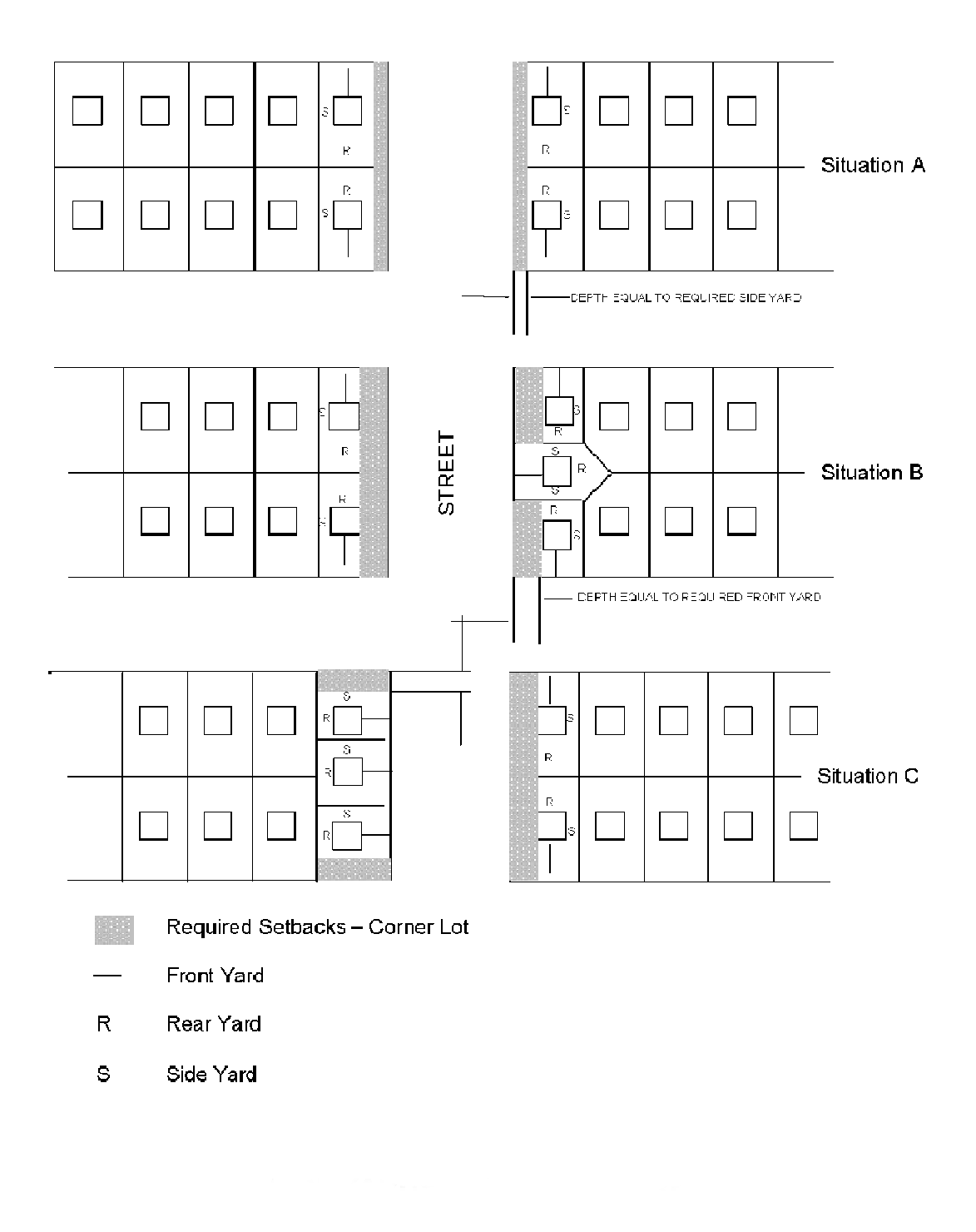
Side Yard Abutting a Street
SECTION 19.02 - OPEN SPACE PRESERVATION PROVISIONS
A.
The purpose of this section is to provide an alternative means of development to the landowner on land which is residentially zoned that would create the same number of home sites, but cluster the homes on no more than 50 percent of the land, while leaving the unused land perpetually in an undeveloped state by means of a construction easement, plat dedication, restrictive covenant or other legal means that runs with the land as required by Section 16(h) of state Public Act 184 of 1943, as amended (the Township Zoning Act).
B.
At the option of the landowner, in areas zoned for single-family residential purposes, the minimum yard setbacks, building heights, and minimum lot sizes per unit as required by Article XIX may be waived by the Township, and the clustering of dwelling units be accomplished, subject to the following:
(1)
The minimum floor area for all units constructed under this option shall be at least equal to the minimum floor area requirements for the single-family residential district in which the cluster is to be constructed. (Please refer also to Section 19.02, G, (5) below.)
(2)
The maximum number of units attached shall not exceed four (4) units per building. The maximum number of buildings allowed in any one (1) cluster shall not exceed four (4) buildings.
(3)
The exterior design of the structures shall be compatible with existing single family structures located in the general area of the project in regards to architectural style, size, overall floor area and heights. Variety in the design of individual units shall be provided by the use of design details which do not appear to be continuous or repetitious. An exterior design pattern which is repetitious throughout the project shall not be permitted.
(4)
Yard requirements shall be provided under this option as follows:
(a)
Minimum spacing between buildings shall be determined by the number of living units that are arranged in any group as shown on the following table.
(b)
All such grouping shall be so situated as to have one (1) side of the building abutting onto open space, not less than thirty (30) feet in width.
(c)
Any side of a building adjacent to an interior road shall not be nearer to such road than twenty (20) feet, measured from the edge of the nearest travel lane.
(d)
Any side of a building adjacent to a public right-of-way shall not be nearer to such public right-of-way than fifty (50) feet.
(e)
This nature of development, when abutting a front yard of an existing recorded subdivision which is not a part of the site plan submitted under this section, shall cause all dwelling units facing such subdivision to relate through its front or entrance facade and shall treat such side of the groupings as front yards.
(f)
No building shall be located closer than thirty (30) feet to the outer perimeter (property line) of the site.
(5)
The maximum height of buildings under this option shall be thirty-five (35) feet.
(6)
Density for a site shall be based upon the total dwelling unit count achieved from a concept layout plan prepared by the applicant and accepted by the Site Committee showing the subject site as a single-family detached development meeting the design requirements established for the zoning district in which it is located. (Please refer to Article XIX, Schedule of Regulations.) The resulting development yield, determined through such computation shall be distributed throughout not more than 50 percent of the subject site's buildable area. All remaining land area shall perpetually remain in an undeveloped state pursuant to Section 19.02, E below. It is further the intent of this section that all undeveloped land be contiguous to the maximum extent practicable and be so arranged to interconnect with existing or planned open space systems neighboring the subject site.
C.
In reviewing the plans and approving the application of this section at a particular site, the Site Committee may require a landscaped berm along the entire property line abutting the major thoroughfare. This berm may be included within a required side or rear yard. The berm shall be designed and planted according to the standards of Section 3.16.
D.
In submitting a proposed layout under this section, the sponsor of the development shall include, along with the site plan, master deed documents, floor plans, topography drawn at two (2) foot contour intervals, main floor grade elevations relative to the existing topography, all computations relative to acreage and density, details relative to any proposed berm, and any other details which will assist in reviewing the proposed plan.
E.
Site plans submitted under this option shall be submitted and reviewed in conformance with Section 3.19. All land not intended to be conveyed to individual dwelling unit owners under this option shall be protected by conservation easements, plat dedications, restrictive covenants, or other legal means which runs with the land and which prohibits their development in perpetuity. Such legal means must be approved by the Township Attorney to assure such unused land remains perpetually in an undeveloped state. Such open space areas shall represent at least fifty (50%) percent of the subject site's gross area.
F.
The construction of a cluster housing development shall be subject to the engineering design standards of the Township, as provided by Chapters 15, 16 and 18 of the Code of Ordinances, as amended, except as may otherwise be provided by this chapter.
G.
Approval of the single-family cluster housing development shall be predicated upon a positive finding that all of the following criteria have been met:
(1)
The design shall promote the goals, objectives, and policies of the Township Master Plan of Future Land Use;
(2)
Open space areas shall be provided in suitable locations that offer convenient access by residents and adequate screening from nearby dwelling units;
(3)
Natural assets, wildlife habitat areas, or sites having historic archaeological or cultural value shall be protected;
(4)
Individual lots, buildings, and roadways, and open space areas shall be designed to minimize the alteration of environmental site features;
(5)
The design of structures shall be compatible with existing single-family structures located in the general area in terms of architectural style, size, overall floor area, building height and neighboring building orientation. Any determination of compatibility shall be based upon the standards of Section 3.27, 7, g.
(6)
Clustering of the dwelling units shall occur in a manner which preserves the basic amenities and qualities normally associated with single-family living (such as, but not limited to, privacy, personal open space, and adequate natural lighting and ventilation) while allowing for innovative site layout and open space areas;
(7)
Where the proposed cluster housing development abuts an existing conventional single-family subdivision, land zoned for single-family use, or a major thoroughfare, an orderly transition shall occur using one or more of the following techniques:
(a)
Detached single-family dwellings;
(b)
Open or recreation space;
(c)
Buffer plantings of sufficient size, character, density and quantity, or
(d)
Mounding or berming of sufficient size, height, and slope to ensure property maintenance of the area.

