
Redford Charter Township
City Zoning Code
City Zoning Code
ARTICLE XX
SIGN REGULATIONS
SECTION 20.01 - STATEMENT OF PURPOSE
The Township finds that signs and other visual outdoor advertising tends to promote commerce and are related to the health, safety, and/or general welfare of the residents of the Township, and that the preservation of the existing character of the community requires regulation of signs and of other visual outdoor advertising. The Township finds that failure to regulate the size, location, and construction of signs and other outdoor advertising may have an adverse effect upon the promotion of business and commerce in the Township, may lead to poor identification of businesses, may have an adverse effect upon the existing aesthetic character of the Township, and may cause deterioration of business and residential areas of the community. Therefore, the purpose of this Section and the subsections thereunder is to permit such signs and visual outdoor advertising as will not, by reason of their size, location, or manner of display, endanger public health and/or safety; confuse or mislead traffic; or obstruct vision necessary for traffic and pedestrian safety; and further, to regulate signs and other visual outdoor advertising in such a way as to prevent the placement of signs, and such other visual outdoor advertising in a manner that will conceal or obscure other signs and other visual outdoor advertising on adjacent businesses; to keep the number of signs and sign messages at a minimum level reasonably necessary to identify a business and its products; to keep signs within a reasonable scale with respect to the buildings to which they relate; and further, to prevent off-premise signs from conflicting with business, residential and public land uses, and to prohibit signs and other visual outdoor advertising which will have an adverse effect upon the existing aesthetic character of not only the zoning district in which they are located, but also upon the overall existing aesthetic character of the Township. (Ordinance No. 152-W, Effective November 4, 1990)
SECTION 20.02 - DEFINITIONS
For the purposes of this Ordinance, certain terms and words are defined as follows:
SIGN: Is a name, identification, description, display or illustration which is affixed to, painted or represented, directly or indirectly, upon a building, structure, parcel or lot and which directs attention to an object, product, place, activity, person, institution, organization, or business. Signs include, but are not limited to, figures, devices, pennants, emblems and pictures. Any of the above which is not placed out of doors, when placed near inside the surface of a window in such a way as to be in view of the general public and used or intended to be used to attract attention or convey information to motorists and pedestrians, shall also be considered as a sign.
SIGN CATEGORIES:
ABANDONED SIGN: A sign which advertises a bona fide business, lessor, owner, product or activity no longer conducted or available upon the premises where such sign is displayed.
ACCESSORY SIGN: A sign which is accessory to the main or principal use of the premises.
ANIMATED SIGN: Any sign that uses movement or change of lighting to depict action or create a special effect or scene.
BANNER: Any sign printed or displayed upon cloth or other flexible material, with or without frames. National flags, state or municipal flags, or the official flag of any institution or business shall not be considered banners.
BEACON: Any light with one or more beams directed into the atmosphere or directed at one or more points not on the same zone lot as the light source; also, any light with one or more beams that rotate or move.
BUILDING MARKER: Any sign indicating the name of a building and date and incidental information about its construction, which sign is cut into a masonry surface or made of bronze or other permanent material.
BULLETIN BOARD/ANNOUNCEMENT SIGN: A sign related to a public school, parochial school, private school, public park or recreation facility, church or other religious institution, which identifies activities or events to take place involving the patrons of such specific use.
CANOPY SIGN: Any sign that is a part of or attached to an awning, canopy, or other fabric, plastic, or structural protective cover over a door, entrance, window, or outdoor service area. A marquee is not a canopy.
CHANGEABLE COPY SIGN: A sign or portion thereof with characters, letters, or illustrations that can be changed or rearranged without altering the face or the surface of the sign. A sign on which the only copy that changes is an electronic or mechanical indication of time, or temperature, or stock market reports shall be considered a "time, temperature and stock market reporting" portion of a sign and not a changeable copy sign for purposes of this Ordinance.
DEVELOPMENT: A planning or construction project involving substantial property improvement including the building, reconstruction, conversion, structural alteration, relocation or enlargement of any structure or any use or extension of the use of land.
DIRECTORY SIGN: An off premises ground sign lighting only the name(s) of tenants or occupants of a building, group of buildings, and/or business district, their professions or business activities, and their direction or location.
FLASHING SIGN: An illuminated sign on which artificial or reflected light is not maintained stationary and constant in intensity and color at all times when in use.
FREESTANDING SIGN/GROUND SIGN: A sign which is attached to or a part of a completely self-supporting structure. The supporting structure shall be set firmly in or below the ground surface and shall not be attached to any building or any other structure whether portable or stationary.
IDENTIFICATION SIGN: A sign stating the name or description of the use of the premises on which the sign is located.
INCIDENTAL SIGN: A sign, generally informational, that has a purpose secondary to the use of the zoning lot on which it is located, such as "no parking," "entrance," "loading only," "telephone," and other similar directives.
ILLUMINATED SIGN: Any sign which has characters, letters, figures, designs or outline illuminated by electric lights or luminous tubes as a part of the sign proper.
MARQUEE: Any permanent roof-like structure projecting beyond a building or extending along and projecting beyond the wall of the building, generally designed and constructed to provide protection from the weather.
MARQUEE SIGN: Any sign attached to, in any manner, or made a part of a marquee.
MONUMENT SIGN: A sign attached to a permanent foundation and not attached or dependent for support from any building, pole, posts, or similar uprights.
NONACCESSORY SIGN: A sign which is not accessory to the main or principal use of the premises.
NONCONFORMING SIGN: Any sign that does not conform to the requirements of this Ordinance.
PENNANT: Any lightweight plastic, fabric, or other material, whether or not containing a message of any kind, suspended from a rope, wire, or string, usually in series, designed to move in the wind.
POLITICAL SIGN: A sign which announces, promotes or advertises the name, program or political party of any candidate for public office, or an opinion regarding a public referendum regarding some political issue, in an upcoming election that will be on the ballot in the township.
PORTABLE SIGN: Any sign not permanently attached to the ground or other permanent structure, or a sign designed to be transported, including, but not limited to, signs designed to be transported by means of wheels; sign converted to a- or t-frames; menu and sandwich board signs; balloons used as signs; umbrellas used for advertising; and signs attached to or painted on vehicles parked and visible from the public right-of-way, unless said vehicle is used in the normal day-to-day operations of the business.
PROJECTING SIGN: A sign other than a wall sign suspended from or supported by a building or structure and projecting therefrom, including marquee signs. REAL ESTATE SIGN: A sign placed upon a property advertising that particular property for sale, rent, or lease.
PROTEST SIGN: A sign which announces, promotes, or expresses a personal grudge, dispute, or position pertaining to an event, person, policy, or proposal.
RESIDENTIAL SIGN: Any sign located in a district zoned for residential uses that contains no commercial message except advertising for goods or services legally offered on the premises where the sign is located, if offering such service at such location conforms with all requirements of the Zoning Ordinance.
RESIDENTIAL DEVELOPMENT SIGN: A sign placed on the premises of a subdivision, or other real estate development site, to identify a proposed start of development, the participants of such development (such as owner, contractor, architect, leasing agent, etc.), and relative date of availability.
ROOF SIGN: Any sign erected and constructed wholly on and over the roof of a building supported by the roof structure.
SWINGING SIGN: Signs which are designed or constructed to move or pivot as a result of wind pressure for the purpose of attracting attention.
SUSPENDED SIGN: A sign that is suspended from the underside of a horizontal plane surface and is supported by such surface.
TEMPORARY SIGN: Any sign or sign structure which is not permanently affixed or installed and is intended to be displayed only for a limited time period. Examples of such signs include, but are not necessarily limited to, the following: real estate, construction, special event, political, garage sale, home improvement/remodeling, model home, portable, and seasonal (holiday) signs.
WALL SIGN: A sign erected or fastened against the wall of a building with the exposed face of the sign in a plane approximately parallel to the plane of such wall and not extending more than fourteen (14) inches beyond the surface of the portion of the building wall on which erected or fastened.
(Ordinance No. 152-W, Effective November 4, 1990; Ordinance No. 332, § 1, Adopted May 28, 2013)
SECTION 20.03 - EXEMPT SIGNS
The following shall be deemed to be excluded from the definition of "sign" as it applies to this Ordinance.
1.
Any single sign with an area of one square foot or less limited to one per premises.
2.
Historic signs designating sites recognized by the state historical commission or local governmental body or agency.
3.
Signs of a duly constituted governmental body, including traffic or similar regulatory devices, legal devices, or warnings at railroad crossings.
4.
Building markers, memorial tablets, or similar signs.
5.
Signs required to be maintained by law or governmental order, rule or regulation; provided, that they do not exceed forty-eight (48) square feet.
6.
Signs directing traffic on private property, but bearing no advertising matter.
7.
Signs displayed for the direction or convenience of the public, including signs which identify rest rooms, location of public telephones, public entrances, freight entrances, or the like, with a total surface area not-to-exceed six (6) square feet per sign on any lot or parcel.
8.
Yard sale signs; provided that no person shall attach in any way posters, notices or advertisements to utility poles, meter posts, or trees in or along any street right-of-way within the Township; and that no person shall put up any notice upon any building, wall or fence or other property of another person without having first obtained the consent of the owner of such property. The maximum time limit for all yard sale signs is six (6) consecutive days within three (3) calendar months, twice within twelve (12) calendar months.
9.
Gasoline price signs; provided the total sign area is less than twelve (12) square feet.
10.
At gasoline stations, corporate identification signs of less than ten (10) square feet each, attached directly to a canopy providing coverage to pump islands.
11.
Signs painted on, or affixed to, glass surfaces of windows or doors and pertaining to and identifying only the lawful business conducted therein.
12.
Wall murals and similar graphics containing no direct advertisement, subject to the review and approval of the Site Plan Committee of the Planning Commission.
(Ordinance No. 152-W, Effective November 4, 1990)
SECTION 20.04 - PROHIBITED SIGNS
It shall be unlawful for any person to erect, maintain, relocate or keep any sign as defined in this Section.
1.
A sign which copies or imitates or in any way approximates an official highway sign or carries the words "stop" or "danger"; or any sign which obscures a sign displayed by public authority for the purpose of giving traffic instruction or direction or other public information.
2.
A sign which incorporates, in any manner, or is illuminated by, any flashing or moving lights or which display different messages by mechanical means on a rotating basis, unless each interval in the cycle is five (5) seconds or more. This does not include the conveyance of noncommercial information which requires frequent periodic change, such as temperature, stock averages, or time.
3.
A sign which obstructs any window or door opening used as a means of egress or prevents free passage from one part of a roof to any other part thereof. A sign which interferes with an opening required for legal ventilation.
4.
A sign or illumination that causes any direct glare into or upon any building other than the building to which the sign may be accessory.
5.
Swinging signs.
6.
Except as may otherwise be provided in this section, no sign or any portion thereof shall be permitted which moves or assumes any motion constituting a nonstationary condition except currently licensed vehicles and trailers which have painted upon them in a permanent manner the name and address of the owner.
7.
Abandoned signs.
8.
Signs which are of a size, location, content, coloring, or manner of illumination which may be confused with or construed as a traffic control device or which hide from view any traffic or street sign or signal which obstruct the view in any direction at a street or road intersection.
9.
Signs which contain statements, words, or pictures of an obscene pornographic or immoral character.
10.
Signs which are painted on or attached to any fence or any wall which is not structurally a part of a building, except to identify a residence.
11.
Signs which emit audible sound, odor, or visible matter.
12.
Roof or projecting signs, not otherwise permitted under Section 30.07,2.
13.
Exterior string lights used in connection with a commercial premise, other than holiday decoration.
14.
A sign which is located within, or which extends over, a public right-of-way.
(Ordinance No. 152-W, Effective November 4, 1990)
SECTION 20.05 - GENERAL PROVISIONS
Except as otherwise provided, the following conditions shall apply in all districts.
1.
APPLICABILITY AND EFFECT. Signs shall be permitted which are in accordance with:
(a)
The general provisions of the Sign Ordinance.
(b)
The district sign regulations for the district in which the sign is to be located.
(c)
All applicable provisions of the building and electrical codes of Redford Township as adopted, and all amendments thereto.
2.
INTERPRETATION. In this interpretation and application, the provisions of this Ordinance shall be held to be the minimum requirements necessary for the promotion and protection of the public health, safety, comfort, morals, and convenience.
3.
CONFLICTING CODES AND ORDINANCES. If any provisions or requirement of this Ordinance is found to be in conflict with any other provision or requirement of this Ordinance or of any other applicable governmental law, Ordinance resolution, rule, or other governmental regulation of any kind, the regulation which establishes the more restrictive rule or higher standard shall govern.
4.
EXISTING AGREEMENTS. This Ordinance shall not abrogate any private agreement, provided that where the regulations of this Ordinance are more restrictive or impose higher standards than such private agreements, the provisions and requirements of this Ordinance shall govern.
5.
SEPARABILITY. In accordance with the following, it is hereby declared that the several provisions of this Ordinance are separable:
(a)
If any court of competent jurisdiction determines any provisions of this Ordinance to be invalid, such determination shall not affect any other provision of this Ordinance, not specifically included in the court's judgment order.
(b)
If any court of competent jurisdiction determines any provision of this Ordinance to be invalid as applied to any particular sign, such determination shall not affect the application of such provisions to any other sign not specifically included in the court's judgment order.
6.
SIGN PERMITS.
(a)
Except for political or protest signs, prior to the erection of, or structural alteration of a sign located in a commercial, office or industrial district, a sign permit shall be secured from the Department of Building and Safety Engineering.
(b)
Application for initial sign permits shall be made upon forms provided by the Department of Building and Safety Engineering and shall contain or have attached thereto the following information:
(1)
Name, address, and telephone number of the applicant.
(2)
Location of building, structure, or lot to which or upon which the sign or other advertising structure is to be attached or erected.
(3)
Position of the sign or other advertising structure in relation to nearby buildings or structures.
(4)
Three (3) blueprints or ink drawings of the plans and specifications and method of construction and attachment to the building or in the ground.
(5)
Name of person, firm, corporation or association erecting the structure.
(6)
Written consent of the owner of the building, structure or land to which or on which the structure is to be erected.
(7)
Any electrical permit required and issued for said sign. Application requesting the electrical permit for the proposed sign must accompany the sign application.
(8)
Such other information as the Department of Building and Safety Engineering shall require to show full compliance with the Township Ordinance.
(c)
Every applicant, before being granted a permit hereunder, shall pay to the Department of Building and Safety Engineering a permit fee for each sign or other advertising structure regulated by this chapter as may be established, by resolution, by the Township Board of Trustees.
(d)
It shall be the duty of the Department of Building and Safety Engineering, upon the filing of an application for an erection permit, to examine such plans and specifications and other data and the premises upon which it is proposed to erect the sign or other advertising structure, and if it shall appear that the proposed structure is in compliance with all the requirements of this chapter and all other laws and ordinances of the Township, he shall then issue the erection permit. If the work authorized under an erection permit has not been completed within twelve (12) months after date of issuance, the said permit shall become null and void.
(e)
All rights and privileges acquired under the provisions of this Ordinance or any amendment thereto, are mere licenses revocable at any time by the Township Board of Trustees.
7.
COMPUTATIONS. The following principles shall control the computation of the sign area and sign height.
(a)
Computation of Area of Individual Signs. The area of a sign face (which is also the sign area of a wall sign or other sign with only one face) shall be computed by means of the smallest square, circle, rectangle, triangle, or combination thereof that will encompass the extreme limits of the writing, representation, emblem, or other display, together with any material or color forming an integral part of the background of the display or used to differentiate the sign from the backdrop or structure against which it is placed, but not including any supporting framework, bracing, or decorative fence or wall when such fence or wall otherwise meets Zoning Ordinance regulations and is clearly incidental to the display itself. (Refer to Diagram A.)
(b)
Computation of Area of Multifaced Signs The sign area for a sign with more than one face shall be computed by adding together the area of all sign faces visible from any one point. When two identical sign faces are placed back-to-back, so that both faces cannot be viewed from any point at the same time, and when such sign faces are part of the same sign structure and are not more than twenty-four (24) inches apart, the sign area shall be computed by the measurement of one of the faces.
(c)
Computation of Height. The height of a sign shall be computed as the distance from the base of the sign at normal grade to the top of the highest attached component of the sign. Normal grade shall be construed to be the lower of 1) existing grade prior to construction; or, 2) the newly established grade after construction, exclusive of any filling, berming, mounding, or excavating solely for the purpose of locating the sign. In cases in which the normal grade cannot reasonably be determined, sign height shall be computed on the assumption that the elevation of the normal grade at the base of the sign is equal to the elevation of the nearest point of the crown of a public street or the grade of the land at the principal entrance to the principal structure on the zoning lot, whichever is lower.
8.
SIGN SURFACE AREA. Unless otherwise provided in this Article, the total surface area devoted to all signs on any lot shall not exceed the limitations set forth in this Section, and all signs except temporary signs, shall be included in this calculation.
(a)
Unless otherwise provided in this Article, the maximum sign surface area permitted on any lot in any residential district is two (2) square feet.
(b)
Subject to the other provisions of this Article, the maximum sign surface area permitted on any lot in a nonresidential district shall be determined as follows:
(1)
There may be not more than one (1) square feet of sign surface area per linear foot of lot street frontage up to two hundred (200) feet of frontage.
(2)
There may be up to 0.25 square feet of additional sign surface area per linear foot of lot street frontage in excess of two hundred (200) feet.
(c)
If a lot has frontage on more than one major thoroughfare, then the total sign surface area permitted on that lot shall be the sum of the sign surface area allotments related to each street on which the lot has frontage. However, the total sign surface area that is oriented toward a particular street may not exceed the portion of the lot's total sign surface area allocation that is derived from frontage on the street.
(d)
Whenever a lot is situated such that it has no street frontage on any lot boundary and an applicant desires to install on such a lot a sign that is oriented toward a street, then the total sign surface area permitted on that lot shall be the sign surface area that would be allowed if the lot boundary closest to the street toward which such sign is to be oriented fronted on such street. The applicant shall be restricted to using only one street and the closest lot boundary to this street for determining the total permitted sign surface area. However, the applicant shall be given the opportunity to determine the one street used in the calculations.
(e)
The sign surface area of any sign located on a wall of a structure may not exceed fifty (50) percent of the total surface area of the wall on which the sign is located.
(f)
In no case may freestanding signs exceed fifty (50) square feet in surface area if the lot on which the sign is located has less than two hundred (200) feet of lot frontage on the street toward which that sign is primarily oriented, seventy-five (75) square feet on lots with two hundred (200) or more but less than four hundred (400) feet of lot frontage, and one hundred (100) square feet on lots with four hundred (400) or more feet of frontage; except as may otherwise be provided herein.
9.
PLACEMENT AND HEIGHT RESTRICTIONS.
(a)
Except as may otherwise be provided herein, freestanding and monument signs shall be setback a minimum of three (3) feet back of the property line, except that signs shall not be located closer than a distance equal to its height to an abutting residential district.
(b)
No sign may extend above any parapet or be placed upon any roof surface, except that for purposes of this section, roof surfaces constructed at an angle of seventy-five (75) degrees or more from horizontal shall be regarded as wall space. This subsection shall not apply to displays, including lighting, erected in connection with the observation of holidays on the roofs of residential structures.
(c)
No sign attached to a building may project more than fourteen (14) inches from the building wall.
(d)
No part of a freestanding sign may exceed a height, measured from ground level of twenty (20) feet. Freestanding signs located on property which abuts both a controlled access highway and state or federal numbered highway, may be erected above the plane of the pavement of the highest road at the intersection, provided such sign does not exceed a maximum of forty (40) feet in height.
(e)
Monument signs may not exceed a height of six (6) feet.
(Ordinance No. 152-W, Effective November 4, 1990; Ordinance No. 332, § 1, Adopted May 28, 2013)
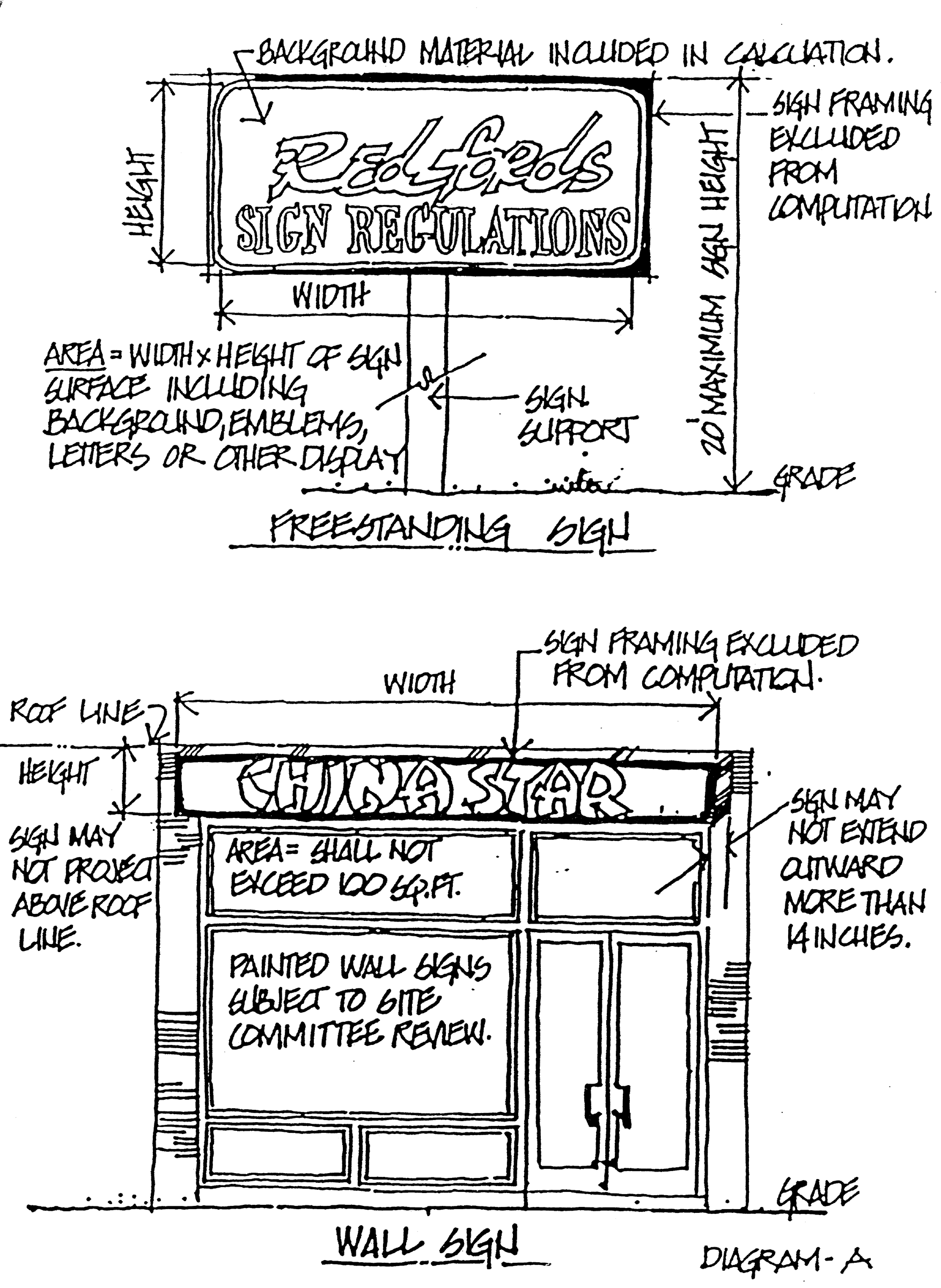
General Elements of Signs
SECTION 20.06 - SIGNS PERMITTED IN ALL RESIDENTIAL DISTRICTS
1.
Up to six (6) political or protest signs shall be permitted on any residential lot, including all buildings on the premises. Each political or protest sign shall not exceed an area of six (6) square feet. Freestanding political or protest signs shall also not exceed a maximum height of four (4) feet as measured from grade.
2.
Permanent residential development signs indicating only the name of the development and the management/developer thereof, subject to the following:
(a)
The residential development signs shall be monument signs.
(b)
There shall not be more than two (2) residential development signs for each major point of vehicular access to development.
(c)
Residential development signs at any location shall not exceed fifty (50) square feet in gross surface area for each exposed face nor exceed an aggregate gross surface area of one hundred (100) square feet for the combined surface of all sign faces.
(d)
Residential development signs shall not project higher than six (6) feet, as measured from the base of the sign or grade of the nearest adjacent roadway, whichever is higher.
(e)
Residential development signs may be located in any required yard but shall not extend over any lot line or within ten (10) feet of any point of any public right-of-way. The location and arrangement of all residential development signs shall be subject to the review and approval of the Department of Building and Safety Engineering. A residential development sign(s), proposed to be located within a public right-of-way, is expressly prohibited.
3.
Two (2) wall, or two (2) monument signs, or combination thereof identifying a park, school, church, public building, other authorized use, or lawful nonconforming use, each not to exceed thirty-two (32) square feet in area and eight (8) feet in height and be placed no closer to the street right-of-way line than one-third (1/3) the minimum authorized front yard depth. Wall signs shall be attached to, and be parallel to, the wall of the building.
4.
One (1) unlighted nameplate, identifying the name of the occupant, not-to-exceed two (2) square feet in area. The nameplate shall be attached flat against the front wall of the building.
5.
Temporary signs permitted by Section 20.08.
(Ordinance No. 152-W, Effective November 4, 1990; Ordinance No. 332, § 1, Adopted May 28, 2013)
SECTION 20.07 - SIGNS PERMITTED IN COMMERCIAL, OFFICE, AND INDUSTRIAL DISTRICTS
Signs are allowed in commercial, office, and industrial districts subject to the following conditions:
1.
SIGNS PERMITTED (NUMBER).
(a)
Except as provided by Section 20.07,8 for political signs, and Section 20.08 for temporary signs, there shall not be more than two (2) signs allowed for any one business with frontage on a single public street or three (3) signs allowed for any one business or planned grouping of structures with frontage on more than one (1) public street. Any business with a rear customer entrance is permitted an additional wall sign at said entrance not to exceed eight (8) square feet in area.
2.
ROOF AND PROJECTING SIGNS.
(a)
Roof and projecting signs shall not be permitted except on appeal to the Board of Zoning Appeals. The Board of Zoning Appeals may grant a variance for a roof sign only in those cases where the applicant demonstrates practical difficulties in utilizing a wall sign and demonstrates that the variance will be in keeping with the spirit and intent of this article.
(b)
Projecting or roof signs authorized under Section 2(a) above shall meet the following criteria:
(1)
Projecting signs shall clear grade level below the sign by a minimum of twelve (12) feet.
(2)
Projecting signs shall not exceed a display area of sixteen (16) square feet.
(3)
Only one (1) projecting sign or roof sign per business is permitted.
(4)
Projecting signs may not extend more than six (6) feet into the right-of-way. Where the right-of-way margin between the property line and the pavement edge is less than ten (l0) feet, only wall signs shall be permitted.
3.
CHANGEABLE COPY SIGNS.
(a)
A changeable copy sign shall be allowed in addition to the conditions of this Section provided that ownership identification or advertising copy does not exceed ten (10) percent of the total sign area and further provided that the total area of the sign does not exceed fifty (50) square feet.
4.
MARQUEE SIGNS.
(a)
Marquee signs shall not extend into any public right-of-way more than eight (8) feet or over the sidewalk more than one-half the width of the sidewalk.
(b)
The minimum height of such sign is eight (8) feet six (6) inches measured from the sidewalk surface.
5.
WALL SIGNS.
(a)
Flat wall signs may not project above the roof or parapet line and may not project more than 14 inches beyond the face of the wall of the building. Wall signs shall be attached to, and be parallel to, the wall of the building.
(b)
Wall signs shall be limited in number to one (1) wall sign per business for each wall having an individual means of access. The maximum size of any such sign shall not exceed fifty (50) percent of the building facade where so provided, however, that no such sign shall exceed one hundred (100) square feet.
(c)
In the instance of several tenants utilizing a common public entranceway, a common wall sign shall be permitted provided any such sign shall not exceed fifty (50) percent of the building facade where so provided, or one hundred (100) square feet in area for all tenants listed, whichever is more restrictive.
(d)
Painted wall signs, subject to the review and approval of the Site Plan Committee of the Planning Commission and the following design standards:
(1)
The appearance, color texture, and materials being used will preserve property values in the immediate vicinity, and will not adversely effect any property values.
(2)
The appearance of the sign will not detract from the general harmony of and is compatible with the structure and other developments already existing in the immediate vicinity.
(3)
The appearance of the sign will not be garish or otherwise offensive to the sense of sight to passersby.
(4)
Sign appearance will tend to minimize or prevent discordant and unsightly surroundings in the immediate neighborhood.
6.
FREESTANDING SIGNS.
(a)
Except as authorized by this section, no development may have more than one freestanding sign.
(b)
If a development is located on a corner lot that has at least one hundred (100) feet of frontage on each of the two intersecting public streets, then the development may have not more than one freestanding sign along each side of the development bordered by such streets.
(c)
If a development is located on a lot that is bordered by two public streets that do not intersect at the lot's boundaries (double front lot), then the development may have not more than one (1) freestanding sign on each side of the development bordered by such streets.
(d)
Monument signs may be substituted for an equal number of freestanding signs. In such cases, monument signs may be increased in area by twenty (20) percent.
(e)
One (1) freestanding identification sign stating the name of a business center and major tenants therein may be erected for a shopping center, office park, industrial park, or other integrated group of stores, commercial buildings, office buildings, or industrial buildings. The sign area shall not exceed one (1) square foot per front foot of building on buildings for which it is erected; however, such sign shall not exceed two hundred (200) square feet in area. If the lot fronts on two (2) or more collector or arterial streets, one (1) such sign may be permitted for each frontage. Individual freestanding signs shall not be permitted where tenants of such business center are under one (1) roof.
7.
CANOPY SIGNS.
(a)
Canopies shall not project more than eight (8) feet into the right-of-way but in no case closer than six (6) feet to the curb line, or eighteen (18) feet from the pavement edge in case the pavement is not curbed.
(b)
A minimum underclearance of the sidewalk of seven (7) feet shall be maintained.
(c)
Canopies hereafter erected shall, whenever practicable, match the established underclearance, height and projection of canopies which exist on abutting parcels.
8.
POLITICAL SIGNS. Political signs on any single zoning lot zoned for commercial, office, or industrial purposes subject to the following conditions:
a.
Political signs shall not exceed 32 square feet in area for any individual sign or a total aggregate area equal to ten (10) percent of the building's front facade for all such signs so displayed, provided that any freestanding sign is not higher than four (4) feet above the average grade of the yard on which it is placed.
b.
Political signs on any vacant zoning lot zoned for commercial, office, or industrial purposes shall not exceed thirty-two (32) square feet in area for any individual sign, or a total aggregate area of fifty (50) square feet for all such signs so displayed, provided that any freestanding sign is not higher than four (4) feet above the average grade of the yard on which it is placed.
(Ordinance No. 152-W, Effective November 4, 1990; Ordinance No. 332, § 1, Adopted May 28, 2013)
SECTION 20.08 - TEMPORARY SIGNS
1.
Temporary signs include, but are not necessarily limited to, the following:
a.
For a single dwelling or building or vacant land: an on-site real estate sign, advertising the property for sale, rent or lease.
b.
For a single dwelling or building or vacant land: an off-site real estate sign for the purpose of providing direction to another property that is offered for sale, rent, or lease.
c.
An on-site sign advertising an on-going garage, estate, or yard sale.
d.
An off-site for the purposes of providing direction to another property that is having a garage, estate, or yard sale, as long as the dates of the sale are clearly indicated on the sign.
e.
Non-commercial signs, which contain non-commercial information or directional messages.
f.
Political or protest signs.
g.
Holiday or seasonal signs.
h.
Construction signs for buildings or development sites under construction.
i.
Portable signs.
2.
Non-illuminated temporary signs shall be permitted, subject to the following terms and conditions:
a.
Temporary signs shall not exceed six (6) square feet in area for any individual sign or a total aggregate area of twenty-four (24) square feet for all such signs so displayed, on any single zoning lot zoned for residential purposes, provided that any freestanding sign is not higher than four (4) feet above the average mean grade of the yard on which is it placed.
b.
Temporary signs on any single zoning lot zoned for commercial, office, or industrial purposes shall not exceed thirty-two (32) square feet in area for any individual sign or a total aggregate area equal to ten (10) percent of the principal building's front facade for all such signs so displayed, provided that any freestanding sign is not higher than four (4) feet above the average mean grade of the yard on which it is placed.
c.
Temporary signs on any vacant zoning lot zoned for commercial, office, or industrial purposes shall not exceed thirty-two (32) square feet in area for any individual sign, or a total aggregate area of fifty (50) square feet for all such signs so displayed, provided that any freestanding sign is not higher than four (4) feet above the average mean grade of the yard on which it is placed.
d.
Temporary signs shall not be attached to any utility pole, fire hydrant, traffic or street sign, street lights, utility cabinet, or fence, or placed within any public right-of-way. On streets with no sidewalks, temporary signs shall not be placed closer than twenty (20) feet from the nearest edge of the travelled portion of the roadway.
e.
Temporary signs shall not be erected in such a manner that may be expected to interfere with, obstruct, confuse, or mislead pedestrian or vehicular traffic. Signs shall comply with the corner clearance requirements of Section 2.16, J.
f.
Any posting of a temporary sign must have the prior written consent of the property owner.
g.
Signs exhibiting movement, and balloons or other gas filled or inflatable devices, are expressly prohibited.
h.
Except as otherwise provided for political signs under Section 20.06, 1 and Section 20.07, 8, temporary signs advertising a special event such as, but not necessarily limited to a grand opening, fair and festivals, and announcements of new products, services or property management, may be displayed for not more than thirty (30) consecutive days. In addition, not more than three (3) display periods be permitted in any one-year period.
(Ordinance No. 152-W, Effective November 4, 1990; Ordinance No. 332, § 1, Adopted May 28, 2013)
SECTION 20.09 - NONACCESSORY SIGNS (BILLBOARDS)
1.
Billboards not exceeding two hundred fifty (250) square feet in area shall be permitted only on the M-2 District provided such signs shall not be less than one hundred (100) feet from any residential district and provided further that at least five hundred (500) feet shall be provided between such signs.
2.
Directory signs shall be permitted in all office, commercial and industrial zoning districts subject to the following:
(a)
Directory signs shall not exceed a height of five (5) feet and a width of four (4) feet.
(b)
The directory sign shall consist of individual sign panels, each of which is no greater than eight (8) inches in height and forty (40) inches in width.
(c)
The design of directory signs shall be in accordance with Township specifications for such signs, as may be adopted by resolution of the Township Board.
(d)
Directory signs shall not count toward the total number of signs permitted per business or maximum sign surface area permitted per business as specified in Section 20.07.
(Ordinance No. 152-W, Effective November 4, 1990)
SECTION 20.10 - NONCONFORMING SIGNS
Subject to the remaining restrictions of this section, nonconforming signs that were otherwise lawful on the effective date of this article, may be continued.
1.
No person may engage in any activity that causes an increase in the extent of nonconformity of a nonconforming sign. Without limiting the generality of the foregoing, no nonconforming sign may be enlarged or altered in such manner as to aggravate the nonconforming condition, nor may illumination be added to any nonconforming sign.
2.
A nonconforming sign may not be moved or replaced except to bring the sign into complete conformity with this article.
3.
If a nonconforming sign is destroyed by natural causes, it may not thereafter be repaired, reconstructed, or replaced except in conformity with all the provisions of this chapter, and the remnants of the former sign structure shall be cleared from the land. For purposes of this section, a nonconforming sign is "destroyed" if damaged to an extent that the cost of repairing the sign to its former stature or replacing it with an equivalent sign equals or exceeds the value of the sign so damaged.
4.
The message of a nonconforming sign may be changed so long as this does not create any new nonconformities (for example, by creating an off-premises sign under circumstances where such a sign would not be allowed).
5.
Subject to the other provisions of this section, nonconforming signs may be repaired and renovated so long as the cost of such work does not exceed within any twelve (12) month period fifty (50) percent of the value of such sign.
6.
If a nonconforming sign other than a billboard advertises a business, service, commodity, accommodation, attraction, or other enterprise or activity that is no longer operating or being offered or conducted, that sign shall be considered abandoned and shall be removed within thirty (30) days after such abandonment by the sign owner, owner of the property where the sign is located, or other party having control over such sign.
7.
If a nonconforming nonaccessory sign (billboard) remains blank for a continuous period of one hundred eighty (180) days, that billboard shall be deemed abandoned and shall, within thirty (30) days after such abandonment, be altered to comply with this article or be removed by the sign owner, owner of the property where the sign is located, or other person having control over such sign. For purposes of this section, a sign is "blank" if:
(a)
It advertises a business, service, commodity, accommodation, attraction, or other enterprise or activity that is no longer operating or being offered or conducted; or,
(b)
The advertising message it displays becomes illegible in whole or substantial part; or,
(c)
The advertising copy paid for by a party other than the sign owner or promoting an interest other than the rental of the sign has been removed.
(Ordinance No. 152-W, Effective November 4, 1990)
SECTION 20.11 - MAINTENANCE OF SIGNS
1.
All signs and all components thereof, including without limitation supports, braces, and anchors, shall be kept in state of good repair. With respect to freestanding signs, components (supporting structures, backs, etc.) not bearing a message shall be constructed of materials that blend with the natural environment or shall be painted a neutral color to blend with the natural environment.
a)
If the Department of Building and Safety Engineering shall find that any sign is unsafe or insecure, or is a menace to the public, he shall give written notice to the owner, agent, or person having the beneficial interest in the building or the premises on which such sign is located. Correction of the condition which caused the Department of Building and Safety Engineering to give such notice shall be effected within ten (10) days after receipt of the notice. If such condition is not corrected after the conclusion of such ten (10) day period, the Department of Building and Safety Engineering is hereby authorized to cause the sign to be removed forthwith at the expense of the owner, agent, or person having the beneficial interest in the building or premises on which such sign is located. Notwithstanding the foregoing provision, the Building Superintendent is authorized to cause any sign to be removed summarily and without notice, at the expense of the owner, agent, or person having the beneficial interest in the building or premises on which such sign is located, whenever he determines that such sign is an immediate peril to persons or property.
2.
If the message portion of a sign is removed, leaving only the supporting "shell" of a sign, the owner of the property where the sign is located, or other person having control over such sign shall, within thirty (30) days of the removal of the message portion of the sign, either replace the entire message portion of the sign or remove the remaining components of the sign. This subsection shall not be construed to alter the effect of subsection 30.10,2 which prohibits the replacement of a nonconforming sign. Nor shall this subsection be construed to prevent the changing of the message of a sign.
3.
All signs must remain in a readable condition. Signs which become unreadable, or which have fallen into a state of disrepair, shall be removed or replaced in accordance with the procedures of Section 20.11, 1, a.
(Ordinance No. 152-W, Effective November 4, 1990; Ordinance No. 332, § 1, Adopted May 28, 2013)
SECTION 20.12 - APPEALS
1.
An appeal may be taken to the Township Board of Zoning Appeals by any person aggrieved by an order, requirement, decision, determination, or interpretation of the Building Superintendent, or other Township Official acting within the authority of the provisions of Article XXIX. Such appeal shall be processed in accordance with the procedures specified under Article XX of Township Ordinance No. 152N (Zoning Ordinance).
(Ordinance No. 152-W, Effective November 4, 1990)

