
Redford Charter Township
City Zoning Code
City Zoning Code
ARTICLE III
GENERAL PROVISIONS
SECTION 3.01 - SCOPE
Except as hereinafter provided no building or land, or part thereof, located in any district as herein established shall be used, altered, constructed or reconstructed except in conformity with the provisions of this Ordinance which apply to the district in which it is located.
SECTION 3.02 - CONFLICTING REGULATIONS
Whenever any provision of this Ordinance imposes more stringent requirements, regulations, restrictions, or limitations than are imposed or required by the provisions of any other law or ordinance, then the provisions of this Ordinance shall govern. Whenever the provisions of any other law or ordinance impose more stringent requirements than are imposed or required by this Ordinance, then the provisions of such ordinance shall govern.
SECTION 3.03 - PRESERVATION OF YARD AREAS
No portion of a zoning lot used in complying with the provisions of this Ordinance for yards, courts, lot area per family or percentage of lot occupancy in connection with an existing or proposed building or structure, including tents and mobile homes, shall again be used as part of the lot required in connection with any other building or structure existing or intended to exist at the same time.
SECTION 3.04 - RESIDENTIAL REAR YARD USE
A rear yard in residential districts may be used for any detached garage or an accessory use such as a swimming pool or some accessory building. The rear yard may also be used for the parking of a currently licensed passenger vehicle, currently licensed accessory trailer, boat, or an unoccupied recreational vehicle, provided such storage area shall not occupy more than ten (10) percent of the unoccupied rear yard area. In a residential district, firewood shall only be stored in the rear yard, subject to the provisions of this section.
No person, whether owner or occupant of any lot or premises, shall place, store, throw, allow, deposit or leave on any premise firewood which is not stacked neatly and safely in piles. A maximum of two (2) single face cords of firewood may be stored in the rear yard of one's premises. Such firewood must be placed upon supports maintaining a minimum clearance of twelve (12) inches above existing grade, and said stacked firewood shall not exceed four (4) feet in height. It is further required that said stacked firewood must be positioned at least one (1) foot from any rear property line, and in no instance shall it be stored in any front or side yard.
(Ordinance No. 152-P, Effective September 19, 1985)
SECTION 3.05 - FRONT YARD USE
Any portion of a residential zoning lot lying in front of a building line shall be used only for ornamental purposes, and nothing, other than trees, shrubs, ornamental lighting fixtures and decorative fencing shall be placed, erected or planted thereon.
Decorative fencing shall be placed on the property no closer than one (1) foot from any public sidewalk, and shall match the design of those previously installed on an abutting parcel(s); however, the Site Committee may modify this requirement upon a finding that the proposed fence would detract from, or be inconsistent with, the style or materials of the single-family dwelling unit contained on the same zoning lot. In addition, the vertical surface of any decorative fence in any five (5) foot wide section, measured from ground grade to the top of the fence, shall have openings equal to at least 50 percent of the total surface area of each five (5) foot section of fence. All framing members including posts, horizontal or vertical supports and fencing shall be considered in such calculation of surface opening.
All fencing and landscaping as installed in the front yard shall also comply with Section 3.16, Clear Vision Zones. In addition, the maintenance of such front yard space, including land within the right-of-way, shall be the responsibility of the property owner.
SECTION 3.06 - SIDE YARDS, ASSEMBLY BUILDINGS
All churches, temples, clubs and lodges, publicly owned and operated museums, libraries, and public and parochial schools hereafter erected on any zoning lot shall have two (2) side yards each having a width of not less than twenty-five (25) feet provided that the Board of Appeals may vary this requirement where such variance will not adversely affect the adjoining property.
SECTION 3.07 - REAR YARD, ASSEMBLY BUILDINGS
On a zoning lot occupied by any building in which persons congregate or which is designed, arranged, remodeled or normally used for the congregation of persons in numbers in excess of twenty-five (25) the depths of the rear yard shall not be less than twenty-five (25) feet.
SECTION 3.08 - REAR YARD DEPTH ABUTTING AN ALLEY
Wherever there is a public alley at the rear of a zoning lot upon which the lot abuts for its full width, measurement of the depth of any abutting rear yard, required under this Ordinance may be made to the centerline of such alley.
SECTION 3.09 - REMOVAL OF SOIL, SAND, ETC.
The removal of topsoil, sand, clay, gravel or similar material from the land shall not be permitted from any premises, in any district of the Township, except under a Temporary Permit from the Board of Appeals. This provision shall not apply to temporary excavations for building construction purposes, pursuant to a duly issued building permit under the Township Building Code.
SECTION 3.10 - NONCONFORMING LOTS, NONCONFORMING USES OF LAND, NONCONFORMING STRUCTURES, AND NONCONFORMING USES OF STRUCTURES AND PREMISES
A.
INTENT. It is the intent of this Ordinance to permit existing, legal nonconforming lots, structures, or uses to continue until they are removed but not to encourage their survival.
It is recognized that there exists within the districts established by this Ordinance and subsequent amendments, lots, structures, and uses of land and structures which were lawful before this Ordinance was passed or amended which would be prohibited, regulated, or restricted under the terms of this Ordinance or future amendments.
Such uses are declared by this Ordinance to be incompatible with permitted uses in the districts involved. It is further the intent of this Ordinance that nonconformity's shall not be enlarged upon, expanded or extended, nor be used as grounds for adding other structures or uses prohibited elsewhere in the same district.
A nonconforming use of a structure, a nonconforming use of land, or a nonconforming use of a structure and land shall not be extended or enlarged after passage of this Ordinance by attachment on a building or premises of additional signs intended to be seen from off the premises, or by the addition of other uses of a nature which would be prohibited generally in the district involved.
To avoid undue hardship, nothing in this Ordinance shall be deemed to require a change in the plans, construction or designated use of any building on which actual construction was lawfully begun prior to the effective date of adoption or amendment of this Ordinance and upon which actual building construction has been diligently carried on. Actual construction is hereby defined to include the placing of construction materials in a permanent position and fastened in a permanent manner; except that where demolition or removal of an existing building has been substantially begun preparatory to rebuilding, such demolition or removal shall be deemed to be actual construction, provided that work shall be diligently carried on until completion of the building involved.
B.
NONCONFORMING LOTS. In any single-family district, notwithstanding limitations imposed by other provisions of this Ordinance, a single-family dwelling and customary accessory buildings may be erected on any single lot of record which is under separate and distinct ownership from adjacent lots at the effective date of adoption or amendment of this Ordinance. This provision shall apply even though such lot fails to meet the requirements for area or width, or both, that are generally applicable in the district; provided that yard dimensions and other requirements not involving area or width or both, of the lot shall conform to the regulations for the district in which such lot is located. However, contiguous nonconforming lots existing under common ownership must be combined to satisfy current lot size and width requirements. Yard requirement variances may be obtained through approval of the Board of Appeals. (Refer also to Ordinance No. 61-A)
C.
NONCONFORMING USES OF LAND. Where, at the effective date of adoption or amendment of this Ordinance, lawful use of land exists that is made no longer permissible under the terms of this Ordinance as enacted or amended, such use may be continued, so long as it remains otherwise lawful, subject to the following provisions:
1.
No such nonconforming use shall be enlarged or increased, nor extended to occupy a greater area of land than was occupied at the effective date of adoption or amendment of this Ordinance;
2.
No such nonconforming use shall be moved in whole or in part to any other portion of the lot or parcel occupied by such use at the effective date of adoption or amendment of this Ordinance;
3.
If such nonconforming use of land ceases for any reason for a period of more than thirty (30) days, any subsequent use of such land shall conform to the regulations specified by this Ordinance for the district in which such land is located.
D.
NONCONFORMING STRUCTURES. Where a lawful structure exists at the effective date of adoption or amendment of this Ordinance that could not be built under the terms of this Ordinance by reason of restrictions on area, lot coverage, height, yards, or other characteristics of the structure or its location on the lot, such structure may be continued so long as it remains otherwise lawful, subject to the following provisions:
1.
No such structure may be enlarged or altered in a way, which increases its nonconformity. For example, existing residences on lots of a width less than required herein may add a rear porch provided that other requirements relative to yard space and land coverage are met.
2.
Should such structure be destroyed by any means to an extent of more than sixty percent (60%) of its replacement cost, exclusive of the foundation at the time of destruction, it shall not be reconstructed except in conformity with the provisions of this Ordinance.
3.
Should such structure be moved for any reason for any distance whatever, it shall thereafter conform to the regulations for the district in which it is located after it is removed.
E.
NONCONFORMING USES OF STRUCTURES AND LAND. If a lawful use of a structure, or of structure and land in combination exists at the effective date of adoption or amendment of this Ordinance, that would not be allowed in the district under the terms of this Ordinance, the lawful use may be continued so long as it remains otherwise lawful, subject to the following provisions:
1.
No existing structure devoted to a use not permitted by this Ordinance in the district in which it is located shall be enlarged, extended, constructed, reconstructed, moved or structurally altered except in changing the use of the structure to a use permitted in the district in which it is located.
2.
Any nonconforming use may be extended throughout any parts of a building which were manifestly arranged or designed for such use, and which existed at the time of adoption or amendment of this Ordinance, but no such use shall be extended to occupy any land outside such building.
3.
If no structural alterations are made, any nonconforming use of a structure, or structure and land in combination, may be changed to another nonconforming use of the same or more restricted classification provided that the Board of Appeals, either by general rule or by making findings in the specific case, shall find that the proposed use is equally appropriate or more appropriate to the district than the existing nonconforming use. In permitting such change, the Board of Appeals may require conditions and safeguards in accord with the purpose and intent of this Ordinance. Where a nonconforming use of a structure, land, or structure and land in combination is hereafter changed to a more conforming use, it shall not thereafter be changed to a less conforming use.
4.
Any structure, or structure and land in combination, in or on which a nonconforming use is superseded by a permitted use, shall thereafter conform to the regulations for the district in which such structure is located, and the nonconforming use may not thereafter be resumed.
5.
When a nonconforming use of structure, or structure and premises in combination is discontinued, abandoned, or otherwise ceases to exist for six (6) consecutive months or for eighteen (18) months during any three (3) year period, the structure or structure and premises in combination shall not thereafter be used except in conformance with the regulations of the district in which it is located. Structures occupied by seasonal uses (one season out of each year) shall be excepted from this provision.
A nonconforming use of structure, and premises in combination, shall be determined to be abandoned or otherwise discontinued if one (1) or more of the following conditions exists, and which shall be deemed to constitute the intent of the part of the property owner to abandon the nonconformity;
(a)
Utilities, such as water, gas and electricity to the property, have been disconnected;
(b)
The property, buildings and grounds have fallen into disrepair;
(c)
Signs or other indications of the existence of the nonconformity have been removed;
(d)
Removal of equipment or fixtures which are necessary for the operation of the nonconforming use; and/or
(e)
Other actions, which in the opinion of the Site Committee, constitute an intention of the property owner or lessee to abandon the nonconforming use.
6.
Where nonconforming use status applies to a structure and premises in combination, removal or destruction of the structure shall eliminate the nonconforming status of the land.
F.
REPAIRS AND MAINTENANCE. On any building devoted in whole or in part to any nonconforming use, work may be done in any period of twelve (12) consecutive months on ordinary repairs, or on repair or replacement of nonbearing walls, fixtures, wiring or plumbing to an extent not exceeding fifty percent (50%) of the assessed value of the building provided that the cubic content of the building as it existed at the time of passage or amendment of this Ordinance shall not be increased.
Nothing in this Ordinance shall be deemed to prevent the strengthening or restoring to a safe condition of any building or part thereof declared to be unsafe by any official charged with protecting the public safety upon order of such official.
G.
USES UNDER EXCEPTION PROVISIONS NOT NONCONFORMING USES. Any use for which a special exception is permitted as provided in this Ordinance shall not be deemed a nonconforming use, but shall without further action be deemed a conforming use in such district.
H.
CHANGE OF TENANCY OR OWNERSHIP. There may be a change of tenancy, ownership or management of any existing nonconforming uses of land, structures and premises provided there is no change in the nature or character of such nonconforming uses.
I.
ACQUISITION. The Township Board may acquire, by purchase, condemnation, or otherwise, private property or an interest in private property for the removal of nonconforming uses. The cost and expense, or a portion thereof, of acquiring the private property may be paid from general funds or assessed to a special district in accordance with the applicable statutory provisions relating to the creation and operation of special assessment districts for public improvements in township. The elimination of the nonconforming uses and structures in a zoning district is declared to be for a public purpose and for a public use.
The Township Board may institute and prosecute proceedings for condemnation of nonconforming uses and structures under the power of eminent domain in accordance with Act 149 of the Public Acts of 1911, as amended, being Sections 213.21 to 213.41 of the Michigan Compiled Laws or other applicable statute.
J.
PREFERRED CLASS OF NONCONFORMING USE. Notwithstanding the above-mentioned enumerated provisions of this Section, certain nonconforming uses may be entitled to the status of "Preferred Class of Nonconforming Use," pursuant to the following conditions:
1.
The use does not adversely affect the public health, safety, and welfare.
2.
The use does not adversely affect the purpose of the district in which it is located.
3.
No useful purpose would be served by the strict application of the provision or requirements of this Ordinance with which the use does not conform.
4.
A nonresidential use in residential district shall not be eligible for preferred status. The structure housing, a Preferred Nonconforming Use, may be enlarged or altered provided such alteration is approved by the Site Committee. The property owner, upon approval of the preferred status shall then submit a site plan pursuant to requirements in Section 3.19 for review and approval by the Site Committee.
(Ord. No. 152N(Amd.), § 5, 10-28-08)
SECTION 3.11 - ACCESSORY BUILDINGS AND STRUCTURES
Accessory buildings and structures shall meet the following requirements:
A.
Attached and Detached Construction. An accessory building may be erected detached from the principal building or it may be connected therewith by a breezeway or similar structure.
B.
Attached to the Principal Building. An accessory building attached to the principal building shall be made structurally a part of the principal building and shall comply in all respects with the requirements of this Ordinance applicable to the principal building, and shall be compatible with the materials and architecture of the principal dwelling.
C.
Detached from the Principal Building. An accessory building detached from the principal building shall not be nearer than ten (10) feet to a principal building and shall be permanently anchored to the ground in a manner approved by the Department of Building and Safety Engineering.
D.
Height of Accessory Buildings
1.
Detached accessory buildings and structures in residential districts.
(a)
A detached accessory building or structure shall not exceed one (1) story or fifteen (15) feet in height.
(b)
The vertical exterior surface of a building, not forming part of the roof, shall not exceed a height of nine (9) feet, measured from grade to the top plate of the wall.
(c)
Detached accessory buildings other than storage sheds having a gambrel roof shall only be permitted on lots having a lot width of sixty (60) feet or greater.
2.
Detached accessory buildings and structures in nonresidential districts.
(a)
Detached accessory buildings or structures in all nonresidential districts may be constructed to equal the permitted maximum building height in said districts, subject to Site Committee review and approval, if the building or structure exceeds one (1) story or fifteen (15) feet in height.
(Effective November 4, 1991)
E.
Lot Coverage. In nonresidential zoning districts, detached accessory buildings shall not exceed thirty percent (30%) of the area of the required rear yard. In residential zoning districts, detached accessory structures may not occupy more than thirty (30) percent of a required rear yard, plus forty (40) percent of any nonrequired rear yard; provided, that the total floor area of all enclosed accessory buildings shall not exceed one thousand five hundred (1,500) square feet in floor area and that it shall not have any dimension greater than forty (40) feet. In no case, shall a detached accessory building exceed the total ground floor area of the principal building or structure on that lot or the minimum floor area of the district in which it is located, whichever is greater.
F.
Yard Requirements. A detached accessory building, on the rear one-half (½) of the lot, shall in no case be less than two (2) feet from the property line, and not less than two (2) feet from any easement. Any accessory building shall not be located within eight (8) feet of any rear lot line or within eight (8) feet of the side lot line of the front one-half (½) of any adjacent lot, or in case of a corner lot, shall not project beyond the front building line required or existing on the adjacent lot. Where rear yards back to back the accessory building shall not be located less than eight (8) feet from the side street lot line, except, however, that the rear wall of a garage may be built to the rear easement line on short lots wherein it has been established that the rear yard depth from the rear portion of the house to rear easement, but not including any part of the easement, is fifty (50) feet or less in depth, and provided, further, when a building permit is issued for a garage, that the owner sign an affidavit stating that he will assume all responsibility for damage to his property and property in the easement and will free the township of any damage expense arising from such construction.
In no instance shall an accessory building be erected in any required yard except a rear yard, except that in a row house development, cluster housing project, or for apartment complexes, off-street parking in the form of covered bays may be permitted in the front of the principal buildings if the location is approved by the Site Committee. In no instance shall an accessory building be located less than ten (10) feet to a principal building as an adjacent zoning lot.
G.
Use of Accessory Buildings. Attached and detached accessory buildings in a residential district shall not be used as a dwelling unit or for any business, profession, trade or occupation, other than a home occupation as regulated by this ordinance.
H.
Nuisances. Accessory structures such as household animal enclosures, dog runs, central air conditioning units, heat pumps, and other mechanical equipment that could produce noise, odors, or other nuisances shall not be located in the required side yard.
I.
Number Permitted. Only one (1) private garage and one (1) storage shed shall be permitted on a single residential zoning lot, subject to the following conditions and exceptions:
1.
The private garage shall not house more than three (3) motor vehicles and shall not exceed an area of 800 square feet.
2.
The storage shed shall not exceed a maximum size of 144 square feet. It shall be built with a rat wall 4 inches wide and 24 inches deep and placed over a cement slab floor having a thickness of four (4) inches. It shall not exceed an overall height of ten (10) feet. It shall be located not nearer than two (2) feet from any property line or easement and not nearer than ten (10) feet from the house. A portable, pre-manufactured storage unit not exceeding 32 square feet in area and ten (10) feet in height shall be exempt from this provision and also allowed provided it is so located and positioned on the property as not to be conducive to the harboring of vermin.
3.
The parking on private property of commercial vehicles having a gross vehicle weight rating of less than 11,500 lbs. shall also be considered a legal accessory use in a residential district provided any advertising copy is restricted to ten (10) square feet for each side of the vehicle and also provided that such vehicles are the property of, and operated for, the personal use of a resident of the zoning lot on which it is parked. For purposes of this provision, the parking of two trucks, dump trucks, cube vans and similar use vehicles outfitted with equipment intended primarily for commercial applications and not customarily used for the personal non-commercial transportation of its owner are expressly prohibited. Notwithstanding the above, such vehicles found in violation of these provisions by reason of sign area alone may be allowed if such vehicles are stored within an enclosed building.
SECTION 3.12 - OFF-STREET PARKING REQUIREMENTS
There shall be provided in all districts at the time of erection or enlargement of any main building or structure, automobile off-street parking space with adequate access to all spaces. The number of off-street parking spaces, in conjunction with all land or building uses, shall be provided prior to the issuance of a certificate of occupancy, as hereinafter prescribed.
A.
Off-street parking spaces may be located within a rear yard or within a side yard which is in excess of the minimum side yard setback unless otherwise provided in this Ordinance. Off-street parking shall not be permitted within a minimum front yard nor within a minimum side yard setback unless otherwise provided in this Ordinance.
B.
Off-street parking for other than residential use shall be on the same lot or, subject to Site Committee approval, within three hundred (300) feet of the building it is intended to serve, measured from the nearest point of the building to the nearest point of the off-street parking lot. Ownership shall be shown of all lots or parcels intended for use as parking by the applicant.
C.
Required residential off-street parking spaces shall consist of a parking strip, parking bay, driveway, garage, or combination thereof and shall be located on the premises they are intended to serve, and subject to the provisions of SEC. 3.11, ACCESSORY BUILDINGS, of this Ordinance. In no instance shall parking be permitted within the right-of-way.
D.
Minimum required off-street parking spaces shall not be replaced by any other use unless and until equal parking facilities are provided elsewhere.
E.
Off-street parking existing at the effective date of this Ordinance, in connection with the operation of an existing building or use, shall not be reduced to an amount less than hereinafter required for a similar new building or new use.
F.
Two or more buildings or uses may collectively provide the required off-street parking in which case the required number of parking spaces shall not be less than the sum of the requirements for the several individual uses computed separately.
G.
In the instance of dual function of off-street parking spaces where operating hours of buildings do not overlap, the Site Committee may grant an exception.
H.
The storage of merchandise, motor vehicles for sale, trucks, or the repair of vehicles is specifically prohibited.
I.
For those uses not specifically mentioned the requirements for off-street parking facilities shall be in accord with a use, which the Site Committee considers is similar in type.
J.
When units or measurements determining the number of required parking spaces result in the requirement of a fractional space, any fraction up to and including one-half (½) shall be disregarded and fractions over one-half (½) shall require one (1) parking space.
K.
For the purpose of computing the number of parking spaces required, the definition of USABLE FLOOR AREA in ARTICLE I, DEFINITIONS, SEC. 1.02, shall govern.
L.
Drive-through facilities, including drive-up windows, shall be restricted to the side or rear yards, except that the Site Committee may approve its location within the nonrequired front yard setback upon a finding that the site is encumbered by utility easements, natural features, and similar limitations demonstrating that no good public purpose would be served by compliance with the requirements of this Section.
M.
The minimum number of off-street parking spaces by type of use shall be determined in accordance with the following schedule. The site committee may modify or waive an off-street parking requirement under this section under any of the following circumstances: 1) a determination by the Site Committee that existing off-street parking spaces on or adjacent to the parcel or lot can effectively accommodate the parking needs of the proposed use without materially negatively impacting traffic safety or adjacent uses; and 2) sufficient evidence has been provided by the applicant to the site committee to demonstrate that an alternative parking standard would be more appropriate for the type, scale or intensity of the proposed use. In addition, except as may otherwise be provided below, the number of required stacking spaces shall be as documented by current professional traffic engineering studies for that particular use.
N.
Each parking lot that services a building entrance, except single or two-family residential or temporary structures, shall have a number of level parking spaces for the physically handicapped as set forth in the following table.
Minimum Number of Accessible Parking Spaces
*
One (1) out of every eight (8) accessible spaces
**
Seven (7) out of eight (8) accessible parking spaces
Accessible parking spaces must be located on the shortest accessible route of travel to an accessible facility entrance. Where buildings have multiple accessible entrances with adjacent parking, the accessible parking spaces must be dispersed and located closest to the accessible entrances.
When accessible parking spaces are added in an existing parking lot, spaces must be located on the most level ground close to the accessible entrance. An accessible route must always be provided from the accessible parking to the accessible entrance. An accessible route never has curbs or stairs, must be at least three (3)-feet wide, and has a firm, stable, slip-resistant surface. The slope along the accessible route should not be greater than 1:12 in the direction of travel. Accessible parking spaces shall be designed in accordance with the following diagram.
O.
Users requiring ten or more off-street parking spaces may provide up to 30 percent of such parking as compact car parking spaces. Compact car parking spaces shall be reserved for such means by means of signage, pavement markings or similar techniques of identification.
(Ord. No. 152N, §§ 1—3, 10-28-08)
SECTION 3.13 - OFF-STREET PARKING SPACE LAYOUT, STANDARDS, CONSTRUCTION AND MAINTENANCE
Whenever the off-street parking requirements in SEC. 3.12 above require the building of an offstreet parking facility, or where P-1 Vehicular Parking Districts (ARTICLE XV) are provided, such off-street lots shall be laid out, constructed and maintained in accordance with the following standards and regulations:
A.
No parking lot shall be constructed unless and until a permit therefore is issued by the Building Inspector. Applications for a permit shall be submitted to the Building Department in such form as may be determined by the Building Inspector and shall be accompanied with two (2) sets of site plans for the development and construction of the parking lot showing that the provisions of this Section will be fully complied with.
B.
Plans for the layout of off-street parking facilities shall be in accord with the following minimum requirements, except as modified for handicapped parking spaces.
Off- Street Parking Space Dimensional Requirements
Parking spaces provided with whell stops, concrete curbing, a man-made ornamental barrier, or curing integral with an adjacent sidewalk having a width not less than seven feet may be reduced to a minimum length of 18 feet when directly abutting landscaped areas or pedestrian ways.
C.
All spaces shall be provided adequate access by means of maneuvering lanes. Backing directly onto a street shall be prohibited.
D.
Adequate ingress and egress to the parking lot by means of clearly limited and defined drives shall be provided for all vehicles. Ingress and egress to a parking lot lying in an area zoned for other than single-family residential use shall not be across land zoned for single-family residential use.
E.
All maneuvering lane widths shall permit one-way traffic movement, except that the 90;deg; pattern may permit two-way movement.
F.
Each entrance and exit to and from any off-street parking lot located in an area zoned for other than single-family residential use shall be at least twenty-five (25) feet distant from adjacent property located in any single-family residential district.
G.
The entire parking area, including parking spaces and maneuvering lanes, required under this section shall be provided with asphaltic or concrete surfacing in accordance with specifications approved by the Building Inspector. The parking area shall be surfaced within one (1) year of the date of the occupancy permit is issued. Off-street parking areas shall be drained so as to dispose of all surface water accumulated in the parking area in such a way as to preclude drainage of water onto adjacent property or toward buildings.
H.
All lighting used to illuminate any off-street parking areas shall be so installed as to be confined within and directed onto the parking area only. The maximum permitted level of illumination shall be measured in footcandles of the interior property line at ground level, in accordance with the following table.
Luminaire Requirements
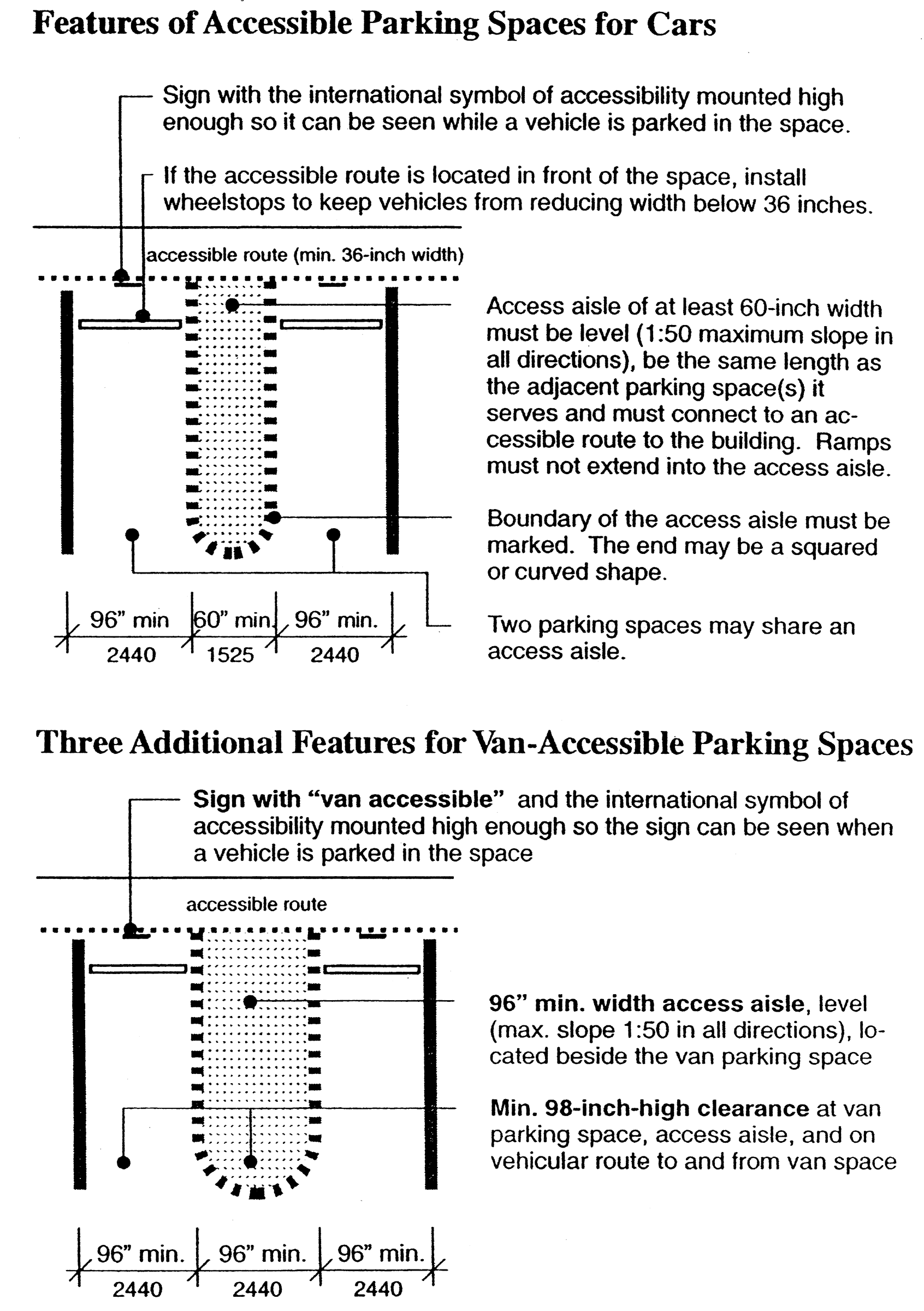
Features of Accessible Parking Spaces for Cars
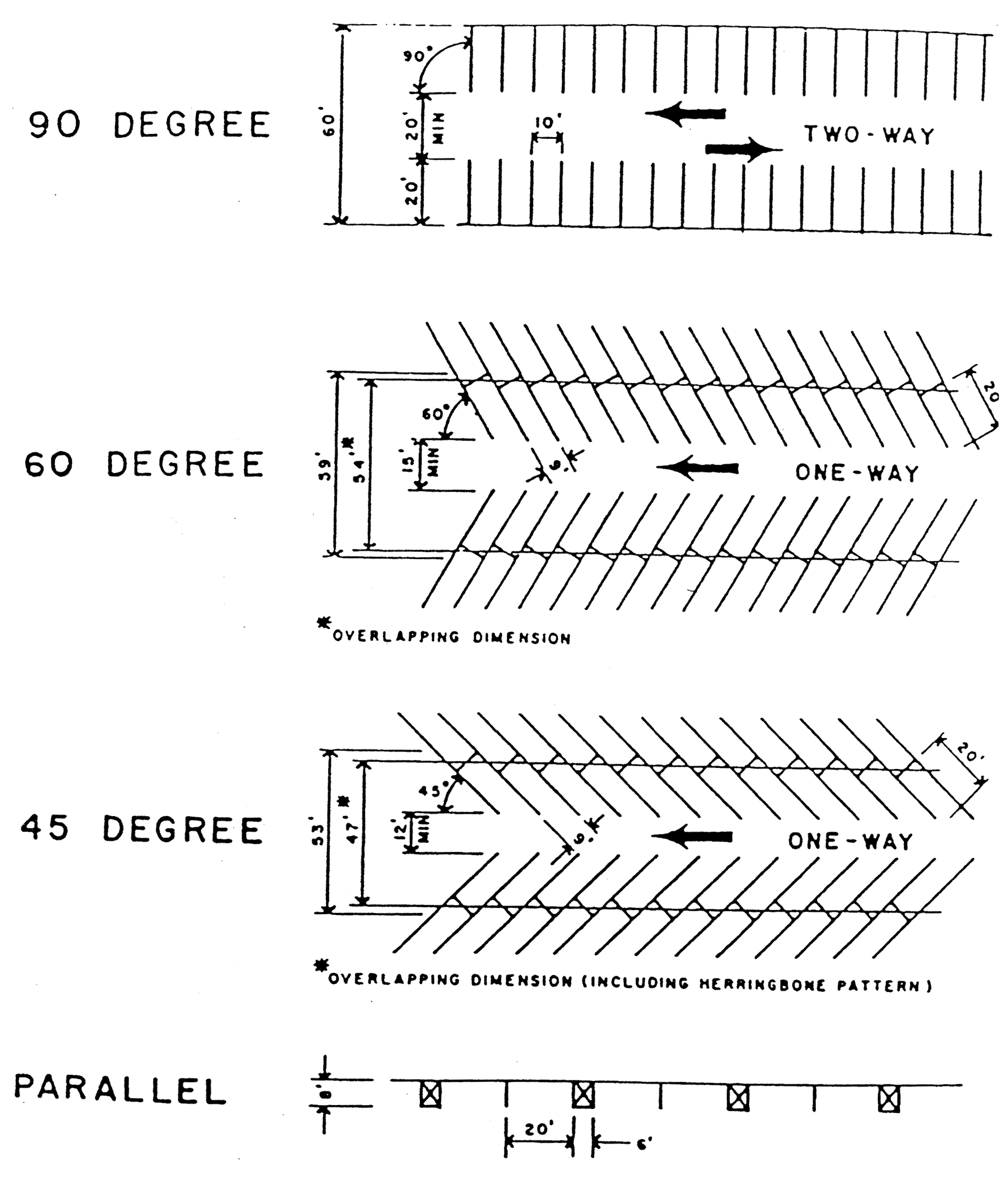
Parking Layouts
(Ord. No. 152N(Amd.), § 4, 10-28-08)
SECTION 3.14 - OFF-STREET LOADING AND UNLOADING
On the same premises with every building, structure, or part thereof, involving the receipt or distribution of vehicles or materials or merchandise, there shall be provided and maintained on the lot, adequate space for standing, loading, and unloading in order to avoid undue interference with public use of dedicated rights-of-way.
A.
Such off-street loading and unloading shall be provided as follows:
1.
All loading spaces shall be in addition to the off-street parking area, access drives, and maneuvering lane requirements.
2.
Off-street loading space shall have a clearance of fourteen (14) feet in height.
3.
Off-street loading space may be completely enclosed within a building, or may occupy a portion of the site outside of the building, provided that where any portion of a loading space is open to public view, said space shall be screened in accordance with Section 3.16.
4.
All loading and unloading in the industrial districts shall be provided off-street in the rear yard or interior side yard, and shall in no instance be permitted in a front yard. In those instances with an industrial district across a public thoroughfare, loading and unloading may take place in said exterior side yard when the setback is equal to at least fifty (50) feet.
SECTION 3.15 - BUILDING GRADES
Any building requiring yard space shall be located at such an elevation that a sloping grade shall be maintained to cause the flow of surface water to run away from the walls of the building. A sloping grade beginning at the sidewalk level shall be maintained and established from the center of the front lot line to the finished grade line at the front of the building and from the rear wall of the building to the rear lot line; however, this shall not prevent the grading of a yard space to provide sunken or terraced areas, provided proper means are constructed and maintained to prevent the runoff of surface water to flow onto the adjacent properties.
When a new building is being constructed on a vacant lot between two existing buildings, the existing established grade shall have priority over determining the grade around the new building and the yard around the new building shall be graded in such a manner as to meet existing grades and not to permit runoff of surface water to flow onto the adjacent properties. Retaining walls and storm water drains shall be provided to allow a normal use of the property to be developed.
Grades shall be established and approved by the Department of Public Services.
SECTION 3.16 - WALLS, BERMS AND GREENBELTS
A.
For the Use Districts and uses listed below, there shall be provided and maintained as indicated, an obscuring wall, landscaped berm or greenbelt, as required below. The height of the wall, berm or greenbelt shall be measured from the surface of the land on the residential or public right-of-way side of the wall, berm or greenbelt as is appropriate:
Requirements by Type of Obscuring Device and Dimension
B.
In the case of variable wall, berm or greenbelt planting height requirements, the extent of obscuring wall or berm shall be determined by the Site Committee on the basis of land usage provided further that no wall, berm or greenbelt shall be less than the above required minimums
C.
Required walls shall be located on the lot line except where underground utilities interfere and except in instances where this Ordinance requires conformance with yard setback lines. Required walls may, upon approval of the Site Committee, be located on the opposite side of an alley right-of- way from a nonresidential zone that abuts a residential zone when mutually agreeable to affected property owners. The continuity of the required wall on a given block will be a major consideration of the Site Committee in reviewing such requests.
D.
Required walls shall have no openings for vehicular traffic or other purposes, except as otherwise provided in this Ordinance and except such openings as may be approved by the Site Committee. All walls herein required shall be constructed of face brick or comparable nonporous facing materials on the exterior sides facing a residential district and shall be approved by the Site Committee to be durable, weather resistant, rustproof and easily maintainable, and wood or wood products shall be specifically excluded. Masonry walls may be constructed with openings which do not in any square section (height and width) exceed twenty percent (20%) of the surface. Where walls are so pierced, the openings shall be so spaced as to maintain the obscuring character required, and shall not reduce the minimum height requirement. The arrangement of the openings shall be reviewed and approved by the Site Committee.
E.
Required berms shall be constructed as landscaped earth mounds with a crest area at least four feet (4;ft;) in width. The exterior face of the berm shall be constructed as an earthen slope. The interior face of the berm may be constructed as an earthen slope, or retained by means of a wall, terrace, or other means acceptable to the Site Committee. Whenever an earthen slope is provided, it shall be constructed with an incline not to exceed one (1) foot of vertical rise to three (3) feet of horizontal distance. Berm slopes shall be protected from erosion by sodding or seeding. If slopes are seeded, they shall be protected with a straw mulch held in place by jute netting until the seed germinates and a permanent lawn is established. The straw mulch is not required if the seeded slope is protected by a net that is specifically designed to control erosion. The berm area shall be kept free from refuse and debris and shall be planted with shrubs, trees or lawn and will be maintained in a healthy, growing condition.
A planting plan and grading plan shall be prepared for the berm and shall be reviewed by the Site Committee. Plant materials within the berm area shall be installed in accordance with the requirements for greenbelts and plant material contained herein.
F.
Whenever a greenbelt planting is required under the provisions of this Ordinance, such greenbelt shall be subject to the following conditions:
1.
The required greenbelt or planting screen shall be planted with permanent living plant materials within six (6) months from the date of occupancy and shall thereafter be maintained in presentable condition, and shall be kept free from refuse and debris; provided further that all plant materials shall be continuously maintained in a sound, healthy, and vigorous growing condition, and shall be kept free of plant diseases and insect pests.
2.
The selection, spacing, and size of plant material shall be such as to create, within a five (5) year period from the date of planting, a horizontal obscuring effect for the entire length of the required greenbelt area and a vertical obscuring effect of such height as is determined adequate by the Site Committee for proper screening between land uses.
3.
The minimum horizontal dimensions of required greenbelt and minimum height of plant materials shall be as set forth under the provisions of this Section for the respective land uses and districts indicated.
4.
In no instance shall the minimum dimensions of plant materials at initial planting be less than the following:
Deciduous shrubs - two (2) feet in height.
Deciduous trees - two (2) inches in caliper.
Evergreen shrubs - two (2) feet in height.
Evergreen trees - four (4) feet in height.
Where, under the provisions of this Section, an option is provided to the developer relative to the substitution of a greenbelt for a required wall or berm, the minimum starting height of plant materials in said greenbelt shall be equivalent to the required wall or berm height.
Requirements as to spread, ball size, number of canes, etc., for the respective starting sizes of all plant materials shall be in accordance with the minimum recommended standards set forth in the latest edition of Horticultural Standards of the American Association of Nurserymen, Inc.
G.
Whenever a greenbelt or planting screen is required under the provisions of this Section, a site plan of the parcel to be developed, together with a detailed planting plan of said greenbelt, shall be submitted to the Site Committee for approval prior to the issuance of a building permit. The site plan shall indicate, to scale, the proposed location and height of buildings and other structures, the location of public walks, roadways and utilities, and the proposed location of off-street parking, loading, service, and outside storage areas and points of ingress-egress to the site.
The planting plan shall indicate, to scale, the locations, spacing, starting size, and description for each unit of plant material proposed for use within the required greenbelt area, together with the finished grade elevations proposed herein. The Site Committee shall review said planting plan relative to:
1.
The proper spacing, placement, and location of plant materials relative to the length and width of greenbelt so as to insure that the required horizontal and vertical obscuring effect of proposed land uses will be achieved.
2.
The choice and selection of plant materials so as to insure that the root system will not interfere with public utilities and that fruit and other debris (other than leaves) will not constitute a nuisance within public rights-of-way, or to abutting property owners.
3.
The proposed relationship between deciduous and evergreen plant materials so as to insure that a maximum obscuring effect will be maintained throughout the various seasonal periods.
4.
The size of plant material (both starting and ultimate) to insure adequate maturity and optimum screening effect of proposed plant materials.
H.
The Department of Public Services shall furnish a list of suggested plant materials upon request of any developer and/or property owner of any parcel requiring the construction of a greenbelt.
I.
The Site Committee may waive or modify the foregoing requirements where cause can be shown that no good purpose would be served and that such waiver or modification would neither be injurious to the surrounding neighborhood nor contrary to the spirit and purpose of this Ordinance.
J.
No wall, fence or shrubbery shall be erected, maintained or planted on any lot which unreasonably obstructs or interferes with the use of adjacent property or traffic visibility at any street intersection or driveway, in accordance with the following standards:
1.
Corner Clearance: When a driveway intersects a public right-of-way or when the subject property abut the intersection of public right-of-way, all landscaping and/or fencing within the corner triangular areas described below shall permit unobstructed cross visibility. Fencing or landscaping located in the triangular area shall not be permitted to exceed a height of more than thirty (30) inches above the centerline elevation of abutting pavement. Trees may be maintained in this area provided that all branches are trimmed to maintain a clear vision for a vertical height of seven (7) feet above the roadway surface except that not more than two (2) trees with trunks of not more than thirty (30) inches in diameter each, and clear of any branches for such height may be located within such area.
2.
The Triangular areas referred to the above are:
a.
The area formed at the corner intersection of a public right-of-way and a driveway, two (2) sides of the triangle area being ten (10) feet in length measured along the right-of-way line and driveway line and the third side being a line connecting these two sides.
b.
The area formed at a corner intersection of two (2) public rights-of-way lines, the two (2) sides of the triangular area being twenty-five (25) feet in length measured along the abutting public right-of-way lines and the third side being a line connecting these two (2) sides.
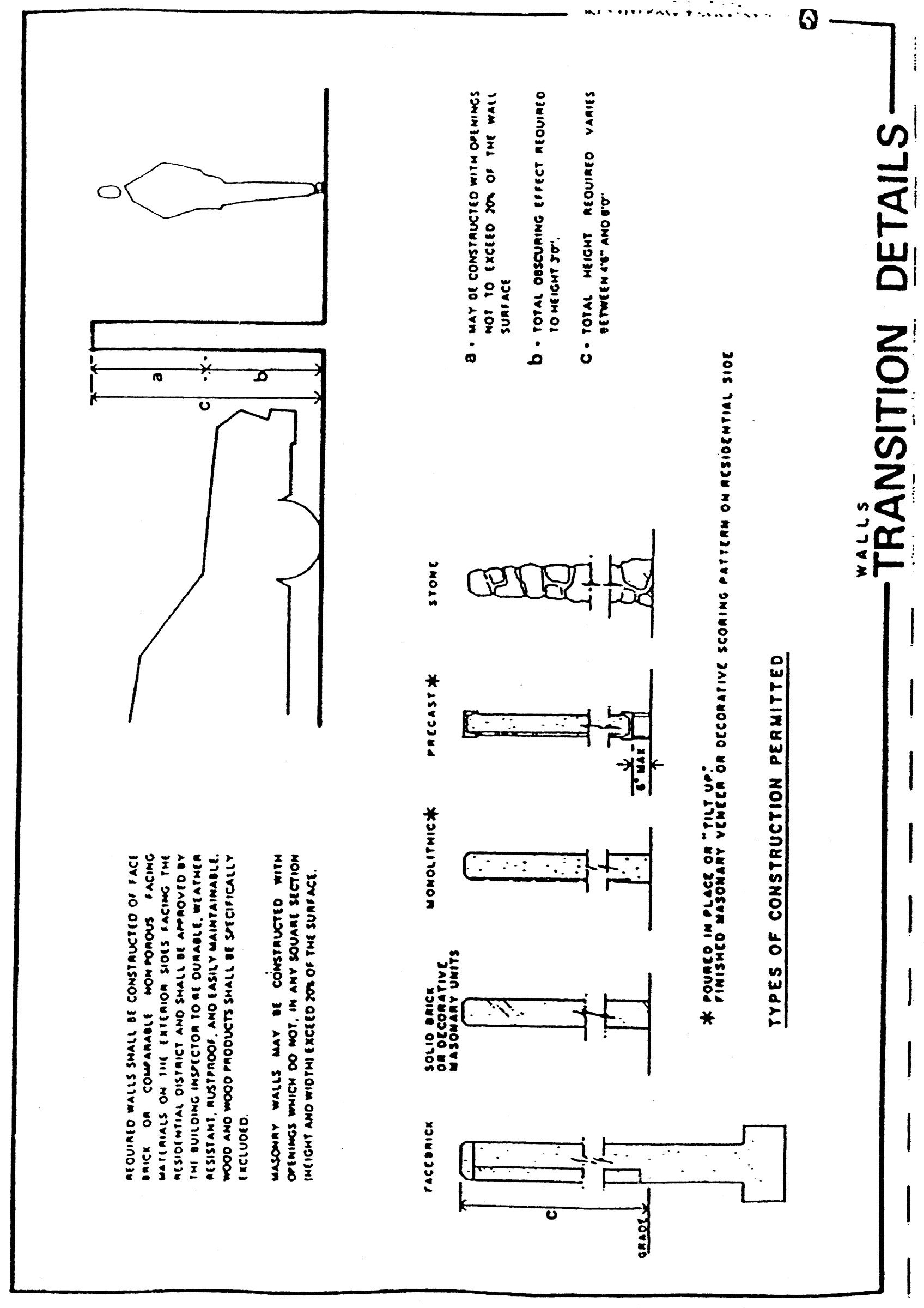
Transition Detail - Walls
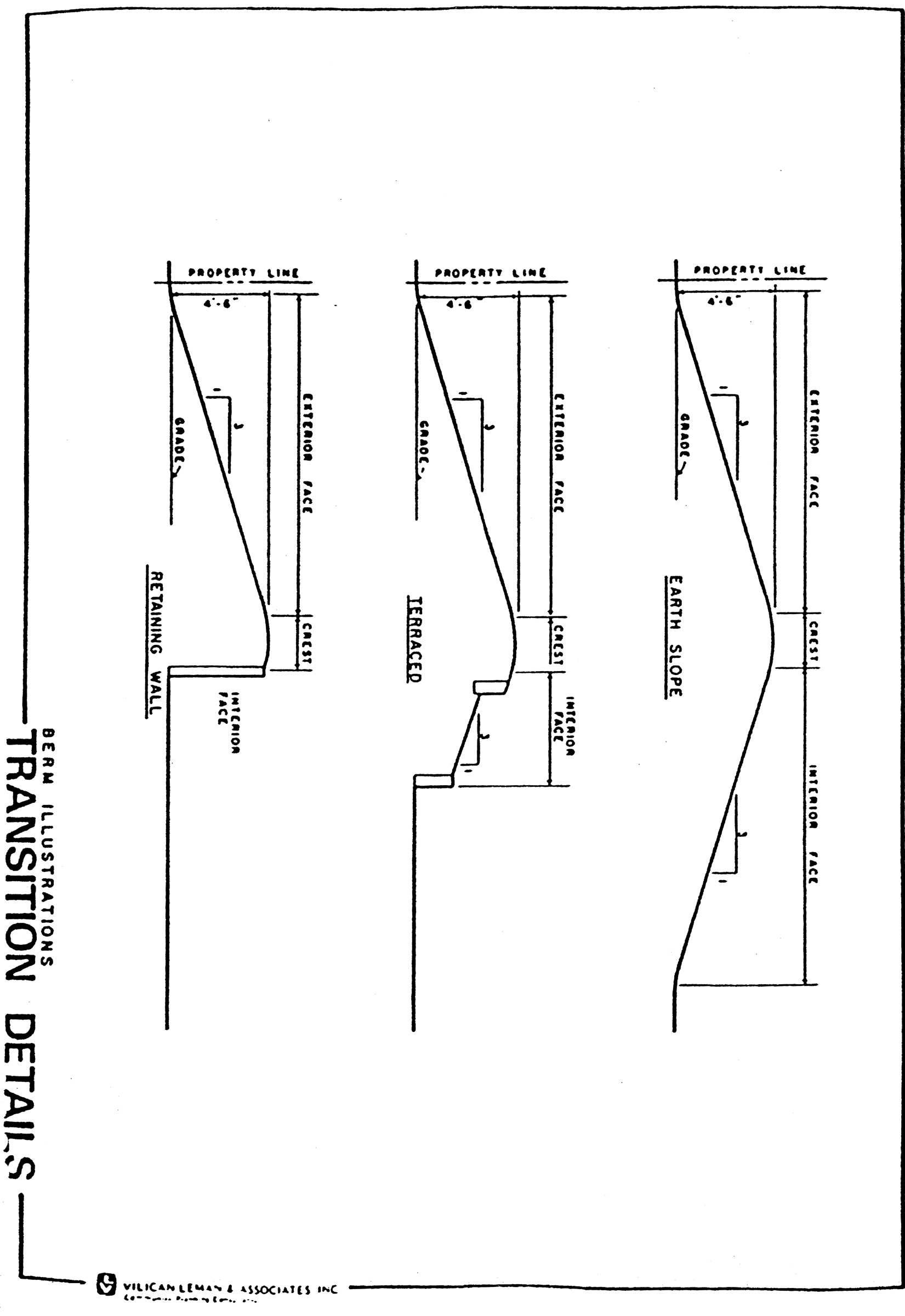
Transition Detail - Berms
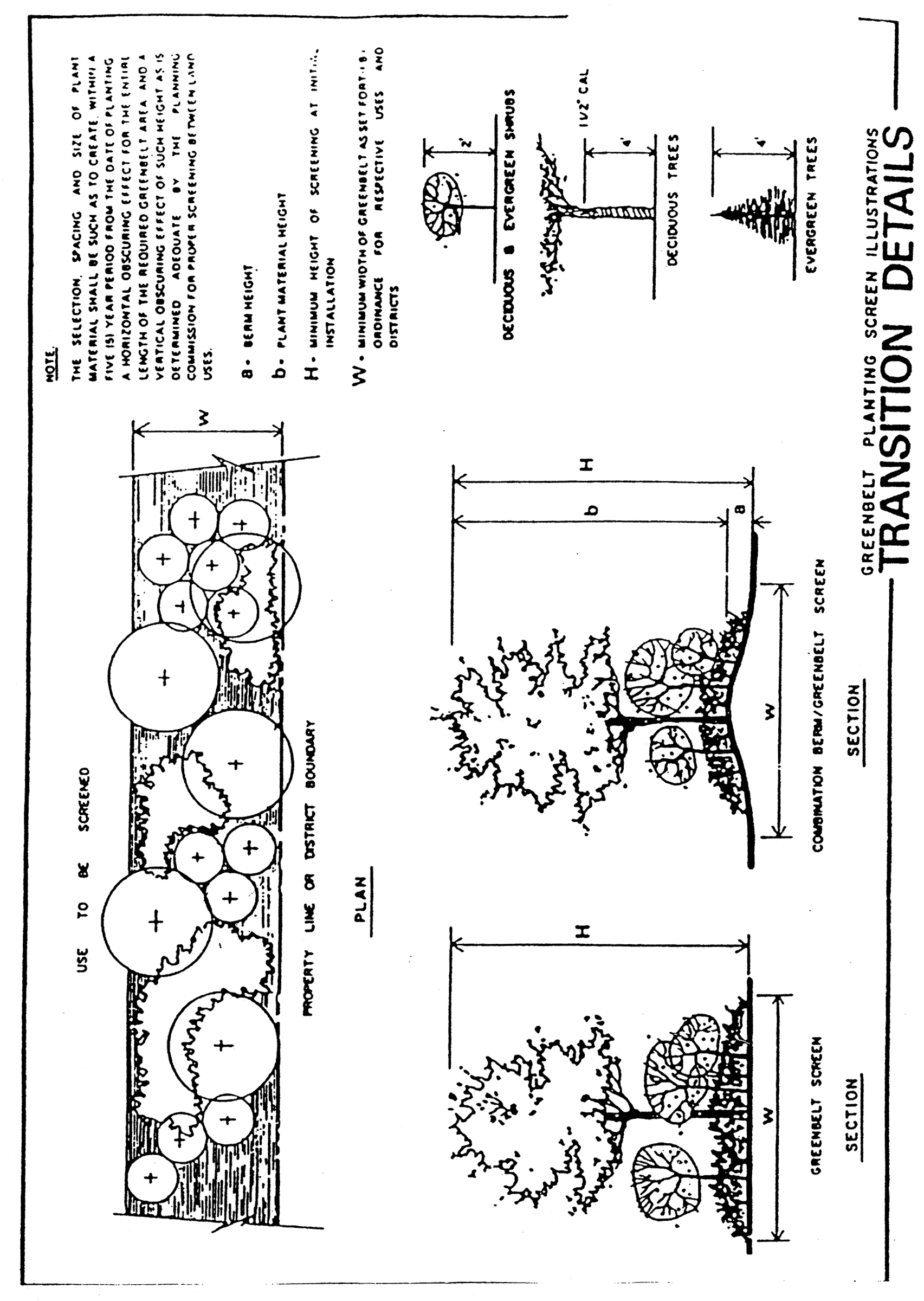
Transition Detail - Greenbelt Planting
SECTION 3.17 - VEHICLE BARRIERS TO UNOCCUPIED BUILDING SITES
Whenever an improved building site which is zoned for nonresidential use shall become vacant for a period exceeding thirty (30) days, the owner of such site shall install temporary barriers to vehicular traffic at all entrance drives for the purpose of preventing unauthorized vehicle entry onto the premises. Such thirty (30) day period may be extended by the Site Committee upon application by the owner, where it can be demonstrated that occupancy of the site will be forthcoming in the near future and where it can be demonstrated that unauthorized vehicle entry on the premises will not become a nuisance.
Such barriers shall be located at the property line and may consist of concrete wheel stops, wood timbers, or such other device as may be approved by the Department of Public Services, provided such device is not less than six (6) inches or more than nine (9) inches in height. Such barrier device shall be maintained and remain installed at the expense of the owner of property until the issuance of building or occupancy permit by the Department of Public Services.
SECTION 3.18 - BUILDING SAFETY
The use of security devices such as, but not limited to steel bars, metal gates and similar apparatus, is prohibited on the exterior or buildings. The use of security devices on the interior of buildings may be approved subject to the review of the Site Committee.
SECTION 3.19 - SITE PLAN REVIEW (ALL DISTRICTS)
The purpose of site plan review is to protect the land and natural resources of the Township, and the health, safety and general welfare of Township residents, surrounding property owners, and future users and/or inhabitants of the proposed project development.
For such purpose, provision is made herein for the required submittal of site plans for review by the Site Committee of the Planning Commission (as established in Ordinance No. 145) as follows:
A.
A Site Plan shall be submitted for approval of:
1.
Any use or development, except a site built one-family detached dwelling, including site condominiums.
2.
Any change of use from a lower to a more intensive use which increases the density of, inhabitants or future users of the development, parking, loading, etc.
B.
Every Site Plan submitted to the Site Committee shall be in accordance with the requirements of this Ordinance. Site plans will be checked for completeness by the Director of Public Services and no plans will be processed unless they are complete and all fees are paid in accordance with the schedule of fees adopted by the Township Board.
C.
In the process of reviewing the site plan, the Site Committee shall consider:
1.
The proposed site plan is in accordance with all provisions and requirements of the Zoning Ordinance.
2.
a.
The location and design of driveways providing vehicular ingress to and egress from the site in relation to streets giving access to the site, and in relation to pedestrian traffic. (Refer also to Article XVIII.)
b.
An approved permit authorizing any curb cuts, from the public agency having jurisdiction over any abutting public thoroughfare shall be furnished prior to the issuance of a building permit.
3.
The traffic circulation patterns within the site and the location and placement of buildings, parking areas, and loading areas as they relate to:
a.
Safety and convenience of both vehicular and pedestrian traffic.
b.
Satisfactory and harmonious relationships between the development on the site and the existing and prospective development of contiguous land and adjacent neighborhoods.
c.
Necessary accessibility by emergency vehicles, etc.
4.
The minimizing of adverse effects on desirable environmental and physical characteristics of the site (as balanced against the reasonable development of the site).
5.
Landscaping, fences, walls and berms in conformance with necessary screening requirements.
6.
The minimizing adverse effects on utility service and established floodplain conditions (as applicable).
7.
The proposed site plan must be in accord with the spirit and purpose of this Ordinance and not be inconsistent with or contrary to the objectives sought to be accomplished by this Ordinance and principles of sound planning.
8.
Site condominium projects shall be subject to all the requirements and standards of the R-1, One-Family Residential District and the design layout and improvement standards of Chapter 78 of the Code of Ordinances for the Charter Township of Redford.
D.
The Site Committee, upon reviewing a site plan, shall take one of the following actions:
1.
Approval - If the site plan meets all the Zoning Ordinance and related development requirements and standards, the Site Committee shall record such approval and shall sign two copies of the site plan, forwarding one to the Building Inspector, and returning one to the applicant.
2.
Disapproval - If the site plan does not meet Zoning Ordinance and related development requirements and standards, the Site Committee shall record the reasons for denial. The applicant may subsequently refile a corrected site plan under the same procedures followed for the initial submission.
3.
Conditional Approval - If minor corrections to the site are necessary, which can be clearly noted, then the Site Committee shall so note such conditions and shall sign two site plans as conditionally approved and stating the necessary conditions. One copy shall be forwarded to the Building Inspector, and one returned to the applicant.
4.
Table - If, during the process of review, the Site Committee finds that additional information is required before a sound judgment is rendered, the Site Committee may table the site plan until such information is provided.
E.
The approval by the Site Committee of any site plan under the provisions of this Ordinance shall expire and be considered automatically revoked one (1) year after the date of such approval unless actual construction has commenced and is proceeding in accordance with the issuance of a valid building permit. If such construction activity ceases for any reason for a period of more than one (1) year, any subsequent use of said land shall be subject to review and approval of a new site plan for said property in conformance with the regulations specified by this Ordinance, except that the Site Committee may, at its discretion, upon application by the owner and for cause shown, provide for up to two (2) successive twelve (12) month extensions.
F.
Any site approval shall be revoked when construction of said development is not in conformance with the approved plans, in which case the Site Committee shall give the applicant notice of intention to revoke such approved plans at least ten (10) days prior to review of the violation by the Site Committee. After conclusion of such review, the Site Committee shall revoke its approval of the development if it feels that a violation in fact exists and has not been remedied prior to such hearing.
G.
Accompanying Reports, Maps and Drawings Required. Reports, maps and drawings, in duplicate, shall be submitted with the application for site plan approval to indicate the following:
1.
A property line and topographic survey indicating the siting of all structures on the subject property, and all adjoining properties, prepared by a Registered Land Surveyor licensed to practice in the State of Michigan.
2.
Landscape plan of proposed development.
3.
Design of ingress and egress.
4.
Layout plan of off-street parking and loading facilities.
5.
Size and location of proposed sewer and water lines and connections.
6.
Contour of base flood elevation and floodway (as applicable).
7.
Sketches of the exterior and elevations, and/or perspective drawings of the building or structures under consideration.
8.
Floor plans of the building under consideration.
9.
The location and width of all existing and proposed sidewalks on or bordering the subject site. When the subject site borders a public right-of-way, a concrete sidewalk five feet in width shall be provided within the public right-of-way one foot from the subject site's property line.
10.
The Site Committee may further require the submittal of a traffic impact study where it anticipates the proposed use may diminish the carrying capacity of neighboring roadways or may increase the traffic accident potential along such roadways.
H.
Improvements
1.
As used in this section, "improvements" means those features and actions associated with a project which are considered necessary by the Site Committee in granting site plan approval, to protect natural resources, or the health, safety, and welfare of the residents of the Township and future users or inhabitants of the proposed project or project area, including roadways, parking, lighting, utilities, sidewalks, screening, drainage, and similar features. Improvement does not include the entire project, which is the subject of site plan approval.
2.
To insure compliance with this ordinance and any conditions imposed hereunder, the Site Committee may require that a cash deposit, certified check, irrevocable bank letter of credit, or surety bond acceptable to the Township covering the estimated cost of improvements associate with a project for which site plan approval is sought be deposited with the Clerk of the Township to insure faithful completion of the improvements. The performance guarantee shall be deposited at the time of the issuance of the building permit. The Site Committee shall not require the deposit of the performance guarantee prior to the time when the Township is prepared to issue the permit. The Site Committee shall establish procedures whereby a rebate of any cash deposits in reasonable proportion to the ratio of work completed on the required improvements will be made as work progresses.
I.
Where the Township has adopted specific area or neighborhood improvement or redevelopment plans and recommendations involving, but not limited to, public rights-of-way, utilities and storm drainage, parking facilities, building placement, access drives, floor space density allocations, building facade and architectural treatment, no site plan and/or building permit shall be approved unless there is general compliance with such Township plan.
J.
Nothing herein shall prevent the Site Committee from reconsidering a submitted site plan upon a subsequent finding that the original submittal by the applicant was incomplete, in error, or falsely portrayed as to existing or proposed conditions.
SECTION 3.20 - FLOODPLAIN CONTROLS
A.
No building or land shall be used within a floodplain except for such uses as are specified under the Principal Uses Permitted and Uses Permitted Subject to Special Conditions Sections of this Ordinance for the applicable Zoning District within which such floodplain is located.
B.
All construction, filling, excavation, and improvements within a floodplain shall be subject to the provisions of the Township of Redford Floodplain Ordinance (being Ordinance No. 96A).
SECTION 3.21 - SPECIAL USE PERMITS
It
is recognized that the operational characteristics and influences of certain specialized uses require special attention to assure that their development and operations will not adversely affect the surrounding area, or the public health, safety and welfare of the Township as a whole.
It
is the intent of this Section to set forth the basic and specialized review process and requirements necessary to evaluate and control these uses. The procedure and requirements for filing and processing special use permits are as follows:
A.
Applications for Special Use Permits shall be filed with the Zoning Enforcement Officer on a form provided by the Township.
B.
Each application shall be accompanied by a fee as established by resolution of the Township Board.
C.
The application shall also include such information as required by SEC. 3.19, SITE PLAN REVIEW (ALL DISTRICTS).
D.
The completed application shall be signed by the fee holder of the affected property.
E.
Basic requirements for reviewing various specified and nonspecified uses.
1.
Arcades, Billiard Parlors, Card Rooms and Similar Uses. Establishments, the principal use of which is to provide facilities and space for patrons to engage in the playing of mechanical amusement devices, pool, billiards, cards or similar activities shall only be permitted in the C-2 Districts, subject further to the following requirements and conditions:
a.
The site shall not be located within one hundred (100) feet of a residential district.
b.
The site shall be so located as to abut a major thoroughfare right-of-way, and all ingress-egress to the site shall be directly from said major thoroughfare.
2.
Sexually Oriented Businesses and Pawn Shops. It has been demonstrated that the establishment of adult businesses and pawn shops in business districts which are immediately adjacent to and which serve residential neighborhoods, has a deleterious effect on both business and residential segments of the neighborhood, causing blight and a downgrading of property values. A prohibition against the establishment of more than two such regulated uses within one thousand (1,000) feet of each other serves to avoid the clustering of certain businesses, which, when located in close proximity to each other, tend to create a skid row atmosphere. However, such prohibition fails to avoid the deleterious effects of blight and devaluation of both business and residential property values resulting from the establishment of adult supply stores, adult motion picture theaters, adult mini-motion picture theaters and adult cabarets, adult personal service establishment, adult physical culture establishment, and pawn shops in a business district which is immediately adjacent to and which serves residential neighborhoods. The concern for and pride in the orderly planning and development of a neighborhood should be encouraged and fostered in those persons who comprise the business and residential segments of that neighborhood.
The Planning Commission and the Township Board should be guided by the expressed will of those businesses and residences which are immediately adjacent to the proposed location of, and therefore, most affected by the existence of any, adult supply store, adult motion picture theater, adult mini-motion picture theater, and adult cabarets, adult personal service establishment, adult physical culture establishment, and pawn shop.
a.
For purposes of this Section, the following definitions shall control:
Adult Arcade - Any place to which the public is permitted or invited wherein coin-operated or slug-operated or electronically, electrically, or mechanically controlled still or motion picture machines, projectors, or other image-producing devices are maintained to show images to five (5) or fewer persons per machine at any one (1) time, and where the images so displayed are distinguished or characterized by the depicting or describing of "specified sexual activities," "specified anatomical areas," or "specified acts of violence."
Adult Cabaret - An establishment where materials or entertainment is presented, displayed, permitted or provided, which is distinguished or characterized by an emphasis on or related to "specified sexual activities," "specified anatomical areas," or "specified acts of violence" as defined herein.
Adult Entertainment - Any use of land, whether vacant or combined with structures or vehicles thereon, by which said property is devoted to displaying or exhibiting material for entertainment, a significant portion of which includes matter or actions depicting, describing or presenting "specified sexual activities," "specified anatomical areas, of "specified act of violence."
Adult Mini-Motion Picture Theater - Any enclosed building with the capacity for less than fifty (50) persons used for presenting material distinguished or characterized by an emphasis on matter depicting, describing, or relating to "specified sexual activities," "specified acts of violence," or "specified anatomical areas" for observation by patrons therein.
Adult Motel - A hotel, motel, or similar commercial establishment that offers accommodations to the public for any form of consideration and provides patrons with closed-circuit television transmissions, films, motion pictures, video cassettes, slides, or other photographic reproductions that are characterized by the depiction or description of "specified sexual activities," "specified anatomical areas," or "specified acts of violence," and has a sign visible from the public right-of-way that advertises the availability of this adult type of photographic reproductions, or offers a sleeping room for rent for a period of time that is less then twenty-four (24) hours; or allows a tenant or occupant of a sleeping room to sub-rent the room for a period of time that is less than twenty-four (24) hours. Adult Motion Picture Theater - Any enclosed building with a capacity of fifty (50) or more persons used for presenting material distinguished or characterized by an emphasis on matter depicting, describing, or relating to "specified sexual activities," "specified acts of violence," or "specified anatomical areas" for observation by patrons therein.
Adult Novelty Business - Any establishment which offers for sale devices which simulate human genitals or devices designed for sexual stimulation.
Adult Personal Service Establishment - Any business agency, or service which arranges, solicits, or provides for the benefit of its customers or clients, escorts, dates, models, "therapists," companions or entertainers, either on or off the premises, for the purpose of engaging in "specified sexual activities," "specified acts of violence" or displaying "specified anatomical area" as defined herein.
Adult Physical Culture Establishment - "Adult physical culture establishment" is any establishment, club, or business by whatever name designated, which provides, offers, or advertises, or is equipped or arranged so as to provide as part of its services, either on or off the premises, massages, body rubs, physical stimulation, baths, body piercing (other than ears), tattoos, or other similar treatment by any person. The following uses shall not be included within the definition of an adult physical culture establishment:
a.
Establishments which routinely provide such services by a licensed physician, a licensed chiropractor, a licensed osteopath, a licensed or certified physical or massage therapist, a licensed practical nurse, or any other similarly licensed medical professional.
b.
Electrolysis treatment by a licensed operator of electrolysis equipment;
c.
Continuing instruction in martial or performing arts or in organized athletic activities;
d.
Hospitals, nursing homes, medical clinics, or medical offices; and,
e.
Barbershops or beauty parlors, health spas and/or salons which offer massage to the scalp, face, the neck, or shoulders only.
Adult Supply Store - Any premises wherein a significant portion or area is used for the sale, rental, distribution, or display of books, magazines, novelties, periodicals, films, videos, recordings, devices, objects, toys, paraphernalia or similar materials, which are used for or characterized by an emphasis on "specified sexual activities", "specified acts of violence", or "specified anatomical areas." Retail establishments which display, sell, distribute, provide or rent such materials within a segregated enclosed area not greater than five (5) percent of the total useable retail space which is limited to persons ages 18 years or over, shall not be included in the definition of "Adult Supply Store."
Establishment - Any business or enterprise which utilizes any buildings, structures, premises, parcel, place, or area. Nude Model Studio - Any place where a person who appears in a state of nudity or displays "specified anatomical areas" is provided in order to be observed, sketched, drawn, painted, sculptured, photographed, or similarly depicted by other persons for consideration.
Pawn Broker - Any person, corporation, or member or members of a corporation or firm who loans money on deposit or pledge of personal property, or other valuable thing, other than securities or printed evidence of indebtedness, or other who deals in the purchasing of personal property or other valuable thing on the condition of selling the same back again at a stipulated price.
Pawn Shop - Any shop, store, or building, or other location at which a pawn broker conducts business.
Restricted Adult Business - Any of the defined sexually oriented businesses, which are not customarily open to the public generally, but only to one or more classes of the public, excluding any minor by reason of age.
Sexual Encounter Center - A business or commercial enterprise that, as one of its principal business purposes, offers for any form of consideration, physical contact in the form of wrestling or tumbling between persons of the opposite sex; or activities between male and female persons and/or persons of the same sex when one or more of the persons is in a state of nudity or semi-nudity.
Sexually Oriented Business - An adult supply store, adult motion picture theater, adult mini-motion picture theater, adult cabaret, adult personal service establishment, adult physical culture establishment, adult arcade, adult motel, adult novelty business, nude model studio, sexual encounter center, or restricted adult business.
"Specified Sexual Activities" shall be defined as:
i.
Actual or simulated sexual intercourse, oral copulation, anal intercourse, oral/anal copulation, bestiality, direct physical stimulation of unclothed genitals, flagellation or torture in the context of sexual relationship, or the use of excretory functions in the context of a sexual relationship, and any of the following depicted sexually oriented acts or conduct: anilingus, coprophagy, coprophilia, cunnilingus, fellatio, necrophilia, pederasty, pedophilia, sapphism, or sodomy;
ii.
Clearly depicted human genitals in a state of sexual stimulation, arousal, tumescence;
iii.
Use of human or animal masturbation, sodomy, oral copulation , coitus, ejaculation;
iv.
Fondling or touching of nude human genitals, pubic region, buttocks, or female breast;
v.
Masochism, erotic, or sexually oriented torture, beating, or the infliction of pain;
vi.
Erotic or lewd touching, fondling, or other contact with an animal by a human being;
vii.
Human excretion, urination, menstruation, vaginal or anal irrigation.
"Specified Acts of Violence" shall include:
i.
The graphic depiction, whether real or stimulated, of human or animal: 1) decapitation; 2) dismemberment; 3) physical torture; 4) stabbing; 5) shooting; 6) strangulation; 7) drowning; 8) electrocution; 9) aggravated assault, whether accomplished by human contact, instruments, or weapons; 10) rape; 11) disfigurement; 12) mutilation; 13) burning; and, 14) disembowelment.
"Specified Anatomical Areas" is defined as:
i.
Less than completely and opaquely covered: 1) human genitals, pubic region; 2) buttock; and 3) female breast: below a point immediately above tope of the areola; and
ii.
Human male genitals in a discernible turgid state, even if completely and opaquely covered.
b.
Sexually oriented businesses and pawn shops as defined above shall only be permitted in the C-2 District subject to the following requirements and conditions:
i.
Not more than two such uses shall be permitted within 1,000 feet of each other.
ii.
It shall be unlawful to establish any such use in a C-2 District if the proposed location is within 500 feet of a residentially zoned district unless the prohibition is waived upon the presentment to the Planning Commission of a validated petition requesting such waiver, signed by 51 percent of those persons owning, residing, or doing business within 500 feet of the proposed location.
iii.
The site shall be so located as to abut a major thoroughfare, rightof- way, and all ingress-egress to the site shall be directly from such major thoroughfare.
c.
Pawn shops shall be subject to an examination at any time by the Supervisor, Township Attorney, or other police officer of the Township or by the Prosecuting Attorney or the Sheriff or other police officer of Wayne County in accordance with Township Ordinance No. 202, for the purpose of inspecting the premises and record of property received.
Applicants seeking approval to provide tattoos or body piercing (other than ears) as part of an adult physical culture establishment shall demonstrate to the satisfaction of the Site Committee through use of floor plans and similar evidence that:
i.
The tattooing, body piercing and clean-up areas will be smooth and easily cleanable.
ii.
The tattooing, body piercing and clean-up areas will be well lit.
iii.
A handwashing sink is provided in the tattooing areas.
iv.
A utensil wash-up sink is provided in the clean-up area.
(Ordinance K, Effective April 15, 1993)
3.
Uses Not Otherwise Specified. Other uses which have not been specifically mentioned may be processed under a Special Use Permit if they possess unique or innovative operational or development characteristics. Any such use must be processed and reviewed in accordance with the applicable procedures and requirements set forth in this Section.
4.
Vehicle dealers with outdoor sales space and/or repair facilities for the sale of new or secondhand automobiles, house trailers, recreational vehicles, or rental of trailers and/or automobiles or similar activities shall only be permitted in the C-2 District, subject further to the following requirements and conditions:
a.
Except as may otherwise be provided below, new and used vehicle dealers shall meet the requirements of Section 14(2) of the Michigan Vehicle Code, Public Act 300 of 1949, as amended.
b.
Vehicle dealers that solely sell vehicles shall be constructed on parcels of at least 15,000 square feet in area. Vehicle dealers that both sell and service vehicles on the property shall be constructed on parcels of at least 18,000 square feet in area.
c.
All portions of the property used for off-street parking, loading and unloading operations, and for outdoor display shall be provided with asphaltic or concrete surfacing meeting Township specifications.
d.
Vehicle dealers that include the servicing of vehicles on the property shall additionally be subject to the following requirements:
i.
Any such activity shall be clearly incidental to the sale of vehicles and shall occur completely within an enclosed building. Service bay doors shall not face residentially-zoned property.
ii.
No vehicle awaiting repair shall be stored in a required yard area.
iii.
The outdoor storage of vehicles awaiting repair shall be totally obscured by a wall, berm, or greenbelt provided in accordance with Section 3.16.
iv.
The outdoor storage of vehicle parts, or partially disassembled vehicles, is expressly prohibited.
v.
A service building shall be provided with a minimum size of 600 square feet.
vi.
In addition to required customer and employee off-street parking, off-street parking for vehicles awaiting repair shall be provided in the amount of one (1) such space for each vehicle service stall, with a minimum of two (2) such spaces. The vehicle storage space shall meet the size requirements of Section 3.13.B.
vii.
The servicing of vehicles is allowed only for vehicles which are owned by the vehicle dealership.
e.
The sale and display of inoperable vehicles is expressly prohibited.
f.
Landscaping shall be provided in accordance with Section 3.26. In addition, a landscaped open area with a minimum width of three (3) feet is required immediately adjacent to all building sides facing a public street or residentially-zoned property. Such required landscaped open area shall have at least 60 percent coverage by shrubs, groundcover, annuals, perennials, or ornamental grasses.
g.
The vertical stacking of vehicles is expressly prohibited.
h.
The use of an outdoor intercom or speaker system is expressly prohibited.
i.
Off-street parking shall be provided in accordance with the following requirements:
i.
One (1) off-street parking space shall be provided for each employee in the largest working shift, with a minimum of two (2) employee parking spaces. A minimum of four (4) employee parking spaces are required for a location that services vehicles.
ii.
If the use includes the servicing of vehicles, one (1) off-street parking space shall be provided for each vehicle service stall, with a minimum of two (2) such spaces.
iii.
One (1) off-street parking space for each 50 square feet of usable floor area devoted to customer use. In no instance shall such vehicle dealers provide less than eight (8) parking spaces for customer parking.
j.
The exterior lighting of off-street parking areas and outdoor display areas shall comply with the requirements of Section 3.13(H) and specified for low-and moderate-density nonresidential uses.
k.
All vehicle dealers shall provide an office building with a minimum size of 500 square feet.
l.
A trash storage area shall be provided and maintained on the site and shall comply with Section 3.29.
m.
A space dedicated to temporary off-street loading and unloading shall be provided and maintained on the site and shall comply with the requirements of Section 3.14(A).
n.
A minimum of ten (10) display vehicle parking spaces shall be provided in compliance with the requirements of Section 14(2)(b) of the Michigan Vehicle Code.
o.
Except as provided below, off-street parking areas located adjacent to public street rights-of-way shall provide either a wall, berm, or greenbelt in accordance with Section 3.16(A)(2), except that the greenbelt width requirement shall increase from 4 feet to 10 feet for vehicle dealers. In lieu of the preceding requirement, an ornamental fence meeting Township specifications may be installed.
p.
In lieu of approval by the Township Board, the Planning Commission, after holding a public hearing in accordance with Subsection 3.21(F), shall have the authority for the approval of vehicle dealer special use permits. Additionally, the provisions of Subsections 3.21(G) and 3.21(H) shall apply.
q.
Vehicle dealerships shall not be located closer than 1,000 feet to another vehicle dealership unless it is part of a planned automotive mall that purposely provides sales space and centralized services for a number of vehicle dealerships and that may also include such related services as vehicle insurance dealers, financial institutions that provide financing opportunities, or vehicle service and repair.
r.
Under Authority of 2006 P.A. 110, Section 208, as may be amended, nonconforming vehicle dealers with outdoor sales space and/or repair facilities for the sale of new or secondhand automobiles shall be required to comply with the standards of this Section 3.21(E)(4) when any of the following circumstances occur:
i.
A change to the Michigan vehicle dealer license applicable to the subject site.
ii.
A change of ownership.
iii.
A re-occupancy of a nonconforming vehicle dealer use which has ceased for a period of more than thirty (30) days.
In such case, compliance with the standards of this Section 3.21(E)(4) shall apply to the greatest extent practicable, as determined by the Site Committee. Notwithstanding the above, such compliance shall not pertain to building size, parcel size, or required setbacks of the principal building.
F.
After completing review and study of the application, the Township Planning Commission shall hold a public hearing in accordance with SEC. 16b of Public Act 184 of 1943 as amended.
Following the public hearing, the Planning Commission shall forward a copy of the application, the minutes of the public hearing, and the Planning Commission recommendation to the Township Board. The Township Board shall review and make final determination on the application.
If the Township Board determines that the application for a sexually oriented business is complete, it shall within ninety (90) days of said determination make and adopt specific findings with respect to whether the sexually oriented business in compliance with the approval standards and development standards of this Section. If the Township Board has not made and adopted findings of fact with respect to a proposed sexually oriented business and either approved or denied the issuance of a special use permit for the same within ninety (90) days of its determination that a completed application has been filed, then the special use permit shall be deemed to have been approved.
In the event an application for a special use permit is denied for a sexually oriented business, the applicant shall be entitled to prompt review by the Township Board of Appeals as a means to exhaust local remedies and to be consistent with the intent of Paragon Properties Co., v. Novi, 206, Mich App 74; 520 NW2d 344 (1994). The applicant shall file for an appeal with the Township Clerk within five (5) business days of the denial of the special use permit request by the Township Board. The review shall, upon the Applicant's request, be conducted at a special Zoning Board of Appeals meeting convened for such purposes within fifteen (15) days of receipt of such a request; otherwise, it will be considered at the next regularly scheduled meeting of the Township Zoning Board of Appeals. The Zoning Board of Appeals shall review the record of proceedings conducted before the Township Board to determine whether the Township Board's decision was based upon competent material and substantial evidence in the record and otherwise review the Township Board's determination to ensure that it complies with all requirements of both the Michigan and United States Constitutions. If the Township Zoning Board of Appeals affirms denial of special use permit application for the operation of sexually oriented businesses, then the applicant shall be entitled to prompt judicial review by submitting a written request to the Township Clerk. Such written request must be received by the Township Clerk within thirty (30) days of the date of the decision of the Township Zoning Board of Appeals. The Township shall within five (5) business days of receipt of such written request do the following:
a.
File a petition in Circuit Court for the County of Wayne, seeking a judicial determination with respect to the validity of such denial and, in conjunction therewith, apply for a preliminary and permanent injunction restraining the applicant from operating the sexually oriented business in violation of the Township Zoning Ordinance;
b.
Request that the application for issuance of a preliminary injunction be set for a show-cause hearing within five (5) days or as soon as thereafter as is possible. In the event the applicant appears at or before the time of such show-cause hearing, waives the notice otherwise provided by Michigan Court Rules, and requests that at the time set for such hearing, the Court proceed to hear the case under applicable rules of civil procedure for the issuance of such permanent injunction on it merits, the Township shall be required to waive its application for preliminary injunction and shall join such request.
In the event that the applicant does not waive notice and/or does not request an early hearing on the Township's application for permanent injunction, it shall nevertheless be the duty of the Township to seek the earliest possible hearing date under Michigan law and the Michigan Court Rules.
The filing of written noticed of intent to contest the Township's denial of a special use permit shall not in any way affect the validity of such denial, but such denial shall be deemed invalid and the special use permit application automatically approved if, within fifteen (15) days of the filing of the Township's petition, a show-cause hearing has not been scheduled.
G.
Prior to approving any application for a Special Use Permit, the Township Board or the Planning Commission, in the case of the approval of vehicle dealers with outdoor sales space, shall find adequate evidence that the proposed use:
1.
Will be harmonious with and in accordance with the general objectives of the Master Plan;
2.
Will be designed, constructed, operated and maintained in harmony with the existing and intended character of the general vicinity and so that such use will not change the essential character of that area;
3.
Will not be hazardous or disturbing to existing or future neighboring uses;
4.
Will represent a substantial improvement to property in the immediate vicinity and to the community as a whole;
5.
Will be served adequately by essential public services and facilities such as highways, streets, drainage structures, police and fire protection, and refuse disposal, or persons or agencies responsible for the establishment of the proposed use shall be able to provide adequately for such services;
6.
Will not create excessive additional requirements at public cost for public facilities and services, and will not be detrimental to the economic welfare of the community.
7.
Will not involve uses or activities which will create nuisance factors.
8.
Will be consistent with the intent and purposes of this Ordinance.
H.
In order to ensure that the proposed use under a Special Use Permit fulfills the requirements of this Section:
1.
The Planning Commission or the Township Board may require such additional conditions and safeguards as deemed necessary for the protection of the general welfare, and individual property rights and for insuring that the intent and objectives of this Ordinance will be observed. The breach of any condition, safeguard, or requirement and the failure to correct such breach within thirty (30) days after an order to correct is issued by the Township shall be reason for immediate revocation of the permit. Additional time for correction of the cited violation may be allowed by the Township Board upon submission of proof of good and sufficient cause. Conditions and requirements stated as a part of Special Use Permit authorizations shall be continuing obligations of the holders of such permits and are binding upon their heirs and assigns and upon any persons taking title to the affected property while such Special Use Permit is in effect. Accordingly, the Special Use Permit shall be recorded with the Register of Deeds of Wayne County.
2.
The discontinuance of a special use after a specified time may be a condition to the issuance of the permit. Renewal of a Special Use Permit may be granted after a review and determination by the Township Board, after recommendation of the Planning Commission, that continuing private need and public benefit will be served by such renewal, provided that the renewal application shall be in accord with standards and requirements in effect at the time that the renewal is requested.
The Special Use Permit may also require that a specified percentage of authorized construction be completed within a stated time as a condition to the issuance of the permit.
3.
No application for a Special Use Permit which has been denied by the Planning Commission or Township Board shall be resubmitted until the expiration of one (1) year from the date of such denial, except on grounds of newly discovered evidence or proof of changed conditions, sufficient to justify reconsideration by the Planning Commission. Each reapplication will be treated as a new application.
(Ord. No. 152N, 2-12-2019)
SECTION 3.22 - PLANNED DEVELOPMENT PROJECTS
A.
Intent. The intent of this Section is to permit the application of a Zoning District for development and use of land as a Planned Development Project pursuant to Sec. 16 c. of Act No. 184, P.A. 1943, as amended.
The rezoning and designation of Planned Development Project status shall be predicated on simultaneous approval of the following by the Township Board:
1.
The specific principal use(s) which is intended to occupy the land.
2.
The specific plan for site and/or building improvements which are intended to be placed on the land, and
3.
The designation of the appropriate Zoning District(s) to the land so as to permit occupancy by the intended use in accord with the Principal Uses Permitted in Articles IV through XVI of this Ordinance, or conveyance of a PDP, Planned Development Project zoning district classification to accommodate mixed-use or "blended" development project.
It is further intended that once a parcel of land has been rezoned, under these provisions no development shall take place thereon nor use made of any part thereof except in accordance with the originally approved application and plans, or in accordance with an approved amendment thereto.
B.
Eligibility for Rezoning and Township Board Approval. The rezoning of land for a Planned Development Project may be approved by the Township Board upon petition by the property owner, subject to the following conditions:
1.
The Planned Development Project shall be mutually agreeable to the property owner and the Township Board.
2.
The Township Board shall find that rezoning and development of such land under the zoning amendment procedures, site plan review procedures, and minimum ordinance requirements as otherwise set forth in this Ordinance may result in future adverse affects on adjacent properties, established land uses, and established zoning districts due to such factors as parcel location, size and/or nature, and intensity of the proposed principal use, or other principal uses that are also permitted in the district being requested.
C.
Application Procedure.
1.
Application Requirements. Application shall be made to the Township Board for rezoning to a specific Zoning District(s) as a Planned Development Project or for a PDP, Planned Development Project zoning district classification for mixed-use or "blended" development projects. Such application shall include the following:
a.
The proposed Zoning District being requested.
b.
A proof of ownership of the land being requested for rezoning.
c.
Maps and drawings as required in Sec. 3.19 (Site Plan Review) of this Ordinance. In requesting preliminary approval pursuant to Sec. 3.22, C., 2., a., such plans and drawings may be of a preliminary nature but shall be completed to such detail as will permit comprehensive review and evaluation of the proposed project. In requesting final approval pursuant to Sec. 3.22, C., 2., b., such plans and drawings shall be completed to such detail as is required for construction.
d.
A written statement explaining in detail the full intent of the sponsor indicating the specifics of the site plan as it relates to the type of dwelling units contemplated and resultant population; the extent of nonresidential development and the resultant traffic generated and parking demands created; and providing supporting documentation such as but not limited to: market studies, supporting land use request, and the intended scheduling of development, as may be appropriate for the specific project submitted.
2.
Site Committee Review.
a.
Preliminary Review - The Site Committee shall review the preliminary plans for the proposed Planned Development Project in accordance with Sec. 3.19 of this Ordinance and shall submit a recommendation to the Planning Commission regarding same.
b.
Final Review - Subsequent to Township Board approval of rezoning for a Planned Development Project, the Site Committee shall review all final plans to assure their conformance to the preliminary plans which were approved by the Township Board as part of the rezoning.
3.
Planning Commission Review. The Planning Commission shall review the Planned Development Project rezoning application, and shall hold a public hearing in accordance with Sec. 16c(5) of Public Act No. 184, P.A. 1943, as amended. Notification of the public hearing shall be in the same manner as required by Sec. 16b(3) of Public Act No. 184, P.A. 1943, as amended.
The Planning Commission shall consider the proposed specific principal use(s) which is intended to occupy the land, the specific plans for building and/or site improvement (including the Site Committee's recommendation), and the specific Zoning District(s) being requested, relative to possible effects on adjacent properties, established land uses, established zoning districts, and future development of the general area as defined in the Township's Master Plan of Future Land Use.
Following the public hearing, the Planning Commission shall forward a copy of the application (including all plans, drawings and documents which are proposed to be made a part of the rezoning for a Planned Development Project), a copy of the Site Committee's recommendation, a copy of the minutes of the public hearing, and the Planning Commission's recommendation, to the Township Board.
4.
Township Board Review. The Township Board shall review and make a final determination on the application for rezoning for a Planned Development Project which shall include the specific principal use(s), the specific building and/or site improvement plans, and the specific Zoning District to be applied to the parcel. Upon approval by the Township Board of this Ordinance amendment, the specific proposed principal use(s) and the specific plans for building and/or site improvements of the parcel shall become an integral part of the zoning amendment, and for purposes of recordation, shall be referred to as "Planned Development Project No. _____," which number shall correspond to the number of the amending ordinance.
All approved plans and records shall be filed with the Township Clerk.
D.
Required Conditions and Standards for Approval
1.
Once an area has been rezoned for a Planned Development Project, no development shall take place thereon nor use made of any part thereof except in accordance with the originally approved plan, or in accordance with an approved amendment thereto. Amendments shall be reviewed in accordance with the procedure for original application.
2.
Approval of a principal use, and building and/or site improvement plans as part of the rezoning, shall be effective for a period of 24 months. If development is not completed in this period, the Planning Commission shall review progress to date and make a recommendation to the Township Board as to action relative to permitting continuation under the original approval.
3.
Within a land development project designated as a Planned Development Project, regulations relating to the use of land, including permitted uses, lot sizes, height limits, required facilities, buffers, open space areas, and land use density shall, in the first instance be based on the proposed principal use(s) of the parcel and the "Principal Uses Permitted" for the respective zoning districts as defined in Article IV through XVI of the Ordinance. Plans for building and for site improvements shall be in accordance with all other requirements of the Ordinance. The Township Board may, however, permit flexibility in the regulation of land development, encourage innovation in land use and variety in design, layout, and type of structures constructed; achieve economy and efficiency in the use of land, natural resources, energy, and the provision of public services and utilities; encourage useful open space; and provide better housing, employment, and shopping opportunities particularly suited to the needs of its residents through the conveyance of a PDP, Planned Development Project zoning district classification provided to allow mixed-use development projects. In such instances, building and/or site improvement requirements and standards need not be uniform with regard to each type of land use provided such modification(s) shall ensure that the land use or activity authorized shall be compatible with adjacent uses of land, the natural environment, and the capacities of public services and facilities affected by the land use. The Site Committee and the Planning Commission may recommend, and the Township Board may impose such additional requirements as are considered reasonable, including the execution of a Development Agreement specifying the obligations which must be met by applicant in the design and construction of his/her project to protect adjacent properties, established land uses, and established zoning districts from any adverse influences created by the Planned Development Project. Conditions imposed shall meet all the following requirements:
a.
Be designed to protect natural resources, the health, safety, and welfare and social and economic well being of those who will use the land use or activity under consideration, residents and landowners immediately adjacent to the proposed land use or activity, and the community as a whole.
b.
Be related to the valid exercise of the police power, and purposes which are affected by the proposed use or activity.
c.
Be necessary to meet the intent and purpose of the zoning ordinance, be related to the standards established in the ordinance for the land use or activity under consideration, and be necessary to insure compliance with those standards.
4.
The Township Board shall find adequate evidence that the standards contained within Section 3.21, G, 1-8 have been met prior to approving any application for a Planned Development Project.
E.
Fees. Fees for legal, engineering and planning review of plans shall be established by resolution of the Township Board.
SECTION 3.23 - WIRELESS COMMUNICATION FACILITIES
A.
Purpose and Intent. The general purpose and intent of these regulations is to regulate the establishment of wireless communication support facilities (WCSF) in recognition of the public need and demand for advanced telecommunication and information technologies and services balanced against the impacts such facilities may have on properties within the Township. It is further purpose and intent of these regulations to:
1.
Providing for the appropriate location and development criteria for wireless communication support facilities and wireless communication antenna within the Township; and
2.
Allow and encourage the location of wireless communication support facilities in industrial zoning districts; and
3.
Minimize the adverse effects of such facilities through careful design, siting and screening criteria; and
4.
Maximize the use of existing and future wireless communication support facilities and encouraging multiple uses on such facilities; and
5.
Protect the character of residential areas throughout the Township from the effects of wireless communication facilities; and
6.
Promote the public health, safety, and welfare.
B.
Wireless Communication Antenna (WCA)
1.
To encourage co-location and to minimize the number of WCSF's within the Township, WCA's shall be considered a permitted accessory use when placed on or attached to any structure which constitutes a principle use, including existing WCSFs, provided that any WCA shall not extend more than twenty (20) feet above the tallest portion of the structure on or to which it is attached. Provided further that the height of WCA shall not exceed one hundred (100) feet unless:
a.
Located on a lawfully existing or approved WCSF; or
b.
Located on a structure existing prior to the adoption of this regulation; or
c.
Located on a structure which has received a height variance.
2.
WCA's shall require no personnel on the premises except as necessary for maintenance and repair.
3.
If a WCA requires an accessory equipment storage structure, it shall not be greater than fifteen (15) feet in height and shall meet all zoning requirements.
4.
WCAs shall not be allowed on any site used as a single-family dwelling unit.
5.
All WCAs shall be designed to blend into or meet the aesthetic character of the principal (primary) structure where reasonably practical taking into consideration the location of the WCA and the line of sight angle and distance from the right-ofway and neighboring uses.
6.
No accessory equipment structure or area shall be allowed in any rights-of-way which creates a public safety hazard.
7.
The installation of a WCA in any zoning district must be reviewed by the Site Committee. The Site Committee shall review all such requests and shall approve such requests that meet the requirements of this section. Such review by the Site Committee shall be without notice.
8.
A WCA proposed to be located on a historic landmark or in a designated historic district may be denied if the WCA would detract from the historic character of the historic landmark or district.
9.
This section shall not exempt the applicant from such other government review and permitting procedures (i.e., FCC, FAA, etc.).
C.
Wireless Communication Support Facilities (WCSF).
1.
General Criteria.
(a)
All WCSF shall be constructed in compliance with all applicable construction codes, which include the Electronic Industries Association/Telecommunications Industry Association (EIA/TIA) Structural Standards of Steel Antenna Towers and Antenna Supporting Structures.
(b)
The WCSF shall comply with all applicable Federal Aviation Administration (FAA) requirements.
(c)
The WCSF shall not be used for advertising purposes and shall not contain any signage except signage which shall show the identity of the service provider and emergency telephone numbers.
(d)
The WCSF may be located on a zoning lot containing other principal uses. The WCSF may be located within an area smaller than the minimum lot size of the applicable zoning district provided the zoning lot complies with the applicable minimum lot size for the existing principal use or is a legal nonconforming or grandfathered lot. The area within such the WCSF is located shall be the area subject to the requirements of this section, rather than the entire zoning lot, unless otherwise provided herein.
(e)
The WCSF shall meet all requirements of the zoning district in which it is located which are not inconsistent with this section. Minimum yard requirements shall be measured from the boundary of the zoning lot to the closest portion of the WCSF of the accessory equipment structure or storage area, whichever is closer.
(f)
The WCSF shall have a landscaped buffer so that the base of the WCSF and accessory equipment structure or storage area shall be screened from any right-of-way, residential use, or residential zoning district. Such landscaped buffer may be placed on the site in a manner which will maximize the aesthetic and environmental benefits, while at the same time consist of hedges planted leaf to leaf which reach a height of not less than six (6) feet at maturity and conifer trees planted on fifteen (15) foot centers along the approved buffer of a species approved by the Site Committee unless safety requirements of the principal use requires otherwise (i.e., utility substations).
(g)
The construction of the WCSF shall be of monopole design unless it can be demonstrated that such design is not feasible to accommodate the user or co-location.
(h)
The application shall contain information showing the geographic search area within which the proposed WCSF must be located and shall also provide locations of all structures of similar height within and adjacent to the search area.
(i)
If co-location is not part of the application, then the applicant must demonstrate in the application as to why co-location is not possible.
(j)
This section shall not exempt the applicant from such other government review and permitting procedures (i.e., FCC, FAA, etc.).
(k)
WCSFs shall not have a shiny or metallic finish.
2.
Replacement of Existing WCSF. An existing WCSF which was lawful at the time of its construction may be replaced for purposes of accommodating co-location or additional WCAs or otherwise provided that:
(a)
The replacement WCSF shall not exceed a total height of 150 feet or, if the existing WCSF has an approved height greater than 150 feet, the replacement WCSF shall not exceed the approved height.
(b)
The replacement WCSF shall be located within the same zoning lot as the existing WCSF and shall be located so as to maximize compliance with existing minimum yard requirements.
(c)
The applicant shall cause the existing WCSF to be removed within ninety (90) days of completion of the replacement WCSF and the relocation or installation of the WCA. In any event, the existing WCSF shall be removed within 180 days of the Township's final construction inspection of the replacement WCSF.
(d)
If the location of the replacement WCSF is such that the existing WCSF must be moved before the replacement WCSF is constructed, temporary portable antennae support facilities may be used, but must be removed within thirty (30) days of the completion of the replacement WCSF and the relocation or installation of the WCA. In any event, the temporary portable antennae facilities must be removed within sixty (60) days of the Township's final construction inspection of the replacement WCSF.
(e)
The replacement WSCF shall meet all criteria and requirements in subsection C.1. hereof.
(f)
The installation of a replacement WSCF in any zoning district must be reviewed by the Site Committee. The Site Committee shall review all such requests and shall approve such requests that meet the requirements of this section. Such review by the Site Committee shall be without notice.
3.
Review criteria for all new WCSFs, except replacement WCSFs.
(a)
A new WCSF shall not be approved unless it can be demonstrated by the applicant that there is a need for the new WCSF which cannot be met by placing WCA on an existing WCSF or on other structures or replacement of an existing WCSF. Information concerning the following factors shall be considered in determining that such need exists:
(1)
Insufficient structural capacity of existing WCSFs or other suitable structures and infeasibility or reinforcing or replacing an existing WCSF;
(2)
Unavailability of suitable locations to accommodate system design or engineering on existing WCSF or other structures;
(3)
Radio frequency interference or other signal interference problems at existing WSCF or other structures;
(4)
The cost of using an existing WCSF or other structure exceeds the costs of permitting and construction a new WCSF;
(5)
Other factors which demonstrate the reasonable need for the new WCSF;
(6)
The denial of the application for a proposed WCSF will result in unreasonable discrimination among providers of functionally equivalent personal wireless communication services and/or will have the effect of prohibiting the provision of personal wireless communication services.
(7)
The refusal of owners or parties who control WCSFs or other structures to permit a WCA to be attached to such WCSFs or structures.
(b)
The applicant must include a statement in the application of its good faith intent to allow the co-location of the WCA of other entities, provided that the cost of modifying the WSCF to accommodate the co-location WCA is borne by the colocating entity.
(c)
The applicant shall send written notice to all potential users of the new WCSF offering an opportunity for co-location. The list of potential users shall be provided by the Township based upon those entities who have requested approval of WCSF in the past, current FCC license holders, and any other entities requesting to be included on the list. Copies of the notice letters shall be provided to the Township at the time the application is filed. If, during a period of thirty (30) days after the notice letters are sent to potential users, a user or users request, in writing, to co-locate on the new WCSF, the applicant shall accommodate the request(s), unless co-location is not reasonably possible based upon the criteria of this subsection.
(d)
New WCSFs shall meet the following additional criteria:
(1)
The WCSF shall not exceed 150 feet in height;
(2)
All WCSFs over hundred (100) feet in height shall be designed for colocation;
(3)
All WCSFs which are located within 250 feet of a lot used for a residential use or residential zoning district as measured from the base of the WCSF shall be subject to Special Use Permit approval provisions of this Ordinance specified in Section 3.21;
(4)
The WCSF shall meet all criteria and requirements of subsection C. 1;
(5)
The installation of a WCSF must be reviewed by the Site Committee. The Site Committee shall review all such WCSFs and shall approve such WCSFs that meet the requirement of this section. Such review by the Site Committee shall be without notice.
(e)
Application Requirements for New WCSFs
(1)
A site plan prepared in accordance with Section 3.19 (Site Plan Review) shall be submitted, showing the location, size, screening and design of all buildings and structures, including fences, and the location and size of outdoor equipment, and the location, number and species of proposed landscaping.
(2)
The site plan shall also include a detailed landscaping plan where the support structure is being placed at a location which is not otherwise developed. The purpose of landscaping is to provide screening for the structure base, accessory buildings and enclosure. In all cases, there shall be shown on the plan fencing which is required for protection of the support structure and security from children and other persons who may otherwise access facilities which may be unsafe.
(3)
The application shall include a certification by a State of Michigan licensed and registered professional engineer of the applicant with regard to the manner in which the proposed structure will fall, which certification will be utilized, along with other criteria such as applicable regulation for the district in question, in determining the appropriate setback to be required for the structure (WCSF) and other facilities.
(4)
The application shall include a description of security to be posted at the time of receiving a building permit for the facility to ensure removal of the facility when it has been abandoned or it is no longer needed, as provided in paragraph C.5 below. In this regard, the security shall be in the form of cash, surety bond, letter of credit, or an agreement in a form approved by the Township's Director of Public Services establishing the land in question as security for removal.
(5)
The application shall include a map showing existing and known proposed WCFs within the Township, and further showing existing and known WCFs within areas surrounding the borders of the Township in location, and in the area, which are relevant in terms of potential co-location or in demonstrating the need for the proposed facility.
(6)
The name, address and phone number of the person to contact for engineering, maintenance and other notice purposes. This information shall be continuously updated during all times the WCF is on the premises.
4.
Additional Criteria for Special Approval Condition Use and Review. The installation of a WCSF in any residential zoning district shall be subject to the following:
(a)
WCSFs shall also meet all criteria and requirements of subsections (C)1 and 3 of this section;
(b)
WCSFs shall be located on lots or parcels of not less than two acres;
(c)
WCSFs shall be accessory uses and shall be located on property owned and used by:
(1)
federal, state, or local government entities
(2)
schools, colleges and universities
(3)
utility companies
(4)
cemeteries
(5)
golf courses and associates facilities (public and private)
(6)
publicly owned parks and recreational areas
(d)
If the WCSF is not entirely surrounded by commercial or industrial uses, a written justification of the need for this site showing why other nonresidential sites are not suitable;
(e)
WCSFs proposed to be located on a historic landmark or in a designated historic district may be denied if the WCSF detracts from the historic character of the historic landmark or district.
(f)
The Site Committee may require a visual/line of site analysis to enable the Township to assess impacts. Such analysis may require the applicant to provide visualization of the WCSF on-site which may include graphic representations or other acceptable methods to demonstrate the visualization.
5.
Removal of Abandoned WCSFs. Any WCSF which is abandoned shall immediately be removed or demolished. For the purposes of this section, abandoned shall mean that no WCA or other commercial antenna has been operational and located on the WCSF for 180 days or more. Where the removal or demolition of an abandoned WCSF has not been lawfully completed within sixty (60) days of the applicable deadline, and after at least thirty (30) days written notice, the Township may remove or secure the removal of the facility or required portions thereof, with its actual cost and reasonable administrative charge to be drawn or collected from the security posted at the time application was made for establishing the WCF or the Township may place a lien on the property to cover costs for the removal of the WCF. A lien on the property shall be superior to all other liens except taxes.
6.
Variances and Appeals. Variances from this section may be requested from the Board of Appeals. Requests for additional height to any permitted or previously approved WCSF may be granted by the Site Committee to provide for co-location of additional WCA so long as such additional height does not exceed 30 feet. Appeals of a Site Committee decision shall be taken to the Board of Appeals.
SECTION 3.24 - NOISE STANDARDS
1.
No person or industry shall create, operate, or cause to be operated on private property any source of sound in such a manner as to create a sound level which exceeds the limits set forth for the receiving land use category in the following table when measured at or within the category in the following land use, which source of sound shall be deemed prima facie to be a noise disturbance.
SOUND LEVELS BY RECEIVING LAND USE
2.
The following uses and/or activities shall be exempt from noise levels regulations:
a)
Noise for safety signals and warning devices.
b)
Noise resulting from any authorized vehicle, when responding to an emergency.
c)
Noises resulting from the provision of municipal services.
d)
Parades and other authorized public gatherings.
e)
Noise, emanating from vehicles and equipment temporarily used for the development construction and maintenance of site, buildings and infrastructure.
f)
Bells, chimes, carillons, while being used for religious purposes or for special civic celebrations.
g)
Nonamplified crowd noises resulting from the activities of schools, governmental, or community groups.
SECTION 3.25 - HOME OCCUPATIONS
Home occupations shall be subject to the following standards:
1.
No article or service shall be sold or offered for sale on the premises, except as such is produced on the premises by such occupation.
2.
The use of the dwelling unit for the home occupation shall be clearly incidental and subordinate to its use for residential purpose by its occupants, and not more than twenty-five (25) percent of the dwelling unit, (not counting areas of unfinished attics, attached garages, breezeways, and enclosed and unenclosed porches or decks) shall be use for purposes of the home occupation.
3.
There shall be no change in the outside appearance of the structure or premise, or other visible evidence of the conduct of such home occupation.
4.
The outdoor storage of goods and materials shall be prohibited. No interior display shall be visible from the exterior of a dwelling unit used for purposes of home occupation.
5.
No more than one (1) home occupation per dwelling unit shall be permitted.
6.
No traffic shall be generated by such home occupation in greater volume than would normally be expected in a residential neighborhood, and any need for parking generated by the conduct of such home occupation shall be provided by an off-street area, located other than in a required front yard.
7.
The list of home occupations specifically excludes these use: animal hospitals, commercial kennels, funeral parlors and undertaking establishments, antique shops, restaurants, rooming houses, dancing schools, tearooms and automotive repair (see also Section 3.16).
SECTION 3.26 - LANDSCAPING
All portions of the lot or parcel area not covered by buildings, paving, or other impervious surfaces, shall be landscaped with vegetative ground cover and other ornamental materials as required below, except where specific landscape elements, such as a greenbelt, berm or evergreen screen are required. (See Section 3.16)
1.
All portions of the landscaped area shall be planted with grass, ground cover, shrubbery or other suitable plant material, except that paved patios, terraces, sidewalks and similar site features may be incorporated with the Site Committee's approval.
2.
A mixture of evergreen and deciduous trees shall be planted at the rate of one (1) tree for each 500 square feet or portion there of landscaped open-space area.
3.
Required trees and shrubs may be planted at uniform intervals, at random or in groupings.
4.
On sites, which are 0.5 acres or larger in size, the landscaped area shall include a greenbelt of a minimum ten (10) foot width, located and continually maintained along the public right-of-way.
5.
In consideration of the overall design and impact of the landscape plan, the Site Committee may reduce or waive the requirements outlined herein for General Landscaping, or for landscaping in greenbelt areas, on berms, or as part of a screen, in instances where healthy plant material exists on a site.
All existing plant materials must first be inspected by the Department of Building and Safety Engineering to determine the health and desirability of such materials. In the event plant materials are to be saved, prior approval must be obtained from the Site Committee before any delimbing, root pruning, or other work is done.
If such existing plant material is labeled "To Be Saved" on site plans, protective techniques, such as (but not limited to) fencing placed at the drip-line around the perimeter of the plan material, shall be installed. No vehicle or other construction equipment shall be parked or stored within the drip-line of any plant material intended to be saved.
In the event that healthy trees labeled "To Be Saved" on the approved site plan are destroyed or damaged, as determined by the Department of Building and Safety Engineering, the owner, developer or contractor shall replace said trees with trees of comparable type.
6.
The total landscaped area shall be the basis for determining the required number of trees or shrubs, irrespective of the portion, which is devoted to patios, terraces, sidewalks, or other site features.
7.
All required landscape areas shall be planted and maintained with living plant materials. All landscaping shall have an irrigation (water sprinkler) system installed to assist in maintaining plant materials in a healthy condition. Failure to maintain required landscaped areas, including the removal and replacement of dead or diseased plant materials, shall constitute a violation of this Ordinance.
SECTION 3.27 - ONE-FAMILY DETACHED DWELLING UNIT STANDARDS
1.
Every dwelling unit hereafter erected shall have a minimum of 800 square feet of floor space on the ground floor. For the purpose of this paragraph, a basement or cellar shall not count as a story, and breezeway or garage shall be not be included in the computation of ground floor area.
2.
The dwelling shall have a minimum width across any section of twenty-four (24) feet and comply in all respects with the local Building Code. Where a dwelling is required, by law, to comply with any federal or state standards or regulations for construction, and where such standards or regulations allow standards of construction which are less stringent then those imposed by the local Building Code, then, and in that event, the less stringent federal or state standard or regulation shall apply.
3.
The dwelling shall be firmly attached to a permanent foundation constructed on the site in accordance with the local Building Code and co-extensive with the perimeter of the building, which attachment shall also meet all applicable local Building Codes and other state and federal regulations.
4.
The dwelling shall not have exposed wheels, towing mechanism, undercarriage, or chassis.
5.
The dwelling shall be connected to a public sewer and water supply or to such private facilities approved by the Wayne County Health Department.
6.
The dwelling shall contain storage area whether in a basement located under the dwelling, in an attic area, in closet areas or in a separate structure being of standard construction similar to, or of better quality than, the principal dwelling. Such storage shall be in addition to the space for the storage of automobiles and shall be equal to not less than fifteen (15%) percent of the minimum square footage requirement. In no case, however, shall more than 200 square feet of storage area be required by this provision.
7.
The dwelling shall be aesthetically compatible in design and appearance with other residences in the vicinity, and with either a roof overhang of not less than six (6) inches on all sides, or alternatively with window sills and roof drainage systems concentrating roof drainage along the sides of the dwelling; with not less than one (1) exterior door being in the front of the dwelling and which contains permanently attached steps connected to said exterior door area where a difference in elevation requires the same. The compatibility of design and appearance shall be determined by the Site Committee, upon review of the plans. Any determination of compatibility shall be based upon the following standards:
a.
Architectural style is not restricted. Evaluation of the appearance of a project shall be based upon the quality of its design and relationship to its surroundings.
b.
Buildings shall have a good scale and be in harmonious conformance with permanent neighboring development.
c.
(i)
Materials shall have good architectural character and shall be selected for harmony of the building with adjoining buildings. In residential zones, after twenty-five (25) percent of the lots and frontage on the side of the street on any block where the proposed improvement is contemplated have been improved by the erection of residences thereon, if one-half or more of the residences built in any such block are of a certain type and style, the remainder of the residences to be constructed, altered, relocated or repaired in such block shall be of a substantially similar type and style so that new or altered buildings will be in harmony with the character of the neighborhood. Provided, however, that nothing herein shall prevent the upgrading of any residential block by installing an exterior finish having fire or weather resistance made of brick or stone, which is greater than the minimum herein required, or by constructing in such block a residence having floor area greater than the average area of residences in such block, such type and style shall be such as not to impair or destroy property values in the block.
(ii)
Materials shall be selected for suitability to the type of buildings and the design in which they are used. Buildings shall have the same materials, or those that are architecturally harmonious, used for all buildings walls and other exterior building components wholly or partly visible from public ways.
(iii)
Materials shall be of durable quality.
(iv)
In any design in which the structural frame is exposed to view, the structural materials shall be compatible within themselves and harmonious with their surroundings.
d.
Building components, such as windows, doors, eaves, and parapets, shall have good proportions and relationships to one another.
e.
Mechanical equipment or other utility hardware on roof, ground, or buildings shall be screened from public view with materials harmonious with the building, or they shall be so located as not to be visible from any public ways.
f.
The roof overhang and pitch shall be comparable to the overhand and pitch of homes typically found in the surrounding area, provided the pitch of the roof shall not be less than one (1) foot of rise for each three (3) feet of horizontal run.
g.
Any determination of compatibility shall be based upon the standards set forth in this section, as compared against the character, design, and appearance of one (1) or more residential dwellings located outside of mobile home parks within three hundred (300) feet of the subject dwelling. The foregoing shall not be construed to prohibit innovative design concepts involving such matters as solar energy, view, unique land contour, or relief from the standard designed home.
8.
The dwelling complies with all pertinent building and fire codes. In the case of mobile homes, the standards for mobile home construction as contained in the United States Department of Housing and Urban Development (HUD) regulations entitled "Mobile Home Construction and Safety Standards" as amended, shall apply. Additionally, all dwellings shall meet or exceed all applicable roof snow load and strength requirements.
9.
The foregoing standards shall not apply to a mobile home located in a licensed mobile home park except to the extent required by state or federal law or otherwise specifically required in the Ordinance pertaining to such parks.
10.
All construction required herein shall be commenced only after a Building Permit has been obtained in accordance with the applicable local Building Code provisions and requirements.
SECTION 3.28 - PRIVATE SWIMMING POOLS
1.
A building permit shall be obtained for alteration, erection and construction of swimming pools with a diameter exceeding twelve (12) feet or an area exceeding one hundred (100) square feet. The application for such permit shall include the name of the owner, and a site plan showing the dimensions and location of the pool and nearby buildings, fences, gates, public utilities, and easements. The application for such permit for a below ground pool shall be accompanied by plans and specifications to scale of the slope, bottom, walkway, diving boards, type and rating of auxiliary construction and safety features deemed necessary by the Township.
2.
No portion of the swimming pool or associated structures shall encroach upon any easement or right-of-way, which has been granted for public use.
3.
Minimum side yard setback shall comply with required side yard spaces specified by Section 3.11, Accessory Buildings and Structures. A swimming pool shall not be built within the front yard or side yard. Rear or side yard setbacks shall be not less than ten (10) feet between the pool wall and/or structure and the side or rear property line, or less than four (4) feet between pool wall and any building on the lot.
4.
For the protection of the general public, all swimming pools shall be completely enclosed by a chain link fence or a fence of comparable safety no less than four (4) feet nor more than five (5) feet in height, set at a distance of not less than four (4) feet from the outside perimeter of the pool wall provided, however, that fencing shall not be required if: 1) to the extent that there is no public access to the lot or enclosure is accomplished by a building four (4) feet or more in height having no means of public access, or 2) if a swimming pool is above grade and has exterior side walls with a smooth surface not less than four (4) feet in height where all means of access are secured, raised and/or locked to prevent unauthorized use. The Department of Building and Safety Engineering shall determine that a fence is not required after inspection.
5.
Hot tub designs may include solid enclosure around the base of the hot tub, but such enclosure may not extend above the top of the hot tub. Any permanent hot tub not enclosed by a fence shall include a locking lid.
6.
All electrical installations or wiring in connection with below ground swimming pools shall be subject to review and approval of the Building Superintendent and/or his/her designee. If utility wires cross under or over the proposed pool area, the applicant shall make satisfactory arrangement with the utility involved for the relocation thereof before a permit is issued for the construction of the swimming pool.
SECTION 3.29 - SCREENING OF TRASH STORAGE AREAS
1.
Any such area shall be limited to normal refuse which is collected on a regular basis and shall be maintained in a neat, orderly, and sanitary condition.
2.
In no instance shall any such refuse be visible above the required screening.
3.
A wall, six (6) feet in height, shall enclose three (3) sides of the storage area. Such walls shall be constructed of materials approved by the Site Committee to be durable and weather resistant. Bollards and/or other protective devices shall be installed at the opening and in the interior to the rear of any storage area to prevent damage to the screening walls. The surface under any such storage area shall be constructed of concrete, which complies with local Building Code requirements.
4.
Any such storage area shall be located in a rear yard and/or be so located and arranged as to minimize its visibility from adjacent streets and uses. The Site Committee may require an obscuring gate when the visibility of such a storage area, from a public street to adjacent use, is deemed to render an adverse influence. In no instance shall any such area be located in a front yard.
SECTION 3.30 - FENCES
A.
Permits.
1.
Required. It shall be unlawful for any person to construct, or cause to be constructed, any fence upon any property within the township without first having obtained a zoning permit therefore, as provided in Section 23.04, and without complying with the provisions of this section.
2.
Application. Any person desiring to construct, or cause to be constructed, a fence upon property in the township shall first apply to the Department of Buildings and Safety Engineering for a permit. Applications for fence permits shall be made upon forms provided by the Department and shall contain or have attached thereto the following information:
a.
Name, address and telephone number of the applicant.
b.
Location of building, structure, or lot to which or upon which the fence is to be attached or erected.
c.
Position of the fence in relation to nearby buildings or structures.
d.
Two (2) blueprints or ink drawings of the plans and specifications and method of construction and attachment of the fence in the ground and/or to a building.
e.
Name of person, firm, corporation or association erecting the structure.
f.
Written consent of the owner of the building, structure or land to which or on which the structure is to be erected.
g.
Such other information as the Department of Buildings and Safety Engineering shall require to show full compliance with this Section.
h.
Written consent of the adjoining property owner(s) as to the erection of a privacy fence, as set forth in Section 3.30, B, 1, b below.
3.
Permit review and revocation. It shall be the duty of the Superintendent of the Department of Buildings and Safety Engineering upon the filing of an application for permit, to examine such plans and specifications and other data and the premises upon which it is proposed to erect the fence and if it shall appear that the proposed fence is in compliance with all the requirements of the Section and all other laws and ordinances of the Township, he or she shall then issue the fence permit. If the work authorized under a fence permit has not been completed within six (6) months after date of issuance, the said permit shall become null and void.
The Superintendent of the Department of Buildings and Safety Engineering may require the owner of property upon which a fence is to be constructed to establish lot lines upon the property, through the placing of permanent stakes located by a licensed surveyor. Such lot lines shall be established before such fence shall be erected and the Superintendent of the Department of Buildings and Safety Engineering may withhold the issuance for the required permit until the lot lines are established and permanent stakes are placed.
4.
Fees. Fees for such permits shall be established by resolution of the Township Board of Trustees, as may be amended from time to time.
B.
Residential Fences.
1.
Specifications.
a.
In residential (R-1, R-2, and R-3) districts, fences shall be constructed of posts sunk at least three feet into the ground and encased in at least 2-1/4 inches of concrete footing, and shall be of a height above the ground surface of not more than four (4) feet, with boards, woven wire or other suitable materials equivalent thereto and approved by the Superintendent of the Department of Buildings and Safety Engineer. Privacy fences shall have not less than four (4) inches or more than six (6) inches of clearance between the bottom of fence and grade level. Privacy fences shall be constructed of vinyl, redwood, cedar, or treated lumber demonstrated to the satisfaction of the Department of Buildings and Safety Engineering to be durable, weather resistant, and easily maintained. They shall not be constructed of old or used materials unless such material shall be reasonably sound in the judgment of the Superintendent of the Department of Buildings and Safety Engineering. Privacy fences shall be of ornamental design. Horizontal members shall have a nominal measurement of not less than two (2) inches by three (3) inches. Similarly, vertical boards shall have a nominal measurement of one (1) inch by four (4) inches. Stockade fencing or chain link fencing using plastic interwoven weave designs are expressly prohibited. All privacy fences, shall be constructed in such a manner that all structural members, including braces, posts, poles, and other similar projections, shall be on the interior side of the fence.
b.
Except as provided below in Section 3.30, B, 1, c, all privacy fences: shall be erected on a lot line; shall require the applicant to obtain the written consent of the affected adjoining property owner(s) as a condition of permit approval; and, shall also force the removal of any pre-existing fencing located along such common border.
c.
The attaching of a privacy fence to another fence is expressly prohibited; however, a privacy fence may be installed less than 18 inches away from an existing partition or property line fence provided it is so designed and installed as to permit convenient removal for maintenance purposes. Privacy fences hereafter erected shall, whenever practicable, match the established height of privacy fences which exist on abutting parcels or lots, for purpose of design continuity.
d.
Except as provided below, privacy fences shall only be located in the rear yard:
i.
A privacy fence not exceeding four (4) feet in height may be constructed between the rear and front building lines on the side of the dwelling unit having a side-door entrance to the extent necessary to include the side door to the home within the fenced enclosure.
ii.
A privacy fence not exceeding (4) feet in height and constructed of materials acceptable to the Township Building Department may be constructed up to and along the front building line; however, any totally obscuring fencing shall be partly concealed by living plant materials to prevent its full visibility from all horizontal lines of site emanating from abutting public streets. (See also Section 3.30, B, 1, h below.) The required landscaping may be interrupted only to provide for driveways providing vehicular access.
iii.
A privacy fence shall be permitted on corner lots along the side street lot line not closer than one (1) foot to the edge of the sidewalk when the side street lot pattern mirrors Situation A illustrated as part of Section 19.01, (x). Such privacy fencing not exceeding a height of four (4) feet may extend into the side yard only to the extent necessary to include the side-door to the home; otherwise, privacy fencing not exceeding a height of four (4) feet on a corner lot may extend along the side street lot line up to the front building line.
iv.
In no instance shall a privacy fence be allowed in the side yard which is immediately adjacent to or which abuts a driveway on an adjoining residential lot, or which prevents or unreasonably impairs access to a side yard on an adjoining residential lot, or which prevents or unreasonably impairs access to a side yard on an adjoining residential lot, without the neighbor's consent.
v.
Fences on corner lots shall comply with the corner clearance requirements of Section 3.16, J.
e.
A privacy fence shall not exceed a height of six (6) feet
f.
Decorative fences shall be allowed in the front yard as permitted by Section 3.05.
g.
Pet enclosures shall be permitted in accordance with the requirements of Section 24.05, (3), f; however, pet enclosures shall not be located behind a garage and not closer than fifteen (15) feet to an abutting residential lot.
h.
Cyclone fencing not exceeding a height of four (4) feet may extend up to and along the front building line without restriction.
2.
Residential Fence Repair or Replacement.
a.
When any party shall consider it necessary to have a partition or privacy fence repaired between his own and the next adjoining lot, it shall be his duty first to attempt to adjust the matter verbally with the adjoining owner. Failing in this, he shall notify the adjoining owner, in writing, and by registered mail, of his desire to have such partition or privacy fence repaired or replaced. If within 15 days no favorable reply is made to the writer in question he shall thereupon notify the Superintendent of the Department of Buildings and Safety Engineering that such notification has been sent.
b.
The Superintendent of the Department of Buildings and Safety Engineering shall inspect the premises to determine the need or necessity of such rebuilding or repair, and if found to need such repair or replacement shall issue orders forthwith to the affected property owner(s).
c.
Failure to comply with such written notices from the Superintendent shall cause such fencing to be deemed a nuisance in accordance with Section 3.30, H below.
d.
Notwithstanding anything contained in this Section, the owners of adjacent lots may amicably agree upon the character and extent of such repair or replacement work to be undertaken and the proportions in which they shall bear the expense and/or work thereof.
C.
Commercial Use Fences. In the C-1, C-2, C-3, PS and P-1 Districts fences shall be constructed of posts sunk at least three (3) feet into the ground and encased in at least 2-1/4 inches of concrete footing, and may be constructed of boards, or other material acceptable to the Site Committee. Razor wire and barbed wire is expressly prohibited. Such fences shall not exceed a height above ground level of more than six (6) feet. No fence shall extend beyond the front of the principal structure except that the Site Committee may approve either cyclone (chain-link) fencing or decorative wrought-iron type fencing within the front yard setback provided it is no closer than five (5) feet to the front property line. No fence shall be constructed along the side street line of a lot closer than one (1) foot from the established sidewalk line. On corner lots, fences shall be subject to the corner clearance provisions of Section 3.16, J.
D.
Industrial Use Fences. In light industrial (M-1), medium industrial (M-1-A), or general industrial (M-2) districts, fences shall be constructed of posts sunk at least three feet into the ground and encased in at least 2-1/4 inches of concrete footing, and may be constructed of boards, or other material acceptable to the Site Committee. Except as permitted below, razor wire and barbed wire is expressly prohibited. Such fences shall not exceed a height above grade of more than eight (8) feet. No fence shall extend beyond the front building line. No fence shall be constructed along the side street line of a lot closer than one foot from the established sidewalk line. On corner lots, fences shall be subject to corner clearance provisions of Section 3.16, J. Barbed wire may be installed on the top of such fences on arms or supports projecting over the private property side of the owner of the fence at least eight (8) feet above the adjacent grade, provided such barbed wire does not exceed two (2) feet above the maximum height of the fence.
E.
Fences in Parks, Playgrounds, or Public Areas. Fences which enclose public or private parks, playgrounds, fields and similar recreation or athletic use areas situated in an area with recorded lots, may contain fencing not exceeding a height of eight (8) feet. Such fencing may be installed only upon review and approval by the township Site Committee upon a finding that such fencing is needed for reasons of public safety, protection of property from vandalism, or to prohibit unwanted trespass. Such fencing shall be constructed of posts sunk at least three feet into the ground and encased in at least 2-1/4 inches of concrete footing, and may be constructed of boards, or other material approved by the Superintendent of the Department of Buildings and Safety Engineering. Razor wire or barbed wire is expressly prohibited. Backstops and similar barriers used in connection with an athletic field, court, or similar recreation facility are exempt from these provisions provided they are located on township or any school property or other approved recreational land. On corner lots, fences shall be subject to corner clearance provisions of Section 3.16, J.
F.
Fence Location.
1.
All fences must be located entirely on the private property of the person constructing the same; provided, however, that if adjoining property owners jointly apply for a permit to erect a fence upon their common property line such fence may be so erected.
2.
The housing numbering system of the township shall govern the side of the partition or property line fence upon which the posts shall be placed. Posts of such fences shall be placed on the side of the fence leading to the higher number as assigned by the numbering system. The posts of so called privacy fences shall face toward the interior of the applicant's lot.
G.
Electrically Charged Fences. It shall be unlawful for any person to construct or maintain, or to allow to be constructed or maintained upon property owned or occupied by such person any fence charged or connected with an electrical current in such manner as to transmit such current to persons, animals or things which might come in contact with such charged fences.
H.
Nuisance. Fences in a deteriorated state needing repair or replacement shall be deemed a nuisance. The Superintendent of Buildings and Safety Engineering shall notify the owner, agent or person in control of the property on which such fence is located of the existence of such nuisance and specify the required repairs or modifications to be made to render the fence safe or require that the unsafe fence or any portion thereof to be removed and shall provide a time limiting such repair, modification, or removal.
I.
Appeals. Upon complaint in writing by any person directly or adversely affected, the Zoning Board of Appeals of the Township may, after a hearing in accordance with the established procedure of the board, in its sound discretion and in the interest of the public health, safety and welfare of the inhabitants of the Township, modify, reduce or remit the requirements of this article in individual cases coming before the board.
(Ord. No. 343, §§ 1—3, 4-26-16)
SECTION 3.31 - WINDOW AND DOOR GUARDS
Wire mesh protection screens, metal window and door guards, steel or wrought iron bar guards, metal panels, metal rolling or hinged shutters, and similar apparatus intended to provide building detention or security shall be permitted only upon the review and approval of the Site Committee. The Site Committee shall only approve window and door guards when all of the following conditions are met:
A.
Window and door guards shall be installed inside, within the interior of the building.
B.
Window and door guards shall be ornamental in design and shall when displayed, to the maximum extent practicable represent an architectural element which is compatible with the size, scale, color and character of the property and appear as an integral structural component of the opening to which it is attached.
C.
Window and door guards shall not impede emergency egress.

