
San Marcos City Zoning Code
CHAPTER 20
300 - SITE PLANNING AND GENERAL DEVELOPMENT STANDARDS
Section 20.300.010 - Purpose of Chapter
The purpose of this chapter is to provide additional regulations and exceptions applicable to all Zones regarding lots, development, and performance standards. The provisions of this chapter shall prevail over the development standards of any individual Zone standard or regulation.
Section 20.300.020 - Lot Standards Applicable to All Zones
A.
Lot Sizes. All structures shall be limited to development on legal lots meeting the minimum lot area required by the applicable Zone, unless otherwise modified by a specific chapter. Single-family residential development can include one (1) primary building; any additional structures shall be subject to Section 20.410 (Accessory Dwelling Units and Accessory Structures) and Section 20.470 (Two-Unit Residential Developments).
1.
Lot size and setbacks for standard and irregular lots shall be measured subject to Figure 20.300-1, at the discretion of the Director. See Section 20.300.050.C Standard Setbacks, for more information regarding setback measurements.
2.
Where a lot or building site is devoted exclusively to public buildings and uses owned by the City, county, City and county, municipality, or other political subdivision or is devoted exclusively to public utility buildings and uses and no living quarters are located on such lot or parcel, a Conditional Use Permit may be issued authorizing a reduction in the minimum required area for such lot or building site.
B.
Minimum Required Area. Actions resulting in reduction of lot size to less than the minimum required area for the applicable Zone are prohibited, except when such action(s) from partial acquisition are for public use; the remaining lot shall be considered as conforming under this Zoning Ordinance until such time as the lot is redeveloped.
C.
Architectural Compatibility. All fencing, walls, carports, and accessory structures shall be architecturally compatible in design and material to the primary building or dwelling unit.
D.
Mechanical Equipment. All mechanical and electrical equipment, including solar panels, fencing, walls, and accessory structures, shall be architecturally integrated with associated structures and appropriately screened from view, especially from State Route 78, subject to Director approval. Sound shall be buffered from adjacent properties and streets to the satisfaction of the Director.
E.
Preexisting Lots. Developed lots and buildings legitimized by a deed on record or executed contract of sale existing prior to the date it was first zoned by the City shall be exempt from minimum lot area requirements if the following conditions apply:
1.
The owner owns no adjoining land, and
2.
It is not the result of a division of land in violation of any state law or City ordinance.
F.
Public Acquisition Remainder Lots. If a portion of a legally existing lot in any Zone is acquired for public use in any manner, including dedication, condemnation, or purchase, the remainder of such lot shall be considered as meeting the minimum lot area and conforming under this Zoning Ordinance if the following standards are met:
1.
A rectangular buildable area of thirty (30) feet by forty (40) feet (1,200 square feet) is usable after all applicable front and side setbacks are met, and a minimum of fifty percent (50%) of the required rear setback is met; or
2.
The lot area is equal to at least fifty percent (50%) of the required minimum lot area of the applicable Zone; or
3.
The lot area is equal to at least 6,000 square feet in Zones requiring a minimum lot area of one-half (0.5) acre (21,780 square feet or maximum of two (2) units per acre) or more; and
4.
The remaining lot has access to a street.
If the above conditions are not met after a portion of the lot is acquired for public use, then a variance shall be used to define the permissible lot standards.
The subsequent lot, deemed conforming based on the above conditions, shall have a reduced rear setback standard of fifty percent (50%) of the rear setback required by the applicable Zone.
Figure 20.300-1
Measuring Lot Size and Setbacks, Standard and Irregular Lots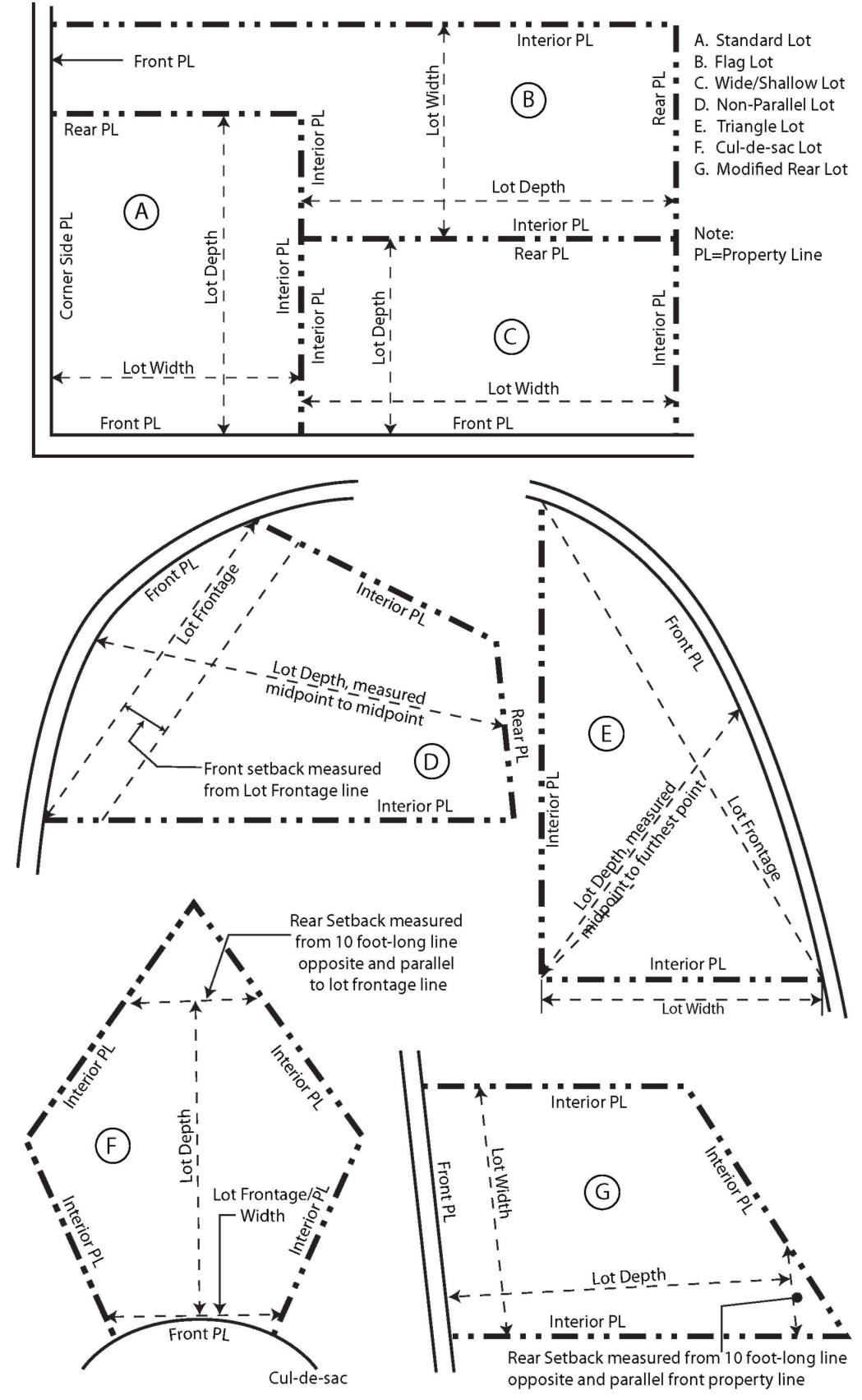
G.
PermittedEncroachment Standards.
1.
Residential Zone Permitted Projections. All buildings and structures shall conform to setbacks established by Tables 20.215-3 and 20.215-4, except where modified per the permitted encroachments standards of this section and the standards of Table 20.300-1 (Permitted Encroachments by Zone), or as otherwise modified by this Zoning Ordinance.
a.
Porches and Decks. Porches and decks may be permitted to encroach into front and rear setbacks per the following standards:
i.
Front setback encroachments may be permitted to a maximum of three (3) feet.
ii.
Rear setback encroachments (deck, patio) may be permitted to a maximum of five (5) feet. Second-story balconies on single-family homes are not permitted.
iii.
Any encroachment shall be limited to fifty percent (50%) of the required setback area.
iv.
Deck level in any required setback area may not exceed thirty (30) inches above surrounding grade.
b.
Front Setback Pavement. Pavement in the front setback shall be limited to driveways, walkways, steps, and terraces; these paving features shall not occupy more than fifty percent (50%) of the required front setback area. If these features are placed directly upon grade, they shall not be required to meet setbacks subject to Building Division approval. See Chapter 20.340 (Off-Street Parking and Loading) for driveway limitations.
c.
Pools and Hot Tubs. Pools and hot tubs may be permitted to encroach into side and rear setbacks per the following standards:
i.
Minimum setback from any side or rear property line shall be five (5) feet to any portion or feature of the pool or hot tub.
ii.
Minimum setback from any side or rear property line shall be four (4) feet to any equipment; equipment shall be screened from public view.
iii.
Height of all features and equipment of the pool or hot tub shall be limited to three (3) feet or less above the finished grade of the lot.
d.
Recreational Facilities in the R-3 Zones: Buildings/structures that abut a plaza, private park area, lake, paseo, greenbelt, or other permanent open space shall be permitted to abut a common property line, and may have pedestrian openings onto such spaces in accordance with current Building and Fire Codes.
2.
Commercial Zone Permitted Projections. All buildings and structures within Commercial (C, NC, OP, SR) Zones shall conform to setbacks established by Table 20.220-3, except where modified per the standards of Table 20.300-1 (Permitted Encroachments by Zone).
3.
Mixed Use Zone Permitted Projections. All buildings and structures within Mixed Use (MU-1, MU-2, MU-3(SP), MU-4(SP)) Zones shall conform to setbacks established by the applicable development standard table (Tables 20.225-1, 20.225-2, 20.225-3, 20.225-4 except where modified per the standards of Table 20.300-1 (Permitted Encroachments by Zone).
4.
Industrial Zone Permitted Projections. All buildings and structures within Industrial Zones shall conform to setbacks established by Table 20.230-3, except where modified per the standards of Table 20.300-1 (Permitted Encroachments by Zone).
Table 20.300-1
Permitted Encroachments by Zone
(Ord. No. 2021-1510, § 5(Exh. 4), 12-14-2021; Ord. No. 2021-1511, § 5(Exh. 4), 1-11-2022; Ord. No. 2021-1512, § 2(Exh. B), 1-11-2022)
Section 20.300.030 - Lot Averaging
A.
Applicability. Lot averaging may be permitted for the following proposed residential projects, subject to a CUP and the standards of this section:
1.
Single-family residential development of five (5) or more units.
2.
Any single lot development in the R-1-20, R-10, or A Zone. Lot averaging may be allowed per the following standards and subject to a CUP.
B.
Minimum Lot Requirements. Minimum lot/parcel sizes shall not be less than the standards established by the development standard table of the applicable Zone (Tables 20.210-3 or 20.215-3) except where modified below.
1.
In the R and A Zones, all lots shall meet the minimum lot size requirement of the Zone, except as follows:
a.
Where land in an R-1-20, R-1-10, or R-1-7.5 Zone is subdivided into five (5) or more lots, a Conditional Use Permit may be granted to authorize a reduction in the minimum lot size required, provided that the subdivided property complies with all conditions that may be imposed by such Conditional Use Permit and that no lot has an area less than three-quarters percent (0.75%) of the minimum lot area required by the applicable Zone. In the R-1-7.5 Zone, no lot shall have a net area less than 6,000 square feet.
2.
Density shall not exceed the maximum density permitted within the Zone.
3.
The total area of all lots in the subdivision shall be equal to or greater than the product of the lots in the subdivision multiplied by the minimum lot area required by the Zone of the property being subdivided.
4.
The slope averaging shall reduce the amount of required grading, thereby leaving more natural ungraded slopes in the project area.
Section 20.300.040 - Gross Slope/Acreage Analysis
In the A and R-1 Zones where the slopes may vary from relatively easy (moderate) slopes to excessive slopes, a gross acreage analysis shall be completed by the property owner or the subdivider to determine the minimum lot/parcel size by gross acreage and slope based on the following calculation standards:
1.
For all R-1 and R-2 Zones, compute the required size and density of each lot based on the standards of Table 20.300-2.
2.
For all A Zones, compute the required size and density of each lot based on the standards of Section 20.210.050 (Agricultural Zone Development Standards) and Table 20.210-3.
3.
Verify that the density for each lot is not less than one (1) dwelling unit.
4.
Determine that the size of each lot as proposed is not less than the minimum permitted by the Zone.
Table 20.300-2
Gross Slope Acreage Analysis Standards
All standards are minimums unless otherwise noted.
Section 20.300.050 - Development Regulations Applicable to All Zones
A.
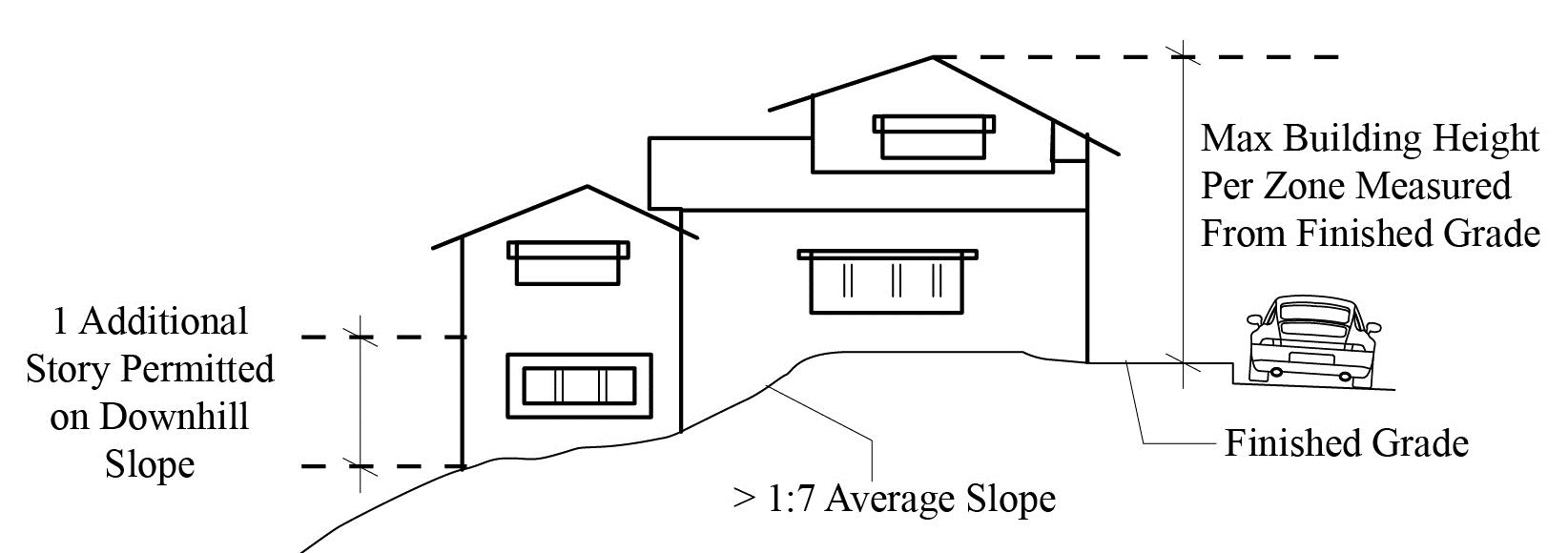
Maximum Building Height. Except as provided in this chapter, no building or structure shall be erected, reconstructed, or structurally altered to exceed the height limit established by this Zoning Ordinance for the applicable Zone, except as modified below. See Figure 20.300-2 for a height measurement example.
1.
Architectural features such as chimneys, elevators, dormer windows, and tanks shall be measured from the finished grade to the top of the feature, not to exceed the maximum height established by the applicable Zone.
2.
Additional Story Permitted. An additional story on the downside of any building shall be permitted for lots with an average slope greater than a one to seven (1:7) ratio (rise to run), or where no established grade exists at the property line due to the slope location of the lot. The additional story and overall design of the building shall be subject to Chapter 20.260 (Ridgeline Protection and Management Overlay Zone).
Figure 20.300-2
Measuring building height and permitted additional story.
B.
Setback Areas.
1.
Required setbacks and open space shall apply only to the individual parcel, building, or development; setbacks established for a lot shall not be applicable to adjacent parcels.
2.
Except as modified in this chapter, every required setback shall be open and unobstructed from the ground to the sky.
3.
Actions, including building modification, lot division, or lot reduction, resulting in any required setback or open space to be less than that required by this Zoning Ordinance are prohibited.
C.
Standard Setbacks. All applicable setbacks shall be measured from the recorded property line, except in the following conditions (see Figure 20.300-3):
1.
Where property lines exist at the center of the street/public ROW, the front setback shall be measured from the outer edge of the dedicated ROW or edge of the future planned ROW extension. The Planning Commission, upon request, shall determine the required maximum ROW width.
2.
In all cases where a lot is located next to an existing or planned street, alley, or public ROW, all applicable setbacks shall be measured from the immediately adjacent edge of the ROW.
Figure 20.300-3
Measuring Standard Setbacks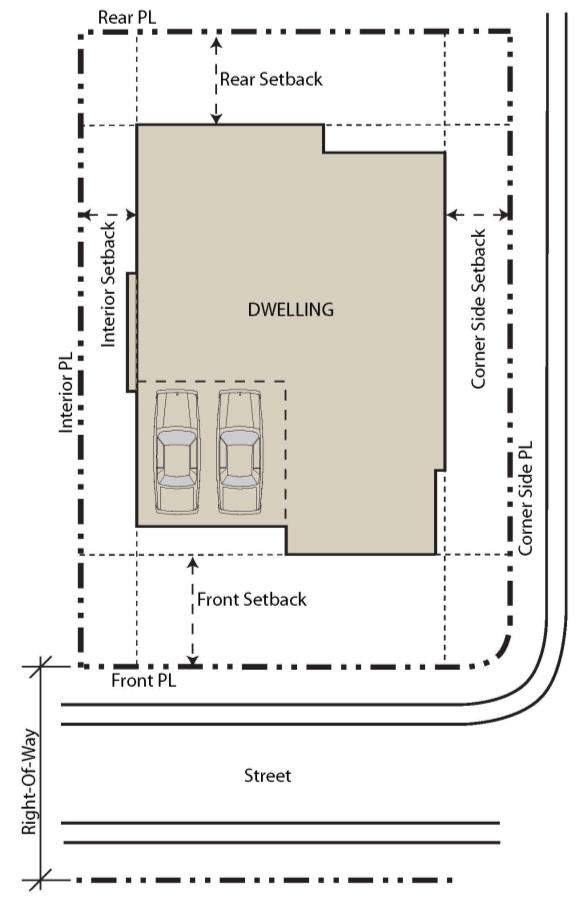
3.
For lots located on a dead-end street or a partially dedicated ROW (half street) where no extension or full dedication is planned, applicable setbacks shall be measured from the edge of the existing ROW at the time of lot development or modification.
4.
Where plans exist to vacate the ROW, the center line of the completed ROW width shall be used as the line from where to measure required setbacks.
5.
For lots abutting private road or access easements, the setback requirement shall be measured from the easement line, or where the building envelope would overlap the recorded easement the building may be located a minimum of 2 feet from the closest edge of the easement unless otherwise specified by the recorded easement.
6.
Setbacks for irregularly shaped lots shall be measured consistent with Figure 20.300-1. In all cases, the front setback shall be measured from the property line which borders on the street/ROW. Setbacks for irregular lot configurations not identified in Figure 20.300-4 shall be measured based on the closest relevant interpretation as deemed appropriate by the Director.
D.
Maximum Setbacks. Where required front setbacks of this Zoning Ordinance conflict, the larger setback requirement shall prevail, except as further modified by an adopted Planned Residential Development or Specific Plan, which shall prevail.
E.
Special Rear Yard Conditions. Within all Residential and Agricultural Zones, the required rear setback may be reduced by fifty percent (50%) where the residential use property rear property line is shared with a public park or designated open space.
F.
Non-Standard Lot Setback Requirements. Setback for lots of unusual shape or dimension or primarily characterized by topography that renders literal application of required setbacks impractical shall measure required setbacks in a practical manner that is appropriate to the context of the lot, at the discretion of the Director and appealable to the Planning Commission.
Section 20.300.060 - Special Setbacks for General Plan Routes
The following setback shall apply to all Zones and land uses, taking precedent over the established requirements of the applicable Zone chapter where these parcels are adjacent to the identified ROW. Setback requirements of Table 20.300-3 establish overriding setbacks for the specified ROWs from all specified Zones adjacent to the identified ROW.
Table 20.300-3
Special Setback Requirements
PL = property line; R = Residential; A = Agricultural
Section 20.300.070 - Performance Standards
A.
Hazardous Materials and Waste. The U.S. Environmental Protection Agency (EPA), the California Department of Health Services (DHS), the California Department of Toxic Substances Control (DTSC), and the County of San Diego identify hazardous materials and prescribe handling, use, and disposal practices. Pursuant to the provision of California Health and Safety Code Section 25135.7(c)(3), this section authorizes EPA, California EPA, and the County of San Diego Hazardous Materials Division to enforce federal and state laws regarding the handling, transportation, and disposal of hazardous materials within the jurisdiction of the City, and, specifically, to implement the following:
•
The provision of Article 3.5 of Chapter 6.5 of Division 20 of the California Health and Safety Code relating to Hazardous Waste Management Plans within the City.
•
The provisions of the San Diego County Hazardous Waste Management Plan within the City.
1.
To protect the health and welfare of the residents and business community of San Marcos, the use, storage, manufacturing, and disposal of hazardous materials shall be regulated and monitored according to the standards established by these federal, state, and local agencies.
2.
A risk management and prevention program, together with an inventory statement that is in accordance with federal, state, and local laws, shall be prepared for all structures and land uses using materials identified as hazardous by federal, state, and local agencies, as applicable.
Figure 20.300-4
Line of Sight per the City Engineer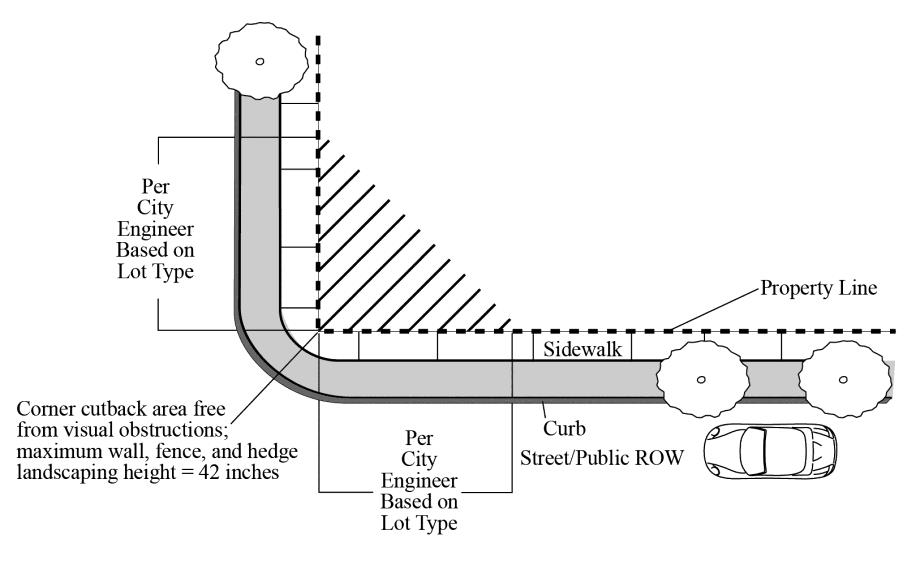
3.
The use and storage of flammable or explosive materials shall comply with the fire prevention code of the City and all applicable ordinances. No open burning is permitted unless a written permit for such activity has been issued by the local Air Quality Management District.
4.
No liquid or solid waste or similar material that may contaminate water supplies, interfere with bacterial processes in sewage treatment, or otherwise cause the emissions of dangerous or offensive elements shall be discharged into the public sewer or private disposal system, except in accordance with the requirements of the City's Public Works Code and other applicable regulations.
5.
No activity that emits dangerous levels of radioactivity shall be permitted at any time.
6.
The approving authority for any permit or other land use approval, including, without limitation, building permits, for a hazardous waste facility, shall ensure compliance with federal and state requirements and local zoning standards, and may impose any appropriate conditions, as follows:
a.
Determined reasonably necessary to comply with the San Diego County Hazardous Waste Management Plan.
b.
For the issuance of such permit or approval, which the approving authority determines are reasonably necessary to protect the public health, safety, or welfare.
c.
Nothing in this section shall be construed to preclude an approving authority from denying an application, permit, or other land use approval for which the approving authority finds is contrary to the public health, safety, or welfare.
B.
Colors and Materials. Colors and materials of all building elements approved during permitting or Site Development Plan Review shall be maintained. The entire project shall be subject to repeat review if approved colors and/or materials are modified.
C.
Line of Sight. Development and structures in all Zones shall maintain the line-of-sight triangle as established by the City Engineer. Line-of-sight geometry shall be shown on applicable plans during permit and review and shall comply with the Sight Distance Minimum Standards, established by the Engineering Division (see Figure 20.300-4).
D.
Electrical Disturbances. No activity shall be permitted if it causes electrical disturbance that affects the operation of equipment located beyond the property line. Radio, television, and microwave transmitters shall be suitably wired, shielded, and controlled so that they do not emit electrical waves or impulses that may affect other electronic devices or equipment.
E.
Noise. These regulations aim to prohibit unnecessary, excessive, and annoying noises from all sources, as certain noise levels are detrimental to the health and welfare of individuals. The standards of this section and of Chapter 10.24 Noise of the Municipal Code apply to all land uses in all Zones unless otherwise specified.
(Ord. No. 2017-1446, 7-25-2017)
1.
Noise shall be measured with a sound-level meter that meets the standards of the American National Standards Institute (ANSI) (Section S1.4-1979, Type 1 or Type 2). Noise levels shall be measured in decibels at the property line of the receptor property, and at least five (5) feet above the ground and ten (10) feet from the nearest structure or wall. The unit of measure shall be designated as an A-weighted decibel (dBA) Leq standard. A calibration check shall be made of the instrument at the time any noise measurement is made.
(Ord. No. 2017-1446, 7-25-2017)
2.
No person shall create or allow the creation of exterior noise that causes the noise level to exceed the noise standards established by Table 20.300-4. Increases in allowable noise levels listed in Table 20.300-4 may be permitted in accordance with the standards outlined in Table 20.300-5.
Table 20.300-4
Exterior Noise Standards by Zone
(Ord. No. 2017-1446, 7-25-2017)
3.
No person shall create nor allow the creation of noise that causes the interior noise level when measured within a dwelling unit to exceed forty-five (45) dBA at any time, except as permitted by Table 20.300-6.
4.
Use of compressors or other equipment, including vents, ducts, and conduits, but excluding window or wall-mounted air conditioners, that are located outside of the exterior walls of any building, shall be enclosed within a permanent, non-combustible, view-obscuring enclosure to ensure that the equipment does not emit noise in excess of the ANSI standards.
Table 20.300-5
Permitted Increase in Noise Levels
Table 20.300-6
Permitted Increase in
Interior Noise Levels
F.
Vibration. Vibration may disturb the conduct of certain activities and create discomfort for some individuals. To minimize the disturbance and inconvenience from vibrations, no person or use shall create, maintain, or cause ground vibration that is discernible without instruments to a person of normal sensitivity at any point on a property that is adjacent to the property of the vibration source. The ground vibration caused by moving vehicles, trains, aircraft, or temporary construction or demolition is exempted.
G.
Odor. Any process that creates or emits odors, gases, or other odorous matter shall comply with standards set by the San Diego Air Pollution Control District.
1.
No use shall be permitted to emit continuous, frequent, or repetitive odorous gases such as to be perceptible at any lot line of the site. An odor emitted no more than fifteen (15) minutes in any one (1) day shall not be deemed as continuous, frequent, or repetitive.
Section 20.300.080 - Light and Glare Standards
Lighting for safety purposes shall be provided at entryways, along walkways, between buildings, and within parking areas. Lighting is important to the visibility, identity, and safety of all developments. The following standards are intended to minimize glare, conflict, and light pollution and to provide performance standards to promote the visibility and safety of all premises in the community.
1.
General Standards. The following general lighting standards shall apply to all non-residential development:
a.
All lighting shall comply with the City's lighting standards.
b.
Any lights used in conjunction with a permitted use shall be shielded or directed away from adjacent residential uses.
c.
All exterior and parking lot lighting fixtures shall be approved by the City. Use of the lowest wattage and highest energy efficiency available is required.
d.
Shielded fixtures with well defined cut-offs directing light downward toward ground surfaces shall be used to confine illumination to on-site areas only. Landscape and signage lighting shall be exempt from this standard.
e.
Lighting directed upward that does not light buildings, landscape, or site surfaces is prohibited in all Zones.
f.
Flood lighting is prohibited.
g.
Light producing varying intensities or colors, moving lights, or search lights are prohibited in all Zones. Holiday lighting appropriate to the season and consistent with Chapter 20.320 (Signs on Private Property) of this Zoning Ordinance are exempt.
h.
Security lighting shall use high-efficiency fixtures and lamps and shall be located in entries, pathways, and parking areas.
i.
Wall-mounted security light packages shall be used.
j.
Accent lighting shall be integrated into building design. Lighting fixtures in parking areas, access drives, and internal vehicular circulation areas shall have zero (0) cut-off. Parking lot illumination level shall achieve a uniformity rating of three to one (3:1) (average to minimum), a maintained average of one (1) foot candle, and a minimum of one-half (0.5) foot candle.
k.
Property perimeter lighting not affiliated with the lighting of parking lots shall not exceed one-half (0.5) foot candle at any point along the property line of the subject or adjacent parcel.
i.
Fixtures shall be pole mounted a maximum of twenty-five (25) feet above paved surfaces.
l.
Service area lighting shall be contained in any service yard boundaries and enclosure walls. No light spillover shall occur outside of service areas, and the light shall not be visible from any street.
m.
Parking garages shall achieve a uniformity of three (3) foot candles minimum maintained within the structure. Perimeter lighting shall be shielded and consistent with subsection k, above.
n.
Lighting fixtures in parking areas, access drives, and internal vehicular circulation areas shall be directed and shielded so as not to illuminate surrounding properties and shall comply with the standards of this Section 20.300.080, as verified through a photometric study.
o.
Lighting levels shall emphasize the walking areas so as to clearly identify the pedestrian walkway and direction of travel. Stairway steps and changes of vertical level shall be clearly identified and safely lit.
i.
Bollard lighting shall be used in and around pedestrian and entry areas.
ii.
A maximum of twelve (12)-foot height shall be used for any pedestrian lighting; a maximum of forty-two (42) inches in height shall be used for bollard lighting.
p.
Lighting fixtures placed on a building shall be architecturally integrated as part of the overall design of the building.
2.
Prohibited Lighting.
a.
Light producing varying intensities or colors, moving lights, and search lights are prohibited in all Zones. Holiday lighting appropriate to the season and consistent with Chapter 20.320 (Signs on Private Property) of this Zoning Ordinance is exempt.
b.
Flood lighting is prohibited.
3.
Light Poles. Notwithstanding other provisions of this Zoning Ordinance, in the C, O-P, SR, all MU, I, and I-2 Zones, lights on poles may be placed within the established setback, upon the following conditions:
a.
Lights shall be used for illumination only, and not for or used as an advertising display.
b.
Lights shall be at least thirteen and one-half (13.5) feet above the ground.
c.
Light fixtures shall be so designed and adjusted as to reflect light away from any road or street, and away from any adjoining premises on which a dwelling is located or that is zoned for a use other than business or industrial.
d.
Lights shall be on a single pole that does not exceed fourteen (14) inches in diameter.
e.
Such poles shall be at least fifty (50) feet apart; however, two (2) poles may be located on each building site.
f.
Poles and lights shall be removed at the owner's expense when property on which they are located is taken for street widening.
4.
Multifamily Development On-Site Lighting. On-site lighting is important to the safety and security of the multifamily residential environment. Projects that provide adequate on-site lighting reinforce the quality of life and sense of community. Multifamily residential projects shall provide lighting in accordance with this chapter (Chapter 20.300), except as modified by the following standards:
a.
Lighting in parking areas, garage areas, and carport areas shall be maintained with a minimum of one (1) foot candle of illumination during the hours of darkness.
b.
On-site walkway areas shall maintain a minimum illumination level equivalent to one-quarter (0.25) foot candle during the hours of darkness.
c.
Methods of illumination may be wall- or ground-mounted with deflectors to confine the rays to the site with minimal intrusion to the dwelling units.
d.
A lighting plan shall be submitted to the Director during the development review process. This plan shall show illumination levels and points of intersection between fixtures, as well as use of energy-efficient exterior lighting in compliance with City standards.

