
San Marcos City Zoning Code
CHAPTER 20
600 - DEFINITIONS
Section 20.600.010 - Purpose of Chapter
The purpose of this chapter is to provide definitions of terms and phrases used in this Zoning Ordinance that are technical or specialized or that may not reflect common usage. If any of the definitions in this chapter conflict with definitions in other provisions of this Zoning Ordinance, these definitions shall control for the purposes of this Zoning Ordinance. If a word is not defined in this chapter or in other provisions of this Zoning Ordinance, the Director shall determine the correct definition.
Section 20.600.020 - Applicability
Terms and phrases defined in this chapter shall be applicable to all contexts within this Zoning Ordinance, unless the context in which they are used clearly indicates otherwise.
A.
Referenced Definitions.
1.
Flood Damage Prevention Overlay Zone Definitions. All definitions related to the Flood Damage Prevention Overlay Zone are located in Section 20.255.170 (Definitions).
2.
Sign Definitions. All definitions related to signs and sign regulations are located in Section 20.320.120 (Definitions).
3.
Adult Entertainment Establishment Definitions. All definitions related to adult entertainment establishments are located in Section 20.405.070 (Definitions).
4.
Wireless Telecommunication Facilities. All definitions related to wireless telecommunication facilities are located in Section 20.465.180.
(Ord. No. 2014-1398, 8-12-2014).
Section 20.600.030 - "A" Definition
A-weighted Sound Pressure Level (dBA). Some frequencies of noise are more noticeable than others. To compensate for this fact, different sound frequencies are weighted more.
Abandoned. The condition resulting when the building(s) of a piece of property have been vacated and all activities related to the approved land use have been discontinued for a period of twelve (12) consecutive months or more, or twenty-four (24) months or more for any property designated as a Transitional Zone. The status of maintenance and the condition of the property shall not be a determining factor in the abandoned status.
Abutting or Adjoining. Having Zone boundaries or property/lot lines in common.
Accessory Dwelling Unit. An attached or a detached residential dwelling unit that provides complete independent living facilities for one or more persons. It shall include permanent provisions for living, sleeping, eating, cooking, and sanitation on the same parcel as the single-family or multifamily dwelling is situated. An Accessory Dwelling Unit also includes the following:
1.
An efficiency unit, as defined in Section 17958.1 of the Health and Safety Code.
2.
A manufactured home, as defined in Section 18007 of the Health and Safety Code.
(Ord. 2017-1445, 7/11/2017; Ord. No. 2020-1493, § 2(Exh. B), 10-13-2020; Ord. No. 2020-1494, § 2(Exh. B), 11-10-2020)
Accessory Structure. A structure that is subordinate to, and detached from the main structure, the use of which is incidental and subordinate to that of the main structure. See Chapter 20.410 (Accessory Dwelling Units and Accessory Structures).
(Ord. 2017-1445, 7/11/2017)
Accessory Use. A land use that is incidental and subordinate to the main use of the site and located on the same site as the main use. An accessory use may be located either in the principal structure or an accessory structure.
Adjacent Property Line. See, "Property Line, Adjacent."
Adult Bookstore. See Section 20.405.070 (Definitions) for adult-related land use definitions.
Adult Cabaret. See Section 20.405.070 (Definitions) for adult-related land use definitions.
Adult Computer Software Establishment. See Section 20.405.070 (Definitions) for adult-related land use definitions.
Adult Entertainment Business (land use). Any establishment engaging in any of the activities defined in Section 20.405.070 (Definitions).
Adult Entertainment Establishment. See Section 20.405.070 (Definitions) for adult-related land use definitions.
Adult Model Studio. See Section 20.405.070 (Definitions) for adult-related land use definitions.
Adult Motel. See Section 20.405.070 (Definitions) for adult-related land use definitions.
Adult Motion Picture Arcade (Peep Show). See Section 20.405.070 (Definitions) for adult-related land use definitions.
Adult Motion Picture Theater. See Section 20.405.070 (Definitions) for adult-related land use definitions.
Adult Residential Facility (land use). A residential facility that provides twenty-four (24)-hour non-medical care for adults ages eighteen (18) through fifty-nine (59), who are unable to provide for their own daily needs. Adults may have physical, developmental, and/or mental disabilities.
1.
Large. An Adult Residential Facility serving seven (7) or more adults per the definition above. This includes the provision of non-medical care for seven (7) or more adult persons on a less than twenty-four (24)-hour basis and commercial care centers for adults. It excludes substance-recovery shared living/dwelling units.
2.
Small. An Adult Residential Facility serving six (6) or fewer adults per the definition above.
Adult Theater. See Section 20.405.070 (Definitions) for adult-related land use definitions.
Adult Video Games. See Section 20.405.070 (Definitions) for adult-related land use definitions.
Agent. A person authorized in writing by a property owner to represent and act for the property owner in contacts with City employees, committees, Planning Commission, and the Council, regarding matters regulated by this Zoning Code.
Agricultural/Horticultural (land use). The growing of any horticulture or agricultural of crops, or the raising of animals, as further defined below in conjunction with a residential or agricultural use, subject to the regulations of the applicable Zone and Chapters 20.210 (Agricultural Zones) and 20.415 (Animals). Does not include Commercial Cannabis Activity or Cannabis Cultivation, Outdoor, which are prohibited uses under Subsection 20.205.030(D) of this Zoning Ordinance.
1.
Non-Commercial. This includes the raising of vegetables, flowers, fruit trees, nut trees, vines and ornamentals, and shrubs. Raising of animals is not permitted within this land use.
2.
Commercial. This includes commercial and wholesale greenhouses and nurseries for the production of vines, trees, and other horticultural stock.
3.
Processing and Packaging. The on-site processing and packing of any horticulture or agricultural of crops, including animals, in conjunction with an agricultural use, subject to the regulations of the applicable Zone, Chapters 20.210 (Agricultural Zones) and 20.415 (Animals), and the conditions of the required CUP.
4.
Plans and Crops Wholesale Production. Includes the raising of vegetables, flowers, fruit trees, nut trees, vines and ornamentals, and shrubs for wholesale distribution on a residential lot.
Alley. Any public roadway without curbs or sidewalk having a roadway not exceeding twenty-five (25) feet in width that is primarily used for access to the rear or side entrances of abutting properties.
Alter or Alteration. To make a change in the supporting members of a structure (e.g., bearing walls, columns, beams or girders) that will prolong the life of the structure.
Ancillary Alcohol-Service. Any portion of or space within an established "Commercial Entertainment" land use business that serves alcohol for on-site or off-site consumption. Requires a CUP.
Animal Keeping (land use). The act of maintain one or multiple animals on a property; type, disposition, and number of animals is regulated by Section 20.415 (Animals) and Table 20.415-2.
Animal Sales and Services (land use). A commercial land use including any individual or combination of the following:
1.
Boarding/Kennels. Shelter and care of animals, daily or overnight, on a commercial basis including feeding and activities. Includes "dog daycare."
2.
Grooming. The provision of bathing, tending, or general trimming services on a commercial basis.
3.
Veterinary Hospitals. An establishment providing medical and surgical treatment for small domestic animals.
4.
Retail Sales. The retail sale and boarding of small animals within an enclosed building.
Animal Shelter (land use). A nonprofit facility operated for the purposes of impounding, harboring, selling, placing and retrieving seized, strayed, distressed, homeless, abandoned or unwanted animals. May include incidental activities including vaccination, training classes, spay/neuter services, and boarding services.
Apartment Building. Any building or structure, or portion thereof, which contains three (3) or more dwelling units.
Appeal. A request by an interested party for a de novo review of a decision.
Applicant. A person filing an application in compliance with this Zoning Code who is:
1.
The owner or lessee of property;
2.
A party who has contracted to purchase property contingent upon that party's ability to acquire the necessary approvals required for that action in compliance with this Zoning Code, and who presents written authorization from the property owner to file an application with the City; or
3.
The agent of either of the above who presents written authorization from the property owner to file an application with the City.
Application Efficiency (AE). A measure of the efficiency of an irrigation system.
Application Rate. The depth of water applied to a given area, measured in inches per minute, inches per hour or gallons per hour.
Applied Water. The portion of water supplied by the irrigation systems to the landscape.
(Ord. No. 2017-1442, 5-23-2017)
Approval. Includes both approval and approval with conditions.
Appurtenance. A tower, spire, cupola, chimney, penthouse, water tank, flagpole, theater scenery loft, radio or television antenna, transmission tower, fire equipment, or other similar structure that is attached to a structure and not intended for human occupancy.
Architectural Feature. Any portion of the outer surface of a structure, including the kind, color and texture of the building material, the type and style of all windows, doors, roof shape, decorations, or other fixtures appurtenant to a structure. Architectural features include the following elements: chimney, fireplace, columns, cornices, eaves, belt courses, water tables, sills, buttresses, capital, bases, and canopy/awning elements. All architectural features shall be consistent with the architectural character, style, and of complementary color to, to the primary structure.
Architectural Projection. A marquee, porch, canopy or similar projection of a building.
Area, Building. The sum in square feet of the area of the horizontal projections of all buildings on a lot excluding buttresses, chimneys, cornices, eaves, open pergolas, patios, steps, unenclosed and unroofed terraces, unenclosed private balconies not used for access, and minor ornamental features projecting from the walls of a building that are not directly supported by the ground.
Area, Lot, or Site. The horizontal area within the property lines of a lot. If a street dedication is required, the lot or site area shall be calculated using the size of the lot prior to the street dedication.
Assembly and Recreation (land use). A building located in a mobile/manufactured housing park or development designed for indoor assembly and/or recreation for on-site residents only.
ATM (land use). A pedestrian-oriented machine used by bank and financial service patrons for conducting transactions including deposits, fund transfers, and withdrawals without contact with financial institution personnel.
1.
Freestanding Exterior/Exterior Wall. A freestanding machine or machine installed in an exterior wall that functions as an ATM as an accessory use to the primary building use(s).
2.
Interior to Building/Vestibule. A space located inside a building dedicated to the functions of an ATM, as an accessory use to the primary building use(s).
Auctions, Indoor (land use). Any commercial or industrial use conducting the live or silent sale of products or merchandise through an auction process. All activities shall be conducted completely indoors and shall abide by all noise, loading, and storage standards of this Zoning Ordinance applicable to the Zone.
Automatic Irrigation Controller. A mechanical or solid-state timer, capable of operating valve stations to set the days and length of time of a water application. Automatic irrigation controllers are able to self-adjust and schedule irrigation events using either evapotranspiration (weather-based) or soil moisture data.
(Ord. No. 2017-1442, 5-23-2017)
Automobile/Automotive Fueling Station (land use). A commercial establishment engaged in the retail sales of vehicle fuels, traditional and alternative fuel types (including electric-charging stations, ethanol, natural gas, propane, solar, etc.), lubricants, parts and accessories. These uses include service stations with convenience stores, self-service auto washes and facilities having service bays for vehicle service and repair as permitted by the applicable land use. The service and repair may include incidental maintenance and repair of automobiles and light trucks as permitted by the applicable land use, but shall not include maintenance and repair of large trucks, or body and fender work or automobile painting on any vehicles.
Automotive Rentals (land use). Any establishment providing for the rental of automobiles, including storage and incidental maintenance, but excluding maintenance requiring pneumatic lifts. Shall not impact required parking standards. Does not include moving van rental facilities or services as permitted/conditionally permitted uses.
Automotive Sales (land use).
1.
New. The retail sale, or leasing of automobiles and trucks, including storage and incidental maintenance and repair. This use includes the on-site storage and display of vehicle inventory. This use does not include uses that exclusively rent vehicles; see Automotive Rental.
2.
Used. The retail sale of previously owned or used automobiles, not directly from the manufacturer. Used automotive sales shall not be permitted on sites of less than one and one-half (1.5) acres (65,340 square feet), shall be limited to one (1) business operator/sales establishment per site, and shall not be located adjacent to an existing used automotive sales establishment.
3.
Wholesale. An establishment for wholesale automotive sales, limited to two (2) indoor fully-enclosed vehicle show spaces. Outdoor storage or display of vehicle inventory shall be prohibited.
4.
Other Vehicles. The retail sale, or leasing of tractors, construction or agricultural equipment, mobilehomes, recreational vehicles, and similar equipment and vehicles not intended for daily personal use, including storage and incidental maintenance and repair. This use includes the on-site storage and display of vehicle inventory.
Automotive Services (land use).
1.
Repair. Automotive Repair, Maintenance or Service. Any activity where automotive vehicles including recreational vehicles, cars, trucks, or motorcycles are serviced, maintained or repaired or associated parts are installed into, on or attached to these vehicles. These shall include, but not be limited to auto body repair and painting, brake service, engine overhaul/rebuilding, muffler installation, oil change, smog check, tire installation or service, tune-ups, and any other use deemed similar by the Director.
2.
Washing/Detailing. Any business, indoor or outdoor, providing machinery or staffing for the cleaning, washing, or detailing of vehicles as a primary use. Washing and detailing are permitted as an accessory use in conjunction with a primary automotive services repair use.
Automotive Wrecking Yards. The dismantling or wrecking of used motor vehicles or trailers, or the storage, sale, or dumping of dismantled or wrecked vehicles or their parts. This use is prohibited in all Zones within the City.
Awning. A permanent or temporary structure attached to and wholly supported by a building and installed over or in front of openings or windows, and consisting of a fixed or movable frame, and covered in canvas or other similar material.
(Ord. No. 2016-1423, 3-8-2016; Ord. No. 2017-1453, § 2(Exh. A), 11-14-2017)
Section 20.600.040 - "B" Definitions
Backflow Prevention Device. A safety device used to prevent pollution or contamination of the water supply due to reverse flow of water from the irrigation system. Backflow device must comply with County Department of Environmental Health standards.
Bar (land use). Any retail facility maintaining and using an "On Sale Beer" license or an alcohol-related license other than an On Sale Beer license. For facilities operating under an On Sale Beer license, food shall not be sold or served to the public except as required by the license.
Barricade (landscaping). Protection for vegetation to be preserved that is erected at the drip line and clearly visible to heavy equipment operators.
Basement. The portion of a building between the floor and ceiling that is wholly or partly below grade and having more than one-half of its height below grade.
Bathroom. A room containing all of the following: a sink, toilet, and shower or bathtub. A partial bathroom is missing at least one (1) of those components.
Battery Charging Station. An electrical component or assembly designed specifically to charge batteries within production electric vehicles.
Battery Exchange Station. A fully automated facility to facilitate an electric vehicle with a swappable battery to enter a drive lane and exchange the depleted battery with a fully charged battery through a fully automated process.
Bed and Breakfast. See, "Lodging, Bed and Breakfast."
Berm. An earthen mound designed to provide visual interest, screen undesirable views, and/or decrease noise.
Best Management Practices (BMPs). Methods, measures, or practices designed to prevent or reduce water pollution.
Bicycle Facilities. A general term describing improvements and provisions to accommodate or encourage bicycling, including parking facilities, maps, all bikeways, and shared roadways not specifically designated for bicycle use.
Blockface. The lots abutting on one (1) side of a street, between the two (2) nearest intersecting streets or a City boundary.
Boat Building (land use). Any establishment engaged in the construction, fabrication, or assembly of water vessels/vehicles of any size.
Body Painting Studio. See Section 20.405.070 (Definitions) for adult-related land use definitions.
Bubbler (landscaping). An irrigation head that delivers water to the roots by "flooding" the planted area, usually measured in gallons per minute. Bubblers exhibit a trickle, umbrella, or short stream pattern.
Buffer, Perimeter Landscape. A continuous area of land set aside along the perimeter of a lot in which landscaping is used to provide a transition between and to reduce the environmental, aesthetic, and other impacts of one (1) type of land use upon another.
Buffer Yard. A landscaped area usually at the side or rear of development sites that are provided to separate and partially obstruct the view of adjacent land uses or properties.
Buffering. The use of landscaping or retained native vegetation or the use of landscaping along with berms, walls or decorative fences that at least partially and periodically obstruct the view from the street or an abutting property in such a manner that vehicular use areas, parking lots, parked cars, detention ponds and conflicting activity areas will be partially or completely screened.
Building. A structure having a roof supported by columns or walls, for the housing or enclosure of persons, animals, chattels, or property of any kind. See "Structure."
Building Complex. A building or group of buildings on one (1) or more lots or building sites containing two or more unrelated occupants and share common parking facilities.
Building Face. The outermost surface of any main exterior wall of a building, but not including cornices, bay windows, balconies, oriels or other architectural features that extend beyond the general outermost surface of such main exterior wall.
Building Materials Storage and Sales Yard (land use). An industrial land use providing retail or wholesale sales of building materials. This use includes indoor and outdoor storage of building materials.
Building Separation. Separation between buildings measure from all stories of both structures.
Business Support Services (land use). An establishment providing non-retail-related services that may be regulated by square footage thresholds subject to the regulations of the applicable Zone. The following services types shall be operated under "Business Support Services":
•
architecture, CAD services, drafting, engineering, etc.
•
dispatch office (including taxi, plumbing, limo, emergency; limited to fielding calls, no on-site vehicle operations, waiting areas or storage)
•
blueprinting printing, binding, engraving, photocopying, or related services
•
business equipment repair services
•
computer-related services (rental, repair)
•
electronics/small machinery maintenance and repair
•
equipment rental businesses within buildings
•
film processing and photofinishing
•
heavy equipment repair services where repair occurs on the client site
•
janitorial and window-cleaning services
•
locksmith
•
mail-box services
•
outdoor advertising services
Section 20.600.050 - "C" Definitions
California Environmental Quality Act (CEQA). CEQA is the State law implemented by the City's Environmental Policy Guidelines and contained in the California Public Resources Code Section 21000 et seq. Definitions of other CEQA-related terms are located in the City's Environmental Policy Guidelines.
California Public Utilities Commission. The governmental agency that regulates the terms and conditions of public utilities in the State.
Caliper. The thickness of trees as measured in inches, feet, etc. Trunk diameter for trees up to four (4) inches shall be measured six (6) inches above the soil line, and all trees more than four (4) inches in diameter will be measured fifty-four (54) inches above the soil line.
Cannabis. Cannabis shall have the same meaning as the definition set forth in California Business and Professions Code Section 26001, as that Section may be amended from time to time. Notwithstanding any provisions of Business and Professions Code Section 26001, the term "Cannabis" shall also include all parts of the plant Cannabis sativa Linnaeus, Cannabis indica, or Cannabis ruderalis, whether growing or not; the seeds of the plant; the resin, whether crude or purified, extracted from any part of the plant; and every compound, manufacture, salt, derivative, mixture, or preparation of the plant, its seeds or resin. "Cannabis" shall also include the separated resin, whether crude or purified, obtained from cannabis. Whenever the term "Cannabis" is used throughout this Code, the term may include Medicinal Cannabis and/or Non-Medicinal Cannabis.
"Cannabis" shall not include either of the following:
1.
"Industrial hemp" as defined by California Health and Safety Code Section 11018.5; or
2.
The weight of any other ingredient combined with Cannabis to prepare topical or oral administrations, food, drink or other product.
Cannabis Cultivation, Indoor (land use). Cannabis Cultivation, Indoor (land use) shall have the same meaning as the definition set forth in California Business and Professions Code Section 26001, as that Section may be amended from time to time. Notwithstanding any provisions of Business and Professions Code Section 26001, the term "Cannabis Cultivation, Indoor (land use)" shall also include the planting, growing, harvesting, drying, cleaning, curing, grading, trimming, packing, storing or handling of Cannabis, Cannabis Products and/or the byproducts of the Cannabis Products, and any and all associated business and/or operational uses and activities that occur to the extent permitted by State law and in compliance with Section 20.400.045 of this Zoning Ordinance.
Cannabis Cultivation, Outdoor (land use). Cannabis Cultivation, Outdoor (land use) shall have the same meaning as the definition set forth in California Business and Professions Code Section 26001, as that Section may be amended from time to time. Notwithstanding any provisions of Business and Professions Code Section 26001, the term "Cannabis Cultivation, Outdoor (land use)" shall also include the planting, growing, harvesting, drying, cleaning, curing, grading, trimming, packing, storing or handling of Cannabis, Cannabis Products and/or the byproducts of the Cannabis Products, and any and all associated business and/or operational uses and activities that occur at any location that is not within a fully enclosed and secure structure. Cannabis Cultivation, Outdoor is a prohibited use under Section 20.205.030 of this Zoning Ordinance.
Cannabis Products. Cannabis Products shall have the same meaning as the definition set forth in California Business and Professions Code Section 26001, as that Section may be amended from time to time. Notwithstanding any provisions of Business and Professions Code Section 26001, the term "Cannabis Products" shall also include Cannabis that has undergone a process whereby the plant material has been transformed into a concentrate, including, but not limited to, concentrated Cannabis, or an edible or topical product containing Cannabis or concentrated Cannabis and other ingredients. Whenever the term "Cannabis Products" is used throughout this Code, the term may include Medicinal Cannabis and/or Non-Medicinal Cannabis Products.
Caretaker Unit (land use). A dwelling unit on the site of a commercial, industrial, public or semi-public use, occupied exclusively by a guard or caretaker and his/her family, and may include a single housekeeping unit. Only one (1) caretaker unit is allowed on a single site and shall be on the same parcel as the permitted use needed continual supervision.
Carpentry. See "Furniture and Carpentry."
Carport. A permanently covered building open on one (1) or more sides used for automobile shelter and storage. Canvas, fiberglass, lath, vegetation, or other similar material are not ordinary roof coverings and cannot be used in providing covered spaces for a carport.
Cat. A feline that has reached the age of 4 months.
Catering (land use). Preparation and delivery of food and beverages for off-site consumption without provision for on-site pickup or consumption.
1.
Food Truck. A mobile food vendor operating a fully self-contained unit with valid State of California registration that sells only food and beverage and that uses no outside cooking area. Mobile food vendors stopping for sales of less than thirty (30) minutes at a single site shall not be considered food trucks. Catering facilities with food truck operations shall be subject to additional storage, parking and screening requirements.
Cemetery (land use). An area or property primarily utilized for the accommodation of graves, tombs, or funeral urns; this may be a standalone burial ground or in conjunction with a mortuary or churchyard.
Certificate of Completion. A written document required prior to occupancy, issued for a use upon a developer's compliance with the provisions of this code and any applicable development agreements.
Certified Irrigation Designer. A person certified to design irrigation systems by an accredited institution a professional trade organization or other program such as the U.S. Environmental Protection Water Sense irrigation auditor certification program and Irrigation Association Certified Landscape Irrigation Auditor program.
Certified Landscape Irrigation Auditor. A person certified to perform landscape irrigation audits by an accredited academic institution, a professional trade organization or other program such as the U.S. Environmental Protection Water Sense Irrigation Auditor Certification program and Irrigation Association Certified Landscape Irrigation Auditor program.
Charging Levels. The standardized indicators of voltage, at which an electric vehicle's battery is recharged. Levels 1, 2, and 3 are the most common charging levels, and include the following specifications:
1.
Level 1 is considered slow charging.
2.
Level 2 is considered medium charging.
3.
Level 3 is considered fast charging.
Check Valve (or Anti-Drain Valve). A valve located under a sprinkler head or other location in the irrigation system to hold water in the system to prevent drainage from sprinkler heads when the system is off.
Child. A person who is under eighteen (18) years of age for whom care and supervision are being provided in a child daycare facility.
Child Care Facility (land use). A land use category including any facility, residential or commercial, that provides non-medical care and supervision to minor children for periods of less than twenty-four (24) hours. This land use includes the following types of facilities, all of which are required to be licensed by the California State Department of Social Services:
1.
Small family home. A daycare facility located in a single-family residence where a full-time resident provides a home-like environment where non-medical care and supervision is provided for periods of less than twenty-four (24) hours that serves no more than eight (8) children, plus two (2) additional children after school as defined in Health and Safety Code Chapter 3.4. Children under the age of ten (10) years old who reside in the home count as children served by the daycare facility.
2.
Large family home. A daycare facility located in a single-family residence and licensed by the State as a family child care home, where a full-time resident provides care and supervision for periods of less than twenty-four (24) hours that serves nine (9) to fourteen (14) children, plus two (2) additional children after school, as defined in Health and Safety Code Chapter 3.4. Children under the age of ten (10) years old who reside in the home count as children served by the daycare facility.
3.
Daycare center. Commercial or nonprofit facility designed and approved to provide non-medical care and supervision is provided for periods of less than twenty-four (24) hours. This land use includes adult daycare, infant centers, preschools, sick-child centers, and school-age daycare facilities that do not qualify as a small or large family care home. This use may operate in conjunction with other approved land uses, such as schools or places of worship, or as an independent land use.
Chimney. A hollow shaft containing one or more passages vertical or nearly so, for conveying products of combustion.
Cigar Lounge/Smoke Shop (land use). A retail establishment whose primary business (30% or more of their receipts come from tobacco or tobacco related products or services) involves the sale of cigars, tobacco products, allows for the interior smoking of tobacco products, and/or provides the sale or services of related products.
City. The City of San Marcos, State of California.
City Council. The City of San Marcos City Council, referred to in this Zoning Ordinance as "City Council," or "Council."
Closet. Small room or recess primarily designed to store wearing apparel.
Club (land use). A meeting, recreational, or social facility of a private or nonprofit organization primarily for use by members or guests.
College (land use). A public or private higher-learning educational facility granting degrees, certificates and academic training, categorized by the following programmatic elements:
1.
Nontraditional Campus Setting. A College in a business/office oriented setting not including any form of student housing.
2.
Traditional Campus Setting. A College in a traditional multi-building campus setting limited to educational purposes and providing faculty offices, student services, and on-campus student housing.
Commercial Artist/Production Studio (land use). Any commercial use or space for the creation, exhibition, or production of artistic or craft pieces. Excludes ceramic manufacturing.
Commercial Bakery (land use). Any establishment manufacturing bakery products for retail or wholesale sales, operating standard bakery ovens, rotary ovens, peel ovens and other commercial bakery equipment, or operating delivery trucks, or shipping such bakery products interstate. Bakeries operating listed equipment for on-site sales only (not engaging in distribution to other food sellers outside of the City) shall be considered a restaurant based on the programmatic categories of the "restaurant" definition within this chapter.
Commercial Cannabis Activity (land use). Commercial Cannabis Activity (land use) shall have the same meaning as the definition set forth in California Business and Professions Code Section 26001, as that Section may be amended from time to time. Notwithstanding any provisions of Business and Professions Code Section 26001, the term "Commercial Cannabis Activity (land use)" shall also include the operation of a Dispensary, and the commercial Cultivation, possession, Manufacture, distribution, Processing, storing, Laboratory Testing, packaging, labeling, Transportation, Delivery or retail, wholesale or other sale of Cannabis and/or Cannabis Products, as those terms are defined under Chapter 5.54 of this Code or State law if not expressly defined under Chapter 5.54 of this Code, and any and all associated business and/or operational uses and activities. Commercial Cannabis Activity includes operations, activities and uses that are for profit and/or not for profit.
Commercial Entertainment (land use). Any place of business providing spectator entertainment for commercial purposes. This use includes:
•
theaters (live performance)
•
concert halls
•
cinemas (movie theaters, any size)
•
comedy clubs
Commercial Recreation (land use). A business providing participant or spectator recreation open to the public for a fee, categorized by the following programmatic elements:
1.
Indoor. Establishments providing indoor amusement and entertainment services for a fee or admission charge, including:
•
bowling alleys
•
coin-operated amusement arcades (see subdefinition below)
•
dance halls, clubs and ballrooms
•
electronic game arcades (video games, pinball, etc.)
•
ice skating and roller skating
•
internet/cyber café
•
pool and billiard rooms as primary uses
Amusement Arcade (subdefinition). Four (4) or more electronic games or coin-operated amusements in any establishment, or a premises where fifty percent (50%) or more of the floor area is occupied by amusement devices, are considered an electronic game arcade as described above; three (3) or fewer machines are not considered a land use separate from the primary use of the site. This use does not include adult businesses. All amusement arcade activities or land uses are subjected to Chapter 5.08 of this Code.
2.
Outdoor. Outdoor participant or spectator recreation; this classification includes amusement parks, driving ranges, golf courses, miniature golf courses, private sport fields, tennis clubs/organizations, outdoor batting cages, and private outdoor swimming pools.
Common Interest Developments. Community apartment projects, condominium projects, planned developments, and stock cooperatives per California Civil Code Section 1353.8.
Common Open Space. Improved or natural areas that provides usable recreation areas available for the use and enjoyment of project residents. Common open space is required per Zone as identified by the applicable development standard table.
Community Garden (land use). A parcel of land, or portion of land, used by residents of the local neighborhood for the planting, raising, harvesting, and trading of horticultural and produce in a co-op setting.
Community Noise Exposure Level (CNEL). The accumulated exposure to sound measured in a twenty-four (24)-hour sampling interval and artificially boosted during certain hours. For CNEL, samples taken between 7:00 p.m. and 10:00 p.m. are boosted by five (5) dB; samples taken between 10:00 p.m. and 7:00 a.m. are boosted by ten (10) dB.
Compost. The safe and stable product of controlled biologic decomposition of organic materials that is beneficial to plant growth.
Conditionally Allowed. Allowed subject to approval of a CUP or Temporary CUP.
Conference/Convention Center (land use). A building or complex of buildings used as a conference center and includes auditorium, meeting rooms, exhibition space, and banquet facilities.
Conservation Easement. A legally binding agreement not to develop part of a property, but to leave it "natural" in perpetuity or for some designated lengthy period of time. The property ownership is retained by the landowner, but restrictions are placed both on the current landowner and on subsequent landowners.
Contractor Offices and Services (land use). Any office space or building operated for use by a contractor of any type that includes the storage of vehicles, equipment, or materials based on the operational standards of Chapter 20.400 (Specific Use Standards). Storage of equipment, materials, are only permitted within enclosed buildings.
Controller. An automatic timing device used to remotely control valves to set an irrigation schedule. A weather-based controller is a controller that uses evapotranspiration or weather data. A self-adjusting irrigation controller is a controller that uses sensor data (i.e., soil moisture sensor).
Conversion Factor (0.62 inches) (landscaping). The number that converts acre-inches per acre per year to gallons per square foot per year.
Council. See, "City Council."
Coverage, Lot or Site. The total ground area of a site occupied by any building or structure as measured from the outside of its surrounding external walls or supporting members. Lot coverage includes exterior structures such as stairs, arcades, bridges, and permanent structure elements protruding from buildings such as overhanging balconies, oriel windows, stories which overhang a ground level story, garages, and covered carports. Lot coverage also includes the perimeter area of a basement. Excluded from lot coverage are roof eaves extending less than thirty (30) inches from the face of any building, awnings, open parking areas, structures under thirty (30) inches in height, and masonry walls not greater than six (6) feet in height such as wing-walls, planter walls, or grade separation retaining walls.
(Ord. No. 2017-1442, 5-23-2017; Ord. No. 2017-1453, § 2(Exh. A), 11-14-2017; Ord. No. 2022-1527, § 2(Exh. A), 10-25-2022)
Section 20.600.060 - "D" Definitions
Day Night Sound Level (Ldn). Representing the Day/Night sound level, this measurement is a twenty-four (24)-hour average sound level where ten (10) dB is added to all the readings that occur between 10:00 p.m. and 7:00 a.m. This is primarily used in community noise regulations where there is a ten (10) dB "Penalty" for night time noise. Typically Ldn's are measured using A weighting.
dBA. A number in decibels read from a sound level meter with the meter switched to the weighting scale "A."
Demolition. Any dismantling, intentional destruction, or removal of public or private structures, sites, surfaces, utilities, or other improvements.
Density. The number of dwelling units on a lot in relation to the lot size, expressed in units per acre. If a street dedication is required, density shall be calculated using the size of the lot prior to the street dedication.
Density Bonus. Dwelling units or non-residential square footage permitted in addition to the permitted density or intensity with a Zone.
Detention Area. An area designed by hydrological calculations for the temporary storage of a determined quantity of water with a release rate that is either fixed or variable.
Developer. Any association, corporation, firm, joint venture, partnership, person, or any entity or combination of entities, which seeks City approvals for all or part of a development project.
Development. Any construction activity or alteration of the landscape, its terrain contour or vegetation, including the erection or alteration of structures. New development is any construction, or alteration of an existing structure or land use, or establishment of a land use, after the effective date of this Zoning Ordinance.
Director. The City of San Marcos of Planning Division Director, referred to in this Zoning Ordinance as the "Director."
Disability. With respect to a person:
1.
A physical or mental impairment that substantially limits one (1) or more of the person's major life activities;
2.
A record of having an impairment as described in Subsection 1, above; or
3.
Being regarded as having an impairment, but the term does not include current illegal use of, or addiction to, a controlled substance.
The foregoing and related terms shall be interpreted in a manner consistent with the same or similar terms set forth in Code of Federal Regulations Title 28, Section 35.104, as amended.
Discretionary Approval. Any approval or entitlement granted in compliance with this Zoning Ordinance that requires the exercise of discretion, including the ability of the review authority to impose conditions of approval.
Distribution Uniformity. The measures of the uniformity of irrigation water over a defined area.
Dog. A canine that has reached the age of 4 months.
Drip emitter. Drip irrigation fittings that deliver water slowly at the roots of the plant, usually measured in gallons per hour.
Drip Irrigation. Any non-spray low volume irrigation system utilizing emission devices with a flow rate equal to or less than two (2) gallons per hour.
Drip Line. An imaginary vertical plumb line that extends downward from the tips of the outermost tree branches and intersects the ground.
Drive-Through (land use). A building, use, or facility that provides a specified "drive-through" lane or driveway where customers receive a service or purchase goods while remaining in a motor vehicle. Drive-through facilities include fast-food restaurants, pharmacies, and financial institutions that provide service windows and/or automated teller machines.
Dry Cleaning or Laundry (land use). Any place of business providing clothes laundering services categorized by the following programmatic elements:
1.
Agency. A facility where materials are dropped off and picked up for cleaning service, or cleaned on-site through either conventional laundry or chemical processes where an agency is less than 2,500 square feet in size and no material collected at other dry cleaning or laundry agencies are brought for cleaning. Cleaning or laundry facilities that are greater than 2,500 square feet in size, or which clean items collected at other dry cleaning or laundry agencies are considered cleaning or laundry plants.
2.
Plant. A facility greater than 2,500 square feet in size or processing items collected from other retail locations, where clothing and similar items are cleaned through either conventional laundry or chemical processes. Cleaning or laundry facilities that are less than 2,500 square feet in size and accept only items dropped off and picked up on-site are considered dry cleaning or laundry agencies.
Duplex (land use). A building comprised of two (2) attached living units within independent unit entrances.
Dwelling. A building or portion thereof used exclusively for residential purposes, including one (1)-family, two (2)-family, and multiple dwellings, but shall not include hotels, or rooming houses.
1.
Unit. One (1) or more rooms in a dwelling, with a minimum of one (1) kitchen, designed and used for occupancy by one (1) household (including necessary servants and employees of such household) for living or sleeping purposes, with all rooms except the garage or carport accessible from the interior of the unit. The definition of dwelling unit shall also include a single-room occupancy unit.
2.
Single-Family. A detached building used exclusively for occupancy by one (1) household (including necessary servants and employees of such household) and containing one (1) dwelling unit. Also referred to as single dwellings.
a.
Single-Family Attached. A form of single-family residential development allowing for two (2) units to be attached, designed in character, style, and massing, to match the setting and scale of a single-family detached neighborhood.
b.
Single-Family Detached. Individual single-family units not attached to any other unit or structure.
3.
Small Attached. A building or portion thereof, used for occupancy by three (3) or four (4) households (including necessary servants and employees of each such households) living independently of each other, and containing three (3) or four (4) dwelling units. Includes three (3) and four (4) unit dwellings similar in size and massing to single-family residences.
4.
Multifamily. A building or portion thereof, used for occupancy by three (3) or more households (including necessary servants and employees of each such households) living independently of each other, and containing three (3) or more dwelling units. Also referred to as multiple dwellings or apartment houses (see also, Residential Development, Multifamily).
(Ord. No. 2017-1442, 5-23-2017)
Section 20.600.070 - "E" Definitions
Easement. A grant of one (1) or more of the property rights by the property owner to and/or for the use by the public, a corporation, or another person or entity.
Ecological Restoration Project. A project where the site is intentionally altered to establish a defined, indigenous, historic ecosystem.
Effective Precipitation (Usable Rainfall, Eppt). The portion of total precipitation that is used by the plants.
Electric Vehicle. Any vehicle that operates, either partially or exclusively, on electrical energy from the grid, or an off-board source, that is stored on-board for motive purpose. "Electric vehicle" includes:
1.
a battery electric vehicle,
2.
a plug-in hybrid electric vehicle,
3.
a neighborhood electric vehicle, and
4.
a medium-speed electric vehicle.
Electric Vehicle Charging Station or Charging Station means any level of electric vehicle supply equipment station that is designed and built in compliance with Article 625 of the California Electrical Code, as it reads on the effective date of this Chapter, and delivers electricity from a source outside an electric vehicle into a plug-in electric vehicle.
Electric Vehicle Charging Station Checklist means the submittal checklist required by the City of San Marcos to be submitted with the permit application for an electric vehicle charging station to demonstrate compliance.
Electronic Submittal means the utilization of one or more of the following: electronic mail or email; the internet; and/or facsimile.
Emergency Shelter (land use). Housing with minimal supportive services for homeless persons that is limited to occupancy of six months or less by a homeless person. No individual or household may be denied emergency shelter because of an inability to pay.
Emitter. A drip irrigation emission device that delivers water slowly from the system to the soil.
Employee Housing (land use). Employee housing for six or fewer employees in a single-family dwelling, pursuant to Health and Safety Code Section 17021.5(b), shall be deemed a single-family use and shall be treated the same as any single-family dwelling in districts where single-family dwellings are allowed. Qualified employee housing for six or fewer employees is subject to all municipal codes, regulations and other standards generally applicable to other residential dwellings of the same type in the same zone.
Employee Services (land use). Uses or space accessory to the primary use for employee personal services, such as the following:
Equipment Rental Yard (land use). A facility providing for short- or long-term leasing or rental of commercial equipment, may include limited service facilities for equipment owned by the same business operator, conducted completely within an enclosed structure.
Equivalent Sound Level (Leq). The true equivalent sound level measured over the run time. L eq is the A-weighted steady sound level that contains the same total acoustical energy as the actual fluctuating sound level.
Established Landscape. The point at which plants in the landscape have developed significant root growth into the soil. Typically, most plants are established after one or two years of growth.
Establishment Period of Plants. The first year after installing the plant in the landscape, or the first two (2) years if irrigation will be terminated after establishment. Typically, most plants are established after one or two years of growth. Native habitat mitigation areas and trees may need three to five years for establishment.
Estimated Total Water Use (ETWU). The total water used for the landscape as described in Section 30.330.060.B.
ET Adjustment Factor (ETAF). A factor of 0.55 for residential areas and 0.45 for non-residential areas, that, when applied to reference evapotranspiration, adjusts for plant factors and irrigation efficiency, two (2) major influences upon the amount of water that needs to be applied to the landscape. The ETAF for new and existing (non-rehabilitated) Special Landscape Areas shall not exceed 1.0. The ETAF for existing non-rehabilitated landscapes is 0.8.
Evapotranspiration Rate. The quantity of water evaporated from adjacent soil and other surfaces and transpired by plants during a specific time.
Evergreen. A plant that retains foliage and remains green year-round.
Existing Massage Establishment (land use). Any existing Massage Establishment legally established in the City of San Marcos as of July 13, 2017, that continuously operates in the City as a Massage Establishment since that date with a valid and current business license issued by the City and all other necessary approvals, and that operates in compliance with all local, State and Federal laws, ordinances, rules and regulations.
Extended Care Facility (land use). A private or nonprofit establishment providing medical care on a twenty-four (24)-hour basis for persons requiring regular medical attention, but excluding residential care facilities and facilities providing surgical or emergency medical services. May include uses such as skilled nursing facilities.
1.
Skilled Nursing Facility. An extended care facility that provides supportive care to patients whose primary need is for availability of skilled nursing care on a daily and extended basis.
(Ord. No. 2017-1442, 5-23-2017; Ord. No. 2019-1469, § 2(Exh. A), 1-22-2019; Ord. No. 2022-1527, § 2(Exh. A), 10-25-2022; Ord. No. 2023-1529, § 3(Att. A), 2-28-2023)
Section 20.600.080 - "F" Definitions
Farmers' Market (Certified). A temporary marketplace, either indoors or outdoors, for the display and sale of produce and other agricultural products such as, but not limited to, fresh fruits, vegetables, nuts, honey, shell eggs, flowers, and nursery stock, for which a Certified Farmers' Market Certificate has been issued by the County Agricultural Commissioner pursuant to California Code of Regulations, Title 3, Division 3, Chapter 1, Subchapter 4, Article 6.5.
Feasible. Capable of being accomplished in a successful manner within a reasonable period of time taking into account economic, environmental, social and technological factors.
Fence, Open. A fence (and the gates in such fence) which permits direct vision through at least 80 percent of any one square foot segment of fence surface.
Fence, Solid. A fence (and the gates in such fence) constructed of solid material through which no visual images or light may be seen. Openings in such fence (and its gates when closed) shall not exceed 2 percent of any one square foot segment of the fence's surface which is more than 8 inches above the ground.
Fence, View-Obscuring. A fence (and the gates in such fence) whose surface is covered by solid or opaque material through which no visual images may be seen. Openings in such a fence (and its gates when closed) shall not exceed 20 percent of any one square foot segment more than 8 inches above the ground, nor shall any opening exceed one-half inch in width. Woven wire or chain-link fences containing slats are not view- obscuring fences.
Financial Institution (land use). A bank, savings and loan, credit union, or other financial institution that provides retail banking services to individuals and businesses. These uses include only those institutions engaged in the on-site circulation of cash money. Financial institutions may or may not have drive-through services.
Firearm. Any barreled weapon capable of firing a projectile or bullet using an explosive charge.
Firearm Shooting Lane. A division of the firing line within a firearm shooting range intended to serve as a firing point for an individual shooter, provide a location for mounting individual targets, and offer a shelf for shooters to use. Firearm shooting lanes are typically separated with walls arranged perpendicular to the firing line designed to protect shooters from adjacent shooters by minimizing side blast interference and reducing the hazard of misdirected shots.
Firearm Shooting Range (Indoor). A completely enclosed facility designed to offer a controlled shooting environment that includes impenetrable walls, floor and ceiling, adequate ventilation and lighting systems, and acoustical treatment for sound attenuation suitable for the range's approved use.
Firing line. A safe and secure line parallel to fixed targets from which firearms are discharged. a firing line is generally broken up into individual "shooting lanes" from which firearms are discharged.
Floor Area, Gross.
1.
Gross Floor Area. The total square footage included within the surrounding walls of a building plus any roofed, partially roofed or open area customarily used for display or business operations. Interior open court may be exempt if not used for display or business operations.
2.
Net Floor Area. The total square footage of all usable space in a building, minus garage, parking, elevator, and stairway square footage. Calculating a land use as a percentage of the gross floor area shall be done by adding the existing space for the specific land use within a structure and dividing that figure by the total gross square footage of the building.
Floor Area Ratio (FAR). The numerical value obtained by dividing the above ground gross floor area of a building or buildings located on a lot by the total area of the lot. If a street dedication is required, the calculation shall be based on the total area of the lot before the street dedication. See Figure 20.600-1.
Flow Rate. The rate at which water flows through pipes, valves, or emission devices, measured in gallons per minute, gallons per hour, or cubic feet per second.
Flow Sensor. An inline device installed at the supply point of the irrigation system that produces a repeatable signal proportional to flow rate. Flow sensors must be connected to an automatic irrigation controller, or flow monitor capable of receiving flow signals and operating master valves. This combination flow sensor/controller may also function as a landscape water meter or submeter.
Food Processing (land use). The processing or production of a natural or man-made solid or liquid food substance(s) used for human or animal internal consumption. Typical supportive activities include food packaging, egg processing, butter or cheese processing.
Friable. A soil condition that is easily crumbled or loosely compacted down to a minimum depth per planting material requirements, whereby the root structure of newly planted material will be allowed to spread unimpeded.
Frontage.
1.
Street or Highway. The portion of a lot that borders and has access to a public street, highway or parkway. The frontage shall be measured along the common lot line separating the lot from the public street, highway or parkway.
2.
Business Frontage. The side or face of the building that is parallel to a public street or a public parking area.
Fuel Modification Plan Guideline. Guidelines from the Fire Department to assist residents and businesses that are developing land or building structures in a fire hazard severity zone.
Fueling Station; Fleet (land use). A site where the primary activity is the retail sale and dispensing of vehicle fuels for non-passenger vehicles. This use may be accessory to a primary industrial or public agency use or a primary use for the regular fueling of site-specific or general commercial fleet vehicles. May include maintenance and service facilities conducted completely within an enclosed structure.
Funeral Home/Mortuary (land use). The provision of services including preparing human remains for burial, and arranging and managing funerals. This use does not include cemeteries, crematoriums, and columbariums.
Furniture and Carpentry (land use). A place of business providing furniture upholstery, furniture manufacture and repair, cabinet making, and general carpentry services. Palette manufacturing is prohibited.
Future Zone. See "Zone" definition; only applicable to designated Transitional Zones.
(Ord No. 2016-1419, 2-23-2016; Ord. No. 2017-1442, 5-23-2017; Ord. No. 2022-1527, § 2(Exh. A), 10-25-2022)
Section 20.600.090 - "G" Definitions
Garage. A permanently roofed structure with three (3) enclosed sides and a garage door, that is used for automobile shelter and storage.
General Plan. The City of San Marcos General Plan, as amended.
Government Code. The State of California Government Code.
Grade.
1.
Existing.The surface of the ground or pavement at a stated location as it exists before disturbance in preparation for a project regulated by this Zoning Code.
2.
Finished.The elevation of the surface of the ground adjoining the building at the completion of a project regulated by this Zoning Code. Where the finished grade is below the level of the existing grade, the existing grade shall be used for this purpose.
3.
Street.The top of the curb, or the top of the edge of the pavement or traveled way where no curb exists.
Grading Plan (landscaping). The Grading Plan shall be shown at the same scale as the Planting and Irrigation Plan. The Grading Plan shows all finish grades, spot elevations as necessary and existing and new contours with the developed landscaped area.
Graywater. Untreated wastewater that has not been contaminated by any toilet discharge, has not been affected by infectious, contaminated, or unhealthy bodily wastes, and does not present a threat from contamination by unhealthful processing, manufacturing, or operating wastes. "Graywater" includes, but is not limited to, wastewater from bathtubs, showers, bathroom washbasins, clothes washing machines, and laundry tubs, but does not include waste water from kitchen sinks or dishwashers. Health and Safety Code Section 17922.12.
(Ord. No. 2017-1442, 5-23-2017)
Greenhouse/Nursery (land use). An establishment where flowers, shrubbery, vegetables, trees, and other horticultural and floricultural products are grown in both open and enclosed buildings. See "Agricultural/Horticultural (land use)."
Gross Building Area. All enclosed floor areas, as measured along a building's outside perimeter.
Ground Cover. Anything that covers the ground surface or topsoil and has the effect of reducing erosion. Preferably, this would be a vegetative layer of grasses and/or other low-growing plants but may also include plant residues such as leaf litter and tree debris as well as various forms of rock or mulch. Artificial ground covers may also be established with such materials as straw mulch, jute mesh, or artificial turf.
Group Home. A facility of any capacity that provides twenty-four (24)-hour non-medical care and supervision to children in a structured environment. Group Homes provide social, psychological, and behavioral programs for troubled youths.
Section 20.600.100 - "H" Definitions
Habitable Space. A room or space in a structure for living, sleeping, eating or cooking. Bathrooms, toilet compartments, closets, halls, storage or utility space, and similar areas are not considered a habitable room or space.
Half Street. A condition where a fully dedicated public or private ROW is only half constructed, resulting in the adjacent property on the non-constructed side having limited access to the ROW.
Hardscapes. Any durable surface material (pervious and nonpervious).
Height. The maximum allowable height of a structure shall be measured from the lowest elevation of the existing grade at an exterior wall of the structure to the highest point of the structure. The following conditions shall apply to the calculation of height. The highest point of any structure shall be considered its highest ridge or parapet.
Figure 20.600-1 Floor Area Ratio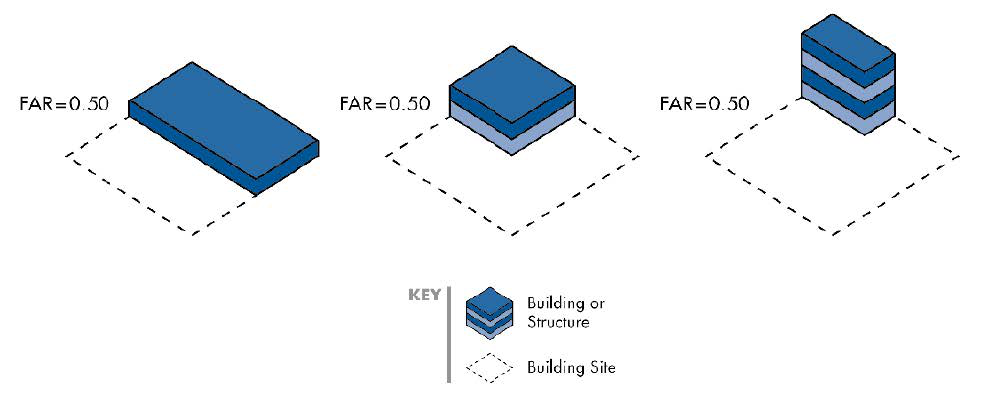
Home Occupation. An occupation conducted as a secondary use entirely within a dwelling unit operated by an occupant of the dwelling. This use shall be incidental and shall not change the character of the primary residential use. The use shall be licensed through the City and shall not be evident beyond the limits of the residential property line including the presences of noise, light, smoke, odor, vibration, electrical interference, storage of material or equipment, no display, no stock in trade, or commodity sold on the premises, and no persons employed.
Hookah Lounge. Any facility or location whose business operation, whether as its primary use or as an ancillary use, is denoted by the inhaling or exhaling of the fumes of any organic or synthetic material, including plants, herbs, tobacco, or shisha, through any device or equipment producing smoke or vapors, including pipes (commonly known as a hookah, waterpipe, or narghiles) designed with a tube passing through an urn of water that cools the smoke as it is drawn through it, including establishments known variously as hookah bars, hookah lounges, or hookah cafes.
Horse. A horse is an equine that has reached the age of 8 months.
Hospital. A facility providing medical, surgical, psychiatric, or emergency medical services to sick or injured persons, primarily on an inpatient basis. This use includes incidental facilities for outpatient treatment, as well as training, research, and administrative services for patients and employees.
Hydrozone. A portion of the landscaped area having plants with similar water needs and rooting depth. A hydrozone may be irrigated or non-irrigated.
(Ord. No. 2017-1442, 5-23-2017)
Section 20.600.110 - "I" Definitions
Impervious Surface. Land area covered by a surface treatment that hinders the ability of the underlying soils to percolate water.
Inclusionary Unit. Any rental or for-sale dwelling units provided per the requirements of Section 20.310 (Inclusionary Housing) for low-, very-low, extremely-low, and moderate-income households in residential projects that require development plans.
Industrial Design and Services (land use). Any business providing or combining professional design services and light fabrication or assembly technology for product specification. This land use may include office space and light or quasi-light industrial space to provide the full range of design, testing, and modification of commercial and industrial products.
Infiltration Rate. The rate of water entry into the soil expressed as a depth of water per unit of time (i.e., inches per hour).
Initial Zone. See "Zone" definition; only applicable to designated Transitional Zones.
In-Lieu Fee. Cash payments that may be required of an owner or developer as a substitute for a dedication of land or physical improvements, including the provision of inclusionary units.
Internet-Based Sales (land use). Any commercial or office use conducting retail or wholesale sales and services provided strictly online. This use may include limited on-site customers and storage of products on-site; all activities shall be conducted interior to the building. Any outdoor storage of large-scale items shall require additional outdoor storage permitting.
Invasive Plants. Those plant species that tend to become nuisances because of their undesirable growth habits such as pampas grass but that, if properly cultivated, may be useful or functional as elements of landscape design.
Invasive Plants Species. Species of plants not historically found in California that spread outside cultivated areas and can damage environmental or economic resources. Invasive species may be regulated by county agricultural agencies as noxious species. Lists of invasive plants are maintained at the California Invasive Plant Inventory and USDA invasive and noxious weeds database.
(Ord. No. 2017-1442, 5-23-2017)
Irrigation Audit. An in-depth evaluation of the performance of an irrigation system conducted by a certified Landscape Irrigation Auditor. An irrigation audit includes an inspection and system tune-up. System test with distribution uniformity or emission uniformity, reporting overspray or runoff that causes overland flow, and preparation of an irrigation schedule. The audit must be conducted in a manner consistent with the Irrigation Association's Landscape Irrigation Auditor Certification program or other U.S. Environmental Protection Agency "Watersense" labeled auditing program.
(Ord. No. 2017-1442, 5-23-2017)
Irrigation Designer. A person who has been certified by the Irrigation Association to prepare irrigation system designs, and/or a Landscape Architect.
Irrigation Efficiency (IE). The measurement of the amount of water beneficially used divided by the amount of water applied. Irrigation efficiency is derived from measurements and estimates of irrigation system characteristics and management practices. The irrigation efficiency for purposes of Chapter 20.330 (Water Efficiency Landscape Standards),are 0.75 for overhead spray devices and 0.81 for drip systems.
(Ord. No. 2017-1442, 5-23-2017)
Irrigation Plan. The irrigation plan shall be shown at the same scale as the planting plan. The irrigation plan shall show the components of the irrigation system with water meter size, backflow prevention, precipitation rates, flow rate and operating pressure for each irrigation circuit, and identification of all irrigation equipment.
Irrigation Survey. An evaluation of an irrigation system that is less detailed than an irrigation audit. An irrigation survey includes an inspection, system test, and written recommendation to improve performance of the irrigation system.
Irrigation Water Use Analysis. An analysis of water use data based on meter readings and billing data.
Section 20.600.120 - "J" Definitions
Junk. Means secondhand or used machinery, equipment, appliances, furniture, motor vehicle parts, tires, lumber, rope, bottles, pipe, wire, drums, scrap metal, construction material, packaging material, including items made of or containing wood, metal, paper, plastic, clay, brick, glass, porcelain, rubber, concrete, or other personal property.
Junkyard. Any parcel, lot, contiguous lots or portions thereof used for dismantling, salvage, outside storage, purchase, sale, or exchange of junk, or containing any activity in the Scrap Operations use type. It is not an exception to this definition that a person intends or proposes to use the junk for some purpose.
Section 20.600.130 - "K" Definitions
Kiosk (land use). Kiosks are freestanding, walk-up facilities. Facilities with drive-through access require a Major Use Permit.
Kitchen. A room used for preparation of food. A complete kitchen contains a sink, refrigerator, stove or range top, and oven or microwave. Includes any room having a sink and either a 3/4-inch gas opening or provision for an electric stove. A partial kitchen is missing one (1) of the above components.
Section 20.600.140 - "L" Definitions
Land Clearing. The removal of vegetation from any site, parcel or; provided, however, it does not include mowing, trimming or pruning, so as to maintain vegetation in a healthy, viable condition.
Land Use. The purpose for which a site or structure is arranged, designed, intended, constructed, erected, moved, altered, or enlarged for which either a site or a structure is or may be occupied or maintained.
Landscape water meter. An inline device installed at the irrigation supply point that measures the flow of water into the irrigation system and is connected to a totalizer to record water use.
(Ord. No. 2017-1442, 5-23-2017)
Landscape Architect. A person who holds a license to practice landscape architecture in the State of California (Government Code Section 5615).
Landscape Area, Net. All of the planting areas, turf areas, and water features in a landscape design plan subject to the Maximum Applied Water Allowance calculation. The landscape area does not include footprints of buildings or structures, sidewalks, driveways, parking lots, decks, patios, gravel or stone walks, other pervious or non-pervious hardscapes, and other non-irrigated area designated for non-development (e.g., open space and existing native vegetation).
Landscape Contractor. A person licensed (with a valid C-27 license) by the State of California to construct, maintain, repair, install, or subcontract the development of landscape systems and facilities consistent with the Business and Professions Code Sections 7058 and 7059.
Landscape Documentation Package. The documents required under Section 20.300.060.
Landscape Irrigation Audit. A process to perform site inspections, evaluate irrigation systems and develop efficient irrigation schedules.
Landscape Project. The total area of landscape in a project as defined in "landscape area."
Landscaping. The planting and maintenance of some combination of trees, shrubs, vines, ground covers, flowers or lawns. In addition, the combination of design may include natural features (e.g., rock and stone) and structural features, including fountains, reflecting pools, art work, screens, walls, fences, and benches. All landscaping shall be consistent with Chapter 20.330 (Water Efficient Landscape Standards).
Lateral Line. The water delivery pipeline that supplies water to the emitters or sprinklers from the valve.
Line of Sight Triangle. The area on either side of an access way at its junction with a public street forming a triangle within which clear visibility of approaching vehicular or pedestrian traffic must be maintained.
Live Entertainment. Music, comedy, readings, dancing, acting, or other entertainment performed on a site three (3) or more days during a calendar year. This includes dancing by patrons to live or recorded music.
Live-Work Unit (land use). Live/Work means an integrated dwelling unit and working space, in which the work component is the primary use and the residential component is secondary, occupied by a single housekeeping unit in a structure, that has been designed or structurally modified to accommodate joint residential occupancy and work activity, and that includes:
1.
Complete kitchen space and sanitary facilities in compliance with the Building Code; and
2.
Working space reserved for and regularly used by one (1) or more occupants of the unit.
Loading Space. An unobstructed area provided and maintained for the temporary parking of trucks and other motor vehicles for the purpose of loading and unloading goods or materials.
Local Agency (landscaping). The City that is responsible for adopting and implementing Chapter 20.330 (Water Efficient Landscape Standards). The City will be responsible for landscape plan checks, design review of the project, and approval of the landscape permit.
Local Water Purveyor. Vallecitos Water District (VWD), Vista Irrigation District (VID), Olivenhain Water district (OWD), and Rincon Water District (RWD) serve as the retail water purveyor within the limits of the City that provides retail water service.
Lodging (land use).
1.
Bed & Breakfast. A dwelling containing a single living unit that serves as the residence for the owner or manager and not more than five (5) guest rooms that, for compensation, provide temporary night to night lodging with or without meals.
2.
Rooming House. A building containing three (3) or more bedrooms or other rooms used, designed, or intended to be used, rented, leased, let or hired to be occupied or which are occupied by five (5) or more individuals under five (5) or more separate oral or written leases, subleases or any other contractual agreement designed to effectuate the same result, with or without meals, for compensation, as permanent guests pursuant to an arrangement for compensation for definite periods, by the month or greater term. A "Rooming Housing" does not require a property owner, or an agent, or a rental manager, to be in residence. A "Rooming House" may or may not have individual or group cooking facilities. A "Rooming House" may or may not provide free access to common living areas beyond the bedrooms or guest rooms. A "room" means any rented, leased, let or hired room, living space or other square footage within the building that is used or designed to provide sleeping accommodations for one (1) or more persons. A property permitted accessory dwelling unit, second unit, or "granny flat" shall not be considered a rooming house if used, designed, or intended to be used, rented, leased, let or hired, to be occupied or that is occupied by two (2) or fewer individuals under two (2) or fewer written leases, subleases or any other contractual agreement designed to effectuate the same result, with or without meals, for compensation, as permanent guests pursuant to an arrangement for compensation for definite periods, by the month or greater term.
3.
Hotel. A building or group of buildings in which there are six (6) or more guest rooms that are designed for and occupied as the temporary lodging place of individuals for generally less than thirty (30) consecutive days, but shall not include jails, hospitals, asylums, sanitariums, orphanages, prisons, detention homes and similar buildings, where human beings are housed and detained under legal restraint.
4.
Motel. A building or group of buildings containing individual sleeping or living units where a majority of such units open individually and directly to the outside, and where a garage is attached or a parking space is conveniently located to each unit, all for the temporary use by automobile tourists or transients.
Lot. A legally established lot of land under one (1) ownership with frontage upon a street. Types of lots include the following. See Figure 20.600-2.
1.
Interior Lot. A non-corner lot bounded on three (3) sides by adjacent lots with street frontage on only one (1) side.
2.
Corner Lot. A lot bounded by two (2) or more intersecting streets that has an angle of intersection of not more than one hundred thirty-five (135) degrees. The intersecting streets shall not be the same street. In determining the angle of intersection for a rounded corner, straight lines shall be drawn as extensions of both street lot lines. The calculation of the angle of intersection shall be made from the side facing toward the lot at the point where these two (2) extensions meet.
3.
Double Frontage Lot. An interior lot with frontage on more than one (1) street. A lot fronting on a street on one (1) side and a private ingress-egress easement on the other side shall be considered a double frontage lot even if the lot does not have ingress-egress from the private easement.
4.
Cul-de-Sac Lot. An interior lot taking access from and having frontage primary on the bulb of a cul-d-sac. Setbacks are measured from
5.
Flag Lot. A lot in the approximate configuration of a flag pole or sign post, with the pole or post functioning primarily as an access way to the main body of the lot from the street of access.
6.
Substandard Lot. A legally created lot that does not have the width or area required by the Zone in which it is located (not shown in Figure 20.600-2 Lot Types).
Figure 20.600-2 Lot Types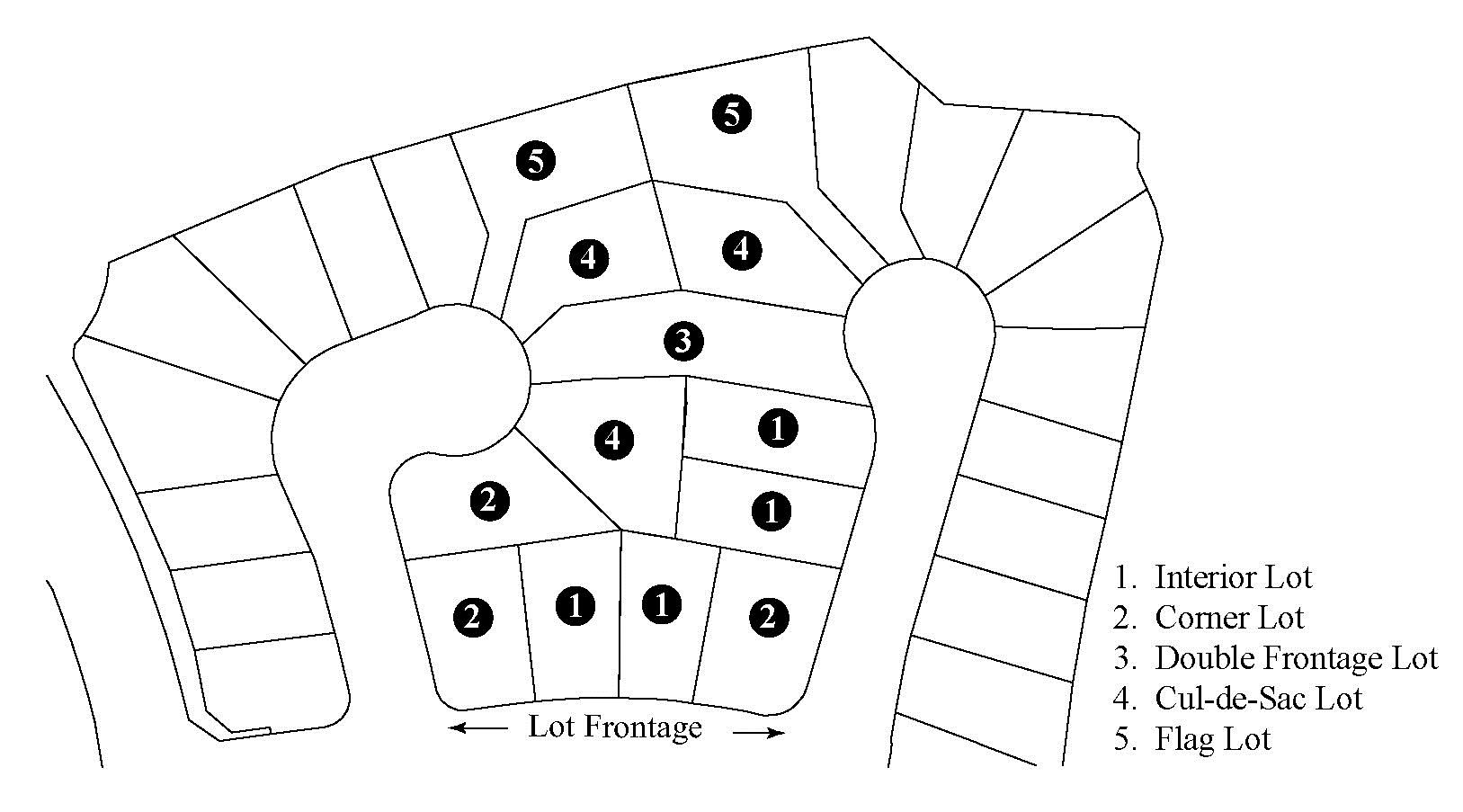
Lot Area, Net. Equal to the lot area exclusive of natural on-site buffer (like creek vegetation, public trail, or any area used for access), and excluding streets, access easements or public trails. Landscaped setbacks may be included in the net calculation.
Lot Depth. The horizontal length of a straight line connecting the bisecting points of the front and rear lot lines.
Lot Frontage (also Business Frontage or Frontage). Those portions of a lot or building site that abut a public street. For purposes of determining frontage on corner lots and through lots, all sides of a lot abutting a public street shall be considered as separate frontage.
Lot, Through. A lot fronting on 2 parallel or approximately parallel streets.
Lot Width. The horizontal distance between the interior property line of a lot, measured at right angles to the lot depth at the rear of the required front property line setback.
Low Barrier Navigation Center (land use). A low-barrier, service-enriched shelter focused on moving people into permanent housing that provides temporary facilities while case managers connect individuals experiencing homelessness to income, public benefits, health services, shelter, and housing. "Low Barrier" means best practices to reduce barriers to entry, and includes but is not limited to, the following:
(1)
The presence of partners if it is not a population-specific site.
(2)
Pets.
(3)
The storage of possessions.
(4)
Privacy, such as partitions around beds in a dormitory setting or in larger rooms containing more than two beds, or private rooms.
Low Volume Irrigation. The application. of irrigation water at low pressure through a system of tubing or lateral lines and low volume emitters such as drip, drip lines, and bubblers. Low volume irrigation systems are especially designed to apply small volumes of water at or near the roots of plants.
(Ord. No. 2022-1527, § 2(Exh. A), 10-25-2022)
Section 20.600.150 - "M" Definitions
Machine Repair Shop (land use). Any establishment engaged in the repair, retooling, and associated light-fabrication activities for mid- to industrial-size machines.
Main Line. The pressurized pipeline that delivers water from the water source to the valve or outlet.
Manufacturing and Assembly (land use). Any establishment engaged in the manufacturing, production and/or assembly of products, primarily from extracted or raw materials, or bulk storage and handling of the products and materials. Uses in this classification involve an incidence of truck or rail traffic, and/or outdoor storage of products, materials, equipment, or bulk fuel. All activities shall be completely enclosed within a structure unless other outdoor activities are expressly permitted within the Zone. This land use includes the following industry types:
Marijuana cultivation (land use). The planting, growing, harvesting, drying or processing of marijuana plants or any part thereof, and any and all associated business and/or operational activities.
(Ord. No. 2016-1423, 3-8-2016)
Market (land use).
1.
Convenience. A retail store of 3,500 square feet or less in gross floor area, which carries a range of merchandise oriented to daily convenience and travelers' shopping needs.
2.
Grocery/Supermarket. The retail sale of food and beverages for off-site preparation or consumption.
3.
Liquor. A retail establishment primarily engaged in selling beer, wine, and other alcoholic beverages, which may specialize in a particular type of alcoholic beverage (e.g., wine shops).
4.
Specialty Food and Beverage. The retail sale of specialty food and beverages for off-site preparation or consumption.
Massage Accessory Use (land use). A use where massages occurs either permanently or temporarily in conjunction with a primary permitted land use, and the area where the massage occurs covers less than twenty percent (20%) of the gross floor of the principal use. All persons performing massage shall possess a current, valid and authentic certificate issued by the California Massage Therapy Council. Massage Accessory Use shall not be classified as a Massage Establishment, and shall not be required to obtain a Massage Establishment License under Chapter 5.44 of this Municipal Code, but shall be subject to the Massage operating requirements under Chapter 5.44 and the specific use standards under Section 20.400.250 of this Municipal Code and all other applicable provisions of this Municipal Code.
(Ord. No. 2017-1443, 6-13-2017; Ord. No. 2019-1469, § 2(Exh. A), 1-22-2019)
Massage Establishments (land use). Any premises, place of business or membership club having a fixed place of business where the primary use is providing or giving for a fee or other form of consideration a massage, including, but not limited to, Swedish massage, sports massage, shiatsu, polarity therapy, rolfing, heller work, reiki, reflexology or other similar massage service or procedure. Any establishment that performs any combination of massage and bathhouse facilities, as that term is defined in Chapter 5.46 of the Municipal Code, including, but not limited to, wet and dry heat rooms, pools, and hot tubs, shall be deemed to be a Massage Establishment. A use where massage occurs as Massage, Accessory Use, shall not be classified as a Massage Establishment.
(Ord. No. 2017-1443, 6-13-2017)
The following professions and services shall not be classified as a Massage Establishment:
1.
Physicians, surgeons, chiropractors, osteopaths, physical therapists, occupational therapists, exercise physiologists, and acupuncturists who are duly licensed to practice their respective professions in the State of California.
2.
Registered Nurses, Practical Nurses and Licensed Vocational Nurses who are licensed to practice under the laws of this State.
3.
Hospitals, nursing homes, mental health facilities, or any other health facility duly licensed by the State of California.
4.
Trainers of any amateur, semiprofessional or professional athletes or athletic teams, or athletic trainers hired by a local, State or Federal government agency, while engaging in their training responsibilities for and with athletes; and trainers working in conjunction with a specific athletic event, such as track meets triathlons, or similar single occurrence athletic or recreational events.
5.
Barbers, beauticians, cosmetologists, aestheticians and manicurists who are duly licensed under the laws of the State of California while engaging in practices within the scope of their licenses.
6.
Any educational institution regulated by the State of California, including any portion of the institution providing Massage services, such as student clinics and work study programs, regulated under such State license.
7.
Any other business or profession exempt from the provisions of Chapter 5.44 of the Municipal Code by State law.
Master shut-off valve. An automatic valve installed at the irrigation supply point which controls water flow into the irrigation system. When this valve is closed water will not be supplied to the irrigation system. A master valve will greatly reduce any water loss due to a leaky station valve.
(Ord. No. 2017-1442, 5-23-2017)
Maximum Applied Water Allowance (MAWA). The upper limit of annual applied water for the established landscaped area as specified in Section 20.330.060. It is based upon the area's reference evapotranspiration, the ET Adjustment Factor, and the size of the landscape area. The Estimated Total Water Use shall not exceed the Maximum Applied Water Allowance. Special landscape Areas, including recreation areas, area permanently and solely dedicated to be edible plants such as orchards and vegetable gardens, and areas irrigated with recycled water, are subject to the MAWA with ETAF not to exceed 1.0. MAWA = (ETo) (0.62) [(ETAF x LA) + ((1-ETAF) x SLA)].
(Ord. No. 2017-1442, 5-23-2017)
Maximum Sound Level (Lmax). Maximum SPL or the highest SPL measured over the time interval the A-weighted network and slow time weighting.
Median. An area between opposing lanes of traffic that may be unplanted or planted with trees, shrubs, perennials, and ornamental grasses.
(Ord. No. 2017-1442, 5-23-2017)
Medical (land use).
1.
Hospital. An institution, specializing in giving clinical, temporary and emergency services of a medical or surgical nature to injured persons and patients. This definition includes acute care hospitals, acute psychiatric hospitals, and special hospitals as defined in Section 1502 of the California Health and Safety Code.
2.
Urgent Care. An establishment providing limited clinical and emergency medical services, generating primary walk-in service.
Merchandise Sales (land use). Any commercial use engaged in retail sales of merchandise not specifically listed under another use. Merchandise sales may be regulated by square footage thresholds subject to the regulations of the applicable Zone and shall be categorized by the following programmatic categories:
1.
Discount. The retail sales of new merchandise by discount retailers, including all products or commercial stores listed under "New Retail."
2.
New Retail. The retail sales of new merchandise including the following products or commercial stores:
3.
Showrooms. Stand alone and retail showroom establishments engaged in the retail sales of larger-scale new merchandise including appliances, indoor or outdoor furniture. All showrooms shall be subject to the operational and design standards of Section 200.400.190 (Showrooms), and the business operator shall sign an affidavit acknowledging all operational standards for such uses prior to issuance of a business license.
4.
Used/Pawn. An establishment engaged in the retail sale of secondhand merchandise, or offering loans secured by personal property.
Metal Working Shop (land use). Any industrial use engaged in metal working of any kind, including sheet metal operations; drop hammers or foundries are prohibited.
Microbrewery. A facility for the production of beer, fermented on the premises, for distribution, retail, or wholesale on- or off-premises. On-site tasting facilities shall be limited to the sale/tasting of product produced on-site and shall not exceed fifty percent (50%) of the building area. Ancillary retail sales are permitted. Alcohol-related businesses are subject to all applicable State law (California Business and Professions Code Section 23000 et seq.) licensing requirements for the sale or provision of alcohol. As an associated use, see "Tasting Room" definition.
Micro-climate. The climate of a small, specific area that may contrast with the climate of the overall landscape area due to wind, sun exposure, plant density, proximity to reflective surfaces, etc.
Mined-Land Reclamation Projects. Any surface mining operation with a reclamation plan approved in accordance with the Surface Mining and Reclamation Act of 1975.
Minimum Sound Level (Lmin). Minimum SPL or the lowest SPL measured over the time interval using the A-weighted network and slow time weighting.
Minor Alteration. Any physical modification to a structure that is limited in scope or has a minor visual impact in relation to the total design of the project. Minor alterations normally include awnings, landscaping, lighting, roofing, paint colors, seismic work, signs, new storefronts, and alterations to existing storefronts.
Mobile/Manufactured Home (Mobilehome) (land use). A structure, transportable in one (1) or more sections, that in the traveling mode is eight (8) or more feet in body width or forty (40) feet in body length, or that when erected is three hundred twenty (320) or more square feet in area and is built on a permanent chassis and is designed to be used as a dwelling with or without a foundation system when connected to the required utilities, and that contains required plumbing, heating, air conditioning, and electrical systems A mobilehome that was constructed after 1974 in accordance with California Department of Housing and Urban Development standards or after 1976 in accordance with U.S. Department of Housing and Urban Development (HUD) standards is considered to be a manufactured home.
Mobile/Manufactured Home Park (land use). Any parcel, area, or tract of land, or portion thereof where two (2) or more mobilehome lots are rented, leased, or offered for rent or lease to accommodate mobilehomes used for human habitation.
Motor Court. A building or group of buildings attached, detached, or semidetached, providing guest accommodations, in which there is exterior access independently to each individual room, unit, or suite, and on which automobile storage space is provided at each unit (e.g., motel, motor lodge, motor hotel).
Moving Company (land use). A facility providing for-hire transportation and temporary indoor warehousing for the moving of personal possessions.
Mulch. Any organic material such as leaves, bark, and straw or inorganic mineral materials such as rocks, gravel, or decomposed granite left loose and applied to the soil surface for the beneficial purposes of reducing evaporation, suppressing weeds, moderating soil temperature, and preventing soil erosion.
(Ord. No. 2017-1442, 5-23-2017)
Multifamily Dwelling (land use). A type of residential development comprised of a building or portion thereof, used for occupancy by three (3) or more households living independently of each other, and containing three (3) or more dwelling units. See definition of "Dwelling, Multifamily" in Section 20.600.060 for additional information.
Municipal Code, or Code. The City of San Marcos Municipal Code, as it may be amended from time to time.
Museum, Library, or Gallery (land use). A commercial or nonprofit use that displays or preserves objects of interest in literature, the arts, or sciences.
Section 20.600.160 - "N" Definitions
New Construction (pertains to landscaping only). A new building with a landscape or other new landscape such as a park, playground, or greenbelt without an associated building.
Newspaper Printing (land use). Any establishment engaging in the production, on-site printing and distribution of any general circulation, private interest, or community newspaper. Regulation of this use is required due to noise, chemicals, and processes used in the printing process.
Nightclubs (land use). A bar, tavern, or similar establishment that provides live entertainment (music, comedy, etc.) that may serve alcoholic beverage for sale, where the performance area exceeds seventy-five (75) square feet, or customer dancing occurs.
Non-Commercial Horticulture (land use). The growing of horticulture or agriculture on-site for the sole purpose of use by the property owner/on-site resident. Sale of such products is prohibited unless permitted under a separate land use.
Nonconforming Sign-Legal. See Section 20.320.120 (Definitions).
Nonconforming Structure. A building, or portion thereof, that was legally constructed or altered and maintained, but that, because of the application of this title, no longer conforms to the physical development standards of the Zone in which it is located.
Nonconforming Use. A use that was legally established and that has been continuously conducted at the same location, but that because of the application of this title, is no longer authorized at that location, or requires approval of a discretionary permit and has not obtained such discretionary permit approval.
Non-Residential Landscape. Landscapes in commercial, institutional, industrial and public settings that may have areas designated for recreation or public assembly. It also includes portions of common areas of common interest developments with designated recreational areas.
(Ord. No. 2017-1442, 5-23-2017)
Nursery (land use). An establishment for the growth, display, and/or sale of plants, seeds, shrubs, trees, and materials used in indoor or outdoor planting, conducted within or without an enclosed building. This includes garden centers. All merchandise other than the plants are kept within an enclosed structure or fully screened. Fertilizers of any type are stored and sold in package form only.
Section 20.600.170 - "O" Definitions.
Occupancy. Each separate use of property conducted on a lot or within a building or any portion thereof.
Octave Band. An octave band is defined as a frequency band whose upper band-edge frequency is twice the lower band frequency.
Office (land use). An establishment providing direct, "over-the-counter" services or business services to consumers or clients (e.g., insurance agencies, real estate offices, travel agencies, utility company offices, etc.) and office-type facilities occupied by businesses providing professional services and/or engaged in the production of intellectual property. Offices shall be categorized by the following programmatic categories:
1.
Corporate, Administrative, Business. Offices for private commercial or nonprofit business.
2.
Government. Any office building or space owned, operated or leased by a municipal entity for the purpose of conducting municipal business or operations.
3.
Medical/Dental/Holistic. Offices for the conduct of medical practice out-patient services.
Office Park: A group of two (2) or more office buildings that are planned and developed together with unique identity and function relationships fostered through the use of coordinated design, site orientation, access and other unifying elements.
Off-Site. An activity or accessory use that is related to a specific primary use, but is not located on the same site as the primary use.
Off-Street Loading Facility. A site or portion of a site reserved for the loading or unloading of motor vehicles or trailers, including loading berths, aisles, access drives and landscaped areas.
Off-Street Parking Facility. A site or portion of a site outside of a public ROW reserved for the parking of motor vehicles, including parking spaces, aisles, access drives and landscaped areas.
On-Site. An activity or accessory use that is related to a specific primary use, and is located on the same site as the primary use.
Open Space, Private. A usable open space adjoining and directly accessible to a dwelling unit, reserved for the exclusive use of residents of the dwelling unit and their guests.
Open Space, Usable. Outdoor space that serves a recreational function or provides visual relief from the building mass, the minimum dimension of which shall be six (6) feet excluding required front yards not used for balconies or patios.
Operating Pressure. The pressure at which parts of an irrigation system are designed by the manufacturer to operate.
Outcall Service Activity. See Section 20.405.070 (Definitions) for adult-related land use definitions.
Outdoor Dining (land use). Any outdoor space directly adjacent and accessory to a primary Restaurant land use for the purpose of outdoor food or beverage service and dining. Subject to provisions of Chapter 20.400 (Specific Use Standards) and regulated by Zone.
Outdoor Recreation Facility (land use). Outdoor public or private recreational activities including cart/car racing course, driving range, golf course, mini-golf, outdoor swimming pool, sports complex, rock climbing, or similar outdoor activities.
Outdoor Storage (land use). On-site at grade or shelved space for the storage of business-related materials, products, and goods. All on-site storage shall be limited to those materials directly used or produced in relation to the functional on-site business activity; subject to all storage and screening requirements of the applicable Zone. This land use may be a primary land use or accessory land use in conjunction with another land use.
Overhead Sprinkler Irrigation Systems or Overhead Spray Irrigation System. Systems that deliver water through the air (e.g., spray heads and rotors).
(Ord. No. 2017-1442, 5-23-2017)
Overspray. The irrigation water that is delivered beyond the target area, and in which can cause overland flow caused by irrigation events onto non-targeted areas such as pavements, walks, and structures.
(Ord. No. 2017-1442, 5-23-2017)
Section 20.600.180 - "P" Definitions
Parcel Delivery Service (land use). A facility providing indoor warehousing, sorting, and delivery (including on-site transportation vehicles) for commercial delivery of parcels and mail. Excludes U.S. Postal Service facilities.
Parking Facility (land use). A parking lot and/or structure. Types of parking facilities include the following:
1.
Fully Subterranean Parking. A mechanically ventilated, subterranean parking structure the top of which is at existing grade.
2.
Parking at Grade. At grade, (carport, partially closed or enclosed) parking with or without a dwelling above.
3.
Partially Subterranean Parking. A mechanically ventilated parking structure, the top of which does not exceed two (2) feet above existing grade measured at the center of the site along the street frontage.
4.
Podium Parking. At grade parking that is fully enclosed with a common entrance that has dwellings over. Podium parking can be at grade or partially depressed by no more than two (2) feet below existing grade.
5.
Surface Parking. Parking at grade with no dwelling above.
6.
Tuck-under Parking.Tuck-under parking is unenclosed parking located below the unit where parking is accessed from an unenclosed driveway that may be at existing grade or below.
Parking; Fleets (land use). Parking at grade, covered or uncovered, for fleet vehicles (two (2) or more business-related vehicles); subject to all storage and screening requirements of the applicable Zone.
Parking Lot Sale (land use). The display and sales of products or services primarily outside a permanent structure, including vehicles, garden supplies, gas, tires, motor oil, food and beverages, boats, motor homes and clothes, where parking is the principal use of the property.
Parking Space. A readily accessible area, within a structure or surface parking area, exclusive of aisles, driveways, ramps and columns, maintained exclusively for the parking of one (1) vehicle.
Parks, Open Space, Recreation (land use). Areas with improvements suitable for active and/or passive recreational facilities.
Parkway. The area between a sidewalk and the curb or traffic lane. It may be planted or unplanted, and with or without pedestrian egress.
(Ord. No. 2017-1442, 5-23-2017)
Patio Cover. A one-story, open-sided shade structure consisting of a roof and structural supports, attached to or detached from the primary dwelling which is used only for recreational, outdoor living purposes and not as a carport, garage, storage room or habitable room.
Pawn Shop. An establishment that engages, in whole or in part, in the business of loaning money on the security of pledges of personal property, or deposits, or conditional sales of personal property, or the purchase or sale of personal property.
Pedestrian Orientation. Any physical structure or place with design qualities and elements that contribute to an active, inviting and pleasant place for pedestrians including:
1.
Building facades that are highly articulated at the street level, with interesting uses of material, color, and architectural detailing, located directly behind the sidewalk;
2.
Design amenities related to the street level (e.g., awnings, paseos, arcades);
3.
Visibility into buildings at the street level;
4.
A continuous sidewalk, with a minimum of intrusions into pedestrian ROW;
5.
Continuity of building facades along the street with few interruptions in the progression of buildings and stores;
6.
Signs oriented and scaled to the pedestrian rather than the motorist;
7.
Landscaping (including pocket parks or outdoor patios); and
8.
Street furniture.
Pedestrian-Oriented Uses (land use). A land use that is intended to encourage walk-in customers and that generally does not limit the number of customers by requiring appointments or otherwise excluding the general public. A pedestrian-oriented use provides spontaneous draw from the sidewalk and street due to visual interest, high customer turnover, and social interaction. Examples of these uses include:
Permit. Any permit issued by the City for new buildings or rehabilitated landscape.
Personal Services (land use). Any place of business providing group or individual non-medical services and the accessory retail sales of products related to the services. Such services are intended to provide for the repair of small personal items, professionally administered cosmetic and personal grooming treatments or providing the means by which individuals may create a desired personal result or improve one's skill in the practice of a specialized activity primarily for personal interest or self-improvement. These services are categorized by the following programmatic elements. Some Personal Services are defined and regulated by SMMC 20.400.200 - Tattoo and/or Body Art Facility (see Chapter 8.95 - Tattoo Parlors/Body Arts Facilities); and SMMC 20.400.250 - Massage, Accessory Use and Massage Establishments (see Ordinance No. 2017-1443, 6-13-2017).
1.
General. Any place of business establishment providing non-medical services to individuals as a primary use, including, but not limited to the following types of uses: hair, cosmetic, nail, and tanning salons (with ear piercing and permanent makeup as an ancillary use subject to SMMC 20.400.200); personal electronics and small appliance repair; seamstress, bridal, tailor, tuxedo rental and shoe repair shops; art and photography studios; travel agents; and, mailing and personal copying stores. To qualify as an ancillary use, ear piercing and permanent makeup services cannot be provided in conjunction with any Tattoo and/or Body Art Facility. Said facilities are subject to Section 20.400.200 (Tattoo and/or Body Art Facility).
2.
Fitness/Health Facility. Any place of business or membership club providing facilities and/or instruction devoted especially to health, beauty, self-improvement, skill development and relaxation that deals with the cosmetic, therapeutic, and/or holistic treatments, where people visit for professionally administered personal care treatments and/or instruction, such as health and physical fitness clubs and day/health spas, which may include individual and/or group instruction of fitness/health activities as identified under Instructional in Section 20.600.180(3) below. Massage as an accessory use may be permitted subject to SMMC 20.400.250. A medical spa shall be classified as a Medical Office land use.
3.
Instructional. Any place of business that is intended for group instruction including, but not limited to, art, dance, gymnastics, weight lifting, indoor batting cages, martial arts, mediation, modeling, pilates, pottery, rock climbing, volleyball, yoga, weight control clinic, hobbies, cooking, tutoring, and other instructional classes not considered as a college or school land use as defined in herein (Chapter 20.600).
4.
Limited Instructional. A small-scale facility intended to provide individual or small group instruction as identified under Instructional in Section 20.600.180(3) above. Limited Instructional facilities shall be limited to an activity floor area of 5,000 square feet and a maximum occupancy of 25 attendees and 4 instructors/employees scheduled to be located at the facility at the same time. This land use may include a small day/health spa provided the gross floor area and number of attendees and employees/instructors do not exceed the maximum.
(Ord. No. 2017-1443, 6-13-2017; Ord. No. 2021-1512, § 2(Exh. B), 1-11-22)
Pervious. Any surface or material that allows the passage of water through the material and into the underlying soil.
Places of Assembly (land use). Gathering places for public, private, commercial or nonprofit gatherings with permanent or moveable seating. Attached portions of civic center and public school buildings including non-fixed seating may also be considered community assembly space that may be rented to nonprofit civic or community organizations; no additional use permit shall be required for this rental use. The following use types shall all be considered within the "Places of Assembly" land use:
1.
Auditorium. A building used or designed for audience attendance, including public assembly, meetings, lectures, dances, entertainment, and similar uses. This use does not apply to auditoriums attached to portions of civic center and public school facilities.
2.
Place of Worship. A facility or establishment where the principal purpose of which is religious worship. A primarily religious or nonprofit facility may include structures and activities including sanctuary space, religious education, ministry, clothing and food distribution (kitchen facility), counseling, employment assistance, study or library space, referral services, and support groups, and assembly rooms. A place of worship shall be limited to one (1) single-family dwelling unit; any additional dwelling units or spaces require separate land use approvals and permits as applicable and permitted within the Zone. A place of worship does not include businesses operated by the religious group for support of religious activities or for charitable purposes. A place of worship falls within the Places of Assembly land use.
3.
Small Place of Assembly. Gathering place for small public, private, commercial or nonprofit or religious worship gatherings; including meetings, lectures, worship, and similar uses with permanent or moveable seating in an existing non-residential building. A Small Place of Assembly shall be limited to 25 attendees within a maximum 1,200 square-feet of assembly floor area. A maximum of 2 instructors/employees scheduled to be located at the facility at the same time shall be allowed in addition to the attendees.
(Ord. No. 2021-1512, § 2(Exh. B), 1-11-22)
Planned Residential Development (land use). A small lot configuration planning tool that can be used in conjunction with specific residential Zones to achieve increased common open space and a density of four (4) to eight (8) dwelling units per acre. See Chapter 20.435 (Planned Residential Development).
Planning Commission. The City of San Marcos Planning Commission, referred to as the "Planning Commission."
Plant Factor (or Plant Water Use Factor) (landscaping). A factor when multiplied by ETo estimates the amount of water needed by plants. For purposes of Chapter 20.330 (Water Efficient Landscaping Standards), the plant factor range for very low water use plants is 0 to 0.1, the plant factor range of low water use plants ranges from 0.1 to 0.3, the plant factor of moderate water use plants ranges from 0.4 to 0.6, and the plant factor of high water use plants ranges from 0.7 to 1.0. Plant factors are derived from the Department of Water Resources 1999 publication "Water Use Classification of landscape Species". Plant factors may also be obtained from horticultural researchers from academic institutions or professional associations as approved by the California Department of Water Resources (DWR).
(Ord. No. 2017-1442, 5-23-2017)
Porch. An architectural feature of a building, structural or non-structural, that is roofed but otherwise unenclosed.
Pre-existing. In existence before the effective date of the ordinance enacting this Zoning Ordinance.
Primary Structure. A structure that houses the primary use on a property or lot. It shall not include accessory structures (e.g., garages, pool houses, or sheds).
Primary Use(s). The primary use(s) for which land or a building is or may be intended, occupied, maintained, arranged or designed.
Private Residential Garage (land use). A permanently roofed structure with three enclosed sides and a garage door, that is used for automobile shelter and storage solely for the purposes of one (1) individual residential property.
Private Viewing Room. See Section 20.405.070 (Definitions) for adult-related land use definitions.
Project. Any proposal for new or changed use, or for new construction, alteration or enlargement of any structure, that is subject to the provisions of this Zoning Ordinance.
Project Applicant (landscaping). The individual or entity submitting a Landscape Documentation Package required under Sections 20.330.050 (Landscape Package Submittal Milestones) and 20.330.060 (Landscape Documentation Package Elements), to request a permit, plan check, or design review from the City. A project applicant may be the property owner or his/her designee.
Property Line/Lot Line. A recorded boundary of a lot, excluding the lines bounding any private easement Types of property lines are as follows.
1.
Front Property Line (PL). The shortest line of a lot that is abutting a public ROW line. The property line of a double-frontage lot abutting an ROW shall be front lot lines. When the PL of a corner lot that is abutting ROW lot lines are of equal or substantially equal lengths, the front lot line shall be determined by the Director. In determining the front lot line, the Director shall take into consideration the character of the improvements in the neighborhood of the lot, the impact to abutting property owners from the establishment of either of the boundaries as a front PL, the character of the building proposed to be constructed and the distance that the building is set back from the lines of the two (2) streets that the lot abuts.
2.
Interior Property Line. A property line not abutting a street shared in common with another adjacent lot. This applies to "side" and "rear" property line conditions.
3.
Street Property Line. A property line abutting a public ROW or street.
4.
Corner Property Line. A street lot line that is not a front property line.
Property Line, Adjacent. Any property line dividing one (1) Zone from a different Zone (i.e., the property line separating an L-M property and a C property). When a non-residentially zoned property is adjacent to a residentially zoned property (any R Zone), the "adjacent property line" regulations shall be applicable to the R Zone property separated from the applicable site by a ROW.
Public Buildings and Facilities (land use). Any building, facility, or development owned, operated, or leased by a government entity (city, state, or federal).
Public Hearing. A public meeting held by the City Council, Planning Commission, or other advisory body for the purposes of receiving testimony to be used in the consideration of the approval, conditional approval or denial of a discretionary application.
Public Maintenance Buildings and Facilities (land use). Any public building or facility operated for the ongoing upkeep of public land, facilities, or services.
Public Park/Open Space/Recreation (land use). A noncommercial park, playground, or other recreation facility, and/or open space officially designated as a public park or recreation facility. This use may include community centers.
Public Property. Any real property, without limitation, owned by the City or any governmental agency, any public ROW or easement, and any property subject to a public open space easement.
Public Utilities (land use). Any facility, equipment, or property used for the production, storage, or distribution of utilities or services as owned, operated, or leased by a public entity or public utility company.
Section 20.600.190 - "Q" Definitions
Qualified Worker Housing, Large (land use). Any living quarters, dwelling, rooming house, bunkhouse, or other housing accommodations, consisting of more than thirty-six (36) beds in a group quarters or more than twelve (12) units or spaces designated for use by a single family or household, and which is for the exclusive occupancy of farm employees and their families in connection with any farm work or place where farm work is being performed, and the premises upon which they are situated.
Qualified Worker Housing, Small (land use). Any living quarters, dwelling, rooming house, bunkhouse, or other housing accommodations, consisting of no more than thirty-six (36) beds in a group quarters or twelve (12) units or spaces designated for use by a single family or household, and which is for the exclusive occupancy of farm employees and their families in connection with any farm work or place where farm work is being performed, and the premises upon which they are situated.
(Ord. No. 2022-1527, § 2(Exh. A), 10-25-2022)
Section 20.600.200 - "R" Definitions
Rain Sensor (or Rain Sensing Shutoff Device). A component that automatically suspends the irrigation event when it rains.
Reciprocal Driveway Access. A shared driveway configuration enabling adjacent properties of the same Zone designation to use the same driveway, may require recording of easements.
Record Drawing or As-Builts. A set of reproducible drawings that show significant changes in the work made during construction and that are usually based on drawings marked up in the field and other data furnished by the contractor.
Recreation Facilities/Park (land use within Residential Manufactured Home Park Zone). Any noncommercial park, recreation, open space, or other active or passive non-building space, within a Mobile/Manufactured Home Park, designed for recreational use by residents and guests.
Recreational Area. Areas excluding private single-family residential areas, designed for active play, recreation or public assembly in parks, sports field, picnic grounds, amphitheaters or golf courses tees, fairways, roughts, surrounds and greens.
Recreational Vehicle. A motorhome, travel trailer, truck camper or camping trailer, with or without motive power, designed for human habitation for recreational or emergency occupancy.
Recreational Vehicles (RVs)/Park. Any parcel, area, or tract of land, or portion thereof improved for the parking, or offering for rent or lease, of two (2) or more recreational vehicles (RVs) for recreational or emergency occupancy.
Recyclable Material. Reusable material including but not limited to metals, glass, plastic and paper, which are intended for reuse, remanufacture, or reconstitution for sale or reuse. Recyclable material does not include refuse or hazardous materials. Recyclable material may include clean (uncontaminated) used motor oil and oil filters collected and transported in accordance with Sections 25250.11 and 25143.2(b)(4) of the California Health and Safety Code.
Recycled Water (or Reclaimed Water, or Treated Sewage Effluent Water). Treated or recycled waste water of a quality suitable for non-potable uses such as landscape irrigation. This water is not intended for human consumption.
Recycling Facilities (land use).
Collections Facility. Any establishment, including a place of business, center, or stand-alone container, for collection or processing recyclable materials from the public. A "Certified Recycling Facility" or "Certified Processor" is a recycling facility certified by the California Department of Conservation as meeting the requirements of the California Beverage Container recycling and Litter Reduction Act of 1986. A recycling facility does not include storage containers or processing activity located on the premises of a residential, commercial, or manufacturing use and used solely for the recycling of material generated by that residential property, business or manufacturer. Recycling facilities shall be categorized by the following programmatic elements:
1.
Small. A recycling center established as an accessory use to a principal use, for acceptance/donation, redemption, or purchase of recyclable not exceeding five hundred (500) square feet in size, devoted exclusively to the collection of recyclable materials from the public.
2.
Large. A recycling facility established either as an accessory use, five hundred (500) square feet or larger in size, or as a principal use, regardless of size, devoted exclusively to the collection of recyclable materials from the public.
Processing Facility (land use). An enclosed structure used for collection and processing of recyclable materials. Processing means the preparation of material for efficient shipment, or to an end-user's specifications, by means such as baling, briquetting, compacting, flattening, grinding, crushing, mechanical sorting, shredding, cleaning, and remanufacturing. Processing facilities include the following:
1.
Light Processing. Occupies an area that is less than 45,000 square feet of gross collection, processing, and storage area and has up to an average of two (2) outbound truck shipments per day. Light Processing Facilities are limited to baling, briquetting, crushing, compacting, grinding, shredding and sorting of source-separated recyclable materials and repairing of reusable materials sufficient to qualify as a Certified Processing Facility. A Light Processing Facility shall not shred, compact, or bale ferrous metals other than food and beverage containers.
2.
Heavy Processing. Any processing facility other than a Light Processing facility.
3.
Reverse Vending. An automated mechanical device which occupies less than 50 square feet (and is an accessory use) that accepts one (1) or more types of recyclable beverage containers, including but not limited to, aluminum cans, glass and plastic bottles, and issues a cash refund or a redeemable credit slip with a value not less than the container's redemption value as determined by the state. The reverse vending machine may sort and process containers mechanically, provided the entire process is fully enclosed. A grouping of multiple reverse vending machines may be necessary/provided to meet the requirements of certification as a recycling facility.
Referenced Evapotranspiration (ETo). A standard measurement of environmental parameters that affect the water use of plants. ETo is given in inches per day, month, or year as represented in Section 20.330.060 (Landscape Documentation Package Elements) and is an estimate of the evapotranspiration of a large field of four (4) to seven (7) inches tall, cool season turf that is well watered. Reference evapotranspiration is used as the basis of determining the Maximum Applied Water Allowance so that regional differences in climate can be accommodated.
Rehabilitated Landscapes. Any re-landscaping project that requires a permit, plan check, or design review and meets the requirements of Section 20.330.020 (Applicability).
Renewable Energy Harvesting/Production (land use). The installation and use of any facility or utility for the generation of on-site energy that may include the transmission, and/or storage of such energy. Such facilities shall be subject to all state, federal, building and utility regulations in addition to the provisions of Chapter 20.450 (Renewable Energy).
Research and Development (land use). Any business combining activities, laboratories, and facilities for research; and uses involving the production of experimental products that neither constitute nor cause a public health risk to employees and/or to surrounding properties and/or residents. Does not include Commercial Cannabis Activity or Cannabis Cultivation, Outdoor, which are prohibited uses under Subsection 20.205.030(D).
Research and Development, Fabrication and Light Manufacturing (land use). Any establishment, or space within a building, conducting the manufacture of experimental or prototype products in support of a Research and Development land use. Manufacture facilities shall be limited to products researched and/or designed on-site.
Residential Care Facility (land use). Any State licensed facility, place, or structure that is maintained and operated to provide non-medical residential care, day treatment, or foster agency services for adults, children, or adults and children as defined in Article 1 of Chapter 3 of the California Health and Safety Code Section 1500 et seq. This use includes licensed skilled nursing facilities and the administration of limited medical assistance (e.g., dispensing of prescribed medications).
1.
Large. A licensed Residential Care Facility providing services for seven (7) or more adults and/or children consistent with the definition above.
2.
Small. A licensed Residential Care Facility providing services for six (6) or fewer adults and/or children consistent with the definition above.
Residential Landscape. Landscapes surrounding single or multifamily homes.
Response Time (F, S, I) (Landscaping). The response time is a standardized exponential time weighting of the input signal according to fast (F), slow (S) or impulse (I) time response relationships. Time response can be described with a time constant. The time constants for fast, slow, and impulse responses are one (1) second, 0.125 second, and 0.35 millisecond, respectively.
Restaurant (land use). Any establishment operated for the primary purpose of providing food, beverages, or meals for compensation, which has suitable kitchen facilities for the preparation, storage and service of food. Any bar area, all applicable licenses required, shall be limited to five hundred (500) square feet or thirty percent (30%) of the dining area; bar areas exceeding these limits shall be classified as a bar.
1.
Sit-Down. Any restaurant for the primary purpose of on-site service and consumption and/or serving meals in non-disposable containers. Accessory sale of food and nonalcoholic beverages for off-site consumption is permitted provided that all food and beverages sold for on-site consumption are served in non-disposable containers.
2.
Take-Out. Any restaurant for the primary purpose of serving food and beverage in disposable containers (paper, plastic, or otherwise disposable/recyclable). This use includes restaurants providing three (3) or less tables for on-site consumption, and retail bakeries coffee, and beverage shops with or without seating.
Restroom /Sanitary Facilities (land use). A structure or facility located within a Mobile/Manufacture Home Park designed for toilet, shower, changing, and sanitary facilities for the use of park residents and guests.
Right-of-Way (ROW). An area or strip of land, either public or private, on which an irrevocable right of passage has been recorded for the use of vehicles or pedestrians or both.
Rooming House (land use). A building containing three (3) or more bedrooms or other rooms used, designed, or intended to be used, rented, leased, let or hired to be occupied or which are occupied by five (5) or more individuals under five (5) or more separate oral or written leases, subleases or any other contractual agreement designed to effectuate the same result, with or without meals, for compensation, as permanent guests pursuant to an arrangement for compensation for definite periods, by the month or greater term. A "Rooming Housing" does not require a property owner, or an agent, or a rental manager, to be in residence. A "Rooming House" may or may not have individual or group cooking facilities. A "Rooming House" may or may not provide free access to common living areas beyond the bedrooms or guest rooms. A "room" means any rented, leased, let or hired room, living space or other square footage within the building that is used or designed to provide sleeping accommodations for one (1) or more persons. A property permitted accessory dwelling unit, second unit, or "granny flat" shall not be considered a rooming house if used, designed, or intended to be used, rented, leased, let or hired, to be occupied or that is occupied by two (2) or fewer individuals under two (2) or fewer written leases, subleases or any other contractual agreement designed to effectuate the same result, with or without meals, for compensation, as permanent guests pursuant to an arrangement for compensation for definite periods, by the month or greater term.
ROW. See "Street, or Public Right-of-Way."
Row Home. A series of dwelling units, attached in a row, separated from each other by an unpierced wall extending from basement to roof.
Runoff. Water that is not absorbed by the soil or landscape to which it is applied and flows from the landscape area. For example, runoff may result from water that is applied at too great a rate (application rate exceeds infiltration rate) or when there is a slope.
(Ord. No. 2017-1442, 5-23-2017; Ord. No. 2017-1453, § 2(Exh. A), 11-14-2017; Ord. No. 2022-1527, § 2(Exh. A), 10-25-2022)
Section 20.600.210 - "S" Definitions
Sales Stand (land use). An accessory structure designed and used for the express purpose of selling produce or horticulture grown on-site; the structure shall conform to all required setbacks of the applicable Zone.
Salvage Yard (Scrap Yard). A lot or parcel of land used for the collection, keeping, or abandonment of discarded or waste materials.
School (land use). Any public, charter or private educational facility for elementary, middle, junior high, and high schools serving kindergarten through twelfth (12th) grade students, including denominational and sectarian, boarding schools, and military academies. Preschools and child daycare uses are included in "Child Daycare Center."
Second Hand Store (Used Goods). A profit or nonprofit business or organization that engages in or specializes in the sale or resale of previously owned or used goods and merchandise.
Self-Storage (land use). Facilities providing individual compartmentalized spaces or warehousing space for rent or lease to the general public for personal storage and characterized by low parking demand.
Senior/Age-Restricted Dwelling (Senior Housing) (land use). Dwelling unit(s) or a residential development for the restricted purpose of serving and housing adults over a specified age. This use may include supportive medical and non-medical services directly affiliated with the treatment of on-site patients.
Setback. The distance by which a structure, parking area or other development feature must be separated from a lot line easement, other structure or development feature. If a street dedication is required, then the setback requirement shall be measured from the revised property line after the dedication.
1.
Front PL Setback. A setback extending across the full width of a lot between the front property line (or primary street property line) and the foremost point of any structure, parking area, or other development feature. Where specified this setback may be measured to the living portion of the building or the garage portion of the building.
2.
Interior Side Setback. A setback extending across the full width of a lot between the interior side property line and the foremost point of any structure, parking area, or other development feature.
3.
Corner Side Setback. A setback extending across the full width of a lot between the corner side property line and the foremost point of any structure, parking area, or other development feature on the lot.
4.
Exterior Setback. A setback extending across the full width of a lot between any property line and the foremost point of any structure, parking area, or other development feature on the lot.
5.
Rear Setback. A setback extending across the full width of a lot between the rear property line and the foremost point of any structure, parking area, or other development feature.
Sexual Encounter Establishment. See Section 20.405.070 (Definitions) for adult-related land use definitions.
Shopping Center: A commercial center composed of more than four (4) businesses, identified by one (1) name as being physically grouped, and sharing a common parking area.
Shrub. A woody perennial plant generally with multiple basal stems.
Sign. See Section 20.320.120 (Definitions).
Single-Family Residential (land use). A type of residential development comprised of detached building used exclusively for occupancy by one (1) household (including necessary servants and employees of such household) and containing one (1) dwelling unit on a single lot. This land use may include mobilehomes and factory-built housing, and may be attached or detached configurations. See definition of "Dwelling, Single-Family" in Section 20.600.060 for additional information.
Single Ownership. Holding record title, possession under a contract to purchase or possession under a lease, by a person, firm, corporation or partnership, individually, jointly, in common or in any other manner where the property is or will be under unitary or unified control.
Single-Room Occupancy (land use). A facility providing dwelling units where each unit has a minimum floor area of one hundred fifty (150) square feet and a maximum floor area of two hundred twenty (220) square feet. These dwelling units may have kitchen or bathroom facilities and shall be offered on a monthly basis or longer.
Site. A lot or group of contiguous lots not divided by any alley, street, other ROW or City limit that is proposed for development in accord with the provisions of this Zoning Code, and is in a single ownership or has multiple owners, all of whom join in an application for development.
Slope. The inclined ground surface of fill, excavation, or natural terrain, the inclination of which is expressed as a percentage. Slope percent is computed by dividing the vertical distance by the horizontal distance multiplied by one hundred (100).
Small Wind Energy System (land use). A devise, of less than one (1) kilowatt and eight (8) feet in diameter, that produces electricity from wind.
Soil Moisture Sensing Devise (or Soil Moisture Sensor). A device that measures the amount of water in the soil. The device may also suspend or initiate an irrigation event.
Soil Texture. The classification of soil based on its percentage of sand, silt, and clay.
Sound Pressure Level (SPL). A ratio of one (1) sound pressure to a reference pressure (L ref ) of twenty (20) μPa. Because of the dynamic range of the human ear, the ratio is calculated logarithmically by twenty (20) log (L/L ref ).
Special Landscape Area (SLA). An area of the landscape dedicated solely to edible plants, recreational areas, areas irrigated with recycled water, or water features using recycled water.
(Ord. No. 2017-1442, 5-23-2017)
Specific Plan. A plan as defined in Government Code Section 65450. Also see Chapter 20.535.
Specified Anatomical Area. See Section 20.405.070 (Definitions) for adult-related land use definitions.
Specified Sexual Activities. See Section 20.405.070 (Definitions) for adult-related land use definitions.
Sport Court (land use). Outdoor facility for the playing of sports activities, including basketball, bocce ball, handball, tennis, or volleyball. Sport courts may be full sized or configured in a reduced or combined manner. Area of sport courts provided on-site can be used toward the calculation of landscape and open space requirements.
Sprinkler Head or Spray Head. A device that sprays water through a nozzle.
(Ord. No. 2017-1442, 5-23-2017)
Stable (land use).
1.
Private. A corral or stable facility for the keeping of large animals subject to the regulations of the applicable Zone. Animal keeping in private stables shall be for the use of the individual land owner.
2.
Public. A corral or stable facility for the keeping of large animals open to the public for the lease or rental of space or facilities including the boarding of large animals.
Stand-Alone. A building, use, or facility that is physically separated from or otherwise unconnected to other buildings, uses or facilities, and that is either: (i) located on a separate lot or parcel from other buildings, uses or facilities; or (ii) located on the same lot or parcel with other buildings, uses or facilities and has its own dedicated parking. A Stand-Alone building, use or facility has required parking that is computed and provided separately from other buildings, uses or facilities.
State Route 78 View Corridor. The area immediately adjacent to, by property line or adjacent to the access roads of State Route 78. The corridor includes all buildings and properties within two hundred (200) feet of the State Route 78 easement and may be subject to additional regulations or standards. Access streets include Los Vallecitos Boulevard/Furniture Row, Grand Avenue, E. Carmel Street, and Rancheros Drive where these streets are within two hundred (200) feet of the State Route 78 easement.
Static Water Pressure. The pipeline or municipal water supply pressure when water is not flowing.
Station. For the purposes of Chapter 20.330 (Water Efficient Landscape Standards), an area served by one (1) valve or by a set of valves that operate simultaneously.
Story. The portion of a building included between the upper surface of any floor and the upper surface of the next floor above, except that the topmost story shall be that portion of a building included between the upper surface of the topmost floor and the ceiling above.
Street, or Public Right-of-Way. A public thoroughfare, avenue, road, highway, boulevard, parkway, way, drive, lane, court or private easement, not including freeways, providing any access to and egress from the property abutting thereon.
Street Frontage. The distance along which a property line of a lot adjoins a public or private street.
Street, Side. A street which is adjacent to a corner lot and which extends in the general direction of the line determining the depth of the lot.
Structural Alterations. Any change in the supporting members of a building such as foundations, bearing walls, columns, beams, floor or roof joists, girders or rafters, or changes in roof or exterior lines.
Structure. Anything constructed or erected that requires a location on the ground, including a building or a swimming pool, or a fence or wall, but not including driveways or walkways.
Subdivision. The division, by any subdivider, of any unit or portion of land shown on the latest equalized San Diego County assessment roll as a unit or contiguous units, for the purpose of sale, lease or financing, whether immediate or future. Property shall be considered as contiguous units, even if it is separated by roads, streets, utility easement or railroad ROWs. Subdivision includes the following, as defined in Civil Code Section 1315: a condominium project; a community apartment project; or the conversion of five (5) or more existing dwelling units to a stock cooperative.
Subdivision Map Act, or Map Act. Division 2, Title 7 of the California Government Code, commencing with Section 66410 as presently constituted, and any amendments to those provisions.
Submeter. A metering device to measure water applied to the landscape that is installed after the primary utility water meter.
(Ord. No. 2017-1442, 5-23-2017)
Substantial (Major) Alteration. Any physical modification to a structure that involves a major portion of the structure or has a substantial visual impact on the structure or its surroundings. Substantial alterations normally include changes to building massing, cladding the exterior walls in a new material, and extensive replacement of windows and doors with a new or unoriginal design in a structure.
Supportive Housing (land use). A facility or use that provides housing with no limit on length of stay, that is occupied by the target population, and that is linked to on-site or off-site services that assist the supportive housing resident in retaining the housing, improving his or her health status, and maximizing his or her ability to live and, when possible, work in the community. "Target Population" means persons, including persons with disabilities, and families who are "homeless," as that term is defined by Section 11302 of Title 42 of the United States Code, or who are "homeless youth," as that term is defined by paragraph (2) of subdivision (e) of Section 11139.3 of the Government Code. Supportive housing that is provided in single-, two-, or multifamily dwelling units, group residential, residential care facilities, or rooming house uses shall be permitted, conditionally permitted or prohibited in the same manner as the other single-, two-, or multifamily dwelling units, group residential, residential care facilities, or rooming house uses under this code.
Swap Meet. Any indoor or outdoor place, location, or activity where new or used goods or secondhand personal property is offered for sale or exchange to the general public by a multitude of individual licensed vendors, usually in compartmentalized spaces; and where a fee may be charged to prospective buyers for admission, or a fee may be charged for the privilege of offering or displaying such merchandise.
Swimming Pool/Sauna/Hot Tub (land use). A water-filled enclosure with a depth of eighteen (18) inches or more, or an enclosure used for creating steam, for the purposes of swimming or recreation on a private residential lot.
Swing Joint. An irrigation component that provides a flexible, leak-free connection between the emission device and lateral pipeline to allow movement in any direction and to prevent equipment damage.
Section 20.600.220 - "T" Definitions
Tandem Parking. A parking space configuration where two (2) or more parking spaces are lined up behind each other.
Tasting Room. An area devoted to the sampling and sales thereof of wine or beer produced on or off the premises and the sale of food is prohibited. On-site tasting facilities shall be limited to the sale/tasting of product produced on-site and shall not exceed fifty percent (50%) of the building area. Ancillary retail sales are permitted. Alcohol-related businesses are subject to all applicable State law (California Business and Professions Code Section 23000 et seq.) licensing requirements for the sale or provision of alcohol.
Tattoo and/or Body Art Facility (land use). Any facility that includes any of the following activities:
1.
Body art facility. Any specified building, section of a building, or vehicle in which a practitioner performs body art, including reception areas, the procedure area, and the decontamination and sterilization area. "Body art facility" does not include a facility that only pierces the ear with a disposable, single-use, presterilized clasp and stud or solid needle that is applied using a mechanical device to force the needle or stud through the ear. This use is subject to the standards and restrictions in Section 20.400.200 (Tattoo and/or Body Art Facility).
2.
Body art. The body piercing, tattooing, branding, or application of permanent cosmetics.
3.
Body piercing. The creation of an opening in a human body for the purpose of inserting jewelry or other decoration. "Body piercing" includes the piercing of an ear, including the tragus, lip, tongue, nose, or eyebrow. Body piercing does not include the piercing of an ear, except for the tragus, with a disposable, single-use, presterilized stud and clasp or solid needle that is applied using a mechanical device to force the needle or stud through the ear.
4.
Branding. The process in which a mark or marks are burned into human skin tissue with a hot iron or other instrument, with the intention of leaving a permanent scar.
5.
Permanent cosmetics. The application of pigments in human skin tissue for the purpose of permanently changing the color or other appearance of the skin. This includes, but is not limited to, permanent eyeliner, eyebrow, or lip color. Permanent cosmetics, if done as an ancillary use within a beauty salon or spa, shall not be subject to the standards and restrictions in Section 20.400.200 (Tattoo and/or Body Art Facility).
6.
Tattooing. The insertion of pigment in human skin tissue by piercing with a needle.
Technical/Scientific/Medical Laboratories (land use). Any business or establishment engaged in laboratory work or research in support of a primary Research and Development land use. These uses shall be fully enclosed and adequately regulated/permitted/licensed for the type of activity facilitated within the laboratory. Accessory laboratory uses shall not exceed forty percent (40%) of the building area; laboratory space greater than forty percent (40%) of the building area shall be subject to a CUP. Incidental related uses such as pharmacies (prescriptions only), biochemical, X-ray laboratories, medical offices, and clinics are permitted.
Temporary Uses. The specified uses may occur on a temporary or intermittent basis subject to the requirements of a Director's Permit, including fixed start and end dates specified in the permit.
Third-Octave Band. A third-octave band is defined as a frequency band whose upper bandedge frequency is 1.26 times the lower band frequency.
Transitional Housing (land use). Buildings configured as rental housing developments, but operated under program requirements that call for the termination of assistance and recirculation of the assisted unit to another eligible program recipient at some predetermined future point in time, which shall be no less than six months. Transitional housing that is provided in single-, two-, or multifamily dwelling units, group residential, residential care facilities, or rooming house uses shall be permitted, conditionally permitted, or prohibited in the same manner as the other single-, two-, or multifamily dwelling units, group residential, residential care facilities, or rooming house uses under this code.
Transmission Line. A power line bringing electricity to a receiving or distribution substation.
Transportation Dispatch (land use). Any establishment engaged in deploying specialized transportation options including ambulances, taxis, limousines, armored cars, tow trucks, and similar vehicles for specialized transportation. This does not include storage facilities for towed vehicles. Dispatch facilities are categorized by the following programmatic categories:
1.
Dispatch Only. An office or location where vehicles are dispatched only; this does not include a vehicle or responder base, waiting areas, or vehicle storage that are prohibited.
2.
Fleet Usage. A base, with or without dispatch operations, where vehicles and/or crew are based, wait for dispatch, or vehicles are stored; subject to all storage and screening requirements of the applicable Zone.
Turf. A ground cover surface of mowed grass. Annual bluegrass, Kentucky bluegrass, Perennial ryegrass, Red fescue, and Tall fescue are common cool season grasses. Bermuda grass, Kikuyu grass, Seashore Paspalum, St. Augustine grass, Zoysiagrass, and Buffalo grass are common warm-season grasses.
Two-unit Residential Development. Any primary dwelling units designed and used to house two households living independently of each other on the same legal lot. Dwelling units may be attached or detached and are subjecct to the provisions of Section 20.470 (Two-Unit Residential Development).
(Ord. No. 2017-1442, 5-23-2017; Ord. No. 2021-1510, § 6(Exh. 5), 12-14-2021; Ord. No. 2021-1511, § 6(Exh. 5), 1-11-2022)
Section 20.600.230 - "U" Definitions
Unenclosed. A covered area with one (1) or more sides open.
Used. Arranged, designed, constructed, altered, rented, leased, sold, occupied or intended to be occupied.
Section 20.600.240 - "V" Definitions
Valve. A device used to control the flow of water in the irrigation system.
Visible. Likely to be noticed by a person of average height walking on a street or sidewalk two (2) years after installation of any planting screening material intended to screen a view.
Section 20.600.250 - "W" Definitions
Warehousing, Indoor (land use). Facilities for indoor bulk storage and handling of product, materials, and goods of any kind occurring within an enclosed building; includes cold storage. May or may not include freight/delivery bays. Does not include self-storage or mini-storage facilities offered for lease or rent to the public. Warehousing facilities primarily for wholesaling and distribution are regulated under "Wholesale, Processing and Distribution."
Water Conserving Plant. A plant species identified as having a very low or low plant factor.
(Ord. No. 2017-1442, 5-23-2017)
Water Feature. A design element where open water performs as an aesthetic or recreational function. Water features include ponds, lakes, waterfalls, fountains, artificial streams, spas and swimming pools (where water is artificially supplied). The surface area of water features is included in the high-water use hydrozone of the landscape area. Constructed wetlands used for on-site treatment or storm water best management practices that are not irrigated and used solely for water treatment or storm water retention are not water features, and therefore not subject to the water budget calculation.
Water Tank (land use). A facility used for the storage of water to serve part of a private the public water infrastructure, or private water usage of a residential lot.
Water Treatment and Filtering Services (land use). A commercial or industrial facility utilized for the processing and biological treatment of water or wastewater enabling treatment for use, reuse, or consumption.
Water Use Classification of Landscape Species (WUCOLS). Refers to the Department of Water Resources 1999 publication authorized by a U.C. Cooperative Extension employee, Larry Costello.
Watering Window. A time of day irrigation is allowed.
Wholesale, Processing and Distribution (land use). Any establishment engaged in selling merchandise to retailers; to contractors, industrial, commercial, institutional, farm, or professional business users; to other wholesalers; or acting as agents or brokers in buying merchandise for or selling merchandise to persons or companies. Includes storage, processing, packaging, and shipping facilities for delivery, mail order and e-commerce retail establishments. This may include the following establishments:
1.
Agents, merchandise or commodity brokers, and commission merchants;
2.
Assemblers, buyers and associations engaged in cooperative market or farm products;
3.
Merchant wholesalers;
4.
Stores primarily selling electrical, plumbing, heating or air conditioning supplies and equipment.
Wholesale Production (land use). Any establishment engaged in the sale of commodities or goods to others for resale and not normally to the ultimate consumer. Sales normally employs warehouses, open enclosures, and office space for the assembly, storage, distribution and display of merchandise for large quantity sales to community or regional retailers, manufacturers, and agricultural, commercial, industrial, institutional and professional uses. Sales may include the rendering of services incidental to and supportive of the wholesale of merchandise.
Window, Bay. An extension of a building wall that is habitable space that encroaches into a required yard and is a minimum of three (3) feet above finished grade. A bay window shall have a minimum of fifty percent (50%) fenestration.
Winery (land use). Any establishment engaging in the processing of grapes, other fruit products, or vegetables to produce wine or similar spirits. Processing includes wholesale sales, crushing, fermenting, blending, aging, storage, bottling, administrative office functions for the winery and warehousing. Alcohol-related businesses are subject to all applicable State law (California Business and Professions Code Section 23000 et seq.) licensing requirements for the sale or provision of alcohol. As an associated use, see "Tasting Room" definition.
Worm Farm Bin. Vermiculture receptacles utilized for worm farming.
Section 20.600.260 - "X" Definitions
Xeriscape. Creative landscape design for water conservation that include principles of planning and design that incorporate practical turf areas, appropriate plant selection, soil improvements, mulches, and efficient irrigation.
Section 20.600.270 - "Y" Definitions
Yard. An open, unoccupied space, other than a court, unobstructed from the ground to the sky, except as otherwise provided by this ordinance, on the lot on which a building is situated.
Yard, Front. The yard between a front lot line or lines and the line defined by the required front yard setback.
Yard, Rear. The yard between a rear lot line or lines and the line defined by a required rear yard setback.
Yard, Side. The yard between a side lot line or lines and the line defined by a required side yard setback, extending from the front to the rear yard.
Yard, Side, Exterior. A side yard abutting a street.
Yard, Side, Interior. A side yard other than an exterior side yard.
Section 20.600.280 - "Z" Definitions
Zone. The Zone applied to a site by the Zoning Map, to which an overlay Zone may also be applied subject to overlay Zone location regulations.
1.
Initial Zone. The existing developed Zone applicable to a Transitional Zone until such time as the designated Transitional Zone property is rezoned to the identified Future Zone.
2.
Future Zone. Applicable to Transitional Zones; the Zone identified for future conversion/redevelopment subject to the standards and timing of the Transitional Zone. See Chapter 20.235 (Transitional Zones).
Zoning Map. The map that graphically shows all Zone boundaries and classifications within the City, as contained within the Zoning Ordinance and adopted as an ordinance by the City.
Zoning Ordinance. The San Marcos Zoning Code, Title 20 of the City of San Marcos Municipal Code, referred to herein as "Zoning Ordinance."

