
San Marcos City Zoning Code
CHAPTER 20
340 - OFF-STREET PARKING AND LOADING
Section 20.340.010 - Purpose of Chapter
The purpose of this chapter is to regulate the provision of off-street parking and loading for all land uses, facilitate community-wide accessibility, and promote viability of business within San Marcos. Specifically, the purpose of this chapter is to do the following:
A.
Ensure adequate off-street parking and loading facilities to serve land use needs.
B.
Provide adequate off-street parking, circulation, and access to help support the viability of businesses in the City.
C.
Maintain efficient use of land by avoiding excessive amounts of parking.
D.
Allow parking alternatives and reductions to off-street parking requirements that provide flexibility in meeting off-street parking needs, when appropriate.
E.
Ensure off-street parking and loading facilities are designed in a manner that ensures efficiency, protects public safety, minimizes adverse impacts to adjacent land uses, and promotes the general welfare of the community.
Section 20.340.020 - Applicability
A.
Applicability. The standards of this chapter shall be applied to new construction and establishment, conversion, or expansion of any land use in the City, applicable to increases in floor space, seating capacity, dwelling units, employees, or rooms/beds associated with a building or structure. Operations associated with a land use shall not commence, nor a building be occupied, unless off-street parking and loading facilities conform to the requirements of this chapter. Exceptions to these standards are permitted when either of the following occurs:
1.
An adopted Specific Plan, policy plan, or special overlay district supersedes the provisions of this chapter; or
2.
An exception has been granted through a Variance or DP in accordance with the provisions in Chapters 20.525 (Variances) and 20.510 (Director's Permit), respectively.
Section 20.340.030 - General Requirements
A.
Use of Parking Areas. Parking spaces regulated in this chapter shall be solely used for parking, not for the display of merchandise; storage or display of equipment; display for sale or lease; or repair of vehicles, trailers, recreation vehicles, boats, and etc. except when permitted by Chapter 20.455 (Temporary Events).
B.
Required Availability and Maintenance. All off-street parking and loading required by this chapter shall be available during all hours of operation, marked for their intended uses, and reserved for parking and loading purposes for the life of the use or facility. Parking spaces and associated driveways, maneuvering areas, and landscaping shall be maintained free of vandalism and litter. Striping, paving, walls, lights, and all other facilities shall be maintained in good condition.
C.
Existing Facilities. Any building or use for which parking facilities become substandard by the adoption of this chapter shall be considered a nonconforming use. Such nonconforming use may continue, but no enlargement or expansion in such a use or building shall be made unless the required number of parking spaces or parking area, as designated by this chapter are provided.
D.
Change of Occupancy or Use. For a change of occupancy, a new business license, or enlargement of a structure or use where the parking demand is increased, off-street parking facilities and loading shall be provided in compliance with the minimum requirements of this chapter.
E.
Parking of Inoperable or Unregistered Vehicles. Except as set forth in this chapter, it shall be unlawful for any person to park or store an automotive vehicle or trailer without current registration from the Department of Motor Vehicles or in inoperable condition, except when stored in a fully enclosed building.
F.
Change of Parking Requirements. When parking requirements, as set forth in this chapter, are amended, such amendments shall not invalidate a previously approved permit.
G.
Request for Special Review of Parking. Modifications to parking improvement standards or other parking provisions in this chapter shall be considered in conjunction with the review permit applications or Site Development Plans by the appropriate authority. The applicant shall submit with the request, evidence necessary to demonstrate the unusual conditions warranting the modification, such as floor plans and other evidence, as requested by the reviewing authority.
Section 20.340.040 - Required Number of Parking Spaces
The requirements of this Section shall be applied uniformly, based on land uses, regardless of the Zone in which a land use is to be located, unless otherwise specified.
A.
Minimum Standards. Every use shall provide at least the minimum number of off-street parking spaces required by Table 20.340-1 (see Section 20.340.090 (Bicycle Parking) for bicycle parking requirements). Reductions to the parking requirements may be permitted, subject to compliance with the provisions of Section 20.340.050 (Off-Street Parking and Trip Reduction Measures). Required parking space dimensions, based on parking configuration, are established in Table 20.3403, Section 20.340.060 (Off-Street Parking Size and Location).
B.
Uses Not Listed. Parking requirements for uses not specifically listed in Table 20.340-1 will be determined by the Director, based on comparable uses in the Table or through a parking demand analysis of similar facilities in the region.
C.
Mixed Use Sites. Where multiple land uses are combined within a single building, structure, or parcel, off-street parking facilities for a single use shall not be considered as providing required parking facilities for any other uses. The aggregate number of parking spaces for each separate use, required by this chapter, shall be met, except where otherwise specified and a reduction of parking is allowed in compliance with Section 20.340.050 (Off-Street Parking and Trip Reduction Measures).
D.
Rounding Calculations. Calculations resulting in a fractional number shall be treated as follows: one (1) parking space is required for fractions of one-half (0.5) or greater; no additional parking space is required for fractions of less than one-half (0.5).
E.
Calculations.
1.
Gross Floor Area Calculations. Gross floor area calculations are based on the area within the surrounding exterior walls of a building or any portion, thereof, including shared bathroom spaces, storage areas, and areas for circulation.
2.
Seating Calculations. Where fixed seats provided are either benches, bleachers, or pews, such seats shall be calculated at one (1) seat per eighteen (18) inches and one (1) seat per twenty-four (24) inches of booth length for dining.
3.
Assembly Area Calculations. All rooms or areas that can be logically used for seating, in addition to any fixed seating area, shall be calculated in determining the parking requirement for assembly areas.
Table 20.340-1
Parking Requirements by Land Use
F.
Mixed Use Parking Requirements
Table 20.340-2
Mixed Use Parking Requirements
G.
Additional Multifamily Requirements
1.
Residential projects and Mixed Use projects with residential components that provide required uncovered parking shall assign parking spaces by dwelling unit. Spaces shall be clearly marked to denote assigned parking. For the convenience of tenants and guests, parking spaces shall be located as close as possible to the unit or common facility it is intended to serve. The project applicant shall submit a Parking Management Plan during the Site Development Plan Review.
2.
Required guest parking shall be provided, per the requirements in Table 20.340-1 and shall be clearly marked. Guest parking need not be in addition to required residential parking when parking spaces are not assigned.
3.
Parking spaces adjacent to non-residential tenants shall be clearly marked for customer parking and shall not permit residential assigned parking.
4.
All permanent, assigned, and unassigned spaces must be full sized spaces, nine (9) feet wide by eighteen (18) feet long. Unassigned spaces are permitted to include compact spaces, evenly distributed throughout the project.
H.
Drive-Through Facilities/Stacking Capacity. For drive-through facilities that permit transaction of business directly with customers within a motor vehicle, the minimum length provided per vehicle for stacking capacity of vehicles in a drive-through service lane shall be twenty-five (25) linear feet. The total stacking capacity required shall be determined through CUP review and approval.
I.
Prohibited Uses and Exceptions
1.
Daycare or Commercial Child Daycare. Required parking may be reduced per the standards of Table 20.340-1 where adequate drop-off facilities are provided.
a.
Drop-off facilities shall be designed to accommodate a continuous flow of vehicles to safely load and unload children. Adequacy will be determined by the approval authority during project application review.
2.
Overnight Parking. Outside overnight parking is prohibited for vehicles associated with repair activities and fueling/service stations.
J.
Permitted Off-Site Parking. Off-site parking may be used to comply with the required off-street parking, subject to the provisions of Section 20.340.080 (Off-Site Parking Alternatives).
(Ord. No. 2022-1527, § 2(Exh. A), 10-25-2022; Ord. No. 2021-1512, § 2(Exh. B), 1-11-22; Ord. No. 2023-1539, § B(Exh. A), 12-12-2023)
Section 20.340.050 - Off-Street Parking Size and Location
Every use shall provide the required off-street parking spaces in accordance with the location and dimensional requirements in this Section.
A.
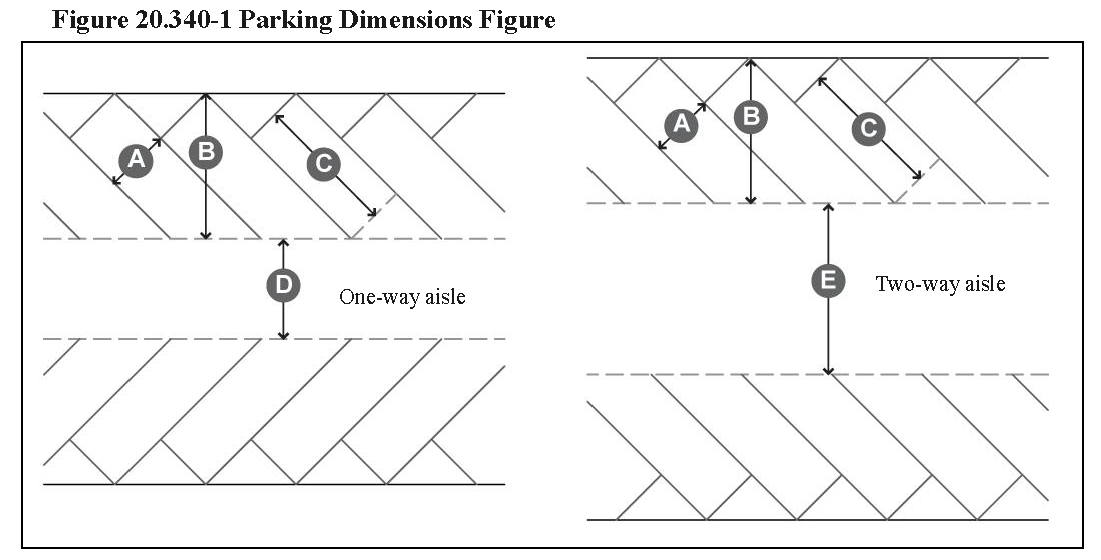
Vehicular Parking and Driveway Sizes. Table 20.340-4 regulates minimum off-street space dimensions and drive aisle requirements for various angles of parking. See Figure 20.340-1 that graphically supplements Table 20.340-4.
Table 20.340-4
Parking Dimensions Table
Notes:
Measured perpendicular to aisle.
2. ;hg;The paved parking space length may be decreased by up to 2 feet by providing
an equivalent vehicle overhang into landscaped areas, or other paved walkways.
3. ;hg;End spaces may be reduced to 18 feet.
4. ;hg;Compact spaces shall not exceed the overall number of required parking spaces
in Section 20.340.060.I.
B.
Minimum Vertical Clearances. Vertical clearance for all standard parking spaces, including entrances, shall be a minimum of seven (7) feet, except the front three (3) feet of a parking space in an enclosed garage in a residential Zone may have a vertical clearance of four (4) feet.
C.
Minimum Drive Aisle and Driveway Widths. Drive aisle widths in parking areas shall comply with the minimum requirements specified in Table 20.340-4. Residential garages shall reference subsection H, below. Shared driveway access with adjacent lots is encouraged, provided the following requirements are met:
1.
The driveway is directly adjacent to a shared property line;
2.
An easement for the use of the driveway is obtained;
3.
The driveway width is adequate to serve the additional number of vehicles to be served.
D.
Driveway Entrances. Parking lot driveway entrances shall be located in a manner to coordinate with future median openings and shall line up with opposite side driveway entrances. Location criteria shall be per the City's Urban Street Design Criteria or its successor and shall be to the satisfaction of the City Engineer.
E.
Sufficient Vehicular Maneuvering Area, Access, and Circulation. The following standards are provided to ensure suitable maneuvering and circulation for parking lots or loading areas accessed from a public street or alley:
1.
All access and circulation shall facilitate vehicles entering and exiting a facility or lot without backing up into a public street, reentering a public ROW, or making other hazardous turning movements, including trucks, solid waste, emergency, and other public service vehicles.
2.
If such circulation, described in paragraph A is not possible, a turnaround area shall be provided, subject to the requirements of the San Marcos Fire Department or City of San Marcos Engineering Division.
3.
Traffic controls at ingress and egress points and directional arrow markings on the pavement may be required, as determined to be necessary by the City for public safety.
F.
Parking Location. Off-street parking shall be provided in a paved parking area, building, as follows:
1.
Residential Development. All off-street parking for residential uses shall be located on the same site as the uses they are intended to serve, but shall not be located within a required front or corner side setback, except as otherwise provided in this chapter.
2.
Multifamily Residential within Mixed Use Development. At least one (1) space for each residential unit shall be located on-site; other required parking spaces may be located off-site, subject to the standards for off-site parking in Section 20.340.080 (Off-Site Parking Alternatives) and the following standards.
a.
Residential parking garages shall be located adjacent and behind the building elevation.
b.
Surface parking for commercial uses shall be located adjacent to or behind buildings and is prohibited at street corners, unless otherwise approved by the City at the time of site development review.
3.
Non-Residential Development within Mixed Use. Parking required to serve non-residential uses may be on the same or different site as the uses served, subject to complying with the standards for off-site parking in Section 20.340.080 (Off-Site Parking Alternatives).
G.
Design Exceptions. Where an applicant can demonstrate to the satisfaction of the approval authority that exceptions on the dimensions, otherwise required by this Section, are warranted in order to achieve environmental design and sustainable building objectives (i.e., certification under the LEED™ Green Building Rating System or an equivalent), specific parking area design variances may be approved by the Director.
H.
Garage Standards. Consistent with the standards of Chapter 20.215 (Residential Zones), garages within the R Zones shall conform to the standards and regulations of Table 20.340-5. All garages and parking spaces shall be constructed concurrently with the dwelling unit prior to occupation.
Table 20.340-5
Garage Development Standards
I.
Compact Car Spaces. Compact car spaces may be permitted in accordance with the following standards:
1.
Dimensions. Spaces shall be the minimum size specified in Table 20.340-4.
2.
Designation of Parking. "Compact" shall be clearly marked on the pavement or curb to designate spaces.
3.
Distribution of Spaces. When included, compact spaces shall be distributed throughout the parking area, and shall not be provided disproportionately near building(s).
4.
For Industrial and Office uses. Parking lots of thirty (30) or more spaces shall be permitted to include compact spaces for up to twenty percent (20%) of total required spaces.
5.
For Uncovered Multifamily Parking and Guest Parking. Compact parking spaces shall be permitted for up to twenty percent (20%) of the total required spaces. All garage dimensions shall conform to standards of Section 20.340.060.H (Garage Standards), and compact spaces shall not be used to count toward requirements for covered spaces. Compact spaces shall not count toward required single-family residential parking spaces.
6.
Other Land Uses. Land uses not identified in Section 20.340.040 (Required Number of Parking Spaces) with parking lots of thirty (30) spaces or more shall be permitted to include compact spaces for up to twenty percent (20%) of total required spaces.
J.
ADA Compliant Parking Spaces. ADA compliant parking spaces shall be provided on-site for each land use and/or development in accordance with the following standards:
1.
Designated ADA parking spaces shall be provided in compliance with state law (Title 24) and the California Vehicle Code (Section 22507.8), including required number of parking spaces and design requirements.
2.
Parking spaces and loading/unloading areas shall be reserved for the life of the approved land use.
3.
Designated parking shall be visibly marked with blue paint and appropriate signage, per state requirements.
K.
Electric/Alternative Fuel Vehicle Parking. Electric/alternative fuel vehicle parking and charging stations shall be provided in accordance with the following standards. Charging station levels are defined in Chapter 20.600 (Definitions).
1.
Number of Spaces Required.
a.
All multi-family residential and non-residential projects are required to provide 5% of their required spaces as Electric Vehicle charging stations (Level 2 or better). Projects that emit fewer than 500 MT of carbon dioxide equivalent annually are exempt from this requirement, as identified in the City's Climate Action Plan Consistency Review Checklist.
b.
All residential and non-residential Electrical Vehicle parking must comply with the requirements of Chapter 17.28 of this Municipal Code and the California Green Building Standards Code.
2.
Permit Requirements. All applicable electrical and building permit requirements, restrictions and inspections shall apply to the construction of charging/exchange stations. Charging stations/spaces:
a.
Shall be posted with signage indicating the space is only for Electric Vehicle charging purposes. Days and hours of operations shall be included if time limits or tow away provisions are to be enforced by the owner. Information identifying voltage and amperage levels or safety information must be posted.
b.
Should be sited within parking areas to discourage non-electric vehicle use.
c.
Shall not interfere with on-site parking or pedestrian circulation.
d.
Shall be maintained in functioning order in all respects.
(Ord. No. 2023-1529, § 3(Att. A), 2-28-2023; Ord. No. 2023-1539, § B(Exh. A), 12-12-2023)
Editor's note— Ord. No. 2023-1539, § B(Exh. A), adopted Dec. 12, 2023, deleted the former § 20.340.050 entitled "Off-Street Parking and Trip Reduction Measures," and further amended the Code by renumbering §§ 20.340.060—20.340.100 as 20.340.050—20.340.090 as herein set out.
Section 20.340.060 - Parking Lot Improvement Standards and Other Parking Layouts
A.
Parking Lot Improvement Standards.
1.
Pavement Surfacing. All circulation, loading, ingress and egress, and off-street parking areas shall be surfaced with an asphaltic or cement concrete paving, designed to withstand repeated vehicular traffic. Other paving material may be used, such as pervious surfaces, subject to the approval of the Director and/or City Engineer.
a.
All surface water runoff shall be conveyed into a public ROW or storm drain or directed into planting areas. Drains shall be provided in accordance with the specifications of the City Engineer. Runoff shall be treated per the requirements of the latest NPDES permit prior to entering the public ROW or storm drain.
2.
Striping. All parking spaces (with the exception of single-family garages or carport) and, when required, aisles, loading Zones, pedestrian walks and crossings, visitor parking, and fire lanes shall be striped or otherwise designated to provide safe access, circulation, and parking.
a.
Pavement markings and other distinctions shall be maintained in a visible and legible manner.
3.
Bumper Guards or Wheel Stops. Bumper guards or wheel stops shall be provided in such a manner as to ensure that no portion of any parked vehicle shall touch any wall, fence, building or project beyond any lot lines bounding a parking area facility.
4.
Landscaping Requirements.
a.
Except those areas devoted to driveways and/or pedestrian walkways, all off-street parking areas or structures abutting a public street or sidewalk shall be bound by a planting strip or appropriate permeable drainage treatment with minimum widths established by Site Development Plan Review standards or permit application review and shall comply with the American with Disabilities Act standards. The design shall include a method to ensure separation between landscaping and vehicle.
b.
In addition to the requirements of paragraph 4.a above, for any required parking area of more than ten (10) spaces, landscaping shall be installed and maintained as follows:
i.
Landscaped areas shall be evenly dispersed throughout the parking lot and shall include a combination of trees, shrubs, and ground cover, emphasizing drought-tolerant landscaping.
ii.
Parking lots shall be required to provide trees for shade at a minimum of one (1) tree for every five (5) parking spaces, in planters or landscaped islands evenly distributed throughout the parking lot. Trees shall be selected from the City's approved planting list, shall be a minimum twenty-four (24)-inch box size, and designed to achieve a goal of fifty percent (50%) shade requirement within fifteen (15) years of planting.
iii.
Tree planters shall have a minimum interior dimension of five (5) feet and/or shall be sized to accommodate the selected species of tree growth. To increase the parking lot landscape area, a two (2)-foot landscaped overhang area may be provided as part of the eighteen (18)-foot minimum length of a parking space, provided the total depth of such overhang area is in accordance with the specifications of Table 20.340-4. Such overhang area shall not be considered as part of the landscaping requirement. In no case shall such overhang be considered part of a required walkway or sidewalk width.
iv.
Landscape irrigation shall be provided per the requirements of Chapter 20.330 (Water Efficient Landscape Standards).
v.
Parking area landscaping requirements may be reduced if a developer provides substitute open areas as approved by the Director. Substitute areas may include reflection pools, lawns, and similar landscape features.
5.
Pedestrian Walkways and Bicycle Paths. To ensure public safety and convenience, internal circulation and connections shall be created between a project and street and parking areas to address the needs of pedestrians, bicyclists, and vehicles and shall be designed to comply with the American with Disabilities Act and the following other standards:
a.
Parking lots should provide direct, continuous, and safe path(s) between the parking area and public entrance of a building or use to minimize pedestrian conflicts with vehicles.
b.
Where pedestrian and/or bicycle paths parallel the side of a building or use with a public entry, pedestrian walkways shall be provided at a minimum interval of seventy-five (75) feet.
c.
Pedestrian and bicycle paths within parking lots or intersecting vehicular driveways shall be clearly distinguished using pavement markings, signage, planter areas, fences, raised curbs at a minimum of six (6) inches high, or other methods that ensure these routes are visible to drivers and require vehicles to yield to pedestrians and bicyclists.
d.
Vehicular drives and aisles shall not be permitted to intersect a bicycle path at intervals of less than eighty (80) feet.
e.
Bicycle paths and pedestrian walkways shall not be required in private parking lots in industrial, warehouse, and manufacturing uses, or for other developments requiring less than ten (10) off-street parking spaces, if deemed unnecessary by the City.
6.
Lighting. Lighting fixtures in parking areas, access drives, and internal vehicular circulation shall be directed and shielded so as not to illuminate surrounding properties and shall comply with the following standards, as verified through a photometric study.
a.
Lighting shall comply with the City's standards.
b.
Parking lot illumination levels shall achieve a uniform ratio of three to one (3:1) (average to minimum) and maintain an average of one (1) foot candle, with a minimum of one-half (1/2) foot candle.
c.
Parking garages shall achieve and maintain uniform lighting at a minimum of three (3) foot candles.
d.
Perimeter lighting, not affiliated with the lighting of parking lots, shall not exceed one-half (1/2) foot candle at any point along the property line of the subject or adjacent parcel.
7.
Parking Area Screening.
a.
Parking lots shall be screened from major public streets and adjacent residential land uses with plants, trees, low walls, fences, berms, or grade changes that are a minimum of forty-two (42) inches in height.
b.
Interior property lines between parking lot areas and an existing or proposed residential development shall require a six (6)-foot-high decorative masonry wall or street trees.
8.
Maintenance. Refer to Section 20.340.030.B (Required Availability and Maintenance) for parking area maintenance requirements.
9.
Parking Locater Signs. Signage clearly identifying the location of parking lots shall be required where parking garages or parking lots are provided that serve off-site uses. See Section 20.340.080 (Off-Site Parking Alternatives) for further requirements and affiliated parking scenarios.
10.
Alternative Energy Systems. Non-commercial alternative energy systems (solar and wind) including the provision of solar panels on parking lot shade structures or carports are permitted as an accessory use in all non-residential, R-2, and R-3 Zone parking areas subject to Site Development Plan Review. See Chapter 20.450 (Renewable Energy).
B.
Additional Improvement Standards for Multifamily Residential and Mixed Use Developments. Parking improvement standards for multifamily residential and mixed use developments shall comply with the standards in this Section and the following design standards:
1.
The design and materials used for covered parking structures shall be compatible with the design of the main structure on the property.
2.
Metal carports with decking for roofs shall be prohibited. Metal posts painted to match the color scheme of the project may be acceptable, but shall not be located within the designated area of the parking space and cannot be counted as part of the required parking stall width. Trees, lattice/trellis structures and/or decorative masonry walls shall be incorporated as part of carports to minimize visual impact.
3.
Solutions that minimize the visual impact of residential and commercial driveways shall be used including shared driveways, alley access, or other design approaches that minimize the number and width of driveways and curb cuts.
4.
Surface parking shall be divided into smaller, landscaped lots or courts with defined pedestrian connections, landscaping, and shade trees.
5.
There shall be a ratio of at least one (1) tree for every seven (7) parking spaces throughout or adjacent to open and covered parking areas. Rows of parking stalls, either open or covered, shall be broken up by a tree planting approximately every seven (7) spaces.
6.
Reduction of parking stall size shall be allowed to be reduced by two and one-half (2.5) feet if:
a.
The two and one-half (2.5) feet gained (by use of a parking stall overhang) shall be incorporated into adjacent landscaping areas.
b.
For angled parking, the triangular space at the head of each stall shall be landscaped (as a planter when abutting a sidewalk or incorporated into adjacent landscaped strips).
7.
The more efficient ninety (90)-degree parking arrangement shall be used when possible, so as to minimize parking lot area.
8.
Dwelling units and parking/driveway areas shall have a minimum five (5)-foot landscaped separation, but, in general shall be located as far apart as possible.
C.
Tandem Parking. Tandem parking shall be permitted for multifamily housing components of mixed use projects, and daycare homes, subject to approval of a DP.
1.
Tandem Parking for Mixed Use Projects. For the residential components of mixed use project, the following conditions shall be met for tandem spaces:
a.
Tandem spaces are required to be assigned for the same dwelling unit.
b.
Up to ten percent (10%) of the total off-street parking spaces provided may incorporate tandem parking.
c.
The minimum dimension for two (2) parking spaces in tandem shall be nine (9) feet in width by thirty-four (34) feet in length.
D.
Tuck Under Parking. Tuck under parking shall be subject to the following requirements:
1.
Parking is restricted to an alley or the rear forty percent (40%) of the site.
2.
Parking spaces shall not be visible from the street or from an adjacent property.
E.
Parking Structures. Parking structures, above or below grade, shall be subject to CUP approval by the Planning Commission when no other entitlement is required. All parking structures shall comply with the following requirements.
1.
Parking structures shall be subject to applicable regulations in this section and to the regulations for main buildings and accessory structures, including setback requirements.
2.
Transition ramps, which are also used as back-up space for parking stalls shall have a maximum slope of five percent (5%). The maximum slope for transition ramps with no adjacent parking spaces shall be ten percent (10%). A ramp used for ingress and egress to a public street shall have a transition section at least sixteen (16) feet long and a maximum slope of five percent (5%).
3.
Parking structures with more than three hundred (300) spaces shall provide secondary circulation ramps and additional ingress and egress if deemed necessary by a traffic study prepared by a state registered traffic engineer.
4.
All parking structures shall be architecturally compatible with existing or proposed structures and shall be subject to review and approval during the Site Development Plan Review process. The following factors shall be considered while reviewing a proposal: bulk, scale, proportion, building materials, colors, signage, architectural features, and landscaping. The design and location of the parking structure should be screened by the main building if possible.
5.
Parking structures shall be provided with a minimum ten (10)-foot-wide perimeter landscape planter at ground level. Parked cars shall be screened on each level through landscape planters or trellises and/or decorative screening wall or railings.
6.
Parking structures shall be designed with smart technology systems, subject to approval by the City.
F.
Valet Parking. Valet parking for restaurants within Mixed Use projects may be authorized through a CUP as a means of satisfying up to one hundred percent (100%) of applicable off-street parking requirements, subject to satisfying the approval criteria for Off-Site Parking in Section 20.340.080.A (Off-Site Parking Criteria).
(Ord. No. 2023-1539, § B(Exh. A), 12-12-2023)
Section 20.340.070 - Off-Site Parking Alternatives
Where use of off-site parking is authorized to satisfy the parking requirements of this chapter, parking shall be provided by one (1) or more alternatives in this section, in accordance with the following requirements:
A.
Off-Site Parking Criteria. Off-site parking options may be permitted through Site Development Plan Review, or Director Permit, subject to the following standards:
1.
Parking Distance. Off-site parking spaces must be located no farther than eight hundred (800) feet of the primary entrance to a site and provide a traversable pedestrian route that complies with Title 24 and ADA standards, not more than six hundred (600) feet in length, over and along public streets or walkways or permanently established easements between the parking site and the buildings or structures they serve.
2.
Improvement Standards. All off-site parking spaces shall conform to the same standards for access, configuration, layout, size, etc. as is required for off-street parking in this chapter.
3.
Off-Site Parking Agreement. An agreement in a form satisfactory to the City Attorney, providing for the use of the off-site parking area, executed by the owner/tenants or other parties involved must be approved and guarantee the long term availability of the parking, commensurate with the uses they serve. Off-site parking privileges shall continue for as long as this binding agreement remains in force.
B.
Collective Parking. Collective parking may be permitted where appropriate locations are identified for commercial or industrial Zones serving two (2) or more buildings or uses. Collective parking may be approved per the following requirements:
1.
Total parking spaces provided shall not be less than the sum of the requirements for the individual uses served, as identified by Table 20.340-1, unless a DP is approved.
2.
Parking facilities on adjoining lots may share access points and driveways, subject to a recorded covenant for the properties on which the facilities are located.
3.
A covenant or agreement establishing the long-term availability, maintenance, and use of the collective parking area(s) shall be executed by all parties involved and approved by the City. Collective parking privileges shall continue in effect for as long as the parking agreement remains in force. If the collective parking agreement lapses or is no longer valid, then parking must be provided for each use on-site, as required by this chapter.
C.
Shared Parking. Shared parking allows reduction of parking spaces for any site development or adjacent parcels proposing two (2) or more land uses where the hours of operation for the uses allows shared use of parking spaces to occur without conflict. Parking reductions are permitted, subject to the following standards:
1.
Approval of a Site Development Plan, or DP, supported by a shared parking study, accompanied by the following findings:
a.
Land uses/buildings participating in the shared parking program demonstrate different parking profile demands;
b.
Parking spaces designated for shared parking are not otherwise committed to satisfying parking requirements for some other use at similar times;
c.
Spaces are located within six hundred (600) feet of the use to be served and comply with the distance requirements, above, in Section 20.340.080.A (Off-Site Parking Criteria).
2.
A parking management plan that includes a shared parking study, citing Urban Land Institute (ULI) accepted ratios or an equivalent source to be approved by the Director, is required as part of the DP application to clearly define and achieve projected shared parking.
a.
Base parking requirements shall be calculated as the sum of the requirements for each land use, per the requirements of Table 20.340-1.
b.
When different land uses share a common parking footprint, the total number of spaces required to support the collective uses will be determined by parking profiles rather than by individual peak ratios.
c.
Review and approval of shared parking studies and associated parking management plan(s) will be at the discretion of the applicable approval authority.
3.
A shared parking agreement establishing the long-term availability, maintenance, and spaces required, commensurate with the use of the facility, shall be approved and recorded by the City. Shared parking privileges will continue in effect for as long as the agreement remains binding on all parties. If a shared parking agreement lapses or is no longer valid, then parking must be sufficiently provided for each use, as required by this chapter.
D.
"Park Once" Program. Establishment and participation in a "Park Once" program may be used to comply with off-street parking requirements, in accordance with the following standards:
1.
A "park once" parking strategy may be established for mixed use sites in a City-owned parking lot, parking assessment district, or other areas where opportunities exist to provide a centralized parking area, within a walkable distance of 1,320 feet of adjoining businesses and uses that encourages patrons to park once and walk to their destinations.
2.
A parking management plan shall be required to define the parking demand needs of participating sites or areas, proposed uses and/or programs, site or parking characteristics, walkability, transit opportunities, and other factors that support the development of the program.
3.
A covenant or agreement establishing the long-term availability, maintenance, and use of the parking area(s) used in the park once program or parking assessment district shall be executed by all parties involved and approved by the City. Collective parking privileges shall continue in effect for as long as the parking agreement remains in force. If the collective parking agreement lapses or is no longer valid, then parking must be provided for each use on-site as required by this chapter.
E.
In-Lieu Fees. The owner/tenant of any property upon which a development project is proposed, adjacent to a City parking facility or within a parking assessment district may meet their off-site parking requirements, established in Table 20.340-1 through payment of an in-lieu fee, subject to the following standards:
1.
Criteria. The reviewing authority must make the following findings:
a.
An existing or planned parking facility exists within six hundred (600) feet of the site.
b.
There is available planned parking capacity to offset parking demands.
c.
The parking will be available when the project is ready for occupancy.
2.
Within a Parking Assessment District. Parking may be provided by payment of an in-lieu fee to a parking assessment district, if a separate fund has been established for the collection of in lieu fees to be used to provide new or improved parking spaces in a participating district.
(Ord. No. 2023-1539, § B(Exh. A), 12-12-2023)
Section 20.340.080 - Bicycle Parking
A.
Applicability. Bicycle parking facilities shall be provided per Table 20.340-6 and the standards in this section. Bicycle parking facility classifications are defined in Chapter 20.600 (Definitions) and in the TDM Policy.
1.
Stand alone building below the thresholds for required bicycle parking in Table 20.340-4 are not required to provide bicycle parking.
2.
Where two (2) or more small uses exist in a single building below the thresholds for required bicycle parking, Table 20.340-6, they are encouraged to provide one (1) bicycle space per tenant and group.
B.
Minimum Bicycle Parking Requirements. Bicycle parking spaces shall be provided in compliance with the minimum requirements in Table 20.340-6 and the standards that follow.
Table 20.340-6
Minimum Bicycle Spaces Required by Land Use
Notes:
1. Fractions over 0.5 shall be rounded up to the nearest whole number.
2. Shall apply to all units in an R-3 Zone, attached PRD units in any R Zone, Specific
Plan areas and Mixed Use zones.
1.
Design. Bicycle parking facilities shall be designed to the following standards and installed in a manner that allows adequate spacing for bicycle use and access:
a.
Designed so as not to cause damage to bicycles.
b.
Consist of racks or lockers anchored so they cannot be easily removed and of solid construction to resist rust, corrosion, hammers, and saws.
c.
For Class II facilities, allow both bicycle frame and wheels to be locked using a standard U-lock.
d.
Each bicycle parking space shall be no less than six (6) feet by two (2) feet wide and provide a minimum of two (2) feet behind the bicycle or adjacent to the nearest wall for access.
2.
Location. The following provisions regulate the location of bicycle parking:
a.
Bicycle parking shall be located in close proximity to public entrances and other high activity areas or highly visible, active, well-lit areas and shall not interfere with a public ROW or pedestrian movement. If the parking is not visible from the sidewalk, a sign directing bicyclists to the parking location shall be posted.
b.
A parcel or development with multiple buildings is permitted to group all required bicycle parking into a single location, subject to Site Development Plan Review.
c.
When located within a parking area, spaces shall be protected by curbs, fences, planters, bumpers, or similar barriers to protect bicycles from damage by motor vehicles.
3.
Feasibility. Where the provision of bicycle parking is physically not feasible, the requirements of this section may be modified by the Director or applicable approval authority.
(Ord. No. 2023-1539, § B(Exh. A), 12-12-2023)
Section 20.340.090 - Truck Loading and Unloading Areas Loading Space Requirements and Design Standards
A.
Applicability. Loading and unloading areas permanently reserved and maintained for the temporary parking of commercial vehicles for the loading or unloading of merchandise or materials, providing adequate ingress and egress from a public ROW or alley.
B.
Minimum Loading Space Requirements. Loading spaces shall be provided and maintained on the same lot with every building in any commercial, mixed use, or industrial Zones per the minimum requirements of Table 20.340-7 and the standards in this section.
1.
For developments with 3,000 square feet of gross floor area or less, loading spaces shall be a minimum of ten (10) feet by twenty (20) feet, with twelve (12) feet of vertical clearance; exceptions to the vertical clearance requirement may be permitted within an enclosed parking garage, subject to City approval.
2.
For developments with more than 3,000 square feet gross floor area:
a.
the first loading space shall be a minimum of twelve (12) feet by thirty (30) feet, with fourteen (14) feet of vertical clearance;
b.
all additional loading spaces shall be a minimum of ten (10) feet by twenty (20) feet, with twelve (12) feet of vertical clearance;
c.
exceptions to the vertical clearance requirement may be permitted within an enclosed parking garage, subject to City approval.
3.
Additional width shall be provided where loading spaces are adjacent to a building along the length of the space. Additional loading sizes shall be permitted as pertinent to the loading needs of the use or building.
4.
No more than three (3) loading spaces shall be required for any use or building despite gross floor area size.
5.
All loading space shall have adequate ingress and egress, as approved by the City.
Table 20.340-7
Minimum Loading Spaces Required
Note:
* The maximum number of loading spaces required for any building or use regardless
of size shall be three (3) spaces.
6.
All loading facilities and maneuvering areas shall be on-site and designed so that vehicles do not back in from or onto a public street and maneuvering, loading, or unloading of vehicles does not interfere with the movement of traffic and pedestrians on the street.
7.
All loading spaces, in connection with any existing building or use, shall be maintained so long as said building remains, unless an equivalent number of spaces are provided on a continuous lot in conformity with the requirements of this article, provided that this regulation shall not require the maintenance of more loading space than is hereby required for a new building, nor the maintenance of such space for any type of main building other than those specified.
C.
Required Location of Loading Spaces. The following standards apply to the location of loading areas:
1.
Lots abutting upon a street. Loading areas in the front of the building or facing front setbacks shall be prohibited unless there are no other ingress or egress points provided within sixty (60) feet of the lot frontage. The preferred location of all service, loading and dock areas, trash and truck parking areas is at the rear of buildings, out of public view from adjacent roadways, when possible.
2.
Lots abutting upon an alley. Loading space abutting an alley shall adjoin or have direct access from said alley. The length of the loading space shall be measured perpendicular to or parallel with the center line of the alley. Where such loading is parallel with the alley, the loading space shall extend across the full width of the lot, except that if only two (2) spaces are required, the length of the loading area shall not exceed fifty (50) feet.
3.
Screening of loading spaces. Areas for loading and unloading shall be designed to avoid potential adverse noise, visual, and illumination impacts on neighboring residences. Height shall screen loading activities.
a.
Any loading space or areas visible from a street shall be screened on three (3) sides by a fence, hedge, or wall at a height that will fully screen loading activity and shall be designed to be compatible with the primary structures and on-site landscaping.
b.
Dense vegetative hedges, combined with decorative six (6)- to eight (8)-foot-high walls are the preferred screening method.
4.
Prohibited parking areas. Truck parking shall be prohibited:
a.
Within the freeway frontage or other public or private roads.
b.
Within access easements and driveways other than for loading and unloading purposes.
c.
Within the front setback.
5.
Truck and/or delivery truck washing shall be prohibited within those areas that have direct visibility from State Route 78.
(Ord. No. 2023-1539, § B(Exh. A), 12-12-2023)

