
San Marcos City Zoning Code
CHAPTER 20
525 - VARIANCES
Section 20.525.010 - Purpose and Intent
The Variance criteria set forth in this chapter are based on the general principle of zoning law that Variances pertain to a piece of property and are not personal. A Variance may be granted for a parcel of property with physical characteristics so unusual that complying with the requirements of the Zoning Ordinance would create an exceptional hardship to the applicant or the surrounding property owners. The characteristics must be unique to the property and not be shared by adjacent parcels. The unique characteristic must pertain to the land itself, not to the structure, its inhabitants, or the property owners.
The sole purpose of any Variance shall be to prevent discrimination, and no Variance shall be granted that would have the effect of granting a special privilege not shared by other property in the same vicinity and Zone. The intent is to avoid practical difficulties, unnecessary hardship, or results inconsistent with the general purposes of this Zoning Ordinance.
Section 20.525.020 - Applicability
A Variance may be granted to allow the following:
A.
A reduction or variation in setback regulations; parking and/or loading regulations; front, side, and rear yard regulations; height regulations; and the expansion, extension, alteration, or relocation of nonconforming buildings and uses.
B.
A change in the required location of accessory buildings and uses, and the building site front.
C.
A reduction or variation in area regulations including limitations on the area covered by accessory buildings.
D.
The reestablishment of nonconforming uses consistent with Chapter 20.345 (Nonconforming Uses and Structures).
E.
Where a lot is divided among two (2) or more Zones, a Variance may be granted to extend the uses permitted in any one (1) of the Zones to include the entire lot, provided the area so changed does not exceed one-half (0.5) acre and provided such lot was held in a single ownership at the time it was so divided among two (2) or more Zones.
Section 20.525.030 - Application
A.
Initiation of Application. An application for a Variance may be made by a property owner or by a lessee with the property owner's consent. The applicant shall submit an application in accordance with the format specified by the Director. Fees shall be paid at the time of application in accordance with the Fee Schedule. An application for an Administrative Variance shall also be accompanied by the following:
1.
A written consent signed by the owner or owners of each lot or parcel adjoining the site of the proposed building or structure, and the owner or owners of land across any street from such site.
2.
Complete plans and description of the property involved and the proposed use.
3.
Evidence, satisfactory to the Director, of the ability and intention of the applicant to proceed with actual construction work in accordance with said plans within six (6) months after issuance of the Variance.
B.
Fees. Fees shall be paid at the time of application in accordance with the Fee Schedule.
1.
Upon the written request of an applicant, when the Planning Commission or the City Council finds that the necessity for a Variance is the result of the dedication or granting (without receipt of substantial monetary consideration) of a portion of the property for a public purpose, said Planning Commission or City Council may waive the fee for filing the application for Variance.
C.
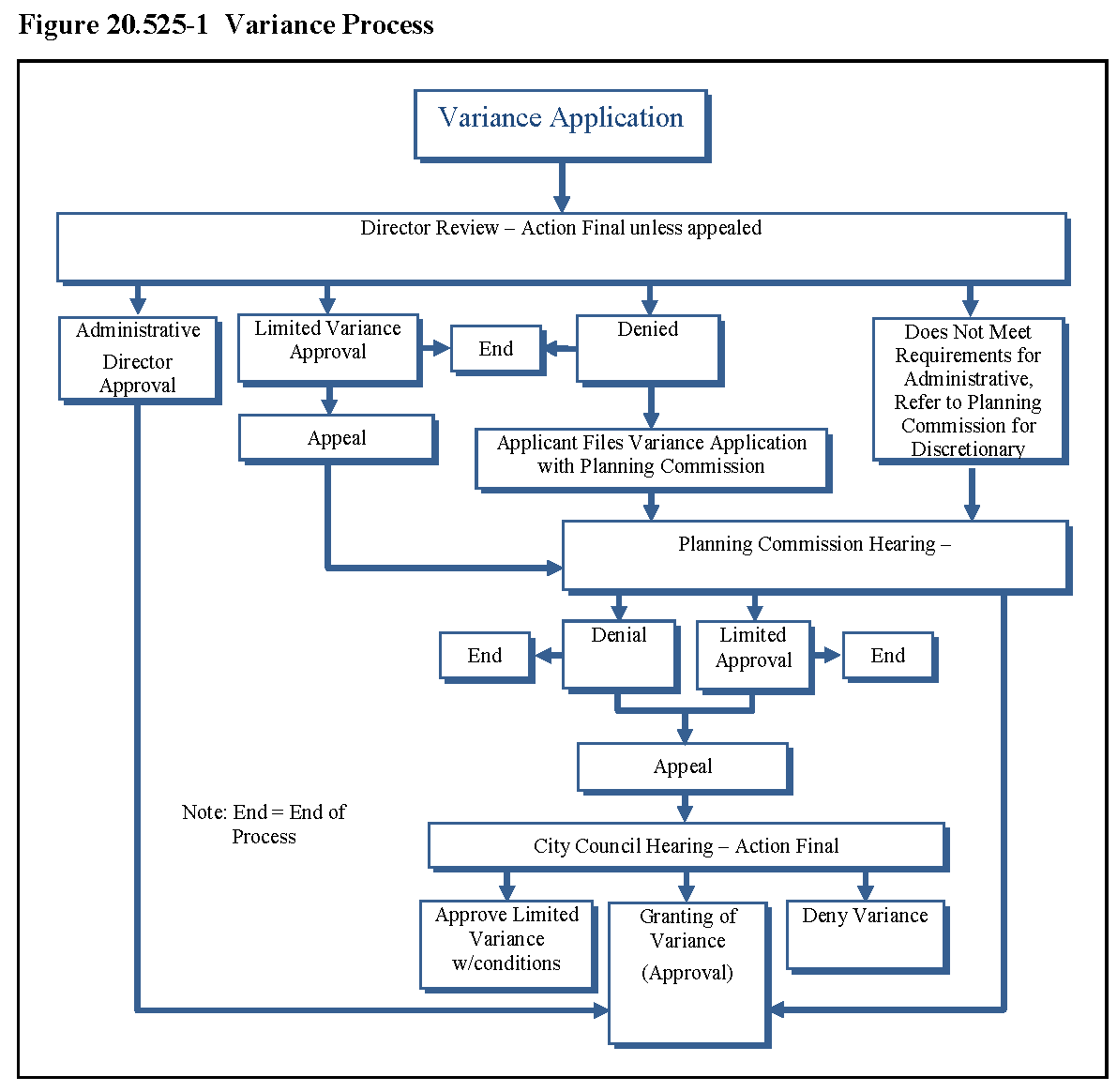
Processing. The administrative and discretionary processes for Variance applications is generally illustrated in Figure 20.525-1, "Variance Process." When an application is deemed complete, the Director shall give public notice and a hearing or hearings shall be held as provided in Chapter 20.505 (Noticing and Public Hearings).
Section 20.525.040 - Required Findings
Before any Variance may be granted, written findings shall be made by the approving body:
A.
That there are exceptional or extraordinary circumstances or conditions applicable to the property involved or to the intended use of the property that do not apply generally to the property or class of use in the same vicinity and Zone.
B.
That the Variance is necessary for the preservation and enjoyment of a substantial property right possessed by other property in the same vicinity and Zone, and denied to the property for which the Variance is sought.
C.
That the granting of the Variance will not be materially detrimental to the public health, safety, or welfare or injurious to the property or improvement in such vicinity and Zone in which the property is located.
D.
That the granting of such Variance will not adversely affect any master or precise plan adopted pursuant to law.
Section 20.525.050 - Decision
A.
Administrative Variance Hardship.
1.
The Director shall review variance applications for site conditions making compliance with standard applicable zoning requirements impossible without difficulty or hardship. The Director may approve the Variance application without notice or hearing if the following conditions are found by the Director:
a.
Hardship due to site conditions exists,
b,
The Variance application meets the requirements of Section 20.525.040 (Required Findings), and
c.
The requested modification reduces required setbacks by twenty-five percent (25%) or less.
2.
Approval of the Variance based on these findings shall be considered granting of the Variance and building permits, subject to review, may be issued.
3.
If the Variance is denied by the Director pursuant to this section, the applicant may file a Variance application with the Planning Commission within sixty (60) days of initial application. No fee shall be charged for the second application.
B.
Discretionary (Planning Commission) Variances. If the Director determines that an application for a Variance does not meet the requirements of Section 20.525.050 (Decision), the application shall be referred to the Planning Commission. Noticing and a hearing or hearings shall be held in accordance with Chapter 20.505 (Noticing and Public Hearings).
C.
Conditions and Limitations. Variances may be granted upon such conditions and limitations and for such periods of time as the Director, Planning Commission, or the City Council shall deem to be reasonable and necessary or advisable under the circumstances so that the objectives of this Zoning Ordinance shall be achieved.
D.
Final Decision. The decision granting or denying the Variance, with or without conditions, shall become final unless an appeal is filed.
E.
Applicant Action. Where the applicant is granted a more limited Variance than for which the application is made or imposes condition on the Variance, the applicant may decline to accept the Variance as granted and may appeal the decision.
Section 20.525.060 - Appeals
All appeals shall be subject to the standards and process of Chapter 20.545 (Appeals and Revocations).
Section 20.525.070 - Floodplain Management Variances
Issuance of a Floodplain Management Variance shall be for the purposes of floodplain management for the public good only. The purpose and intent is as described in Section 20.525.010. Insurance premium rates are determined by statute according to actuarial risk and will not be modified by the granting of a Variance.
It is the duty of the City Council to help protect its citizens from flooding. This need is so compelling and the implications of the cost of insuring a structure built below flood level are so serious that Variances from the flood elevation or from other requirements of Chapter 20.255 (Flood Damage Prevention Zone) are quite rare. The long-term goal of preventing and reducing flood loss and damage can only be met if Variances are strictly limited. Therefore, the Variance guidelines of this section are more detailed than the standard Variance application and contain multiple provisions that must be met before a Floodplain Management Variance can be properly granted. The criteria are designed to screen out those situations in which alternatives other than a Variance are more appropriate.
(Ord. No. 2019-1474, § 2, 5-14-2019)
Section 20.525.080 - Conditions for Floodplain Management Variances
A.
Variances shall not be issued to permit the construction of new structures below the base flood elevation.
B.
Variances may be issued for the reconstruction, rehabilitation, or restoration of "historic structures" listed in the National Register of Historic Places or the State Inventory of Historic Places, upon a determination that the proposed repair or rehabilitation will not preclude the structure's continued designation as a historic structure and the Variance is the minimum necessary to preserve the historic character and design of the structure.
C.
Variances shall not be issued within any mapped regulatory floodway if any increase in flood levels during the base flood discharge would result.
D.
Variances shall only be issued upon a determination that the Variance is the "minimum necessary," considering the flood hazard, to afford relief. "Minimum necessary" means to afford relief with a minimum of deviation from the requirements of this chapter. For example, in the case of Variances to an elevation requirement, this means the City Council need not grant permission for the applicant to build at grade, or even to whatever elevation the applicant proposes, but only to that elevation that the City Council believes will both provide relief and preserve the integrity of the local requirements.
E.
Any applicant to whom a Variance is granted shall be given written notice by a City Official that:
1.
The issuance of a Variance to construct a structure below the base flood level will result in increased premium rates for flood insurance up to amounts as high as twenty-five dollars ($25.00) for one hundred dollars ($100.00) of insurance coverage, and
2.
Such construction below the base flood level increases risks to life and property. It is recommended that a copy of the notice shall be recorded by the Floodplain Administrator in the Office of the County of San Diego Recorder and shall be recorded in a manner so that it appears in the chain of title of the affected parcel of land.
F.
The Floodplain Administrator will maintain a record of all Variance actions, including justification for their issuance, and report such Variances issued in its biennial report submitted to FEMA.
Section 20.525.090 - Floodplain Management Appeal Board
A.
The City Council shall hear and decide appeals and requests for Variances from the requirements of Chapter 20.255 (Flood Damage Prevention Zone).
B.
The City Council shall hear and decide appeals when it is alleged there is an error in any requirement, decision, or determination and by the Floodplain Administrator in the enforcement or administration of Chapter 20.255.
C.
In passing upon such applications, the City Council shall consider all technical evaluations, all relevant factors, and standards specified in Chapter 20.255 (Flood Damage Prevention Zone), and the following:
1.
The danger that materials may be swept onto other lands to the injury of others;
2.
The danger to life and property due to flooding or erosion damage;
3.
The susceptibility of the proposed facility and its contents to flood damage and the effect of such damage on the existing individual owner and future owners of the property;
4.
The importance of the services provided by the proposed facility to the community;
5.
The necessity to the facility of a waterfront location, where applicable;
6.
The availability of alternative locations for the proposed use that are not subject to flooding or erosion damage;
7.
The compatibility of the proposed use with existing and anticipated development;
8.
The relationship of the proposed use to the comprehensive plan and floodplain management program for that area;
9.
The safety of access to the property in time of flood for ordinary and emergency vehicles;
10.
The expected heights, velocity, duration, rate of rise, and sediment transport of the flood waters expected at the site; and
11.
The costs of providing governmental services during and after flood conditions, including maintenance and repair of public utilities and facilities such as sewer, gas, electrical and water system, and streets and bridges.
D.
Variances shall only be issued upon a:
1.
Showing of good and sufficient cause;
2.
Determination that failure to grant the variance would result in exceptional hardship to the applicant; and
3.
Determination that the granting of a variance will not result in increased flood heights, additional threats to public safety, or extraordinary public expense, create a nuisance (see Public safety and nuisance), cause fraud and victimization of the public, or conflict with existing local laws or ordinances.
E.
Variances may be issued for substantial improvements necessary for the conduct of a functionally dependent use, provided that the provisions of Sections 20.525.090.C through 20.525.090.F are satisfied, and that the structure or other development is protected by methods that minimize flood damages during the base flood, does not result in additional threats to public safety, and does not create a public nuisance.
F.
Upon consideration of the facts of Section 20.525.090.C (Floodplain Management Appeal Board) and the purposes of Chapter 20.255 (Flood Damage Prevention Zone), in the event the City Council determines that a Variance shall be granted, it may attach such conditions to the granting of Variances as it deems necessary to further the purposes of Chapter 20.255 (Flood Damage Prevention Zone).
(Ord. No. 2019-1474, § 2, 5-14-2019)

