
San Marcos City Zoning Code
CHAPTER 20
230 - INDUSTRIAL ZONES
Section 20.230.010 - Purpose of Chapter
The purpose of this chapter is to specify the allowable uses, requirements, and development standards within the Industrial Zone as established by the Zoning Map, and, specifically, to accomplish the following:
A.
Establish Industrial Zones to provide for a broad range of manufacturing, research and development, warehousing, and service uses in a setting that is conducive to industrial activities.
B.
Provide a conducive setting for industrial activities by protecting them from the adverse impacts of inharmonious internal or adjacent uses.
C.
Minimize the impact of industrial activities on adjacent residential and commercial uses.
D.
Strengthen the City's economic base and provide employment opportunities close to residents of the City and surrounding communities.
Section 20.230.020 - Purpose of Industrial Zones
In addition to the purposes of this Zoning Ordinance and chapter, the purpose of each Industrial Zone follows:
A.
Light Industrial (L-I) Zone. To provide for the grouping of light- and medium-intensity industrial and support service uses in a business-supportive setting. Generally, these areas will not include pedestrian-oriented businesses and will serve the loading, delivery, and indoor warehousing needs of light industrial space. The L-I Zone is intended to implement and be consistent with the LI land use designation of the General Plan.
B.
Business Park (B-P) Zone. To provide a high-quality, attractive campus setting designed for the grouping of uses engaged in research and development/testing, supportive business and professional offices, and compatible light-industrial activities affiliated with research and development/testing. The B-P Zone is intended to implement and be consistent with the BP land use designation of the General Plan.
C.
Industrial (I). To provide a setting for the full range of indoor manufacturing, distribution, warehousing, processing, and general service uses that are adequately served by vehicular arterials and utilities. Industries that use hazardous materials, require heavy equipment, and/or that generate sustained noise levels are deemed appropriate for this Zone, and may be permitted according to the standards of this chapter. The I Zone is intended to implement and be consistent with the Industrial land use designation of the General Plan.
D.
Industrial 2 (I-2). To provide a setting for the full range of intensive industrial manufacturing, distributing, warehousing, processing, and general service uses, with provision for outdoor storage activities and facilities that service the industrial uses. Active industries and supportive service uses participating in heavy equipment operation, generation of sustained noise levels, warehousing, and/or outdoor or indoor storage and activities are deemed appropriate for this Zone, and may be permitted according to the standards of this chapter. The I-2 Zone is intended to implement and be consistent with the Industrial land use designation of the General Plan.
Section 20.230.030 - Applicability
Land use permit requirements, as detailed in Table 20.230-1, and the regulations and development standards of this section, shall be applicable to the following:
A.
Zones. All existing and new uses, structures, and activities within the L-I, B-P, I, and I-2 Zones.
B.
Transitional Zones. All existing industrial uses and structures that were established prior to the adoption of this Zoning Ordinance, and are continuing to conform to industrial use standards within a Transitional Zone, shall be subject to the regulations of the applicable Industrial Zone of this chapter (as the Initial Zone), established by Table 20.235-1, until such time as the use is transitioned to the Non-Industrial Transitional Zone. See Chapter 20.235 (Transitional Zone).
Table 20.230-1
Permit Requirement Types and Processes
Note: Any land use authorized through a permit approval process identified may also require Site Development Plan Review, a Building Permit, and/or other permit(s) required by the Municipal Code. For unlisted and similar uses, see Section 20.205.030.C (Unlisted and Similar Compatible Uses). All uses, including, but not limited to, "P", "DP" and "CUP" must pay applicable Public Facilities Fees and annex into all applicable Community Facilities Districts.
(Ord. No. 2021-1512, § 2(Exh. B), 1-11-2022)
Section 20.230.040 - Allowable Industrial Uses and Permit Requirements
A.
Permit Requirements. Table 20.230-1 identifies the types of land use permits required to establish land uses in Industrial Zones, consistent with this Zoning Ordinance.
1.
All proposed development projects within the Industrial Zones shall be subject to Site Development Plan Review in conjunction with the permit requirements of Table 20.230-2.
B.
Industrial Land Uses. Table 20.230-2 identifies the land use permit types in all Industrial Zones. Industrial uses are intended to be the primary permitted use, supplemented by light-industrial and business support uses that are complementary to industrial activities.
C.
Additional Use Regulations. In addition to the regulations, development standards, and provisions of this chapter, all land uses are subject to the specific use standards identified in the "Additional Use Regulations" column of Table 20.230-2; refer to the referenced sections for additional operational standards and regulations applicable to the use. All land uses are also subject to all the following standards: Chapters 20.320 (Signs on Private Property), 20.330 (Water Efficient Landscape Standards), 20.335 (Walls and Fences), 20.340 (Off-Street Parking and Loading), and 20.400 (Specific Use Standards).
D.
Prohibited Uses. When a use is not specifically listed, that use is prohibited. However, consistent with Section 20.205.030.C (Unlisted and Similar Compatible Uses), the Director shall have the authority to determine whether the proposed use shall be permitted or conditionally permitted based on the finding that the proposed use is similar to and no more detrimental than a particular use permitted in the Zone.
Table 20.230-2
Industrial District Permitted Uses
Notes: See Table 20.230-1 for definitions.
All proposed development projects within the Industrial Zones shall be subject to
Site Development Plan Review in conjunction with the permit requirements of Table
20.230-2.
2. ;hg;A Director's Permit (DP) shall be required for the establishment of the land
use in an existing building to minimize effects on other land uses within the building
or site. A Conditional Use Permit (CUP) shall be required for the establishment of
a use in conjunction with a new building (development of the building in conjunction
with the use).
3. ;hg;Permitted accessory use in conjunction with a primary use on the same industrial
Zone parcel. Unit shall be continuously occupied exclusively by a superintendent or
a caretaker and his/her immediate family; the unit shall be consistent with the development
standards and setback of the R-3 Zone, provide one (1) paved and covered off-street
parking space, and shall not be located within a required setback.
4. ;hg;The compounding, processing, packaging, or treatment of food is permitted by
right, except fish, lard, meat, pickles, sauerkraut, or vinegar; these uses shall
be subject to CUP restrictions.
5. ;hg;Accessory entertainment is allowed in conjunction with Permitted use, subject
to 20.425.060.
(Ord. No. 2019-1481, § 3(Exh. A), 1-14-2020; Ord. No. 2021-1512, § 2(Exh. B), 1-11-2022; Ord. No. 2025-1568, § 2(Exh. B), 12-9-2025)
Section 20.230.050 - Industrial Zone General Development Standards
A.
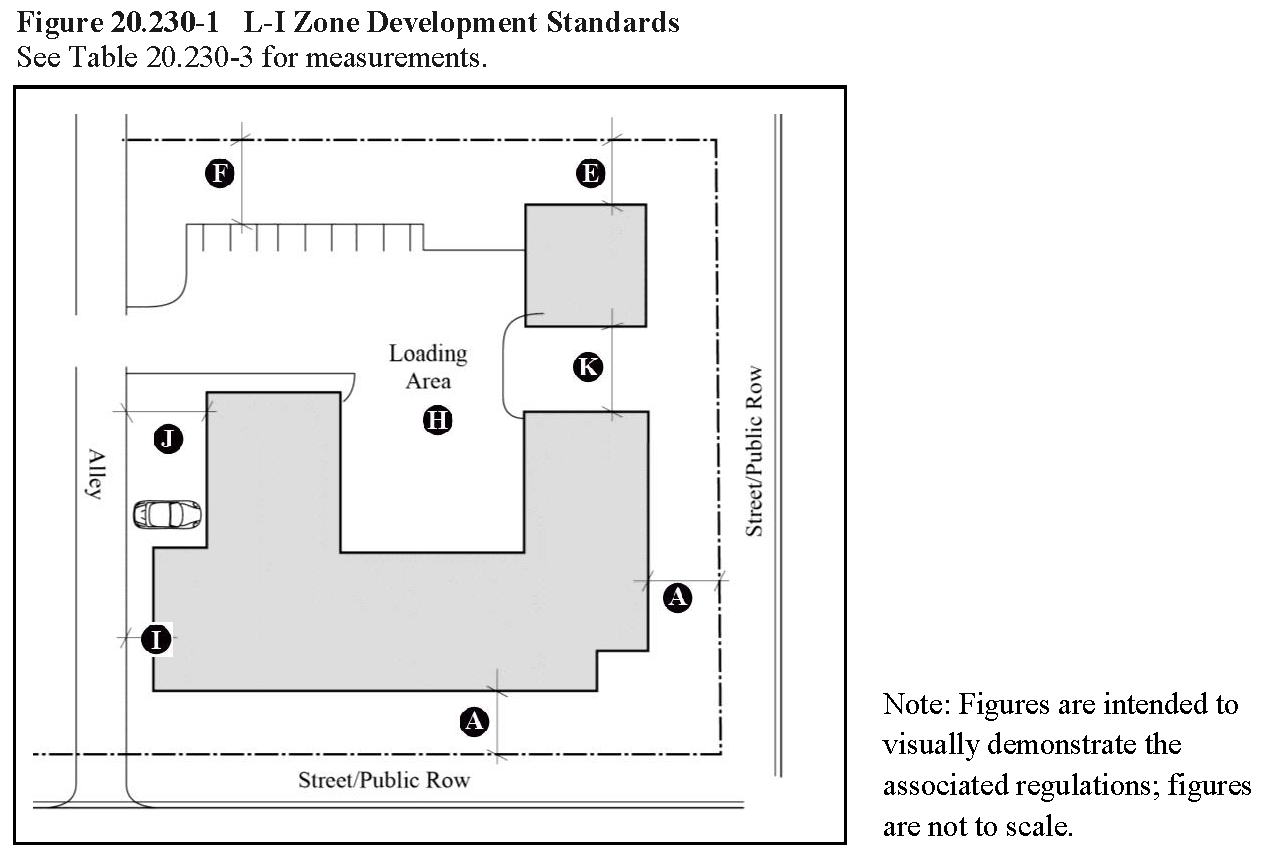
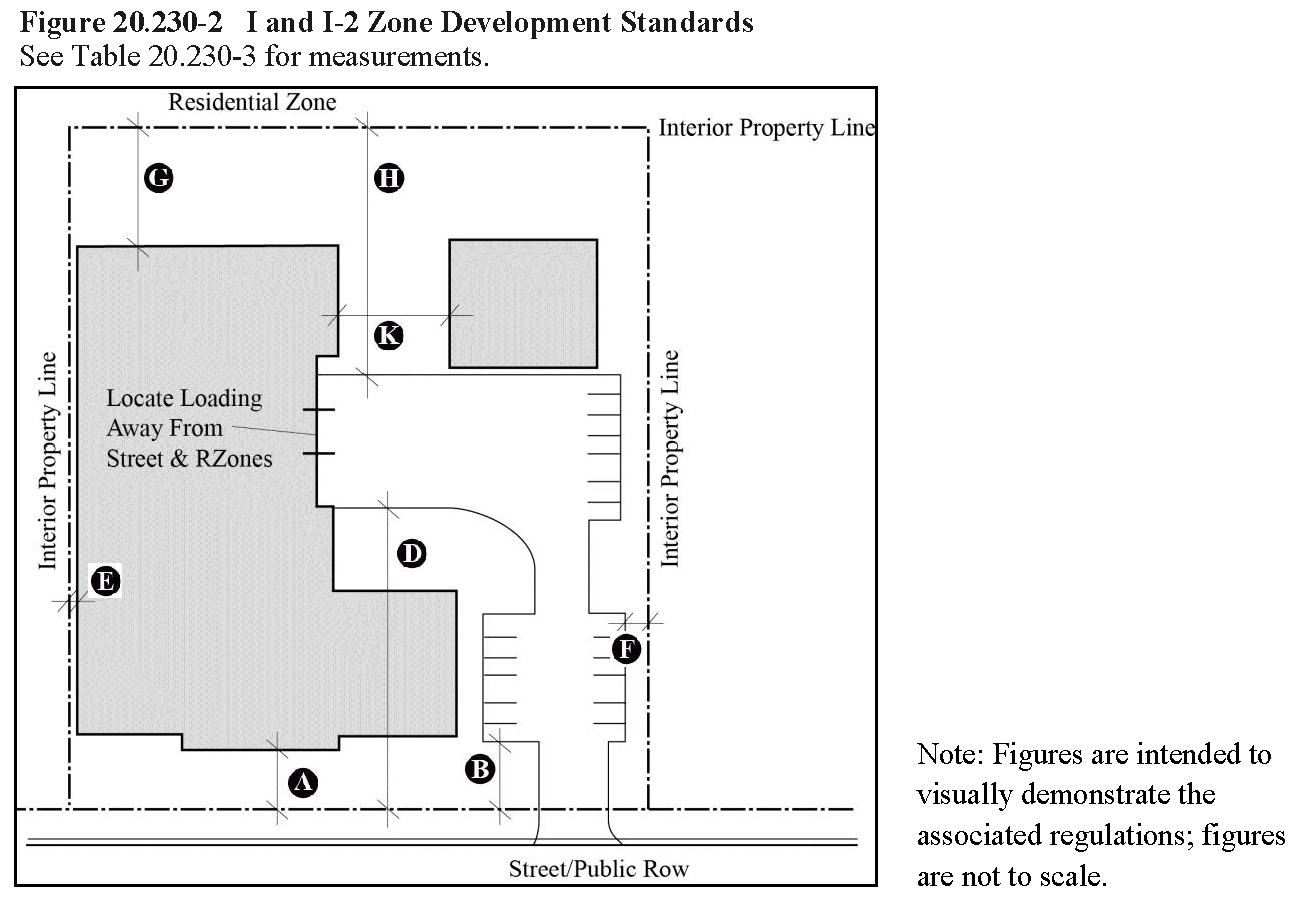
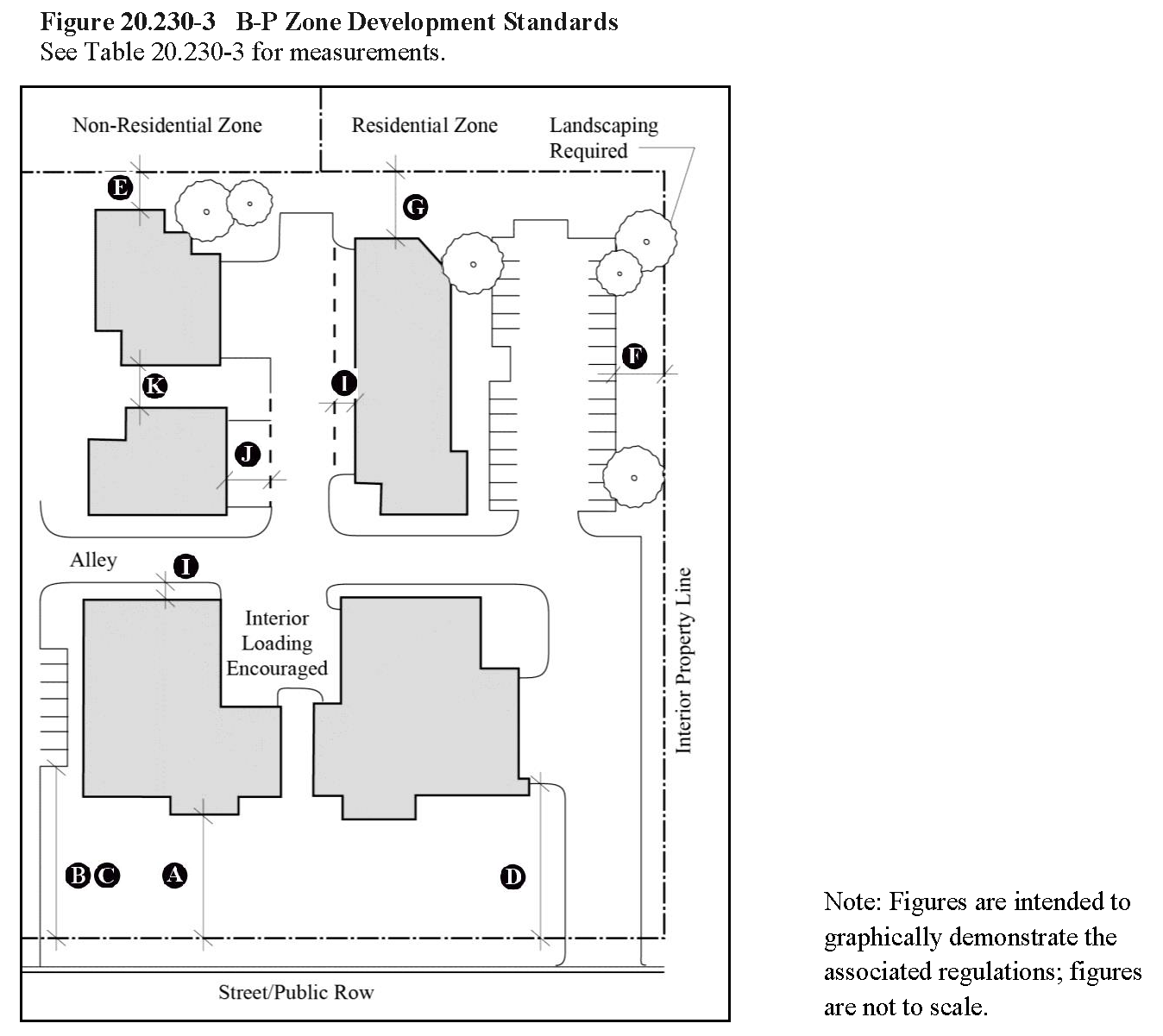
Development Standard Compliance. The design, construction, or establishment of all new and existing land uses, development of structures, and site improvements in Industrial Zones shall conform to the regulations of Table 20.230-3. Principal and accessory structures shall meet the same development standards unless otherwise modified by this Zoning Ordinance. See Figures 20.230-1, 20.230-2, and 20.230-3 for visual development standard summaries.
B.
B-P Development. B-P development shall be subject to the development standards of Table 20.230-3, Table 20.230-4, and Section 20.230.080 of this Zoning Ordinance.
Table 20.230-3
Industrial Zone Development Standards
| Development Standard(1) | L-I | B-P | I | I-2 | Additional Standards | |
|---|---|---|---|---|---|---|
| Minimum Lot Requirements | ||||||
| Lot Area (square feet) | 20,000 | 1 Acre | 10,000 | 10,000 | 20.300 (Site Planning and General Development Standards) | |
| Lot Width | 100 feet | - - | 80 feet | 80 feet | ||
| Floor-Area Ratio | 0.6 | 1.2 | 0.5 | 0.5 | 20.230.060 (Operational Standards) | |
| Site Coverage | - - | 55% net max | - - | - - | ||
| Maximum Height | ||||||
| Building Height | 60 feet | 35 feet or up to 60 feet with setback modification | 45 feet | 45 feet | ||
| Architectural Features | 60 feet | 70 feet | 45 feet | 45 feet | ||
| Minimum Setbacks(2) | For permitted encroachments, see Section 20.300.020.G | |||||
| Street Frontage PL | Note 3, Note 4 | |||||
 | Buildings/Structures | 15 feet | 25 feet | 10 feet | 10 feet | |
 | General Parking | 10 feet | 30 feet | 10 feet | 10 feet | |
 | Truck/Bus Parking | 30 feet | 40 feet | 30 feet | 30 feet | |
 | Loading Doors/Docks | 20 feet | 45 feet | 20 feet | 20 feet | 20.230.060.K (Loading Door/Dock Setbacks) |
| Interior PL | ||||||
 | Building | 0 feet | 10 feet | 0 feet | 0 feet | |
 | Parking | 10 feet | 10 feet | 3 feet* | 3 feet* | *Not applicable if adjacent to a wall/fence; wheel stops shall be installed |
| PL Adjacent to any R (Residential) Zone | ||||||
 | Building | 25 feet | 30 feet | 20 feet | 20 feet | 20.230.050.E (Additional Residential Setbacks) |
 | Loading Doors/Docks Facing an R Zone | 60 feet | 60 feet | 60 feet | 60 feet | 20.230.060.K (Loading Door/Dock Setbacks) |
| Alley PL | ||||||
 | Buildings/Structures | 5 feet | ||||
 | If parking is provided from alley | 25 feet | ||||
| State Route 78 PL | 15 feet | 15 feet | 15 feet | 15 feet | ||
 | Building Separation | 10 feet | 20 feet | 10 feet | 10 feet | |
| Parking | ||||||
| Requirements | 20.340 (Off-Street Parking and Loading) | |||||
| Landscape | ||||||
| Requirements | 10% net | 20% net | 10% net | 10% net | 20.330 (Water Efficient Landscape Standards) | |
| Walls and Fencing | 6 feet minimum height; 10 feet maximum height | 20.335 (Walls and Fences) | ||||
Notes: PL = Property Line; R = Residential
All standards are minimums unless otherwise noted.
2. ;hg;Setbacks shall be measured from the back of the right-of-way.
3. ;hg;Applies to all street frontages, primary and corner-side street setbacks.
4. ;hg; All lot development and setbacks shall be subject to the provisions of Chapter 20.300 (Site Planning and General Development); where standards conflict with Chapter 20.300 (Site Planning and General Development Standards), the largest standard shall prevail.
Table 20.230-4
B-P Zone Additional Development Standards
Notes: PL = property line
See Table 20.230-2 and Section 20.230.100 for additional development standards and requirements.
All standards are minimums unless otherwise noted.
Setbacks shall be measured from the back of the right-of-way.
C.
Site Development Plan Review Required. All development in the Industrial Zones, including all projects that comply with the allowed land use and development standards of this chapter, shall be submitted for Site Development Plan Review, per Chapter 20.515 (Site Development Plan Review).
D.
Industrial Development Lot Width. Minimum lot widths established by Table 20.230-3 shall apply to all new development and subdivision of land. The Director may waive the minimum lot width for integrated multi-building or campus-setting developments.
E.
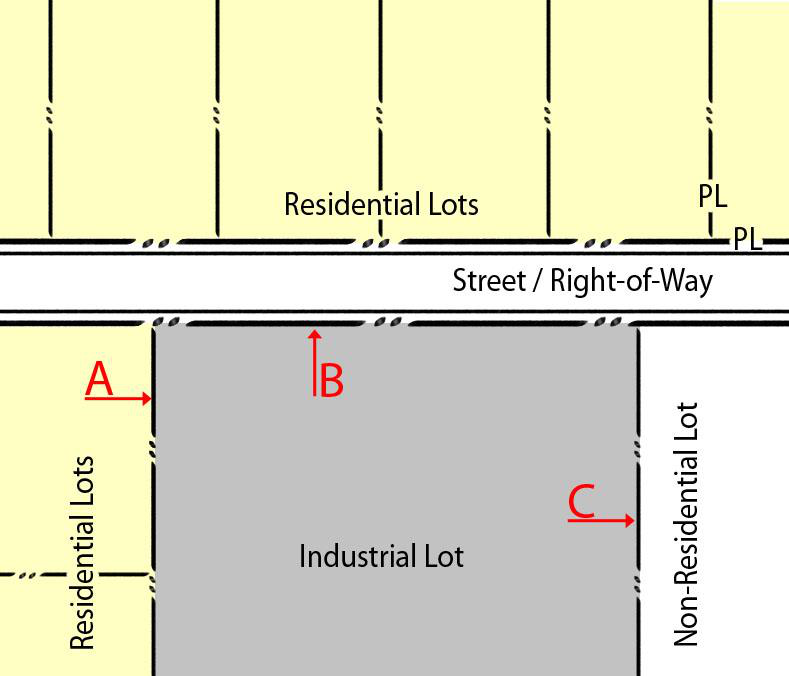
Additional Setbacks from Residential. Setbacks required by Table 20.230-3 related to "PL Adjacent to any R (Residential) Zone" shall be applied subject to the following:
1.
Apply to property lines (PLs) directly shared with/adjacent to Residential Zones, as denoted by "A" in Figure 20.230-4.
2.
Apply to property lines separated from a Residential Zone by public or private ROWs, as denoted by "B" in Figure 20.230-4.
3.
Do not apply to property lines shared with/adjacent to any non-residential Zones, as denoted by "C" in Figure 20.230-4.
Figure 20.230-4 Additional Setbacks from Residential
See Section 20.230.050.E for standards.
(Ord. No. 2025-1568, § 2(Exh. B), 12-9-2025)
Section 20.230.060 - Operational Standards
The provisions of this section further modify and regulate the development form and function of all Industrial Zone land uses (L-I, B-P, I, I-2) listed in Table 20.230-2 and development standards listed in Table 20.230-3 to promote safe, attractive, and compatible development.
A.
Permitted Projections. See Section 20.300.020.G (Permitted Encroachment Standards) for permitted projection standards relevant to Industrial Zones.
B.
Ancillary Retail Sales. Ancillary retail sales shall be allowed in all Industrial Zone, limited to twenty percent (20%) of the gross floor area. Sales shall be directly associated with the manufacture, production, or brand of the primary land use in conjunction with any land use permitted or conditionally permitted by this chapter. Outdoor sales, unless otherwise permitted by this chapter, shall not be permitted.
C.
Architectural Compatibility. All buildings, including secondary and accessory structures, walls, and fences located on a building site, shall be designed and constructed to be architecturally compatible with the primary building.
D.
Delivery Access. Lot frontage for all Industrial Zone parcels shall be adequate to facilitate truck/delivery access and circulation based on single-lot access or shared-lot access/circulation.
E.
Loading Areas. Loading/delivery areas shall not be visible from the street.
1.
Open bay doors shall be oriented away from public view and/or completely screened through a combination of fencing and landscaping, as outlined in this section.
2.
Loading areas for materials, products, or refuse in the front of the building shall be prohibited.
3.
Use of architectural features, decorative fencing, and walls consistent with the design of the primary structure shall be used to shield loading/delivery areas from view.
F.
Indoor Manufacturing. All compounding, processing, packaging, or assembly of articles or merchandise, and treatment of products shall be conducted within a completely enclosed building.
G.
Equipment and Supplies. Equipment and supplies related to building material storage yards, contractor's/construction storage yards, lumberyards, and manufacturing yards shall be conducted entirely inside an enclosed building or buildings, unless the storage premises are entirely enclosed by decorative fences and/or walls, as stipulated in Chapter 20.335 (Walls and Fences).
H.
Outdoor Storage. Outdoor storage shall be limited to the following site coverage and operational standards:
1.
Storage. Outdoor storage shall be limited to materials, products, or equipment used, produced, or manufactured by a permitted use.
2.
Location. Outdoor storage areas shall be located to the rear or side of the main building, away from the street frontage and public ROW.
a.
Outdoor storage areas shall not be located within, or occupy any required parking areas, setback areas, or landscape areas, or be on sidewalks or walkways.
3.
Screening. All materials stored outside shall not be stacked to exceed the height of the screening wall or fence. All storage, equipment, and activities related to outdoor storage shall be completely surrounded on all sides by shielding fencing and/or walls, per the following standards:
a.
Minimum height of six (6) feet required, additional height may be required to properly shield all materials stored behind the fence/wall.
b.
Maximum height shall not exceed ten (10) feet.
c.
Fencing/walls shall be constructed of at least one (1) of the following:
d.
Wood fences are prohibited.
e.
Wall/fencing materials shall be consistent with Chapter 20.335 (Walls and Fences) and Section 20.335.030.E (Prohibited Materials).
4.
Additional Screening Elements. Equipment and supplies related to building material storage yards, contractor's storage yards, lumberyards, and manufacturing yards shall be entirely inside an enclosed building or buildings, unless the premises where such yards are located are entirely enclosed by fences or walls, as described below:
a.
In addition to fencing/wall standards above, all screening fences/walls along a street frontage or adjacent to any other Zone shall employ a minimum of one (1) of the following screening techniques to be used to further shield outdoor storage areas:
i.
Planting with sufficient vines or climbing ivy of an acceptable density to ensure complete view-obstructing screening within one (1) year of planting.
ii.
Combination of landscaped berm and solid masonry block wall meeting height requirements. Trees of the evergreen variety or other year-round, leaf-bearing type shall be planted and shall exceed the minimum height.
iii.
Combination of trees and shrubs of the evergreen variety, or other similar year-round, leaf-bearing type, with proper planting spacing to encroach over the fence. Such plants shall be of such variety and shall be clustered so as to allow only minimal gaps between foliage of mature trees and shrubs within one (1) year after planting.
iv.
Evergreen shrubs or other similar year-round, leaf-bearing shrub, appropriately planted to form a solid hedge with a minimum of eight (8) feet in height within one (1) year after planting.
5.
Site Coverage. Outdoor storage in the Light Industrial (L-I) Zone shall not exceed twenty-five percent (25%) of gross building floor area and shall comply with all of the standards of this section.
6.
Accessory Use. Outdoor storage in all the L-I and I Zones shall be accessory to the primary industrial land use as permitted by Table 20.230-2.
I.
Indoor Activities. Warehousing as a primary land use or accessory activity to the primary land use shall be conducted exclusively in an enclosed building.
J.
Public Visibility. Goods and merchandise stored within warehouse facilities shall not be visible from the public ROW.
K.
Loading Door/Dock Setbacks. Off-site natural buffers or railroad ROWs may be counted in the setback measurement if the project design provides adequate circulation and functionality of the loading dock/door, as determined by the Director during Site Development Plan Review.
(Ord. No. 2025-1568, § 2(Exh. B), 12-9-2025)
Section 20.230.070 - Industrial Building Form/Site Development Standards and Guidelines
All L-I, B-P, I, and I-2 Zone development applications shall provide evidence, site plans, and building elevations to show that the proposed project complies with the following building form and site development standards. Failure to comply with these standards shall result in the withholding of all required zoning and building permits. Where reference is made to additional standards, those requirements shall be shown on development applications.
A.
Building Design.
1.
Avoid monolithic building forms. Varied roof lines and wall planes shall be used to create architectural interest.
2.
Design exteriors to hide undesirable qualities of a proposed use (e.g., storage, ventilation systems).
B.
Architectural Treatments.
1.
Reduce large building volumes to a scale consistent with the existing setting through the use of massing, design, and architectural features/elements. See Section 20.230.070.C (Architectural Features).
2.
Define main entryways clearly, and smoothly integrate them with the building and landscaping.
3.
Design entries to serve as aesthetic focal points of the building and be inviting to visitors.
4.
Create varying patterns of shade, sunlight, and depth through varied wall planes, offsets, or recessed openings in combination with window groupings, recesses, awnings, and shade structures.
5.
Treat the exterior of all buildings and structures with consistent architectural treatments and complementary permanently colored materials/treatments throughout the parcel.
6.
Enhance the character and scale of the building through the design, shape, and slope of roof forms. Roof colors, where visible to the pedestrian, shall be coordinated with those of surrounding wall planes.
7.
Reduce visual prominence of fasteners by using architectural panels, concealed fasteners, or other types of metal wall systems.
8.
Reduce visual prominence of downspouts, unless they are used as a legitimate architectural detail, by coating the downspouts to match the wall color or concealing them within the walls.
9.
For new structures, additions, expansions, and remodeling, landscaping shall not be used to mask substandard building design.
C.
Architectural Features. Architectural features are, generally, nonstructural design features that enhance the building elevation and provide massing and height relief.
1.
Architectural features are permitted to exceed the maximum building height, consistent with the standards of Tables 20.230-3 and 20.230-4.
2.
Massing of architectural features shall be limited to thirty percent (30%) of the linear roof square footage.
3.
Architectural features shall enhance the overall design of the building and may include parapet walls, tower elements, unique roof treatments, and similar features; all features shall be architecturally compatible with the primary building's design.
D.
Materials.
1.
Tilt-up concrete shall be designed with varied textures and color blocking.
2.
All exterior wall elevations facing any street or street frontage shall integrate architectural enhancements; one hundred percent (100%) usage of tilt-up concrete shall not be permitted.
3.
Masonry block with textured surfaces is permitted.
4.
Use of architecturally enhancing materials, including glass, is encouraged. Use of a single material (such as one hundred percent (100%) glass) on exterior walls shall be discouraged and subject to Site Development Plan Review.
5.
All outside and roof equipment, including overhead, rolling, and service doors, shall be painted or designed to be consistent with the architectural theme of the building.
6.
Metal buildings, sheet or corrugated metal, asbestos, and similar materials used on exterior walls are prohibited. See Section 20.400.140 (Metal Buildings) for additional regulations.
7.
Architectural features or treatments, including upgraded steel or metal, may be permitted where the metal/steel feature is consistent with the architectural theme and improves the design overall, as approved in Site Development Plan Review.
E.
Circulation Standards.
1.
Ingress and Egress. All ingress and egress shall take place on paved ROWs or paved private easements. Circulation shall be designed to allow for turning around, and allow for proper circulation to prevent backing of vehicles onto streets, to the satisfaction of the City Engineer and Fire Marshal.
2.
Driveways. Driveway spacing shall be determined by the City of San Marcos Street Design Criteria standards or its successor.
a.
Maximum of one (1) driveway for each property abutting the street is allowed, unless otherwise approved by the City Engineer.
b.
Complexes of two (2) or more buildings sharing access to a public street may be permitted two (2) driveways, as approved by the City Engineer. Shared driveways and reciprocal driveway access configurations are required where possible and feasible.
c.
Driveways shall be thirty (30) feet wide measured at the property line to properly facilitate all passenger and cargo vehicle movements. Driveway widths based on site configuration shall be approved by the City Engineer during Site Development Plan Review.
d.
Driveways shall provide a minimum of twenty (20) feet landscaped throat distance measured from the back of the ROW line. This minimum shall be increased as deemed necessary by the Site Development Plan Review process.
e.
All driveways and site access shall meet City's line-of-sight standards.
f.
Driveways shall conform to the City's "Radius Type Driveway" standards unless otherwise approved by the City Engineer.
3.
Loading Areas. All loading facilities and maneuvering areas shall be on-site and shall comply with the standards of Chapter 20.340 (Off-Street Parking and Loading).
F.
Equipment Screening. Equipment screening is required for all structures within the Industrial Zones, per the standards of Section 20.400.090 (Equipment Screening).
G.
Lighting Standards. Appropriate lighting for access and safety is required for all structures within the Industrial Zones, per the standards of Chapter 20.300 (Site Planning and General Development Standards). All lights shall be shielded and directed away from adjacent residential uses.
Section 20.230.080 - B-P Zone Development Standards
The B-P development standards as required by this section provide further design and development standards to promote the development of high-quality, aesthetically attractive business parks. Specifically, these standards are designed to accomplish the following:
A.
Provide a conducive setting for corporate and business activities by incorporating design, open space, and employee amenities into project development.
B.
Improve the overall aesthetic quality of business park developments.
C.
Strengthen the City's economic base through the provision of high-end corporate and business developments.
The following B-P design and development standards shall apply to the development, redevelopment, and modification of all land uses and structures within the B-P Zone. These are in addition to the standards of Section 20.230.070 (Industrial Building Form/Site Development Standards and Guidelines), and shall comply with the land use permissions of Table 20.230-2 and development standards of Tables 20.230-3 and 20.230-4.
A.
Street Frontage Setback. Site design and landscape features that enhance the quality, usability, and visual aesthetic of the development shall be permitted within the street frontage setback between the front façade/entry and the street frontage. The following items shall be allowed within the street frontage setback:
1.
Walkways;
2.
Architectural fences, walls, or planters; maximum height three (3) feet;
3.
Landscaping, including vegetation, benches, and water features;
4.
Bicycle pathways;
5.
Architectural projections without footings; maximum of three (3)-foot projection permitted.
B.
Building Height/Setback Modifications. Variation in setbacks and building heights is encouraged.
1.
Building setbacks shown in Table 20.230-3 and Table 20.230-4 shall apply to B-P Zone development. Buildings or building elements shall be permitted to exceed thirty-five (35) feet in height to a maximum of sixty (60) feet, with additional setback requirements shown below.
2.
Building height increases are permitted based on building setback modifications (Table 20.230-4). Buildings shall be permitted to exceed thirty-five (35) feet in height where building setback from the street property line is increased a maximum of one (1) foot for every one (1) foot of building height over thirty-five (35) feet. Thus, low-rise buildings and elements shall be permitted at standard setbacks, with taller buildings and elements permitted at increased setbacks. See Figure 20.230-5.
Section 20.230.090 - Design Standards
Figure 20.230-5
Height-Based Setback Modification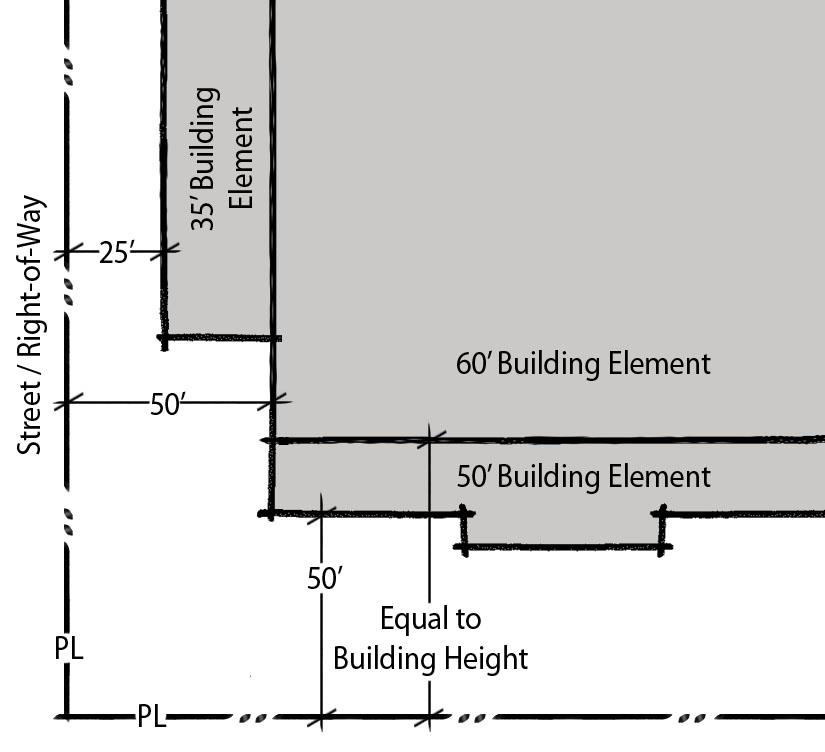
B-P Zone development, redevelopment, and building modifications shall be subject to the following building, site, and performance standards, in addition to the standard Industrial Zone requirements of this chapter. See Figure 20.230-6 for an example of articulated facades/wall plane offsets, shielded interior loading area, and outdoor plaza areas.
A.
Building and Siting Design. Site layouts, including building massing and placement, shall be "organic" rather than "monolithic." Square and rectangular building floor plans and design shall be avoided.
1.
Articulate building facades that are visible from the street.
2.
Emphasize the main building entrance and tie the entry into the overall mass and building composition. Entries shall not appear as an "add on" or afterthought.
3.
Organize the site layout to relate buildings to each other in a campus-like setting. This can be accomplished by creating outdoor plazas and functional gathering places to include amenities such as architecturally compatible shaded coverings, structures, and benches that could be located between or in front of buildings and by grouping loading areas interior to the building layout. See Figure 20.230-6.
4.
Driveway entrances from the street frontage shall be enhanced with design features. Design feature enhancements may include paving materials, medians, wider landscape strips, enhanced landscape features, architectural monument (non-signage) features, and similar improvements that highlight the entrance to the parcel/campus.
5.
Separate public/visitor areas from truck delivery and maneuvering areas, where possible.
B.
Materials. Establish thematic design and materials for buildings, signage, walls, and landscaping treatments throughout the development to solidify the campus-like setting.
1.
Buildings should have a related thematic design that does not override the company/corporate branding.
2.
Tilt-up concrete with textures and colors is allowed, subject to a maximum coverage of fifty percent (50%) of the materials used on the elevations visible from the public ROW.
Figure 20.230-6 B-P Zone "Campus-Like" Setting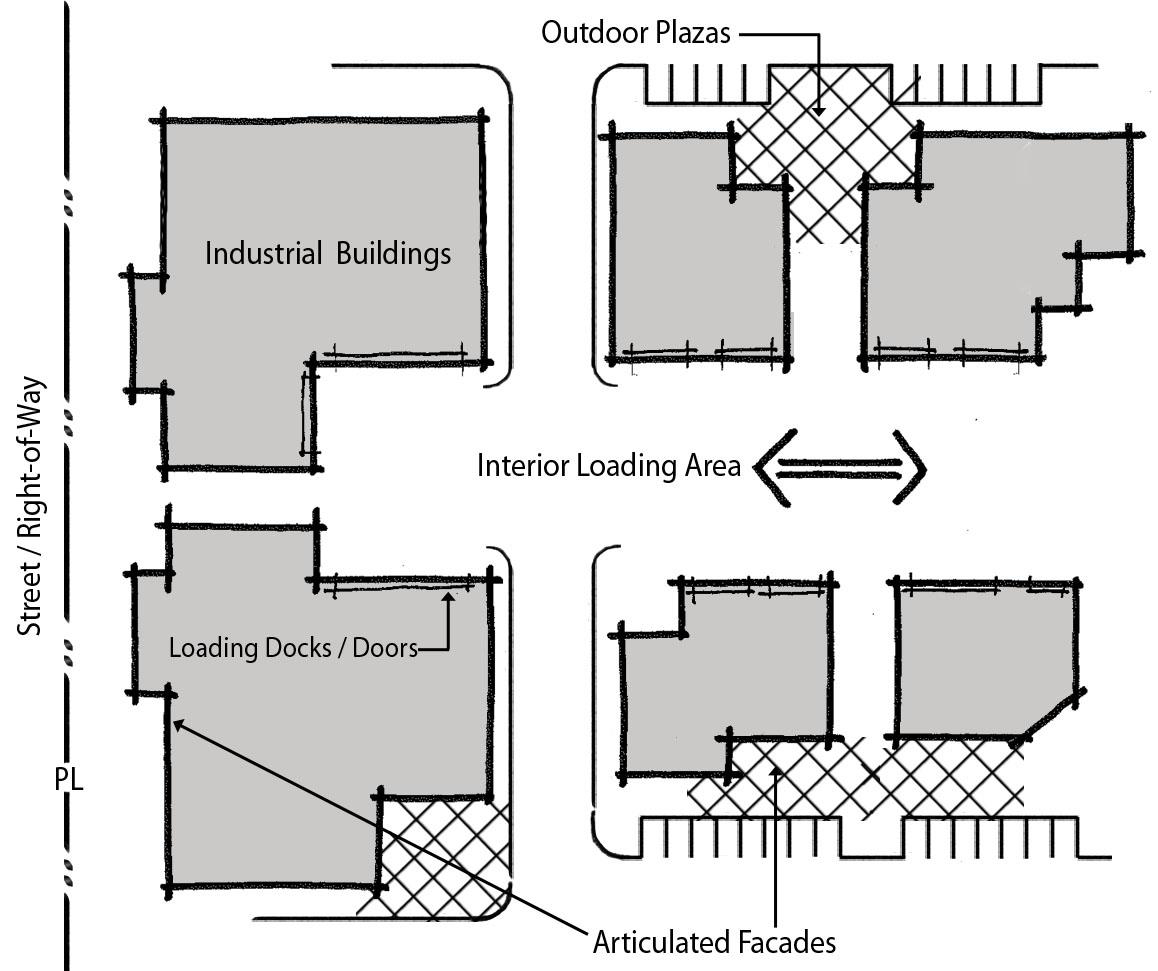
(Ord. No. 2025-1568, § 2(Exh. B), 12-9-2025)
Section 20.230.100 - Business Park Amenity Space Standards
Within the B-P Zone, common amenity space shall be developed in addition to the landscape requirements of Chapter 20.330 (Water Efficient Landscape Standards). The building design of any individual parcel or development shall incorporate common amenity space, and shall comply with the following standards and restrictions:
A.
Applicability. These requirements shall apply to all new development and/or addition of floor area equal to twenty percent (20%) or more of an existing building.
1.
The amenity space requirement may be waived by the Director where written findings can be made that there is not a feasible way to satisfy the requirement either on the lot of the development or on another contiguous, eligible lot within the B-P Zone.
B.
Area Ratio. Common amenity space shall be provided at a ratio of one (1) square foot of amenity space to fifty (50) square feet of building floor area (1:50), consistent with the requirement of Table 20.230-4.
C.
Design. Common amenity space may be composed of indoor or outdoor area(s) or combined areas designed to provide a wide variety of recreational and open space opportunities for workers, visitors, and members of the general public. These amenity spaces may include plazas, courtyards, urban gardens, view and sun terraces, urban parks, greenhouses, atriums, sport courts, outdoor seating, and small sitting areas.
1.
Such area(s) shall be on the same site as the building or may, subject to Site Development Plan Review, be located off-site on public or private property in a location within the B-P Zone.
2.
These areas shall be well-maintained at no public expense, and must be operated in a manner to enhance use of the amenity area by the general public. Amenity space may include areas obstructed by overhead horizontal projections, bays, or overhanging balconies, as long as these do not obstruct pedestrian movement, block required sunlight access, or prevent the proper functioning of the amenity area.
D.
Floor-to-Area Ratio. Common amenity space floor area shall not be counted in the calculation of allowable gross floor area (floor-to-area ratio (FAR)) for the building, whether the feature is an integral part of the building, an open feature, or an enclosed space.
(Ord. No. 2025-1568, § 2(Exh. B), 12-9-2025)

