
San Marcos City Zoning Code
CHAPTER 20
400 - SPECIFIC USE STANDARDS
Section 20.400.010 - Purpose
The purpose of this chapter is to provide operational and development standards to properly regulate specific permitted and conditionally permitted land uses within Zones. Specifically, this chapter provides regulars to do the following:
A.
Promote and protect the public health, safety, and general welfare of the City and its citizens by requiring operational standards to minimize potential adverse effects on surrounding properties.
B.
Further modify the allowable land uses and development standards of individual or multiple Zones, to be applied in all instances where the specific land use is administratively or conditionally permitted.
Section 20.400.020 - Applicability
Land uses and activities addressed by this chapter shall comply with the provisions of this chapter applicable to the land use, in addition to all requirements of the applicable Zone and this Zoning Ordinance.
A.
Applicable Activities. The provisions of this chapter shall apply to the establishment of the land use or any modification to the land use exceeding ten percent (10%) of the value or twenty percent (20%) of the floor area of the existing use.
B.
Nonconforming Uses. The regulations of Chapter 20.345 (Nonconforming Uses and Structures) for nonconforming land uses and structures, including thresholds and timing, shall prevail over the provisions of this chapter.
C.
Permit Requirements. All land uses addressed in this chapter shall be subject to the permit requirements of the applicable Zone. If a CUP is required, the standards of this chapter shall be the minimum requirements for the CUP.
D.
Regulations. All land uses and activities regulated by this chapter shall comply with all state, building, and fire codes, and shall not exceed the City's noise limits of Section 20.300.070.F or Chapter 10.24 Noise of the San Marcos Municipal Code.
(Ord. No. 2017-1446, 7-25-2017)
E.
Conflicts. In the event of any conflict between the requirements of this chapter and those of another chapter or section of this Zoning Ordinance, except the provisions of Chapter 20.345 (Nonconforming Uses and Structures), the provisions of this chapter shall prevail.
Section 20.400.030 - Automated Teller Machines (ATMs)
ATMs shall be permitted as a primary or accessory use subject to the permit regulations of the applicable Zone.
A.
Allowed Locations.
1.
ATMs may be located along public ROWs where a minimum of five (5) feet of clear public sidewalk space is not encroached upon.
2.
ATMs may be located a maximum of fifty (50) feet from a building entry.
3.
ATM locations shall be approved by the City Engineer to ensure clear line of sight is maintained.
B.
Lighting Plan Required. A lighting plan shall be required with the intent to ensure that adequate lighting is provided.
C.
ADA Accessible. All ATMs shall be accessible per the requirements of the ADA.
D.
Refuse Receptacle. A refuse receptacle shall be located within ten (10) feet of the ATM.
E.
Removal. When an ATM is removed, the structure's façade shall be refinished to be consistent with the design and appearance of the existing structure.
F.
Internal Use Locations. ATMs located internal to a primary land use (such as within a retail location) shall be permitted in any Zone and processed as part of the permit required for the primary use. Internal use locations shall not be subject to the ATM permit requirements of the applicable Zone or this section.
Section 20.400.040 - Automotive Sales, Used and Automotive Rental
All standards in this section shall be applicable to single-tenant and multiple-tenant buildings, including the land uses "Automotive Sales, Used" and "Automotive Rentals." Where a minimum is required, that minimum shall be provided for each tenant for the portion of the lot devoted to "Automotive Sales, Used" and "Automotive Rentals." The standards of Table 20.400-1 shall apply.
Table 20.400-1
Storage Limitations by Zone
A.
Required Building. A building with a minimum of two hundred fifty (250) square feet shall be maintained on-site to support the business. The building shall be a permanent structure; modular or portable buildings, trailers, or mobilehomes for this purpose are prohibited.
B.
Landscaping Required. A landscape planter a minimum of ten (10) feet wide shall be provided along all street frontages, subject to the standards of Chapter 20.330 (Water Efficient Landscape Standards).
C.
Property Protection. Decorative bollards or wrought iron fences, permitted maximum height per Table 20.400-1, may be provided along public ROWs. Fences and bollards, where provided, shall be located behind required landscaping and shall not be located in the required setback.
D.
Customer and Employee Parking. Customer and employee parking areas shall be easily accessible and located separately from vehicle display areas. Ground markings and signs shall clearly indicate the location of customer and employee parking.
E.
Amplified Sound. The use or installation of a public address system or amplified sound system is prohibited.
F.
Display. Vehicles shall not be displayed on any above ground apparatus.
Section 20.400.045 - Cannabis Cultivation, Indoor
Cannabis Cultivation, Indoor shall be permitted within a single Private Residence in all zones within the jurisdictional limits of the City of San Marcos to the extent such Cultivation is permitted by State law and subject to compliance with the following requirements. For purposes of this Section, the term "Private Residence" shall have the same meaning as the definition set forth in Chapter 5.54 of this Code, as that Section may be amended from time to time, and shall include a house, apartment unit, mobile home or other similar dwelling, and includes any accessory structure that is fully enclosed, secure and located upon the grounds of the Private Residence.
A.
Cultivation is limited to six (6) or fewer living Cannabis plants per Private Residence.
B.
Cultivation is permitted only within fully enclosed and secure structures within or upon the grounds of the Private Residence that are inaccessible to persons under the age of 21. Cultivation areas shall be secured by lock and key or other security device which prevents unauthorized entry and shall not be visible from the public right-of-way.
C.
Cultivation shall be limited to a total of six (6) plants, whether immature or mature, within or upon the grounds of the Private Residence, regardless of how many persons reside at the Private Residence.
D.
Any lighting, plumbing or electrical components used for Cultivation shall comply with all applicable State and local laws, including, but not limited to, those relating to land conversion, current building and fire standards, grading, electricity usage, water usage, water quality, woodland riparian habitat protection, stormwater and agricultural discharges. Lighting shall not exceed 1,000 watts per light. The use of Volatile Solvents, as that term is defined under Chapter 5.54 of this Code, for Cannabis Cultivation is prohibited. Any Private Residence or fully enclosed and secure structure used for Cultivation must have proper ventilation and shall not create a humidity or mold problem in violation of this Code or any other applicable State or local health and safety regulations.
E.
Cultivation shall not be conducted in a manner that constitutes a public nuisance. A public nuisance may be deemed to exist if the Cultivation produces light, glare, heat, noise, odor or vibration that is or whose effect is detrimental to the public health, safety or welfare, or that interferes with the reasonable enjoyment of life and property.
F.
Any Private Residence where Cultivation occurs shall remain at all times a residence with legal and functioning cooking, sleeping and sanitation facilities with proper ingress and egress.
G.
A portable, fully charged fire extinguisher that complies with the regulations and standards adopted by the State Fire Marshal and all applicable laws shall be kept in every room, space or area where Cultivation occurs.
(Ord. No. 2017-1453, § 2(Exh. A), 11-14-2017)
Section 20.400.050 - Child Care Facilities
This section establishes the standards for City review of child daycare facilities, in conformance with state law (Health and Safety Code Section 1596.78), including the limitations on the City's authority to regulate these facilities.
These standards apply in addition to all other applicable provisions of this Zoning Ordinance and any requirements imposed by the California Department of Social Services through its facility licensing procedures. Licensing by the Department of Social Services is required for all child daycare facilities. Evidence of the license shall be presented to the Planning Division prior to establishing any child daycare facility.
A.
Small Family Care Home. A day care facility located in a single-family dwelling where a full-time resident provides care and supervision for six (6) or fewer children, plus two (2) additional children after school, as defined in Health and Safety Code Chapter 3.4. Children under the age of ten (10) years old who reside in the home count as children served by the day care facility. This use is permitted as a residential use in all Zones in which residential uses are permitted, as allowed by Health and Safety Code Section 1597.44 et seq.
B.
Large Family Care Home. A day care facility located in a residence and licensed by the State as a family child care home, where a full-time resident provides care and supervision that serves seven (7) to twelve (12) children, plus two (2) additional children after school, as defined in Health and Safety Code Chapter 3.4. Children under the age of ten (10) years old who reside in the home count as children served by the day care facility. This use may be permitted by a DP subject to compliance with the following procedures and restrictions:
1.
It is located on a lot a minimum of 5,000 square feet, with a lot width minimum of fifty (50) feet.
2.
Off-street parking is provided as one (1) space for each employee in addition to the parking space required pursuant to Chapter 20.340 (Off-Street Parking and Loading).
3.
A loading area for on-site vehicle pick-up and drop-off shall be provided.
4.
The large family daycare home shall be located a minimum of three hundred (300) feet from any other large family daycare home. If the facility is located between three hundred (300) and five hundred (500) feet from an existing large family daycare home, the applicant shall submit proof that the existing large family daycare home is operating at full capacity.
5.
No swimming pool/spa shall be installed on the site after establishment of the family daycare center due to safety considerations. Any pool/spa existing on the site prior to application for approval of a family daycare center shall be removed prior to establishment of the use, unless the Director determines that adequate, secure separation exists between the pool/spa and the facilities used by children.
6.
An application for a DP to allow a large family care home shall be processed under its own application form and specific fee, and shall not be subject to the submittal requirements of the standard project application.
C.
Daycare Centers. This land use is a child daycare facility other than a family daycare home that includes infant centers, preschools, or extended daycare facilities. A daycare center is considered a business, not a residential use. The following standards shall apply:
1.
Outdoor play space shall be provided:
a.
A minimum of seventy-five (75) square feet per child.
b.
The space shall not be located within twenty-five (25) feet of a main structure on an adjacent lot.
2.
Decorative fencing around the play space shall be required to a height of six (6) feet to limit entry and provide safety.
3.
Outdoor lighting for play or instruction space shall be provided consistent with the standards of Chapter 20.300 (Site Planning and General Development Standards).
4.
Parking and loading facilities shall be provided for on-site vehicular pick-up and drop-off. Parking shall be provided consistent with Chapter 20.340 (Off-Street Parking and Loading).
D.
Daycare Appeals. An action regarding daycare facilities may be appealed pursuant to Chapter 20.545 (Appeals and Revocations).
E.
Revocations. A DP for a large family daycare home may be revoked by the Director, consistent with Chapter 20.545 (Appeals and Revocations).
Section 20.400.060 - Contractor Offices and Services
Contractor offices and services shall be permitted subject to the permit regulations of the applicable Zone and the following standards:
A.
Limited Office. This land use is an office-based use; equipment and materials in conjunction with the land use shall only be stored within enclosed buildings.
B.
Outdoor Storage. Outdoor storage of materials, product, or equipment shall be prohibited unless specifically permitted within the applicable Zone. See Section 20.230.060.H (Outdoor Storage).
C.
Vehicle Parking. Contractor vehicles or trucks that are licensed through the California Department of Motor Vehicles may be allowed to be stored on-site at the end of the business day, subject to the applicable Zone per the following standards:
1.
In the L-I Zone, the following standards apply:
a.
Single-occupancy buildings are allowed to have work vehicles parked overnight. These vehicle overnight areas shall be limited to occupying twenty-five percent (25%) of the building floor area.
b.
Overnight parking of work vehicles shall not be permitted for multi-tenant L-I Zone buildings.
2.
Overnight parking areas in any Industrial Zone shall only be located to the rear or side of the main building, away from public ROW.
3.
Screening shall consist of a wall or fence a minimum of six (6) feet to a maximum of ten (10) feet tall and include planting in front of the screening to enclose the overnight vehicle parking area.
4.
In the I-2 Zone where "Outdoor Storage" is permitted as a primary land use, vehicle storage/parking in conjunction with a Contractor's Office land use, and shall be regulated by Section 20.230.060.H (Outdoor Storage).
5.
Vehicle storage/parking areas exceeding five (5) vehicles or twenty-five percent (25%) of the building floor area shall be considered an independent "Outdoor Storage" land use and shall be subject to the permit requirements of the applicable Zone and the standards of Section 20.230.050.H (Outdoor Storage).
6.
Storage of machinery, heavy-duty vehicles, and/or heavy equipment shall not be permitted outside; these types of equipment shall be stored within an enclosed building unless otherwise permitted under "Outdoor Storage" as a primary or accessory use in the Zone.
Section 20.400.070 - Drive-Through Services
A.
Permit Required. CUP approval shall be required for the establishment of any use that offers drive-through facilities. This shall include drive-through uses in conjunction with, but not limited to, washing/detailing automotive services (automated or hand-washed), restaurants, financial institutions, and coffee stands.
1.
The CUP application shall include a site plan that details the location, provision, and design of all of the following:
a.
Structures and landscaping consistent with the development standards of the applicable Zone.
b.
Parking, driveway locations, and circulation consistent with the requirements below (subsections B, C, D, and E).
c.
Audible equipment, if applicable.
d.
Lighting.
e.
Refuse and recycling area location, screening, and access features.
f.
A property maintenance plan to include litter clean-up for on-site and adjacent public ROWs.
g.
Hours of operation.
B.
Minimum Lot Size. A minimum lot size of 20,000 square feet shall be required to establish a drive-through facility or to add a drive-through operation in conjunction with an existing land use.
C.
Screening. All vehicle lanes, service windows, and car wash openings associated with a drive-through use shall be screened from public view to a minimum height of forty-two (42) inches or as determined by the CUP review process. Screening shall consist of walls and/or berms with supplemental plant materials.
D.
Queuing Space. A minimum distance of one hundred twenty (120) feet from the drive-through entrance to the menu board shall be provided. Additional distance may be required as determined during the CUP review process. This minimum standard shall not apply to car wash facilities.
E.
Circulation. The design of the site and placement of structures shall be done in a manner that does the following:
1.
Minimizes the number of driveway cuts; and
2.
Provides adequate and safe queuing and maneuvering of vehicles to prevent interference with circulation of the site, adjacent uses, or queuing within/onto public ROWs.
Section 20.400.080 - Emergency Shelters
Consistent with Government Code Sections 65582, 65583(a), and 65589.5, all California cities are required to identify a Zone in which to permit shelters by right. The purpose of regulating the siting of shelters is to ensure they do not adversely impact adjacent parcels or the surrounding neighborhood. Emergency shelters shall be developed in a manner that protects the health, safety, and general welfare of the nearby residents and businesses, while providing for the housing needs of the homeless.
A.
Operational Standards.
1.
The shelter shall be available to residents for no more than six (6) months. Staff and services shall be provided to assist residents to obtain permanent shelter and income. Adequate external lighting shall be provided for security purposes. The lighting shall be stationary, directed away from adjacent properties and public ROWs, and of an intensity compatible with the neighborhood.
2.
On-site management of the facility shall be required during all open hours of operation.
3.
The emergency shelter provider/operator shall have a written management plan consisting of, as applicable, provisions for staff training; neighborhood outreach; security; screening of residents to ensure compatibility with services provided at the facility; and training, counseling, and treatment programs for residents.
Section 20.400.090 - Equipment Screening
Roof-mounted equipment, mechanical equipment, skylights, and/or duct work/equipment shall be architecturally screened from all street-level visibility. The method of screening shall be architecturally integrated with the building in terms of materials, color, shape, and size.
1.
In the case that the above requirement is not possible, all roof-mounted equipment visible from the public ROW shall be screened by an enclosure of equal or greater height, and shall be architecturally consistent with the building design.
2.
No mechanical equipment or vent shall be placed on the exterior surface of any building wall that can be viewed from a public ROW.
3.
Ground-mounted equipment (such as a pad-mounted transformer) that can be seen from any street or parking area shall be screened by a solid concrete or masonry wall that is consistent with the building design, or shall be screened with berms or landscaping, subject to Director approval.
4.
Chain-link fencing with slatting as a form of screening is not permitted where visible from the public ROW or adjacent residential development.
Section 20.400.100 - Home Occupation
The purpose of these regulations is to enable home occupations and provide regulations that maximize compatibility and minimize potential adverse impacts to preserve the character of residential neighborhoods.
A.
Applicability. The requirements of this section shall apply to the conduct of business incidental to a primary residential use in a residential dwelling within any Residential (R), Agricultural (A), or the Mixed Use (MU-1 and MU-2) Zone.
B.
Permit Requirements. Prior to establishment of a home occupation, the resident/business owner shall be required to obtain a business license in conformance with the requirements of Chapter 3.08 of this Code. All the standards of this section shall be met prior to business license issuance.
C.
Use Regulations. No person shall conduct a home occupation use unless such home occupation use is conducted in conformity with all the following criteria:
1.
The home occupation business use shall be conducted solely within the confines of the dwelling.
2.
The home occupation business use shall be conducted by residents of the dwelling; no other person shall be employed at the residence.
3.
A maximum of two hundred (200) square feet of floor space within the dwelling shall be devoted to the home occupation business use, unless otherwise approved by the Director.
4.
No display or storage of goods, wares, merchandise, or stock in trade shall be maintained on the premises.
5.
Signage shall be limited to signs permitted within the applicable Zone.
6.
No appreciable increase of traffic, pedestrian or vehicular, shall result from such use.
7.
Vehicle storage on-site shall be limited to resident vehicles and may not include any form of fleet vehicle, equipment truck, or food truck, unless expressly permitted by the applicable Zone.
8.
The home occupation use shall not have utility services other than those required for normal residence use.
9.
No mechanical equipment, material, or other substance or object shall be used that is not customarily used in a residence.
Section 20.400.110 - Care Facilities
The standards of this section shall be in addition to all applicable state and federal requirements, such as the ADA. Care facilities include large and small residential care homes and extended care facilities.
A.
Density. The maximum density of any care facility shall not exceed the maximum permitted residential density of the applicable Zone. Density of any facility shall be further regulated by the adequate provision of parking for the use.
B.
Residential Adjacency. Where a care facility is adjacent to a Residential Zone, the following standards shall apply:
1.
The front setback shall be equal to or greater than the adjacent existing residential use.
2.
Maximum building height within twenty (20) feet of the residential property line shall be limited to one (1) story greater than the existing residential use.
C.
ADA Units. All units designed for people with disabilities shall comply with the standards of Title 24 of the California Code of Regulations.
D.
Congregate Dining. Congregate dining facilities may be provided, subject to the following conditions:
1.
Dining shall be limited to use by residents, guests, and employees of the individual facility; dining shall not be open to the public.
2.
A separate service entrance to the kitchen with an adequate loading area shall be provided.
3.
Congregate dining floor area shall not count toward calculation of any open space requirements.
E.
Development Standards. The care facility shall comply with the development standards for the applicable Zone.
F.
Landscaping. A minimum of twenty percent (20%) of the entire site shall be landscaped; this shall include all landscaping provided in conjunction with parking. See Chapter 20.330 (Water Efficient Landscape Standards) for further details.
G.
Accessory Uses. Any life care facility may include accessory retail and personal service uses appropriate for the population served and limited to use by residents of the individual facility, subject to the permit requirements of the applicable Zone.
(Ord. No. 2022-1527, § 2(Exh. A), 10-25-2022)
Section 20.400.120 - Lodging, Bed & Breakfast
The operation of Bed & Breakfast lodging shall be compatible with the integrity of the surrounding area by not creating adverse impacts such as excess traffic generation, noise, or demand on on-street parking.
A.
Permitted. Bed & Breakfast lodging may only be permitted within the R-1-20 and R-1-10 Zones, subject to a CUP.
1.
Bed & Breakfast lodging shall not be permitted within a PRD or on any lot that does not meet the minimum lot size and setback requirements of the applicable Zone.
B.
Appearance. The exterior appearance of the structure housing the Bed & Breakfast in a residential Zone shall not be altered from its original residential character except for allowed signs (Chapter 20.320), and any structural modifications necessary to comply with Title 24 of the California Code of Regulations.
C.
Operation.
1.
All Bed & Breakfast lodging shall be limited to five (5) guest rooms in a single facility.
2.
The facility shall be the primary residence of the owner-operator.
3.
The maximum length of stay for any guest shall be fourteen (14) consecutive days, twenty-eight (28) days per calendar year.
4.
No cooking facilities shall be permitted in any of the rooms available for rent.
5.
No restaurant activity shall take place. Breakfast may be served to overnight guests only.
6.
Adequate off-street parking shall be provided and maintained at all times during operation of the Bed & Breakfast per the standards of Chapter 20.340 (Off-Street Parking and Loading).
Section 20.400.130 - Lot Access
A.
Required Access. All lots created, subdivided, or established under this Zoning Ordinance shall have direct on-site access to a public ROW (for lots created with a Major Tentative Subdivision) or established private easement (allowed only for lots created with a Minor Tentative Subdivision).
B.
Permitting Required. Where an existing lot that was established prior to the effective date of this Zoning Ordinance does not have physical access as described in Section 20.400.130.A (Required Access), a DP establishing such adequate access shall be required. Approval of the DP and applicable easement recording shall be required prior to issuance of a building permit for the subject lot.
Section 20.400.140 - Metal Buildings
The following guidelines shall apply for metal buildings:
1.
Any proposed metal buildings must be designed to have an exterior appearance of conventionally built structures. Exterior surfaces shall be stucco, plaster, glass, stone, brick, or decorative masonry. Architectural metal accents are permitted as an integral feature of the building design, subject to Director approval.
2.
Exclusive use of metal components shall be avoided. Architecturally treated metal shall be used in conjunction with other materials.
3.
The use of new or used freight or sea/shipping containers as structures for business operations of any kind may be allowed only as consistent with the following standards:
a.
Requires a CUP;
b.
Shall be altered to be similar and compatible with the primary residence;
c.
Shall conform to all required building setbacks of the applicable Zone.
4.
Untreated metal siding or roofing is prohibited.
5.
Roof slope of metal elements shall not exceed one to six (1:6) rise over run. Use of domed metal roofs shall be prohibited, except as used as an architectural statement comprising less than thirty percent (30%) of the roof area.
6.
Materials of less than twenty-six (26)-gauge shall not be used.
Section 20.400.150 - Outdoor Dining
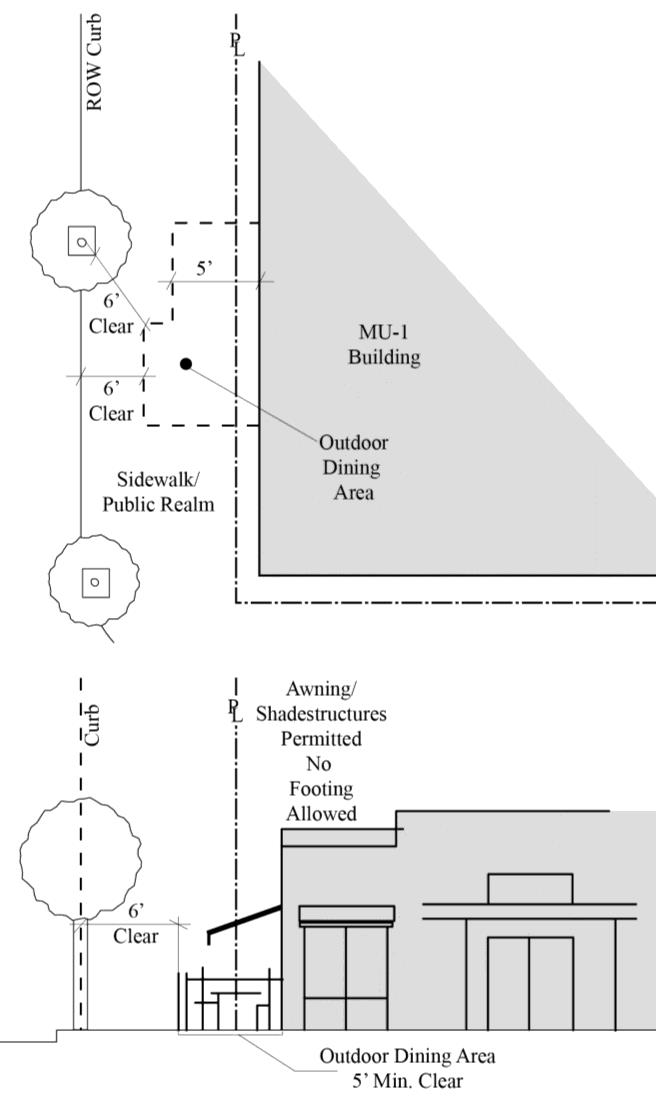
All outdoor eating and dining areas in conjunction with a primary restaurant land use shall be located, developed, and operated in compliance with the following performance standards. These standards shall apply where outdoor dining occurs on private property or encroaching on public property, as permitted by this section. See Figure 20.400-1.
A.
Mixed Use Zone Requirements. Outdoor dining in the MU-1 and MU-2 Zones may be permitted on private property or encroaching into the public ROW (subject to approval of the City Engineer) where the following minimum standards are met.
Figure 20.400-1 Outdoor Dining
See Section 20.400.150 for standards.
1.
An Encroachment Permit shall be required for any outdoor dining encroaching into a public ROW;
2.
The building frontage is set back two (2) feet or more from the minimum required setback line;
3.
A minimum dining area of five (5) feet clear is provided;
4.
A minimum public ROW of six (6) feet clear remains after dining area encroachment;
5.
All requirement of Section 20.400.150 (Outdoor Dining) are met including screening standards;
6.
A CUP shall be required for outdoor dining with alcohol service.
B.
Other Zone Requirements. Outdoor dining may be permitted, subject to permit requirements of the applicable Zone; however, in no case shall outdoor dining encroach into the public ROW or sidewalk. Requirements of Sections 20.400.150.C, D, and E shall apply.
C.
Screening. All outdoor dining areas of three (3) tables or more shall be screened at a fixed height of forty-two (42) inches using one (1) of the following elements:
1.
ornamental wrought iron/tubular steel fence, or
2.
landscape/planting box, minimum width of fifteen (15) inches with maintained planting.
D.
Shade Structures. Awnings and appropriately anchored shade structures may be permitted as reviewed under Site Development Plan Review or by the Director, subject to permit requirements of the applicable Zone. Shade structures shall not be permitted to have permanent footings.
E.
Hours of Operation. Hours for use shall be limited to the hours of operation of the associated primary land use.
F.
Refuse. No structure or enclosure to accommodate the storage of refuse or recycling shall be built or placed on or adjacent to the outdoor dining area.
G.
ADA Compliance. Outdoor dining shall be designed to comply with Title 24 and ADA requirements.
Section 20.400.155 - Personal Services—Fitness/Health, Instructional, and Limited Instructional.
A.
Permit requirements. Personal Services for fitness/health, instructional, and limited instructional facilities shall be allowed, subject to the permit requirements of the applicable Zone, except as follows:
1.
A CUP shall be required for the establishment of a fitness/health or instructional facility in conjunction with a new building (development of the building in conjunction with the use).
2.
A DP shall be required for the establishment of a fitness/health or instructional facility in an existing non-residential building to ensure adequate parking is provided and to minimize effects on other land uses within the building or site.
3.
A ZA (Zoning Approval) shall be required for the establishment of a limited instructional facility in an existing non-residential building subject to the filing of a business operations questionnaire guaranteeing that the following operational and development standards are satisfied for the duration of the land use.
Limited Use Regulations:
a.
All activity shall be conducted entirely within an enclosed building.
b.
The facility shall be designed to accommodate a maximum of 25 attendees.
c.
A maximum of 4 instructors/employees shall be allowed on site at one time in addition to the attendees.
d.
Activity area shall not exceed 5,000 square feet in size.
e.
Instructional facilities adjacent to residentially zoned property shall not operate between 10:00 p.m. and 6:00 a.m., except that such facilities may operate until 11:00 p.m. on Fridays and Saturdays.
f.
Parking shall be accommodated on-site per Table 20.340-1, Parking Requirements by Land Use.
(Ord. No. 2021-1512, § 2(Exh. B), 1-11-22)
Section 20.400.160 - Places of Assembly
A.
Permit Requirements. Places of assembly for religious or non-religious purposes shall be allowed, subject to the permit requirements of the applicable Zone, except as follows:
1.
A CUP shall be required for the establishment of an assembly use in conjunction with a new building (development of the building in conjunction with the use).
2.
A DP shall be required for the establishment of an assembly use in an existing non- residential building to ensure adequate parking is provided and to minimize effects on other land uses within the building or site.
3.
A ZA (Zoning Approval) shall be required for the establishment of a small place of assembly use in an existing non-residential building subject to the filing of a business operations questionnaire guaranteeing that the following operational and development standards are satisfied for the duration of the land use.
Limited Use Regulations:
a.
All activity shall be conducted entirely within an enclosed building.
b.
The facility shall be designed to accommodate a maximum of 25 attendees.
c.
A maximum of 2 instructors/employees shall be allowed on site at one time in addition to the attendees.
d.
Assembly floor area shall not exceed 1,200 s.f. in size.
e.
Assembly facilities adjacent to residentially zoned property shall not operate between 10:00 p.m. and 6:00 a.m., except that such facilities may operate until 11:00 p.m. on Fridays and Saturdays.
f.
Parking shall be accommodated on-site per Table 20.340-1, Parking Requirements by Land Use.
B.
Agricultural and Residential Zones. A CUP shall be required for all places of assembly within Agricultural (A-1, A-2, A-3) and Residential Zones (all R-1, R-2, R-3-6, R-3-10) to properly condition the use as follows:
1.
Front setback shall be determined through the CUP process with consideration for adequate parking and neighborhood context.
2.
Minimum interior property line setback shall be equal to twice the required interior setback of the Agricultural (A) and Residential (R) Zone.
3.
Minimum rear property line setback shall be twenty-five (25) feet.
4.
Hours of operation shall be limited to minimize disturbance to neighboring development from noise and lights.
5.
Off-street parking areas shall be located away from adjacent properties with residential uses whenever feasible to minimize disturbance to neighboring development.
6.
The maximum capacity of the use shall be determined based upon the size of the property, the intensity of surrounding development, and the capacity of streets serving the facility.
C.
Other Zones. The development standards for places of assembly shall be in compliance with the standards for the applicable Zone.
D.
Columbarium. Accessory columbarium areas (for burial ashes) in conjunction with a place of assembly land use shall be subject to the permit requirements of the applicable Zone for the "Funeral and Mortuary" land use.
E.
Emergency Shelter. Where allowed by the applicable Zone, a religious place of assembly may use the site for emergency shelter without a CUP if it is consistent with the standards of section 20.400.080 (Emergency Shelters) and the following requirements:
1.
The primary place of assembly land use was authorized through a CUP approval.
2.
No rent of fees of any kind shall be charged for emergency shelter services offered to homeless persons.
3.
Within Residential Zones, emergency shelter accommodations shall be limited to ten (10) persons at a single time.
4.
Appropriate design accommodations for the emergency shelter was included in the original facility design, and listing of transitional housing as an accessory use was identified in the original CUP application.
5.
Operation of the emergency shelter use commences upon receiving a Certificate of Occupancy that is consistent with the operational commencement of the primary assembly use.
6.
A person residing at the facility shall be limited to sixty (60) days.
(Ord. No. 2021-1512, § 2(Exh. B), 1-11-22; Ord. No. 2025-1568, § 2(Exh. B), 12-9-2025)
Section 20.400.170 - Research and Development (R&D) Uses
This section further regulates research and development (R&D) uses and accessory support uses for all Zones.
A.
Permitted Uses. In addition to all other R&D uses, the use and handling of bio-hazard and nuclear-related materials are permitted, subject to the standards of Section 20.300.070.A (Hazardous Materials and Waste).
B.
Site Development Plan Review. All primary and accessory R&D uses established in new developments shall be subject to Site Development Plan Review in conjunction with the permit requirements of the applicable Zone.
C.
R&D Height. Additional height in excess of the maximum height for the applicable Zone may be permitted through DP approval.
1.
A maximum additional ten (10) feet of building height may be approved to accommodate specialized machinery/equipment and/or additional mechanical equipment located between floors. Additional floor space shall not be permitted with the height increase.
D.
Accessory R&D Uses. Uses listed in Section 20.400.170.A (Permitted Uses) are intended to be secondary uses to the primary R&D office uses, providing support and development of ideas and products on-site. These land uses may feature noise, vibration, machinery, and processes that could affect adjacent tenants and uses. The regulations of this section are intended to minimize potential effects on adjacent tenants and uses.
1.
Applicable uses. Accessory R&D uses include the following:
a.
Production of experimental products;
b.
R&D fabrication and light manufacturing;
c.
Technical/scientific/medical laboratories.
2.
Limited square footage. Accessory R&D uses shall be limited to twenty percent (20%) of the gross floor area of the primary R&D use.
3.
Accessory R&D uses that require more than twenty percent (20%) of the gross floor area shall be subject to a CUP approval.
E.
Operational Standards.
1.
All warehousing, outdoor storage (as permitted by the Zone), loading docks, and delivery areas shall be located behind the primary building and/or away from the public ROW.
2.
Construction of R&D and accessory use space shall be adequate to minimize vibration, noise, and air emissions.
Section 20.400.180 - Self-Storage
Self-storage shall be subject to the permit requirements of the applicable Zone. In all cases, except for the Self-Storage Overlay Zone of the University District Specific Plan, the following criteria for mini-storage facilities shall apply as minimum requirements:
A.
Demand Analysis. Preparation of a City-initiated marketing demand analysis (paid for by the applicant) that substantiates the need for such a facility in the City and the region, and demonstrates a positive fiscal benefit to the City.
B.
Limitations. Proposed mini-storage facilities shall not be permitted within the following areas:
1.
Any existing or proposed planned industrial park, unless a marketing analysis can indicate that no negative impact will result to the build-out of the industrial park and its absorption.
2.
Any SPA Zone.
3.
The State Route 78 view corridor.
C.
Required Access. Any proposed mini-storage site shall have direct access to a six (6)-lane public ROW.
D.
Minimum Setback. All storage buildings shall have a minimum setback of two hundred fifty (250) feet from any public ROW.
E.
Screening. Proposed mini-storage facilities shall be fully screened from the street and adjacent residential uses by virtue of landscaping, exterior walls, or building design. Site plans submitted for Site Development Plan Review shall adequately detail the screening ability of these features to the satisfaction of the Director.
F.
Mitigation. Proposed mini-storage facilities shall require the mitigation of economic impacts for non-tax and non-job-producing uses.
G.
Loading. Side loading areas and doors are permitted but must be screened by a concrete or masonry wall not less than twelve (12) feet high, textured or colored to match the main building and not closer to a street than the applicable parking setback requirement(s).
(Ord. No. 2025-1574, § 2(Exh. B), 1-13-2026)
Section 20.400.190 - Showrooms
Stand-alone and wholesale/retail showrooms located within the State Route 78 corridor shall be conducted per the following standards:
A.
Applicable Uses. Retail showrooms include furniture, appliances, spas, carpets, pianos, pool tables, exercise equipment, doors/windows, kitchen/bath remodeling fixtures and supplies, and similar uses.
B.
Parking/Loading Location. All service, loading dock areas, and truck parking (including delivery trucks) shall be situated at the rear of the building, out of public view from State Route 78 and adjacent roadways. The standards of Chapter 20.340 (Off-Street Parking and Loading) shall apply, in addition to the following:
1.
Tenants for existing buildings that cannot accommodate truck parking in the rear must provide off-site parking out of the State Route 78 view corridor.
2.
Truck parking on the State Route 78 frontage or other public or private roads shall be strictly prohibited.
3.
Truck parking shall be prohibited within access easements and driveways.
4.
Designated parking areas outside of access easements and driveways shall be provided for loading and unloading purposes.
C.
Signage. Signage shall be in strict conformance with Chapter 20.320 (Signs on Private Property). Truck panel signs for advertising shall be prohibited.
D.
Outdoor Displays. Outdoor, non-fenced merchandise displays shall be prohibited.
E.
Outdoor Sales. Outdoor sales shall be prohibited unless approved through a Parking Lot Sales Permit, which allows temporary sales on a limited basis.
Section 20.400.200 - Tattoo and/or Body Art Facility
Every Tattoo and/or Body Art Facility shall be subject to the following, in addition to all other requirements of the law:
A.
The exterior walls of any establishment in the Commercial (C) Zone shall be located more than 2,000 feet from the exterior walls of any other Tattoo and/or Body Art Facility.
B.
Tattoo and/or Body Art Facility shall not operate between the hours of 10:00 p.m. and 10:00 a.m.
C.
Live animals, except for service animals, shall not be allowed on the premises.
D.
Once established, the Tattoo and/or Body Art Facility shall not be permitted to expand into another tenant space or building or otherwise on the site or any contiguous site unless the standards of Section 20.400.200.A above are complied with.
E.
Temporary or mobile establishments or events are not authorized by this section.
F.
The applicant/operator of the Tattoo and/or Body Art Facility shall also comply with all applicable state and local laws as they may be amended from time to time, including Health and Safety Code Sections 119300 et seq. (California Safe Body Art Act), Penal Code Section 653, and Chapter 8.95 of this Code.
Section 20.400.210 - Temporary Sales Offices
For new development of residential subdivisions and commercial construction of more than one (1) acre of land, a temporary sales office shall be permitted.
A.
Building Type. The temporary sales office may include one (1) unit of any of the following: a trailer, mobilehome, dwelling, or occupation of a model home.
B.
Required Provision. Designated and appropriate on-site customer and employee parking shall be provided with an ADA path of travel connecting to the office. Public restroom access (fully plumbed or temporary facility) shall be provided.
C.
Utilities. Utilities and plumbing, consistent with current code, may be installed for overnight habitation for security purposes.
D.
Activities. Sales and security activities shall be directly associated with the operation of the building site and sale of homes/spaces in the development. No other associated or separate retail activities shall be permitted.
E.
Signage Allowed. During such period, one (1) unlighted sign of a maximum one hundred (100) square feet and twenty (20) feet in height may be placed at each street intersection entrance to the subdivision from peripheral streets. The area of only one (1) face of a two (2)-face sandwich-type sign shall be used in computing the allowable area of the sign. The sign or signs installed shall have wording that is restricted to the sale of units within the subdivision.
F.
Removal. All sales offices and signage shall be removed upon sale of all units within the subdivision.
Section 20.400.220 - Utility Service
The developer or owner of a property shall be responsible for utility service connections in cooperation with responsible utility companies and in compliance with Title 17 of this Code.
A.
Undergrounding. To protect the public safety and improve the appearance of the community, all new development and new subdivisions shall be required to install on-site utility, phone, and cable television/internet facilities underground in accordance with the respective industry standards. Transmission lines shall be exempt from this requirement. Further reference is made to Titles 14, 17, and 19 of the Municipal Code.
B.
Screening. Transformer, terminal equipment, and public utility boxes shall be undergrounded where possible. Where utilities are located within view of public ROWs due to utility or site constraints, all transformer, terminal equipment, and public utility boxes shall be placed underground when feasible. If not feasible, the utility shall be screened from view, equal to the height of the equipment, from streets and adjacent properties. Screening shall be architecturally similar to the closest primary structure.
C.
Amateur/Non-Public Antennas. Amateur and non-public transmitting and/or receiving antennas shall meet the following standards:
1.
All such antennas shall conform to required setbacks, consistent with accessory structure setbacks within the applicable Zone; see Chapter 20.410 (Accessory Dwelling Units and Accessory Structures).
2.
All such antennas shall not exceed sixty (60) feet in height, as measured from the finished grade of the lot, except with the issuance of a Special Use Permit subject to the standards of this Zoning Ordinance.
(Ord. 2017-1445, 7-11-2017)
Section 20.400.230 - Vehicle Storage
To minimize the potential adverse effects on surrounding properties, the following standards shall apply to the outdoor storage of vehicles:
A.
Required Screening. All of the following shall be stored in completely enclosed structures or screened from public view:
1.
Vehicles being repaired or services in any manner;
2.
Food/catering trucks numbering one (1) or more.
B.
Non-Operation. Outdoor storage of non-operational vehicles or equipment is prohibited.
C.
Parking Limitations. No vehicle or any component of a vehicle shall be parked on any private property other than those areas legally established as a parking lot, parking facility, or driveway leading to parking.
D.
Sale Prohibited. No vehicle or any component of a vehicle shall be parked on public or private property advertising the vehicle or any other service or merchandise for sale.
Section 20.400.240 - Firearm Shooting Range (Indoor)
The purpose and intent of this section is to provide standards for the location and operation of indoor firearm shooting ranges by locating such facilities in appropriate areas with minimal adverse impact on the community and its resources, and providing operational standards that will protect the public health, safety, and general welfare of the community.
A.
Permit Required. Indoor firearm shooting ranges are a conditionally permitted use within the Industrial (I) zone with Conditional Use Permit (CUP) approval provided the business conforms with all applicable Federal, State, and County standards, as well as all applicable requirements of the San Marcos Municipal Code. Indoor Firearm shooting ranges are prohibited in all other zones of the City.
B.
Distance Requirements. The exterior walls of an indoor firearm shooting range shall not be located within five hundred (500) feet of a child care facility, K-12 public school, public park, residential zoning district, bar, brewery, or any another indoor firearm shooting range.
C.
Noise. The proposed indoor firearm shooting range must be properly designed, constructed, and equipped to contain all firearm discharge noise within the building so that the exterior noise level does not exceed the allowable noise levels outlined in San Marcos Municipal Code (SMMC) 20.300.070.F as measured at the property line. Where a property is occupied by more than one use (whether within the same building or in separate buildings) the noise level shall not exceed forty-five (45) dBA as measured within the interior space of the neighboring establishment. Noise caused by motor vehicles traveling to and from the site are exempt from this standard.
D.
Interior Building Design. The proposed indoor firearm shooting range must be properly designed, constructed, and equipped to contain all firearm ammunition within the building and/or tenant space.
E.
Hours. Indoor firearm shooting ranges shall be permitted to operate during the hours of 7:00 a.m. to 10:00 p.m., unless otherwise approved through the Conditional Use Permit.
F.
Retail Firearm Sales. Retail firearm sales and repair services are permitted in conjunction with indoor firearm shooting range operations. The applicant must comply with all Federal and State requirements for such sales and services as well as all requirements in San Marcos Municipal Code (SMMC) Chapter 5.60 (Firearms).
G.
Public Safety. As part of the Conditional Use Permit process, additional submittal and operational requirements may be imposed or added as conditions of approval as deemed necessary by the San Diego County Sheriff's Department.
(Ord. No. 2016-1419, 2-23-2016)
Section 20.400.250 - Massage, Accessory Use and Massage Establishments
Businesses where massage is performed as Massage Accessory Use and Massage Establishments shall be subject to the following, in addition to all other requirements contained in Chapter 5.44 and Title 5 of this Municipal Code and by law:
A.
Businesses where massage is performed as Massage Accessory Use and Massage Establishments shall only be permitted in Commercial (C, NC) Zones, and in certain Specific Plan Area (SPA) Zones (such as San Marcos Creek Specific Plan Area, Nordahl Marketplace Specific Plan Area, and commercial centers located on San Marcos Boulevard) or certain Mixed-Use (MU-1, MU-2) Zones that function as a commercial land use and are developed as shopping centers, subject to the regulations, site specific standards and provisions of this Zoning Ordinance. The shopping centers must possess commercial land use controls, in the form of common leases, common area maintenance agreements for landscaping and parking areas, reciprocal easement agreements for ingress, egress and parking of vehicles, recorded declarations of covenants, conditions and restrictions defining the responsibility of landlord and tenant concerning the standards for the operation and maintenance of the center, or similar rules and regulations intended to preserve the integrity of such a center. Businesses where massage is performed as Massage Accessory Use and Massage Establishments shall not be permitted in any other zones within the jurisdiction of the City.
B.
A Massage Establishment shall be located no fewer than 1,000 feet from another Massage Establishment existing as of July 13, 2017, as measured in a straight line, without regard to intervening structures, from the property line of one Massage Establishment to the property line of the other Massage Establishment. Any Existing Massage Establishment, which is located within 1,000 feet of another Existing Massage Establishment as of July 13, 2017, is not required to relocate but is subject to all other provisions of this Ordinance for the continued operation and/or transfer of ownership of the Massage Establishment. If any Existing Massage Establishment desires to change locations after July 13, 2017 to another location less than 1,000 feet from another Massage Establishment, the relocation shall be subject to all other zoning requirements under this Zoning Ordinance, and compliance with this distance limitation is subject to some level of discretion of the Planning Manager. This limitation shall not apply to businesses where massage is performed as Massage Accessory Use as that term is defined under this Zoning Ordinance, or to Outcall Massage services, as that term is defined under Chapter 5.44 of this Municipal Code.
C.
The maximum number of Massage Establishments within the jurisdiction of the City of San Marcos shall not exceed one Massage Establishment per every 2,500 inhabitants of the City. For purposes of this Section, the total number of inhabitants of the City shall be determined by the most current published data available from the California State Department of Finance, as of the date an application for a Massage Establishment License is filed. This limitation shall not apply to the following businesses: (i) businesses where massage is performed as Massage Accessory Use, as that term is defined under this Zoning Ordinance; (ii) Outcall Massage services, as that term is defined under Chapter 5.44 of this Municipal Code; or (iii) to any Existing Massage Establishment so long as there is no lapse in the timely renewal of a City business license and/or Massage Establishment license as required under Title 5 of this Municipal Code.
D.
Existing Massage Establishments that do not comply with the zoning limitations imposed upon new Massage Establishments under paragraphs A., B. and C. of this Section as of July 13, 2017 shall be considered a legal, non-conforming use. Such Existing Massage Establishments shall be required to comply with all other applicable local, State and Federal laws, ordinances, rules and regulations, including, but not limited to, Chapter 5.44 of this Municipal Code and this Zoning Ordinance.
E.
The Owner, Operator or Manager, as those terms are defined under Chapter 5.44 of this Municipal Code, of any Massage Establishment or business where massage is performed as Massage Accessory Use shall also comply with all applicable local, State and Federal laws, ordinances, rules and regulations as they may be amended from time to time, including, but not limited to, California Business and Professions Code Sections 4600 et seq. (Massage Therapy Act), California Government Code Sections 51030 et seq., this Zoning Ordinance and Title 5 of this Municipal Code.
(Ord. No. 2017-1443, 6-13-2017; Ord. No. 2019-1469, § 2(Exh. A), 1-22-2019)
Section 20.400.260 - Low Barrier Navigation Centers
Consistent with Government Code Sections 65660 through 65668, all California cities are required to allow low barrier navigation centers as a use by right in areas zoned for mixed use and nonresidential zones permitting multi-family uses.
A.
Standards. A low barrier navigation center shall meet the following requirements:
1.
It offers services to connect people to permanent housing through a services plan that identifies services staffing.
2.
It is linked to a coordinated entry system, so that staff in the interim facility or staff who collocate in the facility may conduct assessments and provide services to connect people to permanent housing.
a.
"Coordinated entry system" means a centralized or coordinated assessment system developed pursuant to Section 576.400(d) or Section 578.7(a)(8), as applicable, of Title 24 of the Code of Federal Regulations, as those sections read on January 1, 2020, and any related requirements, designed to coordinate program participant intake, assessment, and referrals.
3.
It complies with Chapter 6.5 (commencing with Section 8255) of Division 8 of the Welfare and Institutions Code.
4.
It has a system for entering information regarding client stays, client demographics, client income, and exit destination through the local Homeless Management Information System as defined by Section 578.3 of Title 24 of the Code of Federal Regulations.
5.
Low barrier navigation centers shall also comply with operational standards established for emergency shelters in Section 20.400.080.
(Ord. No. 2022-1527, § 2(Exh. A), 10-25-2022)

