San Marcos City Zoning Code
CHAPTER 20
220 - COMMERCIAL ZONES
Section 20.220.010 - Purpose of Chapter
The purpose of this chapter is to specify the allowable uses, requirements, and development standards within the Commercial Zones as established by the Zoning Map, and, specifically, to accomplish the following:
A.
Protect the City's tax base by providing for a full range of retail commercial sales and services in a setting that promotes retail destinations and business hubs in close proximity to highly visible thoroughfares.
B.
Establish, maintain, and protect the viability of commercial, retail, office, and those uses that have similar access and infrastructure needs; locate these in close proximity to appropriate services and transportation infrastructure.
C.
Strengthen the City's economic base and provide employment opportunities in close proximity to residents.
Section 20.220.020 - Purpose of Commercial Zones
In addition to the purposes of this Zoning Ordinance and Chapter, the purpose of each Commercial Zone follows:
A.
Commercial (C) Zone. To provide a business district for the full range of retail goods, services, and commercial centers that stabilize, maintain, and enhance the vitality of San Marcos in a supportive commercial setting adjacent to thoroughfares. Appropriate C Zone commercial uses will contribute to the range of service and destination retail, shopping centers, entertainment, and restaurant uses that generate a strong tax base. The C Zone is intended to implement and be consistent with the Commercial (C) land use designation of the General Plan.
B.
Neighborhood Commercial (NC) Zone. To provide for local retail and commercial goods and services in close proximity to residential neighborhoods to meet daily convenience needs. The NC Zone is intended to implement and be consistent with the Neighborhood Commercial (NC) land use designation of the General Plan.
C.
Office Professional (OP) Zone. To provide a high-quality business district for the development of professional offices, business support, and personal services. This Zone is intended to be exclusively for office and business uses, serving as a buffer between higher-intensity commercial uses and residential development. The land use and development regulations of this Zone are intended to cultivate an office environment characterized by appropriate landscaping and architectural design to generate business investment in the City. The OP Zone is intended to implement and be consistent with the Office Professional (OP) land use designation of the General Plan.
D.
Senior Residential (SR) Zone. To provide for a full range of housing and assisted life care facilities for older adults, with supportive services located near commercial and transit opportunities. These areas should be in appropriate locations adjacent to thoroughfares where age-appropriate living opportunities and services may be established, maintained, and protected from surrounding uses. The SR Zone is intended to implement and be consistent with the Medium Density Residential 2 (MDR2) land use designation of the General Plan.
Section 20.220.030 - Applicability
Land use permit requirements, as detailed in Table 20.220-1, and the regulations and development standards of this chapter, shall be applicable to the following:
A.
Zones. All existing and new uses, structures, expansions, modifications, redevelopment, and activities within the C, NC, OP, and SR Zones.
B.
Senior Residential Development. All provisions related to land use or standards for development of Senior Residential shall be applicable to the S-R Zone and to all senior residential development in any other Zone, unless developed prior to the adoption of this Zoning Ordinance.
Table 20.220-1
Permit Requirement Types and Processes
Note: Any land use authorized through a permit-approval process may also require Site Development Plan Review, a Building Permit, and/or other permit(s) required by this Code. For unlisted and similar uses, see Section 20.205.030.C (Unlisted and Similar Compatible Uses). All uses, including, but not limited to, "P", "DP" and "CUP" must pay applicable Public Facilities Fees and annex into all applicable Community Facilities Districts.
(Ord. No. 2021-1512, § 2(Exh. B), 1-11-2022)
Section 20.220.040 - Allowable Commercial Uses and Permit Requirements
A.
Permit Requirements. Table 20.220-1 identifies the types of land use permits required to establish land uses in the Commercial Zones consistent with this Zoning Ordinance. All permit requirements shall be subject to the process standards of Chapter 20.500 (Permits and Applications Process).
B.
Commercial Zone Land Uses. Table 20.220-2 identifies the permitted land uses in all Commercial Zones.
1.
Commercial uses are intended to be the primary permitted use in the C and NC Zones.
2.
Land uses in the OP Zone should be characterized by business, office, and service uses.
3.
The SR Zone is intended for older adult and assisted living, supported by commercial services appropriate for this setting.
C.
Additional Use Regulations. In addition to the regulations, development standards, and provisions of this chapter, all land uses are subject to the specific use standards identified in the "Additional Use Regulations" column of Table 20.220-2; refer to the referenced sections for additional operational standards and regulations applicable to the use. All land uses are also subject to all of the following standards: Chapters 20.320 (Signs on Private Property), 20.330 (Water Efficient Landscape Standards), 20.335 (Walls and Fences), 20.340 (Off-Street Parking and Loading), and 20.400 (Specific Use Standards).
Table 20.220-2
Commercial Zone Permitted Uses
Notes: For definitions, see Table 20.220-1.
R&D = research and development
s.f. = square feet
1. All land uses are subject to the following standards: Chapters 20.320 (Signs on Private Property), 20.330 (Water Efficient Landscape Standards), 20.335 (Walls and Fences), 20.340 (Off-Street Parking and Loading), and 20.400 (Specific Use Standards).
2. Business, including merchandising and sales, shall be conducted entirely within
an enclosed building, except as identified in Table 20.220-2, where outdoor business
is permitted subject to a Conditional Use Permit (CUP).
3. A Director's Permit (DP) shall be required for the establishment of the land use
in an existing building to ensure that adequate parking and student services are provided
and to minimize effects on other land uses within the building or site. A CUP shall
be required for the establishment of a use in conjunction with a new building (development
of the building in conjunction with the use).
4. Businesses where massage is performed as Massage, Accessory Use and Massage Establishments
are permitted by right when all persons performing massage services possess a current,
valid and authentic certificate issued by the California Massage Therapy Council.
Unless otherwise expressly exempt, all businesses where massage is performed as Massage,
Accessory Use and Massage Establishments shall be subject to Chapter 5.44 and Title 5 of this Municipal Code.
D.
Prohibited Uses. When a use is not specifically listed, that use is prohibited. However, consistent with Section 20.205.030.C (Unlisted and Similar Compatible Uses), the Director shall have the authority to determine whether the proposed use shall be permitted or conditionally permitted based on the finding that the proposed use is similar to and no more detrimental than a particular use permitted in the Zone.
(Ord. No. 2017-1443, 6-13-2017; Ord. No. 2021-1512, § 2(Exh. B), 1-11-2022; Ord. No. 2022-1527, § 2(Exh. A), 10-25-2022; Ord. No. 2025-1568, § 2(Exh. B), 12-9-2025)
Section 20.220.050 - Development Standards for Commercial Zones
A.
Development Standard Compliance. The design, construction, or establishment of all new and existing land uses, development of structures, and site improvements in Commercial Zones shall conform to the regulations of Table 20.220-3. Principal and accessory structures shall meet the same development standards, unless otherwise modified by this Zoning Ordinance. See Figures 20.220-2 and 20.220-3 for setback measurement standards.
B.
Site Development Plan Review Required. All development in the Commercial Zones, including all projects that comply with the allowed land use and development standards of this chapter, shall be submitted for Site Development Plan Review to the Planning Division; see Chapter 20.515 (Site Development Plan Review).
1.
Senior/Age-Restricted dwellings require Site Development Plan Review or Multifamily Site Development Plan Review, depending on the type of project proposed. The Director shall determine which type of review is required based on project components.
C.
Floor Area Requirements.
1.
Office, professional, and business support services (non-retail uses) shall not exceed twenty percent (20%) of the total gross floor area of a building(s) without the Director's approval.
2.
This percentage shall be calculated by adding all office space within a structure and dividing that figure by the total square footage of the building. This calculation shall be completed prior to occupancy of a proposed use. This provision may be administratively waived by the Director.
D.
Residential Adjacency. Where any C, NC, OP, or SR Zone abuts any Residential Zone, the following conditions shall apply (see Figure 20.220-1):
1.
Land use shall provide step-down massing for building height transitions and appropriate screening between uses.
2.
Site design shall orient loading docks and doors away from residential areas. Loading docks or doors shall not be permitted adjacent to a Residential Zone property line.
3.
All buildings within the C, NC, O-P, and S-R Zones shall provide step-down massing for building height transitions adjacent to Residential Zones; see Figure 20.220-1.
Figure 20.220-1. Residential Adjacency Requirements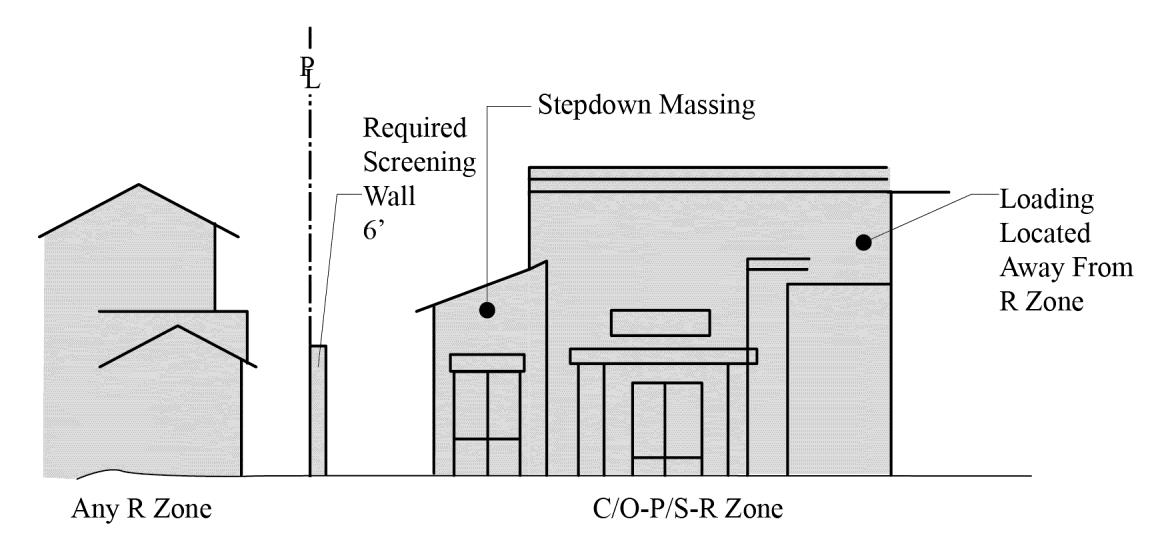
4.
Screening shall be provided along all shared Residential Zone property lines. A solid, split-face masonry, block, stone clad cement, or stucco wall shall be erected and maintained that meets the following standards:
a.
Minimum six (6) feet in height along the entire length of the shared property line.
b.
Chain-link, chain-link with slats, barbed wire, razor ribbon, or other similar fences are prohibited.
c.
Where a slope exists between residential and commercial properties, the screening wall shall be erected at the top of the slope.
E.
Circulation Standards.
1.
Ingress and Egress. All ingress and egress:
a.
shall take place on paved ROWs or paved private easements;
b.
shall be designed to allow for turning-around, and allow for proper circulation to prevent backing of vehicles onto streets; and
c.
shall be to the satisfaction of the City Engineer and Fire Marshal.
2.
Driveways. Driveway spacing shall be determined by the "City of San Marcos Street Design Criteria" standards or its successor.
a.
Maximum of one (1) driveway for each property abutting the street unless approved by the City Engineer.
b.
Complexes of two (2) or more buildings sharing access to a public street may be permitted to have more than one (1) driveway, as approved by the City Engineer. Reciprocal driveway access configurations are required where possible and feasible.
c.
Driveway width shall be thirty (30) feet wide measured at the property line to properly facilitate all passenger and cargo vehicle movements. Driveway widths based on site configuration shall be approved by the City Engineer during Site Development Plan Review.
d.
Driveways shall provide a minimum of twenty (20) feet landscaped throat distance measured from the back of the ROW line. This minimum shall be increased as deemed necessary by the Site Development Plan Review process.
e.
Unless otherwise approved by the City Engineer, driveways shall conform to the City's "Radius Type Driveway" standards.
f.
All driveways and site access shall meet line-of-sight criteria; see Section 20.300.070.C (Performance Standards).
Table 20.220-3
Commercial Zone Development Standards
Notes: PL = Property Line
All standards are minimums unless otherwise noted.
2. ;hg;All lot development and setbacks shall be subject to the provisions of Chapter 20.300 (Site Planning and General Development); where standards conflict with Chapter 20.300, the largest standard shall prevail.
3. ;hg;Setbacks shall be measured from the back of the right-of-way.
4. ;hg;Lot width-to-depth ratio should be, generally, a 1:3 ratio for appropriate
site design and utilization.
5. ;hg;All setbacks are subject to residential adjacency stepback requirements of
Section 20.220.050.D (Residential Adjacency) and provisions of Section 20.300.060 (Special Setbacks for General Plan Routes).
6. ;hg;Sidewalk arcades and similar architectural features of commercial buildings
may be established and maintained in a required front setback upon the issuance of
a Director's Permit.
7. ;hg;Lot area and width standards apply to proposed subdivisions of land. The standards
may be waived by the Director and City Engineer when necessary to accommodate the
parcel configuration for an integrated commercial development.
8. ;hg;Minimum lot sizes are net area; reciprocal access easements not included.
| Figure 20.220-2 C Zone Development Standards See Table 20.220-3 for standards. | 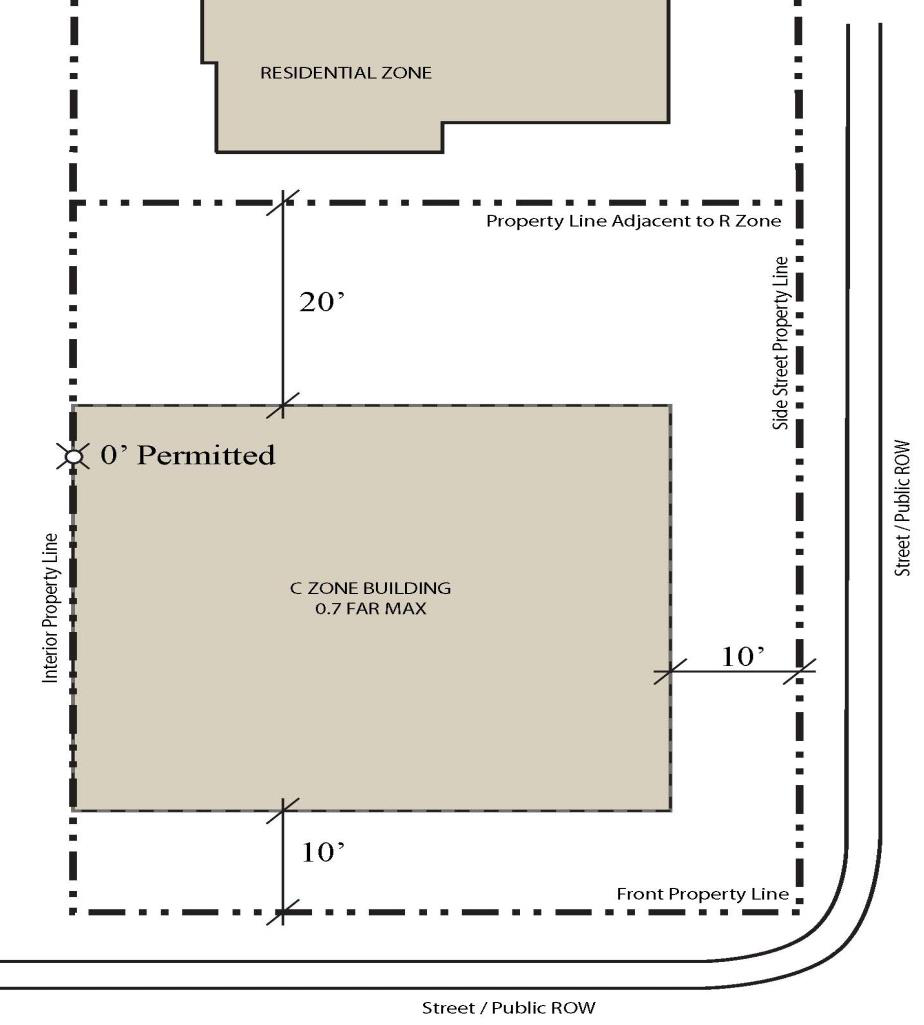 |
| Figure 20.220-3 O-P Zone Development Standards See Table 20.220-3 for standards. | 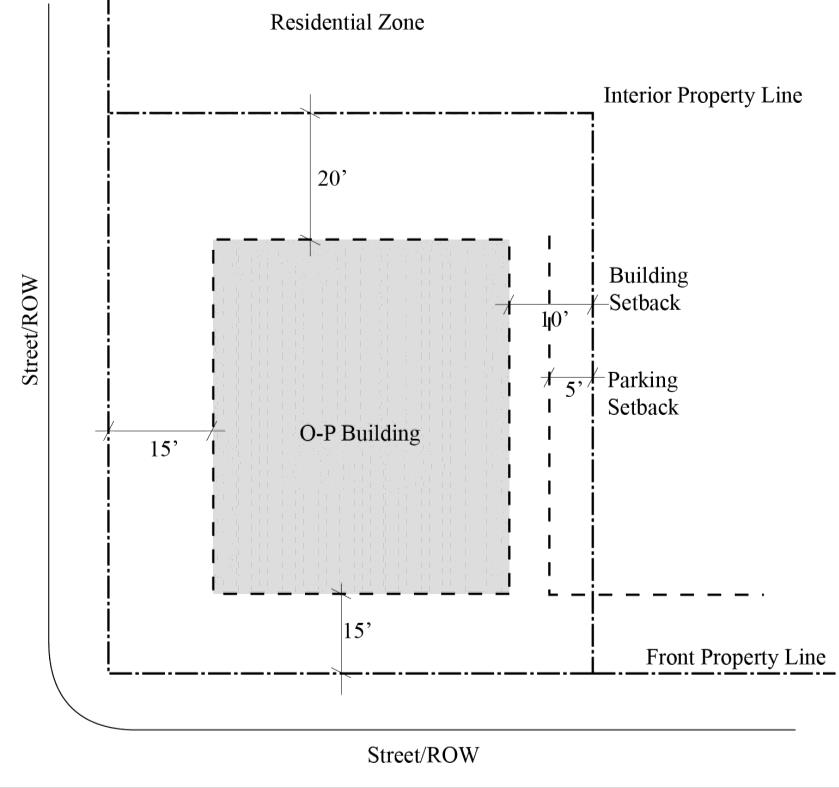 |
(Ord. No. 2025-1568, § 2(Exh. B), 12-9-2025)
Section 20.220.060 - Performance Standards for Commercial Zones
The provisions of this section further modify and regulate the development form and function of all commercial land uses listed in Table 20.220-2 to promote safe, attractive, and compatible development.
A.
Permitted Projections. See Section 20.300.020.G (Permitted Encroachment Standards) for permitted projection standards relevant to Commercial Zones.
B.
Architectural Compatibility. All buildings, including secondary and accessory structures, walls, and fences located on a building site, shall be designed and constructed to be architecturally compatible with the primary building.
C.
Enclosed Activities. Every business shall be conducted entirely within an enclosed building except the following:
D.
Merchandising and sales. Merchandising and sales shall only be permitted for those permitted uses identified in Table 20.220-2. All sales must take place entirely within an enclosed building, with the exception of the following temporary uses: parking lot sales, special events, and loading and unloading; see Chapter 20.455 (Temporary Events).
E.
OP Zone Ancillary Retail Sales. Ancillary retail sales directly associated with the primary land use shall be allowed in the OP Zone in conjunction with any land use permitted or conditionally permitted by this chapter.
F.
SR Zone Accessory Uses. These uses are permitted as an accessory service for residents and their invited guests only, with no outside advertising or signs, and no access to the general public. These uses are subject to the development standards for the SR Zone, and shall not have separate entrances or occupy free-standing structures, except as approved during Site Development Plan Review.
(Ord. No. 2025-1568, § 2(Exh. B), 12-9-2025)
Section 20.220.070 - Building Form/Site Development Standards and Guidelines
The following building and siting standards apply in all Commercial Zones (C, NC, OP, SR) unless otherwise specified:
A.
Pedestrian Scaled Elements. To generate a pedestrian-scaled commercial setting, all buildings shall reduce building massing through changes in building height and roof form, and the introduction of pedestrian-scaled elements.
1.
Emphasize corners and special places through changes in height and building form.
2.
Design building entrances and windows to be enhanced by architectural features, canopies, balconies, or other architectural details.
3.
Reduce massing by incorporating pedestrian-scaled elements such as trellises, plazas, balconies, and outdoor dining areas.
4.
Limit blank walls and use changes in massing and building planes to add depth and scale to building frontages. Uninterrupted walls shall be prohibited without an offset or inclusion of architectural details. Scoring alone shall not be accepted as architectural relief.
5.
Provide comfortable pedestrian walkways. Walkways in retail commercial centers should be covered by a structural projection such as a canopy or shaded by evergreen canopy trees. Trees shall be planted at a maximum of twenty (20) feet on center and with a minimum height at maturity underneath the canopy of no less than eight (8) feet. Tree wells may be cut in the sidewalk and covered with a semi-circle iron grating to avoid reducing the walkway area. All trees and landscaping are subject to Chapter 20.330 (Water Efficient Landscape Standards).
B.
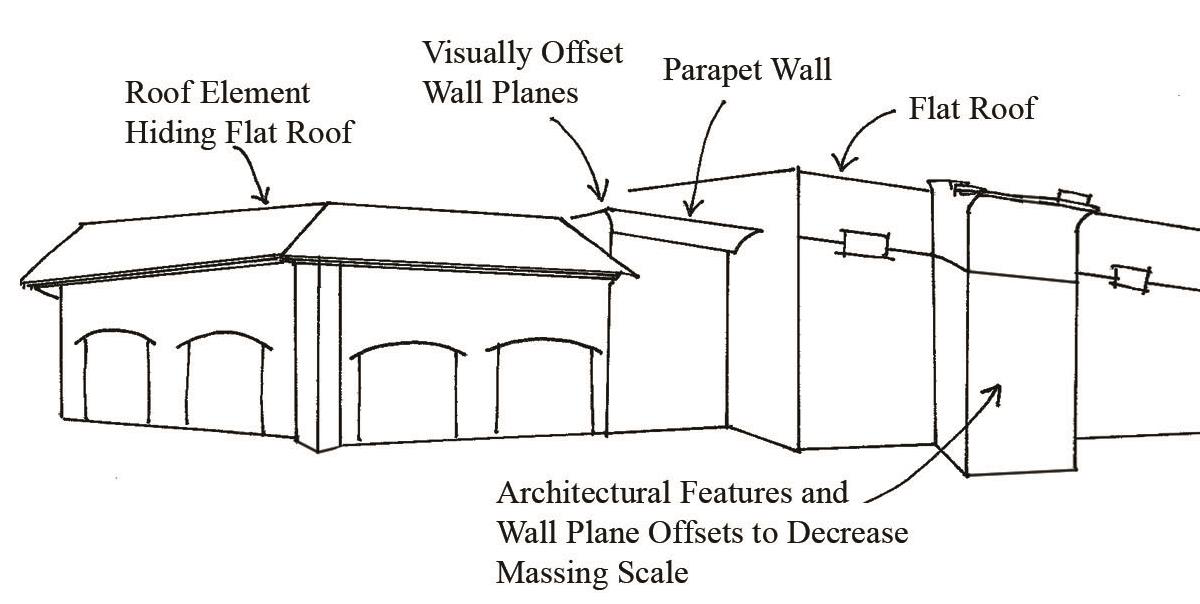
Building Design. Provide articulation of building forms and facades, including variation in massing, roof forms, and wall planes, to reinforce quality architecture. See Figure 20.220-4.
1.
Parcels that have direct frontage onto State Route 78 shall orient architecturally enhanced facades toward the freeway.
2.
Buildings shall be articulated through the use of textured materials and color. A minimum of three (3) colors and/or materials shall be used on all buildings. Materials may include rough sawn woods, split face block, stucco, textured concrete tilt-up, and facade brick or stone. Materials shall be used thematically and complement the surrounding area.
3.
Walls and enclosures shall be architecturally integrated with the design of the associated buildings.
4.
Visually exposed flat roofs on front and side elevations shall be limited. Parapet walls or architectural roofing features shall be used to screen front- and side-elevation flat roofs from pedestrian visibility.
C.
Site Design. Adjacent lots are encouraged to use design-integrated elements for the consolidation of shared driveway/curb cut access, provision of parking in the least amount of space, cohesive thematic landscaping and/or monument elements, and shared commercial amenities.
D.
Pedestrian Plazas. Pedestrian plazas shall include a water feature and/or gas fire pit feature if feasible and as approved by the Director during Site Development Plan Review.
E.
Parking Lot Walkways. Parking lot design shall include designated and landscape pedestrian walkways to allow for safe and direct pedestrian access to storefronts.
F.
National Pollutant Discharge Elimination System Compliance. All development shall comply with the most current National Pollutant Discharge Elimination System (NPDES) permits and implement and maintain best management practices (BMPs), consistent with Chapter 14.15 of this Code.
Figure 20.220-4 Commercial Building Design
Use combinations of roof elements and parapet walls to reduce exposed flat roofs and
increase building articulation.