
San Marcos City Zoning Code
CHAPTER 20
410 - ACCESSORY DWELLING UNITS AND ACCESSORY STRUCTURES
Section 20.410.010 - Purpose of Chapter
The purpose of this chapter is to establish standards for permitting accessory dwelling units and accessory buildings or structures (accessory structures) on Agricultural, Residential and Mixed Use Zone properties to ensure compliance with State law and compatibility with the property and the adjacent neighborhood.
(Ord. No. 2020-1493, § 2(Exh. B), 10-13-2020; Ord. No. 2020-1494, § 2(Exh. B), 11-10-2020)
Section 20.410.020 - Applicability
The provisions of this chapter shall apply to new construction, modifications, and legal conversions of all accessory structures and accessory dwelling units on any lot that is zoned to allow single-family or multifamily dwelling residential use, subject to the permit requirements of the applicable Zone. If any of the provisions noted in this chapter are in conflict with State Government Code, State Government Code shall prevail.
A.
Accessory Structures. Accessory structures shall be limited to Agricultural (A) Zones and Residential (R) Zones under this chapter. Similar structures in non-residential Zones shall comply with the standards of the applicable Zone.
B.
Accessory Dwelling Units. "Accessory dwelling unit" (ADU) means an attached or a detached residential dwelling unit that provides complete independent living facilities for one or more persons. It shall include permanent provisions for living, sleeping, eating, cooking, and sanitation on the same parcel as the single-family or multifamily dwelling is situated. An ADU also includes the following:
1.
An efficiency unit, as defined in Section 17958.1 of the Health and Safety Code.
2.
A manufactured home, as defined in Section 18007 of the Health and Safety Code.
C.
Junior Accessory Dwelling Units. "Junior Accessory Dwelling Unit" (Junior ADU) means a unit that is no more than 500 square feet and is contained entirely within an existing or proposed single-family residence, including all enclosed uses within the residence, such as attached garages. A Junior ADU must include a separate entrance from the single-family residence and may include separate sanitation facilities or may share sanitation facilities with the existing or proposed structure. If a Junior ADU does share sanitation facilities with the single-family residence, the Junior ADU must include both a separate exterior entrance and an interior entrance to the single-family dwelling.
Side and rear setbacks must be sufficient for fire safety and the Junior ADU must meet all the requirements of the California Building Standards Code and the California Fire Code. The Junior ADU may not be sold separately from the primary dwelling unit. The Junior ADU may be rented for terms 30 days or longer. Either the primary dwelling or the Junior ADU must be owner occupied.
A Junior ADU must include an efficiency kitchen, which shall include the following:
1.
A cooking facility with appliances; and
2.
A food preparation counter with storage cabinets that are of reasonable size in relation to the size of the Junior ADU.
D.
ADUs Standards. ADUs shall be permitted on a lot that is zoned to allow single-family, mixed-use, or multifamily dwelling residential use and includes a proposed or existing dwelling, subject to the following minimum parcel standards and requirements:
1.
Number and Location. The number of ADUs or JADUs on a lot shall be the minimum outlined by California Government Code Section 66323. The type and location of ADUs or JADUs on a lot shall be subject to California Government Code Sections 66314—66339.
2.
Parcels Zoned to Allow Single-Family Dwelling Residential Use.
a.
All Junior ADUs and any ADU that is either attached to or located within the proposed or existing primary dwelling, including attached garages, storage areas, or accessory structures including detached garages, must comply with the following:
i.
The ADU is within the proposed space of a single-family dwelling or existing space of a single-family dwelling or accessory structure.
ii.
An ADU within the existing space of an accessory structure may include expansion of not more than 150 square feet beyond the same physical dimensions as the existing accessory structure. An expansion beyond the physical dimensions of the existing accessory structure shall be limited to accommodating ingress and egress.
iii.
The space has independent exterior access from the proposed or existing single-family dwelling.
iv.
The side and rear setbacks are sufficient for fire and safety.
v.
The JADU complies with the requirements of Article 3 (commencing with Government Code Section 66333).
vi.
The ADU meets all requirements of the California Building Standards Code and the California Fire Code.
b.
ADUs that are detached from an existing or proposed dwelling unit located on the same parcel as the existing or proposed dwelling unit must comply with the following:
i.
The ADU shall not exceed four-foot side and rear yard setbacks.
ii.
The ADU shall have a height limitation as provided in paragraph 20.410.060.C.3.
iii.
The ADU meets all requirements of the California Building Standards Code and the California Fire Code.
3.
Parcels Zoned to Allow or Developed with Multifamily Dwelling Residential Use.
a.
Detached ADUs in multifamily zones are subject to height limitations provided in 20.410.060.C.3 and rear yard and side setbacks of no more than four feet.
b.
If existing multifamily dwelling has a rear or side setback of less than four feet, no modification of the existing multifamily dwelling will be required as a condition of approving the application to construct an ADU consistent with this section.
E.
Existing Unpermitted ADUs and Junior ADUs.
1.
The City cannot deny a permit for an unpermitted ADU or Junior ADU constructed before January 1, 2018 for either of the following:
a.
The ADU or Junior ADU is in violation of building standards pursuant to Article 1 (commencing with Section 17960) of Chapter 5 of Part 1.5 of Division 13 of the Health and Safety Code.
b.
The ADU or Junior ADU does not comply with state law or any City ordinance regulating ADUs or Junior ADUs.
2.
The City may deny a permit for an unpermitted ADU or Junior ADU constructed before January 1, 2018 when the ADU or Junior ADU is in violation of building standards pursuant to the Health and Safety Code and/or the ADU or Junior ADU does not comply with Government Code Section 66314 or any City ordinance regulating ADUs or Junior ADUs, if the City makes a finding that correcting the violation is necessary to protect the health and safety of the public or occupants of the structure.
3.
The City is not required to approve a permit for a building that is deemed substandard pursuant to Section 17920.3 of the Health and Safety Code.
(Ord. No. 2020-1493, § 2(Exh. B), 10-13-2020; Ord. No. 2020-1494, § 2(Exh. B), 11-10-2020; Ord. No. 2024-1551, § 2(Exh. B), 9-24-2024)
Section 20.410.030 - Applications
A.
Building Permit. A building permit shall be required for ADUs and Junior ADUs, pursuant to compliance with the minimum requirements described below. The approval process shall be ministerial in nature, and the City shall approve or disapprove an application for a building permit to construct an ADU and Junior ADU on a lot with an existing primary dwelling within 60 days after receiving a complete application. The City shall consider a demolition permit for a detached garage that is to be replaced with an accessory dwelling unit at the same time as the building permit for the ADU. If a complete application for a building permit to construct an ADU is submitted in connection with an application to construct a new primary dwelling on the lot, the application may not be approved until the application is approved for the new dwelling. The application for the ADU must be processed ministerially regardless of the approvals required for the primary dwelling. The City shall provide applicants of rejected applications for ADUs and Junior ADUs with a list of deficiencies and how the applications can be brought into compliance. The City shall not require, as a condition for ministerial approval of a permit application for the creation of an ADU or JADU, the correction of nonconforming zoning conditions. The City shall not deny an application for a permit to create an ADU due to the correction of nonconforming zoning conditions, building code violations, or unpermitted structures that do not present a threat to public health and safety and are not affected by the construction of the ADU.
(Ord. No. 2020-1493, § 2(Exh. B), 10-13-2020; Ord. No. 2020-1494, § 2(Exh. B), 11-10-2020; Ord. No. 2024-1551, § 2(Exh. B), 9-24-2024)
Section 20.410.040 - Development Standards for Accessory Structures
A.
Accessory Structures. The following standards shall apply to all accessory structures that require a building permit and that represent a modification of the development standards of the applicable Zone. The following guidelines do not apply to ADUs, but to other accessory structures. Where the provisions of this section do not offer guidance, the development standards of the applicable Zone shall prevail. Accessory structures shall adhere to the following:
1.
Meet the design standards of Section 20.410.050 (Accessory Structure and ADU Design).
2.
Shall be limited to uses that are accessory to the main use, including a cabana, garage or carport, gazebo, greenhouse, pergola, pool and/or spa and related equipment, or workshop. An accessory structure shall not be used for dwelling purposes. Bathtub(s), fireplace(s), and/or kitchen (full or partial) facilities are prohibited in accessory structures. Air conditioning, heating, shower, toilet, washtub, and/or washer and dryer facilities are allowed within an accessory structure; however, a deed restriction shall be required and shall state that the accessory structure shall be maintained as an accessory structure and shall not be used for sleeping quarters or be converted to a residential use.
3.
Prohibited accessory structures are freight containers, railroad cars, intermodal containers, and similar storage-type structures, unless they are altered to be similar and compatible with the primary dwelling unit. Any structures allowed under this provision must also comply with any requirements in Section 20.400.140.
B.
Accessory Structure(s) Size. The maximum allowable gross floor area for all completely enclosed accessory structures in conjunction with an existing single-family residence, excluding ADUs, shall be equal to forty percent (40%) of the living area of the primary dwelling unit, or eight hundred (800) square feet of gross floor area, whichever is less. The total gross floor area shall include all accessory structures, including those that do not require a building permit, with the exception of those that are completely open on at least three (3) sides, exclusive of any supporting columns.
C.
Height. Height of the accessory structure(s) shall be one (1) story maximum, up to a maximum of fifteen (15) feet at peak of roof, and shall not exceed the height of the primary dwelling unit.
D.
Location. The setback requirements of the applicable Zone for the primary structure shall apply to all accessory structures, except as modified below:
1.
If detached, a minimum of ten (10) feet separation from the primary dwelling unit or any other accessory structure. A breezeway may span the space between the two (2) structures.
2.
Accessory structures shall not be permitted within the required rear yard in the Agricultural Zones (A-1, A-2, or A-3), except for permitted fences and walls.
3.
Rear property line setback: minimum five (5)-foot setback required.
4.
Interior property line setback:
a.
Consistent with the interior property line setback of the applicable Zone; or
b.
Equal to the interior property line setback of the existing primary building, whichever is less.
c.
If located behind the primary building, minimum of five (5)-foot setback to interior property line shall be permitted in the rear yard area.
d.
Unenclosed patios (i.e., patio covers) attached to the main building shall meet the minimum interior property line setback of the base Zone.
5.
Front or Street Property Line Setback: Accessory structures shall not occupy any portion of a required setback from the front property line or any street property line and shall not be closer to the ROW than a dwelling unit.
(Ord. No. 2020-1493, § 2(Exh. B), 10-13-2020; Ord. No. 2020-1494, § 2(Exh. B), 11-10-2020; Ord. No. 2024-1551, § 2(Exh. B), 9-24-2024)
Section 20.410.050 - Accessory Structure and ADU Design
All accessory structures and ADUs shall be architecturally compatible with any existing dwelling unit on the same lot.
1.
All accessory structures and ADUs shall use the same building materials as the existing primary dwelling unit on the lot by incorporating the same or similar architectural features, building materials, and color as the primary dwelling unit on the property. These features shall include roofing material, roof design, fascia, exterior building finish, color, exterior doors and windows (including ratios of window dimensions [i.e., width to height] and window area to wall area), garage door, and architectural enhancements. If the accessory structure or ADU does not use the same building materials as the existing primary dwelling unit on the lot, the architectural features of the primary dwelling unit may be modified to modernize the structure, as long as the accessory structure or ADU maintains the same building materials as the modified primary dwelling unit.
2.
The exterior design of all accessory structures shall be in harmony with and maintain the scale of the neighborhood.
(Ord. No. 2020-1493, § 2(Exh. B), 10-13-2020; Ord. No. 2020-1494, § 2(Exh. B), 11-10-2020; Ord. No. 2024-1551, § 2(Exh. B), 9-24-2024)
Section 20.410.060 - ADU and Junior ADU Requirements
ADUs and Junior ADUs shall be subject to the following requirements:
A.
Density. ADUs do not exceed the allowable density for the lot upon which the ADU is located, because ADUs are a residential use consistent with the existing General Plan and Zoning designation for the lot.
B.
Zoning Compliance. To the extent conformance would not conflict with State law, the ADU shall conform to all land use and development standard provisions of the applicable Zone, including setbacks and separation of buildings, except as expressly permitted under Subsection 20.410.060.C; provided, however, that rear and side setbacks for a new detached ADU shall be a minimum of four (4) feet.
C.
Size and Height Limitations. The building size for all ADUs shall be limited to the smallest square footage applicable to the parcel:
1.
Size of attached or detached ADU shall be:
a.
The total floor area of an ADU shall not exceed fifty percent (50%) of the living area of the proposed or existing primary dwelling, provided, however, that the maximum square footage allowed must be at least eight hundred fifty (850) square feet of gross floor area.
b.
The total square footage for an ADU providing one bedroom shall not exceed eight hundred fifty (850) square feet of gross floor area.
c.
The total square footage for an ADU that provides more than one bedroom shall not exceed one thousand (1,000) square feet of gross floor area.
2.
Size of Junior ADUs:
a.
Junior ADUs cannot exceed a maximum of five hundred (500) square feet of gross floor area.
3.
Height of detached ADU shall be:
a.
16 feet for a detached accessory dwelling unit on a lot with an existing or proposed single-family or multifamily dwelling unit.
b.
A height of 18 feet for a detached accessory dwelling unit on a lot with an existing or proposed single-family or multifamily dwelling unit that is within one-half of one mile walking distance of a major transit stop or a high-quality transit corridor. An additional two feet in height, for a maximum height of 20 feet, will be allowed to accommodate a roof pitch on the accessory dwelling unit that is aligned with the roof pitch of the primary dwelling unit.
c.
A maximum of 18 feet on a lot with existing or proposed multifamily, multistory dwelling.
4.
Height of attached ADU shall be:
a.
A height of 25 feet for an ADU that is attached to a primary dwelling or height limit of primary dwelling unit, whichever is lower. ADUs may not exceed two stories.
5.
Size of detached ADU on lots of one (1) acre or more:
a.
A maximum one thousand (1,000) square feet of gross floor area permitted.
D.
Exterior Access.
1.
ADUs and Junior ADUs shall have separate exterior access from the primary dwelling.
2.
Junior ADUs that do not include a bathroom must include interior entry to the main dwelling structure in addition to separate exterior access.
Figure 20.410-1 Placement of Accessory
Dwelling Units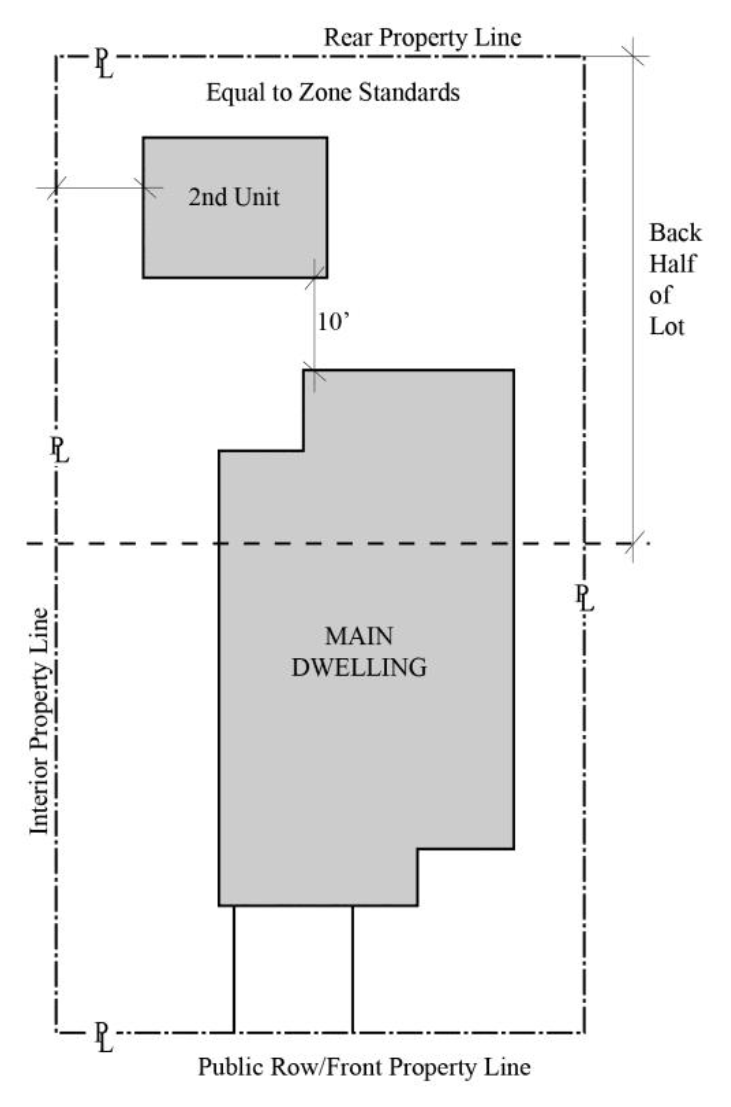
E.
Location, Setbacks. Except as otherwise provided in Subsections 20.410.060.E.1 and 20.410.060.E.4, a detached ADU shall be located within the rear fifty percent (50%) of the lot and shall comply with all setbacks of the applicable Zone required for a single-family residence, provided, however, that the side and rear setbacks shall be a minimum of four (4) feet. The ADU shall be a minimum of ten (10) feet from any structure on-site (eave to eave).
1.
No setbacks are required for an existing living area or accessory structure that is converted to an ADU or is in the same location and to the same dimensions as the original structure.
2.
A setback of four (4) feet from the side and rear lot lines is required for an ADU that is not converted from an existing structure or a new structure constructed in the same location and to the same dimensions as an existing structure.
3.
Except as otherwise provided in Subsections 20.410.060.E.1 and 20.410.060.E.4, an ADU shall not be located within the required front property line setback and shall not be closer to the ROW than the primary dwelling, except that any side or rear setback shall not be required to exceed four (4) feet.
4.
No front setback or location restriction noted in this section shall be required for ADUs pursuant to Government Code Section 66323(a)(2) if no other feasible location on the parcel is available, provided that the following requirements are satisfied:
a.
The ADU has a minimum of four (4) foot side and rear setbacks;
b.
The total floor area of the ADU does not exceed eight hundred (800) square feet;
c.
The ADU is a maximum of sixteen (16) feet in height;
d.
The location of the ADU will allow access to adequate water and sewer services; and
e.
ADU is a detached, new construction unit.
F.
Adequate Public Facilities. Adequate public facilities (including water and sewer) and utilities for the ADU must be available or made available at the time of development and shall be sized in accordance with applicable codes. Local agencies with jurisdiction over utilities must provide utilities for the ADU at the time of development.
1.
Local agencies with jurisdiction over utilities shall determine whether a new or separate utility connection is required to be installed directly between a newly constructed ADU and the utility. An ADU that is created within the proposed space of a single-family dwelling or existing space of a single-family dwelling or accessory structure shall not require a new or separate utility connection.
2.
The County of San Diego Health and Human Services Department must approve any private sewage disposal system that is required under this chapter.
3.
The City must obtain a "will serve" letter from all local agencies with jurisdiction over utilities for the ADU prior to the issuance of a building permit for the construction of the ADU.
G.
Public Facilities and Utilities Fees.
1.
The City does not assess utilities fees or capacity charges.
2.
All public facilities fees required by this chapter shall be proportionate to the burden of the ADU on the public facility, shall be based upon the size of the primary dwelling unit, and shall not exceed the reasonable cost of providing the service. No public facilities fees shall be imposed on ADUs smaller than 750 square feet.
3.
All public facilities fees required by this chapter shall be paid prior to the issuance of any building permit required for the construction of the ADU.
H.
Rental or Sale of ADU. The ADU may be rented for terms 30 days or longer. The ADU may not be sold separately from the primary dwelling unit except when pursuant to Government Code Section 66341. An ADU may be approved and built at the same time as the primary dwelling unit is approved and constructed. This section shall not apply to Junior ADUs.
I.
Occupancy. The maximum occupancy of the ADU shall conform to the latest adopted California Building Code and in conformance with residential standards as adopted by the Zoning Ordinance.
J.
Parking.
1.
A minimum of one (1) on-site paved parking space shall be provided for a new ADU, in addition to the required parking for the primary dwelling unit, except as provided in Subsection 20.410.060.J.4. The additional parking space(s) shall be a minimum dimension of nine (9) feet by eighteen (18) feet.
2.
Off-street parking is permitted in setback areas in locations determined by the City, or through tandem parking, unless specific findings are made by the City that parking in setback areas or tandem parking is not feasible based upon specific site or regional topographical or fire and life safety conditions. Parking spaces are subject to the following:
a.
Parking may be provided on an existing driveway but shall not block sidewalk access or encroach into the public right-of-way.
b.
No more than thirty (30) percent of a front yard shall be dedicated to vehicle parking.
c.
Except for an approved driveway, vehicles must be parked on an acceptable all-weather surface, such as brick, permeable pavers or other stable, dust-free surface deemed acceptable by the Development Services Department and Stormwater Division.
3.
If a garage, carport or covered parking structure is demolished or converted in conjunction with the construction of an ADU, the City shall not require that those off-street parking spaces be replaced. However, if a garage, carport or covered parking structure is demolished or converted in conjunction with the construction of an ADU, any pre-existing driveway parking spaces must be maintained.
4.
No parking standards shall be imposed by the City on an ADU in any of the following instances:
a.
The ADU is located within one-half mile walking distance of public transit as defined in California Public Resources Code § 21155(b) (a location, including, but not limited to, a bus stop or train station, where the public may access buses, trains, subways, and other forms of transportation that charge set fares, run on fixed routes, and are available to the public);
b.
The ADU is located within an architecturally and historically significant historic district;
c.
The ADU is located within an existing primary dwelling unit or an existing accessory structure;
d.
On-street parking permits are required but not offered to the occupant of the ADU; or
e.
There is a car share vehicle located within one block of the ADU;
f.
When a permit application for an ADU is submitted with a permit application to create a new single-family dwelling or a new multifamily dwelling on the same lot, provided that the ADU or the parcel satisfies the requirements of this chapter.
5.
No additional parking is required for a new Junior ADU.
6.
Required parking spaces shall be kept clear and used exclusively for vehicle parking. Such spaces shall not be used for storage or other uses.
K.
Driveway. A driveway connection serving both the main and ADU is highly encouraged where feasible.
L.
Emergency Access. Emergency access and fire apparatus roads shall be provided to the satisfaction of the City of San Marcos Fire Marshal in accordance with the current edition of the California Fire Code.
M.
Fire Sprinklers. Fire sprinklers shall be required for the ADU if required for the primary dwelling unit. Construction of an ADU does not trigger a requirement to install fire sprinkler systems in an existing primary dwelling.
N.
Ridgeline Overlay Zone Restrictions. ADUs in the Ridgeline Overlay Zone must comply with certain sections of Chapter 20.260, including Subsections 20.260.050.E (Building Placement, Maximum Height, and Basements), 20.260.050.F (Architecture), 20.260.050.H (Color and Materials), and 20.260.050.J (Fire Fuel Modification), except as prohibited by state law. However, ADUs in the Ridgeline Overlay Zone shall not be subject to any requirements that conflict with the requirements set forth in this chapter.
O.
Deed Restriction. Prior to the issuance of a building permit for a Junior ADU, a Deed (Land Use) Restriction shall be recorded with the County Recorder that includes all the following:
1.
Prohibiting of the sale of the Junior ADU separately from the sale of the single-family residence, including a statement that the deed restriction may be enforced against future purchasers;
2.
Restricting of the size of the Junior ADU stating that the maximum permitted gross floor area of the Junior ADU is five hundred (500) square feet;
3.
Requiring that the Junior ADU's independent exterior access shall be retained;
4.
Requiring that the Junior ADU be rented for terms thirty (30) days or longer; and
5.
Requiring that one (1) of the dwelling units (main or Junior ADU) shall be owner occupied.
P.
Certificate. A Certificate of Occupancy for an ADU or a Junior ADU shall not be issued prior to the Certificate of Occupancy for the primary dwelling unit.
Q.
Definitions.
1.
"High quality transit corridor" means a corridor with fixed route bus service with service intervals no longer than 15 minutes during peak commute hours.
2.
"Living area" means the interior habitable area of a dwelling unit including basements and attics but does not include a garage or any accessory structure.
3.
"Local agency" means a city, county, or city and county, whether general law or chartered.
4.
"Major transit stop" means a site containing an existing rail or bus rapid transit station, ferry terminal served by either a bus or rail transit service, the intersection of two or more major bus routes with a frequency of service interval of 15 minutes or less during the morning and afternoon peak commute periods, or major transit stops included in the regional transportation plan.
5.
"Passageway" means a pathway that is unobstructed clear to the sky and extends from a street to one entrance of the ADU.
6.
"Public transit" means a location, including, but not limited to, a bus stop or train station, where the public may access buses, trains, subways, and other forms of transportation that charge set fares, run on fixed routes, and are available to the public.
7.
"Tandem parking" means that two or more automobiles are parked on a driveway or in any other location on a lot, lined up behind one another.
(Ord. 2017-1445, 7/11/2017; Ord. No. 2020-1493, § 2(Exh. B), 10-13-2020; Ord. No. 2020-1494, § 2(Exh. B), 11-10-2020; Ord. No. 2024-1551, § 2(Exh. B), 9-24-2024)

