
San Marcos City Zoning Code
CHAPTER 20
435 - PLANNED RESIDENTIAL DEVELOPMENT
Section 20.435.010 - Purpose of Chapter
The purpose of this chapter is to establish a process for allowing flexibility in residential development and design to supplement the single-family development standards of the Residential Zones. PRD is intended to encourage and facilitate the use of contemporary best practices for the development of innovative, compact residential neighborhoods in a range of configurations, which may include standard subdivision, alley loaded, cluster or small-lot development, or courtyard site plans. All PRD areas should accomplish the following:
A.
Facilitate the development of nontraditional single-family and multifamily residences using alternative configurations, lot sizes, or open space and amenity provisions that are otherwise not consistent with the conventional Residential Zone regulations of this Zoning Ordinance.
B.
Promote more economical and efficient use of the land while providing a harmonious variety of housing choices, a higher level of urban amenities, and preservation of natural and scenic qualities of open spaces.
C.
Preserve the function and character of the residential neighborhoods while allowing for progress in the site planning and development of dwelling units to meet the needs of the community.
Section 20.435.020 - Applicability
Figure 20.435-1
PRD Generic Cluster Example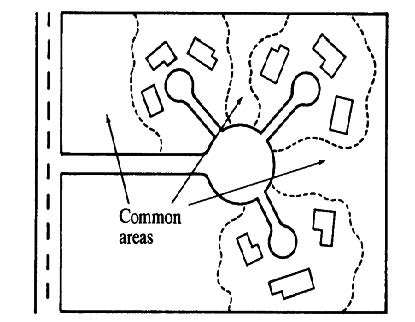
Planned Residential Development may be permitted to create compact and innovative residential developments within all Residential Zones. PRDs shall be subject to a CUP in each of the Zones, and shall only be approved if findings can be made that the development would be consistent with the intent of the applicable Zone, would not adversely affect properties in the vicinity, would not be contrary to the public interest, and would be consistent with the spirit and intent of Section 20.435.010 (Purpose of Chapter). Figure 20.435-1 depicts a generic PRD using cluster development to maximize common open space areas.
Section 20.435.030 - Land Use Regulations
Permitted land uses within a PRD shall be consistent with the land use permit requirements of the applicable Zone, except as follows:
1.
Development shall be limited to one (1)-family, two (2)-family, and multiple dwellings in the respective Zones including dwelling units in developments commonly known as town or rowhomes, condominiums, and cluster housing. Housing types shall be consistent with Table 20.215-2 located in Chapter 20.215 (Residential Zones).
2.
Recreational uses are highly encouraged, including parks; playgrounds; usable common open space; riding and hiking trails; recreational buildings, structures, and facilities; clubhouses; community centers; and similar uses. See Section 20.435.060.E (Open Space).
3.
All open space and recreational uses shall be designed for and limited to use by residents of the planned development and their guests.
Section 20.435.040 - Planned Residential Development Process
All PRD proposals and applications shall be subject to the regulations of Chapter 20.500 (Permits and Applications Process) and the following process requirements:
A.
Permit Required. All single-family PRD proposals and applications shall be subject to a CUP, consistent with the provisions of Chapter 20.520 (Conditional Use Permits). Multifamily proposals and applications shall be subject to Site Development Plan Review, consistent with the provisions of Chapter 20.515 (Site Development Plan Review).
B.
Consistency of Intent. PRD development, by definition, proposes development that is inconsistent with the regulations of the applicable Zone. All PRD proposals shall demonstrate that the proposed development is consistent with the purpose, intent, and character of the applicable Zone, and shall not exceed the density parameters of the General Plan.
C.
Pre-Application. A pre-application preliminary consultation with the Planning Division shall be scheduled by the applicant prior to submitting an application for a PRD, per the provisions of Chapter 20.500 (Permits and Applications Process).
D.
PRD Application. Application for a PRD must be for a parcel of land that is under the control of the person or corporation proposing such planned development. The application shall be accompanied by all of the development application items listed in Table 20.435-1.
E.
Subdivision Map Required. A tentative Subdivision Map created in accordance with the development plan shall be filed whenever the PRD constitutes a subdivision (or division of land) within the terms of this Code. A final Subdivision Map conforming to the approved or conditionally approved tentative Subdivision Map and the requirements of and conditions imposed by the CUP and Site Development Plan Review shall be filed with the County Recorder prior to the issuance of any building permits.
Table 20.435-1
Pre-Application Required Review Items
Section 20.435.050 - Residential Development Standards
All PRD applications and developments shall be designed and constructed in compliance with the following regulations:
A.
Density. In a planned residential development, there shall be no minimum area requirement for individual lots, building sites, or dwelling units.
1.
Within the R-1 Zones, the total area of the PRD shall be equal to the minimum lot size applicable to the Zone, times the number of total dwelling units; development shall be limited to detached dwelling units.
2.
Within the R-2 and R-3 Zones, the maximum number of units shall not exceed the maximum allowed density for the Zone as established by Tables 20.215-3 and 20.215-4.
3.
The number of dwelling units allowable in a PRD shall not exceed the maximum density of the as determined using the Slope Density.
B.
Development Standards. The following development standards shall apply:
1.
Height. Building height shall comply with the Zone in which the PRD is located; the Planning Commission may grant height exceptions where the increased height would not adversely affect the surrounding neighborhood. Additional height shall not be permitted within one hundred (100) feet of the PRD external boundary.
a.
Building height shall be limited to the height of the nearest structure on an adjacent non-PRD lot, unless buffered by one hundred (100) feet or more of open space.
2.
Building Setback.
a.
Minimum twenty (20)-foot setback required for all buildings from the ultimate ROW.
b.
Minimum twenty (20)-foot setback required for all garages with straight in access; fifteen (15)-foot minimum for all other garage configurations.
c.
Minimum twenty-five (25)-foot setback required for all building from the external boundary of the PRD.
d.
Minimum one hundred (100)-foot setback required for all intensive recreation uses from the external boundary of the PRD, unless a permanent intervening open space of at least one hundred (100) feet in width exists on the adjacent property, then twenty-five (25)-foot setback may be permitted.
e.
Minimum five (5)-foot setback required for all buildings from any interior vehicular or pedestrian way, court, plaza, open parking lot, common open space, or any other surfaced area reserved for public or private use. Measurement shall be from back of sidewalk or back of pavement where no sidewalk exists.
3.
Building Separation. Minimum building separation of ten (10) feet required between all buildings.
a.
Each building shall be surrounded on all sides by a ten (10)-foot open space, not to exceed ten percent (10%) in slope.
4.
Parking requirements shall be consistent with the bedroom count of the unit per Chapter 20.340 (Off-Street Parking and Loading).
Section 20.435.060 - Site Design
The PRD shall be designed and developed in a manner compatible with and complementary to existing and potential residential development in the immediate vicinity of the project site.
A.
Perimeter Treatment. Site planning on the perimeter shall give consideration to protection of the property from adverse surrounding influences and protection of the surrounding areas from potentially adverse influences within the development.
B.
Recreational Activities. Intensive recreational use shall not be permitted within one hundred (100) feet of any external boundary that adjoins or is separated by a boundary street from any Residential or Agricultural Zone; this restriction will not apply where permanent intervening open space of at least one hundred (100) feet in width exists on adjacent property, regardless of Zone.
C.
Garage Configurations. Garage doors facing property line boundaries adjacent to any Residential Zones are discouraged. Where possible, site design should create front-on or side-on conditions to shared boundary lines with Residential Zones to maintain the quality and character of the adjacent Zone(s).
D.
Potential PRD Configurations. Flexibility, creativity, and use of contemporary best-practices in architecture and planning can encourage development of a wide range of detached and attached configurations.
E.
Open Space. Required open space shall comprise at least forty percent (40%) of the total area of the planned development.
1.
A minimum of fifty percent (50%) of the required open space shall have an overall finished grade not to exceed ten percent (10%), and shall be suitably improved. All landscaped areas reserved for common use shall be designed and maintained in accordance with the standards of Chapter 20.330 (Water Efficient Landscape Standards).
2.
The remaining fifty percent (50%) of the required open space may also be improved, or left in its natural state for natural feature preservation. Areas devoted to natural or improved flood control channels and those areas encumbered by flowage, floodway, or drainage easements may be applied toward satisfying this portion of the total open space requirement.
3.
Land occupied by recreational buildings and structures may be counted as required open space.
4.
Land occupied by buildings, street, driveways, or parking spaces may not be counted in satisfying this open space requirement.
5.
Open space left in its natural state shall be kept free of litter and shall at no time constitute a health, safety, fire, or flood hazard.
6.
Landscaped areas reserved for common use shall be provided with a permanent watering system adequate to maintain such areas.
7.
Provision of all open space/recreational amenities planned for the PRD are encouraged to be installed concurrent with completion of the first dwelling unit. However, if development is to be accomplished in stages/phases, the development plan shall provide for coordinated improvement of open space and related buildings/improvements with the construction of dwelling units. Each development stage shall include installment of a proportionate share of the total open space.
8.
All or any part of the required open space may be reserved for use in common by the residents of the planned development. Required common open space areas established as part of a PRD shall be reserved in a manner that entitles the City, a public district, or a public agency to enforce the reservation, with the City, public district, or public agency a party to the reservation.
F.
Maximum Slope. Slope surrounding the building pad shall not exceed ten percent (10%) within ten (10) feet in all directions measured from the external building/dwelling walls.
G.
Circulation.
1.
Public Streets. All streets within the PRD that fall within the City's functional street classifications shall be improved to City standards for the particular classification of street, and shall be offered for dedication to the public. The City may reject the offer of dedication, forcing development of private streets.
2.
Private Streets. The developer may retain circulation internal to the PRD as private streets. The following forms of access shall be retained as private streets:
a.
Driveways;
b.
Open parking spaces or areas;
c.
Motor courts or plazas.
3.
Pedestrian walkways or paseos, such as pedestrian ways, courts, plazas, driveways, or open parking lots, shall not be offered for dedication.
4.
These private common access areas shall be permanently reserved and maintained for their intended purpose by means acceptable to the Director and City Attorney.
H.
Access.
1.
Any building or any dwelling unit that is located more than one hundred (100) feet from a public or private street or other vehicular way shall have pedestrian access to the ROW capable of accommodating emergency and service vehicles. Design shall be approved by the Fire Marshal.
2.
For alley and motor court vehicular access to units, a minimum paved width of twenty-four (24) feet shall be maintained between buildings.
I.
Off-Street Parking. Within the PRD, the following parking standards shall apply as a modification to the standard parking requirements of Chapter 20.340 (Off-Street Parking and Loading).
1.
All driveways measuring a minimum of twenty (20) feet in length shall be considered a required non-assigned parking space within a PRD. Driveway spaces shall not count toward guest parking.
2.
All off-street parking areas not under cover shall be screened from view of nearby residents of the development by shrubs or other appropriate landscape features.
J.
Identity Signage. Each PRD shall be permitted one (1) monument or other sign identifying the development at the principal entrance to the development.
1.
This sign shall comprise not more than two (2) sign surfaces of thirty (30) square feet each.
2.
The sign shall be consistent with the architectural style of the PRD.
3.
If the sign is illuminated, illumination shall be limited to continuous reflected light.
Section 20.435.070 - Other Development Criteria
A.
Relation to Natural Features. The PRD shall relate harmoniously to the topography of the site, make suitable provision for preservation of water courses, wooded areas, rough terrain, and similar natural features and areas, and shall otherwise be so designed as to use natural features and amenities to the best advantage.
B.
Fire Protection. Fire hydrants and connections shall be installed as required by the San Marcos Fire Department and shall be of a type approved by the Fire Marshal. The proposed project shall comply with Fuel Modification requirements to the satisfaction of the Fire Marshal.
C.
Signs. Interior street, building, and other signs shall be uniform in design and reflect good taste in style and size.
D.
Night Lighting. Light fixtures for walls, parking areas, driveways, and other facilities shall be provided in sufficient number and at proper locations to ensure safe and convenient nighttime use. For normal street lighting, applicable City standards and regulations shall apply.
Section 20.435.080 - Modification of Requirements
Modification of the standards of this section may be granted by the Planning Commission when it determines that such modification will not be detrimental to the subject development, adjacent properties, or the public interest, provided, however, that no modification be granted for the density requirements or the total open space requirement of this chapter.
A.
Other Applicable Applications. In addition to the PRD application, all applications that include the following conditions shall be considered a PRD application and processed in the same manner:
1.
Any application proposing to substitute open space or recreation for a portion or the required lot area.
2.
Any CUP application for a neighborhood housing development.

