
San Marcos City Zoning Code
CHAPTER 20
445 - REFUSE AND RECYCLING
Section 20.445.010 - Purpose of Chapter
This chapter provides operational and development standards for the provision of safe and adequate facilities to implement Public Resources Code Sections 42900 through 42911 for the reduction of refuse generation. Specifically, this chapter does the following:
A.
Provides standards of convenient and accessible space for collection, storage, and loading of such facilities.
B.
Promotes the public health, safety, and general welfare of the City and its citizens by minimizing adjacency conflicts.
C.
Regulates convenient and accessible space for storage and collection of refuse and recycling facilities.
Section 20.445.020 - Applicability
All new construction within any Zone shall provide adequate space for recycling and refuse receptacles per the provisions of this chapter. All recycling and refuse receptacles shall have a dedicated enclosure area and be consistent with the standards of this chapter.
A.
Review Required. The review of recycling and refuse facilities shall be an integral part of any project application. Compliance with all recycling and refuse facilities standards shall be required, unless otherwise modified by a CUP.
B.
New Construction. A refuse storage area for the collection of trash and recycled goods shall be provided at the time any structure is constructed.
C.
Requirement. Any building remodeling or additions (greater than ten percent (10%( of value or equal to twenty percent (20%) or more of floor area) or discretionary permit shall require the addition of recycling and refuse facilities per the standards of this chapter. The additional facilities shall be completed concurrently with the remodeling/addition construction.
Section 20.445.030 - General Standards
The following provisions and the standards of Table 20.445-1 shall apply to all commercial, industrial, public/institutional, mixed use, and multifamily development in any Zone:
A.
Adequate Facilities. In all Zones, refuse and recycling containers shall be adequate in capacity, number, and distribution to serve the existing and future occupants in an environment that is free from trash and debris. Recycling bins shall be provided in all locations where refuse bins are provided to enable convenience and ease in the recycling of materials.
B.
Enclosure. All refuse and recycling materials and collection bins shall be enclosed on four (4) sides unless the materials and bins are stored within a legally approved building. See Figure 20.445-1.
1.
A swinging double door as an access gate with locking capabilities shall be included on one (1) side of the enclosure. The enclosure shall be designed with decorative heavy-gauge metal gates with cane bolts on the doors to secure the gates when in the open position. Doors or gates to the enclosure shall be self-closing.
2.
Enclosures shall provide walk-in pedestrian access without having to open the main enclosure gate if said facility is larger than ten (10) by fourteen (14) feet in dimension.
3.
Enclosures shall be constructed of solid masonry material with decorative exterior surface finish compatible to the main building(s). Split-face concrete block finish is recommended. Brick or tile veneer exterior finish should be avoided.
Figure 20.445-1
Refuse and Recycling Enclosure Standards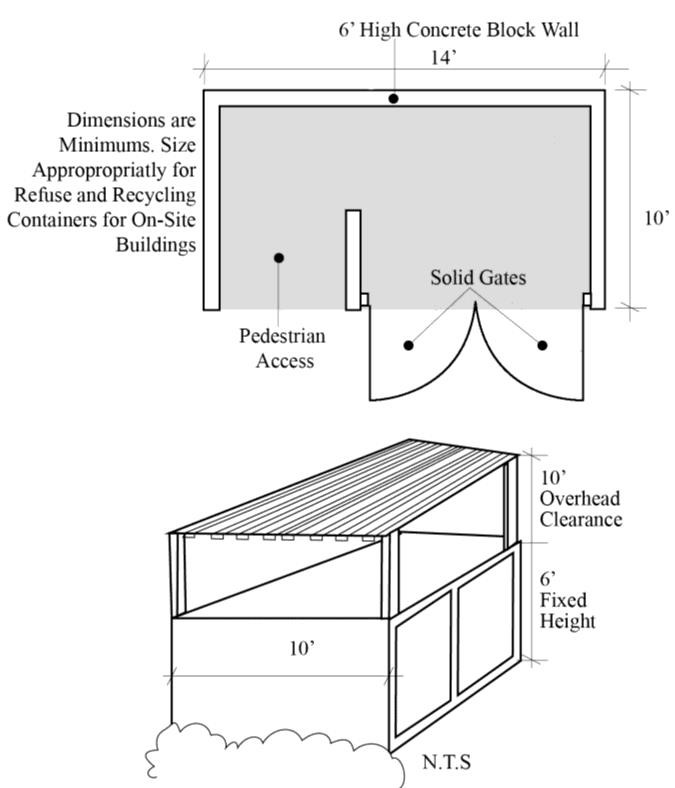
4.
No material shall be stacked higher than the enclosure walls/fence.
5.
A level reinforced concrete slab shall accommodate the entire structure footprint, extending forty-eight (48) inches in front of the access gates, and shall be constructed at the same level as the existing asphalt. Raised bumper guards shall be installed along the inside walls of the enclosure to prevent the dumpster from contacting the enclosure walls.
6.
The enclosure shall have an architecturally compatible solid roof/cover feature, with the design to be approved by the Director. Open roof/covers may be permitted if the dumpsters and recycle bins have closable lids.
7.
The access gate shall be painted steel and generally obscuring the view of the enclosure contents.
C.
Location. Recycling and refuse storage enclosures shall not be located in any required front setback, court, alley, or required landscape or parking space.
1.
Enclosures shall not be located closer to the public ROW than the main structure.
D.
Accessible Design. Each recycling/refuse storage enclosure shall be consistent with Table 20.445-1 and the following standards. All standards shall be evaluated based on site design and circulation, subject to Director review and approval during Site Development Plan Review, if applicable.
1.
The overhead clearance is required in all conditions, including at roof lines such as overhanging carports or cantilevered stories.
2.
The structure shall contain concrete or asphalt drives of sufficient strength to accommodate 54,000 pounds distributed on ten (10) wheels.
3.
The structure shall be designed so that vehicular backing movements into a public ROW are not necessary.
Table 20.445-1
Refuse and Recycling Enclosure Standards
All standards are minimums unless otherwise notes. All standards are dependent on
site design and circulation, subject to Director review and approval.
PL = property line
E.
Architectural Compatibility. All recycling and refuse storage areas, including covers and doors, shall be compatible with the architectural treatment of the primary building on the parcel.
F.
Blank Walls Prohibited. Blank walls are prohibited. Where screening or security walls (excluding fences) are located within ten (10) feet of a public ROW, landscaping shall be provided between the wall and the ROW to a minimum height of forty-two (42) inches to minimize opportunities for crime and unsafe conditions.
G.
Multifamily Development. Refuse and recycling shall not be stored in balcony or porch spaces. The standards of Section 20.445.030 (General Standards) shall apply to all multifamily development.
Section 20.445.040 - Reverse Vending Machines
Reverse vending machines shall be allowed as an accessory use, subject to the following standards. Each reverse vending machine shall:
1.
Be capable of dispensing cash or a certificate for aluminum and non-aluminum metals, glass, and plastic.
2.
Be located adjacent to a building wall and within twenty (20) feet of the main entrance of a market/store.
3.
Not exceed the following size and bulk standards for each reverse vending machine:
i.
fifty (50) square feet of bulk; and the
ii.
height shall not exceed eight (8) feet.
4.
Be located in a manner that does not obstruct pedestrian or vehicular circulation.
5.
Be constructed with durable waterproof and rustproof materials, designed with a color scheme that is in harmony with the surrounding buildings and development. Machines shall be illuminated to ensure safe operation.
6.
Be maintained in a clean and litter-free condition on a daily basis.
7.
Be available and in operation during the operation of the market/store.
Section 20.445.050 - Single-Family Residential Standards
Standards of Section 20.445.030 (General Standards) shall not apply to single-family homes. All single-family homes shall provide a clear space for storage of recycling and refuse containers. The space shall be as follows:
1.
A minimum dimension of five (5) feet by five (5) feet located within the side setback area.
2.
Located behind residential fencing a minimum of five (5) feet in height.
3.
No material shall be stacked higher than the fencing.
4.
Shall not be located within the required front setback or closer to the front property line than the front façade of the dwelling unit.

