
San Marcos City Zoning Code
CHAPTER 20
335 - WALLS AND FENCES
Section 20.335.010 - Purpose of Chapter
The purpose of this chapter is to regulate the development, installation, and maintenance of private walls and fences within the community. Specifically, this chapter does the following:
A.
Promotes the public health, safety, and general welfare of the City by regulating the fences and walls protecting or separating real property.
B.
Further modifies the operation of allowable land uses by regulating the installation, operation, and maintenance of all walls and fences.
(Ord. No. 2017-1450, 9-12-2017)
Section 20.335.020 - Applicability
The provisions of this chapter shall be applicable to all walls and fences required by any land use or within any Zone of this Title except as modified by Chapters 20.400 (Specific Use Standards) or 20.445 (Refuse and Recycling).
A.
Review Required. The review of fences and walls shall be an integral part of any site plan, permit, or Site Development Plan Review application. Compliance with all wall and fence standards shall be required, unless otherwise modified by a DP.
B.
Swimming Pools, Spas, and Similar Features. Swimming pools, spas, and similar features shall be fenced in accordance with the California Building Code.
(Ord. No. 2017-1450, 9-12-2017)
Section 20.335.030 - General Development Standards
A.
Architectural Compatibility. Walls, fences, and architectural screening elements shall be compatible with the architectural treatment of the primary building on the parcel, and shall meet all standards applicable to the Zone unless otherwise modified by this chapter.
B.
Visibility. No wall, fence, or landscaping element shall interfere with intersection visibility or line of sight or other safety issue. See Figure 20.300-4.
C.
Blank Walls Prohibited. Blank walls are prohibited. Where screening or security walls (excluding wrought iron fences} are located within ten (10) feet of a public ROW, landscaping shall be provided between the wall and the ROW to a minimum height of forty-two (42) inches to minimize opportunities for crime and unsafe conditions.
D.
Permitted Materials. Approved materials include: wood, vinyl, stone, masonry, brick, block, stucco, wrought iron, and concrete. Where opaque walls are required, they shall be constructed of brick, split-face block, stone, or frame-stucco.
E.
Prohibited Materials.
1.
Barbed, razor, concertina, corrugated metal and plastic, tarps, and electrified wire of any kind or configuration is prohibited in all Zones, except as modified by Section 20.335.030.E.2 below.
2.
Woven wire, barbed wire, or electrified fencing may be permitted in the front and side yards of all Agricultural (A) Zones only if needed to secure livestock and/or horses; maximum height not to exceed seventy-two (72) inches.
3.
Chain-link fencing and similar material are prohibited along any public ROW regardless of setback. Where chain-link fencing is used, it shall not be visible from the public ROW. This standard shall apply to all Zones except Agricultural (A) Zones.
F.
Maximum Height. The height of all walls, fences, and architectural screening elements shall be measured from the finished grade of the property to the highest point of the element.
1.
Table 20.335-1 established maximum wall/fence heights by Zone.
2.
Where additional height is needed based on security or specific site operating requirements, additional wall/fence height may be approved through a DP, subject to evaluation of adjacencies and necessity.
3.
Hedges or other vegetation shall not exceed the maximum height of walls permitted in the Zone so located.
Figure 20.335-1
Fence Height by Location (applicable to R Zones)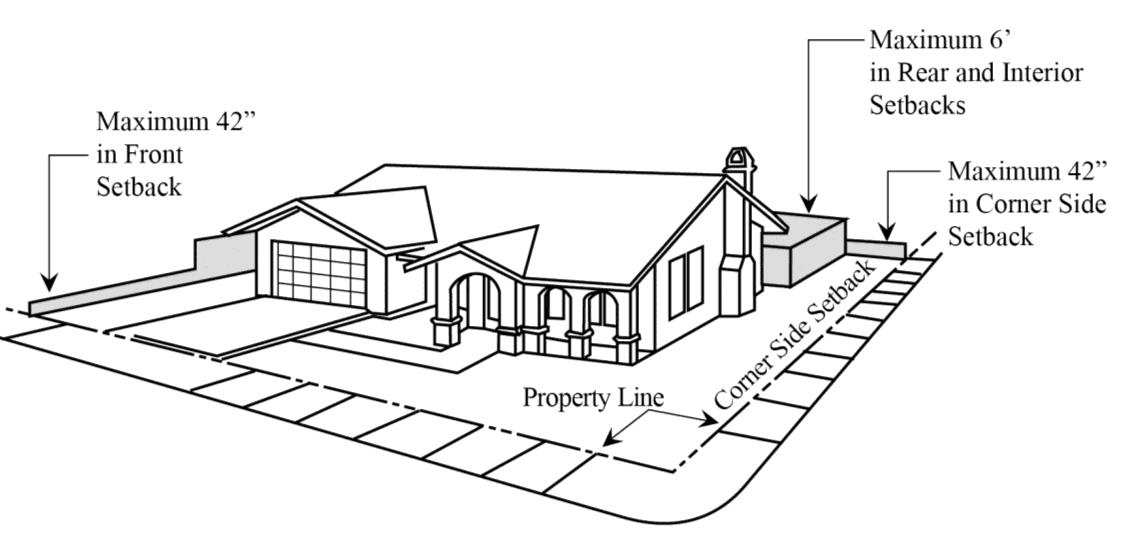
Table 20.335-1
Wall/Fence Maximum Height Standards by Zone
Note: - - - = not permitted. Heights may be modified by DP or the standards of Chapter 20.400 (Specific Use Standards).
*Or as regulated by Sections 20.335.050 (Single-Family Residential Requirements) and 20.335.060 (Agricultural Zone Standards); privacy fence allowed along rear and interior property
lines to the maximum height indicated.
(Ord No. 2017-1450, 9-12-2017)
Section 20.335.040 - Non-Residential and Mixed Use Requirements
Walls and fences define space, provide buffers between properties and uses, and may be used for security purposes. Where fences and walls are used they shall comply with the provisions of this chapter. Fences and wails shall comply with one (1) or a combination of the following fencing standards, as appropriate for the parcel and adjacent uses:
A.
Required.
1.
The use of fences and walls along public ROWs is not required in non-residential and Mixed Use Zones, unless specifically required in conjunction with a land use per the standards of Chapter 20.400 (Specific Use Standards).
2.
Opaque decorative masonry walls, fixed height of six (6) feet, shall be constructed along all property lines abutting properties that have more restrictive Zone.
B.
Open-Style Standards. Open-style fences such as spaced wood, chain-link with redwood slats, and ornamental iron, can be provided when that type of fencing complies with one (1) of the following landscaping requirements, subject to Director approval:
1.
Gaps in spaced wood (or simulated wood) fences not to exceed four (4) inches, or one-half (1/2) the width of the average board or slat, whichever is less.
2.
Planting with sufficient vines or climbing ivy of an acceptable density to ensure complete view-obstructing screening within one (1) year of planting.
3.
Combination of landscaped berm and solid masonry block wall to a minimum height of six (6) feet. Trees of the evergreen variety or other year-round, leaf-bearing type shall be planted so that they exceed this minimum height.
4.
Combination of trees and shrubs of the evergreen variety, or other similar year-round, leaf-bearing type, set away and in front of the fence line so as not to encroach over the fence. Such plants shall be of such variety and shall be clustered so as to allow only minimal gaps between foliage of mature trees and shrubs within one (1) year after planting.
5.
Evergreen shrubs or other similar year-round, leaf-bearing shrub, planted with such spacing so as to form a solid hedge with a minimum of eight (8) feet in height within one (1) year after planting.
6.
All planting and landscaping shall be in compliance with Chapter 20.330 (Water Efficient Landscape Standards).
C.
Mixed Use Limitations.
1.
Mixed Use Zones may use wrought iron or decorative metal fencing and gates along public ROW setback lines to a maximum height of six (6) feet.
2.
Walls along the ground floor public ROW shall be limited to forty-two (42) inches in height and may only be allowed in conjunction with a residential use or outdoor dining. Walls/fences in conjunction with other non-residential uses are prohibited.
3.
No fence or wall shall be closer to the front or public ROW property line than the minimum setback applicable to the Zone or ROW, except for outdoor dining per Chapter 20.400 (Specific Use Standards).
D.
Maintenance. Fences and walls shall be constructed of new material and shall be maintained in a state of good repair. Any dilapidated, dangerous, or unsightly fences or walls shall be repaired or removed.
(Ord. No. 2017-1450, 9-12-2017)
Section 20.335.050 - Single-Family Residential Requirements
A.
Property Boundary Walls. Walls and/or fences for privacy or aesthetics along property boundaries are permitted per the following standards; see Figure 20-335-1.
1.
Front setback area maximum height forty-two (42) inches.
a.
Residential parcels adjacent to major thoroughfares may be permitted a sound wall to an increased height of six (6) to eight (8) feet based on lot configuration and sound wall needs subject to Director and City Engineer approval and building permit requirements.
2.
Side street setback area maximum height of forty-two (42) inches within the front setback area, otherwise six (6) feet.
3.
Side, interior and rear property lines maximum height six (6) feet.
a.
Residential parcels adjacent to non-residential uses/parcels may be permitted a wall to an increased height of six (6) feet based on lot configuration and sound wall needs subject to Director approval and building permit requirements. Wall/fence requirements for the nonresidential use shall apply.
(Ord. No. 2017-1450, 9-12-2017)
Section 20.335.060 - Agricultural Zone Requirements
A.
Property Boundary Fences/Walls. Walls and/or fences for privacy or aesthetics along property boundaries are permitted per the following standards:
1.
Front setback area maximum height forty-two (42) inches, except as follows:
a.
On lots of one (1) gross acre or larger in size, open fences consisting of wrought iron, tubular steel, pipe corral, vinyl-coated chain-link, or rails may be a maximum of sixty (60) inches in height. For the purposes of this chapter, "open fences" means any fence which is ninety (90) percent open/transparent. For all corner lots, the line-of-sight triangle shall not be obstructed and fences shall not exceed forty-two inches within this area (see Figure 20.300-4).
b.
Posts, pilasters, or other support elements for such fences shall not exceed twenty-four (24) inches in any horizontal measurement (width and diameter), shall be spaced a minimum of eight (8) feet apart (edge to edge), and shall not exceed a height of sixty-six (66) inches.
c.
The maximum height of driveway entry gates and associated pilasters shall not exceed seventy-eight (78) inches. A driveway entry gate and associated pilasters shall be located adjacent to a driveway and may be located within the front yard setback area, provided a minimum twenty (20)-foot setback is maintained to the edge of the street intersecting the driveway to allow the vehicle entering the property to stop in the driveway during operation of the gate without impacting traffic in the street.
2.
Side street setback area maximum height of forty-two (42) inches within the front setback area, otherwise, six (6) feet. In the side street setback area for corner lots, fencing shall have a maximum height of 6 feet except for any portion that extends into the front yard setback area where the maximum height shall be 42 inches, except as follows:
a.
On lots of 1 acre or larger in size, an open fence as described in Section 20.335.060.A.1.a may be allowed up to sixty (60) inches in height within the front yard setback area. The line-of-sight triangle shall not be obstructed therefore any fence within this area shall not exceed forty-two (42) inches in height (see Figure 20.300-4).
3.
Side, interior and rear property lines maximum height of six feet.
(Ord No. 2017-1450, 9-12-2017)

