
St Pete Beach City Zoning Code
DIVISION 22
LANDSCAPING AND TREE PROTECTION1
Editor's note— Ord. No. 2005-38, § 2, adopted Nov. 8, 2005, amended Div. 22, in its entirety, to read as herein set out. Prior to inclusion of said ordinance, Div. 22 pertained to similar subject matter. See also the Code Comparative Table.
Sec. 22.1.- Purpose and intent.
It is the intent and purpose of these regulations to provide standards for landscaping and tree protection to improve the appearance of the city, as well as assist in the natural control of air and water pollution and soil conservation. Emphasis shall be placed upon landscaping as a means of achieving beauty in the community. It will be required on all projects, and in some projects and areas it will be the primary tool available. Landscaping is considered extremely important to the aesthetic and environmental goals of the city.
(Ord. No. 2005-38, § 2, 11-8-05)
Sec. 22.2. - Applicability.
The minimum requirements set out in this section are applicable to each zoning district relative to tree protection, the landscaping of certain setback areas and additional required on-site landscaping, including vehicular use areas. Landscape design and planning shall be integrated into the overall design concept and not be considered merely as an afterthought. Towards this end, proposed landscaping schemes will be evaluated as to their relationship to the existing natural landscape, developed and other proposed landscape, including those on adjacent properties and street rights-of-way and the building or buildings proposed. The city may require additional landscaping if it deemed important for buffering or screening.
(Ord. No. 2005-38, § 2, 11-8-05)
Sec. 22.3. - General requirements.
(a)
Plan approval. All new construction, except single-family and two-family dwellings as regulated under section 22.5, must have a site plan and landscape plan approved by the city prior to the issuance of a building permit.
(b)
Screening of certain areas. Screening shall be employed for parking lots as required, and to mask from the public view such service areas as trash and garbage areas, outside equipment of unaesthetic character, and accessory buildings or areas not enhancing or in keeping with the aesthetics of the project or the neighborhood.
(c)
Installation. All landscaping shall be installed in accordance with the approved landscape plan prior to issuance of a certificate of occupancy and shall be installed in accordance with accepted landscape practices within the area. All plant material listed as Category I by the Florida Exotic Pest Plants Council (FEPPC) shall be removed prior to issuance of certificate of occupancy.
(d)
Maintenance. The owner and tenant, or their agent, if any, shall be jointly and severally responsible for the maintenance of all landscaping in accordance with section 22.10, and landscaped areas shall be so maintained as to present a healthy, neat and orderly appearance and shall be kept free from refuse and debris. If trees, shrubs or other landscape material should die, such materials must be replaced within 30 days.
(e)
Protection of landscaped areas. All landscaped areas shall be protected from vehicular encroachment by curbs, wheel stops or other similar device.
(f)
Preservation of existing plant material. In instances where healthy plant material exists on a site prior to its development, in part or in whole, for purposes of off-street parking or other vehicular use areas, or in conjunction with other landscaping requirements, an applicant will be encouraged to retain such landscaping. The city manager may adjust the application of the standards set out in this section to allow credit for such plant material if, in his opinion, such an adjustment is in keeping with and will preserve the intent of this section.
(g)
Reclamation. In the event construction activity ceases on a zoning lot that has been cleared of vegetation, the owner shall be required to restore sufficient vegetation and/or provide such other means, as determined by the city, to ensure the stability of the soil on the lot.
(Ord. No. 2005-38, § 2, 11-8-05)
Sec. 22.4. - Type, quality and size of plant material.
(a)
Quality. Plant materials used in conformance with the provisions of this article shall conform to the standard for Florida No. 1 or better, as given in Grades and Standards for Nursery Plants, part I, 1963, and part II, published by the Florida Department of Agriculture, or equal.
(b)
Invasive exotic plant materials. No plant listed by the Florida Exotic Pest Plants Council shall be counted towards the required landscaping.
(c)
Trees. Except as otherwise provided herein, all trees planted under the provisions of this Code shall be of a species having an average crown of greater than 15 feet at maturity and having a trunk which can be maintained in a clean condition, free of branches, from grade to five feet above grade. Trees having an average mature spread of crown less than 15 feet may be substituted by grouping the trees so as to create the equivalent of a 15-foot crown spread.
(1)
Canopy trees shall have a minimum height of 12 feet and a DBH dimension of three inches at the time of planting. A recommended list of canopy trees and palms to be used includes but is not limited to the following types:
Quercus virginiana (Live Oak)
Conocarpus erectus (Buttonwood)
Conocarpus erectus serviceus (Silver Buttonwood)*
Tabebuia Caraba (Silver Trumpet/Yellow Flower)*
Pinus elliottii (Slash Pine)
Tabebuia argentia (Gold Tree)
Swietenia mahogani (Mahogany)
Celtis laevigata (Sugarberry)
Platanus occidentalis (Sycamore)
Juniperus silicicola (Southern Red Cedar)
Bucida buceras (Black Olive)
(2)
One of the following palms is equivalent to one required canopy tree when planted at the required height of 12 feet of clear trunk:
Phoenix dactylfera (Medjool Date Palm)*
Phoenix canariensis (Canary Island Date Palm)
Roystonea elata (Royal Palm)*
Cocos nucifera (Coconut Palm)*
Or any single or multi-stemmed palm known to be of equivalent mature size.
(3)
Three of the following palms are equivalent to one required canopy tree when planted at the required height of eight feet of clear trunk:
Syragus romanzoffiana (Queen Palm)
Acoelorrhaphe wrightii (Paurotis Palm)
Sabal palmetto Cabbage Palm (Sabal Palm)*
Washingtonia robusta (Washingtonian Palm)
Or any single palm known to be of equivalent mature size.
(4)
Required canopy trees may be replaced with under-story trees when the mature height of the canopy trees will conflict with overhead power lines, excluding service drops. Appropriate setbacks of trees from such power lines, as referenced by Florida Power and Light's "Plant the Right Tree in the Right Place" publication shall be required, a copy of which is on file at the office of the city clerk.
(5)
Accent/under-story trees shall be a minimum of eight feet in overall height and a tree DBH dimension of two inches at the time of planting.
(6)
The following is a recommended list of accent/under-story trees to be used:
Jatropha Hastata Compacta (Jatropha)*
Coccoloba Uvifera (Sea Grape)
Coccoloba diversifolia. (Pigeon Plum)
Tecoma stans (Yellow Elder)
Persea borbonia (Redbay)
Ilex vomitoria (Yaupon Holly)*
Callistemon vaminalis (Weeping bottlebrush)
Eriobotrya japonica (Loquat)
Myrica cerifera (Wax Myrtle)
Lagerstroemia indica (Crepe Myrtle)
(d)
Credit for saving existing trees. No credit shall be given to canopy trees identified by these regulations as nuisance trees. The following trees shall be considered nuisance trees: Malalueca quinquenervia (Punk Tree), Schinus terebinthifolius (Brazilian Pepper), Casuarina spp. (Australian Pine), Cupaniopsis anacardioides (Carrotwood), Melia azedarack (China Berry), and Sapium sebiferum (Chinese Tallow) or any tree listed by the Florida Pest Plant Council. Credit is given for existing canopy trees, in good health as provided below:
(1)
Credit is given at the following ratios for existing canopy trees in good health to be preserved:
4″—10″ DBH = 1 tree
10″—20″ DBH = 2 trees
Over 20″ DBH = 3 trees
(2)
Credit is given at the ratio of three palms to one tree for existing native palms.
(3)
A maximum ten percent required parking credit may be allowed for the purpose of preserving native trees.
(e)
Shrubs and hedges. Shrubs and hedges shall be a minimum of two feet in height when measured immediately after planting. Hedges, where required, shall be planted and maintained so as to form a continuous unbroken solid visual screen within one year after time of planting. A recommended list of shrubs and hedges to be used includes, but is not limited to, the following:
Rapholepis Indica (Dwarf Indian Hawthorne)*
Conocarpus erectus (Buttonwood)
Coccoloba Uvifera (Sea Grape)
Allamanda Cathartica (Dwarf Allamanda)*
Plumbago Capensis (Blue Plumbago)*
Serenoa Repens (Saw Palmetto)*
Penta Lanceolata (Pentas)*
Chrysobalanus icaco (Cocoplum)
Myrica pumila (Dwarf Wax Myrtle)
Ilex vomitoria (Dwarf Yaupon Holly)
Lantana involucrata (Beach Lantana)
Viburnum obovatum (Walter Viburnum)*
(f)
Ground covers. Vegetative ground covers in lieu of grass, in whole or in part, shall be planted in such a manner as to present a finished appearance and reasonably complete coverage. In no instance shall nonvegetative pervious material (for the purposes of this section, stone, shell, gravel, and artificial turf only) be utilized for more than 20 percent of the minimum required pervious area, nor shall such material adversely affect abutting properties, waterways, or the right-of-way. The 20 percent maximum nonvegetative portion of the required pervious area may be increased administratively if the property owner installs an innovative landscape design that incorporates features that retain stormwater onsite, reduces the need for ground water irrigation, or increases the tree canopy as determined by professional best practices which include, but are not limited to, Florida-friendly landscaping, xeriscaping, and low-impact development. New construction that exceeds 10% of the zoning lot area, or the granting of an undue and unnecessary hardship variance or practical difficulty variance, shall require full compliance with this section. A recommended list of vegetative ground covers to be used includes, but is not limited to, the following:
Gallardia Pullchella (Gallardia)*
Helianthus Debius (Beach Sunflower)*
Lantana Camara (Dwarf Yellow Lantana)*
Trachelospernum Jasmine Varigated (Varegated Confederate Jasmine)*
Trachelospernum Jasmine Minima Varegated (Varegated Dwarf Confederated Jasmine)*
Trachelospernum Jasminoides (Confederate Jasmine)*
Licania michauxii (Gopher Apple)
Scaevola plumieri (Inkberry)
Stachytarpheta jamaicensis (Prone Porterweed)*
Zamia pumila (Coontie)*
Muhlenbergia capillaris (Muhley Grass)*
(g)
Lawn grass. Grass areas shall be planted in species normally grown in permanent lawns in the city area. Grass areas may be sodded, plugged or sprigged, except that solid sod shall be used in swales or other areas subject to erosion. A recommended list of ground covers to be used includes but is not limited to, the following:
Stenotaphrum secundatum (St. Augustine)
Paspalum vaginatum (Seashore Paspalum)
(Ord. No. 2005-38, § 2, 11-8-05; Ord. No. 2017-30, § 2, 2-27-18; Ord. No. 2019-18, § 2, 12-10-19)
Sec. 22.5. - Landscaping for single-family and two-family dwellings.
All new or substantially improved single-family and two-family dwellings shall be landscaped in accordance with this subsection prior to the issuance of a certificate of occupancy.
(a)
Trees required. All trees shall meet the standards of section 22.4. The number of trees required to be planted upon construction of a single-family and two-family dwelling shall be as follows:
(b)
Credit for remaining trees. If, on a zoning lot for a single-family or two-family dwelling, existing trees can be saved and will remain in good condition when construction is complete, credit shall be given pursuant to section 22.4(d).
(c)
Other materials. The remainder of the required landscaped areas shall be adequately landscaped with shrubs, grass, ground cover or other landscape treatment as described in subsection 22.4.
(Ord. No. 2005-38, § 2, 11-8-05)
Sec. 22.6. - Landscaping for all other developments.
(a)
New multifamily and all nonresidential developments. New multifamily and all nonresidential developments shall be landscaped in accordance with the applicable provisions of this section.
(b)
Additions to existing buildings. When the cost of any addition to or renovation of an existing multifamily or nonresidential building is determined to be a substantial improvement, as defined in Division 2, the property shall be landscaped in accordance with paragraph (a) prior to the issuance of a certificate of occupancy. If the proposed addition or renovation will not constitute a substantial improvement and if the property does not comply with the requirements of this division, one square foot of landscaping for each one square foot of additional building area shall be required. If no buildings are constructed, landscaping equal to the following table shall be required.
In the event that the required landscaping cannot be placed on the property in such a way as to permit proper maintenance, said landscaping may be placed in the public right-of-way with the approval of the city. If that is not practical, a payment in accordance with the table above may made to the city for landscaping in an appropriate area.
(c)
Changes in use. Changes in use of existing buildings shall require the landscaping of the property to bring it into full compliance with all the standards provided in this section.
(d)
Community Redevelopment District (CRD). All new projects within the CRD abutting Gulf Boulevard and Blind Pass Road are encouraged to utilize plant material marked with an (*) within the front setback.
(Ord. No. 2005-38, § 2, 11-8-05)
Sec. 22.7. - Development standards.
(a)
Front setback areas. Required landscaping in front setback areas in all districts, except RU-1, RU-2 and RLM-1, shall be as follows:
(1)
Minimum size of landscaped areas. Except where driveways and walkways providing ingress and egress crossing the property line, the entire length of the property frontage shall be landscaped and shall have a minimum depth from the front property line inward to the property equal to ten percent of the adjacent right-of-way width.
(2)
Minimum number of trees. The total number of trees shall not be less than one for each 180 square feet or fraction thereof of the area to be landscaped.
(3)
Other materials. The remainder of the required landscaped areas shall be adequately landscaped with a mixture of shrubs, grass, ground cover or other approved landscape treatment.
(b)
Vehicular use areas. Except along the boundary of a vehicular use area that is landscaped in accordance with paragraph (a) preceding, other vehicular use areas, where such areas will not be entirely screened visually by an intervening building or structure from any abutting property line there shall be provided landscaping between such areas and such property lines as follows:
(1)
Planting area. A strip of land at least six feet in depth, located between the property line and the vehicular use area shall be landscaped.
(2)
Minimum number of trees. The minimum number of trees is one tree for each 30 linear feet or fraction thereof.
(3)
Minimum size of landscaped areas. Except for driveways crossing property lines, the entire boundary of the vehicle use area shall be landscaped.
(4)
Hedge required. Unless otherwise approved during the site plan review process, a hedge in accordance with section 22.4 of at least two feet in height shall be placed along the entire length of such landscaped area.
(5)
Other materials. The remainder of the required landscaped area shall be landscaped with grass, ground cover or other approved landscaping treatment.
(c)
Interior landscaping for vehicular use areas.
(1)
Area to be landscaped.
a.
Minimum area per parking space. Off-street parking areas shall have at least 20 square feet of interior landscaping for each parking space, excluding those spaces abutting a perimeter for which landscaping is required by other parts of this section.
b.
Minimum area relative to other vehicular use areas. In addition, other vehicular use areas, such as loading areas or vehicle storage lots, shall have two square feet of landscaping area for each 100 square feet or fraction thereof.
c.
Determination of size of vehicular use areas. Where the property contains both parking areas and other vehicular use areas, the two types of areas may be separated for the purposes of determining the other vehicular use areas by first multiplying the total number of parking spaces by 300 and subtracting the resulting figure from the total square footage of paved areas.
d.
Minimum size of landscaped areas. Each separate landscaped area shall contain a minimum of 400 square feet and shall have a minimum dimension of at least ten feet, unless otherwise specifically provided for elsewhere in this Code.
e.
Parking areas with fewer than 20 parking spaces. On properties with fewer than 20 total parking spaces, interior landscaping required above may be added to the perimeter landscape areas pursuant to paragraph (3) below.
(2)
Plant materials.
a.
Generally. Each separate landscaped area shall include at least one tree, as specified in section 22.4(c), with the remaining area adequately landscaped with shrubs, ground cover or other approved landscaping material.
b.
Minimum number of trees. The total number of trees shall not be less than one for each 100 square feet or fraction thereof of required interior landscaping areas.
c.
Location of landscaped areas. Such landscaped areas shall be located in such a manner as to divide and break up the expanse of paving and at strategic points to guide traffic flow and direction.
(3)
Exception. In off-street parking areas and other vehicular use areas where the strict application of this section will seriously limit the function of such area, the required landscaping may be permitted to be located along the perimeters of the area, including such perimeters which may be adjacent to the building on the site. Such landscaping shall be in addition to all other landscaping requirements.
(d)
Walkways, pedestrian connections and additional landscaped areas. Pedestrian walkways shall be landscaped with additional shade or ornamental trees equal to an average of one shade tree per 50 linear feet of walkway, unless the walkway is adjacent or included within an existing compliant buffer or frontage planting. One shade tree shall be planted for each 200 square feet of separate additional landscaped area.
(Ord. No. 2005-38, § 2, 11-8-05)
Sec. 22.8. - Buffer requirements and installation standards.
(a)
Generally. A buffer shall be defined as specified land area together with its planting and landscaping requirements. Buffers may also contain a barrier, such as a fence, wall, hedge, or berm, where such additional screening is necessary to achieve the desired degree of buffering between adjacent uses.
Landscaped buffers shall be required to separate transient accommodation and nonresidential uses from residential or institutional uses, where such area abuts property zoned or in fact used primarily for residential or institutional purposes, to eliminate or minimize potential negative effects such as dirt, noise, litter, glare of lights, signs, parking areas, or to provide spacing to reduce the adverse impacts of noise, odor, or danger from fires or explosions. The size and nature of the buffer shall be determined by the site plan process. Buffers shall be subject to the following provisions:
(1)
A buffer may be used for passive recreation, when appropriate upon approval of the approving authority.
(2)
A buffer may be used for utility or drainage easements, provided that the requirements of such use and the buffer requirements are compatible.
(3)
A buffer may be used for satisfaction of minimum setback requirements.
(4)
A buffer may be used for satisfaction of minimum open space requirements.
(5)
A buffer may be used for storm water retention or detention areas so long as the required buffer plantings are provided and the design and landscaping of the buffer does not interfere with proper functioning of the drainage system and the design water depth does not harm the viability of the plantings.
(6)
A buffer may be used for passive recreation such as pedestrian or bicycle trails subject to the following limitations:
a.
No plant material is eliminated.
b.
The total width of the buffer is maintained.
c.
All other requirements of these regulations are met.
(7)
A buffer may be used for installation of underground utilities and utility structures provided such structures do not exceed four feet in height so long as the location and use of the utility lines does not interfere with required buffer plantings.
(8)
The following uses shall not be allowed in a required buffer: principal structures, accessory structures, swimming pools, tennis courts, or similar active recreation uses; storage facilities, or parking facilities.
(9)
Buffers shall remain part of the zoning lot for which they are required.
(10)
The required buffer shall not contain any development, impervious surfaces, or site features that do not function to meet the standards of this section. No grading, development, or land-disturbing activities shall occur within the buffer unless approved as part of a development permit. Storm water detention, retention or treatment areas and easements shall be shown on the approved landscape plan and such areas shall not occupy more than 50 percent, horizontally, of the width of the buffer.
(11)
The arrangement of required plants and trees shall be distributed in a relatively uniform manner and as depicted on the approved landscape plan.
(12)
Existing trees and vegetation within a required buffer, which meet these requirements may be counted toward the total buffer plant material requirements. If existing trees and plants do not fully meet the standards for the type of buffer required, additional vegetation shall be planted.
(b)
Location of buffers. The buffers required by these regulations shall be located along the perimeter of a zoning lot where required, extending the entire length of the zoning lot, except at approved entrances or exits to the property or in required sight triangles. Buffers shall extend to the zoning lot line or right-of-way line, except where easements, covenants, or natural features may require the buffer to be set back from the property line.
(1)
Buffers shall not be located on any portion of an existing, dedicated, or proposed right-of-way, road easement, or private street.
(2)
Where an existing utility easement is partially or wholly within a required buffer, the developer shall design the buffer to eliminate or minimize plantings within the easement. Such design may necessitate choosing a buffer with more land area or fewer required plantings.
(3)
All general landscape requirements of these regulations shall be met.
(c)
Landscape buffer along public streets. Landscape buffers along "A" and "B" streets shall meet the following guidelines:
(1)
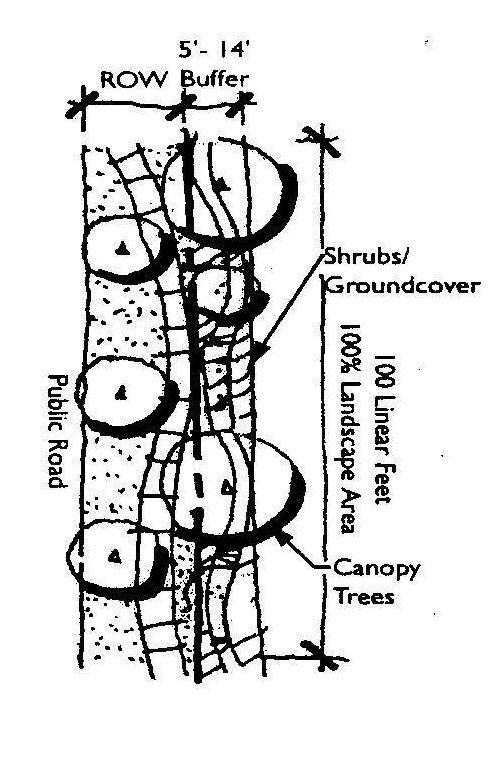
A five- to 15-foot landscape buffer shall be required along public streets and shall include shade trees and groundcover.
(2)
All planted shrub and groundcover areas shall achieve a 100-percent coverage of their planting area within one year.
(3)
Permitted features for front buffers - sidewalks, signs, low wall and picket fences (wrought iron, wood or PVC).
(4)
Additional features such as a knee walls and decorative picket fencing are permissible with the following standards.
a.
Knee wall - maximum 24 inches.
b.
Decorative fencing - maximum 48 inches and must have at least 50 percent of required buffer planting adjacent to right-of-way.
(5)
Prohibited features in front buffers - chain-link fences, walls greater than two feet, loading, service or dumpsters areas or similar items may not be placed in the front buffer or in any additional "open space" adjacent to the street or any direction visible from the street.
(d)
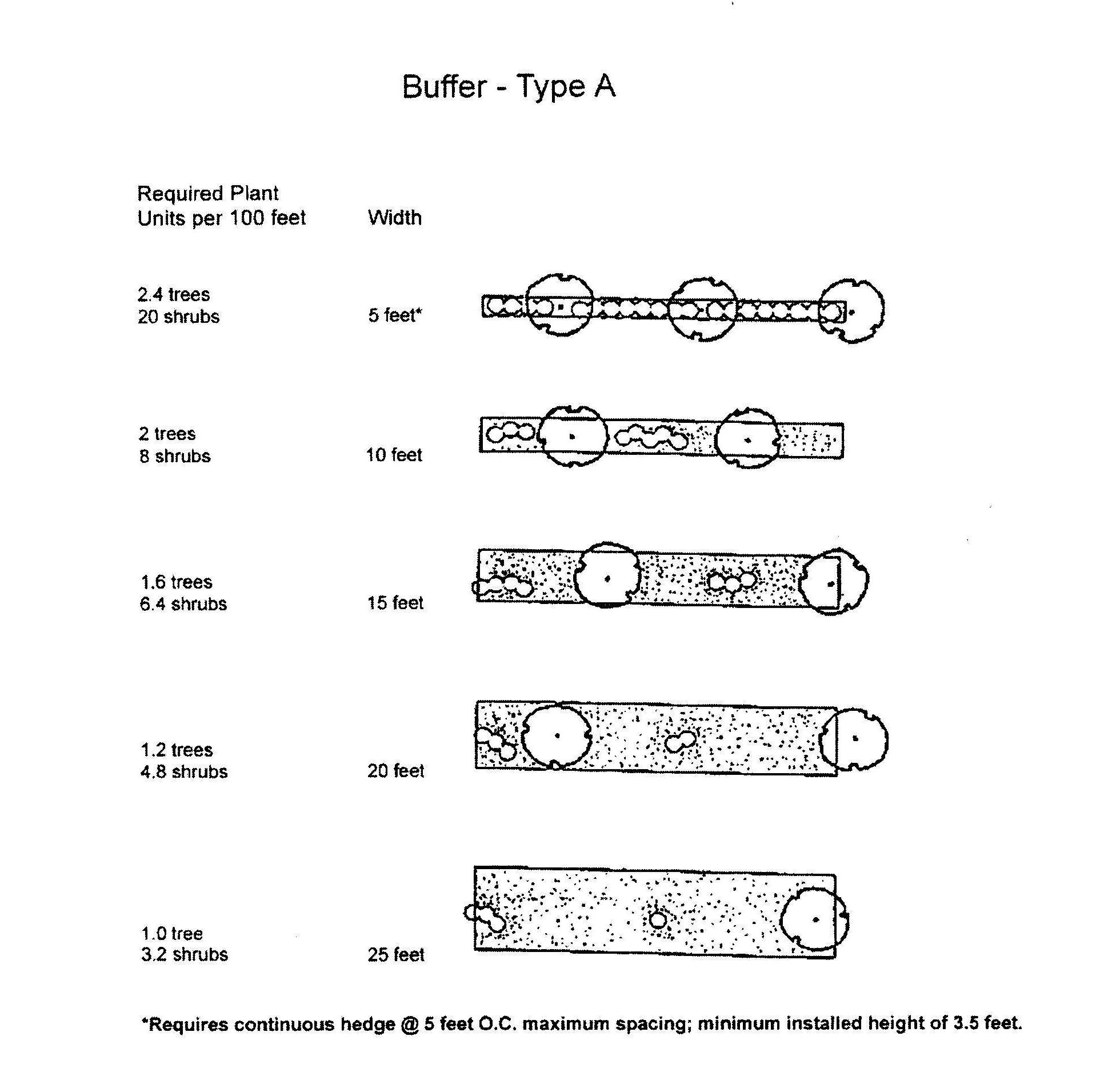
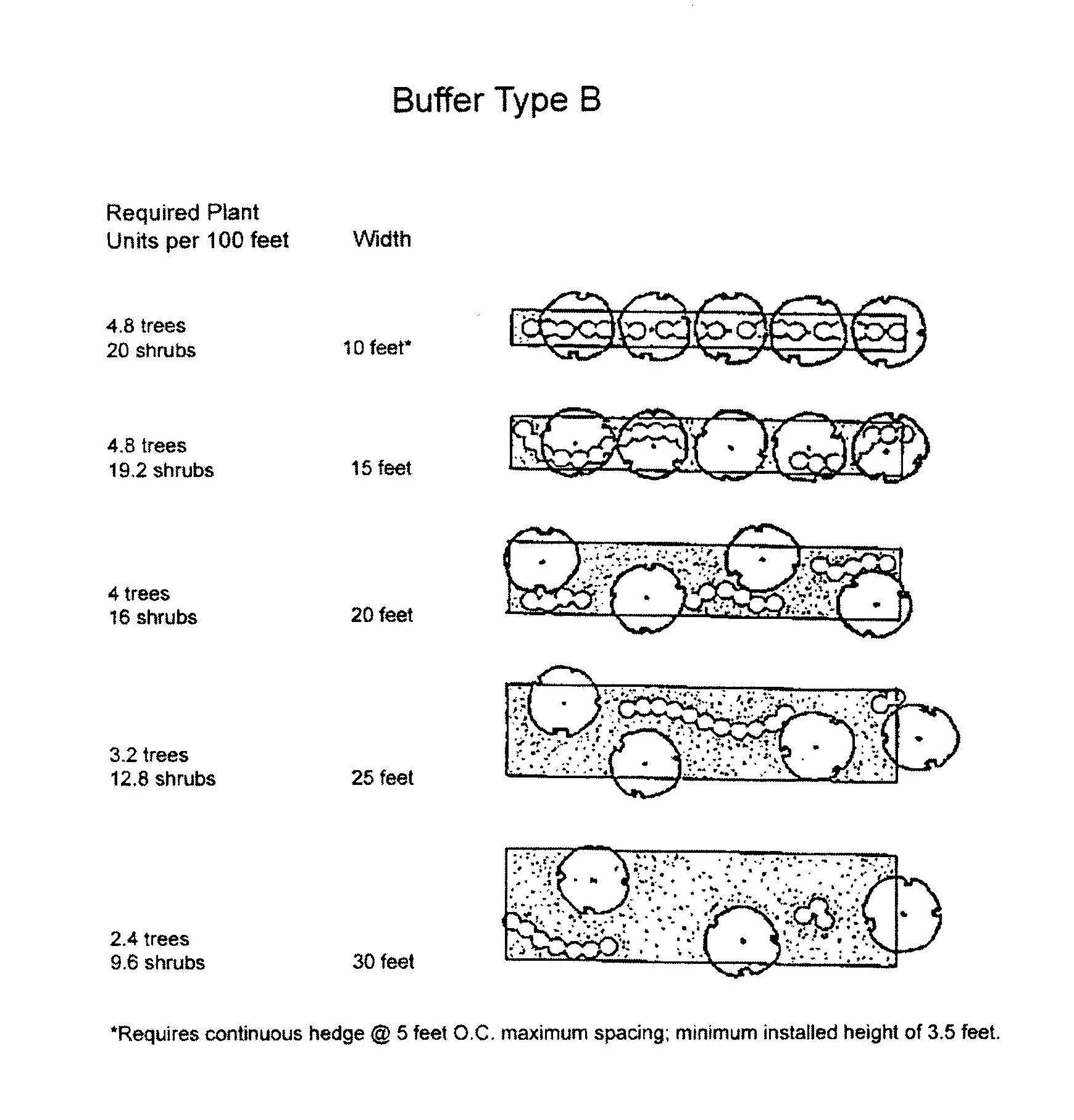
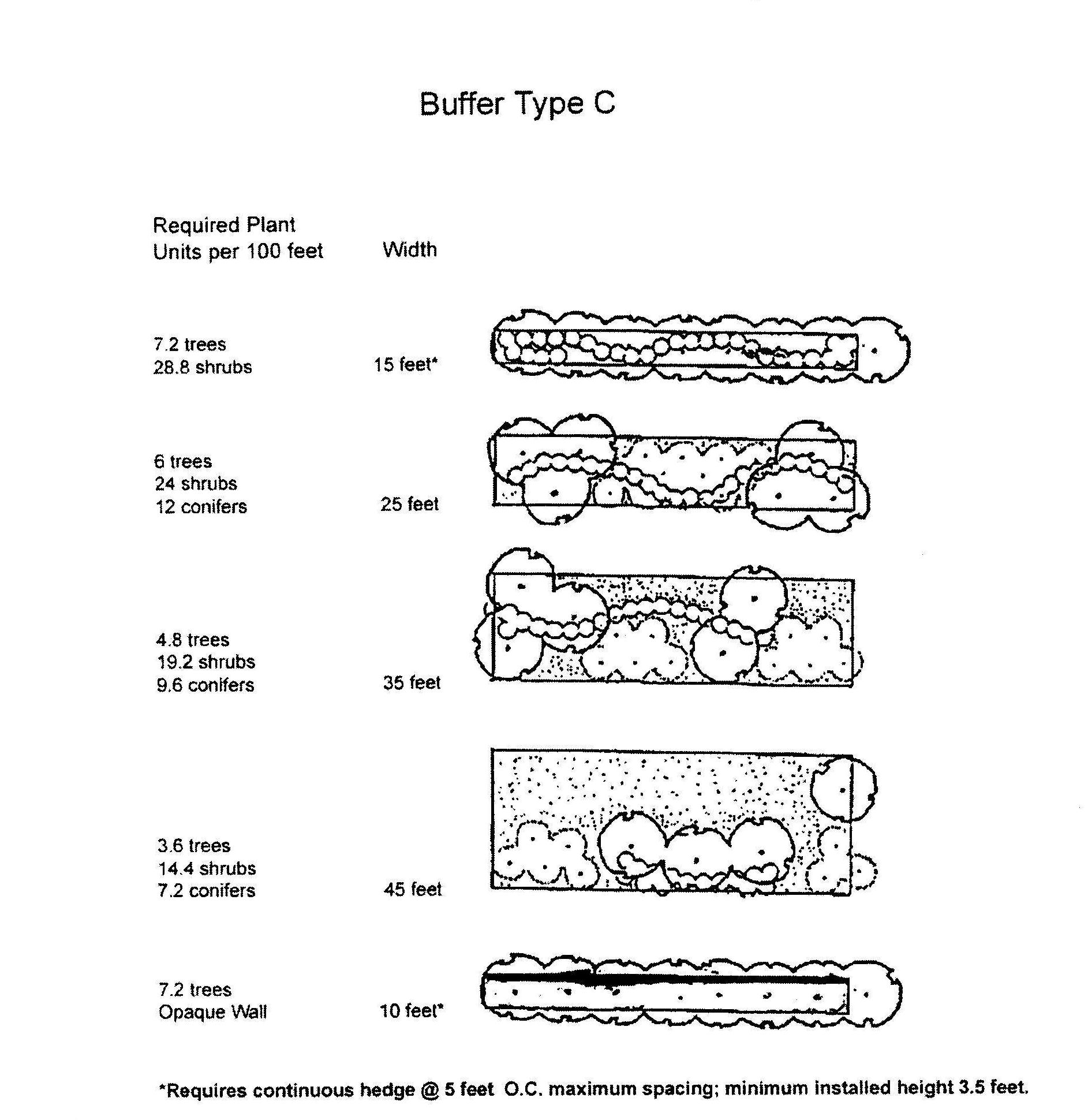
Buffer requirements. The following types of buffers shall be required for the uses described and illustrated on the following pages.
(1)
Commercial use adjacent to single-family or two-family residential — Type C
(2)
Transient accommodation use adjacent to single-family or two-family residential — Type C
(3)
Mixed use adjacent to single-family or two-family residential — Type B
(4)
Commercial use adjacent to mixed-use with residential component — Type B
(5)
Multi-family use adjacent to single-family or two-family residential — Type B
(6)
Commercial use adjacent to commercial use — Type A
(7)
Commercial use adjacent to transient accommodation use — Type B
(8)
Multi-family use adjacent to multi-family use — Type A
(e)
Fencing within buffers. Fencing for the purpose of security or protection is allowable within all buffers provided the fence is in compliance with the applicable standards of these regulations. Developments proposing a privacy fence five feet or more in height within a required buffer may be allowed a 50 percent reduction in the density of plantings. Such request shall be submitted in writing by the applicant and shall include provisions by the owner for maintenance of the buffer and the fencing.
(f)
Plant sizes and design requirements.
(1)
Trees in buffers of ten feet or less should be small or medium. Trees in buffers of more than ten feet may be small, medium, or large provided, however, at least one-half of the required trees shall be large. Trees used in required buffers may be used to meet the required plantings for the property, provided the trees meet or exceed all size, type, and location requirements for replacement trees as specified in these regulations.
(2)
Alternative designs for required buffers may be approved by the city manager upon a finding that such alternative design meets the intent of these regulations and sound landscaping practices. In no case is the city manager authorized to reduce the width of a buffer or the total number of plants required on the site.
(Ord. No. 2005-38, § 2, 11-8-05)
Sec. 22.9. - Preservation standards.
(a)
Construction barriers. During the development of the property, the owner of the property shall be responsible for the erection of any and all barriers or protective guards necessary to protect any existing or installed vegetation from damage during construction.
(b)
Wall. Wherever a change of grade is planned, the trees to be preserved shall be protected by a wall so as to preserve the existing grade for the tree's root system.
(c)
Topsoil. Wherever a change of grade is planned, the topsoil stripped on site shall be preserved for the new landscaping to be installed.
(Ord. No. 2005-38, § 2, 11-8-05)
Sec. 22.10. - Maintenance standards.
(a)
Landscaped areas. All required landscaped areas must include an in-ground automatic irrigation system. The plantings in any landscaped area must be properly maintained in order for the landscaped area to fulfill the purposes for which it was established. Such maintenance shall include all actions necessary to keep the landscaped area free of litter and debris and to keep plantings healthy and orderly in appearance. Where reclaimed water is not used to irrigate, the developer is required to use drip or micro-spray irrigation systems.
(b)
Buffers. The plantings, fences, walls, and berms that constitute a buffer must be properly maintained in order for the buffer to fulfill the purpose for which it is established. Such maintenance shall include all actions necessary to keep the buffer free of litter and debris, and to keep plantings, walls, fences, and berms in good repair and neat appearance. All buffer material shall be protected from damage by motor vehicles or pedestrians which could reduce the effectiveness of the buffer.
(c)
Damage. In the event that any vegetation or physical element functioning to meet the standards of this division is severely damaged, it shall be replanted or replaced within 30 days. In the event that the damage is found to be caused by a catastrophic event, a grace period of 180 days shall be granted for replacement.
(d)
Pruning. Trees shall be pruned in accordance with the pruning standards of the American National Standards Institute (ANSI publication A300); however, the topping of trees is prohibited. Topping shall be considered a violation of Section 22.11 of this division.
(Ord. No. 2005-38, § 2, 11-8-05)
Sec. 22.11. - Tree protection.
It shall be unlawful for any person to remove or cause to be removed any tree having a DBH of three inches or more or any palm with a height of eight feet or more overall without first having obtained a tree removal permit from the city in accordance with section 22.13. Diameter at breast height or DBH means the measurement of a single-stemmed or multi-stemmed tree at four and one-half feet above grade.
(Ord. No. 2005-38, § 2, 11-8-05)
Sec. 22.12. - Tree removal permit required.
Approval of a tree removal permit shall be regulated by the following:
(a)
Mangroves. Mangroves shall be removed only in accordance with the provisions of F.S. §§ 403.9321 through 403.9333.
(b)
Approved permits. Tree removal permits issued by the city, in accordance with the administrative regulations pertaining thereto, shall be valid for a period of three months from the date of issuance.
(c)
New development or redevelopment. When the development of a vacant property or the redevelopment of an existing developed property is proposed, the following requirements shall be followed:
(1)
Where no trees having a three-inch DBH or greater exist on a site proposed for development, an applicant for a development permit shall verify in writing at the time of permit application that no protected trees exist. Such verification shall be in the form of a notarized statement which shall be filed with the application.
(2)
Where such trees do exist on a site proposed for development or redevelopment and are proposed for removal or relocation, a plan showing in what manner removed trees will be replaced or where such trees will be relocated shall be submitted with the application.
(3)
Where such trees will remain, a plan shall be submitted showing how such trees will be protected during the development process.
(d)
Standards for approval. In determining whether or not a permit should be issued, the city manager shall consider and base his decision on the following:
(1)
The condition of the tree with respect to disease, insect attack, danger of falling, proximity to existing or proposed structures and interference with utilities;
(2)
The necessity of removing a tree to construct proposed improvements in order to allow reasonable economic use of the property;
(3)
Whether the tree has been determined to be an historic or specimen tree, meaning a tree which has been determined to be of notable historic or high value to the city because of type, size, age or community association;
(4)
Impact upon the urban and natural environment including:
a.
Ecological impacts. Whether the removal of trees will have an adverse impact upon existing biological and ecological systems, microclimatic conditions which directly affect these systems, or whether such removals will create conditions which may adversely affect the dynamic equilibrium of associated systems.
b.
Noise pollution. Whether the removal of trees will significantly increase ambient or point source noise levels to the degree that a public nuisance is anticipated to occur.
c.
Wildlife habitat. Whether the removal of trees will significantly reduce the available habitat for wildlife existence and reproduction or result in the emigration of wildlife from adjacent or associated ecosystems.
(5)
The ease with which the applicant can alter or revise any proposed development to eliminate the need to remove the tree; and
(6)
Whether the tree is one of the Category I exotic invasive plants, as listed by the Florida's Exotic Pest Plants Council, including, but not limited to the Australian Pine (Casaurina spp.), Chinese Tallow (Sapium sebiferum), Carrotwood (Cupianopsis anacardioides), Punk (cajeput) tree (Melaleuca quinquenervia), and Brazilian Pepper (also known as the Florida Holly) (Schinus terebinthefolius).
(e)
Replacement of removed trees. Trees removed under the provisions of this section shall be replaced as follows:
(1)
New developments. Where trees were removed to accommodate a new development, replacement trees shall be governed by the landscaping requirements of this Code for new developments.
(2)
Other properties. Replacement of removed trees shall be required within six months of the date of issuance of the tree removal permit as follows:
a.
When the removed tree is of a native species, the replacement tree shall also be of a native species.
b.
Except as provided in paragraph d herein, removed trees four-inches DBH or smaller shall be replaced by one tree for each tree removed.
c.
Except as provided in paragraph d herein, removed trees larger than four-inches DBH shall be replaced by two trees for each tree removed.
d.
When the total number of trees on the property meet or exceed the requirements in section 22.4 for single-family and two-family properties, replacement trees shall not be required.
(f)
Denial of a tree removal permit. In the event a tree removal permit is denied, the city manager shall specify the reasons for such denial in writing. Applicants may appeal a denial in accordance with section 3.14 of this Code.
(g)
Removal of hazardous trees required. It shall be unlawful for any owner of real property to allow, suffer or permit any tree which has been damaged or injured to remain upon the real property when the tree creates and constitutes a hazard endangering the life or limb of any person or surrounding adjacent property.
(Ord. No. 2005-38, § 2, 11-8-05)
Sec. 22.13. - Relocation by the city.
In some instances where the trees to be removed are healthy and desirable, with the permission of the owner, the city shall have the option to relocate the tree at its expense. If the city chooses relocation under this provision, such relocation shall be accomplished within 15 working days of the issuance of the permit. If the city fails to remove the tree within the 15-working day period, the permit holder shall be allowed to proceed as provided in the permit.
(Ord. No. 2005-38, § 2, 11-8-05)
Sec. 22.14. - Tree removal permit requirements.
(a)
Unless preempted by state law, any person desiring a permit to remove a tree as required by this section shall make written application, accompanied by the payment of the applicable fee set forth in Appendix A, St. Pete Beach Code of Ordinances, to the city manager.
(b)
Failure to obtain the required permit shall result in a penalty charge equal to twice the cost of the original permit or $100.00, whichever is greater.
(Ord. No. 2005-38, § 2, 11-8-05; Ord. No. 2019-18, § 2, 12-10-19)

