
St Pete Beach City Zoning Code
DIVISION 39
COMMUNITY REDEVELOPMENT DISTRICT GENERAL STANDARDS
Sec. 39.1.- General standards.
These general standards shall apply to all districts within the Downtown and Gulf Boulevard Redevelopment Districts, unless otherwise specified.
(Ord. No. 2008-12, § 1, 6-3-08)
Sec. 39.2. - Classification of district streets.
The following table designates existing streets within the Downtown Redevelopment District only as "Main Street" or "A" street. Streets not identified shall be designated "B" streets.
(Ord. No. 2008-12, § 1, 6-3-08)
Sec. 39.3. - Site design for the Downtown Redevelopment District.
(a)
Buildings shall form a consistent, distinct edge, spatially delineating the public street through maximum building setbacks that vary by no more than ten feet from those of the adjacent building.
(b)
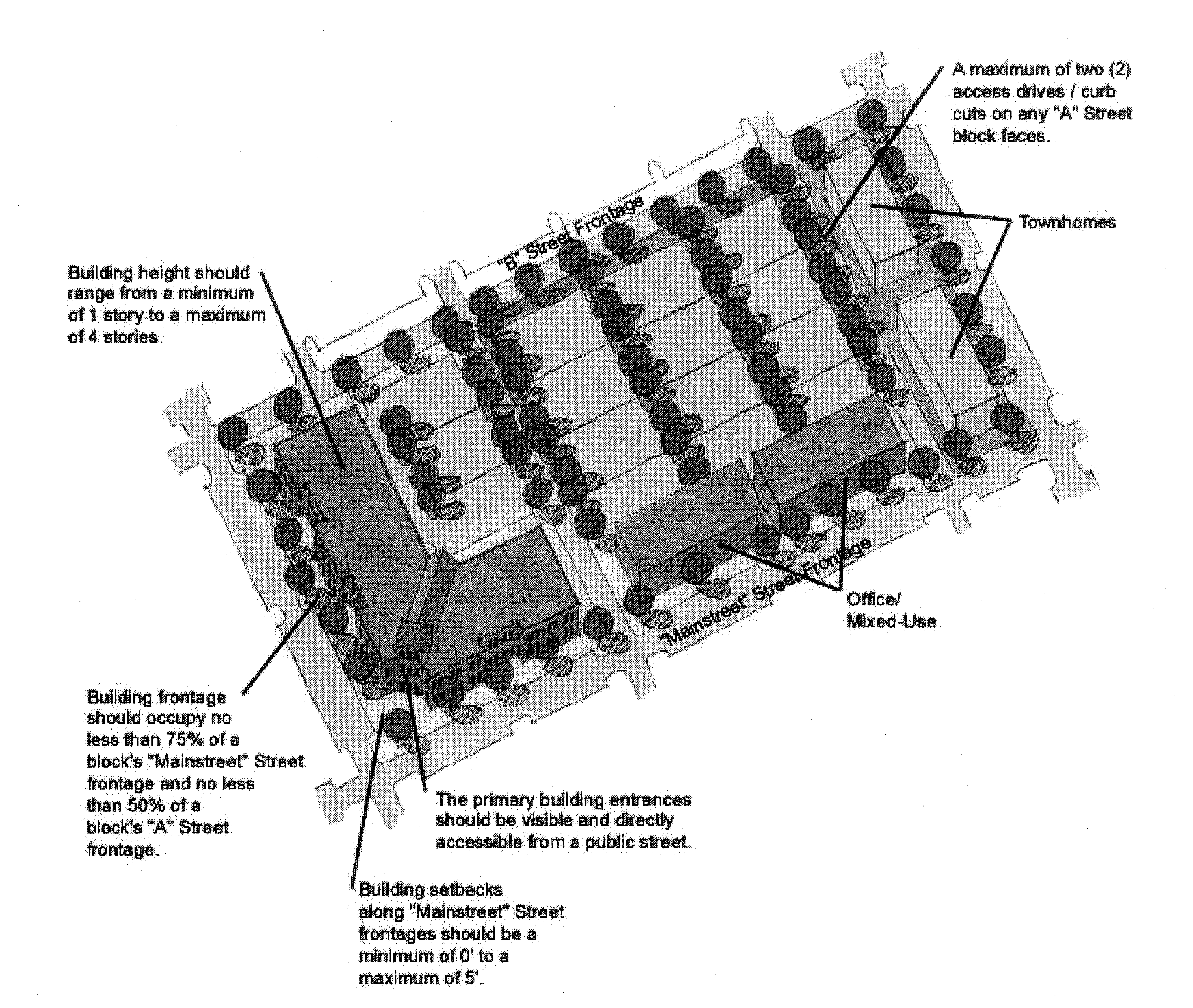
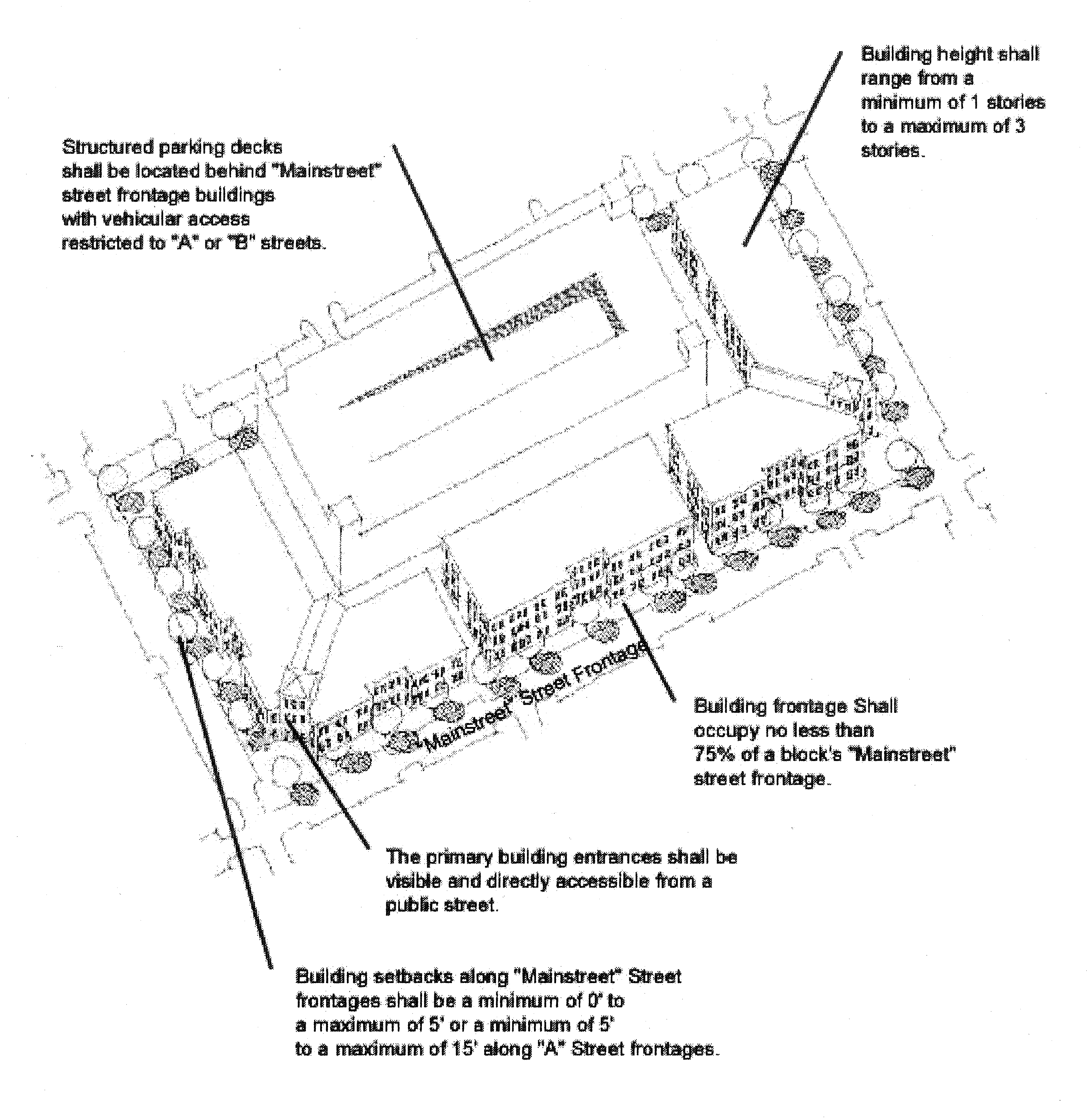
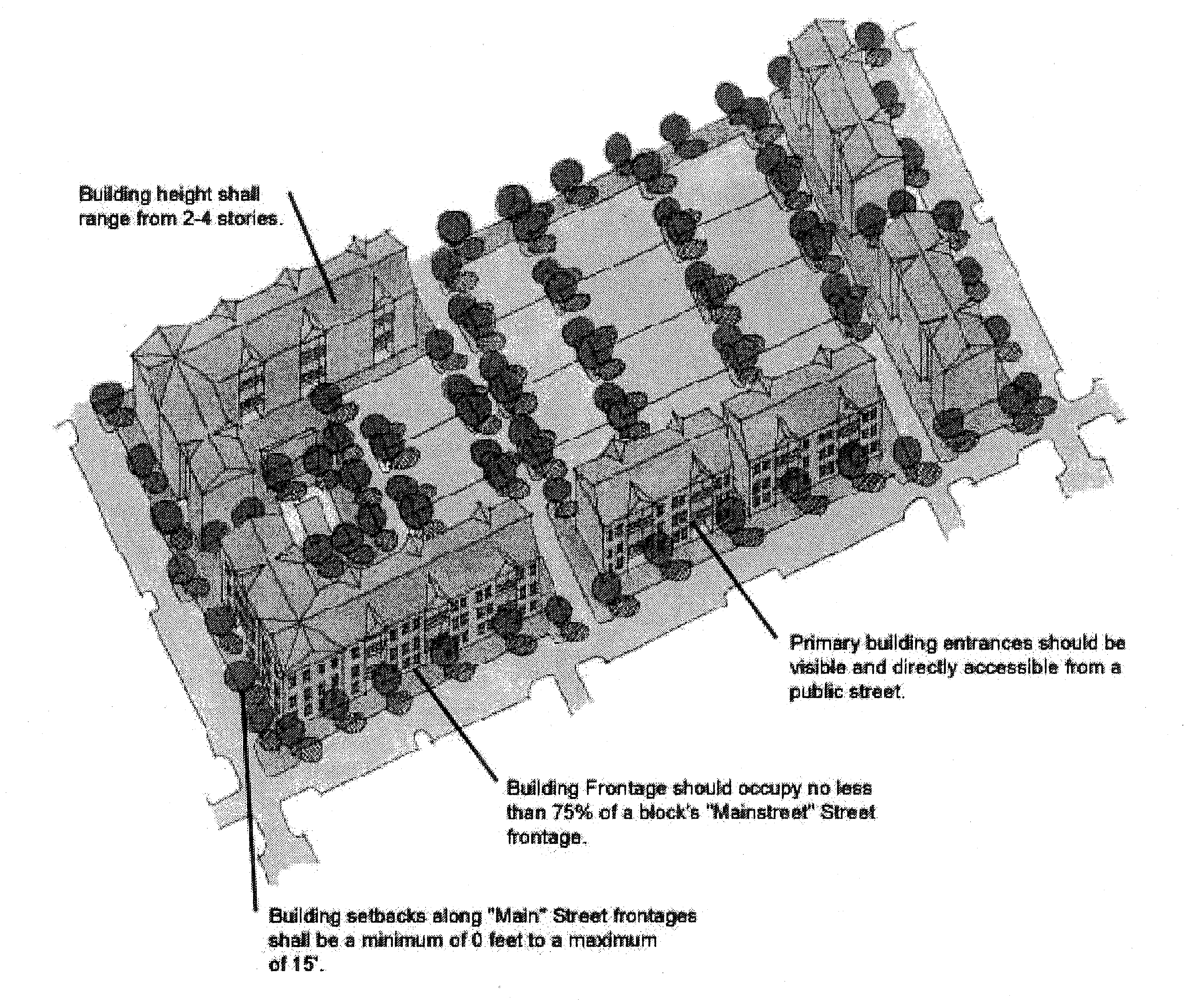
Building frontages shall occupy no less than 75 percent of a "Main Street" street and 50 percent of an "A" street facing entrance. If site constraints exist, a knee wall may be constructed with the following provisions:
(1)
Only 25 percent of the required frontage may be credited as part of a knee wall.
(2)
A knee wall must be constructed in accordance with the design criteria specified herein.
(3)
The knee wall should be the length of the primary building frontage.
(c)
Buildings that are open to the public shall have an entrance for pedestrians from the street to the building interior. This entrance shall be designed to be attractive and functionally be a distinctive and prominent element of the architectural design, and shall be open to the public during business hours. Buildings shall incorporate lighting and changes in mass, surface or finish to give emphasis to the entrances. The primary building entrances shall be visible and directly accessible from a public street. Building massing such as tower elements shall be used to call-out the location of building entries.
(d)
Buildings shall provide a foundation or base, typically from ground to bottom of the lower windowsills, with changes in volume or material. A clear visual division shall be maintained between the ground level floor and upper floors with either a cornice line or awning from 12 feet to 16 feet above base flood elevation or grade, whichever applies to the proposed development. No more than 20 feet of horizontal distance of wall shall be provided without architectural relief for building walls and frontage walls facing the street. All buildings excluding single-family detached homes shall utilize at least three of the following design features to provide visual relief along all elevations of the building:
(1)
Divisions or breaks in materials (materials should be drawn from a common palette).
(2)
Window bays.
(3)
Separate entrances and entry treatments, porticoes.
(4)
Variation in rooflines.
(5)
Awnings.
(6)
Dormers.
(7)
Gables.
(8)
Recessed entries.
(9)
Covered porch entries.
(10)
Cupolas.
(e)
Commercial and mixed-use buildings shall express a "storefront character". This guideline is met by providing all of the following architectural features along the building frontage as applicable:
(1)
Corner building entrances on corner lots.
(2)
Regularly spaced and similar-shaped windows with window hoods or trim (all building stories)
(3)
Large display windows on the ground floor. All street-facing, park-facing and plaza-facing structures shall have windows covering a minimum of 50 percent and a maximum 80 percent of the ground floor of each storefront's linear frontage. Blank walls shall not occupy over 50 percent of a street-facing frontage and shall not exceed 20 linear feet without being interrupted by a window or entry. Mirrored glass, obscured glass and glass block cannot be used in meeting this requirement. Display windows may be used to meet this requirement if the first floor has not been design as a flood proof first floor.
(f)
The use of black or fluorescent colors is prohibited as the predominant exterior building color(s). Black may be used for trim, windows, doors, and awnings.
(g)
The first 20 feet of depth of the first floor of any multifamily structure's primary building frontage facing a street shall be constructed as commercial space.
(h)
Garages are required for attached and detached homes subject to the following provisions:
(1)
Front garages must be set back a minimum of five feet from the primary structure.
(2)
Rear garages must be setback a minimum of four feet from an alley or rear access drive.
(3)
Side garages may have an access from the street, and are required, at a minimum, to be setback in line with the primary structures side setback.
(4)
Ground floor parking, including garages that are located inside the internal block are permitted on the first floor of a structure provided that the street facing side view of the garage must blend in with the primary building frontage by incorporating the same design elements.
[i]
Reserved.
(j)
Front driveway's are required to have a shared driveway and shall be located along the centerline on the common side lot line.
(Ord. No. 2008-12, § 1, 6-3-08; Ord. No. 2013-03, § 1(Exh. A), 1-22-13)
Sec. 39.4. - Use of prototypes.
Development prototypes are intended to provide general guidance for the physical design of new projects within the Community Redevelopment District. These prototypes indicate general patterns for building placement, landscape configuration and the location of parking facilities and access points. The prototypes provide for consistency of site layout within a flexible framework which addresses the individual features of specific sites.
Permitted block types are described within a single-use prototype for illustrative purposes. Development applications for specific sites are required to assemble structures into blocks when the development is over two acres. Each site plan shall be required to identify how the proposed development including buildings and structures are assembled within a context that conforms to the design standards for the block or partial block within which the building occurs.
(a)
Development prototype structure. The development prototype structures are a series of figures that highlight some of the regulations. The prototypes are shown in a block format and individual parcel development may not be able to build to the form of a block. However, all development, at a minimum, will be expected to build to the building design, site design and lot layout. If development of an entire block occurs, the prototype shall be used as a development tool.
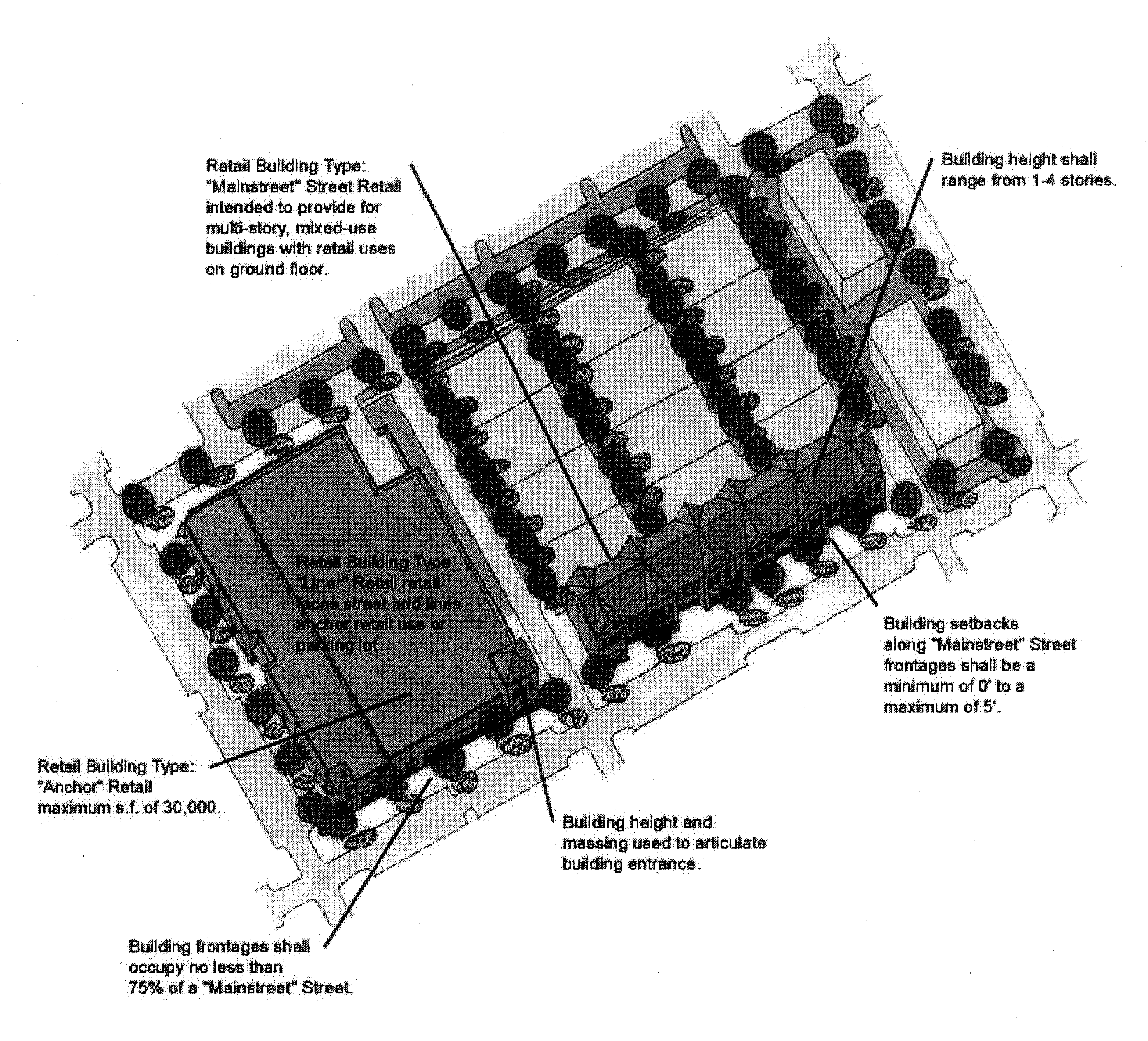
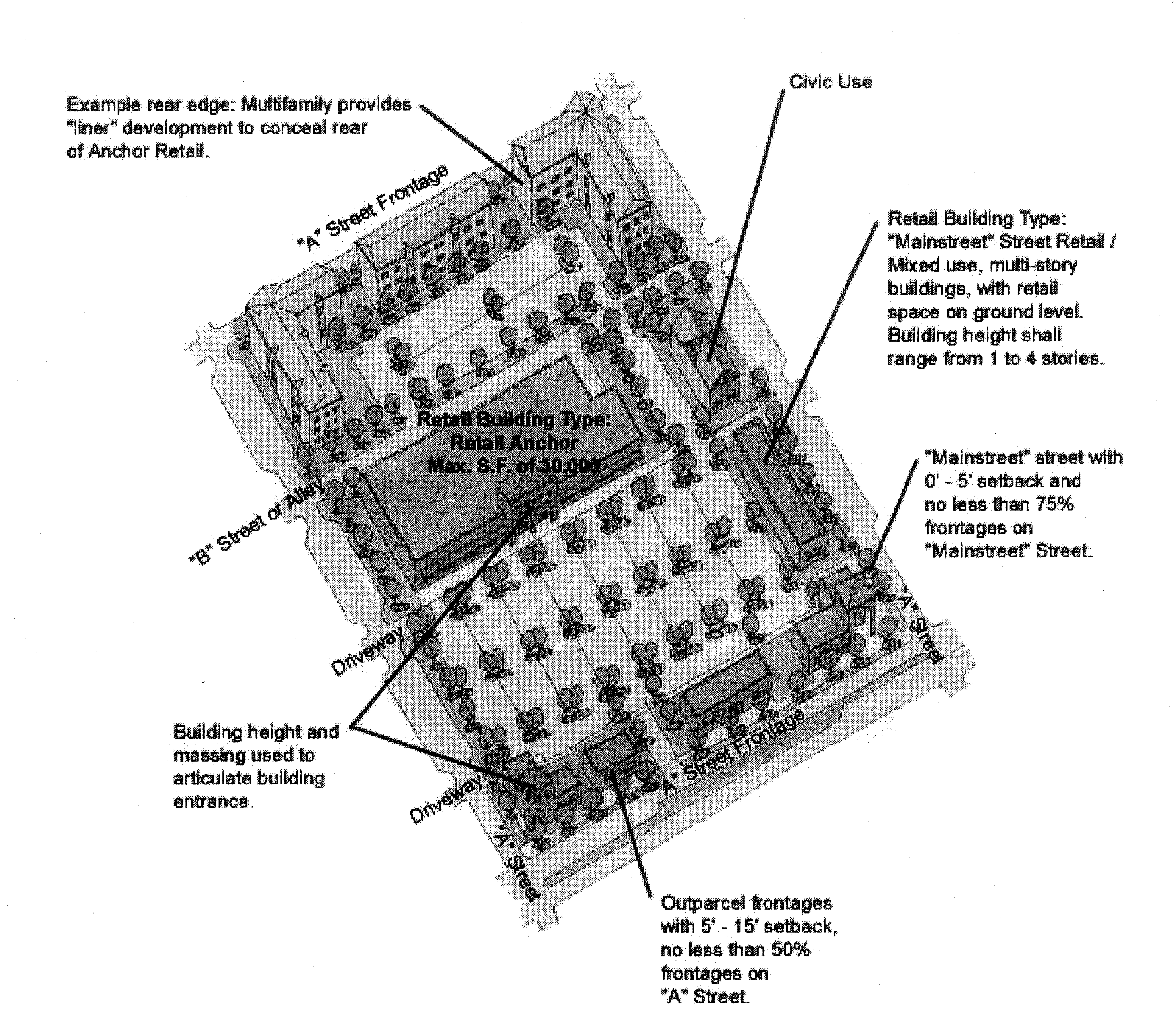
The mixed-use development prototypes are designed to accommodate a range of retail, office and mixed-use building types including "anchor" retail, "liner" retail, and "main street" retail buildings. The Multi-Family Development Block is designed to accommodate a range of multi-family building types including apartment buildings, condominiums and town homes.
(b)
Specific development prototype standards.
"Main Street" Retail. The Main Street Retail building type permits multi-story, mixed-use buildings with retail and office uses on the ground floor.
"Liner" Retail. The Liner Retail building type permits single-story retail uses along "A" Street frontages.
"Anchor" Retail. The Anchor Retail building type permits grocery stores and larger format retail within the retail development block. The maximum size of an "anchor" retail use is 30,000 square feet. At least one building entrance shall face a public street and shall be articulated with additional height and massing.
Shelter. Buildings shall incorporate arcades, roofs, alcoves, porticos or awnings that protect pedestrians from the rain and sun.
Setback encroachment. Special architectural features, such as balconies, bay windows, arcades, awnings, etc. may project into front setbacks and public right-of-ways on streets provided they are eight feet above the sidewalk and leave a minimum five-foot wide unobstructed sidewalk. Support structures for these features shall be located such that they do not affect the clear sight triangle for travel lanes or the on-street parking. Prior to new encroachment into the public right-of-way, a permit shall be obtained from the city manager or designee.
Garages. Street-facing ground floor parking, including garages, is not permitted on the first floor of a multifamily structure on an "A" street. Parking shall occur underneath the multifamily structure, within parking garages, or within surface lots that do not front on a "Main street" Street.
Retail Prototype
Office Mixed-Use Prototype
Mixed Use Commercial Prototype
Mixed Use Development Block with Structured Parking
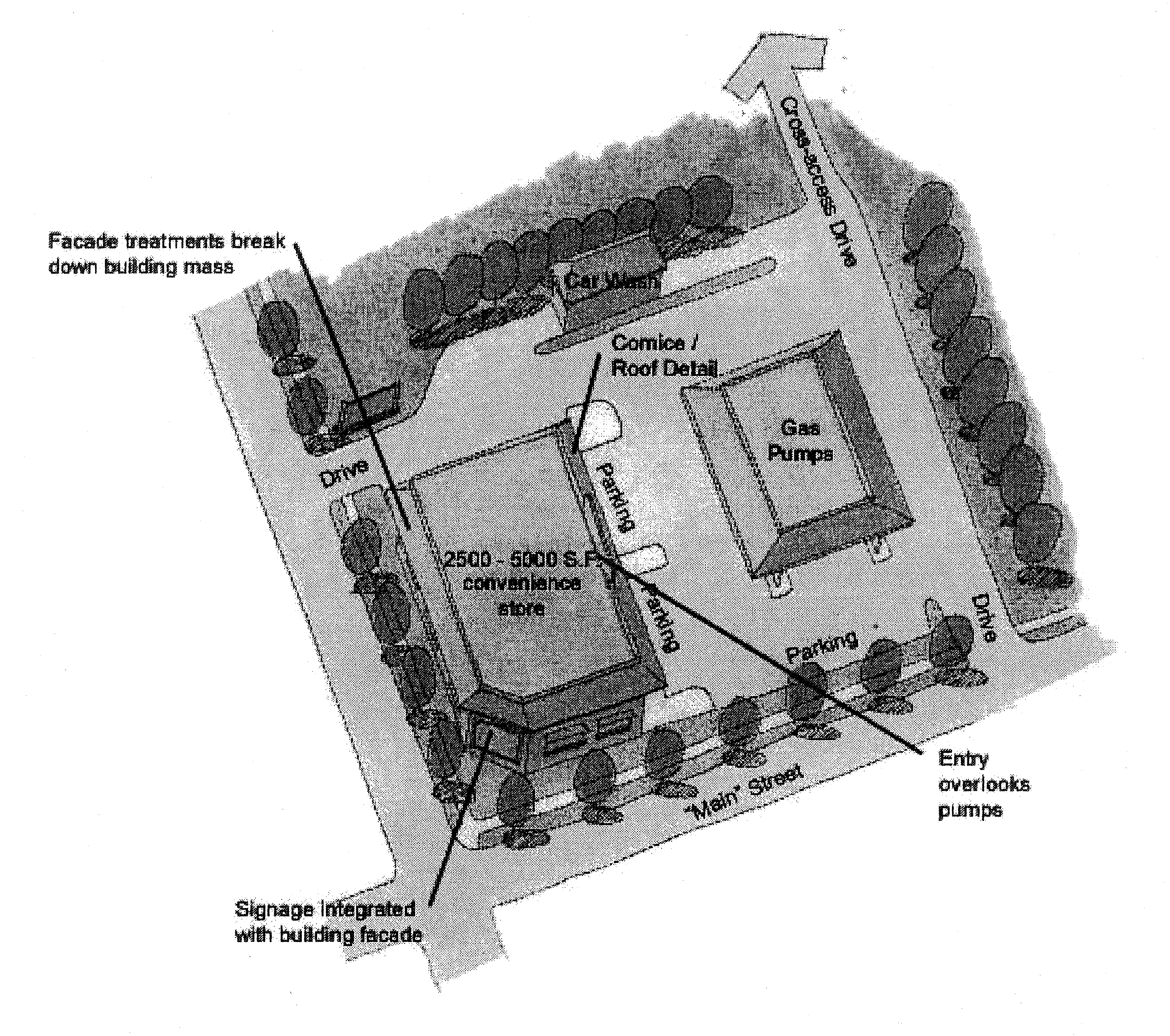
Gas Station Prototype
Multifamily Prototype
(Ord. No. 2008-12, § 1, 6-3-08)
Sec. 39.5. - General operational and aesthetic requirements.
(a)
Commercial and temporary lodging uses shall be designed and operated so that neighboring residents are not exposed to offensive noise, especially from late-night activity. No amplified music shall be audible to neighboring residents. Common walls between residential and non-residential uses shall be constructed to minimize the transmission of noise and vibration.
(b)
All outdoor lighting associated with commercial and temporary lodging uses shall be designed so as not to adversely impact surrounding residential uses, while also providing a sufficient level of illumination for access and security purposes. Such lighting shall not blink, flash, oscillate, or be of unusually high brightness. Also, parking areas shall be illuminated so as to provide appropriate visibility and security during hours of darkness.
(c)
Loading or service areas, including refuse and recycling, must be out of public view and must not front onto Gulf Boulevard.
(d)
No commercial use shall be designated or operated so as to expose residents to offensive odors, dust, electrical interference, and/or vibration.
(e)
Residential, commercial, and temporary lodging uses in a mixed-use development shall provide combined and private bulk sanitation service for the entire development.
(f)
Electric and communications transformers shall be screened from public view through below grade installation, a hedge, or similar measure.
(g)
All other mechanical equipment must be behind or on top of the building and screened from public view through use of a parapet wall or through landscaping.
(h)
Any roof area above the highest allowed story may be utilized for active or passive recreational uses or other similar uses which require no permanent structures. Such roof areas must be enclosed by a parapet wall no less than four feet nor greater than five feet in height.
(Ord. No. 2008-12, § 1, 6-3-08)
Sec. 39.6. - Temporary lodging use operational and occupancy restrictions, limitations and prohibitions.
To ensure that temporary lodging use development authorized and approved within the Community Redevelopment District are built, function, operate, and are occupied exclusively as temporary lodging and adhere to mandatory closure and evacuation procedures, the following restrictions shall apply to temporary lodging use:
(a)
No temporary lodging unit shall be occupied as a permanent residential dwelling unit.
(b)
All temporary lodging units must be offered, advertised and occupied on a temporary basis for 30 consecutive days or less for temporary lodging guests and no more than 30 days cumulatively on an annual basis for a resort condominium unit owner to ensure that any temporary lodging use does not function as a permanent residential use. The thirty days is measured beginning on the first day of any occupancy until 365 days from that date. The city may require affidavits of compliance with this requirement from each temporary lodging use and/or unit owner. Seller of temporary lodging unit shall be responsible for advising the purchaser of this requirement. Any seller of a resort condominium project or temporary lodging unit shall record a covenant in the public records of Pinellas County, Florida, agreeing to said restriction prior to conveyance.
(c)
Temporary lodging units shall not qualify or be used for homesteading purposes or home occupational licensing.
(d)
All temporary lodging units must be included in the inventory of units that are available within a temporary lodging use.
(e)
Conversion of a temporary lodging unit to permanent residential unit shall be prohibited unless the conversion is in compliance with the density and intensity standards and regulations applicable to the property and all other required city approvals are obtained prior to the conversion and provided said conversion does not violate any other legally enforceable agreement or restriction, law or local ordinance prohibiting such conversion.
(f)
A temporary lodging use may include accessory uses, such as recreational facilities, restaurants, bars, personal service uses, retail uses, meeting space, fitness centers, spa facilities, parking structures, affordable housing or other workforce living accommodations, and other uses commonly associated with temporary lodging uses. New outdoor dining and/or drinking areas associated with accessory restaurants and bars shall be permitted to provide for outdoor music, provided that the area meets all of the yard requirements for the property and the property does not abut a single- or two-family residential development or a residential development outside of the Community Redevelopment District, in which case any new outdoor dining and/or drinking area shall require a conditional use permit subject to Division 4 of this Code. Any new or expanded roof dining and/or drinking area shall also require a conditional use permit subject to Division 4 of this Code.
(g)
Proper licensing, including occupational licensing, by the state, county and local government and agencies, shall be required of all temporary lodging uses through all applicable agencies that license hotels and motels prior to any certificate of occupancy being issued. All licenses must be kept current.
(h)
Temporary lodging uses shall be subject to all applicable tourist development tax collections.
(i)
All temporary lodging uses shall include a reservation system and a lobby/front desk area that is necessary to operate the temporary lodging facility and service its guests.
(j)
Temporary lodging uses must have sufficient signage viewable by the public designating the use as a temporary lodging use that also complies with local codes.
(k)
The applicable local government may require affidavits of compliance with this section that includes reasonable supporting documentation that does not violate privacy laws for each temporary lodging use, guests and/or unit owners.
(l)
All temporary lodging uses shall comply with all county and local hurricane closure and evacuation procedures that will ensure orderly evacuation of guests and visitors prior to evacuation orders being issued for residents. The restrictions and procedures contained within the hurricane closure and evacuation plan shall apply to all on-site workforce living accommodations, as applicable.
(m)
The restrictions set forth above shall be made a condition of site plan approval.
(n)
The restrictions set forth in subsections (a), (b), and (d) relating to prohibitions on conversion or use of a temporary lodging unit as a permanent residential dwelling shall be contained in a covenant or other legally enforceable recordable instrument that shall be approved as to content, form and legality by the city and shall be recorded in the public records of Pinellas County at the time of building permit approval.
(o)
All large scale development and redevelopment projects approved under scenario 2 as defined under Permitted Uses & Standards for the Large Resort character district category may be required to provide an easement to the city for unimproved public access landward of the mean high water line to provide a continuous, uninterrupted pedestrian beach system along the Gulf of Mexico prior to a building permit being issued.
(p)
All new temporary lodging uses that exceed 50 feet in height or a density greater than 30 units per acre shall be required to obtain a conditional use permit pursuant to Division 4 of this Code.
(Ord. No. 2008-12, § 1, 6-3-08; Ord. No. 2015-22, § 14, 12-15-15; Ord. No. 2020-24, § 2, 12-1-20)
Sec. 39.7. - Street-level facades.
The human scale and aesthetic appeal of street-level facades, and their relationship to the sidewalk, are essential to a pedestrian-friendly environment. Accordingly, at least 50 percent of the street level facades of buildings used for nonresidential purposes which abut a public street or pedestrian access way, will be transparent. For the purpose of this standard:
(a)
Street level facade means that portion of a building facade from ground level to the allowable first story height;
(b)
Transparent means windows or doors that allow pedestrians to see into:
(1)
The building; or
(2)
Landscaped or hardscaped courtyard or plazas, where street level facades are set back at least 15 feet from the edge of the sidewalk and the area between the sidewalk and the facade is a landscaped or hardscaped courtyard or plaza.
(c)
Parking structures should utilize architectural details and design elements such as false recessed windows, arches, planter boxes, metal grillwork, etc. instead of transparent alternatives. When a parking garage abuts a public road or other public place, it will be designed such that the function of the building is not readily apparent except at points of ingress and egress.
(d)
Window coverings and other opaque materials may cover no more than ten percent of the area of any street-level window in a nonresidential building that fronts on a public right-of-way.
(e)
Building entrances should be aesthetically inviting, easily identified, preferably with a recessed entrance and also distinctive and visually interesting paving pattern.
(f)
Awnings and other structures that offer pedestrians cover from the elements are recommended. Awnings help define entryways and provide storefront identity to both pedestrians and drivers.
(Ord. No. 2008-12, § 1, 6-3-08; Ord. No. 2013-04, § 1(Exh. A), 1-22-13)
Sec. 39.8. - Design, scale and mass of buildings.
(a)
No plane of a building may continue uninterrupted for greater than 100 linear feet. For the purpose of this standard, "interrupted" means an offset of greater than five feet.
(b)
At least 60 percent of any elevation will be covered with windows or architectural decoration. For the purpose of this standard, an elevation is that portion of a building that is visible from a particular point outside the parcel proposed for development.
(c)
The height and mass of buildings will be correlated to: (1) the dimensional aspects of the parcel proposed for development and (2) adjacent public spaces such as streets and parks.
(d)
Buildings may be designed for a vertical or horizontal mix of permitted uses.
(Ord. No. 2008-12, § 1, 6-3-08; Ord. No. 2017-30, § 2, 2-27-18)
Sec. 39.9. - Energy and environmental design—New construction and major renovation.
(a)
All development and redevelopment projects in the Community Redevelopment District shall be required to obtain certification for at least two of the eight standards listed below, as appropriate and applicable to the type of construction:
(1)
Certification by the Florida Green Building Coalition provided the site consists of more than one building and will meet the qualifications of a development. For more information go to www.floridagreenbuilding.org.
(2)
Certification by the U.S. Green Building Council, LEED-NC (Leadership in Energy and Environmental Design — New Construction), Green Building Rating System for New Construction and Major Renovation. For more information go to www.leedbuilding.org.
(3)
Certification by the Florida Green Building Coalition — High Rise Residential Standard for all new residential construction exceeding three stories in height.
(4)
Certification by the Florida Green Building Coalition — Residential Standard Certification for all new residential construction three stories or less in height.
(5)
Certification by the U.S. Green Building Council, LEED-hotels and Green Building Rating System for all new temporary lodging use construction.
(6)
Certification by the U.S. Green Building Council, LEED-EB (Leadership in Energy and Environmental Design — Existing Buildings), or Green Building Rating System for Existing Buildings for existing buildings that are located on a buildable site that is partially being redeveloped. For more information go to www.usgbc.org.
(7)
Certification by the U.S. Green Building Council, LEED-CS (Leadership in Energy and Environmental Design — Commercial Interiors), Green Building Rating System for Commercial Interiors for commercial interior space. For more information go to www.usgbc.org.
(8)
Designated by the Florida Department of Environmental Protection as a Florida Green Lodge for all temporary lodging construction that is existing, new or undergoes a major renovation. For more information, go to http://www.dep.state.fl.us/greenlodging/.
(Ord. No. 2008-12, § 1, 6-3-08; Ord. No. 2015-22, § 15, 12-15-15)
Sec. 39.10. - Streetscape design required elements.
(a)
A ten-foot sidewalk shall be constructed that will allow for safe, unobstructed and efficient pedestrian flow and the potential for sidewalk cafes and outdoor eating areas, as appropriate, in front of all development projects within the Community Redevelopment District along Gulf Boulevard or Blind Pass Road and within the Town Center Core areas. This requirement may be reduced to six feet when warranted through TRC site plan review. This is imperative to ensure pedestrians feel comfortable on the sidewalk as well as important to meet the current American with Disabilities Act standards. Distinctive and visually interesting paving patterns are encouraged, particularly to define an entrance, a gathering place, a pedestrian crosswalk link, or a sidewalk cafe area. Patterns, cooler, materials and constructions standards shall be coordinated with the city manager and his staff to ensure a cohesive and unified streetscape.
(b)
On all streets not designated a Main street or a street type "A" in section 39.2, a minimum eight-foot wide private landscape zone shall be installed along the property between the sidewalk and the building face; minimum building setbacks may be increased in accordance with the width of the landscape zone. The landscape zone proposal shall be reviewed for compliance during the design review/site plan approval process by the TRC and may be reduced to five feet during that process when warranted, in order to coordinate and integrate new development into an overall streetscape plan.
(1)
Trees shall be placed in the landscape zone using the following specifications:
(i)
Trees shall be placed not more than 30 feet apart within the landscape zone. Drought tolerant and native shade trees to reduce urban heat and offer protection to the pedestrian from the sun are encouraged.
(ii)
Where there are physical restrictions, spacing of street trees shall be adjusted, provided the adjustment is the minimum needed to avoid the obstruction.
(iii)
Tree spacing can be adjusted so as not to block, obscure, or interfere with the operation of traffic signals, utilities, or any existing sign, awning, or other public infrastructure that was placed prior to the planting of the landscape zone, provided the adjustment is the minimum required for such avoidance.
(iv)
Street trees shall not be planted in a manner that will diminish adequate sight distance.
(v)
No street tree shall be planted within ten feet of a light standard or utility pole.
(vi)
Tree species should be selected with root growth habits that will not cause damage to sidewalks or anything contained within the public right-of-way, or such tree species should be sited away from such hard-surfaced areas.
(2)
Landscaping plans shall show all obstructions that may affect plant placement and installation limitations including all underground utilities.
(3)
All exposed dirt areas shall be covered with bark, mulch, or other weed control measures included as part of the final landscape plan. The use of non-cypress mulch is strongly encouraged in support of "green" practices for a sustainable community.
(4)
The property owner shall ensure the upkeep, health, and aesthetics of the landscape zone through the use of proper reclaimed irrigation of plant species in the landscape zone, regular maintenance of the landscape zone and replacement of items located within the landscape zone. Waterwise Florida friendly landscapes are encouraged and use of drought tolerant plant material and turf.
(5)
Within the landscape zone on the main commercial corridor the developer shall provide at least two of the following pedestrian amenities for each 200 feet of street frontage that shall be accessible to the sidewalk:
(i)
Benches;
(ii)
Trash receptacles;
(iii)
A design element that offers protection from the weather;
(iv)
Secured bicycle storage;
(v)
Public art;
(vi)
Or other similar design feature integrated into the overall design of the building or portion of the landscape zone in order to enhance the pedestrian environment.
(6)
Pedestrian-scale decorative lighting fixtures are required every 30 feet on the main commercial corridor within the landscape/pedestrian zone. Where there are physical restrictions, spacing of lighting standards shall be adjusted, provided the adjustment is the minimum needed to avoid the obstruction. An adequate easement shall be dedicated to the city, adjacent to the public right-of-way to allow adequate maintenance by the city of the lighting fixtures. Energy efficient or solar lighting is required.
(Ord. No. 2008-12, § 1, 6-3-08; Ord. No. 2017-30, § 2, 2-27-18)
Sec. 39.11. - Walkways and pedestrian connections.
(a)
Pedestrian walkways shall be landscaped with additional shade or ornamental trees equal to an average of one shade tree per 30 linear feet of walkway, unless the walkway is adjacent or included within an existing compliant buffer or frontage planting. Adjustments to tree spacing may be approved by the city manager in accordance with the provisions of sections 39.10(1) and 39.10(2) above.
(b)
A minimum of one shade tree shall be planted for each 200 square feet of separate additional landscaped area.
(c)
Shade trees shall be drought tolerant and the species and location shall be approved by the city manager to ensure proper implementation of the overall streetscape plan.
(Ord. No. 2008-12, § 1, 6-3-08)
Sec. 39.12. - Site utilities and waste management.
(a)
All solid waste areas shall be designed with a six-foot decorative masonry wall. The wall shall be of the same material as the primary structure or concrete masonry, decorative brick or standard concrete masonry clad with painted stucco or other masonry veneer. The wall shall include a continuous cap feature and closing gate.
(b)
In addition to the masonry enclosure, storage and dumpster/solid waste areas shall be treated with a 24-inch high planted hedge that shall reach 36 inches to 42 inches height and 90 percent opacity within one year.
(c)
Other above-ground utility elements such as pull boxes, transformers, and backflow preventers shall be located and designed to permit convenient maintenance access, painted dark green and screened with a 24-inch planted hedge that shall reach 36 inches to 42 inches height and 90 percent opacity within one year.
(d)
Long-term storage containers are prohibited unless located on a parcel with a fully screened masonry or brick enclosure designed and constructed for that purpose.
(e)
There shall be no open storage of materials or equipment.
(f)
On-site utilities shall be located underground.
(g)
Participation in a waste recycling program will be required.
(Ord. No. 2008-12, § 1, 6-3-08)
Sec. 39.13. - Irrigation and maintenance.
(a)
All landscaped areas within the City of St. Pete Beach shall be designed, installed and maintained at a high level of quality, following best management practices for landscaping. Broken lines or damaged spray heads shall be repaired to minimize wasted water.
(b)
All landscaped areas shall be irrigated with a timed, automatic underground system utilizing pop-up heads and/or tree bubblers and providing coverage of not more than one and one-half inches of water per week. (Use of xeric plant materials may require only three-quarter inch water per week).
(c)
The automatic irrigation system shall include a rain gauge or other water saving features to conserve water and minimize waste.
(d)
All landscape areas shall use reclaimed water and shall provide 100 percent irrigated coverage.
(Ord. No. 2008-12, § 1, 6-3-08)
Sec. 39.14. - Garden walls, fences, and hedges.
All garden walls, fences or hedges located or constructed within the required yard area shall conform to the following regulations, except where special requirements are set forth for specific screening purposes elsewhere in this chapter.
(a)
Residential districts.
(1)
Front yard in a residential district. All garden walls, fences or hedges located within the required front yard shall not exceed four feet in height.
(2)
Side and rear yards in a residential district. All garden walls, fences or hedges located within the required side or rear yards shall not exceed six feet in height.
(3)
Side yard of corner lot in a residential district. All garden walls, fences, or hedges located in the side-yard abutting the secondary street of a corner lot must not exceed four feet in height.
(4)
Rear yard abutting water in a residential district. All garden walls, fences, or hedges located in the required rear yard abutting a body of water shall not exceed four feet in height.
(b)
Commercial districts. All garden walls, fences, or hedges located in a commercial or industrial district shall not exceed eight feet in height and must be constructed to allow an unobstructed view of the front yard of the property from adjacent property or a public street.
(c)
Buffering and screening between non-compatible uses. Where a RU-1 or RU-2 Residential District or existing single-family or duplex home abuts a non-residential district, the non-residential development shall provide an opaque to semi-opaque screen consisting of landscaping, wall, fence or a combination of any of those elements adequate to buffer the non-residential development from the adjacent residential property in accordance with the height and location requirements set forth above in sections 39.14(a) and 39.14(b) except that no such screen shall be required in the front yard of the non-residential development.
(Ord. No. 2008-12, § 1, 6-3-08)
Sec. 39.15. - Compatibility with low density residential.
External compatibility. Non-residential development and multi-family development must provide additional buffers and screening from RU-1 and RU-2 residentially zoned properties or parcels of land developed with existing single-family or duplex homes as follows:
(a)
Lighting restrictions. Any development shall control the effects of lights from automobiles or other sources to prevent lighting spillover so that lights do not illuminate adjacent residential property or shine into any residential window.
(b)
Setback. When a commercial retail, restaurant, drinking establishments or multi-family use is abutting any existing single-family or duplex use or a RU-1 or RU-2 residentially-zoned property, there shall be an additional setback required for the boundary line(s) abutting the residential property, as follows:
(1)
Any structure 25 feet in height or less shall be set back at a minimum 20 feet from the abutting residential property.
(2)
Any structure greater than 25 feet in height shall be set back at a minimum 35 feet from the abutting residential property.
(3)
Trash receptacles and loading facilities may not be permitted in the rear of the property. Service areas shall be located on the side yard.
(4)
Building design. The side of the building that is facing or backing up to any residential development shall not be a blank facade and shall have a quality architectural finish that contains the same articulated architectural features as the front of the building except that windows shall not be required.
(Ord. No. 2008-12, § 1, 6-3-08)
Sec. 39.16. - Story standards.
(a)
Definitions.
Story means that portion of a building included between the surface of any floor and the bottom surface of the floor next above it, or if there is no floor above it, then the space between the floor and the ceiling next above it.
Interstitial space means that area between the bottom surface of a floor above and the functional ceiling of the floor below, which usually contains the sprinkler system, recessed room lighting, duct work and other common items installed above drop ceilings.
(b)
Height standards. Total height of any structure shall be determined by land use category, the number of stories and height for each story allowed by the Table below, or the maximum height allowed for each use in each specific District as established in the Special Designation Community Redevelopment District of the Future Land Use Element of The Comprehensive Plan, whichever is greater. Variances to increase height are prohibited.
(c)
In instances where structured parking is developed adjacent to, or at the same level with, enclosed first story space, the allowable height of the parking structure shall be the allowable height of the first story. In addition, in instances where parking is developed adjacent to multiple enclosed stories of the building, as many levels of parking as possible may be developed so long as such parking levels do not exceed the total height allowed for the adjacent stories.
(Ord. No. 2008-12, § 1, 6-3-08)
Sec. 39.17. - Community involvement.
(a)
Community meeting. Applicant shall have a minimum of one community meeting at least 30 days prior to submitting its application for administrative approval of a development or redevelopment site plan proposed to be built within the Community Redevelopment District. Single-family home, duplex construction or any development on buildable site that is less than one-half acre in size are exempt from this meeting requirement.
(b)
Notice requirements. The following are the notice requirements for all development projects within the Community Redevelopment District except single-family home, duplex construction or any development on a buildable site that is less than one-half acre in size. Proof of publication shall be provided to the city clerk prior to the community meeting.
(1)
Notice of the community meeting shall be published in a local newspaper at least seven days and no more than 21 days prior to the community meeting for all development within the community redevelopment district.
(2)
Additionally, the applicant, at its sole expense, shall be required to mail notices of the community meeting via first class U.S. mail to each property owner at the last known mailing address registered with the county property appraiser's office and each association registered with the city clerk as follows:
(i)
Within a one mile radius of any property boundary of the subject property for any development on a buildable site of three acres in size or greater; or
(ii)
Within a one-half mile radius for any development on buildable site greater than one acre in size but less than three acres; or
(iii)
Within 1,000 feet for any development on a buildable site one-half acre in size or greater but less than one acre.
(3)
Notice shall be mailed no later than 15 days and no earlier than 30 days prior to the meeting date. Notice shall state the date, time, location and purpose of the meeting and shall include the physical address and parcel identification numbers that will be the subject of the application. The notice shall include an eight and one-half × 11 copy of the proposed site plan.
(4)
Within three business days of mailing said notice, applicant shall file with the city clerk a copy of the notice including the reduced size site plan and two full size copies of the site plan. The city clerk shall file one full-size copy in the official public record files and maintain one copy for public inspection. The applicant shall provide the city clerk an affidavit of mailing signed by the applicant or authorized agent for the applicant attaching a copy of the mailing list, certifying the date notice was mailed, the contents of the notice and the mailing list as being current and in compliance with the requirements in this section.
(5)
Any defects or deficiencies in these notice requirements shall be identified by the city clerk and the city clerk shall notify the applicant in writing of any defects or deficiencies identified within five business days of the clerk's receipt of the notice affidavit. The applicant shall have three business days to cure said defects or deficiencies and notify the city clerk with evidence of such cure. In the event applicant fails to timely cure any such defects or deficiencies, the applicant shall be required to provide notice in accordance with the requirements in this section as if the first notice was never mailed.
(6)
The property which is the subject of the application shall also be posted with a notice of the community meeting at least 15 days prior to the date of the meeting and said notice shall remain posted up to and including the community meeting date and time. The applicant shall provide proof of posting to the city clerk by affidavit attaching a photo of the posted sign and an affidavit of compliance certifying the date of posting.
(7)
Upon receipt of said notice, the city clerk shall be responsible for posting said notice of the community meeting on Channel 15 up to and including the date and time of the meeting.
(i)
Purpose. The purpose of the community meeting shall be to present the development project site plan to interested city residents and business owners, answer questions and solicit comments. All attendees shall be given at least three minutes to comment or ask questions on the subject matter under consideration. The public shall be allowed to take notes and video record the community meeting. At least one city staff person from the community development services department shall attend the community meeting.
(ii)
Citizen comments. A sign-in sheet and comment cards shall be provided to all attendees and one copy shall be provided to the city clerk and one copy shall be provided to the director of community development within three business days after the community meeting. The city shall consider the written comments submitted by attendees during an administrative site plan review process, and may implement such public comment as appropriate that are consistent with and not contrary to law and local land development regulations, and are in the best interests of the public health, safety and welfare of the community.
(Ord. No. 2008-12, § 1, 6-3-08; Ord. No. 2015-22, § 16, 12-15-15)
Sec. 39.18. - General Residential Unit "RU" Density Pool Reserve.
(a)
Establishment. The residential density pool is established for the entire Community Redevelopment District by reducing the previously allowed maximum residential density of 18 dwelling units per acre in the Large Resort character district by three dwelling units per acre to a maximum of 15 dwelling units per acre over the entire 65.16 acres. The total residential density reduction in the Large Resort district equals 195 residential dwelling units. These 195 residential dwelling units shall automatically become available as a residential density reserve for any property located within the boundaries of the Community Redevelopment District that permits residential use without further need to amend the Future Land Use Plan and Map through the conditional use process in conjunction with an ordinance and a unified site plan. Residential units will be available on a case-by-case basis, with evaluation through criteria established in this Code.
(b)
Intent. It is the intent of the city that these units be distributed to promote quality land management, with emphasis given to proposals that may act in catalytic revitalization of the area. Along with factors considered in the typical conditional use process, consideration shall be given to the local and city-wide impact of the proposal, and the size and proportion of the density pool request in relation to any public benefits included in the proposal.
(c)
Allocation procedures. Units from the residential density pool shall be allocated by ordinance of the City Commission on a case-by-case basis to ensure that the overall density cap is not exceeded. The final version of any ordinance in which residential density pool units are awarded shall state, at a minimum, the number of units available in the density pool prior to any allocation to the subject property, as well as the number of units remaining in the density pool following any allocation to the subject property. The accompanying conditional use application shall be considered at the final reading of the ordinance.
(d)
Project availability and considerations. These 195 residential density pool units are made available without setting a maximum project, acreage, or district cap other than that established by density pool availability at the time of awarding one or more units to a project. The number of units awarded to a project shall be at the discretion of the City Commission upon consideration of criteria listed in this Code.
(e)
Prohibitions. The awarding of one or more residential density pool units to a project shall not be construed to permit variation to the maximum height, impervious surface ratio, or any other district standard to which variances are prohibited in the Comprehensive Plan.
(Ord. No. 2015-22, § 16, 12-15-15; Ord. No. 2020-14, § 2, 9-28-20)

