
St Pete Beach City Zoning Code
DIVISION 6
SUPPLEMENTAL REGULATIONS
Sec. 6.1.- Generally.
The regulations contained in this section apply to all zoning districts, unless otherwise stated in the regulation, within the City of St. Pete Beach and shall be considered additional requirements to be met before the final approval for any development order within any zoning district is granted.
(Ord. No. 03-7, § 3, 5-1-03)
Sec. 6.2. - Bed and breakfast inns.
The following criteria shall apply to bed and breakfast inns:
(a)
Neither hired receptions nor parties shall be permitted in bed and breakfast inns.
(b)
Guest rooms may share toilet and bathing facilities; however, in no instance shall the owner and guests have shared bathrooms.
(c)
The maximum number of rooms for guests shall be as follows:
(d)
In addition to the parking required for the residence, one parking space will be provided for each guest room.
(e)
Cooking shall be for guests and residents only. No cooking facilities shall be allowed in guest bedrooms.
(f)
One attached sign no larger than six square feet in area shall be allowed.
(Ord. No. 03-7, § 3, 5-1-03)
Sec. 6.3. - Community residential homes.
(a)
Homes of six or fewer residents which otherwise meet the definition of community residential home shall be deemed a single-family unit and a non-commercial residential use. A community residential home, as defined in Division 2, having six or fewer residents, shall be permitted in all zones permitting single-family or multi-family uses, provided that such homes shall not be located within a radius of 1,000 feet of another community residential home with six or fewer residents.
(b)
A community residential home for more than six residents is allowed in those zones allowing multi-family uses subject to the following:
(1)
Allowed only as a conditional use in the RM, ROR, RFM and INS districts.
(2)
Such uses shall not be located within a radius of 1,200 feet of another existing community residential home in a zoning district allowing multi-family uses or abutting a single-family zoning district.
(3)
Such uses shall meet the applicable licensing criteria established and determined by department of children and family services, including requirements that the home be located to assure the safe care and supervision of all clients in the home.
(Ord. No. 03-7, § 3, 5-1-03)
Sec. 6.4. - Hobbies.
(a)
Hobbies including, but not limited to, boat building or repair, furniture making or repair, automobile repair and rebuilding, and other activities such as these which are not normally carried on extensively in a residential district, shall not be permitted to the extent that they are injurious to the health or welfare of, or are disruptive to the quiet enjoyment of property by nearby residential occupants. Uses, including but not limited to those listed above, which involve the use of power tools or the creation of noise not usual in a residential district shall not be permitted between the hours of 9:00 p.m. and 7:00 a.m.
(b)
While it is permissible to perform hobby activities outdoors on the owner's property during daylight hours, all tools, materials and other items associated with hobby activities shall be placed within an enclosed building for storage overnight.
(c)
Repair, which term shall, for the purposes of this section, include rebuilding, of a motor vehicle in a residential district shall also be subject to the following requirements:
(1)
For the purposes of this section, a motor vehicle shall have its commonly accepted definition and shall also include boats or other watercraft.
(2)
Motor vehicles repaired within a residential zoning district must be owned by the owner or occupant of the residential property on which they are being repaired.
(3)
At the request by a city inspector or police officer, a person making a motor vehicle repair in a residential zoning district shall demonstrate residence at the residential location where the repair is being made. Should the person be unable or unwilling for any reason to demonstrate residency or ownership of the motor vehicle being repaired, the person shall be in violation of this Code.
(Ord. No. 03-7, § 3, 5-1-03)
Sec. 6.5. - Home occupations.
An occupation conducted in a dwelling unit is permissible in the city, provided:
(a)
No person shall be employed on the premises other than members of the immediate family residing on the premises.
(b)
The use of the dwelling for a home occupation shall clearly be incidental and secondary to its use for residential purposes. No more than one room within the dwelling unit shall be used to conduct the home occupation, provided the area of that room does not exceed 26 percent of the total living area of the dwelling unit. No more than five percent of that room shall be used for storage of commodities related to the home occupation. No display or storage of merchandise or use of land in connection with the occupation is permitted.
(c)
There shall be no change in the outside appearance of the building or premises as a result of such occupation or occupations, and no signs shall be permitted except those signs that may be required by other ordinance or law.
(d)
No home occupation shall be conducted in any accessory building or attached/detached garage.
(e)
No mechanical equipment shall be used or stored on the premises except such that is normally used for domestic or household purposes, nor shall it create noise, vibration, glare, fumes or odors detectable to the normal senses outside of the dwelling unit.
(f)
No retail or wholesale sales shall be permitted on the premises.
(g)
No traffic shall be generated by the home occupation.
(h)
A home occupation shall not be construed to include, among other uses, personal services such as massage, cosmetology, barber shops, beauty parlors, tea rooms, food processing for sale, kennels, dog grooming, real estate office, law office, radio and television repair, furniture refinishing, cabinet making, boat building, auto servicing or rebuilding or repair for others, metal fabrication or cutting, or a use employing welding or cutting torches.
(i)
Not more than one home occupation-related vehicle regardless of the number of home occupations is permitted. Said vehicle shall not be of an overall length exceeding 20 feet nor more than seven feet in overall height and must be parked off any public street right-of-way. All exterior storage of cargo, equipment or other material on the vehicle shall be shielded from view at all times when such vehicle is located on a residential lot.
(j)
A home occupation that is solely used for the purpose of receiving telephone calls, mail and keeping business records in connection with any profession or occupation shall be known as an "address of convenience."
(k)
The city manager shall determine whether the home occupation meets the established criteria. An unfavorable determination may be appealed in accordance with section 3.14 of this Code.
(Ord. No. 03-7, § 3, 5-1-03)
Sec. 6.6. - Temporary lodging uses.
Unless otherwise regulated or restricted in this Land Development Code, Temporary Lodging uses may include secondary uses that are customary guest amenities recognized by the hotel industry. Such uses are retail stores, business centers where guests can use computers, fax machines, printers and copiers, etc., conference and meeting room facilities, fitness facilities, day spas, and restaurants with or without a bar or cocktail lounge. Such secondary uses, in total, may be no larger than 20% of the gross floor area of the temporary lodging use before being considered a mixed use, which would then be regulated by the floor area ratio standards in each zoning district or the future land use designation in the Comprehensive Plan, whichever is more restrictive.
(Ord. No. 03-7, § 3, 5-1-03; Ord. No. 2008-05, § 1, 3-18-08; Ord. No. 2010-31, § 3, 2-22-11)
Editor's note— Ord. No. 2010-31, § 3, adopted February 22, 2011, changed the title of section 6.6 from "Mixed uses (residential and transient accommodations with other uses) to "Temporary lodging uses." The historical notation has been preserved for reference purposes.
Sec. 6.7 - Reserved.
Editor's note— Ord. No. 2005-01, § 1, adopted Jan. 25, 2005, repealed § 6.7, which pertained to pushcart vending. See also the Code Comparative Table.
Sec. 6.8. - Garage sales.
(a)
A limited number of garage sales are allowed as an activity in all zoning districts permitting single-family, two-family and multi-family residences. In all such districts, three garage sales at any one residence in any one calendar year shall be allowed under this Code. Any one garage sale shall be limited to the daylight hours of three consecutive days, and not more than one garage sale shall be held at any one residence in any 90-day period.
(b)
For the purposes of this section, the term "garage sale" means any public sale or offering for sale to the public of three or more items of personal property by a person or a family or other household unit residing on the premises on which the sale is conducted, when the personal property has been acquired, possessed and used by that family or household for personal as opposed to business or commercial use, when such sale is to be conducted at the present residence of such family or household unit, and is open to the general public. "Garage sale" shall include sales commonly referred to as patio sales, driveway sales, yard sales, porch sales and other such sales. "Garage sale" shall not include the sale or offering for sale of goods of more than one family or household.
(c)
One sign of no more than four square feet may be displayed on the property of the residence where the garage sale is being conducted pursuant to this section. Such sign shall be displayed only during the times of the sale. In no case shall the sign be placed on any property other than the property of the residence upon which the garage sale is to take place.
(d)
Garage sales allowed by this section shall be conducted in compliance with all laws, ordinances, rules and regulations not in conflict herewith, but no occupational license shall be required for a garage sale.
(Ord. No. 03-7, § 3, 5-1-03)
Sec. 6.9. - Outdoor sales or outdoor display of merchandise.
(a)
Outdoor sales or outdoor display of merchandise within the public right of way shall be permitted only under the temporary use permit procedure outlined in Section 6.11 herein. Events that are sponsored by the city and/or held within city parks or on city- owned property other than within the right of way are exempt from these requirements. In addition to any special provisions set forth in the permitting process, the following regulations, except where in conflict with the conditions of the permit, shall apply to outdoor sales or outdoor display of merchandise within the public right of way:
(1)
Permits for outdoor sales and/or display of merchandise shall be issued to an individual business or a group of businesses for a maximum of 3 consecutive days.
(2)
Outdoor storage is specifically prohibited in connection with any outdoor sale and/or display of merchandise. Merchandise must be removed from the public right of way between the hours of 10 p.m. and 7 a.m.
(3)
Outdoor sales or outdoor display of merchandise shall be clearly related to the principal use of the site and shall be wholly conducted upon the site.
(4)
Outdoor sales or outdoor display of merchandise shall not be allowed at any time the principal permitted use of the site is not open for business and shall not be allowed between the hours of 10:00 p.m. and 7:00 a.m.
(5)
A minimum of one unobstructed pedestrian path at least five feet wide shall be maintained, parallel to the abutting building(s) at all times;
(6)
Unobstructed passage shall be provided to building entrances including at least a two-foot clearance on each side of any entrance, fire hydrants, or other street fixtures located within the display area;
(7)
Furniture and equipment shall neither be permanently anchored to the sidewalk in the right-of-way nor shall they be attached or affixed to any tree, post, sign or other structure in any way;
(8)
Access for a fire rescue vehicle and equipment shall be maintained in accordance with Section 98-26 of the City's Code of Ordinances;
(9)
The owner or operator shall acquire and keep in full force and effect, at its own expense, the insurance in the following amounts and types:
a.
Commercial general liability in the amount of $1,000,000.00 per occurrence for bodily injury and property damage. The city must be named as an additional insured on this policy and an endorsement must be issued as part of the policy evidencing compliance with this requirement.
b.
Workers' compensation and employers' liability as required by the State of Florida.
c.
The city shall receive at least 30 days written notice prior to any cancellation, non-renewal or material change in the coverage provided.
d.
Any person operating a sidewalk sale shall provide to the city an original certificate of insurance as evidence that the above requirements have been met prior to the initiation of the merchandise display.
(10)
Failure to comply with all the requirements in this section shall cause a suspension or revocation of the temporary use permit.
(b)
Outdoor display of merchandise on private property shall be regulated as follows:
(1)
Outdoor display of merchandise shall be a permitted accessory use to a retail business in non-residential and mixed-use zoning districts. Outdoor display of merchandise is not permitted for any non-conforming use within any residential zoning district.
(2)
A minimum of one unobstructed pedestrian path at least five feet wide shall be maintained, parallel to the abutting building(s) at all times;
(3)
Unobstructed passage shall be provided to building entrances including at least a two-foot clearance on each side of any entrance, fire hydrants, etc.
(4)
Access for a fire rescue vehicle and equipment shall be maintained in accordance with Section 98-26 of the City's Code of Ordinances;
(5)
The merchandise displayed shall be related to the principal use of the property.
(6)
Outdoor display of merchandise is prohibited at any time the establishment is not open for business and is prohibited between the hours of 10:00 p.m. and 7:00 a.m.
(7)
No merchandise display shall obstruct pedestrian or vehicular traffic or located within in a visibility triangle.
(Ord. No. 03-7, § 3, 5-1-03; Ord. No. 2013-05, § 1(Exh. A), 1-22-13)
Sec. 6.10. - Attached single-family residential developments.
Common open space within an attached single-family development shall be so distributed as to provide readily available amenities and visual relief to the entire development. Attached single-family residential developments shall be further regulated as follows:
(a)
Attached single-family residential developments shall not increase the number of dwelling units per acre and shall provide adequate green space areas to ensure that a minimum of 30 percent of the total site area is free of impervious surfaces.
(b)
Each dwelling unit shall have an individual ground floor entrance.
(c)
All structures having a front, side or rear yard relationship with a project site shall meet the minimum yard requirements as are required within the applicable zoning district. Not less than ten feet shall be required between all detached structures, except for detached single-family cluster developments which may have lesser distance between structures, according to the district regulations.
(d)
No more than ten attached dwelling units shall be contiguous. No contiguous group of attached dwelling units shall exceed 240 feet in length.
(e)
The applicant shall provide such covenants, restrictions, financial guarantees and other legal assurances, in a form acceptable to the city, as the city manager deems necessary to guarantee conformity to the achievement of the plan and required maintenance of the open space.
(f)
The applicant shall provide legal assurances deemed adequate by the city attorney to assure that, in the event that the city should assume maintenance of any facilities or land within the development, the city shall have legal enforceable liens against all land and each residential unit within the development to assure recovery of its expenses.
(Ord. No. 03-7, § 3, 5-1-03)
Sec. 6.11. - Temporary uses.
Temporary uses of zoning lots may be permitted under the provisions of this section in accordance with the procedures and standards set forth herein.
(a)
Application submission requirements. All applications shall be submitted to the city manager or the manager's designee in a form specified by the city, accompanied by the payment of the applicable fee set forth in Appendix A, St. Pete Beach Code of Ordinances, as follows;
(1)
All applications shall contain the following minimum information:
• Property owner's name, address and phone number
• Property address and parcel identification number
• Future Land Use Plan category and Zoning district
• Current use of the property
• Proposed nature, size, and location of the proposed temporary use
• Parcel map locating existing use and proposed temporary use
• Length of time during which proposed temporary use will be in place
• Hours of the day the use will be utilized, if applicable
(2)
Applicants may be required to submit additional information after the initial submission commensurate with the type and characteristics of the proposed use and the issues it raises.
(b)
Determination of completeness of application. The city shall determine whether the application is complete within ten (10) days and the applicant notified. If the application is complete, the application shall be forwarded for review to the Technical Review Committee. If the application is not complete, the city shall take no further action on the application until the required information is submitted by the applicant.
(1)
If the applicant fails to respond to the specified request for information within fifteen (15) days of the date of notification of deficiency, the application shall be voided.
(2)
If an applicant submits new data or information at any time after a determination of completeness has been made, the revised application may be subject to an additional application review fee and will be subject to the same stages of review as the initial application.
(c)
Review guidelines. The guidelines by which an application for temporary use will be reviewed shall include, as a minimum, the following:
(1)
The use shall be consistent with the purpose, location and use characteristics of the plan category and zoning district in which it is proposed to be established.
(2)
The specific nature, size, location and hours of access or utilization shall be determined to be compatible with and not to interfere with the public right-of-way or adjoining properties.
(3)
The input and interest of any adjoining property owner that may be affected by the proposed temporary use.
(4)
The provisions for access/egress to and from the public right-of-way, and for public safety vehicles, shall not be impeded.
(5)
Any site alterations or improvements shall be consistent with the applicable provisions of the Code, and any required replacement or restoration of landscaping, fencing, paving, etc., upon termination of the use shall be identified and required.
(6)
Due to unique circumstances of the proposed temporary use, the city may attach such additional conditions to a temporary use permit as are necessary to prevent or minimize adverse effects on the public interest, or upon other property in the neighborhood.
(d)
Specific conditions. The following standards shall govern the establishment and renewal of any temporary use:
(1)
The time period for a temporary use permit shall be limited to a maximum period of ninety (90) days, subject to one (1) extension that may be authorized by the city manager up to an additional period of thirty (30) days.
(2)
The period of time established for the temporary use permit may be issued and limited to less than ninety (90) days if determined to be warranted in the initial review and approval process.
(3)
No temporary use permit shall be approved for the same property for any one or combination of multiple time periods that exceed ninety (90) days [plus any additional period of thirty (30) days that may have been approved] within any twelve (12) month period of time.
(4)
The city shall retain the right to revoke the temporary use permit and require immediate removal of the temporary use if it fails to comply with any of the conditions of the permit, or creates a public safety hazard or nuisance.
(e)
Permit review and issuance process. Upon submission of an application for a temporary use the following process shall be followed:
(1)
Upon determination that an application is complete, mailed notice of the application and the opportunity to provide input will be provided to the owners of property immediately adjoining the property that is the subject of the application.
(2)
The city's Technical Review Committee will review the application within ten (10) days and make a recommendation to the city manager to approve, approve with noted conditions, or deny the application.
(3)
The city manager shall, within five (5) days of receiving the Technical Review Committee's recommendation act to approve, approve with noted conditions, or deny the permit.
(4)
The city manager's decision shall be final. Any appeal shall be filed with a hearing officer designated by the city commission in accordance with section 3.14(a) of the Land Development Code.
(f)
Coordination with other sections of the Code. Nothing in this section shall be construed to conflict with, duplicate, supersede, or eliminate the requirements to comply with the following sections of the city's Land Development Code or Code of Ordinances:
(1)
Land Development Code, section 6.12 - Commercial accessory and temporary equipment, structures, portable buildings and trailers, dumpsters and commercial tents.
(2)
Code of Ordinances, Part II, Chapter 26, Article II - Special Event Permit and the corresponding Guide to Special Events.
(Ord. No. 03-7, § 3, 5-1-03; Ord. No. 2014-0010, § 2, 11-5-14)
Sec. 6.12. - Commercial accessory and temporary equipment, structures, portable buildings and trailers, dumpsters and commercial tents.
(a)
Commercial accessory structures may be allowed as follows:
(1)
Commercial accessory structures shall be limited to storage uses only.
(2)
The accessory structure shall be no larger than 150 square feet.
(3)
The structure will either be designed and constructed in the same architectural style as the principal structure, or it shall be screened from public view by the same type enclosure that is required for the dumpster.
(4)
No more than one accessory structure shall be placed or erected on a zoning lot.
(5)
An accessory structure may occupy one required parking space for a period not to exceed 30 days, once per calendar year.
(6)
No accessory structure shall be located closer to the public right-of-way than the structure to which it is accessory.
(b)
Commercial equipment may be allowed as follows:
(1)
All commercial equipment shall be located within an enclosure or otherwise screened from public view. Equipment shall be limited to tools, machinery, or enclosed storage containers.
(2)
Commercial equipment, except for properly enclosed waste or refuse containers, shall not be located within any yard that abuts a public street without the specific approval of the appropriate board of authority.
(3)
Vending machines may be located in front of a business premises, provided the location is not on a public right-of-way, does not otherwise impede pedestrian access and circulation, and the total area devoted to vending machines shall not exceed 18 square feet. However, vending machines that are visible from the public right-of-way shall be screened from public view.
(c)
Construction trailers or portable buildings may be allowed as follows:
(1)
Construction trailers may only be placed on a construction site operating under a valid building permit. A permit for a construction trailer shall be obtained from the city prior to placing the trailer on the site. A construction trailer may only be used as an office for the contractor(s) on the site and for storage of equipment and construction material for the site.
(2)
Trailers or other portable buildings to be used for storage on a business premises may be permitted by the city for a period of time not to exceed 120 days; provided that such trailers or temporary buildings shall be located on the property in such a manner as to not be visible from the public rights-of-way. This provision shall not apply to trucks or trailers parked on a premises for the purposes of making a delivery to the business; provided that such delivery vehicles shall not remain on the property for more than two consecutive days.
(d)
Dumpsters, commercial waste or refuse containers shall be regulated as follows:
(1)
All new or replacement dumpsters shall have lids that shall be remain closed except for the deposit of waste materials in the dumpster. This provision shall not apply to dumpsters larger than eight-yard capacity.
(2)
All dumpsters, commercial waste and refuse containers, except those that are specifically approved for temporary location and use, shall be located on the same property with the use it serves and fully enclosed as follows:
a.
All dumpsters, commercial waste and refuse containers shall be located as far from public streets and adjacent property as is practical, and dumpsters shall be located on a properly constructed concrete pad.
b.
All dumpsters, commercial waste and refuse containers shall be located within a proper opaque enclosure of sufficient height to fully screen the dumpster, commercial waste or refuse container.
(3)
Dumpster enclosures shall require a building permit and shall be constructed to meet all applicable building standards.
(4)
Where certain circumstances, special conditions may prevent the location and enclosure of a dumpster in accord with paragraph (2) above, the city may grant use of the city right-of-way if it finds that any one of the following conditions would result from locating the dumpster in strict compliance with the regulations:
a.
On-site location of the dumpster would decrease the number of existing parking spaces below that required under the district regulations.
b.
On-site location of the dumpster would prevent or materially impair reasonable ingress and egress to the property.
c.
Access by the dumpster service contractor for pickup and dumping into a loader/packer type garbage truck would be materially impaired.
(5)
Temporary dumpsters for construction projects shall be located as approved at the time a building permit is issued, and temporary dumpsters permitted for temporary uses shall be located in accordance with the approved site plan for the temporary use permit.
(e)
Residential/commercial sales, management and leasing offices may be permitted in a new residential development in accordance with the following:
(1)
The office may be permitted as an accessory use on the same lot, but shall not be used except by the company developing the site and in connection with the development within which it is located. A building permit is required.
(2)
The office, if located within a temporary structure, may not be used as an office for more than 12 months, and thereafter shall be removed.
(3)
At least three off-street parking spaces shall be provided on the same lot as the office and shall be maintained so long as the office is used as such.
(4)
In a multi-family development, a management and/or leasing office may be maintained within one of the residential buildings, or within a permanent accessory building which was approved as part of the original site plan; provided, that such office, if located within an accessory building, shall not be the principal use of the accessory building, and said accessory building shall be architecturally compatible with the principal structures in the development.
(f)
Tents be may erected and maintained by a business within the RFM or CG-1 zoning districts, provided:
(1)
No tent shall be erected within any public right-of-way or within 75 feet of the back edge of a curb, public sidewalk or roadway, whichever is most restrictive.
(2)
Tents shall also be required to meet the side and rear required yards of the zoning district in which the tent is located;
(3)
Tents shall not be located on a parking lot or pedestrian walkway in such a manner that the normal flow of traffic on the site cannot be maintained nor shall any tent render useless more than ten percent of the parking required for the business;
(4)
Tents shall be maintained so as not be constitute a nuisance or hazard;
(5)
Tents used for public assembly or cooking or within which any combustible material will be used or stored must meet all requirements of the Florida Fire Prevention Code and be approved by the fire marshal prior to their use.
(6)
Tents which are placed upon any public beach must be approved through the city's special event permitting process and be approved by the fire marshal prior to their use.
(g)
Portable toilets shall be regulated as follows:
(1)
Nothing in this chapter shall alter the regulations or use of portable toilets in relation to any construction project as set by Florida Statutes or Pinellas County.
(2)
The use of portable toilets shall be strictly prohibited, except during emergency interruption of sewer service or in conjunction with a special event, building, temporary use or conditional use permit, subject to approval.
(3)
The location of portable toilets shall be approved at the time of issuance of the above-stated permits.
(4)
Portable toilets associated with a building permit shall be in accordance with the regulations pertaining to "chemical toilets" and "portable toilets" set forth in section 98-70 of the Code of Ordinances.
(5)
Portable toilets shall be kept clean at all times and shall not emit an odor which is noticeable from adjacent properties.
(6)
Portable toilets shall be removed from the premises immediately following the close of the development permit, special event, or emergency interruption.
(7)
Portable toilets shall be located as far from the public right-of-way as possible or otherwise shielded from view by fencing or landscaping.
(8)
Any portable toilet currently either located on a site or in a manner which is in violation of the provisions of this chapter shall be removed within ten (10) days of the effective date of this ordinance.
(9)
Violation of this chapter shall be declared to constitute a public nuisance and shall be processed in accordance with Chapter 46 of the Code of Ordinances.
(h)
Beach concession standards. Minor structures that currently exist as of the date of the adoption of this ordinance may be maintained by a transient lodging business that has beach frontage along the Gulf of Mexico, in accordance with the following, after approval by the technical review committee (TRC); otherwise, a conditional use permit must be obtained in accordance with Division 4 of the Land Development Code in addition to a department of environmental protection permit for minor structures.
(1)
Concession huts.
a.
Concession huts shall be for the rental of beach equipment, and/or watersports.
b.
One concession hut structure is permitted per transient lodging facility or one for every 200 linear feet of sand beach, or fraction thereof, as measured along the property line adjacent to the sand beach. Huts may be arranged on the sand beach as desired by the property owner.
c.
Concession huts shall maintain a minimum side setback of 20' or 10% of the lot width, whichever is less. A minimum separation of 200' between concession huts must be maintained. For lots with a width less than 200', one hut shall be allowed and shall be located within the center one-third of the lot.
d.
Concession huts shall have a maximum floor area of one-hundred (100) square feet, excluding any platform, with exterior dimensions not to exceed nine feet (9'-0") in height from the sand to the eave line (i.e., the intersection of the roof and the exterior walls).
e.
Any architectural projections above the eave line may not exceed twelve feet (12'-0") in height from the sand (i.e., roof and roof related architectural elements). All roofing elements shall be appropriate to and consistent with the unique beach environment and/or evocative of the upland architecture, and shall be subject to the review and approval of TRC staff. All building construction materials and finishes shall be appropriate to and consistent with the unique beach environment, subject to the administrative review and approval. Accessory electrical apparatuses may extend above the roof line up to 36" additionally.
f.
All concession huts shall be designed to preserve vistas and shall be fully open from forty-six (46") inches above the grade to a minimum eight feet (8'-0") above the sand, with the exception of structural columns or posts. One side of a concession hut may be completely solid to accommodate battery operated equipment and life saving devices and apparatuses. Electrical service is prohibited within a concession hut.
g.
Any security side panels that may be used as shade devices and shall be fully supported from the structure itself and shall not contain independent vertical support columns that extend directly to the sand or perimeter platform walkway.
h.
A detached perimeter platform shall be prohibited as an addition to surround the concession hut.
i.
All concession huts shall be designed so as to facilitate their immediate removal from the beach upon demand by the city or in the event of an emergency condition.
j.
Huts shall be located a minimum of 100' landward from the mean high water.
k.
Signage shall be limited to a total of 60 sf for all signage attached to the huts. Signage maybe divided between all sides with no one sign exceeding 20 sf. All pamphlets or advertisement shall be secured within the hut to prevent litter on the beach.
l.
Exterior surface colors and finishes shall be appropriate to the design of the structure. The review and approval of design of the hut is considered an administrative approval.
m.
Towel bins, not to exceed 42" in height, may be permitted adjacent to the concession huts for the containment of disposed towels. Such bins shall be of a durable material and be able to be removed from the beach to the upland business if necessary.
(2)
Storage boxes.
a.
Storage boxes are considered "beach furniture" and are exempt from permitting criteria if they comply with the following:
b.
Placement of storage boxes are constructed as to not disturb marked marine turtle nests, known nest locations or any other marine nesting habitat or endangered species that is officially designated as such and should generally be located as to not impede pedestrian mobility along the beach.
c.
Storage boxes shall be equipped to be fully mobile via trailer or other towing mechanism incorporated internally, for immediate removal from the beach upon demand by the city, or in cases of mandatory emergency evacuation. Skids are prohibited from use with all beach concession huts.
d.
Plans for concession huts and storage boxes shall include accurate dimensions and scale.
e.
Storage boxes shall be designed for the horizontal storage of chaise lounge pads, umbrellas, sun canopies, daybeds, and similar items and shall not exceed a maximum size of 250 cubic feet, not to exceed 6' in height above the sand.
f.
Storage boxes shall be simply designed, free of adornment and embellishment, and detailed in a manner appropriate to the unique beach environment inclusive of construction materials and finishes and shall be painted to match the concession hut without an accent trim color, and shall be subject to the review and approval of the technical review committee.
g.
No signage shall be permitted on storage facilities, except a discreetly displayed plaque measuring a maximum four inches by six inches (4" x 6"), identifying the concessionaire's name, address and telephone number.
h.
A maximum of two storage boxes shall be permitted per concession hut and must be located to the east of the hut.
(3)
Driving on the beach. Any concessionaire that requires the ability to drive on the sandy beach in conjunction with the operation of the business on the sand beach shall be required to obtain a driving on the beach permit annually and required to adhere to the following:
a.
All recipients of a driving on the beach permit will receive a decal to display on the vehicle at all times while on the beach.
b.
A letter of authorization is required from each of the private property owner affected.
c.
All vehicles must remain at least ten feet (10') at all times from people, vegetation, dunes and any marine wildlife areas that have been officially designated as such by a boundary marker.
d.
A 10 mph speed limit must be adhered to all times.
e.
Driving on the beach shall be prohibited during the marine turtle nesting season until after daily marine turtle nest survey, protection, and monitoring program is conducted throughout the driving area. The marine turtle survey, protection, and monitoring program shall be conducted only by individuals possessing appropriate expertise in the protocol being followed and a valid F.A.C. Rule 68E-1 permit issued by the Florida Fish & Wildlife Conservation Commission (FWC).
f.
A liability bond is required to insure that no damage is done to the beach area involved, the amount of which is to be determined according to the activities involved. Proof of insurance is required by the city manager in the amount of one million dollars ($1,000,000.00) bodily injury and five-hundred thousand dollars ($500,000.00) property damage from the sponsoring organization.
(4)
General restrictions.
a.
Signage on umbrellas or cabanas shall be prohibited, excluding the transient lodging logo or the like.
b.
Children's sand play areas may be incorporated into the overall beach concession hut area and shall have a maximum area of 36' square feet and shall have no elements that are taller than 30" above the sand beach, with the exception of shade umbrellas.
c.
In no instance shall serving trays, coolers, boxes, or other devices or objects remain stacked or stored outside of a storage facility and visible from any vantage point on the beach, at any time.
d.
All mechanical equipment used to prepare watersports gear shall be concealed to the greatest extent possible in accordance with the guidelines for shielding located in division 22 of the LDC and not exposed or remain on vehicular trailers.
e.
The State of Florida Department of Environmental Protection Reserves the right to review and permit all structures, including concession huts and storage boxes, pursuant to section 161.56 of the Florida Statutes.
(Ord. No. 03-7, § 3, 5-1-03; Ord. No. 2004-33, § 1, 12-14-04; Ord. No. 2016-15, § 1(Exh. A), 10-25-16; Ord. No. 2016-08, § 2, 10-11-16; Ord. No. 2017-30, § 2, 2-27-18)
Sec. 6.13. - Residential accessory structures.
Accessory residential structures may be permitted only on zoning lots having one or more existing residential dwelling units and shall be regulated as follows:
(a)
Garage, private residential, as defined, fall into one of two types, either attached to or detached from the principal residential structure. Under the terms of this section, the term "garage" shall also include carports. For the purposes of this Code, a garage shall be deemed to be attached only when it shares at least 75 percent of the length of one wall in common with the principal structure to which it is an accessory.
(1)
Attached garage. An attached garage shall be subject to the same required yard and height requirements as the principal structure.
(2)
Detached garage. Detached garages shall be regulated as follows:
a.
Required yards:
b.
Maximum height: 12 feet above the crown of any street abutting the property.
c.
In no case shall a detached garage have any sleeping room, kitchen facilities or plumbing
(b)
Residential storage buildings. Residential storage buildings may be permitted as an accessory on a residential property. Only one such residential storage building is allowed, and the residential storage building shall be further regulated as follows:
(1)
The residential storage building shall be used exclusively for storage of household items, and no mechanical equipment shall be operated within or attached to such building.
(2)
The placement of a residential storage building shall require a building permit, meet all applicable building codes, and shall be properly anchored.
(3)
All storm water runoff shall be directed and maintained on the property upon which the building is located.
(4)
The residential storage building shall be located a minimum of 60 feet from the front property line and 20 feet from the secondary front yard, provided no residential storage building shall be permitted within the required yard for a waterfront yard.
(5)
Residential storage buildings shall be subject to the following dimensional and required yard requirements.
a.
Maximum size: 80 square feet in area.
b.
Maximum height: Eight feet in height as measured from grade to the highest point on the structure.
c.
Location: May be located along any side or rear property line, except in secondary front yards and waterfront yards as provided in paragraph (4) above; and must be separated at least six feet from any other accessory structure.
(c)
Special accessory structures. Special accessory structures include, but are not limited to, swimming pools, pool enclosures, decks and patios, patio covers, gazebos, fountains, garden trellises and children's playground equipment. Tree houses are specifically excluded as special accessory structures.
(1)
Swimming pools, spas, and screened pool enclosures may be permitted by the city and shall be regulated as follows:
a.
Pool setbacks shall be measured from the edge of the water.
b.
Swimming pools and spas that exceed two feet above grade shall meet all yard requirements for the district within which they are located.
c.
Swimming pools and spas of two feet or less in height above grade shall have the following setbacks:
1.
Front, secondary front, and side yards: As required for the principal structure.
2.
Rear yard: Five feet to pool water's edge, four feet to coping.
3.
Waterfront yard: Three feet to pool water's edge, two feet to coping; however, on a waterfront property when the pool is proposed closer than 20 feet to the seawall, the application shall be accompanied by plans and specifications prepared and sealed by a registered engineer showing how the seawall will be protected.
d.
Screened pool enclosures may be permitted by the city and shall be regulated as follows:
1.
Pool enclosures for swimming pools, spas and their accessory patios that will have a finished floor elevation in excess of two feet above grade shall meet all yard requirements for the district within which they are located.
2.
Pool enclosures for swimming pools, spas and their accessory patios with a finished floor elevation of two feet or less in height above grade shall have front and side yard setbacks as required within the district for a principal structure. The minimum rear yard shall be eight feet. No variance to this standard may be permitted.
3.
Maximum height: Pool enclosures within the setbacks required for principal structures may be constructed to the height allowed for the principal structure. For other pool enclosures, the maximum permitted height shall be 14 feet to the highest point of the enclosure.
(2)
Decks and patios shall be regulated as follows:
a.
Paved walkways and sidewalks located on private property shall be treated as patios for side and rear yard setback purposes.
b.
Decks and patios that exceed two feet above grade shall meet all yard requirements for the district in which they are located.
c.
Decks of two feet or less in height above grade shall have the following setbacks:
1.
Front, secondary front, and side yards: As required for the principal structure
2.
Rear yard: Five feet.
3.
Waterfront yard: Ten feet.
d.
Patios of two feet or less in height above grade shall have the following setbacks:
1.
Front and secondary front yards: As required for the principal structure.
2.
Side and rear yards: Two feet.
3.
Waterfront yards: No required setback.
(3)
Deck and/or patio covers consisting of the covering material and the minimum support mechanism or structure necessary to ensure its wind loading stability may be permitted by the city; provided that no such patio cover shall be permitted to be initially constructed or later enclosed in such a manner that it could be construed as living space. Structural elements of such patio covers shall not be permitted to exceed the dimensions of the patio more than six inches in any direction. Up to a one-foot overhang may be permitted.
a.
Required yards: Shall not encroach into any required front, secondary front or side yard and shall not encroach more than five feet into any required rear yard.
(4)
Gazebos may be permitted by the city under the following conditions:
a.
Maximum size: 64 square feet in area.
b.
Maximum height: 12 feet above grade to the highest point of the roof.
c.
Required yards: Shall not encroach into any required front, secondary front or side yard and shall not encroach more than 15 feet into any required rear yard, except no gazebo shall be permitted to encroach into a required waterfront yard.
(5)
Fountains and waterfalls may be permitted by the city as a decorative element of and shall be regulated as follows:
a.
Maximum height: Five feet above grade.
b.
Required yards: Shall not encroach into any required yard more than 15 feet.
(6)
Garden trellises shall be allowed without a permit, provided such trellis meets the following requirements:
a.
Maximum height: Eight feet.
b.
Maximum width: Five feet, including walk through opening.
c.
Maximum dimension front to back: 35 inches.
d.
Shall not encroach onto public sidewalks, streets or alleys.
(7)
Children's playground equipment shall be allowed without a permit, provided such equipment is located within the rear yard.
a.
Children's playground equipment shall not exceed 12 feet in height.
(8)
Other special accessory structures which cannot be located in accordance with the requirements of the preceding may be permitted after review in accordance with Division 5 of this Code.
(d)
Satellite and amateur radio antennas. The City of St. Pete Beach recognizes that satellite and amateur radio antennas should be regulated in order to protect the health, safety and general welfare of the public. The city recognizes that these antennas pose special problems because of their unique size, orientation requirements, construction and design considerations that set them apart from roof-mounted antennas. The city, therefore, finds it necessary to set the following requirements in order to mitigate potential adverse construction and aesthetic impacts. Where any provision of this section is found to be in conflict with Chapter 131 of the St. Pete Beach Code of Ordinances, Chapter 131 shall prevail.
Small satellite receiving antennas, properly installed and associated with digital satellite television, or "DIRECTV," as an alternative to cable television shall be exempt from the provisions of this section, provided such satellite receiving antennas are no larger than 24 inches in diameter.
(1)
Otherwise, in all zoning districts, the following regulations apply:
a.
Satellite and amateur radio antennas shall be considered accessory structures and shall be located in the rear yard and meet the following requirements:
Maximum height: 70 feet from grade
Required yards: The entire antenna shall meet the minimum side yard requirements for the district in which it is located and be at least 15 feet from the rear property line.
b.
The antenna shall meet all manufacturer's specifications.
c.
The antennas shall be non-reflective and their color shall blend in with the surroundings.
d.
The antenna shall be installed and maintained in compliance with the requirements of the building code and electrical code. A building permit shall be required prior to construction.
e.
No advertising or signage of any type is permitted on an antenna.
(e)
Portable storage units (PSU), as defined, shall be regulated as follows:
(1)
A PSU shall not exceed eight feet in width, 16 feet in length and nine feet in height.
(2)
A PSU shall be placed either on a driveway, approved parking area or in the buildable portion of the lot and shall not be placed in a public right-of-way except as allowed in subsection (3).
(3)
When physical limitations of the property prevent locating the PSU within the areas designated in subsection (2), the police department may approve the placement of the PSU in a public right-of-way as follows:
a.
The PSU may only be placed within an area approved for parking;
b.
The public right-of-way shall be adjacent to the property using the PSU;
c.
The PSU shall have safety reflectors on all sides of the container facing oncoming traffic;
d.
The PSU shall be removed within 72 hours of placement or the city may remove it at the PSU owner's expense;
e.
Placement of the PSU shall not create any unsafe condition; and
f.
The police department shall be authorized to place any other restriction deemed necessary to avoid creating a threat to the safety of persons or property.
(4)
PSUs shall not exceed the following duration of stay. An "event" shall mean the delivery and pickup of the PSU. Events shall be nonconsecutive.
a.
Residential use: A maximum of seven calendar days per event with a maximum of four events per dwelling unit per calendar year.
b.
Nonresidential use: A maximum of seven calendar days per event, with a maximum of four events per calendar year per each nonresidential unit on a property. Longer term storage of up to one 30-day event per calendar year shall be allowed for a nonresidential unit, provided the PSU is placed in a designated parking area on the property, and the parking area is located so that it has the least visibility from adjoining street rights-of-way. Placement of a PSU for longer term storage only shall require submittal and approval of a site plan by the city.
(5)
The PSU shall have clearly posted on the exterior of the unit, the name, current phone number and address of the company providing the PSU, and the date the PSU was placed at the site.
(6)
The PSU shall be locked and secured by the owner or tenant of the unit or property at all times when loading or unloading is not taking place. Storage of hazardous materials is prohibited.
(7)
If the National Weather Advisory Service or other qualified weather advisory service identifies weather conditions which are predicted to include winds of 75 MPH or greater, every PSU shall be removed from all properties and placed in approved storage locations at least 24 hours prior to the predicted onset of such winds or as soon as reasonably practical if less notice is provided. Removal of a PSU under the provisions of this subsection shall not be considered an "event."
(f)
The use of portable toilets shall be strictly prohibited, except in conjunction with an active building permit, and
(1)
Shall be regulated in accordance with section 98-70 of the Code of Ordinances; and
(2)
Shall be removed from the premises immediately following the close of the building permit.
(3)
Violation of this chapter shall be declared to constitute a public nuisance and shall be processed in accordance with Chapter 46 of the Code of Ordinances.
(Ord. No. 03-7, § 3, 5-1-03; Ord. No. 03-15, § 1, 9-2-03; Ord. No. 2016-08, § 3, 10-11-16; Ord. No. 2017-07, § 2, 6-13-17; Ord. No. 2021-12, § 2, 6-22-2021)
Sec. 6.14. - Encroachment of certain specified ancillary residential equipment into required yards.
(a)
Ancillary residential equipment installed no more than two feet above grade, such as but not limited to air conditioning compressors when permitted, swimming pool and spa filters and pumps, etc. shall be allowed to encroach into any required yards up to four feet, provided that any such equipment located in front of the residence shall be adequately shielded from the adjoining property by either a solid enclosure or solid fence or wall and no resulting setback shall be less than 3 feet from any property line.
(b)
Equipment newly installed more than two feet above grade shall not encroach into any required front or side yard setback.
(c)
New elevated equipment on any new or substantially improved residential structures shall not encroach into any required yard setback. This shall apply to any equipment installed for new or substantially improved structures or to such items being installed for existing structures the first time.
(d)
Change-outs or in-place elevation of existing residential equipment located in the required rear or side yard of a structure legally nonconforming to the current required design flood elevation, that has sustained damage from a flood and is required by the Florida Building Code to be elevated above the floodplain, shall be permitted to be elevated in place subject to the following criteria. Equipment required to be elevated shall be as applicable in section 701.3(2) of the Florida Building Code, Existing, as may be amended, and shall include condensers, generators, and other exterior residential equipment and appliances damaged by flood, but shall not include pool equipment when permitted by the Florida Building Code to be installed below the required flood elevation.
(1)
The bottom of the equipment shall be elevated no higher than one foot above required design flood elevation.
(2)
The equipment shall encroach no farther into the required yard than the equipment it is replacing, except that minimum additional encroachment may be permitted to avoid conflict with existing projections located on the structure and/or roof eaves.
(3)
If on a column or pedestal, the equipment with column or pedestal shall be located no closer than three feet from the property line.
(4)
If on a bracket the equipment with bracket shall be located no closer than three feet from the property line or, if elevated on a bracket such that any projection is no lower than 6'-8" from adjacent grade, shall not encroach beyond the property line.
(5)
The top of the equipment shall not exceed the height of the ridge of the roof of the structure to which it is attached or associated.
(6)
This provision shall not apply to residential structures that are new or substantially improved, which are regulated by (c), above.
(Ord. No. 03-7, § 3, 5-1-03; Ord. No. 03-15, § 1, 9-2-03; Ord. No. 2017-07, § 2, 6-13-17; Ord. No. 2024-09, § 2(Exh. A), 10-14-24; Ord. No. 2024-13, § 2(Exh. A), 12-10-24; Ord. No. 2024-14, § 2(Exh. A), 11-4-24)
Sec. 6.15. - Fences and walls.
Fences and walls are permitted, provided fences and walls shall not exceed four feet in height in required front yards and eight feet in height elsewhere. Secondary front yards shall also be considered as front yards for the purposes of this section; provided, however, fences and walls in waterfront yards shall not exceed four feet in height. See also section 6.21 for visibility requirements at street intersections.
(a)
The height of a fence or a wall shall be determined from grade to the average top elevation of the fence or wall. Landscape berms, in conjunction with fences, shall be included in height determinations.
(b)
No fence shall impede or divert the flow of water through any drainage way without the approval of the city.
(c)
In general, the design of fences shall be in keeping with neighborhood appearance. Fences shall be constructed of commonly used materials such as chain link, masonry, vinyl-, wrought iron, or wood. All fences except chain-link fences shall have upper and lower rails between posts. A chain-link fence shall have a top rail. Such materials as corrugated or sheet metal or any scrap or offensive material shall not be permitted. In addition, fences shall not contain any substance such as broken glass, spikes, barbs, nails, electronically charged wiring or similar materials designed to inflict pain or injury to any person or animal.
(d)
Temporary fencing during construction is permitted and regulated in Section 98 of the Code of Ordinances. Once a building permit is closed or becomes inactive, the temporary construction fencing shall be removed. The parcel may remain without a fence or a permanent fence can be erected pursuant to this section.
(Ord. No. 03-7, § 3, 5-1-03; Ord. No. 2013-05, § 1(Exh. A), 1-22-13; Ord. No. 2017-07, § 2, 6-13-17)
Sec. 6.16. - Lights.
All exterior lights from all residential and commercial buildings or other structures and uses shall be shielded and no direct source of illumination shall be visible beyond the lot line of the structure or use involved.
(Ord. No. 03-7, § 3, 5-1-03)
Sec. 6.17. - Performance standards.
(a)
Application of standards. Performance standards shall be imposed under the following conditions:
(1)
Any use established or changed to another use, and any building, structure, or tract of land developed, constructed, or used for any permitted or principal or accessory use shall comply with all of the performance standards.
(2)
If any existing use or building or other structure is extended, enlarged, or reconstructed, the performance standards herein shall apply with respect to such extended, enlarged or reconstructed portion or portions of such use or building or other structures.
(b)
Performance standards regulating noise. See Chapter 46, Article IV, of the St. Pete Beach Code of Ordinances.
(c)
Performance standards regulating vibration. See applicable city, county, state and federal codes.
(d)
Performance standards regulating smoke and other particulate matter. See Chapter 46 of the St. Pete Beach Code of Ordinances and applicable County, State and federal codes.
(e)
Performance standards regulating odorous matter. See Chapter 46 of the St. Pete Beach Code of Ordinances and applicable county, state and federal codes.
(f)
Performance standards regulating hazardous or noxious matter:
(1)
Definitions. For the purpose of this section:
Hazardous matter means any solid, liquid or gaseous material, including, but not limited to, gases, vapors, dusts, fumes, mists or combinations thereof possessing properties which are inherently harmful and likely to destroy life or impair health or capable of causing injury to the well-being of persons or damage property.
Noxious matter means any solid, liquid or gaseous material, including, but not limited to, gases, vapors, dusts, fumes, mists or combinations thereof, the emission of which is detrimental to or endangers the public health, safety, comfort, and other aspects of the general welfare, or causes damage to property.
(2)
Control of hazardous matter. No person shall cause, let, permit, suffer or allow the emission of hazardous matter, from any source whatsoever, except in compliance with the provisions of 40 CFR Part 61.
(3)
Control of noxious matter. Any use which produces any noxious matter shall control the emission of such matter so that no concentration of such matter, at or beyond the property line, shall be detrimental to or endanger the public health, safety, comfort and other aspects of the general welfare, or cause damage to property.
(4)
Method of identification and measurement. Identification and measurement shall be accomplished in accordance with methods approved and published by the United States Environmental Protection Agency or the Florida Department of Environmental Regulation.
(g)
Performance standards regulating radiation hazards. Such regulation is governed by Section 10D-56, Control of Radiation Hazards, Florida Administrative Code, administered by the Florida Department of Health and Rehabilitative Services.
(Ord. No. 03-7, § 3, 5-1-03)
Sec. 6.18. - Reserved.
Editor's note— Ord. No. 2004-3, § 1, adopted March 9, 2004, repealed § 6.18, which pertained to preservation areas. See also the Code Comparative Table.
Sec. 6.19. - Public and semi-public uses.
Public and semi-public facilities are allowable in all districts as conditional uses; however, such uses shall not exceed the acreage threshold of three acres. Any such use, alone or when added to an existing contiguous like use(s), which exceeds the three acre threshold shall require an amendment to the future land use map and a zoning change.
(Ord. No. 03-7, § 3, 5-1-03)
Sec. 6.20. - Utilities.
Notwithstanding other provisions of this Code, it is not intended to regulate or restrict the location of utility lines, poles and related facilities, except plants or substations, nor to regulate or restrict the location of necessary drainage facilities which are part of the community drainage system. Other public utilities facilities may be permitted as conditional uses in all zoning districts.
(Ord. No. 03-7, § 3, 5-1-03)
Sec. 6.21. - Visibility at intersections.
Except as provided herein, no structure or portion of any structure, including earthen berms, shall be placed or erected, no motor vehicle, trailer or equipment shall be allowed to park, stand, stop or be stored, and no vegetation taller than 24 inches in height shall be permitted to be located within the areas described below:
The following illustration depicts how the visibility triangle is determined. Essentially, depending upon which of the above three intersection types is involved, the appropriate measurement is taken as shown in the drawing, and the two points most distant from the theoretical intersection of the two roadway lines are connected by a diagonal line. The shaded area on the drawing represents the determined visibility triangle.
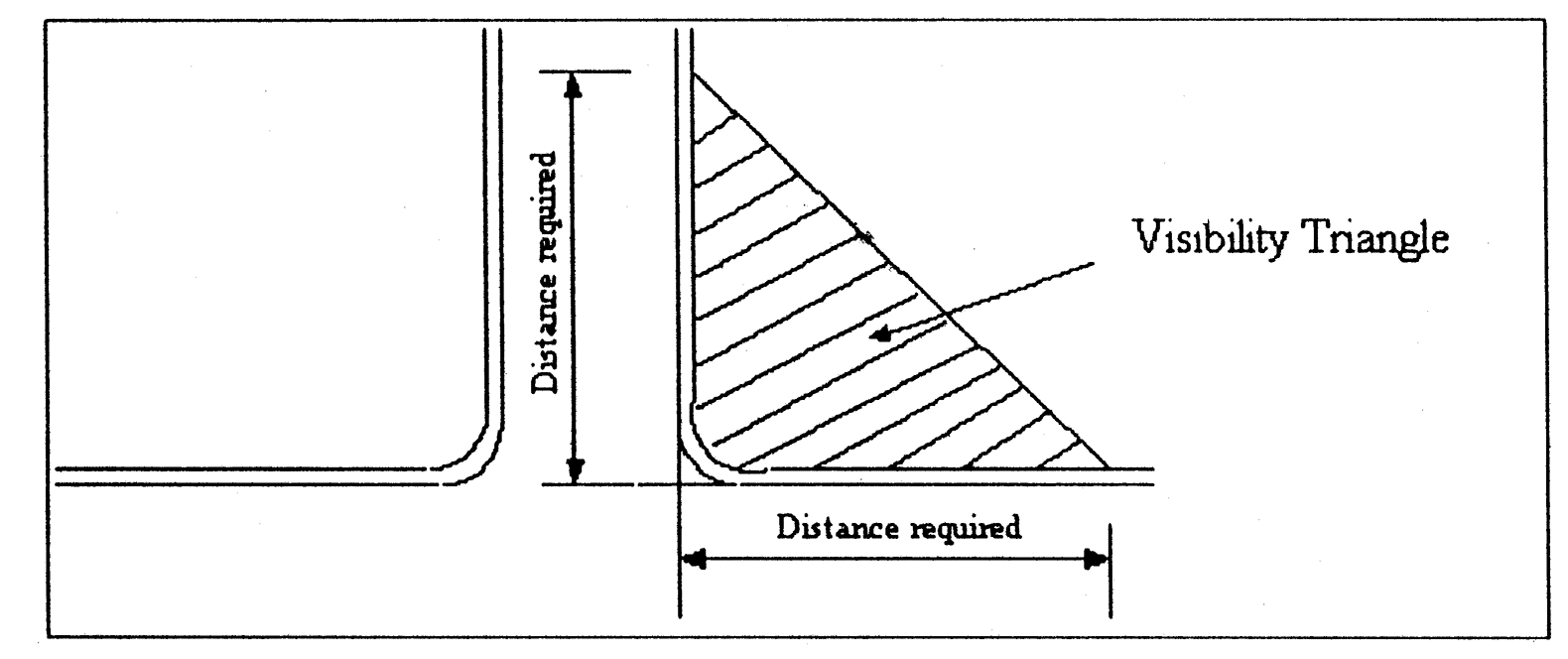
Trees may be planted, with a minimum separation of 20 feet, within the above described areas provided that they are maintained as needed to ensure that no branch of the tree is nearer the ground than eight feet. In certain circumstances, the city may require greater separation for reasons of public safety.
(Ord. No. 03-7, § 3, 5-1-03)
Sec. 6.22. - Yard and measurement requirements.
(a)
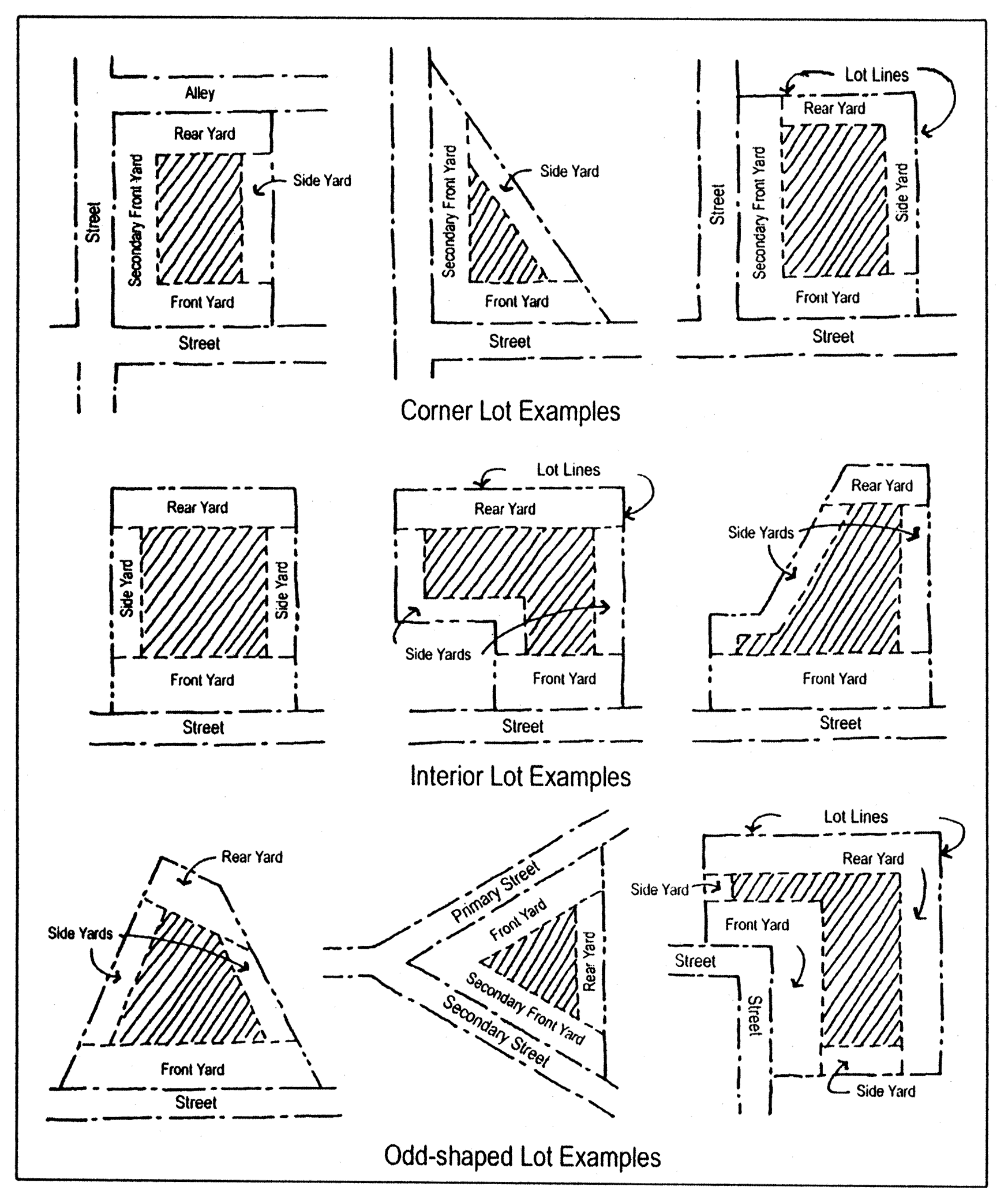
Required yards. Examples of yards are shown in the illustration on the next page.
(b)
Encroachment of open balconies and stairs. Open balconies may be permitted to encroach into required front or rear yards a distance of three feet. Open stairs, without independent roof or overhang systems, may be permitted to encroach into any required yard a distance of three feet provided that no resulting setback shall be less than 2 feet from any property line.
(c)
Encroachment of ornamental building components. Every part of a required front, rear and side yard shall be open from grade to the sky, unobstructed by any structure except for the ordinary projections of sills, belt courses, cornices, buttresses, ornamental features, and chimneys; provided, however, that none of the projections mentioned in this subsection shall extend into a required yard more than 12 inches.
(d)
Encroachment of eaves. Roof eave projections with gutters shall extend no more than two feet into any required side yard.
(e)
Front yard averaging. Prior to the adoption of this Code some existing residential structures were built with lesser front yards than are required by the district regulations herein. When new single-family or two-family residential construction is proposed on a lot fronting on a block where a majority of the existing structures have lesser front yards than are required by the district regulations, the minimum required front yard shall be the average of the yards established by the existing structures. However, no such new structure shall be permitted to have less than a ten-foot front yard under this provision. For the purposes of this section, a block is defined as a group of lots fronting along the same side of the street as the subject lot lying between the two nearest intersecting streets or waterways or combination thereof. If front yard averaging is used, paragraphs (b) and (c) do not apply.
(f)
Determination of front yard on corner lots. On corner lots, the front yard shall be determined as the yard abutting the street on which each lot of record or lots of record involved have their lesser dimension. The other yard abutting the intersecting street shall be determined to be a secondary front yard.
(Ord. No. 03-7, § 3, 5-1-03; Ord. No. 2017-30, § 2, 2-27-18)
Editor's note— Ord. No. 2017-30, § 2, adopted Feb. 27, 2018, amended § 6.22, and in so doing changed the title of said section from "Yards and measurement of required yards" to "Yard and measurement requirements," as set out herein.
Sec. 6.23. - Docks.
It is the intent of the city, together with the Pinellas County Water and Navigation Control Authority, to regulate the construction of residential and commercial dock facilities in order to minimize the adverse impacts of such activities upon the natural resources of the City of St. Pete Beach, Pinellas County and the State of Florida.
(a)
Applicability.
(1)
It shall be unlawful to build, construct, repair or alter any dock or part thereof in the city without conforming to this section.
(2)
It shall be unlawful to raze, alter, move, repair or build upon any dock or any part thereof except according to this section.
(b)
Specifications and materials. All docks, boat lifts, tie poles and attendant structures shall be constructed in accordance with and in conformity to this section and the requirements of the Pinellas County Water and Navigation Control Authority. All materials used in the construction of such structure shall likewise conform to the requirements of any city, county, state and federal agency having jurisdiction.
(c)
General requirements.
(1)
No dock or wharf, pier or other structure contemplated by this section shall be enclosed or covered by any means, either permanent or temporary.
(2)
The height of a docking facility (except openwork, railings, pilings, flag or signal poles and boat davits) shall not exceed 12 inches in height from the seawall or natural grade level to which it abuts, except when state or federal regulations require additional height.
(3)
All dock lighting shall comply with section 6.16.
(4)
Permits for docks shall be issued only for properties upon which a principal structure exists or upon which a building permit for the principal structures has been issued and the structure is substantially completed.
(5)
No building shall be permitted to be constructed over the waters of the county.
(6)
No dock structure or tie pole shall be allowed to project in the navigable portion of a waterway more than 25 percent of the width of the waterway.
(7)
No dock shall extend outward into the water from the seawall, mean or ordinary high water line more than 300 feet.
(8)
No portion of a docking facility shall encroach closer than 150 feet to the centerline of the Intracoastal Waterway.
(9)
Docks may be provided with electric or water utilities, provided no residential dock shall be served by separately metered utility service.
(10)
Submittal of all application information required by the Pinellas County Water and Navigation Control Authority Regulations, as appropriate.
(11)
Minimum construction specifications as required by the Pinellas County Water and Navigation Control Authority.
(12)
All application for docks shall be completed pursuant to paragraphs (10) and (11) above and shall be submitted to the city for approval prior to submission to the Pinellas County Water and Navigation Control Authority for permit.
(d)
Additional requirements for residential docks. In addition to the preceding general requirements, residential docks shall adhere to the following:
(1)
No residential dock shall be designed or constructed to accommodate more than two boats for permanent mooring. No residential zoning lot shall have more than one dock. For the purpose of this section, personal watercraft (wave runners or jet skis) lifts shall not be considered a boat slip.
(2)
Notwithstanding the preceding, a residential dock for the joint use by two or more adjacent waterfront property owners may be permitted where the physical characteristics of the waterfront make it impractical to build individual docks.
(3)
No residential dock, davits, boatlifts or tie poles shall extend from the mean high water line or seawall of the appurtenant upland property to a length greater than one-half the width of the zoning lot at the waterfront. This requirement may be varied administratively provided that signed statements of "no objection" from both adjacent waterfront property owners have been submitted.
(4)
Residential dock, davits, boatlifts or tie poles shall be located within the center one-half of the width of the appurtenant upland property at the waterfront. For the purpose of this regulation, side lot lines of a lot shall be deemed to extend into the adjacent water body perpendicular to the shoreline which they intersect. This requirement may be varied administratively provided that a signed statement of "no objection" from the property owner encroached upon has been submitted with the permit application.
(e)
Additional requirements for commercial docks. A commercial dock shall be permitted only as a conditional use. In addition to the requirements of Division 4, the following standards shall be met prior to the issuance of any development order for any commercial docking facility by the city:
(1)
The applicant shall demonstrate that the waterfront use is in compliance with this Code or can be brought into compliance to accommodate both the current use and the proposed dock, as it relates to parking, drainage, utilities and other facilities necessitated by the development. This provision shall also apply to a property which is already developed with docking facilities and where the owner wishes to add ancillary facilities;
(2)
All commercial dock installations must be consistent with the zoning of the adjacent upland property;
(3)
Commercial docking facilities constructed in the waters of the county shall be constructed so that the width of such facilities shall not exceed 75 percent of the width of the property at the waterfront and shall be further constructed so that the length of the facility shall not extend from the mean high water line or seawall of the property further than 75 percent of the width of the property at the waterfront;
(4)
All docking facilities must be so located that no portion of the proposed facility is closer to either adjacent extended property line than ten percent of the property width at the waterfront;
(5)
Commercial docks abutting adjacent waterfront residential property must be set back a minimum of one-third of the applicant's waterfront property width from the adjacent waterfront residential property. This requirement may be waived administratively provided that signed statements of "no objection" from the affected property owners has been submitted;
(6)
Would have a detrimental effect on the use of such waters for navigation, transportation, recreational or other public purposes and public conveniences;
(7)
Would have a material adverse effect upon the natural beauty and recreational advantages of the city;
(8)
Would have a material adverse effect upon the conservation of wildlife, marine life, and other natural resources, including beaches and shores, so as to be contrary to the public interest;
(9)
Would have a material adverse effect upon the uplands surrounding or necessarily affected by such plan or development; or
(10)
Would have a material adverse effect on the safety, health and welfare of the general public.
(f)
Dock repairs.
(1)
All dock repairs, including repairs to or replacement of permitted boat lifts, shall require a permit from the city, unless otherwise provided in this subsection.
(2)
Replacement of deck boards, only, on a residential dock shall not require the issuance of a permit from the city. All deck boards shall meet the minimum construction criteria as required by the Pinellas County Water and Navigation Control Authority.
(3)
Residential dock owners shall be permitted to repair or replace residential docks in the same size and configuration as the original permitted dock. A copy of the original county permits and drawings shall be submitted with the permit application. If original county permits cannot be provided, then the application will be reviewed as if it were a new dock permit request. This provision shall supersede requirements for nonconforming structures provided for elsewhere in the Code.
(g)
Disrepair or dilapidated docks. If any dock falls into a state of disrepair and becomes a dangerous structure, creating risks to the safety and well-being of the community or individual members thereof, the entire structure shall either be removed or repaired so as to conform to the requirements of this section.
(Ord. No. 03-7, § 3, 5-1-03; Ord. No. 2007-41, §§ 2, 3, 11-27-07; Ord. No. 2011-18, § 1, 7-12-11)
Sec. 6.24. - Outdoor dining and outdoor drinking areas.
A full or limited service restaurant may establish an outdoor dining area and a bar/lounge may establish an outdoor drinking area pursuant to the requirements of this section or as outlined within each zoning district. If an outdoor drinking and/or dining area is required to obtain conditional use approval as outlined in the zoning districts herein, it shall be pursuant to the review and approval procedures provided under Division 4 of this Code. If public consumption of alcohol is proposed to occur on any public street, sidewalk or private sand beach area in connection with the outdoor dining or outdoor drinking area, approval by the city commission is required pursuant to Chapter 6 of the City Code of Ordinances. Provided, however, that the regulations below shall not apply to outdoor dining or drinking approved in tandem with a City parklet program permit, nor shall specified regulations apply when temporarily waived by the City Commission while the City is under a state of emergency.
(a)
General requirements.
(1)
All outdoor dining and outdoor drinking areas located on private property shall comply with the following requirements:
a.
A landscape buffer and opaque wall or fence constructed at the maximum height allowed by this Code shall be required along the lot line of any yard containing an outdoor dining or outdoor drinking area when the lot line of said yard adjoins a property that is occupied by a residential use to effectively screen and mitigate external impacts as determined through the conditional use permitting process.
b.
Outside food and beverage consumption shall not extend beyond the permitted area.
c.
No outdoor food preparation is permitted.
d.
Suitable protective barriers shall be installed when an outdoor dining area or outdoor drinking area is located adjacent to a vehicular use area as determined by the building official.
e.
Upon the issuance of a tropical storm or hurricane warning, all tables, chairs and other equipment shall be securely stored inside.
(2)
In addition to the above requirements, the following requirements shall be met for outdoor dining or outdoor drinking areas located within city-owned public right(s)-of-way:
a.
Outdoor dining or outdoor drinking areas shall only be authorized when adjoining sidewalk has a continuous minimum width of eight feet unless the Technical Review Committee determines that the area can be reasonably accommodated by a narrower sidewalk width.
b.
A minimum four feet of contiguous and unobstructed corridor space must be maintained at all times to ensure a clear pedestrian passageway. The pedestrian passageway shall be a straight line, parallel to the building face and curb line, for the entire length of the outdoor dining or outdoor drinking area.
c.
The outdoor dining or drinking area shall not extend beyond the sidewalk frontage of the associated business establishment unless otherwise approved by the city commission.
d.
All furnishings shall be of good design and made of quality materials and be maintained in a clean and attractive appearance and shall be in good repair at all times.
e.
In addition to suitable protective barriers being installed, the interior perimeter around the outdoor dining or outdoor drinking area may be delineated using nonpermanent fixtures such as planters, decorative chains or other fixtures no less than thirty (30) inches and no greater than forty-two (42) inches in height as may be approved by the building official.
f.
City commission approval is required for public consumption of alcoholic beverages within public rights-of-way pursuant to Chapter 6 of the City Code of Ordinances.
(b)
Required Permit. All applicants for the establishment of an outdoor dining and/or drinking area associated with an eating and drinking establishment shall submit the following information to the City. If a conditional use permit is required for the establishment of the outdoor dining and/or drinking area as outlined in the district divisions herein, and for all new and expanded roof dining and/or drinking areas, a conditional use permit shall also be required in accordance with Division 4 of this Code. The permit application shall include the following information:
(1)
Survey.
(2)
Site plan depicting the proposed outdoor dining area or outdoor drinking area drawn to scale. The plan shall include the following information:
a.
Total square footage of the proposed outdoor dining area or outdoor drinking area.
b.
Number and placement of all seating/table arrangements and other elements.
c.
Distances between each seating/table arrangement, providing pedestrian clearance as required by the Florida Building Code and Florida Life Safety Code.
d.
All points of egress.
e.
Locations of signs prohibiting the removal of alcohol from the premises.
f.
For tenants as applicants, a letter of authorization from the property owner.
(3)
Occupant load of principal business.
(4)
Number of existing men's and women's bathrooms and fixtures.
(5)
Copy of applicant's liquor license(s).
(6)
For eating and drinking establishments providing for outdoor music, the following shall be provided:
a.
The product specifications of any permanent speakers, amplifiers and other support equipment to be installed outdoors.
b.
An explanation of the hours of operation of the outdoor dining and/or drinking area, including any special provisions or intentions for live music.
c.
A description of how music will be regulated in accordance with the City's noise ordinance as found in Chapter 46, Article IV of the Code of Ordinances.
(c)
Insurance and indemnification. For outdoor dining or outdoor drinking areas using public right(s)-of-way, the following is required:
(1)
By the use of any permit granted under this section, the operator agrees to indemnify, defend, save and hold harmless the city, its officers, agents and employees from any and all claims, liability, lawsuits, damages and causes of action which may arise out of the use of the public right(s)-of-way. The operator shall enter into a written agreement with the city to evidence this indemnification. Such agreement must have the written approval of the city attorney prior to issuance of a permit.
(2)
The operator shall show evidence of:
a.
Comprehensive general liability insurance on an "occurrence" basis in an amount not less than $1,000,000 combined single limit bodily injury liability and property damage liability. The city is to be specifically included as additional insured on the policy.
b.
Workers Compensation insurance applicable to its employees, if any, for statutory coverage limits in compliance with Florida laws, including employers' liability which meets all state and federal laws.
(3)
The operator shall provide the city with the certificate(s) of insurance evidencing required coverages. Current certified copies of such required coverages shall be provided to the city when specifically requested in writing.
(4)
All policies of insurance must be endorsed to provide the city with 30 days of notice of cancellation or restriction.
(d)
Revocation of permit. The city may revoke a permit for an outdoor dining or outdoor drinking area if it is found that:
(1)
Any necessary business or health permit has been suspended or revoked; or
(2)
Changing conditions of pedestrian or vehicular traffic cause congestion necessitating removal of the outdoor dining or outdoor drinking area when located within public right(s)-of-way. Such decision shall be based on the findings of the Technical Review Committee that the existing conditions represent a danger to the health, safety or general welfare of the public and cannot be resolved through modification to the outdoor dining or outdoor drinking area layout; or
(3)
The operator fails to comply with one or more requirements of the conditional use permit.
(e)
Removal or relocation of outdoor dining or outdoor drinking area and all related furnishings for right(s)-of-way repairs, emergency situations, or matters of public safety.
(1)
As necessitated by right(s)-of-way repairs, the city may require the temporary removal of outdoor dining or outdoor drinking area and all related furnishings. The operator shall be responsible for removing all furnishings at least 24 hours prior to the date identified in writing by the city. The city shall not be responsible for any costs associated with the removal or the return and installation of such furnishings.
(2)
The city may cause the immediate removal or relocation of all or any part of the outdoor dining or outdoor drinking area occupying public right(s)-of-way in emergency situations. The city, its officers, agents and employees shall not be responsible for any damages or loss of furnishings used in association with an outdoor dining or outdoor drinking area relocated during emergency situations and shall not be responsible for any costs associated with the removal or the return and installation of any such furnishings.
(3)
The city shall have the authority to secure or remove any furnishing(s) associated with the outdoor dining or outdoor drinking area occupying public right(s)-of-way if necessary in the interest of public safety.
(Ord. No. 03-15, § 1, 9-2-03; Ord. No. 2015-21, § 2, 9-22-15; Ord. No. 2015-22, § 5, 12-15-15; Ord. No. 2017-30, § 2, 2-27-18; Ord. No. 2020-24, § 2, 12-1-20)
Editor's note— Ord. No. 2015-21, § 2, adopted Sept. 22, 2015, amended § 6.24, and in so doing changed the title of said section from "Outdoor seating for existing restaurants" to "Outdoor dining and outdoor drinking areas," as set out herein.
Sec. 6.25. - Mobile food establishment.
It is a violation to vend any product from a mobile food truck at any location except in compliance with the requirements of this section.
(a)
Vehicle requirements. A mobile food truck shall not be used for vending a product unless the vehicle has been designed and constructed specifically for such purpose. The mobile food truck shall be licensed in accordance with the rules and regulations of any state and federal agency having jurisdiction over the mobile food truck or products sold therein.
(b)
Special event permits. Mobile food trucks may be permitted in public rights-of-way, or on public property, in conjunction with a special event permit as regulated in this section. Operation of mobile food trucks on public property or within public rights-of-way for special events is permitted, subject to approval of the special event by the City Commission.
(c)
Insurance requirements.
(1)
Operating in rights-of-way. The permittee, owner or operator shall at all times maintain any insurance which the city determines to be necessary, which may include but is not limited to, general liability insurance, commercial automobile liability insurance, worker's compensation insurance, and environmental liability insurance, issued by an insurance company licensed to do business in the State of Florida, in the amounts established by the city which shall be reasonable, based on industry standards and the risk determined to exist. The insurance policy shall be in occurrence form and the City of St. Pete Beach shall be named as an additional insured on the certificate of insurance. The permittee, owner or operator shall furnish the city with a certificate of insurance which shall be accepted by the city only after approval by the city commission. The permittee, owner or operator shall notify the city within three (3) business days of any changes in the insurance coverage. Upon the cancellation or lapse of any policy of insurance as required by this section, the special event permit shall be immediately revoked unless, prior to the expiration or cancellation date of the insurance policy, another insurance policy meeting all the requirements of the city is obtained and a new certificate of insurance is provided to the city.
(2)
Operating in all other locations, not in rights-of-way. A mobile food truck shall obtain at a minimum, the insurance as required by any state or federal laws and regulations.
(d)
Open flame cooking. Open flame cooking is prohibited; except that such activity may take place if permitted by the city fire marshal.
(e)
Noise limitations. Amplified music shall be prohibited; any other sounds from any mobile food truck shall comply with the noise requirements of the city.
(f)
Waste collection. The operator shall provide a waste receptacle for public use within 100 feet of the truck. The area shall be kept neat and orderly at all times and garbage or trash shall be removed daily.
(g)
Improved surface. Food trucks shall only operate from and be located on an improved surface at least 5 feet off the public right-of-way.
(h)
Signage. All signage must comply with the sign section of the Land Development Code. In no case shall "A-frame" signs be permitted.
(i)
Alcohol sales. Mobile food trucks are prohibited from selling alcoholic beverages, except as may be specifically allowed by a city issued permit in conjunction with a special event.
(j)
Business tax receipt. A business tax receipt (BTR) shall be required as provided in Article IV, Chapter 78.
(k)
Restroom facility. Mobile food trucks operating at a site for a duration of more than three (3) hours shall have a written agreement, available upon request by the city, which confirms that employees have access to a flushable restroom within 150 feet of the vending location during the hours of operation.
(l)
Grease disposal. Mobile food trucks shall have a current written agreement for the proper disposal of grease, available upon request by the city.
(m)
Location. The vending of products from a mobile food truck on public rights-of-way shall be prohibited unless in conjunction with a special event permit. The vending of products from a mobile food truck on private lands shall be subject to the following conditions:
(1)
Private property. The vending of products from a mobile food truck on private property, in conjunction with an established business, is permitted only in zoning districts of the city as outlined herein.
(2)
Vacant property. Operation of a mobile food truck is prohibited on vacant and unimproved property.
(3)
Permission. A mobile food truck shall have the written permission of the owner of the property on which it is located, available upon request by the city.
(4)
Frequency. Except as may be allowed as part of a special event permit, mobile food trucks are permitted on each property, a maximum of no more than three (3) days per calendar week. Mobile food trucks may operate at different locations as allowed herein.
(5)
Maximum number of mobile food trucks. No more than two (2) mobile food trucks shall operate on any property at any one (1) time, except as may be allowed by a special event permit.
(6)
Parking.Mobile food trucks shall not be required to provide additional parking on the principal business site. If a mobile food truck parks in a principal business required off-street provided space(s), then the principal business shall provide evidence, in the form of a site plan indicating that on-street parking exists within 800 feet of the establishment, available upon request from the city.
(7)
Access. A mobile food truck shall not be placed in any location that impedes the ingress or egress or building entrances or emergency exits.
(8)
Hours of operation. Mobile food trucks shall be permitted to operate after 7:00 a.m. and before 10:00 p.m. The request for extended hours must be reviewed and approved by the city.
(9)
Power. In no case shall a generator be used within 200 feet of a residential district.
(Ord. No. 2017-12, § 1, 11-28-17; Ord. No. 2019-23, § 2, 1-28-20; Ord. No. 2020-12, § 2, 8-25-20)
Sec. 6.26. - Certified recovery residences.
(a)
Definitions. The following terms shall be defined as follows:
(1)
Certified recovery residence means a residential dwelling that provides a peer-supported, alcohol-free, and drug-free living environment and is certified by a credentialing entity approved by the Florida Department of Children and Families, pursuant to section 397.487, Florida Statutes.
a.
A Level I certified recovery residence houses individuals in recovery who have completed treatment, with a minimum of 9 months of sobriety. A Level I certified recovery residence is democratically run by the members who reside in the home.
b.
A Level II certified recovery residence encompasses the traditional perspectives of sober living homes. There is oversight from a house manager who has experience with living in recovery. Residents are expected to follow rules outlined in a resident handbook provided by the certified recovery residence administrator. Residents must pay dues, if applicable, and work toward achieving realistic and defined milestones within a chosen recovery path.
c.
A Level III certified recovery residence offers higher supervision by staff with formal training to ensure resident accountability. Such residences are staffed 24 hours a day, 7 days a week, and offer residents peer-support services, which may include, but are not limited to, life skill mentoring, recovery planning, and meal preparation. Clinical services may not be performed at the residence. Such residences are most appropriate for persons who require a more structured environment during early recovery from addiction.
d.
A Level IV certified recovery residence is a residence offered, referred to, or provided by, a licensed service provider to its patients who are required to reside at the residence while receiving intensive outpatient and higher levels of outpatient care. Such residences are staffed 24 hours a day and combine outpatient licensable services with recovery residential living. Residents are required to follow a treatment plan and attend group and individual sessions, in addition to developing a recovery plan within the social model of living in a sober lifestyle. No clinical services are provided at the residence and all licensable services are provided offsite.
(2)
Reasonable accommodation means a modification or exception to a local land use, zoning, or building regulation or policy, as necessary to afford individuals with disabilities equal opportunity to use and enjoy a dwelling. The authorization of a certified recovery residential use on a zoning lot where such use is prohibited shall not be approved administratively. Uses that require conditional use approval required under the Land Development Code shall not be approved administratively.
(3)
Disability shall have the same meaning as defined under the Fair Housing Amendments Act and the Americans with Disabilities Act.
(b)
Review Procedures. The establishment of a certified recovery residence shall be subject to review and approval by the Community Development Department ("Department"), with such approval to be granted or withheld in compliance with all applicable local, state, and federal law, including the Fair Housing Amendments Act of 1988, 42 U.S.C. ss. 3601 et seq., and Title II of the Americans with Disabilities Act, 42 U.S.C. ss. 12131 et seq. When not in conflict with the statutory timelines referenced in this section, all requests made under this procedure shall be reviewed administratively by departmental staff of the Technical Review Committee after receipt of a completed application, prior to issuance of a final written administrative determination.
(c)
Application Required. An applicant seeking reasonable accommodation to establish or operate a certified recovery residence shall submit a written application to the Department. The application must include, at minimum:
(1)
Applicant Information: The name, mailing address, phone number, and email address of the applicant or the applicant's authorized representative.
(2)
Property Information: The address and parcel identification number of the subject property.
(3)
Accommodation Request: A description of the specific accommodation requested, including the applicable regulation or policy from which relief is sought, and an explanation of how the accommodation is necessary to afford equal housing opportunity.
(d)
Date-Stamping and Acknowledgement. Upon receipt of the application, the Department shall date-stamp the application and provide written acknowledgment of receipt to the applicant.
(e)
Request for Additional Information. If additional information is required from an applicant, the Department shall notify the applicant in writing within thirty (30) days of receipt of the application. The applicant shall respond to such request within thirty (30) days from the date of receipt of such notification.
(f)
Final Determination. The Department shall issue a final written determination within sixty (60) days after receipt of a complete application, which shall:
(1)
Approve the request in whole, with or without conditions;
(2)
Approve the request in part, with or without conditions;
(3)
Deny the request, stating with specificity the objective, evidence-based reason for the denial and identifying any deficiencies or actions necessary for reconsideration.
(g)
Automatic approval. If a final written determination is not issued by the Department within sixty (60) days after receipt of a completed application, the request shall be deemed approved by operation of law, unless the parties mutually agree in writing to a reasonable extension of time.
(h)
Revocation of accommodation. The Community Development Department may revoke a previously granted reasonable accommodation for cause, including but not limited to violation of conditions of approval; lapse, revocation, or failure to maintain required certification or licensure under Florida law, if such status is not reinstated within one hundred eighty (180) days from lapse; and material misrepresentation of facts in the application process. Applicants subjected to revocation shall be provided written notice of such revocation and shall have thirty (30) days upon receipt of written notice to respond contesting the validity of an accommodation revocation.
(Ord. No. 2025-22, § 2, 12-16-25)

