
St Pete Beach City Zoning Code
DIVISION 23
PARKING AND LOADING1
Editor's note— Ord. No. 2005-39, § 2, adopted Nov. 8, 2005, amended Div. 23, in its entirety, to read as herein set out. Prior to inclusion of said ordinance, Div. 23 pertained to similar subject matter. See also the Code Comparative Table.
Sec. 23.1.- Purpose and intent.
It is the intent and purpose of these regulations to provide accessible, attractive, secure, properly lighted, well maintained and screened off-street parking facilities for the citizens and the visitors of the City of St. Pete Beach. These regulations are also intended to reduce traffic congestion and hazards and to assure the maneuverability of emergency vehicles by requiring the adequate, appropriately designed and well placed provision of off-street parking and loading in proportion to the needs generated by varying types of land use. These requirements are also intended to protect residential neighborhoods from the adverse effects of vehicular noise and traffic generated by adjacent non-residential land use districts. It is the intent of these regulations that every structure and use erected or established shall be provided with adequate off-street parking facilities for the use of occupants, employees, visitors, customers or patrons. It is also the intent of these regulations that certain uses provide adequate off-street loading facilities. Such off-street parking and off-street loading facilities shall be maintained and continued so long as the permitted use continues.
(Ord. No. 2005-39, § 2, 11-8-05)
Sec. 23.2. - Residential parking restricted.
Residential parking restrictions shall apply within the RU-1, RU-2, RLM-1, RLM-2 and RM zoning districts. For the purpose of this section, the term "stored" shall be construed to include parking for a period exceeding 48 hours.
(a)
Recreational vehicles. No recreational vehicle, as defined in Division 2, shall be used for living, sleeping or housekeeping purposes. Such vehicles may be stored in accordance with the following:
(1)
Recreational vehicles may be stored in a rear yard, except waterfront yards, or side yard; and
(2)
No more than one recreational vehicle may be stored in a front yard, provided that such vehicle is located as follows:
a.
On an improved surface; and
b.
Such that the length of the vehicle is perpendicular to the front property line of the zoning lot; and
c.
Located a minimum of ten feet from the back of the curb on any public street.
(3)
Recreational vehicles that are stored off-site may be parked anywhere on a residential lot for up to 48 hours for the purpose of loading or unloading.
(4)
Visiting recreational vehicles shall be allowed to park temporarily for one week in any consecutive 90-day period provided the property owner notifies the city of such recreational vehicle within 24 hours.
(5)
Right-of-way parking of recreational vehicles shall be in accordance with Section 82-136 of the St. Pete Beach Code of Ordinances.
(b)
Boats and trailers. Boats and trailers may be stored in accordance with the following:
(1)
Boats and trailers may be stored in a rear or side yard; and
(2)
No more than one boat and/or trailer may be stored in a front yard, provided that the following regulations are met:
a.
On an improved surface or on an unimproved area adjacent to the side property line; and
b.
Such that the length of the boat and/or trailer is perpendicular to the front property line of the zoning lot; and
c.
Located a minimum of ten feet from the back of the curb on any public street.
(3)
Right-of-way parking of boats and trailers shall be in accordance with section 82-136 of the St. Pete Beach Code of Ordinances.
(c)
Personal watercraft. Up to two personal watercraft may be stored in accordance with paragraph (b) preceding.
(d)
Commercial vehicles. Overnight parking of commercial vehicles, as defined in Division 2, shall be prohibited.
(Ord. No. 2005-39, § 2, 11-8-05)
Sec. 23.3. - Applicability and scope.
(a)
One and two-family residential uses shall have the required number of parking spaces set forth in the applicable district regulations and shall comply with Section 23.11(b) of this Code.
(b)
Every other use hereafter instituted, and every other structure hereafter erected or enlarged, shall have permanently maintained off-street parking areas pursuant to the provisions set out in this division.
(c)
Non-residential properties located within the boundaries of the highlighted areas as shown in Figure 23.3(c) that are within 800 feet of on-street parking may be permitted to count up to 10 percent of the available on-street parking to meet the off-street parking requirement. The City Manager, or designee, may reduce the percentage of available parking that can be applied toward a property's parking requirement on a case-by-case basis depending on current parking demands and trends.
Figure 23.3(c) - On-Street Parking Availability Zones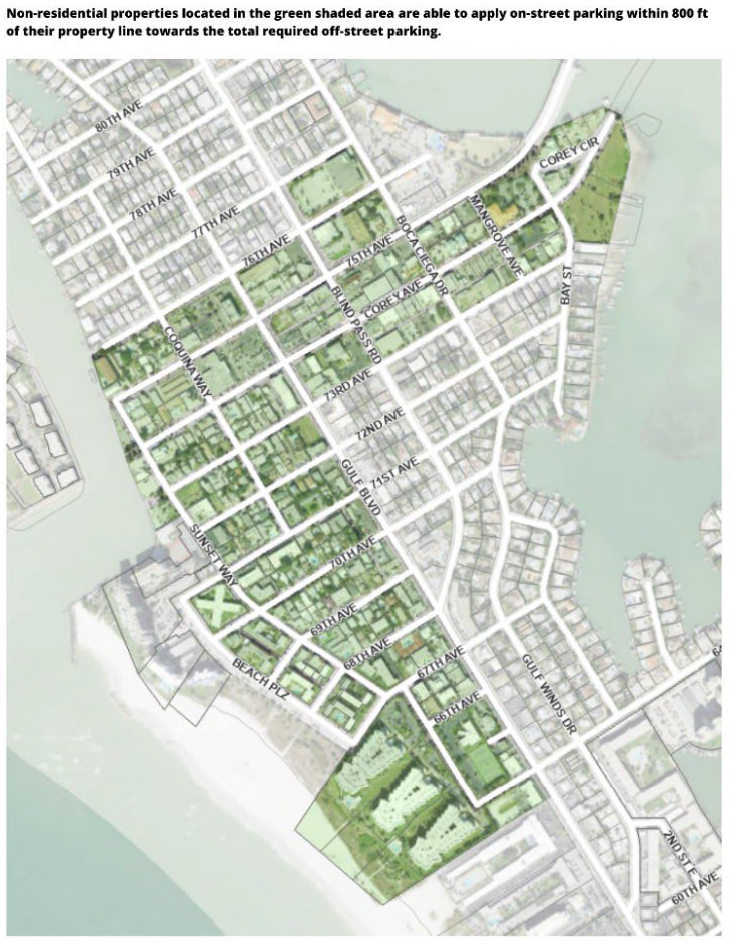
(d)
Where an existing use has fewer parking spaces than the number of parking spaces that would be required by this Code and the existing use is increased in density or intensity, additional parking spaces shall be required only as necessary for the increased units, square footage or intensity of the use.
(e)
Wherever in any zoning district, off-street facilities are provided for the parking or display of any and all types of vehicles or boats, whether such vehicles or boats are self-propelled or not, such off-street facilities and all land upon which vehicles traverse the property as a function of the property use, including "drive-in" facilities, shall conform to the minimum requirements of these regulations.
(f)
Where, upon the date of adoption of this Code, a use exists whose parking, for any reason whatsoever, is less than that which was required by the zoning code in effect at the time a building permit was issued for the structure(s) thereon, such parking shall be deemed a lawfully existing characteristic of use and shall be deemed to be in conformity with these regulations and shall be allowed to continue. However, any expansion of the use shall comply with subsection (d) above.
(Ord. No. 2005-39, § 2, 11-8-05; Ord. No. 2022-06, § 2, 5-9-22)
Sec. 23.4. - General parking requirements.
All off-street parking shall be provided in accordance with the following general requirements:
(a)
No building or use shall be permitted or constructed unless off-street parking spaces are provided in accordance with the provisions of this Code.
(b)
Computation of required spaces.
(1)
Fractional space requirements shall be rounded up to the next whole space.
(2)
In houses of worship and other places of public assembly in which occupants utilize benches, pews or similar seating arrangements, each 18 linear inches of such seating facilities shall be counted as one seat for the purpose of determining the required number of parking spaces.
(3)
In multistory buildings having vertical penetrations including, but not limited to, elevator, mechanical closets, air shafts, stairways and other similar penetrations, and retail or restaurant establishments having "backroom" storage or working space, may deduct these spaces from the gross square footage in calculating parking space needs.
(4)
In the case of mixed uses, the total requirements for off-street parking shall be the sum of the requirements of the various uses computed separately and the parking space for one use shall not be considered as providing the required parking for any other use, except as provided for in the shared parking criteria in this division.
(c)
Off-street parking areas shall not be used for sales, dead storage, repair, dismantling or servicing of any type or kind, nor shall areas devoted to such activities count toward meeting off-street parking requirements.
(d)
Off-street parking areas for five or more automobiles shall have individual spaces that are designed, maintained and regulated so that no parking or maneuvering incidental to parking shall be on any public street or sidewalk and so that any automobile may be parked and unparked without moving another automobile, unless a valet management plan with tandem parking is approved by the City Manager, or designee. The City Manager, or designee, has the authority to review previously approved parking arrangements to accommodate tandem valet parking without a new valet management plan. The valet management plan shall provide for the following:
(1)
The location of the valet area;
(2)
The number of valet spaces (on-site and/or off-site);
(3)
A brief narrative description of how the valet will function and hours of operation;
(4)
The location for the drop-off and pick-up area;
(5)
A diagram showing how automobiles will be shifted in and out of spaces at peak usage;
(6)
The contact information for valet operator(s);
(7)
The location of wayfinding/signage for pick-up/drop-off;
(8)
The location of receiving garage/lot and the number of spaces leased (if applicable);
(9)
A lease agreement for the valet spaces (if applicable);
(10)
A peak period contingency plan;
(11)
A queuing analysis (if requested); and
(12)
The understanding that if any modifications to the management plan are made without City Manager approval, or if the management plan is not being appropriately followed and enforced, the City Manager, or designee, may revoke approval.
(e)
Except as provided in section 23.7, all off-street parking areas shall be surfaced with asphalt, bituminous or concrete material, clay brick or concrete paving units, and maintained in a smooth, well-graded condition; provided, however, turf block may be used for the parking space surface.
(f)
If artificially lighted, such lighting shall be so designed and arranged that light is directed away from any adjoining property used or zoned for residential purposes and so designed and arranged as to shield public roadways and all other adjacent properties from direct glare or hazardous interference of any kind.
(g)
Be arranged for the convenient access and safety of pedestrians and vehicles.
(h)
Be so arranged that no vehicle shall be required to back from such facilities directly onto arterial or collector streets as defined by the ITE Manual.
(i)
Have curbs, motor vehicle stops or similar devices so as to prevent vehicles from overhanging on or into public rights-of-way or adjacent property.
(j)
Off-street parking spaces shall be reserved for the exclusive use of residents, customers, patrons, or employees of the principal use of the property they are designed and intended to serve or as part of a shared parking plan as permitted in this division; provided, however, the city may authorize such parking on non-residentially zoned properties to be used on a temporary basis by the general public in connection with a special event approved by the city under Article II of Chapter 26 of the City of St. Pete Beach Code of Ordinances during those times the principal use of the property is not operating or as provided in a shared parking agreement.
(k)
Required off-street parking shall be located as follows:
(1)
On the same or contiguous property of the use the parking is intended to serve;
(2)
On non-contiguous property which has the same zoning classification or a zoning classification which allows the use as permitted or conditional, as the use the parking is intended to serve, provided:
a.
The off-premises parking is within eight hundred (800) feet of the principal use to be served, to be measured along the most direct pedestrian route; except for a non-residential use that operates and maintains a valet management plan for customers as outlined in section 23.4(d).
b.
An identifiable pedestrian connection is provided between the off-premises parking area and the principal use it is intended to serve. The pedestrian connection shall require no crossing of a collector or arterial street, except at a signalized intersection.
c.
A parking agreement in a form approved by the city attorney is recorded with the Clerk of the Circuit Court of Pinellas County, Florida, at the owner's expense providing that the off-premises parking area will not be disposed of except in conjunction with the sale or use of the building the parking area serves so long as the parking is required.
(3)
Towards the rear of building sites, wherever possible, with the street frontage defined by buildings and building orientation.
(l)
Non-required, supplemental surface parking associated with an off-premises parking lot within the Gulf Boulevard Redevelopment District shall be limited to a time period not to exceed five years from the date the conditional use permit is originally approved by the city commission.
(m)
Conditional use approval for a commercial parking lot in the Bayou Residential Character District shall be limited to two years from the date the conditional use permit is originally approved by the city commission.
(n)
Notwithstanding any other provisions or restrictions contained in this Code, all parking lots, that have been permitted in accordance with this Code and in place at the time of adoption of this ordinance, are considered vested until such time as the owner of the lot chooses to expand or change use of the property.
(o)
Non-residential properties located in walkable areas are entitled to a 10% reduction to the total required off-street parking. Walkable areas must abut the following streets:
a.
Gulf Boulevard from 35 th Avenue to 75 th Avenue.
b.
Blind Pass Road from 75 th Avenue to 81 st Avenue.
The City Commission may modify the walkable areas as needed to adjust for future growth and trends through a Resolution.
(Ord. No. 2005-39, § 2, 11-8-05; Ord. No. 2015-03, § 2, 5-26-15; Ord. No. 2017-30, § 2, 2-27-18; Ord. No. 2022-06, § 2, 5-9-22)
Sec. 23.5. - Number of parking spaces required.
Regardless of any other requirement of these regulations, each and every separate or individual store, office, or other business shall be provided with at least one off-street parking space, excluding required handicap parking, unless specific provision to the contrary is made herein.
The following minimum off-street parking requirements are applicable to all districts except as otherwise provided herein:
(a)
In instances of new construction or facility expansion involving the establishment of outdoor seating areas or other accessory or supplemental uses, the number of required parking spaces shall be increased in accordance with the above table such that parking is adequate to accommodate the entire area of use, both internal and external to the structure; provided, however, outdoor dining or outdoor drinking areas shall not be required to provide additional parking when the outdoor dining or outdoor drinking area is less than 500 square feet or is located on a private sand beach affiliated with a temporary lodging establishment. Any portion of the outdoor dining or outdoor drinking area greater than 500 square feet not located on a private sand beach affiliated with a temporary lodging establishment shall be included as gross floor area for the purposes of calculating off-street parking requirements at the rate set forth in the above table or as otherwise provided by this Code.
(b)
Parking spaces that are in excess of the number of spaces required by this division shall be constructed as grass parking, turf block or in a parking structure.
(c)
Where a project is intended to be developed in phases, the city manager may approve the development of a parking area intended to serve each phase as it is developed.
(d)
All non-residential projects over 5,000 square feet shall be required to provide a minimum of five bicycle rack spaces, or a number of bicycle rack spaces equal to ten percent of the required number of vehicle parking spaces, whichever is greater.
(e)
For properties zoned CRD-EA, permitted non-residential and transient accommodation uses are exempt from the minimum parking standards above. Residential uses shall provide the required off-street parking in the table above.
(f)
For non-residential properties located in the Downtown Redevelopment District, additional parking shall be required for a change of use only if there is an increase in the floor area of an existing building or construction of additional buildings upon a determination by the city that there is inadequate space to increase off-street parking in accordance with city requirements.
(g)
For Transient Accommodations wishing to include Ballrooms, Conference Rooms or Meeting Rooms, an overflow parking plan must be provided for large events and/or events during high season times (March - August). The plan must include the location for overflow parking, how many spaces will be included, and a valet/shuttle plan for transportation to and from the overflow parking area if it is located off-site.
(Ord. No. 2005-39, § 2, 11-8-05; Ord. No. 2006-37, § 1, 12-12-06; Ord. No. 2008-32, § 1, 8-26-08; Ord. No. 2010-18, § 1(Exh. A), 11-8-11; Ord. No. 2015-03, § 3, 5-26-15; Ord. No. 2022-06, § 2, 5-9-22)
Sec. 23.6. - Handicap parking requirements.
Handicapped parking shall be provided consistent with the requirements of Florida Statutes, as may be amended.
(Ord. No. 2005-39, § 2, 11-8-05)
Sec. 23.7. - Pervious and semi-pervious parking.
(a)
Pervious/semi-pervious parking. Drought tolerant sod, shell, gravel or other similar pervious or semi-pervious surfaces that do not cause erosion, barriers to pedestrian access, or adverse effects to abutting parcels may be approved under the site plan provisions of Division 5 of this Code for parking facilities that meet one of the following criteria:
(1)
An off-premise or commercial parking lot in the Gulf Boulevard Redevelopment District for which a conditional use permit has been issued.
(2)
Non-required (excess) parking on the same premise as the use it is intended to serve.
(3)
Required parking in accordance with the following provisions:
a.
For houses of worship, up to 50 percent of required off-street parking facilities
b.
For parks and recreation facilities in a Recreation/Open Space (R/OS) District all required parking except for parking required under section 23.6 of this Code.
c.
For public and private schools, child care and family day care facilities, private clubs, and assisted living facilities, up to 30 percent of their required parking facilities.
(Ord. No. 2005-39, § 2, 11-8-05; Ord. No. 2015-03, § 4, 5-26-15)
Editor's note— Ord. No. 2015-03, § 4, adopted May 26, 2015, amended § 23.7 and in so doing changed the title of said section from "Grass and turf block parking" to "Pervious and semi-pervious parking," as set out herein.
Sec. 23.8. - Reserved.
Editor's note— Ord. No. 2015-03, § 5, adopted May 26, 2015 repealed § 23.8, which pertained to off-site parking, when allowable, and derived from Ord. No. 2005-39, § 2, adopted Nov. 8, 2005.
Sec. 23.9. - Shared off-street parking.
(a)
Two or more owners or operators of buildings or uses requiring off-street parking facilities may make collective provision for such facilities, provided that the total of such parking spaces when combined or used together shall not be less than the sum of the requirements computed separately, except in accordance with the requirements of this section. Any arrangement for combined off-street parking shall be subject to the filing of a legal instrument satisfactory to the city manager, or designee, ensuring that such off- street parking will be maintained in the future so long as a use or uses requiring such off- street parking continue.
(b)
No part of an off-street parking area required for any building or use shall be included as a part of an off-street parking area similarly required for another building or use except as shared parking as set forth below.
(c)
The city manager, or designee, may approve shared parking facilities for developments or uses with different operating hours or different peak business periods if the shared parking complies with all of the following standards:
(1)
Shared parking may not be used to satisfy the off-street parking standards for upper-story residential uses.
(2)
Shared parking spaces must be located within 600 feet of the primary entrance of all uses served. Required parking spaces reserved for persons with disabilities shall meet all requirements of the Florida Accessibility Code.
(3)
Shared parking areas for uses located in a non-residential district shall not be located in any residential district.
(4)
Those wishing to use shared parking as a means of satisfying off-street parking requirements must submit a shared parking analysis to the city manager, or designee, that clearly demonstrates the feasibility of shared parking. The study must be provided in a form established by the city manager, or designee, and made available to the public. It must address, at a minimum:
a.
The size and type of the proposed development;
b.
The composition of tenants;
c.
The anticipated rate of parking turnover and the anticipated peak parking and traffic loads for all uses that will be sharing off-street parking spaces;
d.
The number of spaces to be shared;
e.
Times and days parking is being shared;
f.
Any restrictions to the sharing of parking spaces;
g.
Provide the parking spaces required per code for each business sharing;
h.
Provide a diagram of the parking lot and indicate areas that are being shared (if space specific); and
i.
A termination clause if the agreement is discontinued.
(5)
A shared parking plan shall be enforced through written agreement among all owners of record. The owner of the shared parking area shall enter into a written agreement with the City of St. Pete Beach providing that the land comprising the parking area shall never be disposed of except in conjunction with the sale of the building which the parking area serves so long as the facilities are required; and that the owner agrees to bear the expense of recording the agreement and such agreement shall bind his or her heirs, successors, and assigns. An attested copy of the agreement between the owners of record shall be recorded with the County. Recordation of the agreement must take place before issuance of a building permit or certificate of occupancy for any use to be served by the shared parking area. A shared parking agreement may be revoked only if all required off-street parking spaces will be provided on-site in accordance with the off-street parking schedules in this section. The written agreement shall be voided by the city if other off-street facilities are provided in accord with these zoning regulations.
(6)
Where the uses subject to a shared parking agreement change, the city manager, or designee, shall have the authority to require a revised shared parking study and a new shared parking agreement when the revised shared parking study indicates additional parking is required.
(7)
Non-residential uses with excess off-street parking or having available off-street parking during non-business hours can make such parking available to the public, through administrative approval by the City Manager, or designee. An application and parking management plan must be submitted to the City and include the following:
a.
The parking spaces available to the public;
b.
The operating hours of the business;
c.
The hours the off-street parking will be sold;
d.
Proof that the off-street parking is underutilized/identifying the amount of excess parking if the plan includes spaces to be sold during operating hours;
e.
An enforcement plan; and
f.
The City Manager, or designee, may adopt additional rules and regulations necessary for the administration and enforcement of this subsection.
(Ord. No. 2005-39, § 2, 11-8-05; Ord. No. 2022-06, § 2, 5-9-22)
Sec. 23.10. - Utilization of boat slips as required parking.
Eating and drinking establishments and water oriented retail businesses may utilize boat slips to meet off-street parking requirements subject to approval by the city manager in accordance with the following standards:
(a)
All slips must be under the ownership or long-term control of the subject business.
(b)
Boat slips must be available on a first come, first served basis, with no fee assessed for use.
(c)
Boat slips must be reasonably designed to accommodate customer boats.
(d)
The dock facility must be properly accessible in accordance with the regulations governing the maneuvering of watercraft on the adjacent waterway.
(e)
Boat slips must only be used for transient mooring and no overnight storage of vessels shall be allowed.
(f)
Dock facilities must be compliant with applicable regulations governing handicap access and other accessibility or safety concerns.
(g)
Dock facilities must meet all other provisions of the city's land development code related to commercial docks.
(h)
No more than 20 percent of required off-street parking can be provided as boat slips.
(i)
Boat slips are allowed to meet off-street parking requirements strictly on a one space per slip basis.
(Ord. No. 2005-39, § 2, 11-8-05)
Sec. 23.11. - Parking construction and design requirements.
(a)
General construction requirements.
(1)
All driveway and off-street parking areas shall be constructed of concrete, concrete, pavers or equal on a properly constructed and compacted base unless an alternative is approved by the city.
(2)
No slag, rock, pea gravel or other loose type of material shall be used.
(3)
All driveway aprons within the public rights-of-way shall be constructed of concrete.
(4)
All points of ingress/egress from parking areas to public rights-of-way shall be constructed only upon approval from the city or other public agency having jurisdiction over the right-of-way.
(5)
All establishments with surface parking lots must provide, at a minimum, clearly delineated pedestrian access, separated from traffic lanes, from the public sidewalk to the parking area.
(6)
Surface parking lots containing 100 parking spaces or more shall provide pedestrian walkways through the parking area. Walkways shall connect pedestrian activity such as, but not limited to, public sidewalks, public recreation trails, transit stops, street crossings, bicycle parking facilities, buildings and store entry points, and central features and community spaces.
a.
Location.
(i)
For parking rows perpendicular to the principal building front façade, pedestrian walkways shall be located at a minimum of one pedestrian walkway every 200 feet.
(ii)
For parking rows parallel to the principal building front façade, pedestrian walkways shall be incorporated adjacent to a series of aligned landscape islands with a minimum of one walkway for every 25 parking spaces.
b.
Dimensions. Pedestrian walkways required by this subsection shall be a minimum of five feet in width. The five-foot width shall not include any vehicle overhangs. A landscaped area not less than four feet wide shall abut the entire length of the walkway and shall include one shade tree per 30 linear feet, shrubs, accent plants and groundcovers.
c.
Identification. Pedestrian walkways shall be clearly identified. Pedestrian benches along the walkways are recommended, but not required. Pedestrian walkways which cross vehicular aisles or driveways shall be distinguished by a contrasting paving material such as pavers, bricks, stamped asphalt, or scored concrete.
d.
The City Manager, or designee, may modify the pedestrian walkway standards if the applicant can demonstrate that some other form of pedestrian circulation would be suitable for the site and would provide equivalent pedestrian safety.
(7)
Parking lots and buildings should be designed to allow connections with establishments on adjacent properties, allowing drivers and pedestrians to cross property lines without returning to the street.
(8)
Where a surface parking lot abuts an existing sidewalk, a five-foot-wide buffered landscaping area should be provided containing shade trees or other greenery. The City Manager or their designee may waive this provision of the code of if the applicant can demonstrate that design standard will prohibit them from meeting the parking requirements as outlined in Division 23. If this requirement is waived, other conditions may be imposed to achieve the goal of this provision.
(9)
Where a parking area is abutting, or is across an alley from, any residential use or residential zoning district, the parking area shall be screened from view with either a solid landscape buffer or a masonry wall a minimum of six feet tall. The City Manager or their designee may waive this provision of the code of if the applicant can demonstrate that design standard will prohibit them from meeting the parking requirements as outlined in Division 23. If this requirement is waived, other conditions may be imposed to achieve the goal of this provision.
(10)
Where a driveway intersects a sidewalk located within the right-of-way, the portion of the sidewalk that crosses the driveway shall have a consistent finish and color as the abutting sidewalk and be visually delineated with expansion joints. The abutting property owner shall be responsible for maintaining the sidewalk in good condition and repair with no cracks or voids larger than one inch. Where a drive lane intersects a sidewalk located within the adjoining public rights-of-way, the sidewalk shall be delineated with expansion joints or contrasting surface materials.
(b)
Single-family and two-family residential.
(1)
For each single-family and two-family zoning lots there shall be no more than two driveways providing access to one street, however, in the case of corner lots, no more than three driveways shall be permitted for any lot.
(2)
Standard driveway. Driveways shall measure no less than 10 feet in width and no more than 20 feet as the driveway crosses the property line. The driveway approach shall measure no more than 26 feet at the curb, which includes two three-foot by seven-foot triangular flares.
(c)
All other uses.
(1)
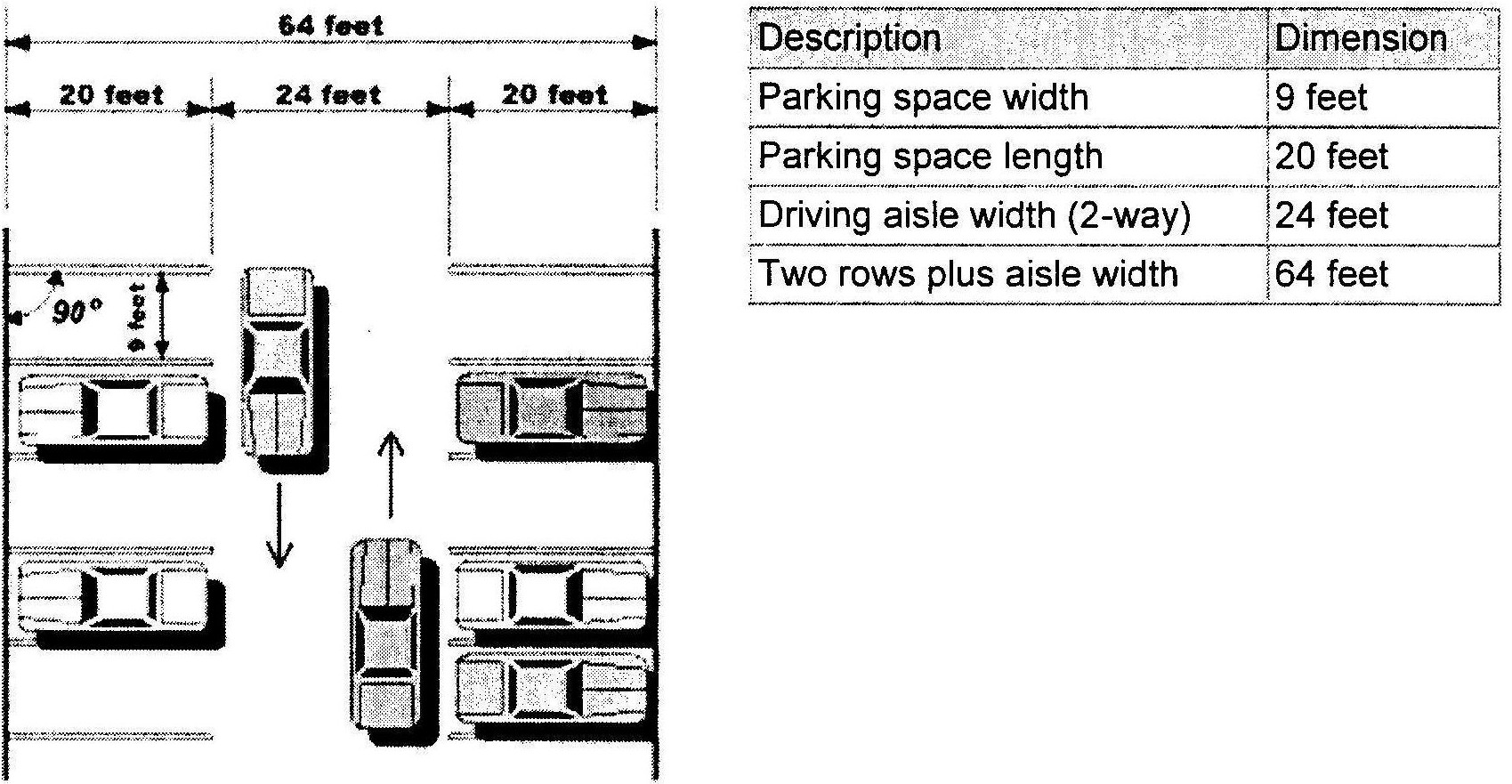
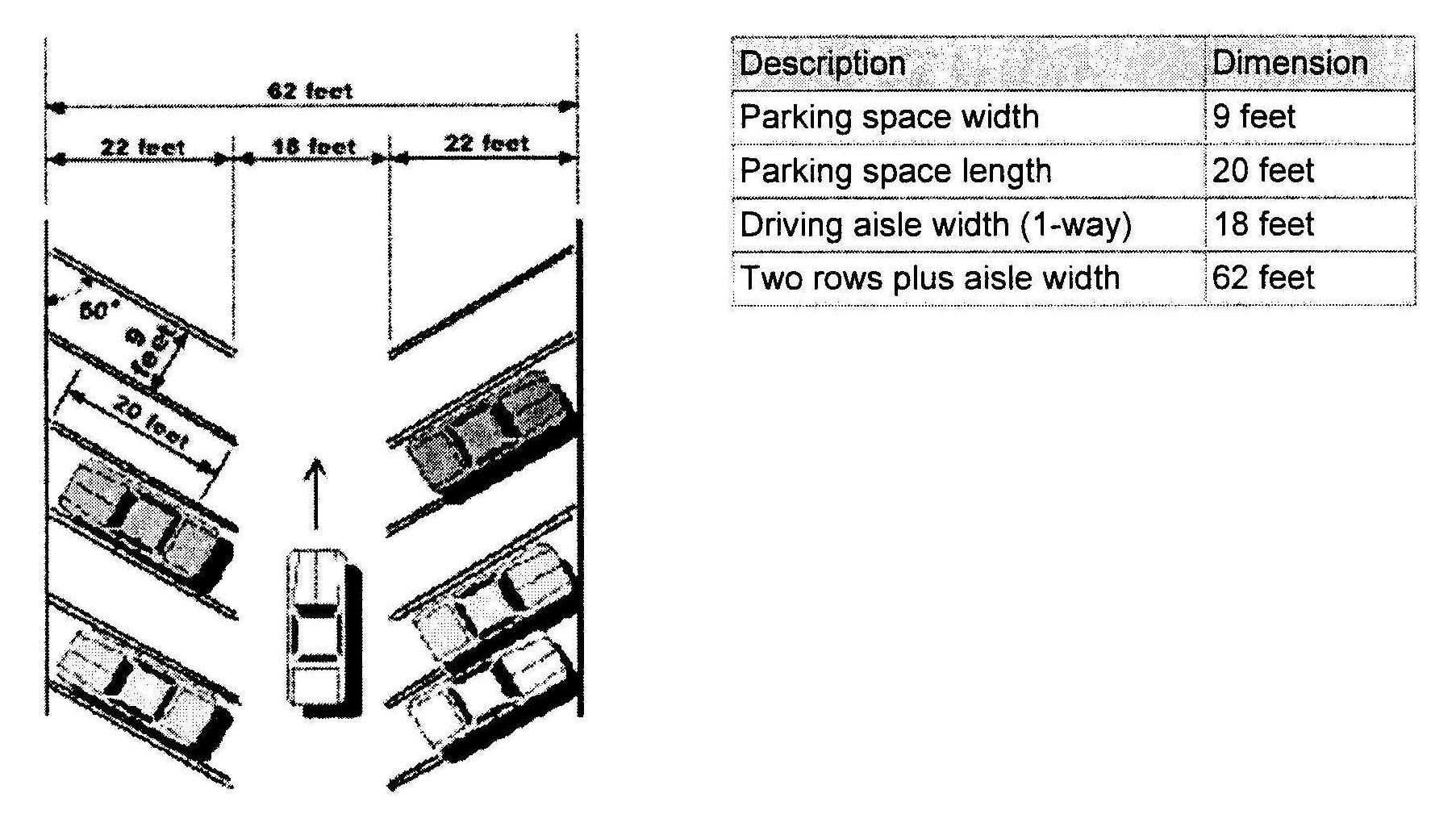
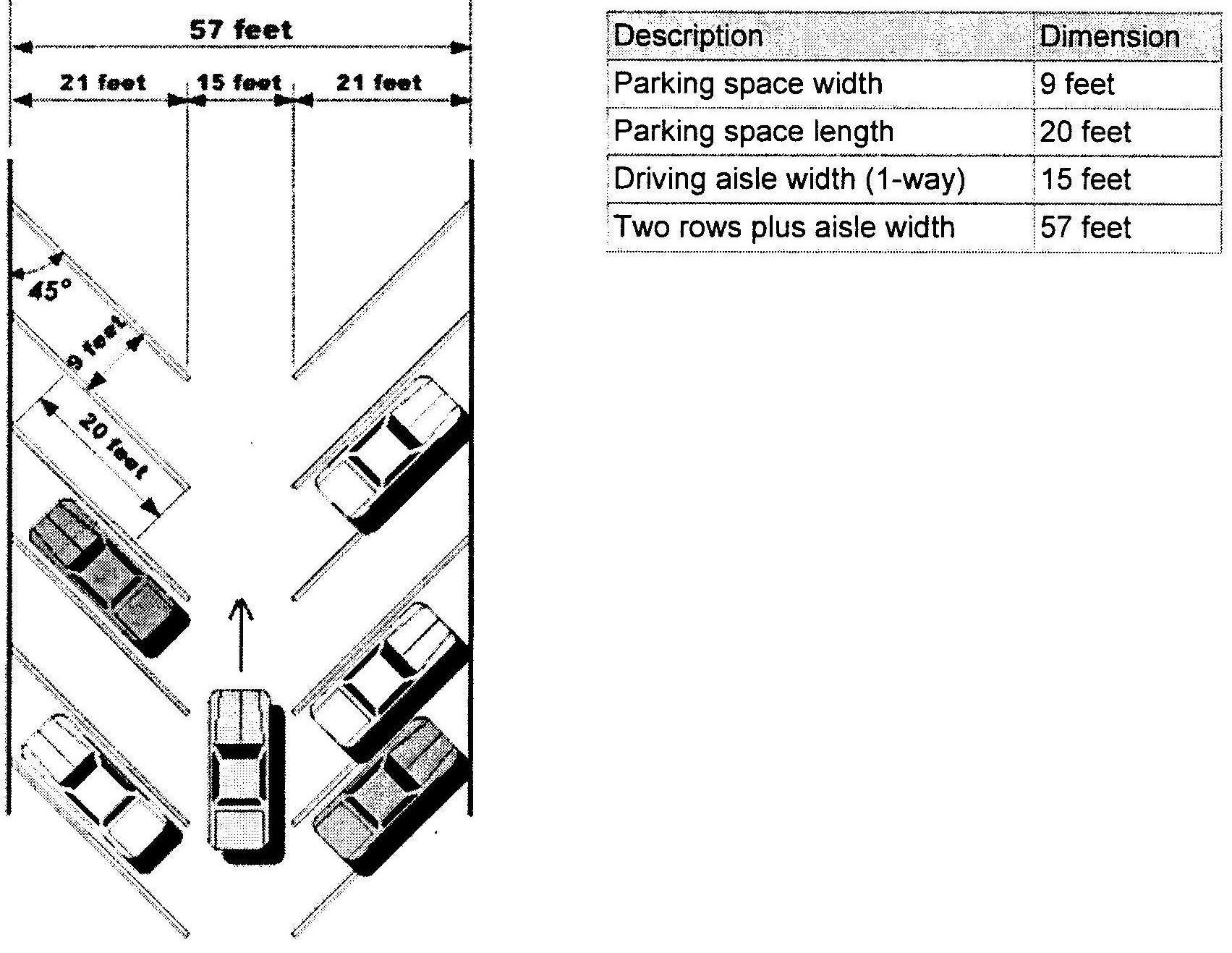
In additional to meeting the general construction requirements of paragraph (a) above, all off-street parking areas shall be designed and constructed in accordance with the dimensional requirements illustrated below, except that in developments requiring more than 50 total parking spaces, a maximum of 25 percent of such spaces may be designed for compact car parking (8 feet by 16 feet). Up to 10 percent of those spaces may be designed for motorcycles and/or scooters (4 feet by 10 feet) and/or golf carts (6 feet by 10 feet), where permitted to operate. Any such space provided must be identified by legible signage as a compact car, motorcycle and/or scooter, or golf cart parking space, where applicable.
a.
Parallel. The dimensional requirements for parallel parking spaces are nine feet in width and 24 feet in length.
b.
Perpendicular - 90 Degree. The dimensional requirements for this configuration are:
c.
Angled - 60 Degree. The standard dimensions for this configuration are:
d.
Angled - 45 Degree. The standard dimensions for this configuration are:
(Ord. No. 2005-39, § 2, 11-8-05; Ord. No. 2022-06, § 2, 5-9-22)
Sec. 23.12. - Off-street loading spaces.
All transient accommodation uses having food service, convention and/or meeting room facilities that in total floor area exceed 10,000 square feet and all nonresidential uses exceeding 10,000 square feet in floor area shall be required to provide one off-street loading space for the first 10,000 square feet and one additional off-street loading space for each additional 10,000 square of floor area or part thereof as follows:
(a)
Dimensions. The minimum dimensions of any required off-street loading space shall be a clear horizontal area of 12 feet by 30 feet, exclusive of platforms and piers, and a clear vertical space 14 feet high. For vehicle sales facilities, the loading space shall be large enough to accommodate at least one full size vehicle transport truck.
(b)
Changes in uses. When the use of a structure or land or any part thereof is changed to a use requiring off-street loading facilities, the full amount of off-street loading spaces required shall be supplied and maintained. When any structure is enlarged or any use extended so that the size of the resulting occupancy requires off-street loading space, the full amount of such space shall be supplied and maintained for the enlarged structure or extended use.
(c)
Accessibility. Each off-street loading space shall be directly accessible from a street or alley without crossing or entering any other required off-street loading space. Such loading space shall be accessible from the interior of the building it serves and shall be arranged for convenient and safe ingress and egress by motor truck or motor truck and trailer combinations, and so no truck or trailer shall be required to back from such facilities directly onto public streets.
(d)
Construction. All off-street loading areas shall be constructed of asphaltic concrete, concrete or equal on a properly constructed and compacted base unless an alternative is approved by the city.
(e)
Use restricted. Off-street loading areas shall not be used for sales, dead storage, repair, dismantling or servicing of any type or kind.
(f)
Shared off-street loading. Collective, joint or combined provisions for off-street loading facilities for two or more buildings or uses may be made, upon the approval of the city, provided that such off-street loading facilities are sufficient in size and capacity to meet the combined requirements of the several buildings or uses and are designed, located and arranged to be usable thereby.
(g)
Loading areas. Loading areas shall be screened from view with a solid masonry wall measuring at least six feet in height. Where the loading area is abutting, or across an alley from, any residential use or residential zoning district, the loading area shall be screened from view with a solid masonry wall measuring at least eight feet in height. The required screening wall(s) shall not conflict with other sections of this Code and shall be architecturally finished to match the building.
(Ord. No. 2005-39, § 2, 11-8-05; Ord. No. 2022-06, § 2, 5-9-22)
Sec. 23.13. - Maintenance of off-street parking and loading areas and driveways.
All off-street parking and loading areas and driveways shall be properly maintained as to surface condition, striping and drainage to ensure that such facilities can continue to serve in a similar fashion as for they were originally approved. The failure to adequately maintain off-street parking and loading areas and driveways, resulting in a nuisance or unsafe condition for pedestrians or motor vehicles, shall be considered a violation of this Code.
(Ord. No. 2005-39, § 2, 11-8-05)
Sec. 23.14. - Reserved.
Editor's note— Ord. No. 2022-06, § 2, adopted May 9, 2022, repealed § 23.14, which pertained to Fee in-lieu of required on-site parking and derived from Ord. No. 2015-03, § 6, adopted May 26, 2015.

