
Missoula City Zoning Code
CHAPTER 20
60 - Parking and Access
20.60.010 - General
A.
Purpose
1.
The regulations of this chapter are intended to ensure provision of off-street motor vehicle parking, bicycle parking, and other transportation access facilities in rough proportion to the generalized parking and transportation demands of different land uses. By requiring such facilities, it is the intent of this chapter to help avoid the negative impacts associated with spillover parking into adjacent neighborhoods, while at the same time avoiding the negative environmental and urban design impacts that can result from parking lots and other vehicular use areas.
2.
The provisions of this chapter are also intended to help protect the public health, safety and general welfare by:
a.
Helping avoid and mitigate traffic congestion;
b.
Encouraging multi-modal transportation options and enhanced pedestrian safety;
c.
Providing methods to reduce the amount of impervious surfaces in parking areas and adequate drainage structures in order to reduce the environmental impacts of stormwater runoff;
d.
Encouraging paving or alternate means of surfacing of parking areas in order to address dust abatement and improve air quality; and
e.
Providing flexible methods of responding to the transportation and access demands of various land uses in different areas of the city.
B.
Applicability
1.
General
Unless otherwise expressly stated, the parking regulations of this chapter apply to
all districts and all uses within zoned and unzoned areas.
2.
New Development
Unless otherwise expressly stated, the parking standards of this chapter apply to
all new buildings constructed and all new uses established in all zoning districts.
3.
Enlargements and Expansions
a.
Unless otherwise expressly stated, the parking standards of this chapter apply whenever an existing building or use is enlarged or expanded to include additional dwelling units, floor area, seating capacity, employees or other units of measurement used for establishing off-street parking requirements.
b.
In the case of enlargements or expansions triggering requirements for additional parking, additional off-street parking spaces are required only to serve the enlarged or expanded area, not the entire building or use. In other words, there is no requirement to address lawfully existing parking deficits.
c.
Additional off-street parking spaces are required only when existing development is enlarged or expanded in any way that results in more than a ten percent increase in the total number of off-street parking spaces required for the development, based on the standards of this zoning ordinance.
Commentary: An enlargement or expansion may trigger the need to provide or increase accessible parking, as determined by the City Building Division.
4.
Change of Use
a.
Unless otherwise expressly stated, when the use of property changes, additional off-street (vehicle and bicycle) parking spaces must be provided to serve the new use only when the number of parking spaces required for the new use exceeds by more than ten percent the number of spaces required for the lawful use that most recently occupied the building, based on the standards of this zoning ordinance. In other words, 110% "credit" is given to the most recent lawful use of the property for the number of parking spaces that would be required under this zoning ordinance, regardless of whether such spaces are actually provided. Any new parking spaces required must comply with all applicable parking area design and layout standards.
b.
When the number of parking spaces required for the new use exceeds the number of spaces required for the use that most recently occupied the property by more than ten percent, additional parking spaces are required only to make up the difference between the amount of parking required for the previous use and the amount of parking required for the new use, based on the standards of this ordinance.
Commentary: A change of use may trigger the need to provide or increase accessible parking, as determined by the City Building Division.
C.
Exemptions, Reductions and Special Area Standards
1.
CBD Zoning District
No off-street motor vehicle parking is required in the CBD zoning district.
2.
B1 Zoning District
No off-street parking is required for retail sales uses in the B1 district unless
such uses exceed 1,000 square feet of gross leasable floor area, in which case off-street parking must be provided for the floor area in excess of 1,000 square feet. On parcels occupied by two or more uses, the 1,000 square foot exemption may only be applied
once.
3.
Pedestrian-Oriented Overlay District
No off-street parking is required for retail sales uses in the /P overlay district unless such uses exceed 1,000 square feet of gross leasable floor area, in which case off-street parking must be provided for the floor area in excess of 1,000 square feet. On parcels occupied by two or more uses, the 1,000 square foot exemption may only be applied
once.
4.
Landmarks and Historic Districts
The zoning officer, in consultation with the historic preservation officer, is authorized
to approve exceptions and waivers to minimum off-street parking ratios for the following:
a.
Rehabilitation or reuse of buildings on the National Register of Historic Places;
b.
Buildings designated as local cultural resources;
c.
Contributing buildings in National Register Historic Districts; or
d.
Buildings in locally designated historic districts.
5.
Long-Term Bicycle Parking
Off-street motor vehicle parking space requirements may be reduced up to a maximum
of 25% of the total requirement by one space for every eight long-term bicycle parking
spaces provided in excess of what is required by Section 20.60.090.B. Long-term bicycle
parking spaces must comply with 20.60.090.
6.
Effect on Bicycle Parking Requirements
The bicycle parking requirements of 20.60.090 apply regardless of any motor vehicle parking exemptions and reductions authorized
in this section.
7.
Transit-served Locations
The number of off-street parking spaces is reduced 15% for nonresidential uses located
within 500 feet of a transit stop that is served at intervals of 30 minutes or less
between 7:00 a.m. and 9:00 a.m. and between 4:00 p.m. and 6:00 p.m.
8.
Vertical Mixed-Use Development
a.
No off-street motor vehicle parking is required for non-residential uses that are a part of vertical mixed-use development.
b.
Required ADA parking spaces may be located off-site.
9.
Combination of Reductions
Vehicle parking reductions in this chapter may be combined.
D.
Compliance Required
Existing parking facilities may not be altered to violate the requirements of this
chapter.
(Ord. 3735, 2024; Ord. 3669, 2020; Ord. 3549, 2015; Ord. 3471, 2011; Ord. 3439, 2010; Ord. 3410, 2009)
20.60.020 - Required Motor Vehicle Parking
A.
Minimum Requirements
Except as otherwise expressly stated, off-street motor vehicle parking spaces must
be provided in accordance with the off-street parking schedule of 20.60.020.C.
B.
Maximum Requirements
Nonresidential uses requiring 100 or more parking spaces may not provide more than
4.3 spaces per 1,000 square feet of gross leasable floor area.
C.
Off-Street Parking Schedule
Table 20.60-1 Off-Street Parking Schedule
[1] The parking ratio applies to all the units in an affordable housing development, including market rate units.
D.
Calculations
The following rules apply when calculating the required number of off-street parking
spaces:
1.
Multiple Uses
Unless otherwise expressly stated, parcels containing more than one use must provide parking in an amount equal to the total
of the requirements for all uses.
2.
Fractions
When measurements of the number of required spaces result in a fractional number,
any fraction of less than ½ is rounded down to the next lower whole number, and any
fraction of ½ or more is rounded up to the next higher whole number.
3.
Area Measurements
Unless otherwise expressly stated, all area-based (square footage) parking standards
must be computed on the basis of the gross floor area.
4.
Occupancy- or Capacity-based Standards
For the purpose of computing parking requirements based on employees, students, residents
or occupants, calculations must be based on the largest number of persons working
on any single shift, the maximum enrollment or the maximum fire-rated capacity, whichever
results in the greater number of spaces.
5.
Unlisted Uses
Upon receiving a development application for a use not specifically listed in an off-street parking schedule, the zoning officer
is authorized to apply the off-street parking ratio specified for the listed use that
is deemed most similar to the proposed use or establish a minimum off-street parking
requirement for the proposed use in accordance with 20.60.020.E.
E.
Establishment of Other Parking Ratios
1.
Upon receipt of an application of a use for which no parking ratio is established, the zoning officer is authorized to apply the parking ratio that applies to the most similar use or establish a different minimum parking requirement on the basis of parking data provided by the applicant and Development Services.
2.
Parking data and studies must include estimates of parking demand based on reliable data collected from comparable uses or on external data from credible research organizations. Comparability will be determined by density, scale, bulk, area, type of activity and location. Parking studies must document the source of all data used to develop recommended requirements.
(Ord. 3769, 2025; Ord. 3735, 2024; Ord. 3733, 2024; Ord. 3723, 2023; Ord. 3669, 2020; Ord. 3609, 2018; Ord. 3549, 2015; Ord. 3519, 2014; Ord. 3494, 2013; Ord. 3471, 2011; Ord. 3439, 2010; Ord. 3410, 2009)
Note— Interim provisions of Ord. 3769 expire March 24, 2026.
20.60.030 - Shared Parking
A.
General
Shared parking is encouraged as a means of conserving scarce land resources, reducing
stormwater runoff, reducing the heat island effect caused by large, paved areas and improving community
appearance. Shared parking facilities are allowed, subject to the following standards
and approval by the city engineer:
1.
Shared parking is allowed among different categories of uses or among uses with different hours of operation, but not both.
2.
Up to ten percent of required parking spaces for any use may be used jointly by a temporary commercial use.
3.
Applicants must provide a shared parking agreement executed by the parties establishing the shared parking spaces. The agreement must be filed with the Missoula County Clerk and Recorder. Shared parking privileges will continue in effect only as long as the agreement, binding on all parties, remains in force. If the agreement is no longer in force, then parking must be provided as otherwise required by this chapter.
4.
Shared parking may be located off-site, subject to the regulations of 20.60.040.C.
5.
Required accessible parking spaces (for persons with disabilities) may not be shared and must be located on-site.
B.
Shared Parking for Different Categories of Uses
A use may share parking with a different category of use according to only one of
the following subsections:
1.
If an office use and a retail sales-related use share parking, the parking requirement for the retail sales-related use may be reduced by up to 20%, provided that the reduction does not exceed the minimum parking requirement for the office use.
2.
If a residential use shares parking with a retail sales-related use (expressly excluding lodging uses, eating and drinking establishments and entertainment-related uses, the parking requirement for the residential use may be reduced by up to 30%, provided that the reduction does not exceed the minimum parking requirement for the retail sales-related use.
3.
If an office and a residential use share off-street parking, the parking requirement for the residential use may be reduced by up to 50%, provided that the reduction does not exceed the minimum parking requirement for the office use.
4.
If office, retail sales, or residential uses share off-street parking, the applicant may elect to use any one of the shared parking reductions of 20.60.030.B.1, 20.60.030.B.2 or 20.60.030.B.3. The applicant may also elect to prepare a shared parking analysis using the Urban Land Institute's (ULI) shared parking analysis methodology. Parking reductions based on the ULI methodology require review and approval by the zoning officer after consultation with the city engineer.
C.
Shared Parking for Uses with Different Hours of Operation
1.
For the purposes of this section, the following uses are considered daytime uses:
a.
Customer service and administrative offices;
b.
Retail sales uses, except eating and drinking establishments, lodging uses, and entertainment-related uses;
c.
Warehousing, wholesaling, and freight movement uses;
d.
Manufacturing, production and industrial service uses; and
e.
Other similar primarily daytime uses, as determined by the zoning officer.
2.
For the purposes of this section, the following uses are considered nighttime or Sunday uses:
a.
Auditoriums accessory to public or private schools;
b.
Religious assembly uses;
c.
Entertainment-related uses, such as theaters, bowling alleys, and dance halls;
d.
Residential uses; and
e.
Other similar primarily nighttime or Sunday uses, as determined by the zoning officer.
3.
Up to 90% of the parking required by this chapter for a daytime use may be supplied by the off-street parking provided for a nighttime or Sunday use and vice-versa, when authorized by the zoning officer.
4.
The applicant must show that there is no substantial conflict in the principal operating hours of the uses for which shared parking is proposed.
(Ord. 3735, 2024; Ord. 3439, 2010; Ord. 3410, 2009)
20.60.040 - Location of Off-Street Parking
A.
General
Except as otherwise expressly stated, required off-street parking spaces must be located
on the same parcel as the building or use they are required to serve.
B.
Residential Districts
The following standards apply in all R districts:
1.
Parking is prohibited in front and street side setbacks except that parking spaces may be located in the front or street side setback in front of a garage, carport or other parking space that is located outside of required buildingsetbacks.
2.
No more than 40% of the front yard area in an R district may be paved or used for parking or vehicular use. On corner parcels, not more than 20% of the street side yard area may be paved or devoted to parking or other vehicle use.
3.
For parcels adjacent to a road easement, when the property line is in the road easement, the front yard and street side areas shall be measured from edge of road pavement rather than from the parcelproperty line.
C.
Off-Site Parking
1.
General
All or a portion of required off-street parking may be provided off-site, in accordance
with the provisions of this section. Off-site parking areas must comply with all applicable
parking area design and accessibility standards. Required accessible parking spaces
may not be located off-site.
2.
Location
a.
Off-site parking areas must be located within a 500-foot radius of the use served by such parking, measured between the entrance of the use to be served and the outer perimeter of the furthest parking space within the off-site parking lot.
b.
Off-site parking must be located on a parcel zoned for the same or more intense use group or building type as the use or building type to be served by the parking.
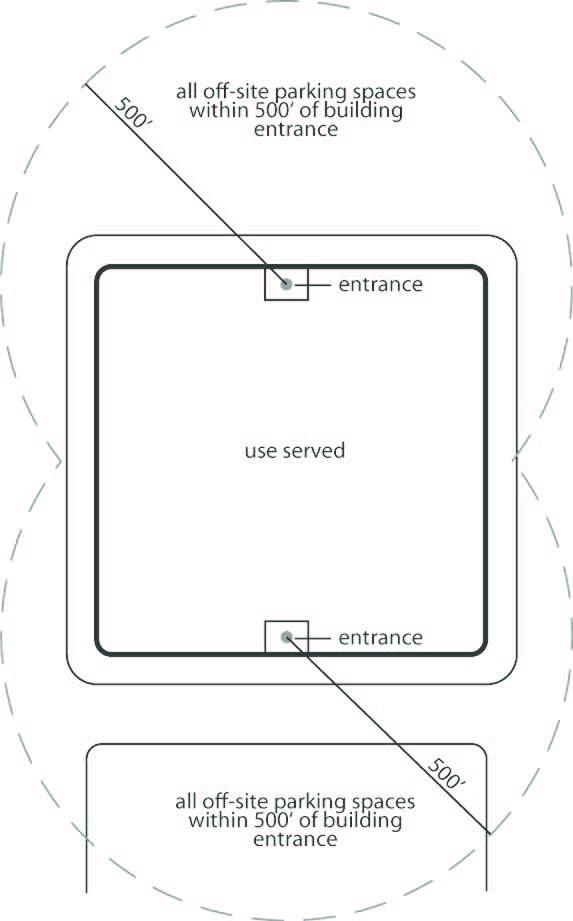
Figure 20.60-1 Shared Parking, Off-site Parking, Location
3.
Control of Off-Site Parking Area
The property to be occupied by the off-site parking facilities must be under the same
ownership as the parcel containing the use to be served by the parking. The off-site parking area may be
under separate ownership only if an agreement is provided guaranteeing the long-term
availability of the parking, commensurate with the use served by the parking. Off-site
parking privileges will continue in effect only as long as the agreement, binding
on all parties, remains in force. If an off-site parking agreement lapses or is no
longer valid, then parking must be provided as otherwise required by this chapter.
(Ord. 3549, 2015; Ord. 3471, 2011; Ord. 3439, 2010; Ord. 3410, 2009)
20.60.050 - Use of Off-Street Parking Areas
A.
Required off-street parking areas may be used solely for the temporary parking of licensed motor vehicles in operating condition.
B.
Required off-street parking spaces may not be used for the display of goods for sale or lease or for storage of building materials.
C.
Required off-street parking spaces are intended to serve residents, tenants, patrons, employees, or guests of the principal use. Off-street parking spaces that are required by this zoning ordinance must be maintained for the life of the principal use.
D.
No commercial motor vehicle repair work of any kind is permitted in a required parking space.
(Ord. 3439, 2010; Ord. 3410, 2009)
20.60.060 - Parking Area Design
A.
General
Parking areas must be laid out and designed in accordance with Municipal Code requirements
and City Engineering Division standards and specifications.
B.
Driveway and Driveway Approaches
1.
Driveways must be reviewed and approved by the City Engineering Division before issuance of a zoning compliance permit or building permit.
2.
Driveway approaches from streets may not be created in residential zoning districts for parcels with access to an alley except those approved by the City Engineer due to topographic, physical or easement constraints.
C.
Pedestrian Walkways
Multi-dwelling residential, commercial, industrial and mixed use development shall
provide pedestrian walkways. A system of pedestrian walkways is required to connect
each primary use structure on a site to the following: adjacent public sidewalks, on-site parking lots or parking structures, other on-site primary use structures, bicycle storage areas, and common outdoor use areas. The pedestrian walkway system
must comply with Municipal Code requirements.
(Ord. 3669, 2020; Ord. 3439, 2010; Ord. 3410, 2009)
20.60.070 - Accessible Parking (for People with Disabilities)
Accessible parking facilities must be provided in accordance with Accessibility Code requirements through the City Building Division.
(Ord. 3669, 2020; Ord. 3439, 2010; Ord. 3410, 2009)
20.60.080 - Reserved
Editor's note— Ord. 3735, § 20, adopted March 25, 2024, deleted § 20.6.080 entitled "Transit-Served Locations," which derived from: Ord. 3439, 2010; and Ord. 3410, 2009. See § 20.60.010.C for similar provisions.
20.60.090 - Bicycle Parking
A.
General
This section establishes requirements for short-term bicycle parking and long-term
bicycle parking and storage facilities. These requirements apply regardless of any
motor vehicle parking exemptions or reductions.
B.
Spaces Required
Short-term and long-term bicycle parking is required in accordance with the following
minimum ratios:
Table 20.60-2 Bicycle Parking, Spaces Required
C.
Short-Term Bicycle Parking Spaces
1.
Purpose
Short-term bicycle parking is generally intended to serve the needs of cyclists who
park their bicycles for short time periods, including customers, clients, students
and other short-term visitors.
2.
Design and Location
a.
General
Required short-term bicycle parking spaces must:
(1)
Consist of bike racks or lockers that are anchored so that they cannot be easily removed;
(2)
Be of solid construction, resistant to rust, corrosion, hammers and saws;
(3)
Allow both the bicycle frame and the wheels to be locked with the bicycle in an upright position using a standard U-lock;
(4)
Be designed so as not to cause damage to the bicycle;
(5)
Facilitate easy locking without interference from or to adjacent bicycles; and
(6)
Be accessed from the outside of the individual dwelling unit.
b.
Location
At least 50% of required bicycle parking spaces must be located within 50 feet of
a customer entrance, and the remainder must be located within 100 feet of any entrance.
If required short-term bicycle parking spaces are not visible from the abutting street
or the main customer entrance, signs must be posted indicating their location.
c.
Size
All required short-term bicycle parking spaces must have minimum dimensions of two
feet in width by six feet in length, with a minimum overhead vertical clearance of
seven feet.
D.
Long-Term Bicycle Parking and Storage Spaces
Long-term bicycle parking is generally intended to serve the needs of cyclists who
park their bicycles for long time periods, including employees and residents.
1.
Design and Location
a.
General
Required long-term bicycle parking spaces must:
(1)
Be protected from weather and access by unauthorized persons;
(2)
Consist of bike racks or lockers anchored so that they cannot be easily removed;
(3)
Be of solid construction, resistant to rust, corrosion, hammers, and saws;
(4)
Be designed so as not to cause damage to the bicycle;
(5)
Facilitate easy locking without interference from or to adjacent bicycles; and
(6)
Be accessed from the outside of the individual dwelling unit.
b.
Location
Required long-term bicycle parking must be provided in at least one of the following
locations:
(1)
In covered stationary racks or lockers that comply with the short-term bicycle parking location requirements of 20.60.090.C.2.b;
(2)
In a designated locked room;
(3)
In a covered, locked area that is enclosed by a fence or wall with a minimum height of seven feet;
(4)
In a private garage or private storage space serving an individual dwelling unit within a multi-dwelling (residential) building;
(5)
In a covered area within clear view of an attendant or security personnel;
(6)
In a covered area continuously monitored by security cameras; or
(7)
In a covered area that is visible from employee work areas.
c.
Size
Required long-term bicycle parking spaces must have minimum dimensions of two feet
in width by six feet in length, with a minimum overhead vertical clearance of seven
feet. Bicycle lockers are exempt from overhead clearance requirements.
E.
Authorized Administrative Adjustments
1.
The zoning officer is authorized to approve an administrative adjustment reducing the number of bicycle spaces required under this section in accordance with the procedures of 20.85.110.
2.
The zoning officer is also authorized to approve an administrative adjustment to modify the bicycle parking design and location requirements of this section in accordance with the procedures of 20.85.110.
(Ord. 3519, 2014; Ord. 3483, 2012; Ord. 3471, 2011; Ord. 3439, 2010; Ord. 3410, 2009)
20.60.100 - Motorcycle Parking
In parking lots containing over 20 motor vehicle parking spaces, motorcycle parking may be substituted for up to five automobile parking spaces or five percent of required motor vehicle parking, whichever is less. For every four motorcycle parking spaces provided, the automobile parking requirement is reduced by one space. Each motorcycle space must have minimum dimensions of four feet by eight feet. This provision applies to existing and proposed parking lots.
(Ord. 3439, 2010; Ord. 3410, 2009)
20.60.110 - Drive-through Facilities and Vehicle Stacking Spaces
A.
Applicability
1.
The regulations of this section apply to all uses that include drive-through facilities and to all portions of a development that comprise the drive-through facility.
2.
The regulations apply to new developments, the addition of drive-through facilities to existing developments, and the relocation of existing drive-through facilities.
Commentary: Drive-through facilities are not a right; the size of the parcel or the size and location of existing structures may make it impossible to meet the regulations of this section.
B.
Parts of a Drive-through Facility
A drive-through facility is composed of two parts:
1.
The stacking lanes (the space occupied by vehicles queuing for the service to be provided); and
2.
The service area, where the service occurs. In uses with service windows, the service area starts at the service window. In uses where the service occurs indoors, the service area is the area within the building where the service occurs. For other facilities, such as gas pumps, air compressors, and vacuum cleaning stations, the service area is the area where the vehicles are parked during the service or operation.
C.
Setbacksand Landscaping
1.
Service areas and stacking lanes on parcels abutting R zoning districts must be set back at least 50 feet and landscaped in accordance with the landscape buffer requirements of 20.65.060.
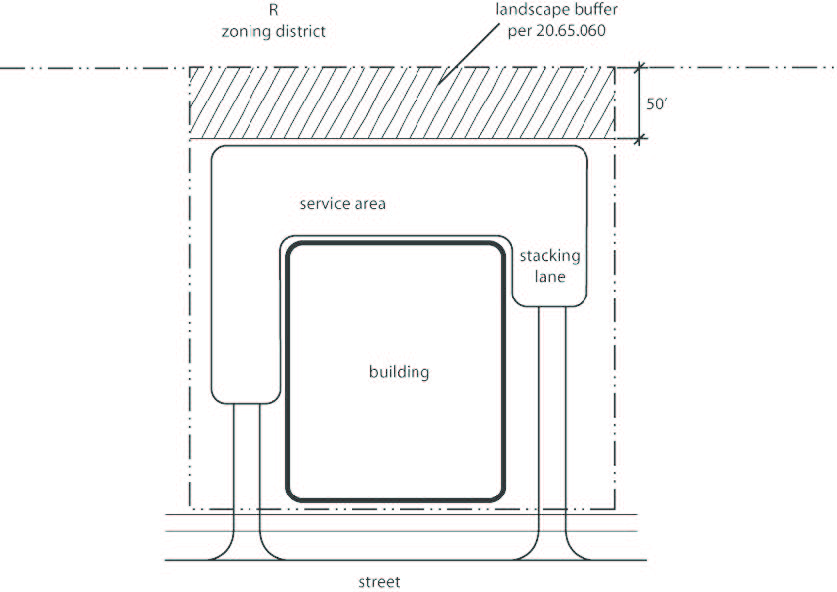
Figure 20.60-2 Drive-through Facilities and Vehicle Stacking Spaces, Setbacks and
Landscaping Buffer
2.
If the service areas and stacking lanes are within 50 feet of and visible from the roadway, they must be set back at least 20 feet from the right-of-way and landscaped in accordance with perimeter parking lot landscaping requirements of 20.65.050.
D.
Stacking Lane Design and Layout
Stacking lanes must be designed and laid out in accordance with Municipal Code requirements
and city engineering division standards and specifications (Title 12 M.M.C).
E.
Noise
Speakers associated with drive-through facilities must comply with Municipal Code requirements. Sound attenuation walls, landscaping or other mitigation measures may be required to ensure that the facility will not
have adverse noise-related impacts on nearby residential uses.
F.
Site Plans
Site plans must show the location of drive-through windows and associated facilities
(for example: communications systems and access aisles), as well as adjacent residential
uses.
(Ord. 3549, 2015; Ord. 3439, 2010; Ord. 3410, 2009)
20.60.120 - Cross-Access
A.
Description and Purpose
Cross-access refers to providing vehicular access between two or more contiguous sites
so that motorists and/or pedestrians do not need to reenter the public street system
to gain access to abutting sites. Cross-access between abutting properties reduces
vehicular conflicts between motorists on the street and motorists entering and leaving
driveways. Reduced traffic conflicts result in fewer accidents and improved traffic
flow on the public street network.
B.
Requirements
Vehicular and/or pedestrian access between abutting parcels may be required in accordance with Municipal Code requirements and City Engineering
Division standards and specifications.
(Ord. 3439, 2010; Ord. 3410, 2009)
20.60.130 - Off-Street Loading
Vehicle loading and unloading areas must be provided in accordance with Municipal Code requirements and City Engineering Division standards and specifications.
(Ord. 3439, 2010; Ord. 3410, 2009)
20.60.140 - Traffic Studies
The city engineer may require the submittal of trip generation data for proposed developments using data from the Institute of Transportation Engineers' publication Trip Generation.
A.
The city engineer may require a traffic study for a proposed development that generates 200 or more average daily (weekday) trips. The traffic study must provide adequate information to allow the transportation planner and the city engineering department to assess the impact of the proposed development on nearby streets and intersections, including its impacts on pedestrians, bicyclists, and public transit.
B.
The city engineer may require traffic control infrastructure improvements, including off-site access and traffic control. The city engineer may require the applicant to finance and construct those traffic infrastructure improvements that are directly attributable to the development.
C.
When development is adjacent to or within one-fourth mile of an established public transit route, the city engineer may require applicant to finance and construct public transit improvements, including bus pull outs and transit facilities such as shelters, benches, bike parking, map cases and signage along established bus routes.
(Ord. 3471, 2011; Ord. 3439, 2010; Ord. 3410, 2009)

