
Missoula City Zoning Code
CHAPTER 20
15 - Industrial and Manufacturing Districts
20.15.010 - General
A.
Districts
1.
List
The city's industrial and manufacturing zoning districts are listed below. Except
as otherwise expressly stated, when this zoning ordinance refers to "industrial" or
"manufacturing" zoning districts or "M" districts, it is referring to these districts.
2.
Deciphering the District Names and Map Symbols
The M district names and map symbols are intended to provide only a general, relative
indication of what is allowed in the district. On the zoning map these districts include
at least one other essential information component; an intensity designator, which
is identified by a dash (-) and a numeral following the initial letter-number combination,
as in M1-2 (M1 dash 2). The intensity designator establishes the allowable intensity
of development andapplicable parcel and building standards.
B.
Purposes
Missoula's industrial (M) zoning districts are primarily intended to accommodate manufacturing,
warehousing, wholesale and industrial uses. The regulations are intended to promote
the economic viability of manufacturing and industrial uses, encourage employment
growth, allow residential uses in the M1R district, and limit the encroachment of
unplanned residential and other non-industrial development into M1- and M2-zoned areas.
(Ord. 3439, 2010; Ord. 3410, 2009)
20.15.020 - Allowed Uses
A.
Use Table
Uses are allowed in M zoning districts in accordance with Table 20.15-1 below.
B.
Use Classification System
For the purpose of this zoning ordinance, uses are classified into "use groups," "use
categories," and "specific use types." These are described and defined in Chapter 20.105. Uses are identified in the first column of Table 20.15-1.
C.
Permitted Uses
Uses identified with a "P" in Table 20.15-1 are permitted as-of-right in the subject
zoning district, subject to compliance with any use standards identified in the final
column of the table and all other applicable standards of this zoning ordinance.
D.
Conditional Uses
Uses identified with a "C" in Table 20.15-1 may be allowed if reviewed and approved
in accordance with the conditional use procedures of 20.85.070. Conditional uses are subject to compliance with any use standards identified in the final column of
the table and all other applicable standards of this zoning ordinance.
E.
Prohibited Uses
Uses identified with a "-" are expressly prohibited.
F.
Use Standards
The "use standards" column of Table 20.15-1 identifies use-specific standards that
apply to some uses. Unless otherwise expressly stated, compliance with such standards
is required regardless of whether the use is permitted as-of-right or requires conditional
use approval.
Table 20.15-1 Uses Allowed in Industrial Districts
(Ord. 3769, 2025; Ord. 3736, 2024; Ord. 3733, 2024; Ord. 3723, 2023; Ord. 3705, 2022; Ord. 3689, 2021; Ord. 3609, 2018; Ord. 3586, 2016; Ord. 3583, 2016; Ord. 3559, 2015; Ord. 3549, 2015; Ord. 3519, 2014; Ord. 3471; 2011; Ord. 3439, 2010; Ord. 3410, 2009)
Note— Interim provisions of Ord. 3769 expire March 24, 2026.
20.15.030 - Residential Building Types
In the M1R district, mixed-use buildings, vertical mixed-use buildings and the types of residential buildings permitted in the RM1 district (See 20.05.030) are permitted as-of-right.
(Ord. 3471; 2011; Ord. 3439, 2010; Ord. 3410, 2009)
20.15.040 - Parcel and Building Standards
A.
General
This section establishes basic parcel and building standards for all development in M districts. The standards that apply vary according to the intensity designator
that is attached to the zoning map symbol. These intensity designators are identified
by the numeral following the dash (-) in the district name, as in "M1-2" (M1 dash
2).
B.
Basic Standards
All development in M districts must comply with the parcel and building standards of Table 20.15-2
except as otherwise expressly provided. General exceptions to parcel and building
standards and rules for measuring compliance can be found in Chapter 20.110.
Table 20.15-2 Parceland Building Standards (M Districts)
Notes to Table 20.15-2
[1] Front and street side setbacks are required only when an M-zoned parcel abuts an R-zoned parcel with frontage on the same street. In such cases, the M-zoned parcel must match the actual front or street side setback of the building that exists on the abutting R-zoned parcel, or if no building exists on the abutting R-zoned parcel, the M-zoned parcel must provide at least 50% of the front setback that applies to the abutting R-zoned parcel.
[2] Rear setbacks are required only when the rear of an M-zoned parcel abuts the rear of an R-zoned parcel.
[3] Interior side setback required only when an M-zoned parcel abuts R-zoned parcel. In such cases, the M-zoned parcel must provide the same interior side setback as required for the abutting R-zoned parcel.
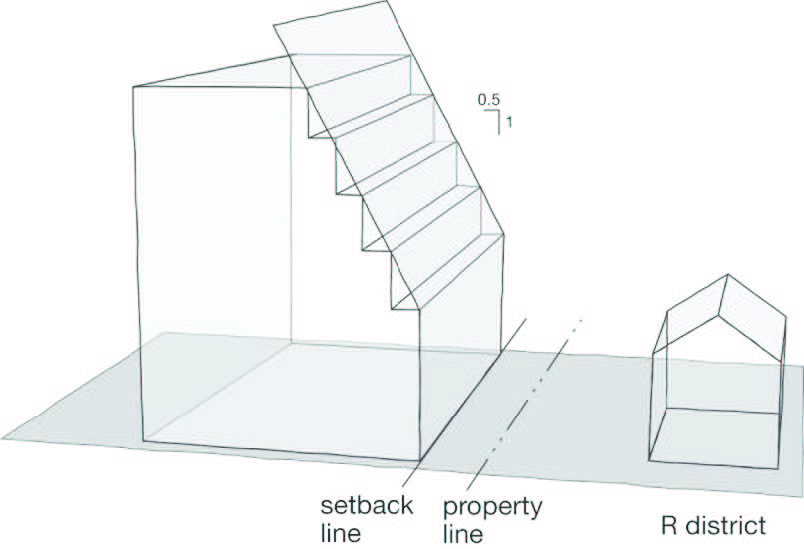
[4] For parcels abutting R districts that have a maximum allowed building height of 35 feet or less, the maximum building height at the point of the required minimum setback line is 35 feet. Height may be increased above 35 feet by up to 1 foot (vertical) for each 6 inches of buildingsetback or upper floor step-back.
[5] Area per unit calculation may include a density bonus up to 20%, as shown in the table above, when a project meets the criteria in Section 20.05.040.C. Different area per unit calculations apply for lower density bonuses.
[6] When the area per unit calculation for the subject parcel is at least 95% of what would be required for one more unit than the calculation allows, that additional unit is permitted.
(Ord. 3735, 2024; Ord. 3483, 2012; Ord. 3471, 2011; Ord. 3439, 2010; Ord. 3410, 2009)
20.15.050 - Site, Design and Operational Standards
A.
Enterprise Commercial Uses
Enterprise commercial uses in M1 and M1R districts are subject to the standards of
20.40.050.
B.
Screening and Buffering of Multi-Dwelling Uses
New multi-dwelling buildings must provide buffers in side and rear setbacks abutting existing industrial uses in accordance with the buffer standards of Chapter 20.65.
C.
Outdoor Work Areas
Outdoor work areas are allowed in M1 and M2 districts but not in the M1R district.
Outdoor work areas are subject to the buffer and screening standards of Chapter 20.65.
D.
Outdoor Storage and Display Areas
Outdoor storage and display is allowed as an accessory use in all M districts if such storage or display is a customary accessory use to an allowed principal use of the site. Outdoor storage and display is allowed as a principal use in M1 and M2 but not the M1R district. Outdoor storage and display areas are subject
to the buffer and screening standards of Chapter 20.65.
(Ord. 3439, 2010; Ord. 3410, 2009)
20.15.060 - Other Regulations
Uses and development in M districts may be subject to other provisions of this zoning ordinance, including the following:
A.
Overlay Districts
See Chapter 20.25.
B.
Use and Building Specific Standards
See Chapter 20.40
C.
Accessory Usesand Structures
See Chapter 20.45.
D.
Natural Resource Protection
See Chapter 20.50.
E.
Parking and Access
See Chapter 20.60.
F.
Landscaping
See Chapter 20.65.
G.
Signs
See Chapter 20.75.
H.
Nonconformities
See Chapter 20.80.
(Ord. 3648, 2019; Ord. 3439, 2010; Ord. 3410, 2009)

