
Missoula City Zoning Code
CHAPTER 20
80 - Nonconformities
20.80.010 - General
A.
Scope
The regulations of this chapter govern nonconformities, which are parcels, uses and structures that were lawfully established but—because of annexation or the adoption of new or amended regulations—no longer
comply with one or more requirements of this zoning ordinance.
B.
Intent
Occasionally, parcels, uses, and structures that were lawfully established (i.e., in compliance with all regulations in effect at the time of their establishment)
have been made nonconforming because of changes in the zoning regulations that apply
to the subject property (e.g., through annexations or zoning amendments). The regulations
of this chapter are intended to clarify the effect of such nonconforming status and
avoid confusion with "illegal" buildings and uses (those established in violation of applicable zoning regulations). The regulations
of this chapter are also intended to:
1.
Recognize the interests of landowners in continuing to use their property for uses and activities that were lawfully established;
2.
Promote maintenance, reuse and rehabilitation of existing buildings; and
3.
Place reasonable limits on nonconformities that have the potential to adversely affect surrounding properties.
Commentary: Nonconformities typically arise because buildings or uses were established before zoning regulations were first established or because ordinance amendments were adopted after buildings or uses were first (lawfully) established.
C.
Authority to Continue
Any nonconformity that existed on the effective date specified in 20.01.020 or any situation that becomes nonconforming upon adoption of any amendment to this
zoning ordinance may be continued in accordance with the regulations of this chapter
unless otherwise expressly stated.
D.
Determination of Nonconformity Status
1.
The zoning officer is authorized to determine whether adequate proof of nonconforming status has been provided by the subject landowner.
2.
The burden of proving that a nonconformity exists (as opposed to a violation of this zoning ordinance) rests entirely with the subject landowner.
3.
A preponderance of the evidence must be provided and be sufficient to show that the nonconformity was lawfully established prior to annexation or prior to the adoption of the subject regulations. Evidence must also indicate that the nonconformity has been continuous and that it has not lost its nonconforming status. Examples of reliable evidence include: business licenses; building permits; zoning compliance permits; city/county billing records; utility billing records; assessment, tax or rent records; and city directory listings.
4.
The use of any building or structure or of land that existed prior to January 1, 1950, and whose nonconformity shall be satisfactorily documented by a substantial preponderance of evidence supported by a history of factors existing prior to January 1, 1950.
5.
The zoning officer must maintain a record of nonconformities as such information becomes available.
6.
Appeals of the zoning officer's decision on nonconforming status determinations may be appealed in accordance with 20.85.100.
E.
Repairs and Maintenance
1.
Nonconformities must be maintained to be safe and in good repair.
2.
Repairs and normal maintenance that do not increase the nonconformity of a nonconforming structure that are necessary to keep a nonconformity in sound condition are permitted unless otherwise expressly prohibited by this zoning ordinance.
3.
Nothing in this chapter is intended to prevent nonconformities from being structurally strengthened or restored to a safe condition in accordance with an order from a duly authorized city official.
F.
Change of Tenancy or Ownership
Nonconforming status runs with the land and is not affected by changes of tenancy,
ownership or management.
(Ord. 3471, 2011; Ord. 3439, 2010; Ord. 3410, 2009)
20.80.020 - Nonconforming Lots
A.
Description
1.
A nonconforming lot is a lawfully created tract of record, shown on a plat or survey map recorded in the office of the County Clerk and Recorder that does not comply with all applicable minimum parcel area or parcel width standards of the zoning district in which the lot is located.
2.
All nonconforming lots are subject to nonconformity determination provisions of 20.80.010.D.
3.
Lots created through subdivisions approved under MCA § 76-3, parts 5 and 6 after May 6, 2019 are not considered to be nonconforming lots.
B.
Use of Nonconforming Lots
1.
Any nonconforming lot in an R district may be used as a building site for a single detached house, except as expressly stated in 20.80.020.B.3 and 20.80.020.B.4.
2.
In nonresidential zoning districts, a nonconforming lot may be used as a building site and developed with a use allowed in the subject zoning district, except as expressly stated in 20.80.020.B.3 and 20.80.020.B.4. If the zoning allows a variety of uses or a variety of intensities of uses and one or more uses or intensities would comply with applicable parcel area and parcel width standards, while others would not, then only the uses or intensities that comply with applicable standards are permitted.
3.
Effective May 4, 2005, when two contiguous lots are held in common ownership, and when both of the lots are nonconforming lots, they will be deemed a single parcel for the purpose of meeting applicable parcel area and parcel width requirements of the zoning district in which they are located. This provision treats contiguous lots under common ownership as merged for the purposes of the zoning regulation of bulk, size, and similar dimensional standards only and does not aggregate individual parcels in a manner affected by MCA § 76-3-103(16)(b).
a.
Lots in the R215, R80, R40, R20, and RT10 zone districts that have been rendered nonconforming as to the minimum lot size requirements by the adoption of this ordinance (Title 20) are not subject to 20.80.020.B.3.
b.
Lots created through subdivisions approved under MCA § 76-3, parts 5 and 6 after May 6, 2019 are not subject to 20.80.020.B.3.
4.
A nonconforming lot may not be used as a building site if the land area resulted from:
a.
The redesign or rearrangement of contiguous nonconforming tracts of record pursuant to a boundary line relocation exemption of the Montana Subdivision and Platting Act occurring after October 23, 2006; or
b.
The removal or destruction of a structure that utilized contiguous nonconforming lots as a single building site.
C.
Parcel and Building Standards
1.
Development on nonconforming lots must comply with the parcel and building standards of the subject zoning district unless otherwise expressly stated.
2.
Nonconforming lots may not be adjusted in size or shape to create nonconformity or increase the degree of nonconformity for parcel area, parcel width, setbacks or other applicable parcel and building standards. Lot area or shape adjustments that decrease the extent of nonconformity are allowed.
(Ord. 3648, 2019; Ord. 3439, 2010; Ord. 3410, 2009)
20.80.030 - Nonconforming Structures
A.
Description
1.
A nonconforming structure is any building or structure, other than a sign, that was lawfully established but no longer complies with the parcel and building standards of the zoning district in which it is located.
2.
All nonconforming structures are subject to nonconformity determination provisions of 20.80.010.D.
B.
General
Nonconforming structures may remain, subject to the regulations of this section.
C.
Alterations and Expansions
1.
Alterations, including enlargements and expansions, are permitted if the proposed alteration or expansion complies with all applicable parcel and building standards, and does not increase the nonconformity of a nonconforming structure. A building with a nonconforming front setback, for example, may be expanded to the rear as long as the rear expansion complies with applicable rear setback standards and all other applicable parcel and building standards. On the other hand, a multi-dwelling building that is nonconforming with regard to density (i.e., contains more dwelling units than allowed by the underlying zoning) may not be expanded to add additional dwelling units.
2.
One- and Two-Unit Nonconforming Residential Dwelling Unit Expansion
a.
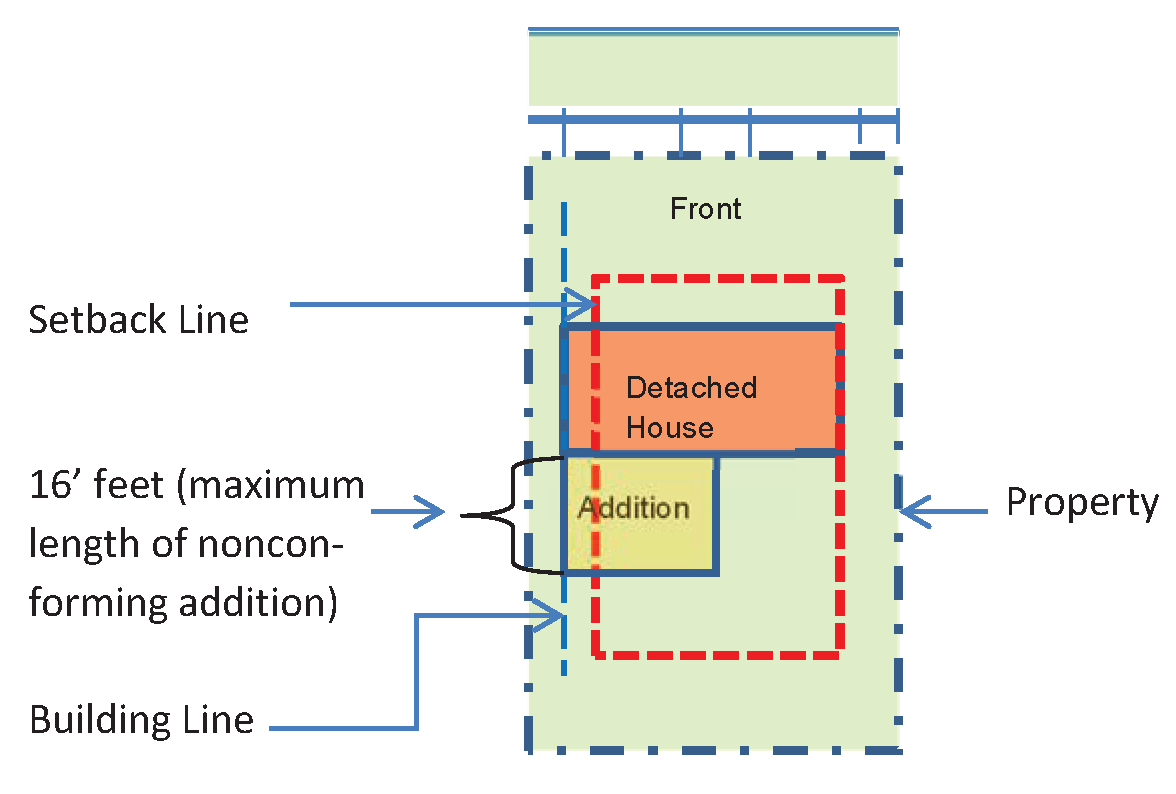
A one- or two-unit residential structure that is nonconforming because it encroaches into front, side, rear, or street side setbacks and is not closer than three feet (five feet in zones R5.4, RT5.4, R8, and RT10) to the subject property line may be expanded up to 16 feet horizontally along the existing nonconforming building line (see illustration). A one- or two-unit structure may be expanded vertically in alignment with a nonconforming front, side, rear, or street side setback to the permitted height of the subject zoning district and will not be considered to increase the non-conformity. The following standards apply:
(1)
In new construction, when building height or length is increased within a side setback, doors and windows on the wall facing the subject side setback are prohibited closer than ten feet from the adjacent building or required setback for the adjacent building, whichever is closer.
(2)
All other development standards of the subject zoning district must be met.
b.
Proposed expansions not subject to 20.80.030C.2.a., must receive Design Review approval per Section 20.85.080.
Site Plan Illustrating "Building Line" and maximum nonconforming addition length:
D.
Use
A nonconforming structure may be used for any use allowed in the zoning district in which the structure is located.
E.
Conversion of an Accessory Structureto a Dwelling Unitin Residential Districts
Legally established existing accessory structures built prior to December 7, 2017 may be converted to a dwelling unit, in whole or in part, and must comply with the following:
1.
The parcel must contain the necessary square footage for the additional unit in accordance with the principal use requirements of the subject zoning district.
2.
The building height is limited to 22 feet or the existing height of the accessory structure, whichever is greater.
3.
Displaced parking must be replaced and additional parking must be provided subject to Chapter 20.60 .
4.
Modifications of the dwelling unit (other than height) are subject to 20.80.030.C.1. and 20.80.030.C.2 does not apply.
F.
Conversion or replacement of an Accessory Structure to an Accessory Dwelling Unit
Legally established existing accessory structures may be converted, replaced, or expanded to accommodate an accessory dwelling unit.
1.
An accessory structure that is nonconforming because it encroaches into, side or rear setbacks may be expanded vertically to a maximum of 25', and horizontally for up to 16 feet along the existing nonconforming building line.
2.
In new construction, when building height or length is increased within a side setback, doors and windows on the wall facing the subject side setback are prohibited closer than ten feet from the adjacent building or required setback for the adjacent building, whichever is closer.
3.
All other development standards of. 20.45.060 shall apply.
G.
Moving
A nonconforming structure may be moved in whole or in part to another location only if the movement or relocation
eliminates or reduces the extent of nonconformity. A nonconforming structure may be moved to another parcel only if the structure would comply with the zoning regulations that apply to that (relocation) parcel.
H.
Replacement of Nonconforming Structures
Nonconforming structures may be replaced with the same encroachments as the existing nonconforming structure without the loss of nonconforming status provided that no new nonconformities are created and that the existing degree of nonconformity is not increased. Newly constructed structures may not apply Section 20.80.030.C.2 at the time of construction or in the future. Replacement of a nonconforming structure requires a building permit be obtained within 24 months of the date the structure is removed or demolished.
I.
Loss of Nonconforming Status
Nonconforming status is lost if a building permit is not obtained within 24 months
of the full removal or demolition of a nonconforming structure.
(Ord. 3735, 2024; Ord. 3669, 2020; Ord. 3586, 2016; Ord. 3549, 2015; Ord. 3481, 2012; Ord. 3471, 2011; Ord. 3439, 2010; Ord. 3410, 2009)
20.80.040 - Nonconforming Uses
A.
Description
1.
A nonconforming use is a land use that was lawfully established in accordance with all zoning regulations in effect at the time of its establishment but that is no longer allowed by the use regulations of the zoning district in which the use is now located. Lawfully established uses that do not comply with any applicable separation (or spacing) distance requirements (e.g., those that require one land use to be located a certain minimum distance from another land use) are also deemed nonconforming uses.
2.
All nonconforming uses are subject to nonconformity determination provisions of 20.80.010.D.
B.
Change of Use
1.
A nonconforming use may be changed to any other use that is allowed in the subject zoning district. Once changed to a conforming use, a nonconforming commercial or industrial use may not be re-established.
2.
The zoning officer is authorized to approve a nonconforming use substitution—substituting one nonconforming use for another nonconforming use that is no more intensive and creates no greater adverse impacts than the previous nonconforming use. In order to approve a zoning compliance permit for a nonconforming use substitution, the zoning officer must determine, based on information provided by the applicant, that the substituted use will cause no net increase in adverse impacts on the surrounding area than the previous nonconforming use of the property. In making such a determination, the zoning officer must consider all of the following factors, as applicable:
a.
Traffic to and from the site;
b.
On-street parking availability;
c.
Hours of operation;
d.
Outdoor display, storage and work activities; and
e.
Other factors likely to substantially affect the immediate area in which the use is located.
3.
A nonconformingopen-air use may not be changed to any other nonconformingopen-air use.
4.
A nonconforming mobile home may be replaced by a manufactured housing unit constructed after June 15, 1976 upon issuance of a zoning compliance permit and a building permit. However, no permits may be issued unless the replacement unit complies with all setback requirements of the subject zoning district or does not infringe upon the setbacks of the original mobile home unit.
C.
Expansion of Use
1.
Except as otherwise expressly stated, the zoning officer is authorized, through the administrative adjustment procedures of 20.85.110, to approve expansion of a nonconforming use into another part of the same building as that building existed on the date that the use became nonconforming, provided that the zoning officer determines such expansion:
a.
Will not result in a violation of off-street parking or loading requirements;
b.
Will not violate any applicable parcel or building standards of the subject zoning district;
c.
Is not an expansion of a nonconformingopen-air use; and
d.
Is not an expansion of a nonconforming industrial or manufacturing use in an R district.
2.
One- and Two-Unit Residential Dwelling Units
Additions to floor area or footprint of nonconforming one- and two-unit principal residential dwelling units do not constitute an expansion of use.
3.
Nonconforming use expansions other than those authorized under 20.80.040.C.1, may only be approved as a variance in accordance with 20.85.090.
D.
Remodeling and Improvements
A building in which a nonconforming use is located may be remodeled or otherwise improved as long as the remodeling or improvements
do not violate the other regulations of this chapter.
E.
Moving
A nonconforming use may be moved in whole or in part to another location on the same parcel only if the movement or relocation eliminates or reduces the extent of nonconformity. A nonconforming use may be moved to another parcel only if the use is allowed under the zoning regulations that apply to that (relocation)
parcel.
F.
Loss of Nonconforming Status
1.
Abandonment
a.
Abandonment of a legal nonconforming use is only applicable to commercial and industrial uses for which there has been a cessation of nonconforming use or activity with evidence of no intention to reclaim the nonconforming use.
b.
Once a nonconforming commercial or industrial use is abandoned, its nonconforming status is lost and any new, replacement use must comply with the regulations of the zoning district in which it is located.
Commentary: Any nonconforming residential use or density may be continued after being abandoned for any length of time.
c.
A nonconforming use is presumed abandoned when the use is discontinued or ceases for a continuous period of two years or more.
d.
A nonconformingopen-air use is presumed abandoned when the use is discontinued for a continuous period of six months or more.
e.
The presumption of abandonment may be rebutted upon showing, to the satisfaction of the zoning officers, that during such period the owner of the land or structure has been:
(1)
Maintaining the land and structure in accordance with all applicable Municipal Code requirements and did not intend to discontinue the use;
(2)
Actively and continuously marketing the land or structure for sale or lease for that particular nonconforming use; or
(3)
Engaged in other activities that affirmatively prove there was not intent to abandon.
f.
Any period of discontinued use caused by government action, unintended fire or natural disaster will not be counted in calculating the length of discontinuance.
2.
Change to Conforming Use
If a nonconforming commercial or industrial use is changed to a conforming use, no
matter how short the period of time, all nonconforming use rights are lost and re-establishment of the nonconforming use is prohibited.
3.
Replacement
A building containing a nonconforming use may be replaced and the use continued (whether due to intentional or accidental destruction)
without the loss of nonconforming status provided that no new nonconformities are created and that the existing degree of nonconformity is not increased.
(Ord. 3481, 2012; Ord. 3471, 2011; Ord. 3439, 2010; Ord. 3410, 2009)
20.80.050 - Nonconforming Signs
Nonconforming signs are addressed in Chapter 20.75.
(Ord. 3439, 2010; Ord. 3410, 2009)

