
Missoula City Zoning Code
CHAPTER 20
65 - Landscaping
20.65.010 - General
A.
Purpose
The landscaping regulations of this chapter are intended to preserve, maintain and
enhance the beauty of the City of Missoula, to advance the general purposes of 20.05.050 and specifically to:
1.
Plant and conserve trees and other desirable vegetation to enhance the city's livability, protect property values, mitigate urban heat island effects and address global climate change;
2.
Mitigate possible adverse impacts of higher intensity land uses located adjacent to lower intensity land uses;
3.
Promote the preservation, expansion, protection and proper maintenance of landscaping, including the wise use of water resources;
4.
Improve air quality;
5.
Protect water quality by providing vegetated areas that minimize and filter stormwater runoff;
6.
Moderate heat by providing shade;
7.
Reduce the impacts of noise and glare;
8.
Enhance pedestrian areas;
9.
Provide landscaped areas within parking lots that are designed to facilitate movement of traffic, break-up large areas of impervious surfaces, provide shade, and buffer and screen adjacent properties from the visual impact of glare and lights;
10.
Enhance the quality and appearance development projects;
11.
Promote sustainable landscape practices including the use of non-invasive native and regionally adaptable plants, green roofs, permeable pavements, healthy soils and local materials; and
12.
Encourage the use of landscape architects licensed in the State of Montana.
B.
Applicability
1.
Unless otherwise expressly stated, the landscaping requirements of this chapter apply to all zoned and unzoned land to be used or developed for nonresidential or multi-dwelling residential purposes, including mixed-use or vertical mixed-use buildings. They also apply when a single parcel is occupied by multiple two-unit houses or a combination of multi-dwelling residential structures, two-unit houses and/or nonresidential buildings.
Commentary: landscaping requirements apply to accessory and non-accessory (commercial) parking areas.
C.
Exceptions
The landscaping requirements of this chapter do not apply in the CBD district.
(Ord. 3609, 2018; Ord. 3471, 2011; Ord. 3439, 2010; Ord. 3410, 2009)
20.65.020 - General Site Landscaping
A.
Applicability
1.
The general site landscaping requirements of this section apply when any of the following occurs:
a.
When new development occurs;
b.
When existing development is expanded or modified in any way that results in a ten percent or greater increase in off-street parking requirements; or
c.
When the expansion or modification results in the addition of four or more new parking spaces.
2.
In the case of expansions or modifications triggering requirements for additional parking, general site landscaping is required only to serve the expanded or modified area, not the entire site. In other words, there is no requirement to address lawfully existing general site landscaping deficits.
3.
The requirement to provide 15% of the parcel area for the purpose of General Site Landscaping may be waived for vertical-mixed use buildings by the zoning officer when all the following conditions are met:
a.
Parking for the development does not exceed the minimum required by the Off-Street Parking Schedule (20.60.020C, Table 20.60-1). Underground parking is exempt;
b.
The requirement for trees based on 20.65.020.B.3 must still be met on site or through a payment-in-lieu to the Parks Department, equal to $1,000 per tree for the net number of trees and associated costs of planting and establishing the trees that would have been required on site. Money received through this payment-in-lieu process is intended to contribute to the urban forest program and benefit the community-wide urban forest;
c.
All other applicable landscape requirements are met including the ability to utilize the Design Excellence Review variation or alternative compliance process;
d.
Boulevard/pedestrian space improvements are established with the following requirements: 13' minimum boulevard/pedestrian space must be created adjacent to all public streets that abut the subject property. The existing right-of-way can be utilized where available, or where needed a right-of-way easement must be granted from the subject property. The boulevard/pedestrian space must include class 2 trees planted in appropriate soil volume. This space can be vegetated boulevard with trees and boulevard sidewalk, full width sidewalk with trees planted in suspended pavement systems or planter/tree pits, or a combination that achieves the required soil volumes for class 2 trees. Standards for boulevard landscaping, tree species and spacing, and required soil volumes can be found in the Public Works Standards and Specifications Manual and the Parks and Recreation Design Manual; and
e.
The proposed design shall be reviewed and approved by the Zoning Officer and the Parks and Recreation Department.
B.
Standards
1.
All areas of a site that are not covered by structures, driveways, parking areas, or other paved surfaces must be landscaped. Existing healthy trees and shrubs must be preserved to the maximum extent possible.
2.
For parcels occupied by multi-dwelling houses, and multi-dwelling buildings, general site landscaping must be provided on at least 35% of the parcel for developments of fewer than ten dwelling units. For parcels occupied by enterprise commercial uses, general site landscaping must be provided on at least 20% of the parcel. In all other cases, general site landscaping must be provided on at least 15% of developed parcels. If the proposal is unable to accommodate the required percentage of the parcel for general site landscaping because the area is encumbered by existing structures, driveways, parking areas, or other paved surfaces, the applicant must provide general site landscaping on the entire area (consistent with 20.65.020.A.2) that is unencumbered.
3.
General site landscaping must consist of at least one tree and six shrubs per 1,000 square feet of required general site landscaping area, as specified in 20.65.020.B.2.
4.
Landscape areas and plant material provided to meet the street frontage landscaping requirements of 20.65.030, the interior parking lot landscaping requirements of 20.65.040, the perimeter parking lot landscaping requirements of 20.65.050, the buffer requirements of 20.65.060 and the screening requirements of 20.65.070 counts toward satisfying the general site landscaping requirements of this section.
5.
Groundcover plants may be substituted for required shrubs at a ratio of three groundcover plants per each required shrub.
6.
Public boulevard areas do not count toward satisfying the general site landscaping requirements of this section except that boulevard trees that comply with Chapter 12.32 of the Municipal Code do count, on a one-to-one basis, toward meeting the general site landscaping requirements of this section.
7.
Existing healthy trees and shrubs count toward meeting the general site landscaping requirements of this section if they comply with the plant height and size requirements of 20.65.080.
8.
Unless otherwise approved by the urban forester, the removal of trees with a diameter breast height (DBH) of six inches or greater, single stem, must be mitigated by providing one or more replacement trees with a total combined DBH that is at least equal to the total DBH of trees that are removed. The urban forester is authorized to waive this tree replacement requirement when they determine that inadequate area exists for healthy growth of replacement trees or when they determine that the removed trees are diseased or of an undesirable species.
C.
Activity Area Requirements for Multi-dwelling Housesand Multi-dwelling Buildings
In addition to the general site landscaping requirements of 20.65.020, the following provisions apply to multi-dwelling houses and, multi-dwelling building developments that include ten or more dwelling units:
1.
Provide at least 20% of the parcel as activity area. This activity area requirement may be satisfied by the following:
a.
Private outdoor areas for individual dwelling units (e.g., balconies and patios) may be counted toward satisfying the activity area requirements of this section. Private outdoor spaces must be directly adjacent to and accessible only from the dwelling unit it serves. Each square foot of upper-floor balcony or terrace space counts as 1.5 square feet of activity area. Each square foot of private outdoor space at ground level counts as one square foot of activity area.
(1)
Ground-floor private outdoor space must be clearly delineated and at least 80 square feet in area in order to count toward satisfying the activity area requirements of this section. Ground-floor dwelling units are those at finished grade or within three feet of (above or below) finished grade. Ground-floor private outdoor space within four feet of a driveway, street or parking lot must be buffered with a wall, a fence, or landscaping which is at least 50% opaque and at least three feet in height.
(2)
Upper-floor private outdoor space must be provided as balconies or terraces that are a minimum of six feet deep and at least 60 square feet in area in order to count toward satisfying the activity area requirements of this section.
b.
Common recreation area may be counted toward satisfying the activity area requirements of this section. Such areas must be readily accessible, contiguous, usable outdoor spaces, with seating, landscaping, and other active or passive recreational features (e.g., grills, sports and play facilities). The common recreation area may include recreational facilities, such as a swimming pool or recreation room (not community meeting room). In order to be counted toward satisfying activity area requirements, the common activity area must:
(1)
Be centrally located within the proposed development or adjacent to an existing park or open space;
(2)
Have a maximum three percent slope; and
(3)
Have a length and width of no less than 40 feet each.
c.
Pedestrian/bicycle greenway corridors may be counted toward satisfying the activity area requirements of this section if such a corridor is determined by the Parks Department to have a primarily recreational and/or commuter function.
d.
Garden areas may be counted toward satisfying the activity area requirements of this section if:
(1)
Tool storage areas are provided for common use by residents;
(2)
Appropriate fencing is provided to exclude deer and pets;
(3)
Access to water (hose bib) is centrally located to all garden beds;
(4)
Topsoil of adequate quality and depth is provided (contact Missoula Parks and Recreation Department); and
(5)
The garden area is located in an area to receive adequate sunlight throughout the growing season (contact Missoula Parks and Recreation Department).
2.
Exceptions
The activity area requirements of this section do not apply to the following:
a.
Development on parcels within the Greater Missoula Downtown Master Plan study area.
b.
Remodel or conversion projects that do not change the building footprint by more than 15%.
c.
Expansion projects that modify structures in existence before August 11, 2003 if such projects cannot comply with the activity area requirements of this section. Such projects must provide the maximum amount of activity area possible (even if less than 20% of the parcel).
d.
Development on parcels in subdivisions approved subject to the parkland dedication requirements in effect after December 31, 2009.
e.
Development on parcels in major residential subdivisions approved subsequent to the requirement for parkland dedication in accordance with the 1973 Montana Subdivision and Platting Act.
3.
Agency Review
a.
The applicant must submit development plans to the Parks Department for their review, comment and approval, prior to submittal of a zoning compliance permit or building permit.
b.
Zoning compliance permit or building permit submittal materials must include approval by the Parks Department.
(Ord. 3769, 2025; Ord. 3735, 2024; Ord. 3733, 2024; Ord. 3723, 2023; Ord. 3669, 2020; Ord. 3609, 2018; Ord. 3511, 2013; Ord. 3439, 2010; Ord. 3410, 2009)
Note— 20.65.020.C.1.b(3)—Interim provision, expires March 24, 2026.
20.65.030 - Street Frontage Landscaping
A.
Applicability
Street frontagelandscaping must be provided along all street frontages, in accordance with the requirements of this section. The street frontage landscaping requirements apply when any of the following occurs:
1.
When new development occurs;
2.
When existing development is expanded or modified in any way that results in a ten percent or greater increase in off-street parking requirements; or
3.
When the expansion or modification results in the addition of four or more new parking spaces.
B.
Exceptions
The street frontage landscaping requirements of this section may be waived or reduced by the zoning officer
in either of the following cases:
1.
Where strict application of these standards is deemed inconsistent with the historic character of a National or Municipal Historic District, upon review by the zoning officer, in consultation with the historic preservation officer; or
2.
For industrial land uses if the surrounding development pattern does not include street frontagelandscaping, then the trees otherwise required as part of street frontagelandscaping may be located elsewhere on the site, such as between the street and building or between the street and parking lot.
C.
Standards
1.
Street frontagelandscaping areas must extend inward on the parcel at least ten feet from the edge of all street rights-of-way along the full length of the street frontage, unless the required zoning district setback is less than ten feet. The following rules apply when the zoning district setback requirement is less than ten feet and lawfully establishedbuildings are located within ten feet of the right-of-way:
a.
For those portions of the parcel on which buildings are set back from the right-of-way less than five feet, street frontagelandscaping is not required.
b.
For those portions of the parcel on which buildings are set back from the right-of-way by five feet but no more than ten feet, the street frontagelandscaping area must be as deep as the actual buildingsetback distance. The maximum required width of a street frontagelandscaping area is ten feet.
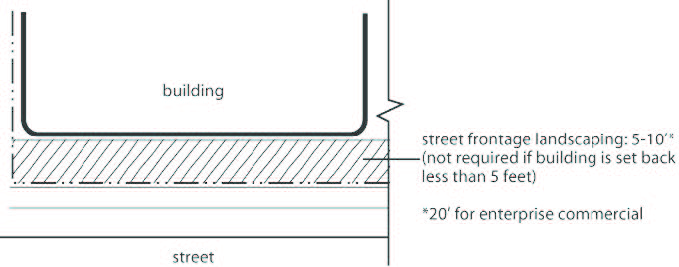
Figure 20.65-1 Street Frontage Landscaping, Standards
2.
Sites occupied by enterprise commercial uses must provide street frontagelandscaping areas with a minimum depth of 20 feet.
Commentary: Street frontagelandscaping areas must be located on the parcel, outside of the right-of-way.
3.
Parking lots and paved vehicular use areas may not encroach into required street frontagelandscaping areas, nor may parked vehicles encroach into required street frontagelandscaping areas.
4.
At a minimum, street frontagelandscaping areas must consist of two trees (if no boulevard trees exist along the street frontage) and six shrubs per 1,000 square feet of required street frontagelandscaping area. Berms may be installed within street frontagelandscaping areas. Required trees and shrubs may be planted throughout street frontagelandscaping area. For required street frontagelandscaping areas under 500 square feet in area, a minimum of one tree is required.
5.
Groundcover plants may be substituted for required shrubs at a ratio of three groundcover plants per each required shrub.
6.
Paved walkway areas may not occupy more than ten percent of the street frontagelandscaping area. For the purposes of calculating the percentage of paved walkway areas, public sidewalks within public access easements are not considered paved walkway areas.
(Ord. 3735, 2024; Ord. 3439, 2010; Ord. 3410, 2009)
20.65.040 - Interior Parking Lot Landscaping
A.
Applicability
The interior parking lot landscaping requirements of this section apply to all of
the following:
1.
The construction or installation of any new parking lot or vehicular use area containing ten or more parking spaces or more than 3,300 square feet of paved area;
2.
The expansion of any existing parking lot or vehicular use if the expansion would create ten or more new parking spaces or more than 3,300 square feet of additional paved area, in which case the requirements of this section apply only to the expanded area; and
3.
The excavation and reconstruction of existing parking lots or vehicular use areas containing ten or more parking spaces or more than 3,300 square feet of paved area if such excavation and reconstruction involves the removal of more than 25% of the paved surface, in which case the requirements of this section apply only to the portion of the parking lot or vehicular use area that is excavated and reconstructed.
B.
Exceptions
Exceptions to the interior parking lot landscaping requirements of this section may
be granted by the zoning officer in consultation with the historic preservation officer
when such landscaping is deemed inconsistent with the historic character of a National or Municipal Historic
District.
C.
Standards
1.
Minimum Area
At least ten percent of the paved vehicular use must be devoted to interior parking
lot landscaping. Vehicular use areas include parking spaces, drive aisles, driveways and drive-through lanes. Vehicular use areas that are covered by carports, canopies or similar structures must be included when calculating minimum interior parking lot landscaping requirements,
but installation of landscaping is not required beneath carports, canopies or other structures that block sunlight and rainfall. Parking and circulation areas located within parking structure are not counted as vehicular use areas for purposes of these interior parking lot landscaping requirements.
2.
Landscaped Islands
Interior parking lot landscaping must be provided in the form of parking lot landscaped islands. Landscaped islands
must comply with all of the following requirements:
a.
They must be bordered by a paved surface on at least two sides;
b.
They must be at least nine feet wide, as measured from the outside edge of the curb;
c.
They must be planted with groundcover and include at least one deciduous tree per 180 square feet of landscaped area, with a minimum of one tree per island;
d.
They must be protected by curbs or other barriers in accordance with City Engineering Division standards and specifications; and
e.
Landscaped islands must be dispersed to define drive aisles and break up long rows of parking spaces by providing at least one landscaped island every 135 feet. Any parking row that ends adjacent to a paved driving surface, regardless of the aisle's length, must have a landscaped (terminal) island at that end of the parking row.
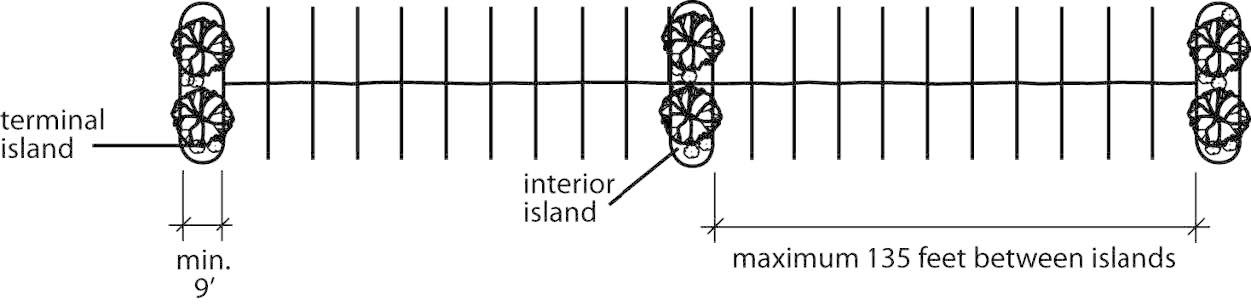
Figure 20.65-2 Interior Parking Lot Landscaping, Landscaped Islands
3.
Other Interior Parking Lot Landscaping
If the minimum ten percent interior parking lot landscaping requirement is not met by providing interior landscaped islands in accordance with
the requirements of this section, then landscaping bordering paved parking and vehicular use areas may be counted to meet interior parking lot landscaping requirements. In order to
be counted, the border landscaping must have a minimum depth of six feet and a maximum depth of 15 feet from the edge
of the parking/vehicular use area pavement.
(Ord. 3439, 2010; Ord. 3410, 2009)
20.65.050 - Perimeter Parking Lot Landscaping
A.
Applicability
The perimeter parking lot landscaping requirements of this section apply to all of
the following:
1.
The construction or installation of any new parking lot or vehicular use area containing ten or more parking spaces or more than 3,300 square feet of paved area;
2.
The expansion of any existing parking lot or vehicular use if the expansion would create ten or more new parking spaces or more than 3,300 square feet of additional paved area, in which case the requirements of this section apply only to the expanded area; and
3.
The excavation and reconstruction of existing parking lots or vehicular use areas containing ten or more parking spaces or more than 3,300 square feet of paved area if such excavation and reconstruction involves more than 25% of the paved surface, in which case the requirements of this section apply only to the portion of the parking lot or vehicular use area that is excavated and reconstructed.
B.
Exceptions
1.
Perimeter parking lot landscaping requirements do not apply to sites on which more than 50% of the required parking spaces are located outside of the area between the primary buildingfaçade and the street right-of-way.
2.
Exceptions to the perimeter parking lot landscaping requirements of this section may be granted by the zoning officer in consultation with the historic preservation officer when such landscaping is deemed inconsistent with the historic character of a National or Municipal Historic District.
C.
Standards
1.
Perimeter parking lot landscaping requirements may be satisfied by providing at least one of the following:
a.
Any combination of berms, planting, walls or fences that results in a continuous buffer to a height of 36 inches above parking lot grade along the length of the parking area frontage; or
b.
A street frontagelandscaping area with a minimum depth of 20 feet and landscaping material at the rates specified in 20.65.030.C.4.
2.
Berms may encroach into the landscaped boulevard area only with approval from the city engineer and/or the State Department of Transportation.
3.
The city engineer is authorized to approve reductions in height for buffers to improve sight distance at intersections.
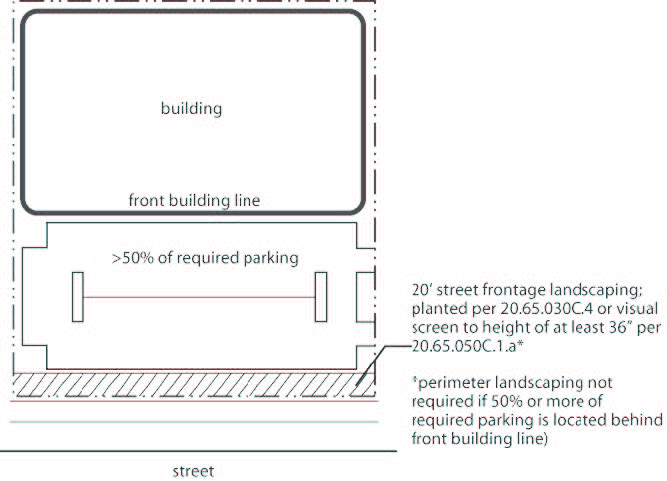
Figure 20.65-3 Perimeter Parking Lot Landscaping, Standards
(Ord. 3439, 2010; Ord. 3410, 2009)
20.65.060 - Buffers
Buffers are intended to mitigate the possible adverse effects (e.g., noise, lighting, and other site-related and operational impacts) that can occur when multi-dwelling houses, multi-dwelling buildings, mixed-use, vertical mixed-use or nonresidential development occurs abutting residential areas.
A.
Applicability
1.
Buffers are required when nonresidential development occurs on parcels that abut R zoning districts or parcels used for residential purposes.
2.
Buffers are required when any multi-dwelling residential, mixed-use, or vertical mixed-use development occurs on parcels that abut parcels occupied by detached houses or parcels zoned R215, R80, R40, R20, RT5.4, RT10, R8 or R5.4.
3.
The buffer requirements of this section are triggered when new development occurs or when existing nonresidential uses or buildings are expanded by more than ten percent of their existing gross floor area.
B.
Standards
1.
Buffers must be provided along the entire property line that abuts the parcel zoned or used for residential purposes. Buffers are not required abutting alleys.
2.
Any of the following three options may be used to satisfy the buffer requirements of this section:
a.
Landscape Buffer
Provide a landscaped area at least eight feet in width with at least one shrub per
two linear feet of buffer area, plus at least one evergreen tree and one deciduous tree per 30 linear feet of buffer area. Shrubs must be at least three feet in height at time of planting.
b.
Fence or Wall
Provide a landscaped area at least five feet in width with a six-foot, 75% opaque
or greater wall or fence along the buffer area. One evergreen tree is required per 20 linear feet of fence or wall. Where vehicular use areas abut adjacent residential property, the lot shall be screened with a solid (100% opaque) wall or fence.
c.
Landscape Berm
Provide a landscape berm between four and six feet in height. If the berm is less
than six feet in height, it must include at least one shrub per three linear feet
along the top of the berm.
3.
Walls and fences must comply with Chapter 12.31 of the Municipal Code. Chain link fences may not be used as part of a required buffer.
4.
Enterprise commercial uses are subject to the buffer standards of this section except that required buffers must have a minimum width of 25 feet.
(Ord. 3609, 2018; Ord. 3471, 2011; Ord. 3439, 2010; Ord. 3410, 2009)
20.65.070 - Screening
Screening is intended to minimize the environmental and community impacts of mechanical equipment, utilities, and service spaces, such as trash and outdoor storage, from the public right-of-way and abutting residential zoning districts and uses, while also providing protection and shelter for these elements. This does not apply to solar energy conversion systems which must comply with standards in 20.45.090.
A.
Applicability
The screening requirements of this section apply to multi-dwelling houses, multi-dwelling buildings, vertical mixed-use, mixed-use or nonresidential development when any of the following occurs:
1.
When new development occurs;
2.
When existing development is expanded or modified in any way that results in a ten percent or greater increase in off-street parking requirements; or
3.
When the expansion or modification results in the addition of four or more new parking spaces.
B.
Features to be Screened
The following features must be screened:
1.
Ground-mounted Mechanical Equipment
Ground-mounted mechanical equipment may not be located within 15 feet of the property line of a parcel used or zoned for residential purposes and such equipment must be screened from view
of streets and abutting residential uses and zoning districts by a dense hedge, solid
wall or solid fence. The hedge, fence or wall must be tall enough to screen the equipment.
Walls and fences must comply with Chapter 12.31 of the Municipal Code.
2.
Structure-mounted Mechanical Equipment
When exterior equipment must be located on a building elevation it must be screened
from view of streets and abutting residential uses and zoning districts.
3.
Trash Receptacles
Trash receptacle areas must be contained and screened along public rights-of-way other
than alleys and all abutting parcels with a solid wall or fence. Trash receptacles may not be located in the front or
street side setback area.
Commentary: See the City Fire Code for minimum spacing requirements for trash receptacle (from buildings and openings).
4.
Utility Cabinets
a.
Above-ground utility cabinets that are 30 or more inches in height and located within 25 feet of a street must be screened along the street by a solid fence, solid wall, dense hedge, or combination of such features.
5.
Materials, Supplies and Equipment
All stored materials, supplies, merchandise, vehicles, equipment, storage or shipping
containers, or other similar matter not on display for direct sale, rental or lease
to the ultimate consumer or user must be screened from a public right-of-way, park,
civic use, and parcels used or zoned for residential purposes by a fence, wall, dense hedge, or combination
of such features.
C.
Standards
1.
Walls and fences must comply with Chapter 12.30 of the Municipal Code. Chain link fences may not be used as part of a required buffer.
2.
All landscape materials and features must be located to avoid damage from vehicles.
3.
For screening purposes, all plant material must be at least three feet in height at time of planting.
4.
Screens may be broken only as necessary to accommodate approved access drives and walkways.
(Ord. 3769, 2025; Ord. 3733, 2024; Ord. 3723, 2023; Ord. 3586, 2016; Ord. 3471, 2011; Ord. 3439, 2010; Ord. 3410, 2009)
Note— 20.65.070.B—Interim provision, expires March 24, 2026.
20.65.080 - Landscape Material and Design
A.
Plant Selection
1.
Plants selected for required landscape areas must consist of plants that are well-suited to the microclimate and soil conditions at the project site. Plants with similar water needs must be grouped together as much as possible.
2.
Interior parking lot landscape islands and other landscaped areas less than eight feet wide on any side must be landscaped with plants that can generally survive with available rainfall once established (although supplemental irrigation may be needed or desirable during summer months).
3.
For developments located in the wildland-urban interface area, plants must:
a.
Be able to survive without irrigation once established;
b.
Be fire-resistant or fire-retardant;
c.
Have low fuel volume or high moisture content; and;
d.
Not be species that tend to accumulate excessive dead wood or debris.
4.
Woody plants must be rated to survive in USDA Hardiness Zones 1, 2, 3, 4.
B.
Trees
1.
Deciduous Trees
Deciduous trees used to satisfy the requirements of this chapter must have a caliper
size of 1.5 inches and the minimum height of eight feet at time of planting.
2.
Evergreen Trees
Evergreen trees used to satisfy the requirements of this chapter must have a minimum
height of six feet at time of planting. There is no minimum caliper size for evergreen
trees at time of planting.
C.
Shrubs
Shrubs used to satisfy the requirements of this chapter must be at least five-gallon
size and have a minimum 12-inch spread at time of planting.
D.
GroundcoverPlants
Groundcover plants are deciduous or evergreen plants that grow low and spread horizontally, not
including turf. Groundcover plants used to satisfy the requirements of this chapter must be at least one-gallon
size.
E.
Mulch
All required trees and shrubs must be located within a mulched area and be separated
from turf by a minimum distance of two feet. Mulch within such areas must comply with the following requirements:
1.
Mulch must be applied to provide at a three-inch (minimum) to five-inch (maximum) soil cover, with no weed barrier material visible.
2.
At least 50% of the total mulch area must be comprised of organic mulch, such as bark, shredded wood, wood chips, or other organic matter. Mineral mulch such as decorative stone, river stone or tumbled glass may be used in up to 50% of the mulch area.
3.
Organic mulch must consist of regionally sourced, fully chipped or shredded, un-splintered wood product or bark chips free of soil, rocks, weeds, metals, toxins, and foreign objects. Organic mulch must have an average particle size of no more than 2.5 cubic inches.
F.
Berms
Berms used to satisfy the requirements of this chapter must consist of a mound or
bank of earth two to six feet in height, planted with vegetation, with a slope not exceeding one foot of rise for each two feet of run.
G.
Fences and Walls
All fences and walls are subject to Chapter 12.31 of the Municipal Code. Chain link
fences may not be used to satisfy any of the requirements of this chapter.
(Ord. 3439, 2010; Ord. 3410, 2009)
20.65.090 - Installation and Maintenance
A.
Installation
Landscaping must be installed in accordance with the requirements of this chapter and the approved
landscape plan.
B.
Irrigation
If the landscape design incorporates plants that require seasonal watering, automatic
irrigation systems in conformance with the current adopted plumbing codes with back
flow prevention must be provided to maintain the landscaping in a healthy, attractive condition.
C.
Maintenance
It is the responsibility of the property owner to maintain required landscaping in accordance with an approved maintenance plan. The maintenance plan must include
methods for providing the following:
1.
Consistent irrigation,
2.
Integrated pest management,
3.
Fertilization,
4.
Tree care and pruning,
5.
Replacement of lost vegetation, and
6.
Weed management consistent with the Missoula County Weed Management Plan.
D.
Timing of Installation
1.
Required landscaping must be installed in complete and healthy condition, with operational irrigation in place, before a final occupancy permit may be issued.
2.
If weather does not permit installation of required landscaping before issuance of a final occupancy permit, a temporary occupancy permit may be issued if the applicant provides a performance bond or other form of financial security and written assurance that the planting will occur during the next growing season. The security and assurances must be in a form approved by the city attorney. The financial security must be in an amount deemed adequate by the zoning officer to cover the cost of completing the required landscaping (materials and labor), as indicated by the applicant's landscape architect or landscape contractor.
Commentary: Boulevard maintenance plans must comply with Chapter 12.32 and Chapter 12.48 of the Municipal Code.
(Ord. 3439, 2010; Ord. 3410, 2009)
20.65.100 - Alternative Compliance
An applicant proposing to deviate from strict compliance with the landscaping requirements of this chapter may do one of the following:
A.
Request alternative compliance review (design review) in accordance with the procedures of 20.85.080.
B.
Submit a landscape plan, covering the limits of the project, prepared and stamped by a landscape architect licensed in the State of Montana.
1.
This exemption does not apply to section 20.65.070 screening or section 20.65.020.C, activity areas for multi-dwelling developments.
2.
When a landscape architect is used to deviate from the landscaping chapter a list detailing the sections being deviated from, and an explanation of how the proposed deviation meets the intent of this chapter, must be provided to Development Services at the time of permit application.
(Ord. 3669, 2020; Ord. 3549, 2015; Ord. 3471, 2011; Ord. 3439, 2010; Ord. 3410, 2009)

