
Missoula City Zoning Code
CHAPTER 20
85 - Review and Approval Procedures
20.85.010 - Review and Decision-making Authority (Summary Table)
The following table provides a summary of the review and approval procedures of this chapter. In the event of conflict between this summary table and the detailed procedures contained elsewhere in this chapter, the detailed procedures govern.
Table 20.85-1 Review and Decision-making Authority (Summary Table)
;sz=8q; R = Review Body (Responsible for Review and Recommendation)
DM = Decision-Making Body (Responsible for Final Decision to Approve or Deny)
A = Local (de novo, non-judicial) appeal
< > = Public Hearing Required
[1] Appeal processed as a variance
* Historic Preservation Permit may be granted by Zoning Officer if standards are met.
(Ord. 3695, 2022; Ord. 3609, 2018; Ord. 3439, 2010; Ord. 3423, 2010; Ord. 3410, 2009)
20.85.020 - Common Provisions
A.
Applicability
1.
The provisions of this section apply to all the procedures in this chapter unless otherwise expressly stated.
B.
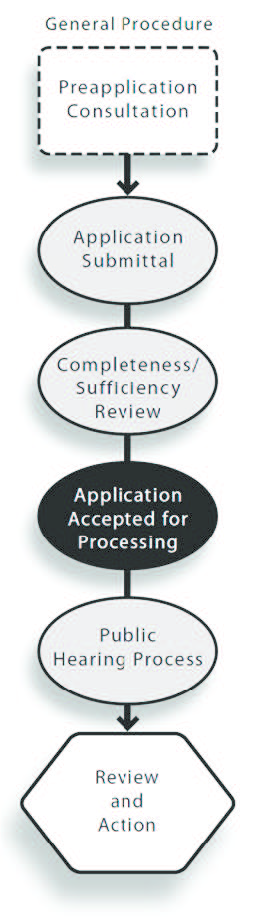
Preapplication Consultations
1.
Preapplication consultations are required whenever the provisions of this zoning ordinance expressly state that they are required. They are encouraged in all cases.
2.
Required preapplication consultations must be scheduled with staff of Development Services.
C.
Application Submittal
1.
Form of Application
Applications required under this zoning ordinance must be submitted in a form and
in such numbers as required by the zoning officer. The zoning officer must develop
checklists of application submittal requirements and make those checklists available
to the public. Application forms and checklists of required submittal information
are available in Development Services.
2.
Completeness and Accuracy Review
a.
An application will be considered complete and ready for processing only if it is submitted in the required number and form, includes all required information and is accompanied by the required filing fee.
b.
If an application is determined to be incomplete, the zoning officer must provide paper or electronic written notice to the applicant along with an explanation of all known deficiencies in the application that will prevent competent review of the application. No further processing of the application will occur until the deficiencies are corrected. If the deficiencies are not corrected by the applicant within 60 days, the application will be considered withdrawn.
c.
No further processing of incomplete applications will occur, and incomplete applications will be pulled from the processing cycle. When the deficiencies are corrected, the application will be placed in the next available processing cycle.
d.
The zoning officer may require that applications or plans be revised before being placed on the agenda of a review or decision-making body if the zoning officer determines that:
(1)
The application or plan contains one or more significant inaccuracies or omissions that hinder timely or competent evaluation of the plan's/application's compliance with zoning ordinance standards; or
(2)
The application contains multiple minor inaccuracies or omissions that hinder timely or competent evaluation of the plan's/application's compliance with zoning ordinance standards.
3.
Application Sufficiency and Acceptance
Applications deemed complete will be considered to be in the processing cycle and
will be reviewed by Development Services and other agency staff and other review and
decision-making bodies in accordance with applicable review and approval procedures
of this zoning ordinance.
4.
Application Filing Fees
Application filing fees are required for processing development review and permit
applications. The fees help offset the cost of providing public notice, personnel costs for plan/permit reviews and
field inspections. Fees must be established by resolution. Fees are not required with
applications initiated by the City Council. Application fees are nonrefundable.
Commentary: Current fee schedules are available in Development Services.
D.
Notice
The purpose of this section is twofold; one, to satisfy legal requirements by providing
adequate notice of governmental actions to those affected by such actions; and two,
to engage the public by making them aware of proposed changes that may affect them.
Notice is provided to encourage citizens to participate in decision making which affects
their interests, and provides opportunity for governing agencies to receive information
pertinent to an application that would not otherwise be available. Each project will
be evaluated to determine the best means of outreach to the public. The City of Missoula
believes that making information public and readily accessible is fundamental to demonstrating
value and promoting transparency.
All noticing must be initiated fifteen (15) days prior to action being taken by a governmental agency or staff (e.g. administrative adjustment), unless otherwise expressly stated. The provisions listed below are considered minimum requirements.
1.
Content of Notice
All required notices must:
a.
Include the name of the project;
b.
Indicate the date, time and place of the public hearing or date of action that is the subject of the notice;
c.
Describe any property involved in the application by street address or by general description;
d.
Describe the general nature, scope and purpose of the application or proposal;
e.
Name of decision-making body; and
f.
Indicate where additional information on the matter can be obtained.
2.
Types of Notice
a.
Newspaper Notice
Whenever the provisions of this zoning ordinance require that newspaper notice be
provided, the notice must be published in a newspaper of general circulation within
Missoula. Two (2) legal ads shall be submitted. One (1) of the required publication
dates must fall within the minimum days required.
b.
Mailed Notice
(1)
Whenever the provisions of this zoning ordinance require that notices be mailed, the notices must be sent by United States Postal Service first class mail, and must include mail to the subject property owner(s) and property owners within 150' unless otherwise noted in Table 20.85-2.
(2)
Addresses must be based on the latest property ownership information available from the Montana Department of Revenue. When required notices have been properly addressed and deposited in the U.S. mail, failure of a party to receive such notice will not be grounds to invalidate any action taken. In addition to adjacent property owners, notice shall be sent to the appropriate Neighborhood Council.
c.
Posted Notice
When the provisions of this zoning ordinance require that posted notice be provided,
at least one notice sign must be posted on each public street frontage abutting the subject property in a location plainly visible to passers-by. All on-site
notices must be located on the subject property outside the right-of-way and visibility
triangle. It shall be the responsibility of the property owner and/or applicant to
maintain the on-site notice and visibility to the public.
3.
Notice Requirements for Specific Application Types
Table 20.85-2
Noticing Requirements for Specific Application Types
Notes:
1.
The distance measured from the exterior property boundary of the subject site to all or part of another parcel of land whose owners must be notified of a governmental action. This distance includes the width of a right-of-way or other public ownership.
2.
For Detached and Internal Addition ADU projects in R215, R80, R40, R20, RT10, R8, R5.4 and R3 districts the applicant must notify all property owners and resident(s) one parcel deep surrounding the subject parcel, excluding adjacent R-O-W, prior to submitting the application. See figure 20.85-1 for example notification areas. The applicant must provide a written statement to Development Services regarding the manner in which the notification occurred and when.
3.
The process does not include a public hearing.
E.
Public Hearing Process
1.
Application Processing Cycles
The zoning officer, after consulting with review and decision-making bodies, promulgate
processing cycles for applications. Processing cycles may establish:
a.
Deadlines for receipt of complete applications;
b.
Dates of regular meetings;
c.
The scheduling of agency and staff reviews and reports; and
d.
Time-frames for review and decision-making.
2.
Public Hearings
a.
Parties in interest and citizens must be given an opportunity to appear and be heard at required public hearings, subject to reasonable rules of procedure.
Commentary: Written testimony (from the public) must be received by the zoning officer at least seven business days before the public hearing to be included in the written staff report. Written testimony received by the zoning officer after this time but before the meeting/hearing will be hand delivered by the zoning officer to the review or decision-making body at the time of the hearing.
b.
A public hearing for which proper notice was given may be continued to a later date without providing additional notice as long as the continuance is set for specified date and time and that date and time is announced at the time of the continuance.
c.
If a public hearing is tabled, deferred or postponed for an indefinite period of time from the date of the originally scheduled public hearing, new public notice must be given before the rescheduled public hearing. If the applicant requests a postponement, the applicant must pay all costs of renotification.
3.
Public Hearing Notices
In addition to the noticing requirements of Section 20.85.020D, the following standards
apply to projects subject to a public hearing:
a.
Additional Notice
City Council or staff shall have the ability to include additional notification of
area residents in the event they feel it is necessary. Notification can include public
meetings, e-mail, resident mailing, additional postings, voluntary property management
distribution of notice, notice on bulletin boards, on-line engagement platforms, neighborhood
council meetings, and any other process deemed appropriate.
b.
Combined Notice
Public notification for city zoning may be combined with notice of annexation.
c.
Notice of city approval.
In order to inform adjacent property owners' and residents that an application has
been approved by the city, any site approved for construction or alteration must maintain on-site notice supplied by Development Services. The
notice must be posted in a conspicuous place on site before any construction begins and may be removed after construction begins. The notice must specify the name of the project, the address of the property,
a description of the scope of work approved and the date of approval.
F.
Action by Review Bodies and Decision-Making Bodies
1.
Review and decision-making bodies may take any action that is consistent with:
a.
The regulations of this zoning ordinance;
b.
Any rules or by-laws that apply to the review or decision-making body; and
c.
The notice that was given.
2.
Review and decision-making bodies are authorized to defer action or continue a public hearing in order to receive additional information or further deliberate.
G.
Conditions of Approval
When decision-making bodies approve applications with conditions, the conditions must
relate to a situation created or aggravated by the proposed use or development and must be roughly proportional to the impacts of the use or development.
(Ord. 3769, 2025; Ord. 3733, 2024; Ord. 3723, 2023; Ord. 3695, 2022; Ord. 3669, 2020; Ord. 3439, 2010; Ord. 3410, 2009)
20.85.030 - Review and Decision-Making Criteria; Burden of Proof or Persuasion
In all cases, the burden is on the applicant to show that an application complies with all applicable review or approval criteria. Applications must address relevant review and decision-making criteria.
(Ord. 3439, 2010; Ord. 3410, 2009)
20.85.040 - Zoning Amendments
A regulation or boundary may be altered, supplemented, changed, modified or repealed subject to the following procedures:
A.
Authority to File
1.
Amendments to regulations or district boundaries of this zoning ordinance may be initiated by the City Council.
2.
Amendments to district boundaries may be initiated by property owners through petitions duly signed by the owners of at least 35% of the area of the parcels included within the area proposed to be rezoned or by at least 35% of the number of parcels included within the area proposed to be rezoned. Rezoning petitions may be filed by the owner or by the owners' authorized agent.
B.
Application Filing
Complete applications for zoning amendments must be filed with appropriate personnel
in Development Services.
C.
Public Hearing Notice
Public noticing standards can be found in Section 20.85.020 - Notice.
D.
Review and Report—Zoning Officer
The zoning officer must prepare a report that evaluates the proposed amendment in
light of adopted plans, the relevant provisions of this zoning ordinance and the review
criteria of 20.85.040.G.
E.
Hearing and Recommendation—Planning Board
The Planning Board must hold a public hearing on each proposed amendment. Following
the close of the hearing, the Planning Board must act by simple majority vote to recommend
that the proposed amendment be approved, approved with modifications, denied, or continued
for further consideration.
F.
Hearing and Final Action—City Council
1.
After action by the Planning Board, the City Council must convene its own public hearing on the proposed amendment.
2.
Following the public hearing, the City Council may act to approve the proposed amendment, approve the proposed amendment with modifications or deny the proposed amendment. The City Council may also return the application to the Planning Board for further consideration, together with a written explanation of the reasons for doing so.
3.
The City Council may act by a simple majority vote of those City Council members present and voting, except when a valid protest petition has been submitted in accordance with 20.85.040.H, approval or approval with modifications requires a two-thirds majority vote of those City Council members present and voting.
G.
Review Criteria
In reviewing and making decisions on zoning amendments, the zoning officer, Planning
Board and City Council must consider at least the following criteria:
1.
Whether the proposed zoning amendment is consistent with MCA § 76-2-304:
a.
Whether the zoning is made in accordance with a growth policy;
b.
Whether the zoning is designed to secure safety from fire and other dangers;
c.
Whether the zoning is designed to promote public health, public safety, and the general welfare;
d.
Whether the zoning is designed to facilitate the adequate provision of transportation, water, sewerage, schools, parks, and other public requirements;
e.
Whether the zoning considers the reasonable provision of adequate light and air;
f.
Whether the zoning considers the effect on motorized and nonmotorized transportation systems;
g.
Whether the zoning considers the promotion of compatible urban growth;
h.
Whether the zoning considers the character of the district and its peculiar suitability for particular uses; and
i.
Whether the zoning conserves the value of buildings and encourages the most appropriate use of land throughout the jurisdictional area.
2.
Whether the proposed zoning amendment corrects an error or inconsistency in the zoning ordinance or meets the challenge of a changing condition;
3.
Whether the proposed zoning amendment is in the best interests of the city as a whole.
H.
Protest Petitions
1.
A formal protest petition opposing a zoning amendment must be submitted to the zoning officer or on the public record before the City Council's vote, allowing sufficient time for the city clerk to determine the validity of the petition.
2.
A protest petition will be considered "valid" if it is signed by the owners of 25% or more of:
a.
The area of the parcels that are the subject of the proposed change; or
b.
The parcels or units, as defined in MCA § 70-23-102, within 150 feet of the parcel that is the subject of the proposed change. The area per unit to be included in the calculation of the protest shall be determined per MCA § 76-2-305.
3.
When a valid protest petition has been submitted, approval of a zoning amendment requires a two-thirds majority vote of those City Council members present and voting.
I.
Zoning Upon Annexation
1.
Timing
A city zoning district classification may be assigned to land annexed into the city
at the time of annexation.
2.
Classification
The zoning district classification assigned at the time of annexation must:
a.
Authorize land uses comparable to the land uses authorized under the county zoning classification that applied to the property immediately before it was annexed into the city;
b.
Authorize land uses that are consistent with the land uses approved by the Board of County Commissioners or the County Board of Adjustment; or
c.
Be consistent with the land use and zoning recommendations for the subject areas, as set forth in the Growth Policy.
3.
Interim Zoning
The City Council is authorized to apply interim zoning to the annexed property, in
accordance with state law. Interim zoning is intended to allow time for land use and
zoning studies and an analysis of the Growth Policy.
4.
Public Hearing Notice
Public noticing standards can be found in Section 20.85.020 - Notice.
5.
Protest Petitions
The protest petition provisions of 20.85.040.H apply to the classification of city
zoning at the time of annexation.
(Ord. 3669, 2020; Ord. 3484, 2012; Ord. 3439, 2010; Ord. 3410, 2009)
20.85.050 - Repealed
(Ord. 3484, 2012; Ord. 3471, 2011; Ord. 3439, 2010; Ord. 3410, 2009)
20.85.060 - Planned Unit Developments
A.
Overview
PUD, Planned Unit Development overlay zoning districts are established through the approval of a zoning amendment in accordance with the
zoning amendment procedures of 20.85.040. PUD zoning amendments must be processed concurrently with a preliminary development
plan application. Final development plan approval is required after approval of the
zoning amendment and preliminary development plan. This section describes the required
review and approval procedures for PUD preliminary and final development plans.
B.
Preliminary and Final Development Plan Approval Required
Approval of PUD preliminary and final development plans must occur before any building
permit is issued and before any development takes place in a /PUD overlay district. Permits may be issued for a development phase if a preliminary development plan
has been approved for the entire PUD and a final development plan has been approved
for the subject phase.
C.
Preliminary Development Plans
At the option of the applicant, the preliminary development plan may serve also as
the preliminary subdivision plat if such intention is declared before the Planning
Board's public hearing and if the plans include all information required for preliminary
plats and preliminary development plans.
1.
Description
Each PUD application must include the following: a vicinity map showing relationships
to surrounding properties, detailed information about the project, proposed and existing
transportation systems within and surrounding the project, lot configurations (if
applicable), proposed building groups, information about the structures including types, size and location, utility locations, architectural drawings showing
the design of each structure, location of recreational space, open space, or other public areas, general landscape
treatments, and description of organizational structure to address management, provision of services, and any other restrictions.
2.
Preapplication Consultation
A preapplication consultation is required before filing of a PUD preliminary development
plan application, in accordance with 20.85.020.B.
3.
Application Filing
Complete applications for preliminary development plan approval must be filed with
appropriate personnel in Development Services at the same time that the /PUD zoning
amendment application is filed. Preliminary development applications may be filed only by the subject landowner or the landowner's authorized agent.
4.
Review and Report—Zoning Officer
The zoning officer must review the proposed preliminary development plan in light
of the /PUD overlay district provisions of 20.25.030 and the review criteria of 20.85.060.C.7. The zoning officer must prepare a report
and recommendation for the Planning Board based on the zoning officer's review.
5.
Hearing and Recommendation—Planning Board
The Planning Board must hold a public hearing on the proposed /PUD zoning amendment
and the preliminary development plan. Following the close of the hearing, the Planning
Board must act by simple majority vote to recommend that the proposed /PUD zoning
amendment and preliminary development plan be approved, approved with modifications
or denied.
6.
Hearing and Final Action—City Council
a.
After action by the Planning Board, the City Council must convene its own public hearing on the proposed /PUD zoning amendment and preliminary development plan.
b.
Following the close of the public hearing, the City Council may act to approve the proposed /PUD zoning amendment and preliminary development plan, approve the proposed /PUD zoning amendment and preliminary development plan with modifications or deny the proposed /PUD zoning amendment and preliminary development plan. The City Council may also return the application to the Planning Board for further consideration, together with a written explanation of the reasons for doing so.
c.
The City Council may act by a simple majority vote of those City Council members present and voting, except when a valid protest petition has been submitted in accordance with 20.85.040.H approval or approval with modifications requires a two-thirds majority vote of those City Council members present and voting.
7.
Review Criteria
In reviewing and making decisions on proposed /PUD rezonings and preliminary development
plans, review and decision-making bodies must consider at least the following factors:
a.
The rezoning criteria of 20.85.040.G;
b.
The preliminary development plan's consistency with the any adopted plans for the area;
c.
The preliminary development plan's consistency with the /PUD district provisions of 20.25.030; and
d.
The sufficiency of the terms and conditions proposed to protect the interest of the public and the residents of the /PUD in the case of a plan that proposes development over a long period of time.
8.
Lapse of Approval
a.
If the landowner fails to file an application for final development plan approval within two years of the date of preliminary development plan approval, the approval will be deemed to have lapsed and the preliminary development plan will lapse and be of no further effect.
b.
For projects to be developed in phases, phase limits must be shown on the preliminary development plan. Decision-making bodies may impose conditions upon the phasing plan as deemed necessary to ensure the orderly development of the subdivision, including requirements for financial guarantees ensuring construction of all required improvements.
9.
Filing of Statement
a.
Within 30 days of approval of a preliminary development plan by the City Council, the zoning officer must file with the office of the County Clerk and Recorder a statement that such a plan: (1) has been approved by the City Council; (2) that the PUD preliminary development plan is applicable to certain specified legally-described land; and (3) that copies of the plan are on file in Development Services. The statement recorded with the office of the County Clerk and Recorder must also specify the nature of the plan, the proposed density or intensity of land use and other pertinent information sufficient to notify any prospective purchasers or users of the land of the existence of such a plan.
b.
The recorded statement must specify that the preliminary development plan will become binding upon all successors and assigns unless amended in conformance with this section. Major changes in the approved preliminary development plan may be made only after rehearing and re-approval of the preliminary development plan.
c.
The landowner is responsible for all costs incurred in filing the statement.
d.
No final development plan application will be considered complete and ready for processing until the landowner has provided the zoning officer with a copy of the recorded statement required by this subsection. Such copy must show the date of the filing and include the signature of the County Clerk and Recorder.
D.
Final Development Plans
1.
Application Filing
Final development plan applications must be filed with Development Services after
approval of and before the lapse of a preliminary development plan.
2.
Consistency with Preliminary Development Plan; Major Changes
a.
A final development plan will not be considered complete and ready for processing if all approved conditions of approval have not been met or if the final development plan constitutes a major change from the approved preliminary development plan.
b.
A final development plan will be considered a major change from (and therefore inconsistent with) the approved preliminary development plan if it:
(1)
Increases the number of dwelling units;
(2)
Increases the total floor area;
(3)
Increases the total building coverage;
(4)
Reduces the amount of land area set aside as open space, recreation area or natural resource conservation area;
(5)
Increases the height of buildings; or
(6)
Represents a material change to the preliminary development plan that creates a substantial adverse impact on surrounding property owners.
3.
Processing of Major Changes
If a final development plan is submitted that constitutes a major change to an approved
preliminary development plan, no further processing of the final development plan
may occur. The zoning officer must notify the landowner that major changes may be
made only after rehearing and re-approval of the preliminary development plan, including
payment of fees, all notices and hearings.
4.
Review and Action by Planning Department; Appeals
a.
The zoning officer must review and take action on the final development plan. The zoning officer must approve the final development plan if it complies with the approved preliminary development plan, all conditions of the preliminary development plan approval and all applicable standards of this zoning ordinance.
b.
If the submitted final development plan does not comply with the approved preliminary development plan, any conditions imposed on that plan or any applicable standards of this zoning ordinance, the zoning officer must disapprove the final development plan and advise the landowner in writing of the specific reason for disapproval.
c.
In the event that the zoning officer does not approve the final development plan, the landowner may either: (1) resubmit the final development plan to correct the plan's inconsistencies and deficiencies; or (2) within 30 days of the date of notice of disapproval, appeal the decision of the zoning officer following the same procedures as required for /PUD rezoning and preliminary development plan approval.
5.
Effect of Approval
a.
A final development plan or any part thereof that has received final approval by the zoning officer or, upon appeal, by the City Council, must be so certified by the zoning officer, and must be filed with the office of the County Clerk and Recorder immediately upon compliance with all conditions of approval. If the landowner chooses to abandon a final development plan or portion thereof after it has been given final approval, they must notify the zoning officer.
b.
The filing of a final development plan with the office of the County Clerk and Recorder does not constitute the effective dedication of easements, rights-of-way or access control, nor will the filed plan be the equivalent of or an acceptable alternative for the final platting of land prior to the issuance of building permits in the PUD.
6.
Lapse of Approval
a.
In the event the landowner fails to commence development shown on the final development plan within two years after final approval has been granted, then such final approval will lapse and be of no further effect unless the time period is extended by the City Council upon written application by the landowner.
b.
Requests for extensions must be submitted to the zoning officer before the final development plan approval expires and must be processed in accordance with the procedures for approval of a /PUD preliminary development plan, including applicable filing fees (for time extension), notices and hearings.
c.
In the event of lapse of approval, approved PUD plans have no further effect.
(Ord. 3439, 2010; Ord. 3410, 2009)
20.85.070 - Conditional Uses
A.
Intent
The conditional use approval procedure of this section is intended to provide a transparent,
public review process for land uses that, because of their widely varying design and
operational characteristics, require case-by-case review in order to determine whether
they will be compatible with surrounding uses and development patterns.
B.
Applicability
1.
The conditional use procedure of this section applies only when required under this zoning ordinance including when a lawfully established existing conditional use is proposed to be changed to a new and different conditional use.
2.
Exceptions to the conditional use procedures apply to a one time request to expand or modify an established conditional use when the following occurs:
a.
The proposal does not increase the existing floor area by more than five percent or 500 square feet, whichever is greater; or
b.
The proposal does not increase the existing parking requirement by ten percent.
3.
Subsequent requests for conditional use expansions or modifications beyond the original conditional use request must go through the Conditional Use review and approval procedures as described in 20.85.070.L.
C.
Authority to File
Applications for conditional use approval may be initiated only by the owner of the
subject property or by the owner's authorized agent.
D.
Application Filing
Complete applications for conditional use approval must be filed with appropriate
personnel in Development Services and include the following information:
1.
Legal description of the subject property;
2.
Ownership and mailing address of all owners of the subject property; and
3.
All submittal materials required by the zoning officer for the conditional use review, which may include any materials that will help the City Council conduct a competent review and support their decision and required findings of fact including a project narrative that gives a general description of what the proposed use will entail, and specific responses on how it will impact each of the individual review criteria in section H (20.85.070.H - Review Criteria) as they apply to the project site.
E.
Notice of Hearing
Public noticing standards can be found in Section 20.85.020 - Notice.
F.
Review and Report—Zoning Officer
The zoning officer must prepare a report and recommendation that evaluates the proposed
conditional uses in light of the review criteria of 20.85.070.H.
G.
Hearing and Final Action—City Council
1.
The City Council must hold at least one public hearing on a proposed conditional use.
2.
Following the close of the hearing, at the same or subsequent meeting, the City Council must take action to approve, approve with modifications or conditions or deny the conditional use based on the review criteria of 20.85.070.H and with regard to public and agency comment (Factors to be Considered 20.85.070.I). The City Council's decision must be supported by written findings of fact.
3.
The City Council may act by a simple majority vote of those City Council members present and voting.
H.
Review Criteria
1.
Conditional use applications may be approved by the City Council only when they determine that the review criteria listed below, as applicable, have been satisfied. All of the applicable review criteria must be addressed in the City Council's findings of fact in support of their decision.
Commentary: Not all review criteria will apply in every case. Only the applicable review criteria need to be met.
2.
Uses that require conditional use approval may be approved by the City Council when they determine that the proposed use:
a.
Is in the interest of the public convenience and will not have a significant adverse impact on the neighborhood or community;
b.
Will not impede the orderly development and improvement of the surrounding properties for uses permitted in the district;
c.
Has operating characteristics that are compatible with the surrounding area in terms of hours of operation, outdoor lighting, noise, and traffic generation;
d.
Will not have a significant adverse impact on traffic safety or comfort, including all modes of transport (non-motorized and motorized), and will be functional and safe in terms of pedestrian, bicycle and vehicular access, parking, loading and servicing;
e.
Is in accordance with the Growth Policy and other relevant adopted plans;
f.
That the site properly addresses open space, light, and protection of natural features; and,
g.
That uses are compatible with adjacent properties and uses in terms of physical elements such as open space design, screening and buffering, any applicable use-specific standards and any other elements considered important by the City Council.
I.
Factors to be Considered
In determining whether all applicable review criteria have been satisfied, the City
Council may specifically consider agency and public testimony.
J.
Lapse of Approval
1.
An approved conditional use will lapse and have no further effect two years after it is approved by the City Council, unless:
a.
A building permit has been issued; or
b.
A zoning compliance permit has been issued.
2.
The zoning officer may extend the expiration period by up to one year if it is determined that there are circumstances warranting the extension. Requests for extensions must be submitted to the zoning officer before the conditional use approval expires.
3.
A conditional use also lapses upon revocation of a building permit for violations of conditions of approval or upon expiration of a building permit.
K.
Transferability
The status of a conditional use approval is not affected by changes of tenancy, ownership
or management.
L.
Amendments
A request for changes in conditions of approval of a conditional use must be processed as a new conditional use application, including the requirements for fees, notices and hearings.
M.
Compliance with Conditions
At the time of zoning compliance review, projects that receive conditional use approval
must:
1.
Demonstrate how they will substantially comply with all conditions of approval.
a.
If an applicant disagrees with staff's determination of what is substantial compliance, they may apply for an amendment as described in section 20.85.070.L.
2.
Comply with all applicable city regulations.
(Ord. 3669, 2020; Ord. 3609, 2018; Ord. 3483, 2012; Ord. 3439, 2010; Ord. 3410, 2009)
20.85.080 - Design Review
A.
Intent
The design review procedure of this section is intended to provide a process for consideration
of alternative compliance plans when an applicant proposes deviations from otherwise
applicable development standards, as well as offer a heightened level of scrutiny
for some of the plans submitted within the Design Excellence Overlay.
B.
Applicability
The design review procedure of this section applies only when expressly authorized
or required under this zoning ordinance.
C.
Authority to File
Applications for design review approval may be initiated only by the owner of the
subject property or by the owner's authorized agent. Design Excellence Overlay plans may be sent to Design Review based on the criteria
in 20.25.80.B.4.g. The Board of Adjustment shall hear the appeal of the Zoning Officer
decisions following Design Excellence Review.
D.
Application Filing
1.
Complete applications for design review approval must be filed with appropriate personnel in Development Services.
2.
The applicant must submit an intake form.
3.
The applicant must provide the following to the zoning officer:
a.
Legal description of the subject property;
b.
Ownership and mailing address of all owners of the subject property; and
c.
All submittal materials required by the zoning officer for the review, which may include elevation drawings or photographs of existing and proposed buildings, site plans including landscaping, and other materials that will help the Zoning Officer conduct a competent review and support the required decision and findings of fact.
E.
Review and Report and Final Action—Zoning Officer
The zoning officer must approve or deny the application based on the review criteria
of 20.85.080.F. The zoning officer's decision must be supported by written findings
of fact.
F.
Review Criteria
1.
Design review applications may be approved by the Zoning Officer only when they determine that the review criteria listed below, as applicable, have been satisfied. All of the applicable review criteria, listed below, must be addressed in the Zoning Officer's findings of fact in support of their decision.
a.
That new buildings and structures are located to create a positive relationship with their environment, both urban and natural;
b.
That the site design properly addresses building orientation, open space, light, sun exposure, views and protection of natural features;
c.
That buildings, structures and uses are compatible with adjacent properties and uses in terms of physical design elements such as volume and mass management, open space design, screening, and any other design elements considered important by the Zoning Officer;
d.
That the overall project will be functional and safe in terms of pedestrian, bicycle and vehicular access, parking, loading, and servicing.
Commentary: Not all review criteria will apply in every case. Only the applicable review criteria need to be met.
2.
Alternative compliance plans proposing deviations from otherwise applicable development standards may be approved by the Zoning Officer only when they determine that the proposed plan will result in a development project that:
a.
Does as good or better job of meeting the overall intent of the subject regulations and the zoning ordinance as a whole than would strict compliance with the standard from which relief is sought; and
b.
Will result in a project design that is as good as or better than would strict compliance with the standard from which relief is sought.
3.
Within the Design Excellence Overlay, the design guidelines of the Design Excellence Manual must be applied as the applicable review criteria.
Commentary: Not all design guidelines will apply in every case. Only the applicable design guidelines need to be met.
G.
Lapse of Approval
1.
An approved design review plan will lapse and have no further effect two years after it is granted by the Zoning Officer, unless:
a.
A building permit has been issued; or
b.
A zoning compliance permit has been issued.
2.
The zoning officer may extend the expiration period by up to one year if it is determined that there are unusual circumstances warranting the extension. Requests for extensions must be submitted to the zoning officer before the design review approval expires.
3.
Design review approval also lapses upon revocation of a building permit for violations of conditions of approval or upon expiration of a building permit.
H.
Transferability
The status of design review approval is not affected by changes of tenancy, ownership
or management.
I.
Amendments
A request for changes in conditions of approval of an approved plan must be processed
as a new design review application, including the requirements for fees, notices and
hearings.
J.
Appeals
Any person aggrieved by a decision of the Zoning Officer may appeal the Zoning Officer's
decision to the Board of Adjustment, as referenced in Section 20.85.100. Appeals must be filed within 30 days of final action by the Zoning Officer.
(Ord. 3769, 2025; Ord. 3733, 2024; Ord. 3723, 2023; Ord. 3669, 2020; Ord. 3621, 2018; Ord. 3609, 2018; Ord. 3439, 2010; Ord. 3410, 2009)
Note— 20.85.080—Interim provision, expires March 24, 2026.
20.85.085 - Historic Preservation Permit (HPP)
A.
Intent
The purpose of this chapter is to establish a uniform procedure for the identification,
protection, enhancement, perpetuation, and use of Historic resources within the city
that reflect unique elements of the City's architectural, artistic, cultural, engineering,
aesthetic, historical, political, economic, social and other heritage. See also Chapter 20.30.
B.
Authority to File
Applications for historic preservation permit approval may be initiated only by the
owner of the subject property or by the owner's authorized agent.
C.
Historic Preservation Permit
A zoning compliance permit for an action subject to review shall not be issued until
the Historic Preservation Commission issues an HPP.
1.
The HPP shall be in addition to any other required permits, and the city shall not issue a building, demolition or other permit authorizing work on-site until the Historic Preservation Commission issues an HPP.
2.
Actions subject to review include alterations to an historic resource, new construction in historic overlay districts, relocation of an historic resource, and demolition of an historic resource, as defined in Section 20.30.030.A.
3.
Ordinary repair and maintenance, like painting and repair of windows, is not an action subject to review.
4.
To avoid undue delay, the HPP permit review should occur prior to or simultaneously with any other permit reviews the applicant has before the city.
5.
Any subsequently issued permit shall be consistent with the terms and conditions of the HPP.
6.
If an action subject to review occurs without an HPP, the historic preservation officer may request that the Building Department issue a stop work order, and all other enforcement provisions in this chapter may be applied.
D.
Application Filing
1.
Parties seeking an HPP are strongly encouraged to schedule a pre-application meeting with the historic preservation officer to obtain guidance about the application process, unless otherwise expressly stated.
2.
A completed HPP application shall be submitted to the historic preservation officer and shall include the following information:
a.
Name, address and telephone number of applicant;
b.
Address and legal description of the Historic resource;
c.
Detailed description of the proposed work;
d.
Photograph of each elevation for which an action subject to review is proposed, and photographs or drawings that clearly illustrate the nature and extent of the action proposed. Photographs and drawings shall be mounted and clearly annotated with the resource address and elevation (front, side, rear façade) and elevation direction (north, south, east, west);
e.
A site plan, drawn to scale and oriented with North at the top of page, showing site boundaries, street and alley names and frontages and location of all structures; and
f.
A statement demonstrating how the proposed work meets the review criteria and any applicable design guidelines.
3.
The Historic Preservation Commission or historic preservation officer may request the following additional information:
a.
Elevation drawings, plans, specifications to scale or other illustrations that will clearly express the proposed action subject to review;
b.
Material samples;
c.
Historical information, photographs, plans or other documentation that may be relevant to the proposed action subject to review; and
d.
Other information necessary to enable the Historic Preservation Commissioners to visualize the proposed work.
4.
The Historic Preservation Commission or historic preservation officer may require a new or amended application if there is a change in plans for actions subject to review. If a new or amended application is submitted, the review procedures provided for in this chapter shall apply in the same manner as if the application had been submitted for the first time.
E.
Notice of Hearing
Public noticing standards can be found in Section 20.85.020 - Notice.
F.
Historic Preservation Officer Review
1.
The historic preservation officer shall review HPP applications for completeness.
2.
When an applicant seeks alternative compliance, the historic preservation officer shall determine whether the conditions in Section 20.85.085.I have been met.
3.
The historic preservation officer shall prepare an HPP report for each HPP application that includes the following:
a.
A summary of the actions subject to review;
b.
Applicable review criteria and any applicable design guidelines triggered by the proposed action subject to review;
c.
Description of whether and how the proposed action subject to review meets or does not meet applicable review criteria and design guidelines;
d.
Conditions recommended to be imposed on the HPP, if any, in order to meet applicable review criteria and design guidelines; and
e.
When an applicant seeks alternative compliance, the recommended manner for alternatively complying with the applicable review criteria and design guidelines.
4.
An HPP application for new construction, relocation or demolition may require Historic Preservation Commission review at a public hearing. Additionally, any application seeking alternative compliance requires Historic Preservation Commission review at a public hearing.
5.
An HPP application for alterations that clearly meets the review criteria of Section 20.85.085.H, and any applicable design guidelines, may be approved by the historic preservation officer without Historic Preservation Commission review, subject to the following process:
a.
For those applications the historic preservation officer intends to approve, the historic preservation officer shall make the applications available for review by Historic Preservation Commissioners and interested parties for a period of one week.
b.
During the one week review period a Historic Preservation Commissioner or interested party may request that the HPP application be reviewed by the Historic Preservation Commission at a public hearing.
c.
If, after one week, no Historic Preservation Commission hearing is requested, the historic preservation officer shall approve the HPP application.
6.
If an HPP application for alterations does not clearly meet the review criteria of Section 20.85.085.H and any applicable design guidelines, further Historic Preservation Commission review is required at a public hearing.
7.
HPP applications that do not require Historic Preservation Commission review at a public hearing may be reviewed and decided by the Historic Preservation Officer.
G.
Commission Action on Historic Preservation Permit Applications.
1.
Except for historic preservation officer reviewed alterations under Section 20.85.085.F.5, the Historic Preservation Commission shall review and decide on an Historic Preservation Permit (HPP) application at a scheduled public meeting. The Commission's decision shall occur within 60 days from the date the completed application was received. If the Historic Preservation Commission is unable to process the request within 60 days of receipt of the completed application, the Historic Preservation Commission may request an extension of time from the applicant. If an application is not processed within 60 days of submittal and no extension of time is requested or granted by the applicant then the Historic Preservation Permit (HPP) is approved. See section 20.85.085.J for timelines and procedures associated with permits for the demolition or relocation of historic resources.
2.
For HPP applications that do not seek alternative compliance, the Historic Preservation Commission may approve, approve with conditions, or deny an HPP application as follows:
a.
The Historic Preservation Commission shall approve an HPP application if it determines that the action subject to review meets the criteria for review and any applicable design guidelines.
b.
The Historic Preservation Commission shall approve an HPP application with conditions if it determines that the action subject to review substantially meets the review criteria, and any applicable design guidelines, and that only minor modifications to the plans for the proposed action subject to review are required to bring it into compliance.
c.
The Historic Preservation Commission shall deny an HPP application if it determines that the action subject to review does not meet the review criteria and any applicable design guidelines, and that more than minor modifications to the plans for the proposed action subject to review are required to bring it into compliance.
3.
For HPP applications that seek alternative compliance, the Historic Preservation Commission may, in its discretion, approve, conditionally approve, or deny the application. Before approving or conditionally approving such an application, the Historic Preservation Commission must find that the exceptional practical difficulty to the applicant outweighs the need for strict adherence to this chapter.
H.
Criteria for Review of Alterations and New Construction
Except as otherwise approved in Chapter 20.30, the characteristics of an historic resource that qualify it for designation shall
be preserved and existing setbacks illustrating historic patterns of development shall be retained. Before issuing an HPP for alterations or new construction, the Historic Preservation Commission shall consider the cumulative effects on the
integrity of the city's historic resources resulting from the requested HPP, any other
pending HPP applications, and any previously issued HPPs. The Historic Preservation
Commission also shall review the HPP application for compliance with the Secretary
of Interior's Standards for Rehabilitation and/or any applicable design guidelines
and the following criteria:
1.
Alterations shall be compatible with the relevant characteristics or character defining features that qualify the Historic resource for designation and shall not diminish, eliminate, or adversely affect the historic character of the Historic resource. Consideration shall include, but not be limited to, elements of:
a.
Size;
b.
Scale;
c.
Parcel coverage;
d.
Massing;
e.
Proportion;
f.
Architectural style;
g.
Orientation;
h.
Surface textures and patterns;
i.
Details and embellishments; and
j.
Relation of these elements to one another.
2.
New construction in historic overlay districts is not required to conform to specific architectural styles. Design of new construction shall be compatible with the character of historic resources in the immediate area, but shall distinguish itself from Historic resources and not create a false sense of history.
3.
Alternative materials may be substituted for original materials when they have the same dimensions and form as original materials.
4.
Photovoltaic and solar hot water equipment are permitted and are not subject to this ordinance.
I.
Alternative Compliance for Alterations or New Construction
1.
In cases of exceptional practical difficulty or undue hardship, alternative compliance may be available for HPPs for alterations or new construction. Alternative compliance is not available for HPPs for relocation or demolition. A property owner unable to comply with the HPP review criteria and any applicable design guidelines may propose alternative forms of compliance if the following conditions exist:
a.
That by reason of unusual circumstances not of the applicant's own making, the strict application of this chapter would result in either:
(1)
Exceptional practical difficulty due to unique physical circumstances or conditions on the property that preclude an alteration or new construction in compliance with this chapter, as based on the following factors:
(a)
Irregularity;
(b)
Narrowness;
(c)
Shallowness;
(d)
Topographical slope;
(e)
Lot configuration; or
(f)
Other physical conditions peculiar to the property;
Or
b.
Undue hardship that precludes an alteration or new construction from complying with this chapter, as based on the following factors:
(1)
The unavailability of any reasonable, historically correct preservation methodology;
(2)
The degree of existing architectural significance and integrity of the historic resource; and
(3)
Whether the strict application of this chapter would prevent the reasonable use of the property.
2.
Alternative materials may be substituted for original materials when they have the same dimensions and form as original materials, but represent more efficient technology.
3.
An applicant seeking alternative compliance shall provide the historic preservation officer supporting documentation demonstrating that the conditions set forth in this Section are met.
J.
Criteria and Procedure for Review of Relocation and Demolition of Historic Resources - Historic Demolition/Relocation Permit
1.
Intent
a.
The demolition or relocation of properties individually listed on the National Register of Historic Places are considered significant actions, as historic sites and structures are community resources and contributing elements to the character of Missoula. The removal of historic resources alters the established character of the neighborhoods of which they are a part. An application to demolish or relocate an historic resource is held to a very high standard, requiring submittal of comprehensive and detailed application materials.
b.
The purpose of this permit process is to evaluate and ensure that the applicant has considered reasonable and economically feasible alternatives to demolition or relocation, and sufficiently mitigate the effects of the potential removal of a historic resource.
c.
To obtain an historic demolition/relocation permit, herein after referred to as "permit," the applicant must demonstrate that:
(1)
Denying the application will cause unreasonable economic hardship to the viability of the property;
(2)
That the applicant has made a bona fide effort to find a reasonable alternative that would result in the preservation, renovation, or adaptive reuse of the historic resource; and
(3)
That conditions necessary to mitigate the effects of approved demolition/relocation are developed.
d.
This permit process also ensures that if a historic resource is removed, redevelopment of the site occurs in a way that mitigates the loss and enhances the many elements that are unique to the fabric, theme and character of each neighborhood and area within Missoula, and is sensitive to the significance of the site.
2.
Applicability
a.
Any property proposed for demolition or relocation which is individually listed on the National Register of Historic Places requires an historic demolition/relocation permit.
b.
Subsequent redevelopment requires a building permit and shall not include plans which leave the site without building(s) or structure(s), unless the existing character of the area does not include building(s) or structure(s).
c.
All other provisions apply within the Historic Preservation Permit section (20.85.085) including Notice.
d.
It is anticipated that every application will have a set of factual circumstances unique unto itself, and that proportionality of the type and scale of the proposed project will be considered during review. The Historic Preservation Commission and historic preservation officer acknowledge that requirements will vary from one context to another and should be assessed on an individual basis.
3.
Definitions
For the purposes of 20.85.085.J the following definitions apply:
Bona Fide
A diligent effort on behalf of the applicant resulting in substantive and collaborative dialogue between all parties involved regarding economic and public interest, and a willingness of the applicant to provide any information requested and as required.
Consultation
The act or process of formally engaging in an active and meaningful discussion in order to seek information and advice. Depending on the circumstances, further consultation may be required on matters and issues that initial consultation may not have acknowledged.
Demolish, demolition, deconstruction
The razing, destruction, or dismantling of an historic resource to the degree that its character defining features are substantially obliterated.
Economic Hardship
That the structure has no viable economic life remaining. "No viable economic life" means the costs of repair/and or rehabilitation to bring the structure to an occupiable condition is unreasonable. Hardships may not be caused by the owner's neglect or intentional lack of appropriate maintenance (see 20.85.085.K), nor is the owner's desire to increase the property's economic return adequate grounds for relief.
Evidence
Requested and/or required information regarding the history of the site, economic hardship and feasible alternatives, and shall be weighed by the Historic Preservation Commission as to whether denying the application will cause unreasonable economic hardship to the viability of the property and whether reasonable alternatives exist.
Relocation
Moving an historic resource any distance from its original location and setting to a different location and setting.
Unreasonable
An amount of effort and difficulty that is oppressively burdensome, onerous and/or excessive.
4.
Application Overview
a.
The applicant shall work with the historic preservation officer in creating and submitting a permit application which is accurate and sufficient for Historic Preservation Commission preliminary application review and historic preservation officer final review.
b.
Application sufficiency is determined based on review of accuracy and completeness of the application consistent with sections 20.85.020.2 and 3.
c.
The review process for the permit application is developed in two stages:
(1)
The first stage is preliminary application review and requires action by the Historic Preservation Commission during a public hearing. Action shall take place in the form of preliminary approval, preliminary approval with conditions, or denial of the permit. Submittal material for preliminary application review is described in section 20.85.085.J.10.
(2)
If the permit is preliminarily approved or preliminarily approved with conditions in stage one, then the application proceeds to stage two. The second stage is final approval review and requires submittal of additional information including a redevelopment plan, and may consider advice from the Historic Preservation Commission. The historic preservation officer either finally approves or denies the permit. Submittal material for final approval review is described in section 20.85.085.J.11.
d.
The permit is not finalized and action on the permit cannot go forward until the final approval occurs during stage two.
e.
No demolition/relocation permit shall be issued unless a permit for subsequent redevelopment is issued simultaneously under section 20.85.085.J.
f.
An application filing fee is required for processing the permit application and is due at the time of preliminary application review submittal. The fee is established through Resolution and is non-refundable.
5.
Application Timeline
a.
A complete and accurate application for the permit preliminary application review must be filed with the historic preservation officer in Development Services no sooner than 30 days after a pre-application meeting.
b.
Once the historic preservation officer has deemed the permit application sufficient for preliminary application review, a period of no less than 30 days and no more than 120 days is initiated for the Historic Preservation Commission to reach a decision regarding the permit application for preliminary approval or denial.
c.
The Historic Preservation Commission may request an extension of time from the applicant. If the Historic Preservation Commission fails to reach a preliminary decision within the time frame specified herein, and if no time extension has been granted, the application will stand as preliminarily approved.
d.
The applicant has two years from the date of preliminary approval, or preliminary approval with conditions, to complete any preliminarily approved conditions and substantially comply with requirements for final approval (see 20.85.085.J.11). If the applicant has not continued to pursue a demolition permit at the end of the two years, the application will be deemed denied by the historic preservation officer and the applicant may start the process again.
e.
If the permit is preliminarily approved, the historic preservation officer shall take no longer than 30 days to work with the applicant in establishing sufficient mitigation efforts for final application review, see 20.85.085.J.11.d for more information.
f.
The applicant may request an extension from the historic preservation officer if they are unable to complete requirements for final approval within the time frame specified herein, and if no time extension has been granted, the application will stand as denied.
g.
The following figure indicates the steps associated with each stage of application review:
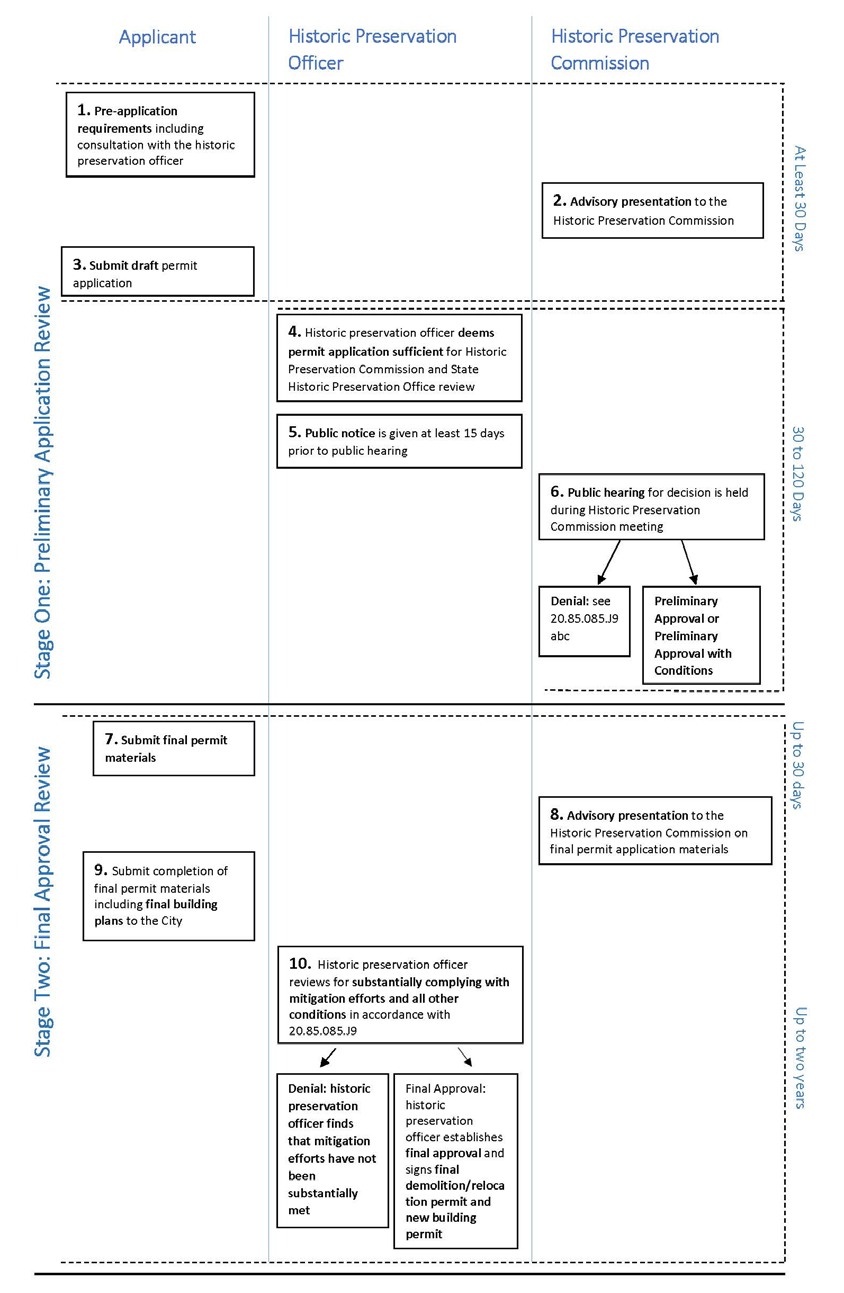
Figure 20.85.085-1 Application Timeline
6.
Pre-Application Requirements
a.
The intent of pre-application requirements is to initiate active mandatory consultation, review permit application materials, and outline the review process.
b.
At least 30 days prior to submitting a permit application, the applicant shall initiate consultation by scheduling a pre-application meeting with the historic preservation officer.
c.
After the pre-application meeting, the applicant shall provide an advisory presentation at an Historic Preservation Commission meeting, in order to gather information and consider comments on the permit proposal.
d.
After the pre-application meeting, the historic preservation officer may notify the State Historic Preservation Office that the process for a potential permit application has been initiated.
Commentary: If the applicant is not the building owner, such as an architect or consultant, it is strongly encouraged that the building owner be willing and available to work with the historic preservation officer and Historic Preservation Commission throughout the permit application process.
7.
Historic Preservation Officer Review
a.
The historic preservation officer shall meet with the applicant in a pre-application meeting to discuss the proposal, review permit application material, and outline the review process.
b.
The historic preservation officer shall review and deem the application sufficient in accordance with 20.85.085.D and F as applicable, and this section for preliminary application review (stage one). Once deemed sufficient, the historic preservation officer shall send a letter of sufficiency to the applicant.
c.
The historic preservation officer shall send a copy of the application to the State Historic Preservation Office, together with a cover letter requesting review and comment. The State Historic Preservation Office shall have 15 days from the receipt of the letter to provide comment.
d.
The historic preservation officer reserves the right to seek outside (third-party) consult from qualified professionals in western Montana, in determining whether the submittal material accurately and sufficiently addresses the required application information, at no cost to the applicant.
e.
If a permit is preliminarily approved or preliminarily approved with conditions by the Historic Preservation Commission pursuant to 20.85.085.J.8, the applicant shall submit application requirements for final approval to the historic preservation officer for review and to be deemed as sufficient (stage two, 20.85.085.J.11).
f.
The historic preservation officer shall determine whether the conditions of preliminary approval and requirements of final approval have been substantially met.
g.
If the historic preservation officer finds substantial compliance with the intent of mitigating adverse effect, the historic preservation officer shall finally approve the permit for demolition/relocation and subsequent redevelopment (building permit).
h.
The historic preservation officer may consult with the Historic Preservation Commission Chair, the Director of Development Services and relevant city staff in reviewing final application materials and reaching a final decision.
8.
Historic Preservation Commission Review
a.
The Historic Preservation Commission shall review the permit application for preliminary application consideration (stage one). Once the historic preservation officer has deemed the permit application sufficient for preliminary application review, a period of no less than 30 days and no more than 120 days is initiated for the Historic Preservation Commission to reach a decision regarding the permit for preliminary application review.
b.
Upon fully reviewing the permit application, the Historic Preservation Commission shall hold a public hearing and may: grant preliminary approval, preliminary approval with conditions, or deny the permit. A denial of a permit shall be accompanied by a written statement of the specific reasons for the denial.
c.
Preliminary approval will be established during the public hearing if the Historic Preservation Commission finds that failure to issue a permit will result in unreasonable economic hardship to the viability of the property, and that a bona fide effort has been made to find reasonable alternatives that would result in the preservation, renovation, or adaptive reuse of the historic resource, and no reasonable alternatives exist.
d.
The Historic Preservation Commission should consider the evidence utilizing the following guiding questions: Is the evidence sufficient? Is the evidence relevant? Is the evidence competent? Is the evidence credible? Is the evidence consistent? The Historic Preservation Commission should also consider any evidence of self-created hardship through deliberate neglect or inadequate maintenance of the property under 20.85.085.K.
e.
The Historic Preservation Commission reserves the right to seek outside (third-party) consult from qualified professionals in western Montana, in determining whether the applicant has put forth a bona fide effort, whether reasonable alternatives have been proven, and in assessing economic feasibility based on the submitted evidence.
9.
Review Criteria
The following must be considered in reviewing and making decisions on demolition/relocation
permit applications:
a.
Whether the structure still maintains viable economic life.
b.
Whether the structure is capable of generating a reasonable economic return if preserved, restored or rehabilitated.
c.
Whether the applicant has made a bona fide effort to find a reasonable alternative that would result in the preservation, renovation or rehabilitation of the structure.
d.
The historic preservation officer must consider whether sufficient mitigation efforts have been met, including but not limited to, documentation, mitigation, redevelopment and deconstruction (see 20.85.085.J.11).
e.
For a proposed relocation, the Historic Preservation Commission and historic preservation officer shall consider setting, location, feeling, and association as it applies to its National Register nomination, whether the structure will maintain its historic significance and integrity having been relocated, and the economic and physical feasibility associated with relocating the structure.
10.
Application Requirements for Preliminary Application Review
After the completion of the pre-application requirements, the following application
information must be submitted as evidence and considered to address the review criteria:
a.
Certificate of Economic Hardship (CEH)
The purpose of the CEH is to provide information as to whether the structure still maintains viable economic life. The burden of proof is on the applicant. The
CEH must be submitted in written form and must include and examine the following as
it relates to current economic and market rate data for Missoula, MT. Provisions:
(1)
The assessed value of the land, and improvements thereon, according to the most recent assessments;
(2)
Property taxes for the previous two years and any arrearages;
(3)
All appraisals obtained within the previous five years by the past and current owner or applicant in connection with the purchase, financing or ownership of the property;
(4)
Any listing of the property, price asked and offers received in the past five years;
(5)
Any environmental assessments or knowledge of environmental hazards associated with the property;
(6)
Any consideration by the owner for profitable adaptive reuses for the property, including renovation studies, structure and site plans, bids; and
(7)
Additional requirements for income-producing property:
(a)
Annual gross income from the property for the previous five years;
(b)
Itemized operating and maintenance expenses for the previous five years;
(c)
Annual cash flow for the previous five years;
(d)
Rent charged to tenants for the previous five years and the current market rate for rent;
(e)
A comparative economic assessment for the utilization of all financial incentives currently available including but not limited to: potential Missoula Redevelopment Agency funding, Federal Historic Tax Credits, MT Historic Tax Abatement, New Market Tax Credits, historic preservation grants, and any other available funding.
(8)
Optional: Additional information such as the following may be helpful in satisfying the burden of proof and in clarifying whether an economic hardship is taking place:
(a)
The date of purchase;
(b)
If property was not purchased at or close to market value, an explanation of the circumstances of the purchase and/or sale;
(c)
A detailed list with costs of any improvements since purchase and the date incurred;
(d)
Annual debt service, if any, for the previous two years; and
(e)
Title report and current balance on all mortgages, trust indentures, and on all debts that encumber the property.
b.
Feasibility Study/Economic Analysis Return
The purpose of the feasibility study is to provide information as to whether the structure is capable of generating a reasonable economic return if preserved, restored or rehabilitated.
The feasibility study must be completed by a third party not associated with the City
of Missoula or the project in review, and must be completed by professionals from
or experience in their field in western Montana. Provisions:
(1)
Written statement and itemized cost list from a licensed engineer and/or a licensed architect with experience in preservation, renovation, restoration, or rehabilitation as to the structural soundness of the structure and its suitability for continued use, renovation, restoration or rehabilitation.
(2)
Written statement and itemized cost list from a land-use professional which includes real estate consultants, appraisers, or other real estate professionals experienced in rehabilitation, as to the economic feasibility of preservation, restoration, renovation or rehabilitation of existing historic structures.
c.
Bona Fide Attempt to Rent, Sell or Relocate Resource
The intent of listing the structure is to ensure that parties interested in saving the structure as opposed to demolishing it are alerted and offered a period of time to purchase
the property. It is highly recommended that any individually listed property be listed
on the National Trust for Historic Preservation online real estate page for the entire
duration that the property is listed for sale. Provisions:
(1)
The applicant must advertise the historic resource for sale using a licensed real estate broker;
(2)
The applicant must illustrate that the asking price was comparable to the value of equivalent local structures of use and form during time of listing;
(3)
The applicant must list the property on a Multiple Listing Service (such as Loopnet.com) and the National Trust for Historic Preservation online real estate page for a period of at least 90 days within the past six months prior to submitting an application.
d.
Supplemental Information
Any additional supplemental information considered necessary and requested by the
Historic Preservation Commission and/or historic preservation officer to address review
criteria.
11.
Application Requirements for Final Approval Review
a.
The intent of application requirements for final approval review is to ensure that if a preliminary approval or preliminary approval with conditions for the permit has been established by the Historic Preservation Commission, then proper mitigation efforts are established and are consistent with Review Criteria.
b.
The applicant shall work with the historic preservation officer to ensure requirements are met and will establish a plan for each final approval requirement and compliance with any preliminarily approved conditions established by the Historic Preservation Commission.
c.
The applicant shall present the proposed mitigation efforts (including documentation, mitigation, deconstruction and redevelopment) for final approval review to the Historic Preservation Commission during an advisory presentation, and the Historic Preservation Commission may provide input as to recommendations of final approval, to be considered by the historic preservation officer.
d.
The following mitigation efforts must be submitted:
(1)
Documentation Plan
All historic resources preliminarily approved for demolition or relocation must be
fully documented using Historic American Building Survey (HABS) or HABS-quality procedure
as defined in 20.30.030.E.
(a)
Documentation shall happen before the final demolition/relocation permit is issued;
(b)
Documentation must be produced by a professional who satisfies professional qualification standards for history, archeology or architectural history, as established by the National Park Service and published in the Code of Federal Regulations, 36 CFR Part 61;
(c)
Documentation may be submitted as early in the process as the applicant desires to support the requested action.
(2)
Mitigation Plan for Demolition or Relocation
In addition to documentation, the applicant must provide a proposal to mitigate for
adverse effect caused by demolition or relocation. Possible mitigation efforts include,
but are not limited to, designated interpretive space, brick and mortar projects,
National Register nomination updates and additions, a preservation plan utilizing
the Secretary of the Interior's Standards, a development agreement with the City, an archeological study among others. Should the applicant
be applying for a relocation permit, additional preservation planning documents could
apply which may include plans for stabilization and/or restoration.
(3)
Redevelopment Plan
The applicant shall consult with the historic preservation officer in creating appropriate
redevelopment plans for the site and may consider advice from the Historic Preservation
Commission.
(a)
Redevelopment should be compatible with the character of the surrounding neighborhood, reflect the historic resource to be demolished or relocated, is sensitive to the significance of the site, and must adhere to any applicable design overlays within the City of Missoula.
(b)
Redevelopment plans shall be oriented with a north arrow at the top of the page and shall include exterior elevations, materials, site boundaries, street and alley frontages with names, location of all structures with distances to the nearest foot between buildings and from buildings to property lines, and must conform to all applicable regulations.
(c)
The applicant must demonstrate the ability to complete the project. The City Building Official may require a bond, letter of credit or cash deposit as a demonstration that the financial backing for the replacement structure is adequate to complete the project.
(4)
Deconstruction Plan
All historic structures approved for demolition must be deconstructed in total rather than demolished, with
deconstructed items to be reused. Property owners are held responsible for all costs
associated with deconstruction.
(a)
The applicant shall ensure that a local deconstruction specialist is consulted on the deconstruction process, for purposes of identifying opportunities for recovering and reusing materials within the structure.
(b)
Prior to the onset of deconstruction, the applicant and the deconstruction contractor shall meet with the historic preservation officer to identify historic features and items within the structure that are important to retain for potential reuse in the new structure or for preservation or interpretive purposes.
(c)
The applicant shall submit a deconstruction plan summarizing timing and approach including a preliminary list of identified historic items, and must be approved by the historic preservation officer. The applicant shall present plans to the Historic Preservation Commission during an advisory presentation.
(d)
The deconstruction specialist shall use their best effort to recover as many historic or non-historic features and items as is feasible, taking into consideration the age and condition of the materials, the safety of workers engaged in the deconstruction efforts, environmental abatement needs, and other conditions of the structure and worksite.
(5)
Supplemental Information
Any additional supplemental information considered necessary and requested by the
historic preservation officer to address conditions of mitigation.
12.
Exceptions
The historic preservation officer may waive items listed in 20.85.085.J if they are
not applicable to the specific review requested by the ordinance. In the event that
any of the required information is not reasonably available to the applicant and cannot
be obtained, the applicant shall file with the permit application a statement of the
information which cannot be obtained and shall describe the reasons why such information
cannot be obtained. The historic preservation officer shall deem whether the reasons
are sufficient or not.
13.
Permit Application Checklist
Figure 20.85.085-2 Checklist for Required Permit Application Material
K.
Demolition by Neglect
Neither the owner of, nor the person in charge of, any historic resource shall permit
such structure or landmark to fall into a state of disrepair which may result in the deterioration
of any exterior appurtenances or architectural feature so as to produce or tend to
produce a detrimental effect upon the character of the Historic resource in question,
including but not limited to:
1.
The deterioration of exterior walls or other vertical supports.
2.
The deterioration of roofs or other horizontal members.
3.
The deterioration of exterior chimneys.
4.
The deterioration or crumbling of exterior plaster or mortar.
5.
The ineffective waterproofing of exterior walls, roofs, and foundations including broken windows or doors.
6.
The deterioration of any feature so as to create or permit the creation of any hazardous or unsafe conditions.
L.
Record of Decision on Historic Preservation Permit
1.
All decisions of the Historic Preservation Commission shall be memorialized in a written record of decision, which shall be provided to the applicant within 30 days of the public meeting at which the decision was made.
2.
The record of decision shall include findings of fact and conclusions relied upon in reaching the decision pertaining to the approval, conditional approval, or denial of the HPP application.
3.
The historic preservation officer shall include a copy of the record of decision as part of the documentation maintained on the Historic resource and shall distribute a copy to the Building Department.
M.
Void if ConstructionNot Commenced
Approved HPPs expire two years from the date of issuance unless the authorized work
is started within that time.
N.
Interim Permit in Hazardous or Unsafe Conditions
The historic preservation officer may grant interim permits to stabilize and mitigate
immediate and serious threats to public safety in extenuating circumstances such as acts of God, fire, or earthquakes. Upon expiration
of the interim permit, any subsequent actions taken that are actions subject to review
shall be subject to the HPP process pursuant to this chapter.
O.
Transferability
The status of Historic Preservation Commission approval is not affected by changes
of tenancy, ownership, or management.
P.
Appeals
Appeals to decisions of the historic preservation officer and to decisions of the
Historic Preservation Commission may be made to the City Council in accordance with
the process described in 20.85.100. Variance requests may be made to the Board of Adjustment in accordance with 20.85.090.
(Ord. 3769, 2025; Ord. 3735, 2024; Ord. 3733, 2024; Ord. 3723, 2023; Ord. 3669, 2020; Ord. 3614, 2018; Ord. 3483, 2012; Ord. 3439, 2010; Ord. 3423, 2009)
Note— 20.85.085.F.1—F.3—Interim provision, expires March 24, 2026.
20.85.090 - Variances
A.
Intent
Zoning variances are intended to address unnecessary hardships resulting from strict
application of zoning ordinance standards.
B.
Applicability; Authorized Zoning Variances
1.
The Board of Adjustment is authorized to grant a variance to any regulation in this zoning ordinance in accordance with the variance procedures of this section, except that the variance procedures may not be used to:
a.
Waive, modify or amend any definition or use classification;
b.
Waive, modify or otherwise vary any of the review and approval procedures of this chapter; or
c.
Waive, vary, modify or otherwise override a condition of approval or requirement imposed by another authorized board or commission.
C.
Authority to File
Applications for zoning variances may be initiated only by the owner of the subject
property or by the owner's authorized agent.
D.
Application Filing
Complete applications for a zoning variance must be filed with appropriate personnel
in Development Services.
E.
Notice of Hearing
Public noticing standards can be found in Section 20.85.020 - Notice.
F.
Hearing and Final Decision
1.
The Board of Adjustment must hold at least one public hearing on a proposed zoning variance.
2.
Following the close of the hearing, at the same or subsequent meeting, the Board of Adjustment must take action to approve, approve with conditions or deny the proposed zoning variance. The Board's decision must be supported by written findings of fact. In the case of approval, the Board's findings must include a written description of the unnecessary hardship that would be created if the subject property was subject to strict compliance with zoning ordinance regulations.
G.
Review Criteria
Zoning variances that will not be contrary to the public interest may be approved
by the Board of Adjustment only when they find substantial evidence in the official
record that:
1.
Owing to special conditions strict application of one or more standards or requirements of this zoning ordinance would result in unnecessary hardships;
2.
The zoning variance is the minimum zoning variance necessary to provide relief from the unnecessary hardships;
3.
The zoning variance is generally consistent with the overall purpose of this ordinance (See 20.01.050); and
4.
The zoning variance will result in substantial justice being done, considering both the public benefits intended to be secured by this zoning ordinance and the individual hardships that will be suffered if the zoning variance request is denied.
H.
Airport Compatibility Act
When considering requests for variances from regulations adopted pursuant to the Airport
Compatibility Act (MCA Title 67, Chapter 7), the Board of Adjustment must give equal
weight to a finding of unnecessary hardship or substantial practical difficulty.
I.
Lapse of Approval
1.
An approved zoning variance will lapse and have no further effect two years after it is granted by the Board of Adjustment or two years after a final court order is issued (if the variance is the subject of litigation), unless:
a.
A building permit has been issued.
2.
The zoning officer may extend the expiration period of 20.85.090.I.1 and 20.85.090.I.3 by up to one year. Requests for extensions must be submitted to the zoning officer before the variance lapses.
3.
A zoning variance that was approved by the Missoula County Board of Adjustment lapses one year after the effective date of the subject property's annexation or two years after approval of the variance by the County Board of Adjustment, whichever is later. The zoning variance will not expire if:
a.
A building permit is issued; or
b.
A zoning compliance permit has been issued.
4.
A zoning variance also lapses upon revocation of a building permit for violations of conditions of approval or upon expiration of a building permit.
J.
Transferability
Zoning variance approval runs with the land and is not affected by changes of tenancy,
ownership or management.
K.
Amendments
A request for changes in conditions of approval of a zoning variance must be processed
as a new variance application, including the requirements for fees, notices and hearings.
L.
Appeals
Any person aggrieved by a decision of the Board of Adjustment may appeal the board's
decision to district court. The appeal must be presented to the court within 30 days after the Board of Adjustment's decision is filed with the County Clerk and Recorder.
(Ord. 3669, 2020; Ord. 3609, 2018; Ord. 3483, 2012; Ord. 3439, 2010; Ord. 3410, 2009)
20.85.095 - Public Forum
For the purposes of this section, an "agency" means a board, bureau, commission, department, district, an authority, or other entity of state or local government.
A.
Applicability; Authorized Public Forum
The City Council must hold a public hearing when an agency proposes to develop or
use public land contrary to these zoning regulations.
B.
Authority to File
Applications for a public forum may be initiated only by the owner of the subject
property or by the owner's authorized agent.
C.
Application Filing
Applications for a public forum must be filed with appropriate personnel in Development
Services.
D.
Notice of Hearing
Public noticing standards can be found in Section 20.85.020 - Notice.
E.
Hearing
The City Council shall hold a public hearing within 30 days of the date the agency
gives notice to Development Services of its intent to develop or use land contrary
to these zoning regulations. The City Council shall hold the public hearing as a public
forum and shall have no power to deny or condition the proposed use, but shall act
only to allow a public forum for comment on the proposed use. The agency shall attend
the public hearing. (See 76-2-402, MCA.)
(Ord. 3695, 2022; Ord. 3669, 2020; Ord. 3609, 2018)
20.85.100 - Appeals of Administrative Decisions
A.
Applicability; Authorized Appeals
The Board of Adjustment is authorized to hear and decide appeals where it is alleged
there has been an error in any order, requirement, decision or determination made
by the zoning officer or any other administrative official (e.g., city engineer) in
the administration, interpretation or enforcement of this zoning ordinance.
B.
Right to Appeal
Appeals of administrative decisions may be filed by any person aggrieved by the zoning
officer or other administrative official's decision or action. The Board of Adjustment
is authorized to make determinations about whether individuals filing appeals are
"aggrieved by the decision or action."
C.
Application Filing
1.
Complete applications for appeals of administrative decisions must be filed with appropriate personnel in Development Services.
2.
Appeals of administrative decisions must be filed within 30 days of the date of the decision being appealed.
D.
Effect of Filing
The filing of a complete notice of appeal stays all proceedings in furtherance of
the action appealed, unless the zoning officer certifies to the Board of Adjustment,
after the appeal is filed, that, because of facts stated in the certification, a stay
would cause immediate peril to life or property.
E.
Record of Decision
Upon receipt of a complete application of appeal, the zoning officer or other administrative
official whose decision is being appealed must transmit to the Board of Adjustment
all papers constituting the record upon which the action appealed is taken.
F.
Notice of Hearing
Public noticing standards can be found in Section 20.85.020 - Notice.
G.
Hearing and Final Decision
1.
The Board of Adjustment must hold a public hearing on the appeal.
2.
Following the close of the hearing, at the same or subsequent meeting, the Board of Adjustment must take action on the appeal. The Board's decision must be supported by written findings of fact.
3.
In exercising the appeal power, the Board of Adjustment has all the powers of the official from whom the appeal is taken, and the Board of Adjustment may reverse the appeal or affirm the appeal, in whole or in part, or modify the decision being appealed.
4.
In acting on the appeal the Board of Adjustment must grant to the official's decision a presumption of correctness, placing the burden of persuasion of error on the appellant.
H.
Review Criteria
An appeal may be sustained only if the Board of Adjustment finds that the zoning officer
or other administrative official erred.
I.
Rehearing by Board of Adjustment
The Board of Adjustment may grant a rehearing on any appeal of administrative decision
if the rehearing request includes new evidence to be presented that was not available
at the time of the original hearing or when the Board of Adjustment determines that
good cause has been shown for a rehearing. The request for a rehearing must be made
within 30 days after the Board of Adjustment's decision and must follow all procedures of this Section
20.85.100, including payment of any required filing fees.
J.
Appeals
Any person aggrieved by a decision of the Board of Adjustment may appeal the Board's
decision to district court. The appeal must be presented to the court within 30 days after the Board of Adjustment's decision is filed with the County Clerk and Recorder.
(Ord. 3669, 2020; Ord. 3439, 2010; Ord. 3410, 2009)
20.85.110 - Administrative Adjustments
A.
Intent
Administrative adjustments are intended to provide a streamlined approval procedure for minor (de minimis) modifications
of selected zoning ordinance standards. Administrative adjustments are further intended to:
1.
Allow development that is in keeping with the general purpose and intent of zoning ordinance regulations and the established character of the area in which it is located;
2.
Provide flexibility that will help promote rehabilitation and reuse of existing buildings when such flexibility will not adversely affect nearby properties or neighborhood character; and
3.
Provide flexibility for new construction when necessary to address unusual development conditions when such flexibility is in keeping with the general purpose and intent of zoning ordinance regulations and will not adversely affect other properties or surrounding neighborhood character.
B.
Applicability; Authorized Administrative Adjustments
The following administrative adjustments are authorized:
1.
/P District—Building Location Standards
a.
The zoning officer is authorized to approve an administrative adjustment to the building placement standards of 20.25.020.C.
b.
Such an administrative adjustment may be approved only when the zoning officer, after consulting with the city engineer, determines that useable public spaces or pedestrian amenities (e.g., extra-wide sidewalk, plaza with seating or outdoor dining area) will be provided between the building and the street.
2.
/P District—Ground FloorGlazed Area Standards
a.
The zoning officer is authorized to approve an administrative adjustment to the door and entrance standards of 20.25.020.D.
b.
Such an administrative adjustment may be approved only when the zoning officer determines that a safe pedestrian walkway not exceeding 20 feet in length is provided between the building entrance and the sidewalk abutting street.
3.
/P District—Door and Entrance Standards
a.
The zoning officer is authorized to approve an administrative adjustment to the ground-floor glazed area standards of 20.25.020.E.
b.
Such an administrative adjustment may be approved only when the zoning officer determines that a safe pedestrian walkway not exceeding 20 feet in length is provided between the building entrance and the sidewalk abutting street.
4.
/P District—Driveway and Vehicle Access Standards
a.
The city engineer is authorized to approve an administrative adjustment to the driveway and vehicle access standards of 20.25.020.H.
b.
Such an administrative adjustment may be approved only when the city engineer determines, in consultation with other appropriate city officials that access to the subject parcel cannot be safely accommodated by alley or side (non-pedestrian) street access.
5.
Bicycle Parking
a.
The zoning officer is authorized to approve an administrative adjustment reducing the number of bicycle spaces required under 20.60.090.
b.
Such an administrative adjustment may be approved only when the zoning officer determines that use will generate no bicycle traffic or that it would be impossible to provide bicycle parking at the subject location.
c.
The zoning officer is also authorized to approve an administrative adjustment to modify the bicycle parking design and location requirements 20.60.090 if the zoning officer determines that an alternative design is necessary to address practical difficulties associated with modifying existing buildings and sites to comply with bicycle parking requirements.
6.
Nonconformities
The zoning officer is authorized to approve an administrative adjustment allowing expansion of a nonconforming use into another part of the same building, in accordance with 20.80.040.C.
C.
Application Filing
Complete applications for administrative adjustments must be filed with appropriate personnel in Development Services.
D.
Notice
Public noticing standards can be found in Section 20.85.020 - Notice.
E.
Review and Decision—Zoning Officer
1.
The zoning officer must review each application for an administrative adjustment and act to approve the application, approve the application with conditions, deny the application or refer the application to the Board of Adjustment for consideration as a variance.
2.
The zoning officer may not take final action to approve or deny an administrative adjustment application until at least 15 days after the date that required notices were mailed.
3.
The zoning officer's decision to approve or deny must be based on the approval criteria of 20.85.110.F.
F.
Approval Criteria
Administrative adjustments may be approved by the zoning officer only when the zoning officer determines that
any specific approval criteria associated with the authorized administrative adjustment and the following general approval criteria have been met:
1.
The requested administrative adjustment is consistent with all relevant purpose and intent statements of this zoning ordinance;
2.
The requested administrative adjustment will have no appreciable adverse impact on the health, safety, or general welfare of surrounding property owners or the general public; and
3.
Any adverse impacts resulting from the administrative adjustment will be mitigated to the maximum extent feasible.
G.
Conditions of Approval
In granting an administrative adjustment, the zoning officer may impose conditions upon the subject property that are necessary
to reduce or minimize any potentially adverse impacts on other property in the surrounding
area, and to carry out the stated purpose and intent of this zoning ordinance.
H.
Transferability
Administrative adjustment approval runs with the land and is not affected by changes of tenancy, ownership
or management.
I.
Amendments
A request for changes in conditions of approval of an administrative adjustment must be processed as a new administrative adjustment application, including the requirements for fees and notices.
J.
Appeals
Final decisions of the zoning officer may be appealed by any person aggrieved by the
decision in accordance with the procedures of 20.85.100.
(Ord. 3735, 2024; Ord. 3669, 2020; Ord. 3439, 2010; Ord. 3410, 2009)
20.85.120 - Zoning Compliance Permits
A.
Purpose
Zoning compliance permits are required for the purpose of determining compliance with
all applicable provisions of this zoning ordinance, including the requirements that
apply to unzoned land (see 20.70.010) Zoning compliance permits are generally required for development and building activities that do not require a building permit, while zoning compliance
review (20.85.130) is required for development and building activities that do require building permits.
B.
Applicability
1.
A zoning compliance permit is required before any structure, or part of a structure is created, erected, changed or converted, wholly or in part, in its use, occupancy, or construction.
2.
A zoning compliance permit is also required before any new use is established or any existing use is changed wholly or in part.
Commentary: Other land use and development plans that do not require a building permit may require a zoning compliance permit. Development that does require a building permit is reviewed for zoning ordinance compliance through the zoning compliance review process of 20.85.130.
C.
Application Filing
1.
Complete applications for approval of a zoning compliance permit must be filed with appropriate personnel in Development Services.
2.
Each application for a zoning compliance permit must be accompanied by a site plan drawn to scale, and in such form as may be prescribed by the zoning officer, showing the actual size and dimensions of the parcel to be built upon, the size of the building to be erected, and such other information as the zoning officer determines necessary to allow a competent determination of whether the requirements of this zoning ordinance have been met.
D.
Review and Decision—Zoning Officer
The zoning officer must review each application for a zoning compliance permit and
act to issue or deny a zoning compliance permit based solely on whether the proposed
use, structure or development complies with all applicable provisions of this zoning ordinance.
E.
Lapse of Approval
1.
A zoning compliance permit will lapse and have no further effect two years after it is issued by the zoning officer, unless:
a.
A building permit has been issued (if required); and
b.
A final certificate of zoning compliance has been issued.
F.
Appeals
1.
Zoning officer decisions to deny the issuance of a zoning compliance permit for noncompliance with one or more regulations of this zoning ordinance may be appealed to the Board of Adjustment in accordance with 20.85.100, unless the subject property is unzoned. Appeals of decisions to deny zoning compliance permits on unzoned land must be processed in accordance with 20.85.120.F.2, below.
2.
Zoning officer decisions to deny the issuance of a zoning compliance permit for noncompliance with one or more regulations that apply to unzoned land may be appealed only to the City Council, as follows:
a.
Appeals must be filed within five days of the date of the zoning officer's decision to deny the zoning compliance permit.
b.
The appeal must be in writing and submitted to appropriate personnel in Development Services.
c.
The zoning officer is responsible for distributing a copy of the appeal to the city clerk and referring the request for a hearing to the City Council.
d.
Once a hearing date is set by the City Council, notice of the public hearing must be published in the newspaper at least 15 days before the hearing. Notice of the City Council's hearing on the appeal must also be posted on the subject property at least 15 days before the public hearing. (See 20.85.020.D.3 for additional information on public hearing notices.)
e.
The City Council's decision is final. Any person aggrieved by the City Council's decision may appeal the decision to District Court. The appeal must be presented to the court within 30 days after the filing of the decision by the zoning officer.
(Ord. 3439, 2010; Ord. 3410, 2009)
20.85.130 - Zoning Compliance Review
A.
Purpose
Zoning compliance review is required—prior to the issuance of building permits or
business licenses—for the purpose of determining whether proposed structures and uses comply with all applicable provisions of this zoning ordinance, including
the requirements that apply to unzoned land (see 20.70.010) Development that does not require building permits may be subject to the zoning compliance permit
procedures of 20.85.120.
B.
Applicability
Zoning compliance review is required before any structure, or part of a structure may be created, erected, changed or converted, wholly or in part, in its use, occupancy, or construction.
C.
Timing
Zoning compliance review must be conducted before the building inspector issues a
building permit or the treasurer's office issues a new business license or allows
the transfer of an existing license.
D.
Applications
1.
Zoning compliance review for development as submitted to the building department requires a site plan drawn to scale, and in such form as may be prescribed by the zoning officer, showing the actual size and dimensions of the parcel to be built upon, the size of the building to be erected, and such other information as the zoning officer determines necessary to allow a competent determination of whether the requirements of this zoning ordinance have been met.
2.
Zoning compliance review for business license issuance must include the subject property's legal street address when the business license application is submitted to the Finance Office.
E.
Review and Decision—Zoning Officer
The zoning officer must review each building permit application and business license
application and act to approve or deny the zoning compliance review based solely on
whether the proposed use, structure or development complies with all applicable provisions of this zoning ordinance.
F.
Appeals
1.
Zoning officer decisions of noncompliance with one or more regulations of this zoning ordinance may be appealed to the Board of Adjustment in accordance with 20.85.100, unless the subject property is unzoned. Appeals of decisions to deny zoning compliance review approval on unzoned land must be processed in accordance with 20.85.120.F.2, below.
2.
Zoning officer decisions to deny the issuance of zoning compliance review approval due to noncompliance with one or more regulations that apply to unzoned land may be appealed only to the City Council, as follows:
a.
Appeals must be filed within five days of the date of the zoning officer's decision to deny the zoning compliance permit.
b.
The appeal must be in writing and submitted to appropriate personnel in Development Services.
c.
The zoning officer is responsible for distributing a copy of the appeal to the city clerk and referring the request for a hearing to the City Council.
d.
Once a hearing date is set by the City Council, notice of the public hearing must be published in the newspaper at least 15 days before the hearing. Notice of the City Council's hearing on the appeal must also be posted on the subject property at least 15 days before the public hearing. (See 20.85.020.D.3 for additional information on public hearing notices.)
e.
The City Council's decision is final. Any person aggrieved by the City Council's decision may appeal the decision to district court. The appeal must be presented to the court within 30 days after the filing of the decision by the zoning officer.
(Ord. 3439, 2010; Ord. 3410, 2009)
20.85.140 - Final Zoning Compliance Approval
A.
No building or premises other than a detached house or two-unit house may be used or occupied until the zoning officer has issued a final zoning compliance approval, which states that the use and arrangement of structures and site features comply with all applicable regulations of this zoning ordinance. The final zoning compliance approval may be issued only after the zoning officer has conducted a final inspection of the premises and has determined that the site has been developed in compliance with the site plan approved by the zoning officer at the time a zoning compliance permit was issued.
B.
Temporary final zoning compliance approvals may be issued for a period of up to six months, during the completion of any alterations or during partial occupancy of such building or site.
1.
Such temporary final zoning compliance approval may be extended, but may not in any way affect the rights, duties and obligations of the owner or the city, relative to the use or occupancy of the premises converted, or any other matter covered by this zoning ordinance.
2.
The zoning officer is authorized to require a financial guarantee, in a form approved by the city attorney, before issuance of a temporary final zoning compliance approval.
a.
Required financial guarantees must be held by the zoning officer for the duration of the temporary final zoning compliance approval.
b.
The amount of any required financial guarantee must be equal to at least 110% of the amount deemed necessary to complete the development in accordance with all applicable requirements of this ordinance.
c.
The financial guarantee may only be returned to the property owner upon the issuance of a final zoning compliance approval.
d.
If the temporary final zoning compliance approval expires and the development is not completed in accordance with all applicable requirements of this ordinance, the city is authorized to exercise the financial guarantee and use the funds to cause the completion of the development.
C.
The zoning officer may conduct a final inspection of the premises occupied by detached houses and two-unit houses to determine if the site has been developed in compliance with the site plan approved by the zoning officer.
(Ord. 3439, 2010; Ord. 3410, 2009)

