
Sandy City Zoning Code
CHAPTER 21
13 RESIDENTIAL CONSERVATION OVERLAY ZONE
21-13-1 Purpose
In an effort to encourage water conservation, improve the long-term viability of planted street trees, create a safer pedestrian walking environment, and allow greater flexibility in subdivision design and lot layout, the Residential Conservation Overlay Zone was created to promote development and redevelopment in Sandy City neighborhoods. The overlay zone is intended to create efficient use of land by controlling the intensity of land use, providing sufficient critical mass, and mass design features to create a walkable neighborhood.
(LDC 2008, § 15A-13-01; Ord. No. 15-35, 11-23-2015)
21-13-2 Procedures
- Development Review. All submissions shall be made well in advance of planned construction for proper coordination and feedback and shall be reviewed by the City Development Committee and/or respective architectural review body before submittal to the Planning Commission.
- Subdivision Process. Prior to the Planning Commission taking action, plans must be submitted in accordance with the subdivision procedure.
(LDC 2008, § 15A-13-02)
21-13-3 Uses Allowed
- Permitted and Conditional. The RCO Zone is an overlay district, and, as such, permitted and conditional uses are governed by the requirements and standards of the specific underlying residential zone. Except as otherwise stipulated in the RCO Zone, development proposals shall comply with the requirements of the underlying zone.
- Ancillary. All permitted and conditional land uses within the RCO Zone may conduct ancillary uses, as specifically defined within Chapter 21-37, provided such use is not regulated by other sections or is listed as a non-permitted use in the underlying zone district.
(LDC 2008, § 15A-13-03)
21-13-4 Walkable Components
A new development implementing the RCO may be located at infill locations where walkable components (e.g., housing choices, convenience commercial, employment, community facilities, transportation linkages, parks or other open spaces, schools, or churches) are already present or planned. As a guiding principle, walkable components should be within a ten minute (or one-half mile) walking distance.
(LDC 2008, § 15A-13-04)
21-13-5 Improvement And Lot Standards
- Road Improvements. A ten-foot cross-section for parkstrips and sidewalks (five-foot parkstrip, five-foot sidewalk) is required when developing new subdivisions. Where possible, and depending on adjacent improvements, an eight-foot parkstrip may be required to provide an area for required street trees.
- Lot Dimensions. To encourage neighborhood reinvestment, the Planning Commission may allow adjustments in minimum lot size, frontage, and setbacks, irrespective of requirements in underlying zones, based upon the following:sfd—single-family dwelling
Minimum Parcel Size and Setback Minimum Requirements
Zone
Minimum Lot Size
Average Lot Size
Lot Frontage
Front Yard Setback
Side Yard Setback
Rear Yard Setback
R-1-40
36,000 s.f.
40,000 s.f.
110 ft.
30'
15'/30'
30'
R-1-30
28,000 s.f.
30,000 s.f.
100 ft.
30'
12'/27'
30'
R-1-20
18,000 s.f.
20,000 s.f.
90 ft.
30'
10'/24'
30'
R-1-15
13,000 s.f.
15,000 s.f.
85 ft.
30'
10'/22'
30'
R-1-12
10,000 s.f.
12,000 s.f.
80 ft.
30'
8'/20'
30'
R-1-10
8,000 s.f.
*9,000 s.f.
70 ft.
10' to porch 15' to living 20' to garage
**8'/16'
20'
R-1-9
7,000 s.f.
*8,000 s.f.
65 ft.
10' to porch 15' to living 20' to garage
*7'/14'
20'
R-1-8
6,500 s.f.
*7,500 s.f.
60 ft.
10' to porch 15' to living 20' to garage
**6'/12'
15'
R-1-6
4,500 s.f.
*5,500 s.f.
50 ft.
10' to porch 15' to living 20' to garage
**5'/10'
15'
R-2-10
5,000 s.f. sfd 8,000 s.f. mfd
*5,000 s.f sfd. *9,000 s.f. mfd
55 ft. sfd 60 ft. mfd
10' to porch 15' to living 20' to garage
**5'/10'
15'
R-2-8
4,000. s.f. sfd 6,500 s.f. mfd
*4,000 s.f. sfd *7,500 s.f. mfd
55 ft. sfd 60 ft. mfd
10' to porch 15' to living 20' to garage
**5'/10'
15'
mfd—multifamily dwelling (duplex and/or twin home)
*If the proposed development is within one-half-mile walking distance (as a pedestrian would walk) to at least five of the nine walkable components (e.g., housing choices, convenience commercial, employment, community facilities, transportation linkages, parks or other open spaces, schools, or churches), then the average lot size shown in Table 15A-13-01(A) will apply. Otherwise, the average lot size would have to maintain the minimum square footage required for the underlying zone. For example, if the subject property is zoned R-1-10 and is within one-half-mile of five of the nine walkable components, then the average lot size could be 9,000 square feet. If the subject property is not within one-half-mile walking distance to at least five of the nine walkable components, then the average lot size would need to remain at 10,000 square feet.
**Side yard setback shall maintain the regular setback on the side that shares the side yard of existing adjacent home, outside of this overlay zone.
(LDC 2008, § 15A-13-05)
21-13-6 Architectural Design And Materials
- Architectural Standards. The treatment of buildings, materials, and exterior appurtenances shall create an aesthetically pleasing dwelling and site that is in character with the proportions of other surrounding structures, and yet provides diversity in design. An architectural balance of building materials, colors, design features, and textures which create random compatibility shall be sought. Requirements applicable to all dwellings and lots are as follows:
- The Planning Commission shall review and approve building elevations and materials for all projects within a Residential Conservation Overlay Zone, particularly where exposed to pedestrian and/or vehicular traffic.
- Basic building materials for all residential uses shall be predominantly one material of brick, stone, or masonry. Limited amounts of stucco and composite or wood siding may be considered if the quality of the design merits such consideration (no vinyl or aluminum siding allowed).
- Buildings shall be designed to relate to grade conditions with a minimum of grading and exposed foundation walls, creating easy pedestrian access from sidewalks, parking areas, etc.
- Front porches shall be added to the living area of dwellings and shall have a minimum depth of five feet and shall comprise a minimum of 50 percent of the width of the building's primary front facade (not including an attached garage). In no case shall the front porch be less than 15 feet in width.
- Attached garages must be clearly subservient to front porches, by at least five feet.
- Sidewalk connections shall be made from front porches directly to street sidewalks.
- Dwelling footprints shall not occupy more than 50 percent of the lot, unless there is a three-car garage, in which case the footprint shall not occupy more than 60 percent of the lot.
- Building Orientation. The entrance of all dwellings shall front onto public streets with entrance sidewalks directly accessing the street sidewalk. On a case-by-case basis, a limited number of dwelling units fronting onto a private street or driveway may be approved by the Planning Commission, depending on the size, scale, design, location, topography, or other natural features associated with the property.
- Building Height. Dwelling structures shall comply with the height requirements of underlying residential districts.
(LDC 2008, § 15A-13-06; Ord. No. 13-04, 1-30-2013; Ord. No. 13-18, 8-22-2013)
21-13-7 Landscaping
- On-Site Trees and Shrubs. All front yards shall be landscaped using trees, both evergreen (six feet minimum) and deciduous, shrubs/bushes, and flowers.
- Street Trees. A minimum two-inch caliper street trees as measured six inches above grade shall be installed by the developer/builder located between the curb and sidewalk along all rights-of-way. In cases where there is not an eight-foot parkstrip, approved street trees shall be planted three feet behind the sidewalk. Public landscaping improvements shall be bonded for at time of building permit.
(LDC 2008, § 15A-13-07)
Adopted by Ord. 23-08 § 1(Exh. A on 7/18/2023
21-13-8 Outdoor Lighting.
The lighting of streets and pedestrian areas is required. Exterior wall-mounted floodlights must be directed downward to avoid light spill on adjacent property. Indirect lighting, bollard lighting, and landscape lighting is encouraged. Street light design fixtures shall be installed as required by the street lighting policy.
(LDC 2008, § 15A-13-08)
21-13-9 Streets And Pedestrian Ways
All accesses within the RCO shall have connectivity with existing and future street patterns. A grid street pattern or modified grid patterns are preferred where practically possible.
(LDC 2008, § 15A-13-09)
21-13-10 Residential Conservation Dwelling Design For Existing Dwellings
- In an effort to encourage neighborhood stability, conserve land, encourage water conservation, and create residential development based upon CPTED principles, property owners of existing dwellings may reduce front setbacks as outlined in this section. More specifically, the intent of this section is to allow additional front setback flexibility for residential remodeling for the following reasons:
- To encourage neighborhood reinvestment by giving property owners more options when building new dwellings or expanding existing dwellings to meet changing family needs;
- To conserve land and to enhance usable yard area;
- To encourage water conservation using drought-resistant plants and by eliminating the need for large expanses of landscape areas within front setback; and
- To encourage greater public safety by requiring architecture to be such that the dwelling has a greater tie to the street through the implementation of CPTED principles.
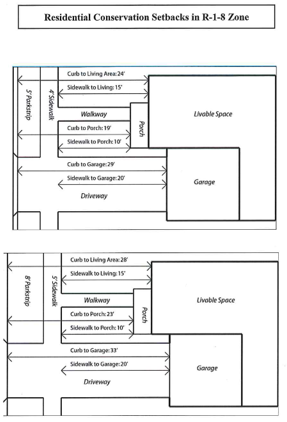
- The Community Development Department staff, irrespective of requirements in the underlying zone, may allow the reduction of the front yard building setback (minimums of ten feet from sidewalk to porch, 15 feet from sidewalk to living space, and 20 feet from sidewalk to garage) for dwelling structures when all of the following standards are met:
- Front porches shall be added to the living area of dwellings and shall have a minimum depth of five feet and shall comprise a minimum of 50 percent of the width of the building's primary front facade (not including an attached garage). In no case shall the front porch be less than 15 feet in width.
- Front porches shall be designed for display, sitting, and conversation and shall not be used for storage.
- Attached garages must be clearly subservient to front porches, sitting back further than the porch as indicated in the diagram below.
- CPTED principles shall be used in the design to promote natural surveillance, access control, territorial reinforcement, sense of ownership, and maintenance. Architectural design shall be such that dwellings are strongly oriented towards the street. Architectural structure, materials and treatments are encouraged which may include, but are not limited to, the liberal use of second-story levels, expansive windows with architectural treatments, balconies, stoops, insets, etc., to create additional interest and tie to the street, and other such architectural elements in accordance with natural surveillance.
- When remodeling an existing home, the new portion of the home shall be architecturally compatible, using similar exterior materials and colors, including similar window and door design.
- Symbolic barriers (e.g., low level fences or hedges in the front setback) may be used to discourage crime and promote safety. Fences, if determined to be necessary or desirable, must be reviewed for their effectiveness in enhancing private space while not creating isolated uses or dead space void of natural surveillance. Fencing, where deemed appropriate, shall use picket fence materials or other similar open construction fencing, with the intent of promoting an open feeling and natural surveillance. Approved fences shall be compatible in color, texture, and design in relationship to building materials.
- It is encouraged that the front yard area be re-landscaped using more drought tolerant plants, which may include a combination of trees, shrubs, and ground covers, using landscaping guidelines as contained in Section 21-25-4.
- Sidewalk connections shall be made from front porches directly to street sidewalks.
- Other design features which promote public safety and pedestrian activity, as approved by staff.
(LDC 2008, § 15A-13-10; Ord. No. 13-04, 1-20-2013)

