
Sandy City Zoning Code
CHAPTER 21
28 FENCING
21-28-1 Purpose
This chapter has been provided to create minimum and maximum fencing standards for residential and commercial areas within Sandy City.
(LDC 2008, § 15A-28-01)
21-28-2 Effect Of Section On Covenants, Agreements, Etc.
This chapter shall not nullify the more restrictive provisions of covenants, agreements, ordinances, or laws, but shall prevail notwithstanding such provisions which are less restrictive.
(LDC 2008, § 15A-28-02)
21-28-3 Fences; Residential Standards
- Side Yards and Rear Yards. In any required side or rear yard on lots, the height of fences shall not exceed six feet, unless otherwise allowed herein.
- Front Yards. Fences in required front yards shall be allowed provided that solid type fences shall not exceed three feet, and open type fences (e.g., wrought iron) shall not exceed four feet.
- Corner Lots. In addition to the other provisions contained in this section, fences located on corner lots shall be subject to the following provisions:
- Any fence, wall, and/or hedge on the front yard setback shall not exceed three feet if opaque construction or four feet if open construction.
- In the side yard setback that fronts on a street, height up to six feet shall be allowed beyond 60 feet from the intersection measured from the intersecting extended curb lines. Height within the 60 foot area shall conform to the requirements of a front yard setback.
Illustration of a Common 60 Foot Sight Visibility Triangle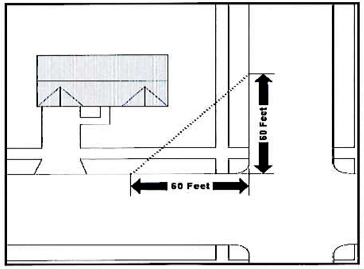
- A clear view zone shall be maintained free of fencing, except a see-through fence or a view obscuring fence no higher than three feet in height when a driveway exists on the adjacent lot within ten feet of the shared property line. The clear view zone refers to the portion of the corner lot lying within a triangular area formed by measuring back ten feet from the point where the interior property line shared with the adjacent lot meets the property line along the public right-of-way.
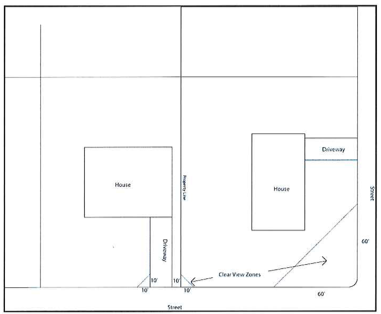
Fence Figure #1. Interior Lot Fence Height Restrictions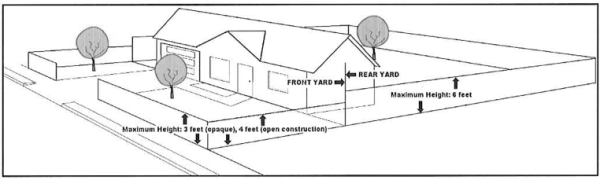
- Heights on the rear yard setback and interior side yard setback shall not exceed six feet, unless otherwise allowed herein.
Fence Figure #2. Corner Lot Fence Height Restrictions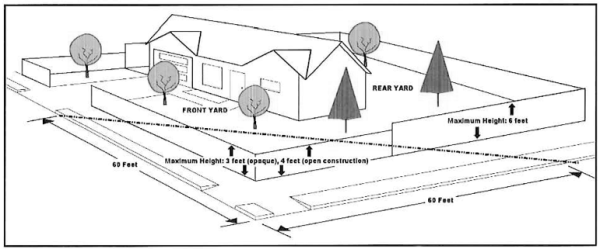
- Fences on Slopes. Fences on slopes may be a maximum of seven feet if the average height of such fence is no greater than six feet six inches, unless otherwise allowed herein (see Figure 3).
Figure #3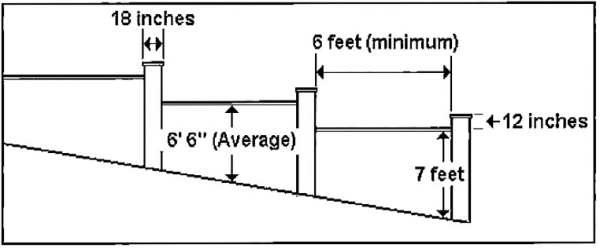
- Fence Posts, Gate Posts, Pillars, and Support Columns. Fence posts, gate posts, pillars, and support columns may extend 12 inches above the maximum fence height when separated by at least six linear feet of fencing (see Figure 3). Gate posts may be as close as three feet of each other with no more than one gate per fence frontage. Structures may not exceed 18 inches in diameter or width.
- Measurement of Fence Height.
- The height of a fence shall be measured from the highest grade.
- The combined height of a fence and retaining wall shall not exceed 11 feet, unless otherwise allowed herein (see Figure 4).
Figure #4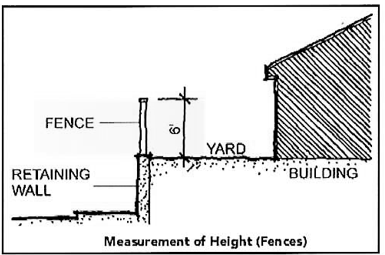
- Approved Fencing Materials. Acceptable construction materials for fences shall be lumber, vinyl, chainlink, wrought iron, precast concrete panels, concrete block, or other solid durable materials as the Director may approve.
(LDC 2008, § 15A-28-03)
21-28-4 Lots Within A Sensitive Area Overlay Zone
A fence may be built upon a slope greater than 30 percent provided the following conditions are met:
- Fences shall be located only upon areas constituting usable land unless otherwise designed to comply with the Environmental Hazards Element as contained in Section VIII of the General Plan and as approved by the Community Development Department.
- Only dark brown, dark green, or black vinyl coated chainlink fencing shall be allowed in order to blend into the native landscaping.
- The fence shall be built in accordance to this chapter and comply with all restrictions imposed by setbacks, etc., as defined in this title, as well as the Environmental Hazards Element as contained in Section VIII of the General Plan.
- Fencing on hillside lots shall only be approved in conjunction with an approved Landscape Plan in accordance with the Environmental Hazards Element as contained in Section VIII of the General Plan.
(LDC 2008, § 15A-28-04)
21-28-5 Fencing; Commercial And Industrial Standards
- Front Yard Fencing.
- General Standards. If a fence is desired between a building and the front property line, decorative iron fences or a combination of decorative iron and brick pillar fences are required. The fence may be a maximum of six feet in height and located immediately behind the front landscape area required by this title for the particular project.
- Corner Lots. All developments located on corner lots shall be considered to have two frontages. The above fencing restriction shall apply to both frontages with the exception that fences may not encroach into the required sight visibility triangle at the intersection of two streets. Sight visibility triangles are determined by engineering standards as contained in the AASHTO publications. In many cases, a 60-foot sight visibility triangle is sufficient. Sight visibility triangles will increase significantly if the location is on or near the inside of a horizontal curve. Fences in the sight visibility triangle shall be no more than three feet in height above the top of curb. In most cases, said sight visibility triangle shall be measured from the intersection of the extended curb lines back 60 feet in both directions.
- Side and Rear Property Lines. Fences along side or rear property lines shall not exceed six feet in height measured from the highest elevation on either side of the fence unless otherwise approved by the Director during site plan review up to a maximum of eight feet measured from the highest elevation on either side of the fence.
- Barbed Wire Fences. Barbed wire and other security wire is allowed on fences on commercial, industrial, business, or civic property for the purpose of maintaining security and preventing property loss and vandalism.
- Temporary Fencing. Fencing may be allowed on a temporary basis for the purpose of securing property prior to and during development and for special events.
(LDC 2008, § 15A-28-05)
21-28-6 Vacant Lots
For the purpose of this chapter, it shall be presumed that a vacant lot shall contain a minimum front, side, and rear yard that are otherwise required by ordinance. In any required side and rear yard on vacant lots, the maximum height of fences or other similar structures shall be six feet.
(LDC 2008, § 15A-28-06)
21-28-7 Barbed Wire
Fences containing strands of barbed wire or other similar fencing designed to prevent intrusions are prohibited unless specifically approved by the Director for public safety, health, or welfare. Such fences may include fencing for farm animals and public utility stations.
(LDC 2008, § 15A-28-07)
21-28-8 Retaining Walls
Where a retaining wall protects a cut below or a fill above the natural grade and is located on the line separating lots or properties, such retaining wall shall not exceed five feet. For cuts/fills to be retained that exceed five feet, retaining walls shall be stepped and separated horizontally by a minimum of five feet. The uppermost retaining wall may be topped by a fence, wall, or hedge of the height that would otherwise be permitted at the location if no retaining wall existed. The Planning Commission may grant a special exception to this criteria where it can be shown that this provision would cause an unreasonable hardship to the property (e.g., where the stepping would eliminate the side or rear yard leaving the property owner with a strip of unusable yard space (less than five feet)), or where it may not be practical due to adjoining uses.
Proper retaining wall installation
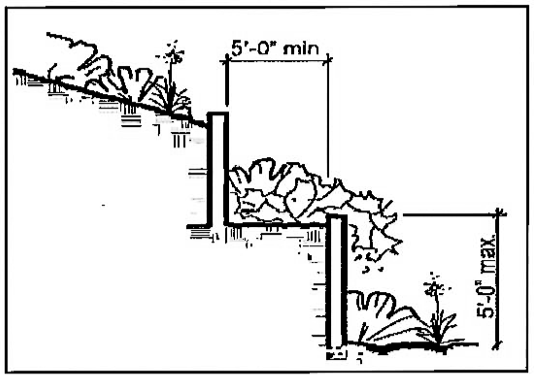 (LDC 2008, § 15A-28-08)
21-28-9 Walls Along Arterial Highways
Whenever any person, firm, or corporation as a subdivider develops or builds upon any property in Sandy City that is part of a recorded subdivision approved by the Planning Commission after the effective date of the ordinance from which this title is derived or in any previously approved subdivision, and which abuts any arterial street as defined and provided herein, said person, firm, or corporation shall construct and install, at their own expense, a fence or wall as provided hereafter along the back property line of lots abutting said arterial.
- An arterial highway is any public road having a right-of-way, developed or undeveloped, of 84 feet or more, including, but not limited to, the following roads:
State Street 700 East 1300 East 10600 South 2000 East 9000 South 9400 South 11400 South - The said fence or wall shall be approved by the Planning Commission after review by the Community Development Department, only upon satisfaction of the following criteria:
- Durable or useful life of at least 20 years duration;
- Wind load of at least 80 miles per hour; and
- Maintenance free for at least five years duration.
- In addition to the above requirements, the following shall be satisfied:
- The fence shall be interrupted approximately every 20 to 30 feet by pilasters, columns, jogs in the fence, or other variation in the construction so as to provide a visual breaking point in construction.
- Acceptable construction materials shall not include chainlink, chainlink with slats, picket, or wood fencing.
- Anti-graffiti coating shall be required as approved by the Parks and Recreation Department.
- Specific structural design shall be reviewed and approved by the City Engineer.
- A barrier wall, six feet in height (measured from the highest elevation on either side of the wall) except where soil retention is required, may be up to eight feet in height (retaining wall and barrier wall combined). All such walls shall meet design specifications adopted by the Planning Commission.
- An additional landscaped buffer, including sprinkling and water connections, may be required by the Planning Commission between the sidewalk and barrier wall where it is impractical for the barrier wall to abut the sidewalk. The specific width of the buffer and landscaping specifications shall be determined by the Planning Commission, upon recommendation by the Parks Director, at the time of final subdivision review.
(LDC 2008, § 15A-28-09)
21-28-10 Exceptions
- Sports Court Fencing. The provisions of this chapter shall not apply to certain other fences such as sports court fences, tennis court backstops, or patio enclosures in the front, side, or rear yards if the Director finds that it meets the following conditions:
- The proposed fence does not create a hazard for the subject property or adjacent properties.
- The proposed fence does not create a violation of other ordinances.
- Additional Height Request.
- The Director is authorized to approve the installation of a fence up to eight feet in height in the side and/or rear yard of any lot or parcel provided the following conditions are met:
- The Director finds the additional height is justified by the particular circumstances of the property, such as safety, lot configuration, building placement on the lot, topography, and/or negative impacts to the property from adjacent uses.
- The proposed fencing is outside of the 60-foot sight visibility triangle and other clear view zones for corner lots.
- At least two weeks prior to construction of the fence, the affected abutting property owners shall be notified of the intent to build an eight-foot fence. Proof of this notification shall be provided to the Planning Division as part of the building permit application with any response from the abutting property owners.
- A building permit is applied for and approved.
- If the Director so desires, this type of request may be forwarded to the Planning Commission for approval as a special exception.
- The Director is authorized to approve the installation of a fence up to eight feet in height in the side and/or rear yard of any lot or parcel provided the following conditions are met:
(LDC 2008, § 15A-28-10; Ord. No. 16-30, 8-20-2016)
21-28-11 Fencing Along Canals
- Any parcel being subdivided or developed that is adjacent to or has within its boundaries a canal right-of-way may be required to provide along such right-of-way a fence as determined by the reviewing land use authority.
- As an alternative to fencing the canal and with the review and approval of the Public Works Department, the developer may pipe the canal. If the canal is piped, the developer must obtain written permission from the canal company and construct the pipe according to the canal company's requirements and specifications.
- All fences bordering canals shall be installed as part of the improvements for the subdivision or other development. No occupancy permit, whether temporary or final, shall be granted until all required fencing is installed in the subdivision or development.
- Where practical, the fence material and type should be alternated to create an open appearance and avoid a walled-in alley look.
(LDC 2008, § 15A-28-11)
Amended by Ord. 26-50 on 7/2/2026

