
Sandy City Zoning Code
CHAPTER 21
17 DRINKING WATER SOURCE PROTECTION OVERLAY ZONE
21-17-1 Title; Applicability; And Authority
- Title. This chapter shall be known as the "Drinking Water Source Protection Overlay Zone." The provisions of this zone shall be effective within the boundaries of Sandy City and shall set prohibitions and restrictions to prevent contamination of the public drinking water supply in the City as a result of hazardous and toxic substances entering the groundwater, including wells not owned by the City. This zone shall be liberally construed to effect the purposes set forth herein.
- Applicability. It shall be the responsibility of any person owning real property and/or owning or operating a business within the jurisdiction of the City to conform and comply with the applicable provisions contained in this zone. Ignorance of this provision shall not excuse any violations of the provisions of this zone.
- Authority. Sandy City has the authority to adopt this zone to facilitate compliance and management with drinking water source protection regulations pursuant to the Land Use and Development Act of the Utah Code Ann., the Utah Administrative Code, and other such authorities and provisions as in the statutory and common law of the State of Utah.
(LDC 2008, § 15A-17-01)
Amended by Ord. 21-08 § 1(Exh. A) on 3/23/2021
21-17-2 Purpose And Intent
- The purpose of this zone is to protect, preserve, and maintain existing and potential public drinking water sources in order to safeguard the public health, safety, and welfare of City residents and visitors. The intent of this zone is to establish and designate drinking water source protection zones and groundwater recharge areas for all sources of public drinking water within City boundaries and jurisdiction. This zone establishes criteria for regulating the storage, handling, use or production of hazardous or toxic substances within identified areas where groundwater is or could be affected by the potential contaminant source. This shall be accomplished by the designation and regulation of property uses and conditions that may be maintained within such zones or areas. Unless otherwise specified, the provisions of this zone apply to new development/redevelopment and/or handling, movement, and storage of potentially hazardous materials.
- The degree of protection afforded by this zone is considered adequate for regulatory purposes. This zone does not ensure that public drinking water sources will not be subject to accidental or intentional contamination, nor does it create liability on the part of the City, any officer, or employee thereof for any damages to the public water supplies from reliance on this zone, nor any administrative order lawfully made thereunder.
- A notice to cease or an exemption issued under this zone shall not relieve the owner of the obligation to comply with any other applicable Federal, State, regional or local regulations, rules, ordinances or requirements, nor shall said notice or exemption relieve any owner of any liability for violation of such regulations, rules, ordinances, or requirements.
(LDC 2008, § 15A-17-02)
Amended by Ord. 21-08 § 1(Exh. A) on 3/23/2021
21-17-3 Extent And Designation Of Recharge Areas And Protection Zones
- Drinking Water Source Protection Zone Map. The extent of the recharge areas and the protection zones may be seen on the most current Drinking Water Source Protection Zone Map (DWSPZ Map) on file in the Public Works Department. The recharge area boundary lines have been located along streets and or section lines for convenience of assessing which prohibition and restrictions apply to a specific property. This map shall be on file with the Sandy City Public Works Department and shall be maintained by the City and Public Water Systems whose groundwater resources lay within Sandy City boundaries and jurisdiction. Any amendments, additions, or deletions to this map shall be by the City and follow hearing and notice procedures established by this title.
- Designation of Recharge Areas and Protection Zones. The following recharge areas and protection zones are hereby designated within Sandy City:
- Primary Recharge Area—as determined by the USGS (see DWSPZ Map).
- Secondary Recharge—as determined by the USGS (see DWSPZ Map).
- Protection Zone 1—area within a 100-foot radius from a well.
- Protection Zone 2—area within a 250-day groundwater time of travel (TOT) to a well. The margin of the collection area, the boundary of the aquifer which supplies water to the groundwater source or the groundwater divide, whichever is closer (see DWSPZ Map).
- Protection Zone 3—area within a three-year TOT to a well. The margin of the collection area, the boundary of the aquifer which supplies water to the groundwater source, or the groundwater divide, whichever is closer (see DWSPZ Map).
- Protection Zone 4—area within a 15-year TOT to a well. The margin of the collection area, the boundary of the aquifer which supplies water to the groundwater source, or the groundwater divide, whichever is closer (see DWSPZ Map).
- Determination of Location of Properties. In determining the location of properties and facilities within the areas and zones depicted on the DWSPZ Map, the following rules shall apply:
- Property located wholly or partially in a recharge area or a protection zone on the DWSPZ Map shall be governed by the restrictions applicable to that recharge area or protection zone.
- Property located within more than one recharge area or protection zone as shown on the DWSPZ Map shall be governed by the restrictions applicable to the most restrictive protection zone.
- Review of DWSPZ Map. The DWSPZ Map shall be reviewed at least one time every five years, or more frequently if determined appropriate by Sandy City Public Works Department. Failure to conduct this review shall not affect the validity of the existing approved map. The basis for updating the map may include, but is not limited to, the following:
- Changes in technical or scientific knowledge in the areas of geohydrology, hydraulics, and geology.
- Changes in well field configuration.
- Changes in pumping rates for the well field.
- Development of new wells, well fields, and/or springs.
- Changes in water quality.
(LDC 2008, § 15A-17-03)
Amended by Ord. 21-08 § 1(Exh. A) on 3/23/2021
Amended by Ord. 26-50 on 7/2/2026
21-17-4 Permitted Uses, Public Utilities Approval, And Not Permitted Within Recharge Areas And Protection Zones
- Releases. No person shall discharge or permit the discharge of any regulated substances or petroleum products, whether treated or untreated, to soils, air, groundwater, or surface water in any recharge area or protection zone that may have a deleterious effect upon the groundwater in Sandy City, unless the release is in compliance with Federal, State, and local regulations.
- Review of Development Plans. All development plans that lie within the primary recharge area shall be reviewed by a registered geologist who has demonstrated expertise in the assessment of recharge rates. Any development that will result in a loss of the beneficial use of groundwater or that may have an adverse or negative effect upon local groundwater quality shall be rejected. Plans that are rejected may be revised by the developer and resubmitted to Sandy City for subsequent review by a registered geologist.
(LDC 2008, § 15A-17-04)
Amended by Ord. 21-08 § 1(Exh. A) on 3/23/2021
21-17-5 Management Strategies And Performance Standards
- Toxic, Hazardous, and Other Materials Handling Regulations.
- The general classes of substances to be regulated under this zone shall be those set forth in the Generic Regulated Substances List which is presented in Section 21-17-12. The regulated substances shall include those set forth in the most current lists, as amended from time to time, entitled Identification and Listing of Hazardous Materials (40 CFR 261, Subpart D) and List of Extremely Hazardous Substances (40 CFR 355, Appendix A and B) and which are in a form that they are, all or in part, capable of entering the groundwater.
- The use and storage of regulated substances in designated protection zones and recharge areas shall be allowed provided that the quantities of these substances do not exceed the reportable quantity for each regulated substance as designated in 40 CFR 302 (pursuant to Section 311 of the Clean Water Act). An applicant may be exempted from the provisions of this section provided that he demonstrates to the Public Works Department and to the Utah Division of Drinking Water Quality that the regulated substances pose no hazard to groundwater.
- Storage Containers.
- All regulated substances shall be stored in suitable containers to reduce the chance for the substances to be accidentally introduced into the environment. These storage containers shall be product-tight and, except where provided elsewhere in the zone, shall be provided with a means to control spillage (primary containment) and to contain or drain off spillage and fire-protection water discharged in the storage area (secondary containment).
- Storage containers which are stored outside must be covered or mounted to prevent the accumulation of rain or other water on the top of the container, or the degradation of the top, sides or bottom of the container, in a manner that would lead to the reduction of the integrity of the container. Defective storage containers shall be removed from service for repair or disposal in accordance with local, State, and Federal standards.
- Secondary Containment.
- Where secondary containment is required, it shall be constructed of a material of sufficient structural integrity and composition to contain the required capacity of liquids and not be structurally weakened as a result of contact with the discharge of the regulated substance to be contained. The material shall be free of cracks, joints, gaps, or other imperfections which would allow leakage through the containment material.
- The secondary containment system shall have sufficient capacity to contain ten percent of the volume of all containers and 100 percent of the volume of the largest single container, whichever is greater, plus the design flow rate of the automatic fire extinguishing system (for 20 minutes) for the area or room in which the storage is located. If the storage area and/or containment area are open to rainfall, the secondary containment system must also accommodate the volume of a 24-hour rainfall as determined by a 25-year storm frequency. Liquid that accumulates in the secondary containment system shall be removed in as timely a manner as necessary to prevent overflow of the system. Non-hazardous liquids may be drained in accordance with applicable local regulations. If the collected material is a hazardous waste under 40 CFR 261, it must be managed as a hazardous waste in accordance with all applicable requirements of 40 CFR 262 through 266.
- Vacuum suction devices, absorbent scavenger materials, or other devices approved by the Public Works Department shall be present on-site or available to facilitate the removal or further containment of spilled regulated substances. Devices or materials shall be available in sufficient magnitude so as to at least control and collect the total quantity of regulated substances that the containment system is designed to contain. Emergency containers shall be present and of such capacity to hold the total quantity of regulated substances plus absorbent material.
- Regulated Substances Emergency Management Plan. An Emergency Plan shall be prepared and filed with the Public Works Department, the Fire Department, and the Police Department indicating the procedures that will be followed in the event of the release of a regulated substance so as to control and collect all such spilled material in such a manner to prevent it from discharging into any storm or sanitary drains or the ground. Facilities which have had, or appear to have had, unauthorized discharges to soil or groundwater shall be required by the Public Works Department to submit a Regulated Substances Management Plan for the facility. The written plan will be used to demonstrate to the Public Works Department that the facility owner or operator understands the procedures and has the proper equipment to handle regulated substances within the guidelines of this zone. The plan should not be implemented without the approval of the Public Works Department.
- Reporting of Spills. Any spill of a regulated substance in excess of the nonaggregate quantity thresholds established by the List of Hazardous Waste (40 CFR 261, Subpart D), 40 CFR Appendix VIII—Hazardous Constituents and EPA Designation Reportable Quantities and Notification Requirements for Hazardous Substances under CERCLA (40 CFR 302, effective July 3, 1986), shall be reported by telephone to the City and designated water utility within one hour of discovery of the spill. Cleanup shall commence immediately upon discovery of the spill. A full written report shall be submitted to the City within 15 days of discovery of the spill.
- Best Management Practices. Under the provisions of this zone, all potential contamination sources within the City's boundaries shall incorporate and utilize Best Management Practices (BMPs) in their operations. BMPs that reduce the potential for spills and leaks at a site to occur and enter groundwater shall be construed within the context of this zone to include, but not be limited to, structural and nonstructural practices, conservation practices, and operation and maintenance procedures as specified by the Utah Division of Drinking Water Quality and the U.S. Environmental Protection Agency.
- Underground Storage Tanks.
- Installation of any new underground storage tanks used to store regulated substances for either residential or nonresidential activities in recharge areas and protection zones designated under this chapter shall require a secondary containment system for the tank and associated underground piping and an automatic leak detection system.
- A permit from the Utah Department of Environmental Quality, Environmental Remediation and Response Division shall be required for the removal or closure of USTs. The permit shall require that leaking tanks be pumped dry and removed from the ground by a State-licensed company. If removal of the USTs is not feasible, the lines shall be disconnected and capped, and the tank shall be filled with an inert substance such as washed sand.
- Best management practices implementation is required for all underground storage tanks.
- Septic Tank Systems.
- No person shall place, maintain, or operate on-site sewage disposal from a septic tank within the primary recharge area, Zone 1, Zone 2, or within 300 feet of any public street in which a public sewer is laid. Septic systems in Zones 3 and 4 shall comply with the Utah State Department of Health Care of Waste Disposal Regulations, Part IV and Part V.
- Nonresidential activities which have septic tank systems shall have installed a four-inch-diameter vertical pipe with a locked cap or locked top in the top of the septic tank. This monitoring pipe shall be located in a manner which will permit ready access by Department personnel to extract representative samples to check for improper/unauthorized disposal of regulated substances.
- A septic holding tank that does not discharge into the soil would be preferred. The contents of such a septic holding tank are removed and can be treated or disposed of at an appropriate facility.
- Sewage Collection, Transmission, and Disposal.
- No person shall discharge treated or untreated sewage in any area not specifically designated for that purpose by the Department. The owner or operators of any waste water treatment plant, sanitary sewer, force main, gravity sewer, or lateral shall notify the Department within 24 hours of discovering a break that may or does result in the leakage of sewage. Emergency telephone numbers will be prominently displayed on all sewage lift stations within Zones 1 through 4, and the primary recharging area.
- All leaking sewage collection and transmission pipes shall be repaired or replaced. New sewage collection and transmission pipes shall be installed according to acceptable construction standards and shall have routine inspections during and after construction.
- No person shall place, maintain, or operate a wastewater treatment plant within Zones 1 or 2.
- General Stormwater Management.
- All future stormwater management systems including Low Impact Development (LID) and Green Infrastructure (GI) features planned for inside the protection zones and groundwater recharge areas shall be planned, designed, permitted and constructed in accordance with applicable local, State, and Federal laws and regulations.
- The discharge or injection of stormwater into drainage wells, open sinkholes, sumps or anything else that would be considered an injection well shall be prohibited in Zones 1 and 2. Where these type of features are approved, treatment requirements identified in Sandy City Standard Specifications shall be met.
- The Clean Water and Storm Water Regulations require municipalities and industries to identify, monitor, and limit urban runoff that may enter rivers, thus potentially affecting groundwater quality.
- Deicing Salt Storage and Application. Deicing salt shall be stored on an impermeable pad and shall be covered. Deicing salt application shall use best management practices and shall evaluate substitute products and technologies.
- Landfills. Expansion or creation of new landfills is prohibited in the primary recharge area, Zone 1, and Zone 2. Existing landfills in the primary recharge area or in Zone 1 shall be required to comply with the provisions of UAC R315-301-1 through 301-5. Landfills shall develop and implement a landfill monitoring program. The monitoring shall include the vadose zone and groundwater. If the monitoring detects contamination, the following corrective measures may be required:
- Cover the landfill with suitable low-permeability materials and minimize the application of supplemental water to reduce infiltration of moisture.
- Install groundwater containment and treatment actions, additional monitoring, and erosion controls as required.
- Environmental Quality Monitoring. Facilities which have had, or appear to have had, unauthorized releases to soil or groundwater shall be required by the Department to monitor soil and groundwater in and adjacent to the facility. At the request of the Department, the facility will submit a Monitoring Plan for review. The plan shall be implemented with the approval of the Department. Facilities that undergo closure may be required to monitor soil and groundwater in and adjacent to the facility subject to closure. All costs associated with the closing and monitoring of the site will be paid for by the operator of the facility.
(LDC 2008, § 15A-17-05)
Amended by Ord. 21-08 § 1(Exh. A) on 3/23/2021
Amended by Ord. 26-50 on 7/2/2026
21-17-6 Table; Land Use Matrix For Potential Contamination Sources
The following table identifies uses which have varying potentials to contaminate groundwater sources. These uses have been classified according to the risk of contamination in each protection zone as follows:
- Permitted Uses (P)—The risk of contamination is considered relatively low in the specified zone if regulatory requirements and best management practices are implemented and, therefore, the use is permitted.
- Requires Public Works Approval (R)—The risk of contamination is moderate in the specified zone. The use may be permitted only after review and approval by the Public Works Department. Approval is subject to implementation of best management practices and compliance with other reasonable conditions as may be established by the Public Works Department. The Utah Division of Drinking Water Quality shall review all requests before Public Works Department approval is given.
- Not Permitted (N)—The risk of contamination is very high in the specified zone. The use is not permitted.
Storm Water: R-317-8-3.8(1)(a)
R-317-8-3.8(b)(c)+(d)Pretreatment: Contact Local Municipal Wastewater Plant Land Use Matrix for Potential Contamination Sources
Potential Contamination Source Protection Zone Best Management Practices Primary Recharge Secondary Recharge Zone 1 Zone 2 Zones 3 and 4 Abandoned wells N N N N N Agricultural pesticide, herbicide, and fertilizer storage, use, filling, and mixing areas R R N R R BMP—Department of Agriculture Airport maintenance and fueling sites R R N R R Appliance repair P P N P P Auto operations and fleet vehicle maintenance facilities (commercial): R R N R R BMP—SL Co. Health •Dealership maintenance departments •Tire •Auto body •Engine repair •Rust proofing •Oil and lube shops •Vehicle rental with maintenance Beauty salons R P N R P Boat building and refinishing R P N R R Car washes R R N R R Contact Local Planning Department Cemeteries, golf courses, parks, and plant nurseries R R N R R Chemical reclamation facilities R R N R R Chemigation wells R R N R R Concrete, asphalt, and tar companies R R N R R Dairy farms and animal feed lots (more than 10 animal units) R P N N P Dry cleaners (with onsite chemicals) R R N N P Dry cleaners (without onsite chemicals) P P N P P Embalming services R R N R R Farm operations •Dump sites N R N R R •Maintenance garages R R N R R •Manure piles (___ cubic feet) R R N R P Food processing, meat packing, and slaughterhouses R R N N P Fuel, oil, and heating oil distribution and storage facilities N R N R R Furniture stripping, painting, and finishing businesses R R N R R Gasoline service stations (including underground storage tanks) R R N R R Hospitals and medical, dental, and veterinary offices R R N R R Industrial manufacturers of: chemicals, pesticides, herbicides, paper products, leather products, textiles, rubber, plastic, fiberglass, silicone, glass, pharmaceuticals, and electrical equipment, etc. N R N R R Industrial waste disposal/impoundment areas N R N R R Junk and salvage yards N R N R R SL Co. BMP Landfills and transfer stations N T N T P Laundromats R P N P P Machine shops, metal plating, heat treating, smelting, annealing, and descaling facilities N R N R R Mining operations •Radiological R R N P P •Sand and gravel excavation and processing R P N P P Municipal wastewater treatment plants R R N N P Pervious surfaces P P N N P Meet Sandy City Standard Specifications Photo processing and print shops R R N R R Railroad yards R P N P P Residential pesticide, herbicide, and fertilizer storage, use, filling, and mixing areas R P N R R Follow manufacturer's directions for use and storage Residential underground storage tanks N R N R P RV waste disposal stations R P N P P Salt and salt-sand piles R R N R R DEQ/UDOT BMP Septic tank drain field systems N R N N R Sumps R R N N R Stormwater detention basin and snow storage sites R R N R P Toxic chemical storage and oil pipelines N N N N N Wood preservative treatment facilities N R N R R UAC: Utah Administrative Code UDDWQ: Utah Division of Drinking Water Quality UDOGM: Utah Division of Oil, Gas, and Mining UDSW: Utah Division of Solid Waste RCRA: Resource Conservation and Recovery Act
(LDC 2008, § 15A-17-06)
Amended by Ord. 21-08 § 1(Exh. A) on 3/23/2021
Amended by Ord. 26-50 on 7/2/2026
21-17-7 Exclusions And Exemptions
Exclusions and exemptions shall not pertain to Zones 1 and 2 within 100 feet from the well field in the recharge areas.
- Exclusions. The following substances are not subject to the provisions of this chapter, provided that these substances are handled, stored, and disposed of in a manner that does not result in an unauthorized release or cause contamination of the groundwater:
- Required substances stored at residences that do not exceed ten pounds or five gallons and used for personal, family, or household purposes.
- Commercial products limited to use at the site solely for office or janitorial purposes when stored in total quantities of less than 20 pounds or ten gallons.
- Prepackaged consumer products available through retail sale to individuals for personal, family, or household use that are properly stored.
- Water based latex paint.
- Fertilizers and treated seed (except as noted in this chapter).
- Pesticide products and materials intended for use in weed abatement, pest control, erosion control, soil amendment, or similar applications when applied in accordance with manufacturer's instructions, label directions, and nationally recognized standards.
- Compressed gases.
- Substances or mixtures which may pose a hazard but are labeled pursuant to the Federal Food, Drug, and Cosmetic Act.
- Continuous Transit. The transportation of any regulated substances through any protection zone or recharge area shall be allowed provided that the transporting vehicle is in continuous transit.
- Vehicular and Lawn Maintenance Fuel and Lubricant Use. The use of any petroleum product solely as an operational fuel in the vehicle or lawn maintenance fuel tank or as a lubricant in such a vehicle shall be exempt from the provisions of this chapter. These spent products shall be properly disposed of in compliance with applicable Federal, State, and local regulations.
(LDC 2008, § 15A-17-07)
Amended by Ord. 21-08 § 1(Exh. A) on 3/23/2021
21-17-8 Enforcement, Violation, And Penalties
- Inspections. The Department shall be granted the right, under this chapter, to enforce the provisions of this chapter for Sandy City. An authorized officer of Sandy City or the Salt Lake City-County Department of Health has the right to conduct inspections of facilities to determine compliance with this chapter. The authorized officer or the Salt Lake City-County Department of Health shall inform the Department and other City entities, as deemed appropriate, of the results of the inspection and whether violations were noted. The authorized officer of Sandy City and/or the Salt Lake City-County Department of Health shall enforce the provisions of this chapter without regard to whether the wells within Sandy City boundaries are owned by Sandy City. Noncompliance with the provisions of this chapter is a violation. If the facility is not complying with the requirements of this chapter, penalties (e.g., citations of noncompliance, orders to cease operations or administrative penalties) may be assessed. This chapter regulates businesses within the protection zones and primary and secondary recharge areas within the City.
- Notice of Violations.
- Whenever it is determined that there is a violation of this chapter or the regulations promulgated pursuant hereto, the Notice of Violation shall:
- Be in writing.
- Be dated and signed by the authorized City agent that made the inspection or determined the violation.
- Specify the violations.
- Provide a specific date that the violations will be corrected by.
- State that if the violation is not corrected by a specific date, a hearing may be requested before the Department.
- If a Potential Contaminant Source (PCS) is out of compliance with the provisions of this chapter, but does not pose an immediate threat to public health, then a written warning of violation may be issued within 30 days. The person has the opportunity to show a good faith effort to correct an unintentional violation within a reasonable amount of time. A cease and desist order shall be issued by the Department if the PCS is found not to employ BMPs, and there is an immediate threat to public health and safety or if the violation is not corrected within the timeframe specified in a written warning previously issued to the PCS. In the event the PCS fails to comply with a cease and desist order within the specified time period, the Department has the authority to file a request for the Department to initiate proceedings for issuance of penalties and other relief as necessary.
- Any PCS or person found in violation of any provisions of this chapter will be served with a written notice stating the nature of the violation and providing a reasonable timeframe for compliance. Violations of the provisions of this chapter constitute a misdemeanor, punishable as provided by law. In the event of a spill, leak, or discharge of a regulated substance and the Department deems the activity to pose a real and present danger of contaminating surface water or groundwater which would normally enter the public water supply, the Department has the authority under this chapter to cause cessation of said activity or use of regulated substance, require administrative controls to mitigate said danger and/or cause the provision of pollution control and abatement activities. A facility is in violation of this chapter if use of regulated substances in a protection zone or a primary or secondary recharge area exceeds 20 gallons or 160 pounds at any time. The total use of regulated substances may not exceed 50 gallons or 400 pounds in any 12-month period.
- Whenever it is determined that there is a violation of this chapter or the regulations promulgated pursuant hereto, the Notice of Violation shall:
- Appeals.
- Persons cited under the enforcement provisions of Subsections (a) and (b) of this section shall be afforded a process for appealing the ruling of the Department. If the appeal pertains to a written warning of violation requesting the PCS to correct an unintentional violation in a reasonable amount of time, the PCS can submit to the Department a written statement demonstrating compliance or explaining a process for coming into compliance. This written response is required no later than 30 days from the date of issuance of the warning.
- If the appeal pertains to a cease and desist order issued by the Department, the PCS can submit a written appeal response no later than ten days from the date of issuance of the order. The written appeal shall contain:
- Documentation of compliance; or
- Response to specific violations cited in the cease and desist order, and the remedial actions planned to bring the facility into compliance; and
- Schedule for compliance.
- Upon receipt of the written appeal, the Department shall be required to review the appeal within ten days of its receipt and respond to the PCS. If the Department determines that the written response from the PCS is adequate and noncompliance issues are addressed, the PCS will be notified by mail and no further action will be required. If the Department determines that the appeals response is inadequate, the PCS may request a hearing before the Department. This hearing shall be held within 30 days of receiving the cease and desist order and shall remain in effect until the hearing is conducted.
(LDC 2008, § 15A-17-08)
Amended by Ord. 21-08 § 1(Exh. A) on 3/23/2021
21-17-9 Other
- Abrogation and Greater Restrictions. This chapter is not intended to repeal, abrogate, or impair any existing easements, covenants, or deed restrictions. However, where this chapter and other restrictions, including land use codes or development regulations, conflict or overlap, whichever imposes the most stringent restrictions shall prevail.
- Disputes. Disputes arising from the delineation of DWSP Zones and primary and secondary recharge areas shall be directed to the Sandy City Public Utilities to review specific detailed delineation maps showing the boundaries. The boundaries have been defined for ease of implementation of this chapter, according to major City streets.
(LDC 2008, § 15A-17-09)
Amended by Ord. 21-08 § 1(Exh. A) on 3/23/2021
21-17-10 Liability
Any person subject to regulation under this chapter shall be liable with respect to regulated substances emanating on or from the person's property for all cost of removal or remedial action incurred by the City and/or Salt Lake City-County Department of Health and for damages for injury to, destruction of, or loss of natural resources, including the reasonable cost of assessing such injury, destruction, or loss from the release or threatened release of a regulated substance as defined by this chapter. Such removal or remedial action by the City and/or Salt Lake City-County Department of Health may include, but is not limited to, the prevention of further contamination of groundwater, monitoring, containment, and cleanup, or disposal of regulated substances resulting from spilling, leaking, pumping, pouring, emitting, or dumping of any regulated substance or material which creates an emergency hazardous or is expected to create an emergency hazardous situation.
(LDC 2008, § 15A-17-10)
Amended by Ord. 21-08 § 1(Exh. A) on 3/23/2021
21-17-11 Administration
The policies and procedures for administration of any protection zone or primary and secondary recharge area established under this chapter, including, without limitation, those applicable to nonconforming uses, exceptions, enforcement, and penalties, shall be the same as provided in any existing zoning ordinance in the City, as the same is presently enacted or may from time to time be amended.
(LDC 2008, § 15A-17-11;)
Amended by Ord. 21-08 § 1(Exh. A) on 3/23/2021
21-17-12 Exhibit 1, Generic Regulated Substance List
- Acid and basic cleaning solutions.
- Antifreeze and coolants.
- Animal dips.
- Arsenic and arsenic compounds.
- Battery acids.
- Bleaches and peroxide.
- Brake and transmission fluid.
- Brine solution.
- Casting and foundry chemicals.
- Caulking agents and sealants.
- Cleaning solvents.
- Corrosion and rust preventatives.
- Cutting fluids.
- Degreasing solvents.
- Disinfectants.
- Dyes.
- Electroplating solutions.
- Engraving and etching solutions.
- Explosives.
- Fertilizers.
- Fire extinguishing chemicals.
- Food processing wasters.
- Formaldehyde.
- Fuels and additives.
- Glues, adhesives and resins.
- Greases.
- Hydraulic fluid.
- Indicators.
- Industrial and commercial janitorial supplies.
- Industrial sludges and stillbottoms.
- Inks, printing, and photocopying chemicals.
- Laboratory chemicals.
- Liquid storage batteries.
- Medical, pharmaceutical, dental, veterinary, and hospital solutions.
- Mercury and mercury compounds.
- Metal finishing solutions.
- Oils.
- Paints, primers, thinners, dyes, stains, wood preservatives, varnishing and cleaning compounds.
- Painting solvents.
- Pesticides and herbicides.
- Photo development chemicals.
- Plastic resins, plasticizers and catalysts.
- Poisons.
- Polishes.
- Polychlorinated biphenyls (PCBs).
- Pool chemicals.
- Processed dust and particulates.
- Radioactive sources.
- Reagents and standards.
- Refrigerants.
- Roofing chemicals and sealers.
- Sanitizers, disinfectants, bactericides, and algaecides.
- Soaps, detergents and surfactants.
- Solders and fluxes.
- Stripping compounds.
- Tanning industry chemicals.
- Transformer and capacitor oils and fluids.
- Wastewater.
- Water and wastewater treatment chemicals.
(LDC 2008, § 15A-17-12)
Amended by Ord. 21-08 § 1(Exh. A) on 3/23/2021
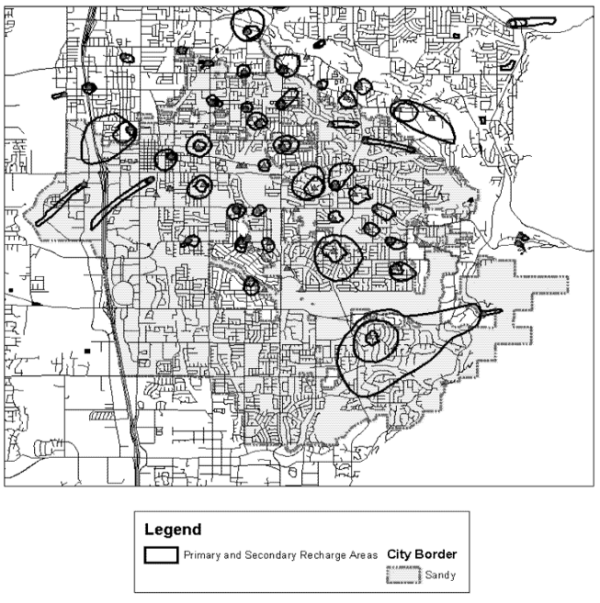
21-17-13 Exhibit 2, Map Of Primary And Secondary Recharge Areas
The full-sized, detailed map is on file with the Public Works Department.
Amended by Ord. 21-08 § 1(Exh. A) on 3/23/2021
Amended by Ord. 26-50 on 7/2/2026

