
Sandy City Zoning Code
CHAPTER 21
18 HISTORIC RESOURCES OVERLAY ZONE
21-18-1 Purpose
The purpose of this chapter is to provide regulations for those areas, districts, sites, and buildings in the Sandy area which have been designated as having significant character, interest, or value as part of the development, heritage, or cultural characteristics of Sandy City, the State of Utah, or the Nation.
(LDC 2008, § 15A-18-01)
21-18-2 Duties Of Community Development Department And Historic Preservation Committee
- Community Development Department. The Community Development Department is hereby charged with the administration and enforcement of the provisions of this chapter.
- Sandy City Historic Preservation Committee. The Sandy City Historic Preservation Committee, hereinafter "Historic Committee," has been established to recommend to the City and aid property owners in maintaining and enhancing the worthwhile historical resources of Sandy City. The duties of the Historic Committee are as follows:
- To make recommendations to the City Council concerning the designation of historic areas, districts, landmark sites and buildings of historic significance.
- To make recommendations to the City Council on matters pertaining to historic resources.
- To make recommendations to the City Council concerning guidelines for rehabilitation and new construction pertaining to historic resources and areas.
- To aid property owners in maintaining and enhancing their properties in a manner consistent with adopted or otherwise established guidelines.
(LDC 2008, § 15A-18-02)
21-18-3 Designation Of Historic Areas, Districts, Landmark Sites, And Buildings Of Historic Significance
- Qualification for Designation. An area, neighborhood, or district may be designated as a historic area or historic district. Any site, natural feature, structure, or building may be designated as a landmark site or building of historic significance if it has significant character, interest, or value as part of the development, heritage, or cultural characteristics of Sandy City, the State of Utah, or the Nation; and if it falls into one or more of the following categories:
- Historical Significance.
- It is the location of, or is associated in a significant way with, a historic event which had a significant effect upon the City, State, or Nation.
- It is associated in a significant way with the life of a person important in the history of the City, State, or Nation.
- It is associated in a significant way with an important aspect of the cultural, political, or economic heritage of the community, City, State or Nation.
- Architectural Significance.
- It embodies the distinctive visible characteristics of an architectural style, period, or a method of construction.
- It is an outstanding work of a designer or builder.
- It contains elements of extraordinary or unusual architectural or structural design, detail, use of materials, or craftsmanship.
- It portrays the environment of a group of people in an era of history characterized by a distinctive architectural style.
- Historic Area Significance. Because of its prominent location, contrasts of siting, age, or scale, it is an easily identifiable visual feature of the City and contributed to the distinctive quality or identity of the City.
- Historical Significance.
- Procedure for Designation.
- Any person, group, or association may nominate a prospective area, district, site, or building for formal designation and inclusion in the Sandy Historic Registry. Nominations shall be filed with the Community Development Department.
- The Historic Committee shall review all nomination and make recommendations to the City Council.
- Prior to an action by the City Council, a public meeting shall be held. Notice of which shall be set forth in the public hearings, public meetings and notification requirements section of this title.
- Following a determination of formal designation by the City Council, notice of the determination shall be mailed to the owners of property affected by the designation, together with a copy of this chapter and any pertinent development guidelines. Such designation shall also be entered in the Sandy Historic Registry.
- Historic Sandy Registry. The Historic Sandy Registry contains a list of all areas, districts, sites, and buildings in the Sandy area which have been designated as having significant character, interest, or value as part of the development, heritage, or cultural characteristics of City, State, or Nation. This information is on file with the Community Development Department.
(LDC 2008, § 15A-18-03)
21-18-4 Designated Historic Resources
- Historic Areas. Historic areas are relatively large areas which are generally distinguished by, but not limited to, a common development, heritage, or cultural characteristic. Likely, they are synonymous with a particular neighborhood. A historic area may contain one or more historic districts within its boundaries and will likely contain several landmark sites, and buildings of historic significance. Those areas within Sandy City which have been designated as historic areas are as follows:
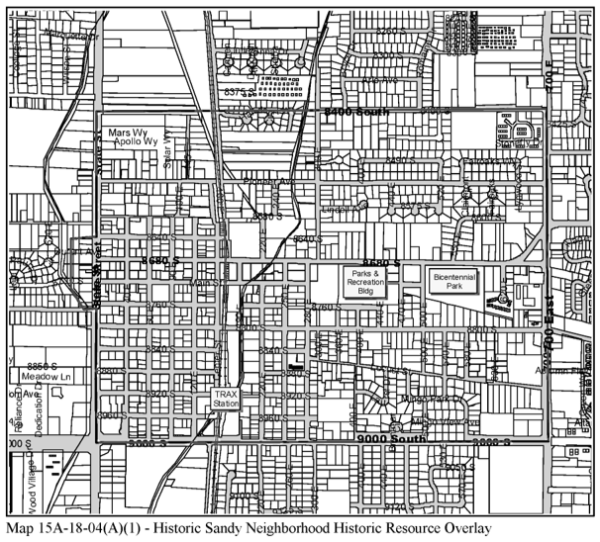
- Historic Sandy Neighborhood.
- Boundaries. The Historic Sandy Neighborhood is that area bounded by 9000 South on the South, State Street on the west, 8400 South and its westward extension on the north, and 700 East on the east. The boundaries of the neighborhood shall also include the commercially zoned area on the west side of State Street between 8640 and 8900 South.
- Purpose. The Historic Sandy Neighborhood encompasses the major part of the original town site of Sandy City and contains a significant inventory of older and unique architectural styles. Lot and block sizes in this area are also characteristic of 19th Century Utah town sites, with historic and other older dwellings which often do not conform to current development standards. The purpose of the design guidelines as they pertain to the Historic Sandy Neighborhood is to:
- Preserve buildings and related structures of historic and architectural significance.
- Allow improvements to existing structures or new construction to be conducted without conflict and without eroding the scale and historic character of the neighborhood.
- Preserve and enhance entryways into the Historic Sandy Neighborhood through design and streetscape standards, where appropriate.
- Historic Sandy Neighborhood.
- Historic Districts. Historic districts are generally smaller and more distinctive than historic areas. Historic districts will likely contain several landmark sites and buildings of historic significance. Those areas within Sandy City which have been designated as historic districts are as shown in Figure 1.
Figure 1. Sandy Historic District, 2006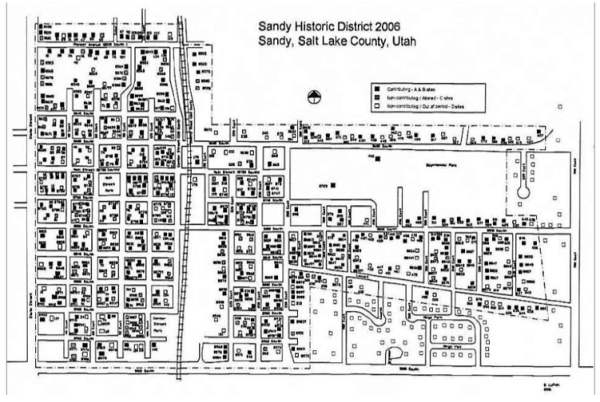
- Landmark Sites and Buildings. Landmark sites and buildings of historic significance are distinctive individual sites. Designated sites and buildings are as listed in the Sandy Historic Registry on file with the Community Development Department.
(LDC 2008, § 15A-18-04)
21-18-5 Historic Development Guidelines
- Establishment of Guidelines. Guidelines for exterior design criteria shall be adopted by the Planning Commission upon the recommendation of the Historic Committee to aid applicants in formulating plans for development or redevelopment relating to designated historic resources.
- Application of Guidelines. The guidelines shall apply to the following instances:
- All rehabilitation, restoration, or reconstruction of, or addition to, the exterior of any improvement which constitutes all or part of a historic area, historic district, landmark site or a building of historic significance.
- A demolition or relocation of any improvement which is all or part of a building within a historic area, historic district, landmark site or a building of historic significance.
- New construction within a historic area or district, upon any landmark site or on the property associated with a building of historic significance.
- Any signs placed on any building within a historic area or district, upon any landmark site, or on the property associated with any building of historic significance.
- Any fences, walls, and major landscaping elements within a historic area or district, on a landmark site, or on the property associated with a building of historic significance.
- Compliance with Guidelines. Compliance with the adopted guidelines by any property owner shall be voluntary, except in the case where a Contract of Compliance has been agreed to by the property owner of a building or site within a designated historic district, of a landmark site, or of a building of historic significance.
(LDC 2008, § 15A-18-05)
21-18-6 Demolition Of Designated Historic Resources
- Permit Processing Requirements. When any application is made for a demolition permit for a building within a historic area or district, or a building of historical significance, the Director may delay approval of the demolition for a period of up to 30 days in order to:
- Make a historical record, both written (history, floor plans and elevations) and photographic, of the structure and site.
- Review the condition of the building to determine the impact of the demolition to the neighborhood and the technical feasibility of preservation of the structure.
- Allow the Historic Committee to consider and make recommendations regarding the application.
- Make the owner aware of economic incentives available to rehabilitate historic resources.
- Encourage the property owner not to demolish the building until an attempt can be made to locate either suitable tenants to make the building economically viable again or to find a purchaser who is willing to acquire and rehabilitate the structure.
- Permit Delays. Upon findings of fact by the Historic Committee, or other groups identified by the Director, that preservation of the building is warranted and in the best interest of the City, the permit may be delayed for an additional 30-day period in order to find funding or other means to compensate the applicant for purchase of the building or for its preservation.
- City Council Action. If the additional 30-day period identified in Subsection (b) of this section is not found to be adequate, a third 30-day delay may be instituted by the City Council.
(LDC 2008, § 15A-18-06)

